Impact of employees' perceived fairness of performance assessments on public service motivation
Abstract
This study investigated the impact of members of the South African (SA) Army's perceived fairness of the performance assessment on their public service motivation. The theoretical framework consisted of organisational justice and public service motivation theories. A quantitative approach and cross-sectional correlation design were used to investigate the problem and provide an answer to the research question. Data were collected using a self-administered questionnaire administered to 200 active members of the SA Army. Pearson's product-moment correlation was performed to measure the mean overall scores of performance assessment fairness and public service motivation, and independent samples t-tests and ANOVAs were performed to measure the differences according to gender, age group and rank. The findings indicated a weak positive correlation between the performance assessments and public service motivation of members in the SA Army. Despite the low levels of perception of fairness of performance assessments, employees had high levels of public service motivation.
Fairness; organisational justice; public service motivation and performance assessment
1. INTRODUCTION
The perceived unfairness of a performance assessment system may have a negative impact on public service motivation. In research performed on the Namibian Defence Force by Hangula (2010:17), it was found that members of the Force perceived the performance assessment applied in the department as ineffective. In a study conducted by Flowers (2014:13), the challenges in performance assessments of United States Army State Reserves were found to include the late submission of performance assessments because of the laziness of commanders, the lack of technology in the department to execute performance assessments, and a lack of time to perform assessments, due to work overload. According to Flowers (2014:17), these challenges have a negative impact on the reserves' motivational levels, as they perceive the performance assessments as ineffective, not transparent, and uncertain, due to a lack of interaction between the commander and the subordinate, as well as a lack of job clarity and accountability.
Thantsa (2013:125), in research on the South African Military Health Service, found that a lack of knowledge regarding performance assessments was evident in management, and concluded that management required training in the assessment process, in order to be able to lead others in its execution. Dube (2014:108), in a study on the Department of Defence regarding the effectiveness of performance assessments, found that 48% of members of the Defence Force did not participate in performance assessment. There was a lack of commitment among members to execute assessments, as they believed that performance assessment did not add value to their performance, because of a lack of participation in the process.
Members of the SA Army face increasing demands in internal and external operations within and across South Africa's borders Bell & Martin (2012:111). Their responsibilities include peace-keeping operations, facilitating political processes, protecting civilians, assisting with disarmament, supporting elections, and restoring the rule of law Cilliers (2014:6). Members of the Army are therefore obliged to stay motivated and disciplined and to achieve the goals set by the policies and procedures of the Department of Defence Cilliers (2014:16). Members of the Army need to be committed and maintain high morale, and they require faith in their ability to achieve their goals during peace-keeping operations Cilliers (2014:6). To enhance their own performance, they need to perceive performance assessment as a fair process and must be given regular feedback on their progress, to increase their motivation Woods & West (2014). The performance assessment system is, therefore, of cardinal importance in keeping members of the Army motivated. The process should include continuous monitoring of performance, keeping records of their performance - whether positive or negative and actions for their development Khan (2013).
Members of the Army are willing to sacrifice their lives to defend the country, even leaving their loved ones behind to fulfil their public duties. Syamsir (2016:34) notes that people volunteer to serve in the public service because they have the inner desire to serve the public. They hold public service values and are eager to provide outstanding service to the public. Although Thantsa (2013), Dube (2014) and Terblanche (2007) researched performance assessment in the SA Army, no previous research has investigated the impact of the perceived fairness of the performance assessment system on public service motivation. No study has been conducted on the public service motivation levels of members of the SA Army.
Based on the above, the problem statement of the present study was that the unfair execution of performance assessments negatively impacts public service motivation. The research question was: What is the impact of members of the SA Army's perceived fairness of performance assessments on their public service motivation?
The conceptual/theoretical framework outlined below focuses on the two constructs perceived fairness of the performance assessment system and public service motivation. The framework is followed by an outline of the empirical investigation conducted; after that, the results are reported and discussed.
2. CONCEPTUAL/THEORETICAL FRAMEWORK
A performance assessment is an instrument of performance management, used to assess employee performance towards the improvement of organisational effectiveness Park (2014:388). According to literature, performance assessments are supported by theories such as expectancy theory, equity theory, and goal-setting theory (Estes & Polnick 2012:3; Maloa 2016:69-70; Miner 2015:94, 134, 159; Mwale 2016:16, 18, 22; Musonda 2014:15; Steyn & Mashaba 2014:382; Renko, Kroeck & Bullough 2012:50). The fairness of the performance assessment is based on organisational justice theory. Organisational justice and public service motivation served as the theoretical framework for this study and were used to measure the perceived fairness of performance assessment and the resultant impact on public service motivation ( Poon 2012; Savolainen 2012; Woods & West 2014).
2.1 Organisational justice
Limited research has been conducted on how fair employees perceive performance assessments impact organisational justice Celik (2014). Organisational justice, as stated by Poon (2012), refers to how employees perceive fairness in the organisation. According to Dusterhoff, Cunningham, and MacGregor (2014:265), previous research studies found that how performance results are accepted by employees of the SA Army emanates from their perceptions of fairness regarding the performance assessment process. They further posit that an organisational justice perspective influences the understanding of reactions to performance assessment Dusterhoff et al. (2014:266). The public service (which includes the SA Army) is ideally suited to testing the relationship between organisational justice and public service motivation, as these entities require members to be intrinsically motivated to deliver a service Ledimo & Hlongwane (2014:1). Intrinsic motivation relates to the inner desire of a person to execute a task, and feeling fulfilled when having completed the task Alonso (2014:26).
According to Matlala (2011:28), judging fairness requires consideration of two aspects: balance and correctness. Fairness enhances employees' commitment, job satisfaction, and performance, resulting in enhanced organisational performance. Perceived organisational injustice has a negative impact on employees' motivation to satisfy the public's needs Dusterhoff et al. (2014:266). Doubt is created when employees feel that they are unable to cope with their circumstances and that their support structures cannot be trusted, and these feelings increase the amount of internal conflict they experience and decrease their sense of enrichment Diner (2014:19). Miner (2015) categorises organisational justice into procedural justice, distributive justice and interactional justice. International justice is subdivided into two categories, namely interpersonal justice and informational justice.
2.1.1 Procedural justice
Procedural justice refers to the fairness of procedures of organisational systems, in this instance, the performance assessment process of the SA Army. Matlala (2011:30) notes that employees perceive procedural justice when the outcomes of policies and procedures are fair. Management of the SA Army also needs to display fairness in their actions, and they must be able to show how they reached the results of performance assessments Rahman, Shahzad, Mustafa, Khan & Qurashi (2016:189). Elements of procedural justice, identified by Sudin (2011:1243) that promote fairness of the performance assessment process in an organisation include two-way communication, trust in the supervisor, clear expectations, and employees understanding the performance assessment process. Employees will perceive the performance assessment procedures as fair when supervisors are seen to avoid making assessment errors (Celik 2014). Staff members perceiving performance assessment procedures as unfair will negatively impact their job satisfaction and commitment to the organisation and society, and increase their intention to quit Dusterhoff et al. (2014:266).
2.1.2 Distributive justice
Distributive justice is defined as the fair distribution of rewards for performance (Celik 2014; Poon 2012). Woods and West (2014) add that distributive justice is also concerned with the fairness of the distribution of rewards in comparison to others. In this regard, Celik (2014) found a weak negative association between perceived distributive justice and public service motivation. Matlala (2011:32) found that employees experience the distribution of rewards as biased when the reward system favours senior management while junior employees are the ones doing the work. Dube (2014) found that members of the SA Army are of the view that the distribution of rewards is not done according to their performance, but to give everyone a chance to receive rewards, regardless of performance. This perception has a direct negative effect on their motivation Dube (2014).
Omboi (2011:22) identified two aspects related to distributive justice in performance assessments, namely decision norms (equity) and the goals of the manager. Normative decision-making focuses on the outcomes of decisions in terms of upholding social norms Omboi (2011:23), with recipients readily believing that the distributions were fair, irrespective of their personal performance. These norms influence managers' to the extent that they feel obliged to develop performance assessments that are in line with the norms, even if this may be unfair to some employees being rated Omboi (2011:23). Secondly, managers'' personal goals have an influence on perceptions of the fairness of performance assessments. Employees will perceive assessments as fair when they feel that the manager is motivating them and trying to improve their performance or capabilities Omboi (2011:23).
Maimela (2015:28) advises that distributions need to be fair and consistent across employees to avoid negative perceptions, demotivation, and conflict. In support, Matlala (2011:31) adds that employees must be allowed to participate in decisions about the distribution of rewards, to enhance their positive perceptions of the fairness of performance assessment and increase their public service motivation.
2.1.3 Interactional justice
Interactional justice in performance assessments refers to the fairness of the treatment employees receive during the assessment process Dusterhoff et al. (2014:266). Matlala (2011:33) defines interactional justice as the decision-maker treating the employee with respect and dignity during social interaction, and providing feedback in a constructive manner. Omboi (2011:23) further divides interactional justice into interpersonal justice and informational justice. Interpersonal justice focuses on the fairness of treatment when evaluating employees, meaning that employees need to be treated with sensitivity by their supervisors. Supervisors need to have empathy with the outcomes and use expressions of remorse in cases of negative feedback, to create the perception of fairness Omboi (2011:23). According to Dusterhoff et al. (2014:266), the information provided to employees must be clear in terms of performance expectations, standards, and reasons for decisions. Perceptions of informational justice are based on employees' perceptions of supervisors' honesty, sincerity, and logic, and clarity in setting performance goals and standards Dusterhoff et al. (2014:266).
2.2 Public service motivation
Ritz, Brewer, and Neumann (2016:25) note that people are the key resource in public service organisations, and, for these organisation to perform well, employees need to be motivated to perform. Managers of the public service have to reinforce the attractiveness of their efforts to attract, retain, and reward public servants equally, as the public service is in direct competition with the private sector in the employment of high-performance individuals Ritz et al. (2016:25).
Jensen and Andersen (2015) posit that individuals with high levels of service motivation tend to be attracted to environments where they can satisfy this need, especially if they want to help people and are committed to serving public interests and values. Public service motivation is regarded by Syamsir (2016:33) as a required characteristic of public servants. Jensen and Andersen (2015) describe public service motivation as a specific type of motivation that is directed at providing a public service and is encouraged by the perceived fairness of performance assessments.
According to Frey, Homberg and Osterloh (2013:961), performance assessments' fairness is linked to public service motivation, as the outcomes of the assessments have an impact on the motivation levels of public servants. According to Park (2014:390), previous research in this area focused more on the private sector, rather than the public sector. Mwale (2016:43) argues that perceptions of fairness of performance assessments in the public service are negatively influenced by factors such as how these are interpreted, the tendency of supervisors to share information in a restricted manner, and assessment outcomes being vulnerable to manipulation. Zhu and Wu (2016) postulate that, although numerous studies have been conducted to determine whether there is a link between perceived fairness of performance assessments and public service motivation, the results have been inconclusive.
Karic (2015) posits that public service motivation theory is supported by self-determination theory. In the many studies conducted on public service motivation, the theory of self-determination was not applied Andrews (2016). Self-determination is of critical importance in understanding public service motivation because every person has the desire to satisfy basic needs and wants, and to be in control of his or her life. The three aspects of self-determination are: autonomy, competence, and relatedness, and are influenced by intrinsic motivation Andrews (2016). Autonomy is displayed when a person takes his or her own decisions on important matters Zahra & Jadoon (2016). Competence is evident in a person performing tasks successfully and effectively Clerkin & Coggburn (2012:213). Career development programmes and positive feedback that confirm competence, acknowledging feelings and fostering cooperation, satisfy the need for relatedness Andrews (2016:245). In the public sector, these individuals are determined and intrinsically motivated to serve the public. They relate to and are attracted to public service, and, through training, can work autonomously and use initiative Andrews (2016). Clerkin and Coggburn (2012:213) found that public service motivation consists of four dimensions, namely attraction to public service, commitment to public values, compassion, and self-sacrifice.
2.2.1 Attraction to public service
Gershwin (2014:16) states that public service motivation is not exclusive to those in the public service, but that this type of motivation is indeed more prevalent in the public service. Attraction to public service is linked to job satisfaction and enhancement of a sense of self-importance derived from, e.g., playing a role in the desired policy change Clerkin & Coggburn (2012:213). Attraction to public service is a desire to satisfy one's personal needs while at the same time serving the public's interests Kim & Vandenabeele (2010:10). An intense intrinsic desire to be part of the public service is called a 'public service ethic' Gershwin (2014:22). These individuals are attracted to the public service to challenge perceptions that this service is self-interested and display high levels of motivation, trustworthiness, and productivity.
Syamsir (2016:33) postulates that individuals with high levels of public service motivation are more attracted to serving the public than those working in the private sector. Mihalcioiu (2011) posits that public service organisations such as the SA Army are perceived as a place of safety by those who have few skills and lack motivation. These persons are attracted to the public service because of the benefits and high salaries offered.
2.2.2 Commitment to public values
Commitment to public values involves normative motives that engender a sense of loyalty towards the government and communities Clerkin & Coggburn (2012:213). Social and cultural norms and values are associated with norm-based motivation, evident in commitment to civic duty and compassion Yousaf, Zafar & Abi Ellahi (2014). This motivation is born of a personal disposition of longing to be a part of society and to fulfil obligations deriving from it. The resultant commitment culminates in the pursuit of attaining and upholding public values Kim (2012).
2.2.3 Compassion
In the public service, compassion is related to affective commitment to an important social programme Clerkin & Coggburn (2012:2013). Kim and Vandenabeele (2010:10) note that compassion is a public service motive that entails love and concern for others and a desire to protect them. However, they highlight that some public servants feel that those in need are not willing to take the first step towards a better life, and consequently show a lack of compassion towards these indivduals.
2.2.4 Self-sacrifice
Self-sacrifice is individuals' unconditional belief in the value of serving society, without consideration for the consequences to themselves Clerkin & Coggburn (2012:213). Affective motives are associated with the desire to self-sacrifice Yousaf et al. (2014), and people who value self-sacrifice do good to others to improve the well-being of the community, and also to satisfy their own inner needs Kim & Vandenabeele (2010:9). These individuals have a strong public service motivation to sacrifice their own needs, without reward (Kim & Vandenabeele 2010:9; Wright, Christensen & Isett 2013:12).
The next section provides a discussion of the current empirical investigation.
3. EMPIRICAL INVESTIGATION
3.1
Aim of the investigationThis study aimed to investigate the impact of the perceived fairness of performance assessments on the public service motivation of members of the SA Army, in order to provide recommendations for improvement.
3.2
Research design and strategyThe researcher used a quantitative research method and correlational research strategy.
3.3
Measuring instrumentThe questionnaire consisted of three sections.
Section 1: Demographic information
This section collected data on the demographic characteristics of the sample, which included the respondents', gender, age group and rank. These were used as control variables to establish whether there were differences in the means scores of perceived performance assessments fairness and public service motivation gender, age groups and ranks.
Section 2: Perceived Performance Assessment Fairness Questionnaire
This questionnaire was adapted from the questionnaire developed by Colquitt (2001:389). The perceived performance assessment fairness questionnaire consisted of four factors that determined fairness, namely procedural justice (seven items), distributive justice (four items), interpersonal justice (four items), and informational justice (five items). The 20 items were rated on a five-point Likert scale ranging from 1 (not at all) to 5 (to a very great extent).
Section 3: Public Service Motivation Questionnaire
The International Public Service Motivation Questionnaire developed by Kim, Vandenabeele, Wright, Andersen, Cerase, Christensen, Desmarais, Koumenta, Leisink, Liu, and Palidauskaite (2012) was used to measure the members of the SA Army's perceived public service motivation levels. The questionnaire consists of 16 items measuring four factors on a five-point Likert scale (1 = strongly disagree, 5 = strongly agree): attraction to public service (four items), commitment to public values (four items), compassion (four items), and self-sacrifice (four items).
3.4
SamplingThe target population for this research study consisted of 416 members of the SA Army in three military units: the Joint Tactical Headquarters North-West, 10 South African Infantry Battalion (both situated in Mafikeng), and 2 South African Infantry Battalion (Zeerust). A simple random sampling technique was used, and the selection of respondents was drawn from the payroll. A total of 200 questionnaires were personally distributed to respondents, and 199 questionnaires were completed and returned, yielding an excellent response rate of 99%.
3.5
Ethical considerationsThe principal researcher obtained permission from Joint Operations Tactical Headquarters, North-West, to conduct this study. A letter of introduction was sent to the respondents, requesting their participation in the study. The questionnaires distributed to the respondents contained an introductory section explaining the aim of the study, as well as that they would remain anonymous, together with a letter of consent, which they had to sign. Anonymity was protected by having the respondents return the completed questionnaires in sealed envelopes. The university granted ethical clearance and approval to conduct the study.
3.6 Trustworthiness aspects
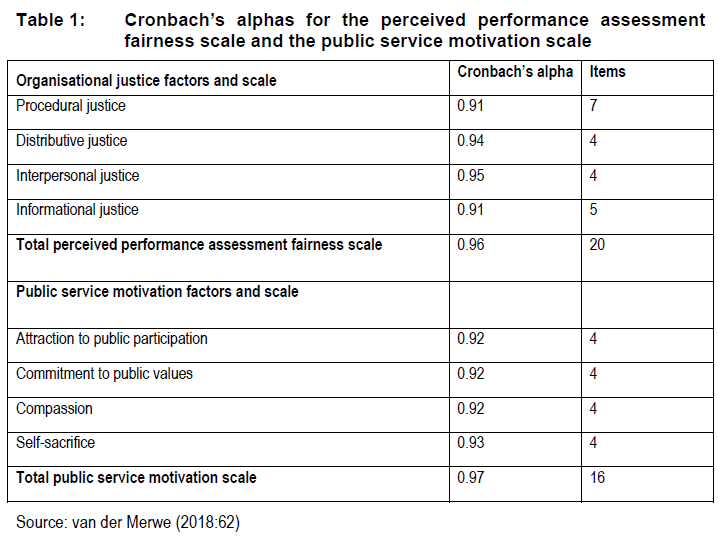
Cronbach's alpha coefficients were calculated to determine the reliability and validity of the scales. The alpha coefficient varies between 0 and 1, where 0 indicates no correlation or internal consistency, and 1 indicates a perfect correlation and complete internal consistency Bryman & Bell (2014). The Cronbach's alphas for the two measuring instruments are reported in Table 1.
The Cronbach's alphas of the total perceived performance assessment fairness scale were 0.96 and 0.97 for the overall public service motivation scale. The Cronbach's alphas for all the factors were greater than the cut-off point of 0.70. Therefore, it was concluded that both scales were reliable and valid.
3.7 Data analysis
The data collected from the self-administered questionnaires were captured on an Excel spreadsheet. Data analysis was performed using the Statistical Package for the Social Sciences (SPSS) Version 25. Descriptive statistics were used to summarise the data in order to determine respondents' demographic characteristics, perceptions of performance assessment fairness, and levels of public service motivation. An independent-sample t-test was used to determine whether there was a difference in the perceived performance assessment fairness and public service motivation mean scores of males and females. ANOVAs were performed to determine the differences in perceived performance assessment fairness and public service motivation mean scores between age groups and ranks. Pearson's product-moment correlation coefficient was computed to determine the strength of a linear relationship and to confirm the impact of perceived fairness of performance assessments on public service motivation.
4. RESULTS
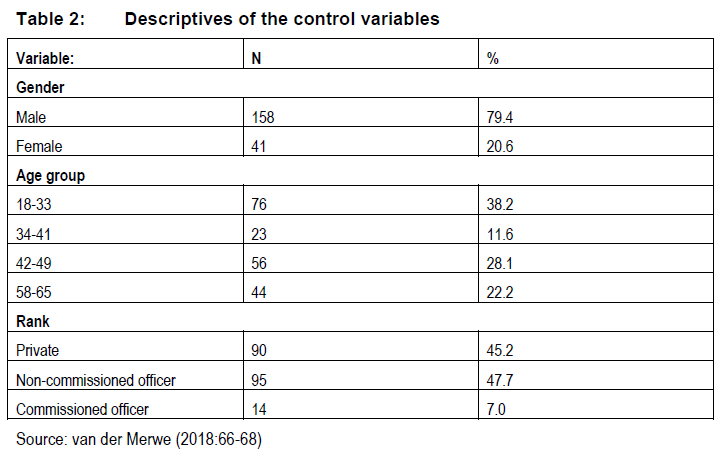
The control variables used were gender, age group, and rank. The descriptive statistics of gender, age group and rank are reported in Table 2.
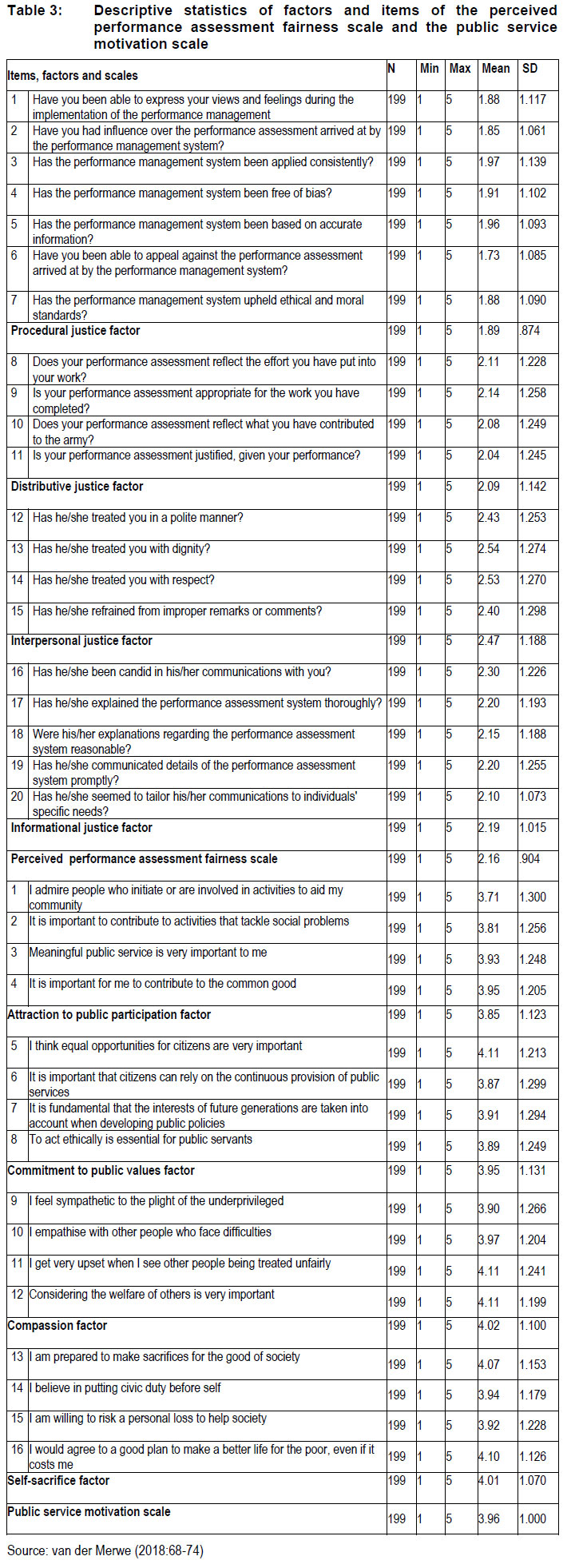
The mean score for the procedural justice factor (M = 1.89: SD = .874), distributive justice (M = 2.09; SD = 1.142), interpersonal justice factor (M = 2.47; SD = 1.188), informational justice factor (M = 2.19; SD = 1.015) and perceived performance assessment fairness scale (M = 2.16; SD = 0.904). The mean scores were for attraction to public participation factor (M = 3,85; SD = 1.123), commitment to public values factor (M = 3.95; SD = 1.131), compassion factor (M = 4.02; SD = 1.100) and self-sacrifice factor (M = 4.01; SD = 1.070), while the mean score for the total public service motivation scale was (M = 3.96; SD = 1.000). The results of the descriptive analysis of the performance assessment fairnes and public service motivation items, factors and scale are depicted in Table 3.
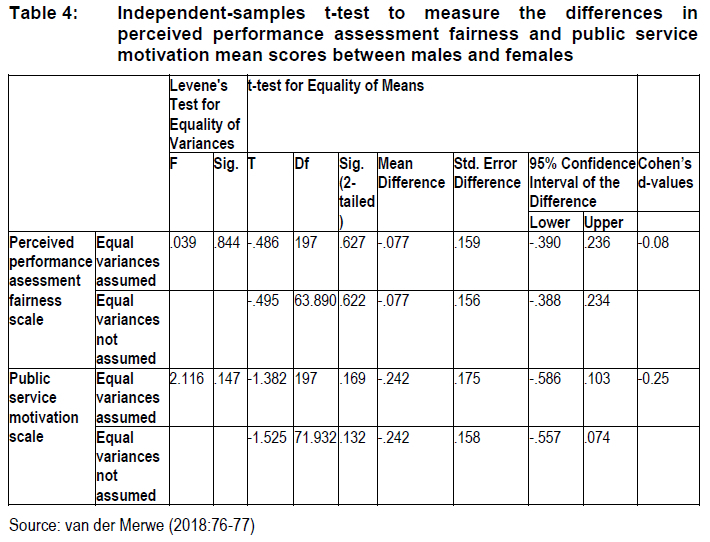
There was statistically no significant difference in the mean scores of perceived performance assessment fairness between males (M = 2.14, SD = .911) and females (M = 2.22, SD = .883) (See Table 4). This difference, -0.077 BCa 95% CI [-0.390 to 0.236] was practically not significant t (197) = -.49, p = 0.84 and showed a small-sized effect, d = -0.08. Also, there was statistically no significant difference in the mean scores of public service motivation between males (M = 3.91, SD = 1.028) and females (M = 4.15, SD = .868). However, this difference, -0.242 BCa 95% CI [-0.586 to 0.103] was practically significant t (197) = -1.382, p = 015 and showed a large-sized effect, d = -0.25.
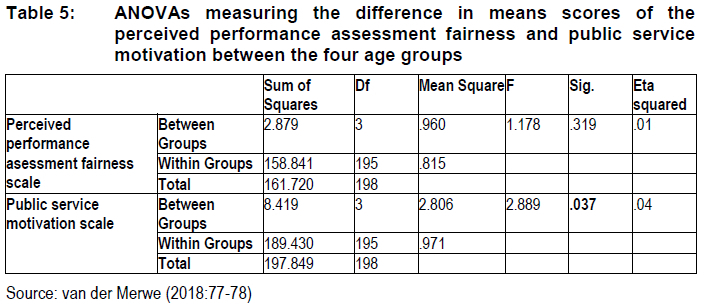
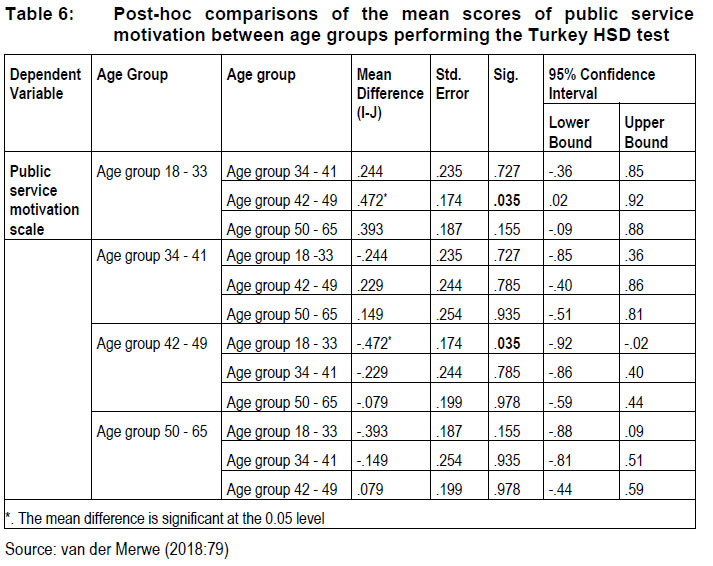
Due to the small representation of only eight respondents in the age group 18-25, this age group was combined with age group 26-33. Also, age group 50-57 was combined with age group 58-65 (with only three respondents). Therefore, the respondents were divided into four age groups (Group 1: 18-33 years, Group 2: 34-41 years, Group 3: 42-49 years, and Group 4: 50-65 years). There was no statistically significant difference at the p > 0.05 level in the perceived performance assessment fairness mean scores between the four age groups: F (3, 195) = 1.18, p = 0.32, eta squared (η2) = .01 (see Table 5). There was a statistically significant difference at the p < 0.05 level in the public service motivation mean scores between the four age groups: F (3, 195) = 2.89, p = 0.04, eta squared (η2) = .04, which is a moderate effect size. Post-hoc comparisons performing Turkey HSD test showed that the mean score of the age group 18 - 33 (M = 4.21; SD = .877) was statistically significant different from age group 42 - 49 (M = 3.73; SD = 1.166) (see Table 6).
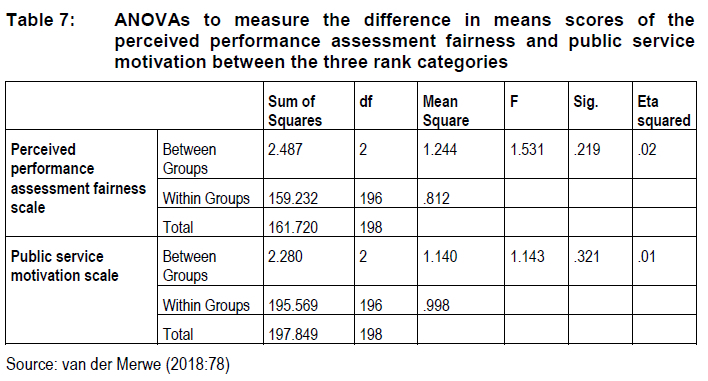
Due to the heterogeneous nature of the ranks classification, the ranks were transformed into three categories, namely privates, non-commissioned officers and commissioned officers. There was no statistically significant difference at the p > .05 level in the public service motivation scores between the three rank categories: F (2, 196) = 1.14, p = 0.32, eta squared (η2) = .01 (see Table 7).
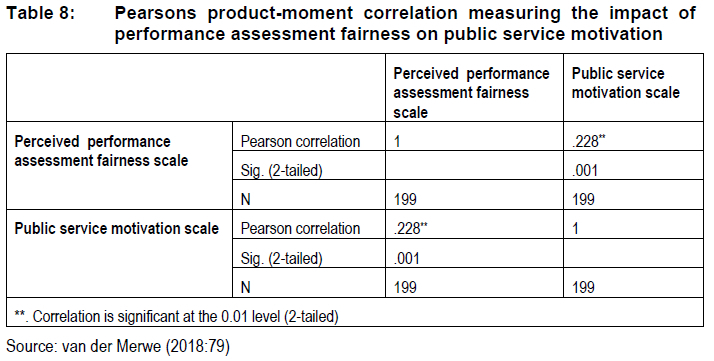
There was a weak positive correlation between the two variables, r, 29, n = 199, p < 0005. The low perceived performance assessment fairness had an insignificant impact on the employees' public service motivation levels. Despite the low degree of perceived performance assessment fairness, employees still had high levels of public service motivation. The results are presented in Table 8.
5. DISCUSSION
5.1
Perceived performance assessment fairnessOverall, the mean score for perceived performance assessment fairness was 2.16, below the mid-point of 2.50. The findings of the present study correlate with those of a similar study by Rowland and Hall (2012), which showed that both supervisors and subordinates experienced feelings of inequality, distrust, and confusion regarding performance assessments, and felt that the assessment was a waste of time.
5.2
Procedural justiceProcedural justice yielded an overall mean score of 1.89, below the midpoint of 2.50, revealing that respondents were not able to express their views and feelings during the performance assessments, had no influence over the conclusions reached in the assessment, and felt that performance assessments were applied inconsistently. They felt that the assessments were biased and based on inaccurate information, and indicated that they were not able to appeal the outcomes. They indicated that the performance assessments did not uphold ethical and moral standards. Overall, respondents were dissatisfied with the inability of supervisors to apply procedural justice principles in the performance assessments. According to Dusterhoff et al. (2014:266), procedural fairness relies on adherence to processes and procedures established through organisational policies and legislation, and include the absence of bias and consistency and accuracy of procedures. Rowland and Hall (2012) posit that disregarding perceptions of unfairness may have a detrimental impact on the organisation. Employees perceiving performance assessment procedures as unfair has a negative impact on their job satisfaction and commitment to the organisation and society and increases their intention to quit (Dusterhoff et al. 2014:266). Govender, Grobler and Joubert (2015:568) argue that employee involvement in the performance assessment system is crucial for it to be considered fair, including having input in its development, in order to create trust in and a sense of ownership of the process as it developments over a period.
Rowland and Hall (2012) recommend seven elements to improve employees' perceptions of procedural fairness: employees' views must be taken into consideration, the criteria for decision-making must be applied consistently to all employees, feedback must be provided after decision-making, decision-making must be justified, communication needs to be honest and truthful, and employees need to be treated with respect and courtesy. Celik (2014) notes that supervisors being seen to avoid making performance assessment errors enhances employees' perceptions of fairness.
5.3
Distributive justiceThe mean score for distributive justice was 2.09, below the midpoint of 2.50, indicating that respondents were of the opinion that their supervisors' assessments did not reflect the effort the respondents had put into their work. They indicated that the assessments were inappropriate for the work they had completed, and not an accurate reflection of their contribution to the SA Army, and were therefore not justifiable. According to Dusterhoff et al. (2014:266), distributive justice requires fairness and consistency and is of great importance in establishing perceived fairness of assessments. According to Rahman et al. (2016:189), employees compare their efforts to those of others in the same setting, to establish whether the rewards they received were fair. When the distribution of rewards is perceived as fair, employees experience a sense of being respected, accepted, and appreciated by the organisation.
5.4
Interpersonal justiceThe results showed a mean score of 2.47 for interpersonal justice, below the midpoint of 2.50. Respondents indicated that they were treated impolitely and without dignity and respect by their supervisors, who made improper remarks or comments. Omboi (2011:23) postulates that employees need to be treated with sensitivity by their supervisors and that supervisors need to have a sense of empathy and remorse when dealing with negative outcomes of assessments.
5.5
Informational justiceThe results revealed a mean score of 2.19 for informational justice. Respondents indicated that supervisors were dishonest in their communications with them, and failed to explain the assessments. Respondents also indicated that performance expectations were unreasonable. According to Srivastava (2015:669), to ensure informational justice, employees need to be updated promptly on performance requirements, together with an explanation of the functioning of the assessment system, its procedures, and the distribution of rewards.
5.6
Public Service MotivationPublic service motivation was measured according to four factors: attraction to public service, commitment to public values, compassion, and self-sacrifice. The mean score for the public service motivation scale was 3.96, which showed that members of the SA Army are highly motivated to serve the public.
5.6.1 Attraction to public service
The mean score of 3.85 indicated that members of the SA Army were highly attracted to public service. Respondents indicated admiration for people who initiate or are involved in activities to aid their communities, and that they considered it important to contribute to addressing societal problems. They indicated that they viewed meaningful public service and contributing to the common good as important. These findings support those of a study by Kim and Vandenabeele (2010:10), who reported that attraction to public service originates from a desire to satisfy a person's need to serve the public, thereby enhancing the person's self-importance and satisfaction.
5.6.2 Commitment to public values
The mean score for commitment to public values was 3.95 (ranging from 3.87 to 4.11), represented by equal opportunities, the provision of continuous services to citizens, the interests of future generations, and ethical behaviour by public servants. Respondents, therefore, placed a high premium on these aspects.
5.6.3 Compassion
The high mean score of 4.02 for compassion showed that respondents held high sympathy and empathy towards underprivileged people and people experiencing difficulties. They further indicated that they view the mistreatment of people as unacceptable and that they have great concern for the welfare of others. According to Kim and Vandenabeele (2010:10), public servants with compassion towards the public feel a sense of love and concern and have the desire to protect the public, which, in this case, is executing the mandate of the military.
5.6.4 Self-sacrifice
The self-sacrifice factor's mean score of 4.01 showed that members of the SA Army are prepared to make sacrifices for the good of society and that they believe in putting civic duty before their own interests. They are willing to risk a personal loss to help society and would agree to a good plan to provide a better life for the poor, even at their own expense. These results support the suggestion of Kim and Vandenabeele (2010:9) that those prepared to self-sacrifice will ensure the well-being of the public before satisfying their own needs.
5.7 Results related to gender, age group, and rank
There were no statistically significant differences in the mean scores for perceived performance assessment fairness according to gender, age group, and rank. There were also no statistically significant differences in the mean scores for public service motivation according to gender and rank. There was, however, a significant difference in mean scores of the age groups 18-33 and 42-49. The higher mean scores of age group 18-39 could be ascribed to the fact that they are relatively young and therefore have more energy and higher aspirations in committing to public service motivation. In contrast, Anderfuhren-Biget, Varone, Giauque and Ritz (2010:36) note that the results of various scientific research studies indicate that age and gender positively correlate with public service motivation; the authors are of the opinion that public service motivation grows stronger with age. They further note that women have shown a higher level of compassion than men and that men have shown a higher level of commitment to public interests, as well as an attraction to policy-making, possibly due to the roles they play in their family (Anderfuhren-Biget et al. 2010:36).
Pearson's product-moment correlation showed a weak positive correlation between perceived performance assessment fairness and public service motivation. Despite respondents' low perceived performance assessment fairness scores, members of the SA army showed a high level of public service motivation.
According to Dusterhoff et al. (2014:265), researchers hold the belief that the performance assessment process is one of the most critical tools in human resource management to encourage employee development and motivation. Previous studies by Syamsir (2016:35) and Celik (2014) found a positive correlation between performance assessment fairness and public service motivation. Their finding was supported by Jensen and Andersen (2015), who found that public service motivation contributes to the improvement of performance because, through public service motivation, the well-being of others is considered, and public servants' motivation levels are reflected in their work efforts.
Interestingly, Boachie-Mensah and Seidu (2012:74) are of the opinion that, if the performance assessment system is perceived as unfair, even if it is designed to appraise, motivate, and develop, it can cause frustration and resentment. It is therefore of critical importance to create a positive perception of the fairness of performance assessments in public organisations, as this will enhance motivation to deliver outstanding public service by achieving organisational goals (Karic 2014; Jensen & Andersen 2015).
6. MANAGERIAL IMPLICATIONS AND RECOMMENDATIONS
Performance assessments should comply with the highest moral and ethical values, to which the SA Army's values should be aligned, and should support carrying out of the SA Army's mandate. Based on the results of the present study, the following practices are recommended.
The SA Army must ensure that its performance management system and related process are free from any form of bias. The SA Army should ensure consistency in the criteria used in performance assessments and related decision-making to ensure fairness. Recruits must be informed regarding the mechanisms and functioning of the performance assessment system, and any changes must be communicated promptly to all staff. The SA Army should ensure that managers and subordinates mutually determine and agree, in writing, on individuals' performance indicators and goals. Avenues for complaints and appeals should be created and communicated to staff and managed appropriately and effectively.
Managers in the SA Army should ideally tailor their communications according to subordinates' individual needs. They should also ensure that the assessments follow a transparent and participative process and allow subordinates to express their views and feelings. Supervisors must explain their assessment decisions to staff, and should be seen to avoid making rating errors by following procedures and supporting organisational goals. This will enhance employees' trust in their supervisors. Performance assessments must be based on accurate information, for example, from a portfolio of evidence. Managers should ensure that the results of performance assessments are appropriate, justifiable, and a true reflection of their subordinates' work performance and contributions. This could be monitored and moderated by an independent official. Managers should treat subordinates politely, respectfully, with dignity and courtesy, and address performance gaps without improper or personal comments. They must provide honest and constructive performance feedback and justification for their decisions, together with development suggestions and assistance.
7. CONCLUSION
Although the results of the present study showed high levels of public service motivation, response bias may have played a role, and respondents may have indicated their beliefs rather than their actions. Prolonged negative views of the fairness of performance assessments will inevitably harm public servants' motivation to deliver outstanding service. Dedicated and motivated SA Army members are critical to serving the public through excellent public service delivery, and appropriate monitoring and remedial actions could enhance these attributes on an ongoing basis. Managers should enhance subordinates' motivation by reflecting, in their own behaviour, ethics, honesty, transparency, and respect, thereby promoting the principles of outstanding public service - a commitment to public values, compassion, and self-sacrifice, to aid the community and, ultimately, the country. The main limitation of this study was that the study was conducted at only three SA Army's military bases; the results cannot be generalised to the whole SA Army. This study has contributed to the body of knowledge by providing a theoretical-conceptual framework and validated measuring instruments to measure perceived performance assessment fairness and public service motivation as well as the relationship between the two variables.
REFERENCES
- ALONSO C. 2014. The effect of goal setting on a student's intrinsic motivation. Saint Mary's College of California. (Doctoral dissertation.
- )
- ANDREWS C. 2016. Integrating public service motivation and self-determination theory: a framework. International Journal of Public Sector Management 29(3):238-254.
- BELL RL & MARTIN JS. 2012. The relevance of scientific management and equity theory in everyday managerial communication situations. Journal of Management Policy and Practice 13(3):106-115.
- BOACHIE-MENSAH FO & SEIDU PA. 2012. Employees' perception of performance appraisal system: A case study. International Journal of Business and Management 7(2):73.
- BRYMAN A & BELL E. 2014. Research methodology: Business and management contexts. Cape Town: Oxford University Press.
- CELIK C. 2014. Performance appraisals' fairness perceptions and public service motivation: the case of Turkish district governors. Dallas: The University of Texas.
- CILLIERS J. 2014. The 2014 South African Defence Review: Rebuilding after years of abuse, neglect and decay. Pretoria: Institute for Security Studies.
- CLERKIN RM & COGGBURN JD. 2012. The dimensions of public service motivation and sector work preferences. Review of Public Personnel Administration 32(3):209-235.
- COLQUITT JA. 2001. On the dimensionality of organizational justice: a construct validation of a measure. Journal of Applied Psychology 86(3):386.
- DINER Y. 2014. Justice perceptions and work-family balance in the work and home environments. (Doctoral dissertation.
- )
- DUBE BJ. 2014. The effectiveness of the PMS used for middle-level managers in the SAMHS HQ within Gauteng Province. (Doctoral dissertation.
- )
- DUSTERHOFF C, CUNNINGHAM JB & MACGREGOR JN. 2014. The effects of performance rating, leader-member exchange, perceived utility, and organizational justice on performance appraisal satisfaction: applying a moral judgment perspective. Journal of Business Ethics119(2):265-273.
- ESTES B & POLNICK B. 2012. Examining motivation theory in higher education: an expectancy theory analysis of tenured faculty productivity. International Journal of Management, Business, and Administration 15(1):1-7.
- FLOWERS HC. 2014. An evaluation of the army reserves performance appraisal process at the battalion level: examining best practices to improve timeliness. The National Graduate School of Quality Management. (Doctoral dissertation.
- )
- FREY BS, HOMBERG F & OSTERLOH M. 2013. Organizational control systems and pay-for-performance in the public service. Organization Studies 34(7):949-972.
- GERSHWIN G. 2014. Understanding and measuring public service motivation among social workers in contemporary South Africa. University of the Western Cape. (Doctoral thesis.
- )
- GOVENDER T, GROBLER A & JOUBERT YT. 2015. Justice perceptions of performance management practices in a company in the chemical industry. South African Journal of Economic and Management Sciences 18(4):567-585.
- HANGULA SS. 2010. An investigation into the implementation of performance appraisal in the Namibia Defence Force: a case study of the Grootfontein Garrison. (Doctoral dissertation.
- )
- JENSEN UT & ANDERSEN LB. 2015. Public service motivation, user orientation, and prescription behaviour: doing good for society or for the individual user? Public Administration 93(3):753-768.
- KARIC M. 2015. Motivation of public sector employees: the case of the Novi Grad Sarajevo Municipality. (Master's thesis, doctoral dissertation.
- )
- KIM S & VANDENABEELE W. 2010. A strategy for building public service motivation research internationally. Public Administration Review 70(5):701-709.
- KIM S. 2012. Does person-organization fit matter in the public-sector? Testing the mediating effect of person-organization fit in the relationship between public service motivation and work attitudes. Public Administration Review 72(6):830-840.
- LEDIMO O & HLONGWANE VC. 2014. The role of organisational justice on employee engagement within a public service organization. Pretoria: University of South Africa.
- MAIMELA EM. 2015. Academic staff perception of performance management: a case study of an open distance learning institution. (Doctoral dissertation.
- )
- MALOA F. 2016. An evaluation of a performance management system in a freight rail organisation. (Doctoral dissertation.
- )
- MATLALA MM. 2011. Employee fairness perceptions of a performance management system. (Doctoral dissertation.
- )
- MINER JB. 2015. Organizational behavior 1: essential theories of motivation and leadership. New York: Routledge.
- MUSONDA Y. 2014. Motivation of librarians in Central and Copperbelt provinces of Zambia. (Doctoral dissertation.
- )
- MWALE DN. 2016. Employees' perceptions of performance appraisal in public technical vocational and entrepreneurship training institutions in Zambia. (Doctoral dissertation.
- )
- PARK S. 2014. Motivation of public managers as raters in performance appraisal: developing a model of rater motivation. Public Personnel Management 43(4):387-414.
- POON JM. 2012. Distributive justice, procedural justice, affective commitment, and turnover intention: a mediation-moderation framework. Journal of Applied Social Psychology 42(6):1505-1532.
- RAHMAN A, SHAHZAD N, MUSTAFA K, KHAN MF & QURASHI F. 2016. Effects of organizational justice on organizational commitment. International Journal of Economics and Financial Issues 6(3S).
- RITZ A, BREWER GA & NEUMANN O. 2016. Public service motivation: a systematic literature review and outlook. Public Administration Review 76(3):414-426.
- ROWLAND CA & HALL RD. 2012. Organizational justice and performance: is appraisal fair? EuroMed Journal of Business 7(3):280-293.
- SAVOLAINEN R. 2012. Expectancy-value beliefs and information needs as motivators for task-based information seeking. Journal of Documentation 68(4):492-511.
- STEYN GM & MASHABA SW. 2014. Cognitive factors that influence principal motivation in Mpumalanga province. Mediterranean Journal of Social Sciences 5(16):381.
- SUDIN S. 2011. Fairness of and satisfaction with performance appraisal process. Journal of Global Management 2(1):66-83.
- SYAMSIR S. 2016. The influence of public service motivation on service quality of civil servants in West Sumatra Indonesia. European Journal of Economics and Business Studies 5(1):33-41.
- TERBLANCHE GM. 2007. An assessment of the performance appraisal system utilised for junior and middle level management within the South African National Defence Force. (Doctoral dissertation.
- )
- THANTSA G. 2013. A needs assessment for a performance management training programme amongst commanders within the South African military health services. Stellenbosch: Stellenbosch University. (Doctoral dissertation.
- )
- VAN DER MERWE YJ. 2018. Relationship between employees' perceived performance assessment fairness and public service motivation of members of the South African Army within the North-West Province. Mafikeng. North-West University. (MBA mini-dissertation.
- )
- WOODS SA & WEST MA. 2014. The psychology of work and organizations. London: Cengage Learning EMEA.
- WRIGHT BE, CHRISTENSEN RK & ISETT KR. 2013. Motivated to adapt? The role of public service motivation as employees face organizational change. Public Administration Review 73(5):738-747.
- YOUSAF M, ZAFAR S & ABI ELLAHI A. 2014. Do public service motivation, red tape and resigned work satisfaction triangulate together? International Journal of Productivity and Performance Management 63(7):923-945.
- ZAHRA A & JADOON MZI. 2016. Autonomy of public agencies in Pakistan: does structure matter? International Journal of Public Sector Management 29(6):565-581.
- ZHU C & WU C. 2016. Public service motivation and organizational performance in Chinese provincial governments. Chinese Management Studies 10(4):770-786.