Impact investing and entrepreneurial orientation as determinants of organisational performance
Abstract
Impact investment is regarded as 'investing with purpose' because of its pursuit for positive social change that is not driven through philanthropy, but is a purposeful and profit-driven investment strategy. The article empirically examines the extent to which impact investing influences the relationship between entrepreneurial orientation (EO) and organisational performance of corporates in South Africa. The research design was a survey-based, quantitative and cross-sectional study where hypotheses were tested using statistical analyses in terms of correlational and regression analyses. The results indicate impact investing has a positive influence on the relationship between EO pro-activeness, EO risk taking and EO innovativeness and organisational performance. Leaders and managers need to institutionalise appropriate systems and support structures, as well as signal to employees that entrepreneurial behaviour together with impact investing practices are highly desirable. Impact investing can assist organisations to provide sustainable and scalable solutions to social problems by leveraging key aspects of EO.
Impact investing; innovativeness; entrepreneurial orientation; organisational performance; pro-activeness; risk taking and South Africa
1. INTRODUCTION
The global business environment is characterised by several challenges and uncertainty that have compelled organisations to look beyond traditional models of management Drucker (2013:7). When considering the many challenges facing organisations and society in the 21st century, there seems to be a visible shift in management thinking towards re-orientating business activities to incorporate more social business perspectives (Nicholls 2011:2; Venter & Urban 2015:313). In this regard Porter and Kramer (2011:66) propose the principle of "shared value, which is concerned with policies and operating practices that enhance the competitiveness of a business while simultaneously advancing the economic and social conditions in the communities in which it operates". Similarly, authors prioritise corporate citizenship in reference to an organisation's social and environmental policies Smith, Mazibuko and Muzvidziwa (2015:449), while others regard corporate social responsibility as the flagship of contemporary organisational-societal relations Carroll (1991:41).
In light of these developments a more recent response to the changing business landscape is impact investing which attempts to create measurable positive impact beyond financial returns for an organisation (Fortune, Ngwakwe & Ambe 2016:58; Höchstädter & Scheck 2015:453). Impact investing has been conceptualised as the "creation of economic and social value by an organisation that has the potential to improve the quality of life and deliver social progress to communities and region" Jackson (2013:102). Researchers regard impact investment as an important policy for any organisation "because of its pursuit for positive social change that is not driven through philanthropy, but is a purposeful and profit-driven investment strategy" Brest and Born (2013:25). Scholars distinguish impact investing from traditional investments since it pursues both financial returns and social and environmental challenges simultaneously (Bugg-Levine & Emerson 2011:13; Partridge 2013:14).
Despite the growth of literature on this new phenomenon of investing, researchers note that impact investing lacks consistency and transparency in terms of its influence on organisational performance measures (Stubert 2013:112; Urban & George 2018:64). While research is emerging which examines the effect of impact investing on business management performance Yun (2012:94), understanding the relationship between impact investing, corporate entrepreneurial orientation and performance is limited. This deficit exists despite that effective impact investing brings about value for all role players, mobilises capital, and brings about transparency and accountability for organisations and society Jackson (2013:101).
Corporates in South Africa realise that acts of social responsibility are of strategic importance as investors are increasingly focused on ethical concerns within publicly held organisations (Bhana 2018:101; Smith et al. 2015:450). Not only are corporates seeking to re-orientate themselves in terms of impact investing activities and social practices but literature and empirical findings point to entrepreneurial orientation (EO) as an important element in corporate innovation (Dess & Lumpkin 2005:151; Wales 2015:6). While impact investing typically measures profit in terms of financial and quantifiable social metrics, investors are urging corporates for lowering of risk while simultaneously increasing innovativeness Urban and George (2018:62). Innovativeness helps organisations serve more beneficiaries with fewer resources, and these organisations can identify sustainable and scalable solutions by offering various and creative approaches to social problems Lumpkin, Moss, Gras, Kato and Amezcua (2013:764). To achieve this balance in terms of impact investing, where there is a need to mitigate risks while increasing innovativeness, prior research shows that organisations are looking at entrepreneurial strategies to drive growth, stimulate internal innovation, and increase their competitive advantage Urban (2018:220).
Entrepreneurship within organisations is a fundamental posture, which is important to strategic innovation, particularly under shifting societal conditions (Dees, Anderson & WeiSkillern 2002:14; Urban 2018:221). Many corporates have adopted an EO to drive their growth and business performance and express a willingness to look for innovation from nontraditional areas such as those increasingly found within the impact investing agenda (Ireland, Covin & Kuratko 2009:22; Urban 2018:220). Seeking innovation and opportunity in non-traditional areas is important for corporates in emerging economies such as South Africa since they need to adapt to transitioning institutional environments as well as maintain their competitiveness (Antoncic & Hisrich 2001:493; Urban 2018:226). Previous studies suggest that EO is not easy to achieve because a successful entrepreneurial strategy goes beyond a simple decision and requires alignment with the entrepreneurial actions throughout the organisational, which suggest moderation effects Ireland et al. (2009:24). Despite the importance of impact investing in the South African context, limited empirical evidence exists on the relationship between EO and impact investing and performance. Moreover, studies are emerging which contribute to EO research wherein the EO dimensions manifest in hybrid organisations that are simultaneously business and social mission oriented Syrjä, Puumalainen, Sjögrén, Soininen & Durst (2019:24). Considering that research findings imply that impact investing activity is not a cost but rather an investment that can enhance organisational performance and levels of innovativeness (Urban & George 2018:62; Yun 2012:95), the potential relationship between EO and impact investing needs further scrutiny.
2. CONTEXT OF THE STUDY
The South African environment like many developing countries is characterised by high unemployment and poverty rates, the HIV & AIDS pandemic, and massive inequalities in housing and education amongst others Venter & Urban (2015:443). South Africa remains a dual economy with one of the highest inequality rates in the world, with a consumption expenditure Gini coefficient of 0.63 in 2015 World Bank (2018:2). According to the Quarterly Labour Force Survey (QLFS) for the first quarter of 2019, the official unemployment rate for South Africa is at 27,6 percent Statistics South Africa (StatsSA) (2019:1). Moreover, studies reveal that low economic growth as well as concerning fiscal sustainability measures may have significant long term consequences, particularly where the existence of structural barriers limit a more inclusive growth climate in South Africa De Jongh and Mncayi (2019:291).
In South Africa, Corporate Social Investment (CSI) expenditure is estimated to be worth approximately R9 billion which is spent across sectors such as education, skills training, and research amongst others CSI (2018:3). A study tracking the JSE Socially Responsible Investment (SRI) Index shows significant positive abnormal returns for new companies added to the annual SRI Index listing Bhana (2018:101).
Prior studies on impact investing tend to focus on the historical and environmental contexts Bugg-Levine and Emerson (2011:12), and are predominantly conducted in developed countries, with limited research in emerging economies such as South Africa Urban and George (2018:62). Similarly, research on EO has tended to focus on issues relating to organisational concerns and outcomes Wales (2015:8), rather than investigating any potential relationships or linkages between EO and impact investing. Despite that EO is recognised as a strategic imperative for organisations, studies report mixed findings in terms of performance links Antoncic and Hisrich (2001:494), and scholars have raised new and important research questions to advance theoretical and empirical knowledge on EO Covin and Miller (2014:12). Specific issues arising from research relate to understanding the unique aspects of EO in social contexts, where scholars have developed a measure of social value orientation for social enterprises, but nonetheless, where there remains a lack of empirical studies Kraus, Niemand, Halberstadt, Shaw and Syrjä (2017:978).
3. STUDY OBJECTIVES
Against this contextual background the research question of the study is presented as "to what extent does impact investing influence the relationship between the different EO dimensions and organisational performance in South Africa"? The study aims to bring together two previously unrelated concepts - EO and impact investing to determine their influence on organisational performance. The study makes an important contribution to the literature in terms of testing causal links between impact investing, EO and organisational performance. Additionally, the study has important managerial implications, since the findings are able to highlight how much emphasis should be placed on EO, while at the same time managing the complex nature of impact investing to increase organisational performance.
The article starts with a brief literature review, followed by research design issues. The results are discussed and the article ends with limitations and future research directions.
4.1 Impact investing
Impact investing is a response to the challenges facing society in the 21st century Höchstädter and Scheck (2015:453), which has its roots in the social responsibility debate Friedman (1970:126). Social responsibility has been a topical issue since the 1970s Carroll (1991:43) where many corporates have at the very least a corporate social responsibility policy as a way of contributing positively to society outside of profit making Bhana (2018:102). Carroll (1979, 1991), who was the pioneer in this field, provides two general schools of thought which encompass the social responsibility debate. The first school of thought states that business' only obligation is to maximise profits in the boundaries of the law and minimal ethical constraints Friedman (1970:126). The opposing school of thought posits a broader range of obligations towards society, where Carroll (1979:501) put forward a definition that the social responsibility of business incorporates the economic, legal, ethical, and discretionary expectations that society has of organisations at a given point in time. Advances within the social issues in management domain have drawn primarily on the work undertaken by Carroll (1979, 1991) and include related areas such as corporate citizenship which can be defined as the extent to which organisations undertake the compulsory economic, legal, ethical, and discretionary responsibilities imposed on them by their stakeholders Smith et al. (2015:451). These different viewpoints on the social responsibility debate suggest that impact investing combines the often-opposed forces of capitalism and social justice to solve major social problems and generate financial returns Porter and Kramer (2011:67).
A critical review of the literature further reveals the differences between impact investing and other related terms such as corporate social responsibility (CSR) and social responsible investment (SRI). Prior studies indicate that investing differs from traditional CSR and SRI where the latter tend to focus on achieving financial returns while avoiding harmful or negative business practices (Brest & Born 2013:20; Urban & George 2018:65). Contrastingly, impact investing entails identifying and making investments that intentionally create a positive social impact Jackson (2013:96). Similarly, other studies show how impact investing seeks to solve social and/or environmental challenges proactively, while CSR and SRI focus on improving corporate governance practices Urban and George (2018:65).
According to Höchstädter and Scheck (2015:455), impact investing is often defined from various perspectives, namely cultural, developmental, and economic, governance and social (environmental). This is also described by Jackson (2013:97) "impact investing as mobilisation of capital for investments, with the intention to generate positive social impact beyond financial return". Others conceptualise impact investing as channelling innovation and capital to empower social improvement (Bugg-Levine & Emerson 2011:13; Partridge 2013:14). Notwithstanding the different conceptualisations, all classifications of impact investing have in common the attainment of societal and environmental changes through capital investments Perrini, Russo and Tencati (2007:286). Impact investing also manifests across different asset classes and financial products including private equity, venture capital and debt as posit by Jackson (2013:99). Investors measure and consider investment options across these different asset classes, whilst fund managers monitor and evaluate their operations, with the aim to support the disadvantaged with affordable products, jobs, income, and services, such as food, healthcare, housing, education, energy and environmental protection (Brest & Born 2013:23; Jackson 2013:101).
Impact investing has been studied in developing economies and regions like Latin America, Africa, Asia, Middle East and Eastern Europe Darragh and Aman (2012). These studies highlight that many of the organisations in these economies face similar challenges around elements of impact measurement, including data collection and lack of publically-available data for counterfactuals (Social Impact Investment Taskforce (SIIT) 2014). In South Africa, impact investing has been categorised into three major sub-sectors: capital markets, the banking sector and other non-bank financial institutions. The banking sector is the dominant sub-sector of the financial sector in South Africa and practices different forms of impact investments to support sustained economic growth, development and social transformation in South Africa. In the South African context, the financial sector which often acts as the major intermediary and transformer of funds is guided by the financial charter which "seeks an equitable society in terms of broadening access and directing investment into targeted sectors of the economy" Maredza and Ikhide (2013:1362).
Research is emerging which highlights the many different types of outcomes that an organisation may produce in terms of two fundamental impacts (Brest & Born 2013:21 Urban & George 2018:62). These are product and operational impact. Product impacts are goods and services produced by the organisation and include clean water, sanitation, malaria safety nets and medication. Operational impact is the management practices of the organisation on its employees' health and economic security, as well as its effect on jobs and the wellbeing of the communities in which it operates. These impacts are categorised as 'outputs' which are products and services produced by the organisation and will then effect the outputs in terms of improving communities (Brest & Born 2013:23; Perrini et al. 2007:290).
A critical review of the literature highlights that many organisations have taken bold steps towards developing and measuring their impact investing activities Urban and George (2018:64). Organisations achieve sustainability when they optimise their human, financial, and natural capitals within the society from which they operate, while adopting business-like strategies to empower societies and increase their chances of having a sustainable performance Porter and Kramer (2011:67). Investors are driven to impact investing when the characteristics of the return on investment can be improved by factoring in the sustainability into the investment decision Jackson (2013:98). Additionally leaders are increasingly aware that organisational sustainability resides on the integration of impact investing principles in organisational strategic planning, with the ability to create market opportunities and be entrepreneurial in terms of shared value initiatives Urban and George (2018:66). This integration means that organisations need to look inward for strategic opportunities and adopt a degree of EO in their impact investing strategies so as to improve long-term performance Ireland et al. (2009:25).
4.2 Entrepreneurial orientation (EO)
EO entails processes, practices, and decision-making that is reflective of entrepreneurial behaviour, where researchers have identified the tenants of risk taking, pro-activeness, and innovativeness as central to EO. Extensive research in this domain generally agrees that EO reflects an organisation's willingness to innovate, rejuvenate market offerings, take risks by trying out uncertain products, markets and services as well as being more proactive towards marketplace opportunities Covin and Miller (2014:14). According to Lumpkin and Dess (1996:137) all the dimensions are central to understanding organisational EO, although they may occur in different combinations.
EO is recognised as one of the prerequisites for organisational success, where researchers point out that any organisation with high levels of EO tends to be innovative and encourages creative initiatives in new products and service development Dess and Lumpkin (2005:148). Several studies have empirically tested the influence of EO on organisational performance, and report that EO is a critical element of firm performance and the most rapidly growing firms attribute a large part of their success on EO posit by Covin and Miller (2014:18).
The EO dimensions have been extensively documented and are briefly delineated as follows: Innovativeness is reflected by the inclination to support new ideas, experimentation, novelty and creative practices and will result in a high rate of technological and/or market innovation, Lumpkin and Dess (1996:139). Pro-activeness is a posture that reflects an organisation's ability of anticipating and acting on future wants and needs of the marketplace, and creating an advantage over competitors. Proactive organisations open pathways with regards to products and services that competitors react to Lumpkin and Dess (1996:139). Risk taking has been conceptualised as engagement with controlled risk endeavours and is associated with a willingness to commit resources to projects where the risk of failure is high Lumpkin and Dess (1996:139).
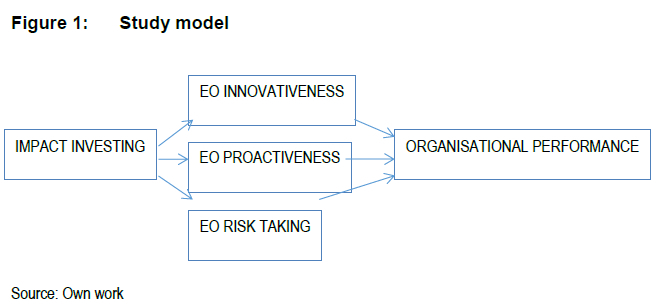
Building on this, in this research direction where organisations which promote an entrepreneurial posture adopt higher levels of EO innovativeness, EO pro-activeness, and EO risk taking, it is anticipated that associating these EO dimensions with impact investing will have a positive influence on organisational performance (See Figure 1).
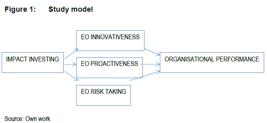
The rationale for this relationship is based on prior findings where entrepreneurship has been found to be the cause and effect linkage between various organisational factors, including corporate social responsibly and firm performance Yun (2012:101). Similarly, others have established a relationship between impact investing and social enterprises in South Africa Urban and George (2018:67). Other studies report that the EO dimensions can be used as moderating factors in the causal model that explains the underlying process of ''why'' and ''how'' a cause-and-effect happens between different organisational factors and business performance Wales (2015:5). Drawings on these past research and empirical findings, three hypotheses are formulated to reflect the expected influence that impact investing will have on the relationship between EO and organisational performance:
Hypothesis 1: Impact investing will positively influence the relationship between EO innovativeness and organisational performance
Hypothesis 2: Impact investing will positively influence the relationship between EO pro-activeness and organisational performance
Hypothesis 3: Impact investing will positively influence the relationship between EO risk taking and organisational performance
See Figure 1 for Impact investing study model.
5. RESEARCH DESIGN
The research design was a survey-based, quantitative and cross-sectional study where hypotheses were tested using statistical analyses in terms of correlational and regression analyses.
The study population was based on corporates in South Africa that are engaged in impact investing activity. Due to the absence of a comprehensive database identifying such corporate activity in South Africa this did not allow for the identification a priori among the population and consequently a sampling frame was constructed from databases such as the South African National NGO Coalition SANGOCO (2018), South African Social Innovation and Entrepreneurship network SASIE (2018), and the CSI (2018). The sampling criteria for qualifying respondents was based on firstly whether the specific manager was currently engaged in any form of impact investing activity, and secondly the organisation was required to have an individual or department delegated with impact investing related responsibility.
Study respondents included organisational managers, who were sourced from the abovementioned sampling frames and the unit of analysis was the individual as managers typically hold some levels of decision-making power, and are engaged in strategic discussions for their respective organisations. Based on the sampling frames obtained an electronic survey yielded a total of 350 qualifying individuals which were coded into a database where a random numbers program was applied to select individuals across different organisations. The response rate was initially lower than anticipated from the emails sent over Qualtrics and the use of personal networks to bolster the sample size was required. This multistage screening rendered a final sample of 106 complete responses, yielding a 30.4 percent response rate. This was regarded as a reasonable response rate, given that a number of emails did not reach the recipients presumably due staff mobility, error in capturing email addresses, and/or strict email policy among the organisations surveyed Cooper and Schindler (2011). To ensure sufficient variability and a high regional representativeness, the survey was evenly distributed among the four major cosmopolitan provinces of South Africa and included Johannesburg, Cape Town, Durban, and East London. To counter any potential sampling bias issues, t-tests were conducted and no significant differences between early and late respondents in terms of organisational size and age were detected.
Sample characteristics reveal that 52.5% of the respondents were males and 47.3% were females, and the majority (59 %) of respondents were between the ages of 35-44 years old. With regards to organisation size in terms of employee numbers 14 percent of the respondents had less than 50 employees, 20 percent between 51-300 employees, 65 percent between 200+ employees. In terms of organisation age, the majority of respondents (68.5 %) worked in firms in existence between 15 and 30 years, while 28.7 percent worked in firms older than 30 years.
Ethical clearance and concerns were addressed by obtaining permission from organisational managers to conduct the survey in their respective units and organisations. Ethical clearance was obtained from the relevant line managers in each organisation and it was stressed that the survey presented no risk to the respondents, specifically insofar full and open information (informed consent) to the respondents was communicated. Moreover a consent letter in relation to voluntary participation and confidentiality accompanied the instrument.
The research instrument, consisting of three sections, was based and adapted on the basis of prior studies documented in the literature review.
The first section was focused on the EO instrument and did not require a new conceptualisation since the measures have evolved from the scale developed by prior researchers Covin and Miller (2014:14). The EO measure reflected a similar Likert type scale where the three dimensions of innovativeness, risk taking and pro-activeness, consisting of nine items, with questions such as "in general, the top managers of my business unit favour a strong emphasis on R&D, technological leadership and innovation", and "in general, the top managers of my business unit have a strong proclivity for high risk projects (with chances of very high returns)". While alternative EO conceptualisations are to be found, using the existing EO measure has the advantage of theoretical backing, a multidimensional construct, and theoretically meaningful relationships established in previous studies, thus allowing for more refined knowledge to evolve Wales (2015:5).
For the second section impact investing, research instruments in prior studies Urban and George (2018:70) were adopted and included measures related to the SROI index Roy (2012:380) and the social impact measures from the Centre for the Advancement of Social Entrepreneurship Dees, Anderson and Wei-Skillern (2002). Items from each of these sources were selected that best encapsulate the themes and areas of impact investing and included questions such as "the initiative is widespread and spans several communities" and "there are many direct beneficiaries", relating to impact and sustainability.
In terms of the third section, organisational performance an instrument was developed which included various performance measures such as profitability, employment growth, sales growth, return on investment and equity (ROI, ROE) Steffens, Davidsson and Fitzsimmons (2009:139). Performance was treated as a perceptive measure for the past three years (performance over three years is broad enough time-space to account for seasonal and cyclical variations in business practices and performance). Absolute growth was simply computed as the size at 1 year minus the size of the previous year. These performance indicators have been shown to have acceptable criterion-related validity using a range of both categorical and continuous criterion variables Steffens et al. (2009:140).
All constructs that were measured used a seven-point Likert scale ranging from 1 (strongly disagree) to 7 (strongly agree). As a precaution, common method response bias was methodologically controlled for by gathering data representing the variables at different time periods and by counterbalancing the question order where the participant sample is divided in half, with one half completing the questionnaire in one order and the other half completing the questionnaire in the reverse order Cooper and Schindler (2011). Safeguarding respondent anonymity also ensured that social desirability and item ambiguity were avoided to some extent Cooper and Schindler (2011). To establish the psychometric properties of the various scales instrument validity and reliability testing was employed. Exploratory Factor Analysis (EFA) was used to establish the validity of the factors. A summated scale for each construct was computed by calculating the average of the items within the construct.
Initially the data was imported into SPSS prior to cleaning the data so as to check for missing values and incomplete responses Cooper and Schindler (2011). Correlation and regression analyses were used to test the study hypotheses.
6. RESULTS
6.1 Validity and reliability testing
In order to run EFA it was important to run the Keiser-Meyer-Olkin (KMO) measure of sampling adequacy first Cooper and Schindler (2011).
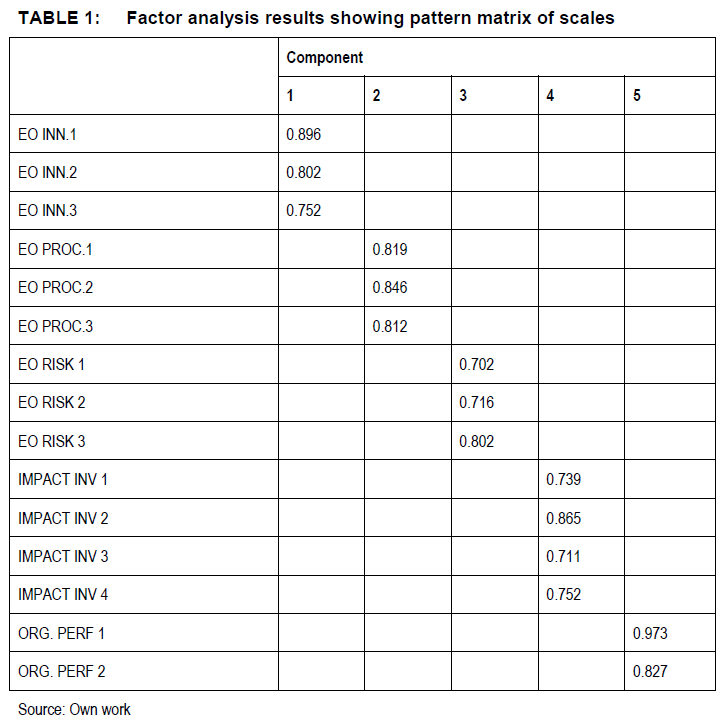
The results provided a KMO sampling adequacy result of .952 with an Approx. Chi-Square of 3318.412 (p < .05), which means the sample was adequate for factor analysis. Analyses of the inter-item correlation matrix containing only the items in the final factor solution were calculated which revealed that all the items were positively and significantly associated (p < 0.01) with correlations greater than 0.3. Based on the EFA results, using Principal Component Analysis revealed that five factors emerged which have eigenvalues greater than 1, and explain 68.18% of the total variance. Employing the Varimax with Kaiser Normalisation rotation method all five factors showed high (ä.07) and distinct loadings. The rotated final factor loadings according to the Pattern matrix are displayed in Table 1.
Reliability results reveal that all factors performed reasonably well with Cronbach Alpha Cooper and Schindler (2011) values of: impact investing = .864, EO Pro-activeness = .911, EO Risk Taking = .905, EO Innovation = .801, Performance = .862.
6.2 Descriptives and correlations
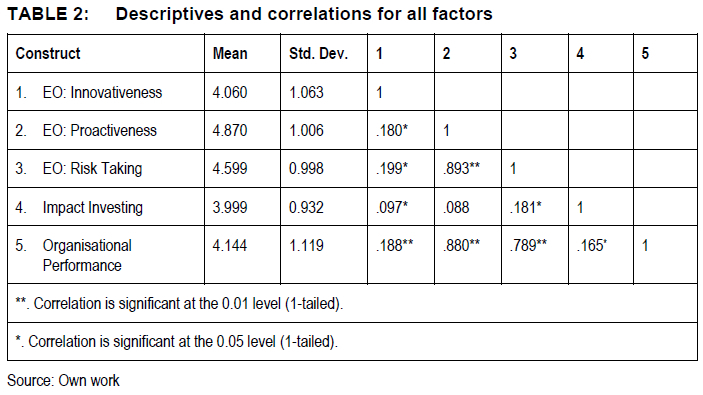
Table 2 shows means, standard deviations and inter-correlations of the study factors, where on the scale ranging from 1 to 7, all the factors show above mid-point mean scores, with the highest mean scores observed for EO pro-activeness ( m = 4.870; std. dev. = 1.006). Table 2 also shows Pearson's correlation coefficients where several factors were significantly and positively correlated to performance: EO Inn. (r = .188, p < 0.01); EO proc. (r = .880, p < 0.01); EO risk. (r = .789, p < 0.01); Impact. (r = .165, p < 0.05). This pattern of correlations suggests that high levels of associations between the variables and performance, and vice versa.
6.3 Hypotheses testing
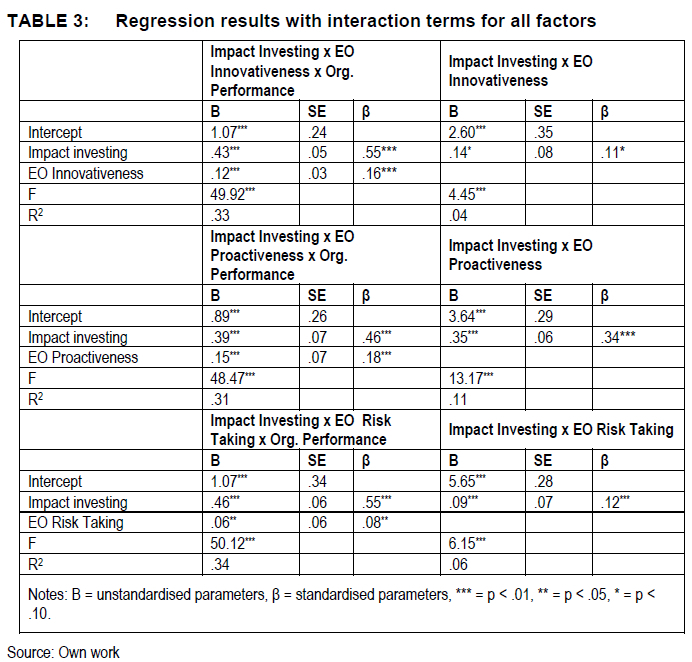
Multiple regression analysis was conducted with impact investing, EO innovativeness, EO pro-activeness and EO risk taking as the predictor variables. Three regression models were formulated to represent the study hypotheses. The interaction terms were included in each regression model with each of the EO dimensions and the impact investing variable, as well as organisational performance as the dependent variable.
In Table 3 in terms of EO innovativeness, a significant F value of 49.92 (p < 0 .01) was obtained where the primary relationship between impact investing and performance and the EO dimension innovativeness is significant and where the relationship between impact investing and EO innovativeness shows the F value of 4.45 (p < 0 .01). The statistically significant coefficients (β = 0.55, p < 0.01; β = 0.16, p < 0.01) provide support for H1 where impact investing and EO innovativeness explain (R2 = 0.33) 33 percent variation in the dependent variable.
In Table 3 in terms of EO pro-activeness, a significant F value of 48.47 (p < 0 .01) was obtained where the primary relationship between impact investing and performance and the EO dimension pro-activeness is significant and where the relationship between impact investing and EO pro-activeness has the F value of 13.17 (p < 0 .01). The statistically significant coefficients (β = 0.46, p < 0.01; β = 0.18, p < 0.01) provide support for H2 where impact investing and EO pro-activeness explain (R2 = 0.31) 31 percent variation in the dependent variable.
In Table 3 in terms of EO risk taking, a significant F value of 50.12 (p < 0 .01) was obtained where the primary relationship between impact investing and performance and the EO dimension risk taking is significant and where the relationship between impact investing and EO risk taking has the F value of 6.15 (p < 0 .01). The statistically significant coefficient (β = 0.55, p < 0.01; β = 0.08, p < 0.05) provides initial support for H3 where impact investing and EO risk taking explain (R2 = 0.34) 34 percent variation in the dependent variable.
Collinearity statistics for each model were also calculated which showed relatively low variance proportions across the study variables. These diagnostics when read in conjunction with tolerance statistics, has variable inflation factor (VIF) values between 1.179 and 1.259 which are well below critical values and deemed as acceptable, indicating no incidence of multicollinearity. When the values are 10.0 or more the regression coefficients can fluctuate widely from sample to sample, making it risky to interpret the coefficients as indicators of the predictors Cooper and Schindler (2011).
In conclusion, given that the statistical results are relatively robust and in terms of their explanatory power on the dependent variable, the findings support the hypothesized relationships between the study factors. Specifically, H1 was supported where impact investing and EO innovativeness explain a significant amount of variation in the performance. H2 was supported where impact investing and EO pro-activeness explain a significant amount of variation in performance. H3 was supported where impact investing and EO risk taking explain a significant amount of variation in performance.
7. DISCUSSION
The aim of this study was to empirically investigate the extent to which each of the different EO dimensions was positively related to performance, while also taking into consideration the impact investing activity of these organisations. The empirical evidence arising from this study supports the study hypotheses. Based on the regression results all of the different EO dimensions together with impact investing explain a significant amount of variance in organisational performance.
The study findings highlight the importance of considering impact investing in relation to EO and organisational performance. The results connect to prior studies which reveal that EO plays a key part in bringing about new products and services, and can result in a resource shift and re-focus on core business activities (Lumpkin & Dess 1996; Urban 2018). Additionally, the study findings resonate with results by Yun (2012) who reports that impact investing can be conducted through the fostering of behaviours reflective of EO, where such an entrepreneurial posture on a management level can enhance overall organisational performance. The positive influence of EO pro-activeness, EO risk taking and EO innovativeness on organisational performance is important in light of research which finds that generative learning is inherently entrepreneurial and connected with knowledge acquisition through innovations, risk taking and the rapid development of new behaviours (pro-activeness) Urban (2018).
Management implications of the study relate to the required alignment between EO pro-activeness, EO risk taking and EO innovativeness and impact investing. Leaders and managers need to institutionalise appropriate systems and support structures, as well as signal to employees that entrepreneurial behaviour together with impact investing practices are highly desirable. EO as a meaningful channel for impact investing activities to take place cannot be confined to a specialist function within the organisational but rather EO needs to permeate the entire organisational structure Ireland et al. (2009).
Specific recommendations include:
• Managers must design initiatives that foster and incentivise EO practices associated with the adoption of impact investing activities
• Managers are advised to leverage their EO competencies in terms of innovativeness, pro-activeness and risk taking so as to facilitate impact investing
• Managers need to strengthen employees capabilities to produce more innovative products and processes, so they exploit opportunities related to impact investing activities
• Managers should adopt appropriate tools for increasing the EO risk taking dimension as this could support impact investing activities in identifying the ideal organisational level of risk taking and could pave the way to provide measurable returns on investment
• Managers should encourage EO processes by engaging in estimated risk-innovation trade-offs
• Managers need to be flexible to impact investing dynamics, which allows them to be proactive and enjoy significant strategic advantages
• Senior managers must ensure that impact investing and EO policy alignment is reflected through vision and mission statements
• Impact investing strategies as such should include guidelines for processes of funding impact investing, as well as guidelines to measuring and reporting on EO and impact investing
• Organisations must have impact investing monitoring, evaluation and reporting activities since there are growing calls for accountability to be considered by organisations undertaking impact investing activities
• Impact investing activity must be undertaken with stakeholder consideration to avoid being detached from communities in which organisations operate in
The study has limitations, which also present future research avenues. The cross-sectional nature of the study prevents any causal relationship between EO and impact investing and organisational performance to be drawn. A longitudinal study is required to provide further insights and causal inferences into the relationship between these factors. Due to the limited availability of accurate data on impact investing in South Africa, the total size of the target population could not be accurately determined and the sample size was therefore computed using minimum sample size (n = 120) recommended for multiple correlation or regression analysis Cooper and Schindler (2011:455). Modest explanatory findings in terms the EO dimensions in relation to impact investing and performance may be interrelated to the influence of other contingencies not incorporated in the present study. Future studies could investigate organisational factors and structures influencing EO and impact investing, such as culture and power structures. In general developing a deeper understanding of the complexities of the organisational context associated with EO and impact investing and performance represents a fertile area for future research.
REFERENCES
4. LITERATURE REVIEW
- ANTONCIC B & HISRICH D. 2001. Intrapreneurship: Construct Refinement and Cross-Cultural Validation. Journal of Business Venturing 16(5):495-527.
- BHANA N. 2018. Corporate social responsibility initiatives and its impact on organisational share price performance: evidence from South Africa. Journal of Contemporary Management 15(1):100-126.
- BREST P & BORN K. 2013. When can impact investing create real impact? Stanford Social Innovation Review 11(4):22-31.
- BUGG-LEVINE A & EMERSON J. 2011. Impact investing: Transforming how we make money while making a difference. Innovations 6(3):9-18.
- CARROLL AB. 1979. A three-dimensional conceptual model of corporate performance. Academy of Management Review 4(4):497-505.
- CARROLL AB. 1991. The pyramid of corporate social responsibility: toward the moral management of organizational stakeholders. Business Horizons 3(1):39-48.
- COOPER DR & SCHINDLER PS. 2011. Business research methods. New York, NY: McGraw-Hill/Irwin.
- COVIN JG & MILLER D. 2014. International entrepreneurial orientation: conceptual considerations, research themes, measurement issues, and future research directions. Entrepreneurship Theory and Practice 38(1):11-44.
- CORPORATE SOCIAL INVESTMENT HANDBOOK (CSI). 2018. Corporate Social Investment. Business in society handbook. Cape Town, South Africa: Trialogue Publishers.
- DARRAGH L & AMAN N. 2012. Impact investing in emerging countries: insights from the due diligence process.The Secretary's Global Impact Economy Forum. United States: Global Impact Economy Forum
- DE JONGH JJ & MNCAYI NP. 2019. An analysis on the key Macroeconomic drivers of consumer vulnerability in the South African economy. Journal of Contemporary Management 16:290-312.
- DEES JG, ANDERSON BB & WEI-SKILLERN J. 2002. Pathways to social impact: Strategies for scaling out successful social innovations. Division of research. Boston, MA: Harvard Business School Press.
- DESS GG & LUMPKIN GT. 2005. The role of entrepreneurial orientation in stimulating effective corporate entrepreneurship. Academy of Management Executive 19(1):147-156.
- DRUCKER PF. 2013. The age of discontinuity: guidelines to our changing society. London: Transaction Publishers.
- FORTUNE G, NGWAKWE CC & AMBE CM. 2016. Corporate image as a factor that supports corporate green investment practices in Johannesburg Stock Exchange listed companies. International Journal of Sustainable Economy 8(1):57-75.
- FRIEDMAN M. 1970. The social responsibility of business is to increase its profits. New York Times. (September, pp126.
-
)
» www.daff.gov.za/doadev/sidemenu/links/Digest17.html/ - HÖCHSTÄDTER AK & SCHECK B. 2015. What's in a name: An analysis of impact investing understandings by academics and practitioners. Journal of Business Ethics 132(2):449-475.
- IRELAND RD, COVIN JG & KURATKO DF. 2009. Conceptualizing corporate entrepreneurship strategy. Entrepreneurship Theory and Practice 12(1):19-46.
- JACKSON ET. 2013. Interrogating the theory of change: evaluating impact investing where it matters most. Journal of Sustainable Finance & Investment 3(2):95-110.
- KRAUS S, NIEMAND T, HALBERSTADT J, SHAW E & SYRJÄ P. 2017. Social entrepreneurship orientation: Development of a measurement scale. International Journal of Entrepreneurial Behavior and Research 23(6):977-997.
- LUMPKIN G & DESS G. 1996. Clarifying the entrepreneurial orientation construct and linking the performance. Academy of Management Review 21(1):135-172.
- LUMPKIN G, MOSS T, GRAS D, KATO S & AMEZCUA A. 2013. Entrepreneurial processes in social contexts: How are they different, if at all? Small Business Economics 40(3):761-783.
- MAREDZA A & IKHIDE S. 2013. Dealing with the challenge of generating employment in South Africa: Does banking sector efficiency matter?' International Business and Economics Research Journal 12(11):1361-1372.
- NICHOLLS A. 2011. Editorial: social enterprise - at the forefront of rethinking business. Journal of Social Entrepreneurship 2(1):1-6.
- PARTRIDGE P. 2013. Impact investing. New York, NY: The Rockefeller Foundation.
- PERRINI F, RUSSO A & TENCATI A. 2007. Impact investing strategies of SME's and large organisations. Evidence from Italy. Journal of Business Ethics 74(5):285-300.
- PORTER ME & KRAMER MR. 2011. The big idea: Creating shared value. Harvard Business Review 89(1):2-5.
- ROY M. 2012. SROI network and buzzcott. Making it count: a social enterprise guide for accounting for value. Social Business Journal 7(3):379-382.
- SIIT (SOCIAL IMPACT INVESTMENT TASKFORCE). 2014. Measuring Impact: Subject paper of the Impact Measurement Working Group, S.I. London: The Taskforce.
- SMITH EE, MAZIBUKO NE & MUZVIDZIWA I. 2015. Perceptions regarding corporate citizenship behaviour in a developing country. Journal of Contemporary Management 12:447-472.
- ]
-
SASIE (SOUTH AFRICAN SOCIAL INNOVATION AND ENTREPRENEURSHIP). 2018. South African Partnering Network for Inclusive Growth through Social Innovation and Entrepreneurship. The SASIE Network. [Internet:www.sasieresearch.net/index.php/sasie-database/2.html/;downloaded on 21 April 2018.
» www.sasieresearch.net/index.php/sasie-database/2.html/ - ]
-
STATSSA (STATISTICS SOUTH AFRICA). 2019. Quarterly Labour Force Survey - QLFS Q1:2019. Statistics South Africa. [Internet:www.statssa.gov.za/?p=12115/html/; downloaded on 17 July 2019.
» www.statssa.gov.za/?p=12115/html/ - ]
- STEFFENS P, DAVIDSSON P & FITZSIMMONS J. 2009. Performance configurations over time: implications for growth- and profit-oriented strategies. Entrepreneurship Theory and Practice 33(1):125-148.
- STUBERT A. 2013. The difficult task of measuring impact. New York, NY: Rockefeller Foundation.
- SYRJÄ P, PUUMALAINEN K, SJÖGRÉN H, SOININEN J & DURST S. 2019. Entrepreneurial orientation in firms with a social mission - a mixed-methods approach, Cogent Business & Management 6(1):1-25.
- URBAN B. 2018. The influence of the regulatory, normative and cognitive institutions on entrepreneurial orientation in South Africa. The International Journal of Entrepreneurship and Innovation 17(4):217-227.
- URBAN B & GEORGE J. 2018. An empirical study on measures relating to impact investing in South Africa. International Journal of Sustainable Economy 10(1):61-77.
- VENTER R & URBAN B. 2015. Entrepreneurship theory in practice. Cape Town, South Africa: Oxford Southern Africa.
- WALES WJ. 2015. Entrepreneurial orientation: A review and synthesis of promising research directions. International Small Business Journal 34(1):3-15.
-
WORLD BANK. 2018. Overcoming poverty and inequality in South Africa: An assessment of drivers, constraints and opportunities. Washington: World Bank Publications. [Internet:www.worldbank.org/en/country/southafrica/overview/; downloaded on 17 July 2019.
» www.worldbank.org/en/country/southafrica/overview/ - ]
- YUN JW. 2012. A Study on the effect of impact investing and entrepreneurship on business management performance. Korea International Accounting Review 50(8):87-106.