The dimensions of perceived risk among youth consumers of mobile money
Abstract
M-money has re-defined convenience and affordability of financial services by enabling users to perform peer-to-peer transfers, bill payments, airtime purchases and cash remittances among others. This study essentially adds on to the developing field of technology acceptance research, demonstrating the role perceived risk through its dimensions, plays in the youth's behavioural intention to use m-money. Using a descriptive research design, and a quantitative research approach, a field survey was used to obtain data from the respondents, and an analysis carried out using multiple linear regression and Pearson's correlation coefficient. The study underlying this article reveals that the dimensions of perceived risk have a weak positive correlation to the behavioural intention to use m-money. As such, it may be assumed that respondents are risk-averse owing to their lack of knowledge of m-money as a payment channel. However, psychological risk shows the most significant antecedence on the Unified Theory of Acceptance and Use of Technology (UTAUT) guided conceptual framework, pointing toward subjective risk and network externalities as key issues negating m-money uptake among university students located in Durban, South Africa.
mobile money; perceived risk; perception management; risk; youth
1. INTRODUCTION
Mobile money (m-money) is characterised as a payment platform utilising mobile technology through cellular devices to complete micro-payments such as utility bills, paying for consumer goods and services, purchasing mobile airtime and to effect cash transfers between users (Dahlberg, Mallat, Ondrus & Zmijewska 2008:165; Jia, Hall & Sun 2014:1). M-money as an innovation has come of age as a cheap and convenient payment solution, enabling the entry of the unbanked and underbanked population into the formal financial services market without the need of a conventional brick-and-mortar bank.
With new technology introductions within virtual payments, implicit risk is bound to exist in relation to the expected benefits of using m-money (Cheng & Hamid 2013:28; Joubert & Belle 2009:5; Liébana-Cabanillas, Munoz-Leiva & Sánchez-Fernández 2013:320). Some of the common models used to assess perceived risk (PR) in eastern and western countries have proven to be successful (Akturan & Tezcan 2012:4; Featherman & Pavlou 2003:457; Kostiwa, Liu & Marchewka 2007:95; Liébana-Cabanillas, Munoz-Leiva & Sánchez-Fernández 2014:159; Tan, Tan, Xu & Zhang 2012:10; Zhou 2013:1088). However, these models have not been sufficiently used in a South African context to examine PR, thereby prompting a need for this study.
Emphasis is put on understanding the dimensions of PR linked to the behavioural intention (BI) to use m-money among youths of the ages between 18 and 35, who attend university. Sambira (2013:19), states that they use their cellular devices for several tasks including communication, social engagements with peers, shopping and buying airtime among others. With this demographic receiving better education and obtaining qualifications that lead to employment, they are likely to have or develop the need to access convenient payment solutions to handle their monetary resources (Dennis, Jayawardhena, Merriless & Wright 2009:1121). In addition, it is upheld that with better education levels, there is an elevated adoption of electronic banking (Clemes, Gan, Limsombunchai & Weng 2006:371). This may similarly be the case for m-money as a key assumption for this study.
2. OPPORTUNITY INVESTIGATED
Preceding studies in technology adoption have centred upon using holistic models in understanding user behavioural intention. This study on the other hand zeroes in on PR that is synonymous in tried and tested theoretical models such as the Technology Acceptance Model (TAM), Theory of Reasoned Action (TRA) and the UTAUT. Technology advancement within the mobile telecoms and banking industries in South Africa has attested to the integration of the two with the introduction of m-payment platforms.
That notwithstanding, the penetration of m-payments has been fairly lacking perhaps owing to PR among potential users, therefore, it forms the basis of this study, namely investigating how PR impacts behavioural intention on the adoption of m-money.
2.1 Perceived risk (PR)
PR is characterised as a consumer action to reduce impulsive consequences due to the upheld and unforeseen vulnerability attached to a transaction, or further adopting an innovation (Blythe 1997:123). With regard to innovation adoption, PR is manifested within a consumer's behavioural pattern to seek further innovation-based material that may shape his or her purchase decision in an attempt to counter cognitive resistance generated by perception (Bauer, Barnes, Neumann & Reichardt 2005:184; Kuwornu & Tobbin 2011:64). Thereby, consumers conceive the need to lower risk through information search in order to take advantage of innovation utility within a transaction.
In m-commerce, PR involves the possibility of loss while trailing an expected outcome while carrying out a transaction using a mobile platform (Liu, Pang, Tarn, Yang & Yen 2015:11). The likeliness of risk being present is apparent because of the lack of physical contact between transacting parties and the spatial distance within such electronic transactions. Service users or potential users may feel that they stand to lose their money and have their personal information misappropriated (Beldad, Geest, De Jong & Steehouder 2012:164; Cha 2011:118-119). Quite a number of studies in the research area, including those of Accenture (2014:5), Chen (2013:426) and Liébana-Cabanillas et al. (2013:331), have linked the existence of PR to negate consumer attitudes toward adopting innovative payment solutions.
2.2
Dimensions of perceived riskAccording to Humayoun, Khan and Sajjad (2010:3081), PR is sensed as a multi-construct supposition, augmented with abstruseness regarding the intensity of its interlinked negative outcomes. Consumer behaviour literature substantiates the exercise of these PR dimensions to ascertain consumers' purchase decisions and appraisal of various product and service options.
A study on evaluating the PR of a dozen well-defined consumer products that included 148 student respondents revealed that out of the overall PR variance weighting, approximately 62 percent explicated functional, financial, physical, psychological and social risks (Bai & Li 2010:52; Jacoby & Kaplan 1972:389).
All dimensions of risk as perceived by consumers are primarily underlined by their individual psychological function (Gronhaug & Stone 1993:44), thus the dimensions stated above are largely interlinked by psychological risk (Bai & Li 2010:53). This study focuses on four dimensions of risk as being key determinants or measures of overall PR within monetary transactions employing the use of m-payments. These risks are psychological, financial, functional and physical. Notably, the use of m-payments has shown no evidence of causing bodily harm, so it shall be conceived in the pretext of security and privacy risks.
2.3
Conceptual framework and hypothesesThe conceptual framework of this study is guided by the UTAUT by Davis, Davis, Morris and Venkatesh (2003:447), an empirically substantiated innovation acceptance model that combines a number of constructs commonly used in assessing consumer behaviour with regard to technology adoption (Kuwornu & Tobbin 2011:61).
Davis et al. (2003:467) indicates that the UTAUT is an appropriate model for managers to evaluate the progress of novel technology introductions and comprehend fundamental adoption drivers. As such, it is adjudged that this theory well befits an investigation to determine consumer behaviour regarding the intention to take up m-money.
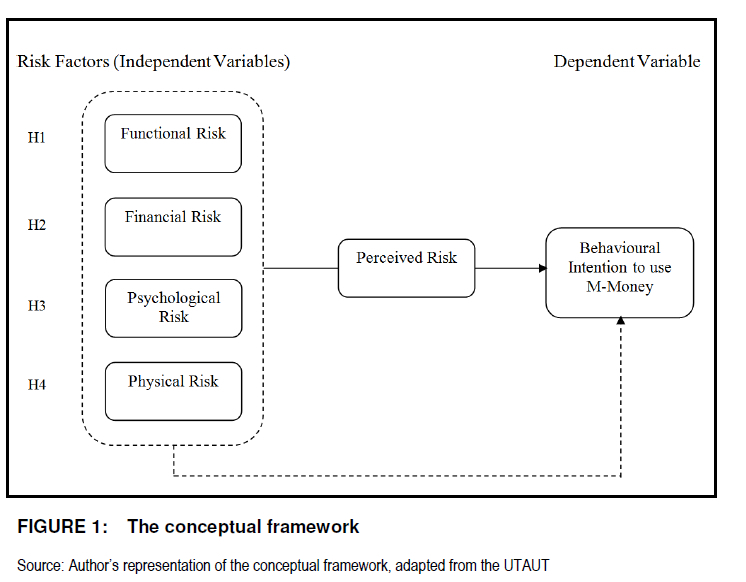
Figure 1 is a representation of the study's conceptual framework that incorporates a portion of the UTAUT by considering PR as the focal point.
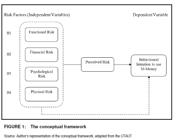
2.3.1 Functional risk
Functional risk is considered to be a pivotal risk dimension in technology adoption as it largely determines the image consumers have on an innovation (Antioco & Kleijnen 2010:1706; Kiviniemi & Laukkanen 2010:378). It revolves around the performance uncertainty of an innovation and its being unable to operate as required, to render due benefits (Akturan & Tezcan 2012:448; Kleijnen, Lee & Wetzels 2009:349). In the context of this study, functional risk appertains to the capability of the mobile service to facilitate transactions and effect M2M transfers effectively, timeously and logically from the point of initiation to completion (Chen 2013:416). The following hypothesis is therefore put forward:
H1 Functional risk positively affects the behavioural intention to use m-money.
2.3.2 Financial risk
This is concerned with the perceived pecuniary cost coupled with obtaining and sequentially maintaining the service, effecting transactions and the potential monetary loss that may be experienced resultant of fraudulent practices (Baur, Bick, Canedoli & Ha 2012:222). It has been found that individuals with limited exposure to financial services and those with low incomes are risk-averse, with many shying away from assuming financial risk and any form of monetary loss (Curto, Lusardi & Mitchell 2010:376; Gross, Hogarth & Schmeiser 2012:9). Therefore, the following hypothesis is put forward:
H2: Financial risk positively affects the behavioural intention to use m-money.
2.3.3 Psychological risk
This refers to consumer discernment related to the degree to which a product or service aligns with individual mental representation of self in the presence of internal and external drivers (Bai & Li 2010:53). Instances of these drivers include attitude, trust, culture and subjective norms among others, all of which make an impression on a consumer's decision making process in a purchase situation.
In this study, psychological risk encompasses the influence a consumer's reference group may have on his or her choice of use of m-money and the extent to which the consumer deems the payment service to be secure and devoid of privacy hazards, to safeguard and have control over personal and transaction details (Antioco & Kleijnen 2010:1705; Chan, Chong & Ooi 2012:37). In addition, Banwet, Ketkar and Shankar (2012:76) point out that the impending perception of theft or loss of a mobile device, poor literacy capacity and a lack of information or misinformation about payment innovations may deter their use. The following hypothesis is put forward:
H3: Psychological risk positively affects the behavioural intention to use m-money.
2.3.4 Physical risk
In the context of m-payments, physical risk surrounds the likely perceived misappropriation of sensitive personal and transactional particulars. Owing to the intangible nature of virtual payments and mobile services, risk among users is naturally impending because they are m-payments and related transactions occur remotely and are impersonal (Beldad et al. 2012:164). In an effort to safeguard service users' security and privacy, they need to instil trust and boost consumer confidence by way of enforcing checks that foster security and information security (Heyer & Mas 2009:12), such as Know-Your-Customer (KYC) regulations. The following hypothesis is thus put forward:
H4: Physical risk positively affects the behavioural intention to use m-money.
Therefore, the dimensions of PR as explained above were empirically tested so as to establish whether they individually have a link with the youth's BI to take up m-money services.
3. RESEARCH METHODOLOGY
This study focused on determining the relationship between perceived risk (via its four dimensions) and the BI to take up an innovation via descriptive research. The population of interest was composed of the University of KwaZulu-Natal's undergraduate and postgraduate students, totalling 12,248 units.
A sample drawn from youthful university students was ideal as Davis (1999) cites them as being primary causal agents for information technology diffusion across society. In addition, the youth are technologically inclined and well informed as they incorporate the use mobile devices in several aspects of their lives. The respondents included users, non-users and likely users of m-money services. By using a confidence interval of 5 percent, 373 sample respondents were determined to make up the required sample size according to Bougie and Sekaran (2013:263). A non-probability sampling strategy was employed through purposive sampling technique, whereby available and willing students were approached in various lecture theatres and recruited into the study.
A field survey was conducted between 23 of September 2013 and 25 of October 2013, using personally administered questionnaires. A questionnaire as a data collection tool fits this research as it enables the capturing of perceptual perspectives from which inferences can be derived through statistical processes (Al-Qeisi 2009:227). In addition, they are best suited for examining cause-and-effect relationships between or among variables (Lewis, Saunders & Thornhill 2009:368).
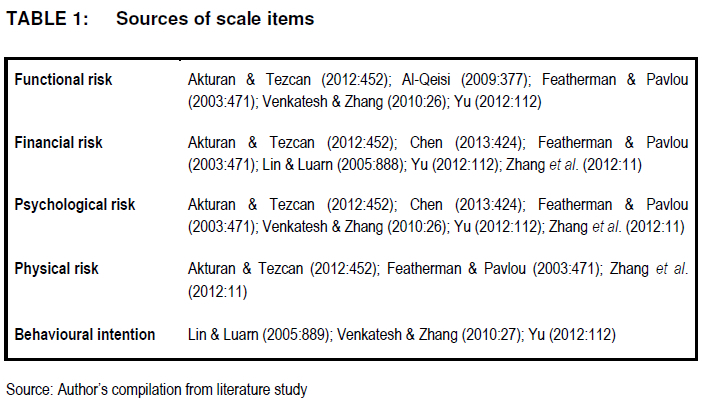
The survey instrument was divided into four distinct sections with the initial part purposed to obtain demographic data. The following part obtained data regarding the students' awareness of various m-money services available in the South African market and the frequency of use of the service of choice. The third part individually tested each of the four dimensions of PR, while the final part obtained data regarding the respondents' BI to take up m-money services. Scale items included in the questionnaire were adapted from standardised innovation usage and adoption tests as illustrated in Table 1.
Reponses to scale items were based on a five-point Likert scale, ranging from 'Strongly agree' to 'Strongly disagree'. According to Leedy and Ormrod (2005:183), the Likert scale is best used in ascertaining consumer perception and behaviour.
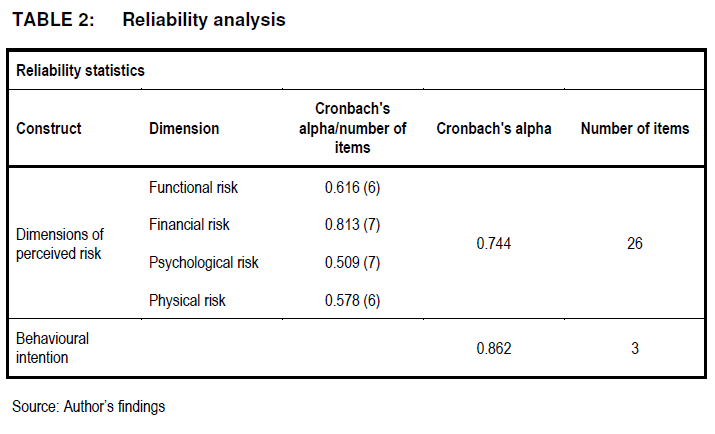
Prior to carrying out the survey, reliability analysis was executed to assess inter-item consistency and stability within each scale by using Cronbach's coefficient alpha, which requires the generated value to be not less than 0.6 or 0.7 for acceptance (Bougie & Sekaran 2013:229; Wang & Wu 2005:725).
The coefficient values yielded are illustrated in Table 2. On account of PR's combined coefficient value, the scales were accepted despite psychological and physical risk individually not meeting the requirement. The low reliability scoring of psychological risk as used in this study is attributed to the fact that it combines both psychological and social risk scale items, that are both resultant of the user's mental manifestations.
Liu et al. (2015:12) state that 'psychological risk and social risk are considered to have an indirect marginal utility' when determining the effect they have on technology acceptance and specifically in the context of electronic payments. Physical risk on the other hand, operationally takes the shape of information security and privacy risks and loss of control over personal details, which are functions of perceived trust in the payment system. Ismail and Masinge (2012:108) observe trust to be a key user psychological expectation of PR. Thus, the inter-relationship of psychological and physical risks leads to low reliability scoring.
4. FINDINGS AND IMPLICATIONS
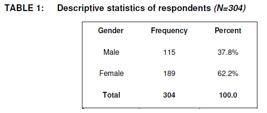
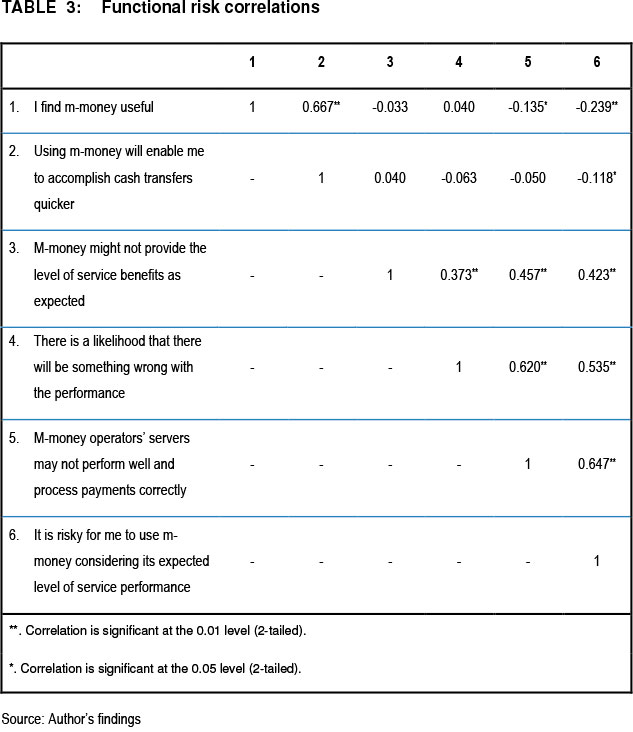
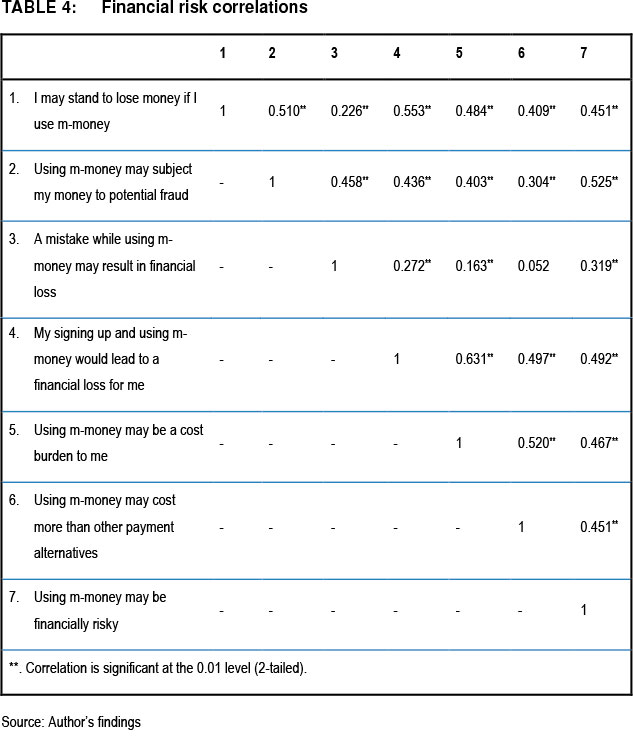
This study's analysis was carried out using IBM SPSS Statistics Version 21. The survey response rate was 81.5 percent with 304 duly completed questionnaires obtained. By utilising measures of central tendency and suitable statistical measures, the yielded quantitative data was treated using non-parametric operations, to include Pearson's product-moment correlation coefficient and multiple regression analysis. In order to determine the strength and direction of linear bivariate relationships between sub-scales within each dimension of PR, Pearson's correlation (r) was used (Pallant 2011:128).
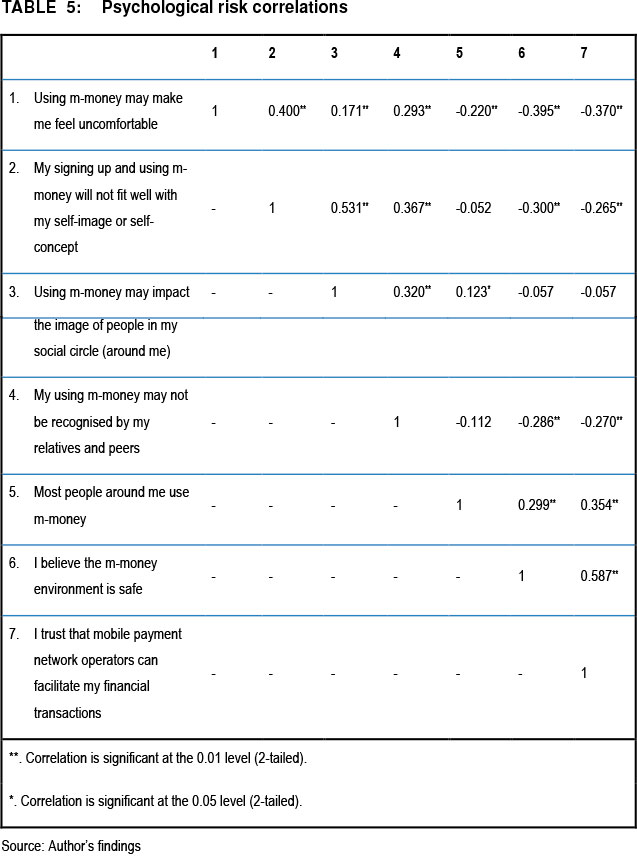
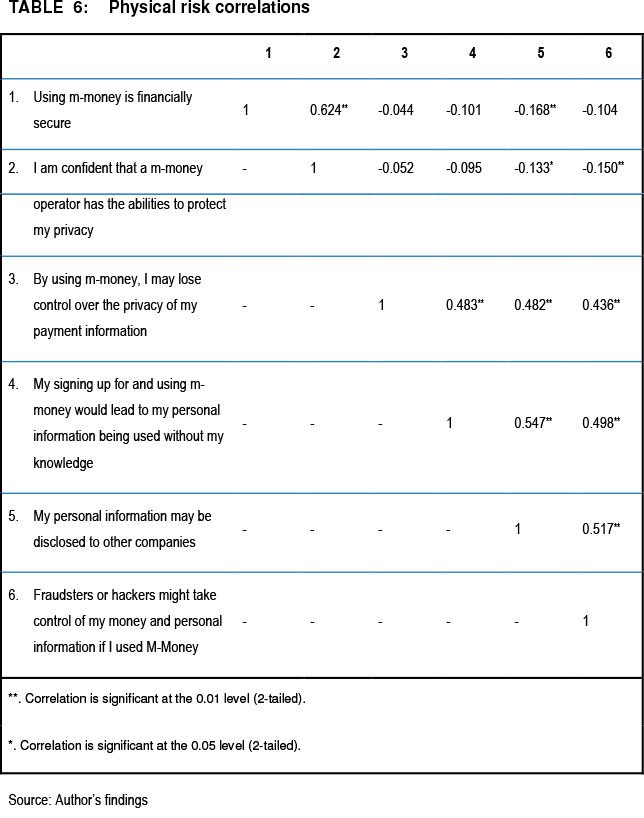
To interpret the significance of correlation, it is put forward that when the coefficient r = 0.10 to 0.29, correlation is weak, r = 0.30 to 0.49 correlation is medium, and r = 0.50 to 1.00 correlation is large, with the '+' and '-'signs denoting the direction of the relationship, either positive or negative, respectively (Cohen 1988:79-81 cited in Pallant 2011:134).
The bivariate relationship between sub-scales of the different dimensions of PR yielded results as depicted in Table 3, Table 4, Table 5 and Table 6. However, some sub-scales did not yield any significant linear correlation.
Multiple regression analysis was run to determine the interrelationships between each scale of PR as predictors to influence the various sub-scales of BI to use m-money. The test was carried out with the significance level set at p < 0.05.
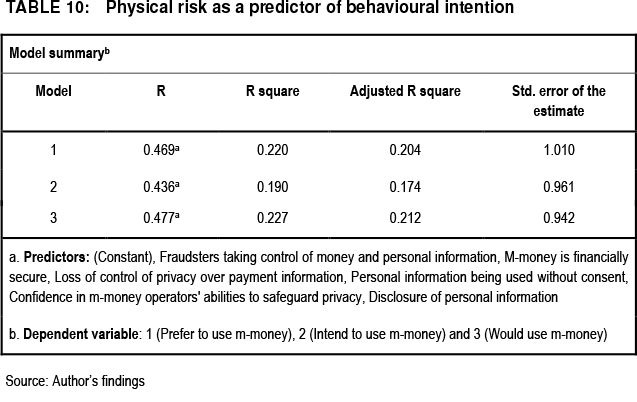
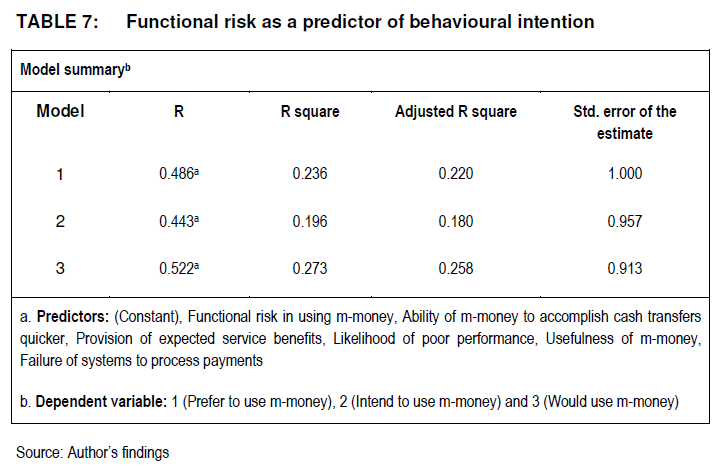
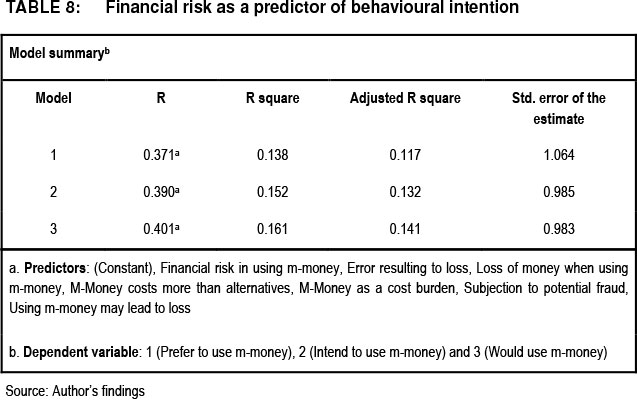
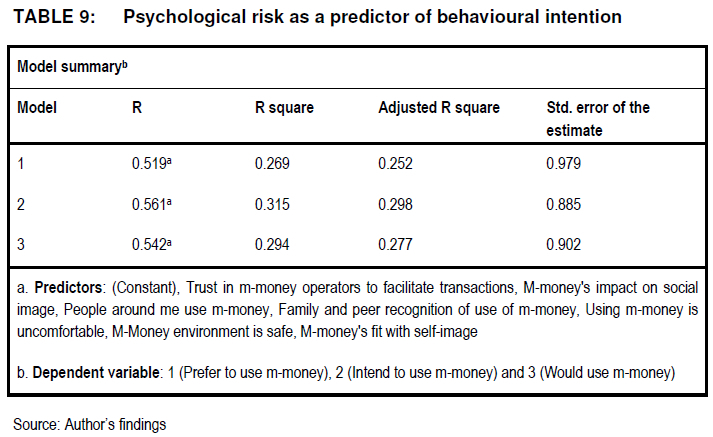
The results yielded from this statistical analysis are depicted in Table 7, Table 8, Table 9 and Table 10.
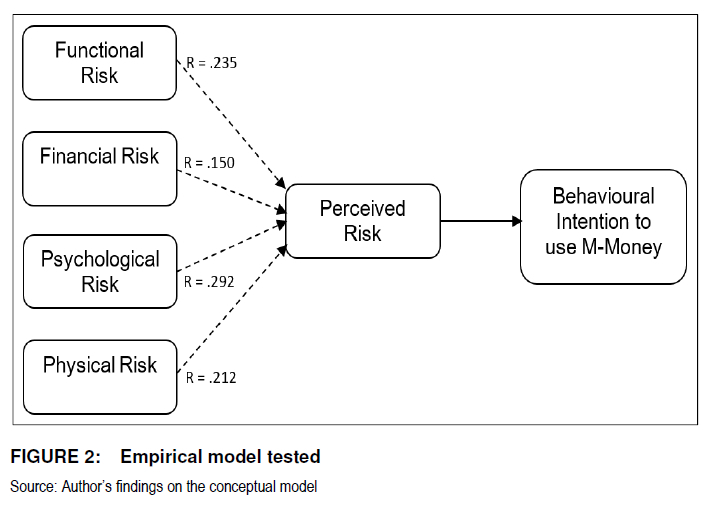
From the results above, the average r2 or R-value of each PR dimension was extracted to indicate the overall interrelationship and strength each dimension had on the BI to utilise m-money. By performing this operation, it made it possible to test the conceptual framework as set out at the beginning of the study. Figure 2 illustrates the interrelationship between the constructs.
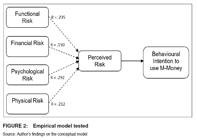
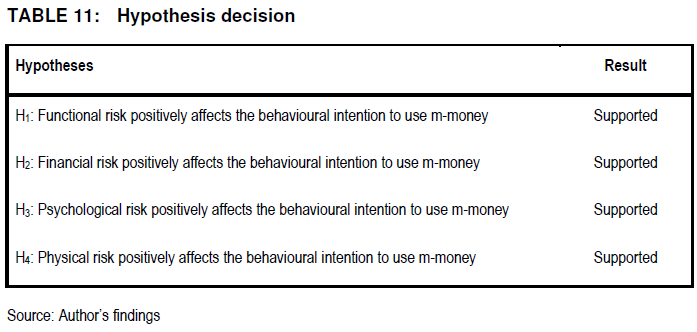
Given the empirical model, it is clear that the objective set out in this study have been achieved. The four dimensions of perceived risk are indeed linked to the BI to use m-money as illustrated in Table 11.
Therefore, the hypotheses stated are treated as follows:
As much as a positive correlation has been established across all dimensions, it should be clear that all relationships are weak. However, psychological risk demonstrates the strongest correlation with behavioural intention as a whole, with 29.2 percent variance.
Functional risk was found to be significant only in determining the BI to use m-money. However, it did not show significance in determining the preference and willingness, the two dependent BI variables. Therefore, functional risk indeterminately influences overall BI to use m-money as an innovation owing to a weak correlation as put forward by Akturan and Tezcan (2012:454).
It was found that on average, the majority of the financial risk responses given were neutral. This points to the assumption that the sampled group were unaware of m-money as a service, hence they were unable to objectively respond to the service's perceived monetary implications. Regression analysis on financial risk showed that it significantly influences m-money use among the youth, confirming the findings of Cruz, Munoz-Gallego, Neto and Laukkanen (2010:363-364), Drennan & Wessels (2010:562) and Lin & Luarn (2005:885), namely that the perception of cost negatively affects consumer attitude towards adoption. Psychological risk on the other hand, was only significant in influencing BI preference and not the other two indicators of BI in relation to the use of m-money when handling low-value transactions. The sub-scales used to measure physical/privacy risk did not reveal any significance in ascertaining overall BI.
In line with suppositions put forward by Kim, Lee, Oh and Sawng (2011:170) and Neudorfer (2004:15), the study finds the sampled university students to be either risk-averse or risk-neutral, given the empirical evidence presented regarding their willingness to adopt m-money. This is owed to the fact that the majority of responses given by the respondents were neutral (Appendix A). M-money as a virtual payment solution exhibits characteristics of a service such as intangibility, and as such, perceived consumer risk around it exists. In addition, it is presumed that a lack of awareness about m-money exists as well as insufficient understanding of related risk among those sampled. Thereby, PR linked with m-money performance and use behaviour was manifested among the respondents, as put forward by Han, Im and Kim (2008:7).
Confirmatory factor analysis, a structural modelling technique, may be performed on the current scale items in the study to refine them and determine concise scale items to be used within each distinct dimension of PR to better reveal statistical correlations regarding the BI to use m-money in future. In retrospect, future research could be dedicated to introducing marketing communications or even consumer education programmes as an intervening variable within the conceptual framework. Either of these variables may assist in building consumer awareness thereby creating a favourable environment to assess the youth's PR.
The study has revealed that the BI to use m-money may not quite be influenced by PR dimensions. PR as upheld within the UTAUT is not befitting in ascertaining new technology adoption among the youth in a South African perspective. Perhaps this finding suggests the need to have studies conducted on technology acceptance in the premise of diverse cultural settings. This may be owed to the fact that the origin of the conceptual framework herein as borrowed from the UTAUT has effectively been used to determine PR related to BI to use innovation in studies set in the Middle-East, Asia and Europe.
6. CONCLUSION
Empirical evidence shows the four dimensions of PR used in this study to determine behavioural intention concerned with the use of m-money to be equivocal. The presumption taken herein, points toward a general absence of youth awareness of the mobile payment platform. This is predicated by the fact that the majority of responses regarding the four PR scale items as captured by the survey, were neutral. It is suggested that mobile payment service operators factor in the youth market's cognisance of m-money's advantages (and disadvantages) and its convenience in terms of easing cash remmitances and payments, when purposing to position their service offerings in the market. It is highly probable that a shift in the behavioural intention to take up the use of m-money among university-going youth may be evidenced once they grasp the innovation's economic merits.
REFERENCES
- ACCENTURE. 2014. Driving the adoption of mobile payments - what SA consumers want. Johannesburg: Accenture.
- AKTURAN U & TEZCAN N. 2012. Mobile banking adoption of the youth market: perceptions and intentions. Marketing Intelligence & Planning 30(4):4-14.
- AL-QEISI K. 2009. Analyzing the use of the UTAUT to predict Internet banking adoption: a behavioural approach to a comparative study. Middlesex, UK:Brunel University. (PhD-thesis.
- )
- ANTIOCO M & KLEIJNEN M. 2010. Consumer adoption of technological innovations: effects of psychological and functional barriers in a lack of content versus a presence of content situation. European Journal of Marketing 44(11/12):1700-1724.
- BAI X & LI Z. 2010. Influences of perceived risk and system usability on the adoption of mobile banking service. In: The Third International Symposium on Computer Science and Computational Technology, South China University of Technology:51-54. (Conference proceedings).
- BAUER H, BARNES S, NEUMANN M & REICHARDT T. 2005. Driving consumer acceptance of mobile marketing a theoretical framework and empirical study. Journal of Electronic Commerce Research 6(3):181-192.
- BAUR AW, BICK M, CANEDOLI A & HA K-H. 2012. Mobile banking - insights on its increasing relevance and most common drivers of adoption. Electronic Markets 22(4):217-227.
- BELDAD A, GEEST T, DE JONG M & STEEHOUDER M. 2012. Shall I tell you where I live and who I am? Factors influencing the behavioral intention to disclose personal data for online government transactions. International Journal of Human-Computer Interaction 3(63-177).
- BLYTHE J. 1997. The essence of consumer behaviour. Harlow, UK: Prentice Hall.
- BOUGIE R & SEKARAN U. 2013. Research methods for business: a skill-building approach. 6th ed. West Essex, UK: Wiley.
- CHA J. 2011. Exlporing the internet as a unique shopping channel to sell both real and virtual items: a comparison of factors affecting purchase intention and consumer characteristics. Journal of Electronic Commerce Research 12(2):115-132.
- CHAN F, CHONG AY-L & OOI K-B. 2012. Predicting consumer decisions to adopt mobile commerce: Cross country empirical examination between China and Malaysia. Decision Support Systems 54:34-43.
- CHENG A & HAMID N. 2013. A risk perception analysis on the use of electronic payment systems by young adult. WSEAS Transactions on Information Science and Applications 1(10):26-35.
- CHEN C. 2013. Perceived risk, usage frequency of mobile banking services. Managing Service Quality 23(5):410-436.
- CLEMES M, GAN C, LIMSOMBUNCHAI V & WENG A. 2006. A logit analysis of electronic banking in New Zealand. Information Journal of Bank Marketing 24(6):360-383.
- CRUZ P, MUNOZ-GALLEGO P, NETO L & LAUKKANEN T. 2010. Mobile banking rollout in emerging markets: evidence from Brazil. International Journal of Bank Marketing 28(5):342-371.
- CURTO V, LUSARDI A & MITCHELL OS. 2010. Financial literacy among the young. Journal of Consumer Affairs 44(2):358-380.
- DAHLBERG T, MALLAT N, ONDRUS J & ZMIJEWSKA A. 2008. Past, present and future of mobile payments research: a literature review. Electronic Commerce Research and Applications 7(2):165-181.
- DAVIS JF. 1999. Effectiveness of internet advertising by leading national advertisers. In: Davids JF (ed.). advertising and the world wide web. Whippany, NJ: Lawrence Erlbaum Associates, pp 81-97.
- DAVIS F, DAVIS GB, MORRIS M & VENKATESH V. 2003. User acceptance of information technology: toward a unified view. Management Information Systems Quarterly 27(3):425-478.
- DENNIS C, JAYAWARDHENA C, MERRILESS B & WRIGHT LT. 2009. E-consumer behaviour. European Journal of Marketing 43(9/10):1121-1139.
- DRENNAN J & WESSELS L. 2010. An investigation of consumer acceptance of M-banking. International Journal of Bank Marketing 28(7):547-568.
- FEATHERMAN MS & PAVLOU PA. 2003. Predicting e-services adoption: a perceived risk facets perspective. International Journal of Human-Computer 59:451 -474.
- GRONHAUG K & STONE RN. 1993. Perceived risk: further considerations for the marketing discipline. European Journal of Marketing 29:39-51.
- GROSS MB, HOGARTH JM & SCHMEISER MD. 2012. Use of financial services by the unbanked and underbanked and the potential for mobile financial services adoption. Federal Reserve Bulletin 98(4):1-20.
- HAN H-J, IM Il & KIM Y. 2008. The effects of perceived risk and technology type on users' acceptance of technologies. Information & Management 45:1-9.
- HEYER A & MAS I. 2009. Seeking fertile grounds for mobile money. Innovations 4(2):1-22.
- HUMAYOUN AA, KHAN Z & SAJJAD M. 2010. Risk perception and adoption of technology: an empirical study of personal computer use for Pakistani managers. African Journal of Business Management 4(14):3080-3086.
- ISMAIL T & MASINGE K. 2012. Mobile banking: Innovation for the poor. African Journal of Science, Technology, Innovation and Development 4(3):98-127.
- JACOBY J & KAPLAN L. 1972. The components of perceived risk. In Venkatesan M (ed.). Proceedings of the 3rd Annual Conference, Association for Consumer Research, pp. 382-393. (Conference proceedings).
- JIA L, HALL D & SUN S. 2014. The effect of technology usage habits on consumers' intention to continue use mobile payments. Twentieth Americas Conference on Information Systems. (Conference proceedings).
- JOUBERT J & BELLE J-P. 2009. The importance of trust and risk in m-commerce: a South African perspective. In: Pacific Asia Conference on Information Systems (PACIS), Association for Information Systems. (Conference proceedings).
- KIM SH, LEE J, OH Y-S & SAWNG Y-W. 2011. Mobile service usage behaviour in Korea: an empirical study on consumer acceptance of innovative technologies. Technological and Economic Development of Economy 17(1):151-173.
- KIVINIEMI V & LAUKKANEN T. 2010. The role of information in mobile banking resistance. International Journal of Bank Marketing 28(5):372-388.
- KLEIJNEN M, LEE N & WETZELS M. 2009. An exploration of consumer resistance to innovation and its antecedents. Journal of Economic Psychology 30:344-357.
- KOSTIWA K, LIU C & MARCHEWKA JT. 2007. An application of the UTAUT model for understanding student perceptions using course management software. Communications of the IIMA 7(2):93-104.
- KUWORNU JK & TOBBIN P. 2011. Adoption of mobile money transfer technology: structural equation modeling approach. European Journal of Business and Management 3(7):59-77.
- LEEDY P & ORMROD J. 2005. Practical research: planning and design. 8th ed. Upper Saddle River, NJ, Prentice-Hall.
- LEWIS P, SAUNDERS M & THORNHILL A. 2009. Research methods for business students. 5th ed. Harlow, UK: Pearson.
- LIÉBANA-CABANILLAS F, MUNOZ-LEIVA F & SANCHEZ-FERNANDEZ J. 2013. The impact of risk on the technological acceptance of mobile payment services. Global Business Perspective 1:309-328.
- LIÉBANA-CABANILLAS F, MUNOZ-LEIVA F & SÁNCHEZ-FERNÁNDEZ J. 2014. The moderating effect of experience in the adoption of mobile payment tools in virtual social networks: the m-payment acceptance model in virtual social networks (MPAM-VSN). International Journal of Information Management 34:151-166.
- LIN H & LUARN P. 2005. Toward an understanding of the behavioral intention to use mobile banking. Computers in Human Behaviour 21 (6):873-891.
- LIU L, PANG C, TARN J, YANG Q & YEN D. 2015. Exploring consumer perceived risk and trust for online payments: an empirical study in China's younger generation. Computers in Human Behaviour 50:9-24.
- NEUDORFER R. 2004. Critical success factors for the management of innovative mobile business models, in Merkur Day 2004. In. 6th Undergraduate and Graduate Students eConference, pp. 1-15. (Conference proceedings).
- PALLANT J. 2011. SPSS Survival Manual: a step by step guide to data analysis using SPSS. 4th ed. Crows Nest, IN: Allen & Unwin.
- SAMBIRA J. 2013. Africa renewal. Magazine. New York, NY: United Nations Department of Public Information 27(1):1-32.
- TAN G, TAN W, XU Y & ZHANG L. 2012. Dimensions of consumers' perceived risk and their influences on online consumers' purchasing behaviour. Communications in Information Science and Management Engineering 2(7):8-14.
- VENKATESH V & ZHANG X. 2010. Unified theory of acceptance and use of technology: US vs. China. Journal of Global Information Technology Management 13(1):5-27.
- WANG S & WU J. 2005. What drives mobile commerce? an empirical evaluation of the revised technology acceptance model. Information Management 42:719-729.
- YU C-S. 2012. Factors affecting individuals to adopt mobile banking: empirical evidence from the UTAUT model. Journal of Electronic Commerce Research 13(2): 104-121.
- ZHOU T. 2013. An empirical examination of continuance intention of mobile payment services. Decision Support Systems 54:1085-1091.