Work-life balance strategies, work-family satisfaction and employees' job performance in Lagos, Nigeria's manufacturing sector
Abstract
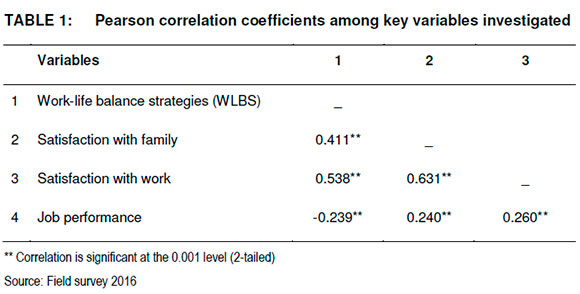
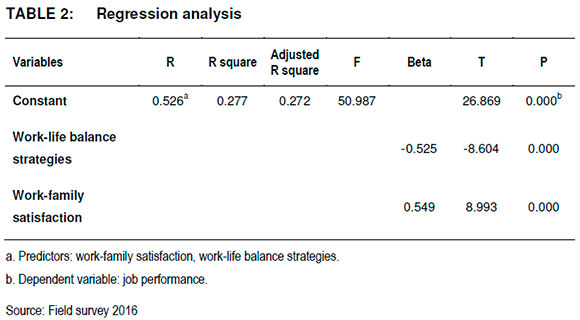
Achieving work-life balance and maintaining high levels of productivity among employees is one of the challenges facing managers in the Nigerian manufacturing sector. This study contributes to the work-family debate by investigating the relationship among work-life balance strategies, work-family satisfaction and employees' job performance. A quantitative research design was adopted by engaging the principle of correlational approach. The correlational approach is necessary in establishing the association between work-life balance strategies and employees' job performance in the manufacturing sector. Simple random sampling technique was adopted in administering 304 questionnaires to employees of two manufacturing firms within Lagos metropolis. The Pearson's correlation coefficient was used to test the link between the variables. The researchers used multiple regression analysis in displaying the influence of work-life balance strategies and work-family satisfaction on employees' work outcomes in the manufacturing industry. It was found that work-life balance strategies and work-family satisfaction significantly predict employees' job performance at selected manufacturing firms in Nigeria. The managerial relevance of the current study was drawn from the statistical inverse relationship between work-life balance strategies and employees' work outcomes in the Nigerian manufacturing industry.
employees' performance; family satisfaction; work-life balance strategies; work satisfaction