The effective implementation of cloud computing through project management: Conceptual framework
Abstract
Organisations are interested in implementing cloud computing (CC) services, as these services are purported to enable Information Technology (IT) to become efficient and effective. However, CC brings new complexities, risks and implications into IT projects. The objective of this study is two-fold: to determine whether CC projects are significantly different from traditional IT projects and to develop a conceptual framework to effectively manage the implementation of CC projects. More specifically, the study evaluated project complexities brought about by CC, and explored the project management knowledge area and approaches required to implement CC. The literature review revealed that CC contributes to the complexity of projects and there are 18 core CC project complexity factors which are key to the successful implementation of CC projects. Apart from these 18 factors, there are 78 other factors which are important for both cloud and traditional IT projects which need to be looked at. Secondly, it is vital to understand which project management knowledge subjects are key to successfully implement cloud projects. Five (5) key knowledge areas have been identified that are linked to the complexity factors. Finally, it is suggested that an agile approach be used when implementing CC projects.
CC; computing project complexity; IT project complexity; knowledge area; project approach and project management
1. INTRODUCTION
Cloud computing is a new information technology trend (El-Gazzar, Hustad & Olsen 2016) and the foundation of the Fourth Industrial Revolution (Roblek, Meško & Krapež 2016). As defined by Mell and Grance (2011), CC provides people and organisations with on-demand and scalable solutions with minimal management. Organisations are interested in implementing CC services because of the benefits which come with cloud computing (Almubarak 2017; El-Gazzar et al. 2016; Ristov, Gusev & Kostoska 2012; Rosenthal, Mork, Li, Stanford, Koester & Reynolds 2010; Zhang, Cheng & Boutaba 2010). Cloud computing are made available through paying for what has been used. This is known as the pay-as-you-use model as it uses the concept of utility computing (Armbrust, Fox, Griffith, Joseph, Katz, Konwinski, Lee, Patterson, Rabkin, Stoica & Zaharia 2010). Cloud computing also offers great benefits to IT organisations by allowing them to focus on their core business and other business-related tasks (such as innovation and value creation) other than software and hardware administration and maintenance (Buyya, Yeo, & Venugopal 2008; Subramanian & Jeyaraj 2018). Cloud computing is cost-effective (e.g. no maintenance, support and licensing cost) and flexible. Mostly no capital expenses are required but only operating expenses, and it is less complex and easy to implement. Most importantly, IT organisations implement CC because CC providers have the required IT skills to maintain IT infrastructure and services.
According to El-Gazzar et al. (2016) and Stendal and Westin (2018), the implementation of CC is still relatively new and that current project management best practices are not yet adapted or developed in relation to managing it. There are still relatively few references describing how to manage CC projects (Wang, Wood, Abdul-Rahman & Lee 2016; Conway & Curry 2012) and whether CC projects should be treated different from traditional IT projects. According to Stendal and Westin (2018), CC implementations suffer from little focus from the research community. El-Gazzar et al. (2016) state that CC still "lack of both knowledge and empirical evidence about which issues are most significance for cloud computing adoption decisions". Due to these identified gaps, there is a need to determine whether CC projects differ significantly from traditional IT projects to be classified as a special type of IT project. This is done through the understanding of the factors that influence CC projects from the perspective of project complexity, project management knowledge areas and project management approaches.
Based on this identified gap and problem, the three (3) research questions for this study were:
1. What are CC project complexity factors?
2. What project management elements are earmarked to address CC project implementation?
3. How are CC project complexity factors integrated with current project management elements earmarked to enable effective CC implementation processes?
To answer these research questions, a conceptual framework is proposed for CC project implementation. Firstly, the concepts of CC, IT project complexity and CC project complexity are presented and linked to derive the concept of CC project complexity. Secondly, the concept of project management standards and project approach are examined in relation to CC. Thirdly, CC project complexity, project management and project approach concepts are conceptualised to enhance the implementation of CC projects. Finally, the key findings, managerial implications and conclusions of the study are presented.
2.1 Cloud computing
The goal of this section is to gain an understanding of the concept of CC. The definition, characteristics, services, deployment, benefits and challenges of CC are discussed. Cloud computing is an IT trend and the foundation of the Fourth Industrial Revolution (Marnewick & Marnewick 2020a; Marnewick & Marnewick 2020b; World Economic Forum 2016). Information technology resources (computing, storage, network and software) are provided and consumed through the internet as a pay-as-you-use service (Mell & Grance 2011; Leavitt 2009; Vaquero, Rodero-Merino, Caceres & Lindner 2008). The main difference between CC and traditional IT is in the ownership, delivery and maintenance of IT resources. In traditional IT, the IT resources are owned, installed and delivered within the premises and networks of the organisation (Accorsi 2011; Wang et al. 2016). In this instance, organisations are responsible for the maintenance of these IT resources. With CC, the organisations do not own and maintain IT resources; they only request what they need and pay only for what they have consumed. In this case, IT resources are owned and maintained by CC providers.
There are several definitions of CC. Buyya et al. (2008) define it as "type of parallel and distributed system consisting of a collection of inter-connected and virtualized computers that are dynamically provisioned and presented as one or more unified computing resource(s) based on service-level agreements established through negotiation between the service provider and consumers". For the purpose of this article, the definition by Mell and Grance (2011) is adopted. They state that CC is "a model for enabling convenient, on-demand network access to a shared pool of configurable computing resources (e.g. networks, servers, storage, applications, and services) that can be rapidly provisioned and released with minimal management effort or service provider interaction. This cloud model promotes availability and is composed of five essential characteristics, three delivery models, and four deployment models". In addition to the preceding definition, the focus is on delivery and deployment models of CC.
The characteristics of CC (Buyya et al. 2008; Mell & Grance 2011; Rosenthal et al. 2010) are as follows:
• On-demand self-service: The organisation can access computing resources automatically as needed without support from the service provider. It can access CC capabilities over the internet using heterogeneous standard mechanisms such as a mobile phone, laptop, tablet and other devices.
• Broad network access: The provider can serve and share computing capabilities with multiple organisations, without the knowledge of the organisation about the location from where the computing capabilities are served (Marston, Li, Bandyopadhyay, Zhang & Ghalsasi 2011; Mell & Grance 2011; Rosenthal et al. 2010).
• Rapid provisioning/elasticity: This refers to the ability to elastically provide and release computing capabilities, depending on the resource demand. Rapid provisioning helps the organisation predict their future demand requirements in advance. Resources are automatically added or removed as and when required (Marston et al. 2011; Mell & Grance 2011; Rosenthal et al. 2010).
• Pay-as-you-use: Organisations pay for computing capabilities as they use them; there is no upfront payment for resources. The positive part of pay-as-you-use is that organisations do not have high capital costs to purchase computing services (Marston et al. 2011; Mell & Grance 2011; Rosenthal et al. 2010).
Generally, within normal IT projects, the solution or product is deployed in a traditional data centre that is managed by the organisation. Within the CC environment, various services are available that influences the deployment of the solution or product and is deployed on the service provider's infrastructure.
2.2 Cloud computing models
There are three (3) major CC models, namely Software as a Service (SaaS), Infrastructure as a Service (laaS) and Platform as a Service (PaaS) (Subashini & Kavitha 2011).
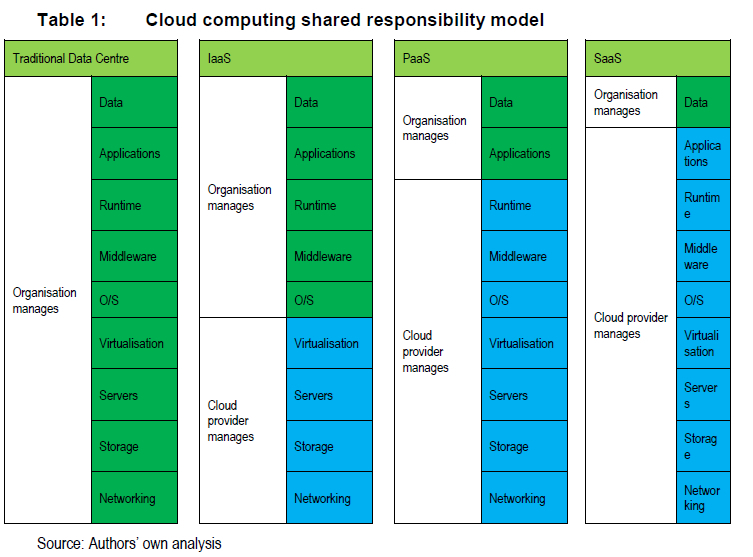
• With SaaS, cloud providers are responsible for the full stack of cloud services from infrastructure, platform to software/application layers (Mell & Grance 2011; Leavitt 2009; Vaquero et al. 2008). The consumer is responsible for the secure access to the applications and their data.
• IaaS enables the consumer to use computing powers, network and storage as a service. The consumer is responsible for operating systems (O/S), databases and applications installed on this infrastructure, and administer and secure access to these infrastructure resources ( Leavitt 2009; Mell & Grance 2011; Vaquero et al. 2008).
• For PaaS, the cloud providers are responsible for the underlying infrastructure and platforms such as databases, application development and middleware applications, which will enable the consumers to use them to develop and create applications.
The CC models are distinguished in terms of what the organisations and cloud provider manage as shown in Table 1.
Apart from deciding on the CC model, a decision must be made on the deployment model that is most suitable for the organisation.
2.3 Cloud computing deployment models
There are five (5) main cloud deployment models which are used by organisations:
1. Private cloud: All cloud services are maintained and managed by the single organisation. There is no sharing of resources and responsibilities with other organisations (Leavitt 2009; Mell & Grance 2011; Vaquero et al. 2008). There is substantial investment in terms of capital, skillset and effort required for the organisation to build up the private cloud ( Dawoud, Takouna & Meinel 2010; Wang et al. 2016).
2. Public cloud: Cloud services are hosted and controlled by cloud providers. The organisation has the option to maintain and manage some of the cloud services, such as operating systems, databases and others. Public cloud services are cheaper but security is a concern because resources are shared among organisations (Mell & Grance 2011).
3. Hybrid cloud: This is a mix of public and private CC because the organisations use the public and private CC services at the same time.
4. Community cloud: This is a type of CC which is shared by different organisations with the same objectives, shared purpose and responsibilities (Mell & Grance 2011).
5. Cloud@customer: This is a deployment model where the external cloud provider, such as Oracle, Amazon Web Services and Microsoft Azure, will put their cloud infrastructure in the organisation's data centre. The cloud provider will manage and maintain the cloud environment on behalf of the organisation (Mueller 2019).
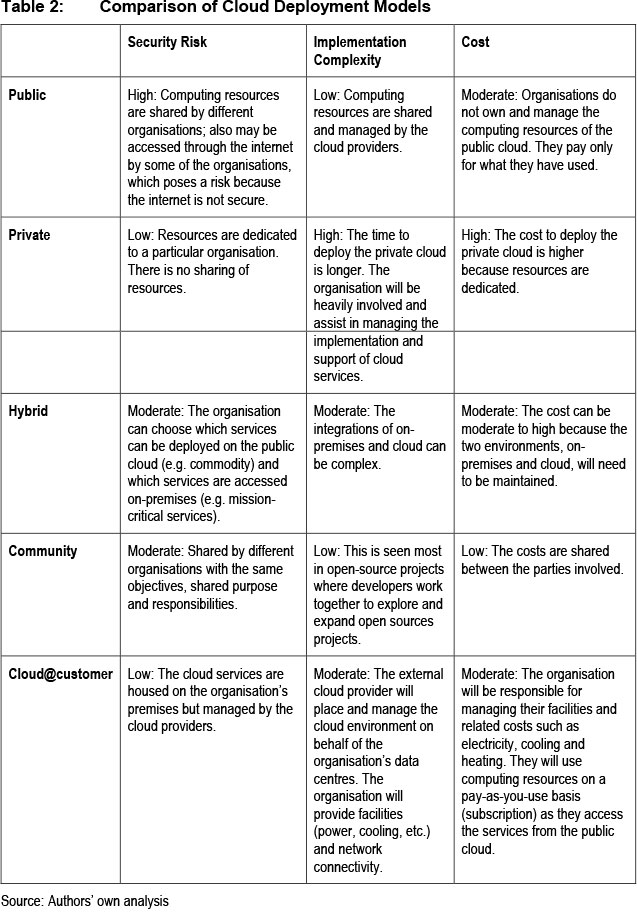
A comparison based on security risk, implementation complexity and cost between the CC deployment models are shown in Table 2.
2.4 CC benefits and challenges
Cloud computing makes it easy for organisations to immediately access and use IT resources with low cost of entry. This is possible because these organisations do not have to buy expensive IT infrastructure and own data centres. In addition, CC does not require upfront capital to purchase the IT resources as organisations pay only for the IT resources they consume. The procurement cycle and deployment of IT resources is shorter. All these benefits enable businesses to enter the market faster and become competitive. Due to its elasticity, CC also enables organisations to deal with unpredictable peak demand for IT resources. It releases organisations from day-to-day IT resource administration and maintenance and enables them to focus on their core business to drive business value (Armbrust et al. 2010; Marston et al. 2011; Wang et al. 2016). Security is one of the biggest challenges for organisations in adopting CC. Organisations are concerned about their data privacy in the cloud, the locations where their data is stored and how they will be audited on the cloud. They feel they have lost control of their IT resources and data because these are stored away in the cloud. As to the distributed nature of the cloud, the regulatory requirements and compliance across countries is also a challenge (Subramanian & Jeyaraj 2018).
Tatikonda and Rosenthal (2000) refer to project complexity as relating to the uniqueness and novelty of the product or service, including its development process, performance objectives and interdependence in terms of its technological advancement and difficulty. According to this definition, CC qualifies as a complex project due to its novelty, interdependence in terms of its technological advancement and difficulty. This is confirmed by Hür Bersam and Gül Tekin (2019), stating that Industry 4.0, which CC is a part of, brings complexity and uncertainty. This also means that a CC project is inherently an IT project. Therefore, before the complexity brought about by CC projects can be understood, it is important to explore and understand the complexity brought about by IT projects.
2.5 IT project complexity
Complexity is a well-researched area in project management (Botchkarev & Finnigan 2015; Daniels & LaMarsh 2007; Murray 2002; Wallace, Keil & Rai 2004; Whitney & Daniels 2013; Xia & Lee 2004). Project complexity is defined by Baccarini (1996) as "consisting of many varied interrelated parts and can be operationalised in terms of differentiation and interdependency'. Baccarini (1996) further indicates that this definition of project complexity is applicable to any type of project. Wood and Ashton (2010) define project complexity as a "single or a combination of factors that affect the responses/actions taken to achieve the project outcomes". Tatikonda and Rosenthal (2000) refer to project complexity as relating to the uniqueness and novelty of the product or service, including its development process, performance objectives and interdependence in terms of its technological advancement and difficulty. (Lu, Luo, Wang, Le & Shi 2015) define project complexity as "consisting of many varied interrelated parts, and ... dynamic and emerging features".
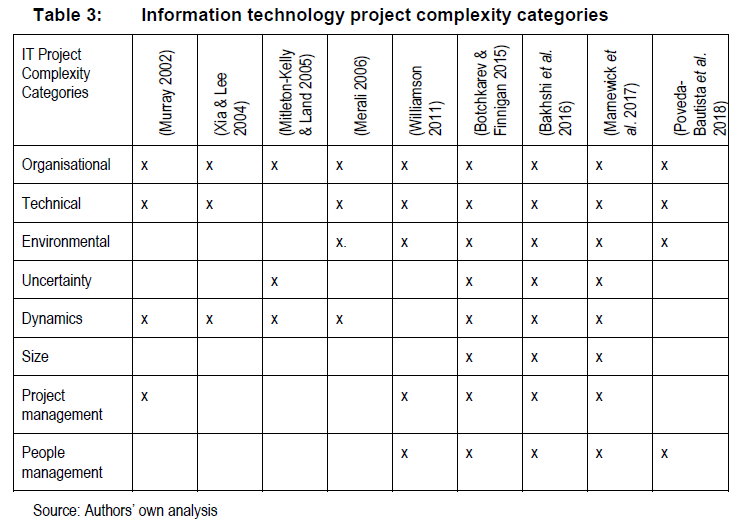
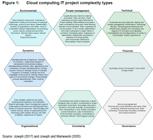
Based on an extensive literature review, IT project complexity can be categorised into (i) organisational, (ii) technical, (iii) uncertainty, (iv) size, (v) project management itself, (vi) people management, (vii) environmental and (viii) dynamics (Bakhshi, Ireland & Gorod 2016; Botchkarev & Finnigan 2015; Marnewick, Erasmus & Joseph 2017; Merali 2006; Mitleton-Kelly & Land 2005; Murray 2002; Poveda-Bautista, Diego-Mas & Leon-Medina 2018; Williamson 2011; Xia & Lee 2004).
• Organisational complexity deals with and consists of factors which affect the organisation at large, such as organisational parts, structure, units and the changes brought about by their related factors (Bakhshi et al. 2016; Botchkarev & Finnigan 2015; Marnewick et al. 2017; Mitleton-Kelly & Land 2005; Poveda-Bautista et al. 2018; Williamson 2011; Xia & Lee 2004; Murray 2002).
• Technical complexity deals with factors dealing with technology and its related processes (Bakhshi et al. 2016; Botchkarev & Finnigan 2015; Marnewick et al. 2017; Merali 2006; Murray 2002; Poveda-Bautista et al. 2018; Williamson 2011; Xia & Lee 2004).
• Environmental complexity deals with the context in which projects are executed, which includes economic, social and legal factors (Botchkarev & Finnigan 2015; Marnewick et al. 2017; Mell & Grance 2011; Merali 2006; Poveda-Bautista et al. 2018; Williamson
2011; Xia & Lee 2004).
• Uncertainty involves the current and future states of different areas of the project factors which can be difficult to predict. It is about the present and the future: triple constraints, activity, goals, technology, stakeholders, among others (Bakhshi et al. 2016; Botchkarev & Finnigan 2015; Marnewick et al. 2017; Mitleton-Kelly & Land 2005).
• Dynamics is about project change management, i.e. the changes both internal and external to the project (Bakhshi et al. 2016; Botchkarev & Finnigan 2015; Marnewick et
al. 2017; Merali 2006; Mitleton-Kelly & Land 2005; Murray 2002; Xia & Lee 2004).
• Size deals with the number and significance/magnitude of all project-related factors (Bakhshi et al. 2016; Botchkarev & Finnigan 2015; Marnewick et al. 2017).
• Project management complexity per se deals with all project-related factors such as scheduling, scoping, methods, tools and techniques (Bakhshi et al. 2016; Botchkarev & Finnigan 2015; Marnewick et al. 2017; Murray 2002; Williamson 2011;).
• People management involves all the people-related factors which affect the project (Bakhshi et al. 2016; Botchkarev & Finnigan 2015; Poveda-Bautista et al. 2018; Marnewick et al. 2017; Williamson 2011).
Table 3 shows the various IT project complexity categories.
2.6 Cloud computing project complexity as a sub-set of information technology
2.6.1 Project complexity
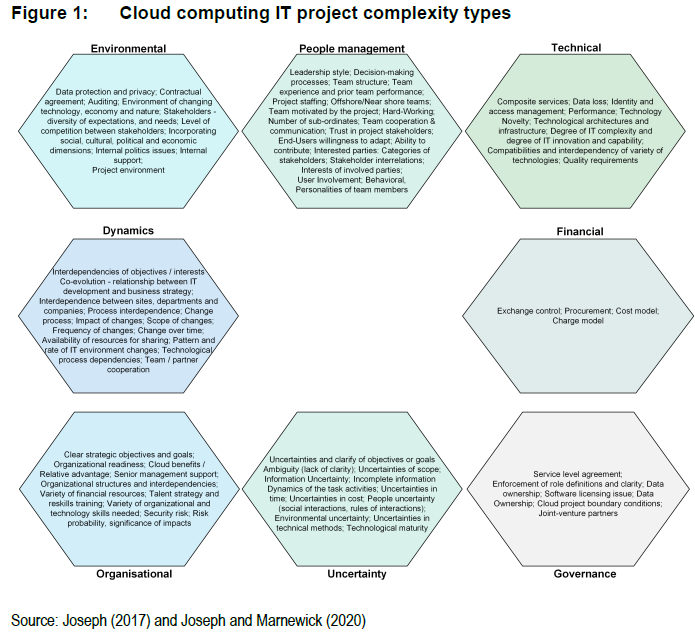
To realise the benefits of CC and to mitigate the risks associated with it, it is important to determine whether CC projects should be managed differently from traditional IT projects. The literature shows that there are specific CC project complexities which can be categorised as organisational, financial, governance, compliance, legal and technical project (Akar & Mardiyan 2016; Almubarak 2017; El-Gazzar et al. 2016; Rai, Sahoo & Mehfuz 2015). Cloud computing projects by default would inherit IT project complexities. Cloud computing project complexity categories are therefore incorporated into IT project complexity categories to create a full list of CC project complexity categories. The full, consolidated CC project complexity categories are organisational, financial, governance, technical, environmental, uncertainty, dynamics and people management.
The full details of the CC project complexity categories and its associated 97 factors are indicated in Figure 1.
As CC is still relatively new, current project management best practices are not yet adopted or developed to manage CC projects (El-Gazzar et al. 2016; Stendal & Westin 2018). There are multiple references which detail CC in terms of its capabilities, characteristics, benefits and architecture, but there are still relatively few references describing how to manage CC projects (Conway & Curry 2012; Wang et al. 2016). Current project management references are not ready and prepared to be regarded as a solution to managing CC projects in terms of transitioning from on-premises to the cloud (Wang et al. 2016). For this reason, project management will be explored in the next section.
2.6.2 Project management
The overall goal of this section is to explore the project management knowledge and skills required to implement CC. The PMBOK Guide (Project Management Institute 2017) defines project management as "the application of knowledge, skills, tools, and techniques to project activities to meet the project requirements". In the literature on project management, two themes and their relationships are found to be critical when managing projects, namely the adoption and application of (i) project approaches and (ii) project management standards and methodologies (Iivari, Hirschheim & Klein 2000; Project Management Institute 2017; Zandhuis & Stellingwerf 2013;).
• Project management approach: This approach is defined as the principles and guidelines of defining the manner in which a project should be managed (Iivari et al. 2000; Introna & Whitley 1997). The choice of approach is important because it helps to structure and organise the project work. This will help to choose the approach's associated life cycle to match the approach. These approaches range from highly predictive methods where there are assumptions that the knowledge about the context is known, to those approaches where the environment is highly adaptive, uncertain and volatile (Kuruppuarachchi, Mandal & Smith 2002). Waterfall and Agile approaches are the most popular. Agile is more focused on adaptation and innovation than the Waterfall approach, which is focused on prediction and control (Cockburn & Highsmith 2001; Vinekar, Slinkman & Nerur 2006).
Project management standards and methodologies: Vukomanović, Young and Huynink (2016) describe a standard as a "document, established by consensus and approved by a recognised body, which provides for common and repeated use, rules, guidelines or characteristics for activities or their results, aimed at the achievement of the optimum degree of order in a given context". The Project Management Institute defines a standard as "a formal document that describes established norms, methods, processes, and practices" (Project Management Institute 2017). Even though it is reported that standards are rarely used within project management (Ahlemann, Teuteberg & Vogelsang 2009), they are perceived as contributing to project success and improving communication within the project environment because they harmonise the terminology and the understandings of processes and methods (Vukomanović et al. 2016; Grau 2013).
3. RESEARCH METHODOLOGY
The literature review provided the basis for the development of the conceptual CC project management framework. This study followed a theoretical (non-empirical) approach proposed by Mayring (2014). More specifically, a systematic literature review was conducted with the aim to identify the current state of empirical research in respect of cloud computing projects. Systematic literature reviews are inductive in nature and, according to Mayring (2014), an important criterion to assess the quality of the review.
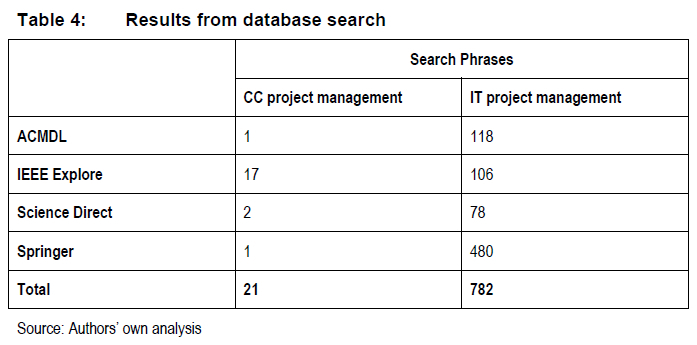
A comprehensive and well-integrated literature Review is essential to any study (Blumberg, Cooper & Schindler 2008; Flick 2014). Such a review provides a good understanding of issues and debates in the area of research, current theoretical thinking and definitions, as well as previous studies and their results. Cloud computing has become an important research topic in recent years. A systematic search process was conducted on four databases that have a specific focus on information technology as well as project management. The search focused on all published journal fitting the search criteria as per Table 4.
The results from Table 4 highlight that limited research has been done on CC project management in relation to IT project management.
• In each relevant reviewed article, the process of identifying the key concepts in the text was followed by marking and underlying the relevant information needed.
• A spread sheet for systematically recording information from the reviewed literature was created by ensuring that all information was relevant to answer the research question.
• The recorded information was linked to the research questions to establish the relationship between different concepts in order to make sense of them.
These processes were used to develop the conceptual framework.
4. DEVELOPING THE CONCEPTUAL FRAMEWORK
In this section, the proposed conceptual framework is presented. The conceptual framework formulated in this study links CC project complexities, the project management knowledge areas and the project approach.
4.1 Cloud computing project complexity and knowledge areas
Project management standards and methodologies (PMBOK Guide, ISO, APM, P2M, AIPM and PRINCE2) provide insight into the various knowledge areas (Akar & Mardiyan 2016; Ohara 2005; Zandhuis & Stellingwerf 2013). Project management knowledge areas are business case, integration management, scope management, schedule management, cost management, risk management, quality management, communication management, stakeholder management and procurement management.
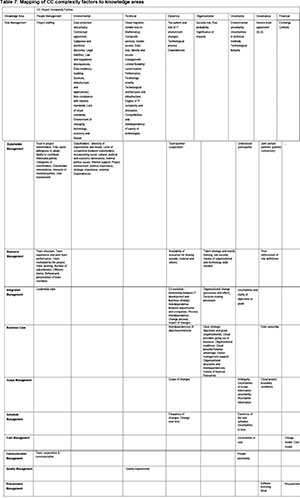
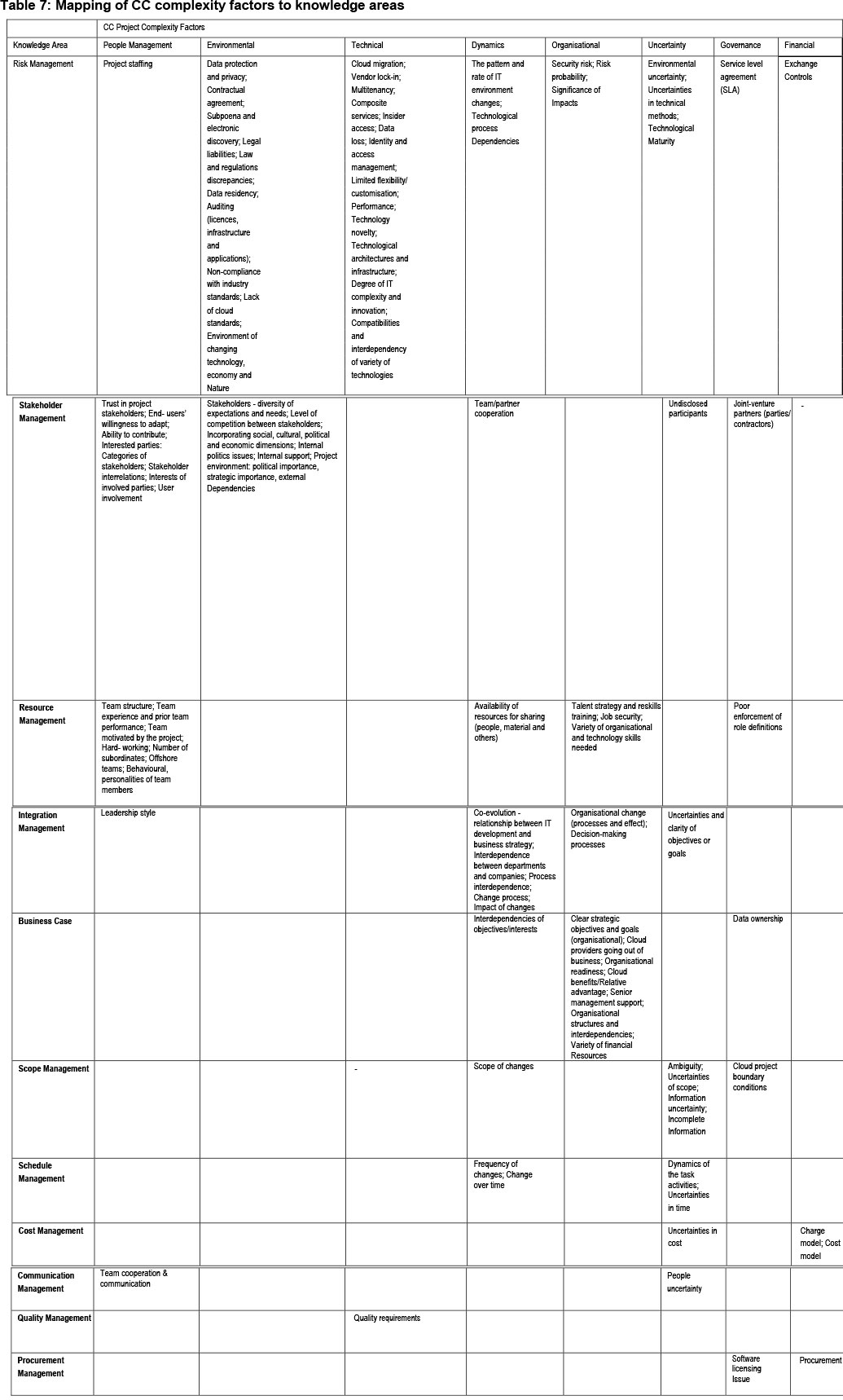
In Table 7 (Annexure A), CC project complexity factors are mapped to their respective knowledge areas. The mapping was done by determining which CC project complexity factors are related to each of the knowledge areas. For example, all the CC project complexity factors involving stakeholders are mapped to stakeholder management. The aim was to determine how CC project complexity factors can integrate with project management knowledge areas to be used to address CC. It shows that all project complexity factors are applicable to all the knowledge areas. In cases where the block intersecting between CC project complexity category and knowledge area is empty, this means that no relationship was established
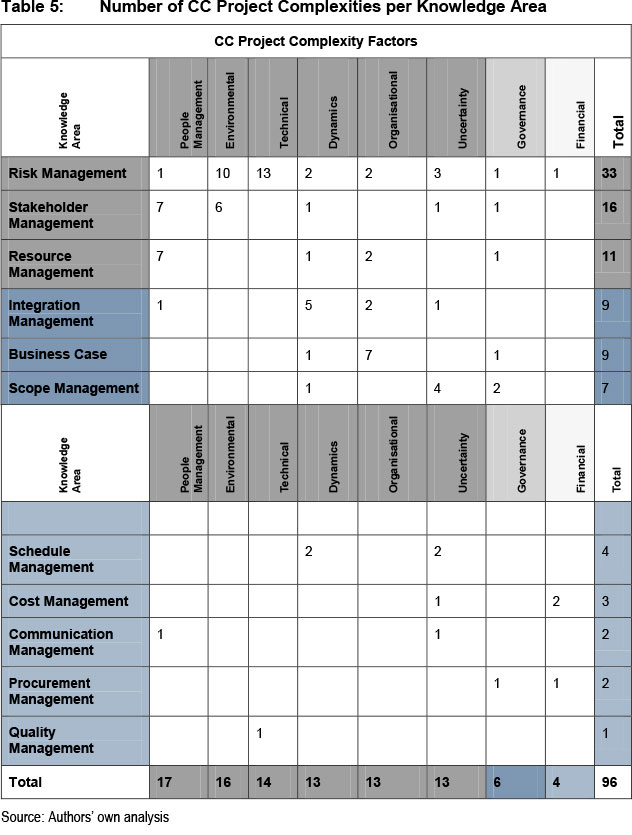
Table 5 summarises the number of CC project complexity category factors in each of the respective knowledge areas.
Environmental, people management, technical, dynamics, organisational and uncertainity CC project complexity categories are extremely important categories, given the higher number of project complexity factors they each have. The governance category is regarded as of high importance due to its number of project complexity factors, and the financial category is regarded as moderately important due to a lower number of project complexity factors.
Risk management, stakeholder management, resource management and intregation management are extremely important knowledge areas which project teams need to give attention to because of the higher number of CC project complexity factors related to them. Risk management's focus should be on technical and environmental project complexity risks. Stakeholder management's focus is on people management and enviromental project complexity factors. Resource management should focus more attention on people management project complexity factors. Integration management should focus more on dynamics project complexity factors.
Buisiness case and scope management are very important given the high number of associated project factors. The business case should focus on organisational project complexity factors. Scope management should focus on uncertainty and governance complexity factors. Schedule, cost, communication, quality and procurement management are moderately important, given the lower number of project complexity factors each has. Schedule should focus on uncertainity and dynamics project complexity factors. Cost management should focus on financial and uncertainty project complexity factors. Communication management should focus on people management and uncertainty project complexity factors. Quality management should focus on technical complexity factors, whereas procurement management should focus on governance project complexity factors.
4.2 Project approach and process groups
The relationship between process groups and project approach is explained in this section. Process groups are repeated in each of the project life cycle phases. Every phase may have initiating, planning, executing and closing process groups, whereas monitoring and controlling is a continuous process group. The application of these process groups is dependent on the size of the project and organisational context (Kuruppuarachchi et al. 2002; Project Management Institute 2017)
The project phases are performed within the project life cycle as part of the project approach. The project life cycle helps to show the beginning and the end of the project. Project phases can vary and have several phases depending on the industry or the choice of project approach (Agile and/or Waterfall) the organisation adopts (Iivari et al. 2000; Kuruppuarachchi et al. 2002). Examples of project phases are conception, requirements gathering, planning, analysis, design, implementation, testing, deployment and maintenance. Each phase has deliverables (Tatikonda & Rosenthal 2000).
Project life cycles describe the processes for project delivery. There are three (3) project life cycles (Cockburn & Highsmith 2001; Kuruppuarachchi et al. 2002):
• Predictive linear (plan driven): Project management uses the predictive linear life cycle when the project requirements (scope), cost and time are known in advance and easily predictable. The phases of this life cycle can be sequential or overlapping from planning, analysis and design and implementation phases. It bears the most stable products and is easier to manage.
• Iterative/incremental approach: Like the predictive life cycle, the phases can be sequential. But the requirements are not unknown in advance and defined in detail. This life cycle repeats phases, in iterations, and each iteration completes all the project phases, namely planning, analysis, design and implementation phases.
• Adaptive (change-driven): This is different from the iterative approach because the iteration slots, called sprints, are kept shorter.
4.3 Proposed theoretical Cloud Computing Project Management Framework
It has been established that a CC project can be perceived and managed as a special type of IT project. This implies two (2) aspects. The first aspect is that a CC project inherit all the characteristics and complexities of an IT project. The second aspect is that a CC project is also different from a traditional IT project and that there are specific characteristics that sets the management of a CC project apart from the management of a traditional IT project.
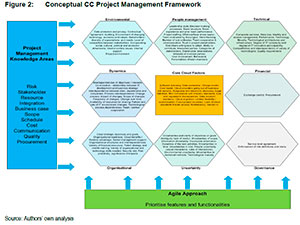
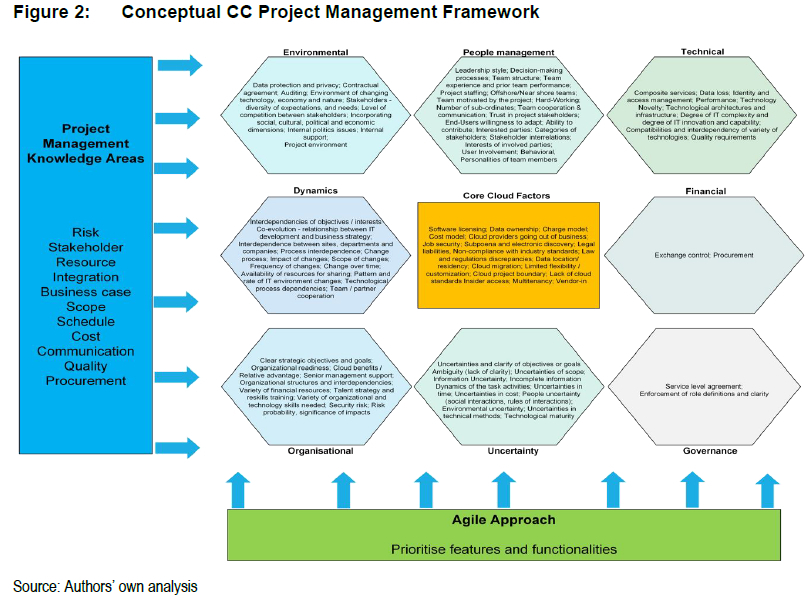
Figure 2 (Annexure B) shows the proposed theoretical CC project management framework. It is essential to consider all the components of the framework during CC projects. The omission or underestimation of any one component can cause the CC project to be unsuccessful.
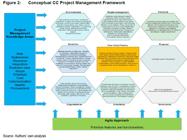
The best approach to implement a CC project is an agile approach. An agile approach allows for the various iterations and various changes to the final solution and product. Only five knowledge areas are specifically applicable to a CC project as per Figure 2 (Annexure B). Of the various complexity factors, only 14 are specific to a CC project ranging from data ownership to legal liabilities.
It is important for the project manager and the team to consider and understand all the CC project complexity categories - most importantly, how they will affect the project and how they will be mitigated. It is important to take into account the organisational context and the industry in which the organisation operates when applying the CC project complexity categories into knowledge areas.
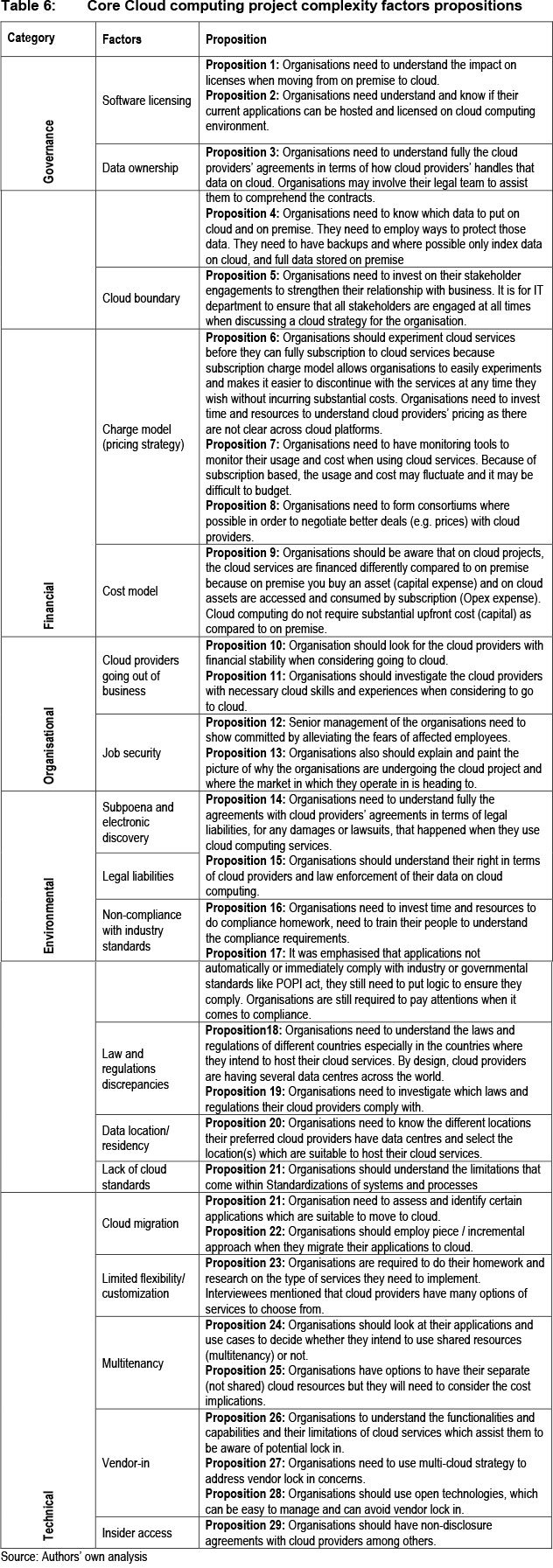
The following propositions are made with regards to the core cloud computing project complexity factors as shown in Table 6.
5. DISCUSSION AND FINDINGS
Cloud computing projects can be managed as traditional IT projects but it opens then the door for potential failures. CC projects are very specific IT projects and should be managed as such.
Project managers and project teams should know and understand CC project complexities to implement CC effectively. It is critical to address organisational, financial, governance, environmental and technical project complexity categories when implementing a CC project.
It is important not to study these project complexity factors and their associated risks in isolation because their integration is vital.
Although all the knowledge areas are important, project managers implementing CC solutions should focus on the knowledge areas of risk, cost, procurement and resource management. The business case for a CC project should clearly address the needs of such a project and how it addresses the organisational strategies.
More attention needs to be given to environmental (including legal and compliance issues), people management and technical CC project complexities, because from literature it appears that they have the most project complexity factors to consider. Risk management, stakeholder management and resource management are the areas which are important for project teams to focus on because most CC project complexity factors are related to these areas. It is also recommended that organisations embrace Agile as the preferred project approach when implementing CC projects, irrespective of the type and nature of the project. It is important to ensure that all the risks relating to project complexity factors are identified, mitigated and addressed throughout the project.
The developed conceptual framework shows that it can be used as a guide to manage CC projects by organisations, IT project managers and IT professionals.
This study identified the key project complexity factors influencing the implementation of CC projects. The findings can guide organisations to make better decisions in this regard. For academia, this study adds to the knowledge in the field of CC and project management. Researchers can depend on this study's results when conducting new studies and applying new theories in these fields.
6. MANAGERIAL IMPLICATIONS
The conceptual framework derived in this study enables IT project managers and other senior management to focus on the key CC project complexity factors. This conceptual framework also helps to determine the key CC project complexities, project management and project approach required to achieve the project objectives. These criteria, once followed, will bring about project success in a CC project context.
7. CONCLUSION
In conclusion, the reviewed literature provides an understanding of CC project complexity as well as the required project management knowledge areas to manage cloud projects. A conceptual framework is proposed that should be used to manage cloud projects in order to improve adoption of CC by organisations. The conceptual framework was developed based on the various concepts as highlighted by the literature review. These concepts include project complexity factors, the project management knowledge areas as well as the different implementation approaches. This framework suggests that project management knowledge areas should be applied to CC project IT complexity factors to ensure that all the risks relating to them are identified, mitigated and addressed throughout the project. An Agile project approach should be adopted to cater for the iterative nature of cloud computing implementations. However, further validation of the conceptual framework is required through data collection from both the private and public sectors. The main idea is to achieve validity by interviewing project managers and IT professionals with experience in implementing CC projects.
REFERENCES
2. LITERATURE REVIEW
- ACCORSI R. 2011. Business process as a service: Chances for remote auditing. 35th Annual Computer Software and Applications Conference Workshops. Munich, Germany: IEEE. (DOI:10.1109/COMPSACW.2011.73.
-
)
» https://doi.org/10.1016/j.ijproman.2008.01.009 -
)
» https://www.researchgate.net/deref/http%3A%2F%2Fdx.doi.org%2F10.14569%2FIJACSA.2017.080107 -
AKAR E & MARDIYAN S. 2016. Analyzing Factors Affecting the Adoption of Cloud Computing: A Case of Turkey. KSII Transactions on Internet and Information Systems 10(1). (DOI:10.3837/tiis.2016.01.002.
» https://doi.org/10.3837/tiis.2016.01.002 -
)
» http://dx.doi.org/10.1016/0263-7863(95)00093-3 - )
-
ARMBRUST M, FOX A, GRIFFITH R, JOSEPH AD, KATZ R, KONWINSKI A, LEE G, PATTERSON D, RABKIN A, STOICA I & ZAHARIA M. 2010. A view of cloud computing. Communications of the ACM. (DOI:http://doi.acm.org/10.1145/1721654.1721672.
» http://doi.acm.org/10.1145/1721654.1721672 - )
- )
-
BAKHSHI J, IRELAND V & GOROD A. 2016. Clarifying the project complexity construct: Past, present and future. International Journal of Project Management 34(7):1199-1213. (DOI:http://dx.doi.org/10.1016/j.ijproman.2016.06.002.
» http://dx.doi.org/10.1016/j.ijproman.2016.06.002 - )
-
BOTCHKAREV A & FINNIGAN P. 2015. Complexity in the Context of Systems Approach to Project Management. Organisational Project Management 2(1):15-34. (DOI:10.5130/opm.v2i 1.4272.
» https://doi.org/10.5130/opm.v2i 1.4272 - )
-
)
» https://doi.org/10.1108/09593849710166147 -
COCKBURN A & HIGHSMITH J. 2001. Agile software development, the people factor. Computer 34(11):131-133. (DOI:10.1109/2.963450.
» https://doi.org/10.1109/2.963450 -
)
» https://digitalcommons.kennesaw.edu/ajis/vol12/iss2/2 -
)
» https://doi.org/10.1109/MC.2009.20 - DANIELS CB & LAMARSH WJ. 2007. Complexity as a cause of failure in information technology project management. 2007 IEEE International Conference on System of Systems Engineering. San Antonio, TX, USA: IEEE.
-
)
» http://dx.doi.org/10.35683/jcm19095.59 -
EL-GAZZAR R, HUSTAD E & OLSEN DH. 2016. Understanding cloud computing adoption issues: A Delphi study approach. Journal of Systems and Software 118:64-84. (DOI:https://doi.org/10.1016/j.jss.2016.04.061.
» https://doi.org/10.1016/j.jss.2016.04.061 -
)
» https://www.ssoar.info/ssoar/bitstream/handle/document/39517/ssoar-2014-mayring-Qualitative_content_analysis_theoretical_foundation.pdf - FLICK U. 2014. An Introduction to Qualitative Research. London: SAGE Publications Ltd.
-
GRAU N. 2013. Standards and Excellence in Project Management - In Who Do We Trust? Procedia - Social and Behavioural Sciences 74:10-20. (DOI:10.1016/j.sbspro.2013.03.005.
» https://doi.org/10.1016/j.sbspro.2013.03.005 -
)
» https://www.oracle.com/a/ocom/docs/constellation-on-gen-2-exacc-fr.pdf -
IIVARI J, HIRSCHHEIM R & KLEIN HK. 2000. A dynamic framework for classifying information systems development methodologies and approaches. Journal of Management Information Systems 17(3):179-218. (DOI:https://doi.org/10.1080/07421222.2000.11045656.
» https://doi.org/10.1080/07421222.2000.11045656 - )
-
)
» https://doi.org/10.5121/ijnsa.2012.420675 -
JOSEPH N. 2017. Conceptualising a multidimensional model of information communication and technology project complexity. South African Journal of Information Management 19(1):1-19. (DOI:10.4102/sajim.v19i1.825.
» https://doi.org/10.4102/sajim.v19i1.825 -
)
» https://doi.org/10.1016/j.jbi.2009.08.014 -
]
» https://doi.org/10.1016/j.jnca.2010.07.006 -
KURUPPUARACHCHI PR, MANDAL P & SMITH R. 2002. IT project implementation strategies for effective changes: a critical review. Logistics Information Management 15(2):126-137. (DOI:https://doi.org/10.1108/09576050210414006.
» https://doi.org/10.1108/09576050210414006 -
)
» https://doi.org/10.1109/17.820727 -
)
» https://doi.org/10.1201/1078.10580530/46108.23.3.20060601/93705.4 -
LU Y, LUO L, WANG H, LE Y & SHI Q. 2015. Measurement model of project complexity for large-scale projects from task and organization perspective. International Journal of Project Management 33(3):610-622. (DOI:https://doi.org/10.1016/j.ijproman.2014.12.005.
» https://doi.org/10.1016/j.ijproman.2014.12.005 -
)
» https://doi.org/10.1111/j.00117315.2004.02059.x -
MARNEWICK AL & MARNEWICK C. 2020a. The Ability of Project Managers to Implement Industry 4.0-Related Projects. IEEE Access 8(1):314-324. (DOI:10.1109/ACCESS.2019.2961678.
» https://doi.org/10.1109/ACCESS.2019.2961678 -
)
» https://doi.org/10.1016/j.procs.2013.09.280 - MARNEWICK C, ERASMUS W & JOSEPH N. 2017. The symbiosis between information system project complexity and information system project success, Cape Town, South Africa: AOSIS (Pty) Ltd.
-
)
» https://doi.org/10.1145/986213.986215 -
MARSTON S, LI Z, BANDYOPADHYAY S, ZHANG J & GHALSASI A. 2011. Cloud computing-The business perspective. Decision Support Systems 51(1):176-189. (DOI:https://doi.org/10.1016/j.dss.2010.12.006.
» https://doi.org/10.1016/j.dss.2010.12.006 -
)
» https://doi.org/10.1007/s13174-010-0007-6 - ]
- MELL P & GRANCE T. 2011. The NIST definition of cloud computing. NIST special publication. Gaithersburg, Maryland: National Institute of Standards and Technology.
-
MERALI Y. 2006. Complexity and Information Systems: the emergent domain. Journal of Information Technology 21(4):216-228. (DOI:https://doi.org/10.1057/palgrave.jit.2000081.
» https://doi.org/10.1057/palgrave.jit.2000081 - )
- MITLETON-KELLY E & LAND F. 2005. Complexity & information systems. In: DAVIS GB (ed). Blackwell Encyclopedia of Management 2nd (ed). Oxford, United Kingdom: Blackwell Publishing Ltd.
- ]
- MURRAY J. 2002. Reducing IT project complexity. In: TINNIRELLO PC (ed.) New Directions in Project Management. Boca Raton, Florida: CRC Press. (pp 435-446.
- )
-
OHARA S. 2005. P2M: A Guidebook of Project & Program Management for Enterprise Innovation. Project Management Association of Japan. [Internet:https://www.pmaj.or.jp/ENG/p2m/p2m_guide/p2m_guide.html; downloaded on 22 October 2020.
» https://www.pmaj.or.jp/ENG/p2m/p2m_guide/p2m_guide.html - ]
-
POVEDA-BAUTISTA R, DIEGO-MAS JA & LEON-MEDINA D. 2018. Measuring the project management complexity: the case of information technology projects. Hindawi. (DOI:https://doi.org/10.1155/2018/6058480.
» https://doi.org/10.1155/2018/6058480 - )
-
RAI R, SAHOO G & MEHFUZ S. 2015. Exploring the factors influencing the cloud computing adoption: a systematic study on cloud migration. SpringerPlus 4:1-12. (DOI:https://doi.org/10.1186/s40064-015-0962-2.
» https://doi.org/10.1186/s40064-015-0962-2 - )
- )
-
ROBLEK V, Meško M & Krapež A. 2016. A Complex View of Industry 4.0. SAGE Open 6(2):1-11. (DOI:10.1177/2158244016653987.
» https://doi.org/10.1177/2158244016653987 - )
- )
-
STENDAL K & WESTIN S. 2018. Implementing cloud based big data platforms - a case using Microsoft Azure. NOKOBIT 26(1):1-14. [Internet:https://ojs.bibsys.no/index.php/Nokobit/article/view/545; downloaded on 21 October 2020.
» https://ojs.bibsys.no/index.php/Nokobit/article/view/545 - ]
- )
-
SUBRAMANIAN N & JEYARAJ A. 2018. Recent security challenges in cloud computing. Computers & Electrical Engineering 71:28-42. (DOI:https://doi.org/10.1016/j.compeleceng.2018.06.006.
» https://doi.org/10.1016/j.compeleceng.2018.06.006 - )
- )
-
VAQUERO LM, RODERO-MERINO L, CACERES J & LINDNER M. 2008. A break in the clouds: towards a cloud definition. ACM SIGCOMM Computer Communication Review 39(1):50-55. (DOI:https://doi.org/10.1145/1496091.1496100.
» https://doi.org/10.1145/1496091.1496100 - )
- )
-
VUKOMANOVIĆ M, YOUNG M & HUYNINK S. 2016. IPMA ICB 4.0 - A global standard for project, programme and portfolio management competences. International Journal of Project Management 34(8):1703-1705. (DOI:http://dx.doi.org/10.1016/j.ijproman.2016.09.011.
» http://dx.doi.org/10.1016/j.ijproman.2016.09.011 - )
- )
-
WANG C, WOOD LC, ABDUL-RAHMAN H & LEE YT. 2016. When traditional information technology project managers encounter the cloud: Opportunities and dilemmas in the transition to cloud services. International Journal of Project Management 34(3):371-388. (DOI:http://dx.doi.org/10.1016/j.ijproman.2015.11.006.
» http://dx.doi.org/10.1016/j.ijproman.2015.11.006 - )
- )
- WILLIAMSON DJ. 2011. A correlational study assessing the relationships among information technology project complexity, project complication, and project success. Capella University, Minneapolis. (Ph.D.
- )
- WOOD H & ASHTON P. 2010. The factors of project complexity. Salford, United Kingdom: CIB. (18th CIB World Building Congress.
- )
-
WORLD ECONOMIC FORUM. 2016.The Future of Jobs: Employment, Skills and Workforce Strategy for the Fourth Industrial Revolution. (Internet:http://www3.weforum.org/docs/WEF_Future_of_Jobs.pdf; downloaded on 22 January 2018.
» http://www3.weforum.org/docs/WEF_Future_of_Jobs.pdf - )
- )
- ZANDHUIS A & STELLINGWERF R. 2013. ISO 21500 Guidance on Project Management: A Pocket Guide, Saltbommel, Netherlands: Van Haren Publishing.