Essential leadership competencies for navigating the future of higher education
Abstract
PURPOSE OF THE STUDY: The objective of this study was to develop a "Leadership Effectiveness" Scale to determine the effectiveness of leadership at higher education institutions in the 2020s and beyond. DESIGN/METHODOLOGY/APPROACH: A quantitative, cross-sectional survey research design within a positivist paradigm was used. The data were collected using a self-developed questionnaire with a six-point Likert-type scale. The sample comprised 482 employees from the University of Cape Coast (UCC), the Kwame Nkrumah University of Science and Technology (KNUST), the University of Health and Allied Sciences (UHAS), and the University of Education, Winneba (UEW). 386 participants completed the Leadership Effectiveness questionnaire, providing a response rate of 80%. FINDINGS: Exploratory factor analysis identified a three-construct measurement model for leadership effectiveness: supervision and staff development, interpersonal relationships, and vision and goal orientation. The confirmatory factor analysis supported the exploratory factor analysis, but 15 items with low factor loadings among the initial 42 were discarded from the SEM model. The results indicated that the Leadership Effectiveness scale is reliable and valid for measuring leadership effectiveness at higher education institutions. RECOMMENDATIONS/VALUE: The findings add to the existing knowledge of leadership effectiveness in higher education, specifically in the unique context of Ghanaian public universities, where bureaucratic and hierarchical leadership styles pose distinct challenges for educational institutions. MANAGERIAL IMPLICATIONS: This study highlighted leaders' vision and goal orientation, supervision and staff development, and interpersonal relationships as critical factors that define leadership effectiveness at educational institutions. The Leadership Effectiveness scale developed in this study can be used to assess leadership effectiveness in higher education institutions. JEL CLASSIFICATION: M10.
Goals and orientation; higher education institutions; inter-personal relationship; leadership scale; staff development; supervision; vision
1. INTRODUCTION
Higher education institutions grapple with leadership issues such as financial sustainability, promoting diversity and equity, integrating technology, embracing digital transformation, and appointing suitable leaders who can implement effective governance structures to promote accountability and transparency. To navigate these challenges requires the evolution from traditional leadership to strong leadership that is transparent and collaborative while remaining focused on the mission of higher education.
When leaders are appointed to public universities, their leadership potential is often not considered. Academic qualifications are often used as the main criterion for appointment. Criteria such as the leader's resilience (Smith & Brown, 2024), agility, and ability to navigate challenges such as pandemics, financial instability, and AI-driven transformations (Patel & Li, 2023) are seldom considered when making selection decisions (Anderson et al., 2018). The numerous responsibilities of higher education institutions require leaders who focus on critical domains to steer institutions towards excellence (Aleixo et al., 2018). Higher education institutions require leaders who can navigate challenges such as reduced subsidies, digitalisation, calls for diversity and equity, global competition, policy changes, and government demands for accountability. Effective leadership is thus critical. An instrument to measure leadership effectiveness in educational institutions specifically led to the development of the "Leadership Effectiveness" scale.
2.1 Definitions and concepts
Leadership is the ability to motivate others to achieve a common goal by moving in a specific direction (Qin et al., 2023). According to Denny (2023), leadership is far more than merely holding a position of power; it is about guiding and inspiring people to focus on the right things. Leaders shape the attitudes and aspirations of organisational members by setting clear visions and expectations (Men et al., 2020).
Qin et al. (2023) emphasise that leadership is an earned title and that individuals who assume leadership must actively demonstrate the key actions that define their role. Leaders should motivate followers by inspiring confidence and enthusiasm in their team members.
Additionally, effective leaders set personal goals that align with organisational objectives, thereby leading by example.
Another crucial aspect of leadership is showing commitment and enthusiasm. Leaders who are passionate about their roles create a work environment that fosters productivity and innovation (Gonçalves et al., 2024). They also establish clear goals for others, providing direction and purpose within the organisation. These leaders embrace agility as a strategic advantage (Nguyen & Carter, 2022).
An essential responsibility of leaders is to build an effectively functioning organisation. Zaccaro et al. (2018) highlight three fundamental leadership attributes that can help accomplish this. First, leaders must believe in themselves. Self-confidence enables them to take on new challenges and inspire others to do the same. Second, passion for the job is another key attribute. Leaders must exhibit the energy and focus necessary to drive the organisation forward. Their enthusiasm is contagious, boosting employees' morale and motivation. Finally, leaders must understand employees' needs to foster motivation. By recognising and addressing what drives team members, leaders can contribute to a work environment that values and empowers individuals.
Uy et al. (2024) identified three key qualities of an effective leader. First, leaders must be good communicators, ensuring that employees and stakeholders remain well-informed. Second, a leader must possess self-awareness and awareness of team members, recognising individual strengths, weaknesses, and personal interests to optimise team performance. A study by Cohen (2022) cautioned against the Confidence-Competence dilemma and highlighted that while confident leaders inspire staff, overconfidence without actual competence leads to misguided decisions. Self-awareness is key to navigating this balance. Third, an effective leader must be able to delegate decision-making, enabling individuals to become part of the organisation's management process, thereby promoting a collaborative and dynamic work environment.
Beyond these qualities, leadership also involves self-leadership. Daud (2020) introduced the concept of self-influence, which enables leaders to enhance their personal effectiveness and, in turn, improve their ability to lead others. A leader's capacity for self-regulation, goal-setting, and discipline significantly impacts their ability to guide and inspire teams.
Leadership, therefore, is a dynamic and multifaceted process that extends beyond authority and control. It requires strong administrative capabilities, strategic planning, and people management skills (Bolden et al., 2021).
According to Niewiesk and Garrity-Rokous's (2020) leadership framework, leadership assessment should evaluate six key domains of competence: people recruitment and development; strategic planning and goal setting; ethical values and behaviour; knowledge of decision-making tools and models; organisational processes; and oversight to ensure alignment between expectations and performance. By assessing these competencies, higher education institutions can ensure that leaders are equipped to balance academic responsibilities with effective governance.
A structured leadership assessment framework also helps address the common misconception that expertise in an academic field translates into effective leadership. Administrators often underestimate the importance of well-defined structures and processes to support academic leaders (Niewiesk & Garrity-Rokous, 2020). Leadership assessment provides an evidence-based approach to developing leaders who integrate academic excellence with sound administrative practices. Concerning higher education, this is particularly important where leadership effectiveness impacts faculty engagement, student success, and institutional reputation.
Leadership assessment is vital in evaluating and promoting transformational leadership within academic institutions. Alzoraiki et al. (2024) emphasise that academic administrators and department heads function as transformational leaders by creating conducive academic environments and fostering collaboration among faculty members. Several studies support the positive relationship between organisational commitment of academics and transformational leadership (Keskes et al., 2018; Gillet & Vandenberghe, 2014; Anselmann & Mulder, 2020). Transformational leaders inspire faculty members, promote collaboration, and cultivate an environment conducive to innovation and academic excellence. By assessing leadership effectiveness through established frameworks, institutions can identify and nurture leaders who possess these transformational qualities.
Higher education institutions face ongoing challenges, including faculty turnover, policy changes, and evolving academic demands (Verma & Kaur, 2024). Systematic leadership assessment allows institutions to identify emerging leaders, provide targeted leadership training, and ensure continuity in leadership roles (Abdullah & Haroon, 2024). It also promotes accountability, as leaders are evaluated against objective criteria aligned with institutional goals. In essence, leadership assessment is a critical tool for enhancing the effectiveness of higher education institutions.
2.2 Leadership competencies
Leadership competencies in higher education are vital for navigating the complex challenges faced by educational institutions. Earlier studies outlined various leadership competencies that organisations require. According to Goleman (1995), emotional awareness is key to fostering positive relationships. Day (2000) outlined the importance of leaders' self-development and dedication towards lifelong learning as key to adapting to changing circumstances. Garrick (2002) focused on communication as a key leadership competency, stating that leaders should be able to articulate organisational goals and engage in open communication. A study by Kezar and Eckel (2004) identified visionary leadership as key to driving transformation. Avolio and Bass (2004) emphasised the importance of strategic thinking and decision-making skills in managing resources and ensuring organisational sustainability. Kezar (2005) outlined the importance of collaboration as a critical leadership competency in fostering organisational change. Northouse (2016) highlighted the significance of ethical leadership in fostering an environment of trust and transparency. Nguyen and Carter (2022) outlined the importance of leaders' resilience and agility to promote lifelong learning post-pandemic. Patel and Li (2023) focused on higher education and how AI-driven developments influence leaders' roles in preparing the workforce for AI integration. This study aimed to determine how leadership effectiveness is defined in higher education by developing a Leadership Effectiveness scale.
3. METHODOLOGY
3.1 Measure development procedure
This study employed a quantitative, cross-sectional survey research design and a self-developed questionnaire distributed to a representative sample of participants. After reviewing the literature on leadership effectiveness in higher education institutions, it was evident that no existing questionnaire addressed this study's aims. As a result, a questionnaire called Leadership Effectiveness was developed. The questionnaire items were generated based on a review of relevant literature and aligned with the study's objective. The draft questionnaire was submitted to a panel of three subject matter experts - two academics specialising in Human Resource Management and one senior manager in Administration. The experts reviewed each item for clarity and wording, relevance to the research objectives, and appropriateness for the study. After receiving recommendations from the experts, the questionnaire was finalised. The final questionnaire was pilot tested before proceeding with the full-fledged study (Leedy & Ormrod, 2015).
The questionnaire used a Likert-type scale (1 = strongly disagree; 6 = strongly agree). To ensure the reliability of the measuring instrument, Cronbach's alpha coefficient (developed by Cronbach in 1951) was used. According to Pallant (2011), a reliability coefficient of 0.7 or higher is generally considered sufficient. Factors 1 to 5 exceeded the predetermined reliability threshold (0.70).
3.2 Participants and research setting
A sample from the population of four universities in Ghana was invited to participate. The sample size was determined by using the following formula:
ny = N/(1 + N*e2).
where; ny = required sample size
N = total population under study (10,890)
e = alpha level /margin of error, which is assumed as 0.05
Four hundred and eighty-two questionnaires were distributed, and 386 responses were received, yielding an 80% response rate, which was considered excellent for data analysis. Respondents were categorised based on gender, age, educational level, and job role. The University of South Africa's research ethics committee (2021_HRM_008) provided ethical approval. Participants provided informed consent and completed the survey online. The data was protected with passwords and stored in a secure, locked location.
Eligible participants included permanently employed academic and administrative staff members at the four universities. A stratified sampling method was used to ensure that the four public universities and various demographic groups (gender, age, educational level, job category, and job grade) were representative of the population. Regarding gender, males made up 60.6% of the total sample. Most respondents (19.2%) were in the 18-25 age group, while the least represented group was employees aged 56-60 (1.8%). Regarding educational qualifications, 33.1% of the respondents held postgraduate degrees, followed by graduates (30%) and undergraduates (25%). Concerning job grade, 44.5% were academic senior staff, while 55.5% were administrative staff.
3.3 Measuring instrument
The Leadership Effectiveness questionnaire consisted of 42 items. The items were designed to reflect situations in a higher education institution setting and required respondents to comment on their experiences with leadership at their institution. Three factors emerged as critical to leadership effectiveness: the leader's vision and goal orientation, interpersonal relationships, and supervision and staff development.
3.4 Data analysis
The Statistical Package for the Social Sciences (SPSS) version 22.0 (2013) was used to analyse the dataset. The Exploratory factor analysis (EFA) used Principal Axis Factoring as the extraction method, with Varimax rotation. The Kaiser-Meyer-Olkin (KMO) and Bartlett's tests (Bartlett, 1954) were used to determine the suitability of the data for factor analysis. KMO values above 0.70 are considered acceptable; 0.70-0.80 is average, 0.80-0.90 is good, and 0.90-1.00 is excellent. Though flawed, KMO values of 0.50-0.60 are still acceptable (Sharma, 1996). The results confirmed that the scale items were sufficiently correlated, and factors were identified based on Eigenvalues greater than 1.00. A factor loading cut-off of 0.50 was applied. Cronbach's alpha was used to assess the leadership measure's reliability, with a threshold of 0.70. Murphy and Davidshofer (1988) state that Cronbach values above 0.90 indicate high reliability, values between 0.80 and 0.90 are moderate, values between 0.70 and 0.80 are low, and values below 0.60 are unacceptable.
4. FINDINGS AND DISCUSSION
This section presents the study's findings. Descriptive statistics, EFA, and CFA are discussed to explore the Leadership Effectiveness Scale's underlying factor structure. Cronbach's alpha and composite reliability (CR) scores were examined to determine the scale's reliability, while the average variance extracted (AVE) and the Heterotrait-Monotrait (HTMT) ratio results were used to determine the validity of the scale.
4.1 Descriptive statistics of leadership effectiveness
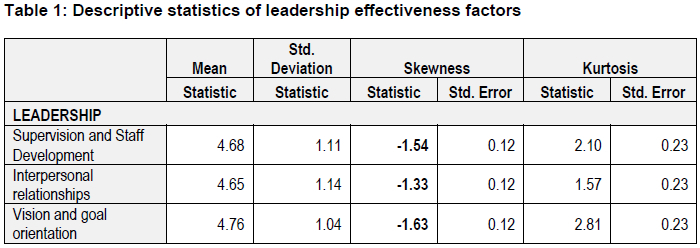
Descriptive statistics provide an overview of the distribution of responses for the identified leadership factors: supervision and staff development, interpersonal relationships, and vision and goal orientation. Table 1 presents the mean, standard deviation, skewness, and kurtosis for each factor.
All three factors have relatively high mean scores-Supervision and Staff Development (M = 4.68), Interpersonal Relationships (M = 4.65), and Vision and Goal Orientation (M = 4.76)-suggesting that respondents generally perceive leadership effectiveness positively across these dimensions. The standard deviation values range between 1.04 and 1.14. The lowest variability is observed for Vision and Goal Orientation (SD = 1.04), suggesting that respondents had a more consistent perception of this factor than of the others. In contrast, Interpersonal Relationships (SD = 1.14) exhibit the greatest variability, indicating a slightly broader range of responses.
The leadership effectiveness factors showed a leftward skew, indicating that most respondents rated them highly. Vision and Goal Orientation (-1.63) and Supervision and Staff Development (-1.54) exhibit the highest negative skewness, reinforcing the strong positive perception of leadership effectiveness in these areas. On the other hand, all three leadership effectiveness factors exhibit positive kurtosis values, meaning the distributions are leptokurtic or more peaked than a normal distribution. Vision and Goal Orientation (2.81) has the highest kurtosis, indicating a concentration of responses around the mean, while Interpersonal Relationships (1.57) has the lowest, suggesting slightly greater variability in responses. In general, data normality is confirmed by kurtosis and skewness values (Kline, 2016).
These descriptive statistics suggest that leadership in the studied higher education institutions is generally perceived as effective, particularly in Vision and Goal Orientation, which has the highest mean score. While still rated positively, Interpersonal Relationships show slightly greater variability in perceptions. The strong negative skew across all three factors indicates strong agreement on leadership effectiveness, with most respondents providing high ratings. The positive kurtosis values suggest that responses tend to cluster around the mean, particularly for Vision and Goal Orientation, reinforcing the consistency in positive perceptions of leadership effectiveness.
4.2 Exploratory factor analysis (EFA)
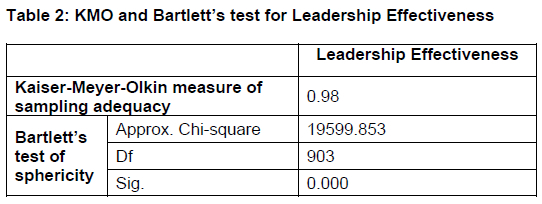
Table 2 presents the results to confirm the suitability of the data for factor analysis. The KMO measure of sampling adequacy was 0.98, well above the threshold of 0.60 (Kaiser, 1970). Bartlett's test of sphericity indicated a significance level of 0, which was below the threshold of p < .05 (Bartlett, 1954). Both the Bartlett's Test of Sphericity and the Kaiser-Olkin Measure of Sampling Adequacy results indicated that factor analyses were appropriate.
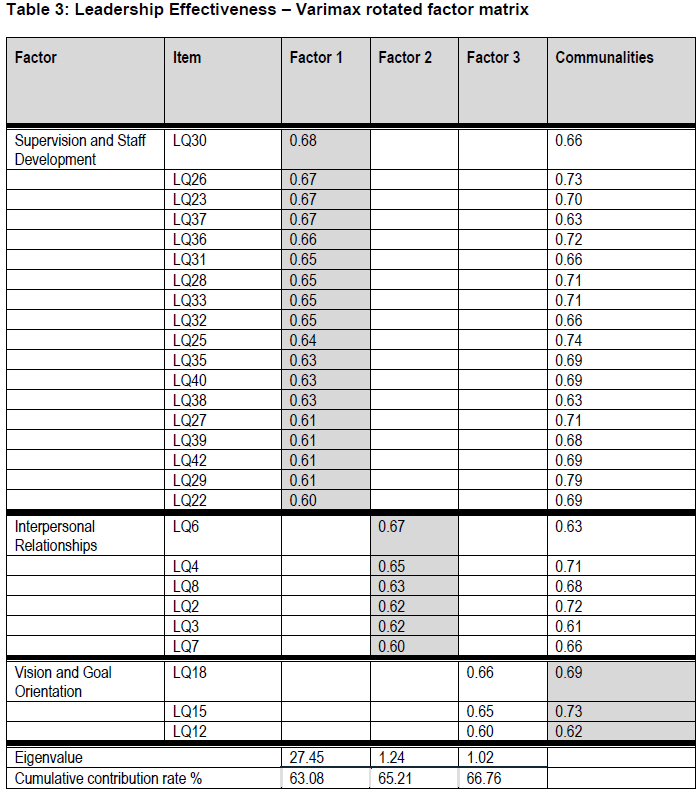
Of the original 42 leadership items, 15 had factor loadings below 0.6 and were discarded from further analysis. This reduction resulted in a final set of 27 items. The decision to remove these items was based on the need to simplify the scale, as each factor initially comprised numerous items.
Concerning the reliability of the factors, a coefficient alpha of 0.6 or more is acceptable (Bryman, 2012). The coefficients ranged between 0.93 and 0.98, which were above the 0.70 threshold set for the study and supported by Hair, Black, Babin, Anderson, and Tatham (2019). The following reliability scores were determined for each of the leadership factors:
• Supervision and Staff Development (21 items): α = 0.98
• Interpersonal Relationships (13 items): α = 0.95
• Vision and Goal Orientation (8 items): α = 0.93
Three factors with eigenvalues exceeding 1.0, which cumulatively explained 69.12% of the variance in leadership effectiveness, were identified by the principal-axis factor analysis. The factor loadings in the rotated factor matrix, as illustrated in Table 3, were analysed in line with the theory and used to identify the leadership effectiveness factors.
A KMO of 0.98 was obtained. All the factor loadings were equal to or greater than 0.60. The total variance was 66.76%. All the factors had Cronbach's alpha values > 0,70, indicating high internal consistency. The items discriminated sufficiently, with no item having an extreme score at the median, and all items had responses at all points. Overall, the results confirm the internal reliability of the leadership effectiveness factor structure, and practitioners and researchers can use the Leadership Effectiveness scale to assess leadership effectiveness at higher education institutions.
4.3 Confirmatory factor analysis
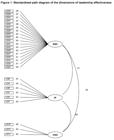
The AMOS version 26 software was used to conduct confirmatory factor analysis to determine the Leadership Effectiveness Scale's reliability and construct validity. The analysis assessed the measurement model fit and examined key validity indicators, including factor loadings, Cronbach's alpha values, average variance extracted (AVE), and the HTMT ratios.
Model fit was evaluated using several goodness-of-fit indices, including the Chi-square statistic (χ2), Tucker-Lewis Index (TLI), Comparative Fit Index (CFI), Root Mean Square Error of Approximation (RMSEA), and Standardised Root Mean Square Residual (SRMR). Factor loadings were examined to ensure that all items loaded significantly onto a specific construct, with a recommended threshold of 0.50 or higher (Hair et al., 2019).
Cronbach's alpha (α) and Composite Reliability (CR) values were computed to establish construct reliability. Cronbach's alpha was used to assess internal consistency, with values above 0.70 indicating acceptable reliability (Nunnally & Bernstein, 1994). Similarly, CR values above 0.70 indicate adequate reliability and provide a more suitable measure within the Structural Equation Modelling (SEM) framework, as it accounts for individual item factor loadings rather than assuming equal contributions (Raykov, 1997). While Cronbach's alpha provides a widely recognised benchmark, CR offers a more precise reliability estimate for latent constructs (Fornell & Larcker, 1981; Hair et al., 2019).
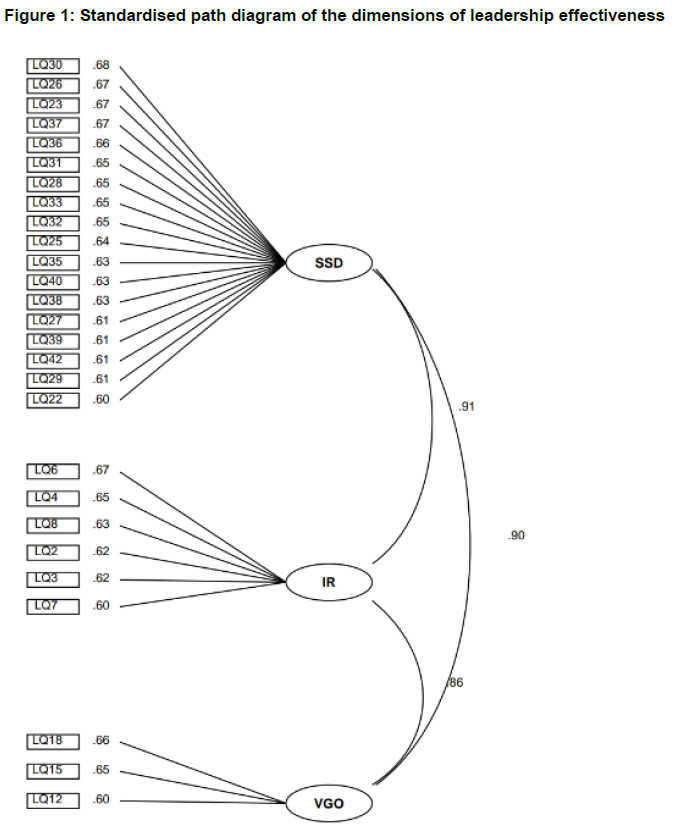
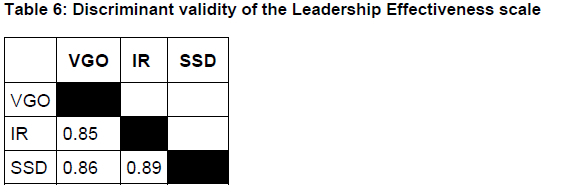
Discriminant and convergent validity were assessed to ensure the construct's structural validity. Discriminant validity was evaluated using the Heterotrait-Monotrait (HTMT) ratio of correlations, following the thresholds of 0.85 for strict and 0.90 for liberal validity. Convergent validity was assessed using Average Variance Extracted (AVE) values, with values above 0.50 indicating that each construct explained more than 50% of the variance in its indicators (Fornell & Larcker, 1981). The results of the HTMT analysis indicated that the constructs met the discriminant validity criteria, with HTMT values of 0.85 (IR and VGO), 0.86 (SSD and VGO), and 0.89 (SSD and IR), all of which remained within acceptable limits.
The refined factor structure was then subjected to Confirmatory Factor Analysis (CFA) for validation. Of the 42 items, 15 were eliminated because their factor loadings were below 0.6. Some of these items also had low communalities, indicating that they did not share sufficient variance with their respective factors and contributed weakly to the overall measurement structure. This adjustment enabled clearer identification of the underlying constructs and enhanced the reliability and validity of the measurement model. HTMT analysis assessed discriminant validity by examining the inter-construct correlations, ensuring the distinctness of each construct. The HTMT values were evaluated against the strict (0.85) and liberal (0.90) thresholds, confirming that the constructs maintained adequate discriminant validity. By adopting this approach, the study met requirements for construct validation, demonstrating that the leadership effectiveness construct showed strong internal consistency and discriminant validity, thereby supporting the robustness of the theoretical model (Hair et al., 2019). The CFA results provided empirical support for the three-factor leadership model: supervision and staff development, interpersonal relationships, and vision and goal orientation. The scale is thus valid and reliable for measuring leadership effectiveness at higher education institutions.
4.4 Model Fit indices for the Leadership Effectiveness scale
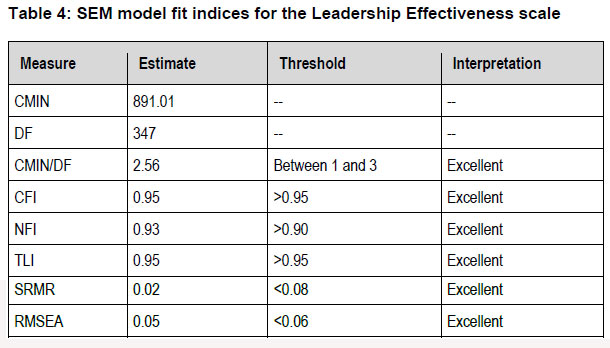
The model fit indices provide an overall evaluation of how well the leadership effectiveness scale's measurement model fits the observed data. The chi-square statistic (CMIN) of 891.01 with 347 degrees of freedom (DF) is significant, as expected given its sensitivity to sample size. To account for this limitation, the relative chi-square (CMIN/DF) is assessed, with a value of 2.56 falling within the required range of 1 to 3. This chi-square value confirms that the model adequately captures the data's underlying structure.
The Comparative Fit Index (CFI), Tucker-Lewis Index (TLI), and Normed Fit Index (NFI), which measure how well the proposed model fits relative to a null model, confirm the model's fit. The CFI value of 0.95, indicates a good fit and is at the commonly accepted benchmark of 0.95. Similarly, the NFI value of 0.93 exceeds the 0.90 benchmark, while the TLI value of 0.95 indicates good fit. These indices indicate that the specified factor structure represents the data reasonably well. The absolute fit indices, including the Standardized Root Mean Square Residual (SRMR) and the Root Mean Square Error of Approximation (RMSEA), offer additional insights into model performance. The SRMR value of 0.02 is well below the 0.08 threshold, indicating an excellent fit, suggesting minimal residual discrepancies between the observed and predicted covariance matrices. The RMSEA value of 0.05 is below the 0.06 threshold, indicating an excellent fit and that the model adequately approximates population-level data. The CMIN/DF ratio of 2.56 falls within the recommended range of 1 to 3, indicating an acceptable-to-good model fit. These fit indices demonstrate that the leadership effectiveness scale exhibits a good model fit as presented in Table 4.
4.5 Reliability and validity of the Leadership Effectiveness scale
The reliability and validity of the Leadership Effectiveness scale were assessed through multiple statistical measures to ensure the robustness of the leadership effectiveness scale used in this study.
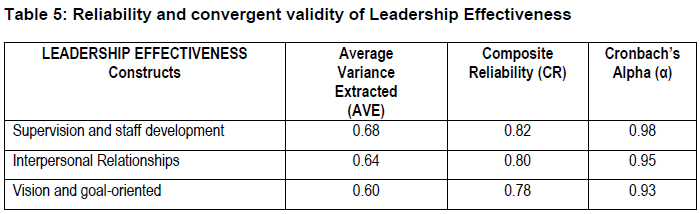
Reliability involves the internal consistency of the measurement scale, ensuring that all the items of a construct consistently measure the same concept. Cronbach's Alpha values above 0.70 are acceptable reliability indicators (Hair et al., 2019). The leadership effectiveness constructs indicated high reliability, with α values of 0.98 for Supervision and Staff Development (SSD), 0.95 for Interpersonal Relationship (IR), and 0.93 for Vision and Goal Orientation (VGO). These values suggest that the constructs have excellent internal consistency. Additionally, the CR values - 0.82 (SSD), 0.80 (IR), and 0.78 (VGO) - were above the recommended threshold of 0.70 (Fornell & Larcker, 1981), further confirming the reliability of the constructs.
Convergent validity ensures that the constructs' items are highly correlated and measure the same concept. Convergent validity was determined using Average Variance Extracted (AVE). The values were above 0.50, indicating that the construct explained more than 50% of the variance in its indicators. The AVE values for SSD (0.68), IR (0.64), and VGO (0.60) all exceeded this threshold, confirming that the leadership effectiveness constructs demonstrated strong convergent validity. This indicates that the items for each construct captured the intended leadership effectiveness dimensions.
Discriminant validity, conversely, focuses on the distinctiveness of each construct, indicating that each construct measures different aspects of leadership effectiveness. The HTMT ratio was used to assess discriminant validity, with thresholds set at 0.85 for strict validity and 0.90 for liberal validity (Henseler et al., 2015). As illustrated in Table 6, the HTMT values observed in the study were 0.85 (IR and VGO), 0.86 (SSD and VGO), and 0.89 (SSD and IR), all of which remained within acceptable limits. This confirms that the constructs are sufficiently distinct, demonstrating strong discriminant validity.
The high Cronbach's Alpha and CR values confirm that the Leadership Effectiveness scale exhibits strong internal consistency, while the AVE values establish convergent validity. Furthermore, the HTMT analysis validates the constructs' distinctiveness, reinforcing the scale's appropriateness for measuring the dimensions of leadership effectiveness. These findings indicate that the Leadership Effectiveness scale is theoretically sound and empirically robust, with strong reliability and validity.
Discriminant validity was assessed to determine whether the three dimensions of the Leadership Effectiveness scale-Vision and Goal-Oriented (VGO), Interpersonal Relationships (IR), and Supervision and Staff Development (SSD)-are sufficiently distinct from one another. The results are presented in Table 6.
The three dimensions of the Leadership Effectiveness scale demonstrate adequate discriminant validity, with the correlations among VGO, IR, and SSD remaining below the recommended threshold of 0.90. This suggests that the three constructs are related but sufficiently distinct from one another.
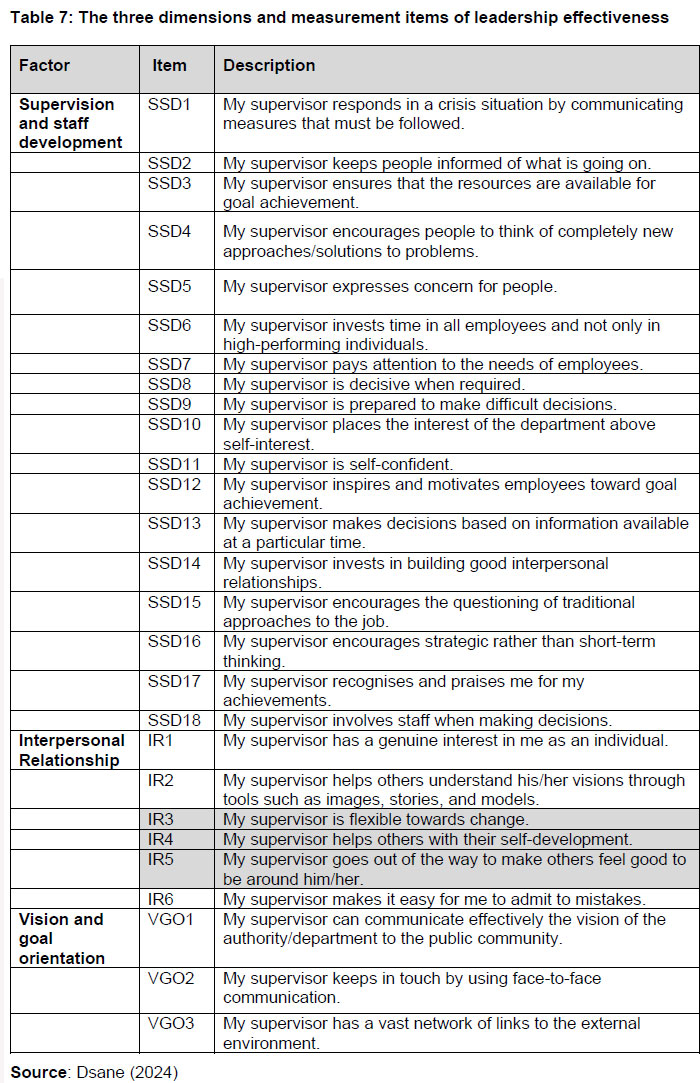
Table 7 presents the three dimensions and measurement items for leadership effectiveness in higher education institutions in Ghana.
5. DISCUSSION
The aim of the study was to develop a Leadership Effectiveness scale applicable in a higher education context. Exploratory and confirmatory factor analyses were conducted. The exploratory factor analysis revealed 3 leadership effectiveness factors: supervision and staff development, interpersonal relationships, and vision and goal orientation.
5.1 Supervision and staff development
Based on the validated scale, supervision and staff development in higher education institutions refer to the role of academic and administrative leaders in guiding, supporting, and enhancing staff performance and professional growth. Effective leaders ensure that employees are well-informed (Khan et al., 2020), equipped with the necessary resources (Norris et al., 2021), and supported in achieving institutional goals. During crises, a strong leader provides clear communication and decisive leadership, ensuring that measures are followed to maintain stability (Yukl, 2013). Additionally, leaders foster innovation (Jiang & Chen, 2018) by encouraging staff to explore new solutions and question traditional methods, thereby promoting a culture of continuous improvement. A good leader does not only focus on high-performing individuals but invests time in all employees, paying attention to their needs, concerns, and professional aspirations (Avolio & Bass, 2004).
Beyond operational management, leadership in higher education institutions is deeply connected to motivating (Tang, 2019), inspiring, and empowering staff (Bass & Riggio, 2006). A strong leader prioritises the department's interests over personal gain, makes difficult decisions when necessary, and demonstrates self-confidence in leadership. Recognising and praising achievements boosts morale and encourages commitment to institutional goals. Leaders play a crucial role in fostering strategic, long-term thinking rather than short-term fixes, ensuring the institution remains adaptive and progressive. Investing in interpersonal relationships and involving staff in decision-making enhances trust and collaboration, ultimately leading to a more engaged and high-performing academic and administrative workforce (Bryson, 2018; Bakker & Demerouti, 2017).
Furthermore, the validated scale indicates that interpersonal relationships in higher education institutions refer to the quality of interactions between supervisors and staff, characterised by trust (Tavanti, 2023), mutual respect (Covey, 1991), and support for professional and personal development (Llorente-Alonso et al., 2024). A leader who genuinely cares about employees as individuals fosters a sense of belonging and motivation within the institution. By actively supporting self-development and mentoring, leaders help faculty and administrative staff grow in their careers, enhancing their skills and contributions to the institution. Effective leaders communicate their visions and institutional goals in a relatable and engaging way, using tools such as stories, images, and models to ensure clarity and shared understanding. This ability to translate institutional vision into practical, relatable terms strengthens teamwork, aligns staff efforts with strategic goals, and fosters a culture of collaboration and purpose.
5.2 Interpersonal relationships
In addition, interpersonal relationships are strengthened by a leader's flexibility and emotional intelligence (Farihah et al., 2022). Higher education institutions operate in dynamic environments that require adaptability to new challenges, policies, and technological advancements. A leader who is open to change and responsive to employees' concerns creates a workplace where staff feel appreciated, heard, and empowered to embrace innovation. Furthermore, a culture of psychological safety, where mistakes are tolerated without fear of punishment, is crucial for continuous learning and institutional improvement. A leader who makes others feel good to be around them cultivates a positive work culture, ultimately contributing to higher job satisfaction, improved team performance, and a more cohesive academic environment.
5.3 Vision and goal orientation
Lastly, vision and goal orientation in higher education institutions refer to a leader's ability to articulate and drive the institution's strategic direction while fostering strong internal and external connections. An effective leader clearly communicates the institution's vision to staff and the broader public community, ensuring alignment with institutional goals (Dutta, 2020). This requires verbal clarity and engaging stakeholders through face-to-face communication, strengthening relationships, and building trust. Additionally, a leader with a broad network of external relationships can leverage partnerships, collaborations, and industry connections to accelerate institutional growth and innovation. Vision-oriented leaders create opportunities for resource mobilisation, knowledge exchange, and long-term institutional success by bridging the gap between the external environment and academia.
The exploratory factor analysis findings were confirmed by the confirmatory factor analysis and indicated that the Leadership Effectiveness scale is reliable and valid for measuring leadership effectiveness in Ghanaian educational institutions.
The staff at higher education institutions rated vision and goal orientation as the most important factors in leadership effectiveness. Consequently, leaders are seen as instrumental in setting clear goals and communicating a compelling vision. Aligning institutional objectives with leadership competencies is particularly valued, as it creates a sense of direction and purpose.
The results highlight the importance of interpersonal relationships, supervision, and staff development in shaping positive perceptions about leaders. Administrative and academic leaders who demonstrate concern for their staff, encourage open communication, and invest in professional growth contribute to a more cohesive and motivated workforce. Effective leadership in higher education goes beyond decision-making; it involves creating an environment that includes employees. With diverse student populations and greater calls for social justice, leaders must advocate inclusivity while driving innovation in learning models (e.g., blended learning and competency-based education) (Harding, 2016; Stefani, 2017).
6. IMPLICATIONS
6.1 Theoretical and practical implications
This study contributes to understanding leadership effectiveness within higher education institutions by highlighting key dimensions that administrative and academic leaders should focus on. It reinforces the significance of supervision and staff development, interpersonal relationships, and vision and goal orientation as critical factors that shape leadership effectiveness. The findings align with existing leadership theories such as transformational leadership, which emphasises motivation, inspiration, and professional development as key elements of effective leadership (Bass & Avolio, 1994). The study also supports the idea that leadership effectiveness in academic institutions extends beyond decision-making to the creation of a supportive and empowering work environment for faculty and administrative staff (Bryman, 2021).
From a practical viewpoint, the Leadership Effectiveness scale developed in this study provides a valuable instrument for assessing leadership effectiveness in higher education institutions. Human resource practitioners can use the scale to assess leadership effectiveness and align recruitment, selection, and development strategies with leadership effectiveness attributes identified in this study. Higher education institutions can create a more engaged and productive academic workforce by fostering leadership practices that promote vision-driven decision-making, supervision, staff development, and strong interpersonal relationships.
6.2 Managerial implications
From a managerial perspective, the Leadership Effectiveness Scale can be used by University administrators and policymakers to evaluate leadership strengths and identify areas for improvement. The findings emphasise the importance of investing in leadership development programmes focusing on communication, staff support, and strategic decision-making. Institutions can incorporate these insights into training initiatives to enhance leaders' ability to motivate, support, and guide their teams effectively.
7. CONCLUSION
This study advanced the understanding of leadership effectiveness in higher education institutions by identifying three key dimensions: supervision and staff development, interpersonal relationships, and vision and goal orientation. The findings suggest that leaders' effectiveness is strongly evaluated on their ability to articulate a clear vision and pursue set goals. These insights underscore the necessity to redefine leadership roles in educational institutions. The scale developed in this study offers a robust tool for assessing leadership effectiveness and holds practical value for HR practices in the recruitment, appointment, and development of leaders in educational institutions.
7.1 Contribution of the study
This study provides an empirically validated tool to measure leadership effectiveness by incorporating higher education context-specific factors. The development of the scale further refines leadership constructs and clarifies which dimensions are most critical for effective leadership at educational institutions. The developed scale also offers a foundation for future research to examine the relationships between leadership effectiveness and outcomes such as institutional performance, improved organisational culture, and organisational identification.
7.2 Limitations and recommendations
Despite this study's contributions, several limitations were identified. First, the study employed a quantitative approach using a questionnaire, which, while effective for gathering structured data, may have limited the depth of responses. A mixed-methods approach, including interviews or focus groups, could have provided richer insights into leadership effectiveness by capturing participants' lived experiences and contextual nuances. Future research could incorporate objective leadership assessments or multi-source feedback, such as supervisor and peer evaluations, to enhance the robustness of findings. The questionnaire can be improved by adding items related to vision and goal orientation, such as developing a clear vision, engaging employees in pursuing the vision, setting clear milestones, allocating resources, and celebrating progress.
Second, the study was conducted within four higher education institutions in Ghana, which may limit the generalisability of the results to other universities or educational settings with different organisational cultures, leadership structures, or socio-political contexts.
Future studies could include a broader range of institutions and adopt longitudinal designs to assess how leadership effectiveness evolves over time, rather than relying solely on cross-sectional data.
Conflict of interest: The authors declare no conflict of interest with respect to the research, authorship, and publication of the article.
Data availability: The authors of this manuscript can be contacted for the data.
Ethical clearance and informed consent statement: The researchers obtained ethical clearance (2021_HRM_008) prior to data collection and obtained informed consent from all participants in this study.
Funding: The authors did not receive any financial support for research, authorship, and publication of the article.
REFERENCES
2. LITERATURE REVIEW
-
Abdullah, N. S. S., & Haroon, H. A. (2024). Assessing leadership capabilities: A systematic profiling approach in higher education. Paper presented at the Association of Southeast Asian Institutions of Higher Learning (ASAIHL) Conference 2024, Juntendo University, Tokyo, Japan. https://apps.crossref.org/SimpleTextQuery
» https://apps.crossref.org/SimpleTextQuery -
Aleixo, A. M., Leal, S., & Azeiteiro, U. M. (2018). Conceptualization of sustainable higher education institutions, roles, barriers, and challenges for sustainability: An exploratory study in Portugal. Journal of Cleaner Production, 172, 1664-1673. https://doi.org/10.1016/j.jclepro.2016.11.010
» https://doi.org/10.1016/j.jclepro.2016.11.010 -
Alzoraiki, M., Ahmad, A. R., Ateeq, A., & Milhem, M. (2024). The role of transformational leadership in enhancing school culture and teaching performance in Yemeni public schools. Frontiers in Education, 9, Article 1413607. https://doi.org/10.3389/feduc.2024.1413607
» https://doi.org/10.3389/feduc.2024.1413607 -
Anderson, E., Winn, K. M., Young, M. D., Groth, C., Korach, S., Pounder, D., & Rorrer, A. K. (2018). Examining university leadership preparation: An analysis of program attributes and practices. Journal of Research on Leadership Education, 13(4), 375-397. https://doi.org/10.1177/1942775117735873
» https://doi.org/10.1177/1942775117735873 -
Anselmann, V., & Mulder, R. H. (2020). Transformational leadership, knowledge sharing and reflection, and work teams' performance: A structural equation modelling analysis. Journal of Nursing Management, 28(7), 1627-1634. https://doi.org/10.1111/jonm.13118
» https://doi.org/10.1111/jonm.13118 - Avolio, B. J., & Bass, B. M. (2004). Multifactor Leadership Questionnaire: Manual and Sampler Set. 3rd ed. Menlo Park, USA: Mind Garden.
-
Bakker, A. B., & Demerouti, E. (2017). Job demands-resources theory: Taking stock and looking forward. Journal of Occupational Health Psychology, 22(3), 309. https://doi.org/10.1037/ocp0000056
» https://doi.org/10.1037/ocp0000056 -
Bartlett, M. (1954). A note on the multiplying factors for various chi square approximations. Journal of the Royal Statistical Society, 16 (Series, 296-298). https://doi.org/10.1111/j.2517-6161.1954.tb00174.x
» https://doi.org/10.1111/j.2517-6161.1954.tb00174.x - Bass, B. M., & Avolio, B. J. (Eds.). (1994). Improving organizational effectiveness through transformational leadership. Thousand Oaks, CA: Sage Publications
-
Bass, B. M., & Riggio, R. E. (2006). Transformational leadership. 2nd ed. New York: Psychology Press. https://doi.org/10.4324/9781410617095
» https://doi.org/10.4324/9781410617095 - Bolden, R., Petrov, G., & Gosling, J. (2021). Leadership in Higher Education: Contexts, Cultures and Change. Cheltenham, UK: Edward Elgar Publishing.
- Bryman, A. (2012). Social research methods. 4th ed. Oxford University Press.
- Bryman, A. (2021). Leadership and organizations. New York: Routledge.
- Bryson, J. M. (2018). Strategic planning for public and nonprofit organizations: A guide to strengthening and sustaining organizational achievement. 5th ed. New Jersey: John Wiley & Sons.
-
Cohen, A. L. (2022). Confidence, competence, and imposter syndrome: Understanding the four quadrants of confidence vs. competence. V&Co Coaching. Retrieved from https://www.vandcocoaching.com/the-newsletter/confidence-competence-imposter-syndrome-practical
» https://www.vandcocoaching.com/the-newsletter/confidence-competence-imposter-syndrome-practical - Covey, S. R. (1991). Principle-centered leadership. New York: Simon & Schuster.
-
Daud, Y. M. (2020). Self-leadership and its application to today's leader: A review of literature. The Strategic Journal of Business & Change Management, 8(1), 1-11. https://doi.org/10.61426/sjbcm.v8i1.1887
» https://doi.org/10.61426/sjbcm.v8i1.1887 - Day, C. (2000). Leading schools in times of change. London: Routledge.
-
Denny, R. (2023). The role of leadership in shaping the future of education. Academy of Educational Leadership Journal, 27(S5), 1-3. https://www.abacademies.org/articles/the-role-of-leadership-in-shaping-the-future-of-education-15801.html (Accessed 18 August 2025).
» https://www.abacademies.org/articles/the-role-of-leadership-in-shaping-the-future-of-education-15801.html - Dsane, N.A.K. (2024). A leadership competency framework for the empowerment of employees and the enhancement of organisational citizenship behaviour in public universities in Ghana. [doctoral thesis, University of South Africa, Pretoria].
- Dutta, M. J. (2020). Communicating social change: Structure, culture, and agency. New York: Routledge.
-
Farihah, H., Sharfizie, M. S., Siti, S. I., Marinah, A., & Mohd Afif, M. F. (2022). Leaders' Emotional Intelligence Influencing Employees' Emotions: An Empirical Investigation in the Public Sector. Global Conference on Business and Social Sciences Proceedings. https://doi.org/10.35609/gcbssproceeding.2022.1(38)
» https://doi.org/10.35609/gcbssproceeding.2022.1(38) -
Fornell, C., & Larcker, D. F. (1981). Evaluating structural equation models with unobservable variables and measurement error. Journal of Marketing Research, 18(1), 39-50. https://doi.org/10.1177/002224378101800104
» https://doi.org/10.1177/002224378101800104 - Garrick, J. (2002). Work-based learning: A transformative approach to education and development. London: Routledge.
-
Gillet, N., & Vandenberghe, C. (2014). Transformational leadership and organisational commitment: The mediating role of job characteristics. Human Resource Development Quarterly, 25(3), 321-347. https://doi.org/10.1002/hrdq.21192
» https://doi.org/10.1002/hrdq.21192 - Goleman, D. (1995). Emotional intelligence: Why it can matter more than IQ. New York: Bantam Books.
-
Gonçalves, G., Sousa, C., Veras, C., & Santos, J. (2024). Catalyzing success: How enthusiastic leaders drive performance through group satisfaction and positive emotions. Volume 9, 397-415. https://doi.org/10.1007/s41463-024-00185-9
» https://doi.org/10.1007/s41463-024-00185-9 - Hair, J.F., Black, W.C., Babin, B.J. Anderson, R.E. & Tatham, R.L. (2019). Multivariate data analysis. 8th ed. Boston: Cengage.
- Harding, J. (2016). Inclusive leadership in higher education. Equality, Diversity and Inclusion: An International Journal, 35(1), 19-33.
-
Henseler, J., Ringle, C. M., & Sarstedt, M. (2015). A new criterion for assessing discriminant validity in variance-based structural equation modeling. Journal of the Academy of Marketing Science, 43(1), 115-135. https://doi.org/10.1007/s11747-014-0403-8
» https://doi.org/10.1007/s11747-014-0403-8 -
Jiang, Y., & Chen, C. C. (2018). Integrating knowledge activities for team innovation: Effects of transformational leadership. Journal of Management, 44(5), 819-1847. https://doi.org/10.1177/0149206316628641
» https://doi.org/10.1177/0149206316628641 -
Kaiser, H. (1970). A second generation little jiffy. Psychometrika, 35(4), 401-415. https://doi.org/10.1007/BF02291817
» https://doi.org/10.1007/BF02291817 -
Kezar, A. (2005). Consequences of the transformation of higher education: The impact of change on campus leadership and governance. The Review of Higher Education, 28(3), 323-344. https://doi.org/10.1353/rhe.2005.0032
» https://doi.org/10.1353/rhe.2005.0032 -
Kezar, A., & Eckel, P. D. (2004). The effect of institutional culture on change strategies in higher education: Universal principles or culturally responsive concepts? The Journal of Higher Education, 75(6), 680-700. https://doi.org/10.1353/jhe.2004.0033
» https://doi.org/10.1353/jhe.2004.0033 - Kline, R. B. (2016). Principles and practices of structural equation modelling (4th ed.). New York: Guilford Press.
-
Keskes, I., Sallan, J. M., Simo, P., & Fernandez, V. (2018). Transformational leadership and organisational commitment: Mediating role of leader-member exchange. Journal of Management Development, 37(3), 271-284. https://doi.org/10.1108/JMD-04-2017-0132
» https://doi.org/10.1108/JMD-04-2017-0132 -
Khan, H., Rehmat, M., Butt, T. H., Farooqi, S., & Asim, J. (2020). Impact of transformational leadership on work performance, burnout and social loafing: A mediation model. Future Business Journal, 6, 1-13. https://doi.org/10.1186/s43093-020-00043-8
» https://doi.org/10.1186/s43093-020-00043-8 - Leedy, P. D., & Ormrod, J. E. (2015). Practical research. planning and design [Kindle version].
-
Llorente-Alonso, M., García-Ael, C., & Topa, G. (2024). A meta-analysis of psychological empowerment: Antecedents, organizational outcomes, and moderating variables. Curr Psychol 43, 1759-1784. https://doi.org/10.1007/s12144-023-04369-8
» https://doi.org/10.1007/s12144-023-04369-8 -
Men, L. R., Yue, C. A., & Liu, Y. (2020). Vision, passion, and care: The impact of charismatic executive leadership communication on employee trust and support for organisational change. Public Relations Review, 46(3), 101927. https://doi.org/10.1016/j.pubrev.2020.101927
» https://doi.org/10.1016/j.pubrev.2020.101927 - Murphy, K.R., & Davidshofer, C.O. (1988). Psychological testing: Principles and applications. Englewood Clliffs, NJ: Prentice Hall.
-
Niewiesk, S., & Garrity-Rokous, E.G. (2020). The academic leadership framework: A guide for systematic assessment and improvement of academic administrative work. Global Business and Organisational Excellence, 38(4), 26-37. https://doi.org/10.1002/JOE.22083.
» https://doi.org/10.1002/JOE.22083 -
Nguyen, T., & Carter, L. (2022). Resilient agile education for lifelong learning post-pandemic: A pathway for social justice and sustainability. Sustainability, 14(16), 10376. https://doi.org/10.3390/su141610376
» https://doi.org/10.3390/su141610376 - Norris, A., Jackson, D., & Jacobs, S. (2021). Laissez-faire leadership and employee well-being: A critical review and future research directions. Journal of Business Ethics, 1(1), 1-18.
- Northouse, P. G. (2016). Leadership: Theory and Practice. 7th ed. Thousand Oaks, CA: Sage Publications.
- Nunnally, J. C., & Bernstein, I. H. (1994). Psychometric theory. 3rd ed. McGraw-Hill.
-
Patel, R., & Li, X. (2023). AI-driven transformations in higher education: Opportunities and challenges. Journal of Educational Technology & Society, 26(3), 78-95. https://www.researchgate.net/publication/370864917
» https://www.researchgate.net/publication/370864917 -
Qin, Z., Li, Y., & Yang, Y. (2023). Leadership. In Management Innovation and Big Data (Management for Professionals). Springer. https://doi.org/10.1007/978-981-19-9231-5_3
» https://doi.org/10.1007/978-981-19-9231-5_3 -
Raykov, T. (1997). Estimation of composite reliability for congeneric measures. Applied Psychological Measurement, 21(2), 173-184. https://doi.org/10.1177/01466216970212006
» https://doi.org/10.1177/01466216970212006 - Sharma, S. (1996). Applied multivariate techniques. New York: John Wiley and Sons.
-
Smith, J., & Brown, K. (2024). Resilient leadership during the COVID-19 pandemic: Strategies for crisis management in education. Journal of Leadership Studies, 16(2), 45-60. https://doi.org/10.1177/19427751241261359
» https://doi.org/10.1177/19427751241261359 -
Stefani, L. (2017). Inclusive Leadership in Higher Education. New York: Routledge. https://doi.org/10.4324/9781315466095
» https://doi.org/10.4324/9781315466095 -
Tang, K. N. (2019). Leadership and change management. Springer. https://doi.org/10.1007/978-981-13-8902-3
» https://doi.org/10.1007/978-981-13-8902-3 -
Tavanti, M. (2023). Values and Principles for Sustainability Leadership. In Developing Sustainability in Organizations (pp. 37-72). Springer. https://doi.org/10.1007/978-3-031-36907-0_2
» https://doi.org/10.1007/978-3-031-36907-0_2 - Uy, F., Vidal, E., Kilag, O. K., Ompad Jr, V., Kiamco, I., & Padilla, K. (2024). The Art and Science of Leadership: A Humanities Perspective. International Multidisciplinary Journal of Research for Innovation, Sustainability, and Excellence, 1(2), 348-354.
-
Verma, S., & Kaur, G. (2024). Faculty Retention Dynamics: Investigating the Role of HR Climate, Trust, and Organizational Commitment in Higher Education Context. SAGE Open, 14(1). https://doi.org/10.1177/21582440241233372 (Original work published 2024)
» https://doi.org/10.1177/21582440241233372 - Yukl, G. (2013). Leadership in organizations. 8th ed. Harlow: Pearson Education.
-
Zaccaro, S. J., Green, J. P., Dubrow, S., & Kolze, M. (2018). Leader individual differences, situational parameters, and leadership outcomes: A comprehensive review and integration. The Leadership Quarterly, 29(1), 2-43. https://doi.org/10.1016/j.leaqua.2017.10.003
» https://doi.org/10.1016/j.leaqua.2017.10.003