Managing customer-supplier relationship between big businesses and SMEs in South Africa
Abstract
This research examines the inhibitors of effective customer-supplier relationship between big businesses and SMEs in South Africa. Conceptual analysis as a qualitative research technique was applied using three main steps; (1) analysis of the models on customer-supplier relationship, (2) evaluation of the strategies for building customer-supplier relationship between big businesses and SMEs in South Africa, and (3) comparison of the theories on customer-supplier relationship management with the approach used by the big businesses and SMEs in South Africa. Due to high failure rates and limited capacity of SMEs, findings imply that most customer-supplier relationships are modelled a long traditional relationships or type 1 partnerships that are often characterised by short-term contracts in which based on pricing, buyers switch from one supplier to another. Such approach limits the ability of SMEs to take advantages of the deeper level of strategic partnerships and alliances that are often latent in supply chain optimisation and improvement of a firm's competitiveness. The research concludes with a framework emphasising a blend of customer-supplier relationship with corporate social responsibility to enable larger businesses use customer-supplier relationships to improve the capacity of SMEs whilst at the same time also enhancing the attainment of their strategic goals and objectives.
big businesses; customer-supplier relationship management; performance; SMEs
1. INTRODUCTION
Customer-supplier relationship management is a prerequisite for SMEs to initiate and maintain valuable strategic partnerships and alliances with key industry players (Slone 2010:29). Such strategic partnerships and alliances influence the ability of SMEs to pull together the often limited resources and share competencies with the established key industry players (Arntzen 2010:49; Slone 2010:29). This can bolster the ability of SMEs to perform more effectively in the increasingly volatile and competitive South African business landscape (Slone 2010:29). The improvement of the overall level of collaboration and liaison linked to the effectiveness of customer-supplier relationship management also amplifies cost minimisation and supply chain optimisation (Slack & Lewis 2011:144). Unfortunately, trends indicate SMEs' ability to initiate and nurture effective customer-supplier relationship is often constrained by lack of trust and confidence of the big businesses in the capabilities of SMEs to deliver as efficiently as possible (Arntzen 2010:49; Olawale & Garwe 2010:729; Scheers 2011:504). Other challenges are linked to the inherent weaknesses of SMEs that are explained by poor business skills and insufficient resources (Arntzen 2010:49 Scheers 2011:504).
In other words, several studies have examined the challenges that mar effectiveness of customer-supplier relationships between big businesses and SMEs in South Africa (Arntzen 2010:49; Olawale & Garwe 2010:729; Scheers 2011:504). However, only a paucity of studies have assessed the effectiveness of the framework that can be adopted during the initiation and building of customer-supplier relationships between big businesses and SMEs in South Africa (Ellegard 2008:9; Sunika & Bindemen 2011:12). Such a situation limits the availability of the alternative strategies that SMEs and big businesses can replicate when seeking to use customer-supplier relationship management as a performance improvement strategy. It is such a gap that this research fills.
It is the fundamental reasoning in this research that the use of the appropriate framework of customer-supplier relationship management can enable big businesses devise a system to managerially, logistically and technologically support the SME suppliers or customers that they work with to perform more sustainably. As SMEs perform well, the reciprocal overall positive effects will not only be reflected in the improvement of the performance of the economy, but also the business environment for big businesses to perform and thrive more sustainably.
Customer-supplier relationship management is a strategic undertaking in which a firm initiates and nurtures seamlessly integrated relationships with the other businesses that are either its suppliers or customers (Sweeney 2013:73). Such decisions are usually undertaken in the context of the prevailing trends vis-à-vis a firm's internal capabilities and weaknesses. The motives of such a strategic move are often to pull together the often limited resources, and secure unique sources of inputs or markets. The other strategic objectives are to share or benefit from the competencies of the established key industry players, and avoid costs of forward and backward vertical acquisitions (Ayyagari, Beck & Demirguc 2007:415; Guyen 2010:33; Slone 2010:29). The foundation of the contemporary concept of customer-supplier relationship management is embodied in the theories and models of authors such as Leenders and Flynn's (2002:1) SRM model, Bensaou's (2003:35) framework, and Mould and Starr's (2003:1) model.
2.1 Leenders and Flynn's (2002:1) SRM model
Leenders and Flynn's (2002:1) SRM model highlights the relationships between suppliers and their customers to often coalesce into five types of relationships; traditional relationships, preferred suppliers, certified suppliers, strategic partnerships and strategic alliances (Sweeney, 2013:73). The traditional customer-supplier relationships are characterised by short-term contracts in which buyers switch from one supplier to another in search of better prices and quality (Leenders & Flynn 2002:1; Sweeney 2013:73). Besides the capabilities to respond more adequately to sudden changes, preferred relationships evolve from the ability of suppliers to meet a firm's quality, delivery and pricing expectations. The resulting efficiency improvement tend to lure buyers to start building and consolidating relationships with certain selected suppliers, who are later categorised as certified suppliers.
In a bid to improve production and quality controls, the activities of certified suppliers are often integrated with a buyer's firm so as to reduce costs linked to the duplication of quality inspections and control (Leenders & Flynn 2002:1; Sweeney 2013:73). After intense and consistent analysis of their capabilities as well as costs and competencies, prequalified suppliers are those suppliers whom the buyer firm selects and places on the list of the selected competent permanent suppliers (Fabbe & Jahre 2008:130: Leenders & Flynn 2002:1). Such suppliers often exercise necessary control and independence to ensure that the supply chain related activities are accomplished in the way that matches the expectations of the buyers.
Strategic partnership and strategic alliances are the advanced types of supplier-customer relationships in which mutual trust and support, and information sharing and exchange are encouraged between all the parties (Fabbe & Jahre 2008:130). Such initiatives are usually aimed at improving efficiency and supply chain optimisation (Fabbe & Jahre 2008:130: Leenders & Flynn 2002:1). Strategic partnerships and strategic alliances are long term and sealed by commitments to participate in joint research, innovation and development of new products (Leenders & Flynn 2002:1). It requires a strong commitment of the suppliers to deliver large volumes of the desired products in as consistently efficient way as possible (Fabbe & Jahre 2008:130: Leenders & Flynn 2002:1). This infers that new ways of thinking and effective collaboration, trust and transparency are preconditions for effective customer-supplier relationship management.
Unfortunately, empirical facts indicate that due to the aggressive nature of competition, it is not easy for firms to begin and maintain effective customer-supplier relationships (Slone 2010:29; Stank, Dittman & Audry 2011:940). As buyers push suppliers to reduce their prices in order to reduce costs, profitability margins of the suppliers are often affected (Slone 2010:29; Stank et al. 2011:940). The social exchange theory highlights such a circumstance to affect suppliers' satisfaction and their commitment towards the contractual relationships. Mould and Starr's (2003:1) model on customer-supplier relationship management attempts to deal with such challenges.
2.2 Mould and Starr's (2003) model for partnership in operational complexity and market sophistication
Mould and Starr's (2003:1) model assumes the effectiveness of customer-supplier partnerships is predicted by the ability of the partnership to identify and diffuse certain operational complexities and market sophistications (Stock, Stefanie, Boyer & Harmon, 2010:32). Whereas operational complexity deals with the intricacies of the components in the supply chain, market sophistication addresses factors that influence how units are bought and sold. Mould and Starr (2003) argue that firms and suppliers can only collaborate under certain conditions. Without such conditions, collaborations would be counterproductive. Based on the level of operational complexity and market sophistication, Mould and Starr (2003) highlight the four types of buyer-supplier relationships to include transactional, unique, operational and integrated relationships.
Transactional relationships are based on the argument that since there are several good suppliers, cost is the primary driver of the decision that firms take to select the best supplier. Unique relationships are often undertaken by firms for convenience and certain short term purposes (Mould & Starr 2003:1; Stock et aí. 2010:32).
Operational relationships arise in instances where firms are largely sensitive to any probable interruptions in the supply chains. Integrated relationships stem from the need to deal with a highly sophisticated market that a firm and supplier operate in (Mould & Starr 2003:1; Stock et al. 2010:32).
Integrated relationships are undertaken to ease the sharing of risks, costs, profits and information. Effective communication between the firm and supplier is a prerequisite for firms and suppliers to operate more effectively in such highly sophisticated and volatile markets (Mould & Starr 2003:1; Stock et al. 2010:32).
Once customer firms and suppliers have selected the type of relationship that they aim to establish, they tend to define the structure of their relationships according to three domains; business objectives and strategies, technology and infrastructure, process integration and organisation (Tokar 2010:89). For the relationship to be sustainable and influence the attainment of the desired expectations, all these must be accompanied by the encouragement of high levels of the partners' collaboration, commitment and trust.
However, in her model titled: "Supplier Portfolio Management", Bensaou's (2003:35) cautions that despite the push for a shift in customer-supplier relationships from arms-length to strategic partnerships, most undertakings have often underestimated risks and costs linked to developing and managing extensive networks of customer-suppliers.
2.3 Bensaou's (2003) model for supplier portfolio management
Bensaou's (2003:35) research postulates a strategic framework for managing a portfolio of customer-supplier relationships in the event of extensive network of relationships and the associated increasing costs and risks. The model highlights customer-supplier relationships are usually modelled along four types of relationships; market exchange, captive buyer, strategic partnerships and captive supplier.
However, Bensaou (2003:35) argues that there is no one best type of relationship as the best customer-supplier relationship is dictated by the contextual and managerial variables prevailing in the firm and supplier enterprises. Contextual factors comprise of the product exchanged, technology, rivalries in the upstream market, and capabilities of suppliers available in the marketplace (Bensaou 2003:35; Stank et al. 2011:940).
Managerial variables often encompass practices on information sharing and exchange, characteristics of boundary spanners' jobs (purchasing agents or engineers) and the social climate within the relationship. All these lead to the comparison and contrasting of the capabilities in their relationships with the actual relationship requirements as defined by the nature of the product and the market. Irrespective of whether there are high capabilities and high requirements or low capabilities and low requirements, a match between capabilities and requirements still subsists (Bensaou 2003:35; Stank et al. 2011:940).
However, risks often arise from the heavy investment in relationships when product and market conditions require simple designs (Newman, Hann & Huang 2009:19). The design of customer-supplier relationship management model must suit the nature of the product and the market, or else it can lead to a costly over-design and vice-versa (Newman et al. 2009:19).
An over view of these models would suggest that Leenders and Flynn's (2002:1) SRM model attempts to elucidate on the shapes that customer-supplier relationships often undertake. Just like Bensaou's (2003:35) framework, the focus of Mould and Starr's (2003:1) model was to highlight the strategies for managing market and operational complexities that arise during the arrangement of customer-supplier relationships. These models provide certain important insights on how customer-supplier relationships must be undertaken.
However, this research finds Stock and Lambert's (2001) SRM model more suitable as a conceptual framework that can guide this research because of the detailed elucidation of the drivers and motivators that bring the customers and suppliers together. It also clearly explains the levels that SMEs and big businesses can undergo to build effective customer-supplier relationships. That is the approach that this research seeks to develop for starting, nurturing and managing customer-supplier relationships between big businesses and SMEs in South Africa.
2.4 Stock and Lambert's (2001) SRM model
In contrast to Leenders and Flynn's (2002:1) SRM model, Stock and Lambert's (2001) SRM model highlights four types of customer-supplier relationships; arms-length partnerships, partnerships, joint ventures and vertical integration (Naslund & Williamson 2010:11). Arms-length relationships are characterised by suppliers offering various standardised products or services to different customers.
Partnerships exhibit more tailored relationships created between customers and suppliers (Naslund & Williamson 2010:11; Stock & Lambert 2001). Partnerships depend on trust, openness, shared risk and rewards to enhance the attainment of significant business values that would have not been achieved in the absence of a partnership (Naslund & Williamson 2010:11; Stock & Lambert 2001).
Stock and Lambert (2001) argue that partnerships between customers and suppliers comprise of three types; type 1, type 11 and type 111 arrangements.
■ Type 1 partnerships are undertaken through short term contracts involving one division or area within each organisation. Although customers and suppliers in type 1 partnerships accept each other as partners, they engage only in limited joint activities' coordination and planning.
■ In type 11 partnerships, customers and suppliers tend to effectively integrate activities along their supply chain through long term plans involving multiple divisions or areas in both enterprises (Naslund & Williamson 2010:11; Stock & Lambert 2001). As compared to type 1 partnerships that only involve loose relationships between customers and suppliers, in type 11 partnerships, deeper integration of activities is undertaken. In addition to the encouragement of information sharing and exchange, it also entails the sharing of resources, equipments and production plants (Naslund & Williamson 2010:11; Stock & Lambert 2001).
To be successful, partnerships also depend on the overall level of trust and commitment of the partners, and the compatibility of the operational cultures. Type 11 partnerships tend to evolve to type 111 partnerships in which customer and supplier enterprises get to treat each other as one joint enterprise. This leads even to the use of a single production budget and distribution outlets (Naslund & Williamson 2010:11; Stock & Lambert 2001).
■ However, in most cases, the attainment of type 111 partnerships has often been constrained by the change of management and ownership. Such changes often lead to the introduction of new management philosophies that contrast with the established practices to thereby cause the split of type 111 partnerships.
Stock and Lambert (2001) postulate a model that can enable customer and supplier firms initiate, nurture, develop and manage their partnerships to type 111 partnerships.
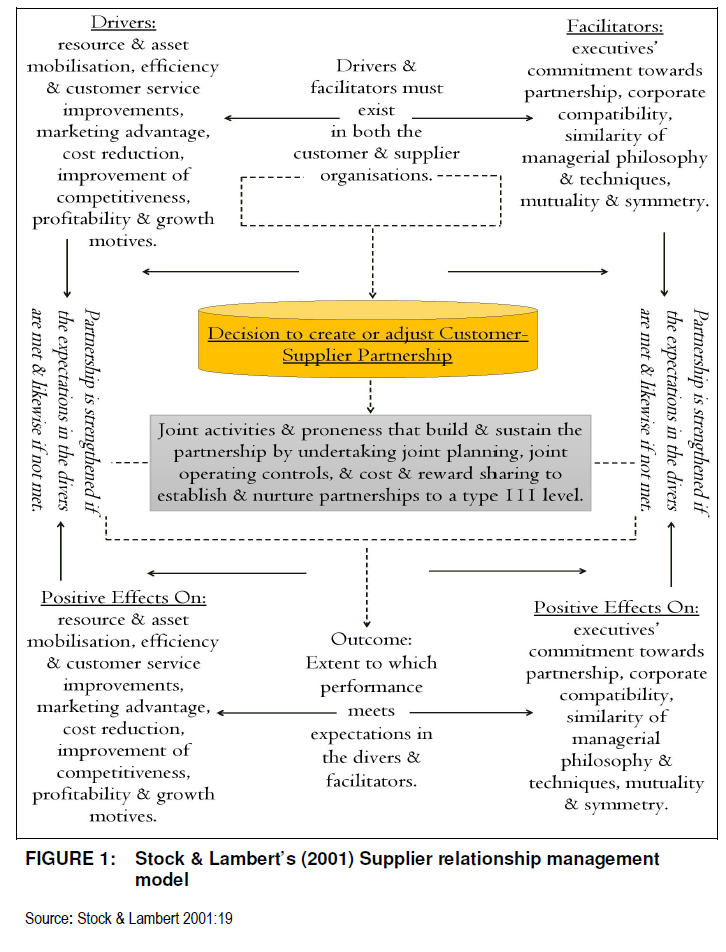
In their SRM model, Stock and Lambert (2001) elucidate on the critical drivers, facilitators and components that contribute to the attainment of the desired outcomes for partners. As it is illustrated in Figure 1, drivers are motivators or influencers like asset, efficiency, customer service improvements, marketing advantage, and profitability and growth that lure customers and suppliers into partnerships.
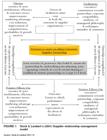
The drivers must exist in customer and supplier enterprises in order to influence both enterprises to understand why a partnership is mutually critical for them to perform more effectively.
Drivers may exist in all the enterprises. However, in-depth partnership between the two enterprises may still be influenced by the facilitators such as the supportiveness of the environment, corporate compatibility, similarity of the managerial philosophy and techniques, and mutuality and symmetry (Naslund & Williamson 2010:11; Stock & Lambert 2001).
If the drivers and facilitators are strong enough in all the partner organisations, then the management in the two enterprises tend to use components encompassing planning, joint operating controls, and cost and reward sharing to establish and nature partnerships to a type 111 level (Naslund & Williamson 2010:11; Stock & Lambert 2001). This influences the attainment of the outcomes and expectations outlined in the initial stages of partnership arrangement.
Stock and Lambert (2001:5) reason that the existence of certain drivers, facilitators and components can titivate the ability of the enterprises to initiate and nurture effective partnerships. Considering that fostering effective customer-supplier relationships between big and SMEs still remain a challenge in South Africa, this research uses Stock and Lambert's (2001) SRM model as the conceptual framework to identify the involved steps and the associated inhibitors, so as to determine the appropriate framework that can be suggested.
3. PROBLEM INVESTIGATED
Lack of a suitable framework limits the entrenchment of the customer-supplier relationships between the big businesses and SMEs in South Africa to the usually more advantageous in-depth strategic partnerships and alliances.
4. PURPOSE OF THE ARTICLE
The purpose underlying this research is to undertake a meta-synthesis of the approach used for initiating and building customer-supplier relationships between big businesses and SMEs in South Africa, so as to identify the major inhibitors and the remedial framework that can be suggested.
5. METHODOLOGY
While drawing from the concept of analytical philosophy espoused in Moore's (1899:59) founding theory, this research uses conceptual analysis as a principal qualitative research technique (Cronin, Ryan & Coughlan 2008:38). Conceptual analysis was accomplished through systematic literature review in line with the four critical research questions encompassing (Boghossian 2011:488):
■ What are the contemporary views in the critical models and theories on customer-supplier relationship management?
■ Which approach is used for initiating and building customer-supplier relationships between big businesses and SMEs in South Africa?
■ What are the challenges marring the effectiveness of the approach used for initiating and building customer-supplier relationships between big businesses and SMEs in South Africa?
■ Which strategic framework can be suggested for improving the effectiveness of the approach used for initiating and building customer-supplier relationship between big businesses and SMEs in South Africa?
To facilitate in-depth critical analysis and identification of themes and subthemes that provide answers to these four fundamental research questions, a meta-synthesis was used in line with Cronin et al.'s (2008:38) interpretation to enhance theoretical evaluation and analysis according to four main steps:
■
Analysis of the core theories on customer-supplier relationship management and identification of the critical modelsTheoretical analysis resulted in the identification of the four foundational models (Leenders & Flynn's (2002:1) SRM model; Bensaou's (2003:35) framework; Mould & Starr's (2003:1) model; Stock & Lambert's (2001:1) SRM model). Since the motive of the study was to determine the critical steps for initiating and building effective customer-supplier relationships between the SMEs and big businesses, key constructs and steps in these models were identified and contrasted with each other.
It emerged that the three levels (loose contracts, integration, and fusion of management structures) and the drivers and facilitators outlined in Stock and Lambert's (2001:1) SRM model seem to provide appropriate chronological steps for initiating, nurturing and building effective customer-supplier relationships (see Figure 1).
■
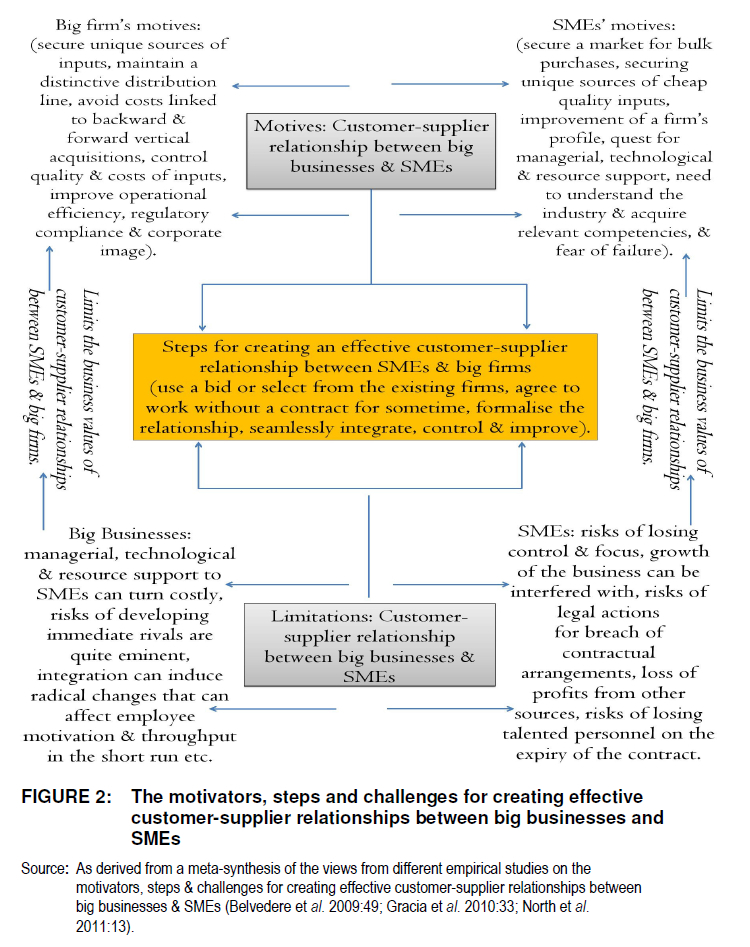
Triangulation of the constructs in the selected model with the findings of the empirical studies on the critical steps for initiating and building customer-supplier relationships between big businesses and SMEs in South AfricaStock and Lambert's (2001:1) SRM model was evaluated and triangulated with the approach used for initiating and building customer-supplier relationships between big businesses and SMEs in South Africa. The results highlighted five steps; evaluation and selection of partners, creating the foundation, contractualisation, integration and control) (see Figure 2).
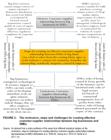
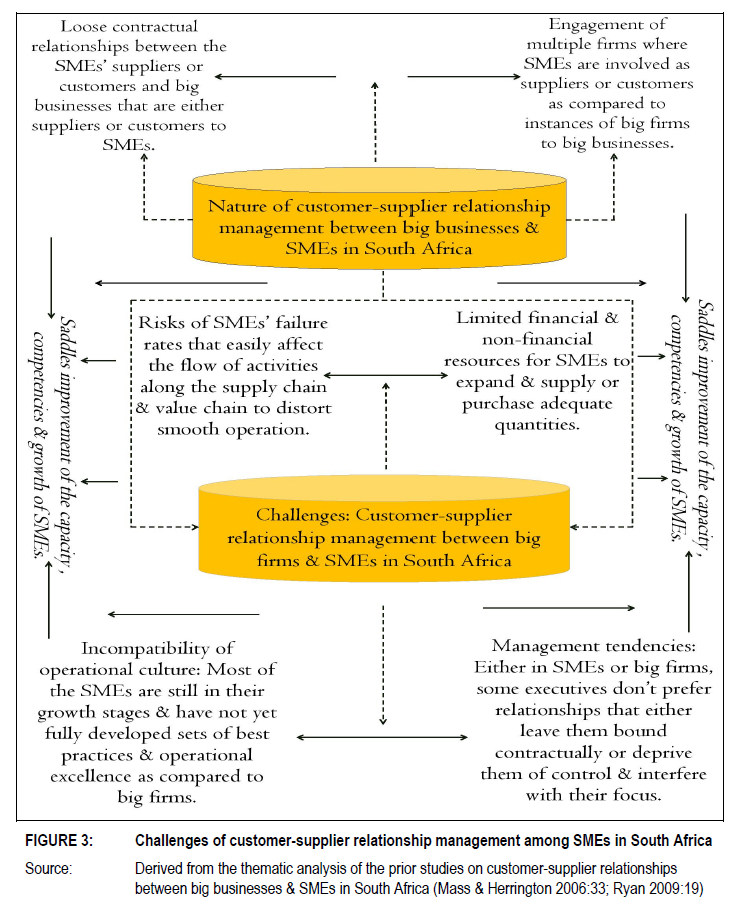
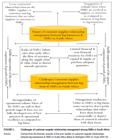
It also revealed key motivators (maintain a distinctive distribution line, avoid costs linked to backward and forward vertical acquisitions, control quality and costs of inputs, and improve operational efficiency, regulatory compliance and corporate image) that echo the articulations in Stock and Lambert's (2001:1) SRM model (see Figure 1 & Figure 2). However, evaluations also indicated most customer-supplier relationships between big businesses and SMEs in South Africa to only exhibit characters of loose contractual relationships (see Figure 3).
■
Identification of the challenges marring effective initiation and nurturing of customer-supplier relationships between big businesses and SMEs in South AfricaThis led to the analysis of the findings of the empirical studies conducted in South Africa in the period between 2010 and 2015 on the challenges affecting the performance of SMEs and the perceptions of SMEs and big businesses about the essence of creating more permanent customer-supplier relationships.
The interpretation from the findings of the analysis highlighted the reasons to be linked to fear of the risks of SMEs' failures, limited resources, incompatibility of operational culture, and management tendencies in both SMEs and big businesses (see Figure 3).
■
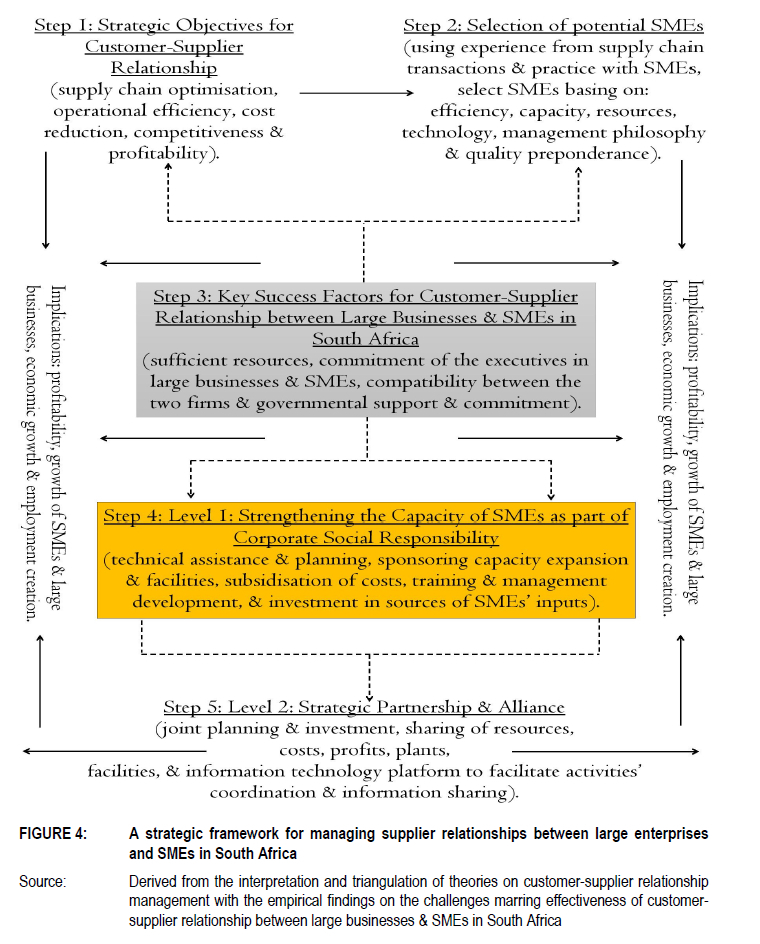
Postulation of the strategic framework for aiding the initiation and nurturing of effective customer-supplier relationships between big businesses and SMEs in South AfricaConsidering the inherent weaknesses of most of the SMEs in South Africa, the levels in Stock and Lambert's (2001:1) SRM model were modified in the context of the identified challenges as the remedial framework to enable big businesses fuse corporate social responsibility with the initial stages of initiating and nurturing customer-supplier relationships with SMEs (see Figure 4).
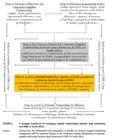
Such approach will enable big businesses develop and improve the capabilities of such SMEs upon which thereafter a more integrated and fused customer-relationship can be undertaken.
The details of the findings are as presented and discussed in the next sections.
6. FINDINGS
The results of conceptual analysis and a meta-synthesis are presented according to two subsections:
■ contemporary studies: customer-supplier relationship between big businesses and SMEs;
■ South African trends: customer-supplier relationships between big businesses and SMEs.
The details are as follows.
6.1 Contemporary studies: customer-supplier relationship between big businesses and SMEs
In line with Figure 2, the results of a meta-synthesis of different empirical studies on customer-supplier relationships between big businesses and SMEs are presented and discussed according to two subsections (Belvedere, Grando & Papadimitriou 2009:49; Gracia, Magistris & Albisu 2010:33; Jamieson, Fettiplace, York & Lambourne 2012:29; North, Baldock & Vickers 2011:13):
■ motives of SMEs and big businesses;
■ the steps for initiating and building effective customer-supplier relationships between big businesses and SMEs.
These views are illustrated in Figure 2.
6.1.1 Motives of SMEs and big businesses
The impetus for undertaking customer-supplier contractual relationships exists among SMEs just as among big businesses. Studies conducted on customer-supplier relationship management highlight one of the drivers for big firms to engage in customer-supplier relationships to be linked to the motive of securing the unique sources of inputs (Belvedere et al. 2009:49; Gracia et al. 2010:33; North et al. 2011:13).
Other drivers are; the need to maintain a distinctive distribution line and avoid costs linked to backward and forward vertical acquisitions. It also entails undertaking the initiatives aiming at controlling quality and costs of inputs, and improving operational efficiency, regulatory compliance and corporate image (Ayyagari, Beck & Demirguc 2007:415; Belvedere et al. 2009:49; Guyen 2010:33).
The SMEs' motives to engage in customer-supplier relationships are explained by the need to secure a market for bulk purchases and unique sources of cheap quality inputs (Gracia et al. 2010:33). Other reasons are related to the need to improve a firm's profile, and the quest for managerial, technological and resources' support (Gracia et al. 2010:33). Some of the SMEs engage in contractual customer-supplier relationships in order to understand the industry and acquire relevant competencies, or to mitigate risks of failure (North et al. 2011:13). These motives influence the decisions of the executives in big businesses and SMEs to initiate and nurture effective customer-supplier relationships (Belvedere et al. 2009:49; North et al. 2011:13).
6.1.2 Steps for initiating and building effective customer-supplier relationship between big businesses and SMEs
In contrast to the complex steps in Stock and Lambert's (2001) SRM model, studies conducted on customer-supplier relationships between SMEs and big businesses indicate five steps for initiating and building effective customer-supplier relationships:
■ Evaluation and selection of suppliers
Bids are used only in circumstances that a firm does not have adequate existing suppliers. However, the use of the present list of SMEs have proved more effective to influence the initiation and nurturing of effective customer-supplier relationships (North et al. 2011:13).
Following several transactions with the existing SME customers or suppliers, managers and supervisors will have already had first-hand experience of their capabilities (North el al. 2011:13). It therefore improves the quality of the decision on the SMEs that must be selected. Such decisions are usually made based on the analysis of the SMEs' quality and efficiency commitments and operational, technical and cultural compatibility. The other area involves the analysis of the willingness of the SMEs' executives to commit their enterprises to such contractual arrangements (North et al. 2011:13). Although most of the big firms conclude contracts straight away, some of the high performing enterprises tend to put the SMEs on the potential watch lists for further evaluations to be undertaken (North et al. 2011:13).
■
Creating a foundationThe fact that a firm has been dealing with a particular SME does not necessarily imply that when in-depth engagement is undertaken, the two can axiomatically be able to seamlessly operate without challenges (Ayyagari et al. 2007:415). Contracts that integrate customers and suppliers' operational activities tend to cause temporary instabilities that can interfere with the operational efficiencies of the relevant partners (Ayyagari et al. 2007:415). This foundational phase therefore creates a preface and a prototype of the critical activities and the associated implications that may emerge once the contractual undertaking sets in (Guyen 2010:33). This stage also facilitates the identification of the issues of cultural incompatibility and other factors that may render the relationship unworkable. If the results of the foundational stage are positive, contractual arrangements can therefore be concluded by the big business and the identified SME (Belvedere el al. 2009:49; Gracia el al. 2010:33).
■
Contractual arrangementAfter years of testing and trials, the contractual arrangement stage deals with the formalisation of the customer-supplier contractual relationships (Belvedere et a . 2009:49; Gracia el al. 2010:33). It is the level that SMEs are required to get more engaged in the relationship. However, some issues may still arise. As much as some of the SMEs are willing to work with a particular firm, they may tend to be unwilling to contractually formalise the process (Gracia et a . 2010:33). Some of the SMEs may find contractual relationships with big businesses to limit them to dealing only with that particular big business (Gracia et al. 2010:33).
In the case of a supplier SME, the executives could be required to only supply the big firm. As for SMEs that are customers of big firms, the SME can be required to sell only the products of the big firm (Cormican & Cunningham 2007:352). This limits SMEs' ability to reap more profits from other opportunities (Cormican & Cunningham 2007:352). Unless, there are other motivating factors, such circumstances tend to affect the conclusion of the customer-supplier contractual arrangement. If the contract is concluded, further integration of the relevant operational activities of the big business and the SMEs can be undertaken (Cormican & Cunningham 2007:352).
■
Seamless integrationSeamless integration is the process of synchronising the activities in the big business with the SMEs' operational activities (Jamieson et al. 2012:29). Synchronisation improves the efficiency of the flow of activities from SME customers or suppliers to the big business and vice-versa (Jamieson et al. 2012:29). It involves the investment in relevant technologies and implementation of relevant changes and transformation to ensure the adaptation of the employees and the entire system to the new system (Jamieson et al. 2012:29). Seamless integration also facilitates joint planning, joint investment, and the use of a single data-base. It further requires the encouragement of free interactions of the managers and employees from both partners (Ayyagari et al. 2007:415; Guyen 2010:33).
■
Control and improvementControl is the process of evaluating the effectiveness of the concluded customer-supplier relationships (Cormican & Cunningham 2007:352). It entails the evaluation of the benefits so far achieved not only by the big business, but also the SME. It also involves the analysis of the cost implications and the impact of the relationship on process efficiency and competitiveness of the partners (Cormican & Cunningham 2007:352). However, risks can rise from the executives' perceptions of the costly implications of the managerial, technological and resources' support to SMEs (McGrath & Jacobson 2010:19).
Big businesses may also fear risks of developing immediate rivals, or the risks of the integration to induce radical changes that can affect employee motivation and throughput in the short run (McGrath & Jacobson 2010:19). For SMEs, the management may fear the risks of losing control and focus to interfere with the growth of the business (Simon 2009:333). Other challenges are often linked to the risks of legal actions for breach of contractual arrangements, loss of profits from other sources and risks of losing talented personnel on the expiry of the contract. The control and improvement process must therefore focus on evaluating and mitigating the emergence of such inhibitors (Simon 2009:333).
6.2 South African trends: customer-supplier relationships between big businesses and SMEs
Findings revealed that the five steps' (evaluation and selection of partners, creating the foundation, contractualisation, integration and control) framework in Figure 2 are similar to the approach used by SMEs and big businesses in South Africa.
However, the process was found never to reach the stage of seamless integration (Mass & Herrington 2006:33; Ryan 2009:19). Instead, it is noted in Figure 3 that most of the customer-supplier relationships between SMEs and big businesses in South Africa only coalesce into loose contractual relationships (Mass & Herrington 2006:33; Ryan 2009:19).
There is often a tendency to engage multiple firms where SMEs are involved as suppliers or customers as compared to the instances of big firms to big businesses (Ryan 2009:19). Reasons were found to link to the four limitations; fear of the risks of SMEs' failures, limited resources, incompatibility of operational culture and management tendencies (Abor & Quartey 2010:219; Ketelhodt & Wocke 2008:5; Olawale & Garwe 2010:729).
The details of these four critical inhibitors are evaluated as follows.
6.2.1 Risks of failure
Even if businesses were willing to initiate and build effective customer-supplier relationships with SMEs, high failure rates among SMEs would still render most of the big businesses more sceptical. In circumstances where the SME is a supplier, firms fear to initiate and consolidate relationship with a business that may fail soon (Ketelhodt & Wocke 2008:5).
In effect, most big businesses tend to maintain multiple relationships with an array of SME suppliers so that if there is a failure by one of the SMEs, the other sources can always be engaged (Ketelhodt & Wocke 2008:5). Most of the big businesses reason that a failure can impact negatively on the profitability of the supplier as it has to incur unnecessary storage expenditures and other costs associated with holding inventories (Arntzen 2010:49; Scheers 2011:504).
Inherent weaknesses of most of the SMEs to survive were found to be explained by poor operational and management skills and limited access to adequate financial resources (Arntzen 2010:49). Other limitations of SMEs' effectiveness are related to unstable electricity supplies, lack of alternative sources of energy and poor investment in the appropriate technology (Ryan 2009:19). These factors not only render it difficult for SMEs to maintain effective customer-supplier relationship, but also their overall ability to survive. The Institute of Risk Management South Africa (IRSA) (2009:9) highlight that of the businesses that are started in a particular year in South Africa, 40% fail in their first year, 60% in their second year and 90% in the first 10 years of existence.
The purpose of initiating and developing an effective customer-supplier relationship is to mitigate market and industry uncertainties. However, with most of the SMEs failing in their first 10 years of existence, it signifies that businesses that are willing to create effective customer-supplier relationships with SMEs will not be able to eliminate or mitigate such uncertainties (Mass & Herrington 2006:33). Risk of failure can lead to distortion and disruption of the normal flow of operational activities that in most cases turn quite costly to rectify. Besides deterring factors related to the stronger preponderance of SMEs to fail, limited resources is another challenge undermining the formation and nurturing of effective customer-supplier relationships between SMEs and big businesses (Abor & Quartey 2010:219).
6.2.2 Limited resources
Most SMEs often struggle with the challenge of limited capital finance. Limited resources affect the performance of SMEs as suppliers or as customers (Ryan 2009:3; Scheers 2011:50). The establishment of the development financial institutions like the Industrial Development Corporation, Ithala Bank and the Development Bank of Southern Africa was therefore among others aimed at improving SMEs' accessibility to capital finance (Small Enterprise Development Agency 2014:12; UNIDO 2014:16). However, lack of essential business skills affects SMEs' ability to generate enough funds and repay the borrowed capital (Ryan 2009:3; Scheers 2011:50).
As a supplier, SMEs are required by big businesses to operate according to certain capacity, but lack of the essential financial resources limit the ability of SMEs to invest in different capacity expansion measures. SMEs that are suppliers tend to use limited machineries and equipment to thereby affect their ability to effectively meet the needs of big businesses (Ryan 2009:3; Scheers 2011:50). As SMEs cannot supply the required quantities within the required duration, big businesses opt to apply sourcing strategies that entail the use of either only big businesses as suppliers or a combination of big businesses and numerous SME suppliers. Such a situation limits the extent to which larger businesses are able to find reasons why they must create and nurture lasting customer-supplier relationships with SMEs that cannot supply the quantities desired (Abor & Quartey 2010:219).
In situations where SMEs are customers, big businesses can only be lured into initiating and nurturing customer-supplier relationships with SMEs if they are convinced that a particular SME has consistently demonstrated the capability to purchase significant quantities of their products (Abor & Quartey 2010:219). Big businesses are driven by profitability motives, as they have to cover their overheads and also accumulate sufficient finances for investment in expansion initiatives to thwart emerging competitive forces (Abor & Quartey 2010:219). Such motives are often only reconcilable with the need for creating effective customer-supplier relationship with SMEs in case that SME is found to be contributing enormously to profitability through frequent bulk purchases.
However, with the limited scale of operation and finances, most SMEs often only purchase limited quantities (Scheers 2011:50). This limits the extent to which big businesses can be driven into initiating and building effective relationship with SMEs as their customers. Instead of dealing with SMEs, big enterprises would prefer to initiate and maintain only loose relationships when dealing with most SMEs (Scheers 2011:50). In addition to the challenge of limited resources, incompatibility of operational philosophy is the other factor undermining the initiation and building of effective customer-supplier relationships between the South African SMEs and big businesses.
6.2.3 Incompatibility of operational culture
Big enterprises seek to uphold a culture of operational excellence in the accomplishment of all their activities (Voortman & Makhitha 2014:81; Absa 2014:6). In effect, excellent services and quality products as well as cost minimisation and supply chain optimisation are values they aim to achieve during the accomplishment of all their operational activities. This poses a direct contrast to the operational cultures in some of the SMEs that are often inefficient and unreliable (Absa 2014:6; Voortman & Makhitha 2014:81). Even in instances where the major portfolios of SMEs have got larger markets, some of the SMEs tend to get muzzled and mingle without necessarily demonstrating operational philosophy that they directly espouse (Ryan 2009:19). The more some of the SME suppliers get more customers to supply, it is often evident that the more they tend to become even overburdened and less efficient (Mass & Herrington 2006:33).
In effect, orders are often not delivered as efficiently as compared to other suppliers. All these affect SMEs' ability to ensure that their operational philosophies are compatible with the operational philosophies in big enterprises (Mass & Herrington 2006:33). Operational deficiencies in some of the SMEs are also linked to the difficulty of complying with the regulatory requirements and lack of the alternative sources of energy. Poor compliance with the regulatory requirements affects production scheduling. To operate more efficiently and deliver the right quantity and quality at the right time and the right place, some of the manufacturing enterprises must remunerate their employees for overtime work (Cox 2003: 42; Ketelhodt & Wocke 2008:5). Due to the need to minimise operational costs and lack of creativity among operational managers, production is only done during the hours prescribed in labour laws.
Consequently, SMEs in the manufacturing sector tend to become irresponsive to the needs of their customers. This affects their reputation and the initiation and building of effective relationship with the big businesses that are their customers. Even if SMEs were to strive to operate more efficiently, lack of alternative sources of energy would still affect their capabilities (Cox 2003: 42; Ketelhodt & Wocke 2008:5). As Eskom engages in the load shedding of different areas, most of the production plants of SMEs tend to get redundant. Investment in alternative sources of energy would have been the appropriate strategy for dealing with the challenge of Eskom's load shedding (Cox 2003: 42; Ketelhodt & Wocke 2008:5). However, with most of the SMEs struggling financially, enormous funds required for investment in alternative sources of energy have often not been obtainable. All these affect the level of operational compatibility and subsequently the fostering of effective customer supplier relationship.
6.2.4 Management tendencies
In some of the SMEs, management tendencies may not allow the initiation and development of customer-supplier contractual relationships that are in most of the cases associated with certain drawbacks (Herrington & Overmeyer 2006:33; SBP Business Environment Specialists 2014:3). Some of the contracts are linked to the pressure to deliver according to the stipulated delivery schedules and quality specifications. Yet, as SMEs strive to deliver according to such specifications, prices that contractual customers pay are usually not that impressive and adequate for covering all the SMEs' overheads. Although such contractual obligations arise with assured sources of earnings, some of the SMEs perceive that lower prices often affect their overall profitability (Herrington & Overmeyer 2006:33; SBP Business Environment Specialists 2014:3).
At the same time, SMEs tend to stay away from contractual relationships with big business on that basis that some of the contractual terms can prevent SMEs from supplying other businesses in order to maintain the competitiveness of the big business being supplied. Such contracts limit the extent to which SMEs are able to exploit other market opportunities and attain the desired level of growth (Herrington & Overmeyer 2006:33; SBP Business Environment Specialists 2014:3). As far as larger enterprises are concerned, the formation and nurturing of effective customer-supplier relationship is often discouraged.
Most of the big enterprises tend to interpret that customer-supplier relationship contracts are costly and time consuming (Absa 2014:6; Voortman & Makhitha 2014:81). Except for certain SMEs, most of the SMEs must be supported and nurtured with the management and operational philosophy of the big enterprises in order to become competent. In effect, most of the big enterprises tend to only maintain loose relationships with SMEs either as suppliers or customers (Absa 2014:6; Voortman & Makhitha 2014:81). All the other initiatives that are usually directed towards consolidating relationships with SMEs are often only undertaken as part of corporate social responsibility to empower the previously disadvantaged businesses.
Through such approach, big businesses improve their reputation and relationship with the general public and the government (Voortman & Makhitha 2014:81; Absa 2014:6). In other words, most of the big businesses interpret that through the normal customer-supplier relationships, there are not much benefits that big enterprises can gain from SMEs.
7. DISCUSSION
Despite the willingness of most of the big businesses to form effective customer-supplier relationships with SMEs, findings imply that most big enterprises are curtailed by fear of the risks of high failure rates among SMEs (Abor & Quartey 2010:219; Ketelhodt & Wocke 2008:5; Olawale & Garwe 2010:729). It was also evident that most of the big businesses tend to use multiple suppliers or customers due to the limited capacity of most of the SMEs to either supply the desired quantities or make frequent bulk purchases (Abor & Quartey 2010:219; Ketelhodt & Wocke 2008:5; Olawale & Garwe 2010:729). In effect, most of the customer-supplier relationships between big enterprises and SMEs in South Africa were noted to be only analogous to the traditional form of customer-supplier relationships.
Leenders and Flynn's (1995) SRM model highlight such traditional relationships to be very simple and less effective for inducing the desired positive effects on the improvement of an enterprise's performance. Reasons for such loose short-term contractual relationships were found to link to the management tendencies in SMEs and big businesses that do not favour the initiation and nurturing of strategic partnerships and strategic alliances. It also emerged that some of the SMEs perceive that some of the contracts come with pressure to deliver according to the stipulated delivery schedules and quality specifications (Herrington & Overmeyer 2006:33).
Yet, as SMEs strive to deliver according to such specifications, prices that contractual customers pay are usually not that impressive and adequate for covering all the SMEs' overheads. In effect, just like big businesses, some of the SMEs do not only prefer to engage in simplistic traditional form of customer-supplier relationships, but also type 1 form of customer-supplier relationships. As compared to type 11 and 111 in which customer-supplier relationships often drift into in-depth strategic alliance and partnerships, Stock and Lambert (2001) reveal that type 1 partnerships are only manifested in short term contracts involving one division or area within each organisation. A loose simple traditional form of customer-supplier relationship limits the ability of SMEs to engage in the in-depth level of strategic partnerships and alliances that provide advantages such as joint planning and investment in expansion initiatives. It also affects the sharing of resources, plants and facilities, and costs and rewards to stimulate the improvement of the competitiveness and profitability and growth of the SMEs. In a bid to deal with these challenges, it is argued that big businesses and some of the SMEs must adopt the strategic framework in Figure 4.
8. MANAGERIAL IMPLICATIONS
The application of the framework in Figure 4 will enhance the ability of big businesses to influence growth and development of SMEs through blending customer-supplier relationships with the notion of corporate social responsibility. Such initiatives will not only impact on the improvement of the performance of SMEs, but also the enhancement of South Africa's economic growth and development. The details of the four critical steps that big businesses should consider following are elucidated as follows.
8.1 Strategic objectives for customer-supplier relationship
Big businesses must first assess the critical business and operational challenges that can be addressed through the improvement of the effectiveness of customer-supplier relationship. Brief consultations with the selected SMEs must be undertaken to ensure that similar business and operational challenges are also affecting the performance of the selected SMEs. This will influence the assessment of whether there is a mutual interest between that particular big business and the SMEs that such challenges can be addressed through strengthening customer-supplier relationship.
Such mutuality of interests will also enhance the improvement of the overall commitment of the executives in the big and small enterprises to ensure that the relationship is successful. Such initiatives lead to the outline of the strategic business objectives that must be achieved by the big business and the SME after the formulation of customer-supplier relationship is successful. The strategic objectives that must be considered include the improvement of supply chain optimisation, operational efficiency, cost reduction, competitiveness and profitability.
With the executives in the big businesses conversant that these are also the objectives that the SMEs aim to achieve, the selection of the like-minded SMEs can then be undertaken in the next step.
8.2
Selection of SME suppliersUsing the experience of dealing with certain SMEs in the previous supply chain transactions, big businesses can profile SMEs that can be selected as potential suppliers. This can be undertaken by examining the compatibility of SMEs' operations vis-à-vis the operational approach of the big business. Critical factors that can be profiled in order to assess the degree of the compatibility between the two enterprises encompass efficiency, capacity, resources, technology, and management philosophy and quality preponderance of the selected SMEs.
In most cases, initiatives to foster effective customer-supplier relationship between big businesses and SMEs have often failed due to the dissatisfactions related to operational inefficiency, poor quality and incompatibility of management philosophies in customer and supplier enterprises. Although the consideration of these factors will influence the extent to which the big business can identify SMEs with potentials that can be improved, it is also important that big businesses ensure that certain key success factors are put in place.
8.3
Key-success factors: customer-supplier relationship managementMost models cannot provide the appropriate strategies for improving the effectiveness of customer-supplier relationships between big businesses and SMEs in South Africa due to the unique South African history of inequities. Due to these inequities, most of the SMEs are often very weak. In effect, measures that are directed towards improving customer-supplier relationships between big businesses and SMEs may tend to be viewed as more of a corporate social responsibility initiative of the big businesses towards SMEs. Such arrangements can become costly for the big businesses.
It is on that basis that it is emphasised that in addition to ensuring the availability of sufficient resources and commitment of the executives of the big and small businesses, it is also critical that big businesses secure governmental support and commitment. This can provide additional resources from the government that can be used to foster the initiation and building of effective customer-supplier relationships between big businesses and SMEs. Such initiatives will improve not only the performance of SMEs, but also the South African economy. With all these in place, big businesses can then select SMEs with significant potential to improve and put them through two phases of development:
■
Level 1: Strengthening SMEs' capacity: corporate social responsibilityIf big businesses in South Africa are to benefit from various SMEs, then using a model that blends customer-supplier relationship with the notion of corporate social responsibility is a prerequisite. Some of the SMEs are critical sources of supplies just as others are important customers. The use of corporate social responsibility to improve the capacity of SMEs will not only benefit SMEs, but also big businesses. To ensure that the selected SMEs are indoctrinated with operational culture and management philosophy in the big enterprises, the executives in the big businesses will need to design mechanisms that facilitate the strengthening of the capacity of the SMEs.
The measures that can be used include providing technical assistance and planning, expansion of production capacity and facilities, subsidisation of transportation, training and management development and investment in the sources of SMEs' inputs. It is also at this stage that big enterprises can assess the SMEs that are emulating their operational and management best practices that can be retained, and the poorly performing ones that can be dropped. Effective accomplishment of the activities in this section prepares SMEs to become independent and able to enter into strategic partnerships and alliances with every big business in the subsequent stages of their growth.
■
Level 2: Strategic partnership & allianceIn this stage, big businesses can then easily enter into strategic alliance and partnership with the selected SMEs. Such a view is attributable to the argument that in the previous stage, the capacity of SMEs will have been improved and the selected SMEs will have already understood the culture in the big businesses and the overall objectives and expectations of the partnership. Besides the conclusion of the relevant contracts outlining the critical expectations and activities, strategic alliance and partnership between the big businesses and the selected SMEs can also be effectively accomplished through facilitating joint planning and investment in expansion initiatives, sharing of resources, sharing of plants and facilities. Other strategies can be undertaken through the use of a single information technology to facilitate activities' coordination, information sharing, exchange and effective communication as well as the sharing of costs and rewards. All these must be accompanied by periodic assessment to ensure that the customer-supplier relationship which is put in place is contributing towards the attainment of the desired expectations.
8.4 Periodic assessment
Periodic assessment can be undertaken through relevant reviews and evaluation to ensure that all the desired critical activities are being accomplished effectively and in a manner that contributes towards the attainment of the desired expectations. This assessment will also have to examine the extent to which the concluded customer-supplier relationship is enhancing the improvement of the performance of the involved big and small businesses. It must also assess the extent to which it is able to influence the ability of SMEs to contribute towards the South African economic growth and development.
9. CONCLUSION
Most big businesses still struggle to initiate and build effective customer-supplier relationships with SMEs, largely due to the inherent weaknesses of most of the SMEs to operate more sustainably. This research has attempted to resolve such challenges by suggesting a framework emphasising a blend of customer-supplier relationship with corporate social responsibility to enable larger businesses use customer-supplier relationships to improve the capacity and sustainability of SMEs prior to undertaking the usually advantageous in-depth level of strategic partnerships and alliances. However, further research can still explore the roles that the government can play to ensure that big businesses contribute towards improving the performance and growth of SMEs through the initiation and nurturing of effective customer-supplier relationships with SMEs.
REFERENCES
2. LITERATURE REVIEW
- ABOR J & QUARTEY P. 2010. Issues in SME development in Ghana and South Africa. International Research Journal of Finance and Economics 39(2):219-228.
- ABSA. 2014. Enterprise development; accessing South Africa's potential. Johannesburg: Absa.
- ARNTZEN BC. 2010. Survey of supply chain risk attitudes and management practices region: Africa-Middle East. Cambridge, UK: MIT Center for Transportation and Logistics.
- AYYAGARI M, BECK T & DEMIRGUC KA. 2007. Small and medium enterprises across the globe. Small Business Economics 29(3): 415-434.
- BELVEDERE V, GRANDO A & PAPADIMITRIOU T. 2009. The responsiveness of Italian small-to-medium sized plants: dimensions and determinants. International Journal of Production Research 48(21): 49-88.
- BENSAOU M. 2003. Portfolios of buyer-supplier relationships. Sloan Management Review 40(4):35-44.
- BOGHOSSIAN P. 2011. Williamson and the a priori and the analytic. Philosophy & Phenomenological Research 82(1):488-497.
- COMMONS JR. 1931. Institutional economics. American Economic Review 21(1):648-657.
- CORMICAN K & CUNNINGHAM M. 2007. Supplier performance evaluation: lessons from a large multinational organization. Journal of Manufacturing Technology Management 18 (4): 352-366.
- COX A. 2003. Managing with power: strategies for improving value appropriation from supply relationships. Journal of Supply Chain Management 37(2):42-47.
- CRONIN P, RYAN F & COUGHLAN M. 2008. Undertaking a literature review: a step by step approach. British Journal of Nursing 17(1):38-43.
- DAVIS GF & COBB JA. 2010. Resource dependence theory: past and future. Bingley, NY: Emerald Group.
- DREES JM & HEUGENS PPMAR. 2013. Synthesizing and extending resource dependence theory: a metaanalysis. Journal of Management 39: 166-169.
- ELLEGARD C. 2008. Supply risk management in a small company perspective. Supply Chain Management: An International Journal 13 (6):425-434.
- FABBE CN & JAHRE M. 2008. Supply chain integration and performance: a review of the evidence. International Journal of Logistics Management 19(2):130-154.
- GRACIA A, MAGISTRIS T & ALBISU LM. 2010. Inter-organizational relationships as determinants for competitiveness in the agri-food sector. Wallingford, CT: CABI.
- GUYEN H. 2010. Increasing the performance of SMEs in supply chains of large enterprises. Galve, CH: University of Gavle.
- HERRINGTON MD & OVERMEYER T. 2006. Study on the procurement relationship between large corporations and mainly black owned or empowered SMEs. Pretoria: ECI Africa.
- JAMIESON D, FETTIPLACE S, YORK C & LAMBOURNE E. 2012. Large businesses and SMEs: exploring how SMEs interact with large businesses. London: ORC International.
- KETELHODT V & WOCKE H. 2008. The impact of electricity crises on the consumption behavior of small and medium enterprises. Journal of Energy in Southern Africa 2 (4):1-9.
- LEENDERS MR & FLYNN AE. 2002. Purchasing and supply management. New York, NY: McGraw-Hill.
- MASS G & HERRINGTON M. 2006. Global entrepreneurship monitor. Johannesburg: The South African Executive Report.
- MCGRATH H & JACOBSON D. 2010. The large leader firm: good or bad? A case study of a leader firm-supplier relationship. Cheltenham, UK: Edward Elgar.
- MOORE GE. 1899. The nature of judgment. Philadelphia, PA: Temple University Press.
-
MOULD TL & STARR CE. 2003. Dangerous liaisons. Outlook 2000. [Internet: www.accenture.com; downloaded on 14-011-2015.
» www.accenture.com - ]
- NASLUND D & WILLIAMSON S. 2010. What is management in supply chain management? a critical review of definitions, frameworks and terminology. Journal of Management Policy and Practice 4(10):11-28.
- NEWMAN R, HANNA M, GATTIKER T & HUANG X. 2009. Charting supply chain management integration and initiatives: a framework to guide implementation. American Journal of Business 24(1):19-31.
- NORTH B, BALDOCK R & VICKERS I. 2011. Research into mid-size business growth. Middlesex, UK: Middlesex University Centre for Enterprise and Economic Development.
- OLAWALE F & GARWE D. 2010. Obstacles to the growth of new SMEs in South Africa: a principal component analysis approach. African Journal of Business Management 1 (3):729-738.
- OSTROM E. 2010. Beyond markets and states: polycentric governance of complex economic systems. American Economic Review 100(3):641-672.
- RYAN E. 2009. Entrepreneurship. Johannesburg: Entrepreneur Magazine.
- SBP BUSINESS ENVIRONMENT SPECIALISTS. 2014. Small business development in South Africa. Johannesburg: SBP.
- SCHEERS LV. 2011. SMEs marketing skills challenges in South Africa. African Journal of Business Management 4(1):504-525.
- SIMON H. 2009. Champions of growth: how innovative mid-sized firms keep on growing. Purdue University Press 23(1):333-43.
- SLACK N & LEWIS M. 2011. Operations strategy. London, UK: Pearson Prentice-Hall.
- SLONE A. 2010. The supply chain agenda. the five steps that add real value. Boston, MA: Harvard Business School Publishing Corporation.
- SMALL ENTERPRISE DEVELOPMENT AGENCY. 2014. SDP research report. Johannesburg: FEM Research.
- STAFFORD R. 2008. Social exchange theories. New York, NY: Thousand Oaks.
- STANK TP, DITTMAN JP & AUDRY CW. 2011. Supply chain agenda: a synopsis and direction for future research. International Journal of Physical Distribution and Logistics Management 41 (10):940-955.
- STOCK J, STEFANIE L, BOYER S & HARMON T. 2010. Research opportunities in supply chain management. Journal of the Academy of Marketing Science 38(1):32-41.
- STOCK JR & LAMBERT DM. 2001. Strategic logistics management. Boston, MA: McGraw-Hill.
- SUNJKA BP & BINDEMAN K. 2011. Systems-orientated supply chain risk management framework at a manufacturing SMME. Proceedings of the International Conference on Industrial Engineering, Systems Engineering and Engineering Management for Sustainable Global.
- SWEENEY E. 2013. The people dimension in logistics and supply chain management: its role and importance. Milan, IT: McGraw-Hill.
- SYTSE D & HEIN S. 2012. Economic approaches to organisations. London, UK: Pearson.
- TOKAR T. 2010. Behavioural research in supply chain and logistics management. International Journal of Logistics Management 21 (1):89-103.
- UNIDO. 2014. Partnerships for small enterprise development. Geneva, CH: UNDP.
- VOORTMAN C & MAKHITHA KM. 2014. The alignment of product strategy to supply chain practices of craft businesses in Gauteng Province, South Africa. Journal of Transport and Supply Chain Management 8(1):81-126.