A new theory for sustainable competitive advantage in a motor services firm in Kenya
Abstract
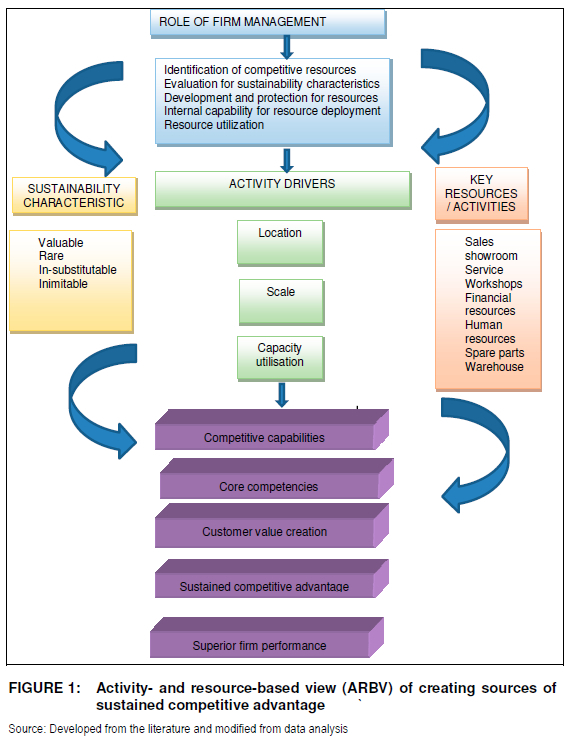
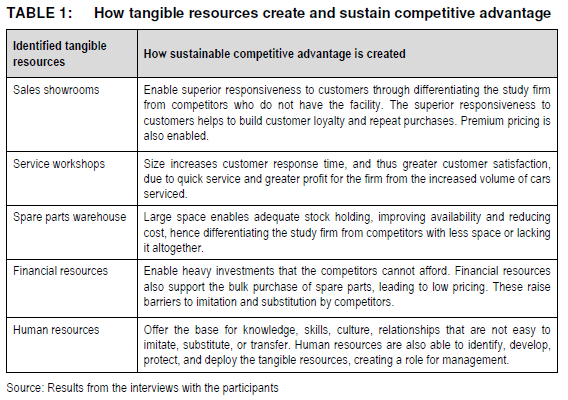
This article advocates the extension of the resource-based view by proposing a new theory to understand the creation of sustainable competitive advantage, using a services firm in the motor industry in Kenya as a case. The research question is: How has a consistently high-performing firm in the motor service industry managed to create and sustain competitive advantage over its rivals, thus achieving superior performance and gaining market leadership? A qualitative case study of a consistently high performing firm in the motor services industry in Kenya was used to answer the research question. To collect data, in-depth, semi-structured, face-to-face audio-taped interviews with nine senior managers including the chairman and CEO were employed. This study's key findings include that tangible resources should possess the characteristics of rarity, valuable, inimitability and non-substitutable which create sustainable competitive advantage. The results further show how activities, through activity drivers, acted on tangible resources with unique characteristics to create sources of sustainable competitive advantage for the firm, generating consistently superior performance, thus enabling the firm to capture and retain a large market share. The empirical results show that tangible resources include state-of-the-art modern showrooms, service workshops, financial resources, spare parts warehouses and human resources. This research contributes to the development of a new theory that integrates the resource- and activity-based view of management.
activity-based view; resource-based view; sustainable competitive advantage; tangible resources
 Thumbnail