Enhancing family business performance through dynamic capabilities and strategic creativity
Abstract
PURPOSE OF THE STUDY: This study aimed to investigate the impact of strategic creativity on the relationship between dynamic capabilities and the performance of family-owned businesses. The literature calls for studies that explore how business performance can be enhanced. The study addresses such calls, exploring the roles of strategic creativity and dynamic capabilities in a family business context. DESIGN/METHODOLOGY/APPROACH: The study employed a quantitative enquiry, with 347 family businesses completing a standardised questionnaire across the Eastern Cape in South Africa. To assess the mediating effect of strategic creativity, a multiple regression analysis was conducted. Dynamic capabilities were measured as the independent variable, while family business performance served as the dependent variable. FINDINGS: The results revealed that strategic creativity has a positive and significant mediating influence between dynamic capabilities, notably scenario planning, environmental scanning, business culture, knowledge creation, and formal organisation. It is worth noting that strategic creativity had the greatest indirect mediating effect on the dynamic capability, comprising environmental scanning and family business performance RECOMMENDATIONS/VALUE: Family businesses are advised to adopt a dynamic capability framework that promotes strategic creativity, with an emphasis on environmental scanning, to enhance business performance. MANAGERIAL IMPLICATIONS: From an organisational perspective, efforts can be put in place to foster family business performance by encouraging strategic creativity within and utilising dynamic capabilities JEL CLASSIFICATION: M10
Dynamic capabilities; environmental scanning; family business; performance; strategic creativity
1. INTRODUCTION
Family businesses are a driving force behind many global economies; collectively, they promote an estimated 90% of job creation (Beck et al., 2020). Family businesses contribute an estimated 75% to the gross domestic product of all economies worldwide (Chaudhary et al., 2021). According to Eze et al. (2021) and Rovelli et al. (2021), the operational definition of a family business first entails 50% share ownership comprising two or more family members (brother, sister, uncle, aunt, spouse, children, cousin, and or grandparents that are related by blood). Secondly, family members must be involved in the daily operations as either managers, advisors, or shareholders (Mikušová et al., 2020; Porfirio et al., 2019).
Research in the family business domain has proliferated in the last two decades (Rovelli et al., 2021); however, various themes remain understudied. Existing family business research primarily focuses on ownership control and structure, with a significant emphasis on succession (Camison-Zornoza et al., 2020). Consequently, the family business domain requires attention to minimise the literature gaps by considering strategic tools to enhance firm performance in uncertain economic environments. These are imperative themes to investigate as they can reconfigure family business performance (Pike-Bowles et al., 2022; Rovelli et al., 2021).
Recent studies indicate that businesses will not experience enhanced business performance unless they implement distinctive capabilities (Abbady et al., 2019; Park et al., 2019). Given this, there is a need to promote and ensure the continued growth and performance of not only non-family businesses but also family businesses, given the continuously changing business landscape in South Africa (Koentjoro & Gunawan, 2020; Semke & Tiberius, 2020). By implementing a dynamic capabilities framework, family businesses could successfully sense, seize, and reconfigure their resources to exploit opportunities and stay ahead of the continuously changing business landscape (Beck et al., 2020; Semke & Tiberius, 2020). Consequently, these elements pave the way for effective decision-making and the cultivation of strategic creativity within a business (Hernández-Linares et al., 2019).
Although various studies focus on dynamic capabilities and strategic creativity within their respective disciplines, there is still a lack of references from the perspective of South African family businesses (Glyptis et al., 2021; Semke & Tiberius, 2020). In South Africa, the Eastern Cape Province is known for its harsh economic conditions. Additionally, current research primarily focuses on the South African provinces of Gauteng, KwaZulu-Natal, and the Western Cape, as reported by Beck et al. (2020), Janse van Rensburg and Tjano (2020), and Urban and Nonkwelo (2020). Investigating such a topic within the Eastern Cape, South African locality, can potentially resolve practical problems currently faced by family businesses (Urban & Nonkwelo, 2020).
The study aimed to investigate the mediating effect of strategic creativity on the relationship between dynamic capabilities and performance in family businesses. The mediation analysis focuses on five distinct dynamic capabilities constructs: scenario planning, environmental scanning, business culture, knowledge creation, and the formal organisation. These constructs were suitable for the study, as insufficient attention has been paid to them within the family business domain (Krishnan, 2020; Ode & Ayavoo, 2020). The study, therefore, adds to the family business domain by providing key recommendations for family business owners operating in uncertain economic environments to enhance business performance.
The literature review elucidates the theoretical framework and empirical literature. Here, concepts related to dynamic capabilities, strategic creativity, and family business performance are discussed, leading to the formulation of the study's hypotheses.
2.1 Family business performance
Family businesses involve family members coming together through their bonds to start a business (Calabrò et al., 2021). Unlike non-family firms, family businesses are predominantly family-controlled, with members of the same family either owning or co-owning the business (Hansen et al., 2020). Family businesses comprise a significant share of small and medium-sized enterprises globally, contributing to economic development in both developed and underdeveloped economies through job creation (Obermayer et al., 2021). Key differences between family and non-family firms stem from their creativity, shared family perspective, and open communication, which is facilitated by higher levels of discretion among family members regarding business operations and performance (Astrachan et al., 2020).
Razzak et al. (2020) found that current research demonstrates that family firms perform better than non-family firms; however, this depends on the key constructs studied. Hansen et al. (2020) additionally recognised that family firms outperform non-family enterprises, particularly in established markets. Analysing family business performance subsequently indicates how well family members manage the business's operations (Bujan, 2020). To measure family business performance, various constructs exist that are categorised into financial and non-financial performance indicators (Alves & Gama, 2020). Financial performance indicators comprise the family business's profit and business growth. Non-financial performance indicators include family businesses' perceived success and productivity (González et al., 2023).
By examining both financial and non-financial performance indicators, the family's strategic capabilities and the firm's operational efficiencies are revealed (Huseyin, 2023). According to Maharajh et al. (2024), family dynamics play a crucial role in the performance of family businesses. Family dynamics, such as family strife, discretion, and rigidity, can negatively impact the firm's performance. However, if family dynamics are managed effectively, the company will experience reduced operational costs and a balanced psychological and emotional business environment, enhancing performance.
2.2 Strategic creativity
To further enhance business performance and develop a competitive edge, firms are encouraged to cultivate strategic creativity. Strategic creativity, also known as organisational creativity, refers to a firm's ability to develop innovative business ideas that enable it to remain ahead of competitors and satisfy customers (Nguyen et al., 2022). Strategic creativity can be implemented in various business processes, such as resource acquisition and reconfiguration, identifying new opportunities, and operations management. Wasim et al. (2024) noted that strategic creativity has been predominantly researched within the marketing field. These authors suggest that strategic creativity has been overlooked as a key contributor to business success, as it can lead to unique products. Consequently, a key component of defining strategic creativity lies in the novel ideas of the firm's employees.
Alyahya et al. (2023) acknowledged that firms must engage in strategic creativity to achieve sustainable performance, especially in uncertain operating environments. This finding was also reported by Nguyen et al. (2022), who recognised that strategic creativity explicitly enhances a firm's financial performance by enabling prompt market responses. However, Wasim et al. (2024) argue that there is a dearth of research linking strategic creativity and performance. Given that family businesses contribute significantly to global economic growth, gaining new and modernised insights into their operations is essential to better appreciate them (Maharajh et al., 2024). Further, Zhang et al. (2022) and Pike-Bowles et al. (2024) recognised that the family business field requires advancement by accounting for diverse business constructs. Consequently, this study adopts a fresh perspective by investigating five distinct dynamic capabilities and the strategic creativity of family businesses.
2.3 Dynamic capabilities view
The underlying theoretical framework pursued in this study encompassed the dynamic capabilities view. According to Teece et al. (1997), the dynamic capabilities view is a crucial framework that enables a firm to attain a sustainable competitive advantage. Dynamic capabilities are an indispensable strategic tool that firms can implement to improve their performance (Cirjevskis, 2019). Such strategies include resource and asset acquisition and management that aid the exposure and requirements of a firm's capabilities (Ochoa et al., 2020). Consequently, the strategic management of a firm can improve performance by incorporating the dynamic capabilities view framework (Steininger et al., 2022).
The dynamic capabilities view stems from the resource-based view, which recognises that a firm can achieve a sustainable competitive advantage through the optimal use of its resources (Glyptis et al., 2021). The dynamic capability view complements the resource-based view by enabling firms to adopt a structured capabilities strategy, thereby protecting them against uncertain, continuously changing economic environments (Abu-Rumman et al., 2021). By doing this, firms can acquire new skills and competencies that contribute towards improved business performance and maintaining a competitive advantage (Teece et al., 1997). In comparison, the resource-based view centres on a firm's resource allocation, while the dynamic capability view focuses on both resource and capability allocation to improve business performance (Bleady et al., 2018).
The term' dynamic capabilities' illustrates a firm's ability to respond to changing operating environments by identifying opportunities, modifying existing business practices, reducing operational costs, and incorporating new resources and competencies to ensure continued business performance (Abbady et al., 2019). By doing this, firms are notably engaging in dynamic capabilities alongside strategic creativity. If a firm fails to implement the dynamic capabilities model, it will not realise its true potential, and business performance will not meet expectations (Bogers et al., 2019).
Daspit et al. (2019) recognised that the dynamic capabilities concept is popular within the strategic management field; however, it remains nascent within the family business sphere. The prominent dynamic capabilities construct comprises environmental scanning, scenario planning, knowledge creation, culture, and formal organisation (Gregurec et al., 2021; Ode & Ayavoo, 2020; Schwarz et al., 2019; Soluk et al., 2021).
2.3.1
Environmental scanningThe first dynamic capability, environmental scanning, is a core business activity that enables firms to analyse and identify trends within the changing internal and external environments (Soluk et al., 2021). These trends could have positive or negative impacts on the business performance. Therefore, environmental scanning enables a firm to foresee such events and respond effectively through planning (Alizadeh & Soltanisehat, 2019). According to Majekodunmi (2020), a positive relationship exists between strategic management and the implementation of a dynamic capabilities model within a business. Strategic creativity entails generating innovative ideas that aid business performance.
As a business engages in dynamic capabilities, it concurrently practices strategic creativity, indicating the relationship between the two constructs (Walia, 2021). The driving force behind strategic creativity is strategic foresight (Buehring & Bishop, 2020). Strategic foresight aligns the firm with an appropriate direction based on environmental scanning and scenario planning, ensuring the best possible predetermined direction is pursued (Buehring & Bishop, 2020; Pulsiri & Vatananan-Thesenvitz, 2021). Based on the aforementioned, the following two hypotheses are proposed:
Hypothesis 1: A relationship exists between environmental scanning and the performance of family businesses.
Hypothesis 2: Strategic creativity mediates the relationship between environmental scanning and family business performance.
2.3.2
Scenario planningScenario planning is recognised as a dynamic capability construct that enables firms to develop innovative action plans in response to various scenarios identified during environmental scanning (Schwarz et al., 2019). Although strategic management and dynamic capabilities are linked, business performance is not necessarily due to the sole implementation of a dynamic capabilities model. Enhanced business performance could result from improved processes and innovations; therefore, dynamic capabilities influence a type of change resulting from intentional preparedness (Nelson & Winter, 1982; Teece et al., 1997).
According to Boddenberg et al. (2024), scenario planning enables businesses to prepare for change in uncertain economic environments. Here, a hypothetical cause-and-effect relationship is explored to identify the chain of possible market trends. Practising this strategic exercise enables businesses to prepare for future uncertainties by developing action plans to respond to the identified scenarios. Consequently, hypotheses three and four are suggested:
Hypothesis 3: A relationship exists between scenario planning and the performance of family businesses.
Hypothesis 4: Strategic creativity mediates the relationship between scenario planning and family business performance.
2.3.3
Knowledge creationKnowledge plays a vital role in identifying opportunities and innovation to make effective business decisions (Ode & Ayavoo, 2020). Oktarina and Witiastuti (2019) argued that a firm's strategic creativity further aids in knowledge creation, problem-solving, and networking, enabling it to put business practices ahead of competitors and gain a sustainable competitive advantage. A business culture that focuses on developing workforce knowledge can foster new ideas and outpace competitors (Bouncken et al., 2020). Consequently, there is a positive association between firms' dynamic capabilities when they reconfigure business activities based on their innovative concepts (Arokodare & Asikhia, 2020). However, to enhance knowledge creation and improve business innovation, knowledge management is required (Hlatywayo & Williamson, 2023; Ode & Ayavoo, 2020). Thus, the study proposes the following hypotheses:
Hypothesis 5: A relationship exists between knowledge creation and the performance of family businesses.
Hypothesis 6: Strategic creativity mediates the relationship between knowledge creation and family business performance.
2.3.4
Business cultureAzeem et al. (2021) and Naong et al. (2023) identified that knowledge creation enhances a firm's competitive advantage; however, a positive business culture must be present in the operational processes. Business cultures are unique to each business as they attain different resources and capabilities that drive the workforce to achieve business goals (Soluk et al., 2021). Business cultures that prioritise continuous knowledge advancement and innovative contributions from all employees can positively impact business performance, particularly during uncertain economic conditions such as those posed by COVID-19 (Caballero-Morales, 2021; Krishnan, 2020). This was similarly identified by Alipour et al. (2025), who determined that family business performance is associated with the business culture. Here, a stable working environment, emphasised by the family business culture, contributes to improved performance.
According to Ode and Ayavoo (2020), strategic creativity contributes to competitive advantage by adding innovations and ideas that competitors lack. Here, innovative ideas can range from employee suggestions for improving the workplace and tasks to enhancing a compliance system and introducing innovations for business products or services (Lee & Kim, 2021). According to Ziyae and Sadeghi (2020), strategic creativity must be embedded in the business culture. Incorporating creativity into the firm's culture will lead to increased development of innovative employees and the seizing of market opportunities aligned with predetermined strategic goals. By emphasising a positive business culture through creativity, firms can build a reputation as creative and innovative compared to competitors. Therefore, it is hypothesised that:
Hypothesis 7: A relationship exists between business culture and the performance of family businesses.
Hypothesis 8: Strategic creativity mediates the relationship between business culture and family business performance.
2.3.5 Formal organisation
A formal organisation, as a dynamic capability, encompasses the procedures and systems that the business adheres to to achieve its strategic direction (Gregurec et al., 2021; Masakale & Pooe, 2022). Due to the current unpredictable environments in which most businesses operate, firms need to modify their original business structures to aid long-term survival (Gregurec et al., 2021; Kamariotou & Kitsios, 2019). Current literature suggests that both strategic creativity and dynamic capabilities facilitate a firm's continuous improvement and enhanced business performance. However, there have been no recent investigations into such a relationship, specifically within the family business domain (Buehring & Bishop, 2020; Hernandez-Linares et al., 2019).
According to Mikalef et al. (2021), firms engage in strategic creativity when modifying and implementing business models to enhance performance. However, the same authors identified a gap in the empirical literature regarding this relationship, specifically within the field of family business. Schilke et al. (2018) further recognised that future research avenues should encompass analyses of moderating and mediating effects of dynamic capabilities and their antecedents. Based on this, the study puts forward the following hypotheses:
Hypothesis 9: A relationship exists between the formal organisation and the performance of family businesses.
Hypothesis 10: Strategic creativity mediates the relationship between the formal organisation and the performance of family businesses.
2.4 Conceptual model
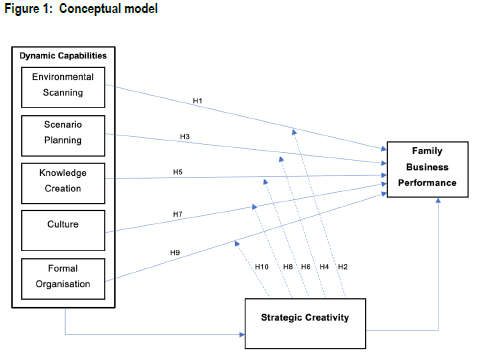
The independent variable consisted of dynamic capabilities, encompassing five selected dimensions. These five dimensions included scenario planning, environmental scanning, business culture, knowledge creation, and the formal organisation. The mediating variable was strategic creativity, while family business performance was the study's dependent variable. The research hypotheses outlined in Figure 1 were developed from the aforementioned literature review. The conceptual model illustrates the mediating role of strategic creativity in the relationships among the selected five dynamic capabilities and family business performance.
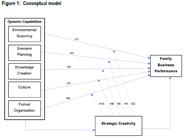
The conceptual model in Figure 1 illustrates the hypothesised relationships between the study's variables. It is essential to note that when testing a mediating variable, the relationships among the independent, dependent, and mediating variables are assessed (Wiid & Diggines, 2021).
3. METHODOLOGY
The study employed a quantitative research approach to conduct an inductive inquiry. A quantitative cross-sectional research design was selected because it enabled statistical analysis of the collected data to test the research hypotheses within a specific timeframe (Damico & Ball, 2019). Inductive logic is further associated with the ontological view of realists and with positivist epistemology (Mir & Greenwood, 2021). These two philosophical foundations were suitable for this study, as reality was understood through an objective viewpoint by measuring constructs that aid family business performance (Bryman, 2021).
3.1
Population and sampleThe selected population consisted of family-owned businesses, while the sample unit comprised one owner or one manager from each of these family businesses. The sample unit was selected to represent only a single outlook per family business, as gaining multiple views from each family business was beyond the scope of this study. According to Hoon et al. (2023), single viewpoints minimise access limitations to multiple respondents from a single firm. Consequently, reducing data collection time and adhering to the time frame of the study. The sample unit had to comply with a specific inclusion criterion. The inclusion criteria included that the family business be formally registered and that the family business owner or manager own, co-own, or manage an operating family business within the Eastern Cape, South Africa.
Studies focusing on Family business performance indicators are on the rise globally (Pike-Bowles et al., 2024). In South Africa, research on family business performance is limited, focusing primarily on various provinces and districts, particularly the Eastern Cape. Consequently, the Eastern Cape province was selected as the study locale firstly to add new insights and secondly because it is the researcher's hometown. The total number of respondents was 347 family businesses due to the scarcity of such firms in the Eastern Cape.
3.2
Research instrument and scaleThe questionnaire was selected as the research instrument, enabling the study's variables to be measured through closed-ended questions using a five-point Likert scale (1 = strongly disagree, 2 = disagree, 3 = neutral, 4 = agree, and 5 = strongly agree) (Kumar, 2019). The questionnaire entailed a standardised set of questions that were self-explanatory to the respondents. The research instrument used existing scales that are reliable and valid for measuring perceived family business performance, dynamic capabilities, and strategic creativity. The scales used to measure the study's variables were adapted from several existing studies that operationalised the items, as there was no existing standardised dynamic capabilities scale encompassing all five of this study's variables at the time of investigation (Kump et al., 2019).
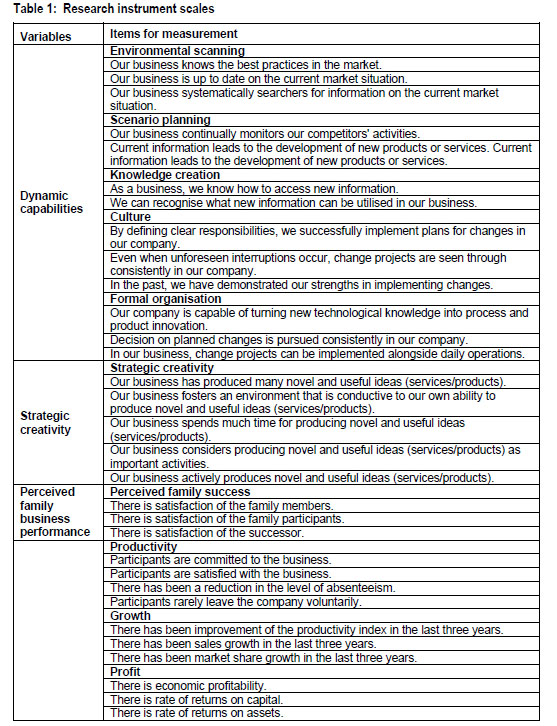
The Perceived Family Business Performance scale was extracted from Utrilla and Torraleja (2012), which comprised 13 items that specifically measured the financial and non-financial aspects of family businesses through constructs related to perceived family success, productivity, growth, and profit. The Strategic Creativity Scale was adopted from Mikalef and Gupta's (2021) work, which in turn drew its items from Lee and Choi's (2003) work. Here, five items measured strategic creativity. Lastly, the five selected dynamic capabilities dimensions of the study were measured using 13 items from Kump et al. (2019). Table 1 illustrates the items used to measure the study's variables.
Table 1 presents the items used to measure the study's variables. According to the literature reviewed, the dependent variable, family business performance, utilises a perceived family business performance scale that encompasses both financial and non-financial performance indicators (Utrilla & Torraleja, 2012). The strategic creativity items provide insight into how a business generates novel, valuable ideas that positively influence performance. Subsequently, measuring the selected items, the influence of strategic creativity on the relation between dynamic capabilities and the performance of family businesses was determined.
3.3
Data collectionTo promote data reliability and validity, a pilot test with 20 respondents with characteristics similar to those of the target group was conducted. A pilot study was conducted 2 months before data collection to ensure internal consistency, and the results were valid and reliable (Damico & Ball, 2019). Data collection was pursued to ensure anonymity and confidentiality, thereby ensuring that the respondent's personal information was stored and shared responsibly. Therefore, the respondents' personal information was not recorded, and each was allocated a pseudonym (Wiid & Diggines, 2021). The pseudonyms were numerical, ranging from 1 to 347, and were assigned to protect identities. Data collection took place face-to-face over six months, during which respondents spent an average of 15 minutes completing the questionnaire.
3.4
Data analysisData were processed, interpreted, and analysed using the SPSS software program. Descriptive statistics comprised basic distributions to determine frequencies and percentages. Additionally, the standard deviation (SD) and mean of the study's variables were tested. The inferential statistics entailed a multiple regression analysis to draw conclusions and test the hypotheses of this study (Wiid & Diggines, 2021). To test the mediating role of strategic creativity in the relationship between dynamic capabilities and family business performance, the Hayes PROCESS macro (Model 4) was employed.
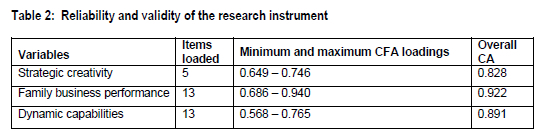
Confirmatory factor analysis (CFA) and Cronbach's alpha (CA) were tested to determine the reliability and validity of the research instrument. Subsequently, minimising common method variance and ensuring validity of the research results (Kock et al., 2021). According to Scharrer and Ramasubramanian (2021), a coefficient between 0.60 and 0.69 is deemed acceptable, while coefficients between 0.70 and 0.80, and above, are favourable. A coefficient value below 0.50 is identified as undesirable. Table 2 summarises the validity and reliability assessment of the items in the research instrument.
Table 2 shows that the study's variables had acceptable and favourable CFA loadings (0.568-0.940), indicating the validity of the research instrument. Additionally, the overall CA coefficients ranged from 0.828 to 0.922, indicating favourable reliability. Consequently, the research instrument proved to be both reliable and valid.
4. FINDINGS
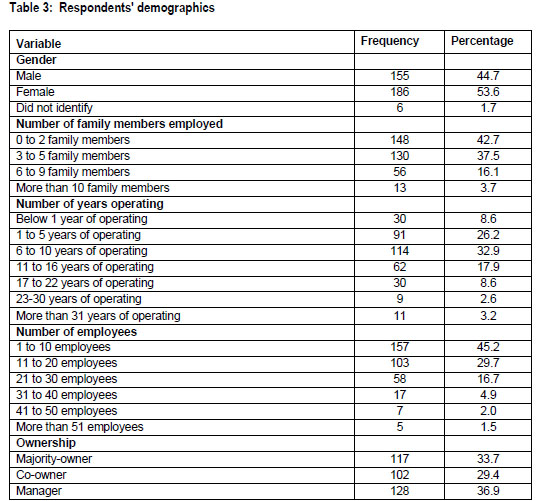
Descriptive statistics examined the respondents' demographics, providing a clear picture of the study's sample. Table 3 summarises the respondents' demographics.
Table 3 indicates that the family business landscape of the Eastern Cape comprises a majority of female-owned businesses (53.6%) that have employed between zero and two family members (42.7%). Moreover, such family businesses have been operating for between 6 and 10 years (32.9%), with a total number of employees ranging from 1 to 10 (45.2%). Table 3 further illustrates that the managers of the family businesses primarily responded to the questionnaire (36.9%).
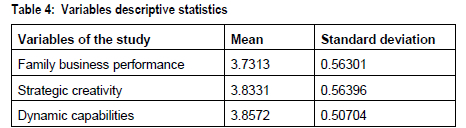
Additionally, descriptive analyses were conducted on the study's variables. Table 4 illustrates the overall mean and SD of the study's variables. SD is used to measure data dispersion (Scharrer & Ramasubramanian, 2021). A lower SD statistic indicates that the data are closely aligned with the mean, while a higher SD indicates that the data are more dispersed from the mean.
The respondents generally agreed with the items in the research instrument, as illustrated in Table 4. This included family business performance (mean = 3.7313), strategic creativity (mean = 3.8331), and dynamic capabilities (mean = 3.8572). Dynamic capabilities had the highest mean and the lowest SD, indicating that the respondents were consistent in their responses. Consequently, Table 4 recognised that the responses were moderately distributed.
4.1 Multiple regression analysis
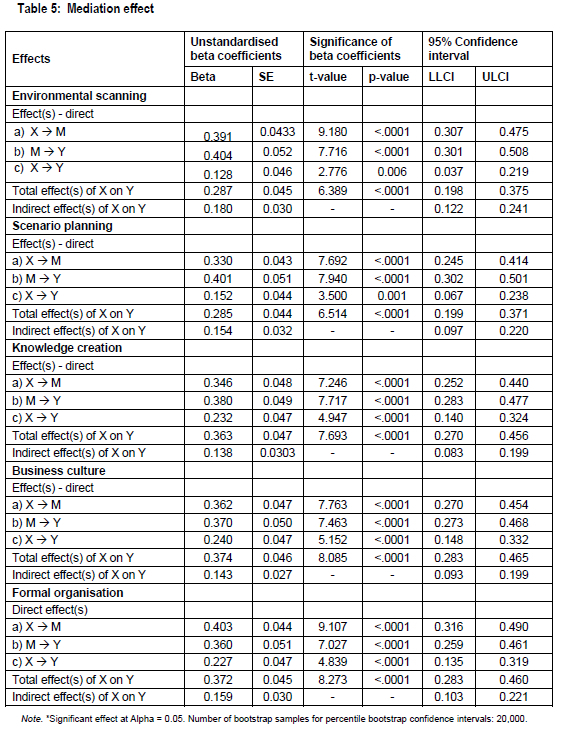
The study employed simple mediation to identify the influence of strategic creativity on the link between the selected dynamic capabilities and the perceived performance of family businesses. Table 5 illustrates the mediating role of strategic creativity in the relationship between dynamic capabilities and family business performance, which was tested using the Hayes PROCESS macro (Model 4) in SPSS. (Wiid & Diggines, 2021). The mediation analysis employed a bias-corrected 95% confidence interval based on a bootstrap sample size of 20000. Here, the unstandardised beta coefficient was examined to determine the change in a dependent variable when a mediating variable is introduced into an existing relationship between independent and dependent variables. Additionally, the standard deviation, denoted by β, represents the unstandardised beta coefficient values.
4.1.1 The link between dynamic capabilities and strategic creativity
An initial test was executed to identify the direct link between the five selected dynamic capabilities (X) and strategic creativity (M). The results indicated a significant relationship between the five selected dynamic capabilities and the mediating variable, strategic creativity. The link between environmental scanning and strategic creativity comprised a beta coefficient value of (0.391), a t-value of (9.180), a p-value of (<0.0001), a lower level confidence interval (LLCI) of (0.307), and an upper level confidence interval (ULCI) of (0.475). The link between scenario planning and strategic creativity entailed a beta coefficient value of (0.330), a t-value of (7.692), a p-value of (<0.0001), an LLCI of (0.245), and a ULCI of (0.414).
The association between knowledge creation and strategic creativity included a beta coefficient value of (0.346), a t-value of (7.246), a p-value of (<0.0001), an LLCI of (0.252), and a ULCI of (0.440). The link between business culture and strategic creativity entailed a beta coefficient value of (0.362), a t-value of (7.763), a p-value of (<0.0001), an LLCI of (0.270), and a ULCI of (0.454). Lastly, the link between the formal organisation and strategic creativity comprised a beta coefficient value of (0.403), a t-value of (9.107), a p-value of (<0.0001), an LLCI of (0.316), and a ULCI of (0.490).
The dynamic capabilities construct, entailing formal organisation, had the strongest significant relationship with strategic creativity (β=0.403), while the weakest significant effect was between scenario planning and strategic creativity (β=0.330), as seen in Table 5 (a) direct effects.
4.1.2 The effect of strategic creativity on family business performance
Secondly, the direct relationship between strategic creativity and the performance of family businesses was tested for each selected dynamic capability. The results include: environmental scanning beta coefficient value of (0.404), a t-value of (7.716), a p-value of (<0.0001), an LLCI of (0.301), and a ULCI of (0.508). Scenario planning entailed a beta coefficient value of (0.401), a t-value of (7.940), a p-value of (<0.0001), an LLCI of (0.302), and a ULCI of (0.501). The relationship between strategic creativity and knowledge creation comprised a beta coefficient of (0.380), a t-value of (7.717), a p-value of (<0.0001), an LLCI of (0.283), and a ULCI of (0.477). Business culture entailed a beta coefficient value of (0.370), a t-value of (7.463), a p-value of (<0.0001), an LLCI of (0.273), and a ULCI of (0.468).
Lastly, the formal organisation had a beta coefficient value of (0.360), a t-value of (7.027), a p-value of (<0.0001), an LLCI of (0.259), and a ULCI of (0.461), as seen in Table 5, b) direct effects. The results illustrated that strategic creativity has a significant and direct influence on family business performance for each dynamic capability. The strongest direct relationship between strategic creativity and family business performance was found for environmental scanning (β=0.404), while the weakest significant relationship was observed for formal organisation (β=0.360).
4.1.3 The relationship between dynamic capabilities and family business performance
When controlling for strategic creativity (M), the mediating variable, the results indicated that the five dynamic capabilities constructs (X) were significant predictors of perceived family business performance (Y), as illustrated in Table 5, direct effects, row c. Environmental scanning entailed a beta coefficient value of (0.128), a t-value of (2.776), a p-value of (<0.0006), a LLCI of (0.037), and an ULCI of (0.219). Scenario planning comprised a beta coefficient value of (0.152), a t-value of (3.500), a p-value of (<0.0001), an LLCI of (0.067), and a ULCI of (0.238). Knowledge creation had a beta coefficient value of (0.232), a t-value of (4.947), a p-value of (<0.0001), an LLCI of (0.140), and a ULCI of (0.324). The results revealed that business culture had a beta coefficient value of (0.240), a t-value of (5.152), a p-value of (<0.0001), an LLCI of (0.148), and a ULCI of (0.332).
Lastly, the formal organisation had a beta coefficient value of (0.227), a t-value of (4.839), a p-value of (<0.0001), an LLCI of (0.135), and a ULCI of (0.319). Based on these statistics, business culture (β = 0.240) is the most significant predictor of dynamic capability in family businesses. In contrast, environmental scanning (β = 0.128) shows the weakest relationship with family business performance. After testing the direct effects of the aforementioned variables, the total and indirect effects were determined to identify the mediating role of strategic creativity in the relationship between dynamic capabilities and family business performance.
4.1.4 The mediation effect of strategic creativity between dynamic capabilities and the performance of family businesses
The total effect of the mediating variable, strategic creativity (M), on the relationship between dynamic capabilities and family business performance was tested using a percentile bootstrap with 20000 samples. All five dynamic capabilities exhibited a significant relationship with family business performance, as illustrated in Table 5, which presents the total effects of X (dynamic capabilities) on Y (perceived family business performance). The total impact of dynamic capabilities on family business performance was influenced by environmental scanning (β=0.287), scenario planning (β=0.285), knowledge creation (β=0.363), business culture (β=0.374), and formal organisation (β=0.372). Of the five dynamic capabilities, business culture had the greatest total effect on family business performance, while scenario planning had the least.
Consequently, testing the indirect influence revealed that strategic creativity (M) significantly mediated the relationships among the five dynamic capability constructs and family business performance. The indirect effect results entailed; environmental scanning [β (0.180), LLCI (0.122), ULCI (0.241)]; scenario planning [β (0.154), LLCI (0.097), ULCI (0.220)]; knowledge creation [(β=0.138, 95% CI [0.083, 0.199]); business culture [β (0.143), LLCI (0.093), ULCI (0.199)]; and formal organisation [β (0.159), LLCI (0.103), ULCI (0.221)], as seen in Table 5, indirect effects of X (dynamic capabilities) on Y (perceived family business performance).
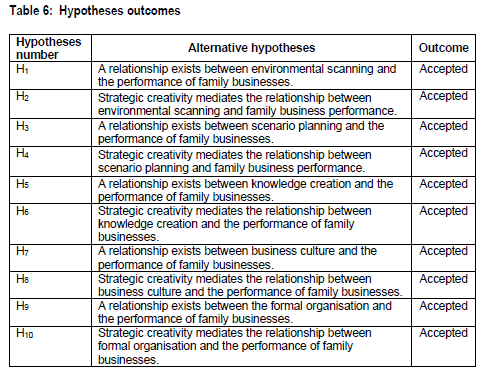
The findings highlighted that strategic creativity positively influences the association between the selected dynamic capabilities and the performance of family businesses. The highest mediating effect was observed between the dynamic capabilities construct, environmental scanning, and family business performance. The lowest mediating influence of strategic creativity was between knowledge creation and family business performance. Thus, based on these results, all alternative hypotheses of the study were accepted, as shown in Table 6.
The statistical outcomes for the hypotheses listed in Table 6 illustrate the study's five hypotheses. All five alternative hypotheses were accepted based on their statistical test results, with unstandardised beta coefficient values ranging from 0.138 to 0.159. These results essentially elucidate that a direct and significant relationship exists between the variables. Although the stipulated unstandardised beta coefficients appear small, a positive association exists between the variables and the mediator.
5. DISCUSSION
The study assessed the mediating role of strategic creativity in the relationship between dynamic capabilities and family business performance. The descriptive statistics provided new insights for the field of family business, particularly in the Eastern Cape, as previous research has not sufficiently considered this locale (Janse van Rensburg & Tjano, 2020; Urban & Nonkwelo, 2020). The results indicated that family businesses within the Eastern Cape are predominantly female-owned and have been operating between six and 10 years.
Based on the inferential statistics output, three key findings are made: a) a positive relationship exists between dynamic capabilities and strategic creativity, b) dynamic capabilities have a significant and direct effect on family business performance, and c) strategic creativity positively influences family business performance when dynamic capabilities are present. A key theoretical contribution is made, as the findings illustrate that strategic creativity has the most significant mediating influence on the relationship between the dynamic capability dimension encompassing environmental scanning and family business performance. This represents a new insight for the field of family business, as Soluk et al. (2021) acknowledged that environmental scanning is a key strategic tool within firms; however, these authors do not specifically consider a mediating influence within the family business field.
Although current research recognises that exercising scenario planning, environmental scanning, business culture, knowledge creation, and the formal organisation do enhance business performance, there is a primary focus on non-family businesses as opposed to family businesses (Alizadeh & Soltanisehat, 2019; Gregurec et al., 2021; Schwarz et al., 2019). The study's findings, therefore, offer new insights through the lens of family businesses, indicating that strategic creativity positively mediates the association between the selected dynamic capabilities and family business performance. Consequently, these findings contribute to the field of family business by showing that family business performance improves when dynamic capabilities and strategic creativity are both present in business operations.
Furthermore, existing research indicates that a positive business culture is a significant contributor to a firm's performance (Soluk et al., 2021), as was similarly identified in this study through the total effect. However, when testing the mediation effect of strategic creativity on the relationship between business culture and family business performance, the findings revealed that although there was a positive mediation effect, it was not a key contributing dynamic capability to enhancing family business performance. Thus, this research study found that family business performance is predominantly improved when environmental scanning and strategic creativity are aligned.
The results of this investigation align with the work of Arokodare and Asikhia (2020), who recognised that firms must engage in strategic creativity by incorporating the dynamic capabilities model to gain a competitive advantage. Furthermore, this study's findings build on the work of Majekodunmi (2020) and Oktarina and Witiastuti (2019). These authors acknowledged that being creative facilitates business performance by continuously improving the firm's resources and capabilities. This investigation adds to the body of knowledge by accounting for a unique mediation effect in family businesses.
These findings, therefore, add to the works of Buehring and Bishop (2020), Pulsiri and Vatananan-Thesenvitz (2021), and Walia (2021), where these authors focused on non-family firms and strategic constructs entailing creativity and leadership that contribute towards improved business performance, with no attention placed on these concepts from a family business standpoint. This study's findings concur with the author's work, which shows that creativity is a key contributor to improved business performance when strategic creativity is practised simultaneously.
6. MANAGERIAL IMPLICATIONS
The findings resulted in key implications and recommendations for family businesses and practitioners specialising in family firms in emerging economies. Such implications and recommendations have the potential to transform the family business landscape in South Africa, enhancing business performance and long-term survival in uncertain economic environments (Aldrich et al., 2021). Family businesses are suggested to modify their current strategies to include a dynamic capabilities framework (Pike-Bowles et al., 2024).
Such a framework should focus on promoting strategic creativity to enhance family business performance. The primary focus should be on environmental scanning within the business's daily operations. Such a dynamic capabilities framework would enable family businesses to sense, seize, and reconfigure their resources and capabilities, thereby enhancing business performance in fluctuating operating environments (Semke & Tiberius, 2020). Additionally, the dynamic capabilities framework should outline the business's current, future, and anticipated dynamic capability constructs. This would allow a family business to determine which dynamic capabilities it currently possesses and how they contribute to business performance when aligned with strategic creativity.
Moreover, it would indicate the missing dynamic capabilities required to reposition the firm's strategic creative direction in the future and how the firm will achieve this (Daspit et al., 2019; Glyptis et al., 2021). Practitioners who focus on family businesses are advised to reconfigure their current business offerings to include a comprehensive dynamic capabilities framework. Here, practitioners should observe a family business's current dynamic capabilities and the presence of strategic creativity.
Based on the observation, a detailed report and a uniquely developed dynamic capabilities framework should be proposed to the family business to enhance performance. Consequently, assisting family business performance in South Africa by providing a lucrative dynamic capabilities framework for family businesses to implement (Pike-Bowles et al., 2024).
7. LIMITATIONS AND FUTURE RESEARCH AVENUES
Regarding the study's limitations, three were identified. Firstly, no family business database exists in the Eastern Cape Province of South Africa; therefore, the authors developed one for this investigation. The database was created by approaching numerous businesses across the eight districts of the Eastern Cape Province of South Africa to determine their eligibility for inclusion in the study.
Secondly, the study considered only one perspective per family business; therefore, multiple perspectives were not acknowledged within the study's specified timeframe. Thirdly, the risk of common method variance and researcher bias is always a concern in cross-sectional studies (Kock et al., 2021). However, this limitation was mitigated by conducting a pilot study to assess the research instrument's reliability and validity, which used CFA and scales that have been shown to be reliable and valid in other publications, while ensuring respondent anonymity.
Future research is needed to develop comprehensive databases for South African family businesses that take into account multiple perspectives within each family business. Future research avenues could involve replicating this study from a qualitative perspective. By doing this, a subjective view of the participant's opinions and experiences can be obtained. Additionally, future research is suggested to identify the strategic benchmarks that should be incorporated into a robust dynamic capabilities framework that emphasises strategic creativity and family business performance.
8. CONCLUSION
Family businesses face uncertain economic conditions, which require them to redefine their existing strategic tools to improve business performance. The study investigated the mediating influence of strategic creativity between five dynamic capability dimensions (scenario planning, environmental scanning, business culture, knowledge creation, and the formal organisation) and family business performance in South Africa. The results indicated that the five hypotheses were supported, suggesting that strategic creativity positively influences the association between dynamic capabilities and the performance of family businesses in South Africa.
Family businesses are encouraged to adopt a dynamic capabilities framework to enhance performance in unstable economic conditions. Family business practitioners are further urged to assess such a dynamic capabilities framework that fosters strategic creativity within South African family businesses. Such a tactical framework can increase the performance of family businesses across South Africa through innovation. The results, therefore, provide distinctive theoretical contributions to the field of family business.
Conflict of interest: The authors declare no conflict of interest with respect to the research, authorship and publication of the article.
Data availability: The data used for this article is available on request from the corresponding author.
Ethical clearance and informed consent statement: The researchers obtained ethical clearance prior to data collection and informed consent from all the participants in this study. The ethical clearance reference number, CHI051SPIK01 (REC270710-028-RA), issued by the Research Ethics Committee at the University of Fort Hare.
Funding: The authors did not receive any financial support for research, authorship and publication of the article.
REFERENCES
2. LITERATURE REVIEW
-
Abbady, M., Akkaya, M. & Sari, A. (2019). Big data governance, dynamic capability, and decision-Making effectiveness: A fuzzy sets approach. Decision Science Letters, 8(4), 429-440. https://doi.org/10.5267/j.dsl.2019.5.003
» https://doi.org/10.5267/j.dsl.2019.5.003 -
Abu-Rumman, A., Al Shraah, A., Al-Madi, F. & Alfalah, T. (2021). Entrepreneurial networks, entrepreneurial orientation, and performance of small and medium enterprises: Are dynamic capabilities the missing link?. Journal of Innovation and Entrepreneurship, 10(1), 1-16. https://doi.org/10.1186/s13731-021-00170-8
» https://doi.org/10.1186/s13731-021-00170-8 -
Aldrich, H.E., Brumana, M., Campopiano, G. & Minola, T. (2021). Embedded but not asleep: Entrepreneurship and family business research in the 21st century. Journal of Family Business Strategy, 12(1), 1-19. https://doi.org/10.1016/j.jfbs.2020.100390
» https://doi.org/10.1016/j.jfbs.2020.100390 -
Alipour, K.K., Barber, D., Batchelor, J.H., Peake, W., Jones, S. & McIlveene, T. (2025). Family business culture: a strategic resource and driver of firm performance. Journal of Family Business Management, 15(3), 477-496. https://doi.org/10.1108/JFBM-03-2024-0064
» https://doi.org/10.1108/JFBM-03-2024-0064 -
Alizadeh, R. & Soltanisehat, L. (2020). Stay competitive in 2035: A scenario-based method to foresight in the design and manufacturing industry. Foresight, 22(3), 309-330. https://doi.org/10.1108/FS-06-2019-0048
» https://doi.org/10.1108/FS-06-2019-0048 -
Alves, C.A. & Gama, A.P.M. (2020). Family business performance: A perspective of family influence. Revista Brasileira de Gestão de Negócios, 22(01), 163-182. https://doi.org/10.7819/rbgn.v22i1.4040
» https://doi.org/10.7819/rbgn.v22i1.4040 -
Alyahya, M., Aliedan, M., Agag, G. & Abdelmoety, Z.H. (2023). Understanding the relationship between big data analytics capabilities and sustainable performance: The role of strategic agility and firm creativity. Sustainability, 15(9), 1-17. https://doi.org/10.3390/su15097623
» https://doi.org/10.3390/su15097623 -
Arokodare, M.A. & Asikhia, O.U. (2020). Strategic agility: Achieving superior organisational performance through strategic foresight. Global Journal of Management and Business Research, 20(3), 7-16. https://doi.org/10.34257/GJMBRAVOL20IS3PG7
» https://doi.org/10.34257/GJMBRAVOL20IS3PG7 -
Astrachan, J. H., Binz Astrachan, C., Campopiano, G. & Baù, M. (2020). Values, spirituality and religion: Family business and the roots of sustainable ethical behavior. Journal of Business Ethics, 163(4), 637-645. https://doi.org/10.1007/s10551-019-04392-5
» https://doi.org/10.1007/s10551-019-04392-5 -
Azeem, M., Ahmed, M., Haider, S. & Sajjad, M. (2021). Expanding competitive advantage through organisational culture, knowledge sharing and organisational innovation. Technology in Society, 66, 1-10. https://doi.org/10.1016/j/techsoc.2021.101635
» https://doi.org/10.1016/j/techsoc.2021.101635 -
Beck, S.B., Farrington, S.M. & Venter, E. (2020). Parental Influences on the next generation's intention to join their family business. Journal of Contemporary Management, 17(2), 74-101. https://doi.org/10.35683/jcm19051.65
» https://doi.org/10.35683/jcm19051.65 - Bleady, A., Ali, A. H., & Ibrahim, S. B. (2018). Dynamic capabilities theory: pinning down a shifting concept. Academy of Accounting and Financial Studies Journal, 22(2), 1-16.
-
Boddenberg, F., Schwarz, J.O. & Schmies, P. (2024). Scenario planning in the digital transformation of the fashion industry: Starting point for the adjustment of business processes from a colour management perspective. Journal of Futures Studies, 28(3), 49-63. https://doi.org/10.6531/JFS.202403_28(3).0004
» https://doi.org/10.6531/JFS.202403_28(3).0004 -
Bogers, M., Chesbrough, H., Heaton, S. & Teece, D.J. (2019). Strategic management of open innovation: A dynamic capabilities perspective. California Management Review, 62(1), 77-94. https://doi.org/10.1177/0008125619885150
» https://doi.org/10.1177/0008125619885150 -
Bouncken, R.B., Hughes, M., Ratzmann, M., Cesinger, B. & Pesch, R. (2020). Family firms, alliance governance and mutual knowledge creation. British Journal of Management, 31(4), 769-791. https://doi.org/10.1111/1467-8551.12408
» https://doi.org/10.1111/1467-8551.12408 - Bryman, A. 2021. Social Research Methods. 6th ed. Oxford: Oxford University Press.
-
Buehring, J. & Bishop, P.C. (2020). Foresight and Design: New Support for Strategic Decision Making. She Ji: The Journal of Design, Economics, and Innovation, 6(3), 408-432. https://doi.org/10.1016/j.sheji.2020.07.002
» https://doi.org/10.1016/j.sheji.2020.07.002 -
Bujan, I. (2020). Entrepreneurial orientation and socioemotional dimensions in small family hotels: do they impact business performance?. Economic research-Ekonomska istrazivanja, 33(1), 1925-1942. https://doi.org/10.1080/1331677X.2020.1763824
» https://doi.org/10.1080/1331677X.2020.1763824 -
Caballero-Morales, S.O. (2021). Innovation as recovery strategy for SMEs in emerging economies during the COVID-19 pandemic. Research in International Business and Finance, 57, 1-9. https://doi.org/10.1016/j.ribaf.2021.101396
» https://doi.org/10.1016/j.ribaf.2021.101396 -
Calabrò, A., Santulli, R., Torchia, M. & Gallucci, C. (2021). Entrepreneurial orientation and family firm performance: the moderating role of TMT identity-based and knowledge-based faultlines. Entrepreneurship Theory and Practice, 45(4), 838-866. https://doi.org/10.1177/1042258720973997
» https://doi.org/10.1177/1042258720973997 -
Camison-Zornoza, C., Fores-Julian, B., Puig-Denia, A. & Camison-Haba, S. (2020). Effects of ownership structure and corporate and family governance on dynamic capabilities in family firms. International Entrepreneurship and Management Journal, 16, 1393-1426. https://doi.org/10.1007/s11365-020-00675-w
» https://doi.org/10.1007/s11365-020-00675-w -
Chaudhary, S., Dhir, A., Ferraris, A. & Bertoldi, B. (2021). Trust and reputation in family businesses: A systematic literature review of past achievements and future promises. Journal of Business Research, 137, 143-161. https://doi.org/10.1016/j.jbusres.2021.07.052
» https://doi.org/10.1016/j.jbusres.2021.07.052 -
Čirjevskis, A. (2019). The role of dynamic capabilities as drivers of business model innovation in mergers and acquisitions of technology-advanced firms. Journal of Open Innovation: Technology, Market, and Complexity, 5(1), 1-16. https://doi.org/10.3390/joitmc5010012
» https://doi.org/10.3390/joitmc5010012 -
Damico, J. S. & Ball, M. J. (2019). The SAGE encyclopedia of human communication sciences and disorders. London: SAGE Publications. https://doi.org/10.4135/9781483380810
» https://doi.org/10.4135/9781483380810 -
Daspit, J.J., Long, R.G. & Pearson, A.W. (2019). How familiness affects innovation outcomes via absorptive capacity: A dynamic capability perspective of the family firm. Journal of Family Business Strategy, 10(2), 133-143. https://doi.org/10.1016/j.jfbs.2018.11.003
» https://doi.org/10.1016/j.jfbs.2018.11.003 -
Eze, N.L., Nordqvist, M., Samara, G. & Parada, M.J. (2021). Different strokes for different folks: The roles of religion and tradition for transgenerational entrepreneurship in family businesses. Entrepreneurship Theory and Practice, 45(4), 792-837. https://doi.org/10.1177/1042258720964428
» https://doi.org/10.1177/1042258720964428 -
Glyptis, L., Hadjielias, E., Christofi, M., Kvasova, O. & Vrontis, D. (2021). Dynamic familiness capabilities and family business growth: A longitudinal perspective framed within management accounting. Journal of Business Research, 127, 346-363. https://doi.org/10.1016/j.jbusres.2021.01.019
» https://doi.org/10.1016/j.jbusres.2021.01.019 -
González L.A.C., Rodríguez, Y.E. & Sánchez, C. (2023). Women in the family business: self and family's influence on their perceptions of financial performance. International Journal of Gender and Entrepreneurship, 15(4), 341-363. https://doi.org/10.1108/IJGE-01-2023-0020
» https://doi.org/10.1108/IJGE-01-2023-0020 -
Gregurec, I., Tomičić Furjan, M. & Tomičić-Pupek, K. (2021). The impact of COVID-19 on sustainable business models in SMEs. Sustainability, 13(3), 1-24. https://doi.org/10.3390/su13031098
» https://doi.org/10.3390/su13031098 -
Hansen, C., Block, J. & Neuenkirch, M. (2020). Family firm performance over the business cycle: a meta-analysis. Journal of Economic Surveys, 34(3), 476-511. https://doi.org/10.1111/joes.12364
» https://doi.org/10.1111/joes.12364 -
Hernández-Linares, R., Kellermanns, F.W., López-Fernández, M.C. & Sarkar, S. (2019). The effect of socioemotional wealth on the relationship between entrepreneurial orientation and family business performance. BRQ Business Research Quarterly, 124, 1-17. https://doi.org/10.1016/j.brq.2019.03.002
» https://doi.org/10.1016/j.brq.2019.03.002 -
Hlatywayo, V. & Williamson, M.K. (2023). Investigating predictors for the successful implementation of open innovation: A case of small and medium enterprises in KwaZulu-Natal, South Africa. Journal of Contemporary Management, 20(2), 315-339. https://doi.org/10.35683/jcman1021.224
» https://doi.org/10.35683/jcman1021.224 -
Hoon, C., Brinkmann, J. & Baluch, A. M. (2023). Narrative memory work of employees in family businesses: How founding stories shape organisational identification. Family Business Review, 36(1), 37-62. https://doi.org/10.1177/08944865231159475
» https://doi.org/10.1177/08944865231159475 -
Huseyin, E. (2023). Financial performance metrics in family vs non-family CEOs of family-owned firms. Journal of Policy Options, 6(2), 1-8. https://resdojournals.com/index.php/jpo/article/view/310
» https://resdojournals.com/index.php/jpo/article/view/310 -
Janse van Rensburg, L.J. & Tjano, R.N. (2020). The relationship of self-efficacy and entrepreneurial intentions on the commitment of the next generation in family-owned agribusinesses. Acta Commercii, 20(1), 1-12. https://doi.org/10.4102/ac.v20i1.742
» https://doi.org/10.4102/ac.v20i1.742 -
Kamariotou, M. & Kitsios, F. (2019). Strategic information systems planning. In Advanced Methodologies and Technologies in Business Operations and Management, 535-546. https://doi.org/10.4018/978-1-5225-7362-3.ch039
» https://doi.org/10.4018/978-1-5225-7362-3.ch039 -
Koentjoro, S. & Gunawan, S. (2020). Managing knowledge, dynamic capabilities, innovative performance, and creating sustainable competitive advantage in family companies: A case study of a family company in Indonesia. Journal of Open Innovation: Technology, Market, and Complexity, 6(3), 1-21. https://doi.org/10.3390/joitmc6030090
» https://doi.org/10.3390/joitmc6030090 -
Kock, F., Berbekova, A. & Assaf, A.G. (2021). Understanding and managing the threat of common method bias: detection, prevention, and control. Tourism Management, 86, 1-10. https://doi.org/10.1016/j.tourman.2021.104330
» https://doi.org/10.1016/j.tourman.2021.104330 -
Krishnan, N. (2020). Developing culture in family business. NHRD Network Journal, 13(1), 84-90. https://doi.org/10.1177/263145119900020
» https://doi.org/10.1177/263145119900020 - Kumar, R. (2019). Research methodology: A step-by-step guide for beginners. 5th ed. California: SAGE Publications.
-
Kump, B., Engelmann, A., Kessler, A. & Schweiger, C. (2019). Toward a dynamic capabilities scale: measuring organisational sensing, seizing, and transforming capacities. Industrial and Corporate Change, 28(5), 1149-1172. https://doi.org/10.1093/icc/dty054
» https://doi.org/10.1093/icc/dty054 -
Lee, H. & Choi, B. (2003). Knowledge management enablers, processes, and organisational performance: An integrative view and empirical examination. Journal of Management Information Systems, 20(1), 179-228. https://doi.org/10.1080/07421222.2003.11045756
» https://doi.org/10.1080/07421222.2003.11045756 -
Lee, Y. & Kim, J. (2021). Cultivating employee creativity through strategic internal communication: The role of leadership, symmetry, and feedback seeking behaviors. Public Relations Review, 47(1), 1-11. https://doi.org/10.1016/j.pubrev.2020.101998
» https://doi.org/10.1016/j.pubrev.2020.101998 -
Maharajh, R., Dhliwayo, S. & Chebo, A.K. (2024). The influence of family dynamics on business performance: does effective leadership matter?. Journal of Family Business Management, 14(3), 515-533. https://doi.org/10.1108/JFBM-04-2023-0058
» https://doi.org/10.1108/JFBM-04-2023-0058 -
Majekodunmi, S.A. (2020). Strategic creativity: Nigerian music industry experience. Journal of CUDIMAC, 8(1), 90-101. https://cudimac.unn.edu.ng/wp-content/uploads/sites/52/2020/09/majekodunmi-PP.-90-101.pdf
» https://cudimac.unn.edu.ng/wp-content/uploads/sites/52/2020/09/majekodunmi-PP.-90-101.pdf -
Masakale, A.M. & Pooe, D. (2022). The relationship between personal entrepreneurial competencies, dynamic capabilities and SME performance. Journal of Contemporary Management, 19(2), 729-755. https://doi.org/10.35683/jcm22017.187
» https://doi.org/10.35683/jcm22017.187 -
Mikalef, P. & Gupta, M. (2021). Artificial intelligence capability: Conceptualisation, measurement calibration, and empirical study on its impact on organisational creativity and firm performance. Information & Management, 58(3), 1-20. https://doi.org/10.1016/j.im.2021.103434
» https://doi.org/10.1016/j.im.2021.103434 -
Mikalef, P., Conboy, K. & Krogstie, J. (2021). Artificial intelligence as an enabler of B2B marketing: A dynamic capabilities micro-foundations approach. Industrial Marketing Management, 98, 80-92. https://doi.org/10.1016/jJndmarman.2021.08.002
» https://doi.org/10.1016/jJndmarman.2021.08.002 -
Mikušová, M., Friedrich, V. & Horváthová, P. (2020). Who is more sustainable? Family business or non-family business? Czech evidence. Sustainability, 12(14), 1-26. https://doi.org/10.3390/su12145540
» https://doi.org/10.3390/su12145540 -
Mir, R. & Greenwood, M. (2021). Philosophy and management studies: A research overview. London: Routledge. https://dpo.org/10.4324/9781351030700
» https://dpo.org/10.4324/9781351030700 -
Naong, M.N., Thomo, W.S. & Dzansi, L.W. (2023). Perceptions of the effects of training and development practices on employee performance: A case of Inyatsi Construction company. Journal of Contemporary Management, 20(2), 123-144. https://doi.org/10.35683/jcm22042.217
» https://doi.org/10.35683/jcm22042.217 - Nelson, R. & Winter, S. (1982). An Evolutionary theory of economic change. Harvard University Press.
-
Nguyen, M.H., Nguyen, H.T.T., Le, T.T., Luong, A.P. & Vuong, Q.H., (2022). Gender issues in family business research: A bibliometric scoping review. Journal of Asian Business and Economic Studies,29(3), 166-188. https://doi.org/10.1108/JABES-01-2021-0014
» https://doi.org/10.1108/JABES-01-2021-0014 -
Obermayer, N., Kövári, E., Leinonen, J., Bak, G. & Valeri, M. (2021). How social media practices shape family business performance: the wine industry case study. European Management Journal, 1-12. https://doi.org/10.1016/j.emj.2021.08.003
» https://doi.org/10.1016/j.emj.2021.08.003 -
Ochoa, M.P.B., Sacristan-Navarro, M.A. & Pelechano-Barahona, E. (2020). A Bibliometric analysis of dynamic capabilities in the field of family firms (2009-2019). European Journal of Family Business, 10(2), 69-81. https://doi.org/10.24310/ejfbejfb.v10i2.10162
» https://doi.org/10.24310/ejfbejfb.v10i2.10162 -
Ode, E. & Ayavoo, R. (2020). The mediating role of knowledge application in the relationship between knowledge management practices and firm innovation. Journal of Innovation & Knowledge, 5(3), 210-218. https://doi.org/10.1016/j.jik2019.08.002
» https://doi.org/10.1016/j.jik2019.08.002 - Oktarina, N. & Witiastuti, R. (2019). The development of business creativity, business superiority, and entrepreneurship network to improve business performance. International Journal of Business and Society, 20(2), 743-754.
-
Park, H.Y., Misra, K., Reddy, S. & Jaber, K. (2019). Family firms' innovation drivers and performance: a dynamic capabilities approach. Journal of Family Business Management, 9(1), 4-23. https://doi.org/10.1108/JFBM-11-2017-0039
» https://doi.org/10.1108/JFBM-11-2017-0039 - Pike-Bowles, A., Puchert-Townes, J. & Chinyamurindi, W.T. (2022). A bibliometric analysis of South African family business research between 2012 and 2022. The Southern Africa Institute for Management Scientists, 33, 619-628.
-
Pike-Bowles, A.P., Townes, J. & Chinyamurindi, W. (2024). The role of strategic flexibility and dynamic capabilities on family business performance. Southern African Journal of Entrepreneurship and Small Business Management, 16(1), 1-11. https://doi.org/10.4102/sajesbm.v16i1.767
» https://doi.org/10.4102/sajesbm.v16i1.767 -
Porfírio, J.A., Felício, J.A. & Carrilho, T. (2019). Family business succession: Analysis of the drivers of success based on entrepreneurship theory. Journal of Business Research, 115, 250-257. https://doi.org/10.1016/j.jbusres.2019.11.054
» https://doi.org/10.1016/j.jbusres.2019.11.054 -
Pulsiri, N. & Vatananan-Thesenvitz, R. (2021). Triangle relationship: A review of dynamic capabilities, strategic foresight and organisational learning. International Journal of Business Environment, 5(3), 1-18. https://www.theijbmt.com/archive/0939/2098339679.pdf
» https://www.theijbmt.com/archive/0939/2098339679.pdf -
Razzak, M. R., Mustamil, N. & Bakar, R. A. (2020). Research gaps in family owned businesses: a conceptual link between socio-emotional wealth, family commitment and firm performance. International Journal of Business Excellence, 20(2), 205-222. https://doi.org/10.1504/IJBEX.2020.105345
» https://doi.org/10.1504/IJBEX.2020.105345 -
Rovelli, P., Ferasso, M., De Massis, A. & Kraus, S. (2021). Thirty years of research in family business journals: Status quo and future directions. Journal of Family Business Strategy, 1-17. https://doi.org/10.1016/j.jfbs.2021.100422
» https://doi.org/10.1016/j.jfbs.2021.100422 -
Scharrer, E. & Ramasubramanian, S. (2021). Quantitative research methods in communication: The power of numbers for social justice. London: Routledge. https://doi.org/10.4324/9781003091653
» https://doi.org/10.4324/9781003091653 -
Schilke, O., Hu, S. & Helfat, C.E. (2018). Quo vadis, dynamic capabilities? A content-analytic review of the current state of knowledge and recommendations for future research. Academy of Management Annals, 12(1), 390-439. https://doi.org/10.5465/annals.2016.0014
» https://doi.org/10.5465/annals.2016.0014 -
Schwarz, J.O., Ram, C. & Rohrbeck, R. (2019). Combining scenario planning and business wargaming to better anticipate future competitive dynamics. Futures, 105, 133-142. https://doi.org/10.1016/j.futures.2018.10.001
» https://doi.org/10.1016/j.futures.2018.10.001 -
Semke, L.M. & Tiberius, V. (2020). Corporate foresight and dynamic capabilities: An exploratory study. Forecasting, 2(2), 180-193. https://doi.org/10.3390/forecast200010
» https://doi.org/10.3390/forecast200010 -
Soluk, J., Miroshnychenko, I., Kammerlander, N. & De Massis, A. (2021). Family influence and digital business model innovation: the enabling role of dynamic capabilities. Entrepreneurship Theory and Practice, 45(4), 867-905. https://doi.org/10.1177/1042258721998946
» https://doi.org/10.1177/1042258721998946 -
Steininger, D.M., Mikalef, P., Pateli, A. & Ortiz-de-Guinea, A. (2022). Dynamic capabilities in information systems research: A critical review, synthesis of current knowledge, and recommendations for future research. Journal of the Association for Information Systems, 23(2), 447-490. https://doi.org/10.17705/1jais.00736
» https://doi.org/10.17705/1jais.00736 -
Teece, D.J., Pisano, G. & Shuen, A. (1997). Dynamic capabilities and strategic management. Strategic Management Journal, 18(7), 509-533. https://doi.org/10.1002/(SICI)1097-0266(199708)18:7<509::AID-SMJ882>3.0.CO;2-Z
» https://doi.org/10.1002/(SICI)1097-0266(199708)18:7<509::AID-SMJ882>3.0.CO;2-Z -
Urban, B. & Nonkwelo, R.P. (2020). Intra-family dynamics and succession planning in family businesses in South Africa: the daughter as a potential successor. Journal of Family Business Management 12(2), 266-279. https://doi.org/10.1108/JFBM-08-2020-0084
» https://doi.org/10.1108/JFBM-08-2020-0084 -
Utrilla, P.N.C. & Torraleja, F.A.G. (2012). Family businesses: How to measure their performance. African Journal of Business Management, 6(12), 4612-4621. https://doi.org/10.5897/AJBM12.035
» https://doi.org/10.5897/AJBM12.035 -
Walia, C. (2021). Creativity and strategy: An Iitegrated analysis. Switzerland: Springer. https://doi.org/10.1007/978-3-030-70466-7
» https://doi.org/10.1007/978-3-030-70466-7 -
Wasim, O., Ibrahim, H. & Baharudin, D.M. (2024). CEO educational level and financial risk-taking behaviour of family listed companies in Malaysia. Global Business & Management Research, 16(4), 516-536. https://www.gbmrjournal.com/pdf/v16n4s/V16N4s-32.pdf
» https://www.gbmrjournal.com/pdf/v16n4s/V16N4s-32.pdf - Wiid, J. & Diggines, C. (2021). Marketing research. 4th ed. South Africa: Juta and Company.
-
Zhang, X., Fang, H., Dou, J. & Chrisman, J.J. (2022). Endogeneity issues in family business research: Current status and future recommendations. Family Business Review, 35(1), 91-116. https://doi.org/10.1177/08944865211049092
» https://doi.org/10.1177/08944865211049092 -
Ziyae, B. & Sadeghi, H. (2020). Exploring the relationship between corporate entrepreneurship and firm performance: the mediating effect of strategic entrepreneurship. Baltic Journal of Management, 16(1), 113-133. https://doi.org/10.1108/BJM-04-2020-0124
» https://doi.org/10.1108/BJM-04-2020-0124