Managers' Perspectives of Service Quality and Customer Loyalty in Small Clothing Retail Businesses
Abstract
In a highly competitive service environment, the quality of service offered by businesses can mean the difference between success and failure. In this regard, the role of customer loyalty cannot be disregarded. The constructs of service quality and customer loyalty are however intangible and complex and therefore difficult to come to grips with. This is more so, because their precursors can be subject to context-specific nuances. This fuels the impetus of the study to investigate the determinants of service quality and the basis for assessment of customer loyalty in small clothing retail businesses. Most studies tend to explore the concepts from the customer's perspectives; however, this study focuses on the managers' perspectives. The study utilised a descriptive qualitative research design and respondents were selected using a homogenous purposive non-probability sampling technique. Eleven semi-structured interviews were conducted with owners or managers of small clothing retail stores. Findings indicate that price, race and personalised service are critical determinants of service quality. On the other hand, credible inference of the existence of customer loyalty may be made on the premise of enhanced business image, improved communications, increased trust and repeat patronage. While repeat patronage is arguably the best indicator of customer loyalty, the other issues provide reasonable grounds to make a reliable inference of the state of customer loyalty to the business. It is imperative for managers of small clothing retail businesses to strive to position their businesses favourably in the minds of the customers, cultivate a business culture that enables more effective communication while concurrently building trust with customers.
Clothing retail; customer loyalty; service quality and small business
1. INTRODUCTION
In a period of unparalleled retail transformation and turbulence, where customers are continually adapting their consumption patterns, understanding consumer preferences is a matter of survival for many clothing retailers (Gauteng Provincial Treasury 2018:16; Rootman & Kruger 2017:1035; Sands & Ferraro 2010:567). Retailers need to endlessly adapt their image, services and products to meet the consumers' demands in a particular market (Donnell, Hutchinson & Reid 2012:907). To this end, service quality may perhaps be a critical factor that contributes to the attainment of a competitive advantage. Taking this into consideration it is essential for owners or managers of small retail clothing stores to focus on providing improved service quality as it leads to customer satisfaction, which in turn fosters customer loyalty (Domenge & Arciniega 2015:12; Prentice 2013:50). Clothing retail businesses operate in the retail sector where according to Reddy and Reddy (2010:122) businesses are primarily involved in the sales of products/services. The retail industry presents a dynamic environment driven by shifting customer behaviours (Rootman & Kruger 2017:1038). The interest of this study is to assess service quality and the role it plays in realising customer loyalty within small clothing retail stores, from the managerial outlook of either the store managers or owners who are concurrently managing the stores.
The main aim of this study is to examine the issues of service quality and customer loyalty in clothing retail businesses from the unusual perspective of managers. The choice of the perspective is unusual because extant literature is replete with studies based on customer perceptions (Birtwistle & Shearer 2001; Premalatha, Venkataravi & Sangeetha 2018; Zohre, Sreenivasan & Chinnasamy 2014). This study takes a different approach and explores the study constructs of service quality and customer loyalty from the perspective of managers. It derives its motivation from the reality that the owner/manager is an invaluable source of useful knowledge that must have been gained from interacting, over time, with numerous customers from a heterogeneous population. The interaction with a chain of customers provides a strong basis for the managers to develop a profound sense of the issues to pay attention in clothing retail small businesses in order to achieve impressive service quality heights and customer loyalty. It is the customer who ultimately decides whether the incorporated features of the service meet their expectations or not; as the service is intended to benefit the customer. For this reason, it is only the customer that can provide accurate feedback regarding their perception of the service offering.
The study therefore seeks to highlight these issues, by seeking answers to the following questions from the managers of small clothing retail stores in Gauteng, South Africa:
• What are the primary determinants of service quality in the clothing retail businesses?
• What do managers rely on to assess customer loyalty in clothing retail businesses?
The study contributes to the theoretical and empirical body of knowledge by presenting factors highlighted by managers that could foster a better understanding of service quality and customer loyalty.
Service quality relates to the extent to which expected service matches the perceived service and leads to customer satisfaction (Izogo 2015:274). In essence, service quality entails a comparison of the pre-service and post-service thoughts of the customer with respect to the service received. Zietsman, Mostert and Svensson (2019:3) as well as Stefano, Casarotto Filho, Barichello and Sohn (2015:433) contend that service quality is an abstract and elusive construct, given the distinguishing features of intangibility, heterogeneity and inseparability of production and consumption that services have. Possibly, due to this, Izogo (2017:22) argues that the service quality construct is contextual to the environment in which it is being determined. This seems to suggest that conclusions drawn from studies conducted in other environments can hardly provide a veritable basis for inference of what the perceptions of service quality may be in a particular context, such as the clothing retail businesses in South Africa.
Parasuraman (1988) notes that service quality is a multi-dimensional construct comprising the elements of reliability, assurance, tangibles, empathy, and responsiveness. In view of this, Tsoukatos and Mastrojianni (2010:93) assert that of these five elements, assurance and empathy emerge as the most important of the lot. Sultan and Wong (2014:501) who aver that customer confidence and trust in the business are mostly affected by the elements of assurance and empathy they receive from a business' employees support this position. In effect, it would seem that service quality has to be customer-centric too in order to yield positive results. Instructively, to survive the dynamic and unique attention to the issue of service quality is critical (Hussain, Nasser & Hussain 2015:170) as it is likely to engender customer satisfaction and customer loyalty, amongst other benefits.
Customer loyalty relates to the favourable disposition of a customer to continue to support, through patronage and other means, a specific business despite the availability of other competing options. According to Izogo (2017:23), it is not sufficient for retail stores to only focus on acquiring customers; they must also strive to keep them loyal. Customer loyalty has been predominated by two mainstream perspectives, namely behavioural and attitudinal loyalty (Davis-Sramek, Droge, Mentzer & Myers 2009; Rauyruen & Miller 2007:22). Behaviourally loyal customers with behavioural attributes find it very desirable and are more willing to keep on repurchasing a certain brand (Bagram & Khan 2012:2; Izogo 2017:191). Behaviourally loyal customers are erratic and depending on the available options, they may become irrelevant for any store (Bandyopadhyay & Martell 2007:43). On their part, attitudinally loyal customers do not only display repurchase behaviour, but also intentionally engage in word-of-mouth and business referrals (Rauyruen & Miller 2007:22). This extent of affinity for the business inevitably means that attitudinally loyal customers hardly have switching intentions (Kumari & Patyal 2017:116) and this could, in the specific case of the clothing retail businesses targeted in this study, lead to improved business performance.
According to Van Vuuren, Roberts-Lombard and van Tonder (2012:95), four primary elements can influence customer loyalty. The first aspect is the business image which comprises the store image and the corporate image (Kuo & Ye 2009:752). According to Da Silva and Alwi (2008:125), the business' image is a fundamental precursor of customer loyalty and its formation and preservation is contingent on the favourability of the business' image created in the customers' mind. The second aspect of trust refers to having faith that an entity will engage in activities that will serve its benefactors. Trust impacts on the longterm orientation of the customer by decreasing risk perceptions associated with the opportunistic behaviour of businesses (Du Plessis 2010:88). Aydin and Ozer (2005:146) contend that creating and maintaining a trust relationship enhances the customers' perception that they can put their confidence in the business. Some have argued that trust is the principal precursor of customer loyalty in the services industry (Bibb & Kourdi 2007:87).
The third element is customer satisfaction, which is a fulfilment response by the customer. It is a decision that the service itself, or, a service characteristic offers gratifying levels of consumption associated with satisfaction (van Vuuren, Roberts-Lombard & van Tonder 2012:96). Customer satisfaction can be affected by the customers' preconceptions of the quality of the service (Kattara, Weheba & Ahmed 2015:3). The fourth element of commitment sprouts from an exchange between partners who realise that their current relationship is mutually beneficial and can be sustained (Ibrahim & Najjar 2008:14). Besides these four elements, some scholars (Ahmad, Raja, Haslinda & Nor Siah 2018; Beenish & Nikkamariahnik 2018; Saleky, Wen, Payangan, Jusni & Pono 2018) also argue that price is a determinant of customer loyalty. This position is given credence by the fact that Yieh, Chiao and Chiu (2007:267) observed that a positive relationship exists between customer loyalty and price.
It is noteworthy that it is unlikely that the presence of a single variable can be relied upon to predict customer loyalty as it may be affected by a combination of variables. Liu, Lee and Hung (2017:152) contend that the elements of individual acknowledgment, product quality, cost and service quality can have an impact on customer loyalty. Of the cocktail of variables that can affect customer loyalty, Izogo and Ogba (2015:254) argue that service quality remains a dominant contributor to customer loyalty. This is understandable in the light of the fact that Liu et al. (2017:153) opine that when a customer's expectations are matched or exceeded in a sales transaction, it increases customer satisfaction and fosters repeat patronage. Indeed, it is more likely that satisfied customers will continue to be loyal (Hu, Cheng, Chiu & Hong 2011:190).
Beerli, Martin and Quintana (2004) examined the positive relationship between customer loyalty and service quality and concluded that customer satisfaction remains an evaluative subjective choice which is developed by customers to help them decide whether to repurchase from a business. Service quality is therefore generally perceived as an antecedent of customer loyalty (Bedi 2010:162). This is why Kumar, Tat Kee and Taap Manshor (2009:222), argue that good service quality provokes higher levels of customer satisfaction and customer loyalty. Chang, Wang and Yang (2009:423) agree with this opinion as their study found that service quality positively influences customer loyalty. Taking all this into account, it is instructive to note that there is no unanimous agreement on the determinants of service quality and the influence of various factors on customer loyalty because they generally differ across industries and contexts (Izogo & Ogba 2015:254). This underlines the importance of context in the study of the constructs of service quality and customer loyalty and consequently provides the necessary justification for this study, which examines the constructs in the specific case of the clothing retail businesses in South Africa.
3. RESEARCH METHODOLOGY
This empirical study was of a qualitative nature and was characterised by the collection and examination of both primary and secondary information. The study was conducted on small clothing retail businesses in the Gauteng province in South Africa. Given the heterogeneity of the clothing retail sector, the participants chosen were small clothing retailers that offered in store tailored clothing as opposed to factory or imported clothing. The Gauteng province was chosen because it is the economic hub of the country and hosts a large number of retailers. Homogenous and purposive non-probability sampling was utilised to identify the participating businesses. This technique allowed the researchers to select participants who met the requirement of being an owner or a manager of the business. The participants, granted that they met the criterion, were therefore considered to be key informants (Burns & Burns 2011:202) and became members of the study's respondent group. This approach duly fed the researchers' intention to generate answers to the study's research questions. In order to be considered for the study, the businesses had to have a physical storefront in Gauteng. In addition, the business had to be within the small-medium enterprises (SME) classification of the Department of Trade and Industry (2004) National Small Business Amendment Act of 2004 that defines an SME as a business that generates less than R50 million in revenue annually. In addition, the business had to qualify as an established business, which according to the Global Entrepreneurship Monitor (GEM) (2018:22), means that the business has been in operation for a minimum of forty-two months.
Businesses were selected by visiting shopping malls and identifying through preliminary interviews, those that qualify to be part of the study. In addition, these preliminary interviews, through the snowball technique also revealed other stores that could be part of the study. It should be kept in mind that an owner can be a manager as well, but a manager is not necessarily an owner, therefore owners or managers were considered. Essentially, the individual selected as a respondent in the study, had to be managing or overseeing the daily operations of the business to be considered as a possible respondent. Additionally, individuals had to be knowledgeable of the business operations and what constitutes service quality and customer loyalty, meaning they had to be running the store or managing it. Questions posed during the preliminary interviews sought to establish if the prospective respondent, owned or managed the shop and if he/she interacted frequently with customers on the shop floor. Further, only those who were found to have been actively managing the shop for over a year were considered to be conversant enough with the shop's customers to hold valued views about the notions of service quality and customer loyalty; from the shop's perspective. These criteria were chosen because the researchers were convinced that persons, who meet them, would be more insightful about issues of service quality and customer loyalty in the specific context of their clothing retail businesses.
Data was collected through face-to-face semi-structured interviews conducted at offices of the managers in the selected clothing retail businesses, over a two-month period in 2017. Individuals that matched the selection criteria within the retail clothing sector were approached with a letter requesting for an interview. Out of the 12 managers of clothing retail stores (located within shopping malls) originally identified and approached, 11 agreed to be interviewed. Of these 11 participants who agreed to be interviewed, three of them were the owners of the stores and eight were managers. Five out of the eleven participants were female and six were male. This was because the participants chosen met the inclusion criteria, were knowledgeable, and had enough experience within the environment to provide meaningful responses. In addition, data saturation was achieved and thus the researchers used the responses from only the eleven participants despite the uneven ratio of male to female participants. The researchers conducted the interviews and with the consent of each interviewee; the complete interview was audio-recorded and later transcribed for analysis. All the interviews were conducted in English and each participant was given a pseudonym (P01, P02...P11) during the data analysis in order to preserve their anonymity.
An in-depth discussion guide was used to direct the course of the interviews. The researchers were free to probe and ask follow up questions, even though questions had been prepared. Information gathered through the interviews was recorded and transcribed to allow the researcher to detail the complexities of the subject under investigation. The study used the principle of data saturation to determine the final number of respondents that participated in the study. Data saturation is achieved when there is no longer any new piece of information emanating from the interviews that might contribute new insight related to the studies' central constructs of service quality and customer loyalty. This technique is widely used within qualitative research because of the challenges researchers face in deciding on a sufficient sample size (Plano Clark & Creswell 2015:336), before a study is conducted. For this study, the point of data saturation was reached after interviews with eleven respondents.
A thematic data analysis technique was used. The recorded interviews were transcribed for analysis, and the transcriptions were read several times to obtain a sense of the overall data. At the same time, memos, such as short phrases, ideas, or keys words, were jotted in the margins of each transcription to facilitate later analysis. Concepts were then identified and elaborated based on the literature review, the interviews, the analysis, and the interviewees' statements. By this analysis, the content meaning was then reduced to core concepts. After the individual analysis was completed, the interpreted data was ranked by concept, compared to the entire body of data, in order to examine the nuances and the different viewpoints. All the data and themes were then tabulated. Subsequently, the managers' responses were collated and used to illustrate the various viewpoints in the results.
4. RESULTS AND DISCUSSION
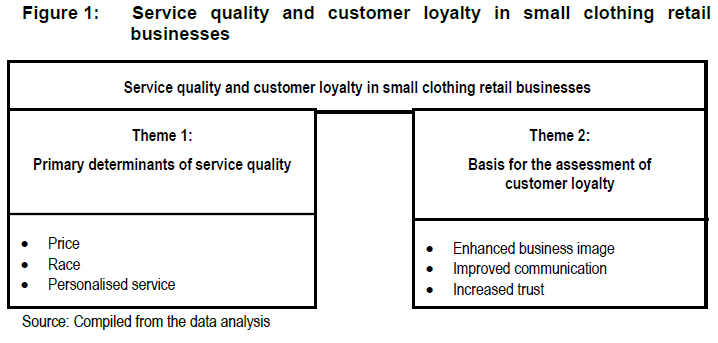
This study identified two main themes as indicated in Figure 1. The themes relate to the determinants of service quality and the basis relied upon by the owner/managers to assess customer loyalty. The importance of the constructs of service quality and customer loyalty to all businesses, including small clothing retail outlets cannot be over-emphasised. Given the fluid and intangible nature of the constructs, determinants (in the case of service quality) and basis for assessment (in the case of customer loyalty) may be unique to businesses in a specific industry. It was therefore important to explore both complex constructs from the perspective of business managers to whom investments made in both constructs would yield returns.
The interviews conducted, revealed that respondents understood the importance of the constructs to business success and volunteered useful information based on their first-hand experiences and understanding of issues of service quality and customer loyalty. The data collected was categorised into two broad construct-inspired themes that yielded a number of issues. The themes and component emergent issues, as extracted from the interviews are presented in Figure 1.
4.1 Primary determinants of service quality
4.1.1 Price
The findings show that perceptions of service quality in clothing retail stores were influenced by price. The respondents suggested that price was used by customers as a determinant of service quality in the store. Their argument was that the average prices of items had a positive association with the service quality expectation of customers. According to the data collected during the interviews, this is because in a highly saturated and competitive industry where customers have various purchase options, pricing becomes a critical determinant of the service quality judgement of the customer. This is perhaps emphasised in clothing retail businesses as customers tend to relate higher prices to higher quality. A respondent volunteered that:
"The issue of price is critical in a small business as its target market is not necessarily top-end customers who are largely price-insensitive. Since this is the case, prices are commonly used to shape service quality expectations. The higher the prices, the higher the expectations. You know in the clothing business; customers' value perceptions are tied to prices. The level of service quality expected from an outlet with relatively low prices will always be less than that expected from shops that sell at higher prices" (P02, Female, Owner)
This acknowledgement of the important role of price in the determination of service quality is supported by the argument of Oyeniyi and Abiodun (2010) who contend that price plays an important role in developing expectations regarding quality of product or services. Customers typically rely on price to form an expectation about the level of service quality (Ali & Ryu 2015:237) that an outlet can offer. Consequently, the role of price in the determination of service quality cannot be over-emphasised.
4.1.2 Race
The respondents opined that the factor of race bears ramifications for determination of service quality. This assertion becomes understandable in the context of the history of South Africa, where issues of race have been and indeed remain prominent. The respondents alluded to the fact that in cases where there is race-congruence between the customer and the shop attendant, service quality judgements are more lenient. The converse is that when the race of the shop attendant differs from that of the specific customer being served, the rating of the service quality can be adversely affected. A manager disclosed that:
"Obviously we assess the customer in every possible way we can, but I think that one must always be there for the customer. I will add though that race can be an issue when it comes to assisting a customer in store. Shop employees shouldn't be with the customer too much because some of the customers (especially if they are of a different race) feel some discomfort. If they're white, they feel uncomfortable that a black consultant is right beside them. If the customer is black, he/she is concerned that a white consultant is 'trailing' him/her in the shop. So, we generally greet all our customers and make them feel free around the place then give them their space. Then when they need help they just call us, and we'll be there. I think that's the best way..,"(P11, Male, Manager).
This observation contradicts the position of Terblanche and Boshoff (2010:1) who found that there are no racially induced variances in the service quality perceptions of customers. This study's finding that race affects service quality judgements is made rational by the fact that clothing preferences though personal, can be influenced by race. A healthier bond is likely to be formed when a shop attendant, with whom he/she shares a race, clearly, serves a customer, there is likely to be a higher level of understanding of the preferences of the customer given that the shop attendant is of a similar racial descent. This would likely make the pre-sale interactions more cordial in comparison to cases where the shop attendant and customer are of dissimilar races. This race polarity that affects service quality perceptions has historical explanations that are not unrelated to frictions emanating from the apartheid system of governance and the group areas act in South Africa's pre-democratic era.
4.1.3 Personalised Service
Information obtained at the interviews emphasise the importance of personalised customer care to the overall perception of the service quality received in the clothing retail business. Personalised customer care is critical in determining service quality because customers often feel appreciated and valued during their shopping experience when the service is customised. According to a respondent, the offering of services, customised to a customers' tastes and preferences, signals to the customer that he/she is valued by the clothing retail business. An excerpt from an interview reveals that:
".there are some customers who call by telephone and we know their preferences and sizes already........the customer doesn't have to provide any information related to his/her size and we can just pick a shirt put it aside and whenever he's around he can come pay. Also, the fact that we offer birthday specials to some of our customers, when we send them birthday wishes, delights them (P10, Male, Manager).
Against the backdrop of this opinion, it seems obvious that a favourable service quality rating is likely to be ascribed by a customer to clothing retail outlets that are sensitive to personal preferences of customers. The modification of a standard service in response to customers' desires provides tacit evidence of a resolve in the part of the clothing retail shop to meet the customers' expectations. This disposition is therefore likely to be rewarded with a favourable service quality perception.
4.2 Basis for the assessment of customer loyalty
4.2.1 Enhanced business image
Interviews revealed that managers can gauge customer loyalty on the basis of what the customer thinks of the image of the business. The general thinking was that the notion of customer loyalty is linked to the image of the business embossed in the minds of customers. In essence, an enhanced business image engenders customer loyalty. The reverse though is also notably true: customer loyalty can positively affect a customer's perception of the business image of the establishment. From the data, it was clear that the participants were convinced that the enhanced image of a clothing retail business can make customers loyal to the outlet. According to a respondent:
"I can tell that a customer is loyal when their words/actions reveal that they have a very good image of our shop in their minds. Sometimes those that they have recommended our shop to, tell us that the customer spoke very highly of us. When you hear something like this, you know that you have yourself a truly loyal customer. Sometimes also, a customer can make really valuable suggestions that you can implement, and it improves the business. Such an occurrence convinced me that the customer has the best interest of the business at heart and for me, this is the same as loyalty". (P05, Female, Manager).
This opinion shows that positive words or actions on the part of the customer that ultimately benefit the organisation are construed as outcomes of the existence of an enhanced business image in the minds of customers. Any expression borne out of this enhanced business image is consequently relied upon by owner/managers to deduce customer loyalty. It is noteworthy to highlight that data collected through the interviews revealed that the business image is often based on a business reputation built over time, through the offering of services that satisfy customers.
4.2.2 Improved communication
Discussions during interview sessions of some respondents signal that repeated friction-less communication with customers serves as an indication of a measure of customer loyalty. Respondents contend that there is a palpable level of ease that attends the communication with loyal customers. This is possibly because of the air of familiarity that envelopes such communication activities, inevitably resulting in improved communication and enhanced mutual understanding between the customer and the business. It is clear that effective communication is vital for maintaining healthy relationships with customers. Some of the participants emphasised the value of reciprocal engagement over conditioned responses that are simply transactional and not relational. According to one respondent:
"When you walk in here.. .umm.. we try to break the monotony of conditioned lines. So, it won't be "how can I help you?" it will be "hi, how are you?" ok "what caught your eye?" I am convinced that asking open-ended questions that are not stereotypical and geared towards closing a sale can enrich the conversation in the shop. It creates an engagement and as soon as you can start an engagement with the person, there is something to build on and umm ...sales happen, because you can relate with one another" (P09, Male, Owner).
There were respondents who opined that regular casual talks rather than overly formal discussions will improve the communication between the customers and stores service consultants. Much of this can be driven a culture that encourages sales consultants to take an interest in customers beyond just a desire to make a sale. According to Gedeon, Fearne and Poole (2009:221), developing personal relationships with customers, fosters mutually reciprocal actions and creates loyalty which in turn increases the business' economic activity. In essence, communication with customers should be relationship rather than transaction-focused as this may make it more effective in engaging the customer and breeding customer loyalty.
4.2.3 Increased trust
Managers or owners of the clothing retail outlets that participated in the study volunteered that the expression of trust in the employees of the business served as a veritable indication of the loyalty of the customer. Some of them hinted that when interactions with customers, graduate to the point where personal information such as contact details are exchanged between the customer and the business employees, then trust that yields customer loyalty is palpable. There were respondents that alluded to the fact that positive behavioural intentions expressed by customers signal profound trust and this is a useful pseudo measure of the loyalty of the customer. One of the study respondents argued that:
"...a loyal customer trusts the business to always act in his/her interest. In fact, when a customer is comfortable with letting me join him/her in the fitting room and seeks my opinion about whether an outfit looks nice on him/her, then you can tell your business is trusted and the customer is a loyal one. In some cases, if the customer provides you with his/her cell number for sales-related discussions and others, then you can almost be assured that customerloyalty has been gained." (P07, Female, Manager).
This view captures the important role of trust in the scheme of customer loyalty and provides justification for owner/managers reliance on customer actions that portray the existence of a trust for the clothing retail shop, to gauge customer loyalty. Trust can be considered as a facilitator of close relationships that nurture loyalty of the customer.
4.2.4 Repeat patronage
Repeat patronage is unarguably the most reliable basis for managers to assess customer loyalty. It is perhaps the most significant expression of loyalty, according to some respondents. This is because one of the cardinal objectives of all of the businesses studied was income generation. This objective is served by the acts of repeat patronage by customers. One participant emphasised that:
".sales are the best indicator of loyalty as there is direct correlation between loyalty and patronage. You know, existing regular customers have obviously become loyal to the brand and the service to the extent that they are unlikely to defect to competitors." (P01, Male, Owner)
The use of repeat patronage by managers in their bid to assess customer loyalty was overwhelming. There was no respondent that indicated that he/she does not use it. The predominant use of repeat patronage for assessing customer loyalty highlights the results-driven disposition of the owner/managers of the small clothing retail businesses that participated in the study. The consensus among the respondents as it relates to the accuracy of repeat patronage as a measure of customer loyalty suggests that all other factors utilised for the assessment of customer loyalty are merely proxies.
5. CONCLUSION AND RECOMMENDATIONS
This study explored the constructs of service quality and customer loyalty in the clothing retail industry in Gauteng, South Africa. The aims were to reveal context-specific determinants of service quality as well as credible factors relied upon for the determination of the existence of customer loyalty. This was done from the perspective of managers of small clothing retail businesses. The study revealed that price, race and personalised service were the determinants of service quality, from the view point of owner/managers.
This means that substantial attention needs to be paid to the pricing strategies of clothing retail outlets as this factor is linked to service quality perceptions. The import of this is that prices have to be competitive and present value to the customer, if it must contribute favourably to service quality perceptions of patrons. Given that race affects service quality judgements, Owner/Managers of small clothing retail outlets may be better served if they maintain a diverse workforce on the shop floor. This will enable them to meet the expectations of customers as it concerns preferences for who they want to assist them in the shops. The issue of personalised service as a determinant of service quality implies that small clothing retail outlets may perform better in terms of service quality if they are dynamic and adaptive to customer preferences as compared to adhering rigidly to the business practices.
The finding that managers of small clothing retail businesses relies on a number of issues to gauge customer loyalty holds practical value for businesses. This is because of the difficulty associated with applying an objective measure for the construct. The study results revealed that an enhanced business image in the minds of the customer, improved communication with customers, palpable trust between the customer and the business as well as repeat patronage are useful for the assessment of the loyalty of a customer. It would seem though that while repeat patronage is arguably the best indicator of customer loyalty, the other issues provide reasonable grounds to make a reliable inference of the state of customer loyalty to the business. It is therefore imperative for managers of small clothing retail businesses to strive to position their businesses favourably in the minds of the customers, cultivate a business culture that enables communication that is more effective and the building of trust with customers.
6. MANAGERIAL IMPLICATIONS
Customer loyalty is sustainable when the business is able to increase customer satisfaction through service quality. The study revealed that retail managers should be cognisant of factors that influence service quality and customer loyalty. They must then determine which one amongst price, race, repeat patronage and increased trust has a greater impact within the small clothing retail businesses environment. This can be determined by constant feedback from the customer as the customer's perspective is the most important factor in deciding the elements to focus on when building customer loyalty. These fundamental elements can be employed as prerequisites to encourage them to bridge the gap between service quality and customer loyalty.
7. LIMITATIONS AND DIRECTIONS FOR FUTURE RESEARCH
From an academic perspective, the shortcomings of the use of a small purposive sample size for this study is instructive and so findings should be interpreted with caution and not generalised to other contexts. A study of a similar nature that is based on the use of a representative random sample in different contexts may prove quite insightful. Without a doubt, the discourse on service quality and customer loyalty has not been exhausted and so there is room for more empirical research efforts that would contribute to the expansion and refinement of the body of knowledge, especially from an African perspective.
REFERENCES
2. LITERATURE REVIEW
-
AHMAD A, RAJA N, HASLINDA H & NOR SIAH J. 2018. Determinants of customer loyalty: a review and future directions. Australian Journal of Basic and Applied Sciences 12(1):106-111. (DOI: 0.22587/ajbas.2018.12.7.17.
» https://doi.org/0.22587/ajbas.2018.12.7.17 -
)
» https://doi.org/10.1108/YC-05-2014-00441 - )
-
AYDIN S & OZER G. 2005. How switching costs affect subscriber loyalty in the Turkish mobile phone market: An exploratory study. Journal of Targeting, Measurement & Analysis for Marketing 14(2):141-155. (DOI:10.1057/palgrave.jt.5740176.
» https://doi.org/10.1057/palgrave.jt.5740176 - )
-
BANDYOPADHYAY S & MARTELLL M. 2007. Does attitudinal loyalty influence behavioural loyalty? A theoretical and empirical study. Journal of Retailing and Consumer Services 14(1): 35-44. (DOI:10.1016/j.jretconser.2006.03.002.
» https://doi.org/10.1016/j.jretconser.2006.03.002 -
)
» http://dx.doi.org/10.1108/EUM0000000007275 - BEENISH T & NIKKAMARIAHNIK M. 2018. The Determinants of Customer Loyalty in Telecommunication Industry of Pakistan. International Journal of Business Marketing and Management 3(1):36-43.
- BEERLI A, MARTIN JD & QUINTANA A. 2004. A model of customer loyalty in the retail banking market. European Journal of Marketing 38(1/2):253-275.
- BIBB S & KOURDI J. 2007. Chapter 7: Building customer trust. Marshall Cavendish Limited 87-105.
-
)
» https://doi.org/10.1108/08858620910939769 - BURNS RB & BURNS RA. 2008. Business research methods and statistics using SPSS. Los Angeles: Sage.
-
CHANG HH, WANG YH & YANG WY. 2009. The impact of e-service quality, customer satisfaction and loyalty on e-marketing: Moderating effect of perceived value. Total Quality Management 20(4):423-443. (DOI:http://dx.doi.org/10.1080/14783360902781923.
» http://dx.doi.org/10.1080/14783360902781923 - )
-
DA SILVA RV & ALWI SF. 2008. Online corporate brand image, satisfaction and loyalty. Journal of Brand Management 16(3):119-144. (DOI:http://dx.doi.org/10.1057/palgrave.bm.2550137.
» http://dx.doi.org/10.1057/palgrave.bm.2550137 -
)
» https://doi.org/10.1108/AJEMS-02-2013-0024 - DAVIS-SRAMEK B, DROGE C, MENTZER JT & MYERS MB. 2009. Creating commitment and loyalty behaviour among retailers: what are the roles of service quality and satisfaction? Journal of Academy of Marketing Science 37(4):440-454.
-
DEPARTMENT OF TRADE AND INDUSTRY. 2004. National Small Business Amendment Act No. 2004. [Internet:https://www.thedti.gov.za/business_regulation/acts/small_business_amendment_act; downloaded on 06 August 2019.
» https://www.thedti.gov.za/business_regulation/acts/small_business_amendment_act - ]
- DOMENGE R & ARCINIEGA L. 2015. Development of a short questionnaire for measuring service quality perceptions. Decision 42(1):11-17.
-
DONNELL L, HUTCHINSON K & REID A. 2012. Fashion retailing in the new economy: the case of SMEs. International Journal of Retail and Distribution 40(12): 906-919. (DOI:http://dx.doi.org/10.1108/09590551211274919.
» http://dx.doi.org/10.1108/09590551211274919 - )
- DU PLESSIS L. 2010. Customer relationship management and its influence on customer loyalty at Liberty Life in South Africa. University of Johannesburg. (Doctoral dissertation.
- )
-
GAUTENG PROVINCIAL TREASURY. 2018. Socio-economic Review and Outlook. Gauteng Provincial Government. [Internet:http://www.gauteng.gov.za/government/departments/provincial-treasury/Documents/SocioEconomic%20Reveiw%20and%20Outlook%202018.pdf; downloaded on 06 August 2019.
» http://www.gauteng.gov.za/government/departments/provincial-treasury/Documents/SocioEconomic%20Reveiw%20and%20Outlook%202018.pdf -
]
» https://doi.org/10.1016/j.jbusres.2005.11.006 -
)
» https://doi.org/10.12691/jbms-6-4-5 -
GLOBAL ENTREPRENEURSHIP MONITOR (GEM). 2018. Global report 2017/2018. [Internet:https://www.gemconsortium.org/report/50012; downloaded on 06 August 2019.
» https://www.gemconsortium.org/report/50012 - ]
- HU H, CHENG C, CHIU S & HONG F. 2011. A study of customer satisfaction, customer loyalty and quality attributes in Taiwan's medical service industry. African Journal of Business Management 5(1):187-195.
-
HUSSAIN R, AL NASSER A & HUSSAIN YK. 2015. Service quality and customer satisfaction of a UAE-based airline: An empirical investigation. Journal of Air Transport Management 42:167-175. (DOI:10.1016/j.jairtraman.2014.10.001.
» https://doi.org/10.1016/j.jairtraman.2014.10.001 -
)
» https://doi.org/10.1108/14502191011043170 -
IZOGO EE & OGBA I. 2015. Service quality, customer satisfaction and loyalty in automobile repair services sector. International Journal of Quality and Reliability Management 32(3):250-269. (DOI:10.1108/IJQRM-05-2013-0075.
» https://doi.org/10.1108/IJQRM-05-2013-0075 -
)
» http://dx.doi.org/10.5539/ass.v10n21p223 - )
-
IZOGO EE. 2017. Customer loyalty in telecom service sector: the role of service quality and customer commitment. The TQM Journal 29(1):19-36. (DOI:10.1108/TQM-10-2014-0089.
» https://doi.org/10.1108/TQM-10-2014-0089 - )
- KATTARA HS, WEHEBA D & AHMED O. 2015. The impact of employees' behaviour on behaviour on customers' service quality perceptions and overall satisfaction. African Journal of Hospitality, Tourism and Leisure 4(2):1-14.
-
KUMAR M, TAT KEE F & TAAP MANSHOR A. 2009. Determining the relative importance of critical factors in delivering service quality of banks: an application of dominance analysis in SERVQUAL model. Managing Service Quality: An International Journal 19(2):211-228. (DOI:10.1108/09604520910943198.
» https://doi.org/10.1108/09604520910943198 - )
-
KUO Y & YE K. 2009. The causal relationship between service quality, corporate image and adults' learning satisfaction and loyalty: A study of professional training programmes in a Taiwanese vocational institute. Total Quality Management and Business Excellence 20(7):749-762. (DOI:https://doi.org/10.1080/14783360903037085.
» https://doi.org/10.1080/14783360903037085 - )
-
LIU WK, LEE YS & HUNG LM. 2017. The interrelationships among service quality, customer satisfaction, and customer loyalty: Examination of the fast-food industry. Journal of Foodservice Business Research 20(2):146-162. (DOI:https://doi.org/10.1080/15378020.2016.1201644.
» https://doi.org/10.1080/15378020.2016.1201644 - )
- OYENIYI O & ABIODUN A. 2010. Switching cost and customers' loyalty in the mobile phone market: The Nigerian experience. Business Intelligence Journal 3(1):111-121.
- PLANO CLARK VL & CRESWELL JW. 2015. Understanding Research: A Consumer's Guide. 2nd ed. Upper Saddle River, New Jersey: Pearson.
-
PRENTICE C. 2013. Service quality perceptions and customer loyalty in casinos. International Journal of Contemporary Hospitality Management 25(1):49-64. (DOI:http://dx.doi.org/10.1108/09596111311290219.
» http://dx.doi.org/10.1108/09596111311290219 - )
- )
- REDDY BK & REDDY JS. 2010 Buying behaviour in organized retailing a study of demographic factors. Mus tang Journal of Business Ethics 1(1):121-132.
- )
- ROOTMAN C & KRUGER J. 2017. Buying behaviour in the South African retail industry: considering reference groups and culture. Journal of Contemporary Management 14(1):1035-1038.
-
STEFANO NM, CASAROTTO FILHO N, BARICHELLO R & SOHN AP. 2015. A fuzzy SERVQUAL based method for evaluated of service quality in the hotel industry. Procedia CIRP 30(1):433-458. (DOI:https://doi.org/10.1016/j.procir.2015.02.140.
» https://doi.org/10.1016/j.procir.2015.02.140 - )
- SULTAN P & WONG HY. 2014. An integrated-process model of service quality, institutional brand and behaviour intensions: The case of a university. Managing Service Quality 24(5):487-521.
-
TERBLANCHE N & BOSHOFF C. 2010. Quality, value, satisfaction and loyalty amongst race groups: A study of customers in the South African fast food industry. South African Journal of Business Management 41(1):1-9. (DOI:10.4102/sajbm.v41i1.509.
» https://doi.org/10.4102/sajbm.v41i1.509 - )
- )
-
VAN VUUREN T, ROBERTS-LOMBARD M & VAN TONDER E. 2012. The relationship between selected variables and customer loyalty within an optometric practice environment. Acta Commercii 2012(1):94-106. (DOI:https://doi.org/10.4102/ac.v12i1.137.
» https://doi.org/10.4102/ac.v12i1.137 - )
-
YIEH K, CHIAO YC & CHIU YK. 2007. Understanding the antecedents to customer loyalty by applying structural equation modelling. Total Quality Management & Business Excellence 18(3):267-284. (DOI http://dx.doi.org/10.1080/14783360601152400.
» http://dx.doi.org/10.1080/14783360601152400 - )
-
ZIETSMAN M, MOSTERT P & SVENSSON G. 2019. Perceived price and service quality as mediators between price fairness and perceived value in business banking relationships. International Journal of Bank Marketing 37(1):2-19. (DOI:http://dx.doi.org/10.1108/IJBM-07-2017-0144.
» http://dx.doi.org/10.1108/IJBM-07-2017-0144 - )