Managerial competencies to enhance performance culture: a fast-moving consumer goods company perspective
Abstract
The primary objective was to investigate the perceptions of middle-level and first-line managers regarding certain managerial competencies to enhance the performance culture at a large fast-moving consumer goods (FMCG) company. This was done by focusing on communication and teamwork as managerial competencies conducive to managerial effectiveness to enhance a performance culture. In the current era, managers often tend to neglect their business's organisational culture although it has been noted that businesses, which deliberately manage their organisational cultures, outperform others that do not. Data was collected by means of descriptive research in the form of quantitative, self-administered questionnaires. A total of 186 viable responses, which targeted 73 middle-level manager and 113 first-line manager respondents, were analysed. The research indicated that middle-level managers who practice certain communication and teamwork-related skills contribute to a large extent to the creation of a performance culture of a business. The research also revealed that discrepancies existed in the perceptions of managers' own competencies versus those of others (peers/subordinates). It is therefore recommended that managers at different levels in the business should be included when measuring managerial competence. The research contributes to existing related scholarly findings and is of value to the individuals and organisations working in the fields of business and human resource management.
communication; managerial competencies; managerial skills; organisational culture; performance culture; teamwork
1. INTRODUCTION
Effective managers and talented employees are essential for a well-established performance culture and overall success of any business, regardless of whether the business is a global giant or a small start-up enterprise (Hellhegel, Slocum, Jackson, Louw, Staude, Amos, Klopper, Louw, Oosthuizen, Perks & Zindiye 2012:30). Reid and Hubbel (2005:1) explain that creating a performance culture requires a systematic and continuous approach to managing the performance of businesses, teams and individuals. Furthermore, business performance is related to organisational culture, but culture only remains linked with superior performance if managers are able to guide the culture to adapt to changes in the business environment.
Viitala (2005:436) states that, in a continuously changing environment, it has become impossible to manage businesses successfully without sustained personal development. The managers of businesses face the globalisation of business, rapid technological change, constant reorganising and competence-based competition. These developments challenge the skills, competencies and capabilities of managers. According to Daft and Marcic (2013:76), the performance culture in a business depends largely on the effectiveness of managers to establish a performance-driven attitude among employees.
Although all managers in a business contribute to the creation of a culture of performance, it is the middle-level managers (MLMs) who have the critical role of executing the strategies to enhance the performance culture in a business.
To spur innovation and achieve high performance in twenty-first century businesses, managers need different competencies to involve workers' hearts and minds, as well as take advantage (in a positive sense) of workers' physical labour (Daft & Marcic 2013:v). Buckingham (2005:70) argues that far too little research has been done concerning the daily interactions and managerial competencies that allow managers to motivate employees, win their commitment, and ultimately enhance the business performance culture. Hellriegel et al. (2012:30) identify specific managerial competencies that they value as essential to management effectiveness, namely communication, planning and administration, teamwork, strategic action, global awareness, emotional intelligence and self-management.
Although there is no single list of competencies that define an effective and efficient manager, some managerial competencies are conducive to managerial effectiveness in establishing and enhancing a business' performance culture. Since management at all levels in the business involves getting work done by other people, managers' communication competency is essential for effective managerial performance (Hellriegel et al. 2012:32). The effective execution of the communication process within the business and with external stakeholders provides major challenges and responsibilities for managers who strive to create a performance culture {Daft 2008:657). In a fast-paced and ever-changing business environment, teamwork is identified as one of the key competencies needed by managers in order to be competitive, to adapt to rapid changes in the business environment and to obtain maximum performance (Charan, Drotter & Noel 2001:2).
Furthermore, several leaders of successful South African companies, such as Raymond Ackerman of Pick η Pay, Ralph Boettger of Sappi, Johan van Zyl of Toyota (SA) and Siza Mzimela of SAA, are of the opinion that teamwork is everything, and that it is a vital element in providing a competitive advantage (Hellriegel et al. 2012:37).
This article, therefore, explores the significance of communication and teamwork as managerial competencies in the enhancement of a performance culture. The purpose of this article is to report on perceptions of middle-level and first-line managers regarding the aforementioned managerial competencies in the enhancement of the performance culture at a large FMCG company.
A literature review was conducted by means of secondary data collection. As a descriptive research design was chosen for this study, primary data was needed and subsequently collected in order to draw inferences. A quantitative research method was used for data collection by means of self-administered questionnaires.
The research conducted on existing literature considered the relationship between organisational culture and business performance. With regard to the managerial competencies, this research formed part of a larger study that incorporated four managerial competencies that contribute to enhanced performance culture in a business. However, for the purpose of this article, only the communication and teamwork managerial competencies are highlighted. In this article, it is argued that the development and subsequent practising of the performance culture-related managerial competencies depicted provide a vehicle for businesses in establishing a sustainable competitive advantage.
2.1 The influence of organisational culture on a business
Organisational culture has a significant influence on the way in which a business conducts its operations (Quappe, Samso-Aparici & Warshawsky 2007:17). Rosenthal and Masarech (2003:4-5) believe that there are several reasons why organisational culture driven by values contributes to business performance. Not only does it attract and retain employees who have the necessary skills to achieve ambitious business goals and who are motivated by the core beliefs of the business, but it also inspires and guides employees' contributions and decisions in a flatter, fast-paced, decentralised workplace. A value-driven organisational culture furthermore aligns employees with diverse interests around shared goals to encourage teamwork and create a sense of community (Rosenthal & Masarech 2003:4-5).
Over the last three decades, research studies have provided concrete evidence that those businesses that have deliberately managed their organisational cultures, outperformed similar businesses that did not (Kotter & Heskett 1992:11; Rosenthal & Masarech 2003:5). When organisational culture is managed with a focus on the enhancement of the business' ability to meet or exceed its objectives, it can lead to a performance culture and improved business results (Quappe et al. 2007:17).
As stated by Botes (2014:22), a performance culture comprises the shared beliefs, values, attitudes and goals of employees and managers (at all managerial levels) that result in the superior execution of agreed actions and the shared recognition that good performance is a business priority. However, if the organisational culture is to be a competitive differentiator, it needs to be unique (Rice 2007:15). Maly and Aiken (2008) propound that creating a performance culture that distinguishes a business from competitors in terms of the way managers and employees relate to their work and choose to behave is among the most powerful levers for superior business performance.
Human-orientated middle-level managers (MLMs) play a fundamental role in the development of an organisational culture as they embed and convey culture in the thinking, feeling and behaviour of employees to ultimately enrich the performance culture in the business (Den Hartog & Verbürg 2004:59). The performance of individuals, teams and the overall business lies at the heart of business success, and the manner in which performance management is conducted ultimately affects the business1 performance culture (Reid & Hubbel 2005:4). The FMCG company concerned made use of self- and upward appraisal as part of their performance management process. Moore {2013:1) argues that self-appraisals are rarely in line with the results of evaluations from fellow employees such as peers or subordinates. Massingham, Nguyen and Massingham (2011:68) concur, but add that although correlations between self- and other ratings tend to be low, using a self-other rating method provides useful context for the identification of opportunities for development.
In businesses that make use of self- and upward appraisals, managers need to understand their performance-based feedback constructed on the experiences and observations of fellow employees. When discrepancies exist between self- and upward appraisal, it is advised that managers use self-assessment as a benchmark and/or reality check concerning their opportunities for development (Moore 2013:1). Furthermore, businesses must provide recipients of upward appraisals, such as MLMs, with relevant support that would enable them to analyse discrepancies (between self- and upward appraisal feedback) in order take appropriate action in response (Smither, London & Reilly 2005:56). Finally, upward appraisal recipients can use a variety of informal or formal developmental activities to address managerial skill deficiencies, for example working with a mentor, discussing the feedback one gets with others, acquiring new skills or improving existing skills (Smither et al. 2005:57).
2.2 Managerial competencies
The concept competency is commonly used to refer to a combination of actions that a person is capable of carrying out in order to perform well in a specific occupation (Edgar 2009:2). This reference to the concept competency is only one of many definitions available in the literature. The definitions of the concept competency are generally approached from two different viewpoints. From the first viewpoint, competencies are portrayed as the power and range of the authority of a certain person or management team (Konigová, Urbancová & Fejfar 2012:131-132). The second viewpoint depicts competencies as a combination of specific skills, which include knowledge, abilities, traits, motives, attitudes or values that are repeated over a certain time (OECD 2010:4).
Since this article highlights the managerial competencies required to enhance performance culture, the focus was on a specific combination of skills that were repeatedly exhibited over a certain time. Certain managerial competencies are conducive to managerial effectiveness in establishing and enhancing a business' performance culture. These managerial competencies include, among others, skills pertaining to communication and teamwork competence (Hellriegel et al, 2012:30), which are deliberated on in the following subsections.
2.2.1 Communication
Effective communication is the transfer and exchange of information, which result in motivated employees who are encouraged to achieve certain expected outputs (Hellriegel et al. 2012:32). To enhance the performance culture of the business and promote effective communication, it is suggested that managers should be knowledgeable about the appropriate communication media. The medium (or media, if more than one medium is needed) chosen to convey the message is just as significant as the content of the message itself (De Janasz, Dowd & Schneider 2012:144). Mastering communication skills also requires that managers should understand interpersonal communication that generally takes place orally, in writing or incorporates both (Griffen & Van Fleet 2014:244). The oral communication medium tends to be the most preferred form of communication and is regarded as more effective than other communication media, since it enables managers to avoid various communication pitfalls (De Janasz et al. 2012:144).
Regular, effective communication is necessary to enhance the performance culture of a business. Managers need to communicate daily, actively and continuously through word and action to build relationships, encourage employees and achieve the goals of the business (Daft & Marcic 2014:197). Due to heightened competitor activity and shifting customer requirements, the giving, receiving and incorporating of feedback into business actions and employee communication are critical to create and improve a business' performance culture. In addition, information provided through feedback enables individuals or groups to compare actual performance with a given standard or expectations (De Janasz et al. 2012:384).
Negotiation as part of effective communication is an essential skill for managers. Managers must ensure that the work gets done on time and within the specified budget. To do this successfully, managers negotiate effectively on behalf of the team over roles and resources in order for their subordinates to perform (De Janasz et al. 2012:186). Managers also need negotiation skills to negotiate on behalf of the team over roles and responsibilities and to settle disputes that arise among various stakeholders (Hellriegel ef al. 2012:34).
Finally, the single most important skill to improve communication effectiveness is being an attentive and active listener (Griffen 2014:362). Listening is the key to unlocking the potential for higher team performance (Sitler 2011:58). When managers listen actively, they listen attentively and take the responsibility for successful communication by giving the speaker non-judgmental feedback to clarify that the message was accurately heard (Williams 2014:453).
2.2.2 Teamwork
Teamwork is significant when businesses aim to accomplish tasks through small groups of people who are collectively responsible for achieving objectives interdependently (Hellriegel et al. 2012:36). A manager must be able to lead the team to achieve success. Leadership is explained as a process through which managers influence the behaviour of team members to work willingly towards the accomplishment of business objectives (Henrico & Visser 2012:166). Leadership skills enable managers to be aware of the environment within which they operate, to set goals and objectives, to inspire their employees and to encourage commitment (Henrico & Visser 2012:166).
Positive leadership entails that managers keep the team moving towards its goals, see the strengths and capabilities of employees and assert human potential. The result of positive leadership often exceeds performance expectations as it allows employees to be creative and resourceful in their problem-solving solutions (Daft & Marcic 2014:556-557). In addition, managers should strive to lead their teams through motivation and empowerment, design cohesive teams, create a supportive work environment and manage team dynamics in order for team goals to be achieved {Hellriegel et al. 2012:36).
Increasing the authority of team members heightens motivation for task accomplishment because members are able to choose how to do a task and use their creativity, which ultimately leads to the improvement of their own effectiveness (Daft 2008:645). Managers often facilitate team motivation through empowerment, which increases autonomy, respect, the authority to make decisions, status, and freedom to grow and develop within the business. An empowered team is conscientious; members become accountable and responsible for their decisions and actions, which lead to greater loyalty, trust, quality and ultimately an enhanced performance culture in the business (De Janasz et al. 2012:415).
In a fast-paced and ever-changing business environment, diversity in businesses is common and teams consist of members who differ in terms of race, gender, language, culture, competencies and skills. Managers should not underestimate the importance of the team design skill that involves, among others, formulating goals to be achieved and defining tasks to be done.
Furthermore, to design a dedicated team, it must be staffed appropriately, taking into account the technical skills needed, the value of diverse perspectives, and individual development goals (Hellriegel et al. 2012:37). A well-designed team is capable of high performance, but needs a supportive work environment to achieve its full potential. Creating a supportive work environment entails eliciting contributions from members whose unique competencies are significant to the team, and to recognise, praise and reward both minor victories and major successes (Hellriegel et al. 2012:37).
Considering the abovementioned substantive literature, in order to enhance the performance culture of the business through effective communication and teamwork, it is suggested that managers should be knowledgeable about the appropriate communication media to convey messages, communication frequency, giving and receiving feedback, negotiating and active listening.
Managers should furthermore create a supportive work environment and strive to lead their teams through motivation and empowerment, design cohesive teams, and manage team dynamics in order for team goals to be achieved.
3. PROBLEM INVESTIGATED
Globalisation has forced managers to deal with new complexities such as communication technology, consumerism and social and political change (Cunningham & De Kock 2012:113). Managers who are able to create and sustain a performance culture and react to rapid change in markets and technologies can maintain exceptional service and product quality levels despite unpredictable business environments (Winter 2003:3).
Traditionally, businesses have been characterised by managerial approaches such as controlling and limiting people, enforcing rules and regulations, seeking stability and efficiency, designing a top-down hierarchy, and achieving bottom-line results (Daft & Marcic 2013:v).
Nowadays, managers need to focus on leading change, harnessing people's creativity and enthusiasm, finding shared visions and values, and sharing information and power (Daft & Marcic 2013:v). Not all managers are able to display the competencies needed to be effective managers and some are even reluctant to change from their traditional managerial approaches.
However, in order to perform effectively and work towards establishing a performance culture, managers need to develop and display certain managerial competencies (Hellriegel et al. 2012:30). Although there is no single list of competencies that define an effective and efficient manager, some managerial competencies are more conducive and prone to managerial effectiveness in establishing and enhancing a business' performance culture. Therefore, the research pertaining to this article is aimed at determining the significance of communication and teamwork as managerial competencies.
It is critical that managers realise the importance of the influence of organisational culture on a business, and that managers furthermore examine and develop performance culture-related managerial competencies, such as communication and teamwork, in order to contribute to the business' performance.
The reason for undertaking this study was therefore to investigate the perceptions of middle-level managers (MLMs) and first-line managers (FLMs) regarding managerial competencies to enhance the performance culture at a large FMCG company.
4. RESEARCH OBJECTIVES
In order to address the identified problem at hand, the following objectives were formulated:
4.1
Primary objectiveThe primary objective of this study was to investigate the managerial competencies of middle-level managers to enhance the performance culture at a large FMCG company. This investigation was conducted by means of self- and upward assessment, where the perceptions of middle-level managers (MLMs) regarding their own managerial competencies as well as the perceptions of first-line managers (FLMs) regarding the middle-level managers' managerial competencies were determined.
4.2
Secondary objectivesThe following secondary objectives were derived from the primary objective:
■ to determine the demographic profiles of first-line and middle-level manager respondents who participated in the study;
■ to determine respondents' perceptions regarding the managerial competencies associated with businesses having a performance culture; and
■ to determine whether practically significant differences exist between FLMs and MLMs in terms of their managerial competency perceptions measured in this study.
The following alternative hypotheses were formulated for the study:
■ H1. There is a significant difference in the MLMs' perceptions of their communication competency to enhance the performance culture and the perceptions of FLMs with respect to their MLM's communication competency to enhance performance culture.
■ H2: There is a significant difference in the MLMs1 perceptions of their teamwork competency to enhance the performance culture and the perceptions of FLMs with respect to their MLM's teamwork competency to enhance performance culture.
5. RESEARCH METHODOLOGY
The study followed a descriptive, quantitative research design using a self-administered questionnaire to survey the respondents. Prior to this survey, the questionnaire had been piloted among a convenience sample of 237 respondents (MLMs) in the retail industry. The target population of this study included all FLMs and MLMs at a large FMCG company; therefore, a census of the target population was undertaken.
Due to the realisation rate, the researchers decided to not merely focus on population parameters, as is the case with a census, but also to calculate the sample statistics. Inferential statistics were therefore used to make comparisons between different groups within the population and the interpretation of comparisons between group means was done according to Cohen's effect sizes, d (Cohen 1988).
The self-administered questionnaires were uploaded on the SurveyMonkey website and subsequently all FLMs and MLMs in the target population were informed of the survey via an e-mail containing a cover letter and hyperlink to the relevant questionnaire. Of the 438 respondents included in the sampling frame of the study, a total of 186 participated in the study, which constituted a 43% response rate. The 186 viable responses, comprising 73 MLM and 113 FLM responses, were subsequently used for statistical analysis.
The data entry, tabulation and statistical analysis were done by the Statistical Consultation Services of the North-West University (Potchefstroom Campus). The data analysis strategy involved the calculation of frequencies and percentages for variables, the assessment of the validity and reliability of measuring scales used and the calculation of overall mean scores for factors and constructs. Finally, significance testing was undertaken to compare groups of respondents with each other.
The research reported on in this article forms part of a larger study that incorporated four managerial competencies that contribute to enhanced performance culture in a business. The construct validity and internal consistency reliability of the measuring scales included in the questionnaires were assessed.
The 32 statements measuring the managerial competency perceptions of managers were subjected to an exploratory factor analysis (EFA) and subsequently a confirmatory factor analysis (CFA) to confirm the four factors uncovered. However, for the purpose of this article, only results pertaining to two factors are reported as explained in the introduction section of this article.
The reliability of the respective managerial competency measurement scales was assessed by calculating the Cronbach's alpha coefficient for each measuring scale. In this study, Cronbach's alpha reliability coefficients > 0.70 were used as cut-off point to indicate reliability. Finally, comparisons were made between MLMs and FLMs' competency perceptions using independent sample t-tests to uncover statistically significant differences among respondents. A confidence level of 95% was used to interpret results. In order to assess whether practically significant differences existed between the means of two or more groups of respondents, effect sizes were calculated. Practical significance was determined by means of effect sizes and, in this article, medium and large effect sizes (d > 0.5) are reported.
The questionnaires were administered to two different target groups, which included FLMs and MLMs. The questionnaires comprised two sections. Firstly, demographic information of the respondents (FLMs and MLMs) was gathered. Secondly, respondents' perceptions regarding managerial competencies were measured based on FLM respondents' assessment of MLMs' managerial competencies as well as MLM respondents' assessment of their own managerial competencies. Furthermore, a five-point Likert-type scale {where 1 = strongly disagree and 5 = strongly agree) was used to indicate the extent to which respondents agreed with statements made in Section Β of the respective questionnaires.
6. RESULTS
In this article, the demographic profile of the respondents, as well as the validity and reliability of the measurement scales, descriptive statistics for statements included in the measurement scales, and inferential statistics are reported in order to test the hypotheses formulated for the study and to uncover significant differences between groups' perceptions.
6.1 Demographic profiles of respondents
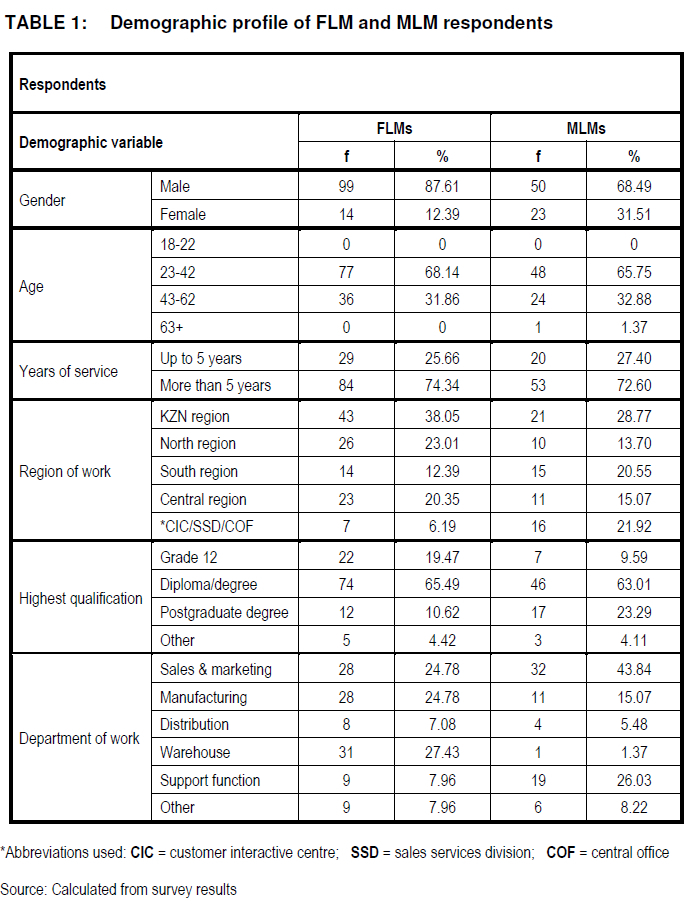
Table 1 provides a summary of the demographic information used to construct a study population profile of FLMs and MLMs, respectively.
Table 1 indicates that the FLM respondents mainly consisted of male respondents (87.61%). The majority of FLM respondents were between the ages of 23 and 42 (68.14%). Most FLM respondents had more than five years of service at the company concerned (74.34%) and worked in the KZN region (38.05%).
As far as their highest qualification was concerned, it was found that the majority of FLM respondents had a diploma or degree (65.49%). With regard to the department of work, an equal number of direct managers worked in sales and marketing (24.78%) and manufacturing (24.78%).
Table 1 also shows that the MLM respondents mainly consisted of male respondents (68.49%). The majority of MLM respondents were between the ages of 23 and 42 (65.75%). Most MLM respondents had more than five years of service at the company concerned (72.60%) and worked in the KZN region (28.77%).
As far as their highest qualification was concerned, it was found that the majority of MLM respondents had a diploma or degree (63.01%) and 23.29% of the respondents had a postgraduate degree. Concerning the department of work, 43.84% of the MLM respondents were working in sales and marketing.
6.2 Assessing validity and reliability
6.2.1 Validity
With respect to the 32 statements measuring managerial competencies, four factors were retained by an EFA, namely communication, planning and administration, and teamwork and emotional intelligence. However, for the purpose of this article, only the results pertaining to the communication and teamwork competencies will be discussed.
To assure construct validity on the study sample of the main study, confirmatory factor analyses were done on the statements defining communication and teamwork, respectively.
This was done for each group (MLMs and FLMs) separately. In this study, Kaiser's measure of sampling adequacy (MSA) was used to examine the appropriateness of factor analysis. The results of these four confirmatory factor analyses yielded MSA counts of 0.88 and higher, indicating that these factor analyses were appropriate (Malhotra 2010:638).
Furthermore, each CFA retained only one factor for each group explaining variances between 59 and 80% of the variance in the data. Taking these results into consideration, construct validity on both factors for both groups of respondents was assured.
6.2.2 Reliability
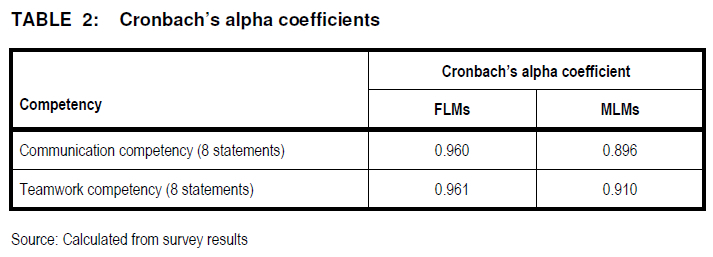
The reliability statistics of the measurement scales measuring the two factors confirmed above are reported in Table 2.
It is evident from Table 2 that the Cronbach alpha coefficients calculated to assure reliability of both scales measuring managerial competencies yielded values above 0.90 and higher, indicating an acceptable level of reliability for the MLM and FLM groups, respectively.
Subsequently, overall mean scores could be calculated for the respective managerial competencies (based upon FLM respondents' assessment of MLMs' managerial competencies as well as MLM respondents' assessment of their own managerial competencies).
6.3 Managerial competency perceptions
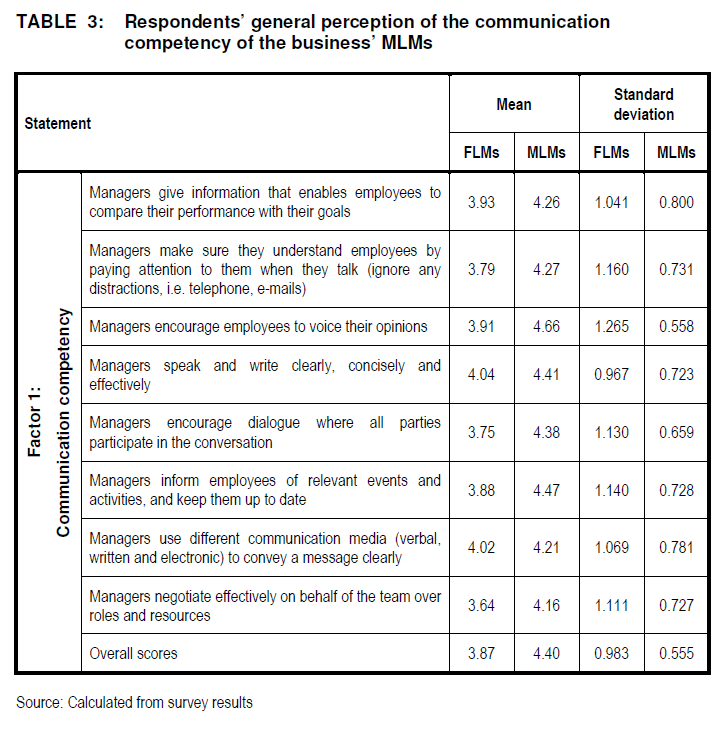
Table 3 depicts the descriptive statistics (means and standard deviations) obtained for the eight individual statements measuring the general perception of respondents towards the communication competency of the business's MLMs.
The results in Table 3 indicate that, with regard to their MLMs' communication competency, FLM respondents agreed mostly with the statements 'Managers speak and write clearly, concisely and effectively1 (mean = 4.04) and 'Managers use different communication media (verbal, written and electronic) to convey a message clearly' (mean = 4.02). FLM respondents agreed least with 'Managers negotiate effectively on behalf of the team over roles and resources' (mean = 3.64) and 'Managers encourage dialogue where all parties participate in the conversation' (mean = 3.75).
Based on Table 3, regarding their own communication competency, MLM respondents agreed mostly with the statements 'Managers encourage employees to voice their opinion' {mean = 4.66) and 'Managers inform employees of relevant events and activities, and keep them up to date1 (mean = 4.47). MLM respondents agreed least with 'Managers negotiate effectively on behalf of the team over roles and resources' (mean = 4.16) and 'Managers use different communication media (verbal, written and electronic) to convey a message clearly' (mean = 4.21).
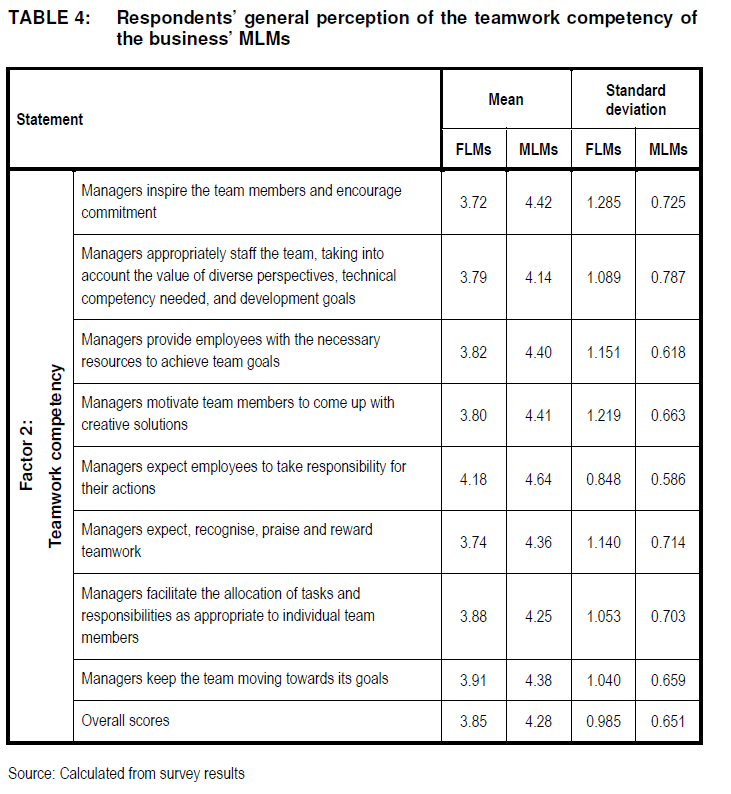
Table 4 shows the descriptive statistics (means and standard deviations) obtained for the eight individual statements measuring the general perception of respondents towards the teamwork competency of the business' MLMs.
Table 4 depicts that, with regard to their MLMs' teamwork competency, FLM respondents agreed mostly with the statements 'Managers expect employees to take responsibility for their actions' (mean = 4.18) and 'Managers keep the team moving towards its goals' (mean = 3.91).
FLM respondents agreed least with 'Managers inspire the team members and encourage commitment' (mean = 3.72) and 'Managers expect, recognise, praise and reward teamwork' (mean = 3.74).
Regarding their own teamwork competency, Table 4 also indicates that MLM respondents agreed mostly with the statements 'Managers expect employees to take responsibility for their actions' (mean = 4.64) and 'Managers inspire the team members and encourage commitment' (mean = 4.42).
MLM respondents agreed least with 'Managers appropriately staff the team, taking into account the value of diverse perspectives, technical competency needed, and development goals' (mean = 4.14) and 'Managers facilitate the allocation of tasks and responsibilities as appropriate to individual team members' (mean = 4.25).
Based on Tables 3 and 4, with regard to their MLMs' managerial competencies, FLM respondents agreed mostly with the communication competency (mean = 3.87) and least with the teamwork competency (mean = 3.85). Regarding their own managerial competencies, MLM respondents similarly agreed mostly with the communication competency (mean = 4.40) and least with the teamwork competency (mean = 4.28).
6.4 Comparisons between middle-level and first-line managerial competency perceptions
This section reports on the results of the statistical test {independent sample t-test) used to draw comparisons between the FLM and MLM groups based on their managerial competency perceptions.
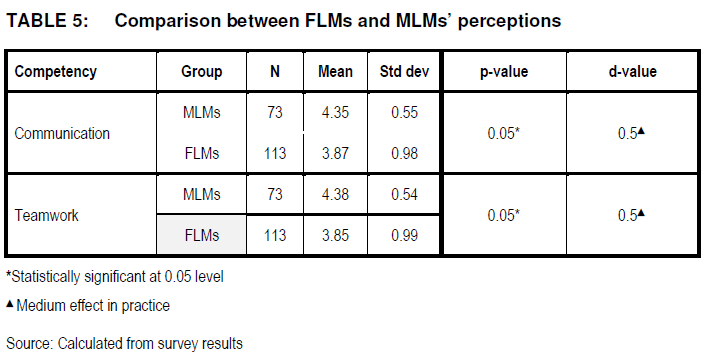
Table 5 provides the results obtained from the independent samples t-test performed to compare the perceptions of FLMs and MLMs regarding the business' MLMs managerial competencies.
With regard to Hi stating that there is a significant difference in the MLMs' perceptions of their own communication competency to enhance performance culture and the perceptions of FLMs with respect to their MLM's communication competency to enhance performance culture, it was found that a medium practically significant difference exists between FLMs {mean = 3.87) and MLMs (mean = 4.35; d-value = 0.5) with regard to their perceptions of MLMs1 communication competency.
Furthermore, MLMs perceived their own communication competency practically significantly better than FLMs perceive their MLMs' communication competency to be. Therefore, could be accepted.
With regard to H2 stating that there is a significant difference between the MLMs' perceptions of their own teamwork competency to enhance performance culture and the perceptions of FLMs with respect to their MLM's teamwork competency to enhance performance culture, it was found that a medium practically significant difference exists between FLMs (mean = 3.85) and MLMs (mean = 4.38; d-value = 0.5) with regard to their perceptions of MLMs' teamwork competency. Furthermore, MLMs perceived their own teamwork competency practically significantly better than FLMs perceived their MLMs1 teamwork competency to be. Therefore, H2 could be accepted.
7. FINDINGS
Pertaining to the demographic profiles of first-line and middle-level manager respondents who participated in the study, FLM respondents were predominantly males between the ages of 23 and 42, had a diploma or degree and have worked for more than five years at the company. The majority of FLM respondents reported to black, male MLMs between the ages of 23 and 42 who either worked in the sales and marketing or manufacturing departments. Similar to FLMs, MLM respondents were also predominantly males between the ages of 23 and 42, had a diploma/degree or postgraduate degree, had more than five years of service at the company and worked in sales and marketing.
Regarding FLMs' perceptions of their MLMs' managerial skills it was found that they perceive their MLM's communication competency to speak and write clearly, concisely and effectively when using different communication media {verbal, written and electronic) to convey a message clearly.
Concerning the teamwork competency of their MLMs, managers expected employees to take responsibility for their actions and to keep the team moving towards its goals. Although FLM respondents had a positive inclination towards both managerial competencies, FLM respondents agreed mostly with communication competency and least with teamwork competency.
Regarding MLMs' perceptions of their own communication competence, it was found that they encouraged employees to voice their opinions, inform employees of relevant events and activities, and keep them up to date. However, although MLMs revealed a positive perception towards different communication media (verbal, written and electronic), they were less inclined to make use thereof in order to convey a message clearly. They furthermore indicated that negotiating effectively on behalf of the team over roles and resources might be a possible opportunity for development.
In terms of MLMs teamwork competence, they agreed that they inspired the team members, encouraged commitment and expected employees to take responsibility for their actions. However, they agreed slightly less with the aspects of appropriately staffing the team {taking into account the value of diverse perspectives, technical competency needed and development goals), and facilitating the allocation of tasks and responsibilities {as appropriate to individual team members). Overall, although MLM respondents had a positive inclination towards both managerial competencies, they agreed mostly with having communication competence and least with having teamwork competence.
It could therefore be said that FLMs and MLMs had a positive perception regarding the communication and teamwork competencies displayed by MLMs in the company concerned.
Regarding the comparisons made between the FLM and MLM groups, MLMs perceived their own communication and teamwork competencies practically significantly better than FLMs perceived their MLMs' communication and teamwork to be. While there was a discrepancy between the groups' perceptions in the measurement of middle-level managers' managerial competencies in the company concerned, respondents perceived the company's MLMs to display managerial competencies related to the enhancement of a performance culture.
8. MANAGERIAL IMPLICATIONS AND RECOMMENDATIONS
Although the findings of this research might be useful to academicians, it has more profound implications on management practitioners that operate in the context as depicted in this article. From the demographic information, as well as the results of the study, it was derived that business managers should focus on employing young, experienced and qualified managers, since they are the ideal candidates for the creation of a performance culture. Regarding communication, MLM's should focus on encouraging dialogue where all parties participate in conversations, and on negotiating more effectively on behalf of the team over roles and resources. Overall, managers might need to put in additional effort in order to inspire the team members and encourage commitment, and they also have to expect, recognise, praise and reward teamwork more often.
It is recommended that, in order to nurture and even enhance the current organisational culture of the company, managers could gain from continuous additional training or coaching in order to develop and/or improve certain existing communication and teamwork skills, and subsequently practicing these.
Furthermore, the perceptions of managers at different levels in the business {i.e. first-line and middle-level managers) should be taken into consideration when businesses measure managerial competence. In businesses that make use of self- and other (peers/subordinates) appraisals, managers need to understand their performance based on other employees' experiences and observations. When discrepancies exist between self-and other appraisals, it is recommended that businesses provide these recipients with relevant support that would enable them to analyse discrepancies in order to take appropriate action.
Finally, managers could use a variety of informal or formal developmental activities to address managerial skill deficiencies, for instance working with a coach/mentor, acquiring new skills or developing existing skills, provided managers get the necessary encouragement and support of the business.
9. CONCLUSION
The main aim of this article was to report on the perceptions of middle-level and first-line managers regarding the significance of communication and teamwork as managerial competencies in the enhancement of the performance culture at a large FMCG company. Relevant literature addressing the influence of organisational culture on business performance as well as certain managerial competencies conducive to managerial effectiveness in establishing and enhancing a business' performance culture was studied.
The findings from the literature review conducted indicated that the performance culture of a business could be enhanced through effective communication and teamwork. Since middle-level managers (MLMs) contribute to a large extent to the creation of a performance culture of a business, there is a clear suggestion that managers should be knowledgeable about the appropriate communication media to convey messages, communication frequency, feedback, negotiating and active listening. Managers should furthermore create a supportive work environment and strive to lead their teams through motivation and empowerment; they should design cohesive teams and manage team dynamics in order for team goals to be achieved. From the results of the empirical research conducted, it was concluded that respondents had a positive perception regarding the communication and teamwork competencies displayed by MLMs in the company concerned.
The literature studied revealed that discrepancies might arise between self- and other ratings when feedback is given (Massingham et at. 2011:68; Moore 2013:1). The results of comparisons between the FLM and MLM groups supported this notion when it was indicated that MLMs indeed perceive their own communication and teamwork competencies practically significantly better than FLMs perceive their MLMs' communication and teamwork to be. Businesses should invest continuously in their human capital and encourage managers to develop their communication and teamwork competencies by offering various informal or formal developmental activities to address managerial skill deficiencies. The contribution of this research is the establishment of a positive link between practising effective communication and teamwork skills and the enhancement of a business' performance culture.
The research contributes to existing scholarly findings in this regard and heightens awareness among business leaders/owners, management and human resource practitioners of the significance of the communication and teamwork managerial competencies in the enhancement of a performance culture. Based on the results of the research and information encompassed therein, the perception that a well-established performance culture is essential for the success of any business is a contentious statement when paired with managerial competencies such as communication and teamwork.
REFERENCES
2. LITERATURE REVIEW
- BOTES Z. 2014. Investigating the role of managers in enhancing performance culture. Potchefstroom: NWU. (M Corn-dissertation.
- )
- CHARAN R, DROTTER S & NOEL J. 2001. The leadership pipeline: how to build the leadership-powered company. San Francisco, CA: Jossey-Bass.
- COHEN J. 1988. Statistical power analysis for behavioral sciences. 2nd ed. Hillsdale, NJ: Erlbaum.
- CUNNINGHAM Ρ & DE KOCK S. 2012. Management competencies. In Botha S & Musengi S (eds). Introduction to business management. Cape Town: Pearson, pp. 110-123.
- DAFT RL. 2008. New era of management. 2nd ed. Cincinnati, OH: Thomson South-Western.
- DAFT RL & MARCIC D. 2013. Management: the new workplace. 8th ed. Mason, OH: South-Western Cengage Learning.
- DAFT RL & MARCIC D. 2014. Building management skills: an action-first approach. Mason, OH: South-Western Cengage Learning.
- DE JANASZ SC, DOWD KO & SCHNEIDER BZ. 2012. Interpersonal skills in organisations. 4th ed. New York, NY: McGraw-Hill.
- DEN HARTOG DN & VERBURG RM. 2004. High performance work systems, organizational culture and firm effectiveness. Human Resources Management Journal 14(1):55-78.
-
EDGAR S. 2009. Guidance on writing competency statements for a job application. [Internet: https://www,gov.uk/government/uploads/system/uploads/attachment_data/file/128968/competency-guidance.pdf; downloaded on 2013-06-29,
» https://www,gov.uk/government/uploads/system/uploads/attachment_data/file/128968/competency-guidance.pdf -
]
» http://www.oecd.org/edu/statistics/deseco - GRIFFEN RW. 2014. Fundamentals of management. 7th ed. Mason, OH: South-Western Cengage Learning.
- GRIFFEN RW & VAN FLEET DD. 2014. Management skills: assessment and development. Mason, OH: Southwestern Cengage Learning.
- HELLRIEGEL D, SLOCUM J, JACKSON SE, LOUW L, STAUDE G, AMOS T, KLOPPER HB, LOUW M, OOSTHUIZEN T, PERKS S & ZINDIYE S. 2012. Management. 4th South African ed. Cape Town: Oxford University Press.
- HENRICO A & VISSER K. 2012. Leading. In Botha S & Musengi S (eds). Introduction to business management. Cape Town: Pearson, pp. 160-189.
- KÖNIGOVÁ M, URBANCOVÁ Η & FEJFAR J. 2012. Identification of managerial competencies in knowledge-based organisations. Journal of Competitiveness 4(1):129-142.
- KOTTER J & HESKETT J. 1992. Corporate culture and performance. New York, NY: Free Press.
- MALHOTRA NK. 2010. Marketing research an applied orientation. 6th ed. Upper Saddle River, NJ: Pearson Prentice Hall.
-
MALY J & AIKEN C. 2008. Creating a winning performance culture. [Internet: http://www.theglobeandmail.com/report-on-business/careers/creating-a-winning-performance-culture/article687233/; downloaded on 2012-01-19.
» http://www.theglobeandmail.com/report-on-business/careers/creating-a-winning-performance-culture/article687233/ - ]
- MASSINGHAM Ρ, NGUYEN TNQ & MASSINGHAM R. 2011. Using 360 degree peer review to validate self-reporting in human capital measurement. Journal of Intellectual Capital 12(1):43-74.
-
MOORE S. 2013. Beware the inaccuracies of self-perception in self-assessment. [Internet: http://www.bloomware.com/news/2013/12/28/beware-the-inaccuracies-of-self-perception-in-self-assessment; downloaded on 2014-07-21]
» http://www.bloomware.com/news/2013/12/28/beware-the-inaccuracies-of-self-perception-in-self-assessment - OECD see ORGANISATION FOR ECONOMIC CO-OPERATION AND DEVELOPMENT.
- ]
-
QUAPPE S, SAMSO-APARICI D & WARSHAWSKY J. 2007. Culture and the myth of the black box. [Internet: http://www.deloitte.com/assets/DcomUnitedStates/Local%20Assets/Documents/US_deloittereview _Culture_and_the_Myth_of_the_Black_Box_aug07.pdf; downloaded on 2012-02-17.
» http://www.deloitte.com/assets/DcomUnitedStates/Local%20Assets/Documents/US_deloittereview _Culture_and_the_Myth_of_the_Black_Box_aug07.pdf - ]
- REI D J & HUBBEL V. 2005. Creating a performance culture. key Business Journal 69(4):1-13, Mar/Apr.
-
RICE C. 2007. Driving long-term engagement through a high-performance culture. [Internet: http://www.blessingwhite.com/content/articles/DrivingLongTermEngagementThroughaHighPerformanceCultureO8.pdf; downloaded on 2012-02-17.
» http://www.blessingwhite.com/content/articles/DrivingLongTermEngagementThroughaHighPerformanceCultureO8.pdf - ]
- ROSENTHAL J & MASARECH MA. 2003. High-performance cultures: how values can drive business results. Journal of Organizational Excellence 22(2):3-18.
- SITLER N. 2011 Going the distance: taking the lead amid muddled middle management. Contract Management 54-59, Jan.
- SMITHER JS, LONDON Μ & REILLY RR. 2005. Does performance improve following multisource feedback? A theoretical model, meta-analysis, and review of empirical findings. Personnel Psychology 58(1):33-66
- VIITALA R. 2005. Perceived development needs of managers compared to an integrated management competency model. Journal of Workplace Learning 17(7):436-451.
- WILLIAMS C. 2014. Effective management: a multimedia approach. 6th ed. Mason, OH: South-Western Cengage Learning.
- WINTER G. 2003. High performance leadership: creating, leading and living in a high performance. Singapore: Wiley.