The Influence of Universities' Management on Academic Factors and Students' Satisfaction: An Empirical Study through Structural Equation Modelling
Abstract
Institutions of higher education are facing intense competition as a result of globalisation. It has become increasingly important for institutions of higher education to realise the significant impact of rendering quality service and the impact it has on customer satisfaction. The aim of this study is to focus on the influence of Universities' management practices on academic factors and the satisfaction levels of students. Three hundred and ninety one students from two South African universities were sampled at random to participate in the study. The study made use of exploratory factor analysis (EFA) followed by confirmatory factor analysis (CFA). Hypotheses testing, through the use of structural equation modelling (SEM) was finally implemented. The main results were as follows: Management-related factors have a strong impact on academic factors and academic factors have a strong impact on student satisfaction. Management as well as academic factors have a strong impact on student satisfaction. Consequently, special attention should be given by institutions' management team in order to enhance the satisfaction level of students.
Academic factors; higher education; management; quality and services
1. INTRODUCTION
Institutions of higher education in South Africa, such as universities, are challenged to provide superior quality of education by growing numbers of students demanding quality higher education. On the other hand, they are also being driven towards competition as a result of aspects such as economic forces that manifest themselves in the form of enhancement in the overall global educational markets as well as decrease in the funds provided by the government for quality improvement by institutions of higher education in order to ensure that students' expectations are met. Competition also empowers potential students, the receivers of quality education services, to become more careful when it comes to choosing where to study (Barron 2015:253). Based on past evidence (Ali, Zhou, Hussein, Nair & Ragavan 2016:70; Alhusban, Alhusban & Al-Betawi 2019; Gregory 2019; Heffernan, Wilkins & Butt 2017:227; Khoo, Ha & McGregor 2017:431; Poon 2018:115) posit that institutions of higher education usually go about by identifying contributing factors to not only attract, but also satisfy customers. These contributing factors normally include aspects such as managing service-related issues more effectively. This should ensure that customers receive what is expected and should bolster overall satisfaction and service quality. This article focuses on the role that management has on students' academic performance; the influence of management on student/customer satisfaction as well as academic-related issues that influence customers' level of satisfaction.
2.1 Service quality and higher education
It is agreed by several authors that service quality and customer satisfaction is certainly two of the most important notions at the centre of marketing theory and practice. Where globalisation brought about strong competition, sustainable competitive advantage emerges in offering exceptional quality of service that will create and maintain satisfied customers (Gregory 2019; Mcleay, Robson & Yusoff 2017:781; Vauterin, Linnanen & Martilla 2011:181; Vijaya 2016:1091; Durkin, Howcroft & Fairless 2016:355; Sharabi 2013:309; Sureshchandar, Rejendran & Anantharaman 2001:378). Mazzerol and Souter (2012) point out that an aspect such as sustainable competitive advantage in higher education are normally a function of the development of distinctive competencies such as financial strength, a convincing reputation and a wide range of wisely distinguished programmes. All abovementioned authors are unanimous about the fact that enhanced quality of services and satisfaction of customers are the fundamental goals of service providers. The need that companies have to ensure satisfied customers lies in its ability to result in monetary gains. Customer retention and loyalty depend on customer satisfaction, which assists in realising economic goals such as profitability, market share and return on investment.
Institutions of higher learning that strive to offer superior service often become institutions with a well-established reputation and strong brand image which in turn tends to enjoy a superior market position (Vianden & Yakaboski 2016:945,). In addition to this, it is also required to timely invest in current human resources and related skills with the aim to maintain a competitive edge. This is important for survival and cannot be taken for granted. A crucial aspect for institutions of higher learning to consider is the development and maintenance of industry alliances. This becomes continuously important in higher education for the purpose of enhanced teaching and research programmes. Corporate universities and open universities should also consider online education systems (Mazzerol & Souter 2012:717). All aspects of service delivery should be monitored, according to Sharabi (2013:30) and Osman and Saputra (2019:142). Although the result of service delivery may for example be favourable (such as obtaining a degree), the process is often flawed. In such cases the quality of the service offering may be perceived inadequate and may lead to customers being dissatisfied. The service offering provided by institutions of higher education should be in line with associated service excellence, regardless of the strategy that is followed (Alhusban et al. 2019; Vijaya 2016:1091).
2.2 The influence of management related factors on academic factors
New age successful organisations are those organisations that are regularly responsible for creating novel knowledge and spreading it throughout the company, which should be followed by rapidly exemplifying in innovative technologies and products. It can consequently be concluded that this is especially applicable for institutions of higher education, due to the fact that it has to rely on the dissemination of timely information that can eventually be converted into action plans. These action plans is to be used to build into various curricula to the extent that it will satisfy customers through a diversified offer (Adhikari 2010:94; Lanford 2016:188).
It is found that most of the discussion that relates to the aspects, management and academic outcomes are to be found under the theme, total quality management (TQM). (Manatos, Sarrico & Rosa 2015:160; Osman & Saputra 2019:142; Sayeda, Rajendran & Lokachari 2010:728; Weerasinghe & Fernando 2018:116) are of the opinion that with TQM, an approach is followed that will enable focused attention on aspects such as core academic activities. This includes teaching and learning with a purpose to achieve, amongst others, sustainable institutional outcome and the satisfaction of all stakeholders involved. A model of quality management is proposed by the authors, while also providing a framework for identifying consequent opportunities for improving teaching and operations as well as academic research within higher education institutions.
If management influences are properly planned and implemented, organisations are enabled to creatively provide the necessary support in a responsive manner within their changing environments. This may for example include higher education institutions that operate in an ever-changing environment (Manatos et al. 2015:160), which is influenced by the effects of globalisation and the opportunities that are brought about by this phenomenon. The term management is sometimes referred to as an act, art or manner of handling the management function. This includes planning, organising, leading and the control of staff and resources. The idea behind the introduction of TQM in the higher education sector aims, amongst others, to improve the quality of courses offered; to improve the input to the instructional process; provide student support as well as resource management processes and structures support output. Improved linkages with the labour market are also envisaged (Berchin, dos Santos Grando, Marcon, Corseuil & de Andrade Guerra 2017:1019-1020; Lanford 2016:188; Sayeda et al. 2010:729).
The drastic change in the global environment (Adhikari 2010:95; Vuori 2015:582-585) resulted in the fact that academic institutions' general decision and operation processes became more volatile and dynamic than in the past. It carries on by contending that academic environments are influenced by radical and discontinuous changes and demands. Academic environments need to transform in terms of knowledge creation and the implementation thereof so they can reap the associated benefits. The uncertainty in the markets is causing successful institutions to lead and to constantly create new knowledge, for dissemination through their systems in order to take advantage of the uncertainties, especially compared to their competitors. An effective education system should prepare students for issues such as knowledge transfer. Consequently, institutions of higher education should understand, facilitate and improve knowledge transfer mechanisms that are led by managers. Above all this, they should meet the needs of not only students, but also the needs of the society. This phenomenon is known as "bottom-line benefits" from the management of knowledge. One of the main challenges for higher education institutions are the development of knowledge management processes. This will manifest in the academic environment as they will offer courses which will eventually produce graduates with relevant skills to benefit society (Adhikari 2010:96; Alhusban et al. 2019).
Top management's commitment to quality, including academic quality, is imperative to improve an organisation's performance. In terms of higher education, this implies that management's influence is critical to the introduction and the maintenance of academic standards at an institution of higher education. Without their drive and support the chances are good that academic excellence may deteriorate (Lanford 2016:188; Saktivel & Raju 2006:913). The commitment of management to provide the necessary resources to maintain academic excellence is of utmost importance. This is demonstrated through, for example, the appointment of knowledgeable and well-qualified lecturers who can convey quality education to students. It is emphasised that a university's top management's commitment (including the department, faculty or institute) is important for the implementation of a quality system (Manatos et al. 2015:160; Saktivel & Raju 2006:913) including academic excellence.
Flumerfelt and Banachowski (2011:225) contend that leadership paradigms are often recognised as a critical element for identifying the quality of higher education. It consequently serves as a driver of actions that can be associated with processes and outcomes such as academic excellence. They go on to state that the improvement of the leadership paradigm contributes to increasing academic quality in higher education.
Academic institutions' (including higher education institutions) major function is to ensure that they manage knowledge to such an extent that it enhances its performance in the development of society. This can be done through offering academic packages to various stakeholders that will eventually benefit society. It may include students who practically utilise the academic knowledge they have gained through intervention of different management levels within an institution of higher education. Many institutions are instrumental in transferring knowledge by supporting faculties to write journal articles and books. Some may even sponsor attendances at conferences with the aim and encouragement of knowledge sharing between researchers and practitioners. The management of an organisation should lead a supportive institutional climate and this is brought about through good knowledge management. It may bring transformation in an entire institutional learning process. Such support may make them become competent to confront most educational challenges (Flumerfelt & Banachowski 2011:225; Sayeda et al. 2010:729; Weerasinghe, Lalitha & Fernando 2017:866).
Martinez-Leon and Martinez-Garcia (2011:537) highlight the importance of organisational structures, with its various management components that lead actions. They also emphasise the important role of determining learning processes. The characteristics of organisational structures are usually pointed out as crucial determinants influencing productivity and innovation. Although the nature of an organisation structure has various impacts on an organisation's learning ability, the authors realised that little empirical research has been conducted on the role of organisational structure in the learning process or knowledge management (KM) outcome. It is thus found from the literature that this phenomenon, a limitation as an organisation structure (that is guided by management), is the basic mechanism available to the organisation and its affiliates for learning and creating knowledge. This applies to general organisations as well as institutions of higher education. One of various components of good management in a knowledge-based society is knowledge management (Adhikari 2010:95; Lanford 2016:185).
H1: Management-related factors have a positive impact on academic factors
2.3 The influence of management factors on customer satisfaction
Trivellas and Dargenidou (2009:294) point out that the dual control system in institutions of higher education (academics and administration managers) can be problematic, due to possible unclear goals and other special issues of normative, professional organisations. Management skills, such as leadership, need to be applied in a range of different settings such as academic and administrative departments. In order to overcome challenges in higher education, quality management programmes such as (TQM) could be considered for implementation as a solution to improved quality education. According to Russel and Taylor (1995:408), as cited by Ardi, Hidayatno and Zagloel (2012:410), total quality management (TQM) is the management of quality through an organisation. Efforts to improve quality in higher education institutions through TQM have taken a few roles: the first one is to concentrate on the fulfilment of customer's requirements, the stimulation of continues improvement efforts in higher education and finally to ensure entire participation of all the elements in quality improvement programmes (Ardi et al. 2012). Various relevant areas of TQM will be discussed, although it is not the focus of the study (Sakthivel & Raju 2006:914).
Previous studies (Ardi et al. 2012:410; Byraktar, Tatoglu & Zaim 2008:552; Duque & Weeks 2010:85; Osman & Saputra 2019:148-149; Trivellas & Dargenidou 2009:295; Sureshchandar et al. 2001:379) regard the role of top management as one of a range of aspects that has an impact on quality in higher education institutions and established a relationship between these dimensions and satisfaction of students. Because TQM is customer focussed, the commitment to leadership is the first core value that is usually addressed in an effort to implement TQM. There is, however, a need for all hierarchical levels in higher education institutions to share the same vision that includes all levels of management such the top management, management on faculty level as well as in the departments. Thus interaction of management in both administrative and academic sections should be stimulated in order to achieve common goals.
There is an increasing need to understand and to develop higher education leaders. This comes as the need for on-going and enlightened management training for higher education professionals is continuously called for (Flummerfelt & Banachowski 2011:226; Osman & Saputra 2019). Burgoyne (2009) advocates leadership development in higher education institutions, about which the author contends that most leadership development experienced in higher education is currently focussing on individual leaders and their development from an individual point of view. According to Petrozzellis, D'Uggento & Romanazzi (2006:349), an alignment of leadership development with strategic goals and organisational changes is one of the requirements for improving current conditions. Changes may include catering for changing needs of students in a competitive academic environment. This could be extended globally, given that globalisation is a reality that needs to be managed. Various challenges are brought about by this phenomenon, while an effective management corps may identify and as a result turn this develop into a competitive advantage.
The above discussion makes it clear that the involvement of management on all levels of academic institutions (including higher education institutions) should have a significant effect on how the institution is managed and maintained. Management behaviour consequently influences satisfaction levels of students. Committed top management should provide inspirational guidance and should consequently deploy human and technical resources to achieve higher levels of productivity. As a result, customer satisfaction will be influenced.
H2: Management factors influence customer satisfaction
2.4 Academic factors
According to Duque and Weeks (2010:85), aspects such as student learning outcomes assessment has become a very important aspect of the learning environment in higher education institutions. The author contends that this phenomenon responds to various academic demands, such as academic accountability to communities and governments that support them as well as professional accreditation on various levels. It also responds to internal practices (departmental and institutional) performance evaluation and improvement. In addition various other studies (Ardi et al. 2012:412; Douglas, Douglas & Barnes 2006:252; Nguyen & Nguyen 2010:305; Saktival & Raju 2006:915; Sayeda et al. 2010:729) explain the importance of measuring the phenomenon student satisfaction in relationship with their higher education experience. Measuring satisfaction relating to various academic issues is a common practice for higher education to survive in a competitive environment. Douglas and Mcclelland. (2008:20) point out that student opinions are, amongst others, developed based on their academic programmes of study. The entire range of student activities that represent academic life also influences their opinions and whether they will recommend a specific institution of higher learning to others (Osman & Saputra 2019:145). According to Blackmore, Douglas and Barnes (2006:251), the range of academic activities may include aspects from the student's perspective such as students who are experiencing a couple of service-related offerings and ranges from learning activities and teaching quality to the availability and quality of on-campus support facilities.
In order to be effective, educational management should examine the important aspects of process management. This should include a learner-focussed education design, education delivery, services and business operations. Education management should pay attention to how key processes are designed, managed effectively as well as improved on a regular basis. Furthermore, it is claimed that by using key measures and indicators the performance results of this element would examine student performance and improvement (Venkatraman 2007:92).
Good teaching reputation, quality of courses input, the most adequate courses, student academic support services, instructional processes, curriculum revisions, teaching and learning methodology, quality programmes, student academic growth; continuous assessment and improvement (Ardi et al. 2012:409; Douglas et al. 2008:19; Nguyen & Nguyen 2010:304; Osman & Saputra 2019:148; Saktival & Raju 2006:914; Sayeda et al. 2010:728) are some of the important dimensions to effectively manage an institution of higher education. All of these components are to be considered in an effective service-quality model.
With students that are increasingly being viewed as customers to whom education services are being provided, the research of Mccuddy, Pinar & Gingerich (2008:611) assumes that student satisfaction can be seen as an indicator of the successful implementation of quality programmes of which the impact of academic programmes are evident. A clear relationship was found between various academic quality dimensions (including academic course offerings) and students' satisfaction (Sakthivel & Raju 2006:915). In addition, Telford and Mason (2005:107) suggest the introduction of a framework that may include quality values in higher education. This may involve various academic inputs such as course design, student recruitment, course marketing, induction, course delivery, course content and assessment that will impact on student satisfaction. Based on the above literature, it is hypothesised that:
H3: Academic factors positively influence customer satisfaction
3. OBJECTIVE OF THE STUDY
The determination of the impact of different variables on customer satisfaction in the higher education sector is the primary objective. The following objectives can be distinguished:
1. To identify the effect of management on academic issues
2. To ascertain the effect of academic factors on customer satisfaction
3. To determine the effect of management on customer satisfaction
4. RESEARCH METHODOLOGY
4.1 The sample framework
In the present research, two South African universities were selected with a total sample of 400. Out of the total sample, 231 useable questionnaires came from a university in the north of South Africa, whereas 160 were from the south. The sample from the aforementioned two universities in two different parts of South Africa was selected based on the convenient sampling technique. Selection of the respondents was based on the random sampling technique, where a self-administered questionnaire was distributed to the students in their respective classes. These classes (subjects) were listed and selected at random, after which a few classes were chosen for the purpose of the survey. In this sample, approximately 41% of the respondents were males, whereas 59% were female students, highlighting a slightly stronger influence of female respondents. All the respondents were tested on pre-identified issues related to the quality of services in tertiary institutions.
4.2 The measuring instrument
The development of the instrument for this study was a process that started with adapting items from previous studies and validating them by means of a focus group of lecturers and students. The final version of the instrument resulted in items related to twenty-three variables of service quality in institutions of higher learning. The five-point Likert scale was used in this self-administered questionnaire with "1" being "very important" and "5" being "not important at all". The whole process of data collection took approximately six months, which was then analysed using SPSS and AMOS software.
5. DATA ANALYSES AND RESULTS
5.1
Respondents' ProfileA total of 391 useable responses were considered for data analysis. A part of the questionnaire was designed to acquire certain vital information on the respondents. The analysis of this part of the questionnaire revealed that a higher percentage (59.3%) of female respondents completed the survey. Male respondents account for a total of 40.4%. The majority (31.5%) of the respondents were 20 years old, followed by 21-22-year old as the second major age group (25.1%). It was also found that the majority (43.5%) of the respondents were in the second year of their studies, whereas the next highest response (23%) was from those in their fourth year. Lastly, with regard to educational grades in their present courses, 39% had fairly good educational grades (60% to 69%).
5.2
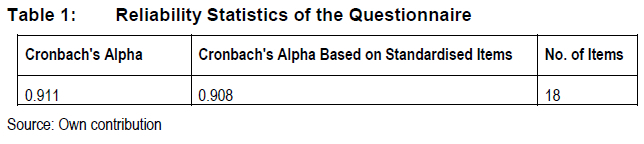
Attributes of the questionnaireThe data collected went through rigorous testing in order to establish its stability and consistency. In this case, the most appropriate test employed was Cronbach's alpha reliability test, as suggested by Nunnally (1978). The result of the alpha revealed a fairly high stability and consistency of the instrument with a value of 0.908. The complete results are presented in Table 1.
5.3
Exploratory factor analysisExploratory factor analysis (EFA) was conducted as an important step to extract the underlying dimensions of the data set. Varimax rotation was used, with all the suggested thresholds, in selecting the final number of dimensions and the subsequent items. In this case, the Kaiser-Meyer-Olkin (KMO) and Bartlett's Test of Sphericity were first inspected to see the correlations among variables. KMO resulted in a value of 0.904 and Bartlett's Test of Sphericity resulted at a significance of p < 0.001, giving the green light to proceed with factor analysis.
A clean three-factor structure was suggested during EFA, keeping a criterion of greater than 1 eigenvalue. These factors had a total variance of 67.89 percent, with each item's loading higher than 0.5. Similarly, all items cleanly loaded on their envisaged factors than on another factor; establishing the discriminant validity of the instrument.
The first factor extracted was named as "academic factors", based on the relevance of items loaded in this factor. A total of seven items loaded under this factor, with the loadings from 0.673 to 0.834. The second factor that emerged was named "management factors" keeping in mind the relevance of the items loaded under this factor. Five items loaded during the extraction process and the items loading varied from 0.831 to 0.891. The last factor extracted during EFA was related to "students' satisfaction" with a total of 6 items. The lowest loading under this factor was 0.696, whereas the highest was 0.842.
5.4
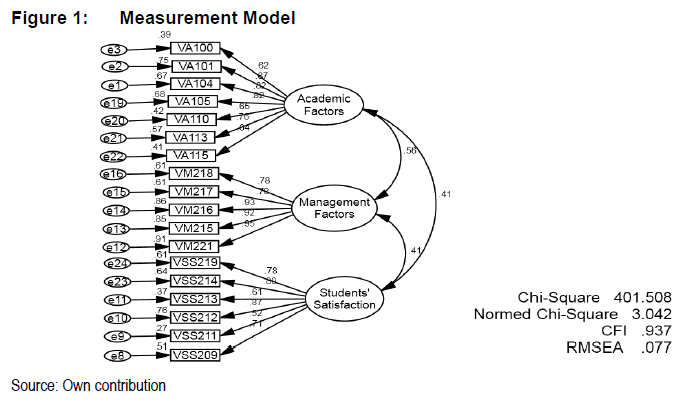
Confirmatory factor analysisThe next imperative stage was to confirm the extracted factors by employing confirmatory factor analysis (CFA), hence applying a two-stage structural equation modelling (SEM) technique. In the first stage CFA, extracted factors were tested with maximum likelihood estimation (MLE) using AMOS software. For this purpose, a complete measurement model of all the factors was used, as presented in Figure 1. The CFA was evaluated based on the fit indices suggested by Byrne (2010); Hair, Black, Babin and Anderson (2010); and Kline (2011). Normed chi-square (x2/df), the comparative fit index (CFI), and the root mean square error of approximation (RMSEA) were considered in the present research as most important.
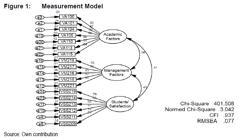
As clearly seen in Figure 1, all the fit measures exceeded the threshold. Here the normed chi-square (x2/df) value of 3.042 is below 5.0. Similarly, the value of CFI is 0.937, which is also well above the threshold value of 0.90. Lastly, RMSEA resulted in a value of 0.077 (< 0.08), which also suggests a reasonably good fit.
5.5 Structural Equation Modelling
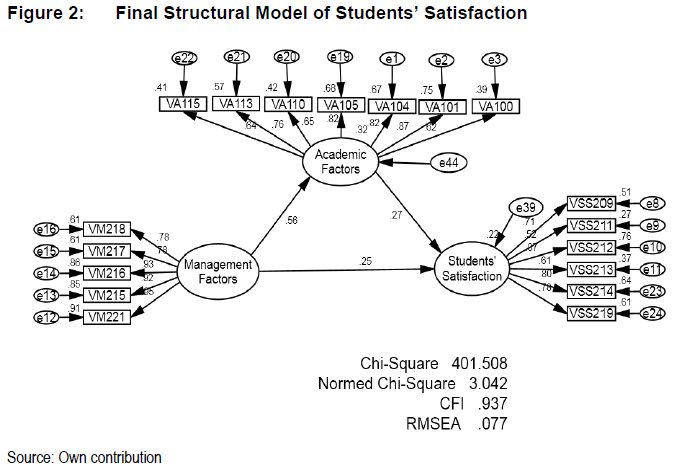
As mentioned earlier, a two-stage SEM approach was taken in the present study. Therefore, the second stage deemed necessary is to employ full-fledge structural modelling, where hypotheses are also tested along with testing the fitness of the proposed model. The results revealed a normed chi-square value of 3.042, CFI value of 0.937 and RMSEA value of 0.077, attesting of a good fit.
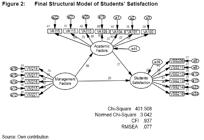
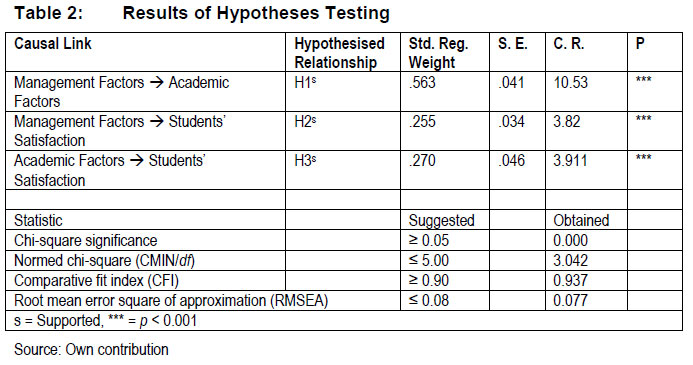
The output of the final structural model from AMOS software indicates a good fit of the model with all the devised hypotheses supported. A causal link between "management factors" and "academic factors" indicates a very strong impact of around 56%, followed by the link between "academic factors" and "students' satisfaction". The practical significance (β) and statistical significance (p value) were observed to draw conclusions about the hypotheses. All the hypotheses were both practically (β > 0.20) and statistically (p < 0.05) significant. The results of hypotheses testing are provided in Table 2.
Based on the result of the hypotheses presented in Table 2, it is evident that all the three hypotheses are supported. In this case, H1 (Management related factors have a positive impact on academic factors), H2 (Management factors influence students' satisfaction), and H3 (Academic factors positively influence students' satisfaction). The aforementioned hypotheses are supported due to the fact that standardised regression weights for H1, H2, and H3 are 0.563, 0.255, and 0.270 respectively. Similarly, all these hypotheses resulted in a p value of less than 0.001, indicating significance.
6. CONCLUSION AND IMPLICATIONS
An interesting attempt has been made to empirically test the relationship among very important factors with regard to satisfaction in higher educational institutions. These factors are management-related factors, academic factors and students' satisfaction. The objective of this research was three-fold: first, to propose and test a model with the aforementioned important variables; second, to determine the impact of these variables, as envisaged; and thirdly, to test the fitness of the proposed model. The said objectives were achieved using structural equation modelling (SEM), as a tool that has the capability to test multiple dependent and independent variables simultaneously along with testing the hypotheses and fit of the model.
In this research, the stronger impact of management-related factors on academic factors suggests that if a university has better management, it will eventually translate into better academic factors. Similarly, the second strongest impact was of the academic factors on student satisfaction, which implies that enhanced satisfaction of students is subject to better academic facilities provided by the university. Lastly, it was also found that management-related factors have a two-fold impact: one on the academic factors and the other on the satisfaction itself. Universities' top management and policymakers may benefit from the findings of this research with regard to enhancing the level of satisfaction of students. Many other factors may be responsible for increasing student satisfaction, for example, location of the institution and ICT services provided by the university to the students (which were not within the scope of this research). Perhaps future researchers may consider incorporating the aforementioned variables in the present model of the study. Another suggestion for future research would be the testing of the model in other countries.
7. RECOMMENDATIONS
Based on the findings of the present study, the researchers would like to offer some recommendations to the institute of higher learning. Firstly, to focus more on management related factors, as it has a two-fold impact, one on academic factors and second on students' satisfaction. Secondly, the importance of academic factor cannot be denied too, as it positively influences students' satisfaction. Lastly, it is recommended that the organisations who wish to adopt and apply the findings of the present study, apply it in totality because the result may differ if one variable is considered and the other left without consideration. It is, therefore, recommended that special attention be given to the improvement of management-related factors by universities in South Africa.
8. LIMITATIONS OF THE STUDY
The main limitation of the study is that the sampling was not representative of all higher learning institutions in South Africa. Thus is generalisability the main limitation of the present study. An attempt will be made to increase the number of institutions when a follow-up study is considered.
REFERENCES
ACKNOWLEDGEMENTS
The researcher would like to acknowledge the financial contribution of the UCDP research development grant that partially made this collaborative attempt possible.
2. LITERATURE REVIEW
- ADHIKARI DR. 2010. Knowledge management in academic Institutions. International Journal of Educational Management 24(2):94-104
-
ALHUSBAN AA, ALHUSBAN SA & AL-BETAWI YN. 2019. The degree of the Hashemite university students' desires, needs, and satisfaction with their campus urban design. [Internet: https://doi.org/10.1108/JPMD-08-2018-0062; downloaded on 14 March 2018.
» https://doi.org/10.1108/JPMD-08-2018-0062 - ]
- ARDI R, HIDAYATNO A & ZAGLOEL TYM. 2012. Investigating relationships among quality dimensions in higher education. Quality Assurance in Education 20(4):408-428.
- BARRON J. 2015. Building a chain of success in marketing higher education: the alumni connection. Industrial and Commercial Training 47(5):253-256.
- BERCHIN II, DOS SANTOS GRANDO V, MARCON GA, CORSEUIL L & DE ANDRADE GUERRA JBSO. 2017. Strategies to promote sustainability in higher education institutions, a case study of a federal institute of higher education in Brazil. International Journal of Sustainability in Higher Education 18(7):1018-1038.
- BLACKMORE J, DOUGLAS A & BARNES B. 2006. Measuring student satisfaction at a UK university. Journal of Quality Assurance in Education 14(3):251-267.
-
BURGOYNE J, MACKNESS J & WILLIAMS S. 2009. Baseline study of leadership development in higher education, 2009. Final report, Research and development series 2(3). Leadership foundation for higher education. [Internet:https://www.mLfhe.ac.uk/publications/research.html; downloaded on 14 March 2018.
» https://www.mLfhe.ac.uk/publications/research.html - ]
- BYRAKTAR E, TATOGLU E & ZAIM S. 2008. An instrument for measuring the critical factors of TQM in Turkish higher education. Total Quality Management 19(6):551-574.
- BYRNE BM. 2010. Structural equation modeling with AMOS: basic concepts, applications, and programming. 2nd ed. New York, NY: Taylor and Francis Group.
- DOUGLAS J, DOUGLAS A & BARNES DB. 2006. Measuring staff satisfaction at a UK university. Quality Assurance in Education 14(3):251-267.
- DOUGLAS J & MCCLELLAND R. 2008. The development of a conceptual model of student satisfaction with their experience in higher education. Quality Assurance in Education 16(1):19-35.
- DUQUE LC & WEEKS JR. 2010. Towards a model and methodology for assessing student learning outcomes and satisfaction. Quality Assurance in Education 18(2):84-105.
- DURKIN M, HOWCROFT B & FAIRLESS C. 2016. Product development in higher education marketing. International Journal of Educational Management 30(3):354-369.
-
GREGORY JL. 2019. Applying SERVQUAL: Using service quality perceptions to improve student satisfaction and program image. [Internet:https://doi.org/10.1108/JARHE-12-2018-0268; downloaded on 14 March 2018.
» https://doi.org/10.1108/JARHE-12-2018-0268 - ]
- HAIR JF, BLACK WC, BABIN BJ & ANDERSON RE. 2010. Multivariate data analysis. 7th ed. New Jersey: Pearson Prentice Hall.
- HEFFERNAN T, WILKINS S & BUTT MM. 2017. Transnational higher education. International Journal of Educational Management 32(2):227-240.
- KHOO S, HA H & MCGREGOR SLT. 2017. Service quality and student/customer satisfaction in the private tertiary education sector in Singapore. International Journal of Educational Management 31(4):430-985.
- KLINE RB. 2011. Principles and practice of structural equation modelling. 3rd ed. New York, NY: The Guilford Press.
- LANFORD M. 2016. Perceptions of higher education reform in Hong Kong: a localisation perspective. International Journal of Comparative Education and Development 18(3):184-204.
- MANATOS MJ, SARRICO CS & ROSA MJ. 2015. The integration of quality management in higher education institutions: a systematic literature review. Total Quality Management 28(2):159-175.
- MARTINEZ-LEON IM & MARTINEZ-GARCIA JA. 2011. The influence of organisational structure on organisational learning. International Journal of Manpower 32(5/6):537-566.
- MAZZEROL T & SOUTER GN. 2012. Revisiting the global market for higher education. Asia Pacific Journal of Marketing and Logistics 24(5):717-737.
- MCCUDDY MK, PINAR M & GINGERICH EFR. 2008. Using student feedback in designing student - focused curricula. International Journal of Educational Management 22(7):611-637.
- MCLEAY F & ROBSON A & YUSOFF M. 2017. New applications for importance-performance analysis (IPA) in higher education. Understanding student satisfaction. Journal of Management Development 36(6):780-800.
- NGUYEN TTM & NGUYEN TD. 2010. Determinants of learning performance of business students in a transitional market. Quality Assurance in Education 18(4):304-316.
- NUNNALLY JC. 1978. Psychometric theory. New York: McGraw Hill.
- OSMAN RA & SAPUTRA RS. 2019. A pragmatic model of student satisfaction: a viewpoint of private higher education. Quality Assurance in Education 26(1):142-156.
- PETROZZELLIS L, D'UGGENTO AM & ROMANAZZI S. 2006. Student satisfaction and quality of service in Italian Universities. Managing Service Quality 16(4):349-364.
- SAKTHIVEL PB & RAJU R. 2006. Conceptualizing total quality management in the engineering education and developing a TQM educational excellence model. Total Quality Management 17(7):913-934.
- SAYEDA B, RAJENDRAN C & LOKACHARI PS. 2010. An empirical study of total quality management in engineering education institutions of India. Benchmarking: An International Journal 17(5):728-767.
- SHARABI M. 2013. Managing and improving service quality in higher education. International Journal of Quality and Service Science 5(3):309-320.
- SURESHCHANDAR GS, RAJENDRAN C & ANANTHARAMAN RN. 2001. A holistic model for total quality service. International Journal of Service Industry Management 12(4):378-412.
- TELFORD R & MASON R. 2005. The congruence of quality values in higher education. Quality Assurance in Education 13:107-119.
- TRIVELLAS P & DARGENIDOU D. 2009. Leadership and service quality in higher education. International Journal of Quality and Service Sciences 1(3):294-310.
- VAUTERIN JJ, LINNANEN L & MARTILLA E. 2011. Issues of delivering quality customer service in a higher education environment. International Journal of Quality and Service Sciences 3(2):181-198.
- VENKATRAMAN S. 2007. A framework for implementing TQM in higher education programs. Quality Assurance in Education 15(1):92-112.
- VIANDEN J & YAKABOSKI T. 2016. Critical incidents of student satisfaction at German universities. International Journal of Educational Management 31(7):944-957.
- VIJAYA SM. 2016. Constructs of quality in higher education services. International Journal of Productivity and Performance Management 66(8):1091-1111.
- VUORI J. 2015. Excellent prospects for beautiful minds: marketing international education. International Journal of Educational Management 29(5):582-595.
- WEERASINGHE IMS & FERNANDO RLS. 2018. Critical factors affecting students' satisfaction with higher education in Sri Lanka. Quality Assurance in Education 26(1):115-130.
- WEERASINGHE IMS, LALITHA R & FERNANDO RLS. 2017. University facilities and student satisfaction in Sri Lanka. International Journal of Educational Management 32(5):866-880.