Key Drivers that Influence Store Choice in the Contemporary Gauteng Apparel Retail Market
Abstract
The purpose of this article is to explore apparel store choice behaviour of female Generation Y student shoppers and analyse factors that influence their choice of apparel store. Generation Y female consumers have been identified as an important segment, particularly for apparel. A total of 370 Generation Y female students provided usable responses to the survey. Structural Equation Modelling (SEM) was used to examine the research aim. The results revealed that store atmosphere, sales personnel and availability of merchandise influence apparel store choice. The study has practical implications for apparel retailers targeting female consumers and suggests how they can improve store atmosphere to enhance the shopping experience, ensure that sales personnel are friendly, supportive and knowledgeable, and ensure the right merchandise is available to avoid customer switching and negative word-of-mouth. The results of this study, while not generalisable, offer important insights for apparel stores and apparel marketers targeting female Generation Y consumers.
Apparel; retail store choice; sales personnel; store atmospherics and merchandise availability
1. INTRODUCTION
In today's post-modern era, young female students face the decision of which retail apparel store to be loyal to and deciding where they will buy apparel products such as clothing, cosmetics and shoes from. Selvakumar and Vikkraman (2012:10967) note that a great deal of spending comes from young individuals, who are labelled as Generation Y in generational studies and classified as those born between 1986 and 2005 (Eastman & Liu 2012:93; Markert 2004:11. This puts them in the 14 to 33 age brackets in 2019. Nadeema, Andreini, Saloa and Laukkanen (2019:433) point out that college-aged Generation Y individuals are often experiencing the freedom of independence for the first time, and thus have specific wants and needs as consumers. Generation Y was raised to view apparel shopping as a difficult activity due to enhanced retail and product selection (Akinwale 2013:3).
Du Plessis and Rousseau (2003:240) and Cooper (2010:57) explain that consumers face decisions about the store they buy from and the products and services they buy on a regular basis. Since consumers are often unsure of the consequences of their store and purchase decisions when making a retail store choice, they perceive a certain degree of risk. Studies show that the personality of the consumer, past buying experience and the socio-economic environment (lifestyle) have an impact on the decision of store choice (Narang 2011:134). As consumers have become more refined in the marketing arena, marketers must try to gain some understanding of how consumers collect and review information that ultimately affects their store choice and loyalty behaviour (Mayland 2000:31). Hwang and Chung (2019:293) also agree that the method of attracting consumers to stores (i.e. store choice) is an important issue for retail chains.
Whilst many research studies have focused on Generation Y consumers and students (Bevan-Dye, Garnett & De Klerk 2012:5582; Ladhari, Gonthier & Lajante 2019:113; Muda, Mohd & Hassan 2016:292), there is scant research on how store atmospherics, sales personnel and merchandise availability influence apparel retail store choice among Generation Y female students. Within the South African context, prior scholars have conducted their studies centred on the Generation Y cohort in various contexts by focusing on:
• Antecedents of trust in mobile banking among Generation Y Students in South Africa (Van Deventer 2019:51);
• The influence of perceived integrity and perceived system quality on Generation Y students' perceived trust in mobile banking in South Africa (van Deventer, de Klerk & Bevan-Dye 2017:128);
• Consumer shopping styles (Mandhlazi, Dhurup & Mafini 2013:154);
• Impulsive fashion apparel consumption (Dhurup 2014:168);
• Generation Y students' attitude towards online shopping (Makhitha 2014:49);
• African Generation Y male students' fashion consciousness behaviour (Motale, Bevan-Dye & De Klerk 2014:121);
• Innovation and risk-taking propensity of Generation Y students in South Africa (Koloba & May 2014:19).
There is a knowledge gap and lack of studies focusing on the influence of store atmospherics, sales personnel and merchandise availability on retail store choice among female Generation Y student apparel consumers. In addition, to the best knowledge of the researchers, only a few have used Structural Equation Modeling (SEM) to test the causal relationships of store atmospherics, sales personnel and merchandise availability on retail store choice. In terms of the robustness of the research in question, the research conceptual model proposed in this study is unique. This research thus adds to the literature by taking results from a geographically distinct context and testing the suggested model in a developing country context.
The rest of the article proceeds as follows: To start, the problem statement is elucidated and, thereafter, this examination is placed in context. In addition, the theoretical framework underlying this study is shown, thus prompting research hypotheses development. Next, a section on research design and methodology is covered and, finally, there is a presentation of the findings, discussion, and conclusion.
2. PROBLEM STATEMENT
North, De Vos and Kotze (2003:41) argue that consumers of apparel are constantly involved in the apparel purchasing process and retailers are therefore constantly faced with challenges in determining and meeting the needs of these consumers competently as possible. Goodman and Remaud (2015:120) argue that retailers should understand how shoppers patronise a range of stores. Puligadda, Ross, Jinjie and Howlett (2012:571) points out that there has been little research on understanding what actually influences the choice on 'where to shop', which is likely an antecedent of store loyalty. This suggests that store choice has become an important area of concern for retailers, with no clear verdict as to what drives customers to choose a store (Van Schalkwyk, Maziriri & Mokoena 2017:193). The critical issue for retailers is developing an understanding of the factors that influence consumers when choosing a store to buy a product from (Mowen 1995:439). It is possible to conceptualise the dynamic store choice decision as a matter of deciding where and when to shop (Leszczyc, Peter, Sinha & Timmermans 2000:324). It is therefore critical for retailers to have extensive knowledge of the various factors that influence consumer decisions to ensure successful product delivery and customer retention in the marketplace (Mandhlazi et al. 2013:154).
3. RATIONALE AND IMPORTANCE OF SELECTING YOUNG ADULT GENERATION Y FEMALE CONSUMERS
This section outlines the aspects to be examined and providing a foundation about Generation Y female buyers. Inseng (2019:33) notes that female Generation Y students love shopping. Females in particular tend to shop and spend their money on what they love, such as clothing, shoes, make-up, jewellery and DVDs (Inseng 2019:33). Beaudoin, Lachance and Robitaille (2003:23) argue that in the process of specifically fashion diffusion, "... regardless of age, females play a significantly greater role than males'. With generation Y representing the future potential of the clothing industry (Nadeema et al. 2019:433), this study argues that females' generation Y consumers are an important market to investigate.
Hence, it can be observed from the above-mentioned elucidations that female Generation Y consumers have relevance in both the retail and academic environments. The subsequent section is centred on the theoretical framework of the study.
4. THEORETICAL GROUNDING
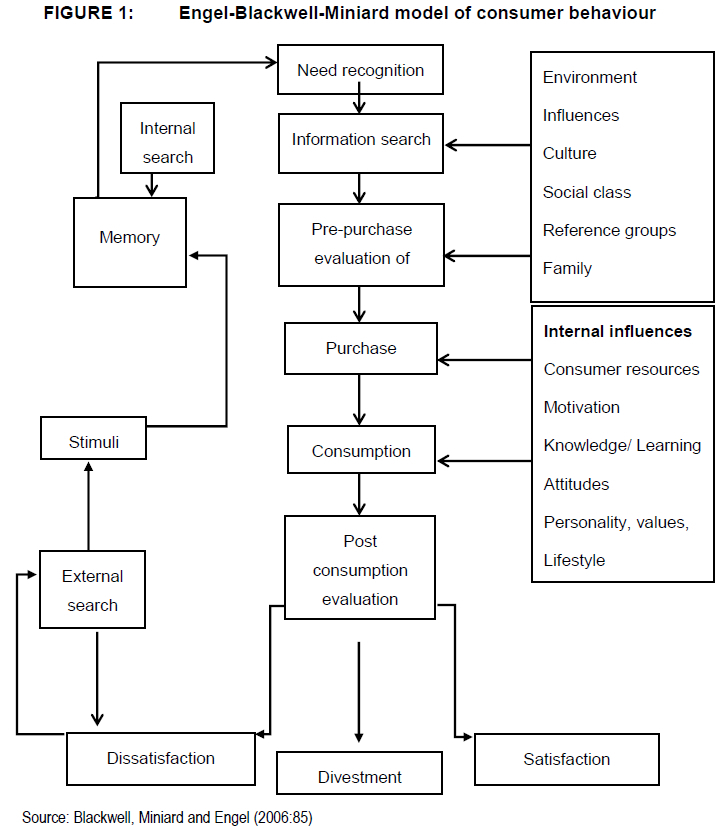
This study is anchored on the Engel-Blackwell-Miniard model, which emphasises the decision-making process, which will serve as the starting point for the research initiative to be developed and justified. The next section highlights the underpinning theoretical model.
4.1 Engel-Blackwell-Miniard model of decision-process behaviour
Since the 1940s, buying behaviour models have been developed to meet the goals of describing and predicting consumer behaviour to achieve a more comprehensive understanding of current and prospective customers (Marreiros & Ness 2009:2). Consumer behaviour depends primarily on consumer decision-making, according to Engel, Blackwell and Miniard (1995:150). The Engel-Blackwell-Miniard (EBM) decision-process behaviour model supports consumer decision-making's cognitive approach (Zietsman 2006:10). The consumer behaviour model by Engel-Blackwell-Miniard defines the process of buying behaviour and specifies variables that influence and shape decision making (Gravely 1999:6).
The model shows that consumers typically take the following seven steps in decision-making: the need for recognition, information search, pre-purchase evaluation, purchase, consumption, post-consumption evaluation and divestment (Blackwell, Miniard & Engel 2006:85). Cooper (2010:2) explains that retailers will gain a better understanding of how consumers decide from which retail store to buy by understanding the consumer decision-making process. The EBM model was chosen largely due to its emphasis on the decision-making process that is relevant to the subject matter and the variables chosen for this study. Figure 1 shows EBM's consumer behaviour model.
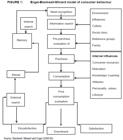
Most people's lives involve a series of daily decisions (Van Staden 2008:9). These decisions or choices can only be made if two or more alternatives are available (Schiffman & Kanuk 2007:524). Michman and Mazze (2001:50) point out that consumers engage in a decision-process approach for store choice. The Engel-Blackwell-Miniard model shows that consumers typically go through the following seven stages when making decisions:
1. Need for recognition.
2. Search for information.
3. Repurchase evaluation.
4. Purchase.
5. Consumption.
6. Post-consumption evaluation.
7. Divestment.
This model also indicates that various environmental variables and individual preferences have an influence on each consumer decision. Nevertheless, an understanding of the consumer decision-making process will provide apparel retailers with a comprehensive and systematic roadmap as to how female Generation Y student consumers make store selection decisions.
Levy and Weitz (2004:111), provided a seminal model, considered to be the starting point in the process of consumers' store choice. The buying process starts with defining an unsatisfied need. There also needs to be an acknowledgement that decisions do not happen in a linear process and that cell phones are increasingly being used to compare and check prices. A consumer identifies the stores that will satisfy this need. Alternative stores are evaluated using criteria that influence store choice behaviour and as a result of this evaluation, the store that will satisfy the consumers' needs and wants is chosen. After specifying the store, the buying process is completed (Levy & Weitz 2004:111). Post evaluation of the selected store and the divestment stage wraps up the consumer decision-making process (Levy & Weitz 2004:111). The seven steps of the consumer decision-making process adapted from Levy and Weitz (2004:111) are expanded comprehensively in the following sections.
4.1.1 Step 1: Problem (need) recognition
Problem recognition is regarded as the first stage of the consumer decision-making process. Problem recognition is well-defined as the result of a difference between a consumer's desired state and the actual state and is thus enough to provoke and activate the decision-making process (Kerin, Hartley & Rudelius, 2009:116). A desired state refers to the way in which an individual want to be and/ or feel. (Hawkins, Mothersbaugh & Best, 2007:514). On the other hand, an actual state is the way an individual perceives his or her feelings and the situation at the present time (Hawkins & Mothersbaugh 2010:500). In relation to this study, the dynamic store choice decision can be conceptualised as a problem of deciding where and when to shop (Leszczyc et al. 2000:324).
4.1.2 Step 2: Information search
In order to make a purchase decision, the consumer searches for information about the store in order to minimise the possibility of dissatisfaction (Mittal & Mittal 2008:27). An information search is the process by which the consumer surveys his or her environment for appropriate data to make a reasonable decision (Solomon 2011:260). For example, a Generation Y female student seeking the best retail store to buy an elegant dress for a lecture presentation can solicit information by visiting speciality clothing stores and fashion designers. Additionally, the consumer could even receive recommendations from neighbours, friends and family about the most appropriate place to go shopping (Mittal & Mittal 2008:27). On the other hand, an ongoing search occurs on a regular basis, even when problem recognition has not been activated (Du Plessis & Rousseau 1999:87). For example, a consumer might constantly read fashion magazines and visit websites of different kinds of apparel retail stores to be well informed.
4.1.3 Step 3: Pre-purchase evaluation of alternative
Alternative evaluation is the third step in the consumer decision-making process (Lamb (Jr), Hair, Mcdaniel, Boshoff & Terblanche 2004:68). Kotler (2000:180) have defined alternative evaluation as a process by which alternatives are evaluated and selected to meet customer needs. After the consumer has gone through the process of gathering information, the consumer must select from the possibilities (Chae, Black & Heitmeyer 2006:26; Solomon & Rabolt 2004:362).
This phase considers the alternative choices as obtained through the information search phase (Blackwell et al. 2006:80). From the authors' explanation, it can be noted that consumers weigh their options to select the best store, as well as the best product or service according to a set of criteria. The consumer's evaluation of a retail store, over and above the evaluation of the actual merchandise, is a complex process (Grace & O'Cass, 2005:227). Consumers will have obtained information on various attributes, features and benefits at this stage, and must evaluate these in order to make a decision.
4.1.4 Step 4: Store choice decision
Once an alternative is selected, a final decision must be made and the consumer then moves to the purchase phase, where they attempt to put their thoughts into action (Tusiime, 2009:19). Based on the information gathered and evaluated in the problem-solving stage, the consumer decides whether to purchase and which product and retailer to choose (Lusch, Dunne & Carver 2011:104). During the purchase stage of the decision process, consumers decide whether to buy, when to buy, where to buy (type of retailer and specific retailer) and how to pay (Cooper 2010:32). There are certain concerns, which the consumer must address in executing a purchasing action, such as whether or not to buy, when to buy, what to buy, where to buy and how to pay (Kotler 2000:182).
This phase holds the possibility of a complete disregard of the previous phases as circumstances may prevail, altering them or making the intended choices impossible to execute (Blackwell et al. 2006:81). For example, a female Generation Y consumer may plan to purchase a jacket from Store A after seeing their advertisement, but when she goes to the store, it is closed. As a result, the consumer purchases a similar jacket from another store. It is at this stage that a consumer makes a store choice decision, as well as the purchase of products.
4.1.5 Step 5: Consumption
The fifth step in the consumer decision-making process is consumption. Evans (2019:499) defines consumption as the process of using the product or service purchased. Consumption could either occur immediately when the consumer purchases the product, or be delayed. Sahelices-Pinto, Lanero-Carrizo and Vazquez-Burguete (2018:307) posit that consumers may decide to use the product as intended or as they choose, especially when instructions are not included or not read. How consumers use the products has a great effect on their satisfaction (Dahiya & Gayatri 2018:80). As such, consumption is considered to be a determinant of satisfaction (Stankevich 2017:11).
Apparel goods are used to express one's identity (Fasoli, Maass, Volpato & Pacilli 2018:2). Consumers have control over what they wear and are conscious of what they may communicate through clothing (Crane 2012:174). A comparative study conducted by Goldsmith, Flynn and Clark (2012:114) found that women invest more money and time in finding the perfect outfit compared to men. Moreover, people tend to choose the outfit to match the social activities they intend to perform (Lee & Choo 2015:264). According to Piacentini and Mailer (2004:254), consumers express how they feel through clothing.
4.1.6 Step 6: Post evaluation of the selected store
The post-consumption evaluation stage can be defined as consumers' evaluation of a product's performance considering their own expectations (Kerin et al. 2009:116). According to Blackwell et al. (2006:210) consumers experience a sense of either satisfaction or dissatisfaction during this stage but can also experience what is called post-purchase dissonance.
Satisfaction is measured in terms of whether the expected performance was met. If it does not perform as expected, it may cause dissatisfaction (Blackwell et al. 2006:82). According to Kardes, Cline and Cronley (2011:91), satisfaction can be viewed as a post-consumption evaluation of whether a chosen evaluation is at least met or if the consumer's expectations have been exceeded. On the other hand, dissatisfaction is the opposite response; it is the degree of discrepancy between the expectations and the actual results (Kardes et al. 2011:91). In relation to this study, a satisfied Generation Y female consumer will frequently buy apparel products from the chosen apparel store, whereas a dissatisfied consumer will try an alternative apparel retail store the next time. Cognitive dissonance occurs after consumption, which makes consumers judge their choice of products or service (Schiffman & Kanuk 2007:547). If they think their decision was good, their cognitive dissonance will be little (Schiffman & Kanuk 2007:547). In relation to this study, a female Generation Y student consumer may feel uncertain about whether the right store choice has been made or may even regret the decision made.
4.1.7 Step 7: Divestment
The last step in the consumer decision-making process is divestment (Sahelices-Pinto et al. 2018:307). Divestment refers to how consumers dispose of the packaging or product after consumption (Chen, Nguyen, Klaus & Wu 2015:963). In this stage, consumers are faced with three options, namely: disposal, recycling and re-marketing. Oke, Kamolshotiros, Popoola, Ajagbe and Olujobi (2015:46) maintain that this stage is essential for organisations. Hence, more organisations are now interested in producing environmentally friendly products. Rayport and Jaworski (2003:278) point out that customers tend to continuously buy products when they are happy with a reinforcement stage. In relation to the apparel industry, there has been an excessive turnaround of apparel due to the fast-changing fashion trends, affordable apparel stores and the continuous supply of new apparel designs (Kamis, Suhairom, Jamaluddin, Syamwil & Puad 2018:4250). In the post-modern era, consumers - particularly female consumers - tend to purchase more apparel goods at affordable prices but dispose of them after consumption for only one season (Fletcher 2008:142). Fast fashion is considered a major contributor to the waste generated by the textile industry. Social campaigns have been developed to influence consumers to donate their clothes to welfare organisations (Bianchi & Birtwistle 2012:337). Recycling has been identified as one of the strategies that can be implemented to reduce waste. As such, consumers are more willing to purchase apparel that can be recycled (Kamis et al. 2018:4250). In addition, apparel consumers have become environmentally conscious, and are now interested in protecting the environment by buying textile products that can be recycled (Wai Yee, Hassan & Ramayah 2016:5). Based on the abovementioned elucidations, and in relation to the context of this research, it is essential to note that Generation Y female students are likely to be more attracted to stores that allow them to dispose of their apparel products for the purpose of recycling it into of other fashionable apparel products.
This section focuses on reviewing literature on the research variables under investigation, namely: store atmospherics, sales personnel, merchandise availability and retail store choice.
5.1 Store atmospherics
Francioni, Savelli and Cioppi (2018:334) stipulate that store atmospherics can be generally referred to as all the physical and non-physical elements of the store that could affect a shopper's behaviour toward a retailer. Sirbu, Säseanu and Ghitä (2015:568) point out that the concept of store atmosphere reflects the effort to create an environment that generates emotional-specific effects on a buyer, effects which increase the probability of a buyer to purchase. In order to estimate how store atmosphere impacts customers' behaviour in terms of approaching or avoiding the store, SÏrbu et al. (2015:568) used variables specific to store atmosphere in terms of:
• Time spent in the store;
• Amount of money spent;
• Intention to return to the store;
• Intention to recommend the store;
• Communication with the staff in the store;
• Assessment of products offered and satisfaction regarding the store.
Singh, Katiyar and Verma (2014:16) explain that store atmospheric attributes such as colour, lighting, interior decoration or music form the overall context within which shoppers make store selection and patronage decisions and are likely to have a significant impact on store image. A pleasant store atmosphere can prolong the time consumers spend in a store, increasing the likelihood that a consumer will find something he or she needs, as well as increasing impulse buying (Chen & Hsieh 2011:10055).
5.2
Sales personnelOsman, Ong, Othman and Khong (2014:182) state that a retail salesperson often serves as a critical nexus between retailers and their customers; a salesperson can provide customer-assisted information and services during the buying process. Al-Ali, Bazin and Shamsuddin (2015:288) claim that shoppers prefer frequenting shops with experienced sales staff who are friendly and courteous. Usually consumers visit clothing shops with friendly, supportive, attentive and courteous staff (Mafini & Dhurup 2015:1296).
A trained salesperson can minimise frustration by guiding and assisting a consumer in the buying process and increasing the purchasing behaviour or impulses impulsive buying. Employee attitude and behaviour will also affect the experiences of customers towards the store - and customers will feel satisfied when employees can solve their queries (Lata & Jain 2015:81). Osman et al. (2014:182) found that when customers are involved in interaction with retail salespersons, they often experience emotions. If such behaviour is interpreted as redolent of aggression (Lee & Dubinsky 2003:21), customers may also consider a salesperson's over enthusiastic behaviour as annoying. Helpful and knowledgeable sales staff has a positive effect on consumers' perception of store image, making store staff one of the key retail elements (Hu 2011:83). In addition, knowledgeable, well-trained and motivated staff provide after-sales service, product information, solve problems, and handle grievances which is indispensable to an apparel retailer (Skottman 2015:21).
5.3
Merchandise availabilityAsuquo and Igbongidi (2015:1) defined merchandise as the products and services or lines offered to the target market by a retailer. Merchandise is the most important factor contributing to consumer store preference and merchandise is a major influence on the consumer choice of store (Hasan & Mishra 2015:10). A variety of merchandise helps retailers attract more consumers and induce them to buy (Chang, Cho, Turner, Gupta & Watchravesringkan 2015:140). In addition to helping retailers attract more consumers, a wider variety of merchandise can also encourage retailers to increase their purchase volume and frequency (Martinez-Ruiz, Jimenez-Zarco & Cascio 2011:506). Summers and Hebert (2001:145) stated that a more attractive store with better lit merchandise could also attract shoppers, make them linger and hopefully make a purchase.
5.4
Retail store choiceRetail store choice is recognised as a cognitive process and is as much a behaviour in information processing as any other purchase decision (Sinha & Banerjee 2004:482). Store selection, according to Rutenberg (2003:114), refers to a retail store where the consumer chooses to shop. Mowen (1995:414) explains that store choice is the process in which a consumer makes a choice between two or more alternatives to shop at a retail outlet. Rikhotso (2004:27) refers to retail store choice as store patronage behaviour or store loyalty. Bailey (2011:25) points out that it may be more important for the consumer to choose a store than to choose a brand, and this may involve a complex set of criteria.
Choosing a store is of great importance as apparel consumers often gather information, evaluate alternatives, and make purchase-point decisions (Du Preez & Visser 2003:16). Du Preez and Visser (2003:16) further stated that consumers choose retail outlets according to their shopping orientations and the challenge for manufacturers is to distribute their merchandise to the correct stores. It is therefore critical for a retailer to understand and the reason why consumers choose a specific store (Taylor & Cosenza 2002:396).
6. CONCEPTUAL RESEARCH MODEL AND HYPOTHESES DEVELOPMENT
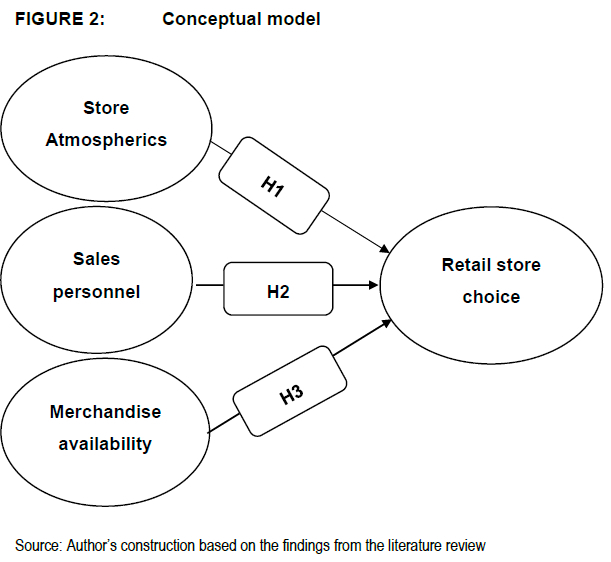
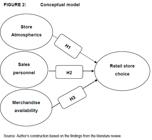
The relationship between the variables investigated in this study is described in a conceptual model (Maziriri, Mapuranga & Madinga 2018:3). The conceptual model of this study suggests that the predictor variables are store atmospherics, sales personnel and merchandise availability. In addition, the model also indicates that retail store choice is the dependent or outcome variable of this conceptual model. Store atmospherics, sales personnel and merchandise availability are all considered to influence retail store choice (Dhurup, Mafini & Mathaba, 2013:359; Singh, Katiyar & Verma 2014:15). A conceptual model based on the above-mentioned constructs was used to guide the empirical study (as shown in Figure 2).
6.1 Store atmospherics and retail store choice
It is imperative to elucidate the nexus between store atmospherics and retail store choice. Lillian (2016:9) maintains that a store's atmosphere can influence:
• consumers' shopping satisfaction;
• the physical time spent browsing and evaluating the merchandise;
• the eagerness of consumers to communicate with store personnel and to make use of store facilities such as dressing rooms;
• the consumers' willingness to spend more money than originally planned;
• the possibility of future patronage.
In their study, which focused on the importance of atmospherics in the choice of hypermarkets and supermarkets, Marques, Trindade and Santos (2016:17) found that atmospherics positively influence the consumers' choice of retail store. According to Ghosh, Tripathi and Kumar (2010:77) store atmospheric attributes (including colour, lighting, sales personnel, music, etc.) form the overall context within which shoppers make decisions of store selection and patronage. Thang and Tan (2003:198) also suggest that pleasing store atmospherics that offer comfortable, fashionable, stylish gratifications that contribute to customers' sense of well-being tend to enhance consumer preferences for a store. From the above, it can be inferred that the atmosphere of any retail store is essential and will often determine whether consumers are prepared to spend more time browsing. The following hypothesis has been formulated:
H1: Store atmospherics have a positive and significant impact on retail store choice
6.2
Sales personnel and retail store choiceIt is also important to clarify the nexus between sales personnel and retail store choice. As suggested by Moschis, Ferguson and Zhu (2011:796), the availability of store personnel is an important factor in the selection of apparel stores. Consistent with these findings, studies by Gundala (2010:71) and Clodfelter (2010:139) concluded that consumers usually visit stores with experienced sales personnel who are friendly, supportive, attentive and courteous when shopping for clothing. Helpful and knowledgeable sales personnel have a positive effect on consumers' perception of store image, which makes store personnel a crucial element in retail (Hu & Jasper 2006:41; Hu 2011:99). As such, to have sufficient well-trained and skilled sales personnel in the retail sector - especially the apparel sector, creates a competitive advantage over those who lack in such provision (Dalwadi, Rathod & Patel 2010:32; Grewal, Baker, Levy & Voss 2003:265). Dhurup, Mafini, & Mathaba (2013:364) also concur that sales assistants in retail stores should have enough knowledge of the products offered and must also be willing and capable of responding. Therefore, based on this assumption, a second hypothesis is formulated as follows:
H2: Sales personnel have a positive and significant impact on retail store choice
6.3
Merchandise availability and retail store choiceVan der Vyver (2008:78) posits the ease of finding merchandise within a retail store is important to customers. Thang and Tan (2003:193) examined how the perception of consumers towards retail store attributes affects their preference for a store. On their post-visit ranking, the authors identified that merchandising significantly influence retail store choice among consumers. For many shoppers, quickly finding the merchandise they seek powerfully influenced their retail choice (Bianchi 2009:311). Thompson, Ellis, Soni and Paterson (2018:157) established that Generation Y Twixter customers prefer clothing stores which provide high quality, unique and fashionable merchandise that meets their value for money requirements. Along these lines, deriving from the literature and the empirical evidence above, it is hypothesised that:
H3: Merchandise availability has a positive and significant impact on retail store choice
7. RESEARCH METHODOLOGY
This investigation pursued a positivist paradigm as it tried to discover a connection between constructs expressed for this examination and utilised target estimation instruments for the information gathering and investigation methods. A quantitative research approach was selected, since it elevates the accuracy of results through statistical analysis. A target population is the complete unit from which a sample is chosen (Bryman & Bell 2011:176), share similar characteristics relevant for a research study (Kent 2007:227). Sampling also includes restricting individuals who do not qualify to form part of the population specified (Clow & James 2014:226). The target population for this study was restricted to Generation Y female students located within the Gauteng province during the che termourse of the survey.
The sampling frame for this study comprised of female Generation Y student consumers who were registered at one university of technology and a traditional university within the Gauteng province. A simple random sampling technique was used in this study, because each element of the population had an equal and known chance of being selected as part of the sample (Maziriri, Mapuranga & Madinga 2018:4). That is, where every name on the list of female Generation Y students registered as per the database of these two institutions had an equal chance of selection.
The Raosoft calculator for sample size was used to calculate the size of the sample (Raosoft Incorporated 2019:Internet). The calculation took into account the population of approximately 9 400 Generation Y female students officially registered at one university of technology and one traditional university in the year 2019, a 5% margin of error, 90% confidence interval, and the recommended 50% distribution, and returned a minimum sample size of 370 respondents.
7.1 Measurement instrument and questionnaire design
A self-administered questionnaire was used for this study to collect the data needed. Leedy and Ormrod (2010:197) state that a questionnaire is research in which the researcher asks willing participants a series of questions, summarises their responses with percentages, frequency counts, or more sophisticated statistical indexes on which references are drawn about a population. From previous studies, measurement scales have been operationalised.
The questionnaire was divided into five sections:
1. Section A, which will consist of questions about the demographic factors of the respondents, including age, current year of study, types of apparel stores usually purchased from and the university of the students.
2. Section B evaluated "store atmospherics" and was measured using a four-item scale adapted from Sharma and Stafford (2000:191).
3. For Section C "sales personnel" was measured using a ten-item scale adapted from Rikhotso (2004:86).
4. Section D evaluated the "accessibility of merchandise" and used a twelve-item scale adapted from Rikhotso as well (2004:84).
5. Section E of the questionnaire included "retail store selection" questions measured using an eight-point scale adapted from Van Schalkwyk, Maziriri and Mokoena (2017:193). To express the degree of agreement, all the questions were measured on a five-point Likert-type scale-1 (strongly disagree) to 5 (strongly agree).
8. DATA ANALYSIS
After screening the returned questionnaires, the collected data from Generation Y female students were then coded and captured onto an Excel spreadsheet. This data was then analysed using the Statistical Package for Social Sciences (SPSS version 25.0) software for descriptive statistics, calculating the Cronbach alpha values and correlations. Structural equation modelling (SEM) was performed using the AMOS (version 25.0) package to test the causal relationships. SEM is a multivariate technique of data analysis (Hair, Black, Babin & Anderson 2010:19) that estimates and tests relationships between one or more independent variables, and one or more dependent variables (Ullman 2006:35). SEM also provides a way to test the specified set of relationships between observed and latent variables and permit theoretical testing, even if experiments are not possible (Chang & Chen 1998:246). As a result, in all social and behavioural sciences, these methods have become omnipresent (MacCallum & Austin 2000:203). SEM is a large sample technique and should ideally include more than 200 responses (Barrett 2007:820), which is said to provide statistical power in multivariate analysis for data analysis (Hoe 2008:77).
8.1 Sample composition
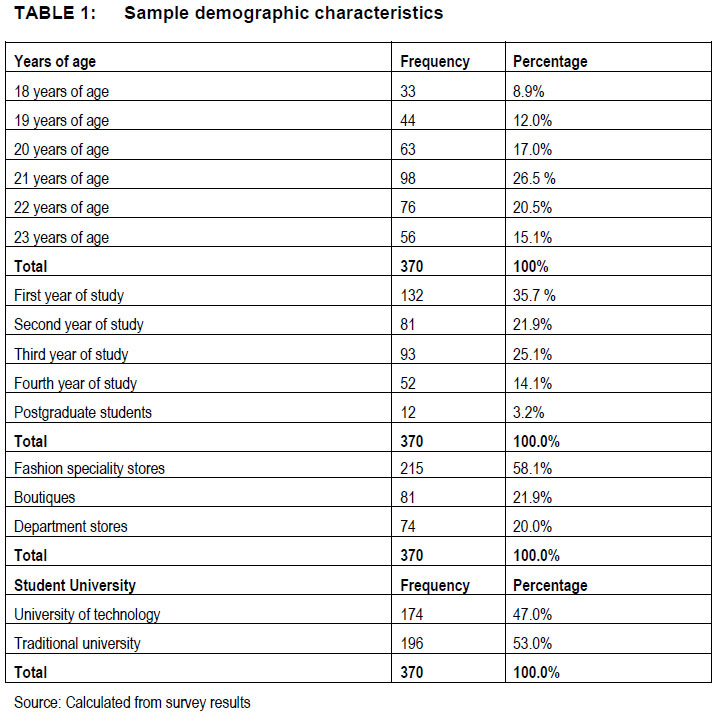
The age distribution of the sample is illustrated in Table 1. The largest group of the participants indicated that 26.5 percent (n=98) of the respondents were 21 years of age, closely followed by 20.5 percent (n=76) who indicated being 22 years of age, followed by 17 percent (n=63) who were 20 years of age. For the remaining respondents, 15.1 percent (n=56) indicated that they were 23 years of age, 12.0 percent (n=44) were 19 years of age and, lastly, 8.9 percent (n=33) were 18 years of age. Table 1 also presented the classification of information related to the participants' current year of study. According to Table 1, 35.7 percent (n=132) were students in the first year of study, 25.1 percent (n=93) were students in their third year of study, 21.9 percent (n=81) were students in their second year of study. The remainder (small portion) of the respondents 14.1 percent (n=52) were in their fourth year of study, and 3.2 percent (n=12) were postgraduate students. Table 1 also reported that 58.1 percent (n=215) of the respondents buy apparel from fashion speciality stores, while 21.9 percent (n=81) of the students buy apparel from boutiques and lastly 20.0 percent (n=74) indicated they buy apparel from department stores. According to Table 1, 47 percent (n=174) of the respondents came from one university of technology and 53 percent (n=196) from one traditional university.
8.2 Reliability analysis
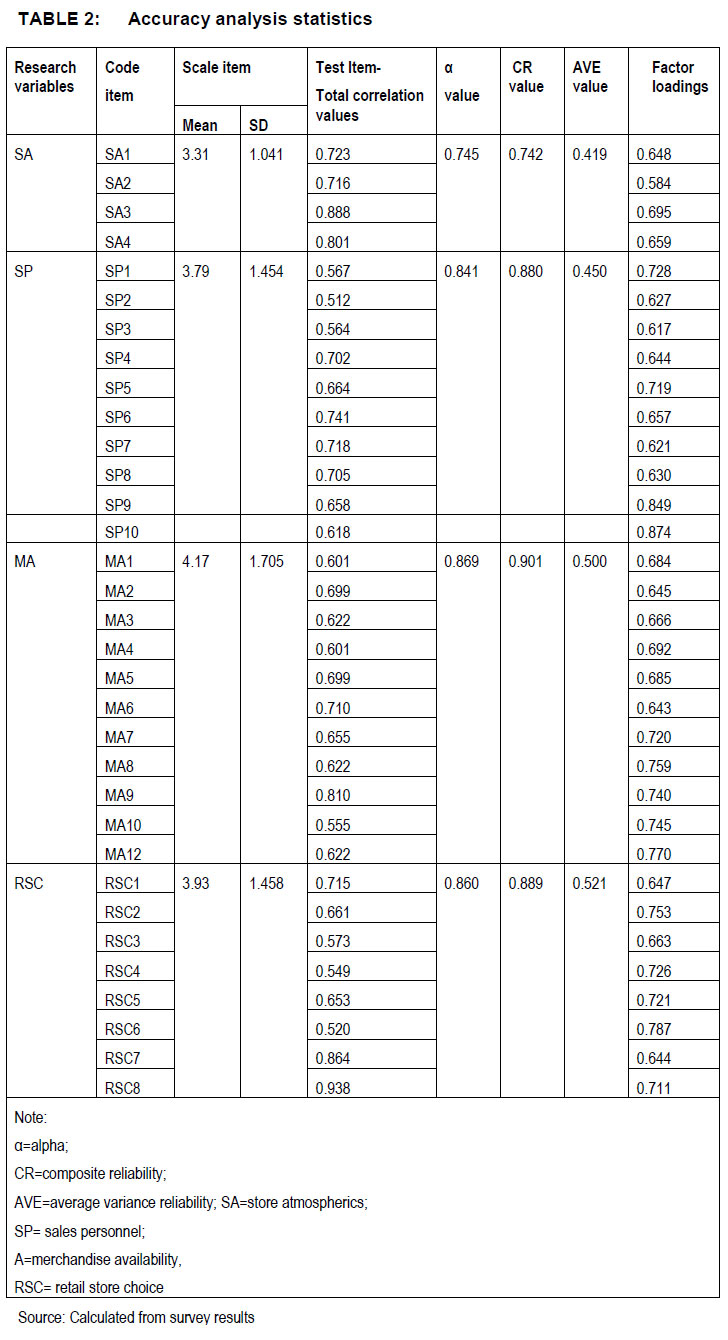
The statistical measures of accuracy tests presented in Table 2 indicate the distinct measures that were utilised to survey the reliability and validity of the constructs of this study. The table contains the means and standard deviations, Item to Total connections, Cronbach alpha values, Average Variance Extracted (AVE), Composite Reliability (CR) and Factor Loadings are reported below.
On merchandise availability (MA), 1 item was deleted, which is MA11 since the item to total correlation value was less than 0.5. It is worth mentioning that this item was deleted, because it did not meet convergent validity. In other words, the item did not measure at least 50% of what it was supposed to measure and that is why it was not used for further analysis.
Cronbach alpha testing was adopted as the measure of internal consistency for the measurement scale, and was used with a co-efficient value of 0.7 as cut-off point (Nunnally 1978:245). An important property of the co-efficient alpha is that its value tends to increase with an increase in the number of scale items (Bryman & Bell 2011:158). A large alpha value indicates a high reliability. Scores close to zero indicate that the reliability of the instrument is low (Malhotra 2010:724). The results provided in Table 2 range from the lowest Cronbach alpha (0.745) to the highest (0.865). The Cronbach alpha scores indicated that each construct exhibited strong internal reliability. Therefore, Cronbachs' alpha values of the constructs exceeded the recommended 0.70, thus meeting the required threshold and demonstrating that the constructs used to measure variables are very reliable for all the variables.
Item loadings for each corresponding research construct were above the recommended value of 0.5 (Aldalaigan & Buttle 2002:369). As shown in Table 2, the item loadings range between 0.584 and 0.787 and this means that the instruments loaded well on their respective constructs. The results also indicate an acceptable individual item convergent validity, as more than 50 percent of each items variance was shared with a respective construct.
Composite reliabilities (CR) and average variance extracted (AVE) for each construct were also computed using the formulae proposed by Fornell and Larcker (1981:40) i.e.
CRn= (Σλyi)2/[(Σλyi)2+(Σ£i)]
Where
CRn, = Composite reliability, (Zλyi) 2= Square of the summation of the factor loadings; (Σεi) = Summation of error variances.
Vη=Σλyi2/ (Σλyi2+Σεi)
Where
νη= Average Variance Extracted (AVE); Σλyi2= Summation of the squared of factor loadings; Σεi= Summation of error variances.
Hair et al. (2010:710) indicate that composite reliability coefficients of 0.7 and above, indicate high levels of construct reliability. As per the results in Table 2, all the constructs used in this study showed very high levels of reliability. The Composite reliability coefficients of the constructs range from 0.742 to 0.901, with the lowest for store atmospherics, and the highest for merchandise availability.
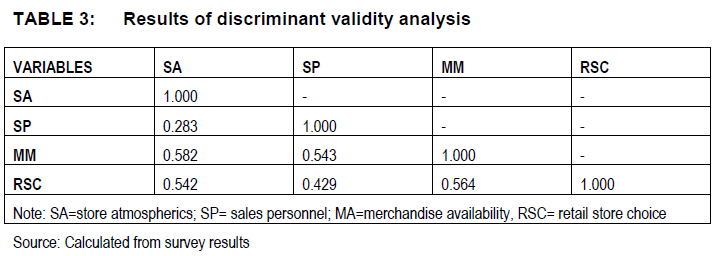
For Average Variance Extracted (AVE) a value of 0.40 or higher indicates a satisfactory measure (Anderson & Gerbing 1988:411). The AVE values above 0.40 indicate that convergent validity was achieved, and this further confirms an excellent internal consistency and reliability of the measurement instruments used. As such, all pairs of constructs revealed an adequate level of discriminant validity (see Table 3). Therefore, the results indicate that the scale for the current study is reliable.
Golafshani (2003:598) and Cooper and Schindler (2011:289) note that one of the strategies used to observe the discriminant validity of research was to assess whether the connections between latent buildings were below 0.60. Empirical literature prescribes a correlation estimate of less than 0.60 to assert the presence of discriminant validity (Golafshani 2003:598; Cooper & Schindler 2011:289). The inter-construction correlation estimates, as shown in Table 3, range from 0.283 to 0.582 and these are all below the reliable guideline of 0.60 (Golafshani 2003:598; Cooper & Schindler 2011:289), showing the achievement of discriminant validity. Table 3 therefore shows that the results further approve the presence of discriminant validity.
8.3 MEASUREMENT MODEL ASSESSMENT
Confirmatory factor analysis (CFA) was performed to examine the reliability, convergent validity and discriminating validity of the multi-item constructs measures. This study used generally acceptable CFA fit indices. In order to meet the acceptable level, the chi-square (CMIN / DF) value must be limited to 1 and 3, according to Schreiber, Stage, King, Nora and Barlow (2006): the Goodness Index (GFI), the Comparative Fit Index (CFI) and the IFI and the Tucker-Lewis Index (TLI) must be equal to or greater than 0.90 to be acceptable (Schreiber et al. 2006:330). Similarly, in order to be accepted, the average root square approximation error (RMSEA) must be equal to or below 0.08 (Schreiber et al. 2006:330). The RMSEA "tells us how well the model, with unknown, but optimally chosen parameter estimates would fit the populations covariance matrix" (Hooper, Coughlan & Mullen 2008:54). The recommended figures showed an acceptable data fit for the final general model evaluation, i.e.: X2/(df)=1,954, GFI=0,912, TLI=0,922, IFI=0,945, CFI=0,938, NFI=0,951 and RMSEA=0,064, respectively.
8.4 STRUCTURAL MODEL ASSESSMENT AND HYPOTHESIS TESTING
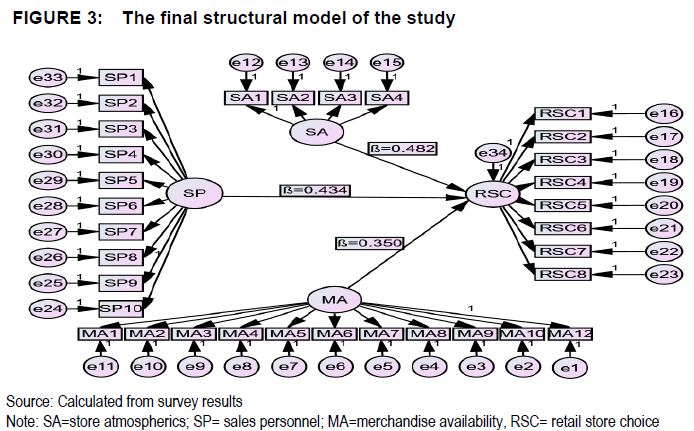
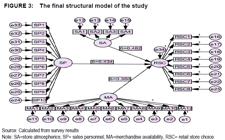
The structural model was examined after establishing the goodness of the measurement model to establish its fitness, as well as testing the hypothesised relationships. For the SEM phase, a model fit analysis was performed before the hypotheses were tested. All other fit indices showed acceptable fit of the structural model according to Mpinganjira (2014:606) and Hair et al. (2010:672). Results show a ratio of 1,956 between the Chi square and the degree of freedom. This is below the 3.0 threshold recommended and confirms the model's fitness. CFI, RMSEA, NFI, TLI, IFI, GFI and AGFI values of 0.954, 0.045, 0.932, 0.933, 0.949, 0.941 and 0.913 respectively met the recommended thresholds. These results are evidence of the structural models' acceptable fit. To regulate the strength and weakness of causal relationships, the hypothesis path modeling test was developed. The structural model is shown in Figure 3 below.
9. OUTCOME OF HYPOTHESES TESTING
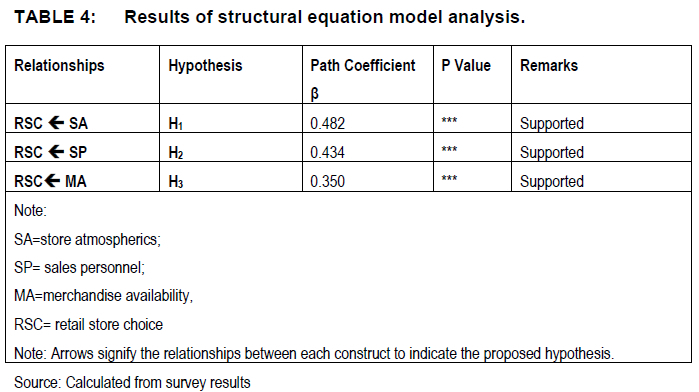
Path coefficient values - as well as p-values for the structural model - were used to determine the testing of the hypotheses noted for the purpose of this study. The results affirmed the models' adequacy and asserted support for the three hypotheses. In the model, the construct relationships suggested in this study generate the path coefficients. The subsequent section outlines the test results for the hypotheses.
9.1 Outcome of testing hypothesis 1: Store atmospherics and retail store choice
The primary hypothesis expressed the positive and significant impact of store atmospherics on retail store choice. The relationship between store atmospherics and retail store choice shows a β=0.482 at p-value < 0.01 based on the results of the final model test. This evidence shows support for hypothesis 1. Therefore, hypothesis 1 was accepted. This result suggests that if apparel retailers are to have attractive store atmospherics, this ultimately will influence female student Generation Y consumers when making their retail store choice. This examination does not dismiss H1 along these lines. It is important to note that several scholars (Dhurup et al. 2013:359; Petermans & Van Cleempoel 2010:33; Thenmozhi & Dhanapal 2011:22) also found similar findings in their studies, thus confirming that store atmospherics is a persuasive store choice element.
9.2
Outcome of testing hypothesis 2: Sales personnel and retail store choiceThe second hypothesis expressed the positive and significant impact of sales personnel on the choice of a retail store. This assumption is upheld in this investigation based on the results. The final structural model presents the relationship between sales staff and retail store selection, resulting in a coefficient of β= 0.434 at p < 0.01. Hypothesis 2 is therefore supported. This result implies that sales staff does influence Generation Y student consumers when making their retail store choice. This inquiry subsequently supports H2. These results are in line with literature - for example, Kumar (2016:1694), who researched retail consumers' criteria for store decision-making and patronage behaviour and found that the friendliness of sales staff is an important attribute in store choice decisions and thus increases re-patronage and positive word-of-mouth communication about a store.
9.3
Outcome of testing hypothesis 3: Merchandise availability and retail store choiceThe third hypothesis indicated that the availability of merchandise has a positive and significant impact on the choice of a retail store. This hypothesis has been upheld in this examination. The relationship between merchandise availability and retail store choice shows a β= 0.350 at p-value < 0.01 based on the results of the final model test. This evidence shows support for hypothesis 3. This result acknowledges that the more apparel retailers provide readily available merchandise for Generation Y female students, the more likely they would be to selected a retail store. These results are in line with the work of Bianchi (2009:311), which emphasised that for many shoppers, finding the merchandise they are looking for influences their retail store choice. These results are also consistent with the works of Thompson et al. (2018:157), who found that Generation Y Consumers Twixter prefer clothing stores who provide high-quality, unique and fashionable merchandise, fulfilling their demands for value for money. Twixters are consumers between 18 and 30 years old, who still stay with their parents (Yanli, Trent, Sullivan & Matiru 2003:313). They still live with their parents because they cannot afford to stay alone or simply because they enjoy the conveniences their parents offer (Grossman 2005:1; Thompson et al. 2018:160).
10. MANAGERIAL IMPLICATIONS
For academics, this study offers significant implications. The research findings, for example, show that the availability of merchandise and the choice of retail stores have a strong influence on one another, as indicated by a coefficient of 0.350. This finding enhances the understanding of the relationship between merchandise availability and retail store choice in the area of retail management and marketing, as this is a useful contribution to existing literature on these two variables.
The findings demonstrate the importance of store atmosphere and its influence on consumer behaviour. Therefore, this study draws the attention of apparel retail management to the importance of atmospherics. In order to attract and retain customers, retail stores should pay attention to four atmosphere dimensions, namely:
• Visual (colour, brightness, size and shapes);
• Aural (volume and pitch); olfactory (scent and freshness);
• Tactile (softness, smoothness and temperature).
This will assist retailers in reinventing the shopping experience. A unique environment can be used by retailers as a point of difference, which will lead to consumers selecting their store over their competitors. This study found that store atmosphere is a key factor for apparel store choice. The findings will allow the retail managers to be proactive, rather than reactive, in changing their store designs to fit the needs of their target market. Apparel retailers should improve their store interior design to enhance shoppers' experience.
Apparel store managers should communicate the importance of dress code to the sales personnel, who should also then understand that the manner in which they present themselves influences how consumers perceive the retail store. Sales personnel are a very crucial factor in the store selection process. Retail management should train their sales representatives. As outlined by Mafini and Dhurup (2015:1296), consumers usually select stores with sales personnel who are friendly, supportive and knowledgeable about the products and the industry. Training on handling customer grievances and providing aftersales service is important for retaining existing customers.
Merchandise is the most important factor contributing to consumer store preference (Hasan & Mishra 2015:10). Consumers do not like uncertainty. When consumers want to buy a product, their greatest uncertainty is the availability of the product in a store. Therefore, retail managers should ensure that they always have the required merchandise. Failure to have the required merchandise might lead to customer dissatisfaction, negative word-of-mouth and a possibility of switching to other stores on the next shopping experience.
11. LIMITATIONS AND FUTURE RESEARCH
It should be noted in evaluating these findings that this study has its own limitations, which open opportunities for further research. The most obvious is that the study results may only apply to female students from Generation Y around the Gauteng province. If data collection is expanded to include the apparel buying behaviour of South Africa's other generational cohorts'; the research findings may be more insightful. This study could be used as a starting point for future research on Generation Y female students as well as other subcultural groups of female clothing consumers in South Africa by other consumer science, retail management or marketing students. It will be in the interest of South African clothing retailers to gain knowledge of store atmospherics, sales staff, availability of merchandise, as well as representing women from all ethnic groups, regions or provinces, as females are generally the main clothing buyers in South Africa. In addition, the findings of this study are limited to the cohort of female students of Generation Y only. Future research should accommodate other generational cohorts, such as Generation X, to obtain valuable information on market segments to develop suitable marketing strategies. In addition, the findings of this study are limited to the apparel market, focusing only on one category of apparel (clothing) products. This provides researchers with an impetus to extend future studies to other types of products. Another limitation is the use of a single data collection method. Future research can use triangulation methodology to consider both a qualitative and quantitative research design, where a qualitative design can be used to generate rich ideas and explanations. Using both qualitative and quantitative paradigms to complement one another will be worthwhile. It is imperative to note that the above limitations do not necessarily negate the contributions of this study, but open avenues for future research.
12. CONCLUSION
It is imperative to note that retailers and fashion marketers currently targeting or planning to target the Generation Y female student cohort need to become familiar with this market in the competitive retail industry and continue to identify influential drivers that influence the choice of retail store. Knowing what motivates shoppers to prefer one store above others and identifying in-store and out-store activities, encourages consumers to remain loyal and is critical to retail business success. A thorough understanding of influential factors in store selection among apparel consumers is therefore imperative for apparel retailers. This study does above all, add new knowledge to the existing retail management setting in South Africa and body of marketing literature - a research context that is currently under-researched and overlooked by academia.
REFERENCES
5. EMPIRICAL LITERATURE
- AKINWALE EJ. 2013. Influence of socialisation agents on Generation Y students' apparel purchasing intentions. Vaal Triangle: North-West University. (Unpublished Masters' Degree Dissertation.
- )
-
ALDALAIGAN AH & BUTTLE FA. 2002. System and transactional service quality scale (SYSTRA-SQ): a new measure of bank service quality. Industrial Journal of Service Industry Management 13(3):362-381. (DOI:10.1108/09564230210445041.
» https://doi.org/10.1108/09564230210445041 - )
- ANDERSON JC & GERBING DW. 1988. Structural equation modelling in practice: a review and recommended two-step approach. Psychological Bulletin 103(3):411-423.
- ASUQUO EE & IGBONGIDI PB. 2015. Retail Store Merchandise Assortment and Display and their Influence on Consumer Impulse Buying Behaviour in North-West Nigeria. Global Journal of Management and Business Research: E Marketing 15(6):1-8.
- )
-
BARRETT P. 2007. Structural equation modelling: Adjudging model fit. Personality and Individual differences 42(5):815-824. (DOI:http://dx.doi.org/10.1016/j.paid.2006.09.018.
» http://dx.doi.org/10.1016/j.paid.2006.09.018 -
)
» https://doi.org/10.1111/j.1470-6431.2005.00434.x -
BEAUDOIN P, LACHANCE L & ROBITAILLE MJ. 2003. Fashion Innovativeness, Fashion Diffusion and brand sensitivity among Adolescents. Journal of Fashion Marketing and Management 7(1):23-30. (DOI:http://dx.doi.org/10.1108/13612020310464340)
» http://dx.doi.org/10.1108/13612020310464340 - BEVAN-DYE AL, GARNETT A & DE KLERK N. 2012. Materialism, status consumption and consumer ethnocentrism amongst black Generation Y students in South Africa. African Journal of Business Management 6(16):5578-5586.
-
BIANCHI CC. 2009. Investigating consumer expectations of convenience-store attributes in emerging markets: Evidence in Chile. Journal of International Consumer Marketing 21(4):309-320. (DOI: 10.1080/08961530802282240.
» https://doi.org/10.1080/08961530802282240 - )
-
BIANCHI CC & BIRTWISTLE G. 2012. Consumer clothing disposal behaviour: a comparative study. International Journal of Consumer Studies 36:335-341. (DOI:http://dx.doi.org/10.1111/j.1470-6431.2011.01011.x)
» http://dx.doi.org/10.1111/j.1470-6431.2011.01011.x - BRYMAN A & BELL E. 2011. Business research methods. 3rd ed. New York: Oxford University Press.
-
)
» http://dx.doi.org/10.5901/mjss.2014.v5n8p168 -
CHANG HJ, CHO HJ, TURNER T, GUPTA M & WATCHRAVESRINGKAN K. 2015. Effects of store attributes on retail patronage behaviors: Evidence from activewear specialty stores. Journal of Fashion Marketing and Management 19(2):136-153. (DOI: 10.1108/JFMM-03-2014-0019.
» https://doi.org/10.1108/JFMM-03-2014-0019 - )
- CHANG TZ & CHEN SJ. 1998. Market orientation, service quality and business profitability: a conceptual model and empirical evidence. Journal of Services Marketing 12(4):246-264.
-
CHEN HS & HSIEH T. 2011. The effect of atmosphere on customer perceptions and customer behavior responses in chain store supermarkets. African Journal of Business Management 5(24):10054-10066. (DOI:http://dx.doi.org/10.5897/AJBM10.608.
» http://dx.doi.org/10.5897/AJBM10.608 - )
-
CHEN C, NGUYEN B, KLAUS PP & WU M .2015. Exploring electronic word-of-mouth (eWOM) in the consumer purchase decision-making process: the case of online holidays- evidence from United Kingdom (UK) consumers. Journal of Travel & Tourism Marketing 32(8): 953-970. (DOI:http://dx.doi.org/10.1080/10548408.2014.956165.
» http://dx.doi.org/10.1080/10548408.2014.956165 -
)
» https://doi.org/10.3389/fpsyg.2018.02401 - CLOW KE & JAMES KE. 2014. Essentials of marketing research: putting research into practice. Thousand Oaks, California: SAGE Publications.
- COOPER B. 2010. Establishing the store attributes that black consumers consider when buying casual wear. Potchefstroom: North West University. (Unpublished Masters' Degree Dissertation.
- )
- COOPER DR & SCHINDLER PS. 2011. Business research methods. 11th ed. New York: McGraw-Hill.
- CRANE D. 2012. Fashion and its social agendas: Class, gender, and identity in clothing. Chicago: University of Chicago Press.
-
DAHIYA R & GAYATRI A. 2018. A research paper on digital marketing communication and consumer buying decision process: an empirical study in the Indian Passenger car market. Journal of Global Marketing 31(2):73-95. (DOI:https://doi.org/10.1080/08911762.2017.1365991.
» https://doi.org/10.1080/08911762.2017.1365991 - )
- DALWADI R, RATHOD HS & PATEL A. 2010. KEY retail store determining consumers' perceptions: an empirical study on consumers of retail store located in Ahmedabad (Gujarat). South Indian Education Society (SIES) Journal of Management 7(1):20-34.
- )
-
DHURUP M, MAFINI C & MATHABA RL. 2013. Store image factors influencing store choice among sportswear consumers: Baseline findings from South Africa. Mediterranean Journal of Social Sciences 4(14):359. (Doi:10.5901/mjss.2013.v4n14p359.
» https://doi.org/10.5901/mjss.2013.v4n14p359 - )
- DU PLESSIS PJ & ROUSSEAU GG. 2003. Buyer behaviour: a multi-cultural approach. 3rd ed. Cape Town: Oxford University Press.
-
DU PREEZ R & VISSER EM. 2003. Apparel shopping behaviour- Part 2: Conceptual theoretical model, market segments, profiles and implications. SA Journal of Industrial Psychology 29(3):15-20. (DOI: 10.4102/sajip.v29i3.112.
» https://doi.org/10.4102/sajip.v29i3.112 - )
-
EASTMAN JK & LIU J. 2012. The impact of generational cohorts on status consumption: an exploratory look at generational cohort and demographics on status consumption. Journal of Consumer Marketing 29(2):93-102. (DOI:http://dx.doi.org/10.1108/07363761211206348.
» http://dx.doi.org/10.1108/07363761211206348 -
)
» https://doi.org/10.5901/mjss.2014.v5n21p19 -
EVANS DM. 2019. What is consumption, where has it been going, and does it still matter? The Sociological Review 67(3):499-517. (DOI:https://doi.org/10.1177%2F0038026118764028.
» https://doi.org/10.1177%2F0038026118764028 -
)
» http://dx.doi.org/10.1016/j.jretconser.2019.02.003 - )
- FLETCHER, K. 2008. Sustainable fashion and textile: Design journeys. London: Earthscan.
- FORNELL C & LARCKER DF. 1981. Evaluating structural equation models with unobservable variables and measurement error. Journal of marketing research 18(1):39-50.
-
FRANCIONI B, SAVELLI E & CIOPPI M. 2018. Store satisfaction and store loyalty: The moderating role of store atmosphere. Journal of Retailing and Consumer Services 43:333-341. (DOI:http://dx.doi.org/10.1016/j.jretconser.2018.05.005.
» http://dx.doi.org/10.1016/j.jretconser.2018.05.005 - )
-
GHOSH P, TRIPATHI V & KUMAR A. 2010. Customer expectations of store attributes: A study of organized retail outlets in India. Journal of Retail & Leisure Property 9(1):75-87. (DOI:10.1057/rlp.2009.27.
» https://doi.org/10.1057/rlp.2009.27 -
)
» http://dx.doi.org/10.1146/annurev.psych.51.1.201 - GOLAFSHANI N. 2003. Understanding reliability and validity in qualitative research. The Qualitative report 8(4):597-607.
-
GOODMAN S & REMAUD H. 2015. Store choice: How understanding consumer choice of 'where' to shop may assist the small retailer. Journal of Retailing and Consumer Services 23: 188-124. (DOI:http://dx.doi.org/10.1016/j.jretconser.2014.12.008.
» https://doi.org/http://dx.doi.org/10.1016/j.jretconser.2014.12.008 -
)
» https://doi.org/10.1080/09593969.2015.1042495 -
GRACE D & O'CASS A. 2005. An examination of the antecedents of repatronage intentions across different retail store formats. Journal of Retailing & Consumer Services 12(4):227-243. (DOI: 10.1016/j.jretconser.2004.08.001.
» https://doi.org/10.1016/j.jretconser.2004.08.001 -
)
» https://doi.org/10.1108/09590551111144897 - GROSSMAN L. 2005. Grow up? Not So Fast. Time Magazine 24:1-6.
- GRAVELY TM. 1999. Apparel buying behaviours of black males and white males when purchasing men's business suits. Virginia: Virginia Polytechnic Institute and State University. (Unpublished Masters' Degree of science in clothing and textile Dissertation.
- )
-
GREWAL D, BAKER J, LEVY M & VOSS BV. 2003. The effects of wait expectations and store atmosphere evaluations on patronage intentions in service-intensive retail stores. Journal of Retailing 79(4):259-268. (DOI:http://dx.doi.org/10.1016/j.jretai.2003.09.006.
» http://dx.doi.org/10.1016/j.jretai.2003.09.006 -
)
» http://dx.doi.org/10.5901/mjss.2014.v5n21p121 - HAIR J, BLACK W, BABIN B & ANDERSON R. 2010. Multivariate data analysis: a global perspective. 7th ed. Upper Saddle River, NJ: Pearson.
-
HASAN A & MISHRA S. 2015. Key drivers influencing shopping behavior in retail store. IUP Journal of Marketing Management 14(3):7-37. (DOI:http://dx.doi.org/10.5958/0974-1852.2014.00906.7.
» http://dx.doi.org/10.5958/0974-1852.2014.00906.7 -
)
» https://doi.org/10.4314/jfecs.v31i1.52834 - HAWKINS DI & MOTHERSBAUGH DL. 2010. Consumer behaviour: building marketing strategy. 11th ed. New York: McGraw-Hill.
- HOE SL. 2008. Issues and procedures in adopting a structural equation modelling technique. Journal of Applied Quantitative Methods 3(1):76-83.
-
HU H & JASPER CR. 2006. Social cues in the store environment and their impact on store image. International Journal of Retail & Distribution Management 34(1):25-48. (DOI:http://dx.doi.org/10.1108/09590550610642800.
» http://dx.doi.org/10.1108/09590550610642800 - )
- HU H. 2011. Chinese Consumers' store Image Formation and Its Impact on Patronage Behaviour. Academy of Marketing Studies Journal 15(2):83-102.
-
HWANG J & CHUNG JE. 2019. What drives consumers to certain retailers for organic food purchase: The role of fit for consumers' retail store preference. Journal of Retailing and Consumer Services 4:293-306. (DOI: https://doi.org/10.1016/jjretconser.2018.12.005.
» https://doi.org/10.1016/jjretconser.2018.12.005 -
)
» http://dx.doi.org/10.5897/AJBM12.037 -
INSENG HD. 2019. Symbolic money attitudes and compulsive buying: are they all bad for happiness? African Journal of Business and Economic Research 14(1):31-48. )DOI:http://dx.doi.org/10.31920/1750-4562/2019/V14n1a2.
» http://dx.doi.org/10.31920/1750-4562/2019/V14n1a2 - )
- KARDES FK, CLINE TW & CRONLEY ML. 2011. Consumer behaviour: Science and Practice. Ohio: SouthWestern Cengage Learning.
- KERIN RA, HARTLEY SW & RUDELIUS W. 2009. Marketing. 9th ed. NewYork. McGraw-Hill.
-
)
» http://dx.doi.org/10.1108/07363760210437623 -
KAMIS A, SUHAIROM N, JAMALUDDIN R, SYAMWIL R & PUAD FNA. 2018. Environmentally sustainable apparel: recycle, repairing and reuse apparel. The international Journal of Social Sciences and Humanities Invention 5(1):4249-4257. (DOI:10.18535/ijsshi/v5i1.04.
» https://doi.org/10.18535/ijsshi/v5i1.04 - )
- KOTLER P. 2000. Marketing. Millennium edition. Upper Saddle River, New Jersey: Prentice Hall.
- KUMAR P. 2016. Store Decision Criteria and Patronage Behaviour of Retail Consumers. International Journal of Management Research and Reviews 6(12):1692-1702.
-
)
» https://doi.org/10.21511/bbs.12(1 -1).2017.05 - LATA A & JAIN D. 2015. To study The Apparel Retail Stores Atmospheric Cues: Impact on Consumer Buying Behavior. An Exploratory Study of Apparel Stores in Uttar Pradesh State. Online International Interdisciplinary Research Journal 5(1):77-88.
-
LEE H & CHOO H. 2015. Daily outfit satisfaction: the effects of self and others evaluation on satisfaction with what I wear today. International Journal of Consumer Studies 39:261-268. (DOI:http://dx.doi.org/10.1111/ijcs.12174.
» http://dx.doi.org/10.1111/ijcs.12174 - )
-
LEE S & DUBINSKY AJ. 2003. Influence of salesperson characteristics and customer emotion retail dyadic relationships. International Review of Retail, Distribution and Consumer Research 13(1):21-36. (DOI:http://dx.doi.org/10.1080/09593960321000051666.
» http://dx.doi.org/10.1080/09593960321000051666 - )
- LEEDY PD & ORMROD JE. 2010. Practical Research Planning and Design. 9th ed. New Jersey: Pearson.
-
LESZCZYC P, PETER T, SINHA A & TIMMERMANS HJP. 2000. Customer store choice dynamics: An analysis of the competitive market structure for grocery stores. Journal of Retailing 76(3):323-346. (DOI:10.1016/S0022-4359(00)00033-6.
» https://doi.org/10.1016/S0022-4359(00)00033-6 - )
- LEVY M & WEITZ B. 2004. Retailing Management. New York. McGraw Hill Companies Inc.
- )
- LUSCH RF, DUNNE PM & CARVER JR. 2011. Introduction to retailing. Ohio: South-Western Cengage Learning.
- )
-
MAFINI C & DHURUP M. 2015. Drivers of Customer Loyalty in South African Retail Stores. Journal of Applied Business Research 31(4):1295- 1310. (DOI:http://dx.doi.org/10.19030/jabr.v31i4.9317.
» http://dx.doi.org/10.19030/jabr.v31i4.9317 - )
-
MAKHITHA KM. 2014. Factors influencing Generations Y students' attitude towards online shopping. Mediterranean Journal of Social Sciences 5(21):39-50. (DOI: 10.5901/mjss.2014.v5n21p39.
» https://doi.org/10.5901/mjss.2014.v5n21p39 - )
- MALHOTRA NK. 2010. Marketing research: an applied orientation. New Jersey: Prentice Hall.
-
MANDHLAZI L, DHURUP M & MAFINI C. 2013. Generation Y Consumer Shopping Styles: Evidence from South Africa. Mediterranean Journal of Social Sciences 4(14):153-164. (DOI:10.5901/mjss.2013.v4n14p153.
» https://doi.org/10.5901/mjss.2013.v4n14p153 - )
-
MARKERT J. 2004. Demographics of age: generational and cohort confusion. Journal of Current Issues and Research in Advertising 26(2):11-25. (DOI:http://dx.doi.org/10.1080/10641734.2004.10505161.
» http://dx.doi.org/10.1080/10641734.2004.10505161 - )
- )
- MARREIROS C & NESS M. 2009. Conceptual framework of consumer food choice behaviour. Callaghan: Cefage.
- )
- MAYLAND KT. 2000. There is just no satisfying us. International Business Journal 14(11):31-32.
- MAZIRIRI ET, MAPURANGA M & MADINGA NW. 2018. Self-service banking and financial literacy as prognosticators of business performance among rural small and medium-sized enterprises in Zimbabwe. The Southern African Journal of Entrepreneurship and Small Business Management 10(1):1-10.
- MICHMAN RD & MAZZE EM. 2001. Specialty retailers: marketing triumphs and blunders. London: Greenwood Publishing Group.
-
MOSCHIS GP, FERGUSON JL & ZHU M. 2011. Mature consumers' selection of apparel and footwear brands and department stores. International Journal of Retail & Distribution Management 39(10):785-801. (DOI:http://dx.doi.org/10.1108/09590551111162266.
» http://dx.doi.org/10.1108/09590551111162266 - )
- )
- MOWEN JC. 1995. Consumer behaviour. 4th ed. Englewood Cliffs, N.J: Prentice-Hall.
- MPINGANJIRA M. 2014. The influence of online store interactivity on customers' shopping experience: an empirical investigation. Journal of Contemporary Management 11(1):593-612.
-
MUDA M, MOHD R & HASSAN S. 2016. Online purchase behaviour of generation Y in Malaysia. Procedia Economics and Finance 37:292-298. (DOI: 10.1016/S2212-5671(16)30127-7.
» https://doi.org/10.1016/S2212-5671(16)30127-7 - )
-
NADEEMA W, ANDREINI D, SALOA J & LAUKKANEN T. 2019. Engaging consumers online through websites and social media: A gender study of Italian Generation Y clothing consumers. International Journal of Information Management 35:432-442. (DOI:10.1016/j.ijinfomgt.2015.04.008.
» https://doi.org/10.1016/j.ijinfomgt.2015.04.008 - )
-
NARANG R. 2011. Examining the role of various psychographic characteristics in apparel store selection: a study on Indian Youth. Young Consumers: Insight and Ideas for Responsible Marketers 12(2):133-144. (DOI:http://dx.doi.org/10.1108/17473611111141597.
» http://dx.doi.org/10.1108/17473611111141597 - )
- )
- NUNNALLY JC. 1978. Psychometric theory. New York: McGraw-Hill.
- OKE AO, KAMOLSHOTIROS P, POPOOLA OY, AJAGBE MA & OLUJOBI OJ. 2015. Consumer behaviour towards decision making and loyalty to particular brands. International Review of Management and Marketing, 6(4):43-52.
- OSMAN S, ONG FS, OTHMAN MN & KHONG KW. 2014. The mediating effect of mood on in-store behaviour among Muslim shoppers. Journal of Islamic Marketing 5(2):178-189.
-
PETERMANS A & VAN CLEEMPOEL K. 2010. Designing a retail store environment for the mature market: a European perspective. Journal of Interior Design 35(2):21-36. (DOI:http://dx.doi.org/10.1111/j.1939-1668.2009.01036.x.
» http://dx.doi.org/10.1111/j.1939-1668.2009.01036.x - )
-
PIACENTINI M & MAILER G. 2004. Symbolic consumption in teenagers' clothing choices. Journal of Consumer Behaviour 3:251-262. (DOI:http://dx.doi.org/10.1002/cb.138.
» http://dx.doi.org/10.1002/cb.138 - )
-
PULIGADDA R, ROSS WT Jr, JINJIE C & HOWLETT E. 2012. When loyalties clash purchase behaviour when a preferred brand is stocked out: the trade-off between brand and store loyalty. Journal of Retailing and Consumer Services 19:570-577. (DOI:http://dx.doi.org/10.1016/j.jretconser.2012.07.002.
» http://dx.doi.org/10.1016/j.jretconser.2012.07.002 - )
-
RAOSOFT INCORPORATED, 2019. Sample size calculator. [Internet:http://www.raosoft.com/samplesize.html; downloaded on 27 April 2019.
» http://www.raosoft.com/samplesize.html - ]
- RAYPORT JF & JAWORSKI JB. 2003. Introduction to e-commerce. New York: McGraw-Hill.
- RIKHOTSO TV. 2004. Personal Characteristics, Perception of Store Image Attributes and Store Choice of Black Female Clothing Shoppers. Potchefstroom. North West University. (Magister dissertation in Consumer Sciences -Clothing.
- )
- )
-
SAHELICES-PINTO C, LANERO-CARRIZO A & VAZQUEZ-BURGUETE J. 2018. Social commitment or self-interest? Effect of responsible practices performance motivations of firms on the consumer decision-making process. Journal of Marketing Communications 24(3):304-319. (DOI:https://doi.org/10.1080/13527266.2018.1425194.
» https://doi.org/10.1080/13527266.2018.1425194 - )
- SCHIFFMAN LG & KANUK LL. 2007. Consumer behaviour. 9th ed. Upper Saddle River: Prentice Hall.
-
SCHREIBER JB, STAGE F, KING J, NORA A & BARLOW EA. 2006. Reporting structural equation modeling and confirmatory factor analysis results: A review. Journal of Educational Research 99(6):323-337. (DOI: 10.3200/JOER.99.6.323-338.
» https://doi.org/10.3200/JOER.99.6.323-338 - )
- )
-
SHARMA A & STAFFORD TF. 2000. The Effect of Retail Atmospherics on Customers' Perceptions of Salespeople and Customer Persuasion: An Empirical Investigation. Journal of Business Research 49(2):183-191. (DOI:http://dx.doi.org/10.1016/S0148-2963(99)00004-1.
» http://dx.doi.org/10.1016/S0148-2963(99)00004-1 - )
-
SINHA PK & BANERJEE A. 2004. Store choice behaviour in an evolving market. International Journal of Retail & Distribution Management 32(10):482-494. (doi:http://dx.doi.org/10.1108/09590550410558626.
» http://dx.doi.org/10.1108/09590550410558626 - )
- SÎRBU MO, SÄSEANU AS & GHITÄ SI. 2015. Consumers' perception on the use of innovative technologies in creating store atmosphere. Amfiteatru Economic 17(39):567-582.
- SKOTTMAN T. 2015. The impact of store atmospherics and store layout on customer behavior in a hardware store retail setting: case: do-it-yourself store. Jyväskylä: University of Jyväskylä. (Unpublished Masters' Degree Dissertation.
- )
- SOLOMON MR & RABOLT NJ. 2004. Consumer behavior in fashion. Upper River, New Jersey: Prentice Hall.
- SOLOMON RS. 2011. Consumer behaviour: Buying, having and being. 9th ed. Sydney, Australia. Pearson Education.
-
STANKEVICH A. 2017. Explaining the consumer decision-making process: critical literature review. Journal of International Business Research and Marketing 2(1):7-14. (doi:http://dx.doi.org/10.18775/jibrm.1849-8558.2015.26.3001.
» http://dx.doi.org/10.18775/jibrm.1849-8558.2015.26.3001 - )
-
SUMMERS TA & HEBERT PR. 2001. Shedding some lights of store atmospherics: Influence of illumination on consumer behaviour. Journal of Business Research 54(2):145-150. (doi:http://dx.doi.org/10.1016/S0148-2963(99)00082-X.
» http://dx.doi.org/10.1016/S0148-2963(99)00082-X - )
- )
-
THANG DCL & TAN BLB. 2003. Linking consumer perception to preference of retail stores: an empirical assessment of the multi-attributes of store image. Journal of Retailing & Consumer Service 10(4):193-200. (DOI:http://dx.doi.org/10.1016/S0969-6989(02)00006-1.
» http://dx.doi.org/10.1016/S0969-6989(02)00006-1 - )
-
THOMPSON KH, ELLIS D, SONI S & PATERSON S. 2018. Attributes influencing clothing store choice for an emerging market's Generation Y Twixter customers. The international review of retail, distribution and consumer research 28(2):157-173. (DOI:https://doi.org/10.1080/09593969.2017.1357647.
» https://doi.org/10.1080/09593969.2017.1357647 - )
- TUSIIME R. 2009. Impulsive Buying Behaviour of Apparel Merchandise among University Students in Southern Gauteng. Vanderbijlpark. Vaal University of Technology. (Published Masters' Dissertation.
- )
-
ULLMAN JB. 2006. Structural equation modeling: Reviewing the basics and moving forward. Journal of Personality Assessment 87(1):35-50. (DOI: 10.1207/s15327752jpa8701_03.
» https://doi.org/10.1207/s15327752jpa8701_03 - )
- VAN DER VYVER J. 2008. The importance of store image dimensions in apparel retail: Customer and management perceptions. Cape Town: University of Stellenbosch, Stellenbosch. (Published Masters' Degree Dissertation.
- )
- VAN DEVENTER M. 2019. Antecedents of Trust in Mobile Banking Amongst Generation Y Students in South Africa. Acta Universitatis Danubius. Economica 15(3):51-64.
- )
- VAN SCHALKWYK P, MAZIRIRI ET & MOKOENA BA. 2017. Refinement and Validation of Scales for Measuring Perceived Social Risk, Buying Behaviour and Retail Store Choice. International Journal of Business and Management Studies 9(2):184-199.
- VAN STADEN J. 2008. Information seeking by female apparel consumer educators in Vanderbijlpark during the fashion decision making process. Vaal University of Technology. (Published Masters' Dissertation. Vanderbijlpark.
- )
-
WAI YEE L, HASSAN SH & RAMAYAH T. 2016. Sustainability and philanthropic awareness in clothing disposal behaviour among young Malaysian consumers. SAGE Open 1-10. (DOI:https://doi.org/10.1177%2F2158244015625327.
» https://doi.org/10.1177%2F2158244015625327 - )
-
YANLI C, TRENT ES, SULLIVAN PM & MATIRU GC. 2003. Cause-related Marketing: How Generation Y Responds. International Journal of Retail & Distribution Management 31(6):310-320. (DOI:10.1108/09590550310476012.
» https://doi.org/10.1108/09590550310476012 - )
- ZIETSMAN L. 2006. Profiling male apparel consumers: demographic characteristics, lifestyle, shopping orientation, patronage behaviour and shopping mall behaviour. Stellenbosch: University of Stellenbosch. (Published Masters' Degree Dissertation.