A Management Approach for Enhancing the Sustainability of Small and Medium Size Enterprises in the North West Province of South Africa
Abstract
Most people start up small businesses without the knowledge of effective management which is one of the major causes of the high rate of Small and Medium Size Enterprises (SMEs) failure and discontinuity in South Africa. The purpose of this study was to establish an effective management approach for enhancing the success of SMEs. This study adopts a quantitative method of data collection and analysis. The research instrument used for this study was a questionnaire, which was administered to 400 small business managers in the North West province of South Africa, and Statistical Package for the Social Sciences (SPSS) was used to analyse the data. It was found that only 41.5% of SMEs in the North West province are likely to be sustainable whereas the majority of 58.5% is likely not to be sustainable due to ineffective management. This is so because SMEs which are effectively managed are most likely to succeed and be sustainable while those that are poorly managed are most likely to fail and discontinued. It is imperative for small business managers to uphold the prescripts of strategic management to be visionary, dynamic, goal orientated, transformational and tactical in applying the effective management measures to manage SMEs for them to succeed and be sustainable.
Business; entrepreneurs; management; SMEs; South Africa and sustainability
1. INTRODUCTION
Before 1994, the SME sector did not receive much attention in South Africa. The Staatskoerant (2017) states that the 1995 White Paper on the National Strategy for the Development and Promotion of Small Businesses in South Africa was the first effort by the government to formulate a policy framework that targeted the whole spectrum of the small business enterprise sector. Bary (2019) asserts that governments worldwide now place a lot of emphasis on developing the SMEs sector in order to stimulate economic growth. Despite the efforts by the government to offer financial and technical support to SMEs in order to develop the sector, Zhang (2016) argues that the rate of failure and discontinuity of SMEs in South Africa is still reported to be one of the highest in the world. Leboea (2017) asserts that 75% of South African SMEs do not grow to become big enterprises because most of them dwindle and even close down within the first five (5) years of operation. According to the Small Enterprise Development Agency (SEDA) (2019), the number of formal and informal SMEs in South Africa also increased insignificantly by only 13.6% in three (3) years from 2.25 million in 2015 to only 2.56 million in 2018. This rate of increase is significantly less than the 14% expansion in Gross Domestic Product (GDP) experienced over the same periods.
Bhorat, Asmal, Lilenstein and Van der Zee (2018) contend that the growth and sustainability of small business enterprises in South Africa do not get enough support and encouragement. As a result, most of these SMEs are failing and some of them are even closing down within a short term of operation. Kalane (2015) argues that one of the major causes of failure of South African small businesses is ineffective management abilities of the managers. Mxunyelwa and Vallabh (2017) affirm that the absence of managerial skills and training is a vital reason for small business failure and the lack of experience and an authoritative culture greatly hinder the development of SMEs in South Africa. This implies that there is an incomplete focus on management issues by most SME managers, as they do not understand the guidelines for operating small businesses as stipulated by business scholars (Leboea 2017). Leboea (2017) further notes that it remains unclear why in spite of the enormous effort to develop the sector and improve on the management guidelines for operating SMEs stipulated by business scholars, the rate of SMEs failure and discontinuity in South Africa is still high as compared to other emerging countries such as Brazil, China and India.
The purpose of this study was to establish a management approach for enhancing the sustainability of SMEs. This study advocates for a management approach by proposing effective management factors (independent variables) influencing the elements that are critical for the sustainability of SMEs (dependable variable). The identification of the problem of ineffective management associated with the failure and discontinuity of SMEs in South Africa is a call for the need to propose an effective management approach for enhancing the sustainability of these businesses. The quest for a management approach for enhancing the sustainability of SMEs is a means to curb the problem plaguing the sector so that SMEs can become more sustainable in South Africa. What is the management approach that is appropriate for enhancing the sustainability of SMEs in South Africa?
Most SMEs that are newly established and start-up businesses that need to adjust to changes at all stages of their existence to be sustainable. A newly established SME requires reaching the breakeven point in the medium and long run and this process typically takes a few years, which requires capital to finance its business operations (Osano 2019). It follows that a proper business strategy gives SMEs competitive advantage over others by overcoming obstacles and adapting to products and market changes. To grasp the overview of SME sustainability in South Africa, this section of the study addresses the concept of sustainability in the context of SMEs and the management prescription to improve the sustainability of small business.
2.1 Sustainability in the context of small and medium size enterprises
Štrukelj, Nikolić, Zlatanović & Sternad (2020) aver that sustainability is fast becoming a yardstick for measuring effective business strategies and a model to achieve the best results. Salimzadeh, Courvisanos & Nayak (2013) defines sustainability as the challenge to concurrently develop social and human wellbeing without diminishing their ecological effect and ensuring the effective accomplishment of organisational objectives. According to Yoo, Choo and Lee (2018), sustainability of SMEs is the ability of small businesses to be profitable in the long-run. On their part, Diabate, Sibiri, Wang & Yu (2019) describe business sustainability as the capability of a business to attain its growth objective in a particular time and within a specific context. It can be deduced from the various definition of sustainability stipulated by different scholars that sustainable SMEs are small business enterprises that maintain their cash flow and remain profitable over the long term. If businesses are to respond to challenges, they need to demonstrate a constant improvement of their economic, social and environmental performance outcomes. It is difficult to measure sustainability because there is no consensual definition that incorporates the multiple components of the economy, society, governing institutions and interaction with the natural environment. Mosher and Smith (2015) argue that the essence for measuring sustainability is to benchmark performances, improve business operations, track down progress and evaluate processes in business operations. Bell and Morse (2013) assert that many methods of measuring sustainability have been developed and each has its own specific uses, strengths and weaknesses. This implies that there is no standard measurement for sustainability; hence the understanding of sustainability in the context of this study is limited to the "likelihood of sustainability." Consequently, these limitations of sustainability measurement portray the importance of scrutinising the sufficiency of monitoring methods as they call for concern for a more accurate metric used for sustainability.
2.2 Management prescription to improve the sustainability of small and medium size enterprises
Management of SMEs can be considered as a process, a systematic manner of doing things to ensure that the desired objectives are met to achieve its mission and goals as productively as possible Information Systems Audit and Control Association (ISACA) 2019).
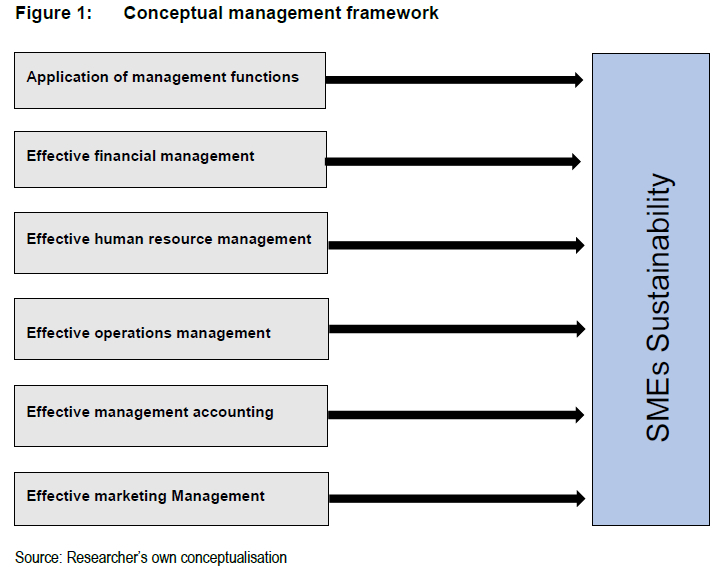
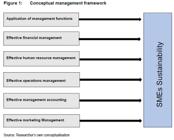
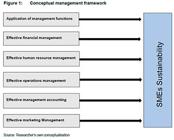
Most entrepreneurs start up their small businesses with a passion for success and growth to be sustainable in business, yet many of them lack the knowledge, skills or expertise and also lack the necessary background to manage the businesses effectively for them to be sustainable (Bary 2019). Conceptually therefore, it could be argued that small business ventures can survive and be sustainable if they effectively apply the four major management functions such as: effective financial management, effective human resource management, effective operations management, effective management accounting and effective marketing management as depicted in Figure 1 below. This study aims to test how the implementation of these management measures contributes to the success and sustainability of SMEs.
2.2.1 Application of management functions
Managing hundreds or thousands of employees and active customers is very challenging and time-consuming, and the process is even more costly and labour intensive, which can lead to unsatisfactory service delivery (Noe, Hollenbeck, Gerhart & Wright 2017). Beale (2017) asserts that the four (4) contemporary management functions are planning, organising, leading, and controlling which are discussed below.
Planning: Business management planning entails identifying means of accomplishing the mission and objectives of an enterprise (Beale 2017). Hill (2016) even argues that there are a lot of benefits of effective planning in the management of a business venture. Effective planning enables business managers to manage uncertainties and risk in their businesses and this will enable them to see where competing businesses are vulnerable and construct strategies to take advantage of their weaknesses.
Organising: Beale (2017) note that the organising function of management gives managers the duty to strategise and design the structure of a business enterprise to accomplish its goals. Caolo (2014) further argues that the benefit of being well organised in a business enterprise is that organising as a management function leads to superior performance, thus ensuring greater productivity of employees.
Leading: Leading as a management function requires managers to motivate and direct employees of their business enterprises towards achieving better performance, choosing the best communication channels and solving problems that arise among employees. Blencoe (2014) contends that if the function of leading is done properly at an enterprise, managers will have less unproductive behaviour to deal with which will lead to higher productivity, increase profit as well as growth and sustainability of their businesses.
Controlling: The management function of controlling enables managers to constantly identify and correct any deviations from the original plans and consider factors that might warrant them to revise their objectives to accomplish set goals (Beale 2017). This means that effective controlling will lead to improved quality of services offered by the employees. Consequently, better services will lead to higher productivity, increase profitability as well as growth and sustainability of a business enterprise.
2.2.2 Effective financial management
Brigham and Houston (2012) state that the term "financial management" as a management function, has a distinct meaning. The term financial management as a management function deals with the procurement of funds and its judicious and effective utilisation according to the expectations of the financier and according to the overall objectives of the beneficiary of the funds. Effective financial management is essential for the implementations of financial strategies such as tighter financial controls and low-cost provider strategies, which produces a temporary recovery to stop a downward trend when financial performance in the business venture is declining (Osano 2019). It can be concluded that effective financial management is essential for the growth and sustainability of SMEs especially as it helps to procure funds for the businesses and ensures the judicious and effective utilisation of the enterprise finances.
2.2.3 Effective human resource management
Human Resource Management was initially described as the process of managing individuals in organisations in a systematic and organised way (Armstrong & Taylor 2014). This implies the supervision of individuals in the form of a joint relationship between employees and management. Xie (2014) asserts that the importance of human resource management to SMEs is that it helps small business ventures to accomplish their goals by through effective motivation of employees to perform at their maximum ability. For SMEs to survive and be sustainable, they need to have effective human resource management systems in place, which will help to minimise unnecessary conflicts between management and the employees. This could lead to job satisfaction, high morale among the employees, which can consequently lead to low employee turnover, high productivity, increase profitability and growth for their business enterprises (Mira, Choong & Thim 2019).
2.2.4 Effective operations management
Operations management is the management of systems or processes that provide services or/and create goods which includes assuring quality, motivating employees, forecasting, and capacity planning, scheduling, deciding where to locate facilities and managing inventories (Radnor, Bateman, Esain, Kumar, Williams & Upton 2015). For small business ventures to effectively compete in the global market, they must have an effective operation strategy to support the mission of the businesses and their overall corporate strategies. Ungerer and Cayzer (2016) affirm that the secret to success in business is to create a robust competitive advantage which can only be achieved if the operations are managed in a manner that makes a difference and creates the concept of differentiation at the shop floor. This means that for SMEs in South Africa to be successful and sustainable, their managers must effectively manage the systems or processes that provide services or create goods. This will result in high productivity and increase profitability that will in turn lead to success and sustainability of the business enterprises.
2.2.5 Effective management accounting
Ameen, Ahmed and Hafez (2018) note that management accounting is an accounting system that assists the management body of an organisation to improve their effectiveness and efficiency. Borker (2016) asserts that management accountants do not only analyse and report financial dealings, but also analyse and report non-financial dealings of corporate social performance and process performance. Management accounting uses the practices and principle of cost accounting and financial accounting in addition to some other contemporary managing techniques for effective operation of a business enterprise (Ameen et al. 2018). More so, management accounting helps in implementing business strategy, facilitate supply chain analysis, helps in decision making as well as performance measurement. It can be deduced from the assertion that SME managers should endeavour to do effective management accounting in order to accomplish the predetermine objectives of their businesses.
2.2.6 Effective marketing management
Mansoor (2019) contends that the success of any business enterprise lies in its marketing strategy and this depends on how goods or services are made known to potential customers. The general marketing functions encompass of public relations, promotions, advertising and sales (Papasolomou et al, 2014). Marketing involves acquiring the information required for product design, the production of goods or services that meet customers' expectations, analysing consumers' needs, and maintaining cordial relationships with suppliers and customers (Ripsam & Bouquet 2016). It can be deduced from this assertion that without effective marketing, an enterprise's potential customers may never be aware of what the business is offering. In this regard, Papasolomou et al (2014) assert that marketing management facilitates a healthy competition that allows small businesses and new businesses to successfully enter and grow in the marketplace. This proclamation implies that SME managers need to implement effective marketing management in their businesses in order to facilitate their entrance into new markets, build a solid reputation, increase sales and profitability.
Papasolomou, I., Thrassou, A., Vrontis, D. and Sabova, M., 2014. Marketing public relations: A consumer-focused strategic perspective. Journal of Customer Behaviour, 13(1), pp.5-24.
3. METHODOLOGY
Explanatory research design was most suitable for this study because it provided an accurate description of observations of the phenomenon and a better understanding of the management factors that influence the sustainability of SMEs in the North West province of South Africa. This study adopted a quantitative approach to validate, establish, or confirm relationships and developed generalisations that contribute to the management and sustainability of SMEs. With quantitative study, it is much easier to transmit knowledge into numeric values. Since this study adopts a quantitative research approach, the principal instrument for collecting data was a questionnaire that was administered to the respondents within the geographical location of the North West province. The questionnaire comprised of closed-ended questions, which limited the respondents to possible answers that were considered to address the sustainability of SMEs and about the management approaches adopted by managers.
A purposive non-probability sampling method was used to select the small business managers to respond to the questionnaire. The respondents were selected based on some arbitrary ideas that could satisfy the criteria of attaining the objective of this study. The sample population was drawn from SME operators from the four District Municipalities of the North West province of South Africa which are: Bojanala Platinum, Dr Kenneth Kaunda, Dr Ruth Segomotsi Mompati and Ngaka Modiri Molema. The 100 respondents were selected from each of the four (4) District Municipalities to represent the views of SMEs in the North West province of South Africa. The respondents were managers of small business enterprises who met the following criteria: they must be actively operating small business enterprises from any sector and they must be operating their SMEs in the geographical proximity of the four District Municipalities of the North West province of South Africa with valid identity documents. The sampled population of small business managers who met this criterion were considered to have the specialist knowledge or capacity to participate in the study. They were the right people who could address the issue under investigation by appropriately responding to the management problems that are affecting the sustainability of SMEs in the North West province of South Africa and all the 400 questionnaire were completed and returned.
Leedy and Ormrod (2014) note that for a larger population that is about 5000 and above, the population size is almost irrelevant and a minimum sample size of 400 will be adequate for a study. Since the target population of SMEs in the North West province of South Africa for this study is more than 5000, the sample size of 400 was appropriate to give a true reflection of all small businesses in this region. For this study to be a true representative sample, attention was given to any form of bias associated with sampling that was noticed to eliminate any systematic error in the sampling process that could distort or falsify the results. Factor analysis was used as a quantitative tool for data analysis and for drawing conclusions. Liu, Ma, Zhao, Guo and Cao (2019) state that factor analysis is a powerful interdependency technique that is applied in multivariate analysis to reduce the large data set into groups of variables. SPSS and Microsoft Excel application software was used to capture and analyse data.
4. RESULTS
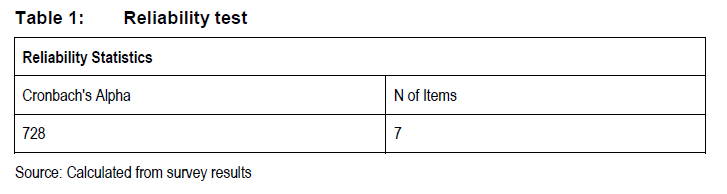
The data analysis began with a reliability test using the Cronbach's Alpha, which is recommended by Taber (2018) as a measure of internal consistency of a scale. The author explains that the most commonly accepted Alpha values range from 0.7 to 0.95. The reliability test was done to confirm whether the items are all measuring the same concept, which is effective management. A stacked bar chart was used to summarise the participants' responses whereas a pie chart was used to summarise the likelihood of the sustainability of the SMEs. In order to test the relationship between the sustainability of SMEs and the measures of effective management, this study used the Chi-square test of association, which is recommended by Hahs-Vaughn and Lomax (2013). The test rejects the null hypothesis of no association when the p-value is less than the given significant level (a=5%) (Hahs-Vaughn & Lomax 2013). To test the strength of significant associations, if founded from the Chi-square test, study adopted the Contingency Coefficient, which is explained by Kraska-Miller (2013). The author explains that values of at least 0.2 - < 0.6 indicate weak associations, values of at least 0.6 - < 0.8 indicate moderate association and values of at least 0.8 to 1 indicate a strong association between the variables. In addition, Kraska-Miller (2013) explains that the negative sign of the coefficient implies that the variables are changing in opposing directions whereas a positive coefficient implies that the variables are changing in the same direction. Chi-square test of association considers only two dependent variables at a time (independent and dependent), therefore the study implemented the decision tree method using Chi-Squared Automatic Interaction Detection (CHAID) to model the relationship between all the independent variables and the success of SMEs. The decision tree approach is adopted from Song and Ying (2015).
Table 1 shows that the overall Cronbach's Alpha is greater than the minimum acceptable benchmark of 0.7 (Taber 2018). The items are measuring the same concept, which is effective management. As such, the results are reliable.
4.1 The Practice of Effective Management by SMEs in the North West Province of South Africa
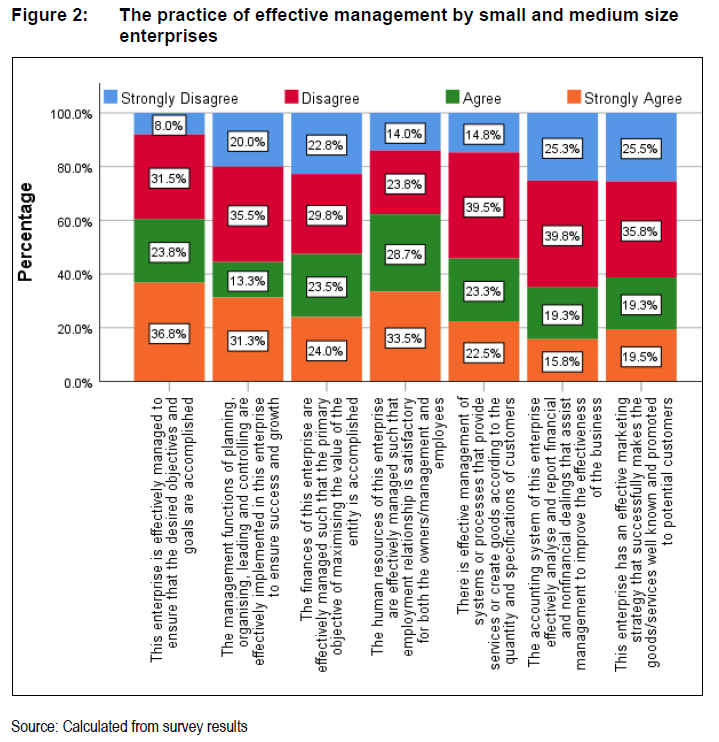
Figure 2 below depicts the practice of effective management by SMEs in the North West province of South Africa.
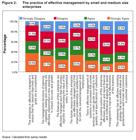
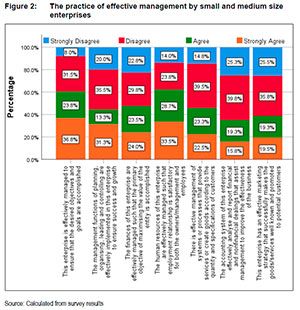
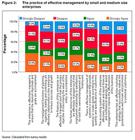
Figure 2 shows that the majority (more than 50%) of the respondents agreed (agree or strongly agree) with the following propositions that:
Figure 2: The practice of effective management by SMEs Figure 2 shows that the majority (more than 50%) of the respondents agreed (agree or strongly agree) with the following propositions that:
1. Their enterprises are effectively managed to ensure that the desired objectives and goals are accomplished (60.6%) and
2. The human resources of their enterprises are effectively managed such that employment relationship is satisfactory for both the owners/management and employees (62.2%).
On the other hand, Figure 2 shows that the majority (more than 50%) of the respondents disagreed (disagree or strongly disagree) with the following propositions that:
1. The management functions of planning, organising, leading and controlling are effectively implemented in their enterprises to ensure success and growth (55.5%)
2. The finances of their enterprises are effectively managed such that the primary objective of maximising the value of the entities was accomplished (52.6%)
3. There is effective management of systems or processes that provide services or create goods according to the quantity and specifications of customers (54.3%)
4. The accounting system of their enterprises effectively analyse and report financial and nonfinancial dealings that assist management to improve the effectiveness of the business (65.1%) and
5. Their enterprise has an effective marketing strategy that successfully makes the goods/services well known and promoted to potential customers (61.3%).
4.2 The Percentage of the small and medium size enterprises that is likely to be Sustainable
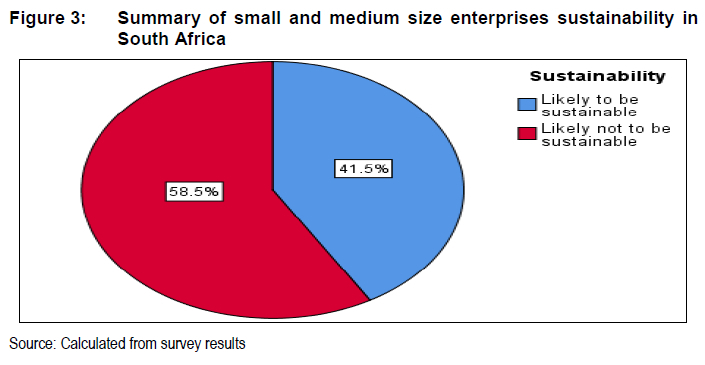
Figure 3 shows that less than half (41.5%) of the SMEs in the study are likely to be sustainable whereas the majority (58.5%) of these SMEs are likely not to be sustainable.
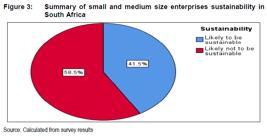
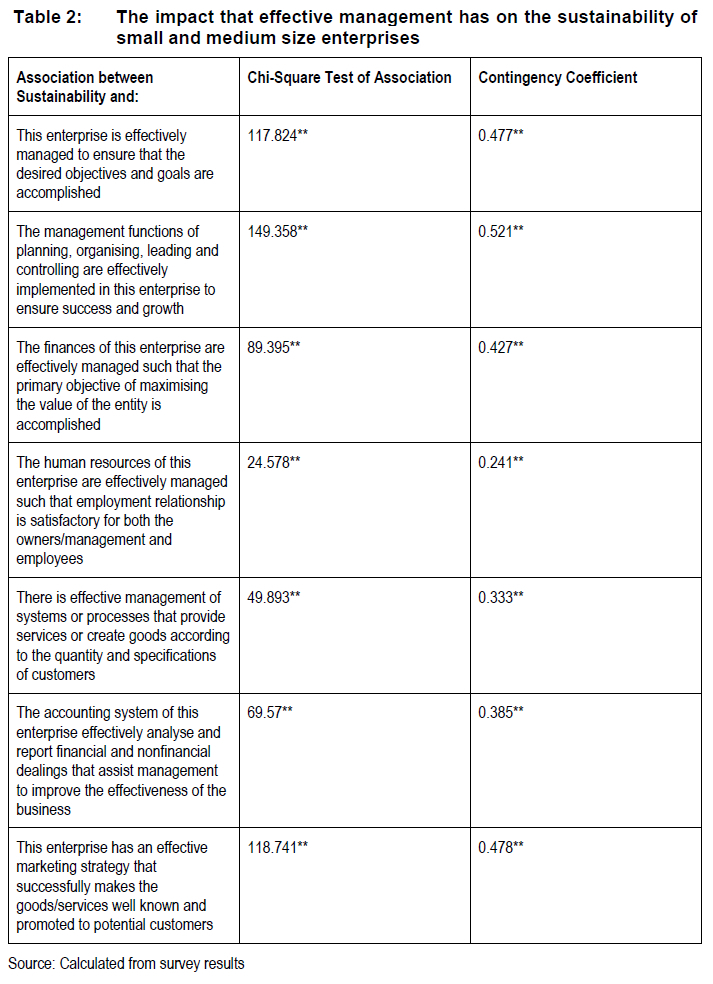
Table 2 shows that Chi-square tests are significant at 1%, which implies that the sustainability of SMEs is significantly associated with each of the measures of effective management. All the contingency coefficients are in the interval 0.2 -< 0.6 and are all positive, which implies that all the independent variables are positively associated with the dependent variable which is the sustainability of SMEs. That is, a positive change in the dependent variable will increase the chances of the sustainability of the SMEs.
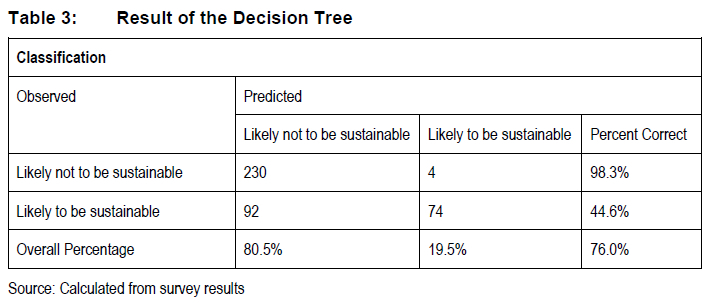
Table 3 shows that the decision tree has a classification accuracy of 76%. Table 3 shows the item: "This enterprise is effectively managed to ensure that the desired objectives and goals are accomplished." The 48.4% of respondents who agreed with this proposition are likely to sustain their SMEs, 70.7% who strongly agreed with the proposition are likely to sustain their SMEs whereas only 10.1% of those who disagreed and/or strongly disagreed with the proposition is not likely to sustain their businesses. As such, effective management is necessary to ensure that the desired objectives and goals of the SME are achieved and in turn sustainability is attained. Figure 3 also shows the item: "There is effective management of systems or processes that provide services or create goods according to the quantity and specifications of customers". The 94.9% of those who agreed and/ or strongly agreed with this proposition is likely to sustain their business whereas only 43.5% of those who disagreed and/or strongly disagreed with this proposition is not likely to sustain their SMEs. As such, effective management of systems or processes that provide services or create goods according to the quantity and specifications of customers is a significant determinant of the sustainability of SMEs.
5. DISCUSSION
From the results of the data analysis, there is a need for diagnosing and addressing the effective management of SMEs by their managers in the North West province of South Africa, to ensure their survival and sustainability. South African SMEs suffer from poor management skills as a result of lack of adequate education and training on management of small businesses which results in high failure rates of these businesses in the country (Bushe 2019). The conceptual management framework for the sustainability of SMEs was compiled systematically from the empirical findings. The six core independent variables identified from the framework in the literature review served as the foundation for this study which indicates their importance to the success of the small businesses. In this regard, business scholars such as Bushe (2019) has concluded from their studies that ineffective management is a major cause of the failure and unsustainability of SMEs in South Africa.
The result of the analysis conducted on the SMEs practice of effective management was necessary to ensure their sustainability as portrayed in Figure 3. According to the findings, only 41.5% of SMEs in the North West province of South Africa are likely to be sustainable because they are effectively managed whereas up to 58.5% are likely not to be sustainable because they are not effectively managed. The results of the analysis revealed that the identified effective management factors can be classified into two groups namely:
Group 1: Effective human resource management and effective management to ensure that the desired objectives and goals are accomplished, are the only two aspects or factors of management that most SME managers in the North West province are effectively practicing in their businesses, reason why only 41.5% of them are likely to be sustainable.
Group 2: Application of management functions, financial management, operations management, management accounting and marketing management. The rest of these five management aspects are not effectively practised by SME managers in their businesses, the reason why up to 58.5% of them are likely not to be sustainable.
The conceptual management framework of this study supports the view that SMEs in the North West province of South Africa suffer from poor management skills. Kalane (2015) equally argues that different reasons such as the lack of managerial planning skills, the inability to effectively manage competitive environments, and ineffective working capital management, are some of the reasons why SMEs fail to grow and are not sustainable. Leboea (2017) affirms that the absence of managerial skills and training is a vital reason for small business failure. From these reports, it is particularly noted that SMEs in the North West province are ineffectively managed which is the reason for their high failure rate. Rungani and Potgieter (2018) emphasised that ineffective management of SMEs by small business managers, decreases the potential success and survival of these businesses. Torliene (2016) avers that most SME managers are normally generalists and therefore do not have the specialised effective management skills required in business operations. This assertion greatly supports the findings of this study. This implies that SME managers need to master and implement the application of management functions, effective financial management, effective operations management, effective management accounting and effective marketing management if they are to be successful and sustainable. It is crucial that SMEs managers acquire the knowledge and skills needed to manage their businesses effectively to ensure sustainability. The most important contribution of this study is the list of priority management aspects (management approach) that SME managers need to practice within the small business sector to ensure their sustainability.
This study was limited by some challenges that were encountered even though they were mitigated to some extent to ensure the success of the work. The main limitation of this study is that the measurement of sustainability was quite problematic because there are various metrics used for measuring it that are still evolving. This means that there is no standard measurement for sustainability; therefore, the understanding of sustainability in the context of this study was limited to the "likelihood of sustainability". It is recommended that the management approach stipulated in this study be implemented in SMEs because the results indicate that those who are practicing these management aspects in the daily running of their businesses are likely to be sustainable while those that are not fully practicing them are most likely not be sustainable (Figure 4). More so, SME managers should be well-grounded and focus specifically on the application of management functions, financial management, human resource management, operations management, management accounting and marketing management.
6. CONCLUSION
This study has proposed a management approach for enhancing the sustainability of small and medium size enterprises in South Africa that could serve as a guide for small business managers in the daily running of their businesses by adopting the prescripts of strategic management to ensure that they survive. So far, six potential effective management aspects have been suggested in this approach to help SMEs managers to identify suitable survival and sustainability strategies for their businesses and to also help researchers to better understand the sustainability models of small businesses. The management approach identified in this study may not be comprehensive, but it is applicable to managerial aspects of strategy formulation that can enable the success of SMEs in the North West province of South Africa. In a nutshell, judging from the findings of this study, if SME managers consider and implement this management approach in the daily running of their businesses, they will be more likely to experience improvement in their businesses.
REFERENCES
2. LITERATURE REVIEW
- AMEEN AM, AHMED MF & HAFEZ MAA. 2018. The Impact of Management Accounting and How It Can Be Implemented into the Organizational Culture. Dutch Journal of Finance and Management 2(1):1-9.
- ARMSTRONG M & TAYLOR S. 2014. Armstrong's handbook of human resource management practice. London: Kogan Page Publishers.
-
BARY A. 2019. SMEs Sector: A Key Driver to the Egyptian Economic Development. [Internet:https://mpra.ub.uni-muenchen.de/93034/1/MPRA_paper_93034.pdf; downloaded on 27 November 2019.
» https://mpra.ub.uni-muenchen.de/93034/1/MPRA_paper_93034.pdf -
]
» https://www.africaportal.org/publications/smmes-south-africa-understanding-constraints-growth-and-performance/ -
BEALE A. 2017. The Four Functions of Management - And How to Apply Them. [Internet:https://bmgoutsourcing.com.au/four-functions-of-management/; downloaded on 27 November 2019.
» https://bmgoutsourcing.com.au/four-functions-of-management/ - ]
- BELL S & MORSE S. 2013. Measuring sustainability: Learning from doing. Abingdon: Routledge.
- ]
-
BLENCOE G. 2014. Possible Benefits of Managers Leading by Example. [Internet:http://www.freemanagementbook.com/1/post/2014/09/8-possible-benefits-of-managers-leading-by-example.html; downloaded on 27 November 2019.
» http://www.freemanagementbook.com/1/post/2014/09/8-possible-benefits-of-managers-leading-by-example.html -
]
» http://smallbusiness.chron.com/importance-planning-organization-1137.html - BRIGHAM EF & HOUSTON JF. 2012. Fundamentals of financial management. Boston: Cengage Learning.
- BUSHE B. 2019. The causes and impact of business failure among small to micro and medium enterprises in South Africa. Africa's Public Service Delivery and Performance Review 7(1):1-26.
-
CAOLO D. 2014. Benefits of Being Organized. [Internet:https://unclutterer.com/2014/01/23/benefits-of-being-organized/; downloaded on 17 November 2019.
» https://unclutterer.com/2014/01/23/benefits-of-being-organized/ - ]
- HAHS-VAUGHN DL & LOMAX RG. 2013. An introduction to statistical concepts. Abingdon. Routledge.
- ]
-
INFORMATION SYSTEMS AUDIT AND CONTROL ASSOCIATION (ISACA). 2019. Framework: Governance and management objectives. [Internet:http://www.isaca.org/Knowledge-Center/Research/Documents/COBIT-2019-Framework-Governance-and-Management-Objectives_res_eng_1118.pdf; downloaded on 27 November 2019.
» http://www.isaca.org/Knowledge-Center/Research/Documents/COBIT-2019-Framework-Governance-and-Management-Objectives_res_eng_1118.pdf - ]
- KALANE L. 2015. Reasons for Failure of SMEs in the Free State. University of the Free State, Bloemfontein. (Master dissertation.
-
)
» http://www.seda.org.za/Publications/Publications/SMME%20Quarterly%202019-Q3.pdf - KRASKA-MILLER M. 2013. Nonparametric statistics for social and behavioural sciences. Boca Raton, Florida: CRC Press.
- LEBOEA ST. 2017. The factors influencing SME failure in South Africa. University of Cape Town, Cape Town. (Doctoral dissertation.
- )
- LEEDY PD & ORMROD JE. 2014. Practical Research Planning and Design. 10th ed. London: Pearson Publishers.
- LIU G, MA F, ZHAO H, GUO J & CAO J. 2019. Application of Multivariate Statistical Analysis to Identify Water Sources in A Coastal Gold Mine, Shandong, China. Sustainability 11(12):1-17.
-
MANSOOR H. 2019. Why is Marketing Important? Nine Reasons Why You Really Do Need It. [Internet:https://www.business2community.com/marketing/why-is-marketing-important-9-reasons-why-you-really-do-need-it-02186221; downloaded on 17 March 2020.
» https://www.business2community.com/marketing/why-is-marketing-important-9-reasons-why-you-really-do-need-it-02186221 - ]
-
MOSHER M & SMITH L. 2015. Sustainability Incorporated: Integrating Sustainability into Business. [Internet:https://sustainability.com/wp-content/uploads/2016/07/sustainability_incorporated.pdf; downloaded on 27 November 2019.
» https://sustainability.com/wp-content/uploads/2016/07/sustainability_incorporated.pdf - ]
- MXUNYELWA S & VALLABH D. 2017. Skills as Impediment to Small and Medium Tourism Enterprises (SMTEs). Eastern Cape, South Africa. African Journal of Hospitality, Tourism and Leisure 6(4):1-8.
- NOE RA, HOLLENBECK JR, GERHART B & WRIGHT PM. 2017. Human resource management: Gaining a competitive advantage. New York, NY: McGraw-Hill Education.
- OSANO HM. 2019. Global expansion of SMEs: role of global market strategy for Kenyan SMEs. Journal of Innovation and Entrepreneurship 8(1):1-13.
- PAPASOLOMOU I, THRASSOU A, VRONTIS D & SABOVA M. 2014. Marketing public relations: A consumer-focused strategic perspective. Journal of Customer Behaviour 13(1):5-24.
-
RIPSAM T & BOUQUET L. 2016. Ten Principles of Customer Strategy. [Internet:https://www.strategy-business.com/article/10-Principles-of-Customer-Strategy?gko=534a0; downloaded on 17 November 2019.
» https://www.strategy-business.com/article/10-Principles-of-Customer-Strategy?gko=534a0 - ]
- SALIMZADEH P, COURVISANOS J & NAYAK RR. 2013. July. Sustainability in small and medium sized enterprises in regional Australia: A framework of analysis. In Small Enterprise Association of Australia and New Zealand 26th Annual SEAANZ Conference Proceedings (pp 11-12).
- ]
- small, medium and micro enterprises in the Eastern Cape province. Acta Commercii 18(1):1-12.
- SONG YY & YING LU. 2015. Decision tree methods: applications for classification and prediction. Shanghai archives of psychiatry 27(2):130-145.
- STAATSKOERANT. 2017. ICT SMME Development Strategy "Unlocking the potential of ICT SMMEs". Pretoria: Government Gazette.
- TABER KS. 2018. The use of Cronbach's alpha when developing and reporting research instruments in science education. Research in Science Education 48(6):1273-1296.
- TORLIENE M. 2016. How do SMEs in Germany incorporate business development? University of Twente. (Bachelor's thesis.
- )
- UNGERER GD & CAYZER S. 2016. A normative model for assessing competitive strategy. South African Journal of Industrial Engineering 27(4):34-49.
- XIE C. 2014. Why Do Some People Choose to Become Entrepreneurs? An Integrative Approach. Journal of Management Policy & Practice 15(1):25-38.
- YOO WJ, CHOO H & LEE S. 2018. A Study on the sustainable growth of SMEs: The mediating role of organizational metacognition. Sustainability 10(8):1-17.