The relationship between job satisfaction and organisational citizenship behaviour: a Democratic Republic of Congo organisational perspective
Abstract
This article investigates the relationship between employees' job satisfaction and organisational citizenship behaviour. The purposive sample (N = 839; females = 32%) was drawn from permanent employees in a railway organisation in the Democratic Republic of Congo (DRC). The measuring instruments were the Job Satisfaction Questionnaire (JSQ), and the Organisational Citizenship Behaviour Questionnaire (OCBQ). Data was analysed using stepwise multiple regressions to predict the relationship between job satisfaction and organisational citizenship dimensions. The results indicated that participants' job satisfaction (JS) related positively to their organisational citizenship behaviour (OCB) and that JS positively and significantly predicted (OCB) behaviour. These findings provide evidence that employees' experience of JS plays an important role in influencing their OCB in an emerging country work setting such as the DRC.
altruism; Democratic Republic of Congo (DRC); job satisfaction; organisational citizenship behaviour; sportsmanship
1. INTRODUCTION
In the 21st century, with its turbulent and increasingly globalised world economy, many organisations try to achieve their objectives, gain a competitive advantage and enhance performance by focusing on organisational citizenship behaviour (OCB) (Jena & Goswami 2014:381). Employee performance refers to those behaviours that contribute to the technical core of an organisation and are often specified in the formal job description (Podsakoff, Podsakoff, MacKenzie, Maynes & Spoelma 2014:88). OCB refers to discretionary behaviour, not directly or explicitly recognised by the formal reward system, and which, in the aggregate, promotes the effective functioning of the organisation (Chin 2014:1115).
Job satisfaction (JS) is considered critical for organisations. It is an indicator of employees' job commitment to the organisation (Yucel & Bektas 2012:1599), because it has been found to influence organisational performance and productivity. It is also not a single concept, because an employee can be satisfied with one aspect of his or her work, but totally dissatisfied with another aspect. The development of employee job satisfaction is therefore likely to reduce absenteeism, turnover and inferior levels of individual and organisational productivity. Employee JS has been defined as a positive and favourable attitude towards one's job, or a pleasurable and positive emotional state resulting from one's job or job experience (Top, Akdere & Tarcan 2015:1264; Zhang & Zheng 2009:334).
Previous research has established that JS related positively to employees' performance (Pan 2015:60; Rich, Lepine & Crawford 2010:617-635) and that JS predicts OCB (Chhabra & Mohanty 2014:449; Vaijayanthi, Shreenivasan & Roy 2014:1953). What remains unclear is the way in which aspects of OCB are influenced by JS perceptions. This is an important question to scrutinise in a developing country setting where organisations have undergone intense restructuring and change. This research investigates how employees' job satisfaction perceptions in a railway organisation in the Democratic Republic of Congo (DRC) influence their level of engagement in OCB.
The DRC continues to face significant socio-political and economic challenges, as it recovers from a long period of war and political upheaval (WFP 2013:2-4). Scholars, for example, D'Haese, Banea-Mayambu and De Winter (2013:2) attribute current challenges to the lack of political will to deal with the complexity of challenges, limited actions by civil society and the private sector, as well as a seriously underperforming agricultural and transport sector.
Within this volatile context, a significant contribution could be made by the public and private sectors in general and employees in particular. Efforts made by the World Bank to address some of the economic challenges failed because of a high level of corruption and the illegal use of organisational resources by individuals and leaders. These situations may negatively influence the level of employees' productivity and performance (Tshiyoyo 2013:25-26). It is believed that these factors negatively influence individuals' level of satisfaction and impact on their levels of performance.
One leverage which is in the control of leaders is to create a conducive working environment that would nurture higher levels of job satisfaction and organisational citizenship behaviours (Vaijayanthi et al. 2014:1955). Hence the relationship between employees' perceptions of JS and OCB, coupled with performance in this sector, needs to be investigated.
2. THEORETICAL FRAMEWORK
2.1 Job satisfaction
The Job Satisfaction Questionnaire (JSQ) developed by Vitell and Davis (1990:489) and the Organisational Citizenship Behaviour Model (OCBS) (Organ 1988:340) provided sound theoretical and empirical grounds for this article.
JS is conceptualised from a variety of perspectives. Some authors highlight the feeling or affective component, framed as the employee's feeling or affective response to various aspects of a situation (Özturk 2010:29) or a feeling that emanates from the perception that one's job satisfies one's material and psychological needs (Aziri 2008:78). JS seems to exclude matters external to one's job because it focuses on the job per se (Sarwar & Aburgre 2013:24).
It also seems to have a personal, subjective dimension since it involves the likes/dislikes and the extrinsic/intrinsic needs of the employee (Robertson & Cooper 2010:326). The most popular dimensions of job satisfaction (Swaminathan & Jawaher 2013:73) seem to be the following:
(1) Pay - the extent to which employees feel adequately compensated for the amount of effort put into their job; employees want to be fairly compensated for their work in order to meet their needs.
(2) Promotion - the extent to which employees are more satisfied when there is a perception of promotion fairness and when perceived expectations match actual expectations; when employees perceive that promotion decisions are made in a fair manner, they are likely to be more satisfied in their job.
(3) Supervision - the extent to which employees see their supervisor as competent, fair and trustworthy; employees also want to participate in decision-making and to be recognised and rewarded for their performance.
(4) Co-workers - the extent to which employees perceive the presence of positive working relations with co-workers; co-workers who are supportive, helpful and who share a common set of values will lead to enhanced job satisfaction.
(5)Work itself - the extent to which an employee's perceptions of work conditions in the form of working hours, hygienic working conditions, clear task expectations and so forth are positive; a job which is interesting, open to success, free from role conflict and where managers provide consistent feedback would be appealing to most employees.
However, the modern world of work is increasingly characterised by volatility, turbulence and the phenomenon of "doing more with less". Organisations are therefore compelled to rely on employees who are prepared to go the extra mile. These voluntary activities have become essential for the survival, profitability and sustai nability of organisations.
2.2 Organisational citizenship behaviour
OCB is defined as individual behaviour that contributes to the maintenance and enhancement of the social and psychological context that supports task performance (Podsakoff et al. 2014:88; Tambe & Shanker 2014:69-70). An argument has been advanced, that OCB has strong communal and social relations because the concept implies the willingness to go the extra mile which will be very difficult in the absence of strong social relations (Mayfield & Taber 2010:750).
A distinction has been suggested between OCBs directed towards the organisation (OCBO) and those focussing on the individual employee (OCBI). OCBO behaviours include the conservation of organisational resources and setting high quality standards. OCBI behaviours, in contrast, refer to those activities which benefit the individual (Robertson & Cooper 2010:330).
The dimensions of OCB are as follows (Podsakoff et al. 2014:88; Tambe & Shanker 2014:69-70):
(1) Altruism - voluntary actions whereby individuals reach out to those who encounter problems, for example, assisting colleagues with an assignment or helping them to resolve problems encountered in the workplace.
(2) Courtesy - attempts to avoid potential problems with others and pre-emptive measures to ensure that the rights of others are not violated, for example, being respectful towards colleagues, liaising with those who might be impacted by one's decisions and sending a reminder to ensure compliance or conducting a briefing session.
(3) Civic virtue - a positive demeanour in reaching out to others, displaying constructive behaviour, or demonstrating a willingness to engage in the life and activities of the organisation.
(4) Sportsmanship - the demonstration of extreme forms of tolerance when things do not go according to expectations, without complaining or conversely displaying a positive attitude in the face of uncomfortable operational scenarios.
(5) Conscientiousness - discretionary actions that go beyond the minimum requirements of the organisation, for example, the conscientious use of organisational resources, being punctual, or executing one's tasks diligently.
Engaging in OCBs could also result in a series of positive consequences for the individual employee, as well as the organisation. Some of these advantages include: the solidification of the employees' sense of self-efficacy and accountability; an opportunity to access more resources from the organisation, for example, a higher performance evaluation; employees who receive support from colleagues may be influenced to reciprocate by also engaging in these extra role behaviours (Somech & Drach-Zahavy 2013:140).
Research conducted by Vaijayanthi et al. (2014:1955) indicated that JS related positively to OCB and performance. Hence satisfied employees are likely to engage in both in-role and extra-role behaviours that are beneficial to the functioning of the organisation. When employees engage in these kinds of behaviours, it is likely that organisational efficiency will be enhanced and that its processes will run more smoothly (Organ 1998:345). The relationships between these constructs and organisational performance were tested in the developed world. However, the manifestation of this in a developing world work setting, such as a railway organisation in the DRC, has not yet been explored. We hypothesise that employees1 perceptions of job satisfaction will influence their OCB.
3. GOAL OF THE STUDY
The goal of this article is to investigate the relationship between employees' JS and their level of OCB in a railway organisation in the DRC. The following research question guided the investigation: How does employees' perceived job satisfaction relate to their level of citizenship behaviour in an organisation in the DRC?
The result of the article should make a valuable contribution to the current body of literature on JS and OCB as well as their performance by responding to recent calls for more context-sensitive research in developing world settings (Chin 2014:115).
4. METHOD
A quantitative, cross-sectional survey design was used (Cohen, Manion & Morrison 2013:122) - the sample was taken from a given population (Tredoux & Durrheim 2013:158).
4.1
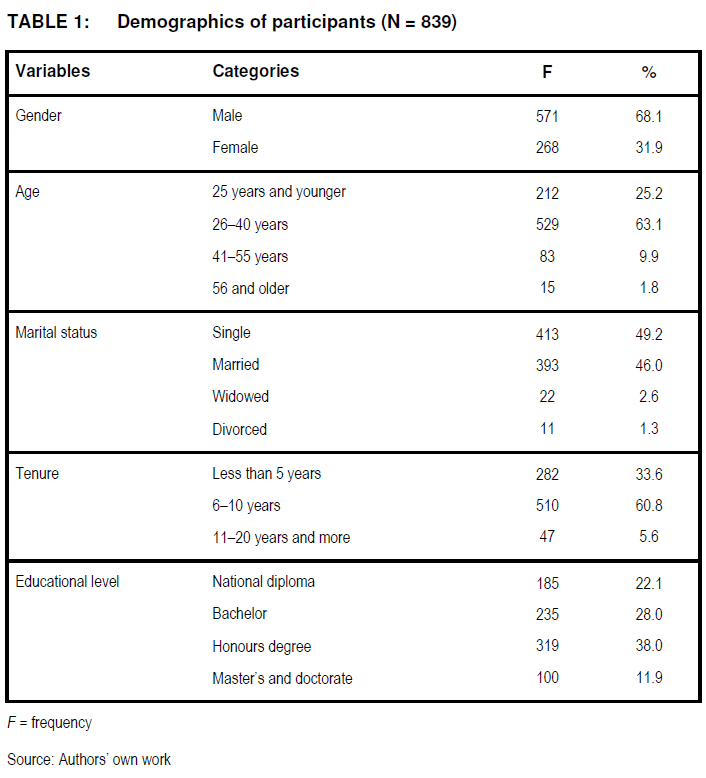
ParticipantsThe article involved a non-probability purposive sample (N = 839; females = 32%) in a railway organisation in the DRC. Their outstanding characteristics were that 68% were male, 60% were single, 60% had six to ten years' tenure and 38% had an honours degree.
4.2
MeasuresA demographic measure was designed for gender, age, marital status, tenure and educational level (see Table 1).
The JSQ {Vitell & Davis 1990) was used. This questionnaire is a 20-item self-rating measure of the dimensions of pay, promotion, co-workers, supervisor and work itself. It is scored on a five-point Likert-type scale (1 = strongly disagree; 5 = strongly agree). Internal consistency Cronbach alpha coefficient refers to the extent to which different participants being measured by the same instrument at different times respond identically to the instrument (Salkind 2012:159). The internal consistency for the five dimensions in the study sample were as follows: satisfaction with pay (0.86), satisfaction with promotion (0.74), satisfaction with co-workers (0.72), satisfaction with supervisor (0.84), satisfaction with work itself (0.80) and total job satisfaction (0.92).
The OCBQ (Organ, Podsakoff & MacKenzie 2006:653) was used. The OCBQ is a 20-item self-report measure of the dimensions altruism, conscientiousness, sportsmanship, courtesy and civic virtue and citizenship behaviour. It is scored on a five-point Likert scale (1 = strongly disagree; 5 = strongly agree). Internal consistency Cronbach alpha coefficient values for the five dimensions in the study sample were as follows: altruism (0.66), conscientiousness (0.68), sportsmanship (0.74), courtesy (0.76), civic virtue (0.75) and total organisational citizenship behaviour (0.93).
The standardised French versions of both instruments were used. Rasch analysis was used in this article to evaluate uni-dimensionality, internal consistency and construct validity (Bond & Fox 2007:36). Rash analysis is an item-based approach where ordinary observed item scores are transformed to linear measures representing the underlying latent construct (Bond & Fox 2013).
According to Nunnally and Bernstein (2010:552), a cut-off point of 0.70 to 0.80 for the Cronbach alpha coefficient is desirable. Millsap and Maydeu-Olivares (2009) argue that between 0.60 and 0.80 is acceptable. The present article indicated acceptable reliability coefficients for the JSQ and OCBQ variables. Based on this information, the instruments were deemed to be psychometrically acceptable.
4.3
ProcedureEthical clearance and permission to conduct the research were obtained from the human resources director of the organisation involved and the Ethics Research Review Committee of the University of South Africa (Unisa). The participants completed the three measurement instruments.
Each participant received a package consisting of the following (all in hard copy): an invitation letter indicating the purpose of the research study; management's approval letter; confirmation of the safekeeping and confidentiality of the responses; a separate form explaining the individual's consent and voluntary participation in this research project; a request for the individual's signature; the instructions for completing the instruments; and the actual instruments. On completion, each participant was requested to sign the consent form and include this with the completed instruments in an envelope addressed to the researcher.
4.4
Data analysesThe data was analysed using the Statistical Package for Social Sciences (SPSS), version 22 for Windows software (Arbuckle 2012). In addition, a Rasch analysis was conducted (Bond & Fox 2007:36). The first stage involved determining the means, standard deviations, Cronbach alpha coefficients and Pearson product-moment correlations, in order to specify the relationship between the JSQ and OCBQ variables.
In terms of statistical significance, it was decided to set a cut-off value at the 95% confidence interval level (p < 0.005). In the last stage, stepwise regression analyses were performed to determine whether or not the JSQ variables acted as significant predictors of the OCBQ variables.
For the purpose of this article, R2 values larger than 0.25 at ρ < 0.05 (Millsap & Maydeu-Olivares 2009:292) were regarded as practically significant. Prior to conducting the various regression analyses, Harman's single factor test was performed to ensure absence of common method bias (using the cut-off point of eigenvalue = 1; σ < 50). Collinearity diagnostics were examined to ensure that the zero-order correlations were below the level of concern (r > 80), that the variance inflation factors did not exceed 10 and that the tolerance values were close to 1.0 (Hair, Black, Babin & Anderson 2010:225).
5. RESULTS
5.1 Descriptive statistics and Cronbach alpha coefficients
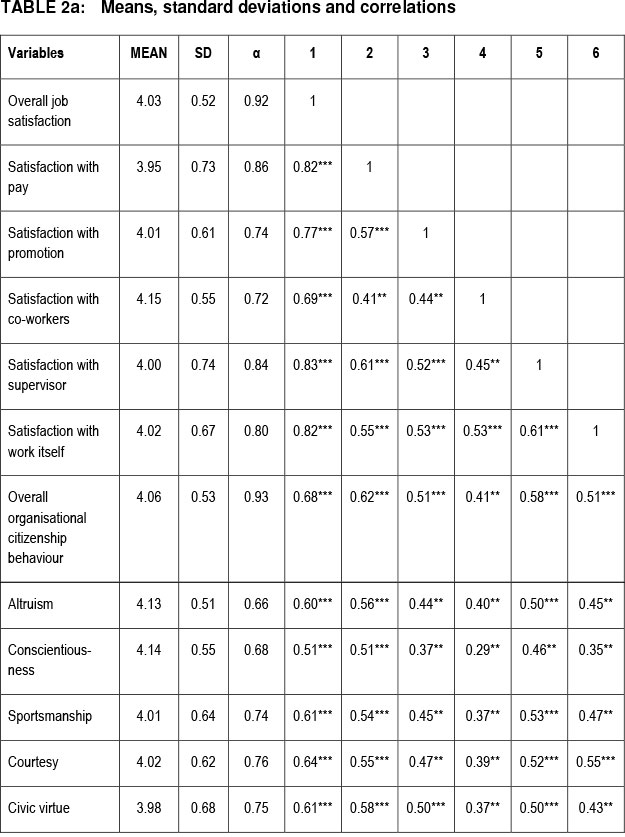
The means, standard deviations and internal consistency reliability coefficients of the measuring instruments are reported in Table 2.
In terms of the JS (the JSQ) variables, satisfaction with co-workers obtained the highest mean score (M = 4.15; SD = 0.55), followed by satisfaction with work itself (M = 4.02; SD = 0.67), satisfaction with promotion (M = 4.01; SD = 0.61), satisfaction with supervisor (M = 4.00; SD = 0.74), satisfaction with pay (M = 3.95; SD =0.73) and total job satisfaction (M = 4.03; SD = 0.52).
In terms of the OCB (OCBQ) variables, table 2 shows that the total sample scored the highest on conscientiousness (M = 4.14; SD = 0.55) and altruism (M = 4.13; SD = 0.51), followed by courtesy (M= 4.02; SD = 0.62), sportsmanship (M = 4.01; SD = 0.64), civic virtue (M = 3.98; SD = 0.68) and total OCB (M = 4.06; SD = 0.53). All five components imply a relatively high level of organisational citizenship behaviour in this sample.
5.2 Pearson product-moment correlations between the JSQ and OCBQ
The significant association between the JSQ and OCBQ variables is reported in Table 2. The results show that the JS variables were significantly and positively related to the OCB variables (r > 0.29; small practical effect size to r > 0.68; large practical effect size). These results showed that the zero-order correlations were well below the threshold level of concern (>0.80) in terms of multi-collinearity.
Table 2 indicates that the total altruism, conscientiousness, sportsmanship, courtesy, civic virtue OCB variables were positively and significantly related to the total satisfaction with pay, satisfaction with promotion, satisfaction with co-workers, satisfaction with supervisor and satisfaction with work itself JSQ variables. P-values ranged between ρ < 0.01 and Ρ < 0.05.
5.3 Stepwise multiple regressions
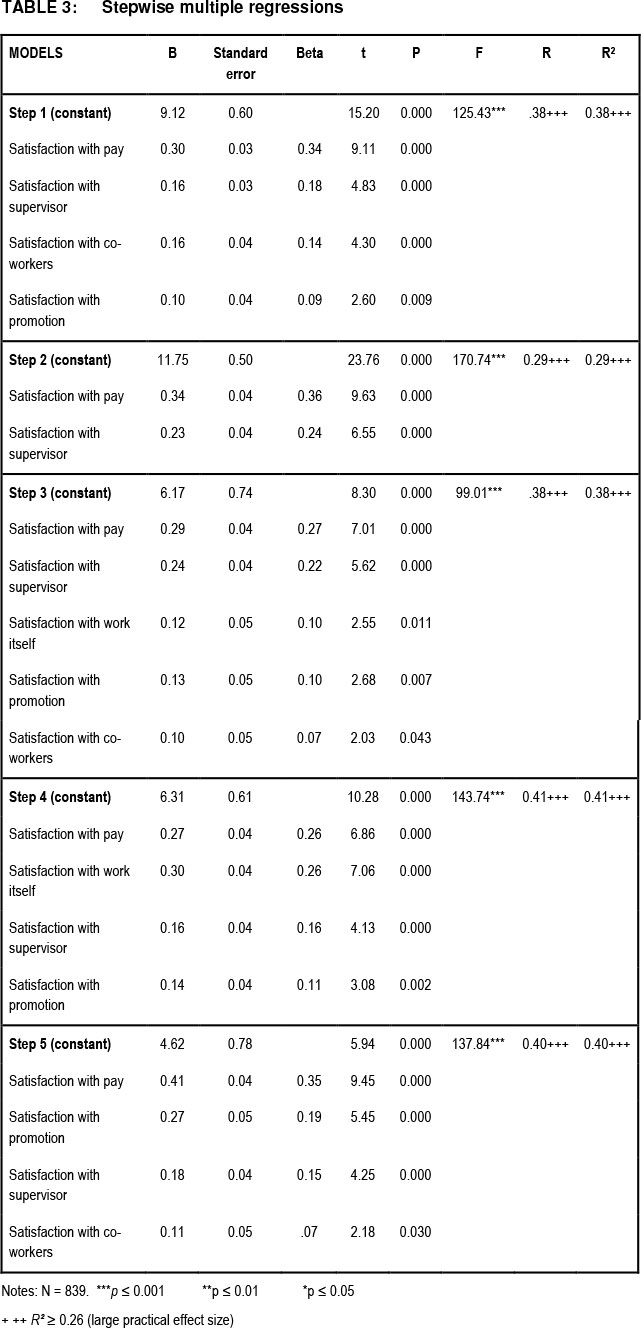
Table 3 indicates the following results:
(1) The JSQ variables of satisfaction with pay, satisfaction with supervisor, satisfaction with co-workers and satisfaction with promotion produced a statistically significant regression model (F(4;824) = 125.43), accounting for 38% (R2 = 0.38; medium effect; ρ < 0.05) of the variance of the altruism OCB variable. More specifically, satisfaction with pay (β = 0.34; t = 9.11; p< 0.000), satisfaction with supervisor β = 0.18; t = 4.83; ρ < 0.000), satisfaction with co-workers (β = 0.14; t = 4.30; p< 0.000) and satisfaction with promotion (β = 0.09; t = 2.60; p< 0.01) contributed significantly towards explaining the proportion of variance in the OCBQ altruism variable.
(2) The JSQ variables of satisfaction with pay and satisfaction with supervisor produced a statistical significant regression model (F(4;824) = 170.74), accounting for 29% {R2 = 0.29; small effect; ρ < 0.05) of the variance of the conscientiousness OCB variable. More specifically, satisfaction with pay (β = 0.36; t = 9.63; ρ < 0.000) and satisfaction with supervisor (β = 0.24; t = 6.55; ρ < 0.000) contributed significantly to explaining the proportion of the variance in the OCBQ conscientiousness variable.
(3) The JSQ variables of satisfaction with pay, satisfaction with supervisor, satisfaction with work itself, satisfaction with promotion and satisfaction with co-workers produced a statistically significant regression model (F(4;824) = 99.01), accounting for 38% (R2 = 0.38; medium effect; ρ < 0.05) in the variance of the sportsmanship OCB variable. More specifically, satisfaction with pay {β = 0.27; t = 7.01; ρ < 0.000), satisfaction with supervisor (β = 0.22; t = 5.62; ρ < 0.000), satisfaction with work itself (β = 0.10; t = 2.55; ρ < 0.01), satisfaction with promotion (β = 0.10; t = 2.68; ρ < 0.01) and satisfaction with co-workers (β = 0.07; t = 2.03; ρ < 0.04) contributed significantly towards explaining the proportion of the variance in the OCBQ sportsmanship variable.
(4) The JSQ variables of satisfaction with pay, satisfaction with work itself, satisfaction with supervisor and satisfaction with promotion produced a statistically significant regression model (F(4;824) = 143.74), accounting for 41% (R2 = 0.41; medium effect; ρ < 0.05) in the variance of the courtesy OCB variable. More specifically, satisfaction with pay (β = 0.26; t = 6.86; ρ < 0.000), satisfaction with work itself (β = 0.26; t = 7.06; ρ < 0.000), satisfaction with supervisor (β = 0.16; t = 4.13; ρ < 0.000) and satisfaction with promotion (β = 0.11; t = 3.08; ρ < 0.002) contributed significantly towards explaining the proportion of variance in the OCBQ courtesy variable.
(5) The JSQ variables of satisfaction with pay, satisfaction with promotion, satisfaction with supervisor and satisfaction with co-workers produced a statistically significant regression model (F(4;824) = 137.84), accounting for 40% (R2 = 0.40; medium effect; ρ < 0.05) in the variance of the civic virtue OCB variable. More specifically, satisfaction with pay (β = 0.35; t = 9.45; ρ < 0.000), satisfaction with promotion (β = 0.19; t = 5.45; ρ < 0.000), satisfaction with supervisor (β = 0.15; t = 4.25; ρ < 0.000) and satisfaction with co-workers {β = 0.07; t = 2.18; ρ < 0.03), contributed significantly towards explaining the proportion of variance in the OCBQ civic virtue variable.
(6) The JSQ variables of satisfaction with pay, satisfaction with supervisor, satisfaction with promotion, satisfaction with work itself and satisfaction with co-workers produced a statistically significant regression model {F(5:824} = 152.20), accounting for 48% (R2 = 0.48; medium effect; ρ < 0.05) in the variance of the overall OCB. More specifically, satisfaction with pay {β = 0.33; t = 9.45; ρ < 0.000), satisfaction with supervisor (β = 0.22; t = 6.10; ρ < 0.000), satisfaction with promotion (β = 0.12; t = 3.44; ρ < 0.001), satisfaction with work itself {β = 0.11; t = 3.02; ρ < 0.003) and satisfaction with co-workers (β = 0.07; t = 2.25; ρ < 0.02), contributed significantly towards explaining the proportion of variance in the overall OCB.
(7) In terms of the collinearity statistics, the tolerance values were below 0.1 and the variance inflation factor (VIF) values were below 2.0, lower than the cut-off of >10. These values imply that multicollinearity was not of particular concern and that the beta values could be interpreted with confidence.
6. DISCUSSION
The goal of this article was to investigate the relationship between employees' perceived JS and their level of OCB in a railway organisation in the DRC. Overall, the results showed that the participants' job satisfaction related positively to their level of organisational citizenship behaviour. More specifically, satisfaction with pay, satisfaction with promotion, satisfaction with co-workers, satisfaction with supervisor and satisfaction with work itself related significantly to employees' level of altruism, conscientiousness, sportsmanship, courtesy and civic virtue. These findings were similar to those in previous research studies (Aziz 2013:25-30; Budiman, Anatadjaya & Prasetyawati 2013:140-145).
For instance, Vaijayanthi et al. (2014:1961) found that organisations that provide generous reward systems, fair treatment in terms of supervision, a positive work climate and opportunities for growth and promotion, significantly stimulate and increase employees' work engagement, helping behaviour, compliance with norms, tolerance and greater concern for the well-being of others. In other words, employees who perceive that they have access to good levels of compensation or financial security, will support others, create a positive work environment and experience that there are significant available opportunities for growth.
OCB manifests in voluntary actions by individuals, for example, reaching out to assist a colleague, complying with the norms of the organisation, displaying tolerant behaviour and demonstrating a high level of concern for the well-being of others. The results of the present article indicate that this extra-role behaviour is motivated by perceptions of satisfaction with pay, satisfaction with promotion, satisfaction with supervisor and satisfaction with coworkers.
The results also showed that satisfaction with supervisor, pay, promotion, work itself and coworkers also enhanced the overall citizenship behaviour of participants. Employees' JS has been related to positive behaviour which, in turn, lowers employees' turnover intention (Itiola, Odebiyi & Alabi 2014:269-270). According to Sharkie (2009:495-497), this positive cognitive (appraisal of one's job) and affective (emotional) state may motivate employees to provide input beyond their contractual employment obligations - input that is not explicitly required in terms of their job descriptions. Intaraprasong, Dityen, Krugkrunjit and Subhadrabandhu (2012:105-106) also confirm the importance of job satisfaction in enhancing employees' OCB.
6.1 Contributions and implications
This article should be of particular value to multinational organisations operating in the DRC. The findings provide non-Congolese managers with a better understanding of the dynamics relevant to JS and OCB. Investing in JS dimensions would enhance OCB that could result in organisational effectiveness, efficiency and productivity. Leaders should strive to adopt more context-friendly managerial, human resource development and employee engagement practices to enhance JS in the work setting.
This article should also contribute to the literature because it focuses on context-sensitive considerations, and highlights the role of JS dimensions relating to the impact of work engagement in the transport industry. This will hopefully instil public confidence in the public sector in its attempt to drive the socioeconomic and political reconstruction and development agenda in the DRC.
6.2 Limitations and recommendations for future research
A number of limitations should be recognised in this research. Despite the relative size of the sample, one cannot confidently generalise the findings across the industry or different industries. Given the size of the DRC, diversified samples from different regions could have been included. It is therefore proposed that this research endeavour should be extended to include samples from more diverse organisations in order to improve the generalisability of the research findings. The voluntary nature of the research implies that the opinions of non-participating employees were not considered.
There is a need for further research to continue developing context-sensitive models in order to expand on the literature by building on current conceptual models. To minimise bias, future research could collect data from a variety of sources, for example, self-, direct and peer reports. There is also the need to explore the mediating effect of culture, climate and other demographic variables on JS and OCB, particularly in the context of young, emerging economies.
7. CONCLUSION
The empirical results of this article demonstrate that employees' job satisfaction influenced their level of OCB in the identified railway organisation in the Democratic Republic of Congo, which could impact positively on organisational performance. The findings provide important evidence about the positive consequences for employees' job satisfaction. Not only does this pose a benefit to organisational functioning and success (Ziegler, Schlett, Casel & Diehl 2012:176), but it can have advantageous effects on employees' loyalty, dispositional affect and productivity.
It is clear that OCB has a definitive contribution to make to organisations across the globe. Therefore, human resources practitioners should use the aspects of job satisfaction as strategies to enhance workers' level of OCB. These strategies will help to ensure that employees experience emotional, psychological and social satisfaction in the workplace. In additions, this could be realised by attending to the job itself, employee relationships, as well as fair supervisory, remuneration and promotion practices.
REFERENCES
- ARBUCKLE JL. 2012. Amos user's guide for computer software. New York, NY: Small Waters.
- AZIRI B. 2008, Job satisfaction: a literature review, Management Research and Practice 3(4):77-86,
- AZIZ K. 2013. Relationships among pay inequity, perceptions of procedural justice, and organizational citizenship. Employee Responsibilities and Rights Journal 8:21-33.
- BOND B & FOX C. 2007. Applying the rasch model: fundamental measurement in the human sciences. Mahwah, NJ: Lawrence Erlbaum Associates.
- BOND TG & FOX GM, 2013, Applying the Rasch model: fundamental measurement in the human science, 3rd ed, New York, NY: Psychology press,
- BUDIMAN A, ANANTADJAYA SP & PRASETYAWATI D. 2013. Does job satisfaction influence organizational citizenship behavior? An empirical study in selected 4-star hotels in Jakarta, Indonesia. Review of Integrative Business and Economics Research 3(1):130-149,
- CHIN T. 2014. Harmony and organisational citizenship behaviour in Chinese organisations. International Journal of Human Resource Management 26(8): 1110-1129.
- CHHABRA B & MOHANTY R. 2014, Mediating role of organisation commitment in the relationship between job satisfaction and organisational citizenship behaviour: a study of Indian IT professionals. International Journal of Indian Culture and Business Management 9(4):449-467.
- COHEN L, MANION L & MORRISON K. 2013. Research methods in education, 6lh ed, Abingdon: Routledge.
- D'HAESE L, BANEA-MAYAMBU JP & DE WINTER R. 2013. Food security in the Democratic Republic of Congo. Kinshasa, DRC: Alliance Belgo Congolaise, Gombe.
- HAIR JF, BLACK WC, BABIN BJ & ANDERSON RE. 2010, Multivariate data analysis: a global perspective, 7th ed, Upper Sadler River, NJ: Pearson,
- INTARAPRASONG B, DITYEN W, KRUGKRUNJIT Ρ & SUBHADRABANDHU T. 2012. Job satisfaction and organizational citizenship behavior of personnel at One University Hospital in Thailand. Journal of Medical Association Thailand 95(6): 102-108.
- ITIOLA KO, ODEBIYI II & ALABI E. 2014. Empirical study of impact of organisational citizenship behaviour dimensions on job satisfaction among administrative staff of Osun state-owned tertiary institutions in Nigeria. International Journal of Academic Research in Business and Social Sciences 4(8):264-274.
- JENA R & GOSWAMI R. 2014. Measuring the determinants of organizational citizenship behaviour. Global Business Review 75(2):381-396.
- MAYFIELD CO & TABER TD. 2010. A prosocial self-concept approach to understanding organizational citizenship behaviour. Journal of Management Psychology 25(7):741 -763.
- MILLSAP RE & MAYDEU-OLIVARES A (eds). 2009. The SAGE handbook of quantitative methods in Psychology. New York, NY: SAGE.
- NUNNALLY CJ & BERNSTEIN IH. 2010. Psychometric theory. New York, NY: Mc Graw-Hill.
- ORGAN DW. 1988. Personality, satisfaction and organizational citizenship behavior. Journal of Social Psychology 135:339-350.
- ORGAN DW, PODSAKOFF PM & MACKENZIE SB. 2006. Organisational citizenship behaviour: its nature, antecedents, and consequences. Thousand Oaks, CA: Sage.
- ÖZTURK F. 2010. Determinants or organisational citizenship behaviour among knowledge workers: the role of job characteristics, job satisfaction, and organisational commitment. Ankara, Turkey: Middle East Technical University. (Unpublished master's thesis.
- )
- PAN FC. 2015. Practical application of importance-performance analysis in determining critical job satisfaction factors of a tourist hotel. Tourism Management 46:84-91.
- PODSAKOFF NP, PODSAKOFF PM, MACKENZIE SB, MAYNES TD & SPOELMA TM. 2014. Consequences of unit-level organizational citizenship behaviors: a review and recommendations for future research. Journal of Organizational Behavior 35(S1):S87-S119.
- RICH JL, LEPINE JA & CRAWFORD ER. 2010. Job engagement: antecedents and effects on job performance. Academy of Management Journal 52:617-635.
- ROBERTSON IT & COOPER CL. 2010. Full engagement: the integration of employee engagement and psychological well-being. Leadership and Organizational Development 31 (4):324-336.
- SALKIND NJ. 2012. Exploring research. 8th ed. New York, NY: Pearson.
- SARWAR S & ABUGRE J. 2013. The influence of rewards and job satisfaction on employees in the service Industry. The Business & Management Review 3(2):22-32.
- SHARKIE R 2009. Trust in leadership is vital for employee performance". Management Research News 32(5):491-498.
- SOMECH A & DRACH-ZAHAVY A. 2013. Organisational citizenship behaviour and employee's strain: examining the buffering effects of leader support and participation in decision-making. European Journal of Work and Organizational Psychology 22(2):138-149.
- SWAMINATHAN S & JAWAHER P. 2013. Job satisfaction as a predictor of organizational citizenship behavior. Global Journal of Business Research 7(1 ):71-80.
- TABACHNICK BG & FIDELL LS. 2007. Using multivariate statistics. 5th ed. Boston, OH: Pearson/Allyn & Bacon.
- TAMBE S & SHANKER M. 2014. A study of organizational citizenship behaviour (OCB) and its dimensions: a literature review. International Research Journal of Business and Management 1:67-73.
- TOP M, AKADERE M & TARCAN M. 2015. Examining transformational leadership, job satisfaction, organisational commitment and organisational trust in Turkish hospitals: public servants versus private sector employees. The International Journal of Human Resource Management 26 (9): 1259-12822.
- TREDOUX C & DURRHEIM K. 2013. Numbers, hypotheses and conclusions. 2nd ed. Cape Town: UCT Press.
- TSHIYOYO MM. 2013. A framework for leadership development in the Democratic Republic of the Congo. African Journal of Public Affairs 6(4):21-31.
- VAIJAYANTHI P, SHREENIVASAN Κ & ROY R. 2014. Deducting the organizational citizenship behavior dimensions and its antecedent (job satisfaction) in the Indian context. Research Journal of Applied Sciences Engineering and Technology 7( 10): 1953-1960.
- VITELL SJ & DAVIS DL. 1990. The relationship between ethics and job satisfaction: an empirical investigation. Journal of Business Ethics 9:489-494.
-
WFP. 2013. Country summaries: annex to the global food security update. (Internet: http://www.documents.wfp.org/stellent/groups/public/documents/ena/wfp255327.pdf; downloaded on 2015-06-14.
» http://www.documents.wfp.org/stellent/groups/public/documents/ena/wfp255327.pdf - )
- YUCEL I & BEKTAS C. 2012. Job satisfaction, organisational commitment and demographic characteristics amongst teachers in Turkey. Social and Behavioural Sciences 46:1598-1608.
- ZHANG J & ZHENG W. 2009. How does satisfaction translate into performance? an examination of commitment and cultural values. Human Resource Development Quarterly 20:331-351.