The future is female: Femvertising and attitude formation towards beauty brands
Abstract
Many beauty brands use 'femvertising' which has piqued the interest of South African Generation Y and Generation Z female consumers. Femvertising has been studied quantitatively; however, limited research has been conducted from a qualitative perspective, particularly within the South African context. The purpose of this study was to explore the influence of femvertising on attitude formation towards beauty brands among South African Generation Y and Generation Z female consumers. Insights on this topic are essential for marketers as Generation Y and Generation Z female consumers are becoming the largest, most powerful consumers of beauty brands. This study was conducted using a descriptive, qualitative approach. Three group interviews were conducted, during which questions were posed about femvertising and the 'attitude towards the advertisement' model. The findings were analysed using deductive content analysis and indicated that femvertising does influence Generation Y and Generation Z women's judgements about beauty advertisements, which in turn influence their beliefs, feelings and attitudes towards beauty advertisements and beauty brands. Advertisers can use femvertising to increase awareness and interest about beauty brands and stimulate positive emotions that will lead to positive attitudes towards femvertising advertisements and beauty brands.
Attitude; beliefs; feelings; feminism; femvertising; judgements
1. INTRODUCTION AND BACKGROUND
The 21st century has brought about a number of significant changes in the social acknowledgement and perception of feminism. Although the empowerment of women and gender equality has improved over time, gender biases and stereotypes are still portrayed in the media (Grau & Zotos 2016:762). Consequently, female-empowered brands and organisations have taken a stand against the stereotypical portrayal of women in the media and in advertising; this has given rise to feminist advertising, termed 'femvertising' (Drake 2017:593). Femvertising has grown due to social media, which is commonly used by Generation Y, those born between 1980 and 1995 and Generation Z, those born between 1995 and 2015. In South Africa, Generation Y and Generation Z women tend to be more open-minded and highly opinionated and prefer beauty brands that reflect their strong feminist views (Gil 2018). Hence it is imperative that marketers consider Generation Y and Generation Z consumers' attitudes towards femvertising and beauty brands, as they are becoming better educated and are entering the workforce. This makes them potentially one of the largest and most powerful consumer groups, with high disposable income (Gil 2018; Potgieter & Doubell 2018:69). This study therefore explores the influence of femvertising on South African Generation Y and Generation Z women's attitude formation towards beauty brands.
This article contributes to the body of South African femvertising knowledge by providing a foundation for beauty brand marketers to improve their advertising appeal to the feminist consumer - a market currently presenting significant growth. The article starts with the specific research questions and objectives of the study, followed by a review of literature on feminism, femvertising and attitude. The research process is then outlined and the findings are presented. Subsequently the recommendations and managerial implications are discussed and the limitations of the study are highlighted.
2. PROBLEM STATEMENT
Despite the aforementioned, few previous studies have explored the influence of the specific antecedents of attitude. Moreover, most previous studies have been quantitative in nature and their results do not provide sufficient in-depth information that would help researchers and marketers to understand the influence of femvertising on attitude. What is more, there is a lack of research on femvertising in South Africa. Due to the recent rise of women's empowerment and feminist movements and the push for gender equality in South Africa, feminism is gaining more awareness. Greater awareness about feminism has made consumers mindful about the content they are exposed to, including advertisements which ultimately affects their purchases decisions. It is therefore deemed necessary to gain insights into feminism and its impact on advertising in South Africa. The paucity of qualitative research on the influence of the antecedents of consumer attitudes on femvertising reinforces the need for this study.
3. RESEARCH OBJECTIVES
The research objectives guiding this study are stated below.
1. To explore the influence of femvertising on judgements about beauty advertisements.
2. To discover how judgements about femvertising influence beliefs about beauty advertisements.
3. To understand the influence of femvertising on feelings about beauty advertisements.
4. To discover how feelings about femvertising influence attitudes to beauty advertisements.
5. To explore how attitudes to beauty advertisements influence attitudes to beauty brands.
4.1. Feminism
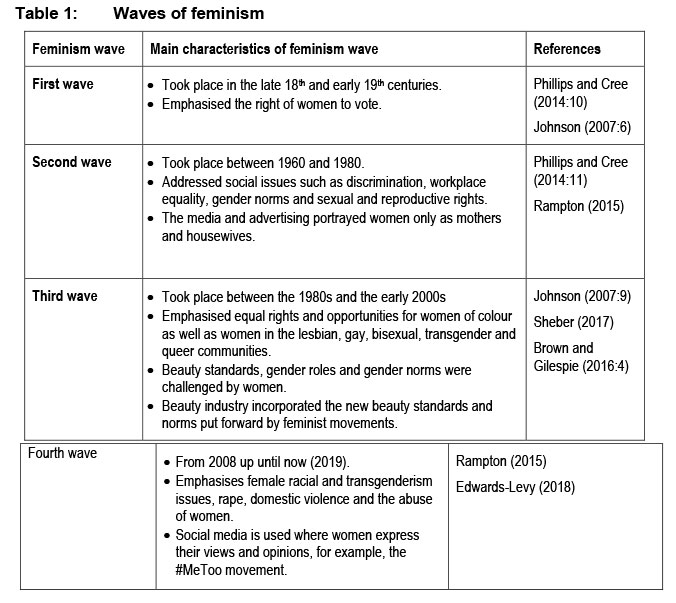
The term 'feminism' refers to equality of the sexes (Angelique & Culley 2003:190; Johnson 2007:3). Since the 19th century, feminism has experienced significant changes. These have been used to classify the movement into four 'waves', which are presented in Table 1 below (Johnson 2007:3; Phillips & Cree 2014:9).
Great strides were made towards accepting feminism in the United States of America and Europe, where feminism is far more advanced than in emerging nations. Feminism has only quite recently become openly accepted in emerging nations such as South Africa and is discussed in detail in section 4.2 below.
4.2 Feminism in South Africa
South Africa has been known as a patriarchal nation due to the norms, customs and cultures of its Western (Afrikaner and European) and African inhabitants (Coetzee 2001:300; Gibbs, Sikweyiya & Jewkes 2014:3). Apartheid imposed additional oppression on women, especially Black women. However, it was during this period that many women fought for their rights, which transformed into three of the most significant feminist campaigns in South Africa:
1. Women's demonstrations that took place in 1913 against purchasing costly passes every month (Filippi 2016:438; Salo 2007:187). Passes were small books that stated which area an individual was allowed to be in (Salo 2007:187).
2. Women's protests that took place in Potchefstroom in 1930 against bullying by their male counterparts over labour needs in the town (Filippi 2016:438; Salo 2007:188).
3. Women's marches take took place in 1958 outside the Union Buildings in Pretoria, calling for the abolition of passes by burning their pass books (Arnold 2017:24).
Jaga, Arabandi, Bagraim and Mdlongwa (2018:430) argue that, despite the feminist movements such as ANC Women's League, the Black Women's Federation and campaigns that took place among South African women in the 1900s, apartheid was still rife and although apartheid formally ended in 1994, previously disadvantaged women struggled to access the same opportunities as their white counterparts (Frenkel 2008:4). Since then, South Africa has taken great strides to improve access to opportunities that were previously denied to disadvantaged women. This has been achieved through regulations and laws such as Broad-Based Black Economic Empowerment (BBBEE), the Women Empowerment and Gender Equity Bill and the Employment Equity Act (Coetzer & Singh 2017; Mataboge 2010).
Through these regulations and laws, society is slowly adapting its mindset and accepting women as equal to men.
South Africa has made great progress in empowering women to break the traditional gender stereotypes and to see themselves as confident, strong, independent individuals (Spiers 2019). Through this new wave of South African feminists, especially among Generation Y and Generation Z, women have become more discerning in the purchase and consumption of products and brands to meet their needs. Thus it is imperative for marketers to explore ways to influence the feminist consumer about their purchases of a range of products and brands (Kapoor & Munjal 2019:140). A popular form of marketing and advertising to feminists is 'femvertising', which is discussed in section 4.3 below.
4.3 Femvertising
'Femvertising' is defined as advertising that portrays the empowerment of women through the use of pro-female messages, talents and personalities (Drake 2017:593). Kapoor and Munjal (2019:137) argue that feminists in the 21st century wish to feel strong, independent, liberated and confident and constantly challenge conventional gender roles. More and more marketers and advertisers are recognising the importance of resonating with the 21st century feminist's desires, as they are more receptive to advertisements that represent their beliefs (Drake 2017:593).
Ákestam, Rosengren and Dahlen (2017:796) state that femvertising has grown in popularity to reflect increasing pressures to abolish gender roles in advertising. More brands are recognising the importance of portraying women as empowered individuals; some, however, have faced severe backlash (Ákestam et al. 2017:797). Critics argue that femvertising commercialises the deeper meaning of feminism and exploits women's rights movements (Fineman 2014; Martell 2018). Moreover, certain brands and companies promote the empowerment of women in their campaigns but do not have a company culture that reflects their public message (Martell 2018).
Despite this, femvertising has still been successful. A study conducted by SheKnows Media (Skey 2016) proved that most Generation Y women are more likely to recall a brand with an empowering advertisement and close to 50 per cent of women switched between brands when advertisements depicted women as strong and empowered. Moreover, femvertising is 80 per cent more likely to be shared, liked and commented on in social media, especially among Generation Y and Generation Z women (Sylvendhal 2017).
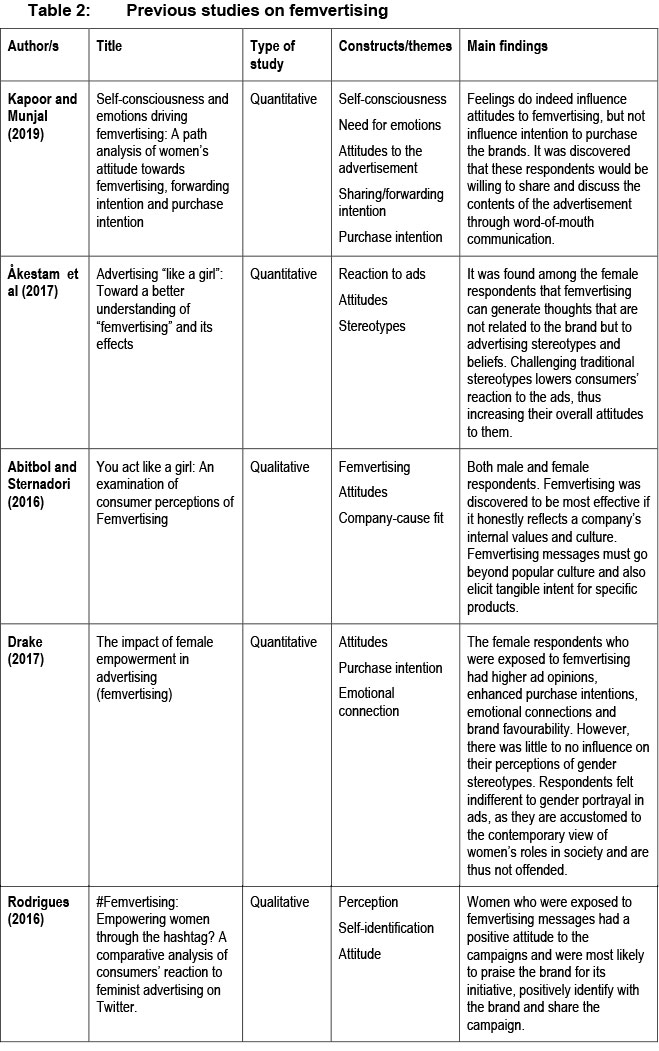
Previous studies which have examined the influence of femvertising on consumer behaviour and are presented in Table 2.
The studies presented in Table 2 have explored the effects of femvertising on numerous constructs, including attitude in general. However, few of them have examined the influence of the specific antecedents of attitude. Moreover, most of these studies have been quantitative in nature and there is a lack of research on femvertising and attitudes in emerging markets, and specifically in South Africa. The 'attitude' construct is explored in detail below.
4.4 Attitude
'Attitude' is defined as a learned predisposition to behave in consistently favourable or unfavourable ways towards a given object and is a driver of behavioural intention (Bashir & Madhavaiah 2015:70; Chih, Liou & Hsu 2015:497; Schiffman & Wisenblit 2015:245). Attitudes are formed in numerous ways, however, for the purposes of the current study, the 'tri-component attitude' model and the 'attitude towards the advertisement' model are discussed.
4.4.1 Tri-component attitude model
The tri-component attitude model consists of three key components that are believed to influence the formation of attitudes: cognitive, affective and conative (Schiffman & Wisenblit 2015:245).
Cognition
Schiffman (2019:146) states that the cognitive component of attitude refers to an individual's perceptions and knowledge, based on direct experience with an attitude object and learning. Marketers aim to enhance consumer learning through their advertising in the hopes of improving brand recall (repetition) and understanding of the brand message (elaboration) (Batkoska & Koseska 2012:71: Schmidt & Eisend 2015:418). Through cognition, individuals form judgements and evaluations of the attitude object; these, in turn, influence their beliefs and feelings about the object (Schiffman 2019:147).
Affective
The affective component of attitude refers to an individual's feelings about a particular attitude object (Chih et al. 2015:497). Feelings amplify an individual's experience with an attitude object (Makanyeza, 2014:876). Often positive feelings amplify positive experiences, while negative feelings amplify negative experiences (Chih et al. 2015:497; Makanyeza 2014:876). In their messages, marketers aim to enhance positive experiences by stimulating positive feelings (Clow 2016:79).
Conative
The conative component of attitude refers to the likelihood that an individual will behave in a particular way towards a given attitude object (Schiffman 2019:147). This component is often regarded as a consumer's intention to purchase (Pande & Soodan 2015:285). Rizvi and Oney (2018:160) argue that conation often takes place once consumers have established beliefs and evaluations about a brand, as well as associated emotions and feelings about a brand. Positive beliefs and feelings about a brand increase the intention to purchase it, whereas negative beliefs and feelings decrease the intention to purchase it (Rizvi & Oney 2018:160; Makanyeza 2014:877).
4.4.2 Attitude to the advertisement model
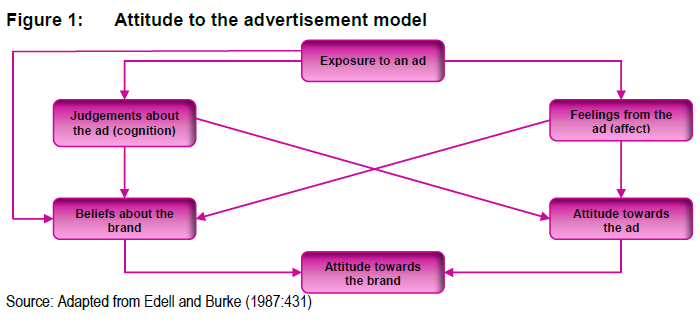
'Attitude towards the advertisement' is defined as a predisposition to respond in a consistently favourable or unfavourable way to a given advertising stimulus during certain exposure (Schiffman 2019:146). The attitude towards the advertisement (AAd) model was developed by Edell and Burke (1987) in order to understand the role of feelings about advertisements. The AAd model consists of six elements as depicted in Figure 1 (Edell & Burke 1987).
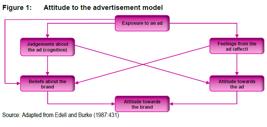
Consumers are exposed to numerous advertisements on a daily basis. However, what distinguishes advertisements from one another is their ability to influence consumer attitudes (Sanchez & Alley 2016:1098). Advertisements aim to provide consumers with information (to stimulate their cognitive process) and create various feelings and emotions (to stimulate their affective process) to assist them in forming attitudes to advertisements and brands (Sanchez & Alley 2016:1098; Schiffman 2019:146). Attitudes, moreover, are formed through constant and repetitive exposure to an advertisement and are used to increase brand awareness and brand recognition (Batkoska & Koseska 2012:71). Once consumers are exposed to an advertisement, they form judgements and feelings about the advertisement (Makanyeza 2014:877). As mentioned in section 3.4.1, cognition enables consumers to form knowledge and beliefs, which in turn influences their attitude to the brand (Schiffman 2019:147).
He and Qu (2018:18) posit that many advertisements incorporate emotional appeals to stimulate affective and emotional responses in consumers who view the advertisement. It has been proven that consumers are more likely to remember an advertisement if it arouses a particular feeling or emotion (He & Qu 2018:18). Advertisements that evoke positive emotions and feelings are more likely to generate positive attitudes and subsequently increase the purchase intention (MacKenzie & Lutz 1989:49). A study conducted by Zha, Li and Yan (2015:527) proved that consumers who have positive feelings about an advertisement with increased cognitive content tend to perceive it as more credible and therefore develop a positive attitude to the brand.
To explore the abovementioned influence in more detail in South Africa, the research process presented in section 5 below outlines the way in which the study was conducted.
5. RESEARCH PROCESS
The six steps proposed by Berndt and Petzer (2011) were used to guide the research process.
Step 1: Defining the research problem and research objectives
The research problems and research objectives were stated in sections 2 and 3.
Step 2: Selecting the research design
A descriptive, qualitative research design was followed due to the exploratory nature of the topic. Using an interpretivist approach, an in-depth understanding of femvertising in South Africa was gained by exploring varying opinions presented by participants. To gauge participants' opinions, group interviews were conducted. Group interviews are similar to focus groups, however, they comprise a smaller number of participants - usually between two and four (Frey & Fontana 1991:177). Having fewer participants makes it possible to gain in-depth, rich data yet still obtain shared views from the group (Krueger & Casey 2014:56).
Despite the advantages of group interviews, there are some ethical issues such as obtaining consent, good conduct and maintaining confidentiality and anonymity (Sim & Waterfield 2019:3036). The participants were given an explanatory statement, highlighting what was required from them; they were also given a consent form to read and sign. The participants were then briefed about the manner in which the group interviews would be conducted - this involved willingness to share their own opinions as well as respecting those of others. To maintain confidentiality and anonymity, all participants were referred to with numbers, for example, Participant 1, Participant 2 and so on. Despite the email addresses that were obtained from potential participants for communication purposes, no identifiable data was used in the group interview.
Step 3: Planning the sample
A two-stage sampling process was followed, using non-probability sampling techniques. In the first stage, the participants were purposefully selected from the target population to ensure that they represented the target population of the study. Purposive sampling was selected due to the nature of study, which required a specific group of participants who met inclusion criteria (Sharma 2017:751). The inclusion criteria was that (a) the participant had to be between the ages of 18 and 40 (the age range for Generation Y and Z consumers) and (b) the participant had to consider herself a feminist.
The second stage in the sampling process consisted of snowball sampling. This form of sampling was used as it was difficult to obtain participants who met the inclusion criteria (Etikan, Alkassim & Abubakar 2016:1). Those participants who had already taken part in the study were asked to use their networks to source other potential participants who shared similar interests (being feminists). The email addresses of the potential participants were obtained from the initial group and the women were contacted to request their participation in the project. Three group interviews were conducted, consisting of three to six members per group, with an overall total of 14 participants. The decision on the sample size was based on the average number of group interviews to be conducted before saturation was reached (Frey & Fontana 1991:177).
Step 4: Collecting the data
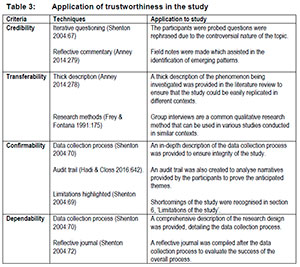
To commence data collection, potential participants were approached at the University of Johannesburg and asked whether they were between the ages of 18 and 40 and whether they considered themselves as feminists. Those who met these criteria were then provided with the explanatory statement to read. Participants' email addresses were obtained and they were emailed about the meeting place and time of the group interviews which took place at a central, public location convenient to the researcher and the participants. Once in the venue, participants were provided with a consent form to read and sign and the conduct or 'ground rules' for the interview were explained. Participants were then shown two examples of femvertising campaigns to facilitate the discussion including the Dove Real Beauty campaign (Bahadur, 2014) and the Always Ultra #LikeAGirl campaign (Keffler 2017). The group interviews were guided by five broad ideas deduced from the literature on femvertising and attitude formation. These included femvertising's effect on participants' (a) opinions; (b) beliefs; (c) feelings and (d) attitudes towards beauty advertisements; and (e) attitudes towards beauty brands. The interviews were audio and video-recorded to gather rich data. In order to maintain trustworthiness, Lincoln and Guba's (1986) criteria were applied, as described in Table 3 below.
Step 5: Analysing the data
The data was analysed using deductive content analysis. Hashemnezhad (2015:60) explains that deductive content analysis is commonly used when the purpose of the study is to test a particular theory which is grounded in previous knowledge. Furthermore, deductive content analysis is used to explore existing phenomena in new contexts (Elo & Kyngäs 2008:111). In this study, the Aad theory, an existing theory, was used to determine attitudes in a new context - femvertising. To conduct deductive content analysis, Kibiswa (2019:2061) suggests starting with specific observations and objectives, which are then analysed and interpreted into a more general observation to draw conclusions. As with the current study, the ideas presented in the Aad model guided the research objectives, which were analysed to provide an overall view of feminists' attitudes towards femvertising.
The steps proposed by Erlingsson and Brysiewicz (2017:95) were used to deductively analyse the data. Step 1 included familiarisation with the data and using the hermeneutic spiral, whereby the transcribed interviews were read and re-read and notes were made on initial impressions. The participants' perspectives on the overall research topic were checked and compared. Step 2 was to divide the text into meaning units and then to condense these units. To do this, meaningful statements were identified, in line with the research questions, which were used as meaning units. This assisted in completing Step 3, formulating codes. Codes were created which best described the meaning units, using one label to identify connections between them. Once the codes were created, categories and themes were developed pertaining to the research objectives (Step 4).
Step 6: Presenting the research report
The research report includes presenting the findings of the data analysis, which are given in section 6 below. Each research objective is addressed with its relevant finding, followed by a brief discussion.
6. KEY FINDINGS AND MANAGERIAL IMPLICATIONS
To commence the group interviews, a number of general questions were posed about feminism to gauge how female Generation Y and Generation Z consumers felt about the topic. In general, it was discovered that the women from these generational cohorts believed that feminism was about equality between men and women, women's empowerment and eliminating gender stereotypes. The definitions of feminism obtained from the participants reflected those provided by Angelique and Culley (2003:190) and Johnson (2007:3). The majority of the participants, however, did feel that they started regarding themselves as feminists only recently, which they attributed to the growing social acceptance of feminism and its visibility on social media. Most participants suggested that social media made it easier to be vocal and open about their views on feminism, as they discovered communities among other feminists who shared the same values and beliefs. This finding is line with the studies conducted by Jackson (2018:45) and Turley and Fisher (2018:130), who discovered that feminism, had indeed become more accepted due to the increasing number of mentions and feminist movements on social media.
An interesting point that came up in all three group interviews was the influence of cultural background on the participants' view of feminism. In their homes, it was their responsibility of women to cook, clean and serve the men. This patriarchal mindset is still evident in South Africa and Africa as a whole and has been documented through African feminist literature as reviewed by Eze (2015:315). It was further discovered that although participants' maternal influencers expected them to carry out those responsibilities, their mothers actually played a role in the participants identifying themselves as feminists. These participants suggested that their mothers encouraged them to study, qualify, get a job and be independent. In general, all participants agreed that feminism was impacting both society and advertising positively; more advertisements were trying to appeal to the feminist consumer and break down gender stereotypes, thus allowing brands to become social advocates. This was proven by Âkestam et al. (2017:800), however, Drake (2017:569) found that femvertising had little to no influence on females' perceptions of gender stereotypes.
The second part of the focus group related to femvertising and attitude specifically. To present this section, a discussion of the overall findings is provided with respect to each objective.
RO1: To explore the influence of femvertising on judgements about beauty advertisements.
It was discovered that femvertising did indeed influence participants' judgements about beauty advertisements, however, there were mixed findings in this regard. Several participants felt that although advertisers were trying to incorporate more feminists into their advertisements, they tended to include either the 'extreme activist' or a beautiful person -both extremes being non-inclusive of a 'regular girl'. The participants felt that few or no advertisements included the 'average woman' to whom they could relate. This finding is line with the results of Wang (2018:59) who conducted a content analysis on femvertising campaigns and found that many of these advertisements included women who had an unattainable self-image for the 'everyday feminist'. From the current study, it was also discovered that women in these advertisements tended to be portrayed as angry and aggressive and that some advertisements were facilitated by men who did not fully understand feminism. This suggests that femvertising had a negative impact on their judgements about the beauty advertisements. Some excerpts from the interviews are presented below:
'...my judgement is that these ads are not inclusive [...] enough and that they don't do enough research into the ordinary girl because the girl either looks extremely activist or extremely touched up like Rihanna. There's no regular girl represented...'
'...feminists are also portrayed as angry and aggressive...some ads are facilitated by men, which can completely miss the point...'
Conversely, the majority of the participants felt that their judgements and opinions about the advertisements were positively influenced. When probed about their responses, they felt that beauty advertisements were incorporating women of all shapes, colours and sizes. This all-inclusiveness meant that participants were able to relate to the women in the advertisements and thus had a positive image of the brand. The participants further mentioned that being able to resonate with the feminist women in advertisements meant that their perception of the advertisement and the brand was enhanced, along with their interest in the advertisement. Jacobson, Katalin Abdallah, Liasse and Lund (2018:13) support this finding, stating that femvertising campaigns have indeed changed women's perceptions of the brands. Emphasis was also placed on who was chosen to be in the advertisements, as this positively impacted on participants' judgement about the beauty brand advertisement. It was also discovered that having positive judgements and opinions about the brand would encourage participants to share the advertisement on social media, discuss it with their friends and potentially even purchase the brand. This was previously proven by Jackson (2018:45) and Turley and Fisher (2018:130). Some excerpts from the interviews are presented below.
'...I grab every opportunity to share about the brand if the ad really resonated with me... also if I see a feminist women in the ad, I want to continue watching the ad and I might even buy the brand in the ad.so who is in the ad also influences my judgement and interest.'
'...the definition of beauty from back then has expanded now because now they are using all types of women.now everyone can be beautiful.my judgement towards these ads [is] positive because now it resonates with everyone and they feel like they are beautiful and included in the brand.'
Overall, it was discovered that there were mixed findings in relation to the type of influence of femvertising on judgements. In order to have a positive judgement towards an advertisement, average women and feminists needed to be part of the advertisement in order to resonate with the feminist consumer.
RO2: To discover how judgements about femvertising influence beliefs about beauty advertisements.
The majority of the participants mentioned that the way they judged the advertisement did influence their beliefs. It was again reaffirmed that having women in an advertisement to whom the participants could relate and with whom they resonated positively influenced their beliefs about the advertisement. Some participants mentioned that they could relate to celebrities who were feminists while others mentioned that having 'normal, everyday women' would increase the believability of the advertisement because participants could relate to them. Results from a content analysis conducted by Wang (2018:59) support this finding as many femvertising campaigns either use celebrities or 'average women' as they are more appealing to feminists. Moreover, the findings from the current study show that the participants' beliefs about these advertisements are influenced by the ads' sincerity, which engenders more positive attitudes in the participants. Femvertising was also said to motivate participants to want to purchase the brands in the advertisements, especially when feminists were part of the advertisement and participants aspired to be like them. This is in line with the findings of Drake (2017:597) yet in contrast to those of Kapoor and Munjal (2019:150). One participant also mentioned that femvertising was breaking down the gender stereotypes associated with women's roles in society and giving rise to what the 'new feminist' was all about. This view is confirmed by the findings of Âkestam et al. (2017:800). Another participant mentioned that femvertising changed her beliefs about what she could and could not wear. Some excerpts from the interviews are presented below.
'...the ad should be genuine and sincere, it should not be done because now feminism is a 'thing'.. .also the people that they use should be normal girls who are feminists, as this influences my beliefs about the ad where I can believe what they are advertising...'
'...Some beauty ads are breaking down beliefs where they show women that are married [are] still looking sexy and wanting to do things for themselves...ads are giving rise to accepting the new feminist culture.'
'.they do influence my beliefs because they use influential women who I resonate with and who I like to see myself become...a part of me wants to look like them
In general, it was discovered that femvertising did influence judgements and, in turn, beliefs about beauty advertisements. It was reaffirmed that having women in the advertisements to whom participants could relate positively influenced their beliefs about the advertisements. Moreover, femvertising was said to eliminate past beliefs about feminism and was giving rise to the 'new feminist'.
RO3: To understand the influence of femvertising on feelings about beauty advertisements.
All participants mentioned that femvertising did indeed influence their feelings about beauty advertisements, which is supported by Kapoor and Munjal (2019:151). For some, femvertising invoked positive feelings; for others, doubts about their self-image were aroused. A few participants mentioned that even though femvertising tried to be all-inclusive, every individual was different and had their own, unique self-image. These participants suggested that part of them still felt left out when they saw advertisements to which they could not completely relate. Those who had positive feelings felt empowered as women since femvertising was breaking down gender stereotypes and social norms, which in turn made some participants feel proud. This contradicts the findings of Bue and Harrison (2019:12) who found that exposure to femvertising campaigns did not necessarily lead to positive feelings such as pride or empowerment. Some excerpts from the interviews are presented below.
'...it can be extreme happiness and elation or sadness, because I want to look like the girls in these ads, but that might not be possible, as some beauty brands are not all inclusive... This leads to esteem issues because sometimes you feel that you are not good enough to look like her and you don't have the means to purchase...'
'...at last women are being recognised and are considered and finally we have a say... I feel proud.'
Other participants suggested that femvertising invoked feelings of trust because having women in advertisements to which they could relate, increased the believability and sincerity of the advertisement. These findings are corroborated by those of Abitbol and Sternadori (2016:130), who found that trust positively, influences attitudes and beliefs. Moreover, feelings of confidence were evoked through these advertisements, such that participants felt that they were beautiful and could be comfortable in their own skin based on the all-inclusiveness of femvertising. This was supported by a textual qualitative analysis by Feng, Chen and He (2019:8). Some participants also affirmed that femvertising aroused feelings of excitement because society now accepted all women for themselves. Furthermore, having the right people in the advertisements also influenced their feelings about femvertising campaigns. Some excerpts from the interviews are presented below.
'...I feel like I trust the brand because they are using our skin types... it makes it seem more credible... it also makes me feel excited that the feminist thing and society are now catching up...'
'...I feel included and more accepted as well as confident in my own skin...'
'...For me, it's not like they are excluding me from this entire campaign... I feel included...'
Overall it was discovered that femvertising did have a significant influence on feelings about beauty advertisements. In general, positive feelings such as pride, trust, confidence, inclusivity and excitement were aroused after being exposed to femvertising.
RO4: To discover how feelings about femvertising influence attitudes to beauty advertisements.
All participants mentioned that the type of feelings they had about the advertisement would influence their overall attitude to the advertisement. For participants who experienced positive feelings when viewing the advertisements, it was affirmed that their attitude to the advertisement would also be positive, which is supported by Kapoor and Munjal (2019:151). Having a positive attitude to the advertisement meant that participants would be willing to watch the advertisement repeatedly as they were emotionally attached to it. The same findings were reported by Drake (2017:597). Some excerpts from the interviews are presented below.
'...because of the amazement and excitement that I feel when watching these ads, I actually do not mind watching it 10 times over... I have a positive attitude towards the ad...'
'...when it's a positive ad you often get emotionally attached to it and you always want to see it, share it and even Tweet about it...'
Participants who could relate to the women in beauty advertisements also felt highly involved with the advertisement and the brand and therefore had a positive attitude to the advertisement. This is supported by Abitbol and Sternadori's (2019:35) findings. One participant mentioned that having advertisements that showed women doing what men could do was empowering and positively influenced her attitude to the advertisement. Moreover, including 'average, everyday' women in feminist advertisements tended to empower participants and make them feel that if the women in the advertisements could do it, so could they. It was further discovered that positive attitudes to the advertisements would lead some participants to sharing the advertisement on social media. Some excerpts from the interviews are presented below.
'...seeing these ads with all types of women makes me feel involved with the ad and the brand, even though I am not actually in the ad, because it's something that I can relate to and that makes me feel positive towards the ad...'
'...I like it when the ads show women that they can do what men can do, for example, seeing ads that say 'Boss Lady' and seeing a woman DJ-ing. This positively influences my attitude and I want to be part of whatever they are offering...'
In general, feelings about femvertising, whether positive or negative, were discovered to significantly influence the participants' attitude to beauty brands.
RO5: To explore how attitudes to beauty advertisements influence attitudes to beauty brands.
Some participants mentioned that having a positive feeling about an advertisement created a positive attitude to the ad and, in turn, led to a positive attitude towards the brand. This finding was supported by Rodrigues (2016) and De Meulenaer, Dens, De Pelsmacker and Eisend (2018:907). These participants felt that the way the message was portrayed in the beauty advertisement would determine whether or not they would have a positive attitude to the brand. It was furthermore discovered that consistency between the beauty advertisement, the message conveyed and the beauty brand was key in influencing the overall attitude to the brand, as proven by Abitbol and Sternadori (2016:131). One participant reaffirmed that if she perceived the woman in the advertisement to be a feminist to whom she could relate, she would have a positive attitude to the brand. The participants also affirmed that if they had a positive attitude to the brand, they would be more likely to trial and purchase the brand. Some would also recommend the brand while others would be willing to stand by the brand. Participants mentioned that they would be willing to share reviews of the advertisement or the brand through social media. Moreover, having a positive attitude to the advertisement led to potential brand loyalty and helped brands remain top-of-mind. These findings were supported by authors such as Abitbol and Sternadori (2019:34), Kapoor and Munjal (2019:132) and Drake (2017:597). Some excerpts from the interviews are presented below.
'.the way you send out the message and the feelings that are evoked make me want to look at beauty brands and see if they actually mean what they say in the ads... stick to what you say in the ads and then my attitude towards the brand won't change negatively... there needs to be consistency'
'...I am going to purchase the brands if I have a good attitude towards the ad and if I believe that the brand is resonating with me... I would even recommend the brand... and also seeing the ad and having a positive attitude towards the ad means that the brand stays on top of my mind.'
'...if I like what I am seeing then I might recommend the brand...' '.I would be more loyal to the brand.'
'...I would use social media to recommend the brand and the ad if my attitude is positive...'
7. LIMITATIONS OF THE STUDY
Although this study sheds light on the influence of femvertising on attitudes to beauty brands, as with all research, it is not without its limitations. The methodology for this study followed a deductive, qualitative approach. Consequently, the findings cannot be generalised to the greater population. Future research could use the findings from this study to inform quantitative studies to further investigate the relationships between each construct and then replicate these to the greater South African population.
This study was limited to female Generation Y and Generation Z consumers. Future studies could explore the influence of femvertising on older generational cohorts to provide valuable insights into generational targeting and ways to advertise to them. Future research could also be conducted in other industries to get male feminists' opinions about femvertising. In addition, due to the numerous segments in the beauty and personal care industry, future studies could be replicated in particular segments to determine whether the influence of femvertising differs between segments.
8. RECOMMENDATIONS FROM THE STUDY
The findings of this study can assist marketers and advertisers to understand how female Generation Y and Generation Z consumers identify themselves as feminists in order to improve their targeting. Advertisers can use femvertising to increase awareness of and interest in their advertisements and beauty brands as it was discovered that having a positive attitude leads feminist consumers to share content on social media and share recommendations with friends.
Currently, many femvertising campaigns use aspirational women in their advertisements; advertisers should also include more 'average, everyday women' in their campaigns. Through these advertisements, marketers should also focus on evoking positive feelings in feminists such as pride, confidence, inclusivity, trust and excitement, as it was suggested that having an emotional attachment to an advertisement reflected positively on the brand.
Advertisers should also ensure that the advertisements they create for beauty brands create positive attitudes through the messages conveyed, the women used in the advertisements and the feelings they evoke. If all of those aspects are positive and consistent, then feminists from the Generation Y and Z cohorts will most likely have a positive attitude to beauty advertisements and brands.
9. CONCLUSION
This aim of this study was to explore the influence of femvertising on attitudes to beauty advertisements and beauty brands. The findings from the study show that, overall, femvertising positively influences Generation Y and Generation Z women's judgements, beliefs and feelings. In turn, these positively influence the women's attitudes to beauty advertisements and beauty brands. Advertisers can therefore use the findings from this study as a foundation for creating femvertising campaigns to stimulate trial, increase purchases, generate recommendations and enhance brand loyalty.
REFERENCES
4. LITERATURE REVIEW
- ABITBOL A & STERNADORI M. 2016. You act like a girl: an examination of consumer perceptions of femvertising. Quarterly Review of Business Disciplines 3(2):117-138.
-
ABITBOL A & STERNADORI M. 2019. Championing Women's Empowerment as a Catalyst for Purchase Intentions: Testing the Mediating Roles of OPRs and Brand Loyalty in the Context of Femvertising. International Journal of Strategic Communication 13(1):22-41. (DOI:https://doi.org/10.1080/1553118X.2018.1552963.
» https://doi.org/10.1080/1553118X.2018.1552963 -
)
» https://doi.org/10.1002/jcop.10050 -
ÅKESTAM N, ROSENGREN S & DAHLEN M. 2017. Advertising "like a girl": toward a better understanding of "femvertising" and its effects. Psychology & Marketing 34(8):795-806. (DOI:https://doi.org/10.1002/mar.21023.
» https://doi.org/10.1002/mar.21023 - )
-
)
» https://doi.org/10.1108/JIBR-02-2014-0013 -
ANNEY VN. 2014. Ensuring the quality of the findings of qualitative research: Looking at trustworthiness criteria. Journal of Emerging Trends in Educational Research and Policy Studies 5(2):272-281. [Internet:http://jeteraps.scholarlinkresearch.com/articles/Ensuring%20The%20Quality%20Of%20The%20Findings%20new.pdf; downloaded on 31 October 2019.
» http://jeteraps.scholarlinkresearch.com/articles/Ensuring%20The%20Quality%20Of%20The%20Findings%20new.pdf - ]
-
BAHADUR N. 2014. Dove 'Real Beauty' campaign turns 10: how a brand tried to change the conversation about female beauty. [Internet:https://www.huffpost.com/entry/dove-real-beauty-campaign-turns-10_n_4575940; downloaded on 06 November 2018.
» https://www.huffpost.com/entry/dove-real-beauty-campaign-turns-10_n_4575940 - ]
-
)
» http://www.bizcommunity.com/Article/196/717/166217.html -
BATKOSKA L & KOSESKA E. 2012. The impact of cognitive learning on consumer behaviour. Procedia-Social and Behavioral Sciences 44(1):70-77. (DOI:https://doi.org/10.1016/j.sbspro.2012.05.006.
» https://doi.org/10.1016/j.sbspro.2012.05.006 -
)
» http://www.jormonline.com/index.php/jorm/article/download/199/76 -
BROWN J & GILESPIE D. 2016. Ladies, lipstick, and liberty: beauty trends within women's social movements in 1960s America. [Internet: https://digitalcommons.northgeorgia.edu/cgi/viewcontent.cgi?filename=0&article=1682&conte xt=ngresearchconf&type=additional; downloaded on 09 November 2018.
» https://digitalcommons.northgeorgia.edu/cgi/viewcontent.cgi?filename=0& article=1682& conte xt=ngresearchconf& type=additional -
]
» https://doi.org/10.1111/j.1365-2648.2007.04569.x - BUE ACC & HARRISON K. 2019. Empowerment Sold Separately: Two Experiments Examine the Effects of Ostensibly Empowering Beauty Advertisements on Women's Empowerment and Self-Objectification. Sex Roles: A Journal of Research 81(9-10):627-642.
-
CHIH W, LIOU D & HSU L. 2015. From positive and negative cognition perspectives to explore e-shoppers' real purchase behavior: an application of tricomponent attitude model. Information Systems and e-Business Management 13(3):495-526. (DOI:https://doi.org/10.1007/s10257-014-0249-0.
» https://doi.org/10.1007/s10257-014-0249-0 -
)
» https://doi.org/10.1080/03056244.2016.1214114 -
COETZEE D. 2001. South African education and the ideology of patriarchy. South African Journal of Education 21(4):300-304. [Internet:https://www.ajol.info/index.php/saje/article/viewFile/24919/20531; downloaded on 20 Apri 2019.
» https://www.ajol.info/index.php/saje/article/viewFile/24919/20531 - ]
-
]
» https://doi.org/10.1080/02650487.2016.1203556 -
DE MEULENAER S, DENS N, DE PELSMACKER P & EISEND M. 2018. How consumers' values influence responses to male and female gender role stereotyping in advertising. International Journal of Advertising 37(6):893-913. (DO I:https://doi.org/10.1080/02650487.2017.1354657.
» https://doi.org/10.1080/02650487.2017.1354657 - )
-
EDELL JA & BURKE MC. 1987. The power of feelings in understanding advertising effects. Journal of Consumer Research 14(3):421-433. (DOI:https://doi.org/10.1086/209124.
» https://doi.org/10.1086/209124 -
)
» https://doi.org/10.1080/13668803.2017.1311840 -
EDWARDS-LEVY A. 2018. Here's what America thinks about the me too movement now. [Internet: https://www.huffingtonpost.com/entry/poll-me-too-sexualharassment_us_5b7dcbdde4b07295150f7e5e; downloaded on 30 October 2018.
» https://www.huffingtonpost.com/entry/poll-me-too-sexualharassment_us_5b7dcbdde4b07295150f7e5e -
]
» https://doi.org/10.1080/13527266.2017.1338611 -
ETIKAN I, ALKASSIM R & ABUBAKAR S. 2016. Comparison of snowball sampling and sequential sampling technique. Biometrics&BiostatisticsInternationalJournal3(1):1-2. (DOI:https://dx.doi.org/10.15406/bbij.2016.03.00055.
» https://dx.doi.org/10.15406/bbij.2016.03.00055 -
)
» https://search.proquest.com/openview/9c263bd851300bbb4fe6ef98eb389b45/1?pq-origsite=gscholar& cbl=55152 -
)
» https://doi.org/10.1002/ev.1427 -
ERLINGSSON C & BRYSIEWICZ P. 2017. A hands-on guide to doing content analysis. African Journal of Emergency Medicine 7(3):93-99. (DOI:https://doi.org/10.1016/j.afjem.2017.08.001.
» https://doi.org/10.1016/j.afjem.2017.08.001 -
)
» http://dx.doi.org/10.5901/mjss.2014.v5n20p874 -
EZE C. 2015. Feminist Empathy: Unsettling African Cultural Norms in the Secret Lives of Baba Segi's Wives. African Studies 74(3):310-326. (DOI:https://doi.org/10.1080/00020184.2015.1067996.
» https://doi.org/10.1080/00020184.2015.1067996 -
)
» https:// mg.co.za/article/2010-07-30-more-women-in-business-makes-good-sense - FENG Y, CHEN H & HE L. 2019. Consumer Responses to Femvertising: A Data-Mining Case of Dove's "Campaign for Real Beauty" on YouTube. Journal of Advertising 148(3):1-10.
-
)
» https://www.pacificu.edu/about/media/four-waves-feminism -
FINEMAN M. 2014. When not to use feminism to sell stuff to women. [Internet:https://hbr.org/2014/10/when-not-to-use-feminism-to-sell-stuff-to-women; downloaded on 03 November 2018.
» https://hbr.org/2014/10/when-not-to-use-feminism-to-sell-stuff-to-women - ]
-
FRENKEL R. 2008. Feminism and contemporary culture in South Africa. African Studies 67(1):1-10. (DOI:https://doi.org/10.1080/00020180801943065.
» https://doi.org/10.1080/00020180801943065 -
)
» https://doi.org/10.1002/acp.3290 -
FREY JH & FONTANA A. 1991. The group interview in social research. The Social Science Journal 28(2):175-187. (DOI:https://doi.org/10.1016/0362-3319(91)90003-M.
» https://doi.org/10.1016/0362-3319(91)90003-M -
)
» https://bookshelf.vitalsource.com/#/books/9780134734996/recent -
GIL N. 2018. What Millennials should learn from Generation Z. [Internet:https://www.refinery29.com/en-gb/2018/04/195492/what-is-generation-z; downloaded on 02 October 2018.
» https://www.refinery29.com/en-gb/2018/04/195492/what-is-generation-z -
]
» http://corporate.shemedia.com/attachments/204/iBlog_Magazine-SheKnows-FemvertisingFeature.pdf -
)
» http://www.allresearchjournal.com/archives/2017/vol3issue7/PartK/3-7-69-542.pdf - HADI MA & CLOSS SJ. 2016. Ensuring rigour and trustworthiness of qualitative research in clinical pharmacy. International Journal of Clinical Pharmacy 38(3):641 -646.
-
HE Q & QU H. 2018. The impact of advertising appeals on purchase intention in social media environment -analysis of intermediary effect based on brand attitude. Journal of Business Administration Research 7(2):17-30. (DOI:https://doi.org/10.5430/jbar.v7n2p17.
» https://doi.org/10.5430/jbar.v7n2p17 - )
- JACKSON S. 2018. Young feminists, feminism and digital media. Feminism & Psychology 28(1):32-49.
- JACOBSON C, KATALIN ABDALLAH L, LIASSE D & LUND E. 2018. Femvertising and its effects on brand image: A study of men's attitude towards brands pursuing brand activism in their advertising. LBMG Strategic Brand Management - Masters Paper Series.
- )
- JOHNSON ML. 2007. Third wave feminism and television: Jane puts it in a box. Indiana, IN: Indiana University Press.
- )
-
KEFFLER B. 2017. Always '#LikeAGirl' returns to fight girls' fear of failure. [Internet: https://www.campaignlive.co.uk/article/always-likeagirl-returns-fight-girls-fear-failure/1442313; downloaded on 06 November 2018.
» https://www.campaignlive.co.uk/article/always-likeagirl-returns-fight-girls-fear-failure/1442313 - ]
- ]
- KRUEGER RA & CASEY MA. 2014. Focus groups: A practical guide for applied research. Thousand Oaks, CA: Sage Publications.
- )
-
MACKENZIE SB & LUTZ RJ. 1989. An empirical examination of the structural antecedents of attitude toward the ad in an advertising pretesting context. The Journal of Marketing 23(2):48-65. (DOI:10.2307/1251413.
» https://doi.org/10.2307/1251413 - )
- )
-
MARTELL K. 2018. The new rules of using feminism in marketing. [Internet:https://www.chiefmarketer.com/new-rules-using-feminism-marketing/]; downloaded on 03 November 2018.
» https://www.chiefmarketer.com/new-rules-using-feminism-marketing/ - ]
- ]
-
PANDE AC & SOODAN V. 2015. Role of consumer attitudes, beliefs and subjective norms as predictors of purchase behaviour: a study on personal care purchases. The Business & Management Review 5(4):284-291. [Internet:https://www.researchgate.net/profile/Vishal_Soodan/publication/274294679_ Role_of_consumer_attitudes_beliefs_and_subjective _norms_as_predictors_of_purchase_behaviour_a_study_on_personal_care_purchase/links/551a977b0cf244e9a4589e7b.pdf; downloaded on 03 May 2019.
» https://www.researchgate.net/profile/Vishal_Soodan/publication/274294679_ Role_of_consumer_attitudes_beliefs_and_subjective _norms_as_predictors_of_purchase_behaviour_a_study_on_personal_care_purchase/links/551a977b0cf244e9a4589e7b.pdf - ]
-
PHILLIPS R & CREE VE. 2014. What does the 'fourth wave' mean for teaching feminism in twenty-first century social work? Social Work Education 33(7):930-943. (DOI:https://doi.org/10.1080/02615479.2014.885007.
» https://doi.org/10.1080/02615479.2014.885007 - )
- POTGIETER A & DOUBELL M. 2018. The impact of a new generation of employees on corporate reputation in South Africa as an emerging market. Johannesburg: Wits Business School. (The 2018 Annual Conference of the Emerging Markets Conference Board.
- )
- ]
-
RIZVI WH & ONEY E. 2018. The influence of emotional confidence on brand attitude: using brand belief as mediating variable. Economic Research - Ekonomska istrazivanja 31(1):158-170. (DOI:https://doi.org/10.1080/1331677X.2017.1421993.
» https://doi.org/10.1080/1331677X.2017.1421993 - )
- )
-
SALO E. 2007. Gendered citizenship, race and women's differentiated access to power in the new South Africa. Agenda 21(72):187-196. [Internet:https://s3.amazonaws.com/academia.edu.documents/35365037/013_Feminist.indd.pdf?response-content-disposition=inline%3B%20filename%3DGendered_citizenship_race_and_womens_dif.pdf&X-Amz-Algorithm=AWS4-HMAC-SHA256&X-Amz-Credential=AKIAIWOWYYGZ2Y53UL3A%2F20191209%2Fus-east-1%2Fs3%2Faws4_request&X-Amz-Date=20191209T145210Z&X-Amz-Expires=3600&X-Amz-SignedHeaders=host&X-Amz-Signature=2170281db5de8042aba8a50ada16d703afe5fa9acddffe60a9bbd5ef7812ea9a; downloaded on 19 April 2019.
» https://s3.amazonaws.com/academia.edu.documents/35365037/013_Feminist.indd.pdf?response-content-disposition=inline%3B%20filename%3DGendered_citizenship_race_and_womens_dif.pdf& X-Amz-Algorithm=AWS4-HMAC-SHA256& X-Amz-Credential=AKIAIWOWYYGZ2Y53UL3A%2F20191209%2Fus-east-1%2Fs3%2Faws4_request& X-Amz-Date=20191209T145210Z& X-Amz-Expires=3600& X-Amz-SignedHeaders=host& X-Amz-Signature=2170281db5de8042aba8a50ada16d703afe5fa9acddffe60a9bbd5ef7812ea9a - ]
- )
- SCHIFFMAN LG & WISENBLIT JL. 2015. Consumer behavior. 11th ed. New York, NY: Pearson.
- ]
-
SHEBER V. 2017. Feminism 101: what are the waves of feminism? [Internet:https://femmagazine.com/feminism-101-what-are-the-waves-of-feminism/; downloaded on 29 October 2018.
» https://femmagazine.com/feminism-101-what-are-the-waves-of-feminism/ - ]
-
SHENTON AK. 2004. Strategies for ensuring trustworthiness in qualitative research projects. Education for Information 22(2):63-75. (DOI: 10.3233/EFI-2004-22201.
» https://doi.org/10.3233/EFI-2004-22201 - )
-
SIM J & WATERFIELD J. 2019. Focus group methodology: Some ethical challenges. Quality & Quantity 53(6):3003-3022. (DOI:https://doi.org/10.1007/s11135-019-00914-5.
» https://doi.org/10.1007/s11135-019-00914-5 - )
- ]
-
SCHMIDT S & EISEND M. 2015. Advertising repetition: a meta-analysis on effective frequency in advertising. Journal of Advertising 44(4):415-428. (DOI:https://doi.org/10.1080/00913367.2015.1018460.
» https://doi.org/10.1080/00913367.2015.1018460 - )
- ]
-
SPIERS E. 2019. Why Generation Z are embracing feminism. [Internet:https://psmag.com/ideas/why-generation-z-is-embracing-feminism; downloaded on 02 November 2018.
» https://psmag.com/ideas/why-generation-z-is-embracing-feminism - ]
-
SYLVENDHAL F. 2017. Why femvertising is the future of advertising. [Internet:http://www.brandba.se/blog/femvertising; downloaded on 04 November 2018.
» http://www.brandba.se/blog/femvertising - ]
-
TURLEY E & FISHER J. 2018. Tweeting back while shouting back: Social media and feminist activism. Feminism & Psychology 28(1):128-132. (DOI:https://doi.org/10.1177%2F0959353517715875.
» https://doi.org/10.1177%2F0959353517715875 - )
-
WANG S. 2018. Empowering women through advertising: A content analysis on 'femvertising' campaigns. Northeast Normal University. Graduate School Southern Illinois University Carbondale. (Master's Thesis). [Internet:http://search.proquest.com/openview/5d26550b51d650d26b7c5d29349a33af/1?pq-origsite=gscholar&cbl=18750&diss=y; downloaded on 28 April 2018.
» http://search.proquest.com/openview/5d26550b51d650d26b7c5d29349a33af/1?pq-origsite=gscholar& cbl=18750& diss=y - ]
-
ZHA X, LI J & YAN Y. 2015. Advertising value and credibility transfer: attitude towards web advertising and online information acquisition. Behaviour & Information Technology 34(5):520-532. (DOI:https://doi.org/10.1080/0144929X.2014.978380.
» https://doi.org/10.1080/0144929X.2014.978380