Leading and motivating pharmaceutical sales teams through a strategic alliance strategy
Abstract
Existing literature confirms that effective leadership contributes to motivation in a way that enhances organisational performance. This article confirms this view and reports on research that was conducted in a pharmaceutical organisation in South Africa that investigated the relationship between leadership behaviour of sales managers and the motivation of sales teams. A quantitative dominant mixed methods approach was used for this research with a correlational design and the inclusion of content analysis. Data were collected from a population of 60 respondents in a multinational pharmaceutical organisation, using a survey questionnaire. Factor analysis on the questionnaire confirmed four leadership behaviours, namely team, supportive, autocratic and directive leadership. The findings showed that Pearson's correlation coefficient (r) for autocratic leadership and motivation was the highest with an r-value of 0.574, indicating that during the implementation of a strategic alliance strategy, the strongest relationship existed between autocratic leadership behaviour and motivation. Furthermore, the findings of the content analysis of the open ended questions indicated that task-oriented leadership behaviour could be the strongest motivating behaviour for sales team members when they implement strategies.
implementation; leadership; motivation; pharmaceutical industry; sales managers; sales teams; strategic alliance
1. INTRODUCTION
The economic downturn that started in 2008 negatively affected industries globally, including the pharmaceutical industry. In 2014, the size of the South African pharmaceutical market was USD 3.67 billion with an expected turnover of USD 3.62 billion for 2015, yielding a decline of 1.4% in dollar terms (BMI Research 2015:15). The effect of the economic downturn on the pharmaceutical industry is widespread (Behner, Vallerien, Ehrhardt & Rollmann 2009:1-10; Buysse, Laing & Mantel 2010:1-65). Most notably is the decline in the research and development (R&D) of innovative products.
In the pharmaceutical industry, R&D forms the cornerstone of organisational growth. Consequently, pharmaceutical organisations allocate capital in growth opportunities that include collaborations with each other. In South Africa, several multinational pharmaceutical organisations entered into strategic alliance agreements with each other to ensure organisational growth, which may enhance organisational competitiveness. Strategic alliance strategies comprise the formation of business partnerships that offer organisations a competitive advantage (St John & Harrison 2010:88).
As with other industries, the pharmaceutical industry requires a committed and motivated workforce that ensures optimal organisational performance. As sustai η ability is built on the sales of pharmaceutical products, it is increasingly important that the leadership of pharmaceutical organisations motivate sales employees to sell their products and avoid dissatisfaction, which adversely affects organisational performance.
Sales employees, in particular, are key human actors in ensuring successful implementation of planned strategies. Jones, Brown, Zoltners and Weitsz (2005:105-111) confirm that motivating sales teams is challenging for the leadership of organisations. Wiese and Coetzee (2013:24) assert that sales managers leading sales employees have a duty to drive the motivation levels of the sales employees reporting to them in order to achieve the organisation's objectives. Therefore, a motivational pathway may exist between a manager and his/her subordinates (DeRue, Barnes & Morgeson 2010:639). Linked with motivation levels is the need to implement strategies successfully. Parisi and Adl (2012:2) confirm that leadership behaviours enhance successful implementation that effectively aligns and motivates those responsible for implementing strategies.
Research on sales team member motivation within the pharmaceutical industry is not new. Durrani, Ullah and Ullah (2011:295), Malik and Naeem (2009:25), Parvin and Kabir (2011:117) conducted research on motivation in the pharmaceutical industry. In an attempt to identify factors which motivate sales employees, Malik and Naeem (2009:25) found that sales employees view a good relationship with their supervisor as an important motivating factor. This finding was confirmed by Parvin and Kabir (2011:117). Durrani et al. (2011:295) concur with previous research that a relationship exists between leadership and employee performance, denoting that the leadership behaviour of managers may increase sales employees' motivation in a pharmaceutical context.
However, these studies limit themselves to motivation on an overall basis and do not assess this relationship during a specific situation, or during the implementation of a specific strategy, which may be the relationship between a leader's behaviour and the motivation of sales employees during the implementation stage of a strategy.
The research on which this article reports attempted to highlight important correlations between leadership behaviour of sales managers and motivation of their sales teams. This quantitative dominant mixed methods research, which comprised 60 respondents, including sales managers and sales team members, investigated the extent to which a relationship exists between leadership behaviour of sales managers and the motivation of sales teams during strategy implementation. Furthermore, the present research explored which leadership behaviours may be required to motivate sales teams during the implementation of strategic alliance strategies.
The interest in the present research originated from a practicing sales team member who is interested in leadership behaviour of sales managers and the extent to which it motivates sales teams during the implementation of a strategic alliance strategy in a pharmaceutical organisation in South Africa.
Although research has been conducted in the field of leadership and its relationship with the motivational aspects of sales people, there still exists insufficient evidence of leadership behaviour in a pharmaceutical organisation in South Africa, particularly during a specific stage (implementation) and the application of a specific strategy (strategic alliance).
The findings of this research may be of value to practicing sales team managers because the research identified leadership behaviours that may increase motivation levels of sales teams when a specific task of implementing strategic alliances is required. Further, the findings are quite possibly contrary to contemporary views on leadership behaviour. It was surprising to find that autocratic and task-oriented leadership exhibited the strongest relationship with sales team motivation.
What follows in this article is an overview of the theoretical framework, which is underpinned by two constructs, namely leadership behaviour (of sales managers) and motivation (of sales team members). A description of the methodology is followed by a description of how the data were analysed. The reliability, validity, credibility and ethical considerations are explained. The findings and discussion follow thereafter, which leads to a discussion of the limitations and implications.
2. LEADERSHIP PERSPECTIVES DURING STRATEGY IMPLEMENTATION
The concept of leadership has been researched extensively. Within this journal, Dirkse van Schalkwyk, Davis and Pellissier (2013:227) define leadership as an activation of influence upon others that steers towards a common objective through a process of developing effective relationships. This definition is applied in the marketplace as providing significant co-ordination and direction (Mutsonziwa & Serumaga-Zake 2015:166). From an organisational perspective, and for the purpose of this research, leadership is regarded as a phenomenon consisting of leaders and followers, whereby a leader exercises a measure of influence through a process of social exchange that guides decisions and actions towards organisational performance.
The evolution of leadership theories started in the twentieth century. These theories are currently referred to as 'traditional leadership theories', comprising the trait theories as the first leadership theories, followed by the behavioural theories and thereafter, the creation of the contingency theories of leadership (Mello 2003:346).
The contingency theories claim that a situation dictates the amount of power and influence given to a leader (Fiedler 1972:454). A situation may involve a specific task at hand. The task-oriented perspective of leadership is concerned with the efficient use of resources to complete operational tasks in an orderly manner (Yukl 2002:65). Another popular contingency leadership style is autocratic leadership. An autocratic leader expects his/her subordinates to obey his/her decisions without question (Maseti & Gumede 2011:1479).
Furthermore, Hersey and Blanchard (1977:94) link contingency theories with leadership behaviour and posit that leaders adapt their leadership style to the development level of their subordinates, and are based on two leadership behaviours, which are directive and supportive leadership (Blanchard 2008:22). Directive leadership considers the extent to which a leader engages in one-way communication, whereas supportive leadership assesses the extent to which a manager engages in two-way communication, listens to, supports, encourages and involves subordinates in decision-making.
However, Spillane (2005:144) comments on the contingency theories of leadership and claims that these theories focus on the leader in isolation and his/her role in the exchange of influence, which gave rise to contemporary perspectives of leadership that distributes or shares the leadership role amongst the various stakeholders in the exchange setting. Carson, Teslukpe and Marrone (2007:1220) describe distributed or shared leadership as an interactive process of influence between individuals that drives all members towards common goals. Distributed or shared leadership is often pertinent in team settings or team dynamics, in which team members engage for mutual benefit. Team leadership, as construct of distributed leadership, attempts to satisfy the needs of team members that will ultimately ensure team effectiveness (Morgeson, Derue & Karam 2009:144).
However, complexities may arise considering factors such as human diversity and other elements in the business environment, which interact with each other. Earlier studies identified the aforementioned deficits and introduced the concept of complexity leadership (Uhl-Bien, Marrion & McKelvey 2007:302).
Complexity leadership is an interactive system that considers the dynamic and unpredictable variables that interact with each other in complex feedback networks. The outcomes of the interactions lead to knowledge dissemination, learning innovation and further adaptation to change.
According to Spillane (2005:143-150) distributed leadership is effective if responsibilities are shared amongst team members, and complexity leadership recognises the complexity that exists between variables of people and factors that are interrelated. Both distributed and complexity leadership may be applied effectively within a team context, depending on the relationships between the variables. In addition, certain aspects of contingency leadership may be included to supplement situational behaviours expected from various levels of management. However, for the purpose of this research, a few contingency leadership behaviours (autocratic, directive and supportive leadership) and one contemporary leadership behaviour (team leadership) were examined.
It has already been established that leadership drives strategy implementation (Mosia & Veldsman 2004; Thompson & Martin 2010; Pearce & Robinson 2013). The leadership at various levels of management may be a key driver in ensuring the successful implementation of a strategy, which is the action stage of the strategic management process. However, a degree of uncertainty exists on whether formulated strategies are actually implemented to their full potential (Jooste & Fourie 2009:2) due to implementation barriers, such as a lack of cooperation and motivation (Cocks 2010:263; Lynch 2015:17). The onus rests upon the leadership team to ensure implementation success and to overcome such implementation barriers. The leadership team ultimately drives an implementation culture, which is based on organisational performance standards that are inclusive of all members within the organisation (Hrebiniak 2013:11).
Closely linked to leadership is motivation - another driver in strategy implementation. The leadership team should also recognise the centrality of employee motivation to the performance of the organisation (Steers, Mowday & McKelvey 2004:379). Motivation is concerned with the factors that influence people to behave in a manner that drives them to attain an end-result (Ryan & Deci 2000:54).
3. MOTIVATION IN THE PHARMACEUTICAL INDUSTRY
As with leadership, some published research on motivation in the pharmaceutical industry exists. Specifically within the South African pharmaceutical industry, Singh (2010:72) investigated pharmaceutical sales people in a large pharmaceutical organisation in Cape Town, and identified growth, promotion, recognition and relationships with co-workers as some of the key motivators. In KwaZulu-Natal, Roopai (2012:44) discovered that working conditions, work itself and recognition were amongst the top motivating factors for pharmaceutical sales people, with good supervision ranking as the seventh highest motivating factor. Wiese and Coetzee (2013:38) investigated various large pharmaceutical organisations in South Africa with the aim to identify the non-financial motivators, and found that good customer relations, being well informed, having strong products, job security and high ethical standards exhibited by the pharmaceutical organisation ranked as the five most important motivating factors.
Although the South African-based research acknowledges the depiction of a manager or supervisor as a motivating factor, the manager does not appear as a top motivating factor. In studies conducted in Bangladesh and Pakistan, the relationship with a supervisor was viewed as a more important motivator (Malik & Naeem 2009:25; Parvin and Kabir 2011:117), denoting that in other countries, a stronger relationship may exist between leadership and employee motivation in a pharmaceutical organisation (Durrani et aí. 2011:295). In addition, the literature explores the motivating factors in a general, day-to-day sense, without cognisance of specific conditions or situations, such as implementing specific tasks. This article reports on research that set out to address this gap by investigating the relationship between leadership behaviour of sales managers as direct supervisors and the motivation of sales employees in a pharmaceutical organisation in South Africa during the implementation of a strategy.
4. RESEARCH METHODOLOGY
The research on which this article reports followed a quantitative dominant mixed methods approach with a dominant quantitative approach, accompanied by a small qualitative component as part of the questionnaire. The population consisted of the only division within the organisation that was responsible for the implementation of strategic alliance strategies. The sales structure of the division had 60 members, who were demarcated into six sales teams. Furthermore, each sales team had a single sales manager who had seven to 12 sales team members reporting to him/her.
The research was conducted online using SurveyMonkey software. The respondents were able to complete the questionnaire at their own convenience. The use of SurveyMonkey enhanced anonymity as it stored and numbered the collected surveys as "Respondent 1" to 'Respondent 60". A total of 57 questionnaires were collected. From these, 51 responses were collected from the sales team members, yielding a response rate of 91% from the sales team members. Six responses were collected from the sales managers, yielding a response rate of 100%. The total response rate was 95%.
The questionnaire comprised four sections, covering biographical information and then focusing on the constructs of leadership and motivation respectively, using a six-point Likert-type scale. The perceptions of respondents were explored using the Likert scale. The questions on the survey questionnaire were developed by the researcher and were informed by literature.
Labels on the scale ranged from Strongly Disagree (1), to Disagree (2), to Slightly Disagree (3), to Slightly Agree (4), to Agree (5) to Strongly Agree (6). Respondents were required to select one option per question.
The second and third sections of the questionnaire were aligned to the aim of the research. The second section comprised questions that measured sales teams' perceptions of their manager's leadership behaviour. The third section comprised questions based on motivation factors to establish the extent to which correlation existed between leadership behaviour and motivation.
The questions in the third section were phrased differently to those in the second section with the aim to measure the associated motivation linked to the leadership behaviour question posed in the second section.
The final section contained an open-ended question to explore which leadership behaviour the sales team members and sales managers perceived would enhance the motivation levels of sales teams. The inclusion of this section was aimed at identifying possible new or different perspectives of leadership behaviour that could induce sales managers to adapt or change their behaviour towards enhancing motivation levels of their subordinates.
In summary, the questionnaire aimed to measure the perceptions of sales teams towards two constructs, namely the sales managers' leadership behaviours and their own level of motivation, as well as their views on which leadership behaviour may increase their motivation levels during the implementation of strategic alliance strategies.
5. DATA ANALYSIS
The quantitative data gathered from the second and third sections were analysed using both inferential and descriptive statistics. Both these sections were analysed using Statistical Package for the Social Sciences (SPSS) where the responses of each member of the sales teams were plotted on the Likert-type scale. The inferential statistical procedures that were used for this research were factor analysis and the analysis of variance (ANOVA).
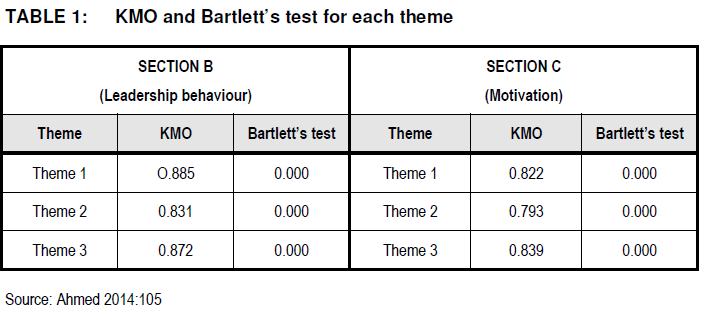
A Kaiser-Meyer-Olkin (KMO) measure of sampling adequacy and Bartlett's test of sphericity were used to explore the factorability of the questionnaire.
Table 1 shows the KMO measure of sampling adequacy and Bartlett's test of sphericity for each theme on the questionnaire. An examination of the KMO measure of sampling adequacy suggests that the population is factorable since KMO is larger than 0,7 for all themes. Bartlett's test of sphericity is highly significant for all themes with a p-value of 0.000.
Factor analysis was appropriate and was conducted with the response data. The findings of the factor analysis explained four factors in the second section and five factors in the third section. The factor analysis yielded a total of nine factors. Four of the 56 questions in the questionnaire were removed as a result of double-loading. The first four factors identified in the second section of the questionnaire related to directive, supportive, team and autocratic leadership behaviour. The five factors identified in the third section of the questionnaire were the motivation factors associated with the four leadership behaviour factors. For team leadership, two types of motivational factors were identified, namely extrinsic and intrinsic motivation.
Descriptive statistics were applied for the responses in the second section of the questionnaire to depict the leadership behaviours of sales managers. The mean values for each sales team were used. The descriptive research type for this research was a correlational design. Correlation analysis was established within each geographic sales team to identify whether the leadership behaviour of each sales manager correlated with his/her sales team's motivation. The means and the Pearson correlation coefficient (ήwere used for each sales team in order to measure the extent of the relationship between leadership behaviour of sales managers and motivation of sales teams. Correlation analysis was finally calculated as an aggregate for all six sales teams.
Considering the above procedures, the means in the second and third sections were finally compared to establish to which extent a relationship existed between leadership behaviour of sales managers and the motivation of their respective sales teams. As indicated in the first paragraph of this section, data were analysed using SPSS where the responses of each member of the sales teams were plotted on the Likert-type scale. The responses to the open-ended question in the fourth section of the questionnaire were analysed using content analysis (Hsieh & Shannon 2005). The data collected from the open-ended question were manually coded to produce key themes to represent perceptions of leadership behaviour based on the words and phrases of the respondents. As the open-ended question formed part of the questionnaire, no direct probing was possible.
Thereafter, the codes were reviewed for overlapping or common codes. The codes were eventually categorised into five categories, which are the five main themes that are represented as the findings of the fourth section. After assigning and categorising the codes into the key themes, the frequencies of the codes were counted for each category of leadership behaviour or leadership action.
Microsoft Excel was used to present the key themes. The occurrences of the identified themes were counted and are presented as bar charts based on the number of times they appeared (i.e. the frequencies). The purpose of including an open-ended question was to explore which leadership behaviours may motivate sales teams during the implementation stages of a strategic alliance strategy.
6. RELIABILITY, VALIDITY, CREDIBILITY AND ETHICAL CONSIDERATIONS
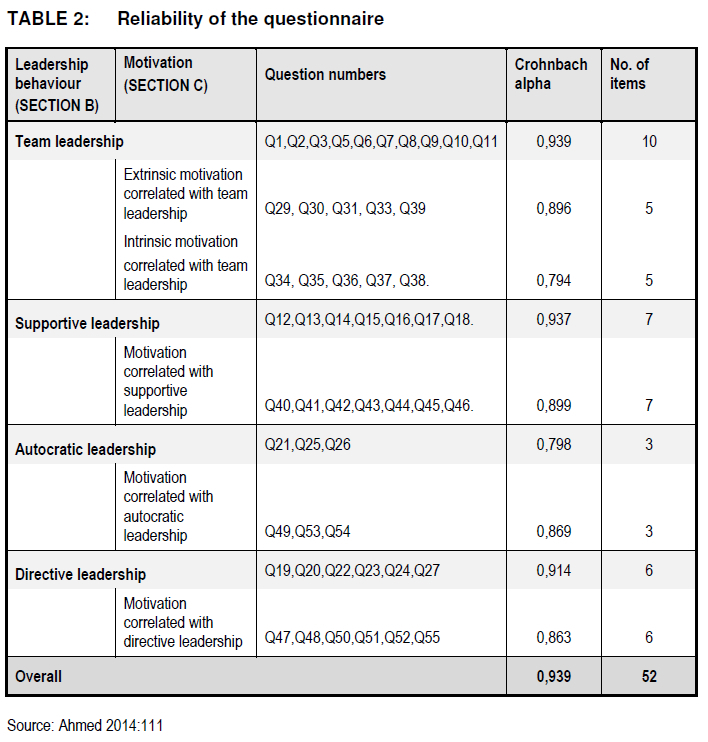
The questions formulated for the questionnaire were carefully constructed to adhere to issues of leadership behaviour and levels of motivation. Cronbach's alpha was used to test the internal reliability of the questionnaire (see Table 2).
It was recognised that the researcher's own perceptions on the subject matter could have been a threat to internal validity. As such, care was taken to remain objective and detached from personal views.
Table 2 indicates that all alpha coefficients are high and above 0,7, confirming the acceptable to excellent internal consistency of the surveyed constructs. The alpha coefficient of the entire instrument is 0,939, yielding an excellent overall level of internal consistency.
External validity was limited because the population represented a single pharmaceutical organisation. To enhance face validity, the instrument was perused and endorsed by the case organisation's human resource manager, who was an industrial psychologist and expert in the field of motivation and leadership. Credibility was established, because the researcher was employed by the case organisation and was familiar with the culture of the organisation.
This research may be transferred as a thick description of the information was provided. Care was taken to remain objective and unbiased. A detailed description of the methodology is presented, making allowance for the results to be repeated and scrutinised. Further, the research was conducted with permission of the institutional research ethics committee. Data was collected in confidentiality and no respondents were harmed in their participation of this research project. Respondents were also informed that the results were to be used for academic purposes only.
7. FINDINGS AND DISCUSSION
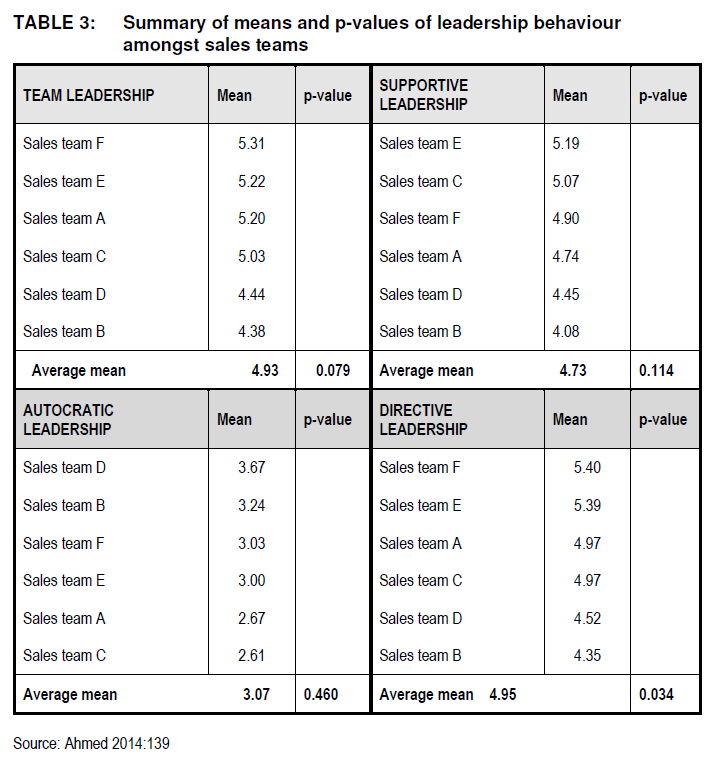
Table 3 presents a summary of means and p-values of leadership behaviour amongst the sales teams in descending order.
The purpose of this analysis was to establish the leadership behaviour of sales managers in order to achieve the aim of the research on which this article reports, namely to highlight important correlations between leadership behaviour of sales managers and motivation of their sales teams.
Table 3 indicates that the average means for team, supportive and directive leadership were 4.93, 4.73 and 4.95 respectively.
Autocratic leadership had the lowest overall mean of 3.07. There was no statistically significant difference between the sales teams for team leadership, supportive leadership and autocratic leadership (p > 0.05).
The findings indicate that all sales teams agreed that their sales managers exhibited supportive, directive and team leadership behaviour. The findings, however, show that sales teams slightly disagreed that their respective sales managers exerted autocratic leadership behaviour. It could be inferred that traditional leadership behaviours, such as autocratic leadership, were perceived to be lower due to the organisational culture or possible policies within organisations that guided certain behaviours.
In addition, based on the clustering of sales people into teams, there might have been a more participative approach within sales teams to enhance team effectiveness, whereby the need to include the feedback from sales teams was perceived as essential inputs for sales managers into decision-making processes.
The aim of this article is to report on findings that investigated to which extent a relationship existed between leadership behaviour of sales managers and sales team motivation based on perceptions of sales teams.
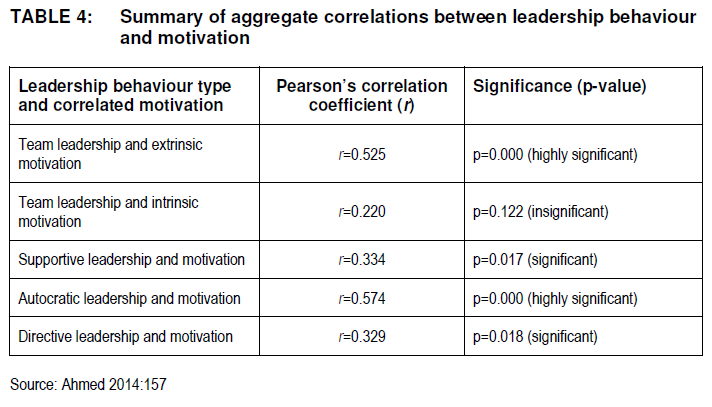
The correlation analysis aimed to determine the extent to which the leadership behaviour of sales managers showed a relationship with the motivation of sales teams. In summarising the aggregate correlation coefficients for all four leadership behaviours and the extent to which it motivated all six sales teams, the following table was compiled.
Table 4 offers a summary of aggregate correlation coefficients between leadership behaviour and motivation. Table 4 provides a summary of the results of the leadership behaviours and the correlated motivation. The r-values of all five relationships reflect a positive value for Pearson's correlation coefficient (r), indicating that the motivation of sales teams increased in relation to the leadership behaviour practised by their sales managers.
The strongest relationship among the various leadership behaviours existed between autocratic leadership and the extent to which it motivated the sales teams within the entire sales force (r-=0.574, p=0.000). The second strongest relationship was the extent to which team leadership behaviour was related to extrinsic motivation (r=0.525, p=0.000). Both relationships were statistically highly significant. The relationship between supportive leadership and motivation (r=0.334, p=0.017), as well as between directive leadership and motivation (r=0.329, p=0.018) was weak and statistically significant. The weakest relationship existed between team leadership and intrinsic motivation, which was statistically insignificant (r=0.220, p=0.122).
The findings indicate that, despite the fact that sales teams slightly disagreed that their respective sales managers employed autocratic leadership behaviour (refer to Table 1), it may appear that, when autocratic leadership behaviour is exerted, it may still be effective in certain situations, such as the situation of implementing a strategic alliance strategy. Such a strategy may require aggressive actions and this behaviour may be an effective match when actions require urgency and discipline. Despite the drawbacks of autocratic leadership behaviour, it may positively induce sales teams to accomplish tasks with a sense of urgency that may relate to motivation. The findings also suggest that leaders and managers may have flexibility in their behaviour and that no single leadership behaviour is effective in all situations.
What emerged as the next strongest relationship was the extent to which team leadership behaviour had a relationship with extrinsic motivation. The findings suggest that sales team members may motivate each other towards achieving team goals. Each member serves as an external source of motivation. Both the relationships between autocratic leadership and motivation as well as between team leadership and extrinsic motivation were highly significant.
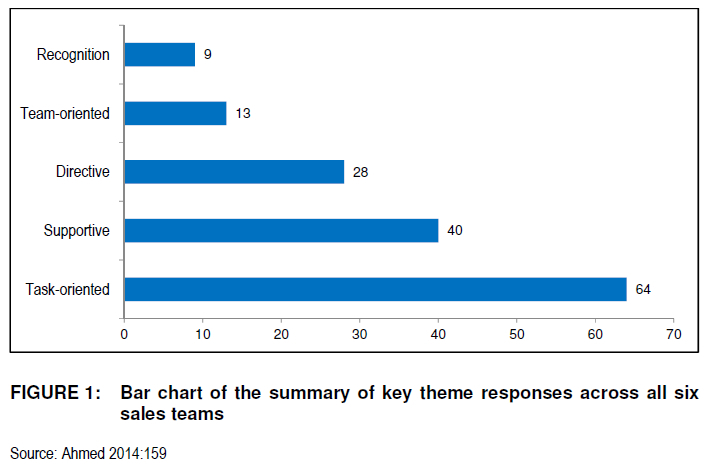
As described earlier, the final question on the questionnaire contained an open-ended question. The combined results of the sales teams' key themes, as well as a chart revealing the key themes based on the sales managers' perceptions are also included below. Figure 1 provides a summary of the key themes as an aggregate of all six sales teams.
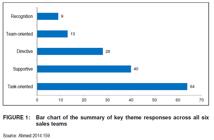
As can be viewed from Figure 1, task-oriented leadership behaviour ranked as the highest theme as it appeared 64 times in the responses. Supportive leadership behaviour ranked as the second highest leadership behaviour with a frequency of four recurrences. Sales teams ranked directive leadership as third highest, followed by team leadership behaviour. In last position was the recognition that sales teams require from their sales managers, appearing nine times.
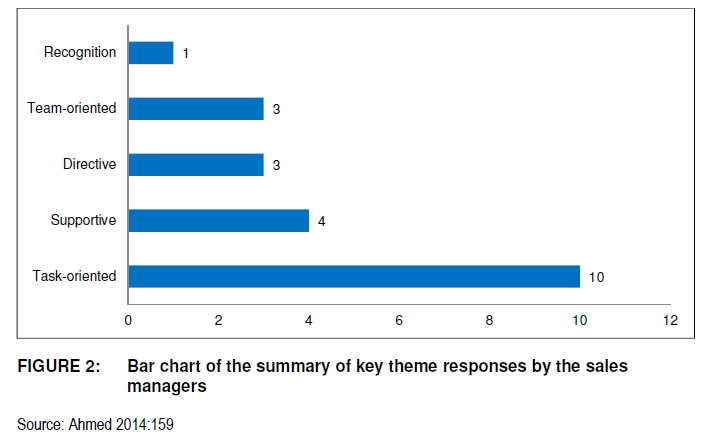
The findings of the sales managers' perceptions are presented in Figure 2.
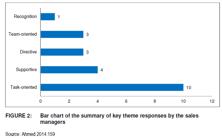
The sales managers ranked task-oriented behaviour as the highest theme they perceived would motivate the sales teams when a strategy is implemented. Task-oriented leadership behaviour appeared at a frequency of 10 times. Supportive leadership behaviour ranked in second place and appeared at a frequency of four times. Directive and team-oriented behaviour was equally ranked in third position and lastly, recognition appeared only once.
In comparing the findings of the two groups of respondents, both groups perceived task-oriented leadership behaviour as the most important behaviour that may motivate sales teams. Both groups of respondents also placed supportive leadership behaviour as the second most important leadership behaviour, followed by directive and team-oriented leadership behaviour.
Lastly, both groups perceived recognition from sales managers as an important motivator. The findings of the content analysis showed that there were similarities in perceptions between sales teams and sales managers on leadership behaviours that may motivate sales teams during the implementation of strategies. The findings of the open ended question indicated that sales managers were well attuned to the leadership behaviours that may motivate sales teams for specific purposes of implementing strategic alliance strategies.
8. LIMITATIONS OF THIS RESEARCH
Although the findings are relevant, the research was subjected to a number of limitations. Firstly, the scope of the research was limited to a single pharmaceutical organisation in South Africa. This resulted in a relatively small sample size. Consequently, generalisations cannot be made to all sales teams in the pharmaceutical industry in South Africa.
Furthermore, the population of this research comprised respondents from one pharmaceutical organisation. As a result, the respondents' perceptions may have been influenced by internal beliefs, organisational culture and general perceptions about management behaviour. This research was largely quantitative in nature with an open ended question.
The use of a Likert-type scale to draw conclusions may have impeded the quality and richness of the data collected. A qualitative research approach could have added greater insight and depth to the information gathered from the respondents.
9. IMPLICATIONS
Amongst the four leadership behaviours measured in this research, team leadership was considered to be contemporary leadership behaviour, because in contemporary leadership behaviour, leadership is transferred to other members of the team.
The organisation where this research was conducted had a traditional linear, top-down leadership structure. The application of contemporary leadership behaviour to a traditional, pharmaceutical organisation may be tested in further research.
The differences in the extent to which sales managers' leadership behaviour motivates sales teams should be acknowledged by sales managers and the organisation as a whole. Sales managers should develop a mechanism in which they find a fit between their leadership behaviour and sales team members' motivation, especially during the implementation of a strategic alliance strategy. Actions may include perceptual workshops or training in order to align sales managers' perceptions on their leadership behaviour with the sales team's perceptions.
Due to the limitation of using a Likert-type scale questionnaire, future research may include qualitative research to enhance the richness and quality of the data. In addition, further research should be conducted with different sales teams from various other pharmaceutical organisations in South Africa in order for generalisations to be made.
10. CONCLUSION
The aim of this research was achieved by investigating the relationship between leadership behaviour of sales managers and motivation of sales teams during the implementation of strategies in a pharmaceutical organisation. The findings of this research reveal that a weak to moderate relationship existed between the leadership behaviour of sales managers and the motivation of sales teams during the implementation of a strategic alliance strategy in a pharmaceutical organisation in South Africa.
A surprising finding was that the strongest relationship existed between autocratic leadership and motivation. In addition, task-oriented leadership, which is a construct of autocratic leadership, exhibited as the highest factor that motivated sales team members. Since the situation in this specific research involved a specific task of ensuring the successful implementation of a strategic alliance strategy, the findings concur that autocratic leadership with the aim of completing a specific task enhances the motivation of sales teams, hence ensuring organisational performance.
The findings also concur with some of the benefits of autocratic leadership whereby intensive inspection not only makes for quicker decision-making, but also enhances effectiveness and competitiveness (Maseti & Gumede 2011:1481)
This research confirms the relative importance of the inclusion of certain types of traditional leadership behaviour in contemporary business environments with specific practical application when a specific strategy or task is being implemented.
REFERENCES
- AHMED LC. 2014, The relationship between leadership behaviour of sales managers and the motivation of sales teams during the implementation of strategic alliances. Pretoria: University of South Africa. (Unpublished master's dissertation.
- )
-
BEHNER P, VALLERIEN S, EHRHARDT Μ & ROLLMANN D. 2009. Pharmaceutical companies in the economic storm - navigating from a position of strength, [Internet: http://www,strategyand.pwc.com/media/file/Pharmaceutical_Companies_Economic_Storm.pdf; downloaded on 2016-01-04,
» http://www,strategyand.pwc.com/media/file/Pharmaceutical_Companies_Economic_Storm.pdf -
]
» http://apps.who.int/medicinedocs/documents/s17419e/s17419e.pdf - BMI RESEARCH. 2015. South Africa: pharmaceuticals and healthcare report. London, UK: Business Monitor International.
- BRYMAN A. 2012. Social research methods.4,h ed. New York, NY: Oxford University Press.
- ]
- CARSON JB, TESLUK PE & MARRONE JA. 2007. Shared leadership in teams: an investigation of antecedent conditions and performance. Academy of Management Journal 50(5): 1217-1234.
- COCKS G. 2010. Emerging concepts for implementing strategy. TQM Journal 22(3):260-266.
- DERUE DS, BARNES CM & MORGESON FP. 2010. Understanding the motivational contingencies of team leadership. Small Group Research 41(5):621-651.
- DIRKSE VAN SCHALKWYK R, DAVIS A & PELLISIER R. 2013. The impact of leadership practices on service quality in higher private education in South Africa. Journal of Contemporary Management 10:223-238.
- DURRANI B, ULLAH O & ULLAH S. 2011. Effect of leadership on employee performance in multinational pharmaceutical companies in Pakistan. Interdisciplinary Journal of Contemporary Research in Business 2(9):286-297.
- HERSEY Ρ & BLANCHARD KH. 1977. Management of organizational behavior: utilizing human resources. 3rd ed. Englewood Cliffs, NJ: Prentice Hall.
- HREBINIAK LG. 2013. Making strategy work: leading effective execution and change. Upper Saddle River, NJ: Pearson.
- HSIEH Η & SHANNON SE. 2005. Three approaches to qualitative content analysis. Qualitative Health Research 15(9):1277-1288.
- JONES E, BROWN SP, ZOLTNERS AA & WEITZ BA. 2005. The changing environment of selling and sales management. Journal of Personal Selling & Sales Management, 25(2): 105-111.
- JOOSTE C & FOURIE B. 2009. The role of strategic leadership in effective strategy implementation: perceptions of South African strategic leaders. Southern African Business Review 13(3):51-68.
- LYNCH R. 2015. Strategic management. 7lh ed. London, UK: Pearson Education.
- MALIK ME & NAEEM B. 2009. Motivational preferences of pharmaceutical sales force: empirical evidence from Pakistan. Pakistan Economicand Social Review 47(1):19-30.
- MASETI Z & GUMEDE N. 2011. Contemporary perspectives on autocratic leadership. Journal of Contemporary Management 46(4): 1479-1487.
- MELLO JA. 2003. Profiles in leadership: enhancing learning through model and theory building. Journal of Management Education 27(3):334-361.
- MORGESON FP, DERUE DS & KARAM EP. 2009. Leadership in teams: a functional approach to understanding leadership structures and processes. Journal of Management 36:5-39.
- MOSIA MS & VELDSMAN TH. 2004. The importance of different leadership roles in the strategic management process. SA Journal of Human Resource Management 2(1):26-36.
- MUTSONZIWA K & SERUMAGA-ZAKE P. 2015. Exploring employee satisfaction and leadership attributes within the research industries in Gauteng province. Journal of Contemporary Management 12:164-183.
-
PARISI D & ADL I. 2012. Demystifying strategy execution: the critical drivers. [Internet: http://www.bts.com/news-insights/i n-the-news/news-and-press-rel eases/2012/11/26/Demystifying-strategy-execution-the-critical-drivers-aspx; downloaded on 2015-09-14.
» http://www.bts.com/news-insights/i n-the-news/news-and-press-rel eases/2012/11/26/Demystifying-strategy-execution-the-critical-drivers-aspx - ]
- PARVIN MM & KABIR MMN. 2011. Factors affecting employee job satisfaction of the pharmaceutical sector. Australian Journal of Business and Management Research 1(9):113-123,
- PEARCE JA & ROBINSON RB. 2013. Strategic management: planning for domestic and global competition. 13th ed. New York, NY: McGraw-Hill.
- ROOPAI D. 2012. Job satisfaction among pharmaceutical sales representatives in the context of Herzberg's motivation-hygiene theory. Durban: University of KwaZulu-Natal. (Master's thesis).
- RYAN RM & DECI EL. 2000, Intrinsic and extrinsic motivations: classic definitions and new directions, Contemporary Educational Psychology 25:54-67,
- SINGH VK. 2010. Job satisfaction among pharmaceutical sales force in South Africa: a case with special reference to Cape Town. Isletme Arastirmalari Dergesi 2/3:63-74.
- SPILLANE PS. 2005. Distributed leadership. The Educational Forum 69(2):143-150.
- STEERS RM, MOWDAY RT & SHAPIRO DL. 2004. The future of work motivation theory. Academy of Management Review 29(3):379-387.
- ST JOHN CH & HARRISON JS. 2010. Strategic management fundamentals. 5th ed. Melbourne, AUS: Southwestern Cengage Learning.
- THOMPSON J & MARTIN F. 2010. Strategic management: awareness and change. 6th ed. London, UK: Southwestern Cengage Learning.
- UHL-BIEN M, MARION R & MCKELVEY B. 2007. Complexity leadership theory: shifting leadership from the industrial age to the knowledge era. The Leadership Quarferly 18(4):298-317.
- WIESE M & COETZEE R. 2013. The importance of non-financial motivators to pharmaceutical sales representatives: a demographic study. South African Business Review 17(1):23-56.
- YUKL G. 2002. Leadership in organizations. 5th ed. Upper Saddle River, NJ: Prentice Hall.