Investigating the place marketing levels of Business Improvement Districts in South Africa
Abstract
Place marketing is one of the primary services offered by Business Improvement Districts in an attempt to rejuvenate decayed areas in towns and cities around the world. The success of the place marketing process is influenced by the interrelationship of the three levels of place marketing, namely target markets, place marketing factors and the place marketing planning group. The objective of this study was to identify the levels of place marketing of Business Improvement Districts in order to improve the effectiveness of the place marketing process. Judgement sampling was used to select research participants. Data was collected by conducting nine semi-structured interviews with Business Improvement District managers. Results indicated that Business Improvement Districts in South Africa primarily target property owners, business owners and residents. Place marketing factors included location, historical significance, safety and recreational facilities. The place marketing planning group comprised of multiple stakeholders, ranging from management to local residents.
Business Improvement Districts; place marketing; South Africa; urban regeneration
1. INTRODUCTION
The aftermath of World War II brought about various economic, social and political crises in urban environments and Central Business Districts (CBDs) of towns and cities around the world (Monk 2012:20-21). The crises in CBDs were mainly caused by a lack of resources, suburbanisation, divestiture, demographic challenges, crime and the implementation of ineffective and inefficient urban planning strategies. The combination of all these factors contributed to the rapid deterioration of CBDs and urban decay, and as a result large-scale decentralisation took place. Decentralisation can be described as the relocation of businesses, retail outlets, employment opportunities, residents and affluent consumers from CBDs to outlying suburban areas (Fox 2013:6).
The decentralisation of populations and businesses from CBDs, and the resultant population growth in suburbia, have led to the establishment of out-of-town retail formats such as highway commercial strips and suburban shopping centres, business complexes and retail parks (De Magalhães 2012:146). As inner-city residents and affluent consumers relocated from the decaying urban environments of CBDs to the burgeoning suburbs, rental income for property owners decreased as the demand for inner-city properties declined, and concurrently, profitability levels of businesses located within CBDs diminished due to the lack of affluent consumers in these areas. This, in turn, had an adverse effect on local governments' tax revenues. Due to a declining tax base, local governments were unable to meet administrative and financial challenges, and as such did not possess the necessary resources to provide public services to CBDs (Morcöl, Vasavada & Kim 2014:799).
As a response to these various urban challenges, Neil McLellan, a Canadian businessman, established the world's first Business Improvement District (BID). BIDs can be defined as privately directed and publicly endorsed entities that generate income through a compulsory levy on property and/or business owners within a geographically defined area in order to provide supplementary services with the primary aim of rejuvenating moribund urban milieus (Michel 2013:1014). BIDs make use of the capital obtained to offer services to its members which include security, sanitation, landscaping and place marketing (Morcöl et al. 2014:798).
According to Niedomysl and Jonasson (2012:225), place marketing refers to "the measures taken, by stakeholders appointed to govern a place, to improve the competitive image of that place with the explicit aim of attracting capital from elsewhere". Place marketing is implemented by BIDs in order to strengthen the BID's competitive position in the market through effective differentiation tactics; attracting capital in the form of stakeholders by satisfying their respective demands; improving the perceptions of the area; construct a suitable place identity and image; and to create an effective and sustainable place brand (Baker & Cameron 2008:85; Pawaskar & Goel 2014:255-257).
In order to maintain the importance and relevance of place marketing, BIDs need to devise and implement effective and efficient place marketing strategies. To do so, the different levels of place marketing need to be identified and integrated into the creation of a place marketing strategy. The levels of place marketing include the target markets of a place, the place marketing factors, and the place marketing planning group (Kotler, Hamlin, Rein & Haider 2002:46). Very little research has been conducted on the place marketing activities of BIDs - not only in South Africa, but on an international scale. In addition, no research has been conducted on the levels of place marketing pertaining to BIDs in South Africa, which creates a void in terms of the insight and knowledge required to devise effective place marketing strategies. The purpose of this study was to identify the levels of place marketing of BIDs in South Africa. The insight gained from conducting this study is required to devise and improve place marketing strategies of BIDs, and by so doing, enabling BIDs to obtain their place marketing goals and objectives more effectively. In addition, as no research has been conducted on the place marketing functions of BIDs in South Africa, the results obtained from the study contributes towards the literature on both BIDs in South Africa and place marketing.
2. BUSINESS IMPROVEMENT DISTRICTS
Van Meerkerk, Boonstra and Edelenbos (2013:1635) describe the BID model as an urban regeneration tool in which property and/or business owners develop proactive behaviour and self-organising capacity for improving and redeveloping decayed urban areas. A BID can be regarded as an organisation that is territorial in nature, as it is formed by delineating strictly defined boundaries in which it operates by delivering supplementary services to BID members. The services offered by the BID are financed and administered by the BID members themselves, who are also the primary beneficiaries of such services.
In order to illustrate the link between BIDs and the regeneration of CBDs, the academic literature highlights their role in enhancing residential development; their ability to strategically advance retail; and emphasises the importance of the place marketing component that allows a BID to market the area as a place to live, work and play, and in doing so, luring desirable stakeholders to the district. Dorritie (2010) propounds that BIDs are used as an innovative investment tool by property and/or business owners in CBDs to take control of the urban environment in which their properties are established, and to regenerate these areas through the application of various improvements and services. It is argued that BIDs can help promote, protect and empower business owners to increase their income by regenerating derelict CBDs to their former glory, and by attracting customers and investors to CBDs in order to improve business activity within the demarcated areas (Baxter 2010:9).
BIDs are responsible for a variety of different costs, including the administrative costs incurred in the day-to-day running of its operations, as well as the provision of various services and programmes aimed at improving and regenerating the area in which the BID is established. Ruffin (2010:33) confirms that the primary financing mechanism implemented by BIDs around the world is the imposition of an ad valorem levy on all BID members. Following the legal ratification of a BID, every property and/or business owner situated within the boundaries of the BID, regardless of whether they approved the BID's original proposal to be established or not, automatically becomes a statutory member of the BID, and is therefore legally obligated to pay the special levy (Baxter 2010:10).
BIDs around the world are now widening their responsibilities into areas such as strategic planning and configuration (Dorritie 2010). Whilst BIDs aim to implement a holistic strategy towards improving the district and creating a pleasant environment for its members and stakeholders, security and cleanliness remain two of the core functions of a BID (Michel 2013:1020). Provided that BIDs offer a wide variety of services to its members, an analysis of the literature pertaining to BID-related functions and services, four services have been identified that are a shared priority among most BIDs around the world. These services include security, sanitation, landscaping and infrastructure and place marketing (Morcöl et al. 2014:798).
3. PLACE MARKETING
The package of goods and services that a place of comprises makes it possible for the place to be commoditised into a marketable product, commonly referred to as the place product (Warnaby, Medway & Bennison 2010:1365), which is positioned in a global market according to an accurate analysis and matching the respective offerings of a place and those of market demand (Giovanadri, Lucarelli & Pasquinelli 2013:367; Warnaby & Medway 2013:346). A place product is a social construction of a variety of spatial elements that are co-produced by various independent businesses, both public and private (Kalandides 2011:286). A place product consists of the place's particular environment (i.e. economic, political, cultural, residential and social); the facilities offered by the place (i.e. infrastructure, the built environment, transportation and medical facilities); the various identities, images and brands of the place (i.e. place brand and/or public image); and the human resources of a place (i.e. the talent and labour force) (Zhou & Wang 2014:28). Due to their complex nature, place products cannot be marketed in the same way as stereotypical products (Skinner 2008:916-918).
According to Niedomysl and Jonasson (2012:225), place marketing refers to the measures taken, by stakeholders appointed to govern a place, to improve the competitive image of that place with the explicit aim of attracting capital from elsewhere. Eshuis, Klijn and Braun (2014:153) affirm that place marketing refers to the application of marketing instruments to geographical locations, such as cities, towns, regions and communities. For the purpose of this study, place marketing is defined as a long-term process which follows a proactive and coordinated approach towards the application of marketing instruments to a specific geographic location in order to meet stakeholder demand and to attract capital to the area, and in doing so, contributing towards the economic and cultural development of the place (Goldberg 2018:81).
3.1 Levels of place marketing
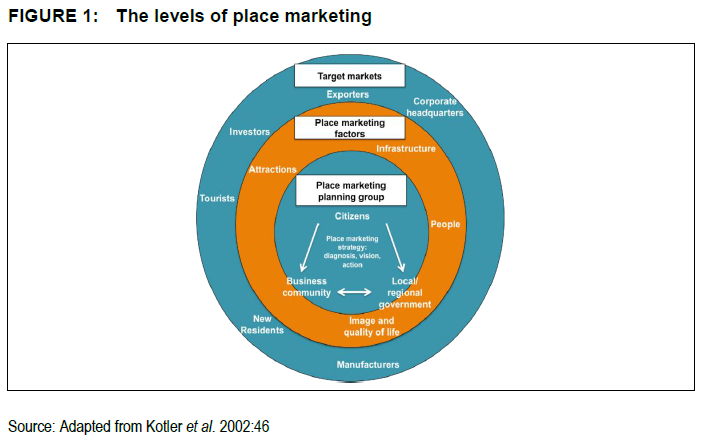
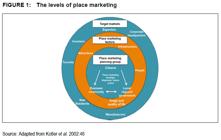
In order to maintain the relevance of place marketing on an international scale, place marketers must devise and implement effective place marketing strategies that allow places to achieve their goals and objectives, which include, among others, to improve overall place competitiveness and to attract capital through the satisfaction of both internal and external stakeholders. Baker and Cameron (2008:80) suggest six generic strategies to achieve the aforementioned objectives: (1) attracting tourists and visitors; (2) attracting businesses form elsewhere; (3) retaining and expanding existing businesses; (4) promoting small business expansions and fostering new business start-ups; (5) expanding exports and outside investments; (6) and/or expanding the population or changing the mix of residents. The proposed strategies provide evidence that various target markets are affected by a number of place marketing factors that should be controlled by a planning group assigned to devise, implement, and monitor the place marketing of a specific place. Target markets, place marketing factors, and the place marketing planning group comprise of the levels of place marketing as proposed by Kotler et al. (2002:46) and are presented in Figure 1.
3.2 Target markets
Places, similar to that of businesses, have their own target markets. A place's target markets comprise those stakeholders who benefit directly and/or indirectly from place marketing initiatives (Zenker & Beckmann 2012:65-55). In order to be effective and to improve commercial success, it is important that place marketing strategies are aimed at satisfying the needs of both internal and external target markets of a place (Basile, Dominici & Tani 2016:473). Internal target markets comprise those who already live, work and conduct business in a place, whereas external target markets are those prospective stakeholders who are not yet established in a place and who are actively targeted by place marketing strategies in order to attract them to a particular place (Berglund & Olsson 2010).
Three primary target markets of a place are identified as follows: (1) internal and external residents; (2) internal and external businesses; and (3) tourists (Hospers 2011:272; Zenker & Martin 2011:34). Arnegger and Herz (2016:83) assert that visitors (tourists) are regarded as the most important target market on which a place should focus, as their expenditures are above average mainly due to the need for accommodation, catering expenses, and their high purchasing power. Another important target market of a place is residents. Not only internal (current) residents are targeted by place marketing strategies, but, indeed, also external (prospective) residents (Berglund & Olsson 2010). According to Jessop (1998), other prominent target markets that places strive to attract are businesses and investors, both local and international. According to Zenker and Martin (2011:34), places try to attract businesses and investors by emphasising the place's marketing factors (opportunities and facilities) that match their specific commercial needs.
3.3
Place marketing factorsPlace marketing concerns the creation, communication, delivery and exchange of place offerings that have value for the stakeholders of a specific place Braun (2008:43). In Figure 1, Kotler et al. (2002:46) make use of the term place marketing factors to denote the place offerings insofar as it describes the attractors of a place, including, inter alia, any element, attribute, event, activity, business or the like that attracts people to a specific place (Mattson, Sundbo & Fussing-Jensen 2005:362). The term is used in this study to describe those aspects and/or resources of a place that can be mobilised to give the place a unique perceived value and that can be utilised in place marketing and promotional efforts to attract stakeholders to a specific place.
The aggregate of the different place marketing factors constitute the place product, and is described by Abeltina (2014) as everything within a particular place that can be promoted and marketed as a product. According to Basile et al. (2016:477), place marketing factors could be both tangible and intangible in nature. Tangible place marketing factors include, among others, the residents of the place; local celebrities and heroes; natural landscapes and features; heritage sites; museums, monuments and art; entertainment and sporting facilities; medical facilities; and other infrastructure and buildings like shopping malls, hotels, and office blocks (Basile et al. 2016:477; Berglund & Olsson 2010; Eshuis, Braun & Klijn 2013:509; Hughes 2016:6; Mattson & Sorensen 2015:198; Teller & Elms 2012:546). Intangible place marketing factors include political, cultural, and social distinctions; the standard of living among residents of the place; the level of technological advancement; investment and the investment rating; public relations; the place image and brand; fiscal laws; history; culture; services; the emotions of people; and the environment of the place, including the commercial, political, cultural, historical, technological and residential environments respectively (Basile et al. 2016:477; Mattson & Sorensen 2015:198). O'Cass, Ngo and Siahtiri (2015:195) affirm that an array of different stakeholders is necessary for the deployment and mobilisation of available place marketing factors.
3.4
Place marketing planning groupPrior to implementing the place marketing strategy, sufficient planning needs to be done. Place marketing planning comprises of: (1) reviewing and evaluating all the place marketing factors the place holds; (2) formulating a vision and various place-specific goals and objectives; (3) devising the place marketing strategy; (4) developing an action plan as to how to go about implementing the place marketing strategy; and (5) planning the implementation and control procedures of the place marketing strategy (Kotier, Haider & Rein 1993). According to Özdemir and Simsek (2015:503), place marketing planning is often difficult to organise as there are many stakeholders involved, each with their own aims, goals and motivations.
Hankinson (2007:242) propounds that the stakeholders in the planning of place marketing generally comprise an amalgamation of both public and private sector participants that primarily include local governments, businesses, and residents. The role-players of place marketing, however, are not limited to local authorities only. Jessop (1998) adds that in addition to those stakeholders involved in place marketing planning identified by Hankinson (2007:242), other authorities of place marketing include national political parties, trade unions, trade associations, chambers of commerce, local educational and religious institutions, new social movements, and public-private partnerships. External place marketing consultants are also regarded as stakeholders of place marketing planning, although the role of these consultants is merely that of a facilitator, somebody who uses sound methodological tools to extract and structure the knowledge that is already there (Kalandides 2011:288). Even though a clear distinction can be made as to those place marketing stakeholders who form part of the public sector (i.e. the local government) and the private sector (i.e. place marketing organisations) respectively, place marketing concerns all who contribute to a specific place.
4. RESEARCH METHODOLOGY
The next section will focus on the research methodology that was followed.
4.1
Research paradigmThis exploratory study adopted a constructivist paradigm to gain multiple and subjective perspectives of the place marketing levels from the experience of BID managers and executives.
4.2
SamplingNine sampling elements were identified by using non-probability judgement sampling. Judgement was passed based on: (1) whether the BID was located in South Africa; (2) whether the BID was legally ratified in terms of the Property Rates Act, Section 22 (Special Rates Areas (SRA) and the South African SRA bylaw; (3) whether the research participant is involved with the place marketing function of the BID; and (4) whether the research participant voluntarily agreed to partake in the study.
The nine sampling elements selected to partake in this study comprised of BIDs across South Africa, including BIDs in the Gauteng province, Kwazulu-Natal and Western Cape.
4.3
Data collectionData was collected in December 2017 by means of conducting 55 to 60 minute semi-structured in-depth interviews. The point of diminishing return (saturation) was reached when interviewing the eighth sampling element; however a ninth interview was conducted in order to validate this point. An interview guide was devised and used to guide the conversation. The voice recordings of the interviews were transcribed by a professional transcription service company prior to further analysis.
4.4
Data analysisThe qualitative data collected for this study was analysed by using the Morse and Field (1996) approach. The four stages of this approach include comprehension (the literature and interview transcripts were reviewed multiple times, and the data was coded accordingly), synthesis (inter-participant analysis was conducted by comparing the interview transcripts across all research participants'-:; answers after which data synthesis was implemented by applying category analysis), theorising (the literature and empirical data were analysed in order to theorise various problems and to formulate different explanations as to why it is important to identify various place marketing levels) and recontextualising of data (the theories identified were expanded on in order to determine the significance and application of place marketing levels of BIDs). The Morse and Field (1996:104) line-by-line analysis approach was implemented in order to code the data. Coding, categorising and thematic analysis was completed by using the Atlas.ti 8 qualitative data analysis software.
Trustworthiness was established by implementing the four criteria proposed by Guba and Lincoln (1981) including credibility (via member checking, prolonged engagement and peer debriefing), transferability (via member checking, scientific analysis, low-inference descriptors and purposeful sampling), dependability (via audit trails, peer debriefing, recording of interviews and transcribing interviews) and confirmability (via audit trails and reflexivity).
5. RESULTS
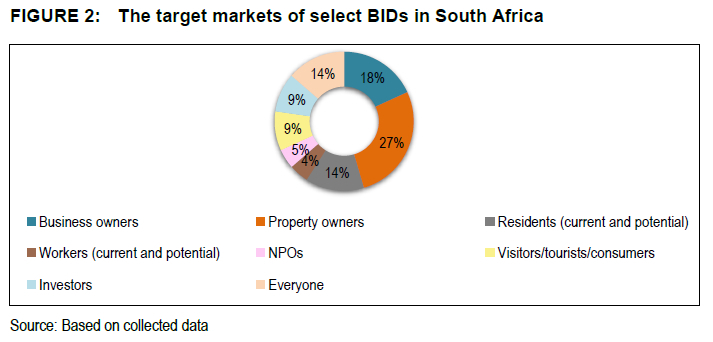
Figure 2 presents the results pertaining to the target markets of BIDs included in this study.
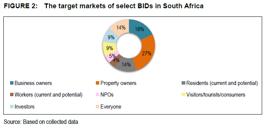
The results indicated that most BIDs have multiple target markets to which they direct their place marketing efforts. The predominant target markets across BIDs included in this study are property owners (27%) and business owners (18%). BIDs also target current and potential residents of the district (14%). Other groups that are targeted by BIDs include investors (9%) and visitors/tourists/consumers (9%). To a lesser extent, BIDs also target non-profit organisations (5%) as well as current and potential workers in the area (4%). Fourteen percent of the BIDs indicated that they aim their place marketing efforts towards all possible target markets. The target markets were highlighted by BID managers as follows:
"It's a full range which is sometimes not easy, and you don't always hit the right note" (Participant 1).
"Residents. People working here" (Participant 3). "The commercial property owners" (Participant 5).
"Visitors I would say, to invest in the area...and also corporate companies" (Participant 6).
"Largely to business and entrepreneurs to invest in the area" (Participant 7).
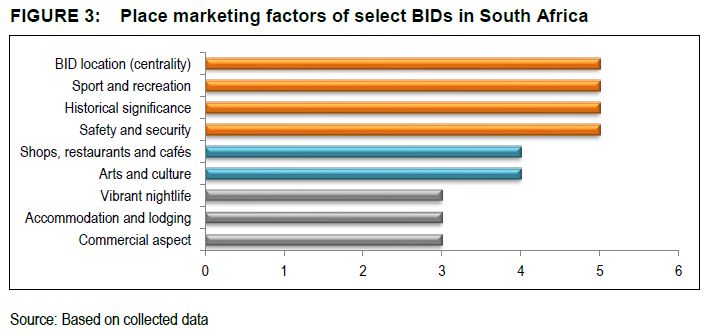
Figure 3 presents the results obtained in terms of the place marketing factors of BIDs included in this study.
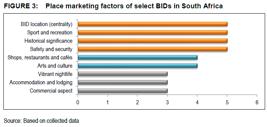
The results indicated that BIDs differ vastly in terms of their available place marketing factors. This is due to the different types of BIDs that are established in South Africa as well as the variance in location (i.e. some BIDs are established in urban areas and some BIDs are located in coastal towns and cities). Five of the nine BIDs included in this study indicated that their primary place marketing factors include the safety and security aspect of the BID; the sport and recreational facilities offered by the BID and its immediate surroundings; and the centrality of the BID's location - being near to major highways, urban precincts and other central locations. Four of the BIDs stated that they make use of the arts and culture aspect of the area to lure stakeholders to the area, as well as the various shops, restaurants and cafes situated within the BIDs' boundaries. Three of the BIDs indicated that they make use of the commercial aspect to attract desirable stakeholders, emphasising the ease of conducting business within the area. In addition, three BIDs states that the selection of accommodation and lodging options within the area also act as a major pull-factor for stakeholders, and also the vibrant nightlife offered by the array of establishments located within the BID. The place marketing factors were highlighted by the BID managers as follows:
"It's got a lot of historical significance" (Participant 2).
"There's also arts and culture" (Participant 3).
"Prime business area" (Participant 4).
"...a hub of nightlife..." (Participant 7).
"Clean, green and safe" (Participant 8).
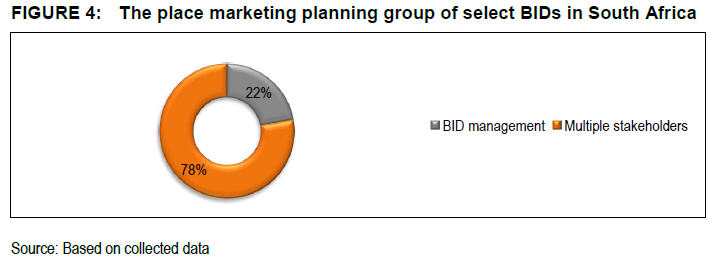
Figure 4 presents the results obtained pertaining to the place marketing planning group of BIDs included in this study.
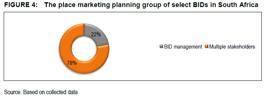
The results indicated that seven of the nine BIDs included in this study agree that the responsibility of the design, implementation and control of their place marketing strategy and respective place marketing activities lies with multiple BID stakeholders, ranging from the BID residents to the BID management. Only two BIDs stated that the responsibility of its place marketing activities solely lies with the management of the BID. The stakeholders who act as part of the place marketing planning group of BIDs were highlighted by the BID managers as follows:
"Everyone.. .the ward councillor, the residents, the life savers' club" (Participant 1).
"The varsity, ourselves and a select band of property owners" (Participant 3).
"Everybody in the district" (Participant 4).
"It's not in isolation when you're doing something like marketing strategies. This is an absolutely transparent process with everybody in the district" (Participant 5).
"The management of the CID...some of the residents are very involved...the business people also, the business leaders, the churches..." (Participant 6).
6. CONCLUSIONS AND RECOMMENDATIONS
The following section will discuss the conclusions and recommendations of the article.
6.1 Target markets of BIDs in South Africa
One of the main objectives of BIDs is to attract desirable consumers, including, inter alia, residents, tourists and affluent consumers back to the district for regeneration purposes and to increase the profitability levels of businesses located within the BID. The primary target markets of BIDs around the world include tourists, residents and business/property owners. BIDs in South Africa predominantly target property and business owners, with a few BIDs not having a clearly defined target market at all.
It is recommend that firstly BIDs in South Africa must ensure that they have a clearly defined target market to which their place marketing activities are targeted; secondly BIDs in South Africa must expand their target market(s) to include residents, tourists and affluent consumers in order to increase footfall within the district and to increase profitability levels of businesses located within the BID; and thirdly BIDs in South Africa must conduct extensive market research in order to learn more about their target markets, and in so doing, customise their place marketing strategies to reach their target audiences more effectively and efficiently.
6.2
Place marketing factors of BIDs in South AfricaThe primary place marketing factors of BIDs in South Africa include the safety and cleanliness of the BID; the historical significance of the area in which the BID is established, as well as the historical background of monuments and buildings within its confines; sport and recreation facilities located within the BID; and the location of the BID - such as being close to highway access points and other central locations within the wider town/city.
It is important for a BID to identify and promote place marketing factors inherent to the area in which it is established. If adequate place marketing factors are not known or available, place marketers should strive to amend existing factors or create new place marketing factors that are in line with the demands of stakeholders and that would attract desirable stakeholders to the area.
It is recommended that firstly BIDs in South Africa should identify and promote those place marketing factors of the area in which they are established that are most significant, and consequently deemed most attractive and valuable to BID stakeholders; secondly BIDs in South Africa should amend existing place marketing factors and/or create new place marketing factors if those that are in place are undesirable or inadequate; and thirdly BIDs in South Africa should conduct extensive market research in order to determine which place marketing factors are in line with the demands of targeted stakeholders, and actively promote (or create) those place marketing factors sought by stakeholders.
6.3
Place marketing planning group of BIDs in South AfricaThe amalgamated efforts, in terms of place marketing, between stakeholders in both the public and private sectors are important and is a necessary step in the sustainable place-development process. According to Baker and Cameron (2008:83), individual stakeholders would create less promotional impact on potential visitors than if they collaborated; a promotional campaign where resources are pooled allows the benefits to be shared equally among all stakeholders; and objectives can be achieved more effectively if stakeholders recognise their interdependencies.
Various BID stakeholders are involved in the design, implementation and control of place marketing strategies of BIDs in South Africa. The long-term success of place marketing depends on the collaboration between public institutions, private individuals and business leaders with the role of local government being particularly important.
It is recommended that firstly BIDs in South Africa must ensure that stakeholders from both the public and private sectors are responsible for the planning, implementation and control of their place marketing strategies; and secondly public and private stakeholders of place marketing must cooperate on various levels of social association, in and across different functional domains, and on different spatial scales in order to support their involvement in place marketing planning.
Even though this study was carefully devised and achieved its objectives successfully, some unavoidable limitations can be noted. Though literature is available on place marketing, very little information is available on the various levels of place marketing. The literature available on the place marketing aspect of BIDs in South Africa is also very limited and fairly outdated. The sample size of the study was representative; however the type of BIDs and their geographic locations were slightly underrepresented.
For future studies, it is recommended that the levels of place marketing of BIDs in various different countries be investigated and compared with one another. This will allow BIDs to determine the dominant target markets of BIDs around the world, as well as identify place marketing factors that are primarily mobilised by BIDs so as to attract capital. In addition, BIDs will be able to determine the composition of the place marketing planning group of BIDs around the world. A comparative study of the levels of place marketing of BIDs in different countries will ultimately allow BIDs to formulate a method of best practice with regards to their place marketing efforts.
REFERENCES
-
ABELTINA A. 2014. Place marketing attraction factors. [Internet:http://old.konferencijos.vgtu.lt/bm.vgtu.lt/public_html/index.php/bm/bm_2014/paper/viewFile/279/511; downloaded on 06 March 2018.
» http://old.konferencijos.vgtu.lt/bm.vgtu.lt/public_html/index.php/bm/bm_2014/paper/viewFile/279/511 -
]
» https://www.researchgate.net/deref/http%3A%2F%2Fdx.doi.org%2F10.1016%2Fj.jdmm.2015.11.007 -
)
» https://doi.org/10.1007/s11213-016-9372-9 -
BAKER MJ & CAMERON E. 2008. Critical success factors in destination marketing. Tourism and Hospitality Research 8(2):79-97. (DOI:https://www.researchgate.net/deref/http%3A%2F%2Fdx.doi.org%2F10.1057%2Fthr.2008.9.
» https://www.researchgate.net/deref/http%3A%2F%2Fdx.doi.org%2F10.1057%2Fthr.2008.9 -
)
» http://www-sre.wu.ac.at/ersa/ersaconfs/ersa10/ERSA2010finalpaper236.pdf -
)
» https://doi.org/10.1016/j.progress.2012.03.002 - BAXTER W. 2010. Sold out: how Ottawa's downtown business improvement areas have secured and valorised urban space. Ottawa: Carleton University. (MCom-thesis.
-
)
» https://www.researchgate.net/deref/http%3A%2F%2Fdx.doi.org%2F10.1111%2Fpuar.12044 - ]
- BRAUN E. 2008. City marketing: towards an integrated approach. Doctorate thesis. Rotterdam, The Netherlands: Erasmus University.
-
)
» https://www.researchgate.net/deref/http%3A%2F%2Fdx.doi.org%2F10.1057%2Fpalgrave.bm.2550065 -
DORRITIE A. 2010. An analysis and evaluation of business improvement districts. (Internet:http://louisville.edu/politicalscience/GSR%20%233%20A.pdf; downloaded on 27 August 2014.
» http://louisville.edu/politicalscience/GSR%20%233%20A.pdf -
)
» https://journals.co.za/content/nm_monm/2016/06/EJC190391?crawler=true -
)
» https://www.researchgate.net/deref/http%3A%2F%2Fdx.doi.org%2F10.1108%2F17538331111176093 -
ESHUIS J, KLIJN EH & BRAUN E. 2014. Place marketing and citizen participation: branding as strategy to address the emotional dimension of policy making? International Review of Administrative Sciences 80(1):151-171. (DOI:https://www.researchgate.net/deref/http%3A%2F%2Fdx.doi.org%2F10.1177%2F0020852313513872.
» https://www.researchgate.net/deref/http%3A%2F%2Fdx.doi.org%2F10.1177%2F0020852313513872 - )
-
)
» https://doi.org/10.1080/13662710500195967 -
GIOVANADRI M, LUCARELLI A & PASQUINELLI C. 2013. Towards brand ecology: an analytical semiotic framework for interpreting the emergence of place brands. Marketing Theory 13(3):365-383. (DOI:https://doi.org/10.1177%2F1470593113489704.
» https://doi.org/10.1177%2F1470593113489704 - )
- GOLDBERG RH. 2018. A strategy for measuring the place marketing performance of business improvement districts in South Africa. Potchefstroom, South Africa: North-West University. (PhD-thesis.
- )
- GUBA EG & LINCOLN YS. 1981. Effective evaluation: improving the usefulness of evaluation results through responsive and naturalistic approaches. California, CA: Jossey-Bass.
-
)
» https://doi.org/10.1016/S2212-5671(14)00194-4 -
HOSPERS G-J. 2011. Place Marketing in Shrinking Europe: Some Geographical Notes. Tijdschrift voor Economische en Sociale Geografie 102(3):369-375. (DOI:https://www.researchgate.net/deref/http%3A%2F%2Fdx.doi.org%2F10.1111%2Fj.1467-9663.2011.00672.x.
» https://www.researchgate.net/deref/http%3A%2F%2Fdx.doi.org%2F10.1111%2Fj.1467-9663.2011.00672.x -
)
» https://www.researchgate.net/deref/http%3A%2F%2Fdx.doi.org%2F10.1362%2F026725708X381966 -
]
» https://www.researchgate.net/deref/http%3A%2F%2Fdx.doi.org%2F10.1080%2F09654313.2012.722963 - JESSOP B. 1998. The narrative of enterprise and the enterprise of narrative: place marketing and the entrepreneurial city. In Hall T & Hubbard P eds. The entrepreneurial city. Chichester: Wiley. (pp 77-99.
-
)
» https://www.researchgate.net/deref/http%3A%2F%2Fdx.doi.org%2F10.1068%2Fa42481 -
)
» https://www.researchgate.net/deref/http%3A%2F%2Fdx.doi.org%2F10.1057%2Fpb.2011.5 - KOTLER P, HAIDER D & REIN I. 1993. Marketing places: attracting investment, industry and tourism to cities, states and nations. New York, NY: The Free Press.
-
MATTSON J & SORENSEN F. 2015. City renewal as open innovation. Journal of Innovation Economics & Management 16(1):195-215. (DOI:https://www.researchgate.net/deref/http%3A%2F%2Fdx.doi.org%2F10.3917%2Fjie.016.0195.
» https://www.researchgate.net/deref/http%3A%2F%2Fdx.doi.org%2F10.3917%2Fjie.016.0195 - )
- )
-
MICHEL B. 2013. A Global Solution to Local Urban Crises? Comparing Discourses on Business Improvement Districts in Cape Town And Hamburg. Urban Geography 34(7): 1011-1030. (DOI:https://doi.org/10.1080/02723638.2013.799337.
» https://doi.org/10.1080/02723638.2013.799337 - )
- )
-
MORCÖL G, VASAVADA T & KIM S. 2014. Business Improvement Districts in Urban Governance: A Longitudinal Case Study. Administration and Society 46(7):796-824. (DOI:https://doi.org/10.1177%2F0095399712473985.
» https://doi.org/10.1177%2F0095399712473985 - )
-
NIEDOMYSL T & JONASSON M. 2012. Towards a theory of place marketing. Journal of Place Management and Development 5(3):223-230. (DOI:https://www.researchgate.net/deref/http%3A%2F%2Fdx.doi.org%2F10.1108%2F17538331211269639.
» https://www.researchgate.net/deref/http%3A%2F%2Fdx.doi.org%2F10.1108%2F17538331211269639 - )
-
O'CASS A, NGO LV & SIAHTIRI V. 2015. Marketing resource-capability complementarity and form performance in B2B firms. Journal of Business & Industrial Marketing 30(2):194-207. (DOI:https://www.researchgate.net/deref/http%3A%2F%2Fdx.doi.org%2F10.1108%2FJBIM-05-2012-0087.
» https://www.researchgate.net/deref/http%3A%2F%2Fdx.doi.org%2F10.1108%2FJBIM-05-2012-0087 - )
-
ÖZDEMIR G & SIMSEK ÖF. 2015. The Antecedents of Complex Destination Image. Procedia - Social and Behavioral Sciences 175(1):503-510. (DOI:https://www.researchgate.net/deref/http%3A%2F%2Fdx.doi.org%2F10.1016%2Fj.sbspro.2015.01.1229.
» https://www.researchgate.net/deref/http%3A%2F%2Fdx.doi.org%2F10.1016%2Fj.sbspro.2015.01.1229 - )
- )
- RUFFIN FA. 2010. Hybrid governance and network management in the globalising metropolis: a comparative case study examining the impact of law on the business improvement district model in Cape Town and Newark. Brunswick, NJ: Rutgers University. (PhD-thesis.
- )
- )
-
TELLER C & ELMS JR. 2012. Urban place marketing and retail agglomeration customers. Journal of marketing management 28(5-6):546-567. (DOI: https://doi.org/10.1080/0267257X.2010.517710.
» https://doi.org/10.1080/0267257X.2010.517710 - )
- )
-
WARNABY G & MEDWAY D. 2013. What about the 'place' in place marketing? Marketing Theory 13(3):345-363. (DOI:https://www.researchgate.net/deref/http%3A%2F%2Fdx.doi.org%2F10.1177%2F1470593113492992.
» https://www.researchgate.net/deref/http%3A%2F%2Fdx.doi.org%2F10.1177%2F1470593113492992 - )
- )
- ZENKER S & BECKMANN SC. 2012. Place branding: the issue of a narrowed tourism perspective. In Tsiotsou, RH & Goldsmith RE eds. Strategic marketing in tourism services. Bingley: Emerald Group Publishing. (pp 63-77.
- )
- )
-
ZHOU L & WANG T. 2014. Social media: A new vehicle for city marketing in China. Cities 37(1):27-32. (DOI:https://doi.org/10.1016/j.cities.2013.11.006.
» https://doi.org/10.1016/j.cities.2013.11.006