Assessing Electronic Procurement at a State-Owned Enterprise in South Africa
Abstract
South Africa's state-owned enterprises (SOEs) have been related to maladministration, inefficiency, and abuse of power. In most instances, SOEs procurement departments are in the middle of illegal practices. This research argues that the effective introduction of an electronic procurement system can be one of SOEs strategic tools for fostering openness and accountability and reducing corruption. This study aimed to (i) assess procurement employees' perceptions of factors affecting the implementation of electronic procurement and (ii) investigate the statically significant relationship between factors affecting electronic procurement and the successful implementation of electronic procurement. A quantitative descriptive approach, with the use of a structured questionnaire, was employed to collect data from a sample of 130 procurement employees at a single SOE in South Africa. The Statistical Package for Social Sciences (SPSS) was employed to conduct descriptive and multivariate analyses, including factor analysis, correlations, and regression analyses. Results showed that procurement employees had negative perceptions on factors affecting the implementation of electronic procurement that include compatibility, resources, organisational cultural issues, infrastructural issues, and environmental issues. It was also found that factors affecting electronic procurement have a positive statistically significant relationship with the successful implementation of electronic procurement. This study provides recommendations for improvement to the management of procurement division within SOEs in South Africa.
Compatibility; electronic procurement system; environmental aspects; implementation; infrastructure; organisational culture and resources
1. INTRODUCTION AND BACKGROUND TO THE STUDY
In recent years, SOEs in South Africa (SA) have been linked to maladministration, inefficiency and misuse of office (Government Gazette 2018:4; Munzhedzi 2016:214; PriceWaterhouseCoopers (PWC) 2018:1). In most cases, the procurement divisions of SA SOEs were found to be in the middle of corrupt activities. According to Magubane (2017:1) the infamous Gupta saga involving Transnet and Eskom is one of the many examples where officials within SOEs procurement divisions were involved in dishonest operations. Researchers in procurement argue that the proper implementation of an electronic procurement (e-procurement) system is one of the strategies that can be employed by SOEs authorities to promote transparency, accountability and reduce corruption (Hashim, Said & Idris 2013:836; Laryea & Ibem 2014:137).
Authors in procurement, including Nawi, Roslan, Salleh, Zulhumadi and Huran (2016:329) and Hashim et al. (2013:836) bemoan the fact that most SOEs supply chain authorities, especially those in developing nations, have not yet realised the need to include opinions of procurement employees in the implementation of e-procurement. Consequently, the failure of SOEs supply chain authorities to assess procurement employees' opinions on factors affecting e-procurement has led to poor implementation and the continued use of paper-based procurement systems that are susceptible to corruption (Korir, Afande & Maina 2015:59).
Whilst many research studies have focused on e-procurement (Afolabi, Ibem, Aduwo, Tunji-Olayeni & Oluwunmi 2019:1; Alomar & de Visscher 2017:103; Gunasekaran & Ngai 2008:159; Rahim 2020:55; Ramkumar, Schoenherr, Wagner & Jenamani 2019:333; Toktas-Palut, Baylav, Teoman & Altunbey 2014:77) there is scant research on precursors influencing the implementation of e-procurement and the effect of the successful implementation of an e-procurement system at an organisation such as an SOE. Within the SA context, prior scholars have conducted their studies centred on the issue of procurement in different contexts by focusing on:
• Public procurement as a tool to drive innovation in SA (Bolton 2016:1);
• Implementation of regulation-based e-procurement in the Eastern Cape provincial administration (Van Greunen, Herselman & Van Niekerk 2010: 3655);
• Implementation of e-procurement by the Gauteng Department of Infrastructure Development and its impact on the development of small- and medium construction firms (Sithole 2017:1);
• The use of e-procurement in the SA construction industry (Ibem & Laryea 2015:364);
• Gender-based e-procurement within the City of Johannesburg Metropolitan municipality (Kithatu-Kiwekete & Vyas-Doorgapersad 2017);
• Public procurement trends and developments in SA (Ambe 2016:277);
• Electronic public procurement as a tool of reform in SA public procurement (Kramer 2016:1).
Deducing from the aforementioned studies, there is a knowledge gap and lack of studies focusing on factors influencing the implementation of e-procurement as well as the effect of the successful implementation of an e-procurement system at an organisation such as an SOE in SA. Applying international studies in a SA context would raise the question of their appropriateness and applicability. As findings on determinants predicting e-procurement vary across countries and cultures (Mariam & Kisimbii 2020:14; Sabato, Datche & Ogolla 2019:503; Suliantoro & Ririh 2019:8), some studies are needed at the local setting to increase the relevance and accuracy of the results. In terms of the conceptual model proposed in this study, it can be noted that it is one of a kind. This research thus adds to the literature by taking results from a geographically distinct context, a developing country such as SA.
Consequently, this article aims to provide a more informed and empirically based image of the precursors influencing the implementation of e-procurement and to investigate its effect on the successful implementation of an e-procurement system. Therefore, this article seeks to answer the following primary question:
• To what extent do factors affecting e-procurement influence the successful implementation of e-procurement?
The specific objectives of the article are (i) to assess procurement employees' perceptions of factors affecting the implementation of e-procurement and (ii) to measure the relationship between factors affecting e-procurement and the successful implementation of e-procurement.
The structure of the article is as follows: first, the empirical literature is presented, followed by a theoretical model and hypotheses statements. The research design and methodology are then presented followed by a presentation of the results and the discussions. The final sections of the article discuss the implications, limitations and future research directions.
After a search on scholarly online databases and search engines, the literature was reviewed around this study's variables. This section looks at the literature about the difference between procurement and e-procurement as well as the research variables under investigation, namely e-procurement systems, resources, compatibility, organisational culture, infrastructure, environmental aspects and empirical evidence on the factors affecting the implementation of e-procurement.
2.1 A contrast between procurement and e-procurement
Procurement is defined by Dhull and Narwal (2016) as the integration of manufacturing activities starting from raw materials to the final products and distribution to customers. On the other hand, Dube and Gawande (2011) explained procurement as the movement of materials from the source to the end customers. The definitions provided by both Dube and Gawande (2011) and Dhull and Narwal (2016) point out to the fact that procurement is coordinated by a network of different channel partners and activities. Dube and Gawande (2011) further provide these channel network aspects as suppliers, manufacturing centres, warehouses, transportation, distribution centres, retail outlets, raw materials, work in progress inventory and finished products.
On the other hand, e-procurement is a concept introduced within the supply chain processes to make operations effective and efficient. E-procurement is therefore an advancement on the traditional paper-based procurement system (Nawi et al. 2016:329). According to Patel, Kumar and Khajuria (2016:264), e-procurement is a transformed version of the traditional purchase of goods and services and supply of goods and services into electronic processes such as e-tendering, e-awarding, e-auction and e-sourcing through the Internet. E-procurement, therefore, replaces the paper-based system with the use of computers and Internet facilities. Turban (2006:137) describes the e-procurement as the automation of procurement processes through the use of web-based applications. Bausa, Kourtidis, Liljemo, Loozen, Rodrigues and Snaprud (2013:1) posit that e-procurement involves the use of the internet and information communication technology to handle stages of the procurement process that include goods and services search, sourcing, negotiation, ordering, receipt and after purchase review. The definitions of e-procurement presented by different authors (Nawi et al. 2016:329; Patel et al. 2016:264) appreciate the significance of digital technology such as computers and the internet in facilitating acquisition and supply of goods and services to an organisation. The definitions also indicated that the paper-based systems have loopholes, are prone to manipulation and abuse by authorities is eliminated.
2.2
Electronic procurement systemElectronic procurement is defined by Patel et al. (2016:264) and Turban, King McKay, Marshall, Lee and Viehland (2008:64) as the use of Internet-based information and communication technologies (ICT) to carry out the stages involved in the procurement process, including search, sourcing, negotiation, ordering, receipt and post-purchase review. The e-procurement system provides advantages such as improved communication, transparency, corruption reduction, total integration of organisational operations, improved decision making, time-saving and cost-cutting (Patel et al. 2016:267). Given the benefits that are achieved through an effective e-procurement system, it is important to include procurement employees in the assessment of perceptions of factors that affect its implementation. Based on the theoretical framework developed by Laryea and Ibem (2014:135) and Eei, Husain and Mustaffa (2012:14), it is conceptualised that the successful implementation of e-procurement is affected by factors that include resources, compatibility, organisational culture, infrastructure and environmental aspects. These factors are clarified in the context of an SOE as follows:
2.3
ResourcesResources are a critical part of the implementation of the e-procurement system (Eei et al. 2012:17). An SOE needs to acquire sufficient resources that enable a smooth set up of the e-procurement system. According to Korir et al. (2015:59) and Eadie, Perera and Heaney (2011:669), enough capital should be put in place to finance hiring, training and development of procurement employees who are involved in running the e-procurement system. Resources, therefore, are regarded as critical in the implementation of e-procurement (Farzin & Nezhad 2010:449).
2.4
CompatibilityThe alignment of existing work processes and the e-procurement system determines the success of implementation (Hashim et al. 2013:836). It is therefore important to ensure that the hardware and software components employed are linking properly with the structure of the organisation (Isikdag, Underwood, Ezcan & Arslan 2011:117; Patel et al. 2016:267).
Patel et al. (2016:267) further assert that the e-procurement components should be widely acceptable to supply chain channel partners to enable their successful implementation.
2.5
Organisational cultureThe culture of the organisation determines the extent to which the e-procurement system is accepted (Korir et al. 2015:59). Eei et al. (2012:14) allude that a favourable organisational culture is critical in ensuring the acceptance of an e-procurement system. Eei et al. (2012:14) also posit that the organisation needs to embrace change, creativity and innovation. Thus, a degree of flexibility is expected to exist in the organisation for e-procurement to be adopted (Isikdag et al. 2011:117).
2.6
InfrastructureInfrastructural issues are essential in developing an environment that is favourable for the smooth running of an e-procurement system (Laryea & Ibem 2014:137; Turban et al. 2008:64). Lavelle and Bardon (2009:104) argue that infrastructure is needed to ensure continuous availability of the Internet, enough broadband and system developers who are supportive. The existence of sufficient infrastructure is important in ensuring that e-procurement is implemented with ease (Lou & Alshawi 2009:101).
2.7
Environmental aspectsThe environment in which the organisation exists is of utmost importance in determining the success of e-procurement processes (Munzhedzi 2016:217). Nawi et al. (2016:329) also state that the environment needed for the successful e-procurement implementation include adequate government policies and legislation on e-procurement. The usage and understanding of e-procurement systems in the market is also critical in ensuring proper implementation (Oyediran & Akintola 2011:557). The next section discusses empirical evidence on factors affecting the implementation of e-procurement.
3. EMPIRICAL EVIDENCE ON FACTORS AFFECTING IMPLEMENTATION OF ELECTRONIC PROCUREMENT
Several studies were carried out to test the factors that influence e-procurement implementation (Korir et al. 2015:59; Laryea & Ibem 2014:137; Nawi et al. 2016:329). Studies including Hashim et al. (2013:836) and Farzin and Nezhad (2010:449) looked at factors that affect e-procurement such as infrastructure, resource availability, organisational culture and environmental issues. This study also sought to investigate the same factors in a SA SOE. Eei et al. (2012:14) and Eadie et al. (2011:669) conducted studies in Malaysia and the United Kingdom respectively. In both studies, it was found that compatibility has a significant effect on the successful implementation of e-procurement systems (Eei et al. 2012:14; Eadie et al. 2011:669). Eei et al. (2012:1) and Eadie et al. (2011:669) also found that the most significant factors for compatibility include the work processes, procurement software and software solutions. However, Yamamoto and Karaman (2010:247) found that the most important factors for the implementation of e-procurement include the procurement system and the provision of support from e-procurement system providers. Considering the contestation among researchers that include Eei et al. (2012:1), Eadie et al. (2011:669) and Yamamoto and Karaman (2010:247) regarding compatibility factors and their influence on e-procurement implementation, it was important to carry out this study to find out which compatibility factors have a significant influence on e-procurement implementation.
The study by Oyediran and Atintola (2011:557) establishes that resource constraints have a huge impact on the implementation of the e-procurement system. Oyediran and Atintola (2011:559) also found that the cost of establishing the e-procurement system and hiring knowledgeable procurement employees has a huge impact on the implementation of e-procurement. Researchers such as Eei et al. (2012:14) and Oyediran and Atintola (2011:562) found that the availability of procurement employees is important in the implementation of e-procurement. Rankin, Chen, and Christian (2006:75) found that the high prices of e-procurement systems make implementation difficult. This study sought to establish the importance of resources in the implementation of e-procurement.
A study by Isikdag et al. (2011:146) found that organisational culture is a critical factor that influences the implementation of e-procurement. Lavelle and Bardon (2009:104) found that a lack of management support results in poor implementation of e-procurement. In Eei et al.'s (2012:14) study it was found that the flexibility of the organisation is critical in determining the implementation of e-procurement. Bausa et al. (2013:117) and Lou and Alshawi (2009:98) found that infrastructural issues play a critical role in determining the successful implementation of e-procurement. This study, therefore, aimed at establishing the significance of infrastructural and environmental issues in the implementation of e-procurement.
4. PROBLEM STATEMENT
As already indicated, SOEs in SA have been subjected to maladministration, abuse of office and corruption (Government Gazette 2018:4; Munzhedzi 2016:214). This situation has been most rampant in the procurement department as evidenced by the Gupta saga with SOEs such as Transnet and Eskom being implicated in the state capture (Magubane 2017:1). The utilisation of e-procurement is recognised as one of the strategies to ensure transparency, efficiency and effectiveness within the procurement divisions of SOEs in SA. Also, the existing body of knowledge has not yet tested the statistically significant relationships that could exist among factors affecting e-procurement (i.e. resources, compatibility, organisational culture, infrastructure, environmental aspects) and the successful implementation of e-procurement. The inference on this relationship is of great significance as it leads to the development of insights that are critical in assisting leadership within SOEs to develop successful e-procurement systems. It is, therefore, on this background that this study aimed to assess factors affecting the implementation of an e-procurement system at an SOE in SA.
5. PURPOSE AND SIGNIFICANCE OF THE RESEARCH
The persisting corruption within the procurement divisions at SOEs in SA (Government Gazette 2018:4) calls for strategies to improve procurement systems. Consequently, the present study aimed at improving e-procurement at an SOE through an assessment of procurement employees' perceptions of factors affecting the implementation of e-procurement. The literature, as it stands, also reflects a paucity of studies that address factors affecting e-procurement at SOEs especially in developing countries. To date, most studies addressing the implementation of e-procurement have been carried out in Europe and Asia (Eei, Husain & Mustaffa 2012:14; Nawi et al. 2016:329). A study in the SA context is suitable to close this existing gap. Factors such as organisational culture and environmental issues are usually ignored in e-procurement studies (Hashim et al. 2013:836; Korir et al. 2015:59). This study addresses these soft aspects since they are important considerations for the successful implementation of e-procurement. This study also sought to assess procurement employees' perceptions of factors affecting e-procurement. In most cases, the opinions of procurement employees who work directly with e-procurement systems are ignored. Hence, this study serves as an opportunity to address the problem by understanding the factors affecting e-procurement by considering procurement employees' opinions.
6. THE THEORETICAL MODEL AND HYPOTHESES STATEMENTS
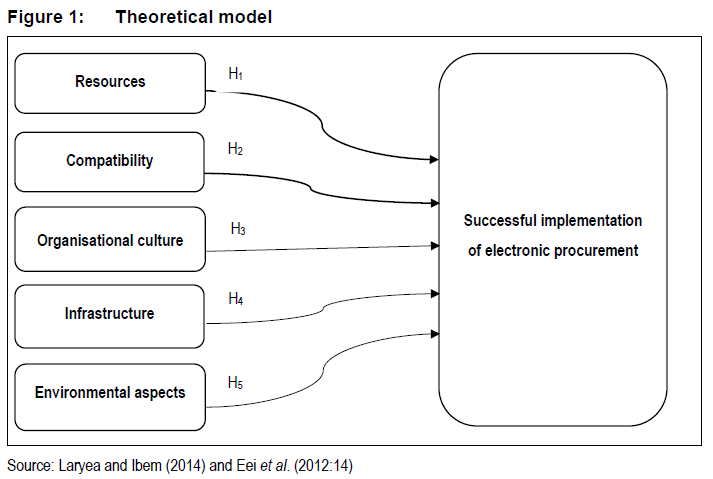
This study is grounded on the e-procurement theory (Laryea & Ibem 2014:135; Eei et al. 2012:14). The adopted theory conceptualises a relationship between factors affecting e-procurement (resources, compatibility, organisational culture, infrastructure, environmental aspects) and the successful implementation of e-procurement (Laryea & Ibem 2014:135; Eei et al. 2012:14). This relationship is expressed in a theoretical model depicted in Figure 1.
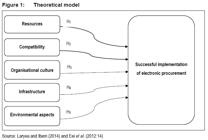
The theoretical model illustrates the suggested interconnection of six constructs, namely resources, compatibility, organisational culture, infrastructure, environmental aspects and the successful implementation of e-procurement. The relationships between the proposed constructs in the theoretical model are resources, compatibility, organisational culture, infrastructure and environmental aspects, which provide the starting point of the model (exogenous variables) and directly affect the successful implementation of e-procurement (endogenous variable).
This study used hypotheses to state specific relationships between variables in such a way that the relationships can be empirically tested. Also, the hypotheses were used to validate the theory used in the research and to allow the logical analysis of relationships of variables to deduce the interplay of those variables, based on scientific evidence regarding e-procurement systems, resources, compatibility, organisational culture, infrastructure, environmental aspects and factors affecting the implementation of e-procurement. In light of the e-procurement theory, the study developed five hypotheses statements, as follows:
H1: Compatibility has a statistically significant positive relationship with the successful implementation of e-procurement.
H2: Resources have a statistically significant positive relationship with the successful implementation of e-procurement.
H3: Organisational culture has a statistically significant positive relationship with the successful implementation of e-procurement.
H4: Infrastructural issues have a statistically significant positive relationship with the successful implementation of e-procurement.
H5: Environmental issues have a statistically significant positive relationship with the successful implementation of e-procurement.
7. METHODS AND MATERIALS OF STUDY
From the ontological perspective of objectivism of the research, this investigation pursues a positivistic framework as it seeks to discover a link between the variables presented for this analysis and uses measurement instruments for gathering data. Hence, a quantitative descriptive research design was employed to conduct the investigation. The investigation was based on a conceptual theoretical framework developed by Laryea and Ibem (2014:135), then later by Eei et al. (2012:14) on factors affecting the implementation of e-procurement in an SOE. The factors affecting the implementation of e-procurement were measured through a five-point Likert scale (Strongly Agree = 1; Agree = 2; Neutral = 3; Disagree = 4; Strongly Disagree = 5). The target population were employees working within the procurement division at an SOE in SA. The SOE had a total population of 516 employees within the procurement division country-wide (SA 2017:2). Based on Slovin's formula (Tejada & Punzalan 2012:130), the sample size for this population was 130.
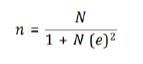
Where n = the desired sample size
e = probability of error (i.e., the desired precision, e.g., for 95% confidence level)
N = the estimate of the population size.
Non-probability sampling using a convenient sampling technique was applied (Malhotra 2010:54). The convenience sampling method envisaged was deemed not to compromise the quality of research because the sample was comprised of homogenous elements of procurement employees working within one functional division at the same SOE in SA (Malhotra 2010:54). The data were collected using a self-administered survey questionnaire, which was accessed online via SurveyMonkey®, with a link sent to the sample. The questionnaire that was used was adapted from the instrument used in the theoretical framework of Laryea and Ibem (2014:135). The collected data were analysed using IBM
Statistical Package for Social Science (SPSS) version 25. The data were prepared by evaluating them for missing data, extreme outliers and normality. After this, the descriptive statistics were analysed to understand the characteristics of the data using frequency and percentage frequency for discrete data and mean, standard deviation, skewness and kurtosis for ordinal or continuous data. The relationships between the factors affecting e-procurement and the successful implementation of e-procurement were analysed using Pearson's correlation and linear regression.
8. RESEARCH FINDINGS AND DISCUSSION
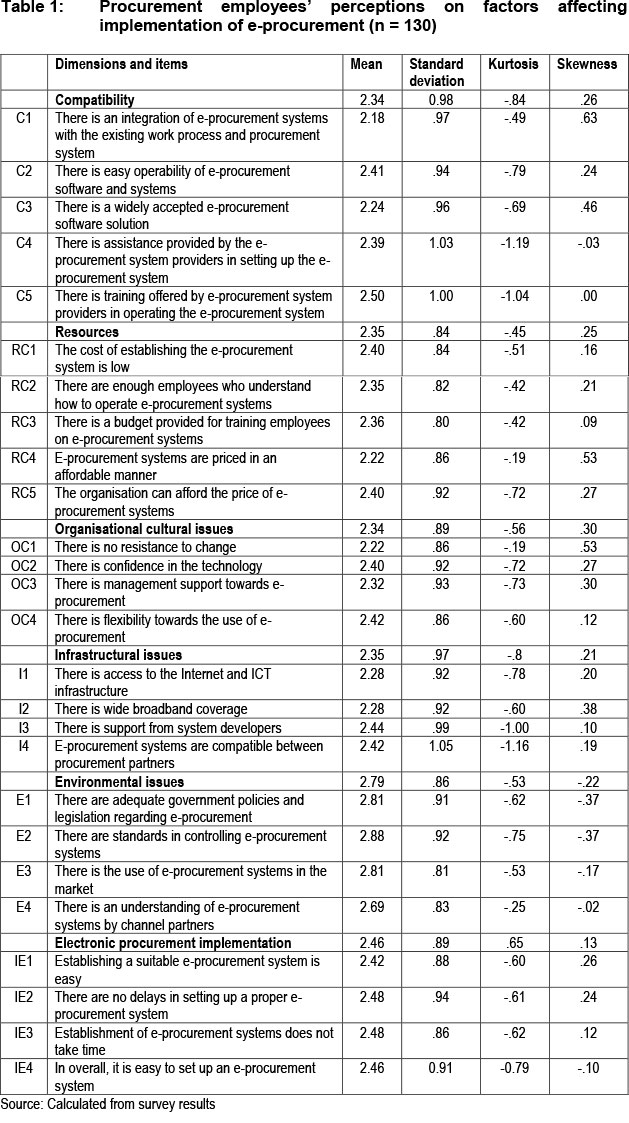
The first objective of this study aimed at assessing procurement employees' perceptions of factors affecting the implementation of e-procurement. This objective was measured through descriptive data analysis that included mean, standard deviation, kurtosis and skewness. In this study, a mean value scale that falls within the range 1.0-2.0 represented a positive perception of factors affecting the implementation of e-procurement and mean values within the range of 2.1-5.0 represented a negative perception. Factors affecting the implementation of e-procurement included compatibility, resources, organisational cultural issues, infrastructural issues and environmental issues. Table 1 describes the perceptions of procurement employees on factors affecting the implementation of e-procurement.
Before the mean and standard deviation were carried out, the researcher performed kurtosis and skewness as a standard measure to determine the normality of the data before descriptive analyses were carried out. In line with Eei et al. (2012:14) and Eadie et al. (2011:669), this study found that procurement employees had negative perceptions of all the factors that affect the implementation of e-procurement. The highest negative perceptions were on environmental issues as evidenced by the mean value (2.79). This was followed by infrastructural issues with a mean value (2.35) and resources with a mean value (2.35). Compatibility and organisational cultural issues had the least negative employee perceptions with a mean value (2.34) each. Korir et al. (2015:59) and Farzin and Nezhad (2010:449) also found that procurement employees had negative perceptions on factors such as environmental issues, infrastructure and organisational cultural matters.
9. RELIABILITY AND VALIDITY
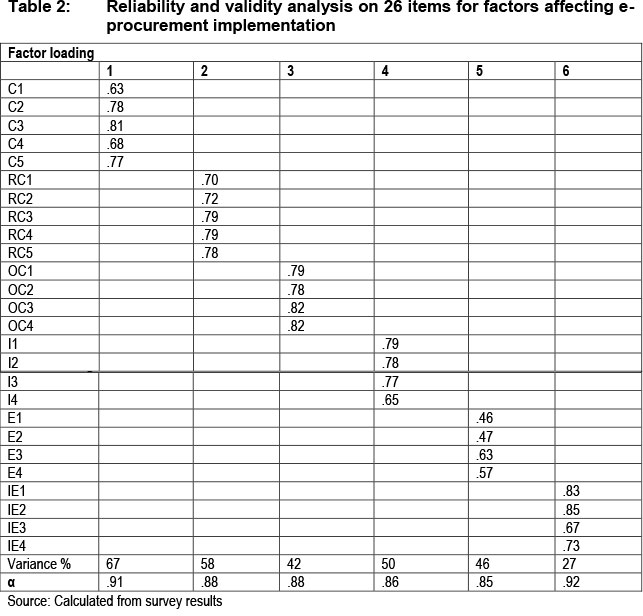
Reliability and validity were carried out in preparation for inferential analysis. Blumberg, Cooper and Schindler (2011:123) and Malhotra (2010:97) attest that validity is a test meant to ensure that a measurement instrument measures what it is set to measure. Reliability ensures the precision of the measurement instrument (Malhotra 2010:97). Validity analysis was carried out using factor analysis and a minimum threshold of 0.4 should be reached for items to be regarded as valid for inferential analysis (Field 2009:122). Reliability analysis was carried out through Cronbach's Alpha and 0.7 was the minimum allowed threshold (Field 2009:123; Malhotra 2010:71). The 26 items for factors affecting the implementation of e-procurement were measured through factor analysis and it was found that all the factors (items) had scores above 0.4, which is enough evidence for the validity of the factors. Reliability analysis also showed that all sub-constructs for factors affecting e-procurement surpassed the expected 0.7 minimum threshold. Hence, the sub-constructs and items that were employed in this study were reliable and valid. See Table 2.
Considering that the items and the sub-constructs that were employed in this study were reliable, the researcher proceeded with inferential analysis.
10. CORRELATION ANALYSIS
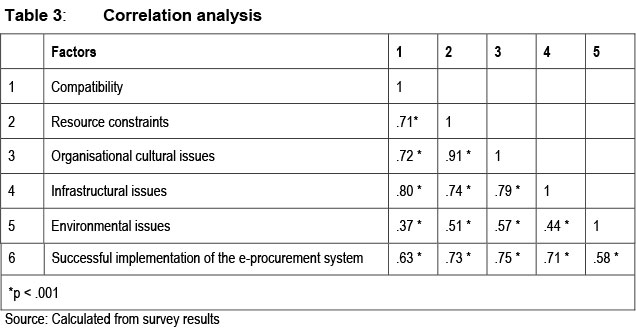
The standard requirements for conducting correlation analysis were met through reliability and validity analyses. The correlation was employed to measure the relationships between the independent and the dependent sub-constructs. The correlation was measured through Pearson's coefficient (r-value) and the probability value (p-value) (Field 2009:123).
The r-values range from (-1) to (1) (Malhotra 2010:127). The value (-1) represents a negative perfect relationship while (1) represents a positive perfect relationship (Blumberg et al. 2011:117). According to Field (2009:124), the p-value is a probability value that is employed to measure the significance of the results produced. In this study, results were regarded as significant when the p-value was 0.05 or below (Field 2009:126). Table 3 illustrates the findings of the correlation analysis.
The results on correlation analysis showed that there was a moderate to the strong significant positive relationship among sub-constructs that represent the implementation of e-procurement (compatibility, resource constraints, organisational cultural issues, infrastructural issues and environmental issues). A moderate to the strong significant relationship was found between factors affecting the implementation of e-procurement and the successful implementation of e-procurement. The next section discusses findings on a regression analysis that was employed to test the formulated hypotheses.
11. REGRESSION ANALYSIS AND HYPOTHESES TESTING
Regression analysis was conducted to test the five (5) formulated hypotheses in this study. The r-value, Beta (β) and the p-value were employed to measure the hypotheses (Malhotra 2010:127). The r-value measured the strength and the direction of the relationship between independent and the dependent sub-constructs and the p-value measured the significance of the results (Field 2009:126). According to Field (2009:126), results with a p-value equal to or less than 0.05 are regarded as significant. The five hypotheses were tested as follows:
11.1 Hypothesis H1
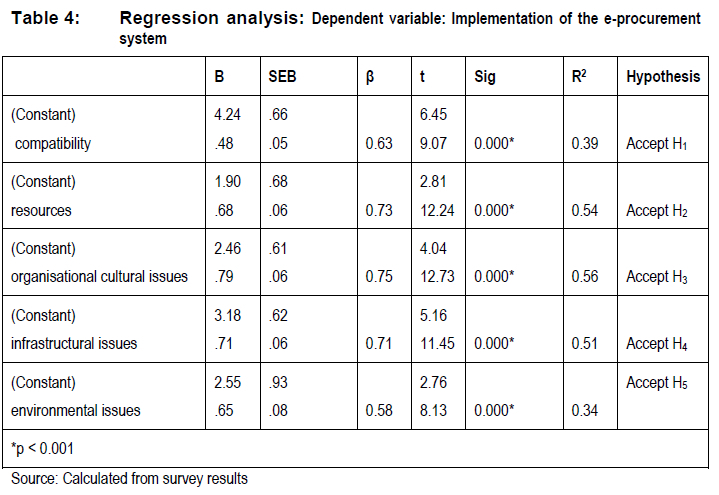
Hypothesis H1 stated that compatibility has a statistically significant positive relationship with the successful implementation of e-procurement. Based on the regression analysis findings (p < 0.001; r = 0.63; β = 0.63) provided in Table 3, this study accepts H1 at 0.05 significance level. Compatibility has a statistically significant positive relationship with e-procurement. This finding concurs with Nawi et al. (2016:329) and Korir et al. (2015:59) who also found that compatibility is critical in the successful implementation of e-procurement. However, Hashim et al. (2013:836) and Farzin and Nezhad (2010:449) specify that compatibility does not determine the success of e-procurement implementation.
11.2
Hypothesis H2Hypothesis H2 stated that resources have a statistically significant positive relationship with the successful implementation of e-procurement. Based on findings on regression analysis (p < 0.001; r = 0.73; β = 0.73), this study accepts H2 at 0.05 significance level. Resources have a statistically significant positive relationship with the successful implementation of e-procurement. Eei et al. (2012:14) and Eadie et al. (2011:669) also found that resources influence the successful implementation of e-procurement.
11.3 Hypothesis H3
Hypothesis H3 stated that organisational culture has a statistically significant positive relationship with the successful implementation of e-procurement. Based on regression analysis findings (p < 0.001; r = 0.75; β = 0.75) in Table 1.4, this study accepts H3 at 0.05 significance level. This study found that organisational cultural issues have a statistically significant positive relationship with the successful implementation of e-procurement. The findings in this study mirror Isikdag et al. (2011:146) and Yamamoto and Karaman (2010:247) who found organisational cultural issues to be critical in the successful implementation of e-procurement.
11.4 Hypothesis H4
Hypothesis H4 stated that infrastructural issues have a statistically significant positive relationship with the successful implementation of e-procurement. Based on regression analysis findings (p < 0.001; r = 0.71; β = 0.71) provided in Table 1.4, this study accepts hypothesis H4 at 0.05 significance level. Thus, infrastructural issues have a statistically significant positive relationship on the successful implementation of e-procurement. This finding is in line with Nawi et al. (2016:329) and Korir et al. (2015:59) who also found that infrastructural issues are critical in the implementation of the successful implementation of e-procurement. However, Hashim et al. (2013:836) and Farzin and Nezhad (2010:449) found that infrastructural issues on their own are not enough to determine the successful implementation of e-procurement.
11.5
Hypothesis H5Hypothesis H5 stated that environmental issues have a statistically significant positive relationship with the successful implementation of e-procurement. Based on findings on regression analysis (p < 0.001; r = 0.58; β = 0.58) provided in Table 4, this study accepts H5 at 0.05 significance level. In this study, it was found that environmental issues have a positive correlation with the successful implementation of e-procurement. Eei et al. (2012:14) and Eadie et al. (2011:669) also found that environmental issues influence the successful implementation of e-procurement.
The R2 represents the explanatory power of independent constructs on the dependent construct. This study found that organisational cultural issues had the highest explanatory power (influence) on the successful implementation of e-procurement with a value (R2 = 0.56). Resources followed with an explanatory value (R2 = 0.54), infrastructural issues with (R2 = 0.51), compatibility (R2 = 0.39) and perceived environmental issues with (R2 = 0.34).
12. CONCLUSION ON RESEARCH OBJECTIVES AND RESEARCH QUESTION
The objectives of this study were two-fold, thus to (i) assess procurement employees' perceptions of factors affecting the implementation of e-procurement and (ii) investigate the statistically significant relationship between factors affecting e-procurement and the successful implementation of e-procurement. The research question was formulated as: To what extent do factors affecting e-procurement influence the successful implementation of e-procurement? Based on the mean values and standard deviation in Table 1 the conclusion on the first objective is drawn and it is concluded that procurement employees have negative perceptions on factors affecting the implementation of e-procurement, which include compatibility, resources, organisational cultural issues, infrastructural issues and environmental issues. Conclusion on the second objective is made based on correlation and regression results in Table 3 and 4. Hence, it is concluded that factors affecting e-procurement, such as compatibility (p < 0.001; r = 0.63; β = 0.63), resources (p < 0.001; r = 0.73; β = 0.73), organisational culture (p < 0.001; r = 0.75; β = 0.75), infrastructural issues (p < 0.001; r = 0.71; β = 0.71) and environmental issues (p < 0.001; r = 0.58; β = 0.58) have a statistically significant influence on the successful implementation of e-procurement. The conclusion of the research question is also made based on the explanatory values (R2) in Table 4. It is concluded that factors affecting e-procurement influenced successful e-procurement at varying levels. Thus, organisational cultural issues (R2=0.56) have the highest influence on the successful implementation of e-procurement, followed by resources (R2=0.54), infrastructural issues (R2=0.51), compatibility (R2=0.39) and environmental issues (R2=0.34), respectively.
13. IMPLICATIONS FOR PRACTICE
It is concluded that procurement employees had negative perceptions of factors that affect the implementation of e-procurement. Based on this conclusion, recommendations are provided to members of procurement management at a specific SA SOE. These recommendations have implications for practice as discussed next.
13.1
Train procurement employees to operate the e-procurement systemThe findings show that procurement employees struggle to operate the e-procurement system. The SOE should establish a training contract with the e-procurement software supplier. In the contract, it should be specified that the supplier is responsible for training procurement employees on how to use the procurement system and its components.
13.2
Obtaining a cost-effective e-procurement systemFindings indicate that e-procurement software is expensive. The SOE should seek cost-effective suppliers to purchase the e-procurement software at a much affordable rate. Careful consideration should also be made to ensure that cost is not the only consideration when getting the supplier for the software. Aspects such as quality and reasonable delivery conditions should be considered.
13.3
Maintain a good relationship with the suppliersIt has been mentioned that the SOE does not have a long-standing relationship with the suppliers of e-procurement software. The SOE needs to establish a long-standing relationship with the best service providers. The service provider should be qualified based on cost-effectiveness and quality.
13.4
Ensure that a flexible e-procurement system is introducedSince rigidity is one of the problems facing the e-procurement system at the SOE, the SOE must seek appropriate software that can be adjusted according to each situation. The flexibility of the software is therefore an important attribute to consider when introducing an e-procurement system.
13.5
Ensure compatibility of e-procurement software between procurement systemsLack of compatibility of the e-procurement software with the existing procurement procedures was cited as one of the problems facing the implementation of e-procurement. It is important, therefore, to ensure that e-procurement software that is compatible with all the sub-components of the existing procurement system is obtained. The SOE should request that the e-procurement is tailor-made specifically for its requirements.
13.6
The government should introduce adequate policies and legislation around e-procurementLack of uniformity within the industry, including channel partners, was also raised as one of the problems facing the establishment of an e-procurement system. The establishment of a unified system is important. The government should ensure that common systems are employed. It is also important for the government to establish adequate legislation that controls the use of an e-procurement system.
13.7
Educate channel members on the correct use of e-procurement systemsIncompatibility among channel members makes it impossible to achieve a successful e-procurement system. The SOE must educate the channel members on how to use the e-procurement system. The supplier of the e-procurement system should be provided with the role to train the channel members on the appropriate use of the system.
14. LIMITATIONS OF THE STUDY
The first limitation of this study is related to its inability to cover two (2) or more SOEs. This study was based on a single SOE. Its findings cannot be generalised to the implementation of e-procurement system at all SOEs in SA; therefore, it was limited in terms of its scope. The second limitation is about the research methodology that was used. The quantitative research methodology using a questionnaire was employed, thus foregoing the benefits of using qualitative data collection mechanisms. Interviews could have made it possible for the respondents to provide the answers in their perspective. The third limitation is in connection with the conceptual framework that was used. This study made use of a conceptual framework that comprised of only five (5) factors affecting the implementation of e-procurement. These factors included compatibility, resources, organisational cultural issues, infrastructural issues and environmental issues. These are not the only factors that influence the implementation of e-procurement. Fourth, this study adopted a cross-sectional study approach that took only a month to collect data. This, therefore, meant that data collection could not be carried out for a prolonged period.
15. DIRECTION FOR FUTURE RESEARCH
Considering that this research focused on a single SOE, future researchers can conduct a similar study and assess factors affecting the implementation of e-procurement in more than one SOE. Apart from this angle, researchers can also carry out a study that focuses on comparing factors affecting the implementation of e-procurement between SOEs and the private sector. Future research can also seek the opinion of management regarding factors affecting the implementation of e-procurement systems. Considering that this study employed a quantitative research methodology with the use of a questionnaire to collect data, respondents were not allowed to respond in their own words. A qualitative research methodology could be employed for future research to allow respondents to express themselves fully on the constructs of the study. Further research should be carried out to understand additional factors that affect the implementation of e-procurement. Future research can also be carried out using a longitudinal research design that permits the collection of data in a prolonged period. This approach would allow the researcher to monitor the possible change in the opinions of the respondents, unlike the cross-sectional research design that was used in this research.
REFERENCES
2. LITERATURE REVIEW
-
AFOLABI A, IBEM E, ADUWO E, TUNJI-OLAYENI P & OLUWUNMI O. 2019. Critical Success Factors (CSFs) for e-Procurement adoption in the Nigerian Construction Industry. Buildings 9(2):1-15. (DOI:https://doi.org/10.3390/buildings9020047.
» https://doi.org/10.3390/buildings9020047 -
)
» https://issuu.com/academic-conferences.org/docs/ejeg-volume15-issue2-article502?mode=a_p/ -
]
» https://ec.europa.eu/docsroom/documents/15443/attachments/1/translations/en/renditions/native -
AMBE IM. 2016. Public procurement trends and public procurement trends and developments in South Africa. Research Journal of Business and Management 3(4):277-290. [Internet:http://uir.unisa.ac.za/bitstream/handle/10500/22017/Ambe%20article1%202016.pdf?sequence=1/;downloaded on 08 April 2020.
» http://uir.unisa.ac.za/bitstream/handle/10500/22017/Ambe%20article1%202016.pdf?sequence=1/ -
]
» https://doi.org/10.17159/1727-3781/2016/v19i0a1286 -
]
» https://www.ijcaonline.org/proceedings/iccia/number10/5162-1074 - BLUMBERG B, COOPER DR & SCHINDLER PS. 2011. Business research methods. McGraw-Hill: London.
- )
-
DHULL S & NARWAL MS. 2016. Drivers and barriers in green supply chain management adaptation: A state of the art review. Uncertain Supply Chain Management 4:61-76. (DOI:https://doi.org/10.5267/j.uscm.2015.7.003.
» https://doi.org/10.5267/j.uscm.2015.7.003 -
)
» https://doi.org/10.1016/j.ijpe.2007.04.012 -
]
» https://core.ac.uk/download/pdf/79124292.pdf -
EADIE R, PERERA S & HEANEY G. 2011. Analysis of the use of E-procurement in the Public and Private sectors of the UK construction industry. Journal of Information Technology in Construction 16(1):669-686. [Internet:https://nrl.northumbria.ac.uk/id/eprint/6602/1/2011_39.content.08822.pdf; downloaded on 08 April 2020.
» https://nrl.northumbria.ac.uk/id/eprint/6602/1/2011_39.content.08822.pdf -
]
» https://dergipark.org.tr/en/download/article-file/440429 -
EEI KS, HUSAIN W & MUSTAFFA N. 2012. Survey on Benefits and Barriers of E-Procurement: Malaysian SMEs Perspective. International Journal on Advanced Science Engineering Information Technology 2(6):14-19. (DOI:https://doi.org/10.18517/ijaseit.2.6.238.
» https://doi.org/10.18517/ijaseit.2.6.238 -
)
» https://doi.org/10.14803/3-1-16 -
FARZIN S & NEZHAD HT. 2010. E-procurement the Golden Key to Optimizing the Supply Chains System. World Academy of Science, Engineering & Technology International Science Index 4(6):449-456. [Internet:https://publications.waset.org/10542/e-procurement-the-golden-key-to-optimizing-the-supply-chains-system; downloaded on 08 April 2020.
» https://publications.waset.org/10542/e-procurement-the-golden-key-to-optimizing-the-supply-chains-system -
]
» http://www.northumbria.ac.uk/static/5007/bepdf/journal_dec.pdf - GOVERNMENT GAZETTE. 2018. Commission of inquiry into tax administration and government by South African Revenue Service. Government Gazette. (17 June 2018, Number 41715.
-
)
» http://stratfordjournals.org/journals/index.php/journal-of-entrepreneurship-proj/article/view/409/496 -
)
» https://www.econjournals.com/index.php/ijefi/article/view/3627/pdf -
HASHIM N, SAID I & IDRIS NH. 2013. Exploring e-Pprocurement Value for Construction Companies in Malaysia. Procedia Technology 9:836-845. (DOI:https://doi.org/10.1016/j.protcy.2013.12.093.
» https://doi.org/10.1016/j.protcy.2013.12.093 -
)
» https://www.academia.edu/24382329/A_Study_to_Identify_Factors_That_Affect_e_Procurement_Implementation -
]
» http://e-journal.uum.edu.my/index.php/jict/article/view/7812 - ISIKDAG U, UNDERWOOD J, EZCAN V & ARSLAN S. 2011. Barriers to e-procurement in Turkish AEC Industry. Sophia Antipolis, France: CIB W78-W102 2011. (International Conference; 18-26 October.
-
)
» https://www.itcon.org/papers/2006_6.content.02652.pdf -
]
» http://wiredspace.wits.ac.za/jspui/bitstream/10539/24199/3/1.%20Master%20of% 20Science%20Research%20Report%20for%20Ronald%20Alfred%20Sithole.pdf -
KORIR S, AFANDE FO & MAINA MP. 2015. Constraints to Effective Implementation of E-Procurement in the Public Sector: A Survey of Selected Government Ministries in Kenya. Journal of Information Engineering and Applications 5(4):59-78. [Internet:https://www.iiste.org/Journals/index.php/JIEA/article/view/21686/21815; downloaded on 10 April 2020.
» https://www.iiste.org/Journals/index.php/JIEA/article/view/21686/21815 -
]
» https://doi.org/10.23917/jiti.v18i1.7116 -
)
» https://doi.org/10.1016/j.ijpe.2014.07.017 -
LARYEA S & IBEM EO. 2014. Barriers and prospects of e-procurement in the South African construction industry. Semantic Scholar 11 (7):137-156. [Internet:https://www.semanticscholar.org/paper/Barriers-and-prospects-of-e-procurement-in-the-Laryea-Ibem/a2ff03d37fbaa3a6c979f3ac0d1a576ff7a404f2; downloaded on 08 April 2020.
» https://www.semanticscholar.org/paper/Barriers-and-prospects-of-e-procurement-in-the-Laryea-Ibem/a2ff03d37fbaa3a6c979f3ac0d1a576ff7a404f2 - ]
-
]
» https://www.researchgate.net/deref/http%3A%2F%2Fdx.doi.org%2F10.4018%2F978-1-59904-153-7.ch005 -
LOU ECW & ALSHAWI M. 2009. CRITICAL SUCCESS FACTORS FOR E-TENDERING IMPLEMENTATION IN CONSTRUCTION COLLABORATIVE ENVIRONMENTS: PEOPLE AND PROCESS ISSUES. Journal of Information Technology in Construction 14:98-109. [Internet:https://www.itcon.org/papers/2009_10.content.08794.pdf; downloaded on 01 April 2020.
» https://www.itcon.org/papers/2009_10.content.08794.pdf - ]
-
MAGUBANE K. 2017. SIU has a stack of reports to release on maladministration at SOEs. [Internet:https://www.businesslive.co.za/bd/national/2017-09-27-siu-has-a-stack-of-reports-to-release-on-maladministration-at-soes/; downloaded on 23 July 2018]. (Business Day.
» https://www.businesslive.co.za/bd/national/2017-09-27-siu-has-a-stack-of-reports-to-release-on-maladministration-at-soes/ - )
- MALHOTRA N. 2010. Marketing research: an applied orientation. 6th ed. Upper Saddle River, NJ: Pearson.
- ]
-
MUNZHEDZI PH. 2016. South African public sector procurement and corruption: Inseparable twins? Journal of Transport & Supply Chain Management 10(1):214-235. (DOI:https://doi.org/10.4102/jtscm.v10i1.197.
» https://doi.org/10.4102/jtscm.v10i 1.197 - )
- ]
-
OYEDIRAN OS & AKINTOLA AA. 2011. A survey of the state of the art of e-tendering in Nigeria. Journal of Information Technology in Construction 16:557-576. [Internet:https://www.itcon.org/2011/32; downloaded on 08 April 2020.
» https://www.itcon.org/2011/32 - ]
- ]
-
PRICEWATERHOUSECOOPERS (PWC). 2018. Global economic crime and fraud survey 2018 South Africa. PWC. [Internet:https://www.pwc.co.za/en/assets/pdf/gecs-2018.pdf; downloaded on 06 February 2020.
» https://www.pwc.co.za/en/assets/pdf/gecs-2018.pdf - ]
- ]
-
RAMKUMAR M, SCHOENHERR T, WAGNER SM & JENAMANI M. 2019. Q-TAM: A quality technology acceptance model for predicting organizational buyers' continuance intentions for e-procurement services. International Journal of Production Economics 216:333-348. (DOI:https://doi.org/10.1016/j.ijpe.2019.06.003.
» https://doi.org/10.1016/j.ijpe.2019.06.003 - )
- ]
-
SABATO F, DATCHE E & OGOLLA P. 2019. FACTORS INFLUENCING ELECTRONIC PROCUREMENT IMPLEMENTATION BY SMALL AND MEDIUM ENTERPRISES IN KISAUNI SUB-COUNTY MOMBASA COUNTY. Strategic Journal of Business & Change Management 6(3):503-516. [Internet:https://strategicjournals.com/index.php/journal/article/view/1332/1292; downloaded on 05 April 2020.
» https://strategicjournals.com/index.php/journal/article/view/1332/1292 - ]
- ]
-
SOUTH AFRICA. 2017. Government system, structure and functions in the South African government. SA. [Internet:http://www.gov.za/about-government/government-system/structure-and-functions-south-african-government; downloaded on 31 July 2018.
» http://www.gov.za/about-government/government-system/structure-and-functions-south-african-government - ]
- )
-
TEJADA JJ & PUNZALAN JRB. 2012. On the Misuse of Slovin's Formula. The Philippine Statistician 61(1):129-136. [Internet:https://www.psai.ph/docs/publications/tps/tps_2012_61_1_9.pdf; downloaded on 08 April 2020.
» https://www.psai.ph/docs/publications/tps/tps_2012_61_1_9.pdf - ]
- )
- TURBAN E. 2006. Electronic commerce: a managerial perspective. Englewood, NJ: Prentice-Hall.
-
VAN GREUNEN D, HERSELMAN M & VAN NIEKERK J. 2010. Implementation of regulation-based e- procurement in the Eastern Cape provincial administration. African Journal of Business Management 4(17):3655-3665. [Internet:https://academicjournals.org/journal/AJBM/article-abstract/50AB23D15588; downloaded on 05 April 2020.
» https://academicjournals.org/journal/AJBM/article-abstract/50AB23D15588 - ]