Commitment to online customer community websites: the role of information quality
Abstract
Customers are increasingly making use of online customer community sites to access product related information. While this is so not much is known about customers' perceptions on quality of information shared on such sites nor the influence of such perceptions on community members. This study contributes to filling this gap by examining the influence of perceived information quality on satisfaction with community as well as on commitment to online community site. Data used in the analysis was collected in Gauteng from 221 content generating members of non-company hosted online customer communities. Structural equation modelling was used to analyse the data. The results show that members had relatively positive perceptions about quality of information available on their online community sites. Information quality was found to have significant influence on commitment to online community site and the level of this influence was found to be mediated by members' satisfaction with their community. The findings contribute to literature by empirically providing support to the positive influence of information quality in online customer community sites on content generators. From a practical perspective, the study provides marketers with insights that can assist them to retain content generating members.
commitment; content-generating members; customer community websites; information quality; online customer community
1. INTRODUCTION
Widespread usage of social media has become an integral part of communication between and among customers and businesses (Gomez, Chalmeta & Sosa-Varela 2016:56). Through social networking services individuals, including customers, are now able to come together and create online communities that meet on online customer community websites (Currás-Pérez, Ruiz-Mafé & Sanz-Blas 2013:61). Online customer community websites are virtual sites where groups of customers interact with each other to discuss consumption related issues and activities (Rouse 2014:lnternet; Zheng, Zhao & Stylianou 2013:513).
The ability of customers to connect with others online and share information has greatly changed the role of the customer in marketing communications from that of being largely passive receivers of brand messages to that of being co-creators and multipliers (Jahn & Kunz 2012:344). While online customer community sites have become a common phenomenon and are attracting large numbers of users, research shows that many fail to instil commitment among most of their members (Chen & Ku 2013:732). Relationship marketing literature, however, widely recognises the importance of customer commitment for organisational success (Zhang, Zhang, Lee & Feng 2015:305).
Taking cognisance of the fact that online customer communities are built around sharing of and access to information, this study aims at examining perceptions of the content generating members regarding quality of information available on online customer community sites and the influence of this on commitment to community sites. In doing so the study focuses on independent online customer communities. As noted by Kim and Jung (2007:234) the development of online customer communities can be initiated by companies or consumers.
The decision to focus on independently hosted online customer communities is based on the understanding that the dynamics surrounding content sharing on independent online customer communities is likely to be different from those in company hosted communities. Company sponsored communities are known to be subject to high levels of moderation some of which is aimed at removing content that may be harmful to the image of the company and/or its products and services (Rouse 2014:lnternet).
Independent customer communities on the other hand are less inclined to censor contributions on the basis that it depicts any company in the negative light. Due to lack of high levels of moderation, independent sites may become havens of contributions from a wide range of people and the quality of information available on such sites may be more questionable in nature than that found on company sponsored communities. Taking cognisance of the importance of content in the sustainability of online communities, it is essential for managers of such independently hosted online customer communities to have a good understanding of perceived levels of information quality on their community sites and the influence this has on members. This study contributes to uncovering the same.
The article is structured as follows: the next section presents the research problem followed by objectives of the study. Subsequently, a review of literature including the study's hypotheses as well as proposed conceptual model is, presented. Thereafter details of the research methodology are outlined before presenting. This is followed by discussion of results and their implications. Lastly, the limitations of the study are outlined and suggestions for future research offered before concluding.
2. RESEARCH PROBLEM
No online customer community can deliver benefits to individual users and companies without having members who contribute to content generation (Ye & Nov 2013:753). Research however shows that most people in online communities like to browse through content generated by others without contributing themselves (Hung, Lai & Chou 2015:2494). The research problem examined in this study is captured in the question below:
What influence does perceived information quality have on commitment to online customer community sites?
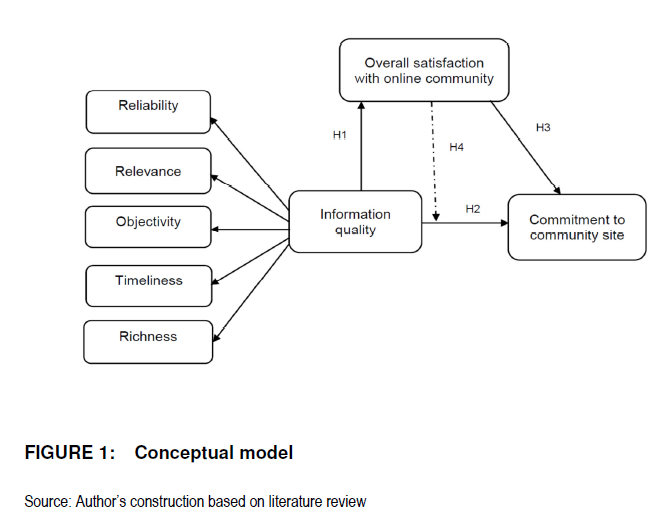
By addressing this question, this study aims at contributing to literature on commitment in the context of independently hosted online customer communities by examining the extent to which information quality can help explain commitment of content generating community. In examining the role of information quality on commitment, this study proposes a model that depicts that perceived information quality exerts both direct and indirect influence on content generators' commitment to their community websites. The indirect influence is posited to be through overall satisfaction with online community.
3. RESEARCH OBJECTIVES
The primary objective of the study is to investigate the influence of perceived information quality on commitment to online customer community sites. The specific objectives of the study are:
■ To examine perceived levels of information quality in independently hosted online customer community sites.
■ To examine the influence of perceived information quality on commitment to online customer community sites.
■ To investigate the relationship between satisfaction with online customer community and commitment to community sites.
■ To examine the influence of satisfaction with online customer community on the relationship between perceived information quality and commitment to community sites.
4.1 Information quality
Hilligoss and Rieh (2008:1469) defined information quality as 'subjective judgement of goodness and usefulness of information'. Information available online is a matter that raises a lot of quality concerns (Flanagin & Metzger 2013:1627). Flanagin and Metzger (2013:1627) observed that this is particularly so when content shared is not subject to much oversight through peer or editorial review processes before publication. While this is so, research shows that users of online information make use of different cues to help them assess information quality. These cues, commonly known as information attributes, help users assess the quality of information that they are dealing with.
As noted by Alenezi, Tarhini and Sharma (2015:330) there are varied attributes that can be used to assess information quality. Yang, Cai, Zhou and Zhou (2005:578) contended that attributes of information quality fall under two main dimensions namely usefulness and adequacy of information. They noted that included in the usefulness dimension are issues of value, currency, reliability and accuracy of information while adequacy of information is about quantity i.e. the extent to which available information is complete enough to facilitate good understanding of issues and better informed decision making. In line with assertions by Yang et al. (2005:578), in looking at information quality, this study includes attributes that relate to both usefulness and adequacy of information. The attributes examined include reliability, relevance, objectivity, timeliness and richness of information. These attributes are consistent with those identified by McKinney et al. (2002:300) as the main ones, following an extensive review of literature on information quality. In the context of this study:
■ Perceived reliability of information refers to the extent to which users perceive information available on their online customer community site as being accurate and dependable.
■ Relevance is about the extent to which information on online customer community site is perceived to be useful and in line with their needs.
■ Objectivity focuses on the extent to which information in an online customer community site is perceived to be not overly influenced by personal prejudices.
■ Timeliness is about how up to date information on online customer community site is.
■ Richness is about amount of detail available i.e. level of comprehensiveness of information available on online customer community site.
Literature shows that information quality can be examined from a single dimensional perspective or from a multi-dimensional perspective. Studies that take a uni-dimensional perspective including Chen, Jubilado, Capistrano and Yen (2015:258) and Zhang ef al. (2015:315) treat attributes as items making up the information quality construct.
Studies that take a multi-dimensional perspective such as as Zheng et al. (2013:519) treat attributes as dimensions of information quality. In examining information quality, this study takes a multidimensional perspective. The reason for this is that multidimensional constructs unlike uni-dimensional ones help capture the complexity of a construct and allow for a more in-depth understanding of a phenomenon (Edwards 2001:145).
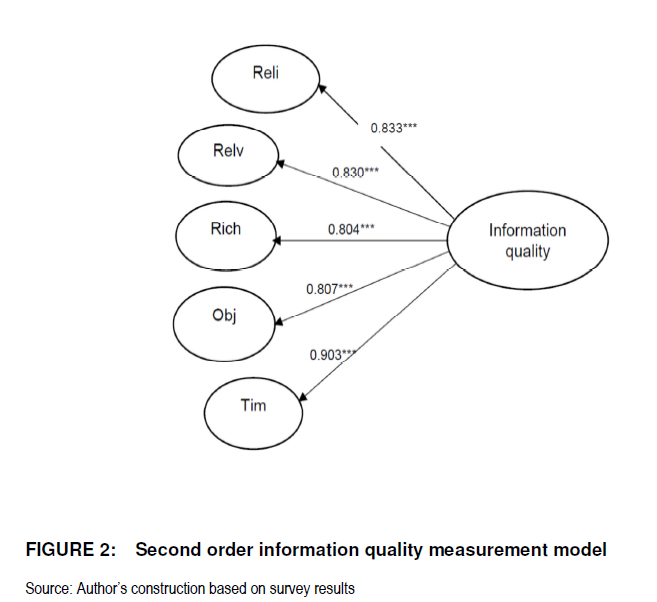
In modelling information quality, the dimensions are in this study treated as first order factors. Perceived information quality is modelled as a second order factor made up of the first order factors. This is consistent with assertions by Zheng et al. (2013: 517) that perceptions regarding information quality are as a result of the combined effects of the individual dimensions.
4.2
Information quality and overall satisfaction with online communitySatisfaction is an affective state that results from the appraisal of a variety of factors affecting a given situation (Hsiao, Chang & Tang 2016:344). Overall satisfaction with online community can be looked at as users' level of contentment with a community resulting from appraisal of factors relating to it. Ghasemaghaei and Hassanein (2015:967) pointed out that satisfaction is a well-established general measure of the success and/or effectiveness of information systems.
Chen eí al. (2015:255) noted that in appraising websites users concern themselves with a number of factors including information quality and system quality. In their study Chen et al. (2015:255) found that online information quality had the strongest influence on satisfaction compared to system quality. A meta-analysis study conducted by Ghasemaghaei and Hassanein (2015:965) also acknowledged the positive influence that online information quality has on satisfaction. Accordingly this study hypothesises that:
H1: Perceived information quality on community website has positive influence on levels of overall satisfaction with online customer community.
4.3
Information quality and commitment to online community siteCommitment is a term that captures one's "intention to continue a course of action or activity" (Seo, Green, Ko, Lee & Schenewark 2007:236). Ferro, Padin, Svensson & Pavan (2016:20) pointed out that commitment is known to exert significant effect on behaviour and consequently it is a key construct in relationship marketing literature. Of interest in this study is members' commitment to online community site. This captures one's intentions to want to continue to make use of the online community site.
Studies on commitment to online sites acknowledge the importance of perceived website's utility in influencing commitment (Nusair, Bilgihan, Okumus & Cobanoglu 2013:19). Mathwick, Wiertz and De Ruyter (2008: 841) observed that given that the primary objective behind web visits tends to be for information seeking purposes, information resources have a lot to do with benefits i.e. utility users derive from online communities. A study by Kim and Niehm (2009:227) found that information quality was positively associated with website loyalty intentions. Consistent with findings in literature, it is hypothesised in this study that:
H2: Perceived information quality on community website has positive influence on levels of commitment to online customer community website.
4.4 Effects of satisfaction
Past experience is one of the factors that is known to have direct effect on people's behaviour and behavioural intentions (Limbu, Wolf & Lunsford 2011:71; Uysal 2016:358). Marketing literature in general notes the important role that level of satisfaction in past experiences plays in influencing the decision to commit to an activity or to a relationship (Ferro et al. 2016:20).
Findings by Limbu er al. (2011:71) show that loyalty towards websites is directly influenced by satisfaction. Hashim and Tan (2015:149) found that commitment to online business community is directly influenced by levels of satisfaction with the community.
Apart from satisfaction having direct influence on behavioural intentions, findings in other studies including (Carlson & O'Cass 2011:281; Mpinganjira 2015:45) show that overall satisfaction can also play a significant role as a mediator of the relationship between consumer behavioural response and its other precursors.
A study by Carlson and O'Cass (2011:281) specifically found that the relationship between service quality and behavioural intentions is mediated by customer satisfaction. Papadomichelaki and Mentzas (2012:101) observed that content quality is a well acknowledged key component of online service quality.
A study by Lin and Lee (2006:485) shows that online information quality influences behavioural intentions through among other factors, satisfaction.
In line with findings in literature, this study posits that:
H3: There is a positive relationship between overall satisfaction with online customer community and commitment to community website.
H4: Overall satisfaction with online customer community mediates the relationship between perceived information quality and commitment to community website.
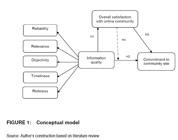
Figure 1 presents the proposed conceptual model used in the study to examine the influence of information quality on commitment to online customer community sites. The model depicts the hypothesised relationships in the study. It depicts that information quality, as second order construct, has direct influence on level of overall satisfaction with online community as well as on commitment to online customer community site. It further depicts that overall satisfaction exerts positive influence on commitment to community sites and mediates the relationship between information quality and commitment to community site.
5. RESEARCH METHODOLOGY
5.1 Research design
This article is based on a larger study of online customer communities. The study followed a quantitative research approach. A survey questionnaire was administered on members of online customer communities in Gauteng South, Africa. Use of survey method was considered appropriate for this study because of the fact that it facilitates easy collection of data from a large number of respondents (Burns & Bush 2010:235).
5.2
Participants and samplingA total of 221 members of independent online customer communities participated in the study. The respondents were chosen using convenience sampling method. This is a non-probability sampling method in which respondents are chosen based on ease of access and willingness to participate (Hair, Celsi, Oritinau & Bush 2013:145). Choice of non-probability sampling method was informed by the fact that there was no readily available list of members of online customer communities from which to draw a random sample.
5.3
MeasuresMulti-item scales were used to measure constructs of interest. Items used were adapted from literature so as to enhance the content validity (Alenezi et al. 2015:337). Items used to measure dimensions of information quality including Information reliability, relevance, richness, objectivity and timeliness were adapted from McKinney eí al. (2002:310) and Zheng et al. (2013:522). Overall customer satisfaction towards online customer community was measured using items adapted from Kim and Lee (2013:123) as well as Liang, Ho, Li and Turban 2011:79).
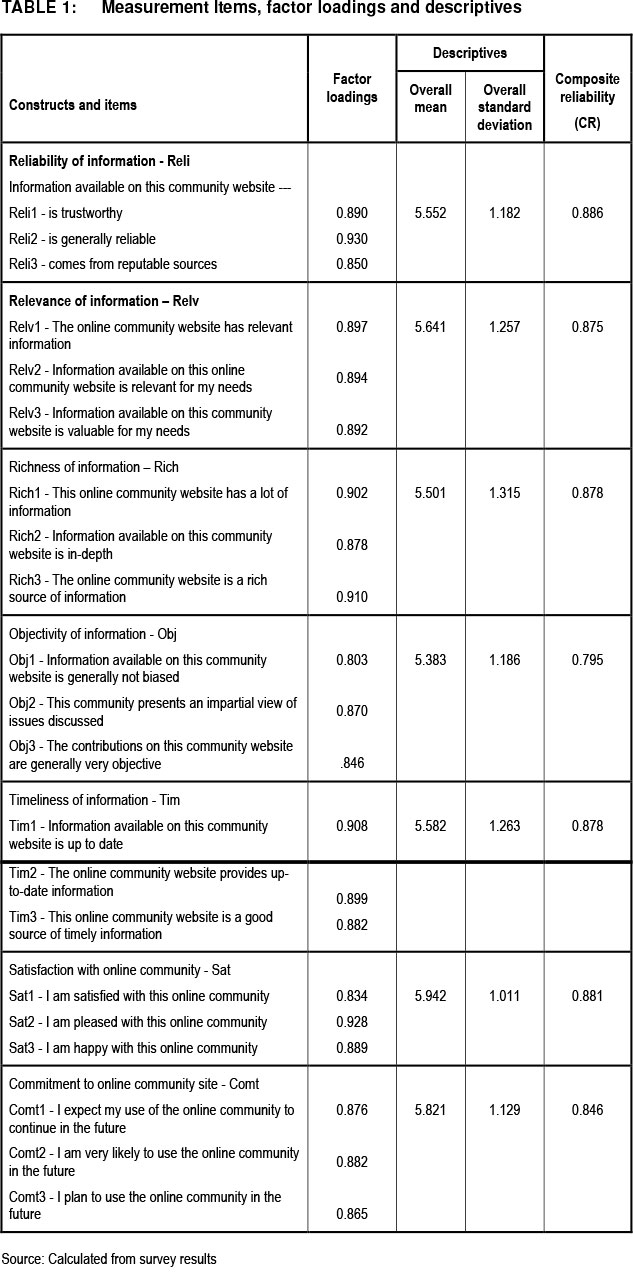
Commitment to online customer community was measured using items adapted from Hashim and Tan 2015:148 as well as Lin (2009:431). Details of items used to measure the constructs are provided in table 1. All items were measured on a seven point Likert scale ranging from 1 = very strongly disagree to 7 = very strongly agree.
5.4
Data collection and profile of respondentsData collection was done with the assistance of trained research assistants from a Gauteng based research company. Respondents were approached by the research assistants at varied public places including shopping malls and invited to participate in the study. Participation in the study was voluntary and respondents were notified accordingly. Screening questions were used to identify content generating members of online customer communities. Respondents were specifically asked to indicate if they read as well as share information on online customer community sites. Only those who not only read but also share information were allowed to participate in the study. Respondents were also asked to keep in mind one online customer community that they were a member of in mind when responding to the questions.
By the end of the data collection period 221 usable responses were obtained. 47% of the respondents were male and 53% were female. 60% of the respondents were aged between 18 and 29; 23% were aged between 30 and 35 and 17% were aged between 36 and 49. The largest percentage of respondents (42%) had been members of their online customer community for a period of 1 to 2 years followed by 25% who had been members of their online customer community for a period of 3 to 5 years. 17% had been members for less than one year while 16% were members for a period of more than five years.
5.5 Data analysis
Data analysis was conducted using version 23 of SPSS/AMOS software. Structural equation modelling was the main statistical method used to analyse the data. A two stage approach as recommended by Hair, Black, Babin and Anderson (2010:730) was followed.
In the first stage, the measurement model was assessed for goodness of fit, construct reliability and construct validity. In the second stage the structural paths were analysed. Goodness of fit of measurement model was assessed using multiple indices including the normed chi-square, the comparative fit index (CFI), the Tucker-Lewis index (TLI), the adjusted goodness of fit index (AGFI), and the root mean square error of approximation (RMSEA).
Factor loadings and average variance extracted (AVE) was used to assess convergent validity of constructs. Discriminant validity was assessed by comparing each construct's square root of the AVE with inter-correlating coefficients between constructs. The 95 percent confidence interval was used during hypotheses testing to inform the decision to accept or reject the hypothesis.
6. RESULTS
This section presents the results of the analysis.
6.1 Assessment of measurement model
The composite reliability of each of the 7 first order constructs, as shown in table 1, was found to be greater than 0.7. The actual values ranged from 0.795 for perceived objectivity of information to 0.886 for perceived reliability of information. According to Hair eí al. (2010:710) composite reliability coefficients of greater than 0.7 are indicative of high reliability.
The goodness of fit measures showed that the measurement model was acceptable as per Hair et at. (2010:672). The normed chi-square value (X2/df) was 1.618 which is within the recommended threshold of no greater than 3 (Hair eí al. 2010:672). CFI was 0.967 while TLI was 0.958. The values are above the recommended cut-off values for CFI and TLI of 0.9 as per Hair et al. (2010:672). The AGFI was 0.854 while the RMSEA was 0.053. The recommended cut-off minimum value for AGFI is 0.80 while the recommendation for RMSEA is that it should be below 0.80 (Hair eí al. 2010:672).
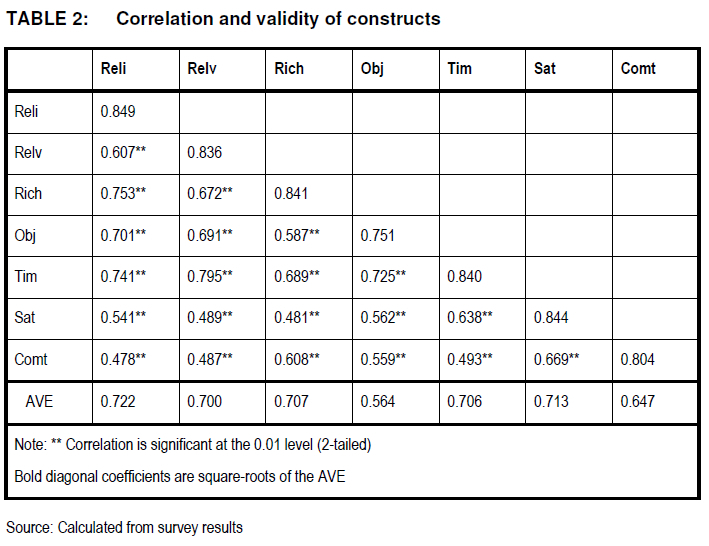
Findings presented in table 1 show that all items had loadings of greater than 0.5 on their respective constructs. Table 2 shows that the AVE estimates associated with each construct were higher than 0.5. The actual estimates ranged from 0.564 to 0.722. Hair er al. (2010:695) points out that AVEs of 0.5 or greater as well as standardised factor loading estimates of 0.5 or higher indicate adequate convergent validity. These results thus show that the measurement model met the criteria for convergent validity.
With regard to discriminant validity, results in table 2 show that the square root of the AVE for each construct was greater than the inter-construct correlation coefficients. According to Hair et al. (2010:710) discriminant validity is evidenced by AVE square root values that are greater than inter-correlation coefficients between values. The results thus show that the measurement model satisfies the criterion for discriminant validity.
6.2 Measurement model - testing for existence of second order factor
After assessing the full measurement model, the existence of the second order information quality factor made up of all first order information quality factors was tested.
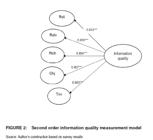
The results showed good model fit as evidenced by fit statistics that were within recommended thresholds. The normed chi-square value (X2/tlf) was found to be 1.588, the CFI was 0.977, TLI was 0.972, the AGFI was 0.890 while the RMSEA was 0.052. The results also showed that all five dimensions loaded significantly on the second order factor, see figure 2. The factor loadings as shown in figure 2 were all above 0.70. The findings thus support the existence of a second order factor.
6.3 Hypothesis testing - direct effects
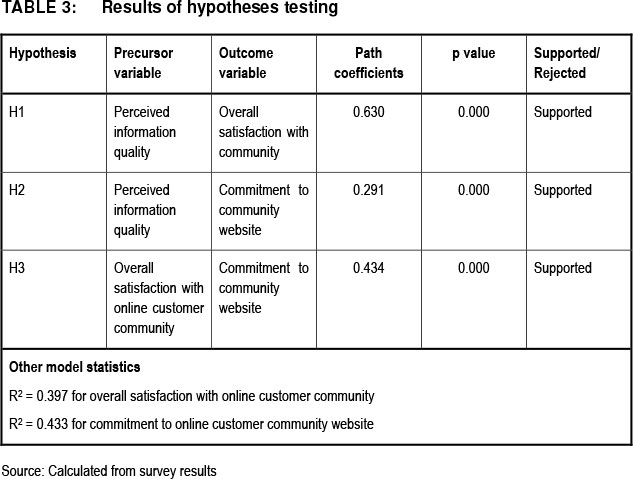
The results, presented in table 3, show that information quality, as a second order factor, exerts significant positive influence on members' overall satisfaction with their online customer communities (β = 0.630; ρ = 0.000). Information quality was also found to have significant positive influence on levels of members' commitment to online customer community website (β = 0.291; β = 0.000). The findings thus provide support for H1 and H2 which are about the direct influence of information quality on members' response.
Results in table 3 also show that overall satisfaction with online customer community exerts significant positive influence on commitment to community website (β = 0.434; ρ = 0.000). Accordingly, hypothesis 3 is accepted.
6.4 Hypothesis testing - mediation effect
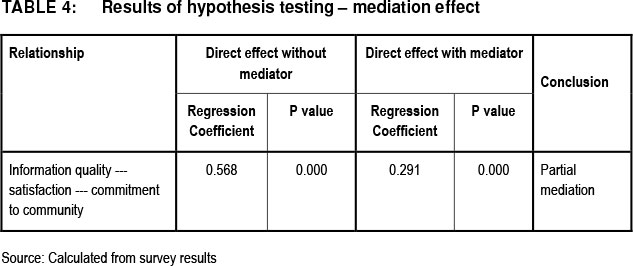
The mediation effect of overall customer satisfaction with online customer community on the relationship between information quality and commitment to community website was tested using Baron and Kenny (1986:1177) approach. Use of the procedure entailed examining results of the direct regression effect of information quality on commitment to community website and comparing these with results from regression model containing the mediator variable i.e. overall customer satisfaction with online customer community.
According to Baron and Kenny (1986:1177) mediation is established when there are changes in effect of independent variable on the dependent variable as a result of the presence of mediator variable. Findings in this study as presented in table 4 show loss of strength in level of influence of perceived information quality on commitment to community website from β = 0.568; ρ = 0.000 when the mediator variable is not present to β = 0.291; ρ = 0.000 when the mediator variable is present.
As there was no complete loss of significance, the results provide evidence of partial mediation. Accordingly hypothesis 4 is accepted.
7. IMPLICATIONS OF FINDINGS
The findings in this study shed light on perceived levels and influence of information quality in independently hosted online customer communities. The results show that in general, members perceived information available on their online customer community sites to be moderate in quality. They further show that perceived information quality exerts significant positive influence on overall levels of satisfaction with one's community and that it contributes significantly to members' commitment to community website. The findings in this study have significant implications to both researchers and practitioners.
From the research perspective this study firstly, makes significant contributions to social commerce theory by examining the influence of information quality on active online customer community members' commitment to community websites. Shin, Song and Biswas (2014:154) observed that most studies on word of mouth in online platforms focus on understanding factors related to content consumption and not content generation. By focusing on commitment of content generating members, this study contribute to understanding an important segment of members of any online customer community.
Secondly, the findings contribute to theory on conceptualisation of information quality. The discriminant validity results show that although concepts of reliability, relevance, objectivity, timeliness and richness of information are related as evidenced by significant correlations between them, they also represent distinct dimensions of information quality.
The study also contributes to theory by providing empirical support to the proposition that information quality is a significant direct antecedent of overall satisfaction with ones online customer community and also of commitment of active members to online customer community websites. Furthermore the findings show that members overall satisfaction with online customer community is a significant mediator of the relationship between perceived information quality and commitment to community website.
From practitioners' perspective the findings in this study point to the need for managers of online customer communities to take cognisance of the important role that information quality plays in influencing members' levels of overall satisfaction with online communities and their commitment to community websites. Miller (1996:lnternet) noted that the value of information lies in how it is able to affect users. In their quest for ensuring member retention, managers can focus on examining members' perceptions about quality of information associated with their managed community websites.
In their efforts aimed at enhancing information quality, the findings in this study point to the need for managers of online customer community sites to take cognisance of the fact that what gives rise to overall perceptions on information quality are varied information attributes working together. These attributes make up important dimensions of information quality. Accordingly, it is recommended that efforts aimed at improving information quality target quality at each dimensional level.
Findings in this study also point to the need for managers to take deliberate steps to enhance reliability and objectivity of information on their sites, by regularly inviting independent experts to be special guests on their sites and respond to some of the questions posted by ordinary members.
8. LIMITATIONS AND SUGGESTIONS FOR FUTURE RESEARCH
Limitations of the study include the fact that data was collected from a sample drawn from a limited geographical scope. This limits the generalisability of the findings to the wider population of active members of independent online customer communities. Subsequent research could consider replicating the study on samples drawn from other geographical areas so as to allow for comparison of findings.
Secondly, this study did not examine the direct influence of each dimension of information quality on satisfaction and commitment. Future research may consider uncovering this.
Lastly, the findings show that only 43.3% of variance in commitment could be accounted for by the model. There is thus need for more studies aimed at uncovering other factors that may help explain commitment in online customer communities among content contributing members.
9. CONCLUSION
Based on the findings in the study it can be concluded that respondents perceived information available on their respective community sites to be moderate in quality. It can further be concluded that perceived information quality exerts significant positive influence on members' levels of satisfaction with their online customer community and on their commitment intentions towards online customer community sites.
Considering the fact that contributing to content generation is an activity that members engage in voluntarily, it is important for managers of online customer communities to nurture factors that contribute to retention of content generators on their sites. To this end, this study points to the need for managers to closely put in efforts aimed at ensuring availability of high quality information on their community websites.
REFERENCES
4. LITERATURE REVIEW
- ALENEZI H, TARHINI A & SHARMA SK. 2015. Development of quantitative model to investigate the strategic relationship between information quality and e-government benefits. Transforming Government; People, Process and Policy 9(3):324-351.
- BARON RM & KENNY DA. 1986. The moderator-mediator variable distinction in social psychological research: conceptual, strategic, and statistical considerations. Journal of Personality and Social Psychology 51(6):1173-1182.
- BURNS A & BUSH R. 2010. Marketing research. 6th ed. Upper Saddle River, NJ: Pearson Prentice Hall.
- CARLSON J & O'CASS A. 2011. Developing a framework for understanding e-service quality, its antecedents, consequences, and mediators, Managing Service Quality: An International Journal 21 (3):264-286.
- CHEN JV, JUBILADO R, CAPISTRANO Ε & YEN D. 2015. Factors affecting online tax filing - an application of the IS success model and trust theory. Computers in Human Behavior43:251 -262.
- CHEN C & KU E. 2013, Bridging indistinct relationships and online loyalty: evidence from online interest-based communities. Online Information Review 37(5):731-751.
- CURRÁS-PÉREZ R, RUIZ-MAFÉ C & SANZ-BLAS S. 2013. Social network loyalty: evaluating the role of attitude, perceived risk and satisfaction. Online Information Review 37(1):61-82.
- EDWARDS JR. 2001. Multidimensional constructs in organizational behavior research: an integrative analytical framework. Organizational Research Methods 4(2):144-192.
- FERRO C, PADIN C, SVENSSON G & PAYAN J. 2016. Trust and commitment as mediators between economic and non-economic satisfaction in manufacturer-supplier relationships, Journal of Business & Industrial Marketing 31 (1):13-23.
- FLANAGIN AJ & METZGER MJ. 2013. Trusting expert-versus user-generated ratings online: The role of information volume, valence, and consumer characteristics, Computers in Human Behavior 29(4): 1626-1634,
- GHASEMAGHAEI Μ & HASSANEIN Κ. 2015. Online information quality and consumer satisfaction: the moderating roles of contextual factors-Α meta-analysis, information & Management 52(8): 965-981.
- GOMEZ LM, CHALMETA R & SOSA-VARELA JC. 2016. Usage and importance of social media for corporate communication and stakeholder dialogue. In Plangger Κ (ed). Thriving in a new world economy, pp. 56-59. New York, NY: Springer International.
- HAIR JF, BLACK WC, BABIN BJ & ANDERSON RE. 2010. Multivariate data analysis: a global perspective. 7th ed, Upper Saddle River, NJ: Prentice Hall,
- HAIR JF, CELSI MW, ORITINAU DJ & BUSH RP. 2013. Essentials of marketing research. 3rd ed. New York, NY: McGraw-Hill.
- HASHIM KF & TAN FB. 2015. The mediating role of trust and commitment on members' continuous knowledge sharing intention: a commitment-trust theory perspective. International Journal of Information Management 35(2):145-151.
- HILLIGOSS Β & RIEH SY. 2008. Developing a unifying framework of credibility assessment: construct, heuristics and interaction in context. Information Processing & Management 44(4):1467-1484.
- HSIAO CH, CHANG JJ & TANG KY. 2016. Exploring the influential factors in continuance usage of mobile social apps: satisfaction, habit, and customer value perspectives. Telematics and Informatics 33(2):342-355.
- HUNG SY LAI HM & CHOU YC. 2015. Knowledge-sharing intention in professional virtual communities: a comparison between posters and lurkers. Journal of the Association for Information Science and Technology 66(12):2494-2510.
- JAHN B & KUNZ W. 2012. How to transform consumers into fans of your brand. Journal of Service Management 23(3):344-361.
- KIM KH & JUNG YM. 2007. Website evaluation factors and virtual community loyalty in Korea. Advances in International Marketing 18:231-252.
- KIM S & LEE JS. 2013. Is satisfaction enough to ensure reciprocity with upscale restaurants? The role of gratitude relative to satisfaction. International Journal of Hospitality Management 33:118-128.
- KIM H & NIEHM LS. 2009. The impact of website quality on information quality, value, and loyalty intentions in apparel retailing. Journal of Interactive Marketing 23(3):221 -233.
- LIANG TP, HO YT, LI YW & TURBAN E. 2011. What drives social commerce: the role of social support and relationship quality. International Journal of Electronic Commerce 16(2):69-90.
- LIMBU YB, WOLF Μ & LUNSFORD DL. 2011. Consumers' perceptions of online ethics and its effects on satisfaction and loyalty. Journal of Research in Interactive Marketing 5(1):71-89.
- LIN HF. 2009, Examination of cognitive absorption influencing the intention to use a virtual community. Behaviour& Information Technology 28(5):421-431.
- LIN HF & LEE GG. 2006. Determinants of success for online communities: an empirical study. Behaviour & Information Technology 25(6): 479-488.
- MATHWICK C, WIERTZ C & DE RUYTER K. 2008. Social capital production in a virtual P3 community. Journal of Consumer Research 34(6):832-849.
-
MILLER H. 1996. The multiple dimensions of information quality. [Internet: http://www.muhlenberg.edu/depts/abe/business/miller/mdiqual.html; downloaded 20/03/2016].
» http://www.muhlenberg.edu/depts/abe/business/miller/mdiqual.html - MPINGANJIRA M. 2015. Online store service convenience, customer satisfaction and behavioural intentions: a focus on utilitarian oriented shoppers. Journal of Economics and Behavioral Studies 7(1):36-49.
- NUSAIR K, BILGIHAN A, OKUMUS F & COBANOGLU C. 2013. Generation Y travellers' commitment to online social network websites. Tourism Management 35:13-22.
- PAPADO Ml CHELAKI X & MENTZAS G. 2012. e-GovQual: a multiple-item scale for assessing e-government service quality. Government Information Quarterly 29(1):98-109.
-
ROUSE M. 2014. Online customer community. [lntemet::http://searchsalesforce,techtargetcom/definition/online-customer-community; downloaded on 2016-01-18,
» http://searchsalesforce,techtargetcom/definition/online-customer-community - ]
- SEO WJ, GREEN BC, KO YJ, LEE S & SCHENEWARK J. 2007. The effect of web cohesion, web commitment, and attitude toward the website on intentions to use NFL teams' websites. Sport Management Review 10(3):231-252.
- SHIN D, SONG JH & BISWAS A. 2014. Electronic word-of-mouth (eWOM) generation in new media platforms: the role of regulatory focus and collective dissonance. Marketing Letters 25(2):153-165.
- UYSAL A. 2016. Commitment to multiplayer online games: an investment model approach. Computers in Human Behavior 61:357-363.
- YANG Z, CAI S, ZHOU Ζ & ZHOU N. 2005. Development and validation of an instrument to measure user perceived service quality of information presenting Web portals, information & Management 42(4):575-589.
- YE C & NOV 0. 2013. Exploring user contributed information in social computing systems: quantity versus quality. Online Information Review 37(5):752-77
- ZHANG H, ZHANG KZ, LEE MK & FENG F. 2015. Brand loyalty in enterprise microblogs: influence of community commitment, IT habit, and participation. Information Technology & People 28(2):304-326.
- ZHENG Y, ZHAO K & STYLIANOU A. 2013.The impacts of information quality and system quality on users' continuance intention in information-exchange virtual communities: An empirical investigation. Decision Support Systems 56:513-524.