Leadership challenges facing the South African construction industry: A framework for human-centred leadership development
Abstract
PURPOSE OF THE STUDY: Engaging the right leadership is critical to the success and sustainability of construction organisations. Amid various industry leadership challenges, human-centred leadership (HCL) provides a beneficial solution for organisations. The study aims to examine the leadership challenges in the South African construction industry and develop a framework of strategies to foster human-centred leadership. DESIGN/METHODOLOGY/APPROACH: The study adopts a qualitative research methodology within an interpretivist paradigm. This exploratory qualitative research study lent itself to in-depth, face-to-face online interviews conducted with purposively selected construction company executives in KwaZulu-Natal. The collected data were analysed using a thematic analysis approach and NVivo 12 Pro. FINDINGS: The study highlights the need for effective leadership to address the challenges facing the South African construction industry. Human-centred leadership has emerged as an approach that promotes employee well-being and all-round organisational success. Based on the themes arising from the findings, the Coaching, Mentoring, Curating (CMC) Framework was proposed to develop human-centred leadership. RECOMMENDATIONS/VALUE: The study recommends that the construction industry develop leadership for organisational success and sustainability, highlighting human-centred leadership as an approach to facilitate transformation amidst industry challenges. The study recommends adopting the CMC framework, developed as part of the research. Future studies should examine human-centred leadership in the South African construction industry from a quantitative perspective, including other stakeholders and low-level employees. MANAGERIAL IMPLICATIONS: The study indicates significant implications for construction associations, regulatory bodies, and organisations. A shift in organisational culture, changes in leadership behaviour, influence on employee performance, innovation, and talent management are among the implications of human-centred leadership development. JEL CLASSIFICATION: L74, N67, O14.
Challenges; Construction industry; Human-centred leadership; Leadership; South African; Strategies
1. INTRODUCTION
According to the Department of Trade, Industry and Competition's annual report (2023), the South African construction industry is one of the fastest-growing sectors in the economy, contributing a significant portion of the country's GDP, playing a vital role in creating jobs, stimulating investment, and enhancing infrastructure. Consequently, efficiency, productivity, and sustainability are essential to ensure long-term organisational success in the construction industry, which, in turn, involves leadership as a crucial component of everyday operations. The construction industry is not exempt from the importance of effective leadership (Emere et al., 2018).
With the onset of numerous unprecedented disruptions and a rapidly evolving economic climate, many scholars believe that the construction industry is struggling to keep pace with the rate of change (Alade & Windapo, 2021). Studies have revealed that many challenges facing the South African construction industry relate to leadership and inadequate leadership development (Liphadzi et al., 2021). Research has shown that leadership skills and development are vital for effecting change, as the absence of appropriate leadership in the construction industry has perpetuated numerous leadership challenges (Emere et al., 2018). Developing a leadership approach to facilitate transformation amidst the challenges of the construction industry becomes imperative. Human-centred leadership that recognises the urgency of supporting employees' well-being will inevitably lead to business success and sustainability (Pascual, 2022).
Although existing scholarship has examined leadership challenges and leadership development within the construction sector, limited attention has been given to the role and application of human-centred leadership within this industry (Alade & Windapo, 2021; Liphadzi et al., 2021). Persistent challenges remain, including rigid leadership structures that struggle to respond to rapid industry change, declining project productivity, and shortages of appropriately skilled personnel. These conditions underscore the need for leadership approaches that are more adaptive, inclusive, and responsive to the evolving demands of the sector. In this regard, organisations must intentionally cultivate strategies that advance human-centred leadership to strengthen inclusion, promote equity, and reaffirm the importance of the human dimension of work in an environment characterised by disruption and uncertainty.
Against this backdrop, the overarching aim of the present study was to develop an original framework of strategies designed to foster human-centred leadership within the South African construction industry. The research responds to the pressing need for leadership approaches that address the sector's complex and persistent challenges. The framework generated by this study seeks to provide practical guidance for construction industry leaders, government stakeholders, and training institutions by outlining mechanisms for developing and embedding human-centred leadership within organisational practice.
More specifically, the study sought to examine the leadership challenges confronting the construction industry and to propose a structured framework of strategies that support the development of human-centred leadership. The insights from this investigation are particularly relevant to both current and emerging leaders in the South African construction sector, as they illuminate the leadership capabilities required to navigate contemporary industry pressures. By foregrounding the relevance of human-centred leadership within this context, the study contributes to legitimising these strategies as a coherent framework for leadership development in the South African construction industry.
2.1 The South African construction industry
Historically, the construction sector has been a major pillar of a country's economy, providing numerous employment opportunities (Alsharef et al., 2024). The South African construction industry is no exception; while encountering numerous difficulties, it is recognised as a complex sector with a substantial impact on the country's economic wealth, emphasising the need for maximum productivity in building the country (Emere et al., 2018; Madi, 2021). A study examining the performance factors of the South African construction industry underscores the industry's substantial contribution to the country's economic growth (Dithebe et al., 2018).
Industries globally have been affected by rapid change and disruption; compounding studies have shown that the South African construction industry has struggled to keep pace (Alade et al., 2021). Liphadzi et al. (2021) indicate that to succeed in the construction industry, leaders must overcome evolving technologies and employee skills gaps, manage customer relations, and prioritise immediate productivity. According to Alade et al. (2021), the South African construction industry faces various challenges that have led to the failure of many large contractors. Studies have shown that large contractor failures are attributable to poor strategic leadership (Alade et al., 2021).
An article by Gaultier (2018) opines that the South African and global construction industries are typically slow to adapt to change and advancements. A call for a new approach to leadership and the adoption of new technologies is necessary to sustain the industry (Gaultier, 2018). A study on leadership development challenges suggests that effective leadership is crucial for maintaining a competitive advantage, optimal operations, and adaptability in the construction industry (Liphadzi et al., 2021).
Evidence indicates that the construction industry lacks the relevant skilled individuals required to occupy leadership roles, suggesting that leadership development is essential for organisations (Liphadzi et al., 2021). A study by Alade and Windapo (2020) noted that uncertainty, disruption, and change are standard terms in the global industry, adding that the construction industry is no exception, with changes and disruptive events regularly challenging leadership.
2.2 Leadership challenges affecting the construction industry
According to Alade and Windapo (2021), leadership makes a significant contribution to organisational success, playing a pivotal role in facilitating change and implementing solutions to organisational challenges. A study by Aghimien et al. (2020) highlights numerous shortcomings in the South African construction industry in project delivery, including budget overruns, missed estimated timeframes, and deviations from project specifications. Studies have highlighted the innumerable leadership challenges faced by the construction industry, including inadequate preparation for an uncertain future, slow adaptation to change, and ineffective implementation of strategic planning (Emere et al., 2018).
The South African construction industry faces challenges, including poor governance, inadequate skills, corruption, insufficient regulation, and low productivity (Boshomane & Naidoo, 2022). As an industry that contributes substantially to societal development, leadership is considered critical to organisational success, and effective leadership can mitigate apparent challenges (Boshomane & Naidoo, 2022). Sustainable and effective construction organisations often encounter barriers, such as a shortage of skilled employees and inadequate knowledge and information, which typically lead to poor training and retention (Aghimien et al., 2018). A study by Liphadzi et al. (2021) opines that leadership should be developed to understand the skills, knowledge and characteristics required to cultivate a successful project and effective construction management.
Simmons et al. (2020) highlight the increasing need for professional development within the construction and civil engineering sectors, particularly with regard to leadership capabilities. Existing scholarship indicates that leadership capacity and leadership development remain among the most persistent challenges affecting the construction industry (Liphadzi et al., 2021). In response to these challenges, Gaultier (2018) argues that the South African construction sector requires a fundamental leadership reset. Given the labour-intensive nature of the industry and the widespread resistance to organisational change, construction leaders are expected to demonstrate a range of critical competencies to navigate complex operational environments.
This proposed leadership reset requires leaders to actively develop the capabilities of the existing workforce, demonstrate agility in decision making, anticipate disruption, and respond constructively to uncertainty. In addition, leaders must implement strategic initiatives while fostering collaborative approaches to organisational management (Gaultier, 2018). Leadership, therefore, becomes central to guiding sustainable responses to the multifaceted challenges facing the construction sector (Ikuabe et al., 2024). Because the industry involves coordinating diverse tasks, infrastructure activities, and project responsibilities, it is essential that leaders possess the skills to manage these complexities effectively (Liphadzi et al., 2021). Empirical research consistently demonstrates that leadership plays a critical role in shaping organisational performance and facilitating strategic change within construction organisations (Alade et al., 2020). Successful firms tend to exhibit strong leadership capabilities, deep industry knowledge, an entrepreneurial orientation, effective communication practices, and transparent leadership behaviours (Alade et al., 2020).
Within highly competitive market environments, strong and effective leadership is widely regarded as a key determinant of organisational success in the construction industry (Alade et al., 2021). Aigbavboa et al. (2016) similarly emphasise that the competitive nature of the sector necessitates continuous training and development of leadership and professional competencies. Evidence from Ismail and Fathi (2018) further confirms that leadership effectiveness significantly contributes to organisational performance in construction organisations. Leadership provides direction by articulating organisational vision, guiding development processes, and promoting innovation across projects and teams (Ismail & Fathi, 2018). In addition, Opoku et al. (2015) contend that leadership in construction plays a crucial role in empowering employees, fostering cooperation, and strengthening organisational alignment.
Within the South African context, leadership remains a critical factor in sustaining the success and continuity of construction organisations (Emere et al., 2018). Their findings suggest that the leadership culture within the South African construction industry displays distinctive characteristics when compared with other contexts, with democratic, transformational, and transactional leadership styles emerging as dominant approaches (Emere et al., 2018). At the same time, inadequate leadership has been linked to organisational underperformance and, in some cases, the failure of construction firms (Alade et al., 2020). Evidence from prior research therefore demonstrates a strong relationship between leadership approaches and organisational outcomes, highlighting the central role of effective leadership in supporting the sustainable development of construction companies (Alade et al., 2020).
Developing effective leadership is crucial for creating an organisational culture that enhances productivity and efficiency, improves employee well-being, and achieves personal and organisational goals (Liphadzi et al., 2021). Studies have concluded that leadership and leadership development are crucial for facilitating change and overcoming the obstacles faced by the construction industry (Alade et al., 2021).
2.3 Human-centred leadership
The primary tenet of human-centred leadership is prioritising people and putting them at the forefront of decision-making (Howard, 2015). Human-centred leadership leads from character, focusing on vision, purpose, and well-being whilst diminishing aspects of authority and power (Howard, 2015). A study by Harvard Business Publishing (2024) suggests that typical definitions of human-centred leadership encompass empathy, authenticity, inclusivity, connection, and vulnerability. It further notes that the foundation of human-centred leadership requires a sincere and intentional desire to support individuals in achieving success and fulfilment.
Organisations operate within an unprecedented, accelerated pace of change and uncertainty, facing many demands and challenges that were not previously experienced; therefore, the strategies and leadership solutions cannot be the same as those used in the past (Theofilou et al., 2021). The challenges facing industries are human-centric, requiring human-centred solutions and responses that enable companies and leadership to remain agile amidst unpredictability (Theofilou et al., 2021). In contrast, traditional leadership prioritises performance, productivity, and profitability, whereas human-centred leadership prioritises people and ensures their success, ultimately contributing to organisational success (Bersin, 2021). Human-centred leadership has been identified as an approach that enables organisations to respond more effectively to complex and unpredictable challenges. Anders (2021) suggests that this leadership orientation supports organisations in navigating uncertainty, encourages employee creativity, and fosters a culture of continuous learning. By placing people at the centre of organisational processes, human-centred leadership promotes adaptability and innovation in rapidly evolving environments.
Abarca and Majluf (2021) describe human-centred leadership as a leadership orientation characterised by leaders who demonstrate insight, respect, and a strong commitment to the well-being of their followers. Within this perspective, leaders prioritise the needs, aspirations, and development of employees while cultivating supportive organisational environments. Schloetzer (2021) further argues that human-centred leadership is particularly significant in preparing employees for the evolving future of work, as it helps individuals recognise their purpose, strengthen their capabilities, and identify opportunities for personal and professional development. In this regard, leaders play an active role in nurturing employees' sense of purpose, practical experience, and individual strengths so that organisations are better positioned to harness these capabilities during periods of uncertainty (Pascual, 2022).
The growing body of literature on human-centred leadership highlights several core attributes associated with this leadership orientation. Qualities such as empathy, respect, transparency, empowerment, and a commitment to employee well-being are widely regarded as defining characteristics of human-centred leaders. In an increasingly volatile economic environment, organisations are compelled to adopt leadership approaches that not only prioritise organisational performance but also support employee development and well-being, thereby contributing to long-term sustainability and organisational success (Pascual, 2022). The South African construction industry is similarly confronted with instability, complexity, and uncertainty, reinforcing the need for leadership approaches that adopt a more human-centred orientation.
2.4 Theoretical foundation
According to Mensah et al. (2020), a conceptual framework represents the intellectual structure that integrates the key constructs of a study and clarifies the relationships between theory, empirical inquiry, and the research problem. It therefore provides more than a descriptive outline of concepts; it serves as a guiding lens through which the phenomenon under investigation is interpreted. In the context of leadership development research, conceptual frameworks are typically grounded in established theoretical traditions while also drawing on insights from prior empirical investigations. The present study seeks to develop strategies for advancing human-centred leadership as a mechanism for facilitating transformation within the South African construction industry. Given the complexity of the leadership challenges confronting the sector, it was necessary to interrogate existing leadership theories and approaches to provide a robust explanatory foundation for understanding leadership practice in this context.
To address this need, the study draws on three interrelated theoretical perspectives: transformational leadership theory as the primary theoretical anchor, supported by complexity leadership theory and authentic leadership theory as complementary lenses. The integration of these theories enables a more comprehensive conceptualisation of human-centred leadership by combining insights into motivation, relational dynamics, adaptability, and ethical leadership practice. These theoretical perspectives were selected because they collectively offer conceptual elements that align with the principles underpinning human-centred leadership.
Transformational leadership theory emphasises the role of leaders in inspiring followers to embrace a shared vision, encouraging individuals to exceed expected performance levels, and supporting personal and professional development (Bass, 1985). The continued relevance of transformational leadership has been widely acknowledged, particularly in contexts characterised by organisational disruption and rapid environmental change (Benmira & Agboola, 2021). However, while transformational leadership has often been associated with organisational performance and strategic change, its emphasis on motivation, trust, and meaningful leader-follower relationships also resonates strongly with the principles of human-centred leadership. In this study, transformational leadership therefore provides a foundational perspective through which the relational and developmental dimensions of leadership can be examined (Anders, 2021).
While transformational leadership provides insight into motivation and vision-driven leadership, it has been criticised for insufficiently accounting for the complexity and unpredictability of contemporary organisational environments. In response to these limitations, complexity leadership theory offers an additional theoretical lens. Complexity leadership emphasises organisational adaptability, collective learning, and the dynamic interactions that emerge within complex systems (Uhl-Bien et al., 2007). The theory conceptualises leadership as consisting of enabling, adaptive, and administrative practices that collectively facilitate organisational responsiveness and innovation. Within the context of human-centred leadership, this perspective is particularly relevant because it acknowledges that leadership effectiveness often emerges through collaborative processes and adaptive responses to uncertainty.
Authentic leadership theory further complements these perspectives by emphasising the ethical and relational foundations of leadership practice. Authentic leadership focuses on the behavioural and moral characteristics of leaders, highlighting qualities such as self-awareness, relational transparency, and ethical decision making (Avolio et al., 2004). These characteristics contribute to the development of trust between leaders and followers and reinforce values-based leadership practices. Building on the principles of ethical leadership, authentic leadership incorporates both behavioural and character-based elements that shape leadership effectiveness (Gardner et al., 2011). In this study, authentic leadership strengthens the conceptual grounding of human-centred leadership by foregrounding the importance of integrity, transparency, and ethical engagement with employees.
The integration of transformational, complexity, and authentic leadership theories provides a multi-dimensional theoretical foundation for examining human-centred leadership within the South African construction industry. This combination allows the study to move beyond single-theory explanations and instead adopt a more nuanced perspective that recognises the relational, adaptive, and ethical dimensions of leadership practice in complex organisational contexts.
3. METHODOLOGY
Research paradigms, often referred to as philosophical worldviews, play a critical role in shaping research design by informing the assumptions that guide the study, the strategies used to investigate the phenomenon, and the interpretation of findings (Creswell & Creswell, 2017). These paradigms provide the epistemological and ontological foundation through which researchers conceptualise reality and determine appropriate methodological approaches. In this study, an interpretivist philosophical orientation was adopted. Interpretivism emphasises understanding social phenomena through individuals' subjective experiences and interpretations, allowing the researcher to explore how participants construct meaning within their specific contexts (Creswell & Creswell, 2017). This approach was considered appropriate because the study sought to explore leadership challenges and leadership development within the construction industry from the perspectives of industry practitioners. Ethical approval for the study was obtained from the MANCOSA Research Ethics Committee in 2022 to ensure that the research procedures and instruments adhered to established ethical standards.
To address the research objectives, the study adopted an inductive, exploratory qualitative research design. Qualitative inquiry enables an in-depth examination of complex organisational phenomena and allows researchers to capture nuanced insights that may not be easily accessible through quantitative methods. An inductive approach was particularly appropriate, as the study aimed to generate insights and develop a framework for human-centred leadership grounded in participants' experiences and perspectives in the construction industry.
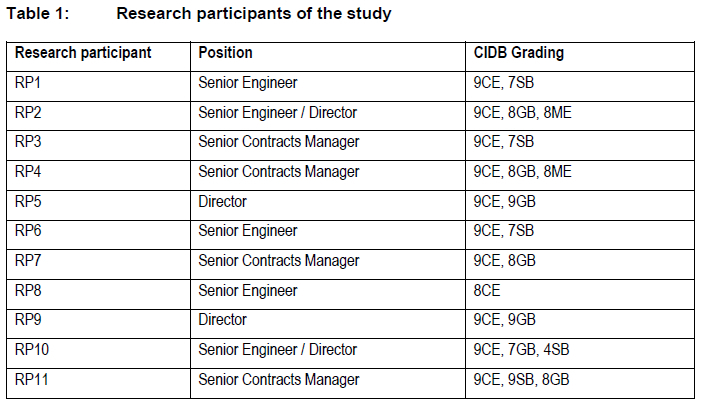
The sample comprised eleven participants purposively selected from large civil engineering construction firms operating in KwaZulu-Natal. Purposive sampling was employed to ensure participants had relevant knowledge and experience in leadership practices within the industry. To enhance the credibility and relevance of the sample, the Construction Industry Development Board (CIDB) Register of Contractors was used to identify companies with a CIDB grading of 7-9. These grades typically represent well-established contractors undertaking large-scale projects, thereby ensuring that the selected participants occupied senior executive or managerial leadership roles capable of providing informed and meaningful insights into industry leadership challenges.
Semi-structured interviews were utilised as the primary data collection method. As noted by Denzin et al. (2023), semi-structured interviews offer flexibility while enabling researchers to explore participants' perspectives in depth, allowing for the emergence of rich and diverse viewpoints. The interview guide used in this study is presented in Appendix A. In response to COVID-19 restrictions, the eleven in-depth interviews were conducted online with senior construction executives, thereby ensuring the continuity of data collection while adhering to public health regulations. Table 1 provides an overview of the participants' positions and their respective CIDB grading categories. In addition to the primary data collected through interviews, a review of relevant literature was conducted to contextualise the leadership challenges identified within the industry and to inform the conceptual understanding of human-centred leadership.
Qualitative data analysis followed the principles outlined by Saunders et al. (2016), which involve iterative processes of reading, interpretation, coding, and synthesis. The interviews were conducted and recorded between August 2022 and November 2022. Following data collection, the recordings were transcribed and cleaned to ensure accuracy, then analysed using a thematic analysis approach. NVivo 12 Pro software was used to support the organisation and coding of qualitative data, enabling the systematic identification of patterns, themes, and relationships emerging from the interview transcripts. The themes derived from this analytical process form the basis of the findings presented in the subsequent section.
4. FINDINGS AND DISCUSSION
4.1 The leadership challenges facing the construction industry
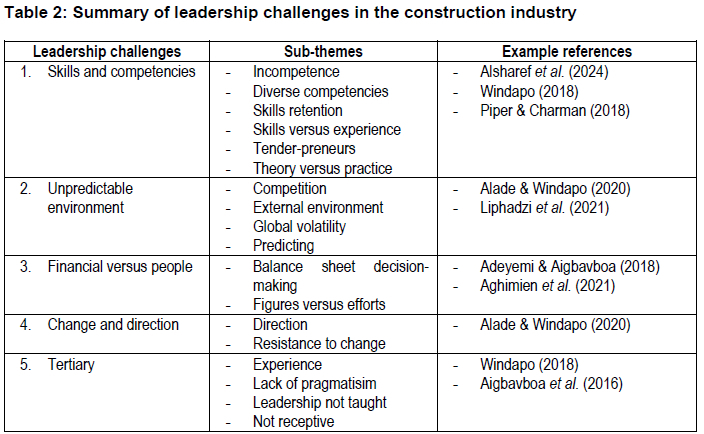
The findings of this study reveal a range of leadership challenges that continue to affect the performance and sustainability of the construction industry. Participants highlighted several interrelated concerns, including insufficient leadership skills and competencies, limited adaptability to unpredictable environments, and gaps in both leadership mindset and industry experience. These challenges suggest that leadership capacity within the sector remains uneven, particularly in contexts characterised by rapid change and operational complexity. Table 2 presents the key themes and subthemes identified through the analysis, alongside relevant literature that contextualises the findings within existing scholarship.
Evidence from prior research reinforces these observations. Emere et al. (2018) report that the South African construction industry faces numerous leadership-related challenges arising from the sector's complexity and the historically limited emphasis on leadership competence. Similar patterns emerged from the interviews conducted in this study, in which participants described the difficulties of navigating uncertain operating environments, managing diverse competencies among employees, and addressing behavioural and cultural dynamics within organisations. Emere et al. (2018) further found that democratic, transformational, and transactional leadership styles often characterise leadership practices within the South African construction industry. While these approaches remain prevalent, the findings of their study suggest that strengthening and refining leadership capabilities is necessary to support sustainable growth and improved organisational performance in the sector.
Alade and Windapo (2021), in an additional scholarship, highlight the difficulties faced by construction leaders in responding to rapid industry change. Alade and Windapo (2020) observe that leaders within the construction sector frequently demonstrate reluctance to adapt to evolving technological and organisational demands. Their study proposes a leadership framework aligned with Fourth Industrial Revolution (4IR) developments, emphasising agility, talent development, and proactive preparation for disruption. Consistent with these insights, participants in the present study emphasised the importance of leadership development initiatives, particularly those involving training, mentoring, and experiential learning, as mechanisms for strengthening leadership capability and enabling leaders to respond more effectively to industry challenges.
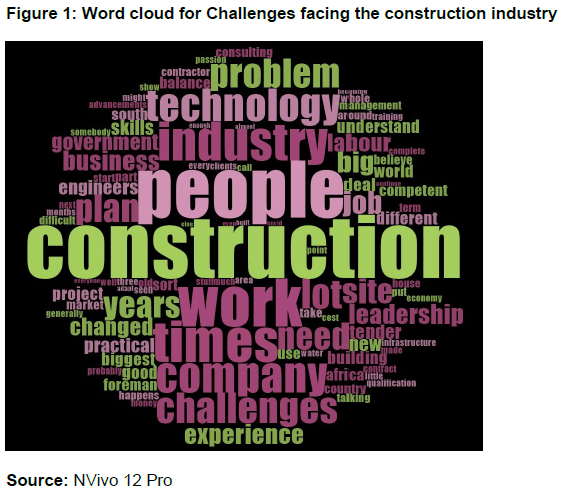
To further illustrate the patterns emerging from the qualitative analysis, Figure 1 presents a word cloud generated from the interview data, highlighting frequently referenced challenges within the construction industry. The visual representation emphasises key terms such as people, technology, leadership, and government, indicating the multi-dimensional nature of the challenges identified by participants. Words that appear more prominently in the visualisation reflect recurring concerns raised during the interviews, particularly those related to skills shortages, leadership capability, experience, and workforce dynamics.
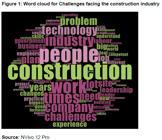
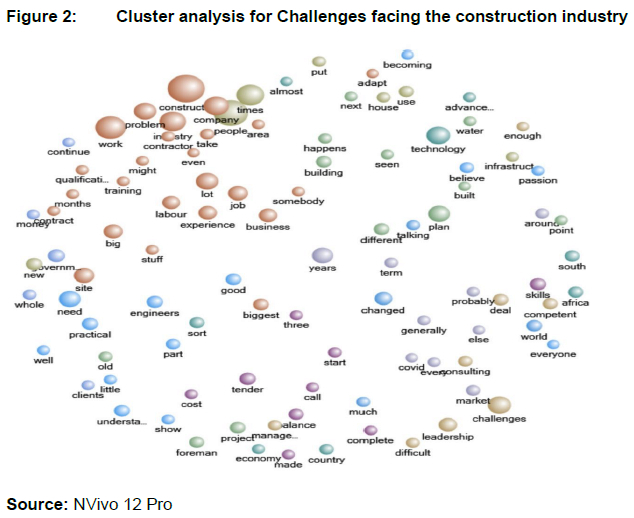
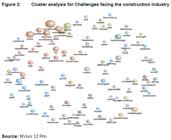
Figure 2 presents a cluster analysis of the coded data, providing an additional layer of insight into the relationships between key challenges identified during the analysis. The cluster visualisation illustrates the concentration of frequently occurring concepts, with the orange cluster indicating recurring references to issues such as site management, labour dynamics, experience, and professional qualifications. These visual patterns correspond with the thematic structure identified in the study and reinforce the central leadership challenges identified in the findings, including skills and competency gaps, the unpredictability of the industry environment, tensions between financial imperatives and employee well-being, resistance to change and strategic direction, and the perceived limitations of tertiary education in preparing leaders for industry realities.
Theme 1: Skills and competencies
The interviews revealed several leadership challenges, which emerged as sub-themes from the qualitative data. These included incompetence, diverse competencies, skills retention, the tension between skills and experience, the presence of tenderpreneurs, and the divide between theoretical knowledge and practical application. Alsharef et al. (2024) similarly identify shortages of skilled labour as a persistent challenge affecting the construction industry. Within the South African context, the construction sector faces multiple pressures at both leadership and employee levels. According to participant RP1, leadership positions in certain government departments were often occupied by individuals lacking the necessary qualifications and competencies, resulting in ineffective decision-making and poor operational outcomes. It was suggested that appointments were sometimes influenced by favour rather than merit. From an organisational perspective, participants also noted that leadership frequently faced challenges managing employees who lacked competence and therefore required constant supervision. Participant RP6 emphasised that communication and competence remain ongoing concerns, stating that "[…] Leadership challenges are trying to get people to do things the correct way […]." Another difficulty arises from the presence of diverse competencies within organisations, where employees across different levels possess varying skills and knowledge, requiring leaders to adopt different management approaches. Participant RP10 highlighted this challenge, explaining that "[…] dealing with the diverse levels of intellect and competency from a leadership perspective. It's probably the biggest challenge" […].
These findings support the observations of Alsharef et al. (2024), who indicate that limited collaboration and ineffective communication across diverse competency levels remain significant obstacles within the construction sector. Participants further identified skills retention as a major concern, noting that experienced and capable employees are often lost to other organisations or international opportunities. The tension between formal qualifications and practical experience also emerged as an ongoing debate within the industry. Several participants noted that some employees possess academic qualifications but lack the hands-on experience needed to manage complex construction projects. These findings are consistent with Windapo (2018), who argues that formal education alone does not necessarily guarantee organisational success and that experienced strategic leadership is often a stronger determinant of performance. Another issue raised during the interviews was the presence of tenderpreneurs. These individuals are often insufficiently qualified to operate construction businesses, yet still obtain government tenders. As a result, projects may be awarded to contractors who lack the capacity to fulfil contractual obligations. Participant RP1 illustrated this concern, noting that "[…] The problem in this country is that you were getting a lot of tenderpreneurs […]." Piper and Charman (2018) define a tender-preneur as a businessperson who leverages political connections to obtain government procurement contracts. The term is widely used in South Africa and typically carries negative connotations associated with corrupt or unethical business practices (Piper & Charman, 2018).
Theme 2: Unpredictable environment
A study by Alade and Windapo (2020) indicates that the construction industry is typically criticised for poor adoption of change, necessitating the leadership development agenda. Global volatility and unpredictable work environments are inevitable, posing a challenge for leadership in the construction industry. Obstacles arising from the industry's competitive nature, external influences and involvement, global volatility, and industry unpredictability were noted in the interviews. Participant RP4 indicated that, "[…] the way to get ahead in the market is to bring new ways to make yourself more competitive than your competitors[…]." Global and South African industries are struggling to maintain stability and predictability, with the adverse effect of a lack of strategic planning. "[…] The challenge for leaders is embracing the change […]" commented Participant RP2. Findings reveal that the challenge for leaders lies in their inability to adapt and remain agile in the face of uncertainty. Results align with those of Liphadzi et al. (2021), affirming that effective leadership can achieve success in the construction industry by addressing workforce skills gaps, rapidly changing environments, and unprecedented pressure from competitors.
Theme 3: Financial vs people
Within the construction industry, employees are the organisation's greatest asset, and managing people poses an ongoing challenge for leadership. Maintaining a balance between profitability and employee well-being is critical. Findings reveal that decisions were made based on profits and production rather than on people and their competencies. Results align with Adeyemi and Aigbavboa (2018) and Aghimien et al. (2021), suggesting that for effective management and leadership in the construction industry, employee-related issues, healthy working environments, and employee well-being must be addressed. An ongoing challenge for leadership is balancing the financial books and people's needs, and Participant RP10 says, "[…] Those are the kind of challenges we're dealing with, the balance between production-driven, and different competencies of people and their needs […]."
Theme 4: Change and direction
According to Alade and Windapo (2020), the purpose of leaders is to promote change initiatives, drive performance, and ensure people's alignment with the organisation's vision. The interviews revealed the rigidity of leadership in terms of change and direction. The role of leadership was to plan, align, and direct the organisation while adopting an adaptive approach to leading. However, participant RP1 noted that "[…] People are resistant to change […]." The findings align with Alade and Windapo (2020), who affirm the reluctance of construction business leaders to adapt to change and reposition their organisations for positive results.
Theme 5: Tertiary
Studies have shown that a formal qualification remains necessary in the construction industry. However, it also faced specific challenges regarding real-world and practical experience, which were perceived as lacking (Aigbavboa et al., 2016; Windapo, 2018). The findings agree that whilst tertiary qualifications are necessary and valid, the presence of actual experience, a positive and receptive attitude and practical knowledge cannot be replaced. Participant RP3 says, "[…] the formal tuition that they get to get their qualifications might be fine, but it goes beyond that […]." One interviewee mentioned that leadership could not be taught and could not form part of a tertiary syllabus or course. Participant RP4 suggests that leadership abilities are innate and can be developed through experience or mentorship. According to Aigbavboa et al. (2016), the construction industry is highly competitive, thereby warranting the need for employee and leadership training and development, which can be achieved through mentorship. Findings align with Windapo (2018), highlighting the contribution of education to leadership success, and add that formal education may not always contribute positively to the success of construction companies.
5. IMPLICATIONS
5.1 Developing the CMC leadership framework
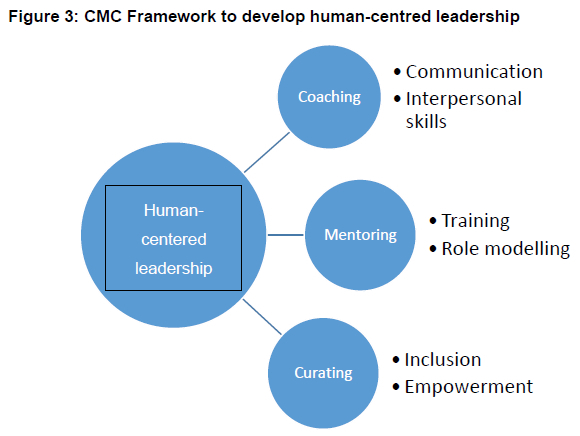
The Coaching, Mentoring, and Curating (CMC) Framework is a set of strategies and programs developed to facilitate human-centred leadership development, as depicted in Figure 3. The study's findings reveal five themes that necessitate specific strategies and programs to address these challenges. Theme one outlines the difficulties encountered with diverse skills and competencies in the construction industry, proposing that developing communication and interpersonal skills, along with relevant training, can provide the necessary intervention to overcome these issues. Theme two highlights the volatile construction industry and its contribution to leadership challenges in the sector, underscoring the need to empower and train individuals to adapt to change and plan strategically. The careful balance between profitability and employee well-being is highlighted in theme three, where the findings suggest that developing interpersonal skills, fostering inclusion, and enhancing communication are essential to addressing these challenges. Theme four highlights the resistance to change and direction in the construction sector, emphasising the need to cultivate inclusion, empowerment, and interpersonal skills. Whilst tertiary education is a priority in the construction industry, theme five highlights the need for fundamental and practical training in mentoring, training, and role modelling to benefit the industry and overcome challenges. Studies have highlighted the need for a practical leadership framework to support organisations, facilitate transformation amid uncertainty and disruption, and overcome industry challenges (Alade & Windapo, 2020; Liphadzi et al., 2021). The framework identifies three core strategies for advancing human-centred leadership: coaching, mentoring, and curating. These strategies incorporate programmes that strengthen communication and interpersonal skills, including training and role modelling, while simultaneously promoting inclusion and empowerment within organisations.
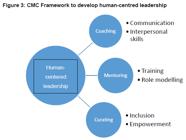
As illustrated in Figure 3, the framework conceptualises the development of human-centred leadership through these three interconnected strategies. The first strategy, coaching, is widely recognised as an effective approach to leadership development. Coaching enhances emotional intelligence, supports the adoption of new leadership practices in response to change, and assists leaders in clarifying professional goals and development pathways (Gavin, 2018). Insights from the interviews further highlighted various programmes and mechanisms that support human-centred leadership development, particularly those aimed at strengthening communication and interpersonal competencies to facilitate constructive and trust-based relationships within organisations.
Pietersen (2015) emphasises that mentors can serve as valuable leadership role models, suggesting that guidance from experienced leaders through coaching or mentoring can play a significant role in leadership development. Mentoring, therefore, represents the second strategy within the framework, incorporating training and role-modelling practices that enable leaders to gain practical experience and develop the skills needed to address real-world workplace challenges. Participants consistently emphasised the importance of structured training, mentorship, and role modelling as key mechanisms for cultivating human-centred leadership within the construction industry.
The third strategy focuses on curating organisational environments that enable human-centred leadership to flourish. Effective human-centred leadership requires the development of several critical competencies, including cross-cultural awareness, forward-thinking orientation, and adaptability. Bonnici (2023) suggests that these competencies can be strengthened through adaptive strategic responses, continuous learning that encourages knowledge creation and innovation, and the cultivation of collaborative cultures built on shared learning and diverse perspectives. Within the context of this study, participants also highlighted empowerment and inclusion, together with ongoing monitoring and targeted interventions, as important mechanisms for curating organisational environments that support the development of human-centred leadership.
5.2 Managerial implications
Previous studies examining leadership development in the South African construction industry have adopted a variety of perspectives, yet have paid limited attention to developing a structured, human-centred leadership framework for the sector. In this regard, the present study contributes to addressing this theoretical gap by proposing an integrated framework for human-centred leadership development. The findings are particularly relevant to both current and emerging leaders in the South African construction industry, offering insights into the leadership strategies required to respond effectively to contemporary organisational challenges. Furthermore, the academic contribution of this research lies in its examination of human-centred leadership as a viable approach for addressing the persistent leadership challenges confronting the construction industry. By exploring the transformative potential of this leadership orientation, the study highlights its capacity to influence both organisational practices and individual leadership development. In doing so, the research positions human-centred leadership strategies as a coherent framework to support leadership development in the South African construction sector.
The findings further suggest that the successful implementation of a human-centred leadership development framework could support meaningful transformation within the construction industry. The study therefore proposes a structured framework designed to advance human-centred leadership practices. This framework is built around three interrelated strategies, namely coaching, mentoring, and curating, each of which incorporates practical tools for leadership development. Through integrating these strategies, construction organisations and training institutions can adopt targeted leadership development programmes that promote a human-centred approach to leadership practice.
Developing human-centred leadership offers numerous significant managerial implications. Potential benefits include a shift in organisational culture, with companies focusing on people, inclusivity, and diversity, as well as increased teamwork and collaboration. Another implication is a shift in leadership behaviours and skills, with leaders demonstrating greater communication, empathy, compassion, and transparency. Employee retention, motivation, and job satisfaction are other positive managerial implications that enhance motivation, increase job satisfaction, and improve retention. There are significant benefits to employee performance, productivity, and innovation.
6. CONCLUSION
This study examined the leadership challenges confronting the South African construction industry and highlighted the urgent need for leadership approaches that can support organisational resilience, sustainability, and long-term sectoral development. The findings revealed several persistent leadership challenges within the industry, including deficiencies in leadership skills and competencies, difficulties navigating unpredictable and volatile environments, tensions between financial imperatives and employee well-being, challenges related to organisational change and strategic direction, and the limitations of tertiary qualifications in preparing leaders for industry realities. These challenges underscore the complexity of leadership in the construction sector and the need for approaches that go beyond traditional managerial practices.
In response to these challenges, the study advances human-centred leadership as a viable and necessary leadership orientation capable of addressing the structural and relational issues identified in the findings. By foregrounding the human dimension of organisational leadership, the study emphasises the importance of leadership practices that prioritise employee development, inclusion, collaboration, and adaptability in complex industry environments. The research, therefore, contributes to the existing body of knowledge by proposing the Coaching, Mentoring, and Curating (CMC) framework as an integrated approach to leadership development within the South African construction industry. The framework provides a structured set of strategies through which organisations can cultivate leadership capabilities that are responsive to both organisational performance demands and employees' well-being.
The theoretical contribution of this study lies in extending leadership development scholarship within the construction sector by conceptualising human-centred leadership as a structured developmental framework rather than merely a leadership philosophy. By integrating coaching, mentoring, and curating as complementary leadership development mechanisms, the study offers a practical, theoretically informed model to guide leadership development initiatives within the industry. From a practical perspective, the framework provides construction organisations, training institutions, and industry stakeholders with actionable strategies that can support the development of leadership competencies required to navigate increasingly complex and uncertain operating environments.
The implications of this study extend beyond organisational leadership to the broader governance and professional standards of the construction industry. Industry bodies in South Africa, including the Construction Industry Development Board (CIDB), the South African Council for the Project and Construction Management Professions (SACPCMP), the South African Forum of Civil Engineering Contractors (SAFCEC), and the Construction Engineering Association of South Africa, may consider incorporating elements of the proposed leadership development framework into professional competency standards, leadership training programmes, and industry development initiatives. Such integration could strengthen leadership capacity across the sector and improve organisational performance and industry sustainability.
While the study provides important insights into leadership development within the construction sector, several limitations should be acknowledged. The research focused primarily on the perspectives of executives, directors, and senior engineers, which may limit the extent to which the findings capture the experiences of other industry stakeholders. Future research could therefore extend this work by incorporating the perspectives of employees, clients, consultants, and other industry participants to provide a more comprehensive understanding of leadership dynamics within the sector. In addition, further research adopting quantitative approaches could test and refine the proposed CMC framework, thereby providing additional empirical evidence regarding its effectiveness in supporting human-centred leadership development within the construction industry.
Conflict of interest: The authors declare no conflict of interest with respect to the research, authorship and publication of the article.
Data availability: The data used for this article can be found in Moodley, V. 2024. Developing Human-Centred Leadership Strategies for Transformation in an Age of Technological Disruption within the South African Construction Industry. DBA Thesis. MANCOSA.
Ethical clearance and informed consent statement: The researchers obtained ethical clearance (MREC 013/2021) prior to data collection and obtained informed consent from all participants in this study.
Funding: The authors did not receive any financial support for the research, authorship, or publication of this article.
REFERENCES
2. LITERATURE REVIEW
-
Abarca, N. & Majluf, N. (2021). Sensible Leadership: Human-centered, insightful, and prudent. 1st Edition. Routledge. https://doi.org/10.4324/9781003091844
» https://doi.org/10.4324/9781003091844 - Adeyemi, B. & Aigbavboa, C. (2018). A review of factors influencing construction performance in South Africa. International Conference on Industrial Engineering and Operations Management, Pretoria, South Africa.
-
Aghimien, D.O., Aigbavboa, C. O., Anumba, C. J. & Thwala, W. D. (2021). A confirmatory factor analysis of the challenges of effective management of construction workforce in South Africa. Journal of Engineering, Design and Technology, 21(4), 1134-1152. https://doi.org/10.1108/JEDT-05-2021-0264
» https://doi.org/10.1108/JEDT-05-2021-0264 - Aghimien, D. O., Aigbavboa, C. O., Oke, A. E. & Musenga, C. (2018). Barriers to sustainable construction practices in the Zambian construction industry. In Proceedings of the International Conference on Industrial Engineering and Operations Management, Paris, France.
-
Aghimien, D., Aigbavboa, C., Oke, A., Thwala, W. & Moripe, P. (2020). Digitalisation of construction organisations-a case for digital partnering. International Journal of Construction Management, 22(10), 1950-1959. https://doi.org/10.1080/15623599.2020.1745134
» https://doi.org/10.1080/15623599.2020.1745134 -
Aigbavboa, C., Oke, A. & Mutshaeni, M. (2016). Challenges of mentoring in South African construction industry. Journal of Economics and Behavioral Studies, 8(6), 183-187. https://doi.org/10.22610/jebs.v8i6(J).1492
» https://doi.org/10.22610/jebs.v8i6(J).1492 -
Alade, K. & Windapo, A. (2020). 4IR Leadership effectiveness and practical implications for construction business industry. In: Aigbavboa, C., Thwala, W. (eds) The Construction Industry in the Fourth Industrial Revolution. CIDB 2019. Springer, Cham. https://doi.org/10.1007/978-3-030-26528-1
» https://doi.org/10.1007/978-3-030-26528-1 -
Alade, K. & Windapo, A. O. (2021). Developing effective 4IR leadership framework for construction organisations. Engineering, Construction and Architectural Management, 28(5), 1377-1396. https://doi.org/10.1108/ECAM-07-2020-0576
» https://doi.org/10.1108/ECAM-07-2020-0576 - Alade, K., Windapo, A. & Umeokafor, N. (2020). Sustainable contractor development: Do CEO's/Company leaders make a difference. In Joint CIB WO99 & TG59 International Web Conference 2020. Glasgow Caledonian University, Scotland.
-
Alade, K., Windapo, A. & Wachira-Towey, I. N. (2021). Rethinking leadership in the fourth industrial revolution: Lessons for construction business organisations. Journal of Leadership Studies, 15(1), 74-80. https://doi.org/10.1002/jls21731
» https://doi.org/10.1002/jls21731 -
Alsharef, A., Ovid, A., Jamil Uddin, S.M. & Albert, A. (2024). Biggest challenges facing the construction industry. In Construction Research Congress 2024 (652-660). https://doi.org/10.1061/9780784485286.065
» https://doi.org/10.1061/9780784485286.065 -
Anders, A. (2021). Human-centered leadership development: A communication-based approach for promoting authentic and transformational leadership. International Journal of Business Communication. P23294884211056558. https://doi.org/10.1177/23294884211056558
» https://doi.org/10.1177/23294884211056558 -
Avolio, B.J., Gardner, W.L., Walumbwa, E.O., Luthans, E. & Mayo, D.R. (2004). Unlocking the mask: A look at the process by which authentic leaders impact follower attitudes and behaviours. Leadership Quarterly, 15 (6), 801-823. https://doi.org/10.1016/j.leaqua.2004.09.003
» https://doi.org/10.1016/j.leaqua.2004.09.003 - Bass, B.M. (1985). Leadership and performance beyond expectations. Free Press.
-
Benmira, S. & Agboola, M. (2021). Evolution of Leadership Theory. British Medical Journal Leader, 5, 3-5. https://doi.org/10.1136/leader-2020-000296
» https://doi.org/10.1136/leader-2020-000296 -
Bersin, J. (2021). Big Reset Playbook: Human-Centered Leadership. https://joshbersin.com/wp-content/uploads/2021/04/Big-Reset-Playbook_Human-Centered-Leadership_Josh-Bersin_2021.pdf?_hsmi=122260775&_hsenc=p2ANqtz-8S9EV59x78_ThmUf34loRH73pE18Sy5_6lMcLlIFisX36kMeNQlaczqmrscEvtPspdPH3J93yCBPbzo1luc5A4dlJXQnlNtU9tvDl659Q-cJ25gFY
» https://joshbersin.com/wp-content/uploads/2021/04/Big-Reset-Playbook_Human-Centered-Leadership_Josh-Bersin_2021.pdf?_hsmi=122260775&_hsenc=p2ANqtz-8S9EV59x78_ThmUf34loRH73pE18Sy5_6lMcLlIFisX36kMeNQlaczqmrscEvtPspdPH3J93yCBPbzo1luc5A4dlJXQnlNtU9tvDl659Q-cJ25gFY -
Bonnici, F. (2023). Leading into tomorrow: skills to navigate through change. World Economic Forum. https://www.weforum.org/agenda/2023/10/leading-through-disruption-skills-leaders-need-to-navigate-the-future
» https://www.weforum.org/agenda/2023/10/leading-through-disruption-skills-leaders-need-to-navigate-the-future -
Boshomane, L. J. & Naidoo, D. S. (2022). Leadership factors influencing successful project delivery: The case of a South African civil engineering company. In Proceedings of the International Conference on Industrial Engineering and Operations Management. https://doi.org/10.46254/AF03.20220195
» https://doi.org/10.46254/AF03.20220195 - Creswell, J.W. & Creswell, J.D. (2017). Research Design: Qualitative, Quantitative and Mixed Methods Approaches. Fifth Edition. Sage Publications Inc.
- Denzin, N.K., Lincoln, Y.S., Giardina, M.D. & Cannella, G.S. (2023). The Sage Handbook of Qualitative Research. Sage Publications.
-
Dithebe, K., Aigbavboa, C., Oke, A. & Muyambu, M. A. (2018). Factors influencing the performance of the South African construction industry: A case of Limpopo province. In Proceedings of the International Conference on Industrial Engineering and Operations Management (1185-1192). https://ieomsociety.org/southafrica2018/papers/401.pdf
» https://ieomsociety.org/southafrica2018/papers/401.pdf -
Emere, C. E., Aigbavboa, C. O. & Thwala, W. D. (2018). An investigation of leadership styles of construction professionals in the South African construction industry. In Creative Construction Conference (290-295). https://doi.org/10.3311/CCC2018-039
» https://doi.org/10.3311/CCC2018-039 -
Gardner, W.L., Coglister, C.C., Davis, K.M. & Dickens, M.P. (2011). Authentic Leadership: A review of the literature and research agenda. The Leadership Quarterly, 22(6), 1120-1145. https://doi.org/10.1016/j.leaqua.2011.09.007
» https://doi.org/10.1016/j.leaqua.2011.09.007 -
Gaultier, T. (2018). Why a leadership reset in SA construction is necessary for the 4th Industrial Revolution. Construction and Engineering News South Africa. 15 October. https://www.bizcommunity.com/Article/196/494/183019.html
» https://www.bizcommunity.com/Article/196/494/183019.html - Gavin, C.S. (2018). The impact of leadership development using coaching. Journal of Practical Consulting, 6(1), 137-147.
-
Harvard Business Publishing. (2024). Leadership fitness: The path to developing Human-Centered leaders who drive employee fulfilment. Harvard Business Publishing Corporate Learning, Perspectives. https://www.harvardbusiness.org/insight/leadership-fitness-the-path-to-developing-human-centered-leadership/
» https://www.harvardbusiness.org/insight/leadership-fitness-the-path-to-developing-human-centered-leadership/ - Howard, A. (2015). Humanise: Why human-centred leadership is the key to the 21st century. First Edition. Wiley.
-
Ikuabe, M., Aigbavboa, C., Adekunle, S., Liphadzi, M. & Adekunle, P. (2024). Organisational Leadership as a driver for the delivery of sustainable construction in South Africa. In International Conference on Engineering, Project, and Production Management (pp. 483-492). Cham: Springer Nature Switzerland. https://doi.org/10.1007/978-3-031-56544-1
» https://doi.org/10.1007/978-3-031-56544-1 - Ismail, M. & Fathi, M.S. (2018). Leadership in construction: Leadership styles practiced in construction projects - A review. Journal of Advanced Research in Business and Management Studies, 13(1), 24-30.
-
Liphadzi, M., Aigbavboa, C., Osunsanmi, T. & Thwala, D. (2021). Challenges affecting leadership development in the construction industry. In: Ahmed, S.M., Hampton, P., Azhar, S.D., Saul, A. (eds) Collaboration and Integration in Construction, Engineering, Management and Technology. Advances in Science, Technology & Innovation. Springer, Cham. https://doi.org/10.1007/978-3-030-48465-1_70
» https://doi.org/10.1007/978-3-030-48465-1_70 -
Madi, D. (2021). After being the economy's worst-performing sector last year. SA Construction News, 24 May. https://www.saconstructionnews.co.za
» https://www.saconstructionnews.co.za - Mensah, R.O., Agyemang, F., Acquah, A., Babah, P.A., & Dontoh, J. (2020). Discourses on conceptual and theoretical frameworks in research: Meaning and implications for research. Journal of African Interdisciplinary Studies, 4(5), 53-64.
-
Opoku, A., Ahmed, V. & Cruickshank, H. (2015). Leadership style of sustainability professionals in the UK construction industry. Built Environment Project and Asset Management, 5(2), 184-201. https://doi.org/10.1108/BEPAM-12-2013-0075
» https://doi.org/10.1108/BEPAM-12-2013-0075 -
Pascual, D. (2022). What does Human-Centered leadership mean in an uncertain world. Leadership Excellence, 7 May. https://www.hr.com/en/magazines/leadership_excellence_essentials/july_2022_leadership_excellence/what-does-human-centered-leadership-mean-in-an-unc_l57tgtuy.html
» https://www.hr.com/en/magazines/leadership_excellence_essentials/july_2022_leadership_excellence/what-does-human-centered-leadership-mean-in-an-unc_l57tgtuy.html - Pietersen, E. (2015). Leadership in the African Context. Second Edition. Juta.
-
Piper, L. & Charman, A. (2018). Tenderpreneur (also tenderpreneurship and tenderpreneurism). The Global Informality Project. UCL Press. https://www.researchgate.net/publication/326990577_Tenderpreneur_also_tenderpreneurship_and_tenderpreneurism
» https://www.researchgate.net/publication/326990577_Tenderpreneur_also_tenderpreneurship_and_tenderpreneurism - Saunders, M., Lewis, P. & Thornhill, A. (2016). Research Methods for Business Students. 7th Ed. Pearson Education Ltd.
-
Schloetzer, J. (2021). A case for why the future of work needs human-centered leadership. Washington Business Journal. https://www.bizjournals.com/washington/news/2021/03/11/a-case-for-why-the-future-of-work-needs-human
» https://www.bizjournals.com/washington/news/2021/03/11/a-case-for-why-the-future-of-work-needs-human -
Simmons, D.R., McCall, C. & Clegorne, N.A. (2020). Leadership competencies for construction professionals as identified by construction industry executives. Journal of Construction Engineering and Management, 146(9), 04020109. https://doi.org/10.1061/(ASCE)CO.1943-7862.0001903
» https://doi.org/10.1061/(ASCE)CO.1943-7862.0001903 -
The Department of Trade, Industry and Competition. (2023). The DTIC Annual Report 2023-24. https://www.thedtic.gov.za/wp-content/uploads/Annual-Annual-thedtic.pdf
» https://www.thedtic.gov.za/wp-content/uploads/Annual-Annual-thedtic.pdf -
Theofilou, B., Curtis, M. & Shah, B. (2021). Adding a human-centered approach to business. Accenture. https://www.accenture.com/content/dam/accenture/final/a-com-migration/r3-3/pdf/pdf-117/accenture-strategy-the-heart-of-the-matter-human-centered-pov.pdf
» https://www.accenture.com/content/dam/accenture/final/a-com-migration/r3-3/pdf/pdf-117/accenture-strategy-the-heart-of-the-matter-human-centered-pov.pdf -
Uhl-Bien, M., Marion, R. & McKelvey, B. (2007). Complexity leadership theory: Shifting leadership from the industrial age to the knowledge era. Leadership Institute Faculty Publications, 18(4), 298-318. https://doi.org/10.1016/j.leaqua.2007.04.002
» https://doi.org/10.1016/j.leaqua.2007.04.002 -
Windapo, A. (2018). Entrepreneurial factors affecting the sustainable growth and success of a South African construction company. Sustainability, 10(4), 1276. https://doi.org/10.3390/su10041276
» https://doi.org/10.3390/su10041276 -
World Economic Forum. (2017). Advancing Human-Centered Economic Progress in the Fourth Industrial Revolution. A Leadership Agenda for G20 Governments. G20/T20 Policy Brief - May. https://www3.weforum.org/docs/WEF_Advancing_Human_Centred_Economic_Progress_WP_2017.pdf
» https://www3.weforum.org/docs/WEF_Advancing_Human_Centred_Economic_Progress_WP_2017.pdf
APPENDIX A: Interview Guide
1) Kindly share some information about yourself for the purpose of context. Please confirm your gender, age, time in executive management position and current position?
2) What is your understanding of the technological age of disruption?
3) What would you describe as leadership challenges in the construction industry?
4) What is your understanding of human-centred leadership?
5) What measures or processes are put in place to cope with the technological age of disruption?
6) In your opinion, what are the critical skills and competencies you believe are essential for leaders in the construction industry?
7) In your opinion, does the South African construction industry necessitate human-centred leadership to cope with technological disruption, and why?
8) In your view, what leadership approach can be adopted to cope with technological disruption?
9) What interventions or strategies can be implemented to develop human-centred leadership in the South African construction industry?
10) What are the time horizons to ensure effective coaching and development of leadership in an age of technological disruption within the South African construction industry?