Performance management and talent development: their impact on job satisfaction at selected higher education institutions
Abstract
The purpose of this study was to examine the impact of performance management and talent development on job satisfaction amongst academic staff in selected higher education institutions (HEI's in the South African context. This research is significant because performance management and talent development are perceived as having a positive influence on job satisfaction. This study employed a quantitative research method to investigate the impact of performance management and talent development on job satisfaction within HEIs. An explanatory hypothesis-generating approach was employed, and a survey design used to collect data through a semi-structured questionnaire. A sample of 279 academic staff was selected for the study. Results revealed a positive and significant impact between performance management (0.591), talent development (0.624) and on the job satisfaction (0.442). Therefore, talent development has the strongest impact on job satisfaction amongst academic staff. Based on the findings, management in HEIs should implement performance management systems (PMS) and provide talent development opportunities to enhance job satisfaction amongst academic staff with the aim of achieving institutional objectives.
Career opportunities; HEIs; job satisfaction; performance management and recognition; talent development
1. INTRODUCTION
Higher education is influential in the development of a country. It not only functions as a provider of knowledge, but also as an important sector for a nation's growth and societal wellbeing (Council for Higher Education 2016:7). Higher education institutions play a significant role in the development of skills, increasing economic growth; therefore, high quality staff is required (Hunjet, Kozina & Kurečić 2015:1). The National development plan (NDP) stresses that education, training and innovation are central to South Africa's long-term development. One therefore needs to underscore the importance of these aspects as the core elements in eliminating poverty and reducing inequality by bringing in the foundations of an equal society (Mutekwe 2017:143). Higher education institutions are also considered as centres of research, knowledge, change and excellence, which are conversant with acquiring, generating, and transferring knowledge to society (Mubarak, Wahab & Khan 2012:65). The management at modern-day academic institutions is required to make special endeavours in acquiring and retaining highly skilled employees to operate effectively in an extremely competitive environment (Mabaso & Dlamini 2017:81).
Challenges in the higher education sector, which includes a decline in state funding, inadequate remuneration, high employee turnover and low productivity, cannot be ignored since these have affected the operations in the sector (Mushemeza 2016:242). Kivistö, Pekkola, Berg, Hansen, Geschwind and Lyytinen (2019:38) affirm that this trend is further intensified by the fact that the higher education sector competes with other sectors for public funds, namely primary and secondary education, public health, social services and defence. All these mean that there is an increasing focus on cost efficiency and productivity, as well as quality. The need for greater efficiency, productivity and quality in the higher education sector has triggered increased governmental interest towards different mechanisms of accountability, especially evaluation and performance measurement (Kivistö et al. 2019:38).
Moloantoa and Dorasamy (2017:193) contend that the overall performance of a university depends on academics and ultimately their level of commitment and job satisfaction. In essence, job satisfaction remains a crucial human resource (HR) dimension that needs organisational support, if optimal employee performance is the ultimate target underpinning the overall success of HEIs (Moloantoa & Dorasamy 2017:193). Maimela and Samuel (2016:3) attest that the motivation for the introduction of a PMS in the higher education sector could perhaps be linked directly to increasing pressure from government for universities to increase both student throughput and research output. The introduction of a performance incentive system (subsidy) by government in the higher education sector in South Africa has no doubt provided an unintended impetus for competition in the academy. Performance management linked to incentives was unfamiliar to the educational sector; management of universities therefore imported the prevailing performance management practices as in the private sector (Maimela & Samuel 2016:3). Melo and Figueiredo (2019:2) attest that many PMS in public service organisations (including in HEIs) are poorly applied.
Birdsall (2018:671) affirms that politics, resource constraints, organisational capacity, institutional differences, and the nature of public goods and services create a number of complications that may make implementing PMS ineffective or harmful for public organisations such as HEIs.
To achieve satisfaction and productivity amongst staff, sound HR strategies and practices are required. This can only be achieved by maintaining skilled personnel within climates which take these institutions to greater heights. The attraction, development and retention of highly qualified talent are the most critical aspect for the success of an academic institution (Tyagi, Singh & Aggarwal 2017:47). Tlaiss, Martin and Hofaidhllaoui (2017:426) attest that organisations have realised that the value of talent is a competitive weapon in any firms' armoury. Thus, organisations aiming to achieve a competitive advantage over competitors should invest more in their most important assets, their employees. Performance management has therefore become a critical tool used in the achievement of organisational objectives. Couturier and Sklavounous (2019:1) state that performance measurement is fundamental for effective organisation management. To improve the performance of employees, it is extremely important to periodically evaluate their performance to learn where they stand, what is expected of them and what their actual contribution is (Aguinis 2013:265). Performance management is considered one of the strongest tools for developing human assets, since it lays the foundations for training, promotion, career planning and competency mapping (Gupta & Upadhyay 2012:97).
Satisfied employees will display extraordinary performance, and organisations with well-performing workforces will be successful. It is important to emphasise that the relationship between job satisfaction and performance management or organisational success is far from simple or direct. Currently, no studies exist which simultaneously investigate performance management, talent development and job satisfaction within the South African higher education context. Due to the significance of performance management, talent development and job satisfaction, a gap has been identified which needs to be addressed. Hence, the present study seeks to examine the relationship between performance management, talent development and job satisfaction amongst academic staff at HEIs. In keeping with this, the following research questions were formulated:
• What is the relationship between performance management and job satisfaction?
• What is the relationship between job satisfaction and talent development?
• How does performance management and talent development predict the job satisfaction of academic staff in selected HEIs?
2.1 Overview of higher education in South Africa
Institutions of higher education in South Africa are established under the Higher Education Act 101 of 1997, and comprise of internal and external stakeholders, such as employers, employees, students, suppliers and other role players and interest groups (Sibiya 2017:190). The HEIs referred to in this article are the public universities in South Africa. Additionally, HEIs render a valuable service in providing for the public good in the form of education, and thus have a special place in the lives of any country's citizenry. Tertiary education delivered through HEIs enables its recipients to enhance their earning abilities, live longer and contribute positively towards the strengthening of democracy (Mncube & Harber 2013:234). South African higher education, in particular, has gone through numerous historical changes (Singh 2001:8). These changes have resulted in the establishment of traditional, comprehensive and technological universities (Du Pré 2009:7). In 1967, the South African government established six (6) colleges of advanced technical education, which were later transformed into Technikons in 1979 (Du Pré 2009:6).
Technikons were designed for career-focused education incorporating work-integrated learning (Koen 2003:4). These institutions focused more on teaching and on outcomes, resulting in low research outputs. This was further aggravated by the fact that the majority of academics within these institutions held qualifications lower than a master's degree (Cooper 1995:244). In 2003, six (6) Technikons were transformed into Universities of Technology (UoTs), while other Technikons merged with universities and became comprehensive universities (Du Pré 2009:7). Subsequent to the establishment of the current six (6) UoTs, their research capacity and ability to offer core-degree programmes have been questioned and criticised by traditional universities. There was also a fear that these universities would lower the envisaged university standard (Winberg 2005:39). The transformation of Technikons into UoTs had implications for these less-qualified academics to join the ranks of their acknowledged peers. This pressurised academics at UoTs to upgrade their professional status by improving their qualifications and building research track-records through publication in peer-reviewed journals, conference presentations and participation in postgraduate degree programmes (Jansen 2003:9).
2.2 Job satisfaction in relation to academic staff in the higher education sector
Job satisfaction is a concept, which has been broadly studied in the field of HR management and organisational behaviour in the past and continues to be regarded as highly important (Eyupoglu & Saner 2009:686; Lam, Zhang & Baum 2001:148; Verret 2012:1). Spector (1997:2) defines job satisfaction as how people feel about their jobs and different aspects of their jobs. Job satisfaction is considered as the extent to which people like (satisfaction) or dislike (dissatisfaction) their jobs. Stankovska, Angelkoska, Osmani and Grncarovska (2017:160) define job satisfaction as an individual's emotional response to his or her current job condition. Nath Gangai and Agrawal (2015:269) describe job satisfaction as a pleasurable emotional state, resulting from the appraisal of one's job; an effective reaction from one's job as an attitude towards one's job. Job satisfaction is the collection of feelings and beliefs that employees have about their jobs. In fact, employee's general attitude towards his or her job could equally be regarded as job satisfaction (Aziri 2011:78).
It can be contended that the overall performance of a university depends on academics and ultimately their level of commitment and job satisfaction. Job satisfaction is an important consideration if management is serious about performance and productivity of academic employees to ensure quality teaching and learning (Moloantoa & Dorasamy 2017:193). Stankovska et al. (2017:160) attest that job satisfaction is a complex phenomenon since it is correlated to various causal factors like personal, cultural and financial factors. For the purpose of this article, Spector's definition will be used. Therefore, understanding the nature of job satisfaction is a significant factor in determining the level of satisfaction amongst employees. Mabasa and Ngirande (2015:364) attest that employees' level of satisfaction with their jobs is key to the success of organisations. It is thus important to understand how employees can be kept satisfied within organisations in order to achieve better work results. Webber and Roggers (2018:1) warn that if academic staff is not satisfied with their academic responsibilities they may look for employment elsewhere. Ledimo and Martins (2015:78) attest that organisations are concerned with the implementation of programmes and interventions to improve and sustain employee satisfaction to attain competitive advantage. Ehsani, Sofdel, Amiri, Masrur and Hossini (2013:1302) maintain that job satisfaction increases productivity, guarantees physical and mental health, brings life satisfaction, raises morale, creates fewer job events and hastens the training of new job skills. Job satisfaction is therefore one of the important variables which contribute to the success of an organisation as a whole. Job satisfaction is a result of an employee's perception of how well their job provides those things which are viewed as important. Job satisfaction is hence an emotive response to a job situation.
2.2.1 Facets of job satisfaction
Naseem and Salman (2015:3), Abdulla, Djebarni and Mellahi (2011:126) and Spector (2001:1) point out several facets to job satisfaction which includes work itself; working conditions; pay; supervisor; job security; promotion; recognition and co-worker relations. Facet of job satisfaction includes work itself and working conditions, the content and nature of the work itself is a major factor that influences job satisfaction (Bahri, Sanusi & Asih 2017:20). A study by De Lourdes Machado, Soares, Brites, Ferreira and Gouveia (2011:1719) reveals that academic staff was satisfied with their teaching activity, academics working in private HEIs are the most satisfied. However, academics who are teaching at public universities and public polytechnic institutes were less satisfied. The study by Clarke, Kenny and Loxley (2015:13) shows that almost three quarters of academics (72%) in their study believed that their working conditions had deteriorated. They were under pressure to teach more students and they worked longer hours. Additionally, Bahri et al. (2017:13) attest that salary has a significant effect on job satisfaction. Heathfield (2012:1) affirms that salary is a fixed amount of money or remuneration paid to an employee by an employer in exchange for productive work performed. Employee satisfaction levels of academic staff are affected by various factors such as pay, supervisor, co-worker relations, performance, training and recognition (Akyol 2014:21). Mustapha (2013:246) indicates that a remuneration system plays a significant role in determining an employee's level of job satisfaction in HEIs. Supervision is also an important fact that affects job satisfaction (Shooshtarian, Ameli & Amini Lari 2013:29). Supervisors are the human faces of an organisation. A study done by Mbundu (2011:81) revealed that the majority of academic staff of the respondents showed that they were satisfied with their relations with their immediate supervisors. The institution again scores a positive response which needs to be maintained to keep employees happy with this job aspect. Sharma (2015:69) reveals that there was a significantly relationship between supervision and job satisfaction among academic staff. Promotional opportunities also affect job satisfaction (Tabatabaei & Farazmehr 2015:188). In relation to opportunities for upgrading, Herzberg (1966) proposed that personal needs for progress, accountability, appealing and challenging work, safety, vacation and currency are all connected to salary system preference. Promotional opportunities affect job satisfaction in HEIs (Taduvana 2017:107). Promotion typically entails aspects such as higher-level responsibilities, more complex work, greater competency demands and better remuneration. Aydogdu and Asikgil (2011:44) allude that promotion possibilities involve the availability of advancement opportunities. If people think that they will not have much promotion possibilities, they may be affected adversely.
Promotion opportunities have a positive relationship with job satisfaction (Aydogdu & Asikgil 2011:44). Lastly, relationship with co-workers is also a factor that influences job satisfaction. Robbins, Judge, Odendaal and Roodt (2016:111) state that the degree to which fellow employees are technically proficient and socially supportive to one another influences job satisfaction. McClelland's theory on the need of affiliation and Maslow's theory on the need for belonging postulate that an employee's social needs can be satisfied at work. Lee and Ok (2012:1101) state since employees spend the majority of their time at work, interpersonal relationships are consciously and unconsciously formed. Dimova, Stoyanova, Harizanova, Tarnovska and Keskinova (2019:2387) revealed a positive relationship between co-workers and job satisfaction. Academic staff was satisfied with their working relationship with their co-workers (Dimova et al. 2019:2387). These facets are also in line with Spector's facets and they are relevant in the HEIs.
2.3 Job satisfaction and performance management in higher education institutions
Job satisfaction and performance is one of the most studied relationships in organisational psychology. A notion from the Hawthorne studies revealed that happy employees are very productive (Mathur & Prasad 2014:190). Paposa and Kumar (2015:160) state that for organisations to be productive they are required to know their core business operations and factors that impact business operations like employee performance. They are also required to check the performance of their employees from time to time and to inform them of their strength and weaknesses. Performance management is viewed more broadly as a management tool, the use of which aims to improve the performance of organisations (Goh 2012:31). Swanepoel, Erasmus, Schenk and Tshilongamulenzhe (2014:613) affirm that performance management comprises actions based on performance measures and reporting, which result in the improvement of employee behaviour, motivation and work processes and which also promote innovation. Aguinis (2013) attests that employee motivation to perform is increased when performance management is being administered effectively. When employees are satisfied with their organisation's PMS, they are more likely to be motivated to perform well and be committed to their organisation (Aguinis 2013). Satisfied workers will display extraordinary performance, and companies with this kind of worker will be more likely to succeed. This includes establishing expectations, the demonstration of skills, assessment, feedback and continuous improvement (Hatice 2012:29).
To achieve this, organisations require an effective PMS to allow them to plan, implement and assess their progress towards the achievement of set objectives (Paposa & Kumar 2015:160). Performance management is one of the most important HR development practices and is crucial for every organisation. For organisations to improve the performance of the employees, regular performance intervals are required in order for employees to understand where they stand, what is being expected of them and what they are actually contributing (Paposa & Kumar 2015:159). Mujtaba and Shuaib (2010:112) state that for HEIs to attract, motivate and retain qualified staff, these institutions must have appropriate reward systems in place which encourage employees to remain focused on performance.
Additionally, the quality of the academic institution can be improved through the enhanced performance of academics (Al-Hinai & Bajracharya 2014:13). Tokers (2011:167) revealed a positive correlation between job satisfaction and performance management amongst academic staff in Turkey. The research findings of Shin and Jungs (2014:612) revealed that job satisfaction is a strong predictor of performance amongst academic staff in Korea and the United Kingdom. A study by Chun, Choi and Song (2018:12) revealed a link between job satisfaction and performance, in HEIs in Korea. Their study revealed that intrinsic rewards i.e. work itself may be an effective motivator for individuals to produce higher performance. Additionally, environmental factors such as working conditions play different roles such as preventing employees from being dissatisfied with their job (Chun et al. 2018:12). Employees are thus seen to demonstrate more positive attitudes when they are better satisfied with their jobs (Jain, Jabeen, Mishra & Gupta 2007:193). Shikongo (2011:73) proposes that a proper PMS needs to be in place in order to assess both individual or team performances, and which rewards them accordingly. De Bruyn (2014:32) suggests that if an effective performance bonus system exists, academic staff will be more satisfied with their jobs, while maintaining their overall organisational commitment. Based on the above, the following hypothesis was therefore formulated:
H
1: There is a positive relationship between performance management and job satisfaction.2.4 Job satisfaction and talent development in higher educational institutions
Talent development is a set of learning experiences designed to enhance the applied skills and competencies of employees (World at Work 2015:1). Development engages employees to perform better, and enlists leaders in advancing their organisations' people strategies (Hodor 2014:130). Pregnolato, Bussin and Schlechter (2017:2) state that talent development involves organisational plans to assist employees in pursuing their career goals. Ellis (2015:1) confirms that progressive companies are promoting their talent development opportunities as part of total rewards packages. These include further learning in the form of tuition assistance, corporate university learning, attending seminars and conferences, self-development, challenging assignments and even sabbaticals.
These talent development interventions may have significant implications for their job satisfaction, retention factor and motivation. Ng'ethe, Iravo and Namusonge (2012:210) attest that promotion for academic staff depends on teaching, research and publication. Academics who feel stagnant in their positions are generally not motivated and will not remain in unfulfilling positions for long. This could ultimately lead to job dissatisfaction and poor talent retention at academic institutions. Akhtar, Aamir, Khurshid, Abro and Hussain (2015:256) confirm that highly qualified academics will leave academic institutions for reasons that are not necessarily monetary, but based on limited development and promotional opportunities instead. Noor, Khan and Naseems' (2015:1502) study revealed that job promotion has a positive effect on both job satisfaction and employee advancement. However, Malik, Danish and Munirs' (2012:7) research argues that promotion has less explanatory power in this regard, because the beta coefficient for this variable was not found to be significant. Therefore, promotion is directly related to job satisfaction, but its impact is not significant, which also means that other factors, such as job security, work environment, fringe benefits and supervision, can also influence employee job satisfaction (Raziq & Maulabakhsh 2015:720).
Haider, Aamir, Hamid Aba and Hashim (2015:341) state that the absence of proper career development plans drives some HEIs to offer higher pay and improved benefits packages to attract and retain employees, as compared to others which have more attractive career development plans. The Chaudhary and Bhaskar (2016:95) study revealed that a strong correlation between training and development and job Satisfaction. Academic staff that receives training and development programmes are having more job Satisfaction. Additionally, academic staff feels that they are able to perform better in their jobs, if they receive the right type of training and development. It helps them to enhance their functional area of expertise and also prove helpful in improving their classroom delivery as a faculty. It enhances the abilities of a faculty to contribute in the academic world by conducting meaningful research in their respective disciplines.
Career advancement opportunities are linked to the learning and development aspect of talent management in which a clear career path is crucial, as also those criteria applied for making lateral and diagonal moves, including promotions (Armstrong & Murlis 2004:23). Longo (2014:55) states that career opportunities can be viewed as an element in support of institutional succession planning. Achieving goals in a developmental plan allows employees to keep abreast of changes in their fields of specialisation (Aguinis 2013). Moreover, such plans highlight employee strengths and areas of improvement, as well as setting in place action plans to improve in areas of weakness. The overall objective of talent development is to foster improved performance in an employee's current job and prepare them for advancement in that position (Aguinis 2013). Additionally, such development provides employees with growth opportunities and avenues to learn new skills. Academic staff confirms that career development opportunities are the focal purpose behind their decision to remain at one (1) institution for a longer period (Sharma & Sinha 2015:81). Based on the above, the following hypothesis was developed:
H2: There is a positive relationship between talent development and job satisfaction.
3. RESEARCH METHOD
The study employed a quantitative research design using a survey questionnaire. The aim of quantitative research is to describe patterns, trends and relationships in numerical data (Lochmiller & Lester 2017). Quantitative research looks at numbers and the statistical interpretation of the data gathered from questionnaires, as opposed to looking at processes and meanings, as is the case in qualitative research (Creswell 2014:156). The main reason for choosing this method was because the variables used in the study could be easily measured quantitatively.
3.1 Research participants
This study was conducted in the higher education sector of South Africa. The total number of employees within this population equal 1 089 (N=1 089). The composition of the staff from UoTs in Gauteng and the Free State (University of Technology A=820, University of Technology B=296) comprised of lecturers, senior lecturers, heads of department and professors. The study employed probability sampling using systematic sampling. According to Lochmiller and Lester (2017:54), probability sampling attempts to construct a sample which includes individuals who approximate the general population. Probability samples allow the researcher to generalise the results obtained from their sample to the whole. For the results to remain accurate, equal opportunity was provided to select the sample from each of the UoTs using every fourth element as a systematic sampling tool.
Thus, for UoT A, the sample selected equalled 74 respondents, using every fourth element. For UoT B, the sample selected equalled 205 respondents, again using every fourth element as a systematic sampling tool. Thus, the sample respondents from both UoTs totalled 279 (UoT A: N=74 + UoT B: N=205). A biographical questionnaire was used to generate data related to the general information of the participants. Of the 279 participants, 225 returned the questionnaires to the researcher. However, upon scrutiny it was discovered that 23 respondents had not answered the majority of questions asked. These questionnaires were therefore completely discarded. A response rate of 72.4 percent was achieved overall for the study. The questionnaires returned for analysis therefore equated to n=202, which was considered appropriate for use in the study. A sample size between 410 and 420 is appropriate from a target population size ranging between 180 and 201 (Sekaran 2003:294).
3.2 Measuring instrument
Paper-based questionnaires were used to collect data, and the researcher personally handed copies of the questionnaires in enclosed envelopes to the respondents. The measuring instruments for the study were the "Total Rewards Questionnaire" adopted from World at Work (2015) where performance management and talent Development was extracted, and the "Job Satisfaction Survey" developed by Paul Spector in 1997. The total rewards questionnaire was designed to measure specific performance factors and talent development. Responses were based on a five-point Likert scale rating (1 = strongly disagree; 2 = disagree; 3 = neutral; 4 = agree; and 5 = strongly agree).
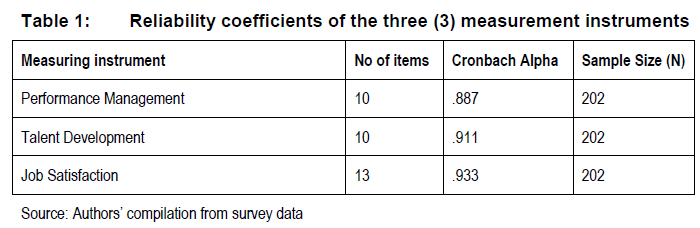
The job satisfaction survey was developed based on the facet approach, which suggests that the different facets used to assess an individual's job satisfaction preferences include: appreciation; communication; co-workers; fringe benefits; job conditions; the nature of the work itself; the organisation itself; the organisation's policies and procedures; pay-scales; personal growth; promotion opportunities; recognition; security; and supervision. The job satisfaction survey responses were based on a five-point Likert rating scale rating (1 = strongly disagree; 2 = disagree; 3 = neutral; 4 = agree; and 5 = strongly agree). Before the commencement of data analysis, reliability coefficients in the form of Cronbach's Alpha test scores were calculated for each of the three (3) scales (job satisfaction, talent development and performance management). The results are presented in Table 1 below.
A Cronbach Alpha between 0.60 to 0.80 coefficients is deemed acceptable (Millsap & Maydeu-Olivares 2009; Nunnally & Bernstein 2010:552). Peters (2014:57) however argues that a Cronbach Alpha of 0.80 or higher is acceptable. Results from this study indicated acceptable reliability coefficients for the performance management, talent development and job satisfaction variables. Based on this information, the instruments were deemed to be psychometrically acceptable.
3.3
Ethical consideration and research procedurePermission to conduct the research was obtained from the participating UoTs. Research respondents were requested to participate in the study voluntarily by completing the questionnaires provided. A covering letter accompanied each set of questionnaires stating the purpose of the research, and guaranteeing the protection of the respondent's identity, since this was an anonymous survey. A total of 279 questionnaires were distributed to all selected academic staff. To ensure confidentiality, the questionnaires were collected by the researcher at a selected drop off and collected by the researcher at a point that was indicated on the enclosed envelopes provided upon distribution.
3.4
Data analysisData was analysed with the aid of the Statistical Package for the Social Sciences (SPSS), Version 24. Initially, demographic data, frequencies and the scores of the overall work-related factors, as well as measures of central tendency, were established. Following this, a series of multivariate statistical procedures, which included exploratory factor analysis, Pearson's product-moment correlation coefficient analysis and standard linear regression, were conducted on all the variables i.e. performance management, talent development and job satisfaction.
4. RESULTS
An analysis of the demographic profiles of respondents revealed that 50.5 percent (n=102) of the respondents were female, whereas 49.5 percent (n=100) were male. After collapsing the respondents' ages, it emerged that the largest group of respondents (43.6 percent; n=88) were aged between 30 and 45 years. Additionally, 38.1 percent (n=77) of the respondents were in possession of a master's degree. In terms of racial groups, Africans (68.8 percent; n=139) were represented with the highest number. Regarding work positions occupied, the largest group of respondents (89.6 percent; n=181) were lecturers, followed by senior lecturers (6.9 percent; n=14), with associate professors (0.5 percent; n=1) being the smallest number.
4.1 Correlation matrix for the study variables
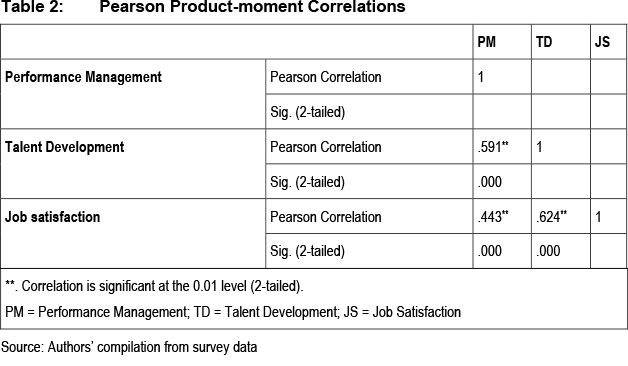
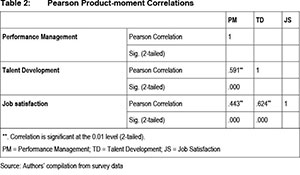
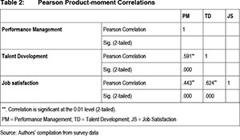
In terms of statistical significance, it was decided to set a cut-off value at the 95 percent confidence interval level (p < 0.005). In the last stage, regression analyses were performed to determine whether or not the performance management and talent development variables acted as significant predictors of the JS variables. For the purpose of this article, R2 values larger than 0.25 at p < 0.05 were regarded as practically significant (Millsap & Maydeu-Olivares 2009:292). Prior to conducting the various regression analyses, Harman's single factor test was performed to ensure absence of common method bias (using the cut-off point of eigenvalue = 1; σ < 50). Collinearity diagnostics were examined to ensure that the zero-order correlations were below the level of concern (r > 80), that the variance inflation factors did not exceed 10 and that the tolerance values were close to 1.0 (Hair, Black, Babin & Anderson 2010:225). Table 2 presents the correlation matrix for the three-factor model showing performance management, talent development and job satisfaction.
4.1.1 Performance management and job satisfaction
The purpose of the first research question was to determine the relationship between performance management and job satisfaction. Pearson's correlation coefficient was computed to determine the relationship between the variables (performance management and job satisfaction). These results are presented in Table 2 above. Pearson's correlation indicates a strong positive relationship between performance management and job satisfaction (r=0.591, p<0.01). This means that performance management has a positive impact on job satisfaction, and this result confirms Hi. The hypothesis is therefore accepted.
4.1.2 Talent development and job satisfaction
The purpose of the second research question was to determine whether a relationship exists between job satisfaction and talent development. The Pearson correlation reveals a positive and significant relationship between job satisfaction and talent development. From the results presented in Table 2 there is a strong positive correlation between talent development and job satisfaction, (r = 0.624, p<.000). H2 is therefore also accepted.
4.2 Inferential statistics
Multiple regression analysis was applied to establish whether performance management and talent development had an impact on job satisfaction.
4.2.1 Standardised multiple regression analysis
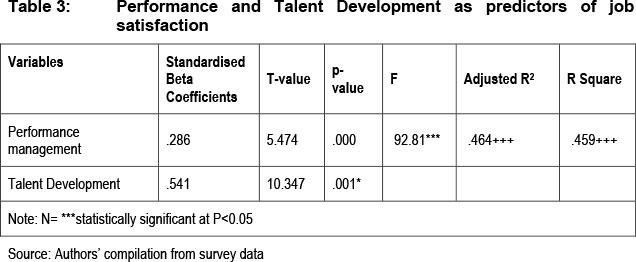
Regression analysis is a statistical technique which focuses on investigating and modelling the relationship between variables (Montgomery, Peck & Vining 2012:71). Table 3 below contains the results of the multiple regression analysis conducted to establish whether performance management and talent development act as predictors for job satisfaction.
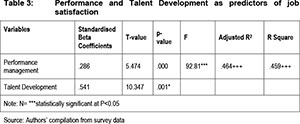
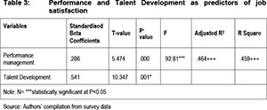
The results in Table 3 illustrate a significant F-ratio (p=0.00), which infers that the regression model predicts job satisfaction. The model accounted for a 46.4 percent (R2=0.464) impact on job satisfaction, with performance management (β=0.286; p=0.000) and talent development (β = 0.541; p=0.001) being seen to act as significant positive predictors for job satisfaction. Moreover, this beta value indicates that a 54.1 percent impact was created by talent development, while performance management created a 28.6 percent impact. Talent development therefore contributed the highest percentage towards explaining a perceived variance in job satisfaction.
5. DISCUSSION
The purpose of the study was to examine the impact of performance management and talent development on job satisfaction amongst academic staff in selected HEIs in the South African context. Performance management is one of the most important HR and development practices and crucial in every organisation. In order to improve employee performance, it is critical to evaluate their performance at regular intervals to understand where they stand, what is expected of them and what they actually contributing to the organisation. The study responded to the calls in the literature for more studies regarding job satisfaction and its relationship with performance management and talent development in HEIs. This research is significant because performance management and talent development are perceived as having a positive influence on job satisfaction. The results of the current study indicated that performance management and talent development are crucial in predicting employee job satisfaction in HEIs.
Overall results revealed a positive and significant relationship between performance management, talent development and job satisfaction. This study demonstrated that performance management and talent development was linked with job satisfaction in HEIs. Additionally, these results imply that if performance management is applied effectively in the working environment, employee job satisfaction will improve. Akyol (2014:21) states that the employee satisfaction levels of academic staff are affected by various factors such as pay, supervisor, co-worker relations, performance, training and recognition. However, another matter relating to employee satisfaction is the relationship between their satisfaction levels and their work performance. These results are consistent with results of previous studies which find a positive relationship between performance management and job satisfaction (Al-Hinai & Bajracharya 2014:13; Chun et al. 2018:12; Jain et al. 2007:193; Mathur & Prasad 2014:190; Shin & Jung 2014:612; Toker 2011:167). According to Gupta and Upadhyay (2012:101), a significant and effective impact has been made by PMS on employee satisfaction and commitment. Thus, a high job satisfaction of employees increases the productivity of an organisation, which in turn increases overall organisational performance. H1 is accepted and it is clear that performance management has a positive relationship with job satisfaction.
Talent development was found to be the strongest predictor of job satisfaction with a beta value of 54.1 percent over performance management which only explained job satisfaction at 28.6 per cent. These findings are consistent with the findings of the previous studies that reported a significant relationship between talent development and job satisfaction (Chaudhary & Bhaskar 2016:95; Haider et al. 2015:341; Moloantoa & Dorasamy 2017:193). Since academics are an important asset in academic delivery at universities, their perceptions of job satisfaction needs to be considered if universities are to remain the portals of growth and development, both locally and internationally. The present study reveals that most academic staff is satisfied with talent development opportunities in their institutions. Results of the study confirms the findings of or are in line with research studies of Moloantoa and Dorasamy (2017:193), Taduvana (2017:107), Chaudhary and Bhaskar (2016:95), Akhtar et al. (2015:256), Haider et al. (2015:341), Sharma and Sinha (2015:81), Tabatabaei and Farazmehr (2015:188), Aydogdu and Asikgil (2011:44) and Armstrong and Murlis (2004:23). H2 is accepted and it is clear that talent development has a positive relationship with job satisfaction. Therefore, if talent development is improved at HEIs, then job satisfaction will be enhanced.
5.1 Limitations
The study's limitations are its geographical sampling, which was limited to Free State and Gauteng UoTs. Understanding the empirical versatility of the phenomenon requires further investigation to take place which covers UoTs, comprehensive universities and traditional universities nationally. Generalisation of the findings is restricted since the study was conducted at only two (2) UoTs.
6. RECOMMENDATIONS
In the competitive environment, HEIs require satisfied academics to generate value for the institution. Therefore, if these institutions do not pay attention to performance of their employees, they will not be able to achieve their set objectives. Policymakers should prioritise the implementation of effective performance management in HEIs. If employee performance is not achieved, talent development can be used as an intervention to mitigate substandard performance. Talent development is one of the strategies available at UoTs, but the way in which it is implemented should not in any way impact on the development of specific employees.
Policymakers are to relook policies regarding employee performance and talent development. Therefore, talent development of the various factors in job training should be made compulsory for all employees, and follow-up monitoring should be conducted to ascertain the impact this has on them. The more individual employees accumulate skills, the more such employees should be rewarded by means of promotion or monetary incentives. Providing necessary training and development can thus ensure job satisfaction amongst employees. Providing necessary training and development can thus ensure job satisfaction amongst employees. Although, some performance bonuses exist at institutions, these have not yet been fully implemented. This has a negative effect on the performance of those who have not benefited from them, and therefore reduces their overall efforts and outcomes. Higher education institutions should establish linkage between performance management, talent development and job satisfaction. Academic staff involvement in the decision-making processes on issues concerning their well-being should be prioritised since this affects their job satisfaction. Management should work hand in hand with the policymakers to achieve successful implementation of policies in order to make subsequent reviews. This will improve the quality of intellectual capital and individual performance.
7. CONCLUSION
The current study examines the influence of performance management and talent development on job satisfaction in the higher education sector in South Africa. In the efforts of enhancing job satisfaction amongst employees, an insight into performance management and talent development is critical. The study reveals a positive relationship between performance management, talent development and job satisfaction. Talent development found to be the strong predictor of job satisfaction in HEIs.
The study creates awareness to policymakers in HEIs on the importance of talent development in enhancing employee performance and job satisfaction. The analysis reveals that HEIs should implement PMS for employees since it plays a significant role in job satisfaction. Additionally, the study suggests an implementation of talent development programmes to mitigate sub-standard performance amongst employees. The study highlights the critical role of improving talent development in enhancing job satisfaction. The findings provide important evidence about the positive consequences for employees' job satisfaction. This view is supported by Moloantoa and Dorasamy (2017:193) who attest that understanding the factors that affect academic performance is pivotal for satisfactory levels of performance by HEIs. In essence, job satisfaction remains a crucial HR dimension that needs organisational support, if optimal employee performance is the ultimate target underpinning overall success (Tennant, Mcmullen, & Kaczynsk 2010:186). Eyupoglu and Saner (2009:686) support this view, contending that a positive university climate does not only increase job satisfaction among academic staff, but also the overall productivity of the organisation. The current study adds value to the theoretical and empirical debates on the importance of performance management and talent development on job satisfaction. Talent development should also be a key priority for HEIs. Although the implementation of PMS effectiveness is not the only means of employee satisfaction, it is considered one of the major factors affecting it.
REFERENCES
2. LITERATURE REVIEW
-
ABDULLA J, DJEBARNI R & MELLAHI K. 2011. Determinants of job satisfaction in the UAE: A case study of the Dubai police. Personnel review 40(1):126-146. (DOI:10.1108/00483481111095555.
» https://doi.org/10.1108/00483481111095555 - )
-
AKHTAR CS, AAMIR A, KHURSHID MA, ABRO MMQ & HUSSAIN J. 2015. Total Rewards and Retention: Case Study of Higher Education Institutions in Pakistan. Procedia-Social and Behavioural Sciences 210:251-259. (DOI:10.1016/j.sbspro.2015.11.365.
» https://doi.org/10.1016/j.sbspro.2015.11.365 - )
-
AKYOL H. 2014. The Measuring Effect of Employee Satisfaction of Academic Staff to Employee Performance. Journal of Social and Administrative Sciences 1(1):18-33. [Internet:http://kspjournals.org/index.php/JSAS/article/download/119/169; downloaded on 11 September 2019.
» http://kspjournals.org/index.php/JSAS/article/download/119/169 -
]
» http://www.mrp.ase.ro/no34/f7.pdf -
AL-HINAI Z & BAJRACHARYA A. 2014. A Study on the Factors Affecting Job Satisfaction of Academic Staff in Higher Education Institution. In Proceedings of International Academic Conferences (No. 0800160). International Institute of Social and Economic Sciences. [Internet:https://iises.net/proceedings/13th-international-academic-conference-antibes/table-of-content/detail?article=a-study-on-the-factors-affecting-job-satisfaction-of-academic-staff-in-higher-education-institution; downloaded on 12 September 2018.
» https://iises.net/proceedings/13th-international-academic-conference-antibes/table-of-content/detail?article=a-study-on-the-factors-affecting-job-satisfaction-of-academic-staff-in-higher-education-institution -
]
» https://www.tandfonline.com/doi/abs/10.1080/15309576.2018.1481116 -
AYDOGDU S & ASIKGIL B. 2011. An empirical study of the relationship among job satisfaction, organizational commitment and turnover intention. International Review of Management and Marketing 1(3):43. [Internet:https://ideas.repec.org/a/eco/journ3/2011-03-2.html; downloaded on 11 September 2019.
» https://ideas.repec.org/a/eco/journ3/2011-03-2.html -
]
» https://doi.org/10.1080/03050069529137 -
]
» https://doi.org/10.1108/IJPPM-09-2017-0238 -
BAHRI MS, SANUSI A & ASIH P. 2017. Job Satisfaction as a Benchmark of Higher Education Leadership for Lecturer Performance in Indonesia. IOSR Journal of Business and Management (IOSR-JBM) 19(9):15-23. [Internet:http://www.iosrjournals.org/iosr-jbm/papers/Vol19-issue9/Version-5/C1909051523.pdf.
» http://www.iosrjournals.org/iosr-jbm/papers/Vol19-issue9/Version-5/C1909051523.pdf -
]
» https://ujcontent.uj.ac.za/vital/access/services/Download/uj:12070/CONTENT1?view=true -
)
» https://doi.org/10.3889/oamjms.2019.657 -
CHAUDHARY NS & BHASKAR P. 2016. Training and development and job satisfaction in education sector. International Journal of Business Quantitative Economics and Applied Management Research 2(8):89-97. [Internet:https://www.researchgate.net/profile/Narendra_Chaudhary9/publication/295490748_TRAINING_ AND_DEVELOPMENT_AND_JOB_SATISFACTION_IN_EDUCATION_SECTOR/links/56cac13708ae5488f0d95925/TR AINING-AND-DEVELOPMENT-AND-JOB-SATISFACTION-IN-EDUCATION-SECTOR.pdf; downloaded on 24 August 2018.
» https://www.researchgate.net/profile/Narendra_Chaudhary9/publication/295490748_TRAINING_ AND_DEVELOPMENT_AND_JOB_SATISFACTION_IN_EDUCATION_SECTOR/links/56cac13708ae5488f0d95925/TR AINING-AND-DEVELOPMENT-AND-JOB-SATISFACTION-IN-EDUCATION-SECTOR.pdf -
]
» https://www.cabdirect.org/cabdirect/abstract/20143208444 -
CHUN YH, CHOI S & SONG M. 2018. Analysing the Link between Job Satisfaction and Performance in Educational Institutions. International Journal of Public Administration 42(9):707-722. (DOI:10.1080/01900692.2018.1498101.
» https://doi.org/10.1080/01900692.2018.1498101 -
)
» https://doi.org/10.1016/j.sbspro.2009.01.120 -
CLARKE M, KENNY A & LOXLEY A. 2015. Creating a supportive working environment for academics in higher education: Country report Ireland. Irish Federation of University Teachers and Teachers' Union of Ireland. [http://edepositireland.ie/bitstream/handle/2262/79891/Clarke%2c%20Kenny%20%26%20Loxle y%202015.pdf?sequence=1&isAllowed=y; downloaded on 24 August 2018.
» http://edepositireland.ie/bitstream/handle/2262/79891/Clarke%2c%20Kenny%20%26%20Loxle y%202015.pdf?sequence=1& isAllowed=y -
]
» http://www.ijmra.us/project%20doc/IJMIE_JULY2012/IJMRA-MIE1272.pdf - )
- COUNCIL FOR HIGHER EDUCATION (CHE). 2016. South African Higher Education Reviewed. Two decades of democracy. Pretoria.
-
)
» https://www.gov.za/documents/higher-education-act - CRESWELL JW. 2014. Research Design Qualitative, Quantitative and Mixed Methods Approaches. 4th Edition. Thousand Oaks: CA Sage.
-
)
» https://repository.up.ac.za/bitstream/handle/2263/986/Jansen%20%282003%29f.pdf?sequence=2& isAllowed=y -
DE LOURDES MACHADO M, SOARES VM, BRITES R, FERREIRA JB & GOUVEIA OMR. 2011. A look to academic's job satisfaction and motivation in Portuguese higher education institutions. Procedia-Social and Behavioural Sciences 29:1715-1724. (DOI:10.1016/j.sbspro.2011.11.417.
» https://doi.org/10.1016/j.sbspro.2011.11.417 -
)
» https://open.uct.ac.za/bitstream/handle/11427/7385/DPRU_WP03-080.pdf?sequence=1& isAllowed=y -
)
» http://uir.unisa.ac.za/bitstream/handle/10500/21651/validation%20of%20an%20employ ee%20satisfaction%20model.pdf?sequence=1& isAllowed=y - DU PRÉ R. 2009. The place and role of Universities of Technology in South Africa. Bloemfontein: South African Technology Network.
-
]
» https://doi.org/10.1080/14330237.2015.1078102 -
ELLIS R. 2015. Making Learning a Key Element of a Total Rewards Package. [Internet: https://www.td.org/insights/making-learning-a-key-element-of-a-total-rewards-package; downloaded on 14 December 2018.
» https://www.td.org/insights/making-learning-a-key-element-of-a-total-rewards-package -
]
» https://doi.org/10.4102/sajhrm.v14i1.784 -
)
» https://www.ripublication.com/ijmibs-spl/ijmibsv4n2spl_10.pdf -
GOH SC. 2012. Making performance measurement systems more effective in public sector organizations. Measuring business excellence 16(1):31-42. (DOI:10.1108/13683041211204653.
» https://doi.org/10.1108/13683041211204653 -
)
» https://doi.org/10.1007/s11233-019-09044-x -
]
» https://www.unisa.ac.za/static/corporate_web/Content/Colleges/CEDU/Images/violence_report_version2_2013.pdf -
HAIDER M, AAMIR A, HAMID ABA & HASHIM M. 2015. A literature analysis on the importance of non-financial rewards for employees' job satisfaction. Abasyn Journal of Social Sciences 8(2):341-354. [Internet:http://ajss.abasyn.edu.pk/admineditor/papers/V8I2-10.pdf; downloaded on 23 August 2019.
» http://ajss.abasyn.edu.pk/admineditor/papers/V8I2-10.pdf - ]
-
HATICE O. 2012. The influence of intrinsic and extrinsic rewards on employee results: an empirical analysis in Turkish manufacturing industry. Business and Economic Research Journal 3(3):29-48. [Internet:https://www.researchgate.net/profile/Hatice_Ozutku/publication/254448517_The_Influence_of_Intrinsic_ and_Extrinsic_Rewards_on_Employee_Results_An_Empirical_Analysis_in_Turkish_Manufacturing_Industry/link s/56e7f64808aea51e7f3af963/The-Influence-of-Intrinsic-and-Extrinsic-Rewards-on-Employee-Results-An-Empirical-Analysis-in-Turkish-Manufacturing-Industry.pdf; downloaded on 23 August 2018.
» https://www.researchgate.net/profile/Hatice_Ozutku/publication/254448517_The_Influence_of_Intrinsic_ and_Extrinsic_Rewards_on_Employee_Results_An_Empirical_Analysis_in_Turkish_Manufacturing_Industry/link s/56e7f64808aea51e7f3af963/The-Influence-of-Intrinsic-and-Extrinsic-Rewards-on-Employee-Results-An-Empirical-Analysis-in-Turkish-Manufacturing-Industry.pdf -
]
» http://ijbssnet.com/journals/Vol_4_No_3_March_2013/27.pdf -
HEATHFIELD SM. 2012. Salary and Salary Requirements of Job Candidates: Attract and Retain Superior Employees. [Internet:https://www.thebalancecareers.com/salary-requirements-of-job-candidates-1918254; downloaded on 11 July 2018.
» https://www.thebalancecareers.com/salary-requirements-of-job-candidates-1918254 -
]
» http://ijmbr.srbiau.ac.ir/article_7957_00f359f786fbf60d13a40db3cc4b4497.pdf - HERZBERG F. 1966. Work and the nature of man. Cleveland, OH: World Publishing.
-
]
» https://doi.org/10.1177/0258042X15601538 -
HODOR ES. 2014. Total Rewards Model in Romanian Companies. Cross-Cultural Management Journal 16(30):313-319. [Internet:http://seaopenresearch.eu/Journals/articles/SPAS_3_28.pdf; downloaded on 11 July 2018.
» http://seaopenresearch.eu/Journals/articles/SPAS_3_28.pdf -
]
» https://doi.org/10.4102/sajhrm.v15.804 -
HUNJET A, KOZINA G & KUREčIć P. 2015. The Role of Higher Education Institutions in the Development of Entrepreneurship. Competences on the Study Programs Other than Economy. In Economic and Social Development. (9th International Scientific Conference.) [Internet:https://www.researchgate.net/profile/Petar_Kurečić/publication/274391620_THE_ROLE_OF _HIGHER_EDUCATION_INSTITUTIONS_IN_THE_DEVELOPMENT_OF_ENTREPRENEURSHIP_COMPETENCES_ON_ THE_STUDY_PROGRAMS_OTHER_THAN_ECONOMICS/links/551ef2690cf2f9c1304daf83/THE-ROLE-OF-HIGHER-EDUCATION-INSTITUTIONS-IN-THE-DEVELOPMENT-OF-ENTREPRENEURSHIP-COMPETENCES-ON-THE-STUDY-PROGRAMS-OTHER-THAN-ECONOMICS.pdf; downloaded on 24 August 2018.
» https://www.researchgate.net/profile/Petar_Kurečić/publication/274391620_THE_ROLE_OF _HIGHER_EDUCATION_INSTITUTIONS_IN_THE_DEVELOPMENT_OF_ENTREPRENEURSHIP_COMPETENCES_ON_ THE_STUDY_PROGRAMS_OTHER_THAN_ECONOMICS/links/551ef2690cf2f9c1304daf83/THE-ROLE-OF-HIGHER-EDUCATION-INSTITUTIONS-IN-THE-DEVELOPMENT-OF-ENTREPRENEURSHIP-COMPETENCES-ON-THE-STUDY-PROGRAMS-OTHER-THAN-ECONOMICS.pdf - ]
-
JAIN KK, JABEEN F, MISHRA V & GUPTA N. 2007. Job satisfaction as related to organisational climate and occupational stress: a case study of Indian Oil. International Review of Business Research Papers 3(5):193-208. [Internet:https://www.researchgate.net/profile/Fauzia_Jabeen2/publication/265071888_Job_Satisfaction_as_Related_to _Organisational_Climate_and_Occupational_Stress_A_Case_Study_of_Indian_Oil/links/559fd19608aea7f2ec589d51/Job-Satisfaction-as-Related-to-Organisational-Climate-and-Occupational-Stress-A-Case-Study-of-Indian-Oil.pdf; downloaded on 23 August 2018.
» https://www.researchgate.net/profile/Fauzia_Jabeen2/publication/265071888_Job_Satisfaction_as_Related_to _Organisational_Climate_and_Occupational_Stress_A_Case_Study_of_Indian_Oil/links/559fd19608aea7f2ec589d51/Job-Satisfaction-as-Related-to-Organisational-Climate-and-Occupational-Stress-A-Case-Study-of-Indian-Oil.pdf -
]
» https://hrcak.srce.hr/file/221545 -
]
» http://etd.cput.ac.za/bitstream/handle/20.500.11838/1739/staff%20attraction%2 0and%20retention%20model%20for%20namibian%20state-owned%20enterprise.pdf?sequence=1&isAllowed=y -
KIVISTÖ J, PEKKOLA E, BERG LN, HANSEN HF, GESCHWIND L & LYYTINEN A. 2019. Performance in higher education institutions and its variations in Nordic policy. Reforms, Organizational Change and Performance in Higher Education 37-67. (DOI:https://doi.org/10.1007/978-3-030-11738-2_2). (Palgrave Macmillan, Cham.
» https://doi.org/10.1007/978-3-030-11738-2_2 -
)
» https://doi.org/10.22059/ijms.2013.30123 -
]
» http://citeseerx.ist.psu.edu/viewdoc/download?doi=10.1.1.470.8247&rep=rep1& type=pdf -
LAM T, ZHANG H & BAUM T. 2001. An investigation of employees' job satisfaction: the case of hotels in Hong Kong. Tourism Management 22:157-165. (DOI:10.1016/S0261 -5177(00)00039-X.
» https://doi.org/10.1016/S0261 -5177(00)00039-X -
)
» http://shell.cas.usf.edu/~pspector/scales/jssovr.html - ]
-
LEE J & OK C. 2012. Reducing burnout and enhancing job satisfaction: critical role of hotel employees' emotional intelligence and emotional labour. International Journal of Hospitality Management 31(4):1101-1112. (DOI:https://doi.org/10.1016/j.ijhm.2012.01.007.
» https://doi.org/10.1016/j.ijhm.2012.01.007 -
)
» http://openscholar.dut.ac.za/bitstream/10321/2599/1/TADUVANA_S_2017.pdf - LOCHMILLER CR & LESTER JN. 2017. An Introduction to Educational Research Connecting Methods to Practice. 1st Edition. Los Angeles: SAGE.
-
LONGO R. 2014. Rhetoric and practice of strategic reward management. Milan: HR Professionals. [Internet:https://issuu.com/rosariolongo/docs/rhetoric_and_practice_of_strategic_; downloaded on 23 August 2018.
» https://issuu.com/rosariolongo/docs/rhetoric_and_practice_of_strategic_ -
]
» https://doi.org/10.5121/ijci.2017.6206 -
)
» https://doi.org/10.1007/s11162-018-9494-2 -
MABASO MC & DLAMINI BI. 2017. Impact of compensation and benefits on job satisfaction. Research Journal of Business Management 11:80-90. (DOI:10.3923/rjbm.2017.80.90.
» https://doi.org/10.3923/rjbm.2017.80.90 -
)
» https://www.worldatwork.org/total-rewards-model - )
-
MALIK ME, DANISH RQ & MUNIR Y. 2012. The impact of pay and promotion on job satisfaction: evidence from higher education institutes of Pakistan. American Journal of Economics 2(4):6-9. (DOI:10.5923/j.economics.20120001.02.
» https://doi.org/10.5923/j.economics.20120001.02 - )
- ]
-
MBUNDU IN. 2011. A critical evaluation of job satisfaction levels during the transitional period of a merger: the case of Walter Sisulu University. Pretoria: University of South Africa. [Internet:http://uir.unisa.ac.za/bitstream/handle/10500/5301/dissertation_mbundu_in.pdf?sequence=1&isAllowed=y; downloaded on 24 July 2018]. (Unpublished Master's Dissertation.
» http://uir.unisa.ac.za/bitstream/handle/10500/5301/dissertation_mbundu_in.pdf?sequence=1& isAllowed=y - )
- )
- MILLSAP RE & MAYDEU-OLIVARES A. 2009. The SAGE handbook of quantitative methods in Psychology. New York, NY: SAGE. (eds.
- )
- ]
-
MOLOANTOA ME & DORASAMY N. 2017. Job satisfaction among academic employees in institutions of higher learning. Problems and Perspectives in Management 15(3):193-200. (DOI:http://dx.doi.org/10.21511/ppm.15(3-1).2017.03.
» http://dx.doi.org/10.21511/ppm.15(3-1).2017.03 - )
-
MUBARAK RZ, WAHAB Z & KHAN NR. 2012. Faculty retention in higher education institutions of Pakistan. Journal of Theories and Research in Education 7(2):65-78. (DOI:10.6092/issn.1970-2221/3213.
» https://doi.org/10.6092/issn.1970-2221/3213 - )
-
MUJTABA BG & SHUAIB S. 2010. An Equitable Total Rewards Approach to Pay for Performance Management. Journal of Management Policy and Practice 11(4):111-121. [Internet:http://digitalcommons.www.na-businesspress.com/JMPP/MujtabaWeb.pdf; downloaded on 12 September 2018.
» http://digitalcommons.www.na-businesspress.com/JMPP/MujtabaWeb.pdf - ]
-
MUSHEMEZA ED. 2016. Opportunities and Challenges of Academic Staff in Higher Education in Africa. International Journal of Higher Education 5(3):236-246. [Internet:http://www.sciedu.ca/journal/index.php/ijhe/article/view/10080/6127; downloaded on 23 July 2018.
» http://www.sciedu.ca/journal/index.php/ijhe/article/view/10080/6127 - ]
- ]
-
MUTEKWE E. 2017. Unmasking the ramifications of the fees-must-fall-conundrum in higher education institutions in South Africa: a critical perspective. Perspectives in Education 35(2):142-154. (DOI:10.18820/2519593X/pie.v35i2.11.
» https://doi.org/10.18820/2519593X/pie.v35i2.11 - )
- ]
-
NG'ETHE JM, IRAVO ME & NAMUSONGE GS. 2012. Determinants of academic staff retention in public universities in Kenya: Empirical Review. International Journal of Humanities and Social Science 13(2):205-212. [Internet:http://www.ijhssnet.com/journals/Vol_2_No_13_July_2012/22.pdf; downloaded on 23 July 2018.
» http://www.ijhssnet.com/journals/Vol_2_No_13_July_2012/22.pdf - ]
-
NOOR Z, KHAN AU & NASEEM I. 2015. IMPACT OF JOB PROMOTION AND JOB ADVANCEMENT ON JOB SATISFACTION IN UNIVERSITIES OF KPK PROVINCE OF PAKISTAN. Science International Journal 27(2):1499-1505. [Internet:https://www.semanticscholar.org/paper/IMPACT-OF-JOB-PROMOTION-AND-JOB-ADVANCEMENT-ON-JOB-Noor-Khan/09a23b3b12f4384353500aba529b292215cda486; downloaded on 24 July 2018.
» https://www.semanticscholar.org/paper/IMPACT-OF-JOB-PROMOTION-AND-JOB-ADVANCEMENT-ON-JOB-Noor-Khan/09a23b3b12f4384353500aba529b292215cda486 - ]
- NUNNALLY CJ & BERNSTEIN IH. 2010. Psychometric theory. New York, NY: Mc Graw-Hill.
- )
-
PETERS G-JY. 2014. The alpha and the omega of scale reliability and validity: Why and how to abandon Cronbach's alpha and the route towards more comprehensive assessment of scale quality. The European Health Psychologist 16(2):56-69. [Internet:https://www.ehps.net/ehp/index.php/contents/article/view/ehp.v16.i2.p56/1; downloaded on 23 August 2018.
» https://www.ehps.net/ehp/index.php/contents/article/view/ehp.v16.i2.p56/1 - ]
- )
-
RAZIQ A & MAULABAKHSH R. 2015. Impact of working environment on job satisfaction. Procedia Economics and Finance 23:717-725. (DOI:https://doi.org/10.1016/S2212-5671(15)00524-9.
» https://doi.org/10.1016/S2212-5671(15)00524-9 - )
- SEKARAN U. 2003. Research Methods for Business, a Skill Building Approach. 4th Edition. New Jersey: Wiley.
- ]
-
SHARMA PR. 2015. Organizational Communication: Perceptions of Staff Members' Level of Communication Satisfaction and Job Satisfaction. Electronic Theses and Dissertations. Paper 2481. [Internet:http://dc.etsu.edu/etd/2481; downloaded on 14 September 2019.
» http://dc.etsu.edu/etd/2481 - ]
- )
-
SHIN JC & JUNG J. 2014. Academics job satisfaction and job stress across countries in the changing academic environments. Higher Education 67(5):603-620. [Internet:https://link.springer.com/article/10.1007/s10734-013-9668-y; downloaded on 24 July 2018.
» https://link.springer.com/article/10.1007/s10734-013-9668-y - ]
- )
-
SIBIYA H. 2017. Governance of the institutional leadership and student organisation interfaces in South Africa's Higher Education Institutions. African Journal of Public Affairs 9(5):190-199. [Internet:https://repository.up.ac.za/bitstream/handle/2263/59050/Sibiya_Governance_2017.pdf?sequence=1&isAllowed=y; downloaded on 25 August 2019.
» https://repository.up.ac.za/bitstream/handle/2263/59050/Sibiya_Governance_2017.pdf?sequence=1& isAllowed=y - ]
- )
-
SPECTOR PE. 1997. Job Satisfaction: Application, assessment, causes, and consequences. Thousand Oaks, CA: Sage. (DOI:http://dx.doi.org/10.4135/9781452231549.
» http://dx.doi.org/10.4135/9781452231549 - )
- ]
-
STANKOVSKA G, ANGELKOSKA S, OSMANI F & GRNCAROVSKA SP. 2017. Job Motivation and Job Satisfaction among Academic Staff in Higher Education. Current Business and Economics Driven Discourse and Education: Perspectives from Around the World 15(4):159-166. [Internet:https://files.eric.ed.gov/fulltext/ED574225.pdf; downloaded on 22 July 2018.
» https://files.eric.ed.gov/fulltext/ED574225.pdf - ]
-
TABATABAEI SO & FARAZMEHR Z. 2015. The relationship between emotional intelligence and Iranian language institute teachers' job satisfaction. Theory and Practice in Language Studies 5(1):184-195. (DOI:10.17507/tpls.0501.25.
» https://doi.org/10.17507/tpls.0501.25 - )
- )
- TENNANT M, MCMULLEN C & KACZYNSKI D. 2010. Teaching, learning, and research in higher education: a critical approach. New York, Routledge.
-
TLAISS HA, MARTIN P & HOFAIDHLLAOUI, M. 2017. Talent retention: evidence from a multinational firm in France. Employee Relations 39(4):426-445. (DOI:10.1108/ER-07-2016-0130.
» https://doi.org/10.1108/ER-07-2016-0130 - )
-
TOKER B. 2011. Job satisfaction of academic staff: an empirical study on Turkey. Quality Assurance in Education 19(2):156-169. [Internet:https://www.emeraldinsight.com/doi/full/10.1108/09684881111125050; downloaded on 14 November 2018.
» https://www.emeraldinsight.com/doi/full/10.1108/09684881111125050 - ]
- )
-
VERRET LB. 2012. Factors affecting university STEM faculty job satisfaction. Louisiana State University. [Internet:https://digitalcommons.lsu.edu/cgi/viewcontent.cgi?article=3477&context=gradschool_dissertations; downloaded on 12 November 2018]. (Unpublished Masters' Dissertation.
» https://digitalcommons.lsu.edu/cgi/viewcontent.cgi?article=3477& context=gradschool_dissertations - )
- )
-
WINBERG C. 2005. Becoming a University of Technology. Academic Journal of Vaal University of Technology 2:38-54. [Internet:http://citeseerx.ist.psu.edu/viewdoc/download?doi=10.1.1.131.9336&rep=rep1&type=pdf, downloaded on 24 July 2018.
» http://citeseerx.ist.psu.edu/viewdoc/download?doi=10.1.1.131.9336& rep=rep1& type=pdf - ]