Time-based competition as a competitive strategy for online grocery retailers
Abstract
In an attempt to stay competitive in customer-driven markets, many industries have morphed to include internet-enabled services as part of their day-to-day business. Grocery retailing is one such industry. The aim of this study was to firstly, explore the role of time in online grocery retailing. Secondly, the study investigated whether time-based competition (TBC) (i.e. when an organisation achieves a significant competitive advantage through the effective utilisation of time) could be a feasible competitive strategy for online grocery retailers to gain a competitive advantage. A qualitative methodology was used to collect empirical data for this study. An interview and two focus group discussions were analysed by means of thematic analysis. The findings suggest that time is an important issue in online grocery shopping and that online grocery retailers could gain a competitive advantage through effective time management, since one of the main motivations for consumers to participate in online grocery shopping is the perceived time-saving characteristic of purchasing groceries online. However, saving time along a grocery supply chain is challenging, and further research could focus on determining what constitutes time saving along the online grocery supply chain.
competitive advantage; online grocery retailing; online shopping; time-based competition
1. INTRODUCTION
In order for organisations to compete in challenging business environments, there should be increased emphasis on a competitive strategy which sets an organisation apart from its rivals. Several elements contribute towards the competitive strategy implemented by a specific organisation. Most commonly, organisational objectives determine the organisation's competitive strategy, with objectives such as cost reduction, superior quality and differentiation in terms of product or processes (Jooste, Strydom, Berndt & Du Plessis 2012:231).
Today, the element of time management as a competitive strategy has become the focus of many research studies (Blackburn 2012:397; De Toni & Meneghetti 2000:255; Filho & Saes 2013:1177; Pantano 2016:58). Results from these studies suggest that the time-related characteristics of supply can influence consumers' perceptions of products and services; and, if managed correctly, effective time utilisation could provide the organisation with a new a competitive edge (Sapkauskiene & Leitoniene 2010:210; Sathiyaraj, Santhosh & Subramani 2015:33; Siddiqui & Tripathi 2016:193).
Retailing is an example of an industry that is characterised by fierce competition between rivals to gain a unique competitive advantage, which would see consumers supporting them instead of their rivals (Campo & Breugelmans 2015:76).
However, determining which competitive strategy to pursue is not an easy task for any retailer. De Toni and Meneghetti (2000:255) argue that the best competitive strategy for an organisation would be one which appeals to a customer's sensitivity; for example, if customers in a retail industry are more focused on saving money, the retailer should pursue a low-cost strategy, whereas if customers demand a high level of quality, the retailer should pursue a competitive strategy focused on superior quality products and services. McGuinness and Hutchinson (2013:462) agree and argue that the uniqueness of an individual grocery retailer would depend on the number of individual capabilities and distinctive competencies which add value for the customer. Hence the feasibility of a competitive strategy depends on its relevance in terms of the industry of the organisation.
2. BACKGROUND
In an attempt to be competitive, traditional retailers have had to adapt their business models since the last two decades of the retail industry have been defined by dramatic advancements in technology with an ongoing focus on moving towards multi-channel retailing (i.e. adding online retailing). Advancements in technology have changed even the most basic consumer behaviour, with the result that retailers' customers are demanding more channel options, such as online retailing and even mobile applications as a method of purchasing products. For grocery retailers, online retailing has been exceptionally challenging as the movement of perishable food products demands careful consideration (Hübner, Kuhn & Wollenburg 2016:228). Thus, simply offering the online service is a challenge in itself, let alone pursuing the correct competitive strategy.
Time as a competitive strategy was first introduced in the business lexicon in 1988 with the revolutionary paper by George Stalk entitled "Time: the next source of competitive advantage". In this article, Stalk introduced the concept of time-based competition (TBC). This theory states that an organisation would be able to achieve a competitive advantage by engaging in TBC to satisfy customer needs as a crucial element in achieving organisational success (Stalk 1988:41). Competition expressed in a reduction in response time is referred to as TBC, and several authors (Blackburn 2012:396; De Toni & Meneghetti 2000:255; Filho & Saes 2013:1177; Stalk 1988:45; Stalk & Hout 1990:19) argue that a reduction in response time could lead to other types of competitive advantages such as lower cost, higher customer service quality and increased flexibility and credibility.
A competitive advantage can be defined as "the ability to provide greater value to customers than one's competitors (in the longer term, this kind of competitive advantage is called a sustainable competitive advantage)" (Brevis & Vrba 2014:286). Several authors have attempted to pinpoint the reasons why some organisations perform better than others, looking at, for example, a competitive advantage gained from the organisation's internal structure. In this instance, the organisation's internal resources and capabilities are superior to those of its rivals, contributing to interpretations such as the resource-based view. Alternatively, organisations could gain a competitive advantage by considering their external environment. Hence organisations might make use of tools such as Porter's five forces model to determine their competitive advantage in relation to the industry they are operating in (Carpenter & Sanders 2009:22).
This article reflects on one part of a larger study aimed at highlighting the burning issues pertaining to barriers to and motivators of online grocery retailing in South Africa. One of the issues that emerged from the larger study, is that time is a significant issue in online grocery retailing. It therefore became clear that the issue of time needs further investigation - hence the focus of this article on time and TBC in online grocery retailing. After exploring the issues relating to time in online grocery shopping, the article aims to explore the possibility of whether a focus on improving the efficiency of time utilisation (i.e. TBC) could lead to a competitive advantage for online grocery retailers in South Africa.
3. AIM OF STUDY
Considering the above, aim of this study was therefore to answer the following two research questions:
■ What role (negative/positive) does time play in online grocery retailing in South Africa?
■ Would time-based competition be a feasible competitive strategy for online grocery retailers to gain competitive advantage in South Africa?
Over time, several authors (e.g. Blackburn 2012:397; De Toni & Meneghetti 2000:255; Sapkauskiene & Leitoniene 2010:210; Yang, Véricort & Sun 2013:1) have examined TBC and the advantages of this strategy on numerous industries (i.e. motor vehicles, fast food, electronics, etc.). However, there is a paucity of research on the relevance of TBC in online grocery retailing. This study makes a unique contribution by exploring TBC as a competitive strategy for grocery retailers in the so-called "last mile" of the online grocery supply chain.
The research focused specifically on online grocery retailing for the following two reasons: (1) online grocery retailing is distinctive from other types of online retailing such as clothing or books; and (2) because online grocery retailers face the added challenge of perishability of their products, it is probable that time, as a competitive strategy, would be especially relevant to online grocery retailing.
The primary data for this research was collected in two phases. In phase one, an interview (and follow-up interview) was conducted with the online manager of one of the two online grocery retailers in South Africa. In phase two, two focus groups were conducted with consumers, one with consumers who regularly purchase groceries online and the other with consumers who have never bought any product online.
The article is structured as follows: In the next section, literature on TBC is discussed, followed by a discussion of online grocery shopping and more specifically online grocery shopping in South Africa. Also, literature on future developments that imply time advantages in online retailing is presented. Thereafter, the methodologies, findings and implications of the empirical research are discussed. Finally, conclusions are drawn on the importance of time and the possibility of adopting TBC by online grocery retailers.
Technology-enabled services experiences have created noteworthy interest in industry, government and academia around the world. The internet and its vast array of options have empowered industries such as the retail sector to offer their customers a wider variety of services. Online retailing, for example, affords retailers opportunities to interact with customers on a much deeper level, while customers enjoy the advantage of selecting the most convenient way of shopping.
Hodson, Egol and Blishchok (2012:Internet), interviewed over a dozen grocery CEOs and 2 000 customers in order to determine what the future would hold for grocery retailing. In their study they found that an effective online grocery service would become essential for these retailers to be competitive in future (Hodson et al. 2012:Internet). The wide adoption of and increased competition in online retailing have therefore challenged retailers to find new ways of adding value for their customers.
Hence, the focus of this study was to determine if time could serve as such a value-adding activity, distinguishing option or competitive strategy in online grocery retailing. As a gap in the literature owing to the paucity of research specifically examining online grocery retailing and the specific role time plays in this form of multichannel retailing.
Time, as a singular unit of analysis in relation to online retailing, has not been widely researched. Although terms such as "delivery time", "lead time", "just-in-time" and "real time" are commonly used in "last mile" supply chain terminology , there should be more emphasis on time as a unit of analysis and the specific role time plays in the retail supply chain. Effective time management has shown to be a new source of success for organisations, especially in relation to long-term competitiveness (De Beer & Rossouw 2015:34).
In light of this, one would expect management to measure time (as a performance variable) as unambiguously as they would when evaluating traditional financial performance variables such as costs and sales (Stalk 1988:45). However, this is not the case, as most retailers measure their online performance in terms of traditional performance measures such as quality and cost (Jacobs, Chase & Lummus 2014:40). This is problematic for online retailers as time and the way it should be managed is more of an issue for online retailers than traditional retailers. In online retailing, customers have to wait for their products to be delivered, whereas in a traditional shopping, customers obtain their products immediately or at a time convenient to them. Thus, time as a competitive strategy could have vast potential for online grocery retailers.
4.1 Time-based competition
At the heart of TBC lies the rationalisation that time could be a feasible alternative for the strategic alignment of an organisation. Sapkauskiene and Leitoniene (2010:206) discuss two main reasons why time could play an influential role in the competitiveness of an organisation.
Firstly, by reducing or eliminating delays, organisations could gain the favour of the most profitable customers, which leads to higher sales and increased market share.
Secondly, an organisation that builds its strategy with enough flexibility to adapt to change will enjoy substantial advances in time productivity and quality (Hübner, Kuhn & Sternbeck 2013:512).
Blackburn (2012:397) further posits that TBC strategies are focused on the development of a holistic approach to managing the external and internal retail supply chain for high performance, with the purpose of gaining a competitive advantage in the consumer market (Nguyen & Wright 2015:594). This could be done through developing a superior support structure for inter-organisational integration with superior levels of coordination and synchronisation of material flow. TBC can be achieved by reducing the amount of time consumed in each stage of the retail supply chain by eliminating non-value-adding activities and focusing on the effective execution of value-adding activities. Ironically, Blackburn (2012:397) found that supply chains are becoming longer instead of shorter and faster, which poses a conundrum for TBC since increased replenishment time along the retail supply chain leads to increased inventory and safety stock in the pipeline.
De Toni and Meneghetti (2000:255) highlight some of the disadvantages of an TBC strategy, stating that a focused TBC strategy can drive organisations to operate at an accelerated pace, and if time is the only consideration in achieving a competitive position, TBC could negatively affect an organisation's competitive advantage as the bigger picture such as market conditions and the specific industry should also be considered.
To determine whether TBC would be a feasible competitive strategy, online retailers have to consider the following questions: 'Would the consumer be willing to pay more to receive their products faster?' or 'Would the consumer rather save on cost and wait longer for the products to be delivered?' In terms of TBC and its feasibility as a competitive strategy for online grocery retailers, the strategy looks promising as some online retailers have already started to utilise time as a competitive advantage. Amazon.com for example charges different rates for different delivery times (Simchi-Levi, Kaminsky & Simchi-Levi 2009:160).
4.2 Saving time through innovation: the future of time-based competition in retailing
Online grocery retailers in developed countries (such as the UK, European countries and the USA) have fully functional mobile applications which allow customers to purchase their groceries via their mobile phones. They also offer customers the option of collecting their own groceries from dedicated collection points, called "click-and-collect" stores (Hübner et al. 2016:228). These extended online services were not yet available in South Africa at the time of the empirical study. However, when questioned, the online manager indicated that these options were part of their future planning.
"It's on our radar. It's not in the twelve month deliverables. It's certainly in the eighteen months, two years. It's one of those things that everyone just says it's a no-brainer, you must do it."
Hence, one way of determining whether time would be a potential competitive strategy for multichannel retailers in future, would be to investigate what "first movers" in online grocery retailing are doing to plan for growth. In the 2016 report of the research organisation, IGD, "What will be hot in food and grocery retail in 2016?", four trends for 2016 and beyond, are discussed (Hendry 2015:Internet; Walton 2016:Internet).
One of these trends is the emphasis grocery retailers place on finding quicker ways to fulfil online orders in the last mile of the supply chain. The report cites examples of UK-based online grocery retailers, Amazon.com, Ocado and Argos offering customers the option of home delivery within an hour after ordering online or via their mobile application. IGD argues that these large online retailers see the future of online as being quicker and more convenient than in-store shopping (Hendry 2015:Internet; Walton 2016:Internet).
The feasibility of time as a competitive strategy becomes even more palpable when exploring the envisaged future of distributing online orders. In 2013, Amazon.com and Google (Project Wings) started testing the use of drones as an alternative distribution method to cut cost and delivery time in the last mile of the retail supply chain.
Drones are defined: "[un]manned aerial vehicles (UAVS) and aircrafts either controlled by 'pilots' from the ground or increasingly, autonomously following a pre-programmed mission" (Cole & Wright 2010:Internet). In the USA, the commercial use of drones is still illegal, and retailers are anticipating the release of the official regulations by the FAA (Federal Aviation Administration) on the use of drones for commercial deliveries such as online ordered grocery products.
However, in Australia, the commercial use of drones has been legalised, which has resulted in the world's first drone delivery service (Stolaroff 2014:Internet). The Sydney-based organisation, Flirtey, partnered with book-rental service, Zookal, and is diminishing response times through the delivery of books to customers via hexacopters (robots with six rotors). Using this service, customers can place their order via their mobile application and the hexacopter (using the GPS service from the customer's mobile application) delivers directly to the customer's location.
Thus, through the use of this technology, retailers could close the gap of one of the main barriers for consumers in online grocery retailing, namely the time between order placement and order delivery (D'Andrea 2014:647). All of these innovative distribution channels have one thing in common - to cut the time it takes for customers to receive the products they have ordered online. However, one should be realistic and realise that these innovative distribution methods have limitations regarding size and weight.
4.3 South African online grocery shopping
To be able to consider TBC as a possible strategy by online grocery retailers the conditions in the retail and online retail market needs to be considered. Despite a relatively modern economy, sizable internet connectivity (49 per cent of the South African population - World Economic Forum (WEF), Global Competitiveness Report, 2015-2016) and the rise of modern consumers, online grocery retailing is still not a preferred method of purchasing groceries in South Africa.
There are five large grocery retail chains in South Africa, but only two of these grocery chains offer an online grocery delivery service to their customers. Euromonitor International (2015:Internet) reports that internet retail sales constitute only a small part of total retail sales in South Africa. Although only two of the large five grocery retailers offer online grocery delivery service, competition is fairly strong if one considers the limited market size.
Regarding market size, it is important to mention that mainly sophisticated consumers (with access to the internet and electronic banking services) are able to use an online grocery service, and as an emerging country, the largest part of the South African grocery market consists of unsophisticated consumers, with Van Zyl (2015:Internet) indicating that of the 55.6 million South African citizens (Statistics South Africa 2016:Internet) only 25 million have bank accounts, of which only 14 million have access to the internet; yet, only 2.3 million South African citizens use internet banking services.
Nevertheless, internet retail sales continue to be the most dynamic channel in South Africa's retail market (Euromonitor International 2015:Internet). A possible reason could be the improvement in infrastructure, mobile penetration, availability of payment options and a growing number of middle-income consumers in South Africa. However, according to The Nielsen Company's African Prospects Indicator Report (2016:3) 82 per cent of South Africa's surveyed consumers had changed their spending patterns because of economic pressure and in order to save on household expenses by cutting spending on luxuries, such as takeaways and entertainment. These consumers even indicated that they were switching to cheaper grocery brands.
The Nielsen Company further found that South African consumers base their decision on which retailer to purchase from, firstly, on a brand/store with a good reputation (one that is trusted), and secondly, on the affordability of the store. This alludes to the findings of McGuinness and Hutchinson (2013:475), who found that retailers usually base their competitive strategy on product/service differentiation or on establishing a cost advantage, i.e., traditional strategies of gaining a competitive advantage.
On the other hand, in a study conducted in 2015 by a global market research company, Ipsos, the finding was that South African consumers have an appetite for online shopping. This research found that 70 per cent of consumers who had never shopped online indicated that they would probably do so in the future. Of the consumers who had purchased online, 85 per cent indicated that faster delivery would make the online shopping experience more enjoyable (Bremmen 2015:Internet). These opposing market forces of economic pressure (characterised by cost consciousness), on the one hand, and higher customer expectations (a need for faster delivery coupled with possible cost implications), on the other, in the South African retail and online retailing environment demonstrate the relevance of the current study.
5. METHODOLOGY
As mentioned previously, the data for this study was derived from of a wider study aimed at determining all barriers and motivators for online grocery retailing in South Africa. A qualitative exploratory research design was employed.
The data was collected by means of two focus groups with customers and an in-depth interview with one of the two online grocery retailers in South Africa. After an analysis of the data for the larger study, time was identified as a significant factor in online grocery retailing. Hence the aim of this study was to delve deeper into time as a factor in online grocery retailing.
5.1 Data collection methods
As already mentioned, there are only two retailers in South Africa that has an online grocery ordering and delivery service1. Owing to the competition between these two retailers, one of the two online managers declined an interview with the researcher, which meant that only the one online manager was interviewed for the study.
According to Cooper and Schindler (2014:238), the objective of in-depth interviews is to explore an individual person/business or scenario in depth in order to build a holistic picture of a specific case. This is achieved by exploring a case from different perspectives (i.e. data collection methods), as was done in this study by triangulating between data from the interview and focus groups.
The main aim of a focus group, according to Cooper and Schindler (2014:238), is to assemble a group of participants who offer a range of positions on the issues in question. Focus groups or group interviews comprise a small number of participants, usually between eight and ten (Saunders, Lewis & Thornhill 2012:400). Focus groups were chosen for this study because they would provide the researcher with unique (South African-specific) data relating to the buying behaviour and perceptions of consumers who buy their groceries online.
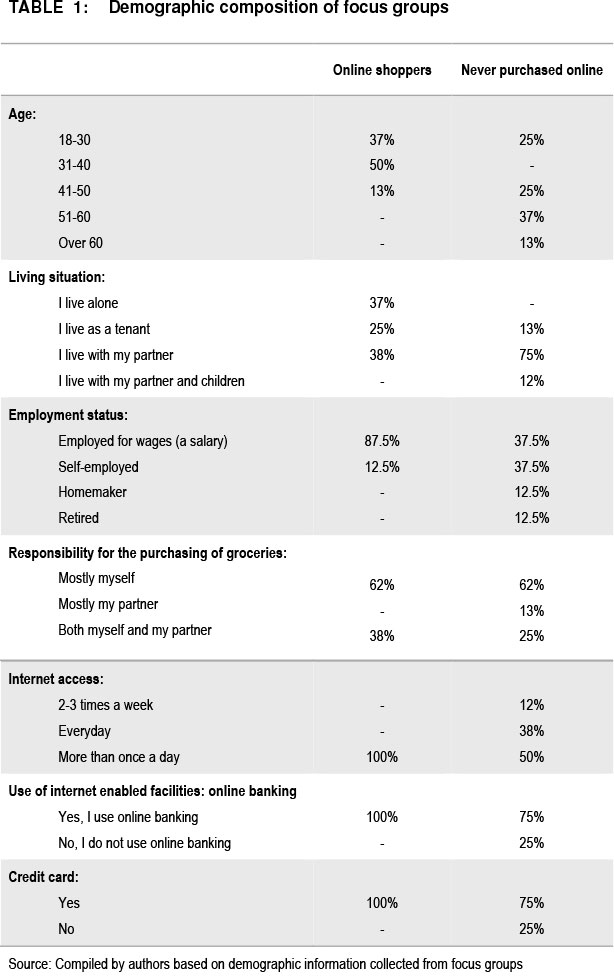
Two focus groups were conducted both with eight participants each. The first focus group consisted of consumers who had never purchased an item online, while the second group comprised consumers who had purchased groceries online, table 1 depicts the demographic composition of the focus group participants.
5.1.1 Sampling
The sampling method use for the data collection was convenience sampling, but more specifically multiplicity (snowball) sampling. According to Tustin, Ligthelm, Martin and Van Wyk (2005:349), in multiplicity (snowball) sampling, participants are first chosen according to judgement sampling, which entails that possible participants identify other members who will meet the specific requirements of the study. Inclusion criteria were determined for both focus groups.
5.1.2 Inclusion and exclusion criteria
Non-consumer inclusion criteria included: a) a person who has bought a grocery product online, b) a person who has the means for doing online grocery shopping (i.e. is computer-literate or has access to the internet), but does not participate in this service and c) after meeting criteria a and b, the person should also be available to participate in the focus group on the day/time scheduled.
The inclusion criteria of the 'online shoppers' focus group were as follows: a) a consumer who has purchased groceries online by means of a South African online grocery retailer, b) a consumer who has done online grocery shopping in the past two years, even if they have since stopped using the service c) after meeting criteria a and b, the person should also be available to participate in the focus group on the day/time scheduled.
5.2 Trustworthiness of the data
Qualitative research is frequently evaluated against criteria suitable for quantitative research, particularly in terms of reliability and validity, and is then found to be deficient. Qualitative researchers argue that, because of the difference in nature and purpose of quantitative and qualitative research, it is erroneous to apply the same criteria for merit.
To ensure the trustworthiness of the data in this study, both the interviews and the focus group discussions were auto recorded and transcribed. The researcher enlisted the services of a professional touch-typist to assist with transcription of the audio recording and a specialist in qualitative research who assisted with the focus group discussions and member-checked the data analysis.
According to Blumberg, Cooper and Schindler (2011:504), one of the most important methods to ensure the trustworthiness of qualitative data is through triangulation, defined as "a process of verifying information through multiple sources to increase the validity of the description of what is observed". The data collected from the in-depth interview and the two focus group discussions was triangulated to ensure that the codes, categories and themes identified from the data sets were a true reflection of the discussions with the online manager and focus group participants.
5.3 Data analysis technique
The data analysis technique used to analyse the qualitative data for this paper was thematic analysis. Braun and Clarke (2006:98) argue that many researchers confuse thematic data analysis with the more commonly known content analysis. The former was chosen as the most appropriate method of analysing the data of this study, as content analysis tends to focus more on a micro level, often providing frequency counts which allow for quantitative statistics to be applied.
Thematic analysis differs from content analysis, as the themes identified should not be quantified - the value of the analysis is housed in the words of the participants. Thematic analysis thus provides the researcher with a "thicker" representation of the data. Tesch (1990, in Smith & Firth 2011:58) defines thematic analysis as "... an interpretive process, whereby data are systematically searched to identify patterns within the data in order to provide an illuminating description of the phenomenon. The process results in the development of meaningful themes without explicitly generating theory. Thematic analysis can provide rich and insightful understandings of complex phenomena ... ".
The process of thematic data analysis involves six sequential steps. These steps were meticulously followed with the analysis of the data for this study. The steps are as follows: familiarising oneself with the data, generating initial codes, searching for themes, reviewing themes, defining and naming themes, and producing the report. These steps were first followed for each of the three datasets individually; thereafter, the datasets were combined to identify differences and similarities between the categories, themes and codes. The researcher subsequently compiled the thematic map. A thematic map is a visual representation of the categories, themes and codes identified during the thematic analysis and serves to illustrate the empirical findings. The next section of this paper will analyse the thematic map. The thematic map was compiled by the researcher after considering the relevance of each theme in relation to the entire data set.
In the following section of this article, the thematic map will be scrutinised and discussed to provide the reader with an in-depth understanding of the data. To support the findings, each section will also provide the reader with verbatim quotations from both the focus group participants and the online manager.
6. FINDINGS
The purpose of this study was twofold, firstly, to determine what role time plays in online grocery retailing, and secondly, to determine if time would be a feasible competitive strategy for online grocery retailers.
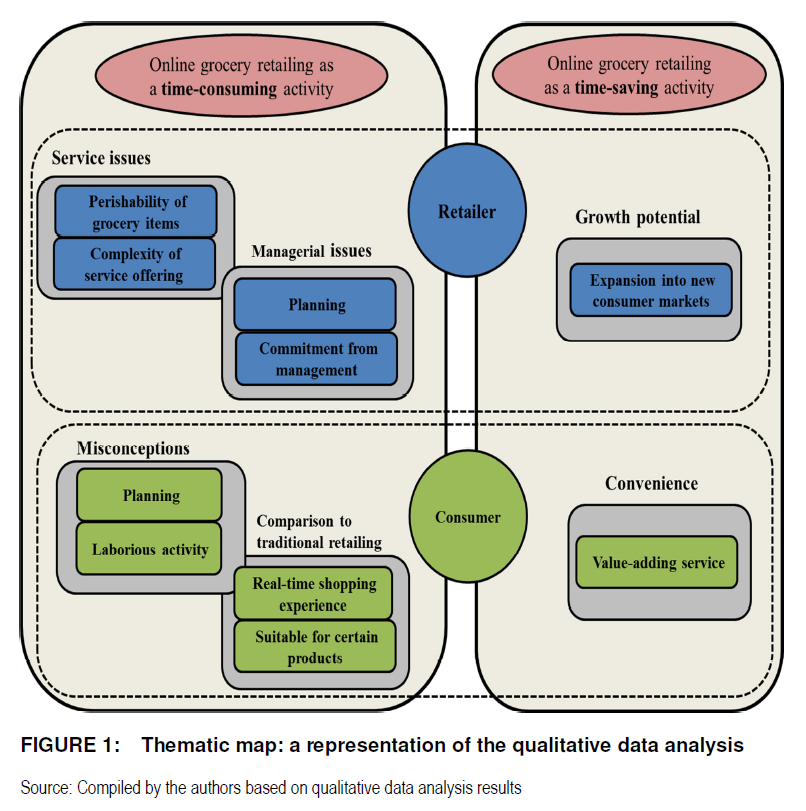
Figure 1 (the thematic map) is a visual representation of the themes, categories and codes that emerged from the data. In the next section, each of these themes, categories and codes will be discussed and particularly the time issue highlighted.
It is evident in figure 1 that two main themes were identified from the primary data: (1) online grocery shopping as a time-consuming activity, (2) online grocery shopping as a time-saving activity. This correlates with the literature which indicated that online grocery shopping is perceived as a time-saving activity which motivates consumers to participate in this service while also being a barrier from the retailer's perspective as it is time-consuming for retailers to offer this service.
Another observation that could be made from the thematic map is the evident lop-sidedness of the issues pertaining to online grocery shopping as a time-consuming activity from both the retailer's and the consumer's perspectives. These issues will be considered individually below.
6.1 Online grocery shopping as a time-consuming activity
The data indicated that both retailers and consumers experience online grocery shopping as a time-consuming activity. The codes identified from the data could be arranged into four categories, two applicable to the retailer (service issues and managerial issues) and two applicable to the consumers (misconceptions and comparison to traditional retailing).
6.1.1 The retailer's perspective: results from the in-depth interview
In the in-depth interview with the online manager, four codes kept emerging from the data.
Service issues
Firstly, in terms of service issues, the online manager referred to the perishability of grocery items and how planning the delivery of grocery items (with the possibility of being spoilt) is a logistical nightmare. He indicated that the perishable nature of grocery items was one of the barriers constraining the company to expand into additional geographical areas (i.e. hampering their growth), as they have to take into consideration the time it takes from order fulfilment to delivery.
"It's very hard to have hundred percent reliability in a food supply chain. It's very difficult... foods determine the radius ... because of the cold chain requirements but there's no reason why you can't send clothing anywhere
The second code relating to service issues identified in the interview was the complexity of the service offering. The online manager indicated that online grocery retailing is considerably more time consuming for retailers than traditional grocery retailing. Many shopping activities (which are the responsibility of the consumer in traditional retailing) become the responsibility of the retailer in online retailing. The retailer alluded to this and indicated that online grocery shopping entails additional services such as the picking and packaging of food items, which takes time.
"We spend a fortune of time and materials wrapping things every day but all the packaging does get destroyed at the end by the customer. So that's not a value at all."
"... we make a lot of promises. We promise effectively availability, we promise fulfilment, we promise delivery date and time within three hours. That's the proposition, end-to-end. That's what we've promised."
The online manager went on to indicate that the company has "packaged" this service in such a way to create the most value for the customer. Unfortunately the reality is that, at best, it is able to fulfil customer orders at a rate of 93 per cent. This is a seven percent difference between what customers order and what they receive. That margin is too high for most online customers; they expect 100 per cent (as they would when doing their own grocery shopping in a traditional retail store). When questioned on why the margin of error was this high, the online manager indicated that it was because of the complexity of the service. He explained that the company hopes that its suppliers will deliver the products on time; it hopes that the employee responsible for fulfilling the order catches his or her bus on time. The company hopes that its delivery partner arrives on time and delivers the product to the customer within the three-hour-window on time. There are a lot of variables in online grocery retailing, which complicates the service immensely.
Managerial issues
In terms of the category, managerial issues, the code planning for online grocery retailing was touched on several times. Here planning refers to the time online retailers invest in trying to keep up with the ever-evolving nature of online retailing. Hence if they plan to expand their service, they will need to plan ahead of time to be able to inform their suppliers and delivery partners of the planned expansion.
The last code applicable to online grocery shopping as a time-consuming activity from the retailer's perceptive is commitment from top management. As stated in the introduction, the competitive strategies employed by an organisation are usually determined by the organisation objectives (i.e. cost-savings, quality, etc.). The online manager indicated that one of primary challenges the company faced was the time span to align the business as a whole to acknowledge the value of online grocery retailing. He indicated that it had taken him and this team 13 years to have top management acknowledge and include online retailing in their organisational strategy. He was hopeful that online retailing would become a major driving force behind the company's competitive strategy in the future.
"For thirteen years, we fought David and Goliath and that's very hard to run a business where the majority of the business gives you no value ... I would make sure the business was completely strategically aligned behind the need for an online channel and that you had buy in and commitment from the very, very top."
After considering the categories, themes and codes in the data relating to online grocery shopping as a time-consuming activity, it could be concluded that time is a constraining factor for the online grocery retailer. Issues such as, the perishability of grocery items and the speed with which these items need to be delivered to the consumer, make time an inhibitor instead of an contributor to a successful service.
6.1.2 The consumer perspective: results for the focus group discussions
On analysis of the focus group data, two categories emerged - misconceptions and comparison to traditional retailing.
Misconceptions
Misconceptions were titled as a category because of the way in which consumers expressed their disappointment with what they thought they would experience versus what the actual experience was. The first code which forms part of misconceptions is planning. Planning from the consumer's perspective differs from planning from the retailer's perspective. Many of the focus group participants had started to do online grocery shopping because of the perception that it would save time. Unfortunately, many of them reported that the service was in fact more time consuming than time saving. The participants discussed several reasons why they perceived online grocery shopping as a time-consuming activity. Some of their arguments are cited below.
"My problem is I don't plan too far ahead ... take tonight for example I have to go stop at the shop on my way home to buy the things that I need and they don't...I can't place an order today and have it delivered for tonight."
"...planning to see one's milk is three quarters way done so now I have to order it so two days and then I'll get it and then that takes time."
Although the consumers see time as the problem, planning ahead seems to be the real problem. The challenges lays with retailers which should utilise time as a way to create a competitive advantage by designing the online service in such a way that the customer perceives online grocery shopping as a value-adding, i.e. time saving.
The second code listed under the theme misconceptions is online grocery shopping as a laborious activity. Participants from both focus groups were of the opinion that setting up an online account feels like a waste of time. Several participants also indicated that grocery products cannot be returned, and was concerned about the time that would be wasted if they did not receive what they ordered.
"...out-of-stocks became a huge problem for me that I was ordering a full basket of goods and only a quarter of the goods sometimes arrived. I'm spending all that time online that I might as well have gone to the shops."
"...it took so much time for me to actually initiate the purchase process. It takes time for me to set up the list and it doesn't necessary remain the same."
Comparison of online to traditional retailing
The second theme identified from the focus groups were the comparison of online to traditional retailing. After analysing the data from both focus groups it became apparent that consumers expect the same service from online grocery shopping as they would experience in traditional retailing. During the in-depth interview, the manager also addressed this consumer mind-set:
"...in a sense buy now, in a customer's mind that is the last point at which anything is required from them..It actually doesn't matter what happens down the line, in the customer's mind that's the transaction done. The only thing they can see beyond that point is they can see what they've bought and they can visualise it arriving at their door."
The first code in the category comparison of online to traditional retailing is a real-time shopping experience. As the name of the category suggests, this code relates to consumers expectation to have the same - real-time - shopping experience in online grocery shopping as they would have in traditional grocery retailing. However, the reality is quite different. Because consumers compare the two channels with each other, they have the perception that online grocery shopping is more time consuming than traditional grocery retailing.
"...I am impulsive. I'll plan a party for tonight and I don't have time, I'm in the office or what, and then I want to do it. So in that sense then you think online, it will be quick, but it's not and that defies the whole thing about online shopping."
"I think it would be great if there's an option for speed delivery or something like that. If you have a party tonight and you don't have time to go to the store and maybe not even have it delivered but have it packed, let me just come pick it up at the store. It's there, it's packed, I can just pop in, pay, thank you and go out with my packets."
After considering this category, the conclusion could be made that this misconception (consumers expecting the same service with online grocery shopping as traditional grocery shopping) results in consumers perceiving online grocery shopping as a time consuming activity since they do not have access to the products immediately after purchasing. This challenges retailers since they will have to consider innovative distribution strategies to try and bridge this gap between online and traditional retailing in the minds of the consumers.
The last code in this category is: online grocery shopping is more suitable for certain products. This code goes hand-in-hand with the code of perishability, discussed as part of the retailer's service issues. This code relates to the consumers' view that not all products are suitable or convenient for online grocery shopping. For example, with perishable food items such as fruit and vegetables the consumers prefer to purchase in a more proactive way. The participants also indicated that they would buy certain parts of their monthly or weekly groceries online, but prefer to buy other products in-store. They admit that these 'double-visits' are time consuming.
"I buy on a weekly basis - or I buy basics at the beginning of the month but that I'll do in store, the big league stuff I'll buy online. I think if you buy all your groceries online it must be very difficult."
6.2 Online grocery shopping as a time saving activity
Although the findings indicate an overwhelming inclination towards online grocery shopping as a time consuming activity, both the consumers and the retailer mentioned how online grocery shopping is a time saving activity. Two categories were identified under this theme -growth potential of the retailer and convenience for the consumer.
6.2.1 The retailer's perspective: results from the in-depth interview
From the retailer's perspective, the issue of time and the role it plays in online grocery shopping impedes the retailer's growth, and more specifically growth in terms of expansion into new consumer markets. As mentioned earlier, online grocery retailers are restricted in terms of the time sensitivity of the delivery of perishable foods.
However, the online manager indicated that delivery of non-perishable foods with a different distribution strategy to perishable food products is a new avenue the retailer hopes to capitalise on, as expansion into these consumer markets allows for cost saving and time saving, while gaining a substantial new consumer market. In contrast to investing a substantial amount of time and money in opening new stores, the retailer would be able to expand its footprint by taking non-perishable groceries to the customers who would not otherwise have had access to their stores.
"... that opens the door for non-perishable food to be delivered anywhere which would be a big win for us. It's a really big business opportunity for us to deliver the non-perishable products, even just outside of our footprint."
By delivering non-perishable foods to consumers, online retailers could gain a competitive advantage by gaining access to consumer markets that they would not have access to with traditional retailing at the fraction of the time (and cost) it would take to roll out an entirely new store.
6.2.2 The consumer's perspective: results from the focus group discussions
From the consumer's perspective, the conveniences of the service were mentioned several times. Although many of the participants indicated that the perceived convenience was less than expected, some of them specified that they perceived online grocery shopping as a value-adding service. They indicated that when they did receive exactly what they had ordered and it was delivered on time, online grocery shopping was seen as an activity that would save them time.
"I used to work in a [sic] office and it was my break to ... in lunch time to sit and do my grocery shopping, plan for the week, because parking was a nightmare at the office. So I wouldn't leave the office to go do my grocery shopping or to go just get a break from the office."
"You can still save time by buying the basics online, then you have your basics, then you only have to hop into the store to get one or two or three things. That takes a lot of time to get the whole basket of stuff."
From the above results, it could be concluded that time plays a prominent role in online grocery shopping from both the consumer's and the retailer's perspective in both a positive and negative way.
The challenge for retailers is to be innovative to use time as a competitive advantage, where customers are able to have a more real-time shopping experience when purchasing online.
7. CONCLUSION
The purpose of this study was, firstly, to determine the role time plays in online grocery shopping in South Africa, and secondly, to determine if TBC could be a feasible strategy to create a competitive advantage for online grocery retailers.
It could be concluded from the results that online retailing has many time-based complications for grocery retailers in South Africa. The perishable nature of some grocery items inhibits the extension of the online market in terms of delivery time. In addition, it takes time for the retailer to process the online order in terms of picking, packaging and delivery -time that the customer has no knowledge of. The delivery date and time also put pressure on the retailer because many variables need to fall into place to make the promised date and time of delivery. Aligning online offering with corporate strategy takes time.
From the consumer's perspective time also plays a crucial role. The results indicated that for some consumers, online grocery shopping did not live up to expectations in terms of saving them time. However, some indicated it as a value-adding service, particularly when they receive exactly what they have ordered and it is delivered on time.
An important factor in online shopping that was evident from the results is that consumers need to plan ahead for online grocery shopping if they wish to receive full value of the service offering. As a result, it could be recommended that online retailers utilise the opportunity to educate customers on the planning involved with online grocery shopping.
Online retailers could for example specify what the average time from initiating the order to time of expected delivery could be with a standard list of daily needed products to re-educate the customer regarding the online process. As indicated in the discussion on the empirical data, time and the issues surrounding it, were fairly prominent factors for the participants of the focus groups - even more than the cost or price of the online service. Price (cost), especially in terms of delivery cost, was not even mentioned as an issue for the consumers during the focus group discussions.
As stated in the literature, mainly sophisticated (wealthy) South African consumers use online grocery shopping, which underscores the above finding that time is more important than cost for online customers. On the strength of this finding, it could be concluded that customers would be willing to pay more for a service which saves them time, and from the customer's perspective, the retailer would be able to gain a competitive advantage by employing time-based competition as a competitive strategy.
Consequently, it could be concluded that TBC would be a feasible competitive strategy for online grocery retailers as the impulse to purchase online with the incentive of saving time already serves as a motivation for consumers to purchase their groceries online. It therefore becomes the responsibility of the retailer to harvest this impulse from the consumer by designing services where consumers are convinced that their online grocery platform would not only be convenient, but would save them time. Yet, if one considers the future innovations envisaged in section 2.2 above, it can be argued that there are limits to costly innovative technologies. In such a small market as South Africa, it would make sense for online retailers to employ simpler tools such as more efficient fulfilment strategies, better logistics in the last mile (such as on-time delivery) and functional mobile applications which make it easy for customers to purchase their groceries via their mobile phones.
Alternative fulfilment options such as, collecting their own groceries from dedicated collection points, called "click-and-collect" stores would also be more realistic time-saving tools for online grocery retailers in South Africa. From the retailer's perspective it would thus also make sense to base its competitive strategy on TBC.
In conclusion, the aim of this study was to first explore the role of time in online grocery retailing, and secondly, to investigate whether time-based competition (TBC) (i.e. when an organisation achieves a significant competitive advantage through the effective utilisation of time) could be a feasible competitive strategy for online grocery retailers to gain a competitive advantage.
Hence the final conclusion is that time is important in online retailing from both the customer's and the multichannel retailer's perspective, which means that a TBC strategy would create a competitive advantage in online grocery retailing. However, saving time along the last mile of a grocery supply chain poses a challenge, and a future research focus could be on determining what constitutes time saving along the online grocery retailing.
REFERENCES
4. LITERATURE REVIEW
- BLACKBURN J. 2012. Valuing time in supply chains: establishing limits of time-based competition. Journal of Operations Management 30:362-405.
- BLUMBERG B, COOPER DR & SCHINDLER PS. 2011. Business research methods. London, UK: McGraw-Hill Education.
- BRAUN V & CLARKE V. 2006. Using thematic analysis in psychology. Qualitative Research in Psychology 3(2): 77-101.
-
BREMMEN N. 2015. Boom of bust: which direction is the South African ecommerce space headed in? [Internet: http://ventureburn.com/2015/03/boom-bust-direction-south-african-ecommerce-space-headed/; downloaded on 2016-04-15.
» http://ventureburn.com/2015/03/boom-bust-direction-south-african-ecommerce-space-headed/ - ]
- BREVIS T & VRBA M. 2014. Contemporary management. Cape Town: Juta.
- CAMPO K & BREUGELMANS E. 2015. Buying groceries in brick and click stores: category allocation decisions and the moderating effect of online buying experiences. Journal of Interactive Marketing 31:63-78.
- CARPENTER MA & SANDERS G. 2009. Strategic management: a dynamic perspective - concepts. New York, NY: Pearson International.
-
COLE C & WRIGHT J. 2010. What are drones? [Internet: https://dronewars.net/aboutdrone/; downloaded on 2016-02-18.
» https://dronewars.net/aboutdrone/ - ]
- D'ANDREA R. 2014. Can drones deliver? IEEE Transactions on Automation Science and Engineering 11(3):647-648.
- DE BEER A & ROSSOUW D. 2015. Focus on management principles: a generic approach. 3rd ed. Cape Town: Juta.
- DE TONI A & MENEGHETTI A. 2000. Traditional and innovative paths towards time-based competition. International Journal of Production Economics 60:255-268.
-
EUROMONITOR INTERNATIONAL. 2015. Retailing in South Africa. [Internet: http://www.euromonitor.com/retailing-in-south-africa/report; downloaded on 2015-08-17.
» http://www.euromonitor.com/retailing-in-south-africa/report - ]
- FILHO MG & SAES EV. 2013. From time-based competition (TBC) to quick response manufacturing (QRM): the evolution of research aimed at lead time reduction. International Journal of Advanced Manufacturing Technology 64:1177-1191.
-
HENDRY V. 2015. The growth potential of online grocery. [Internet: http://www.igd.com/Research/Shopper-Insight/The-growth-potential-of-online-grocery/; downloaded on 2016-02-04.
» http://www.igd.com/Research/Shopper-Insight/The-growth-potential-of-online-grocery/ - ]
-
HODSON N, EGOL M & BLISCHOK T. 2012. Four forces shaping competition in grocery retailing. [Internet: http://www.strategyand.pwc.com/media/uploads/Strategyand_Four-Forces-Shaping-Competition-in-Grocery-Retailing.pdf; downloaded on 2016-02-04.
» http://www.strategyand.pwc.com/media/uploads/Strategyand_Four-Forces-Shaping-Competition-in-Grocery-Retailing.pdf -
]
» http://cs2016.statssa.gov.za/?page_id=270 - HÜBNER A, KUHN H & STERNBECK MG. 2013. Demand and supply chain planning in grocery retail: an operations planning framework. International Journal of Retail and Distribution Management 41 (7):512-530.
- JACOBS FR, CHASE RB & LUMMUS RR. 2014. Operations and supply chain management. 14th ed. New York: NY: McGraw-Hill Irwin.
- JOOSTE CJ, STRYDOM JW, BERNDT A & DU PLESSIS PJ. 2012. Applied strategic marketing. 4th ed. Cape Town: Pearson.
- MCGUINNESS D & HUTCHINSON K. 2013. Utilising product knowledge: competitive advantage for specialist independent grocery retailers. International Journal of Retail and Distribution Management 41 (6):461-476.
- NGUYEN T & WRIGHT M. 2015. Capacity and lead-time management when demand for service is seasonal and lead-time sensitive. European Journal of Operations Research 247:588-595.
- PANTANO E. 2016. Benefits and risks associated with time choice of innovating in retail settings. International Journal of Retail and Distribution Management 44(1):58-70.
- SAPKAUSKIENE A & LEITONIENE S. 2010. The concept of time-based competition in the context of management theory. Inzinerine Ekonomika-Engineering Economics 21(2):205-213.
- SATHIYARJ S, SANTHOSH AK & SUBRAMANI A. 2015. Consumer perception towards online grocery stores, Chennai. International Journal of Multidisciplinary Research 5(6):24-34.
- SIDDIQUI MH & TRIPATHI SN. 2016. Grocery retailing in India: online mode versus retail store purchase. International Business Research 9(5):180-195.
- SIMCHI-LEVI D, KAMINSKY P & SIMCHI-LEVI E. 2009. Designing and managing the supply chain: concepts, strategies and case studies. 3rd ed. New York, NY: McGraw-Hill.
- SMITH J & FIRTH J. 2011. Qualitative data analysis: the framework approach. The International Journal of Research Methodology in Nursing and Health Care 18(2):52-62.
- STALK G & HOUT TM. 1990. Competing against time. Research Technology Management 33(2):19-24.
- ]
-
STOLAROFF JK. 2014. The need for a life cycle assessment of drone-based commercial package delivery. [Internet: https://e-reports-ext.llnl.gov/pdf/772743.pdf; downloaded on 2016-03-15.
» https://e-reports-ext.llnl.gov/pdf/772743.pdf - ]
-
THE NIELSEN COMPANY. 2016. Africa's prospects: macro environment, business, consumer and retail outlook indicators. 2nd ed. [Internet: http://www.nielsen.com/content/dam/nielsenglobal/ssa/docs/reports/2016/9573_Africa_Prospects_Report_ DIGITAL_FINAL.pdf; downloaded on 2016-03-15.
» http://www.nielsen.com/content/dam/nielsenglobal/ssa/docs/reports/2016/9573_Africa_Prospects_Report_ DIGITAL_FINAL.pdf - ]
- TUSTIN DH, LIGTHELM AA, MARTINS J & VAN WYK HJ. 2005. Marketing research in practice. Pretoria: Unisa Press.
-
VAN ZYL G. 2015. FNB rated as SA's 'top internet banking provider'. [Internet: http://www.fin24.com/Tech/News/FNB-rated-SAs-top-internet-banking-provider-20150507; downloaded on 2016-07-10.
» http://www.fin24.com/Tech/News/FNB-rated-SAs-top-internet-banking-provider-20150507 - ]
-
WALTON J. 2016. What will be hot in food and grocery retail in 2016? [Internet: http://www.igd.com/Research/Economics--horizon-scanning/What-will-be-hot-in-food-and-grocery-retail-in-2016-; downloaded on 2016-03-15.
» http://www.igd.com/Research/Economics--horizon-scanning/What-will-be-hot-in-food-and-grocery-retail-in-2016- - ]
-
WEF. 2015. Global competitiveness report 2015-2016. [Internet: http://www3.weforum.org/docs/gcr/2015-2016/Global_Competitiveness_Report_2015-2016.pdf; downloaded on 2016-04-28.
» http://www3.weforum.org/docs/gcr/2015-2016/Global_Competitiveness_Report_2015-2016.pdf - ]
- YANG L, VÈRICOUNT F & SUN P. 2013. Time-based competition with benchmarking effects. Manufacturing and Service Operations (16)1:119-132.