Language use as a manifestation of leadership anxiety dynamics: a conceptual analysis and systems psychodynamic model
Abstract
Amid the turmoil of the 21st-century work environment, leaders, managers and followers often become the persecutory objects of one another. In this anxiety-ridden work setting, unconscious anxieties often show up in language use. The problem for members of management is that they are often hampered by their inability to recognise and work consciously and constructively with their anxieties. When managing and leading from this anxious space, human resource practitioners are then inclined to take fewer strategic risks. The focus of this article was on exploring the potential content of a systems psychodynamic model that describes language use as a manifestation of leadership anxiety dynamics. Thus, the aim of the study was to provide a tool in the form of a systems psychodynamic model that allows managers and leaders to work with their anxieties more consciously. A gap exists, particularly in the systems psychodynamic literature, in that there is no model that integrates anxiety, leadership and language use into a meaningful, coherent and integrated whole. Qualitative research was conducted, taking a hermeneutic interpretive stance. A literature review was conducted to explore the systems psychodynamic literature as it relates to the dynamic interaction between anxiety, leadership and language use. The result of this conceptual analysis was a new theoretical model, grounded in the systems psychodynamic and human resource management literature, which describes the different components of language use as a manifestation of leadership anxiety dynamics.
Anxiety; language; leadership; leadership anxiety dynamics; systems psychodynamics; unconscious
1. INTRODUCTION
Postmodern organisations are aptly referred to as anxiety machines (Daskal 2017:65; Hader 2017:10), eliciting what is known as primitive anxieties (Petriglieri 2020:3). One of the few areas of agreement among leadership practitioners is that leaders, who are entrusted with the primary task of the organisation, are under unprecedented strain (Mannor, Wowak, Bartkus & Gomez-Mejia 2016:21; Petriglieri 2020:10). In the postmodern world of work leaders are experiencing high levels of anxiety, creating the perception of leaders being under attack. Leadership thus involves a toxic mix of intense idealisation and deep envy between leaders and followers (Western 2013:130; Zepf 2016:301). Anxiety, as the unconscious emotional and physiological reaction to threats in leaders' internal and external environment (Vince 2019:953), often becomes unnerving for them and could result in toxic behaviour in the work environment if not effectively contained.
The literature alludes to the assumption that there is a connection between anxiety and language use, i.e. a particular, inimitable way of communication (Buchholz & Kächele 2013:25). The concept of language use refers not only to written and spoken communication, but also includes body language, tone of voice, facial expression and other actions that carry symbolic intent (Zaffron & Logan 2009:225). Language is constitutive by nature. In other words, it defines the nature of that which is referred to, gives meaning to human interactions and actively gives shape to the world (Holtgraves & Kashima 2008:98; Souba 2009:62).
The author therefore asserts that the construct of leadership anxiety has to be explored in the context of, and in relation to, language use. It is further posited that leaders who have a sound understanding of anxiety, which are aware of their own sources of anxiety and who use language that reflects this awareness are often able to embrace anxiety in a positive fashion. If this sounds reasonable, then the harnessing of leadership anxiety is essentially linguistic in nature. Leaders, therefore, need to become aware of how they use language as they take up their leadership roles in a dynamic organisational setting.
One of the primary tasks of managers and leaders is to make critical decisions under increasingly ambivalent conditions. This could create performance and survival anxieties. A report by Mannor et al. (2016:24) that compared to their less anxious peers, leaders who are more anxious take fewer strategic risks to avoid potential losses. When leaders become anxious, they tend to surround themselves with trusted subordinates, which could lead to groupthink (Western 2013:133). These leaders then become susceptible to paranoia, which makes it difficult for them to pose bold, difficult questions (Mannor et al. 2016:25).
A gap exists in the literature in that no model exists that integrates anxiety, leadership, and language use into a meaningful, coherent and integrated whole. There is no direct trace of research on language use as an explicit manifestation of leadership anxiety dynamics. It would therefore seem that the connection and relationship between language use and unconscious dynamic anxiety triggers may not yet have been investigated adequately.
Furthermore, the literature searches seem to indicate that this issue has never been explored from a systems psychodynamic perspective. There has been a dramatic increase in performance and survival anxieties in the wake of the Covid-19 pandemic (Kets de Vries 2020; Petriglieri 2020). Thus, during these turbulent and uncertain times, managers will have access to a tool to identify (raise awareness) and work more consciously with their anticipatory, performance and survival anxieties.
2. PURPOSE OF THE STUDY
Leaders are often hampered by their inability to work consciously and constructively with their anxieties. This inability often results in leadership derailment, whether in the form of poor, ineffective decision-making, toxic behaviour or ineffectiveness in their leadership role when leading from this anxious space. Consequently, the purpose of this research was to develop a tool in the form of a systems psychodynamic model that allows managers and leaders to work with their anxieties more consciously.
3. A SYSTEMS PSYCHODYNAMIC APPROACH AND ITS FUNDAMENTAL THEORETICAL ASSUMPTIONS
In the next section, systems psychodynamics as a theoretical stance and its underlying assumptions are briefly discussed.
3.1 Systemic and psychodynamic axes
It has become increasingly clear that it is not simply the rational and observable, but more importantly, the hidden, covert and unconscious personal and institutional forces that stall personal and organisational advancement (Kilburg 2007:98; Manley 2014:323; Zietsma & Toubiana 2018:428). The systems psychodynamic approach proposes a two-pronged framework, which pushes the boundaries of awareness to uncover the covert meaning of organisational behaviour (Petriglieri & Petriglieri 2020:112). This theoretical stance makes a valuable contribution in that it focuses on the dynamic interaction between the individual and social, as well as conscious and unconscious factors. Obholzer (2006:xxi) suggests that systems psychodynamics has two (2) critical axes or components, namely a systemic and a psychodynamic axis. The systemic dimension highlights the stage, props and backdrop of human interaction in a personal or work-related setting. The notion of a system refers to the open systems concept and provides the framework for understanding the structural dimensions of the organisational system, inclusive of its design, division of labour, authority levels, reporting relationships, and primary task (Petriglieri & Petriglieri 2020). Continuing to use Obholzer's (2006:xxiii) analogy, the psychodynamic element, on the other hand, emphasises the stage and how the self-responds negatively and positively through a reciprocal process to unconscious group and social processes, unresolved and unrecognised organisational difficulties and the presence and triggers of the other players on this stage (Gould, Stapley & Stein 2001:201). It is often these hidden, underlying phenomena that sabotage both personal and organisational growth and development (Boxer 2014:141; Obholzer 2006:24).
3.2
Definition of systems psychodynamicsWhen taking the above intertwined aspects of this approach into account, systems psychodynamics has been defined as a way to chart overt and covert issues on the journey of life by proposing a sensitive monitoring system that alerts leaders to sabotaging elements prior to their arrival (Gould 2009:46; Gould et al. 2001:202). It also accentuates the soft, emotional human relations dimension that is often missing from other forms of analysis (Petriglieri & Petriglieri 2020). Thus, it assists individuals to arrive at an in-depth understanding of their inner and outer worlds, while emphasising the connections between these realities (Dimitrov 2008:32). Systems psychodynamics refers to collective psychological behaviour not just within but also between groups and organisations (Fraher 2004:66). Furthermore, systems psychodynamics refers to an evolving body of knowledge that explores work and life in organisations and to a form of inquiry that results in deep understanding of a system to take effective action (Vansina & Vansina-Cobbeart 2008:122).
3.3
Fundamental theoretical assumptionsLike any other theoretical paradigm, systems psychodynamics is underpinned by a number of theoretical assumptions, among others:
Unconscious mental life: Central to psychodynamic thinking is the assumption that part of the mental life of individuals is hidden and affects them in ways of which they are not always aware - the unconscious life (De Board 2014:25; Palmer & Whybrow 2007:221).
Unconscious anxieties and defences: Anxiety refers to an unconscious, disturbing emotional state (Vince 2019:955). This state is preceded by the anticipation of a future threatening event in the internal or external environment. Human beings subsequently mobilise defence mechanisms to protect themselves against this imminent danger (Blackman 2004:134).
Transference, counter-transference and unconscious communication: Individuals attempt to bring ('transfer') past experiences into the present, which results in the distortion of perceptions about others (Hayden & Molenkamp 2004:137). Counter-transference refers to the feelings and emotions evoked in the second party (Hirschhorn & Barnett 1993:170; Segal 2006:190).
Management of and on the boundary: Boundaries could be physical or psychological and delineate what is inside and outside the system (Hayden & Molenkamp 2004:138). Regulation is a critical management function. It allows the leader to be in contact with the environment and in touch with the emotional state of staff, as he or she provides containment of anxieties (Flotman, May & Cilliers 2019:81).
Authority and leadership: Authority denotes the legitimate application of power in the course of executing the primary task of the organisation (Stapley 2006b:203). Authority is both given and taken in the organisational context as well as one's psychological make-up. According to Hayden and Molenkamp (2004:145), leadership authority is the application of this power to influence the organisation to execute its primary task.
Thus, if applied to the workplace, employees not only create but also sustain their own psychic reality of organisational life. This psychic reality influences behaviours, processes and procedures in the workplace. According to Alvesson, Gabriel and Paulsen (2017:156), people attribute their own emotional and unconscious meanings to the experiences they have and the relationships that they form in the organisation. This has been referred to as the organisation-in-the-mind (Armstrong 2005:45).
Next, the article explores the core constructs of this conceptual analysis, namely leadership (as context), anxiety and language use from a systems psychodynamic perspective.
4. LEADERSHIP: A SYSTEMS PSYCHODYNAMIC PERSPECTIVE
In recent years theories have developed explaining the role of leaders in complex systems and dynamic social networks (Balkundi, Kilduff & Harrison 2011:1211; Diamond 2016:87; Nagel 2020:122; Veldsman & Johnson 2016:349; Western 2013:179). There appears to be little consensus on the essence of leadership. It is necessary to point out the lack of consensus, as well as the complexity when it comes to leadership, and therefore the purpose of this section is to explore systems psychodynamic contributions to leadership, specifically leadership development.
Psychodynamic theorists and practitioners posit that individual behaviour, as well as organisational life, is a reflection of constantly shifting irrational forces that underlie seemingly 'rational' choices and actions (Gould et al. 2001:46; Kets de Vries 2014:27; Krantz 2010:67). Both a rational and an irrational approach are required to provide more meaningful explanations of leadership life in organisations (Boxer 2014:138; Vansina & Vansina-Cobbaert 2008:246). In other words, if understanding of leadership is to be enhanced, the complexities, paradoxes and undercurrents of human behaviour and organisational life need to be explored (Zietsma & Toubiana 2018:430). A psychodynamic approach to leadership acknowledges people as complex beings with innumerable motivational drives and patterns of interaction (Kets de Vries & Korotov 2011:11). The complexity of the leader as a person, in particular when the leadership role is taken up, has been described by Stein and Allcorn (2014:346) as a "black box".
Despite the notion of leadership as a complex mix of functions and roles, theorists seem to place different emphases on leadership either as a function or as a role. Obholzer (2001:89) and Obholzer and Miller (2004:36), for example, suggest that leadership consists of several core functions. These authors propose that one of the core tasks of the leader is to develop a vision and to create a clear awareness and understanding of the primary task of the organisation. Effective leaders review these elements on a regular basis and, when necessary, consider a change in functioning, staffing and structure. Organisational activities and priorities should always revolve around the vision and primary task of the organisation (Manley 2014:324).
A connected function of leadership is the management of change inside and outside of the organisation (Brunning & Perini 2010:136; Gould et al. 2001:87; Obholzer & Miller 2004:37). This leads to inherent tension between leaders and followers. Leaders push for change and followers tend to resist change (Burt 2014:266; Cytrynbaum & Noumair 2004:200; Fraher 2004:70). Change implies the disruption of the status quo in terms of emotional peace and, as an authority figure, the leader becomes a legitimate emotional target (Fairholm 2009:9; Greyvenstein & Cilliers 2012:38; James & Arroba 2005:301). Effective change management requires different parts of the organisational system to cooperate with one another to ensure that these subsystems have the emotional capacity to deal with the change. Leaders need to work with resistance and to understand anxieties if they want to release positive energy and creativity into the system for the effective implementation of the change process (Bell & Huffington 2011:10). This change management (and often change leadership) function leads to a third related function, which is the exercise of authority (Obholzer & Miller 2004:34; Obholzer 2001). 'Authority' refers to the legitimate application of power in the interest of executing the primary task of the organisation (Macaux 2014:264; Stapley 2006a:17), or the formal and official power that the team experiences to perform allocated tasks (Diamond & Allcorn 2009:200). Petriglieri (2020:10) further explains that this authority can be given 'from above', for example by management, or 'from below' by subordinates, or 'from within' by individuals or by a team to themselves. Hence, a distinction is made between organisational authority (i.e. authority delegated to roles) and personal authority - a critical aspect of the individual's enduring sense of self, regardless of the role she or he occupies.
Related to the withholding of authority, leaders have to deal with organisational dynamics in general and anti-task behaviour in particular (Sievers & Beumer 2006:66). These elements are often connected, as the organisation tends to function as an extension of the defence mechanisms of individuals (Padavic & Ely 2013:77). Finally, because leaders are expected to work across relational and other boundaries, they have to fulfil a critical boundary management function (Laughlin & Sher 2010:123). This includes the management of relationships with other parts of the system and with the whole (Obholzer & Miller 2004:40). Boundaries refer to physical and psychological demarcations of what are inside and outside a system (Hayden & Molenkamp 2004:151). Due to the anxiety-provoking nature of boundaries and boundary management, it is critical that these boundaries be identified and regulated appropriately, particularly in turbulent times (Brunning & Perini 2010:88; Jarrett & Kellner 1996:56).
Implicit in the leadership role is that it is negotiated with followers, the organisation and its environment (Kets de Vries 2014:14). Leadership therefore also implies followership. According to Obholzer (2000), effective followership implies being active, participative and willing to use one's personal authority in the interest of personal, group and organisational tasks. This complexity creates fertile ground for splitting, projection and projective identification (Long 2018:278; Maccoby 2004:77; Stapley 2006a:84). A potential positive is that followers develop critical managerial skills and leaders take up the membership role, thereby raising leaders' consciousness of membership dynamics (Manley 2014:340). Thus, according to Long (2018:68), leadership binds leaders and followers to a shared moral, intellectual and emotional commitment. In this conceptual analysis, by pulling the various above-mentioned theoretical strands together, leadership is defined as a negotiated, boundary management role (managing within from that which is without) that leaders take up both consciously and unconsciously, by exercising their authority relations (relationships and relatedness) within a unique, connected and emotional organisational system in service of the primary task (James & Denyer 2011:314; James & Huffington 2004:212; Kets de Vries 2007:231).
5. ANXIETY: A SYSTEMS PSYCHODYNAMIC PERSPECTIVE
From a systems psychodynamic perspective, anxiety is perceived as fear of the future, serving as the impetus or driving force (dynamo) of the relations and relatedness between leaders and their followers (Cilliers & Terblanche 2010:5). Jarrett and Kellner (1996:60) in turn describe it as an emotional reaction of the unconscious to internal and external threats, resulting in psychological disturbance. Anxiety is at the core of psychodynamic theory (De Board 2014:286). Koortzen and Cilliers (2002:262) conceptualise anxiety as the emotional state of apprehension, which is characterised by unpleasant feelings of tension or, according to Vansina and Vansina-Cobbaert (2008:68), as an emotion, which is triggered by a primary functioning mental system when a situation is experienced as unsafe. Moving from the personal to the work environment, anxiety is seen as the very foundation of organisational behaviour. Much of the behaviour in organisations can therefore be attributed to anxiety (Zietsma & Toubiana 2018:428).
Anxieties are all-pervasive, ever-present and are contained when organisations provide members with a safe haven and a sense of belonging. Free-floating anxiety - describing the objectless nature of this anxiety - is a common form of anxiety (Hoggett 2013:71). Survival anxiety is triggered by the unpleasant realisation that one must change in order to survive. Performance anxiety is triggered when one is haunted by the perception of being incompetent, inadequate or unable to perform (Hoggett 2013:72). Koortzen and Cilliers (2002:281) contend that understanding anxieties is crucial to uncovering the conscious and unconscious motivations of self-defeating behaviour at different levels throughout the organisation.
Several common strands can be drawn from the discussion leading up to this point. For example, anxiety is perceived as a predominantly unconscious process and driving force (Koortzen & Cilliers 2002:281). This energy, psychic pain or impetus, which is prevalent in all systems, manifests in different ways. It is triggered by threats in the environment and affects individual and organisational functioning. For anxiety to be acknowledged and owned a depressive position must be assumed and the impairment caused by splitting has to be reconnected (Mihalits & Codenotti 2020:5). Drawing from these strands, anxiety is conceptualised as an emotional state and/or the emotional and psychological reaction of the dynamic unconscious to perceived threats in the external or internal world, which serve as impetus for organisational behaviour, thereby either developing or impairing leadership functioning (Cilliers & Terblanche 2010:5; Jarrett & Kellner 1996:54; Vansina & Vansina- Cobbaert 2008:203).
6. LANGUAGE USE: A SYSTEMS PSYCHODYNAMIC PERSPECTIVE
A central purpose of this conceptual analysis is to provide an in-depth psychological description of the way in which leaders and managers use language, thereby reflecting the different forms of anxiety they may experience. Key to a systems psychodynamic approach to language use is to focus on underlying unconscious meanings. This contrasts with ordinary listening, which only 'hears' denotative and connotative meanings (Makari & Shapiro 1992:992; Shapiro 1985:353). Systems psychodynamic theory is an extension of psychoanalytic assumptions, including that of language use. In his seminal work, Freud (1916:17) was adamant that the unconscious must be 'in' language. Lorenzer (1972:469) supports this notion, suggesting that the unconscious could appear in language use, for example through defensive operations. Thus, through listening, one has to be alert to what the unconscious is gently (potentially) whispering through sentences, between sentences and even without sentences (Jemstedt 2000:125; Winnicott 1975:112). This is difficult because to access the inner world of the other, one must proverbially journey through the presenting wall of words as expressed by the other (Grotstein 2008:19). Language use thus becomes the presenting data for psychodynamic inferences and interpretations to be offered. Theorists, such as Zepf (2016:294), Boroditsky (2010:12), Makari and Shapiro (1992:991) and Horowitz (1979:214), all allude to the way in which intended narratives (predominantly conscious) are seamlessly woven into shadow narratives (predominantly unconscious). Words, as in language use, are important because it is through words that the world is named and described, sense is made of experiences, and ultimately inner desires and realities are revealed. By focusing on the language use of the client, the psychodynamic consultant collects data and interprets a situation to arrive at an evidence-based, validated shadow narrative.
Lacan (1997:56, 2001:12) was one of the earliest psychoanalytic theorists who alluded to the connection between the unconscious and language use. Lacan (1964:89) suggests that the unconscious is formed through speech (the expression of or the ability to articulate sounds in a meaningful manner), particularly words imposed by significant others during childhood, and these mental scripts are then reflected in language use and behaviour. Vansina and Vansina-Cobbaert (2008:202) suggest that the unconscious uses several 'languages' to communicate its content and the meaning emerges only in the total context within which these languages are used. The above-mentioned authors further discuss the unconscious language of images, actions and relations, which they regard as critical in understanding individuals, teams and organisations.
In concluding this review, it is evident that words, and by extension language use, could conceal as well as reveal important facets of one's inner and outer psychological world (James & Huffington 2004:212) and thus play both a conscious and an unconscious psychological role. Language use carries unconscious processes (Makari & Shapiro 1992:991). Anxiety is one example of these unconscious processes. Since the unconscious is present in language use (Mihalits & Codenotti 2020:4), it is reasonable to suggest that anxiety - as an unconscious psychological process - is also present in language use. This is essentially what is meant by language use as a manifestation of leadership anxiety dynamics.
7. RESEARCH DESIGN
In the next section, the approach, method and strategy of the study are discussed.
7.1
Research approachThe focus of this article was on exploring through the literature what a systems psychodynamic model that describes language use as manifestation of leadership anxiety dynamics would contain. Thus, this article can be categorised as a combination of a comprehensive review (Nieuwenhuis 2016:124) and a meta-analysis (Churchill 2018:208). A qualitative hermeneutic exploration was adopted to investigate the dynamic interaction between anxiety, leadership and language use from a systems psychodynamic perspective.
7.2
Research method7.2.1 Targeted literature and data collection:
The researcher conducted a literature search to explore the primary constructs of the investigation, namely anxiety, leadership and language use, by adopting a systems psychodynamic stance. Data were collected through a systematic search by identifying relevant systems psychodynamic literature in the form of books, journal articles and papers in which the constructs of the article are discussed. Focused searches were undertaken between June 2018 and June 2019.
7.2.2 Data analysis:
The literature was analysed and interpreted using thematic content analysis (Brewerton & Millward 2004:111). The following five-step procedure, as suggested by Terre Blanche, Durrheim and Painter (2006:234), was used: (1) familiarisation and immersion, (2) induction of themes, (3) coding, (4) elaboration and (5) interpretation and checking. An iterative process of interpretation, hermeneutic text analysis and re-categorisation was also followed.
7.2.3 Presentation of the data (conceptualisation of the model):
Data are presented in the form of a critical discussion, as well as a theoretical model that explains the dynamic interaction between the constructs. The model was conceptualised through a process known as theoretical modelling (Eriksson 2003:204). Theoretical modelling is viewed as a common tool in both quantitative and qualitative research (Alvesson et al. 2017:112; Briggs 2007:590; Eriksson 2003:203). Consecutive steps were used to construct the model during this study (Briggs 2007:590). Step 1: Initial reading of the systems psychodynamic literature by focusing on the constructs of the study. Step 2: General impressions gained from this reading and preliminary analysis. Step 3: Understanding of the literature concepts. Step 4: Deeper, more formal analysis by identifying possible relationships between the constructs. Step 5: Final conceptual modelling.
8. RESULTS OF THE THEORETICAL STUDY
In the next section, the systems psychodynamic model is presented and discussed.
8.1 A systems psychodynamic model of language use as a manifestation of leadership anxiety dynamics
In line with the systems psychodynamic stance, the case was made that unconscious material in the form of thoughts, emotions, anxieties, dysfunctional patterns of thinking and experiences (the repressed unconscious) could have a significant effect on leadership behaviour and decision-making. By becoming more aware of their unconscious behaviours through reflection on leadership practices, particularly through the exploration of language use, leaders might be able to conceptualise different alternatives and courses of action.
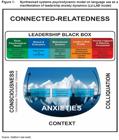
The systems psychodynamic approach provided the researcher with a lens to explore leadership anxiety dynamics as these are reflected in language use 'below the surface' (unconscious use of language) (Brunning & Perini 2010:77; Long 2018:102). After integration, the new theoretical model was synthesised, outlining the nature of the relationship between leadership anxiety dynamics and language use, as well as how these unconscious dynamics could be accessed and explored through this model. This model will be conceptualised and referred to as the 'systems psychodynamic model on language use as a manifestation of leadership anxiety dynamics', or the LU-LAD model (see Figure 1). Its purpose is to explore the nature of the interaction between anxiety in leadership and leaders' language use, as well as to serve as a guide in raising awareness, identifying and exploring leadership anxiety dynamics as these are manifested in the language use of the leader.
9. DISCUSSION OF THEORETICAL MODEL
Next, this model is described and discussed with reference to its subcomponents. A number of propositions have been distilled or abstracted from the literature study, primarily step four of the theoretical modelling process, as outlined in the section 'Presentation of data and conceptualisation of the model'. The following propositions emanating from the literature are suggested:
•
Context - Organisational life is a complex, evolving, dynamic and systemic reality (James & Denyer 2011:314; Petriglieri 2020:13).•
Consciousness - Leaders bring a certain level of consciousness to the leadership role (Blackman 2004:134; Manley 2014:340).•
Connected-relatedness - The complexity of the leader as a person and the leadership role can be encapsulated as a 'leadership black box' (Stein & Allcorn 2014:346).•
Colliquation - The unconscious uses several languages to express itself. Collisions occur when (unconscious) anxieties are revealed in the language use of the leader (Turillazzi, Baroldi, Silver, Parolini, Pomara & Fineschi 2005:56).The major components of the model are its contextual, consciousness, connected and colliquation components. These components are presented in isolation, but this presentation style should not create the impression that these are separate entities. They are by their very nature interactional, interwoven and integrated.
9.1
Contextual componentThis part of the model denotes that the realities of organisational life are complex, dynamic and evolving (Long 2018:225). Furthermore, the model departs from the premise that all human interaction is related and situated within a systemic and psychodynamic environment. The workplace is therefore conceptualised as a connected, psychodynamic system (Boxer 2014:130; Petriglieri & Petriglieri 2020:12). Leaders have to function within this systemic reality, which is alive, interactive, turbulent and vibrant, and which has above and below the surface dimensions (Kahn 2014:89). The context, which is situated at the bottom of the model, not only signifies the importance of being aware of certain fundamental influences, such as the social and emotional environment, but also the containing capacity of this reality (Boydell 2009:225; Krantz 2001:133).
9.2
Consciousness componentThis part of the model suggests that as leaders interact with their daily realities, a certain level of personal consciousness is at play. Leaders can draw from a conscious source of information accessible in the here and now, and from their pre-conscious source of information, which reflects a state and content that can be retrieved into consciousness by exerting a certain level of effort (American Psychological Association 2015:12). Leaders must be aware of the role that unconscious forces could play, particularly the unconscious use of language, in their behaviour in the context of the messiness, ambivalence and complexities of the relationships, anxieties and relatedness of organisational life (Blackman 2004:89; Stapley 2006a).
9.3 Connected - relatedness component
The leader's internal world and external reality are always connected (Diamond & Allcorn 2009:249; Nagel 2020:35; Vansina 1993:89).
9.3.1 Leadership black box
The complex nature of the leader as a person as well as that of leadership as a role is encapsulated in the concept of a psychological 'leadership black box' (Stein & Allcorn 2014:346). This concept of a leadership black box reflects the leader's complexity and uniqueness in the form of personality, values and beliefs, attachments, projections, transferences, valence, language use, interests and past experiences, unconscious motivations, preferences and seductions that leaders bring to the leadership role (that which the leader carries into the work environment). These realities are always connected to how the leader deals with the leadership role. Within the leadership black box, the following factors reside:
9.3.2 Basic psychological needs
At the core of humanity (our personal life) lies the basic psychological need for safety in the form of attachment, control orientation, avoidance of pain/maximisation of pleasure and self-enhancement (Bowlby 1973:214; Grawe 2007:112; Rossouw 2014:203; Western 2012:85). Intertwined with these needs are the leader's defensive, protective instinct and need for self-preservation (Clarke, Hahn & Hoggett 2008:98; Long 2018:103; Vince 2019:970).
9.3.3 Stimuli and evaluation
As situated beings, leaders find themselves in a larger psychodynamic environment filled with numerous and diverse actual and potential stimuli. The leader observes, evaluates (as 'high threat' or 'low threat') and interprets environmental stimuli through the phenomenon of relatedness and the organisation-in-the-mind, his or her unique structure of interpretation (Alvesson et al. 2017:96; Flaherty 2005:126), which is a unique mix of both conscious (objectives, behaviours, perceptions and conscious experiences) and unconscious (assumptions, representations, values and defences) psychodynamic material. The way leaders view the world and the meaning that is attached to this will influence their behaviour, the actions taken, and the emotions experienced (Reciniello 2014:89; Vince 2019:972). Observations, a particular way of thinking and a series of actions, are always unique to a specific individual, based on his or her structure of interpretation at a given time. Leaders respond to environmental stimuli as either threat triggers or reward triggers (Long 2018:102). Threat triggers, perceived as threats to the self, elicit anxiety-related responses. This emotional response from the dynamic unconscious system is activated by perceived dangers/threats in the subjective inner world of the leader or the objective external environment (Cytrynbaum & Noumair 2004:189; Long 2018:101).
9.3.4 Motivational schema
The assessment of environmental stimuli affects the motivational schema. The purpose of a motivational schema is to satisfy or protect the leader's basic needs (Dahlitz 2015:47), which are classified into two psychological approaches, namely an approach orientation (movement towards - gaining or keeping something perceived as positive) or an avoidance orientation (movement away - getting away or keeping away from something perceived as negative) (Elliot 2006:113).
9.3.5 Leader's risk profile
Furthermore, the leader's unique, subjective psychological risk profile seems to be directly relevant in the interpretation of threat or reward triggers (Nagel 2020:99; Prins 2002:100; Sher 2010:42). This profile consists of, among others, the leader's need for and level of attachment, valence, preferred defences, frustration threshold, perception of outcome path, as well as the context (perceived as safe or anxiety-provoking). Whatever is triggered also depends on the leader's capacity to contain (Diamond 2016:33; Gould et al. 2001:56). An environment characterised by high stress levels, increased expectations, ambiguous tasks, complex organisational structures and ever-shifting organisational priorities will inevitably stir up vulnerabilities in leaders (Rao 2013:15; Vansina 2014:82). The leader is expected to contain change, anxiety, confusion, uncertainty and loss (Reciniello 2014:89). This is tough because the leader's connections with the task to be performed are affected by inner personal and external contextual realities (for example withholding authorisation) that will inevitably have an influence on her or his ability to hold others in the mind and to provide 'good enough containment' (Hoggett 2013:67; Stein & Allcorn 2014:345). Containment is thus a process whereby a potentially overwhelming feeling is held, understood and put into perspective, primarily dialogically (i.e. via language use), between the self and the other (Vince 2019:960; Western 2013:102). When powerful emotional content cannot be contained, it has to go somewhere; it is then projected, enacted or embodied. The leader who is able to contain the emotional turbulence of the modern work setting helps employees to focus on their primary tasks and helps to prevent regressing to an infantile dependency, thoughtless consensus, reckless action and the expectation of an imminent miracle (Diamond 2016:15; Reciniello 2014:89; Stein & Allcorn 2014:344).
9.3.6 Anxiety triggered and defences precipitated
Perceived threats to the self-trigger apprehension (mental mode of increased consciousness) and defences in the form of psychic and social defensive processes, developmental practices and basic assumption behaviours. The unconscious plays a critical role in the process of selection and perception (Armstrong 2005:51; Bion 1985:130; Vansina 2014:81) and the attention paid to stimuli. These defences against anxiety could be positive, resulting in functional, sophisticated, competence-enhancing adaptations. However, they can also be negative, leading to dysfunctional, debilitating impairments (Vansina & Vansina-Cobbaert 2008:233). In the leadership landscape, there is always the perception of threat and the subsequent response of anxiety. Energy is invested in actions to reduce this anxiety (Blackman 2004:90).
9.4 Colliquation component
The final part of the model describes the colliquation component. The concept of colliquation is the process and point where two substances meet, enter each other and mutually influence each other to such an extent that they start to reflect each other's characteristics (Turillazzi et al. 2005:155). These collisions and mutual influences occur when the leader's unconscious anxieties are reflected in his or her language use and vice versa. Thus, these anxiety dynamics, which are often manifested in the form of psychic and social defensive processes, may be reflected in the language that leaders use - linguistic manifestations of anxiety. Language is used by the unconscious as a vehicle of communication, a medium to connect, a conduit for psychodynamic material, a bridge to and from the dynamic unconscious and a mirror for reflection (Tolpin 2017:34).
The unconscious uses several languages, being the language of images, of actions and of relations (Vansina & Vansina-Cobbaert 2008:191). These languages have been adapted and extended to reflect leadership anxiety dynamics through the following:
•
Language as speech and image - language that reflects the popping into the mind of images, sounds, symbols, individual nuances, dreams, metaphors and phrases, as well as what has become known as the 'slip of the tongue' (also known as Freudian slips) phenomenon.•
Language of relations and relatedness - the way in which leaders describe and verbalise actual or potential relationships, including 'languaged' emotional responses or relatedness expressed through, for example, identity, power, authorisation, attachments, role, as well as transference, counter-transference and projective identification as methods of communication.• Language in action and omission - the way in which leaders, through their actions or omissions, actually 'communicate' experiences and expectations, articulate unfulfilled wishes, phantasies or thinking related to tasks to be executed, unspeakables, hesitance, silence and ambivalence. In this way, possible terrains of tension and anxieties lurking behind verbalised actions are communicated (Vansina-Cobbaert 2006:90).
10. THE PRESENCE OF ANXIETY IN LANGUAGE USE
Because of the nature of the unconscious, the psychology of language use and the complexity of psychological processes, and because anxiety is predominantly an unconscious process, it is not easy to access the presence of anxiety in the language use of the leader. Therapists and other practitioners take years to master their therapeutic skills of which listening to the client are a critical component. The unconscious remains an intangible and mysterious phenomenon. There is thus a need to guard against the phantasy of looking for a recipe, formula or step-by-step guide to access leadership anxiety dynamics in the language use of the leader. The following listening guidelines are recommended in particular for systems psychodynamic practitioners when listening to leaders to access their language use as an indication of leadership anxiety:
• to listen in the totality of the here and now;
• to listen not only through the ears, but also through the eyes and the body of the practitioner;
• to listen without memory, judgement and desire;
• to listen for somatic data, for example transference and counter-transference reactions, as well as emotional reactions both in the client and in the body of the practitioner;
• to listen for linguistic idiosyncrasies, for example unique language usage, repetitions, hesitance and object relations;
• to listen to the unconscious language of images, for example symbols, signs, images, metaphors, sounds, slips of the tongue and signifiers; and
• to listen to the unconscious language of relations, for example the quality of relations in the narrative of the leader, relational patterns, objects, identities and attachments.
These listening guidelines will take the consultant down numerous potential psychological avenues for further exploration and validation, given the skill set of the systems psychodynamic practitioner, in collaboration with the client. Thus, leaders should be assisted to learn how to recognise the presence of defensive behaviours as a way in which the unconscious expresses unfulfilled needs and desires, disturbing uncertainties and anxieties through the medium of language use.
11. PRACTICAL IMPLICATIONS, LIMITATIONS AND RECOMMENDATIONS
The article has practical implications for leadership theories and leadership development in that it situates 'linguistic leadership' within the well-being space and calls for more conscious multidisciplinary research. The theoretical model that has been developed could assist with the grounding of managers (during these turbulent and uncertain times) by translating the model into a coaching framework to develop awareness of their personal authority, identity, potential sources of anxiety and the effect this could have on their behaviour and relational and decision-making practices (Rao 2013:15; Vince 2019:956). The Covid-19 pandemic is bound to have a negative ripple effect for some time to come. Through this proposed theoretical model managers could also consciously develop what is known as negative capability. Leaders and managers tend to keep locked inside themselves feelings of shame, loneliness and incompetence. This threatens their leadership psychosomatic integration: the capability to tolerate uncertainty, ambiguity and destructiveness. It involves being resilient and holding the tension between the 'created' object and the 'found' object (Tolpin 2017:33). Finally, the model has implications for the training and development of human resource practitioners in that the nature, impact and manifestation of unconscious, covert and irrational forces should be re-emphasised as a critical component of the repertoire of human resources and wellness practitioners. Leaders and managers are therefore encouraged to work with their anxieties (and the anxieties of their followers), as opposed to working against them, by harvesting language for its relational value. Language use lies within the relational space; this capacity could be consciously applied to create more energising, authentic relationships.
The delineated nature of the study made it difficult to utilise relevant discoveries fully in the fields of related disciplines, for example neuropsychology (biological origins of anxiety) and therapeutic psychology (language used as tool in therapy) pertaining indirectly to the study.
The model appears to present a 'static snapshot' of the interdependent influences of the identified constructs, which is not the case in reality and which is not reflected well by the model. The dynamic nature of these interrelationships could have been communicated better. The author proposes that future studies adopt an even more multidisciplinary approach by taking recent developments in neuroscience, psychotherapy and neuro-psychotherapy into consideration.
12. CONCLUSION
This article, together with the culmination of the research underlying it in a theoretical model on language use as a manifestation of leadership anxiety dynamics, is an attempt to explore and integrate leadership anxiety dynamics and language use from a systems psychodynamic perspective. The purpose was to develop a tool in the form of a systems psychodynamic model that allows managers and leaders to work with their anxieties more consciously. The model affirms that language serves both conscious and unconscious purposes. When leaders experience threats to their psychological safety, language could be used as a good-enough container of their personal, follower and other organisational anxieties. Language use should then have the capacity to play an auxiliary ego function to experience a deeper sense of self in the form of self- and other-consciousness.
COMPETING INTERESTSThe author declares that there are no financial or personal relationships that may have inappropriately influenced the writing this article.
FUNDINGThis research received no specific grant from any funding agency in the public, commercial or not-for-profit sectors.
ACKNOWLEDGEMENTS
The author would like to thank the critical reader for sharp insights and meaningful comments on an earlier draft of this article.
REFERENCES
- ALVESSON M, GABRIEL Y & PAULSEN R. 2017. Return to meaning: a social science with something to say. Oxford: Oxford University Press.
- AMERICAN PSYCHOLOGICAL ASSOCIATION (APA). 2015. APA concise dictionary of psychology. Washington, DC: Routledge.
- ARMSTRONG D. 2005. Organisation in the mind. The Tavistock Clinic Series. London: Karnac.
-
BALKUNDI P, KILDUFF M & HARRISON DF. 2011. Centrality and charisma: Comparing how leader networks and attributions affect team performance. Journal of Applied Psychology 96(6):1209-1219. (DOI:https://doi.org/10.1037/a0024890.
» https://doi.org/10.1037/a0024890 - )
- BELL J & HUFFINGTON C. 2011. Coaching for leadership development: a systems psychodynamic approach. In James KT & Collins J (eds). Leadership learning. London: Palgrave Macmillan. (pp 5-22.
-
)
» https://www.asymmetricleadership.com/2014/07/02/leading-organisations-without-boundaries-quantum-organisation-and-the-work-of-making-meaning/ - BION WR. 1985. Container and contained. In Colman AD & Geller MH (eds). Group relations reader 2. Washington, DC: A. K. Rice Institute. (pp 127-134.
- )
- BLACKMAN JS. 2004. 101 defences: how the mind shields itself. New York, NY: Brunner-Routledge.
-
)
» https://doi.org/10.1093/litimag/imu024 - BOWLBY J. 1973. Attachment and loss, Vol. 2: Separation. New York, NY: Basic Books.
- ]
-
BOYDELL L. 2009. The defensive function of partnerships. Organisational and Social Dynamics 5(2):225-241. [Internet https://firingthemind.com/product/osd-5-2/ ; downloaded on 12 January 2020.
» https://firingthemind.com/product/osd-5-2/ - ]
-
BRIGGS ARJ. 2007. The use of modelling for theory building in qualitative analysis. British Educational Research Journal 33(4):589-603. (DOI:https://doi.org/10.1080/01411920701434102.
» https://doi.org/10.1080/01411920701434102 - )
- BRUNNING H & PERINI M. 2010. Psychoanalytic perspectives on a turbulent world (eds). London: Karnac.
-
BUCHHOLZ MB & KäCHELE H. 2013. Conversation analysis - a powerful tool for psychoanalytic practice and psychotherapy research. Language and Psychoanalysis 2(2):4-30. (DOI:https://doi.org/10.7565/landp.2013.004.
» https://doi.org/10.7565/landp.2013.004 - )
-
)
» https://doi.org/10.1037/1093-4510.7.1.65 -
CHURCHILL SD. 2018. Explorations in teaching the phenomenological method: challenging psychology students to "grasp at meaning" in human science research. Qualitative Psychology 5(2):207-220. (DOI:https://psycnet.apa.org/doi/10.1037/qup0000116.
» https://psycnet.apa.org/doi/10.1037/qup0000116 - )
-
CILLIERS F & TERBLANCHE L. 2010. The systems psychodynamic leadership coaching experiences of nursing managers. Health SA Gesondheid 15(1):1-9. (DOI:https://doi.org/10.4102/hsag.v15i1.457.
» https://doi.org/10.4102/hsag.v15i1.457 -
)
» https://doi.org/10.4102/sajip.v38i2.1001 - CLARKE S, HAHN, H & HOGGETT P. 2008. Object relations and social relations: The implications of the relational turn in psychoanalysis. London: Karnac.
-
DAHLITZ MJ. 2015. Neuropsychotherapy: defining the emerging paradigm of neurobiologically informed psychotherapy. International Journal of Neuropsychotherapy 3(1):47-69. (DOI :10.12744/ ijnpt.2015.0047-0069.
» https://doi.org/10.12744/ ijnpt.2015.0047-0069 - )
- DE BOARD R. 2014. The psychoanalysis of organisations: a psychoanalytic approach to behaviour in groups and organisations. London: Routledge.
- DIMITROV PL. 2008. Organizational psychodynamics: introductory lectures for students, managers and consultants. Sofia: Bulgarian Academy of Science.
- DIAMOND MA. 2016. Discovering organizational identity: dynamics of relational attachment. Missouri, MO: University of Missouri Press.
-
ELLIOT AJ. 2006. The hierarchical model of approach-avoidance motivation. Motivation and Emotion 30:111116. (DOI:https://doi.org/10.1007/s11031-006-9028-7.
» https://doi.org/10.1007/s11031-006-9028-7 - )
-
ERIKSSON DM. 2003. A framework for the constitution of modelling processes: a proposition. European Journal of Operational Research 145(1):202-215. (DOI: 10.1016/S0377-2217(01)00390-3.
» https://doi.org/10.1016/S0377-2217(01)00390-3 - )
-
FAIRHOLM MR. 2009. Leadership and organisational strategy. The Innovation Journal 14(1):1-16. [Internet:https://www.researchgate.net/publication/255648017 downloaded on 20 October 2019.
» https://www.researchgate.net/publication/255648017 - ]
-
FLOTMAN AP, MAY MS & CILLIERS F. 2019. Language as potential space for relational positioning: exploring language use as manifestation of leadership anxiety dynamics. Journal of Psychology in Africa 29(1):80-83. (DOI:https://doi.org/10.1080/14330237.2019.1568002.
» https://doi.org/10.1080/14330237.2019.1568002 - )
-
)
» https://hbr.org/2004/09/why-people-follow-the-leader-the-power-of-transference - FREUD S. 1916. A general introduction to psychoanalysis (J. Riviere, Trans.). New York, NY: Simon & Schuster.
-
)
» https://doi.org/10.1007/s12124-020-09515-6 - GOULD L, STAPLEY LF & STEIN M. 2001. The systems psychodynamics of organizations: integrating the group relations approach, psychoanalytic, and open systems perspectives. New York, NY: Karnac.
- )
- GROTSTEIN JS. 2008. A beam of darkness: Wilfred Bion's legacy to psychoanalysts. London: Karnac.
-
HADER R. 2017. Leadership anxiety? Choose courage over complacency. Nursing Management 38(5):6-12. (DOI:https://doi:10.1097/01.LPN.0000269810.87639.c7.
» https://doi:10.1097/01.LPN.0000269810.87639.c7 - )
- HAYDEN C & MOLENKAMP P. 2004. Tavistock primer II. In Cytrynbaum S & Noumair DA (eds). Group dynamics, organisational irrationality, and social complexity: Group relations reader 3. Jupiter, FL: The A. K. Rice Institute. (pp 135-157.
-
)
» https://doi.org/10.5465/annals.2017.0007 - HIRSCHHORN L & BARNETT CK. 1993. The psychodynamics of organizational life. Philadelphia, PA: Temple University Press.
-
HOGGETT P. 2013. Governance and social anxieties. Organisational & Social Dynamics 13(1): 69-79. [Internet:https://firingthemind.com/product/osd-13-1-issue/ downloaded on 12 January 2019.
» https://firingthemind.com/product/osd-13-1-issue/ - ]
-
HOROWITZ. 1979. The theory of the basic assumption of in cohesion: aggregation/massification or (BA) I: A/M. British Journal of Psychotherapy 25(2):214-219. [Internet:https://www.academia.edu/26499143/The_Theory_of_the_Basic_ Assumption_of_Incohesion_Aggregation_Massification_or_Ba_I_A_M downloaded on 22 June 2019.
» https://www.academia.edu/26499143/The_Theory_of_the_Basic_ Assumption_of_Incohesion_Aggregation_Massification_or_Ba_I_A_M - ]
-
JAMES K & ARROBA T. 2005. Reading and carrying: a framework for learning about emotion and emotionality in organizational systems as a core aspect of leadership development. Management Learning 36(3):299-316. (DOI:https://doi.org/10.1177%2F1350507605055348.
» https://doi.org/10.1177%2F1350507605055348 - )
-
JAMES KT & DENYER D. 2011. Alternative approaches for studying shared and distributed leadership. International Journal of Management Reviews 13(3):313-328. (DOI:https://doi.org/10.1111/j.1468-2370.2011.00312.x.
» https://doi.org/10.1111/j.1468-2370.2011.00312.x -
)
» https://www.questia.com/read/1P3-3512393951/good-enough-leadership-a-model-of-leadership -
JAMES K & HUFFINGTON C. 2004. Containment of anxiety in organizational change: a case example of changing organisation boundaries. Social and Organisational Dynamics 4(1):212-233. [Internet:https://www.researchgate.net/deref/http%3A%2F%2Fdx.doi.org%2F10.1108%2FEUM0000000005872?_sg%5B0%5 D=YOzXoCg7PhLjUX4yHyjBOoy_c2WlB90mopyLXwlckvqs3cHlhuwNVfUR0NLuVdKIDWsblESMR mQSv6floaZcLhWJPA.TnirWuvz-lFP-b8MVa6xy-8Xf3osAurgGRd8InoHcM3oCPbZ8hipb7hm8m_-E4XmTCi83_RwajBi96tNtRAw_Q downloaded 12 June 2018.
» https://www.researchgate.net/deref/http%3A%2F%2Fdx.doi.org%2F10.1108%2FEUM0000000005872?_sg%5B0%5 D=YOzXoCg7PhLjUX4yHyjBOoy_c2WlB90mopyLXwlckvqs3cHlhuwNVfUR0NLuVdKIDWsblESMR mQSv6floaZcLhWJPA.TnirWuvz-lFP-b8MVa6xy-8Xf3osAurgGRd8InoHcM3oCPbZ8hipb7hm8m_-E4XmTCi83_RwajBi96tNtRAw_Q -
]
» https://doi.org/10.1080/00797308.1971.11822275 -
JARRETT M & KELLNER K. 1996. Coping with uncertainty: a psychodynamic perspective on the work of top teams. Journal of Management Development 15(2):54-68. (DOI:https://doi.org/10.1108/02621719610147850.
» https://doi.org/10.1108/02621719610147850 - )
-
JEMSTEDT A. 2000. Potential space: the place of encounter between inner and outer reality. International Forum Psychoanalysis 9(1):124-131. (DOI:https://doi.org/10.1080/080370600300056075.
» https://doi.org/10.1080/080370600300056075 - )
- KAHN M. 2014. Coaching on the axis: working with complexity in business and executive coaching. London: Karnac.
- KETS DE VRIES MFR. 2007. Coach and couch. London: Palgrave.
- KETS DE VRIES MFR. 2014. Vision without action is hallucination: making strategy implementation a reality. Fontainebleau: INSEAD.
- KETS DE VRIES MFR. 2020. Journeys into coronavirus land: lessons from the pandemic. London: KDVI Press.
- KETS DE VRIES MRF & KOROTOV K. 2011. The clinical paradigm: a primer for personal change. In Kets de Vries MRF, Korotov K & Florent-Treacy E. (eds). Coach and couch: The psychology of making better leaders. Hampshire: Palgrave Macmillan. (pp 3-14.
- )
- KOORTZEN P & CILLIERS F. 2002. The psychoanalytic approach to team development. In Lowman RL (ed). The California School of Organizational Studies handbook of techniques. San Francisco, CA: Wiley. (pp 260284.
- )
- )
- KRANTZ J. 2010. Dilemmas of organizational change: a systems psychodynamic perspective - A republication. London: Karnac.
- LACAN J. 1997. Écrits: a selection. London: Routledge.
- LAUGHLIN R & SHER M. 2010. Developing leadership in a social care enterprise: managing organisational and individual boundaries and anxiety. An action learning approach to leadership development. London: Karnac.
- LONG SD. 2018. Transforming experience in organisations: a framework for organisational research and consultancy. London: Routledge.
- )
-
MACAUX WP. 2014. Coaching the faltering executive. Organisational & Social Dynamics 14(2):264-284. [Internet:https://www.researchgate.net/publication/315815313_Coaching_the_Faltering_Executive downloaded on 15 August 2019.
» https://www.researchgate.net/publication/315815313_Coaching_the_Faltering_Executive - ]
- ]
-
MAKARI G & SHAPIRO T. 1992. On psychoanalytic listening: language and unconscious communication. Journal of the American Psychoanalytic Association 41:991-1020. (DOI:https://doi.org/10.1177%2F000306519304100404.
» https://doi.org/10.1177%2F000306519304100404 - )
-
MANLEY JY. 2014. Gordon Lawrence's social dreaming matrix: background, origins, history and development. Organisational and Social Dynamics 14(2):322-341. [Internet:https://www.academia.edu/34375648/Gordon_Lawrences_Social_Dreaming_Matrix_Background _Origins_History_and_Developments; downloaded 11 October 2020.
» https://www.academia.edu/34375648/Gordon_Lawrences_Social_Dreaming_Matrix_Background _Origins_History_and_Developments - ]
-
MANNOR M, WOWAK A, BARTKUS VO & GOMEZ-MEJIA LR. 2016. How anxiety affects CEO decisionmaking. Harvard Business Review July:19-29. [Intemet:https://hbrorg/2016/07/how-anxiety-affects-ceo-decision-making; downloaded 4 January 2019.
» https://hbrorg/2016/07/how-anxiety-affects-ceo-decision-making - ]
- )
- NAGEL C. 2020. Psychodynamic coaching: distinctive features. Routledge: New York.
- NIEUWENHUIS J. 2016. Introducing qualitative research. In Maree K (ed). First steps in research (2nd ed). Pretoria, South Africa: Van Schaik.
- OBHOLZER A. 2000. The unconscious at work - individual and organizational stress in the human services. London: Karnac.
- )
- OBHOLZER A. 2006. Foreword. In Brunning H (ed). Executive coaching: systems psychodynamics. London: Karnac. (pp xix-xxiv.
- )
- OBHOLZER A & MILLER S. 2004. Leadership, followership, and facilitating the creative workplace. In Huffington C, Armstrong D, Halton W, Hoyle L & Pooley J (eds). Working below the surface: the emotional life of contemporary organisations. London: Karnac. (pp 33-48.
- )
-
PADAVIC I & ELY R. 2013. March 1. The work-family narrative as a social defence. Paper presented at the Gender and Work: Challenging Conventional Wisdom Research Symposium Harvard Business School, Boston, MA. Internet:https://www.hbs.edu/faculty/conferences/2013-w50-research-symposium/Documents/Gender_and_work_web_update2015.pdf downloaded 12 May 2018.
» https://www.hbs.edu/faculty/conferences/2013-w50-research-symposium/Documents/Gender_and_work_web_update2015.pdf - ]
-
PETRIGLIERI G. 2020. F**k science!? an invitation to humanize organization theory. Organisation Theory 1:1-18. (DOI:https://doi.org/10.1177%2F2631787719897663.
» https://doi.org/10.1177%2F2631787719897663 - )
- )
- PRINS S. 2002. Who's in charge here? Leadership dynamics in multiparty collaboration. Melbourne. (International Society for the Psychoanalytic Study of Organizations Symposium.
- )
-
RAO A. 2013. Taming resistance to thinking: place of containment in organisational work. Organisational & Social Dynamics 13(1):1-21. [Internet:https://firingthemind.com/product/osd-13-1-article/ downloaded 30 May 2019.
» https://firingthemind.com/product/osd-13-1-article/ - ]
- RECINIELLO S. 2014. The conscious leader: nine principles and practices to create a wide-awake and productive workplace. London: LID Publishing.
- SEGAL H. 2006. Introduction to the work of Melanie Klein. London: Karnac and the Institute of Psychoanalysis.
- SHAPIRO ER. 1985. Unconscious process in an organisation: a serendipitous investigation. In Colman AD & Geller MH (eds). Group relations reader 2. Jupiter, FL: A. K. Rice Institute. (pp 353-362.
- )
-
SHER M. 2010. Corruption: Aberration or an inevitable part of the human condition? Insights from a Tavistock approach. Organisational & Social Dynamics 10(1):40-55. [Internet:https://www.tavinstitute.org/projects/corruption-aberration-or-an-inevitable-part-of-the-human-condition/downloaded 5 April 2019.
» https://www.tavinstitute.org/projects/corruption-aberration-or-an-inevitable-part-of-the-human-condition/downloaded - ]
- )
-
SOUBA C. 2009. The language of leadership. Academic Medicine 85(10):57-89. (DOI:https://doi.org/10.1097/acm.0b013e3181ee0045.
» https://doi.org/10.1097/acm.0b013e3181ee0045 - )
- STAPLEY LF. 2006b. Individuals, groups and organisations beneath the surface: an introduction. London: Karnac.
- ]
- TERRE BLANCHE M, DURRHEIM K & PAINTER D. 2006. Research in practice: applied methods for the social sciences. Cape Town: UCT Press.
- )
-
TURILLAZZI E, BAROLDI G, SILVER MD, PAROLINI M, POMARA C & FINESCHI V. 2005. A systematic study of a myocardial lesion: colliquative myocytolysis. International Journal of Cardiology 104(2):152-157. (DOI:https://doi.org/10.1016/j.ijcard.2004.10.051.
» https://doi.org/10.1016/j.ijcard.2004.10.051 - )
- )
-
VANSINA LS. 2014. Are we, social scientists, neglecting humanness in organisations? A manifesto. Organisational and Social Dynamics 14(2):379-398. [Internet:https://www.semanticscholar.org/paper/Are-We%2C-Social-Scientists%2C-Neglecting-Humanness-in-Vansina/6542df27b66e3d2aa51164925e3dfb00e35d2d95 downloaded 16 June 2018.
» https://www.semanticscholar.org/paper/Are-We%2C-Social-Scientists%2C-Neglecting-Humanness-in-Vansina/6542df27b66e3d2aa51164925e3dfb00e35d2d95 - ]
- VANSINA LS & VANSINA-COBBAERT M. 2008. Psychodynamics for consultants and managers. Hoboken, NJ: Wiley-Blackwell.
- VELDSMAN T & JOHNSON A. 2016. Leadership: perspectives from the frontline. Randburg: Knowres.
-
VINCE R. 2019. Institutional illogics: the unconscious and institutional analysis. Organization Studies 40:953-973. (DOI:https://doi.org/10.1177%2F0170840618765866.
» https://doi.org/10.1177%2F0170840618765866 - )
- WESTERN S. 2012. Coaching and mentoring: a critical text. Los Angeles, CA: Sage.
- WESTERN S. 2013. Leadership: a critical text (2nd ed.). Los Angeles, CA: Sage.
- WINNICOTT DW. 1975. Transitional objects and transitional phenomena. London: Hogarth Press.
- ZAFFRON R & LOGAN K. 2009. Environmental decline and organisational response. In Cummings LL & Staw BM (eds). Research in organisational behaviour 7:223-262. Greenwich, CT: JAI Press. (pp 223-262.
- )
-
ZEPF S. 2016. Language and the unconscious: a comparison of Freud and Lorenzer with some supplementary comments. Psychoanalysis, Culture & Society 21(3):293-310. (DOI:https://doi.org/10.1057/pcs.2015.51.
» https://doi.org/10.1057/pcs.2015.51 - )
-
ZIETSMA C & TOUBIANA M. 2018. The valuable, the constitutive, and the energetic: exploring the impact and importance of studying emotions and institutions. Organization Studies 39:427-443. (DOI:https://doi.org/10.1177%2F0170840617751008.
» https://doi.org/10.1177%2F0170840617751008