Organisational learning in Crime Intelligence: A qualitative review
Abstract
Crime Intelligence is one of the units within the South African Police Service with the purpose to collect, analyse and disseminate information in an effort to anticipate, prevent, and monitor criminal activities. Due to this fact organisational learning can assist police members to create, retain, and transfer knowledge within this unit. The twofold objectives of the study on which this article reports were, firstly, to investigate which stages should be evident during organisational learning and, secondly, to determine at which levels organisational learning should be implemented. A qualitative research approach was used and semi-structured interviews were conducted. Commanders, team leaders and operational members participated in this study. Content analysis was used to identify codes and themes. The findings indicated that preparation, contribution and outcomes were identified consequential stages & managerial, organisational, personal and work-related categories were identified as the specific levels at which organisational learning should be implemented to anticipate, prevent and monitor criminal activities. The contribution to the body of knowledge is that a flow diagram was developed to indicate the specific stages and accompanying levels of the organisational learning process within Crime Intelligence in order to improve the flow of knowledge to combat crime.
Crime intelligence; contribution; organisational learning; outcomes and preparation
1. INTRODUCTION
The Crime Intelligence Division of the South African Police Service is an intelligence agency that tracks criminal elements within the Republic of South Africa. Crime intelligence is the result of the collection, analysis, and interpretation of all available information concerning known and potential criminal threats and vulnerabilities of supported organisations. In order to combat crime effectively, the police must be able to access qualitative expertise, knowledge and an effective intelligence gathering capability, so that any challenge or contingency may be addressed in an appropriate manner. The continual availability or relevant and accurate gathering of crime intelligence is a crucial factor in enhancing the effectiveness of the South African Police Service in executing and fulfilling its functions and obligations. This has prompted the researchers to investigate organisational learning within the police's intelligence capability. Crime Intelligence should attend to certain stages and levels of the organisational learning process to create, retain, and transfer knowledge within this unit as an effort to anticipate, prevent, and monitor criminal activities. Crime Intelligence needs to collect, evaluate and analyse information (United Office on Drugs and Crime 2011:6) and it is therefore essential for this unit to be a learning organisation. The systems theory entails a system that is open to, and interacts with its environments and this theory was proposed in the 1940's by the biologist von Bertalanffy (1969:39). Characteristics of organisational learning, according to Senge (2006:10), are personal mastery, mental frameworks, shared vision, group learning and systems thinking (Senge 2006:11). It is essential to see the bigger picture and to be able to see the interrelationships between what might, at first, seem to be completely unrelated (Senge 2006:12).
The study of organisational learning and other fields of research such as organisational development, system theory and cognitive sciences provide the theoretical basis for specifically prescribing interventions to improve productivity (Senge 2006:35). According to Senge (2006:12), learning organisations encourage a holistic approach called systems thinking and systems thinking stems from the tenets of system theory where each process integrates with all the others. Organisational learning is a process, which involves creating, retaining and sharing knowledge within the organisation (Molodchik & Jardon 2015:308). The main agents in the process of organisational learning are the individual, the group and the organisation (Martínez-León & Martínez-García 2011:540). The individual within the organisation learns new skills, which in turn improves his or her work performance, and amongst the group, knowledge is shared, and this causes learning to occur. The organisation creates knowledge, and this influences the institutional memory of the organisation (Akhavan, Marzieh & Mirjafari 2015:200).
Belle (2016:334) mentions that organisational learning could assist to create core competencies in the organisation. With this in mind, organisational learning could help with the turnaround strategy to improve the crime problem in the country. High levels of crime pose a serious threat to the emergent democracy of South Africa and crime casts fear into the hearts of South Africans (South African Government 2019:Online). The total amount of crimes in South Africa during 2018 was 2 204 292 including for example 20 306 murders, 227 727 burglaries at residential premises and 50 666 common robberies (Crime stats SA 2019:Online). An organisational learning culture comprises a set of norms and values in the organisation where the emphasis is placed on the organisational learning process (Filstad & Gottschalk 2011:487). Leaders in an organisational learning environment set the example for lifelong learning. Leaders should encourage training and development of individuals and the group in the organisation to gain new skills and new capabilities (Oh & Han 2018:2).
Policing is complex, and to address the seriously high level of crime in South Africa, staff working in the unit, whom was interviewed for this study, needs to acquire new skills competencies, job insight, and knowledge to turn around the current situation. The concept of organisational learning in the Crime Intelligence environment can be used to improve the proficiencies of administrative staff and the police force (Park & Kim 2018:1409). New skills obtained during the organisational learning process can be utilised to ensure that Crime Intelligence achieve the vision and goals of the organisation as stated by the constitutional mandate. The skills development section in Crime Intelligence is responsible for training and development, and organisational learning is a fairly new concept in this environment. Organisational learning in the Crime Intelligence environment occurs when learning transpires on a continuous basis and members interact, skills are transferred and members focus on sharing knowledge, creating a knowledge culture and becoming a knowledge-based organisation (Brandi & Iannone 2015:3). The significance of this study lies in the fact that Crime Intelligence can attend to the different stages and accompanying levels of organisational learning so that police officers can create, retain, and transfer knowledge to anticipate, prevent, and monitor criminal activities, as mentioned previously. The flow of knowledge to combat crime can therefore be improved.
2. PROBLEM INVESTIGATED
Previous organisational learning research had focused on defining the construct (Dixon 1994:65; Senge 2006:33) and identifying the dimensions with model development (Garvin 1993:78; Senge 2006:34; Watkins & Marsick 1996:45). Other studies measured the success rates of implementing or adopting the learning organisation (Griego, Geroy & Wright 2000:5; Moilanen 2005:71). Current studies about organisational learning and the process thereof do not specify the process of specific stages and levels during which organisational learning should be implemented (Brandi & Christensen 2018). A flow diagram that indicates the stages and accompanying levels of the organisational process could also not be found in literature. This research gap was addressed in the current research by identifying the following problem statement: it is not clear how staff members at Crime Intelligence perceive the different stages and levels of the organisational learning process in order to assist with reducing crime.
3. RESEARCH OBJECTIVE
The purpose of this research was to obtain the views of staff members at Crime Intelligence about the different stages and levels of the organisational learning process that should be implemented to assist with reducing crime. The threefold objectives of the study on which this article reports were therefore, firstly, to investigate which stages should be evident during organisational learning; secondly, to determine at which levels organisational learning should be implemented; and thirdly, to develop a flow diagram of the stages and levels of the organisational learning process.
Organisational learning and the process of organisational learning are discussed below.
4.1 Organisational learning
Organisational learning has been defined in many ways. Hodgkinson and Sparrow (2002:4446) as well as Argyris and Schon (1978:2) define organisational learning as "the detection and correction of error", while Fiol and Lyles (1985:803) define learning as the "process of improving actions through better knowledge and understanding". Dodgson (1993:376) describes organisational learning as "the way firms build, supplement, and organise knowledge and routines around their activities and within their cultures and adapt and develop organisational efficiency by improving the use of the broad skills of their workforce". Argote and Hora (2017) stated a broader definition of organisational learning that includes the processes of creating, retaining and transferring knowledge.
Knowledge service is an indicator of organisational learning (Argote 2011). Organisational learning only occurs if there is a change in the knowledge of the organisation, and knowledge is an important resource for organisational learning (Catignani 2014:35). There are mainly two types of knowledge: explicit and tacit knowledge. Explicit knowledge is an easy form of knowledge, and may be in written, verbal and document format (Watad 2018:3). This knowledge can be obtained in the form of instruction, definitions and documents (Salmador & Florin 2013:375). Tacit knowledge is more difficult, which can only be transferred in a practical way (Venkitachalam & Busch 2012:357). This is the application of theory into practice and can only be obtained through intensive experience and training of one person by another (Watad 2018:3).
Majila (2012:27) claims that organisational learning improves knowledge and job insight, which facilitates behaviour changes that lead to better work performance in the organisation. This shows organisational learning as a process through which leaders and management can improve members' capabilities to make better decisions at all levels in the organisation. During group learning, members learn from one another, information is shared, and individuals' energies synchronised. Majila (2012:55) explains that, in an organisational learning structure, members and management will have the following competencies: strategic leadership skills, communication skills and problem solving with analysis skills. According to Garvin (1993:1), when building a learning organisation, the management of the company must focus on the following tasks: solving problems systematically, experimenting with new ideas and approaches, observing and learning from other organisations, and transferring knowledge into the organisation.
An organisational learning culture encourages training, education and knowledge (Pantouvakis & Bouranta 2017:367). In such a culture, effective leadership is essential (Muhammed, Muhammad, Aslam & Rahman 2016:233). Leaders steer movement and set the tone for the vision of the organisation, and develop approaches to build organisational learning (Belle 2016:335). Park and Kim (2018:1410) state that transformational leaders have an important influence on the process of organisational learning. Salas-Vallina, López-Cabrales, Alegre and Fernández (2017:315) explain that transformational leaders can promote organisational learning by allowing the organisation to learn through experimentation and knowledge building. The purpose of organisational learning is to adapt successfully to change, adjust under uncertain conditions and increase efficiency (Jones 2018:4).
4.2 The process of organisational learning
Martínez-León & Martínez-García (2011:539) state that organisational learning is a process and not an outcome. Organisational learning can be viewed as a process within the organisation to acquire knowledge with the objective of achieving the organisational goals and improve core competencies (Catignani 2014:36). Argyris and Schon (1978:2) state that organisational learning is a process of "detecting and correcting errors". Organisational learning is "the process of information acquisition, dissemination and development of sharing knowledge and in turn becomes the organisational memory" (Bettis-Outland & Guillory 2018:129). According to Muhammed et ai. (2016:232), the main objective of organisational learning is the process of transforming from a resource-based organisation to a knowledge-based organisation.
For an organisation to tolerate the growing, difficult and ever-changing environment, it is necessary to become a learning organisation (Haight & Marquardt 2018:331). To become a learning organisation, open and flexible organisational structures that constantly monitor change in the environment must be applied (Mckenzie & Varney 2018:1). The organisation must also develop a good problem-solving process. The organisation must be able to develop key qualifications, promote learning and develop the abilities of members who need it (Tuggle 2016:455). There are two important components of the process of organisational learning that should be taken into account. These components are the agents and the objectives of organisational learning. The agents of organisational learning are the individual, the group and the organisation itself (Oh 2019:3). Meanwhile, the objectives of organisational learning are connected to the learning processes, which occur within the organisation and which take place on two levels: the change of individual behaviour and the change in the organisational structures (Oh & Han 2018:4).
Valentine (2017:571) explains that this process involves attempting to improve work practices and that learning depends on the change of old practices. This change will bring understanding to achieving new goals and taking advantage of new opportunities. Knowledge culture is the first and principal step towards developing an organisational learning environment, with the benefits of local and worldwide compatibility and a more effective global communication system (Muhammed et al. 2016:236).
Intra-organisational learning, according to Park and Kim (2018:1410), is a knowledgesharing environment where organisational members are encouraged to discuss and collaborate develops organisational learning capacity. At the turn of the new millennium, a new stream of organisational learning theory emerged indicating four micro-processes at different levels and across different levels in organisations (Crossan, Lane & White 1999:522). Crossan et al. (1999:522) developed the process of the 4i framework for organisational learning and Lin and Sanders (2017:304) describe the 4i process framework as follows:
• Intuiting is the preconscious recognition of the pattern and/or possibilities inherent in a personal stream experience.
• Interpreting is the process of explaining an idea to oneself and/or to others.
• Integrating refers to developing shared understanding and meaning among individuals or groups and taking coordinated action through mutual adjustment.
• Institutionalising ensures that actions are taken.
More recently, Brix (2017:114) proposes that this 4i framework can be further developed by applying knowledge creation theory and a sense making and sense giving perspective to explain transitions between exploration and exploitation more thoroughly. Morland, Breslin and Stevenson (2019:88) advance the multilevel framework for learning by including perspectives on trust, time and communication, and they highlight the importance of the context and conditions for learning to occur at multiple levels. At organisational level, learning includes both integrating and institutionalising (Lin & Sanders 2017:304). The process of organisational learning will bring benefits to the organisation. Majila (2012:31) states that learning increases everyone's capability to contribute to the positive success of the company. Learning allows the organisation to be effective in achieving its vision (Lebron & Tabak 2018:118). If learning is the heartbeat of the organisation, the long-term success of the organisation will be guaranteed. Organisational learning can take the form of single-loop or double-loop learning (Wathne 2012:706). Single-loop learning takes place when an organisation discovers a mistake, corrects it, and continues with its present policies and objectives (Wathne 2012:706). Double-loop learning takes place when an organisation detects a mistake and changes its policies and objectives before taking corrective actions (Wathne 2012:706). According to Senge (2006:13), the highest level of organisational learning is deutero-learning, which may be regarded as "learning how to learn". At this level, members of the organisation reflect on and enquire into the organisation's previous contexts and experiences of learning (Senge 2006:13).
Inter-organisational learning is "achieved by transferring existing knowledge from one organization, as well as by creating completely new knowledge through interaction among organizations" (Larsson, Bengtsson, Henriksson & Sparks 1998:289). In the process of knowledge transfer and knowledge creation, Larsson et al. (1998:289) stress the importance of the collaborating organisations' choices and their abilities to be both receptive and transparent in the collaboration. Receptive means the degree to which the organisation is prepared to take in new knowledge from another organisation and transparent means the degree to which the organisation is prepared to disclose knowledge to another organisation. Lane and Lubatkin (1998:462) explain that three learning approaches exist in the inter-organisational learning process, namely, passive learning, active learning and interactive learning. According to Holmqvist (2004:72), it is important that organisations engaging in inter-organisational learning are aware that the value of inter-organisational learning is directly coupled to intra-organisational learning.
Toiviainen (2007:343) found that there are different levels of learning: the network-ideological level (learning across levels), project level (within a plan), production level (within operations) and worker level (within employees). Yeo (2006:10) found strategies for implementing organisational initiatives, namely individual learning, group learning and organisational learning. Brandi and Christensen (2018:3) also found that organisational learning must be implemented on individual and organisational levels. According to the opinions that are expressed in the literature, it is an accepted fact that organisational learning appears at multiple levels: individual, group, organisational and inter organisational (Holmqvist 2004:74; Sanchez 2001:5; Skerlava, Dimovski & Desouza 2010:190) and research has been done on all three learning sub-processes of creating, retaining and transferring knowledge (Argote 2011:444). Scholarly research about the different stages in the organisational learning was found. Nevis, DiBella and Goulds' (1995:74) theory presents an organisational learning process featuring three unique stages: 1) knowledge acquisition, consisting of the development or creation of skills, insights, and relationships; 2) knowledge sharing, characterised by the dissemination of what has been learned; and 3) knowledge utilisation, comprised of the integration of learning to make it broadly available and generalised to new situations. Daft and Weick (1984:286) state that organisational learning is a three-stage process: Search and collecting information, interpreting information and learning by practical using of information. According to Nonaka and Takeuchi (1995:33), organisational learning consists of three stages: Obtaining science (identifying and collecting useful information), using science (practical use of science) and transferring science (distribution and issuance throughout the organisation).
5. RESEARCH METHODOLOGY
A qualitative research methodology was used in this research. A qualitative research can be described as a type of research used to gain insight into a problem, issue or theory (Saunders, Lewis & Thornhill 2009:90).
5.1 Research design
Phenomenological research is a design of inquiry from the field of philosophy in which the researcher describes the lived experiences of individuals about a phenomenon as described by participants (Creswell 2014:14). The current research was conducted within the constructivist research paradigm. The main tenet of constructivism is that reality develops social construction and individuals develop subjective meanings of their own personal experiences (Bryman & Bell 2014:16). Phenomenological constructivism (PC) embraces a wide range of philosophical and sociological stances, which share the common characteristics of attempting to understand and explain the social world from the perspective of the actors directly involved in the social process (Burrell & Morgan 1989). The objective of a phenomenological study is to explain the individual's experiences or the meaning of his or her experiences (Brink, Van der Walt & Van Rensburg 2012:122). From an ontological perspective, PC views the social world as extremely complex and problematic, where researchers seek to interpret, understand, experience or produce the very basis and source of social reality (Burrell & Morgan 1989; Howell 2013). The current study followed a qualitative research approach, and semi-structured interviews with management and members of crime intelligence in Gauteng were conducted.
5.2
Research participantsCrime Intelligence has a working strength of 300 functional members. This study was conducted in Gauteng. In order to arrive at more consistent and trustworthy results, the purposively selected sample population was spread as evenly as possible, taking into account variables such as job profile and years of experience in the SAPS Crime Intelligence. The unit of analysis of this study was the section commander of human resources, the operational commander, the training commander, team leaders and operational members due to their exposure to organisational learning and years' of service. The selection criteria was 5 years' of experience and staff members who were exposed to organisational learning on different job levels (3 commanders, 6 team leaders and 6 operational members). Saturation of data was reached after the fifteenth interview.
5.3
Measuring instrumentIn this study, an interview guide was developed to obtain the perceptions of the interviewees about organisational learning, and semi-structured interviews were conducted. The interview guide consisted of the following questions:
Q1 . Tell me more about your experiences of organisational learning at Crime Intelligence.
Q2. How do you think organisational learning will benefit the Crime Intelligence environment?
Q3. Give your views on management's support and guidance in the process of organisation learning.
Q4. How will organisational learning in the Crime Intelligence environment improve members' skills and working ability?
Q5. What are your perceptions of the Crime Intelligence members' openness to learning?
5.4
Trustworthiness of the dataBless, Higson-Smith and Sithole (2013:236) state that trustworthiness involves the following elements: credibility, dependability, confirmability and transferability. The trustworthiness of the current study was increased by maintaining a high degree of objectivity through applying various reasoning strategies, such as content analysis (independent coder was used to compare the codes identified from the transcripts), inductive reasoning, blending, bracketing and understanding in order to interpret data and to ensure dependability. Bracketing is the cognitive process of putting aside one's beliefs and not making judgements (Smith & Smith 1995). As recommended by Harvey (2015), member checking was utilised in order to improve the accuracy and trustworthiness of the transcriptions of the interview recordings to ensure confirmability. Credibility entails ensuring that research is carried out according to good practice and that the researcher correctly understands the social world of the participants (Bryman & Bell 2014:44). The research process followed was logical, traceable and clearly documented to ensure dependability (Sinkovics & Alfoldi 2012:14).
Transferability was ensured through thick descriptions of organisational learning. Bryman and Bell (2014:44) state that a thick description provides others with a database for making judgements about the possible transferability of findings to other contexts and milieus.
5.5 Data analysis
Teschs' (1990:142-145) method of qualitative content data analysis was applied in the current study to analyse the data collected by way of open-ended questions about organisational learning. Data was coded, and themes and categories were developed. Deductive coding (theoretical codes) that were derived from relevant theory on organisational learning and inductive coding (new codes) were used. Hand coding (Miles & Huberman 1994) was utilised to analyse the data.
6. Findings
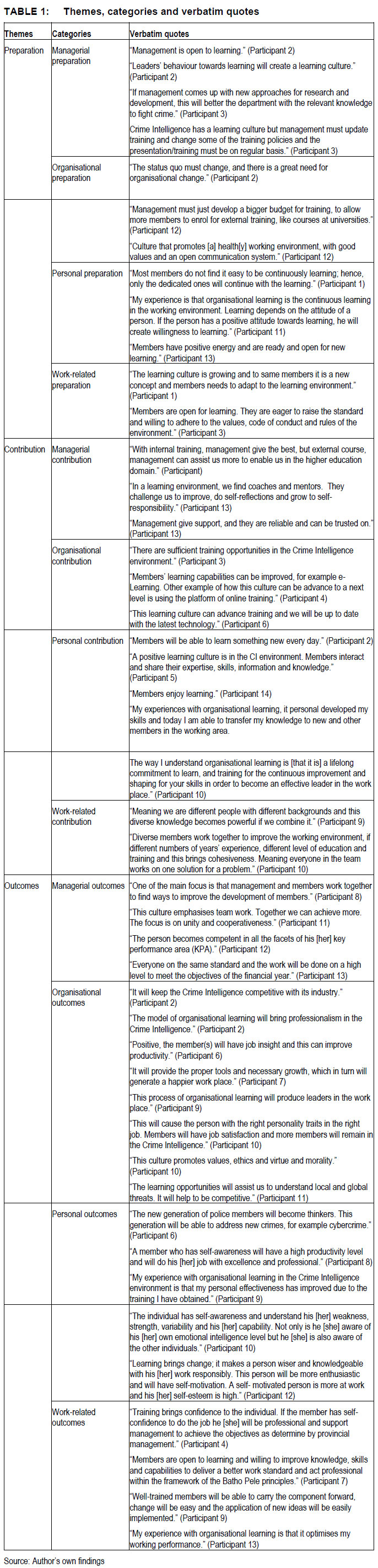
Main themes, categories and quotes from the interviews are presented in Table 1. Please note that all quotes are reproduced verbatim without editing.
In Table 1, preparation, contribution and outcomes were identified as the stages of organisational learning. Managerial, organisational, personal and work-related categories were identified as the specific levels at which organisational learning should operate. It was clear that there were sufficient quotes (verbatim) to support each level and stage.
7. DISCUSSION
The twofold objectives of the study on which this article reports were, to investigate which stages should be evident during organisational learning, and to determine at which levels organisational learning should be implemented. Preparation, contribution and outcomes related to these stages. Managerial, organisational, personal and work-related categories were identified as the specific levels during which organisational learning should be implemented. It was clear that organisational learning preparation should be done at managerial, organisational, personal and work-related level. There should also be an organisational learning contribution at managerial organisational, personal and work-related level. Organisational learning outcomes or results should be evident at managerial, organisational, personal and work-related level. Martínez-León & Martínez-García (2011:540) as well as with Tam and Gray (2016) also found the individual and organisational levels of the organisational learning process but this study found two more levels: managerial level and work-related level. Toiviainen (2007), however, also found that organisational learning takes place at worker level.
The three stages that were found in this study (preparation, contribution and outcomes) did not concur with the three stages of Nonaka and Takeuchi (1995:33): Obtaining science (identifying and collecting useful information), using science (practical use of science) and transferring science (distribution and issuance throughout the organisation).
Managers are more likely to assume incorrectly that employees are being empowered with the setting and implementation of a joint vision and that they are being motivated with responsibility and decision-making (Weldy & Gillis 2010). Sienkiewicz-Matyjurek, Kozuch and Szczygtowski (2019) found that inter-organisational learning in the public safety management system is of a multi-level nature (single, deuteron-learning and meta-level) and in dynamic conditions of action, learning processes may stem from the intentions of the managerial staff, but may also arise spontaneously during the implementation of actions. This concurs with the findings of the current study, which also found that managerial involvement is important.
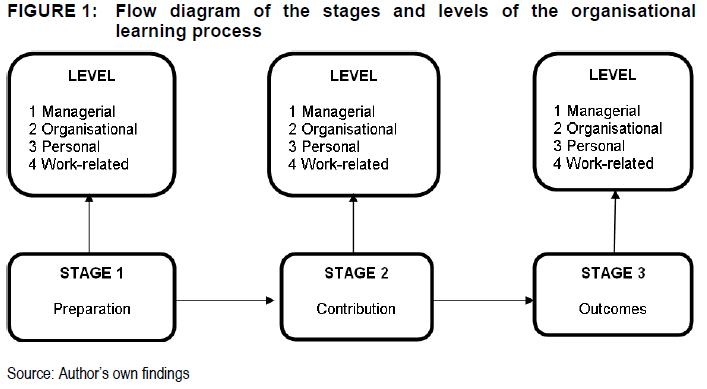
Watad (2018:11) explains in his findings that a lifelong commitment to learning is necessary to assist with knowledge creation. This again concurs with the findings of the current study. The leadership vision of Crime Intelligence is that all members must be at a professional level, and training is core to organisational learning (Oh & Han 201812). In Crime Intelligence Gauteng, the organisational learning process is important due to the fact that their role is to continually use new methods to obtain and evaluate information in order to prevent crime. Organisational learning can be a complex concept, which can be conceptualised as the development of new knowledge. The new knowledge has the potential to assist with reducing crime. The finding of this study leans towards this basis of the systems theory as illustrated in the flow diagram in Figure 1.
It is clear from the above figure that organisational learning consists of three main stages that follow after one another. The condition of these sequential stages is that preparation at managerial level, organisational level, personal level and work-related level must first be completed. On managerial level, a learning culture must be created, research and development to prevent crime must be conducted and training policies must be updated. On organisational level, there must be sufficient money in the budget for training and a culture with good values and an open communication system must be evident. On a personal level, staff must be dedicated and open for new learning as well as having a positive attitude towards learning. On a work-related level, adapting to a learning environment and raising the standard are essential. Each of these four levels must be properly addressed in order to move to the next stage.
After proper preparation, the contribution stage to making organisational learning a success must then be done at managerial, organisational, personal and work-related levels. On a managerial level, management must give their support, be able to act as coaches and mentors. On an organisation level, there must be training opportunities; the learning capabilities of the staff must be improved with the latest technology. On a personal level, sharing of information is important, staff must enjoy learning and continuous improvement is important. On a work-related level, knowledge and team work from the diverse workforce are powerful.
If there were contributions on each of these levels, stage 3 (outcomes) can then get the appropriate attention. On a managerial level, managers must ensure there is cooperation and unity between the staff and management, as well as clarifying key performance areas and ensuring work is done at a high level to meet the objectives of Crime Intelligence. On an organisational level, organisational learning must ensure professionalism, improved productivity and identifying local as well as global threats. On a personal level, the staff must be able to address new crimes such as cybercrime, have self-awareness, excellence, self-motivation and emotional intelligence. On a work-related level, optimised work performance is ensured and that staff is well-trained.
In summary, it is evident from Figure 1 that each stage has an accompanying level with four components (managerial, organisational, personal and work-related). In order to properly execute stages 1, 2 and 3 each component of these levels should get the necessary attention. This figure about the stages and levels of organisational learning is a systematic and holistic approach towards organisational learning. It is interesting that according to Engeström and Sannino (2010:22) learning in organisational networks is commonly depicted as horizontal movement of information between organisational units but in this study it was found that there is a horizontal as well as a vertical movement between the stages and the levels.
8. MANAGERIAL IMPLICATIONS
The twofold objectives of the study on which this article reports were, to investigate which stages should be evident during organisational learning, and to determine at which levels organisational learning should be implemented. Preparation, contribution and outcomes related to these stages. Managerial, organisational, personal and work-related categories were identified as the specific levels during which organisational learning should be implemented. It was clear that organisational learning preparation should be done at managerial, organisational, personal and work-related level. There should also be an organisational learning contribution at managerial organisational, personal and work-related level. Organisational learning outcomes or results should be evident at managerial, organisational, personal and work-related level. This concurs with the findings by Martínez-León & Martínez-García (2011:540) who found that the main agents in the process of organisational learning are the individual, the group and the organisation (Martínez-León & Martínez-García 2011:540) but the current study identified more levels, namely preparation, contribution and outcomes. Toiviainen (2007) also found that organisational learning takes place at worker level. Tam and Gray (2016) concur with the fact that learning takes place at the individual level and organisational level.
9. RECOMMENDATIONS
Organisational learning should get the necessary attention during the three stages, namely preparation, contribution and outcomes. During each of these stages, organisational learning should be addressed at four different levels: the managerial, organisational, personal and work-related level. Management, the organisation, the individual as well as the work itself should get the required consideration in order for organisational learning to be effective. Training programmes and mentoring initiatives should be launched to address organisational learning during all stages and at all levels at Crime Intelligence. The human resource managers should engage with management and staff in order to improve organisational learning during all stages and at all levels. Learning strategies should be developed to collect, analyse and disseminate information in an effort to anticipate, prevent, and monitor criminal activities.
This study was conducted in the Gauteng province and for future research, can be conducted in Crime Intelligence in other provinces and countries to determine whether the stages and levels are similar. A quantitative study could also be conducted in Crime Intelligence in South Africa to compare the way in which staff perceives organisational learning and its influence on performance. Lastly, the future of organisational learning should also be investigated in order to properly prepare for the future world of work.
10. CONCLUSION
The contribution to the body of knowledge is that the findings of this study lean towards systems theory and a holistic approach where preparation, contribution and outcomes were identified as the different stages and managerial, organisational, personal and work-related as the specific levels of the organisational learning process. This organisational process was illustrated as a flow diagram. It is important to note that, according to the interviewees, these three stages and its accompanying four levels should get the necessary attention in order for organisational learning to function fully at Crime Intelligence in Gauteng with the purpose to combat criminal activities.
REFERENCES
4. LITERATURE REVIEW
-
AKHAVAN P, MARZIEH B & MIRJAFARI M. 2015. Identifying the success factors of communities of practice (CoPs): How do they effect on students to create knowledge? Vine 45(2):198-213. (DOI:10.1108/VINE-03-2014-0022.
» https://doi.org/10.1108/VINE-03-2014-0022 -
)
» http://dx.doi.org/10.1177/1350507611408217 - )
-
ARGOTE L & HORA M. 2017. Organisational learning and management of technology. Production and Operations Management 26(4):579-590. (DOI:https://doi.org/10.1111/poms.12667.
» https://doi.org/10.1111/poms.12667 -
)
» http://dx.doi.org/10.1108/JBIM-03-2017-0066 -
BELLE S. 2016. Organisational learning? Look again. The Learning Organisation 23(5):332-341. (DOI:http://dx.doi.org/10.1108/TLO-01-2016-0007.
» http://dx.doi.org/10.1108/TLO-01-2016-0007 - )
- )
- BLESS C, HIGSON-SMITH C & SITHOLE SL. 2013. Fundamentals of Social Research Methods. 5th ed. Cape Town: Juta
-
BRANDI U & CHRISTENSEN P. 2018. Sustainable organisational learning: a tool for implementing learning in enterprises. Industrial and Commercial Training 50(6):356-362. (DOI:https://doi.org/10.1108/ICT-05-2018-0047.
» https://doi.org/10.1108/ICT-05-2018-0047 - )
-
BRANDI U & IANNONE RL. 2015. Innovative organisational leasing technologies: organisational learning's Rosetta Stone. Development and Learning in Organisations 29(2):3-5. (DOI:http://dx.doi.org/10.1108/DLO-07-2014-0048.
» http://dx.doi.org/10.1108/DLO-07-2014-0048 -
)
» https://doi.org/10.5465/amr.1999.2202135 -
BRIX J. 2017. Exploring knowledge creation processes as a source of organizational learning: a longitudinal case study of a public innovation project. Scandinavian Journal of Management 33(2):113-127. (DOI:https://doi.org/10.1016/j.scaman.2017.05.001.
» https://doi.org/10.1016/j.scaman.2017.05.001 -
)
» https://doi.org/10.1016/j.edurev.2009.12.002» https://https://doi.org/10.1016/j.edurev.2009.12.002 - BURRELL G & MORGAN G. 1989. Sociological paradigms and organizational analysis. Aldershot: Gower.
-
CATIGNANI S. 2014. Coping with knowledge: organisational learning in the British Army? Journal of Strategic Studies 37(1):30-64. (DOI: 10.1080/01402390.2013.776958.
» https://doi.org/10.1080/01402390.2013.776958 -
)
» http://dx.doi.org/10.1080/1743727X.2014.914487 -
CRIME STATS SA. 2019. Crime stats simplified. [Internet:http://www.crimestatssa.com/national.php; downloaded on 12 August 2019.
» http://www.crimestatssa.com/national.php -
]
» http://dx.doi.org/10.1108/IJES-04-2017-0026 -
)
» https://doi.org/10.1287/orsc.9.3.285 -
DAFT RL & WEICK KE. 1984. Toward a Model of Organizations as Interpretation Systems. Academy of Management Review 9:284-295. (DOI:10.2307/258441.
» https://doi.org/10.2307/258441 -
)
» http://dx.doi.org/10.1111/1748-8583.12127 - DIXON N. 1994. The organizational learning cycle: how we can learn collectively. London: McGraw-Hill.
-
DODGSON M. 1993. Organizational learning: a review of some literatures. Organization Studies 14(3):375-394. (DOI:https://doi.org/10.1177%2F017084069301400303.
» https://doi.org/10.1177%2F017084069301400303 - )
- )
-
FILSTAD C & GOTTSCHALK P. 2011. Becoming a learning organisation: the espoused values of police managers from two Norwegian districts. The Learning Organisation 18(6):486-500. (DOI:10.1108/09696471111171321.
» https://doi.org/10.1108/09696471111171321 -
)
» https://doi.org/10.1108/TLO-09-2015-0053 -
FIOL CM & LYLES MA. 1985. Organisational learning. The Academy of Management Review 10(4):803:813. (DOI:https://doi.org/10.5465/amr.1985.4279103.
» https://doi.org/10.5465/amr.1985.4279103 - )
- GARVIN DA. 1993. Building a learning organization. Harvard Business Review 71(4):78-91.
-
GRIEGO OV, GEROY GD & WRIGHT PC. 2000. Predictors of learning organizations: a human resource development practitioner's perspective. The Learning Organization 7(1):5-12. (DOI:http://dx.doi.org/10.1108/09696470010313632.
» http://dx.doi.org/10.1108/09696470010313632 -
)
» http://dx.doi.org/10.1108/JKM-10-2017-0467 - HAIGHT VD & MARQUARDT MJ. 2018. How chief learning officers build learning organisations. The Learning Organisation 25(5):331-343.
- )
- HODGKINSON GP & SPARROW PR. 2002. The competent: a psychological analysis of the strategic management process. Buckingham: Open University Press.
-
HOLMQVIST M. 2004. Experiential learning processes of exploitation and exploration within and between organizations: An empirical study of product development. Organization Science 15(1):70-81. (DOI:http://dx.doi.org/10.1287/orsc.1030.0056.
» http://dx.doi.org/10.1287/orsc.1030.0056 - )
- HOWELL K. 2013. An introduction to the philosophy of methodology. Los Angeles. CA: Sage
-
)
» https://doi.org/10.1108/EJTD-07-2015-0052 -
LANE PJ & LUBATKIN M. 1998. Relative absorptive capacity and inter organizational learning. Strategic Management Journal 19(5):461-477. (DOI:10.1002/(SICI)1097-0266(199805)19:5<461::AID-SMJ953>3.3.CO;2-C.
» https://doi.org/10.1002/(SICI)1097-0266(199805)19:5<461::AID-SMJ953>3.3.CO;2-C -
)
» https://doi.org/10.1108/13665620710777093 -
)
» https://www.unodc.org/documents/organized-crime/Law-Enforcement/Criminal_Intelligence_for_Analysts.pdf -
LEBRON MJ & TABAK F. 2018. Leading in the real world: operationalising a power-based model of collaboration for leadership experiential learning. Organisational Management Journal 15(3):110-129. (DOI:http://dx.doi.org/10.1080/15416518.2018.1497471.
» https://doi.org/http://dx.doi.org/10.1080/15416518.2018.1497471 -
)
» http://dx.doi.org/10.1108/13673271211218915 -
)
» https://doi.org/10.1108/BPMJ-12-2016-0240 - MAJILA VT. 2012. Organisational learning in the public sector. Stellenbosch: Stellenbosch University. (MPhil dissertation.
- )
-
MARTÍNEZ-LEÓN IM & MARTÍNEZ-GARCÍA JA. 2011. The influence of organisational structure on organisational learning. International Journal of Manpower 32(5/6):537-566. (DOI:10.1108/01437721111158198.
» https://doi.org/10.1108/01437721111158198 -
)
» https://doi.org/10.1108/14777280610656334 -
MCKENZIE J & VARNEY S. 2018. Energising middle managers practice in organisational learning. The Learning Organisation 25(6):383-398. (DOI:https://doi.org/10.1108/TLO-06-2018-0106.
» https://doi.org/10.1108/TLO-06-2018-0106 - )
-
MOLODCHIK M & JARDON C. 2015. Facilitating organisational learning in the Russian business context. The Learning Organisation 22(6):306-316. (DOI:http://dx.doi.org/10.1108/TLO-11-2014-0061.
» http://dx.doi.org/10.1108/TLO-11-2014-0061 - )
-
MORLAND KV, BRESLIN D & STEVENSON F. 2019. Development of a multi-level learning framework. The Learning Organization 26(1):78-96. (DOI:10.1108/TLO-04-2018-0080.
» https://doi.org/10.1108/TLO-04-2018-0080 - )
- )
- NEVIS EC, DIBELLA AJ & GOULD JM. 1995. Understanding organizations as learning systems. MIT Sloan Management Review 36(2):73-83.
-
OH S. 2019. Effects of organisational learning on performance: the moderating roles of trust in leaders and organisational justice. Journal of Knowledge 23(2):313-331. (DOI:http://dx.doi.org/10.1108/JKM-02-2018-0087.
» http://dx.doi.org/10.1108/JKM-02-2018-0087 - )
-
OH S-Y & HAN H-S. 2018. Facilitating organisational learning activities: types of organisational culture and their influence on organisational learning and performance. Knowledge Management Research & Practice 23(2):313-331. (DOI:http://dx.doi.org/10.1080/14778238.2018.1538668.
» http://dx.doi.org/10.1080/14778238.2018.1538668 - )
-
PANTOUVAKIS A & BOURANTA N. 2017. Agility, organisational learning culture and relationship quality in the port sector. Total Quality Management 28(4):366-378. (DOI:http://dx.doi.org/10.1080/14783363.2015.1084871.
» http://dx.doi.org/10.1080/14783363.2015.1084871 - )
- )
-
SALAS-VALLINA A, LÓPEZ-CABRALES A, ALEGRE J & FERNANDEZ R. 2017. On the road to happiness at work (HAW): transformational leadership and organisational learning capability as drivers of HAW in a healthcare context. Personnel Review 46(2):314-338. (DOI:http://dx.doi.org/10.1108/PR-06-2015-0186.
» http://dx.doi.org/10.1108/PR-06-2015-0186 - )
-
SALMADOR MP & FLORIN J. 2013. Knowledge creation and competitive advantage in turbulent environments: a process model of organizational learning. Knowledge Management Research & Practice 11(4):374-388. (DOI: http://dx.doi.org/10.1057/kmrp.2012.33.
» http://dx.doi.org/10.1057/kmrp.2012.33 - )
- SANCHEZ R. 2001. Managing Knowledge into Competences: The Five Learning Cycles of the Competent Organization. In Sanchez R. Ed. Knowledge Management and Organizational Competence. Oxford: Oxford University Press. (pp. 3-37.
- )
- SENGE PM. 2006. The fifth discipline: the art and practice of the learning organization. New York: Doubleday.
-
SIENKIEWICZ-MALYJUREK KE, KOZUCH B & SZCZYGLOWSKI J. 2019. Inter-organisational learning in the public safety management system. Disaster Prevention and Management: An International Journal 28(2):272-284. [Internet:https://doi.org/10.1108/DPM-09-2017-0217; downloaded on 12 March 2019.
» https://doi.org/10.1108/DPM-09-2017-0217 - ]
-
SINKOVICS RR & ALFOLDI EA. 2012. Progressive focusing and trustworthiness in qualitative research: the enabling role of computer-assisted qualitative data analysis software (CAQDAS). Management International Review 52(6):817-845. (DOI:http://dx.doi.org/10.2307/41682288.
» http://dx.doi.org/10.2307/41682288 - )
- SMITH B & SMITH DW. 1995. The Cambridge companion to Husserl. Cambridge: University Press.
-
SOUTH AFRICAN GOVERNMENT. 2019. National crime prevention strategy. [Internet:https://www.gov.za/documents/national-CRIME-prevention-strategy-summary#3; downloaded on 12 August 2019.
» https://www.gov.za/documents/national-CRIME-prevention-strategy-summary#3 - ]
- ]
- TESCHS R. 1990. Qualitative Research. Analysis types and software tools. New York: Falmer.
- ]
-
TUGGLE FD. 2016. Gaps and progress in our knowledge of learning organisations. The Learning Organisation 23(6):444-457. (DOI: http://dx.doi.org/10.1108/TLO-09-2016-0059.
» http://dx.doi.org/10.1108/TLO-09-2016-0059 - )
- ]
-
VALENTINE MA. 2017. Renegotiating sphere of obligation: the role of hierarchy in organisational learning. Administrative Science Quarterly 63(3):570-606. (DOI:http://dx.doi.org/10.1177/0001839217718547.
» http://dx.doi.org/10.1177/0001839217718547 - )
- )
- VON BERTALANFFY L. 1969. General System Theory. New York: George Braziller.
- ]
-
WATHNE CT. 2012. The Norwegian police force: A learning organisation? Policing: An International Journal of Police Strategies & Management 35(4):704-722. [Internet:https://www.deepdyve.com/lp/emerald-publishing/the-norwegian-police-force-a-learning-organization-iK0a00gOsT; downloaded on 05 May 2019.
» https://www.deepdyve.com/lp/emerald-publishing/the-norwegian-police-force-a-learning-organization-iK0a00gOsT - ]
-
WELDY TG & GILLIS WE. 2010. The learning organization: variations at different organizational levels. The Learning Organization 17(5):455-470. [Internet:https://doi.org/10.1108/0969647101105983; downloaded on 06 February 2019.
» https://doi.org/10.1108/0969647101105983 - ]