Principles for internalising systems resilience into business management and value creation
Abstract
This article introduces principles for internalising the concept of social ecological systems resilience into business management and value creation. It is no longer enough for businesses to simply reduce their impact on the environment. Businesses need to refocus their strategies and management within the limits of their social ecological system, such that they not only create value for their immediate stakeholders, but also create value that enables systems resilience to be built and maintained. Resilience thinking shifts sustainability towards business operating within the limits of the social ecological system in which they exist so that business is able withstand disturbances and uncertainty in the light of global change. The intention of the principles is to improve the ability of integrated thinking and management within businesses; such that businesses expand the scope of the system for which value is created, beyond the organisation itself, to the broader social ecological system in which they operate. In light of global change, and the increasing complexity of risks with which businesses are faced, addressing the broader system is crucial in order for businesses to improve their adaptive capacity, and therefore to ensure their own long term sustainability. The principles include a systems principle, risk and adaptation principle, decoupling principle, restoration principle, well-being principle, collaborative governance principle, and innovation and foresight principle. Managers are encouraged to build these principles in their business strategies, governance, performance and integrated reporting. The principles are being developed into a maturity tool for easy application by managers.
Systems; resilience; integrated management; sustainability and value creation
1. INTRODUCTION
The engagement of businesses in sustainability has generally been through the pursuit of value creation for itself and its shareholders, in terms of how social and environmental goals may help organisations achieve profitability and strategic advantage (Bansal 2005:199; Carbo, Langella, Dao & Haase 2014:177; Gomis, Parra, Hoffman & Mcnulty 2011:175; Hahn, Figge, Pinske & Preuss 2010:218; Hahn, Pinkse, Preuss & Figge 2015:297; Hart & Milstein 2003:57; Porter & Kramer 2006:79; Schneider 2014:525). Even though concepts such as the triple bottom line (financial/economic, social and environmental) and the "3 Ps" (people, planet, profit) centre on doing less harm to the environment and society while maintaining a healthy bottom line; they are based on the assumption that natural resources are limitless and that efficient production and consumption will suffice to support continuous economic growth and development (Ehrenfeld 2012:612).
A conflict exists between pursuing sustainability for the financial benefit of a business, and for the persistence of the social and ecological systems within which businesses operate and are dependent (Carbo et al. 2014:179; Figge & Hahn 2004:173; Gao & Bansal 2013:247; Hahn et al. 2015:297; Jones 2016:401; Porter & Kramer 2011:64; Schneider 2014:526).
Acknowledging this conflict, businesses are engaging with integrated thinking and management as a systematic approach to overcome global sustainability challenges (Jones 2016:402). Through integrated thinking, businesses are encouraged to recognise and embrace interconnected social, environmental and economic issues relating to sustainability and risk in time and space; and to understand how these link sustainability and risk impact to value creation (Bizikova, Swanson & Roy 2011:3; Figge & Hahn 2004:184; Gao & Bansal 2013:242; Waldick 2010:76;). In the past value creation was a short term concept defined as the cash flow of a business, it is now understood that it embraces the non-financial aspects of a business, which are interconnected with its financial performance (Figge & Hahn 2004:181). Porter and Kramer (2011:64) highlight that value creation needs to be considered as a shared concept, where businesses create measurable value by identifying and addressing societal problems that interact with their business. Management, through the lens of integrated thinking, is evolving to enhance competitiveness of the business, while simultaneously advancing the economic, social and environment conditions of the larger society in which it operates (Porter & Kramer 2011:64).
The unprecedented pace and complexity of global change is presenting business with new and emerging risks, compromising the ability of organisations to effectively identify and manage risks and opportunities in planning for their future. Addressing uncertainty and adapting to changing conditions so as to be sustainable is becoming essential, particularly when considering the instability and deterioration of social, ecological and economic systems (KPMG 2012:22; Olsson, Folke & Berkes 2004:75; Whiteman, Walker & Perego 2013:309). There is a need to refocus business within the limits of the systems in which they operate (Ehrenfeld & Hoffman 2013:6; Jones 2016:402; Lozano, Carpenter & Huisingh 2015:438; Westley, Tjornbo, Schultz, Olsson, Folke, Crona & Bodin 2013:27). The authors suggest that integrated thinking and management need to be closely aligned with key concepts from systems dynamics. This will enable organisations to understand the effect of their actions on the whole system upon which their operations depend. Businesses need to capture their sustainability aspirations and risk management in relation to the concept of systems resilience - the ability to persist and to adapt in response to external shocks, while retaining their original structure and functions (Adger 2003:2; Walker, Carpenter, Anderies, Abel, Cumming, Janssen, Lebel, Norberg, Peterson & Pritchard 2002:3; Walker & Salt 2006:8). Creating value that builds and maintains system resilience will impact the ability of a business to create economic value. This implies that these two means of value creation are interlinked, in the same manner that resilience of the system is linked to resilience of the business.
The authors present principles for facilitating the adoption of systems resilience into integrated management. The intention of these principles is to enable managers to strengthen the resilience of their organisation by addressing the resilience of the social ecological system within which they operate. The principles will facilitate managers to improve integrated management to ensure that organisations are sustainable within the boundaries and resilience of the broader social ecological system in which they operate. As organisations start to broaden their sustainability and risk management practices beyond their own immediate boundaries, they will be in a better position to understand vulnerabilities in their own operating system. In addition a systems thinking approach will ensure that a business engages in sustainability initiatives that address system vulnerabilities and improve the adaptive capacity of the business. This will ensure that sustainability initiatives are more than just improving efficiencies of resources use, but rather about building the resilience of both the organisation and the system in which it operates.
2. THEORETICAL BACKGROUND
2.1 Sustainability and integrated management: Current practice
Since the first United Nations Conference on Environment and Development in Rio de Janeiro in 1992, business has increasingly sought ways to respond to the pressures brought about by global change (Beerman 2011:836; Eweje 2011:125). This has been done under the banner of 'corporate sustainability' (Bansal 2005:199; Dyllick & Hockerts 2002:131; Linnenluecke, Russel & Griffiths 2009:432; Lozano 2012:15; Salzmann, Ionesco-Somers & Steger 2005:27). Over the past decade, corporate sustainability has become an increasingly mainstream concept (Haanaes, Reeves, Von Strengvelken, Audretsch, Kiron & Kruschwitz 2012:70; Hayward, Lee, Keeble, Mcnamara, Hall, Cruse, Gupta & Robinson 2013:21 Haywood, Trotter, Faccer & Brent 2013:112; KPMG 2013:10). The business case centres on businesses improving their corporate financial performance through corporate social responsibility activities that enhance their reputation, social license to operate, stakeholder engagement, and ultimately their competitive advantage (Anderies, Folke, Walker & Ostrom 2013:8; Carrol & Shabana 2010:85; Dyllick & Hockerts 2002:132; Lloret 2015:419; Minoja 2012:67; Porter & van der Linde 1995:98; Salzmann et al. 2005:27; World Business Council for Sustainable Development (WBCSD) 2000:20).
While there are several 'Theories of the Firm' explaining how businesses function, there is limited discourse on how such theories relate to corporate sustainability (Seth & Thomas 1994:177; Starik & Kanashiro 2013:9; Lozano et al. 2015:431). The rise of sustainability has led to the recognition that organisations have responsibilities to a broader range of stakeholders, beyond profit generation and job creation (Lozano et al. 2015:438). It is suggested that the Stakeholder Theory is the only theory of the firm that focuses on the environmental dimension of a business. It is an approach in which to explain and improve the sustainability of a business and contribute to sustainable development overall (Hörisch, Freeman & Schaltegger 2014:329; Lozano et al. 2015:439). Traditional management theories lack features, benefits, opportunities, challenges, or orientations to assist individuals, organisations, and societies to move toward sustainability (Könnölä & Unruh 2007:535; Loorbach, Van Bakel, Whiteman & Rotmans 2010:135; Starik & Kanashiro 2013:13). They fail to explain the inclusion of organisations and their embeddedness and interconnected relationship within social ecological systems. Therefore, integrative approaches that address system-wide interdependencies are needed to contribute toward further sustainability initiatives (Jones 2016:402; Könnölä & Unruh 2007:535; Loorbach et al. 2010:135; Starik & Kanashiro 2013:16). Lozano et al. (2015:430) propose a new theory of the firm; Sustainability Oriented Theory of the Firm; which firmly integrates the holistic perspectives of corporate sustainability into the purpose and function of business. This theory promotes an organisation becoming integrative in their management; such that the organisation's obligations, opportunities, relations, and processes contribute towards make society more equitable and sustainable in the short and long term (Lozano et al. 2015:430).
Integrated management was born from the concept of 'integrated thinking', as promoted by the International Integrated Reporting Council (IIRC) as a tool for integrated reporting. The IIRC refers to the term 'integrated thinking' as a means to describe how an organisation could achieve integrated management of its performance (IIRC 2013:2). Integrated thinking promotes a holistic view of the operations of an organisation in terms of its interactions and relationships with its capitals (see below), such that the business can contribute towards decision-making that considers value creation over the short, medium and long term (IIRC 2013:2). Integrated management considers the connectivity and interdependence between the business, society and environment (IIRC 2013:2). It is thereby a management style in which integrated thinking is applied and implemented such that the business makes integrated decisions with regards to its value creation.
A positive change through integrated management would be to look at value creation for the system as a whole, rather than simply in relation to the organisation and its investors. There is a need to ensure value creation across all "six capitals" (financial capital, manufactured capital, intellectual capital, human capital, social and relationship capital, and natural capital; as identified by the IIRC); i.e. that none of the six capitals decrease over time. Currently, value creation tends to be expressed mainly in financial terms within businesses' integrated reports; with the focus on benefits for the organisation and its shareholders. Value created for society or the environment is seen merely as a component of the value expressed in financial terms. In this regard, there is never a true understanding of the implications of the business towards addressing the stocks and flow of their capitals, especially those that are not necessarily measured in financial terms. New perspectives on accounting and integrated management are needed to grasp the positive potential of integrated reports for organisational change, and their potential to contribute to a full accountability of positive and negative impacts in a comprehensive fashion. Businesses have to inform stakeholders how their measures contribute towards building the sustainability of the surrounding social ecological system (Adams 2015:25; Flower 2015:16; IIRC 2013:4).
A change is needed in the way in which businesses conduct integrated management and reporting, and more broadly in the way in which they conceptualise their sustainability and value creation strategies. Organisations should aim for an improved understanding of their dependence on the social ecological system as a source of resources and a sink for wastes, and their own role in undermining or promoting system-wide security of such resources and services (Jones 2016:407; Walker et al. 2002:1; Whiteman et al. 2013:313; Young, Berkhout, Gallopin, Janssen, Ostrom & Van Der Leeuw 2006:305). Sustainability strategies within businesses need to adopt a broad systems thinking approach, in which the organisations' value creation proposition is addressed from an understanding of the interconnectedness of the social and ecological interface in which the business operates (Lozano et al. 2015:440). Sustainability strategies need to re-affirm the position of an organisation within the social ecological system(s) in which they operate, and in particular, in relation to the inherent ecological and social limits of that system(s) (Loorbach et al. 2010:136; Rammel, Stag & Wilfing 2007:10). In short, businesses need to make a transition; one that firmly refocuses value creation within the limits of the system in which the business operates. The concept of 'systems resilience' is a powerful tool in this regard (Anderies et al. 2013:9; Xu, Marinova & Guo 2015:123).
2.2 The relationship between sustainability and resilience
While the concept of resilience initially had origins in ecology, it has evolved with influence from the theories of adaptive capacity and systems dynamics. For reasons, including the need to determine optimal ways of adapting to environmental change and human impacts, as well as hazards characterised by surprises and unknown risks, the theory and concept of systems resilience is having traction in business management (Adger, Hughes, Folke, Carpenter & Rockström 2005:1036; Collier, Jacobs, Saxena, Baker-Gallegos, Carroll & Yohe 2009:172; Curtin & Parker 2014:913; Linnenluecke, Griffiths & Winn 2012:20; Sandhu 2010:287; World Economic Forum (WEF) 2013:41; Xu et al. 2015:124). The aspirations for sustainability; namely environmental integrity, economic prosperity and social equity; can be captured and operationalised more concretely in the concept of resilience (Adger 2003:3; Bansal 2005:198; Elkington 1998:20; Walker, Holling, Carpenter & Kinzig 2004:7; Whiteman et al. 2013:313; Xu et al. 2015:124). The concepts of sustainability and resilience are thereby interrelated and multifaceted; sustainability focusing on the long-term goals and strategies, while resilience is oriented towards preparing for unexpected disruptions that may destabilise an otherwise sustainable system (Xu et al. 2015:123).
Derissen, Quaas & Baumgärtner (2011:1121) argue that sustainability and resilience are two highly abstract and multifarious concepts, each of which has a great variety of interpretations and definitions. They suggest that resilience is a descriptive concept that gives insight into the dynamic properties of social ecological systems; while sustainability is a normative concept that captures basic ideas of intergenerational justice when human well-being depends on natural capital and services (Derissen et al. 2011:1121). They conclude that resilience and sustainability are independent concepts. The authors argue against the notion of independence of the two concepts and rather argue that in light of global change, systems resilience is a precondition for sustainability. Sustainability and resilience are in fact highly interdependent. This is further supported by (Arrow, Bolin, Costanza, Dasgupta, Folke, Holling, Jansson, Levin, Mäler, Perrings & Pimentel 1995:520; Holling & Walker 2003:1; Lebel, Anderies, Campbell, Folke, Hatfield-Dodds, Hughes & Wilson 2006:1; Levin, Barrett, Anyar, Baumol, Bliss, Bolin, Dasgupta, Ehrlich, Folke, Gren, Holling, Jansson, Jansson, Mäler, Martin, Perrings & Sheshinski 1998:227; Perrings 2006:418). Resilience provides the practical mechanism through which to achieve the goal of sustainability; as it is about existing and continuously adapting within the social and ecological boundaries and thresholds of a defined system, such that the system is able to maintain a favourable function and structure (Collier et al. 2009:178; Pisano 2012:10; Xu et al. 2015:126; Young et al. 2006:306). Since social ecological systems are shared, it is the responsibility of all the users within a system to be conscious of the vulnerabilities that exist between social and ecological variables within the system, and of the interactions and relationships that lead to vulnerabilities. Sustainability is not just about reducing ones' impact on the environment by being more resource efficient, it is rather an attribute of dynamic, adaptive systems that are able to flourish and grow in the face of uncertainty and constant change (Ehrenfeld & Hoffman 2013:19; Perrings 2006:422). Resilience thinking shifts the concept of sustainability from that of maintaining stability and controlling change, to dealing with changes, disturbances and uncertainties, such that systems have sufficient social and ecological variables to support their capacity to be adaptive during periods of change (Ahern 2011:342; Berkes 2007:287; Xu et al. 2015:127).
The resilience of a system is measured by the magnitude of the disturbances that it can absorb while still retaining its overall structure and functioning; by the degree to which the system is capable of self-organisation; and by the degree to which capacity can be built for learning and adaptation (Berkes, Colding & Folke 2003:13; Folke 2006:254; Xu & Marinova 2013:912). The challenge in managing complex systems (for example, a business in its social ecological environment) towards desired outcomes (for example 'sustainability') is to ensure that the system can adapt and readjust following disturbances without being destroyed or irreversibly changed, to the extent that it can no longer function as it did before (Berkes & Folke 1998:6; Folke, Carpenter, Walker, Scheffer, Chapin & Rockström 2010:1; Walker & Salt 2006:37; Xu et al. 2015:130). In the case of a business, not being able to continue with its primary function could mean no longer being financially viable or not being able to retain its social licence to operate.
Resilience, however, does not always imply a desirable state of a social ecological system (Carpenter, Walker, Anderies & Abel 2001:766; Xu et al. 2015:130). Systems could have already undergone significant changes in which critical social and ecological thresholds have been crossed, forcing the system to reorganise itself into a state that is currently viewed as unsustainable, due to its inability to meet intergenerational equity (Carpenter et al. 2001:766; Xu et al. 2015:136). Undesirable system configurations can also be very resilient, and they can have high adaptive capacity in the sense of re-configuring to retain the same undesirable controls and functions (Holling & Walker 2003:2). Resilience is not always a positive attribute of a system; nor is it necessarily sufficient for sustainability. It must be noted that when applying resilience as a means to address sustainability, it needs to be applied from the notion that the social ecological system does not flip from a desirable into an undesirable state (Carpenter et al. 2001:766; Derissen et al. 2011:1122; Xu et al. 2015:136). It is the role and responsibility of society and businesses within a social ecological system to create and maintain systems where ecological, political, social, or economic conditions make the existing system untenable and sustainable (Walker, Holling, Carpenter & Kinzig 2004:4; Westley et al. 2013:28).
The aim is to enable managers to address the dynamic components and relationships that exist to support businesses in their social ecological systems to ensure their resilience against disturbances or shocks. This involves managers understanding the critical thresholds or tipping points of the key controlling social and ecological variables that define the complex adaptive system in which each business operates (Walker & Salt 2006:32; Xu et al. 2015:136). When an organisation works towards building resilience for the social ecological system in which it exists, it is contributing towards achieving long term sustainability as an approach to deal with change and uncertainties (Berkes 2007:288; Xu et al. 2015:136).
The authors are of the opinion that the key to effective management for sustainability lies in ensuring resilience both of the business and of the social ecological system in which the business operates. It is understood that a resilient business would be dependent on the resilience of the social ecological system. The greater the 'positive' resilience of the system, the greater the likelihood of the business being resilient and adaptive to certain risks and shocks. This understanding needs to be at the heart of integrated management. The value creation process of a business needs to reflect this focus on systems resilience. As explained in the following sections, the authors have developed principles for facilitating this transition within businesses.
3. RESEARCH METHODOLOGY
The key objective of the research was to develop principles for internalising and facilitating systems resilience in integrated management. The team tasked with developing such principles comprised of specialists from a variety of disciplinary and research backgrounds; including environmental anthropology, resource economics, risk management, sustainability science, strategic environmental management, ecology, business management, auditing and reporting, and pollution and waste.
In order to achieve the research objective the project team made use of a review process to answer the following questions:
• What are the existing principles guiding the sustainability and integrated management in business?
• How do these principles align with systems thinking?
• How can the principles be adapted so as to embrace building systems resilience for a business?
A desktop analysis of relevant literature was undertaken to identify documents that cited principles relating to business, sustainability and global challenges. Identified were existing principles that are currently guiding global corporate sustainability; principles guiding and defining the development of the green economy (given the current global traction of this concept towards the growth of an economy within the limits of planetary resources); and principles relating to complex adaptive systems and the concept of social ecological systems resilience. The following sets of principles were consulted:
• United Nations Global Compact: ten universally accepted principles in the areas of human rights, labour, environment and anti-corruption (United Nations Global Compact 2017:internet).
• Green Economy Coalition: Nine principles of a green economy (Green Economy Coalition 2012:internet).
• United Nations Global Compact-Accenture CEO Study on Sustainability 2013: Emerging themes to address sustainability in the light of global challenges (Accenture & UN Global Compact 2013:16).
• Stockholm Resilience Centre: Seven principles for resilient social-ecological systems (Stockholm Resilience Centre 2015:internet).
• Bioregional Development Group: One planet living (Bioregional 2017:internet).
• New Economy Network: Principles for a New Economy 2012 (New Economy Network 2012:internet).
• International Chamber of Commerce: Ten conditions for a transition towards a "green economy" (International Chamber of Commerce 2011:internet).
After a critical analysis of the principles from the literature discussed, a series of workshops with the multi-disciplinary team was held in order to distil the key elements from these principles; specifically those elements which embodied actions that would enable businesses to adapt their management strategies in order to embrace systems resilience. While the principles from the literature listed above are not presented here due to their volume, the team focussed their analysis of them on elements that embraced sustainability science such as complexity, system governance, system well-being, interconnectedness, risk and adaptation, and decoupling.
Deliberations in generating an entire new set of principles relating specifically to building system resilience in business management was informed by the latest research on embedding sustainability in the vision and operations of business and government. There is a growing trend in looking at economic and business growth through a different lens, so that the value created in production and the provision of services is perceived more broadly than financial return or market share (Jackson 2009:20; Jones, Pimbert & Jiggins 2011:123; Makower 2014:6; O'neill, Dietz & Jones 2010:14; Whiteman et al. 2013:308). The team also considered emerging challenges to the corporate pursuit of sustainability, towards a more visionary and aspirational goal (Ehrenfeld & Hoffman 2013:19; Elkington 2012:1).
The draft set of principles were then tested with a company providing sustainability advisory and auditing services to businesses. During this testing phase, the company in question reviewed the principles in terms of their applicability and practicality to a number of contexts; such as the current business environment, integrated reporting standards, and value creation processes. In addition, the principles were tested in terms of their innovation to push the boundaries of current business practice towards aspirational sustainability goals, while at the same time making sure that they are still grounded and relevant. The results from this testing were then taken up by the team and the principles were finalised accordingly.
3.1 Limitations
The main limitation to the systematic review was that the multi-disciplinary workshops should have been conducted with more stakeholders groups. Field expertise present at the workshop included anthropology, environmental management, business risk, corporate sustainability, systems thinking, economics, and business reporting. The authors suggest that the research and refinement of the principles could be enhanced with future engagement and testing with similar experts but from a range of different sectors and industries.
4. RESULTS
4.1 Principles for internalising systems resilience in integrated management
The intention of the principles is to provide the frame of reference, or paradigm, for building systems resilience into integrated management; and thereby to assist a business to operate within the limits of its shared social ecological system, and to build its adaptive capacity based on identified vulnerabilities in that system. The principles are not prescriptive, nor are specific methods proposed as to how to achieve systems resilience. Rather, they are intended to provide businesses with the fundamental concepts which can then be integrated into existing business strategies that work for the particular organisation.
4.1.1. Principle 1: The Systems Principle
The organisation recognises that it is embedded within a larger social ecological system; upon which it and other shared users are dependent for resources; and which is in turn affected by and impacted upon by its operational activities.
This principle focuses on the organisation's recognition that the six capitals (refer to the International Integrated Reporting Councils' Integrated Reporting guideline) from which they draw input to create value are part of an interlinked system of humans and nature. Because of this interconnectedness, changes or influences that may occur in one component of the system can inevitably impact on all other components, due to relationships and interdependencies that exist between them. As such, when an organisation defines value creation, it needs to do so within the boundaries of the system in which the organisation operates and shares with other users, which is larger than the physical boundaries of the organisation itself. In this light, the organisation should express its understanding as to how impacts and opportunities arise due to the interconnections and relationships between the six capitals and shared users of those capitals within the system.
4.1.2. Principle 2: The Risk and Adaptation Principle
The organisation's risk landscape is inclusive of risks to their broader social ecological system; with adaptation strategies in place to strengthen their adaptive capacity and that of the system.
The focus of this principle is the extension of an organisation's risk landscape to be inclusive of risks and vulnerabilities that have the potential to influence thresholds or tipping points that define the resilience of the social ecological system. Once thresholds are crossed, the system loses its ability and capacity to support the users of the system in a manner in which they are accustomed (Walker & Salt 2006:59). Thresholds can, for example, be crossed as a result of the over-utilisation of resources (e.g. water), or by the discharge of waste, or by changes in land use. This principle is therefore about how the organisation contextualises its risks and how it identifies and analyses vulnerabilities that exist between relationships and interconnections in their social ecological system; which are not necessarily directly related to operational, regulatory, reputational, market/product, or financing risks in the traditional sense; but rather in relation to thresholds within the system. In this light, the organisation should work to maintain system resilience, so that the system retains an adaptive capacity to respond to disturbances or changes as they occur, thereby having greater ability to continue to provide the goods and services that support the value creation model of the organisation.
4.1.3. Principle 3: The Decoupling Principle
The organisation reduces negative impacts on the natural environment in absolute terms
This principle embraces the concept of absolute decoupling, that is, reducing negative impacts on the environment in absolute terms (e.g. CO2 emissions per annum), rather than simply relative decoupling, i.e. reducing negative impacts per unit of output or turnover (e.g. CO2 emissions per tonne of output or $ of turnover). The organisation recognises that efficiency measures (e.g. reducing resource or energy use per unit of output) alone are not sufficient, as these are often outweighed by increases in the volume of output or value of sales. Reductions in negative impacts per unit of output or turnover need to be of a sufficient magnitude to outweigh growth in output/sales; such that the total impact over the reporting period (e.g. CO2 emissions per annum) is reduced.
4.1.4. Principle 4: The Restoration Principle
The organisation directs financial, manufactured and intellectual capital towards restoring and regenerating the human, social and natural capital base upon which it fundamentally relies as inputs for its business model.
Through their business models, organisations draw on financial, manufactured, intellectual, human, social and natural capital in the process of creating value for the organisation and for their stakeholders. Generally speaking, profits earned from the use of human, social and natural capital are invested further into financial and manufactured capital; rather than in restoring human, social and natural capital. This can seriously undermine the integrity and resilience of the social ecological system. This principle focuses on how the organisation reinvests profits into human, social and natural capital, thereby contributing to the continued resilience of the social ecological system within which they operate. The focus is on financial, manufactured and intellectual contributions made by the organisation toward building and regenerating system integrity.
4.1.5. Principle 5: The Well-Being Principle
The organisation creates opportunities for people to develop their capabilities to attain a higher quality of life, so as to enhance the organisation's ability to create value and innovation.
This principle focusses on the organisation nurturing human resources such that employees are capacitated to enhance value creation and innovation for the organisation; and thereby to contribute towards building the resilience of the social ecological system. The principle is not just about human capital development, it is about creating opportunities that improve the quality of life of the employees and directly affect stakeholders within the domain of the business model.
4.1.6. Principle 6: The Collaborative Governance Principle
Organisational governance demonstrates accountability by facilitating partnerships, co-learning and knowledge generation that builds and maintains systems resilience.
The focus of this principle is on the role of the board and top executives, and how their ethics/values effectively (or otherwise) filter into organisational and broader governance systems. The leadership of an organisation is accountable to its employees and its stakeholders, as well as responsible for the integrity of the system upon which it relies for its business model. As an organisation's social ecological system is shared with a whole host of other users, governance of system resilience requires partnerships and cooperation with the other users. This principle thereby embraces the concept of collaborative engagement with a range of different stakeholders to find innovative ways to address sustainability challenges and adaptation strategies. Partnerships draw on the diverse competencies of stakeholders from various sectors to tackle problems that individual organisations cannot solve working independently. Such a governance structure must have mechanisms in place to effectively allow participation in collaborative activities aimed at ensuring the resilience of the system within which the organisation and its stakeholders (as well as other users) exist.
4.1.7. Principle 7: The Innovation and Foresight Principle
The organisation embodies intergenerational equity, pioneering new ways to understand and manage long term impacts, risks and opportunities within the context of the social ecological system within which it exists.
The purpose of this principle is to stretch organisational thinking well beyond current accepted best practice about what sustainability and resilience might entail. The focus is on thinking ahead on behalf of the social ecological system, and doing so into the very long term. It is about moving beyond the continued use of products, materials, services and practices which weaken the resilience of the social ecological system through their negative impacts (despite incremental mitigation through improvements in efficiency), towards the development of entirely new and different products, materials, services and practices which build the resilience of the system. Visionary thinking, courage, creativity and support for innovation are vital resources for putting this principle into practice.
5. DISCUSSION
While the IIRC does provide insight into an integrated and holistic way of defining and reporting value creation by an organisation, it does not yet significantly embrace the value that an organisation needs to contribute to towards building the resilience and sustainability of the greater social ecological system upon which the organisation is dependent. Integrated management as currently reported in the integrated reports, appears to only focus on the value the organisations creates for itself and its immediate stakeholders. These reports do not show how organisations value the social ecological system upon which they are dependent. In addition, they fail to show value created by the organisation in undertaking initiatives that maintain the functioning of the social ecological system upon which it depends in a state which both physically supports the business and its shared users, and also enables it to sustain or absorb shocks/hazards.
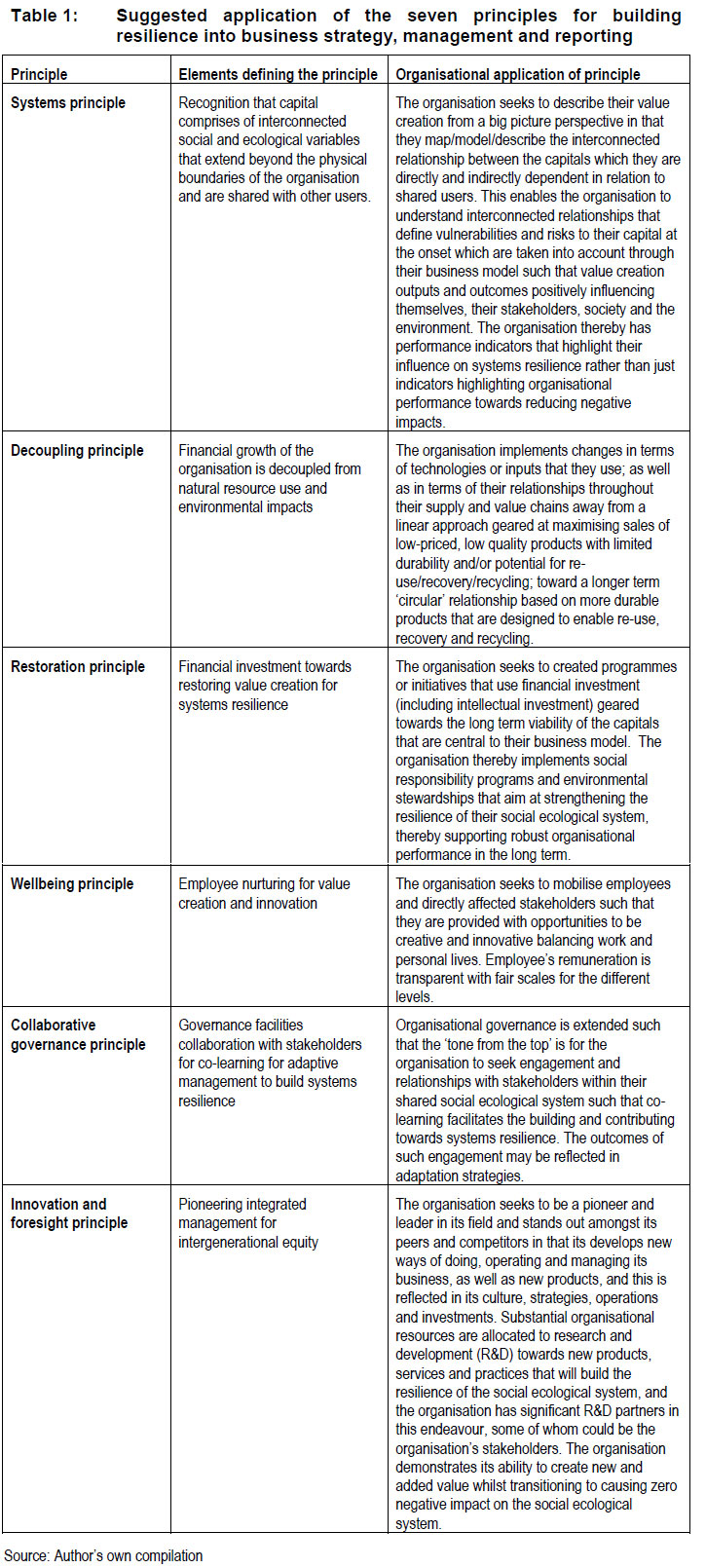
Focusing on systems resilience, elevates the sustainability conversation beyond reducing impact on the environment and society towards businesses operating within the limits of the social ecological system in which they exist. These limits are defined not only by physical limits but also by vulnerabilities that exist between interconnections or relationships amongst the key controlling social and ecological variables in their social ecological systems. The seven principles described above are presented to the business community at a time when it is grappling with the concept of integrated thinking and management and what value creation means in the context of global change. Introducing systems resilience into integrated thinking and management offers businesses the potential for improved adaptability against the backdrop of global change, based on the limits and adaptive capacity of the social ecological systems within which they exist. The principles present the foundation for managers to grow and develop an adaptation strategy in light of growing uncertainty emerging from global change. Managers are encouraged to apply the presented principles in integrated management specifically to define business strategy, governance, performance and future prospects; all in the context of the broader social ecological system. This will lead to the creation of value in the short, medium and long term for an organisation. Table 1 provides a very basic guide towards the application of the principles (see below). This framework will be further developed into a maturity tool for the use of managers. Currently it is subject to further research towards refinements in its practical implementation.
These seven principles also contribute towards the 'sustainability oriented theory of the firm' (Lozano et al. 2015). The principles facilitate the notion that resilience is a mechanism to further engage with the goals of sustainability. The principles can thereby further guide a more integrative and holistic 'theory of the firm' towards a more complete vision of the obligations, opportunities, relationships and processes that business leaders should address in their value creation propositions and long term sustainability (Lozano et al. 2015:440 ).
6. CONCLUSION
In this article the authors have presented seven principles for internalising systems resilience into integrated management. The authors have argued that given the current unprecedented pace of global change and the resulting risks it is no longer enough for businesses to be addressing sustainability from the perspective of reducing their impact on the environment or being more socially responsible. There is rather a need for a transformational change, one in which businesses firmly define and report their value creation from the perspective of not only their profitability, but the value they have created towards building and maintaining the resilience of the social ecological system in which they operate. The authors have argued that sustainability is about maintaining the structure and function of social ecological systems through addressing and maintaining systems resilience, such that systems are able to support businesses to withstand increasing external uncertainties and perturbations. For this to happen, it is imperative that businesses start operating within the limits of their social ecological system, so that they can contribute towards growing and maintaining a sustainable future.
Focusing on systems resilience elevates the sustainability conversation beyond reducing impact on the environment and society towards businesses operating within the limits of the social ecological system in which they exist. These limits are defined not only by physical limits, but also by vulnerabilities that exist between interconnections or relationships amongst the key controlling social and ecological variables in the system. The intention of the principles presented is to encourage businesses to look beyond their immediate boundaries as the system for which to create value, towards creating value for the broader social ecological system in which they operate. In turn, by addressing the resilience of that larger social ecological system, the organisation is ultimately improving its own adaptive capacity, which will contribute towards ensuring the long term sustainability of the business itself.
ACKNOWLEDGEMENTS
This research was funded by a South African national parliamentary grant investment.
REFERENCES
-
ACCENTURE & UNITED NATIONS GLOBAL COMPACT. 2013. The UN Global Compact-Accenture CEO Study on Sustainability. Architects of a Better World. [Internet:https://www.unglobalcompact.org/docs/news_events/8.1/UNGC_Accenture_CEO_Study_2013.pdf; downloaded on 17 July 2018.
» https://www.unglobalcompact.org/docs/news_events/8.1/UNGC_Accenture_CEO_Study_2013.pdf - ]
- ADGER WN, HUGHES TP, FOLKE C, CARPENTER SR & ROCKSTRÖM J. 2005. Social-ecological resilience to coastal disasters. Science 309(5737):1036-1039.
- ADAMS C. 2015. The international integrated reporting council: a call to action. Critical Perspectives on Accounting 27:23-28.
- AHERN J. 2011. From fail-safe to safe-to-fail: Sustainability and resilience in the new urban world. Landscape Urban Planning 100(4):341-343.
- ANDERIES JM, FOLKE C, WALKER B & OSTROM E. 2013. Aligning key concepts for global change policy: robustness, resilience, and sustainability. Ecology and Society 18(2):8.
- ARROW K, BOLIN B, COSTANZA R, DASGUPTA P, FOLKE C, HOLLING CS, JANSSON BO, LEVIN S, MÄLER KG, PERRINGS C & PIMENTEL D. 1995. Economic growth, carrying capacity, and the environment. Science 268(5210):520-521
- BANSAL P. 2005. Evolving sustainably: A longitudinal study of corporate sustainable development. Strategic Management Journal 26(3): 197-218.
- BEERMAN M. 2011. Linking corporate climate change adaptation strategies with resilience thinking. Journal of Cleaner Production 19(8):866-842.
- BERKES F & FOLKE C. 1998. Linking social and ecological systems for resilience and sustainability. In Berkes F, Folke C & Colding J. Eds. Linking social and ecological systems: management practices and social mechanisms for building resilience. Cambridge: Cambridge University Press. (pp 1-25.
- )
- BERKES F, COLDING J & FOLKE C. 2003. Introduction. In Berkes F, Colding J & Folke C. Eds. Navigating Social-ecological Systems. Building Resilience for complexity and Change. Cambridge: Cambridge University Press. (pp 1-30.
- )
- BERKES F. 2007. Understanding uncertainty and reducing vulnerability: Lessons from resilience thinking. Natural Hazards 41(2):283-295.
-
BIOREGIONAL. 2017. One Planet Principles. [Internet:https://www.bioregional.com/wp-content/uploads/2017/01/One-Planet-Principles-guide-Jan-2017.pdf; downloaded on 16 January 2017.
» https://www.bioregional.com/wp-content/uploads/2017/01/One-Planet-Principles-guide-Jan-2017.pdf - ]
-
BIZIKOVA L, SWANSON D & ROY D. 2011. Evaluation of Integrated Management Initiatives. International Institute for Sustainable Development. Winnipeg. [Internet:http://www.iisd.org/pdf/2011/evaluation_integrated_management.pdf; downloaded on 17 July 2018.] (Canada.
» http://www.iisd.org/pdf/2011/evaluation_integrated_management.pdf - )
- CARBO J, LANGELLA IM, DAO VT & HAASE SJ. 2014. Breaking the ties that bind: From corporate sustainability to socially sustainable systems. Business and Society 119(2):175-206.
- CARROLL AB & SHABANA KM. 2010. The business case for corporate social responsibility: A review of concepts, research and practice. International Journal of Management Review 12(1):85-105.
- CARPENTER SR, WALKER B, ANDERIES JM & ABEL N. 2001. From metaphor to measurement: Resilience of what to what? Ecosystems 4:765-781.
- COLLIER WM, JACOBS KR, SAXENA A, BAKER-GALLEGOS J, CARROLL M & YOHE GW. 2009. Strengthening socio-ecological resilience through disaster risk reduction and climate change adaptation: Identifying gaps in an uncertain world. Environmental Hazards 8(3):171-186.
- DERISSEN S, QUAAS MF & BAUMGÄRTNER S. 2011. The relationship between resilience and sustainability of ecological-economic systems. Ecological Economics 70(6):1121-1128.
- EHRENFELD JR. 2012. Beyond the brave new world: Business for sustainability. In Bansal P & Hoffman AJ. Eds. The Oxford Handbook of Business and the Natural Environment. Oxford: Oxford University Press. (pp 611619.
-
)
» www.theiirc.org - EHRENFELD JR & HOFFMAN AJ. 2013. Flourishing - A Frank Conversation about Sustainability. Stanford: Stanford University Press
- ELKINGTON J. 1998. Accounting for the bottom line. Measuring Business Excellence 2(3):18-22.
- EWEJE G. 2011. A shift in corporate practice? Facilitating sustainability strategy in companies. Corporate Social Responsibility and Environmental Management 18:125-136.
- FLOWER J. 2015. The International Integrated Reporting Council. A story of failure. Critical Perspectives on Accounting 27:1-17.
- FOLKE C. 2006. Resilience: The emergence of a perspective for social-ecological systems analyses. Global Environmental Change 16(3):253-267.
- FOLKE C, CARPENTER SR, WALKER B, SCHEFFER M, CHAPIN T & ROCKSTRÖM J. 2010. Resilience Thinking: Integrating Resilience, Adaptability and Transformability. Ecology and Society 15(4):20.
- GAO J & BANSAL P. 2013. Instrumental and integrative logics in business sustainability. Journal of Business Ethics 112(2):241-255.
- GOMIS AJB, PARRA MG, HOFFMAN WM & MCNULTY RE. 2011. Rethinking the concept of sustainability. Business and Society 116(2):171-191.
-
GREEN ECONOMY COALITION. 2012. Sign up to the 9 principles of a green economy https://www.greeneconomycoalition.org/news-analysis/sign-9-principles-green-economy; downloaded on 18 July 2018.
» https://www.greeneconomycoalition.org/news-analysis/sign-9-principles-green-economy -
]
» https://www.sd-network.eu/?k=resources -
HAANAES K, REEVES M, VON STRENGVELKEN I, AUDRETSCH M, KIRON D & KRUSCHWITZ N. 2012. Sustainability nears a tipping point. MIT Sloan Management Review and the Boston Consulting Group. [Internet:https://sloanreview.mit.edu/article/sustainability-nears-a-tipping-point/; downloaded on 18 July 2018.] (Boston.
» https://sloanreview.mit.edu/article/sustainability-nears-a-tipping-point/ - )
- HART S & MILSTEIN MB. 2003. Creating sustainable value. Academy of Management Executive 17:56-67.
- HAHN T, FIGGE F, PINSKE J & PREUSS L. 2010. Trade-offs in corporate sustainability: You can't have your cake and eat it. Business Strategy and the Environment 19(4):217-229.
- HAHN T, PINKSE J, PREUSS L & FIGGE F. 2015. Tensions in corporate sustainability: Towards an integrative framework. Journal of Business Ethics 27(2):297-316.
-
HAYWARD R, LEE J, KEEBLE J, MCNAMARA R, HALL C, CRUSE S, GUPTA P & ROBINSON E. 2013. The UN Global Compact-Accenture CEO Study on Sustainability 2013. Architects of a better world. United Nations Global Compact. United Nations. [Internet:https://www.accenture.com/t20150527T202823_w__/gben/_acnmedia/Accenture/Conversion-Assets/LandingPage/Documents/2/Accenture-UNGC-Utilities-Industry.pdf; downloaded on 18 July 2018.
» https://www.accenture.com/t20150527T202823_w__/gben/_acnmedia/Accenture/Conversion-Assets/LandingPage/Documents/2/Accenture-UNGC-Utilities-Industry.pdf -
]
» http://www.stockholmresilience.org/download/18.10119fc11455d3c557d6928/1459560241272/SRC%20Applying%20Resilience%20final.pdf - HAYWOOD LK, TROTTER DH, FACCER K & BRENT AC. 2013. The diversity of the practice of corporate sustainability: An exploratory study in the South African business sector. World Journal of Entrepreneurship, Management and Sustainable Development 9(2/3):111-125
-
HOLLING CS & WALKER BH. 2003. Resilience defined. In Internet Encyclopedia of Ecological Economics (eds). International Society of Ecological Economics. [Internet:http://www.ecoeco.org/pdf/resilience.pdf; downloaded on 18 July 2018.
» http://www.ecoeco.org/pdf/resilience.pdf - ]
- HÖRISCH J, FREEMAN RE & SCHALTEGGER S. 2014. Applying stakeholder theory in sustainability management: Links, similarities, dissimilarities, and a conceptual framework. Organization and Environment 27(4):328-346.
-
INTERNATIONAL CHAMBER OF COMMERCE. 2011. 10 conditions for a transition towards a green economy. [Internet:https://cdn.iccwbo.org/content/uploads/sites/3/2012/07/ICC-Ten-Conditions-for-a-transition-towards-a-Green-Economy-.pdf; downloaded on 18 July 2018.
» https://cdn.iccwbo.org/content/uploads/sites/3/2012/07/ICC-Ten-Conditions-for-a-transition-towards-a-Green-Economy-.pdf - ]
- ]
-
JACKSON T. 2009. Prosperity without Growth? The Transition to a sustainable Economy. Sustainable Development Commission. United Kingdom. [Internet:http://hdl.handle.net/10023/2163; downloaded on 18 July 2018.
» http://hdl.handle.net/10023/2163 - ]
- JONES A, PIMBERT M & JIGGINS J. 2011. Virtuous Circles: Values, Systems, Sustainability. London: IIED and IUCN CEESP.
- JONES DR. 2016. The 'Biophilic Organization': An integrative metaphor for corporate sustainability. Journal of Business Ethics 138(3): 401-416
- KÖNNÖLÄ T & UNRUH GC. 2007. Really changing the course: The limitations of environmental management systems for innovation. Business Strategy and the Environment 16(8):525-537.
-
KPMG. 2012. Expect the unexpected: Building business value in a changing world. Amsterdam: KPMG International. [Internet:https://home.kpmg.com/ru/en/home/insights/2012/05/expect-the-unexpected.html; downloaded on 18 July 2018.
» https://home.kpmg.com/ru/en/home/insights/2012/05/expect-the-unexpected.html - ]
-
KPMG. 2013. KPMG International survey of corporate responsibility reporting 2013. Amsterdam: KPMG International. [Internet:https://home.kpmg.com/bm/en/home/insights/2016/07/the-kpmg-survey-of-corporate-responsibility-reporting-2013.html; downloaded on 18 July 2018.
» https://home.kpmg.com/bm/en/home/insights/2016/07/the-kpmg-survey-of-corporate-responsibility-reporting-2013.html - ]
- LEBEL L, ANDERIES JM, CAMPBELL B, FOLKE C, HATFIELD-DODDS S, HUGHES TP & WILSON J. 2006. Governance and the capacity to manage resilience in regional social- ecological systems. Ecology and Society 11(1):19.
- LEVIN SA, BARRETT S, ANYAR S, BAUMOL W, BLISS C, BOLIN B., DASGUPTA P, EHRLICH P, FOLKE C, GREN IM, HOLLING CS, JANSSON A, JANSSON B-O, MÄLER K-G, MARTIN D, PERRINGS C & SHESHINSKI E. 1998. Resilience in natural and socioeconomic systems. Environment and Development Economics 3(2):221-235.
- LINNENLUECKE MK, RUSSEL SV & GRIFFITHS A. 2009. Subcultures and sustainability practices: the impact on understanding corporate sustainability. Business Strategy and the Environment 18(7): 432-452
- LINNENLUECKE MK, GRIFFITHS A & WINN M. 2012. Extreme weather events and the critical importance of anticipatory adaptation and organizational resilience in responding to impacts. Business Strategy and the Environment 21(1):17-32.
- LLORET A. 2015. Modelling corporate sustainability strategy. Journal of Business Research, 69(2):418-425.
- LOORBACH D, VAN BAKEL JC, WHITEMAN G, ROTMANS J. 2010. Business strategies for transitions towards sustainable systems. Business Strategy and the Environment 19(2):133-146.
- LOZANO R. 2012. Towards better embedding sustainability into companies' systems: An analysis of voluntary corporate initiatives. Journal of Cleaner Production 25:14-26.
- LOZANO R, CARPENTER A & HUISINGH D. 2015. A review of 'theories of the firm' and their contribution to corporate sustainability. Journal of Cleaner Production 106:430-442.
-
MAKOWER J. 2014. State of Green Business Report. Greenbiz Group Inc. [Internet: http://info.greenbiz.com/state-green-business-2014-get-report.html?src=Greenbiz; downloaded on 16 August 2017.
» http://info.greenbiz.com/state-green-business-2014-get-report.html?src=Greenbiz - ]
- MINOJA M. 2012. Stakeholder management theory, firm strategy and ambidexterity. Journal of Business Ethics 109(1):67-82.
-
NEW ECONOMY NETWORK. 2012. Principles for a New Economy. [Internet:https://www.tellus.org/pub/Principles%20for%20a%20New%20Economy%202012.pdf; downloaded on 18 July 2018.
» https://www.tellus.org/pub/Principles%20for%20a%20New%20Economy%202012.pdf - ]
-
O'NEILL D, DIETZ R & JONES N. 2010. Enough is Enough: Ideas for a sustainable economy in a world of finite resources. The Report for the Steady State Economy Conference. Centre for the Advancement of the Steady State Economy and Economic Justice for All. Leeds, UK. [Internet: https://steadystate.org/enough-is-enough-excerpt/; downloaded on 18 July 2018.
» https://steadystate.org/enough-is-enough-excerpt/ - ]
- OLSSON P, FOLKE C & BERKES F. 2004. Adaptive co-management for building social-ecological resilience. Environmental Management 34(1):75-90.
- PERRINGS C. 2006. Resilience and sustainable development. Environmental and Development Economics 11(4):417-427.
- ]
- PORTER ME & VAN DER LINDE C. 1995. Towards a new conception of the environment-competitiveness relationship. Journal of Economic Perspectives 9(4):97-118.
- PORTER ME & KRAMER MR. 2011. Creating shared value. Harvard Business Review 89(1/2):62-77.
- RAMMEL C, STAG S & WILFING H. 2007. Managing complex adaptive systems - A co-evolutionary perspective on natural resource management. Ecological Economics 63(1):9-21.
- SALZMANN O, IONESCO-SOMERS A & STEGER U. 2005. The business case for corporate sustainability: literature review and research options. European Management Journal 23(1):27-36.
- SANDHU S. 2010. Shifting paradigms in corporate environmentalism: From poachers to gamekeepers. Business and Society Review 115(3):285-310.
- SCHNEIDER A. 2014. Reflexivity in sustainability accounting and management: Transcending the economic focus of corporate sustainability. Journal of Business Ethics 127(3):525-536.
- SETH A & THOMAS H. 1994. Theories of the firm: Implications for research. Journal of Management Studies 31(2):165-191.
- STARIK M & KANASHIRO P. 2013. Toward a Theory of Sustainability Management. Uncovering and Integrating the Nearly Obvious. Organization and Environment 26(1):7-30.
- ]
-
UNITED NATIONS GLOBAL COMPACT. 2017. The ten principles of the UN Global Compact. [Internet:https://www.unglobalcompact.org/what-is-gc/mission/principles; downloaded on 19 July 2018.
» https://www.unglobalcompact.org/what-is-gc/mission/principles - ]
- WALDICK R. 2010. The role of institutions in integrated management. Horizons 10(4):73-80.
- WALKER BH, HOLLING CS, CARPENTER SR & KINZIG A. 2004. Resilience, adaptability and transformability in social-ecological systems. Ecology and Society 9(2):5.
- WALKER B & SALT D. 2006. Resilience Thinking: Sustaining Ecosystems and People in a Changing World. Washington DC: Island Press.
- WESTLEY FR, TJORNBO O, SCHULTZ L, OLSSON P, FOLKE C, CRONA B & BODIN O. 2013. A theory of transformative agency in linked social-ecological systems. Ecology and Society 18(3):27.
-
WORLD BUSINESS COUNCIL FOR SUSTAINABLE DEVELOPMENT (WBCSD). 2000. Eco-Efficiency: Creating more value with less impact. World Business Council for Sustainable Development. Geneva . [Internet:https://www.wbcsd.org/; downloaded on 19 July 2018.
» https://www.wbcsd.org/ - ]
- XU L & MARINOVA D. 2013. Resilience thinking. A bibliometric analysis of socio-ecological research. Scientometrics 96(3):911-927.
- YOUNG OR, BERKHOUT F, GALLOPIN GC, JANSSEN MA, OSTROM E & VAN DER LEEUW S. 2006. The globalization of socio-ecological systems: An agenda for scientific research. Global Environmental Change 16(3):304-316.