Assessing perceptions regarding organisational citizenship behaviour in South African retail firms
Abstract
The growth of technology in the retail sector has brought many challenges to retailers, who have to focus not only on prices and quality, but also on global competition. Consequently, retailers need to source highly customer-focused employees who are willing to go beyond their expected call of duties to satisfy customer needs and wants, thereby keeping firms competitive. This behaviour is called organisational citizenship behaviour (OCB). The primary objective of this study is to assess the perceptions of employees regarding OCB within retail firms in South Africa. A quantitative research design was employed. Non-probability sampling was used and 554 usable questionnaires were returned. The empirical results revealed that job considerations and employment considerations have a positive influence on both OCB related to compassion and OCB related to civic non-obligatory acts, while role considerations and job security were found to have no significant influence on both OCB related to compassion and OCB related to civic non-obligatory acts. Furthermore, OCB related to compassion was found to have a positive influence on both organisational commitment and propensity to resign, while OCB related to civic non-obligatory acts had a positive influence on organisational commitment and its influence on propensity to resign was not significant.
employment considerations; job considerations; organisational citizenship behaviour (OCB); organisational commitment; propensity to resign; retail firms
1. INTRODUCTION
The wholesale and retail sector is a more volatile sector with respect to cyclical changes and global economic conditions than many other sectors. It is the fourth largest contributor to GDP in South Africa, with a contribution of approximately 13.7% (Lehohla 2011:4), and is one of the major employers in South Africa, providing just over 22% of the total active workforce of the country (Memela 2012:3).
The growth of technology has led to informed customers who are bringing many challenges to retailers as they have to win customer loyalty by focusing not only on prices and quality, but also on global competition (Raub 2008:179). As a result, retailers needed to source highly customer-focused employees who are willing to go beyond their expected call of duty to satisfy customer needs and wants, thereby keeping firms competitive. This indicates that employees who do more than their call of duty are engaged in organisational citizenship behaviour (OCB).
Stoner, Perrewe and Munyon (2011:97) maintain that OCB involves extra-role performance which represents behaviours not formally required by any particular job yet which help to develop the social context of all jobs, thus facilitating effectiveness.
Research findings (see for example Daniels, Joireman, Favy & Kamdar 2007 and Wu, Wu, & Zhang 2005) indicate that OCB promotes the effectiveness of organisational operations and is not only beneficial to the organisation, but to its employees as well. Consistent with this view, Hall, Zinko, Perryman and Ferris (2009:383) postulate that citizenship performance has been associated with positive benefits within and across levels of an organisation, such as improved co-worker productivity, enhanced inter- and intra-unit performance and increased organisational performance by creating structural, cognitive and relational forms of social capital (Organ, Podsakoff & MacKenzie 2006:204).
Although retail industry positions make up an increasingly large percentage of the total jobs in the South African economy (Memela 2012:7), there is limited research on organisational citizenship behaviour in the retail industry within South Africa. Moreover, the antecedents of OCBs in retail settings are not well documented and represent a significant gap in the literature (Ackfeldt & Coote 2005:151).
Furthermore, several characteristics of retail jobs, as compared to other organisational behaviour settings, suggest the need to examine OCBs in this context. In addition, despite the importance of employees' service behaviours influencing customer perceptions of service quality and customer satisfaction, relatively little research has focused attention on identifying factors that affect employees' service behaviours (Ackfeldt & Wong 2006:728).
This study will thus focus on perceptions regarding OCB within retail firms in South Africa. The first part of this article highlights the problem statement, research objectives and questions, as well as the proposed hypothetical model and hypotheses of the study. This is followed by the clarification of the key concepts, the research design and the methodology of the study. The last part covers the empirical results and main conclusions and recommendations of the study.
2. PROBLEM STATEMENT
South Africa is the gateway to Africa, and the retail industry has grown with a huge emerging population that is technologically advanced - this has led to a different kind of customer. The middle-class is increasingly expanding and needs goods and services that international markets offer, as well as those offered domestically. To foster positive interaction, customer satisfaction, loyalty and trust, employees must engage in a constellation of behaviours, some of which are difficult to specify and mandate (Rego & Cunha 2008:542). Thus, retail firms need to encourage these behaviours so as to enhance the total customer experience.
Retail employees are often boundary spanners with multiple roles to fulfil - they are evaluated on the productivity and quality of their performance and are typically young and inexperienced workers (Ackfeldt & Coote 2005:151). Due to the seasonal and unpredictably long operating hours of retail firms, they hire a number of employees on a permanent, temporary or casual basis in order to meet with the influx of customers. These employees are expected to provide high customer service and often do more than is expected. Some employees are reluctant to go beyond the call of duty because their employment contracts do not provide the benefits and security they need. Rahman, Sulaiman, Nasir and Omar (2013:85) concur that the success of an organisation is influenced by employees who, besides performing their jobs, contribute their time and energy by providing assistance to achieve organisational effectiveness.
Thus, employee attitudes towards their employment contracts and other factors in the organisation can influence their behaviour in either a positive or a negative way, depending on their motivation, attitudes and motives. However, some employees might choose to engage in OCB because it fits a certain situation or the employee is acting out of narrow self-interest (Ariani 2012:162). Hence, this study is aimed to gain greater insight and understanding of the perceptions of retail employees engaging in OCB.
The main research question to be addressed in this study is: What are the perceptions regarding OCB in South African retail firms?
3. RESEARCH OBJECTIVES
The primary objective of this study is to investigate perceptions regarding OCB in South African retail firms. The following secondary research objectives are identified:
■ to provide a comprehensive literature study regarding OCB behaviour;
■ to develop a hypothetical model and measuring instrument to test perceptions regarding OCB in retail firms;
■ to empirically test perceptions of retailers regarding OCB in retail firms in South Africa;
■ to provide guidelines to retailers regarding OCB in retail effectiveness.
4. PROPOSED HYPOTHETICAL MODEL OF THE STUDY
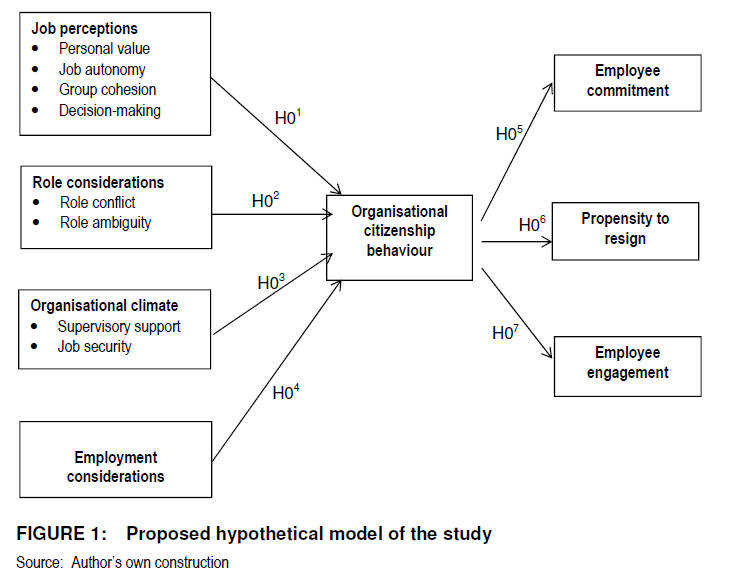
Figure 1 depicts the hypothetical model of the study.
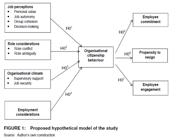
The hypothetical model was based on four previous studies and models on OCB, namely Mansoor, Aslam, Javad, Ashraf and Shabbir's model (2012); Chen, Tang and Wang's model (2009); Bell and Menguc's model (2002) and Ackfeldt and Coote's model (2005).
5. THEORETICAL OVERVIEW OF ORGANISATIONAL CITIZENSHIP BEHAVIOUR
5.1 Clarification of key concepts
This section attempts to define the key concepts used in this study.
■
Organisational citizenship behaviour (OCB)Organ et al. (2006:34) define organisational citizenship behaviour as the discretionary individual behaviour that promotes the effective operation of an organisation, but is not formally recognized by the organisation's reward system. The citizenship is often marked by its spontaneity, voluntary nature, constructive impact on results, unexpected helpfulness to others, and the fact that it is optional. Turnipseed and Wilson (2009:204) emphasise that behaviour is classified as "organisational citizenship" if it is discretionary and not an enforceable requirement of the job; is not directly recognized by the formal reward system; and, it contributes to organisational effectiveness. Contrary to this view, Peng and Zhao (2012:76) suggest that OCB does not only refer to selfless and voluntary behaviour, but also contains a variety of self-interested behaviours.
■
Retail firmRetailing is the set of business activities that adds value to the products and services sold to consumers for their personal or family use (Levy, Weitz & Grewal 2014:7). Furthermore, retailing involves the sale of products and services such as overnight lodging in a motel, a doctor's exam, a haircut, or a home-delivered pizza. Not all retailing is performed in stores; there is also non-store retailing like internet sales, direct sales, catalogue sales, and DVD rentals. For the purpose of this study, a retail firm will be referred to as a business organisation that is selling products and/or services for consumers' personal, family or household use (Berman & Evans 2012:4).
5.2 Dimensions of OCB
Podsakoff, Whiting, Podsakoff and Blume (2009:122) argue that the literature has focused primarily on understanding the relationship between OCB and other constructs, rather than carefully defining the nature (dimensions) of citizenship behaviour itself. Thus, the conceptualisation of OCB could be manifest in a better way by discussing the dimensions of OCB. A significant amount of research has been conducted by various authors to identify behaviours that are associated with OCB (Akan, Allen & White 2009:99; Organ et al. 2006:34). The dimensions that were identified include (amongst others) helping behaviour or altruism, conscientiousness, compliance, sportsmanship, organisational loyalty or boosterism, individual initiative, and self-development.
Redman and Snape (2005:301) refer to helping behaviour, or altruism, as the act of helping a fellow worker on an assigned task or problem; thus, going beyond job requirements to help others with whom the individual comes into contact. Compliance refers to an individual's implicit acceptance of the rules, regulations, and the procedures of their team, even when they are not being directly monitored (Akan et al. 2009:102). According to Organ et al., (2006), sportsmanship refers to the willingness of employees to tolerate organisational difficulties, inconveniences, and co-worker behaviours, accepting work-related problems without complaining excessively, maintaining a positive attitude, and others. The five-factor dimensions, for the purpose of this study, will be used; these include altruism, conscientiousness, sportsmanship, courtesy and civic virtue.
Empirical studies have supported this five-factor structure (Mansoor et al. 2012:568; Salavati, Ahmadi, Sheikhesmaeili & Mirzaei 2011:398-399 and Shin & Kim 2010:117). Though a meta-analysis, LePine, Erez and Johnson (2002:52) suggested that scholars should think of Organ's (1988) OCB as a latent construct and consider the OCB dimensions as imperfect indicators of the same underlying construct, where OCB is the focal construct of interest, and focusing on its specific dimensions should therefore be avoided. However, a meta-analysis conducted by Hoffman, Blair, Meriac and Woehr (2007:562) suggested that efforts to operationalise OCB are best viewed as indicators of a general OCB factor.
5.3 Importance of OCB in retailing
In retailing, as in any service organisation, spontaneous cooperative actions seem especially relevant (Ackfeldt & Wong 2006:727) as most aspects need non-mandated employee behaviour that can be critical to customer satisfaction (Rego & Cunha 2008:542). Although helping customers is in-role behaviour for retail employees, as they are evaluated on their ability to interact with customers (Ackfeldt & Coote 2005:157) employees are also expected to go beyond their call of duty in order to promote the positive image of the organisation (Rego & Cunha 2008:542) and increase customer satisfaction and loyalty to the company.
Perreira and Berta (2015:19) further state that taking time to understand employee attitudes and learning where their commitment is targeted can help managers capitalise on extra-role citizenship behaviors by bringing about positive effects, simply by the way they treat their employees.
The creation of customer value, in the interaction between the customer and the employee, is important in retail as it keeps customers returning and generates positive word-of-mouth communication, which attracts new customers (Levy & Weitz 2012:500). Retail firms hire employees who are the major drivers of the firm's success, increasing retail sales and industry growth. These retail stores are thus very dependent on employees to achieve their objectives and face the competition (Ajbani & Deshpande 2013:2).
Concurring with this view, Rego and Cunha (2008:545) indicate that conscientious and committed employees are more likely to take a diligent approach to solving customer problems and will be less inclined to shirk responsibilities, to pass problems along to others or to accept suboptimal solutions for customers, as this will tarnish the image of the organisation. The positive climate may result in better interactions with customers, thus increasing service quality and customer attraction. Arnaud and Wasieleski (2014) further postulate that management's treatment of service employees influences organisational citizenship behaviour and employees who perceive their supervisors to be non-supportive are unlikely to engage in any OCBs.
6. RESEARCH DESIGN AND METHODOLOGY
6.1 Research paradigm and approach
The positivistic research paradigm is employed in this study, which means that quantitative data are collected; aspects of the social world and social phenomena, are measured; causal relationships between different aspects of the social world are sought; and large data sets and statistical analysis are used (Matthews & Ross 2010:27). Given the nature of the study, the research approaches followed in this study are exploratory and descriptive in nature. The aim is to explore a relatively new area and describe respondents' perceptions regarding OCB in the retailing sector.
6.2
Population and samplingThe population in this study is comprised of all retailers in South Africa. According to Memela (2012:4), there are 80 353 retailers in South Africa which make up 70% of the country's economically active enterprises.
For the purpose of this study, non-probability sampling is used, specifically, convenience sampling. The reason for this choice is that respondents are available and accessible. Another sampling method that are used in this study is snowball sampling whereby respondents refer the researcher to others who possess similar characteristics and who, in turn, identify others (Cooper & Schindler 2006:425). This is particularly important in this study as retail employees from different retail firms may have similar experiences.
6.3
Data collectionSecondary sources for the literature review was obtained through conducting international and national data searches, through the use of journal articles, textbooks and the Internet. The primary data for this study was obtained using the survey method by means of self-administered structured questionnaires. In this regard, the aim was to target 1000 employees in the retail industry (250 employees each, from the Eastern Cape, Western Cape, Gauteng and Kwa-Zulu Natal). Ethical clearance was obtained from the NMMU before the empirically study was conducted.
6.4
Questionnaire designQuestionnaires are used as the primary data collection method in this study. This method of data collection is chosen because questionnaires are inexpensive to administer, can be administered to many people and a significant amount of data can be collected (Coldwell & Herbst 2004:48). In this study, self-administered structured questionnaires with closed-ended questions were used. This method is consistent with the measuring tool used in previous studies (Ackfeldt & Wong 2006:733; Ackfeldt & Coote 2005:154; Dimitriades 2007:469).
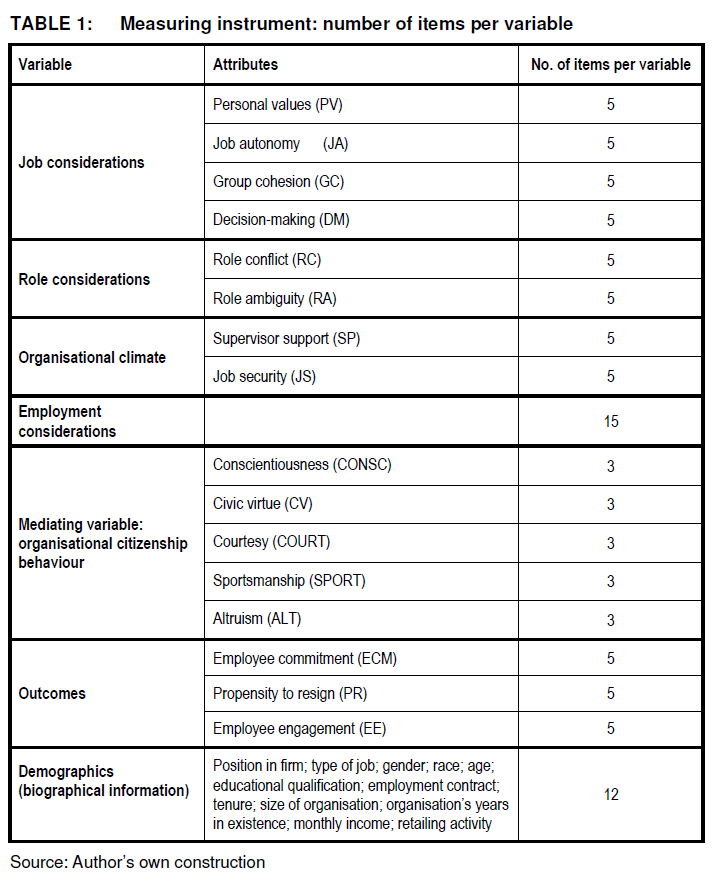
The questionnaire consists of four sections:
■ Section A of the questionnaire investigates the role of the independent variables on OCB, using an ordinal scale by means of a five-point Likert-type scale.
■ Section B of the questionnaire assesses general perceptions regarding OCB (5 dimensions), according to a five-point ordinal Likert scale.
■ Section C analyses the impact of OCB on dependent variables (outcomes), using a five-point ordinal Likert-type scale.
■ Section D of the questionnaire seeks demographical information that will provide clear insight into the background information of the respondents, using a nominal scale.
Table 1 depicts a brief summary of the sections contained in the measuring instrument.
6.5
Data analysisThe data analysis stage was started by calculating descriptive statistics (e.g. mean, mode, median and standard deviation) and frequency distributions. In this study exploratory factor analysis was used to measure whether the items measure various constructs under consideration thus assessing construct validity of the measuring instrument.
Reliability testing will be done by calculating Cronbach's alpha values. Multiple regression analysis and correlations were also used to analyse the statistical data collected. The data was captured on an Excel spread sheet and the computer programme, Statistica (Version 12) was used to analyse the data.
6.6
Reliability and validity of the measuring instrumentCronbach's alpha was used to assess the reliability of the entire scale and all values yielded alpha coefficients exceeding 0.8, except the Cronbach's alpha coefficient for propensity to resign, which was 0.642. Removing item PR1 improved the Cronbach's value to 0.727, which is regarded as sufficient for retaining the variable.
According to Zikmund, Babin, Carr and Griffin (2010:306), scales with a coefficient alpha between 0.7 and 0.8 are considered to have good reliability.
The validity of the measuring instrument was tested through exploratory factor analysis by assessing content and construct validity (discriminant and convergent validity).
7. EMPIRICAL RESULTS
7.1 The demographical information
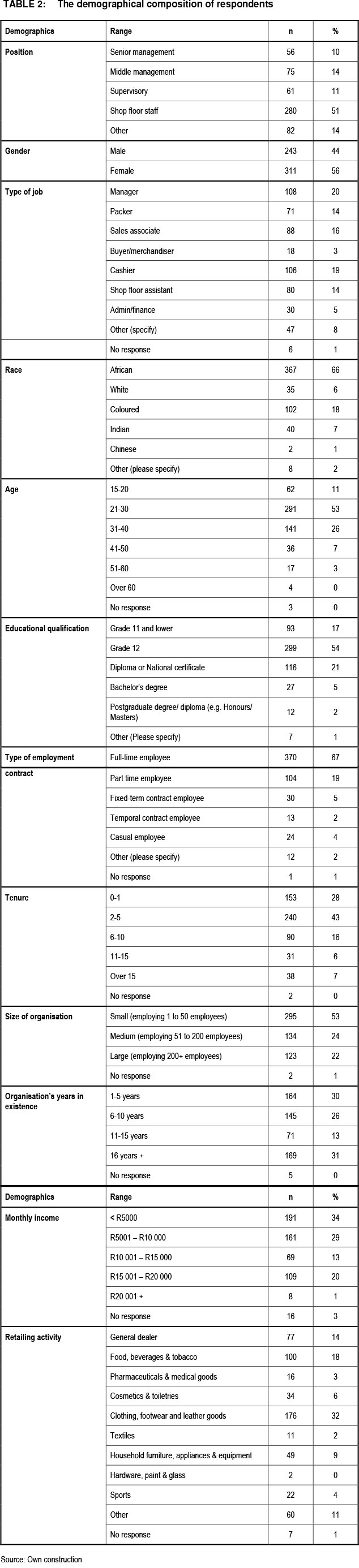
The demographical results are depicted in Table 2.
Table 2 shows that 51% of the respondents are working on the shop floor while 35% hold supervisory, middle and senior management positions. Fifty six per cent and 44% of respondents were females and males, respectively. The majority of the respondents were Africans at 66%. Furthermore, Table 2 indicates that 53% of the respondents were between the ages of 21-30 years, 54% had grade 12 certificates, 21% had a diploma or a national certificate, and 2% of the respondents had bachelors and postgraduate certificates, respectively.
In addition, Table 2 shows that 67% of the respondents were full time employees and 43% had tenure of 2-5 years. According to the respondents, 53% of the firms for which they worked were small firms, with between one and 50 employees and 31% of these firms had been in existence for over 16 years. The respondents further confirmed that only 1%) of them earned over R20 000 per month, 34% earned less than R5000 per month, while 29% earned between R5000-R10000 per month. The majority of these firms (32%) were clothing, footwear and leather goods retailers.
7.2 Exploratory factor analysis
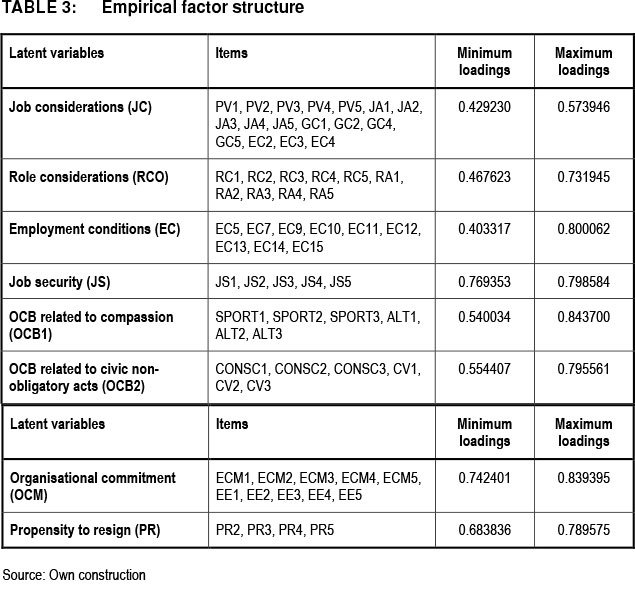
Exploratory factor loadings are depicted in Table 3.
Perceptions of employees regarding the independent variables, OCB and the dependent variables (outcomes) are presented. Factor loadings greater than 0.4 were considered significant and many items were thus deleted and not considered for further analysis.
Table 3 indicates that the respondents perceived 'organisational citizenship behaviour' as a two-dimensional construct. All three items (SPORT1, SPORT2 and SPORT3) which were meant to measure 'sportsmanship' and all three items (ALT1, ALT2 and ALT3) which were meant to measure 'altruism' loaded onto one factor and are termed 'OCB related to compassion' (OCB 1).
All three items (CONSC1, CONSC2 and CONSC3) which were meant to measure 'conscientiousness' and all three items (CV1, CV2 and CV3) which were meant to measure 'civic virtue' loaded onto another factor and are termed OCB related to civic non-obligatory acts' (OCB2). As a result of the discriminant validity assessment with the exploratory factor analysis, some items were deleted and new variables were formed; thus, the original theoretical model had to be adapted.
7.3 Descriptive statistics
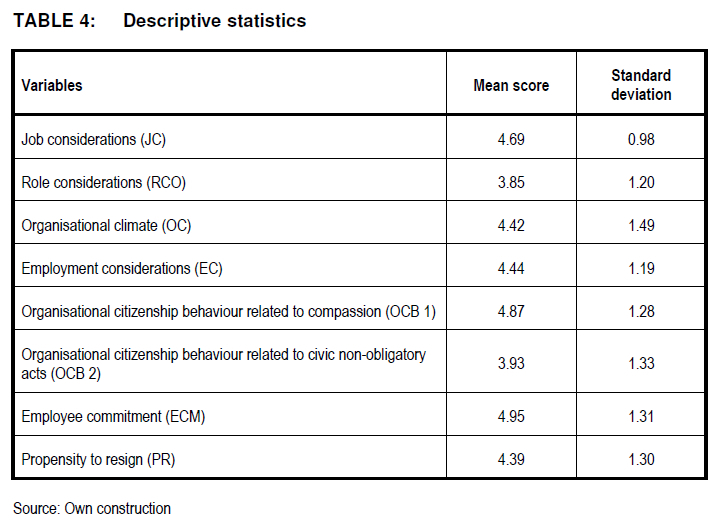
The descriptive statistical analysis involved the calculation of measures of central location, such as the mean, as well as measures of variability such as the standard deviation. These results are presented in Table 4.
Table 4 shows the mean scores and standard deviation for the variables under investigation in this study. As can be seen, ECM obtained the highest mean score of 4.95, while RCO obtained the lowest score of 3.85. This means that respondents somehow agreed that they are committed to the organisation. Most respondents somehow disagreed that there is clarity or conflict in their roles.
Apart from RCO, OCB(2) is the only other factor that shows that respondents somehow disagreed that they engage in OCB related to civic non-obligatory acts. Excluding ECM and RCO, the other factors indicate that the respondents are neutral about the fact that their firms consider that the employment contracts, the reward system, working hours and overtime are important factors that contribute towards employees' engagement in OCBs, the organisational climate is conducive, they engage in OCB, and they have propensity to leave their organisations.
Respondents perceived employee engagement as being the same as employee commitment; hence, employee engagement was deleted.
7.3 Reliability of the measuring instrument
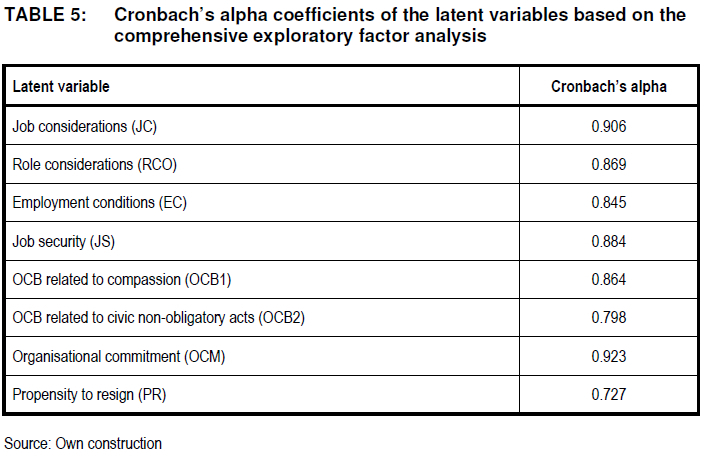
The reliability of the new and adapted variables had to be reassessed. Table 5 indicates the Cronbach's alpha coefficients of the latent variables based on the comprehensive exploratory factor analysis. The study retained JC, RC, JS, EC, OCB related to compassion, OCB related to civic non-obligatory acts, OCM and PR, since their Cronbach's alphas were above the cut-off point, but deleted OC and EE as they did not load as separate factors, and were not considered for further analysis. Table 5 summarises the items which are regarded as measures of individual variables in the theoretical model, following the exploratory factor analyses.
Table 5 indicates that all Cronbach's reliability coefficients are above 0.70 which is regarded as acceptable for the purpose of this study. This indicates that all instruments have a reliability of 0.70 and above, which is regarded as good reliability and is sufficient for retaining the variable, according to Zikmund et al. (2010:306).
7.4 Regression analysis
Four sets of regression analysis tests were conducted as to test the relationship between the variables.
7.4.1 The influence of job considerations, role considerations, job security and employment considerations on OCB related to compassion
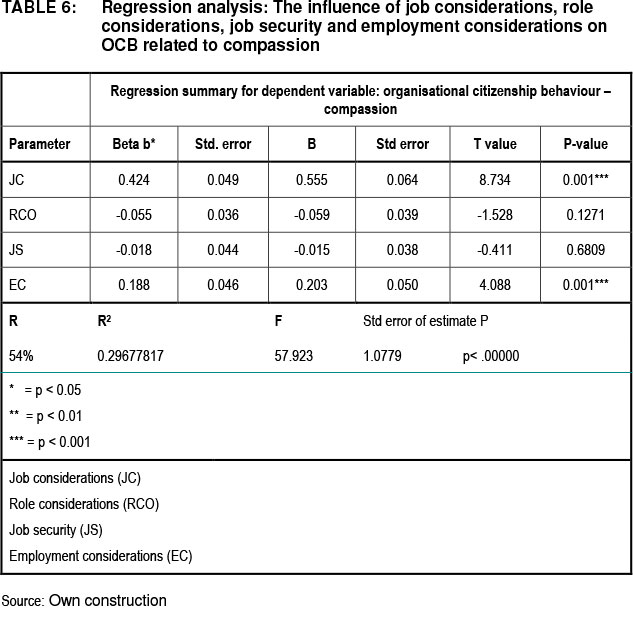
Table 6 indicates that job considerations measured by personal value, job autonomy, group cohesion and job clarity (b = 0.555, p < 0.001) are positively related to OCB related to compassion. Table 6 further indicates that employment considerations (b = 0.203, p < 0.001) is positively related to OCB related to compassion. The R2 of 0.297 explains the 30% of variability in the model explained by the moderating variable (OCB related to compassion) as shown in Table 6, below. Table 6 further indicates that role considerations measured by role conflict and role ambiguity (r = -0. 055, NS) and job security (r = -0.018, NS) do not exert significant influence on 'OCB related to compassion'.
In total, the R2 of 0.296 explains the 30% of variability in the model explained by the moderating variable (organisational citizenship behaviour related to compassion) as shown in Table 6.
7.4.2 The influence of job considerations, role considerations, job security and employment considerations on OCB related to civic non-obligatory acts
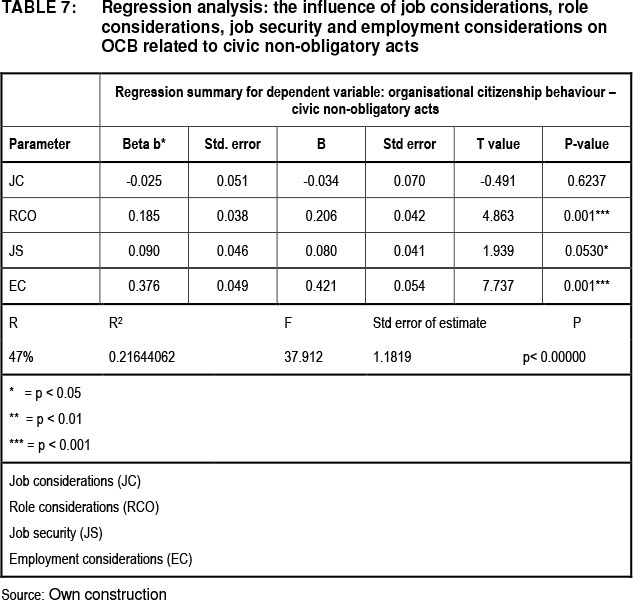
Table 7 indicates that role considerations measured by role conflict and role ambiguity (b = 0.206, p < 0.001) are positively related to OCB related to civic non-obligatory acts
Table 7 further indicates that employment considerations (b = 0.421, p < 0.001) is positively related to OCB related to civic non-obligatory acts. Although Table 7 indicates that job security (b = 0.080, p < 0.05) has a relationship with OCB related to civic non-obligatory acts, it is not sufficiently significant. This means that employees need to be constantly assured and supported by management regarding their job retention status. The R2 of 0.216 explains the 22% of variability in the model explained by the moderating variable (OCB related to civic non-obligatory acts), as shown in Table 7. According to Table 7, job considerations measured by personal value, job autonomy, group cohesion and job clarity (r = -0. 025, NS) do not exert significant influence on 'OCB related to civic non-obligatory acts'.
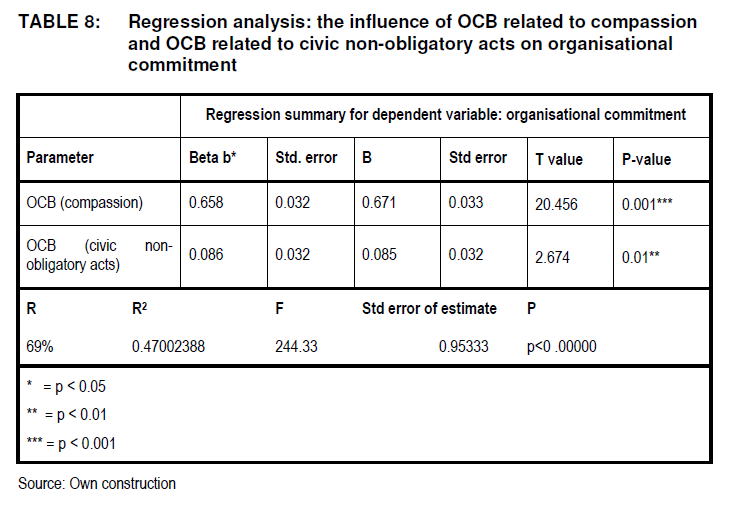
7.4.3 The influence of OCB related to compassion and OCB related to civic non-obligatory acts on organisational commitment
Table 8 shows that the R2 of 0.470 indicates that 47% of the variability in the model is explained by the variables grouped as 'organisational commitment'. This indicates that OCB related to compassion (b = 0.671, p < 0.001) and OCB related to civic non-obligatory acts (b = 0.085, p < 0.01) have a positive relationship with organisational commitment. Furthermore, this means that sportsmanship, altruism, civic virtue and conscientiousness, as measures of OCB, promote and increase in organisational commitment amongst employees.
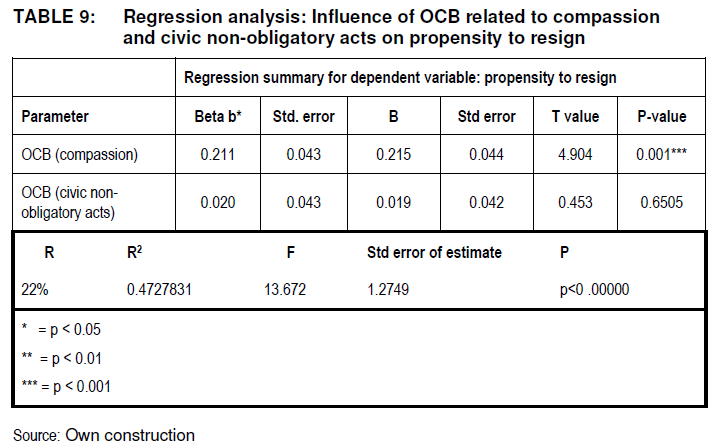
7.4.4 The influence of OCB related to compassion and OCB related to civic non-obligatory acts on propensity to resign
Table 9 indicates that OCB related to compassion (b = 0.215 p < 0.001) has a positive relationship with propensity to resign, it also shows that the R2 of 0.472, which indicates 47% of variability in the model, is explained by propensity to resign. This implies that sportsmanship and altruism among the employees have been a driving force behind the increased OCB related to compassion.
Table 9 further indicates that OCB related to civic non-obligatory acts (r = -0. 020, NS) does not exert significant influence on 'propensity to resign'.
Table 9 indicates that OCB related to compassion has a moderate impact on propensity to resign, with a t-value (t = 4.904), whilst OCB related to civic non-obligatory acts has a weak impact on organisational commitment (t-value = 2.674) and on job security (t-value = 1.939).
7.6 Correlation analysis
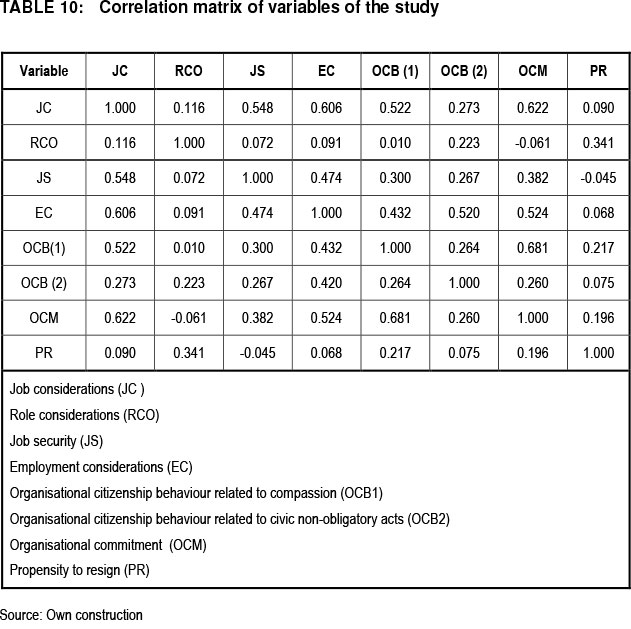
Table 10 indicates the correlation matrix of the study.
Table 10 clearly indicates that there is a strong positive correlation between most of the variables in the matrix. Only a few variables indicated a weak correlation.
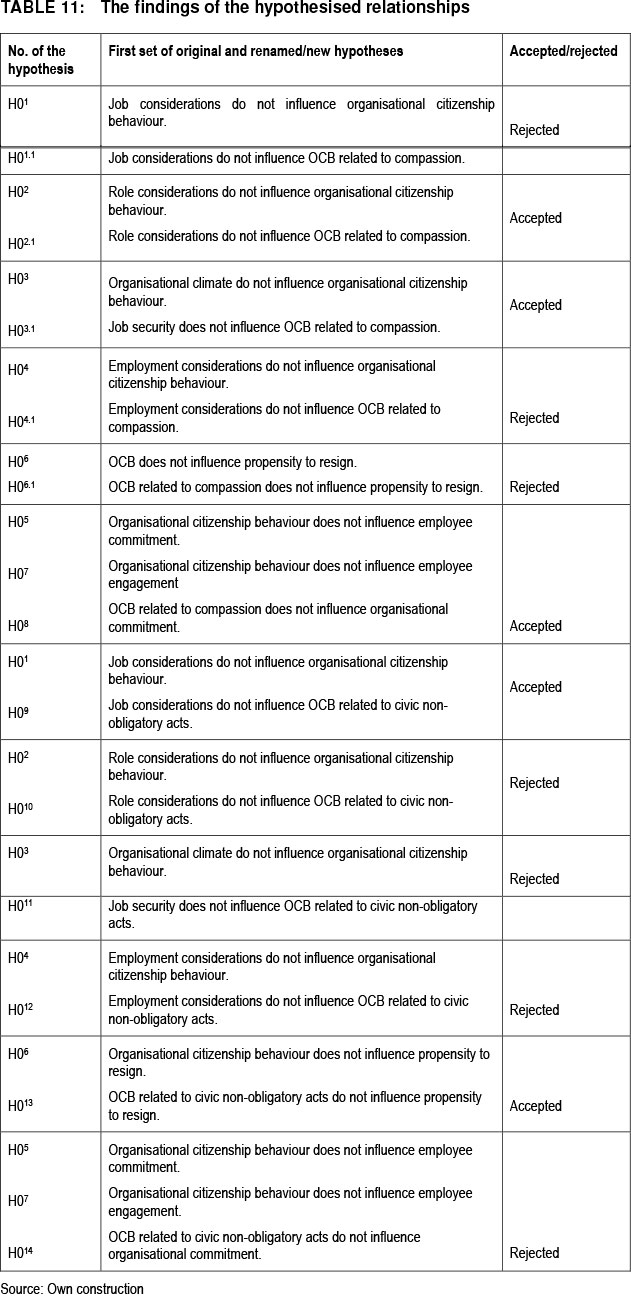
7.7 Findings on hypothesised relationships
Table 11 indicates the findings of the hypothesised relationships and renamed hypotheses.
8. RECOMMENDATIONS
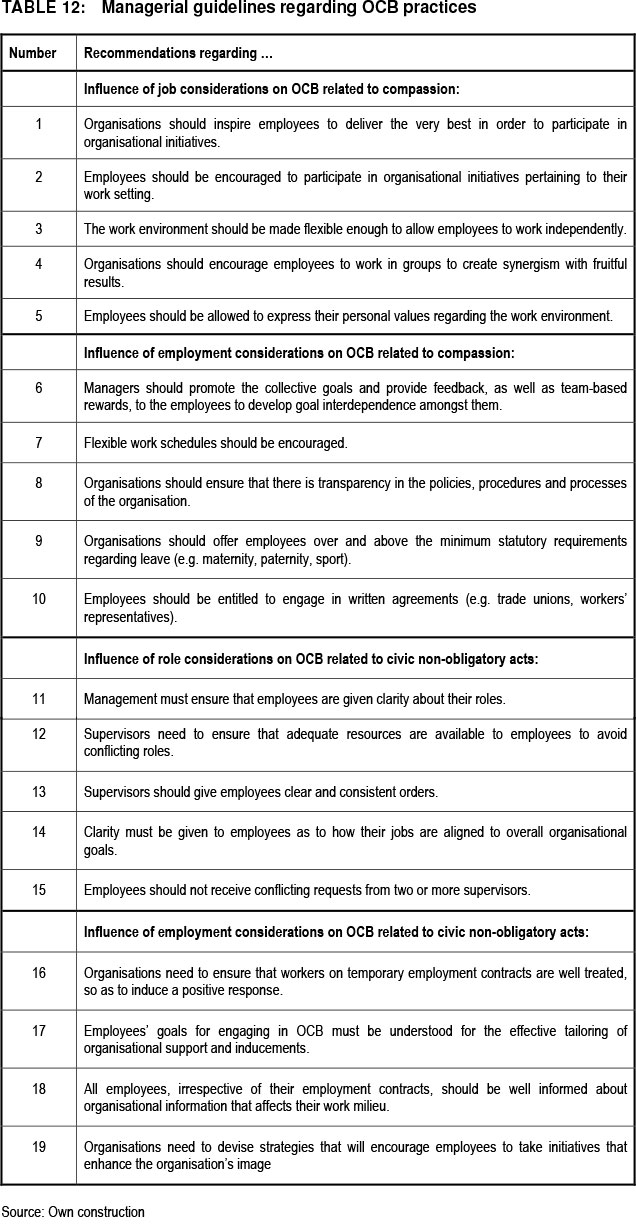
Employees who engaged in OCB related to compassion exhibit citizenship behaviours such as bearing minor setbacks in the workplace (Netemeyer, Boles, McKee, McMurrian 1997).
For example, not complaining about petty issues or minor setbacks and not finding fault with other employees and the willingness of employees to assist workmates (Podsakoff & MacKenzie 1997), for example, assisting others with challenging tasks and helping to orient new employees. Whilst, employees engaged in OCB related to civic non-obligatory acts exhibit behaviours such as constructive engagement in organisational activities (for example, attendance at voluntary meetings, responding promptly to correspondence) and going well beyond minimally required role and task requirements (for example, leaving work late to complete a task or waiting for the next shift to start smoothly).
Table 12 highlights some general guidelines regarding OCB implementation.
Some of the contributions of this study relevant to this article are identified below:
■ The findings of this study have contributed to the body of knowledge in retail literature in South Africa by developing a theoretical model of OCB in retail firms.
■ The antecedents of OCBs in retail settings are not well documented and represent a significant gap in OCB literature. Findings of this study could contribute towards closing this gap in the literature.
■ The study made a unique contribution to the field of OCB as for the first time in literature this study identified two aspects of measuring OCB perceptions, namely OCB related to compassion and OCB related to civic non-obligatory acts.
■ Retail managers seeking to build OCBs should view job, role and employment considerations as cornerstones of their strategy for managing retail employees.
■ The findings of this study can inform retail strategy policy formulation so as to assist with the implementation of OCB programmes.
■ This study provided useful and practical guidelines to organisations as to ensure effective strategising and management of OCB that could enhance their local and global competitiveness and long term sustainability.
10. CONCLUSION
The empirical results reveal that job considerations and employment considerations have a positive influence on both OCB related to compassion and OCB related to civic non-obligatory acts, while role considerations and job security were found to have no significant influence on both OCB related to compassion and OCB related to civic non-obligatory acts.
The findings of this study complement a study by Van-Dijk, Yaffe and Levontin (2008) that found support for the relationship between personal values and OCB; Lloyd (2008) found that autonomy is vital for the expression of discretionary behaviours as without autonomy all job roles would be prescribed leaving no latitude for the employee; Kibedi and Kikooma (2011) found that high levels of role clarity generate high OCBs and Chen et al. (2009) found that task interdependence and goal interdependence strengthen group cohesion, further leading to employees' willingness to engage in more OCB. Likewise, the findings of this study are consistent with a study by Judeh (2012:596) that revealed that there is a significant relationship between OCB and job security.
Furthermore, the empirical results show that OCB related to compassion have a positive influence on both organisational commitment and propensity to resign, while OCB related to civic non-obligatory acts have a positive influence on organisational commitment and no significant influence on propensity to resign. Previous research (Lambert, Hogan and Griffin 2008:63) found that organisational commitment is a salient antecedent of OCB. Moreover, the findings of this study are consistent with studies by Afshardoust, Feizabadi, Zakizadeh, and Abdolhoseyni (2013:871); Chen et al. (1998:928); Podsakoff et al. (1997); Podsakoff and MacKenzie (1997) and Waltz and Niehoff (1996), demonstrating that OCB is a critical determinant of turnover. This means that employees who exhibit low levels of OCB are more likely to leave an organisation than those who exhibit high levels of OCB.
The empirical results of this study demonstrated that four independent variables of the study namely, job considerations, role considerations, organisational climate and employment considerations influenced perceptions of organisational citizenship behaviour in retail firms, which ultimately have an impact on organisational commitment and employees' propensity to resign.
REFERENCES
- ACKFELDT A & WONG V. 2006. The antecedents of pro-social service behaviours: an empirical investigation. The Services Industries Journal 26(7):727-745.
- ACKFELDT AL & COOTE L. 2005. A study of organisational citizenship behaviours in a retail setting. Journal of Business Research 58:151-159.
- AFSHARDOUST M, FEIZABADI MS, ZAKIZADEH B & ABDOLHOSEYNI M. 2013. Relationship between organizational citizenship behaviour and organizational perceived politic among the sport organization experts of Tehran Municipality. International Journal of Applied and Basic Sciences 4(4):870-873.
- AJBANI L & DESHPANDE M. 2013. Employees' perception towards defined job roles and responsibilities in organised retail stores in Nashik City, India. Indian Streams Research Journal 3(3):1-6.
- AKAN O, ALLEN R & WHITE C. 2009. Equity sensitivity and organizational citizenship behavior in a team environment. Small Group Research 40(1):94-112.
- ARIANI D. 2012. Comparing motives of organizational citizenship behavior between academic staffs' universities and teller staffs' banks in Indonesia. International Journal of Business and Management 7(1):161-168.
- ARNAUD S & WASIELESKI D. 2014. Corporate humanistic responsibility: social performance through managerial discretion of the HRM. Journal of Business Ethics 120:313-334.
- BELL S & MENGUC B. 2002. The employee-organization relationship, organizational citizenship behaviors, and superior service quality. Journal of Retailing 78:131-146.
- BERMAN B & EVANS J. 2012. Retail management: a strategic approach. 11th ed. Essex, Oxford, UK: Pearson.
- CHEN CHC, TANG YY & WANG SJ. 2009. Interdependence and organizational citizenship behavior: exploring the mediating effect of group cohesion in multilevel analysis. Journal of Psychology 143(6):625-640.
- COLDWELL D & HERBST F. 2004. Business research. Cape Town: Juta.
- COOPER D & SCHINDLER P. 2006. Business research methods (9th ed.) Singapore: McGraw-Hill.
- DANIELS D, JOIREMAN J, FAVY J & KAMDAR D. 2007. Organizational citizenship behaviour as function of empathy consideration of future consequences, and employee time horizon: an initial exploration using an in-basket simulation of OCBs. Journal of Applied Social Psychology 36(9):2266-2292.
- DIMITRIADES Z. 2007. The influence of service climate and job involvement on customer-oriented organizational citizenship behaviour in Greek service organizations: a survey. Employee Relations 29:469-491.
- HALL A, ZINKO R, PERRYMAN A & FERRIS G. 2009. Organizational citizenship behaviour and reputation: Mediators in the relationships between accountability and job performance and satisfaction. Journal of Leadership & Organizational Studies 15(4):381-392.
- HOFFMAN B, BLAIR C, MERIAC J & WOEHR D. 2007. Expanding the criterion domain? A quantitative review of OCB literature. Journal of Applied Psychology 92:555-566.
- JUDEH M. 2012. Examining the relationship between organisation justice, job security, and organisational citizenship behavior in the Jordian Banks: a structural equation modeling perspective. Jordan Journal of Business Administration 8(3):581-602.
- KIBEDI H & KIKOOMA J. 2011. Organisational internal environment, role clarity and citizenship behavior at casualty emergency centres. Journal of Behavioral Studies in Business 4(1):1-14.
- LAMBERT E, HOGAN N & GRIFFIN M. 2008. Being the good soldier: organisational citizenship behavior and commitment among correctional staff. Criminal Justice and Behavior 35(1):56-68.
- LEHOHLA P. 2011. Gross domestic product, 2nd Quarter 2011. Pretoria: Statistics South Africa.
- LEPINE J, EREZ A & JOHNSON D. 2002. The nature and dimensionality of organisational citizenship behavior: a critical review and meta-analysis. Journal of Applied Psychology 87:52-65.
- LEVY M & WEITZ B. 2012. Retailing management. New York, NY: McGraw-Hill International.
- LEVY M, WEITZ B & GREWAL D. 2014. Retailing management. New York, NY: McGraw-Hill Education.
- LLOYD R. 2008. Discretionary effort and the performance domain. The Australian and New Zealand Journal of Organisational Psychology 1:22-34.
- MANSOOR N, ASLAM H, JAVAD T, ASHRAF F & SHABBIR F. 2012. Exploring organizational citizenship behavior and its critical link to employee engagement for effectual human resource management in organizations. Mediterranean Journal of Social Sciences 3(1):567-576.
- MATTHEWS B & ROSS L. 2010. Research methods: a practical guide for the social sciences. Essex, UK: Longman-Pearson.
- MEMELA V. 2012. Job opportunities in the wholesale and retail sector in the South African labour market. Johannesburg: Wholesale & Retail SETA - Research Business Unit.
- NETEMEYER R, BOLES J, MCKEE D & MCMURRIAN R. 1997. An investigation into the antecedents of organisational citizenship behaviors in a personal selling context. Journal of Marketing 61(3):85-98.
- ORGAN D, PODSAKOFF P & MACKENZIE S. 2006. Organisational citizenship behaviour: its nature, antecedents, and consequences. Thousand Oaks, CA: Sage.
- PENG Zl & ZHAO HD. 2012. Does organizational citizenship behavior really benefit the organization? Study on the compulsory citizenship behavior in China. Nankai Business Review International 3(1):75-92.
- PERREIRA T & BERTA W. 2015. Increasing OCB: the influence of commitment, organizational support and justice. Strategic HR Review 14(1/2):13-21.
- PODSAKOFF P & MACKENZIE S. 1997. Impact of organizational citizenship behavior on organizational performance: A review and suggestions for future research. Human Performance 10:133-151.
- PODSAKOFF N, WHITING S, PODSAKOFF P & BLUME B. 2009. Individual- and organizational-level consequences of organizational citizenship behaviors: a meta-analysis. Journal of Applied Psychology 94(1):122-141.
- RAHMAN U, SULAIMAN W, NASIR R & OMAR F. 2013. Analyzing the construct validity of organizational citizenship behaviour scale using confirmatory factor analysis with Indonesian samples. Asian Social Science 9(13):85-91.
- RAUB S. 2008. Does bureaucracy kill individual initiative: the impact of structure on organizational citizenship behavior in the hospitality industry? International Journal of Hospitality Management 27(2):179-186.
- REDMAN T & SNAPE E. 2005. I to We: the role of consciousness: transformation in compassion and altruism. Journal of Management Studies 42(2):301-328.
- REGO A & CUNHA M. 2008. Organisational citizenship behaviours and effectiveness: an empirical study in two small insurance companies. The Service Industries Journal 28(4):541-554.
- SALAVATI A, AHMADI F, SHEIKHESMAEILI S & MIRZAEI M. 2011. Effects of organizational socialization (OS) on organizational citizenship behavior (OCB). Interdisciplinary Journal of Contemporary Research in Business 3(5):395-410.
- SHIN H & KIM K 2010. Examining identity and organizational citizenship behaviour in computer-mediated communication. Journal of Information Sciences 36(1):114-126.
- STONER J, PERREWE P & MUNYON T. 2011. The role of identity in extra-role behaviors: development of a conceptual model. Journal of Managerial Psychology 26(2):94-107.
- TURNIPSEED D & WILSON G. 2009. From discretionary to required: the migration of organizational citizenship behavior. Journal of Leadership & Organizational Studies 15(3):201-216.
- VAN-DIJK D, YAFFE T & LEVONTIN L. 2008. The effect of personal values on organisational citizenship behaviour. Paper delivered at 3rd International Conference on Interdisciplinary Social Sciences. Tuscancy, Italy.
- WALTZ S & NIEHOFF B. 1996. Organizational citizenship behaviours and their effect on organizational effectiveness in limited menu restaurants. Academy of Management Conference 307-311.
- WU X, WU Z & ZHANG D. 2005. New perspectives in organizational citizenship behavior research. Advances in Psychological Science 2:211-218.
- ZIKMUND W, BABIN B, CARR J & GRIFFIN M. 2010. Business research methods. 8th ed. Toronto, Canada: South-Western Cengage Learning.