Enterprise skills and performance: an empirical study of smallholder farmers in Kwa-Zulu Natal
Abstract
BACKGROUND: The article empirically investigates the extent to which various enterprise skills are related to smallholder farming enterprise performance. These skills encompass management skills, marketing skills, production skills, infrastructural utilisation skills, ICT skills, financial management skills, as well as attitudes towards business. METHODS: A quantitative and cross-sectional design was used with a structured survey to collect data. The target population was smallholder farmers in the Zululand District Municipality of Kwa-Zulu Natal Province of South Africa. Regression analysis was used to test the hypotheses. FINDINGS: The results indicate that the respondents recognise the importance of various skills associated with agribusiness performance which include the value of investing in infrastructure, the importance of developing a brand for their business, and the importance of hiring a financial manager to ensure sustainability. CONCLUSIONS: Gaining proficiency in the skills identified remains one of the key challenges in promoting commercial farming in rural areas in South Africa. Skills development should be grounded in the context and in the task environment of the farmers' operations. To carry out a job or task skilfully is to do it proficiently, that is competently. This suggests practical standards of proficiency, and the need for standards to be developed for smallholder farming enterprises. Classification: Research paper
attitudes; enterprises; financial; ICT; infrastructure; marketing; performance; skill; smallholder farming; South Africa
1. INTRODUCTION
In the globalised economy, agriculture is a crucial commercial activity and agricultural enterprises are an integral part of economic activity for many developing countries in Africa. Moreover, the contribution of entrepreneurial ecosystems in the creation of clusters in Africa has been highlighted Muffato (2015:2-4), where skills development (Uchezuba, Moshabele & Digopo 2009:171) of agriculture-based enterprises is imperative (Asokan & Singh 2003; Meena, Prasad & Singh 2009).
In South Africa, the Department of Land Reform and Rural Development has made it a priority to recapitalise as well as provide developmental support to land reform beneficiaries in rural communities to improve their capacity for sustainable economic agriculture (Binswager 2008:13; DAFF 2012:3).
The National Development Plan NGP (2010) in South Africa identifies the potential of agro-processing to spur growth and development through backward and forward linkages with other sectors of the economy (DAFF 2012:4). Agro-processing is relevant to the developing country context as food processing activities are not always scale dependent. Small enterprises have the potential to operate as economically efficient as larger plants whose competitive advantage is economies of scale (Mather 2005:11).
Competitive advantage stems from the possession and efficient utilisation of a unique set of assets such as locational advantages, natural resources, skills and knowledge and proximity to inputs (Dorosh & Thurlow 2013:450; Ortmann & King 2010:399; Shiimi, Taljaard & Jordaan 2012:42; Urban & Kongo 2015:1-3). However, in most of the developing countries, including South Africa, the majority of the rural farmers have small landholdings, limited resources and excess labour (Faostat 2006:3-6; Preisendorfer, Bitz & Bezuidenhout 2012:25). Additionally, inadequate entrepreneurial skills and strategies among rural farmers, limits agricultural development as well as the sustainability of their agricultural enterprises (Louw, Troskie & Geyse 2013; World Bank 2013:Internet).
Moreover, research into South African worker co-operatives highlights the importance of management and operations of the more successful co-operatives (Oelofse & Van der Walt 2015:289-294). Regardless of the support by government and its several agricultural policies and interventions, many previously disadvantaged black farmers still struggle to attain full potential of the arable land they received through the land reform processes.
One of the biggest challenges currently facing these smallholder farmers is the development and improvement of its knowledge and skills base, particularly among previously disadvantaged and marginalised sectors of the population (Darroch & Clover 2005:321-325; Rwigema, Urban & Venter 2010:521-525).
1.1 Problem and rationale of study
The argument for the improvement in the national skills' profile is based on the notion that in order to compete successfully, enterprises need to secure a strategic position, attract highquality resources, be innovative and maintain market presence (Urban, Van Vuuren & Barreira 2008:58-65).
Research among South African SME owners' finds that even though the mostly sought assistance is in the areas of finance, marketing and human resources, it was not the assistance that made these SMEs successful, but rather factors such as the product type, product quality and marketing (Ferreira, Strydom & Nieuwenhuizen 2010:95-99).
Additionally, skills for entrepreneurship and innovation are likely to be specific to those activities and to aim to produce particular outcomes. The latter vary from business founding, growth and sustainability of an enterprise, to the development of innovative products and services, enabling enterprises to compete locally, nationally or globally (Chell 2013:6-12; Shree & Urban 2012:292).
It has been suggested that the creation of agro-entrepreneurs may be enhanced and reinculcated through the development of entrepreneurship. By adopting an entrepreneurial work culture, which comprises of personal values, managerial skills, experiences and behaviours, these farmers would typify the entrepreneur in terms of a spirit of initiative, propensity for risk, capacity for innovation and ability to manage a firm (Mohamed, Rezai, Apriyanti, Abdullah & Taman 2011:492; Muffato 2015:1-3).
The primary focus of many smallholder farmers is often on short-term operational actions, rather than long-term strategic issues, and their decision-making is generally reactive and intuitive as opposed to proactive and deliberate (Urban & Kongo 2015:2).
However, when considering the vagaries of the market, changing consumer habits, enhanced environmental regulations, new requirements for product quality, supply chain management, food safety and sustainability issues, it is imperative for these businesses to adapt to such changing circumstances (Lans 2010:12-25). It has been argued that these types of change have opened the door for experimentation with alternative farming and growing methods, for instance, organic farming, landscape conservation, rural tourism, care farming and innovation in business processes and distribution such as introducing tracking and tracing systems, value-added logistics and certification (Lans 2010:15). Such developments mark a shift in which entrepreneurial skill is needed as a way to confront these new challenges (Fan, Brzeska & Halsema 2013:10-13).
1.2 Aims of study
This paper responds directly to calls for considerably more research to identify the nature of skill in the entrepreneurial process and to test theory for the benefit of training and educating entrepreneurs of the future (Chell 2013:30). The study investigates the extent to which various enterprise skills are perceived to be related to smallholder farming enterprise performance. These skills encompass management skills, marketing skills, production skills, infrastructural utilisation skills, ICT skills, financial management skills and attitudes towards agricultural business.
Additionally, by viewing farming through an entrepreneurship lens, this may serve as a catalyst for smallholder farmers to discover and exploit novel opportunities brought about by agro-processing (de Lauwere, Verhaar & Drost 2006:14; Mhazo, Mvumi, Nyakudya & Nazare 2012:1608). Indeed, it is recognised that 'farm-gate level', smallholder farming entrepreneurs are likely to derive benefits such as access to niche markets, business opportunities and income generation (Jari & Fraser 2009:1130; World Bank 2013:Internet).
The study takes place in South Africa which faces numerous economic and social challenges, key of which are a high unemployment rate, high poverty rate and high inequality (NDP 2010). The study has important implications when considering that in many African countries, such as South Africa, Nigeria and Ghana, governments have introduced policies not only to encourage entrepreneurship but also to increase or create more skills and knowledge so that entrepreneurship can flourish (Doyer, Haese, Kirsten & Van Rooyen 2007:495; Mitra, Abubakar & Sagagi 2011:458).
Indeed, Oluwatobi and Ogunrinola (2011:77-85) argue that human capital is one of the most important factors that is accountable for the wealth of nations, where skills and knowledge need to be strategically cultivated and positioned for the preservation of both the present and the future economic growth and development of a country.
The article starts by highlighting relevant theoretical foundations and unpacks the study variables to provide a basis on which the hypotheses are formulated. Next the research methodology is explicated and the hypotheses are tested using regression analysis. Results and implications follow. The article ends by highlighting study limitations and avenues for future research.
2. THEORETICAL OVERVIEW
2.1 Human capital attributes
Considering the intensity of human capital requirements necessary for smallholder farmers to progress upstream in agro-processing activities, skills and knowledge are pivotal towards improving the competitiveness of agribusinesses (Genis 2012:25; Louw 2012; Matshekga & Urban 2013:260-265; Uchezuba et al. 2009:172).
The theory of human capital is rooted in the field of macroeconomic development theory, where Becker (1964) emphasised the social and economic importance of human capital theory and noted that the most valuable of all capitals is the investment in human beings.
Theodore Schultz developed a theory of entrepreneurship based on this concept of human capital. He conceptualized entrepreneurs as being able to deal with disequilibrium - where individuals engage in optimising behaviour which entails reallocating resources to regain equilibrium. Human capital theory maintains that knowledge provides individuals with increases in their cognitive abilities, leading to more productive and efficient potential activity (Barham, Chavas, Fitz, Ríos-Salas & Schechter 2015:11-23).
A recent review of human capital attributes included skills meta-analytically reviewed from 70 independent samples in an attempt to clarify the relationship between human capital and entrepreneurial success (Unger, Rauch, Frese & Rosenbusch 2011:342-355).
The authors demonstrated the importance of relating human capital to task performance in order to achieve successful outcomes. They found that the majority of papers used human capital investments (such as education, experience and learning) rather than outcomes of human capital investments (i.e. various entrepreneurially related, business or technical skills). They showed that the outcomes of human capital investments were related to success with statistical significance.
2.2 The nature of skill-sets
Skills are multidimensional; they comprise a cognitive element - knowhow, affect - the emotional expression of carrying out the task, and behaviour - the selected action be it strategic, tactical or personal. All of this is carried out in a context in which the cues must be learnt in order to take appropriate action (Chell 2013:6-11).
There is a wide range of "skills" that are associated with entrepreneurship and innovation. These skills and person attributes are primarily cognitive, personality related, social and interpersonal, business specific, motivational and learning. However, different theoreticians emphasise different combinations of person attributes, behaviours and skills, where for instance emphasis on the cognitive capabilities is a reflection of the dominance with which opportunity recognition theory has held sway (Chell 2013:5-12).
Empirical studies show that labour market experience, management experience and previous entrepreneurial experience all impact strongly on entrepreneurial success (Hashemi, Nadi & Rezvanfar 2012:575). Researchers have found that the following skill-set based factors provide enterprises with a competitive advantage (Barham et al. 2015:11-13; Matshekga & Urban 2013:259-265; Urban & Kongo 2015:3):
■ Profitable production linked to continuous follow-up of production, incomes and
■ expenditures (financial literacy and management)
■ Constant development of cognitive and professional skills (education, skill development)
■ Strong self-belief and readiness to work hard (commitment)
■ Having goal-orientated operations (proper planning)
■ Using up-to-date information relevant to the farmer's circumstances and needs
■ Employ operating technology and methods that are more effective than those of competitors
■ Utilisation of team building/work by fostering an entrepreneurial climate
■ Innovativeness reflecting a tendency to encourage, engage in, and support new ideas, novelty, experimentation and creative process that may result in new products, services or processes
■ Ability to secure access to rare resources and gain new knowledge of key factors and issues
2.3 Skills and enterprise performance
Past research has also noted the positive relationships between entrepreneurial skills, management experience and business growth (Unger et al. 2011:345). It has been argued that there are two ways in which previous experience impacts enterprise performance:
First, it leads to the development of experientially-acquired skills or expertise which will lead in turn to more knowledgeable actions and decisions.
Second, as founders are inclined to start businesses which are similar (e.g. in terms of industry, geographic area) to enterprises with which they are familiar, experience influences start-up characteristics (Unger et al. 2011:342-347). Research finds that owner-managers with previous experience are more likely to avoid costly mistakes than those with no prior experience.
Additionally, prior business ownership experience has been associated with assets like extended networks, increased expertise, and a solid reputation with financiers, customers and suppliers (Matshekga & Urban 2013:259-266; Urban & Kongo 2015:1-6).
The notion of enterprise performance is important when considering that past research has found a positive relationship between management experience and enterprise growth (Matshekga & Urban 2013:365). Moreover, the terms "growth", "success" and "performance" are often used interchangeably in entrepreneurship research and are typically measured using indicators such as: (1) earnings, (2) net worth, (3) cash flow, (4) market share, and (5) sales volume (Unger et al. 2011:342). Financial indicators are probably the most common form of performance measures across all business types, even though they are primarily one-dimensional measures, which are biased towards short-term profitability at the expense of long-term growth. Consequently the use of non-financial measures is increasingly being adopted by businesses with a focus on issues such as customer satisfaction, customer referral rates, delivery time, waiting time and employee turnover (Steffens, Davidsson & Fitzsimmons 2009:125-145).
Notwithstanding the burgeoning work on enterprise skills and performance, the effect of human capital does not always have a positive effect on business performance (Shree & Urban 2012:293). For instance, previous research has shown that over-investment in education leading to high levels of certification may discourage risk taking, while underinvestment may encourage it. For this reason, migrants are frequently engaged in entrepreneurial activities - they reside in a new social structure that may not reward their formal human capital investments (Davidsson & Honig 2003:303).
Human capital has also been shown to have a negative or non-linear effect on entrepreneurship when individuals with higher levels of education particularly in developing economies, often seek employment in the formal economy, for jobs that pay well. On the other hand, external conditions in a particular country, region or city may lead to even well-educated individuals who are presented with limited opportunities for satisfying and sufficiently rewarding employment, to engage in entrepreneurship(Fan et al. 2013; Rwigema et al. 2010:521).
2.4 Hypotheses formulation
Building on in this research direction several key variables are operationalised for the purpose of this study which have been identified in the literature as important skills for enterprise performance (Chell 2013:7-9; Unger et al. 2011:345-350). Cognisance is also taken of attitudes toward enterprise, since they positively affect the personal attractiveness of starting one's own business as more favourable attitudes justify more favourable perceptions of desirability of the behaviours related to the goal of becoming an entrepreneur (Shree & Urban 2012).
The selection of these variables is by no means exhaustive. It is acknowledged that the actual process of how skills are formed and used is far more complex and that no single factor can determine the outcome of this process. A number of variables are necessary, but no one is sufficient. It is also important to recognise that these variables work in combination rather than as single predictors (Chell 2013:7-10). Notwithstanding the complexity of the phenomenon and the reciprocal nature of relationships between the skills and enterprise performance, hypotheses are formulated but are restricted to a number of variables and links. By recognising the mixed findings of the relationship between skills and enterprise success (Unger et al. 2011:345-350), the hypotheses are structured to address the relationship between variables in line with the study objectives:
Hypothesis 1: Higher levels of management skills are positively related to smallholder farming enterprise performance
Hypothesis 2: Higher levels of marketing skills are positively related to smallholder farming enterprise performance
Hypothesis 3: Higher levels of production skills are positively related to smallholder farming enterprise performance
Hypothesis 4: Higher levels of utilisation of infrastructure is positively related to smallholder farming enterprise performance
Hypothesis 5: Higher levels of access to and utilisation of information communication technology (ICT) facilities is positively related to smallholder farming enterprise performance
Hypothesis 6: Higher levels of financial management skills are positively related to smallholder farming enterprise performance
Hypothesis 7: Favourable attitudes toward agri-business are positively related to smallholder farming enterprise performance
3. METHODOLOGY
The research design was quantitative and cross-sectional which relied on a survey to collect data in order to investigate the proposed relationship between the variables under study. A structured questionnaire was administered to smallholder farming entrepreneurs. The target population was smallholder farmers in the Zululand District Municipality of Kwa-Zulu Natal Province of South Africa.
3.1 Sampling and instruments
The sample selection criterion was based on the AgriBEE charter. The AgriBEE charter is a sub-item of the BBBEE Act 53 of 2003, stipulating smallholder farming entrepreneurs employ between one and 50 people and have a maximum turnover of approximately R10 million per annum (Government Gazette 2013:45). Sampling frames were obtained from the Provincial Departments of Agriculture that could be used for data collection purposes were solicited.
Initially, 1 200 farmers were identified as the target population of which 700 farmers met the sampling selection criteria as per the abovementioned BBBEE Act 53 of 2003 and once suitable locations were identified, a survey was administered physically to these individuals by trained field workers. A final sample of n = 100 qualified responses was achieved and deemed to be appropriate for an empirical survey based study (Cooper & Schindler 2006:543; Hair, Black, Babin & Anderson, 2010:323).
Based on previous research (Chell 2013; Matshekga & Urban 2013; Shree & Urban 2012; Unger et al. 2011) suitable measures were identified particularly where there was empirical support for each construct as examined in the literature review section. A structured questionnaire that comprised of three sections - the cover letter, a section on demographic information of respondents and the last section where respondents provided their responses to statements on skills reflecting each of the hypothesis.
The various items representing the independent variables (IV) and dependent (DV) variable were based on the conceptualisation of these constructs as discussed in the literature review, where multiple items were used to measure each of the constructs as per the hypothesis.
Considering the multidimensional nature of particular skills, seven broad categories of skills were measured with several items each; these included: enterprise management skills, marketing skills, production skills, infrastructural utilisation knowledge, ICT skills, financial management skills and attitudes towards agriculture as a business activity. For the DV, performance was measured in terms of various growth indicators. Although there is no consensus on the appropriate measure of enterprise growth, entrepreneurship researchers have pointed to multidimensional nature of growth as the crucial indicator of entrepreneurial success (Steffens et al. 2009:125-135). Consequently, sales performance, return on assets (ROA), employment growth, and operating profit were used to measure financial performance. The respondents were asked to consider enterprise performance in terms of these indicators over a period of three years.
Metric (i.e. interval and ratio scaled) data were measured on a 1 to 5 Likert scale, where '5 equals strongly agree and 1 equals strongly disagree'. In order to ensure that the instrument demonstrated sufficient face and content validity, a preliminary analysis via a pilot test, to easily accessible respondents was undertaken (n = 15). This procedure ensured that the respondents had no difficulties in answering the questions and there was no problem in recording the data. As a precaution, common method response bias was methodologically controlled for by gathering data representing the IVs and DV at different time periods (2 week intervals) and by counterbalancing the question order. Safeguarding respondent anonymity also ensured that social desirability and item ambiguity were avoided to some extent (Cooper & Schindler 2006:575; Hair et al. 2010:325).
3.2 Data analysis
Data collected was captured and coded on Excel software and analysed statistically using IBM Social Package for Social Scientist (SPSS) version 21 software. Descriptive statistics were calculated and regression models were formulated to explain the extent of variation in enterprise performance by skills levels of smallholder farmers. Since the hypotheses were formulated to reflect the individual skills-performance relationships, the constructs were presented as individual item scores at the first level of analysis.
An equation was formulated that could explain performance (DV) in terms of the independent variables (IVs). To address the stated objectives a multiple regression analyses using ordinary least squares regression was performed to assess the predicted relationship between the specified variables. The use of multiple regressions allows for the partitioning of variance with correlated predictors, thereby reducing the likelihood of making a Type 1 error (Cooper & Schindler 2006:408).
4. RESULTS
4.1 Demographic characteristics of respondents
The respondents reflect the typical smallholder farmer profile currently prevalent in South Africa where they are Black (100%), female (51%), average age (28 years old), and are farming vegetables (66%). This profile coincides with the Strategic Plan of Department of Agriculture Forestry and Fisheries (2012) which concedes that the majority of smallholder farmers are African (Black), and that female farmers are the backbone of many rural farming communities (World Bank 2013:Internet).
Furthermore, the majority of respondents have not completed high-school education (44%) and are engaged predominantly in secondary agro-processing activities, i.e., sorting, slicing, grinding, and labelling (62%).
4.2 Hypotheses testing
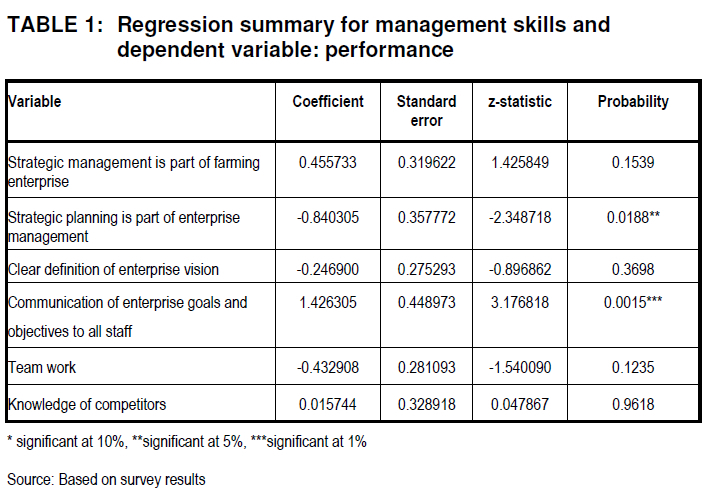
Hypothesis 1 predicated that higher levels of management skills are positively related to smallholder farming enterprise performance. Regression results are summarised in Table 1./ Table 1 shows the standardized beta coefficient weights of the IVs of which two are statistically significant: (1) strategic planning is part of enterprise management (β = -0 .840; p < 0.05) and (2) communication of enterprise goals and objectives to all staff (β = 1.426; p < 0.001).
The negative coefficient obtained for strategic planning is part of enterprise management suggests an inversely correlated relationship with the DV. The overall regression coefficient for this model was R2 = 0.236, which shows that in this model the IVs explain only 23.6 percent of performance. The limited amount of variance (23.6%) explained by these IVs means that the predictive and explanatory power of this model is limited and a fair amount of work needs to be conducted to further understand the relationship between these variables; consequently limited support was evident for Hypothesis 1.
Table 1 shows the standardized beta coefficient weights of the IVs of which two are statistically significant: (1) strategic planning is part of enterprise management (β = -0 .840; p < 0.05) and (2) communication of enterprise goals and objectives to all staff (β = 1.426; p < 0.001). The negative coefficient obtained for strategic planning is part of enterprise management suggests an inversely correlated relationship with the DV.
The overall regression coefficient for this model was R2 = 0.236, which shows that in this model the IVs explain only 23.6 percent of performance. The limited amount of variance (23.6%) explained by these IVs means that the predictive and explanatory power of this model is limited and a fair amount of work needs to be conducted to further understand the relationship between these variables; consequently limited support was evident for Hypothesis 1.
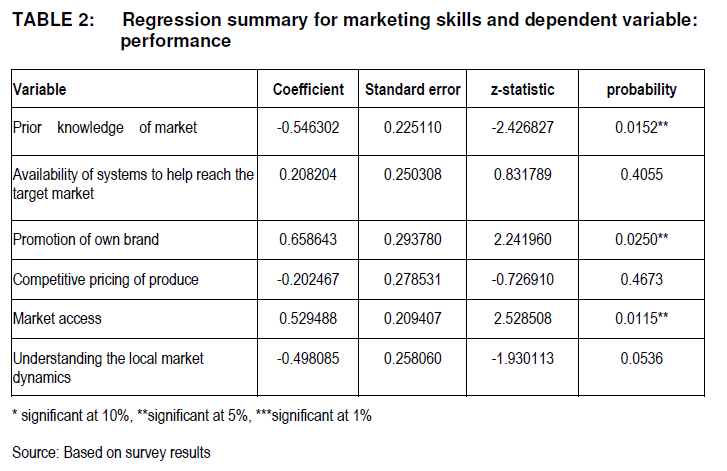
Hypothesis 2 predicted that higher levels of marketing skills are positively related to smallholder farming enterprise performance. Regression results are summarised in Table 2.
Table 2 shows the standardized beta coefficient weights of the IVs of which three are statistically significant: (1) prior knowledge of market (β = -0 .546; p < 0.05), (2) promotion of own brand (β = 0.658; p < 0.05), and (3) market access (β = 0 .529; p < 0.05). The negative coefficient obtained for prior knowledge of market suggests an inversely correlated relationship with the DV. The overall regression coefficient for this model was R2 = 0.277, which shows that in this model the IVs explain only 27.7 percent of performance. The limited amount of variance explained by these IVs means that the predictive and explanatory power of this model is limited and a fair amount of work needs to be conducted to further understand the relationship between these variables; consequently limited support was evident for Hypothesis 2.
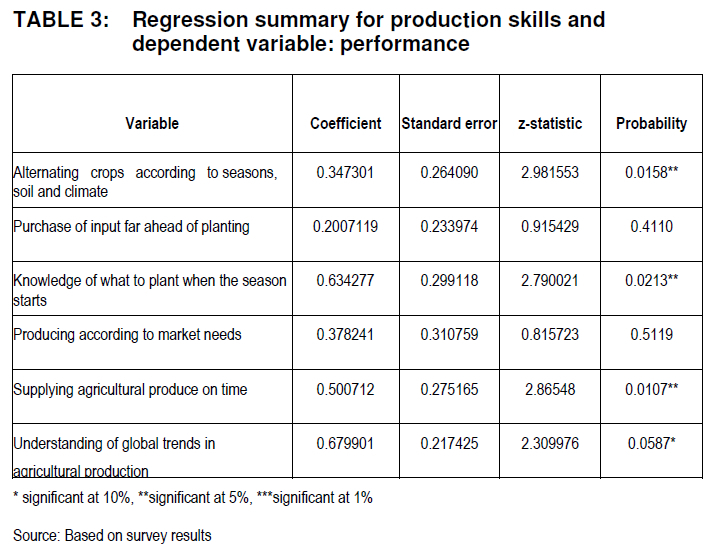
Hypothesis 3 predicted that higher levels of production skills are positively related to smallholder farming enterprise performance. Regression results are summarised in Table 3.
Table 3 shows the standardized beta coefficient weights of the IVs of which four are statistically significant: (1) alternating crops according to seasons, soil and climate (β = 0 .347; p < 0.05), (2) knowledge of what to plant when the season starts promotion of own brand (β = 0.634; p < 0.05), (3) supplying agricultural produce on time (β = 0 .500; p < 0.05),
and (4) understanding of global trends in agricultural production (β = 0.6790; p < 0.01). The overall regression coefficient for this model was R2 = 0.417, which shows that in this model the IVs explain 41.7 percent of performance. The amount of variance (41.7%) explained by these IVs means that the predictive and explanatory power of this model is relatively strong. Although no rule exists regarding what fraction of variance needs to be explained to be able to describe a relationship as strong, many researchers consider a squared multiple correlation of 0.3 or greater to be at least moderately strong Cooper and Schindler (2006), consequently support was evident for Hypothesis 3.
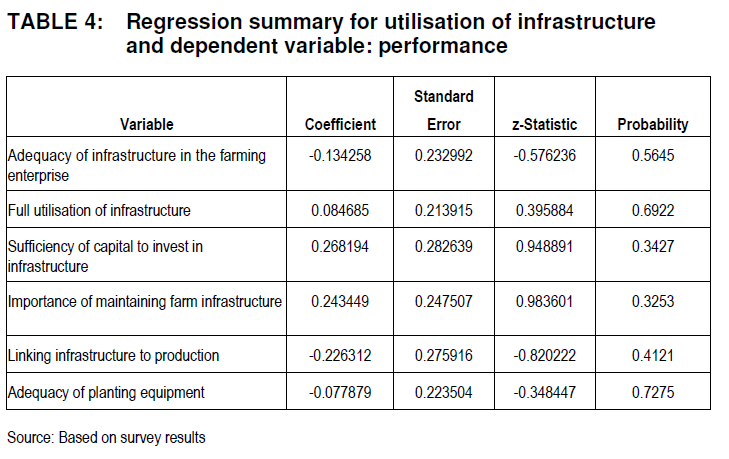
Hypothesis 4 predicted that a higher level of utilisation of infrastructure is positively related to smallholder farming enterprise performance. Regression results are summarised in Table 4.
Table 4 shows the standardized beta coefficient weights of the IVs of which none are statistically significant. Several negative coefficients were obtained in terms of the IVs which suggests an inversely correlated relationship with the DV. The overall regression coefficient for this model was R2 = 0.214, which shows that in this model the IVs explain only 21.4 percent of performance. The limited amount of variance (21.4%) explained by these IVs means that the predictive and explanatory power of this model is limited and a fair amount of work needs to be conducted to further understand the relationship between these variables; consequently no support was evident for Hypothesis 4.
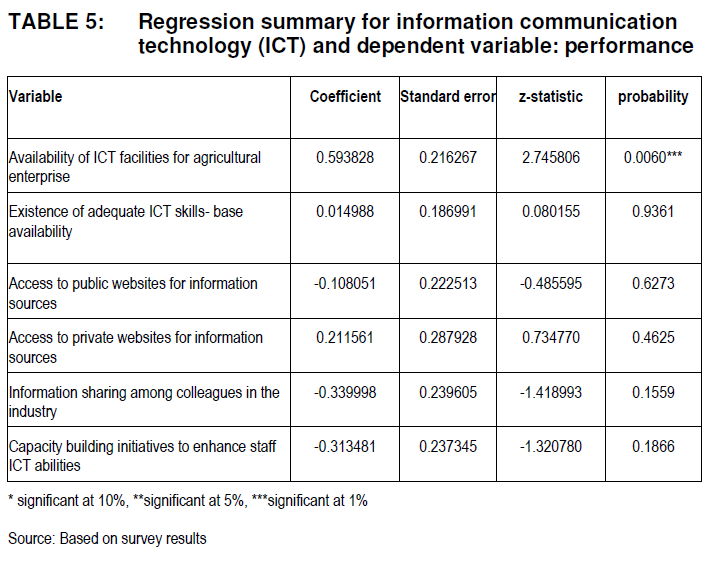
Hypothesis 5 predicted that higher levels of access to and utilisation of information communication technology (ICT) facilities is positively related to smallholder farming enterprise performance. Regression results are summarised in Table 5.
Table 5, which shows the standardized beta coefficient weights of the IVs of which one is statistically significant: (1) availability of ICT facilities for agricultural enterprise (β =0.593; p < 0.001). Several negative coefficients indicate an inversely correlated relationship with the DV. The overall regression coefficient for this model was R2 = 0.253, which shows that in this model the IVs explain only 25.3 percent of performance. The limited amount of variance (25.3%) explained by these IVs means that the predictive and explanatory power of this model is limited and a fair amount of work needs to be conducted to further understand the relationship between these variables; consequently limited support was evident for Hypothesis 5.
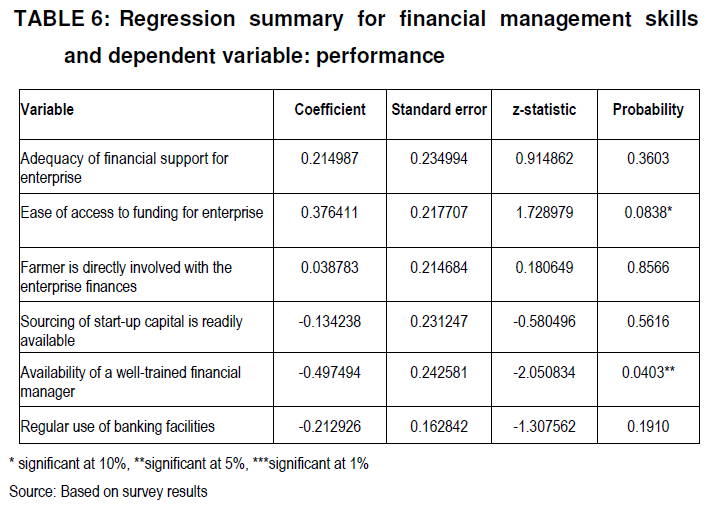
Hypothesis 6 predicted that higher levels of financial management skills are positively related to smallholder farming enterprise performance. Regression results are summarised in Table 6.
Table 6 shows the standardized beta coefficient weights of the IVs of which one is statistically significant: (1) ease of access to funding for enterprise (β = 0.376; p < 0.01) and (2) availability of a well-trained financial manager (β = -0.497; p < 0.05). Several negative coefficients indicate an inversely correlated relationship with the DV. The overall regression coefficient for this model was R2 = 0.311, which shows that in this model the IVs explain only 31.1 percent of performance. The amount of variance explained by these IVs means that the predictive and explanatory power of this model is relatively strong; consequently partial support was evident for Hypothesis 6.
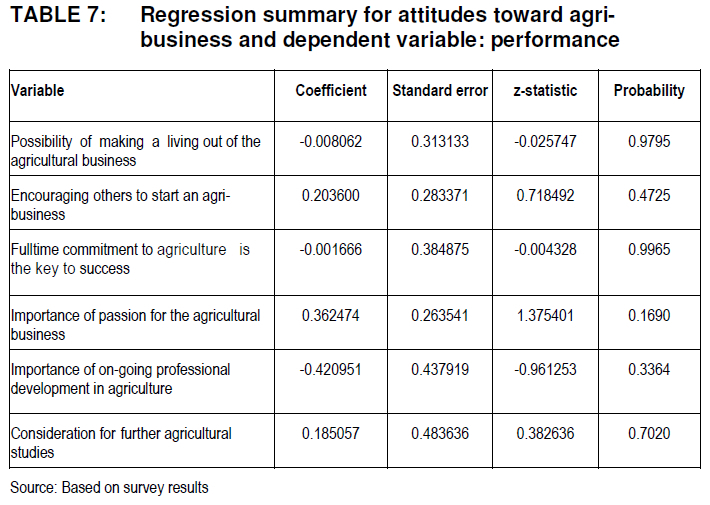
Hypothesis 7 predicted that favourable attitudes toward agri-business are positively related to smallholder farming enterprise performance. Regression results are summarised in Table 7, which shows the standardized beta coefficient weights of the IVs of which none are statistically significant. Several negative coefficients indicate an inversely correlated relationship with the DV. The overall regression coefficient for this model was R2 = 0.227, which shows that in this model the IVs explain only 22.7 percent of performance. The limited amount of variance (22.7%) explained by these IVs means that the predictive and explanatory power of this model is limited and a fair amount of work needs to be conducted to further understand the relationship between these variables; consequently no support was evident for Hypothesis 7.
5. DISCUSSION
The study contributes to existing knowledge on skills and performance in the context of agricultural enterprises. The findings add to the literature by providing causal links between skills and the perceived performance of enterprises. It has been noted, that only by carefully providing theoretical roadmaps are we in a position to support tomorrow's entrepreneurs with today's knowledge (Shane & Venkataraman 2000:18).
The empirical evidence emanating from this study indicates that respondents recognise the importance of various skills associated with performance, particularly in terms of production and marketing skills which explained the greatest amount of variation in the hypothesised relationship. Producing according to market needs and understanding of the importance of access to markets are pivotal skills associated with performance. However, several skill gaps among respondents were noted, particularly in terms of utilization of infrastructure and attitudes towards agri-business. These caveats restrain the smallholder farmer specifically in terms of adequacy and sufficiency of capital to invest in infrastructure. Similarly, a lack of commitment to agriculture and the absence of passion for the agri-business signal areas of concern for sustained performance.
The relevance of investigating skills is demonstrated where research is proliferating showing that skills are pivotal to improving farming productivity, increase adaptability to deal with change and facilitate diversification of livelihoods to manage risks, expand markets beyond the immediate environment, and increase competitiveness (Genis 2012:23). Being proficient in such skills is one of the key challenges in promoting commercial farming in rural areas in South Africa. However a range of additional factors such as access to training and financial resources, as well as illiteracy, poor rural transport infrastructure and inadequate entrepreneurial training, prevents most South African smallholder farmers from competing effectively (Lans 2010).
Consequently, smallholder farmers need to be innovative in their own areas of speciality and exploit opportunities that will distinguish them from other farmers. They must constantly be looking out for opportunities that will enhance their business operations in the most efficient and effective ways (Shree & Urban 2012:292-299). This suggests practical standards of proficiency, and the need for standards (Chell 2013:7). Based on the findings of the present study proficiency in the following skills which seem to lead to high levels of performance is required by smallholder farmers:
■ Efficiency in utilising resources for maximum returns on investments
■ Embracing of new technology faster in order to adapt to a changing market and economy
■ Understanding market characteristics and demands in order to plan production
■ Gaining access to markets and the ability to supply the right qualities and quantities to the marketplace
■ The use of computer technology in irrigation, soil sampling, communication, and research could improve the efficiency of agribusinesses and thus improve their chances to produce at a scale large enough to allow them to commercialise successfully
■ Skills such as bookkeeping and financial reporting are crucial in tracing the direction of a business on a day-to-day basis.
6. RECOMMENDATIONS
It is recommended that in addition to training, government promotes partnerships with the private sector in improving access to funding and assist smallholder farmers in dismantling barriers to entry to both local and regional markets. Specifically it is suggested that government, together with the agricultural association of South Africa, explore possibilities of collaborating with the private sector to provide smallholder farmers with essential business skills and knowledge. Such collaborative efforts could include for instance the establishment of information hubs loaded with essential agricultural information which farmers could access at a nominal or no fee.
In respect of skill per se, it is evident that there is a set of baseline skills that young people learn through education and then build upon through experience and training. These skills are for life, employability and entrepreneurial/innovative capability. Hence the implications of this study are that skills can be learnt and through policy an appropriate framework should be provided at all levels of education and training to enable people to upgrade their skills continuously. To inspire young people to be interested in agriculture in general and commercial farming in particular, strategic policies must be used as drivers for encouraging the youth to see farming as a viable career and productive industry opportunity (FANRPAN 2013:12).
In a broader African context the study has relevance as developing skills is pivotal not only to developing economies such as South Africa, but also to sub-Saharan Africa (SSA), where huge change is taking place and where the growth in the gross domestic product (GDP) per capita is one of the highest in the world, albeit from a very low base (World Bank 2013:Internet). Contextually the findings of this study highlight that most South African smallholder farmers are in rural areas, located in provinces such as Kwa-Zulu Natal. This rural dynamic makes it challenging for these farmers to access most of the economic advantages that their urban counterparts enjoy. Smallholder farming is relevant to the developing country context as smallholder farming activities are not always scale dependent. Small enterprises have the potential to operate as economically efficient as larger plants whose competitive advantage is economies of scale (Faostat 2006:55). Competitive advantage stems from the possession and efficient utilisation of a unique set of skills and assets such as locational advantages, natural resources, social capital, human capital and proximity to inputs (Dorosh & Thurlow 2013:453).
Although the government has made a tremendous effort in enacting suitable legislation and progressive policies in the agricultural sector, with a focus on rural areas and young people, much more work is still needed, especially with regard to influencing their skill-set and attitudes towards agribusiness. The agricultural sector is pivotal to the South African economy when considering forward and backward linkages. Moreover the agricultural sector remains crucial towards addressing the triple challenges of poverty, unemployment and inequality in South Africa and Africa in general (World Bank 2013:Internet).
The study is not without limitations. Due to survey based biases, acquiescence and social desirability may have affected the responses in terms of artificially inflating skill-sets. Moreover, the cross-sectional data used in the analysis prevents the regression model from demonstrating causation. Hence, further research applying longitudinal research designs is required to examine the skill-performance link. Future research should utilize more dynamic models and examine reverse causality when investigating skills and performance measures. Future studies may also benefit by focusing on variables not included in the study, especially as institutional support (Jagwe & Machethe 2011:110) and the implementation of massive government rural capital infrastructure projects have been highlighted as ways to change the negative influences of market access and transaction costs faced by smallholder farmers.
7. CONCLUSION
The study set out to investigate levels of various enterprise skills and their perceived influence in relation to smallholder farming enterprise performance. The results reveal that it is the set of production and marketing skills which explain the greatest amount of variation in enterprise performance. Furthermore, the skills which smallholder farmers need to cultivate must be grounded in the context and the task environment of their operations.
REFERENCES
- ASOKAN SR & SINGH G. 2003. Role and constraints of contract farming in agro-processing industry. Indian Journal of Agricultural Economics 58(3):566-568.
- BARHAM BL, CHAVAS JP, FITZ D, RÍOS-SALAS V & SCHECHTER L. 2015. Risk, learning, and technology adoption. Agricultural Economics 46(3):11-24.
- BECKER G. 1964. Human capital. Chicago, IL: University of Chicago Press.
- BINSWAGER HP. 2008. Empowering rural people for their own development. Agricultural Economics 7(2):13-27.
- CHELL E. 2013. Review of skills and the entrepreneurial process. International Journal of Entrepreneurial Behavior & Research 19(1):6-31.
- COOPER DR & SCHINDLER PS. 2006. Business research methods. 9th ed. International edition. New York, NY: McGraw-Hill.
- DAFF see DEPARTMENT OF AGRICULTURE, FORESTRY AND FISHERIES
- DARROCH AGM & CLOVER TA. 2005. The effects of entrepreneurial quality of the success of small, medium and micro agribusiness in Kwazulu-Natal, South Africa. Agrekon: Agricultural Economics Research Policy and Practice in Southern Africa 44(3):321-343.
- DAVIDSSON P & HONIG B. 2003. The role of social and human capital among nascent entrepreneurs. Journal of Business Venturing 18(3):301-331.
- DE LAUWERE C, VERHAAR K & DROST H. 2006. Het mysterie van het Ondernemerschap, boeren en tuinders op zoek naar nieuwe wegen in een dynamische maatschappij (The mystery of entrepreneurship; farmers looking for new pathways in a dynamic society, in Dutch with English summary). Netherlands: Wageningen University and Research Centre.
-
DEPARTMENT OF AGRICULTURE, FORESTRY AND FISHERIES. 2012. Strategic plan for department of agriculture, forestry and fisheries 2012/13-2016/17. [Internet: http://www.nda.agric.za/doaDev/topMenu/StratPlan201213-201617.pdf; downloaded 2 August 2014].
» http://www.nda.agric.za/doaDev/topMenu/StratPlan201213-201617.pdf - DOROSH P & THURLOW J. 2013. Agriculture and small towns in Africa. Agricultural Economics 44(4-5):449-459.
- DOYER OT, HAESE MFC, KIRSTEN JF & VAN ROOYEN CJ. 2007. Strategic focus areas and emerging trade arrangements in the South African agricultural industry since the demise of the marketing boards. Agrekon 46(4): 494-513.
- FANRPAN see FOOD AGRICULTURE AND NATURAL RESOURCES POLICY NETWORK
- FAOSTAT. 2006. All longitudinal production and population data. [Internet; downloaded 20 March 2014].
- FERREIRA E, STRYDOM J & NIEUWENHUIZEN C. 2010. The process of business assistance to small and medium enterprises in South Africa : preliminary findings. Journal of Contemporary Management 7:94-109.
-
FOOD AGRICULTURE AND NATURAL RESOURCES POLICY NETWORK. 2013. Current and emerging youth policies and initiatives with a special focus on links to agriculture. [Internet: http://www.fanrpan.org downloaded 14 March 2014].
» http://www.fanrpan.org - GENIS A. 2012. The changing nature of large-scale commercial farming and implications for agrarian reform: Evidence from Limpopo, Western Cape and Northern Cape, Working Paper 24. Bellville, University of Western Cape: Institute for Poverty, Land and Agrarian Studies.
- GOVERNMENT GAZETTE . 2013. Broad-Based Black Economic Empowerment Amendment Act (53/2003): as amended by Act 46 of 2013: Codes of Good Practice on Broad Based Black Economic Empowerment: Draft AgriBEE Sector Codes 39429: Pretoria: Department of Trade and Industry.
- HAIR JF, BLACK WC, BABIN BJ & ANDERSON RE (eds). 2010. Multivariate data analysis: a global perspective. 7th ed. Upper Saddle River, NJ: Pearson.
- HASHEMI SM, NADI HK & REZVANFAR A. 2012. Agricultural personnel's intrapreneurial behaviour: effects of perceived organisational support. Annals of Biological Research 3(1):575-582.
- JAGWE JN & MACHETHE C. 2011. Effects of Transaction costs on choice of selling point: a case of smallholder banana growers in the Great Lakes Region of Central Africa. Agrekon: Agricultural Economics Research Policy and Practice in Southern Africa 50(3):109-123.
- JARI B & FRASER GCG. 2009. An analysis of Institutional and technical factors influencing agricultural marketing among smallholder farmers in the Kat River Valley, Eastern Cape Province. South Africa. African Journal of Agricultural Research 4(11):1129-1137.
- LANS T. 2010. Entrepreneurial competence in agriculture characterization, identification, development and the role of the work environment. Wageningen, Netherlands: Wageningen University.
- LOUW D. 2012. Presentation to the Gauteng Department of Agriculture and Rural Development on market. Lecturer Extraordinary: Department of Agriculture Economics, University of Stellenbosch, Director: Optimal Agricultural Business Systems (OABS), University of Stellenbosch.
- LOUW A, TROSKIE G & GEYSE M. 2013. Small millers' and bakers' perception of the limitations of agro processing development in wheat-milling and baking industries in rural areas of South Africa. Agrekon: Agricultural Economics Research Policy and Practice in Southern Africa 52(3):101-122.
-
MATHER C. 2005. SMEs in South African food processing complex: development prospects, constraints and opportunities. Trade and Industrial policy strategies (TIPS). [Internet: http://www.tips.org.za/files/756.pdf; downloaded 2014-01-03].
» http://www.tips.org.za/files/756.pdf - MATSHEKGA M & URBAN B. 2013. The importance of the human capital attributes when accessing financial resources. Journal of Contemporary Management 10(15):259-278.
- MHAZO N, MVUMI B, NYAKUDYA E & NAZARE M. 2012. The status of the agro-processing industry in Zimbabwe with particular reference to small and medium-scale enterprises. African Journal of Agricultural Research 7(11):1607-1622.
- MITRA J, ABUBAKAR YA & SAGAGI M.2011. Knowledge creation and human capital for development: the role of graduate entrepreneurship. Education and Training 53(5):457-479.
- MOHAMED Z, REZAI G, APRIYANTI I, ABDULLAH AM & TAMAN E. 2011. Work culture and developing agri-entrepreneurial skills among farmers. American Journal of Economics and Business Administration 3(3):490-497.
- MUFFATO MSM. 2015. The present state of entrepreneurship ecosystems in selected countries in Africa. African Journal of Economic and Management Studies 6(1):1-33.
-
NDP. 2010. Macro-economic plan of South Africa adopted by cabinet for implementation. [Internet: http://www.thedti.gov.za; downloaded 8 July 2014].
» http://www.thedti.gov.za - OELOFSE R & VAN DER WALT JL. 2015. An evaluation of South African worker co-operatives against specified business success factors. Journal of Contemporary Management 12:289-312.
- OLUWATOBI S & OGUNRINOLA IO. 2011. Government expenditure on human capital development: implications for economics growth in Nigeria. Journal of Sustainable Development 43(3):77-89.
- ORTMANN GF & KING RP. 2010. Research on agri-food supply chains in Southern Africa involving small-scale farmers: Current status and future possibilities. Agrekon: Agricultural Economics Research Policy and Practice in Southern Africa 49(4):397-417.
- PREISENDORFER P, BITZ A & BEZUIDENHOUT FJ. 2012. In search of black entrepreneurship: why is there a lack of entrepreneurial activity among the black population in South Africa? Journal of Developmental Entrepreneurship 17(1):1-18.
- RWIGEMA H, URBAN B & VENTER R. 2010. Entrepreneuship theory in practice Johannesburg: Oxford University Press.
- SHANE S & VENKATARAMAN S. 2000. The promise of entrepreneurship as a field of research. Academy of Management Review 25(1): 17-23.
- SHIIMI T, TALJAARD PR & JORDAAN H. 2012. Transactions costs and cattle farmers' choice of marketing channel in North-Central Namibia. Agrekon: Agricultural Economics Research Policy and Practice in Southern Africa 51(1):42-58.
- SHREE S & URBAN B. 2012. Internationalisation processes and links with capital factors: the case of South Africa. Teorija Ir Praktika (Business Theory and Practice) 13(4):292-303.
- STEFFENS P, DAVIDSSON P & FITZSIMMONS J. 2009. Performance configurations over time: implications for growth- and profit-oriented strategies. Entrepreneurship: Theory & Practice 33(1):125-148.
-
STRATEGIC PLAN OF DEPARTMENT OF AGRICULTURE FORESTRY AND FISHERIES. 2012. [Internet: http://pmg.org.za/committee-meeting/14311/; downloaded 21 April 2014.
» http://pmg.org.za/committee-meeting/14311/ - ]
- UCHEZUBA ID, MOSHABELE E & DIGOPO D. 2009. Logistical estimation of the probability of mainstream market participation among small-scale livestock farmers: a case study of the Northern Cape Province. Agrekon: Agricultural Economics Research,Policy and Practice in Southern Africa 48(2): 171-183.
- UNGER JM, RAUCH A, FRESE M & ROSENBUSCH N. 2011. Human capital and entrepreneurial success: a meta-analytic review. Journal of Business Venturing 26(3):341-358.
- URBAN B & KONGO M. 2015. The relevance of human capital on firm performance: a focus on the retail industry in Kinshasa, DRC. Acta Commercii 15(1):1-9.
- URBAN B, VAN VUUREN J & BARREIRA J. 2008. High-growth entrepreneurs: the relevance of knowledge and work experience on venture success. Journal of Contemporary Management 5:58-71.
-
WORLD BANK. 2013. Growing Africa: unlocking the potential of agribusiness. [Internet: http://siteresources.worldbank.org; downloaded 21 December 2014.
» http://siteresources.worldbank.org