Pre-Fourth Industrial Revolution: Challenges for Small, Medium and Micro Enterprises in a Transforming Economy
Abstract
The emergence of the fourth industrial revolution is perceived to have profound effects on many spheres of society. Such effects within the business environment are anticipated to be radical digitalised changes in the production process posing challenges for enterprises. Given the contribution of Small, Medium and Micro Enterprises (SMMEs) to the nation's development, these institutions are engulfed in challenges detrimental to their growth. Specifically, for a transforming economy such as South Africa, the article provides insight into the growth determinants, and various internal and external challenges facing SMMEs in readiness for the fourth industrial revolution (4IR). The article is a descriptive study and adopted a quantitative research approach. A sample of 155 was drawn from a target population of 264 using a disproportional-stratified sampling technique. The results of the study suggest varying degrees of effects of internal and external factors to the business environment with factors pointing at market share, investment in technology, high taxes, and high competition. The article concludes by suggesting shared business strengths for the growth of SMMEs. It provides insightful information on the state of SMMEs in South Africa and proposes a framework for policy makers aimed at repositioning SMMEs to tackle the anticipated challenges with the advent of the 4IR.
Challenges; 4IR; SMMEs; South Africa and transformation
1. INTRODUCTION AND BACKGROUND
Small enterprises carry an enormous weight in economic development of every nation and the world economy at large. As such, it is believed that smaller enterprises play a significant role towards achieving the Sustainable Development Goals (SDGs). Its innovative nature through technology resonates well with SDG 17- partnerships for achieving the goals. This is also well captured in the African Union Agenda 2063 on the priority areas of economic growth through advances in technology and innovation.
Within the South African context, smaller enterprises mostly referred to as SMMEs are important elements driving the economy. Bhorat, Asmal, Lilenstein and van der Zee (2018:2) noted that SMMEs are key components for advancing inclusive growth and development in South Africa. In view of this, the Bureau for Economic Research (BER) (2016:18), argued that SMMEs contribute more to employment creation than larger enterprises. In addition, the BER (2016:1) notes that SMMEs constitute 95% of all operating businesses and account for 30% of the nation are Gross Domestic Product (GDP). At the time of developing this article, The Small Enterprise Development Agency (SEDA) (2019:13) notes that SMMEs provide employment to 10.8 million people (about 19% of the population), which accounts for 66% of all jobs in the first quarter of 2019. Furthermore, the number of SMMEs increased by 4.4% compared to the previous year (SEDA 2019:6). Irrespective of these contributions, the sector, which is envisaged to drive economic growth, is struggling to achieve this objective. SEDA (2019:6) notes that most of the jobs created by SMMEs are for SMMEs owners and International Labour Organisation (ILO) (2018:2; 2016:15) states that these SMME owners are funded by personal savings, families or friends, irrespective of the country's strong financial funding opportunities. This supports the assertion that South African SMMEs adopt mostly solo entrepreneurship, which is inadequate to sustain livelihoods due to the challenging business environment, especially in the areas of access to markets and finance (Herrington & Kew 2018:25; SeedAcademy 2017:19). The result is evident in the increasing failure rate of these SMMEs (Herrington & Kew 2018:25).
It is obvious that SMMEs are here to stay and identifying the existing gaps are needed to harness the opportunities offered by the digital revolution are of vital importance. The 4IR has become a buzzword globally with the discourse centred on the anticipated global shifts and potentially significant changes in the different spheres of society. It is the opinion of the authors that within the business environment, the predictions on these changes are because of the advances in technologies, new techniques, and business models for the transformation of production processes. The authors also note that such changes are envisaged to be radical and tend to challenge the way businesses are conducted, government decision-making processes, industries and the economy at large. While larger enterprises may have the necessary capacity and resources to prepare for the anticipated potential risks emerging from 4IR, the case may be different for the smaller enterprises characterised by, for example, low capital, size and workforce. However, with such characteristics, the roles of smaller enterprises have been widely acknowledged by various stakeholders, academia, professionals and government. Globally, smaller enterprises are widely recognised for their substantial contributions to economic growth, job creation and poverty alleviation. In most countries, small businesses make up the vast majority of businesses, accounting for close to 50% of the output, and have the ability to cushion economic shocks (Bennett 2014:4). In addition, various studies have demonstrated the role of smaller enterprises in market penetration and as supporters of innovation (Chimucheka 2013:784; Karadag 2015:179; Obaji, Senin, & Olaolu 2018).
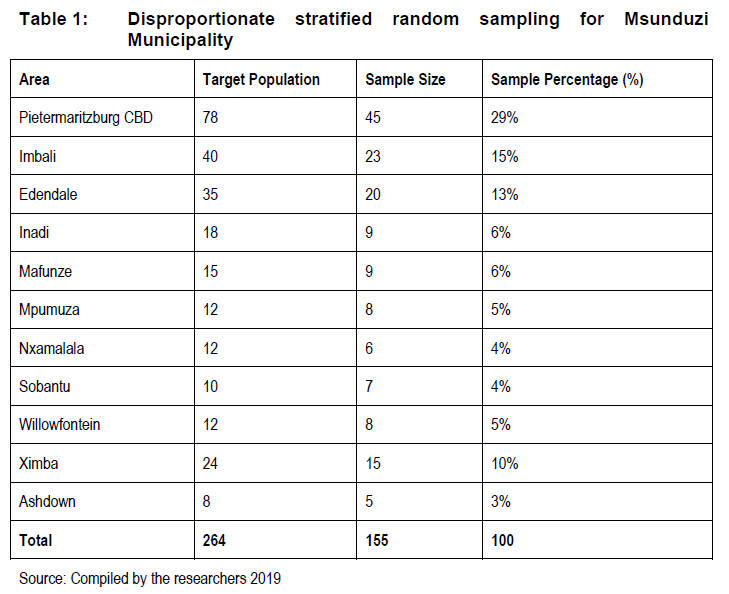
The notion of 4IR brought about the first South African Digital Economy Summit with the launch of seven (7) priorities for enhancing the full potential of 4IR (The Presidency 2019:1). Within the scope of this article, there is a need for interventions aimed at achieving the #SA4IR priorities of economic transformation and job creation, fundamental to the justification of this study. Given the background and 4IR on the doorstep, this article seeks to stimulate discussion on growth determinants and environmental factors affecting the digital revolution on SMMEs. Focusing on SMMEs in the Msunduzi Municipality, which is located within Pietermaritzburg, KwaZulu-Natal, the researchers tested the internal and external environments of these SMMEs.
The article is structured as follows: Section 2 provides information on the reviewed literature in relation to the research. The literature review places SMMEs within the broader South African context, showing the salient features of 4IR and South Africa's readiness to embrace the revolution. Furthermore, a theoretical perspective on 4IR which was aligned to the business environment is presented. Section 3 provides the methodological approach adopted for the study. Going by the emerged data, the section argues the need for South Africa as a transforming society to step up strategies to ensure that small businesses achieve the full benefits of 4IR. Section 4 provides concluding thoughts and possible implications based on the results of the study.
2. A SYSTEMATIC REVIEW OF LITERATURE
2.1 Entrepreneurship and Entrevolution: A synergetic paradigm
Academic research in entrepreneurship has flourished extensively in recent years and the domain cuts across disciplines. According to Carlsson, Braunerhjelm, McKelvey, Olofsson, Persson and Ylinenpää (2013:914), the concept of entrepreneurship refers to "an economic function carried out by individuals (also known as entrepreneurs), independently or within an organizations, to perceive and create new opportunities and introduce ideas into the market system". The authors posit given that entrepreneurship is a principal component of market economies, it accelerates growth and expands boundaries of economic activities within nations. In doing so, entrepreneurial ventures are influenced positively or negatively by environmental factors such as technology.
Gilpin (2018) notes a substantial rate of these technological changes which, to a large extent, determine the success of an economy in achieving higher levels of innovation. It changes the business processes and strategies, and the nature of products and services, resulting in a shift from the normal business traditions. Such technological changes may include but are not limited to blockchain, artificial intelligence (AI), the Internet of Things (IoT), and automation; they cause transformation and disruptions in the economic system, leading to an ideology labelled 'revolution', within the entrepreneurial sphere, hence the term 'entrevolution'.
The domain of entrevolution addresses the impact of technological advances on entrepreneurship which could be positive or negative. To reduce the negative impact, the era has seen entrepreneurs leveraging skills and knowledge to keep up with the transforming businesses environments. Entrepreneurs use such skills to implement their imaginations and enhance the unlimited possibilities technological networks create for business development (Gilpin 2018; Marinescu 2018). An example of such is the use of social networking technologies by entrepreneurs to connect with other geographically dispersed businesses (Avgerou & Li 2013; Di Domenico, Daniel & Nunan 2014; Sigfusson & Chetty 2013). In addition, the use of social media to empower virtual businesses has enhanced the representation and global footprint of entrepreneurs. Increasingly, business intelligence is being implemented to enhance an organisation's decision-making processes and performance (Kappelman, Mclean, Johnson & Torres 2016). Indeed, the era allows for faster and effective communication, irrespective of time and space, thereby making access to knowledge and market more convenient.
With the rapid growth in business transformation, Mazzarol (2015) asserts that technology has become an integral part of businesses for survival and is therefore no longer a question of choice for entrepreneurs. Considering that South Africa is the second largest economy in Africa, but with low levels of entrepreneurship when compared to other smaller economies within the continent, it is of utmost importance that the potential benefits of the era are fully enhanced. This therefore calls for the need to build structural programs to harness the unprecedented opportunities presented by the power of entrevolution.
2.2 Business Growth in Small, Medium and Micro Enterprises
The concept of small businesses is acknowledged across economies and the definitions are country-specific. A broad definition of small businesses takes into consideration the economic and statistical categories or qualitative and quantitative measures (WRSeta 2014:6). While some country's definition of SMMEs is based on the number of employees, others take into account specifically the financial turnover of the business. In view of the foregoing, the National Small Business Amendment Act (26 of 2003) (Republic of South Africa 2003), defines small enterprises along five (5) categories as previously established by the original Act: standard industrial sector and subsector classification, size of the class, an equivalent of paid employees, turnover and asset value. Thus, a small business is "a separate and distinct business entity, together with its branches or subsidiaries, if any, including cooperative enterprises, managed by one owner or more predominantly carried on in any sector or subsector of the economy classified as a very small, micro, a small or a medium enterprise" (Department of Small Business Development 2018:1).
The concept of business growth is largely associated with indicators of success or failure. Extant literature suggests multidimensional indices for measuring business growth. From a broader perspective, Zhou and de Wit (2009:4) classified enterprise growth under individual, environmental and organisational factors. Some researchers consider parameters such as absolute or relative changes in sales, profits, and profit margins, value-added, net assets or the number of employees, and productivity (Mthimkhulu & Aziakpono 2016:73; Olawale & Garwe 2010:730). Schmidpeter and Weidinger (2014:3) argue that indicators for business success include survival, profits, return on investment, sales growth, the number of personnel employed, happiness and corporate reputation. For Machado (2016:421), growth results from a good administration and management of resources and capabilities, which may reflect across various areas in an organisation. Parameters such as an increase in sales and the number of employees are considered good indicators of business growth in small businesses (Blackburn, Hart & Wainwright 2013:22; Martin & Swank 2012:69). It is also established in literature that the wide acceptance of the number of employees is a growth indicator for small businesses (Fiala & Hedija 2015:1641; Nassar, Almsafir & Al-Mahrouq 2014). Achtenhagen, Naldi and Melin (2010:300), in their study, noted that growth manifests as an increase in sales/profit, an increase in the number of employees, increase in assets/firm value and continuous internal development. Ordinarily, the output of every business is in the form of goods or services vis-à-vis production. Vasu and Jayachandra (2014:125) demonstrated the use of production level as a good indicator of business growth in small businesses. Scholars have also shown business growth drawing from the positive link between market share and organisational return on equity (ROE), return on asset (ROA), return on capital employed (ROCE) or organisational performance, as the case may be (Becherer & Helms 2016:139; Etale, Bingilar & Ifurueze 2016:107; Farris, Bendle, Pfeifer & Reibstein 2010:28; Khantimirov 2017:590). The use of business-size as a growth indicator in small businesses is also acknowledged by Machado (2016:421) in the literature.
Considering the dimensional propositions of the measuring indices for growth in small businesses, the researchers focused on parameters such as sales, market share, business-size, number of employees, assets and business output for the research objective. Thus, the research objective was to examine the determinants of growth for SMMEs in the Msunduzi Municipality.
Though the growth of SMMEs is a vital indicator of a thriving economy, its perceived uncertainty has been widely acknowledged due to the changes in the business environment. The effect of the last global economic crises still lingers as nations experience, for example, slow growth in businesses, the decline in investments, and increasing unemployment rates. With the emergence of 4IR, speculation is under way on the anticipated job losses, job creations, and scepticism on the impact of the revolution on businesses most especially, small businesses. Within the South African context, the environmental readiness for the digital revolution is of vital importance for the alleviation of poverty and reducing inequality, as highlighted in the National Development Plan (NDP), and Vision 2030 (The Presidency 2012:8). The NDP posits the realisation of these goals by drawing on the energies of its people through enterprise development.
2.3 The Resource-Based View theoretical exposition on Small, Medium and Micro Enterprises growth and 4IR
Situated within the ideology of business success or failure is an emphasis on human resources, thus the notion of the resource-based view (RBV). The RBV highlights the use of organisational resources and capabilities to achieve a competitive edge (Alvarez-Suescun 2010; Gupta, Guha & Krishnaswami 2013:2; Kaleka 2002). Barney, Ketchen and Wright (2011:1308), noted that human resources is 'a critical underlying mechanism for such capabilities'. Li and Liu (2014:2797) revealed that dynamic capabilities positively and significantly contribute to enterprises competitive advantage. Resource-based view is a widely acceptable theory for business growth and the strategic link between human resources and business performance/growth is established in the literature (Allen, Ericksen, & Collins 2013:155; Lai, Saridakis & Johnstone 2017:482; Sheehan 2014:547). Mohamad Radzi, Mohd Nor and Mohezar Ali (2017:32), contended the relevance of resource-based view in the context of small business. The idea resonates from the proposition that the effective use of resources (both tangible and intangible) impacts positively on enterprise performance and productivity, which may invariably reflect as growth. Given the foregoing, RBV is recognised as the most influential framework for understanding business management, constructs of competitive advantage (Barney, Wright & Ketchen 2001:630; Peng 2001:806) and factors that affect business performance or growth (Rahman & Ramli 2014:134).
Similarly, the concept of the RBV sits well within the ideology of 4IR, an era predicted with unprecedented changes. Xu, David and Kim (2018:90) highlighted shifts in power, wealth, and knowledge because of the changes. Schwab (2015), heralds the era with exponential disruption and transformation of the entire production, management, and governance. In support, Lee, Yun, Pyka, Won, Kodama, Schiuma, Park, Jeon, Park, Jung, Yan, Lee & Zhao (2018:4), noted the effect of the revolution on business models, such as reshaping of customer expectations, the quality of products and services, open and calling for the collaborative innovation, and the need for organisations to deliver values. Furthermore, opportunities are also predicted in the areas of market innovation, artificial intelligence, 3D printing, fusion, robotics and the internet (Xu et al. 2018:91; Schwab 2016). However, the ability of the enterprises to navigate the wheel of changes and benefit from 4IR lies in their human resources. In support of this, Lee et al. (2018:14) noted that an enterprise's capacity to accumulate knowledge to address the 4IR challenges is of utmost importance.
The RBV holds that there are unlimited sources of opportunities for businesses to manage transition and growth in an era of transformation (Gupta et al. 2013:9). The RBV theory is relevant in the small business context because it posits the long-term survival of the enterprise in its capacity and ability to provide unique offerings for growth (Mohamad Radzi et al. 2017:32). However, there may exist various internal and external factors likely to influence the ability of small businesses to manage transition and growth in a changing environment. Thus, the researchers propose Internal and external environmental factors simultaneously and partially affect the growth of SMMEs.
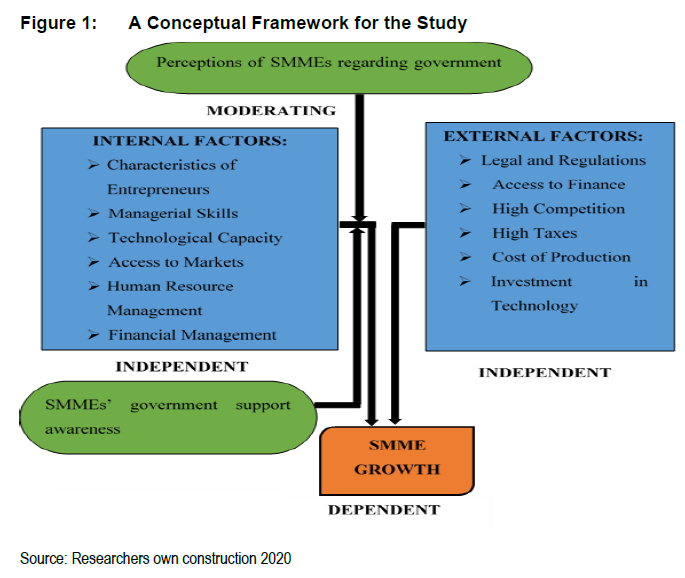
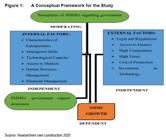
Drawing from the hypothesis, the following framework was developed using the components of the internal and external environments identified within the scope of this study.
The conceptual framework as depicted in Figure 1, consists of dependent, independent and moderating variables. The dependent variable is SMME growth or business growth, while the independent variables are internal and external environmental factors indicating their components. The moderating variables are SMMEs' awareness and perceptions regarding government support presumed to be a vital component in surviving the era of digital transformation.
3. RESEARCH METHODOLOGY
3.1 Study methodology
The study adopted an exploratory research design to examine the perceived effect of environmental factors in relation to SMMEs growth within the Msunduzi Municipality.
Using a closed-ended questionnaire, primary data was drawn from SMMEs as per the definition provided by the Department of Small Business Development. Data were captured using the Statistical Package for the Social Sciences (SPSS) version 24, and interpreted using both descriptive and inferential statistics. The descriptive statistics used tables and figures for data presentation. For the inferential statistics, the researchers conducted a Principal Component Regression (PCR) analysis. Draper and Smith (1998:250) attested to the use of PCR in determining the relationship between an independent and a dependent variable. The choice of PCR is because of the many independent variables involved in the study. The factors within the environment of SMMEs are the independent variables while business growth is the dependent variable in the PCR analysis. In measuring the validity and the reliability of the study, the researchers conducted a pilot study using 20 SMMEs. This was supported with the measurement of the Cronbach's Alpha Coefficient for the actual study. Secondary data was sourced from the University of KwaZulu-Natal database using google scholar, EBSCO, JSTOR, Elsevier, Web of Science and ScienceDirect.
3.2 Data presentation and analysis
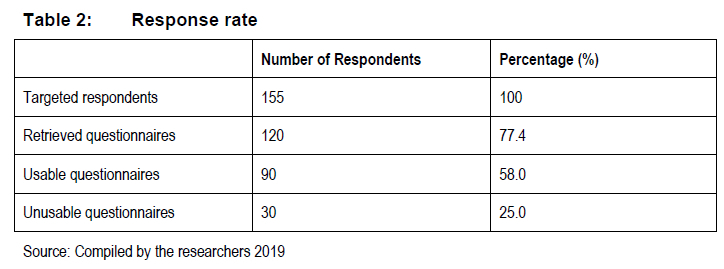
3.2.1 The study response rate
The study response rate is presented in Table 2.
3.2.2 Biographic data of the respondents
The data showed that 33.3% of the sampled respondents are business owners, and 31.1% are managers, while 27.8% represent supervisors. The remaining 7.8% of the respondents remained neutral. In terms of gender representations, 54.5% of the respondents were males, while 45.5% were females. 16.7% of the respondents were in the 18-25-year age group; 30% were aged between 26-30, and 35.6% fell within the age bracket of 31-40 years; 12.2% were in the 41-55-year age group and 5.6% were in the 56-60 age group. The data also indicated that 3.4% of the respondents had no formal education or had completed only primary education respectively; 37.1% had completed secondary education; 32.6% had Certificates or Diploma degrees, 10.1% had undergraduate degrees and 13.5% had postgraduate degrees. In terms of the business ownership structure, 66.7% of the respondents are private companies, 26.7% indicated partnership structure, 5.6% operate as close corporations, and 1.1% remained neutral. Furthermore, the data indicated that 13.6% of the respondents have operated their businesses for less than a year. Another, 18.2% have been in the business for 2-3 years, while a fairly good percentage of the respondents (29.5%) had spent 4-5 years in their business. Moreover, 14.8% of the respondents had been in business for 6-7 years, while 23.9% had spent more than 7 years in their business.
3.2.3 The test of the research objective
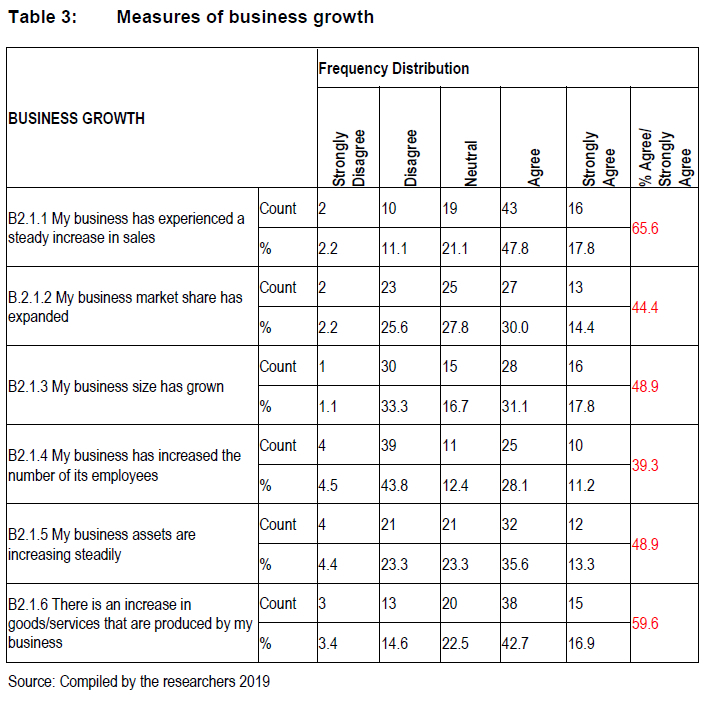
The research objective was to examine the determinants of growth for SMMEs in Msunduzi Municipality. Using a 5-point Likert Scale questionnaire ranging from strongly disagree to strongly agree, the researchers tested parameters for business growth, which include sales, market share, business-size, number of employees, assets and business output (See Table 3).
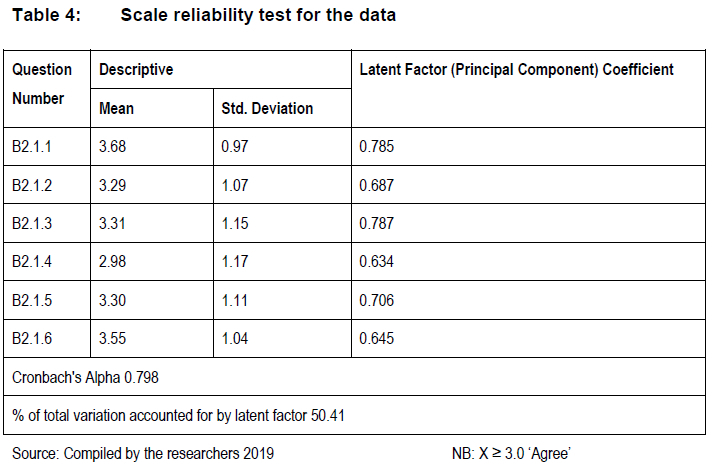
Given the frequency of the distribution of the responses in Table 3, a further analysis was conducted to examine the measures of spread such as arithmetic mean and standard deviation and also to determine the internal consistency of the data. The results are presented in Table 4.
In analysing the data, the arithmetic mean was used at a decision point of 3.0, which means that a mean above 3.0 is positive or 'agree' and below 3.0 is 'disagree'. Drawing from Tables 3 and 4, and at decision point 3.0, data indicate that the SMMEs sampled showed growth along with measures of sales, market share, size, assets and production of goods and services. Data also revealed that these SMMEs hardly use the number of employees as an indicator of success. This is, of course, acceptable given that the internal consistency shows a Cronbach's Alpha coefficient value of 0.798. Accordingly, Cronbach (1951:300), notes that alpha varies from 0-1 and a coefficient value ranging from 0.76-0.95 is fairly high. This means that the items measured have high internal consistency, an indication that the study is reliable.
3.2.4 The test of research hypotheses
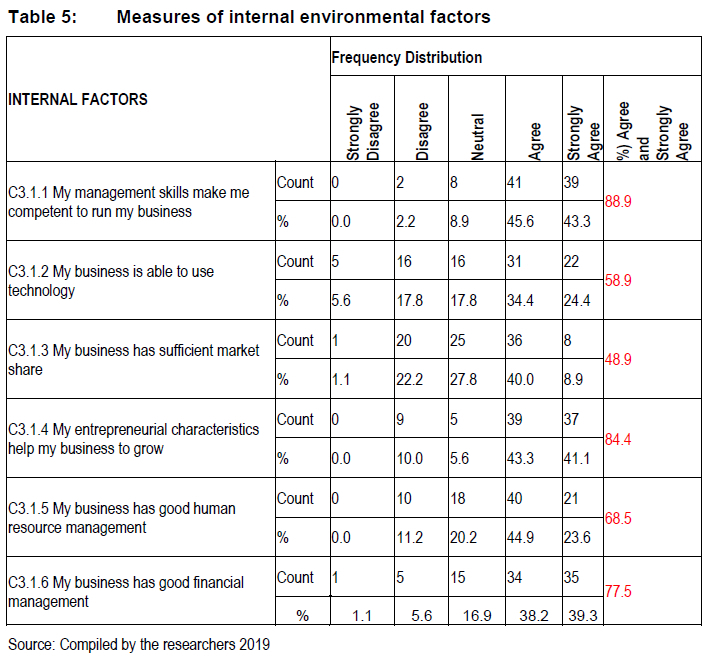
The study hypothesis thus read: "Internal and external environmental factors simultaneously and partially affect the growth of SMMEs". The components tested within the internal environment of SMMEs are management skills, technology, market share, entrepreneurial characteristics, resource management system and cash management records. The results of the study are presented in Table 5.
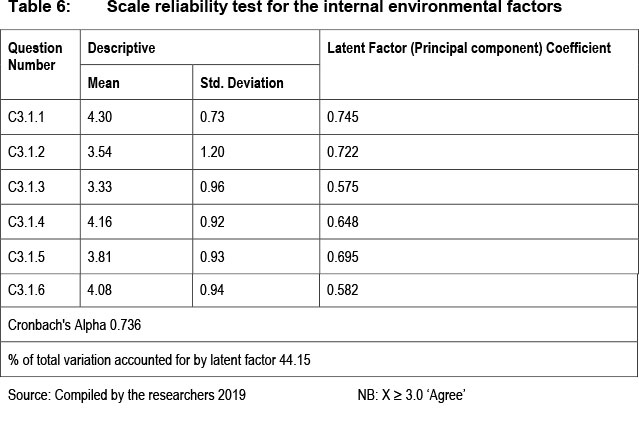
The internal consistency of the data was measured and the results presented in Table 6.
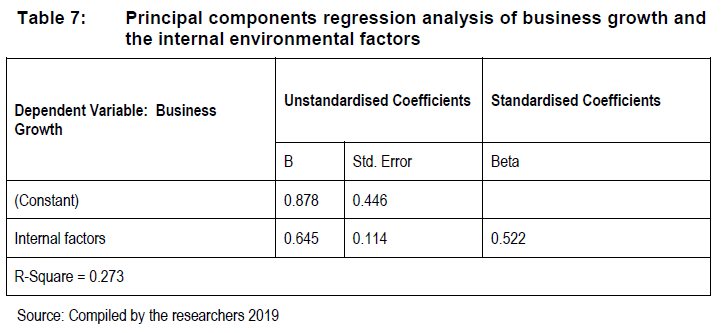
At decision point 3.0, data from Table 5 and Table 6 indicate that there is a generally positive consensus towards all the components of the internal factors. This is supported by the Cronbach's Alpha coefficient value of 0.736, which translates to a high level of internal consistency of the data tested. Furthermore, a Principal Components Regression (PCR) analysis was introduced at this stage because of the established correlation in the tested research objective. The dependent variable is the business growth, while the independent variables are the components of the internal environment. The output of the analysis is presented in Table 7.
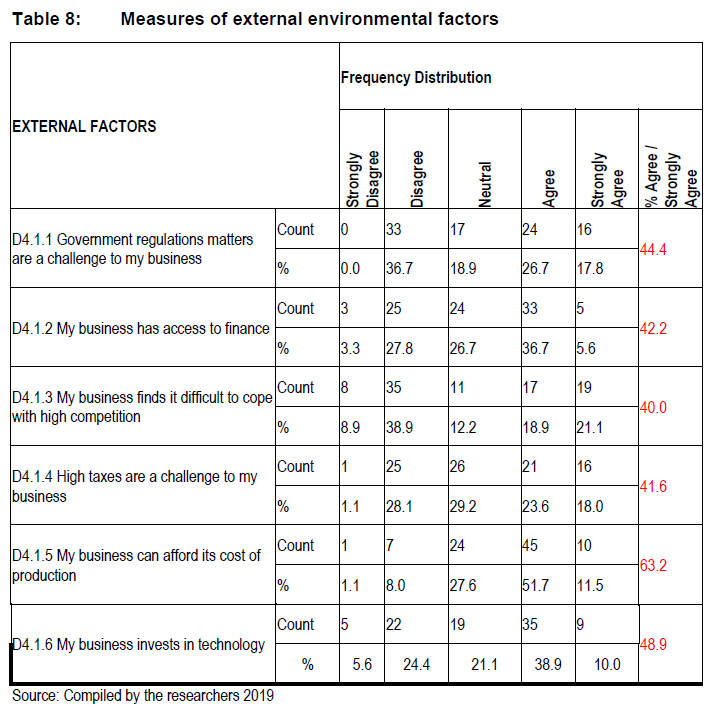
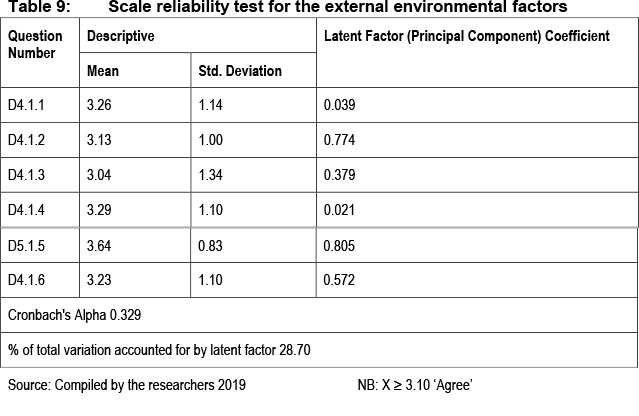
Similarly, the descriptive statistics of the data emerging from the test of business growth and the external of the SMMEs are presented in Tables 8 and 9. The components of the external environment tested are government regulations, access to finance, competition, high taxes, cost of production and technology.
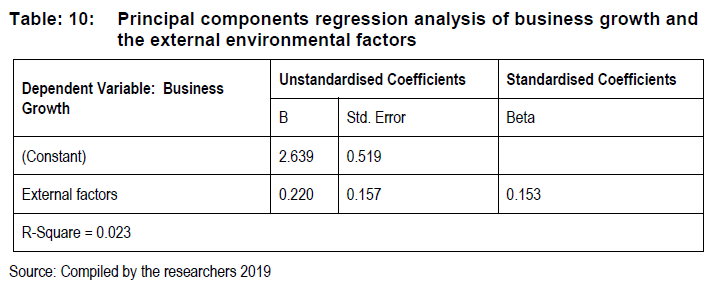
Given the spread in the data distribution from Tables 8 and 9, the researchers raised the decision point of the arithmetic mean by 10% (at the level of significance, 0.1). The acceptable decision point is therefore set at 3.10, meaning that there is a slightly positive level of agreement for questions with the mean value from 3.10 and above. In view of this, the data shows that government regulations, access to finance, high taxes, cost of production and technology partially correlate with the growth of SMMEs. However, the data shows that competition has a slightly minor correlation with business growth. In addition, the internal consistency of the data indicated a low Cronbach's Alpha coefficient value of 0.329. Given this and the quest to understand the relationship, a PCR analysis was conducted and the output of the analysis is presented in Table 10.
3.3 Discussion and implications of research results
The results from the tested research objective showed that SMMEs in Msunduzi Municipality use indicators such as sales, market share, size, assets and production of goods and services to measure business growth. This result concurs with other studies in the literature presented earlier in Section 2 (Machado 2016:421; Khantimirov 2017:590; Vasu & Jayachandra 2014:125). Though other research (Fiala & Hedija 2015:1641; Nassar et al. 2014) may have found the use of the number of employees as an indicator of growth in SMMEs, this study found otherwise. The results show that though SMMEs show growth patterns along indicators tested, these businesses make do with their existing staff. This justifies the assertion that South African SMMEs mostly adopt solo entrepreneurship. This type of entrepreneurship, which is considered inadequate to sustain a livelihood, provides a clearer picture of why these SMMEs do not measure growth using the number of employees as a parameter. The implication of this, with the emergence of 4IR, is an economy with an increasing number of unemployed individuals. With the national unemployment rate at 30.8% in the Q3 2020 (Statistics South Africa 2020), small businesses who are envisaged as mechanisms for creating jobs are not doing so, and it becomes concerning as to what the future holds for the populace. With 4IR on the doorstep, the net effect would be additional job losses in a struggling economy. In light of the foregoing, it is vital to understand how the environment contributes to the success or failure of these SMMEs.
The PCR test of the internal environmental factors indicated a correlation coefficient of determination (R-Square or R2) value of 0.273 (Table 7). In addition, the calculated correlation coefficient of determination (R2) for the external environmental factors indicated a value of 0.023 (Table 10). According to Hamilton, Ghert and Simpson (2015:152), R2 represents the percentage of the total variation in the dependent variable that is accounted for by the independent variable. Narrowing to this study, R2 represents the proportion of the variance in the growth of SMMEs that is predictable from the components of both the internal and the external environment. Ideally, the value of R2 ranges from 0-1 and indicates the extent to which the dependent variable is predictable (Draper & Smith 1998:407). A value of R2 closer to '1' indicates a higher positive correlation between the dependent and the independent variables, while a value of '0' means that the dependent variable cannot be predicted from the independent variables (Schroeder, Sjoquist & Stephen 1986). For various researchers, there is no rule of thumb in the value of R2; rather, the value explains the strength of variance in the independent variables that is predictable in the dependent variable (Hamilton et al. 2015:152). Gimenez and Giussani (2018:731) emphasise the difficulty in interpreting R2 because it represents weighted averages of the coefficients of the underlying explanatory variables.
For the purposes of this study, the R2 value of 0.273 for the internal environment means that while 27% of the variance in the outcome data can be predicted from the independent variable, the model cannot explain 72.7% of the outcome data. This means that 27% of the components of the internal environmental factors account for changes in SMMEs business growth. These factors, as noted earlier, are management skills, technology, market share, entrepreneurial characteristics, resource management system and cash management records. To further understand this, the acquisition of management skills is found to contribute to business improvement (Brijlal, Naicker & Peters 2013; Naiker, Le Roux, Bruwer & Bruwer 2017:52; Ward 2011). This is why Masutha and Rogerson (2015:238) pointed out on the need to address the SMMEs owner/managers' lack of management skills to ensure growth in the business. In terms of technological developments, studies have shown that innovations in technology trigger changes in the SMMEs business growth. Such changes include improved efficiency, greater production, profit generation, reduced costs, and market expansion (Audretsch, Lehmann & Wright 2014:308; Nguyen, Newby & Macaulay 2015:221). For the internal factors such as accessibility, the BER (2016:10) found that the lack of access to the market is a major factor in the business longevity of SMMEs. With shorter business longevity, SMMEs tend to lack access to finance and such contributes to their lack of market expansion (First National Bank 2015:1; Herrington & Kew 2018:45). Research has shown a positive relationship between the entrepreneur's characteristics and the growth in the business (Blackburn et al. 2013:22; Mitchelmore & Rowley 2013:138; Sidik 2012:375). Moreover, cash management as an internal factor, affects the growth of SMMEs positively or negatively (Salazar, Soto & Mosqueda 2012:101).
Given the foregoing, the results of this study concur with other similar studies which attested to internal factors accounting for changes in SMMEs growth (Becherer & Helms 2016:139; Khantimirov 2017:590; Machado 2016:421).
For the external environment with R2 close to '0', it means that 97.7% of the variation in the outcome data is unexplained by the model. Though the calculated R2 for both internal and external environment may be of low value, Hamilton, Ghert and Simpson (2015:152) showed in their study that a high coefficient of variation is not an indication of a goodness-of-fit. In addition, Saikia and Singh (2014: 2439) and Grace-Martin (2012:1), posit that small R2 value can be significant in research depending on the discipline.
Given the foregoing, the researchers conclude that the business growth of SMMEs is not predictable from the components of the external environment. The researchers therefore rephrase and accept the hypothesis: "Internal environmental factors simultaneously and partially affect the growth of SMMEs". These remain important factors needed by SMMEs not only to navigate the wheels of the revolution, but also to gain the full benefits of the revolution.
4. CONCLUDING THOUGHTS AND RECOMMENDATIONS
Evidence from literature has shown the role of SMMEs in advancing inclusive growth and development in South Africa. The country's National Development Plan highlights the importance of SMMEs for job creation, innovation, and competitiveness, and achieving vision 2030 of creating 90 percent of new jobs. The successful entry and growth of these enterprises may create a sustainable mechanism for alleviating poverty and unemployment.
This article has made an effort to contribute to the development of the literature on factors that that impact on the growth of SMMEs within the Msunduzi Municipality. The literature review presented various indicators used in determining the growth in SMMEs and factors within the business environment that affect the growth. The discussions brought into context an existing knowledge gap by examining the theoretical framework of the RBV view as a pillar for SMMEs business growth in the era of a digital revolution. The findings underscore growth patterns for SMMEs within the Msunduzi Municipality along with sales, market share, size, assets and production output. The results also revealed that these SMMEs rarely use the number of employees as an indicator of success. The components of the internal environment factors such as management of skills, technology, market share, entrepreneurial characteristics, resource management system and cash management records were found to be positively and partially correlated with the business growth in SMMEs. To address challenges emanating from this study and ensure the full benefits of 4IR are achieved, the researchers recommend the following:
i. Educational awareness programs targeting specifically management skills, which would ensure that SMME owners/managers are prepared prior to the disruptive challenges of the digital revolution.
ii. Increasing awareness of government institutions established to address SMME challenges would go a long way in assisting the owners/managers.
iii. Intense training and development would help to equip the capability challenges facing human resources to tackle the challenges in the SMME business environment.
iv. There is a need for the regular data collection on the challenges facing SMMEs and prioritised possible solutions to address them.
Achievement of the above would probably create an environment for SMMEs to grow their businesses, create jobs, reduce unemployment and measure growth using the number of employees. This would help attain the vision and idea of SMMEs being the panacea for South Africa's economic problems.
5. LIMITATIONS OF THE STUDY
One of the limitations of the study was its geographical location, which makes it difficult to generalise the results of the study. The sample does not provide insightful information on all the all SMMEs in Msunduzi Municipality, but rather only ones registered with SEDA. The sample size is envisaged to contribute to the limitations of the study, but only 90 out of 155 questionnaires were considered appropriate for analysis. A larger sample size would have provided more insight into the business environment of SMMEs. In addition, a Principal Components Regression (PCR) analysis provides a clearer picture of the problem at hand with a larger sample size.
DECLARATION OF CONFLICTING INTERESTS/FUNDING
Mr Siphelele Blose extends his gratitude to the National Research Foundation (NRF) for sponsoring his Master's Degree programme from which this piece of an article was developed from.
REFERENCES
-
ACHTENHAGEN L, NALDI L & MELIN L. 2010. "Business growth": do practitioners and scholar really talk about the same thing? Entrepreneurship Theory and Practice 34(3):289-316. (DOI:https://doi.org/10.1111%2Fj.1540-6520.2010.00376.x; downloaded on 02 June 2019.
» https://doi.org/10.1111%2Fj.1540-6520.2010.00376.x -
)
» https://https://doi.org/10.1002/hrm.21523 -
)
» https://doi.org/10.1007/s10961-012-9283-6 -
ALVAREZ-SUESCUN E. 2010. Combining transaction cost and resource-based insights to explain IT implementation outsourcing. Information Systems Frontiers 12(5):631-645. (DOI:https://doi.org/10.1007/s10796-010-9237-1; downloaded on 13 June 2019.
» https://doi.org/10.1007/s10796-010-9237-1 -
)
» https://doi.org/10.1177/0149206310391805 -
)
» https://www.questia.com/library/journal/1P3-4159661371/the-role-of-entrepreneurial-marketing-in-improving -
AVGEROU C & LI B. 2013. Relational and institutional embeddedness of web-enabled entrepreneurial networks: Case studies of entrepreneurs in China. Information Systems Journal 23(4):329-350. (DOI:https://doi.org/10.1111/isj.12012; downloaded on 30 April 2019.
» https://doi.org/10.1111/isj.12012 - )
-
)
» http://hdl.handle.net/10566/2931 -
BARNEY JB, WRIGHT M, & KETCHEN DJ Jr. 2001. The resource-based view of the firm: ten years after 1991. Journal of Management 27(6):625-41. (DOI:https://doi.org/10.1177/014920630102700601; downloaded on 12 June 2019.
» https://doi.org/10.1177/014920630102700601 -
)
» https://www.ber.ac.za/home/ -
)
» https://doi.org/10.1007/s11187-013-9503-y - BENNETT RJ. 2014. Entrepreneurship, Small Business and Public Policy: Evolution and revolution, 1st edition. New York: Routledge.
-
BLACKBURN RA, HART M & WAINWRIGHT T. 2013. Small business performance: Business, strategy and owner-manager characteristics. Journal of Small Business and Enterprise Development 20(1):8-27. (DOI:https://doi.org/10.1108/14626001311298394; downloaded on 14 July 2019.
» https://doi.org/10.1108/14626001311298394 - )
-
)
» https://blog.fnb.co.za/2015/05/limited-access-to-market-restricts-growth-of-small-business-sector/ -
BULUT Y & SAYIN E. 2010. An Evaluation of Entrepreneurship Characteristics of University Students: An Empirical Investigation from the Faculty of Economic and Administrative Sciences in Adnan Menderes University. International Journal of Economic Perspectives 4(3):559-568. (DOI:https://hdl.handle.net/20.500.12712/4050; downloaded on 11 May 2019.
» https://hdl.handle.net/20.500.12712/4050 -
)
» https://arxiv.org/abs/1308.6626 -
]
» http://www.theanalysisfactor.com/small-r-squared/ -
CHIMUCHEKA T. 2013. Overview and performance of the SMMEs sector in South Africa. Mediterranean Journal of Social Sciences 4(14):783-795. (DOI: 10.5901/mjss.2013.v4n14p783; downloaded on 09 August 2019.
» https://doi.org/10.5901/mjss.2013.v4n14p783 -
)
» https://www.gemconsortium.org/file/open?fileId=50411 -
)
» https://www.ilo.org/wcmsp5/groups/public/---ed_emp/---emp_ent/---ifp_seed/documents/publication/wcms_459981.pdf -
CRONBACH LJ. 1951. Coefficient alpha and the internal structure of tests. Psychometrika 16:297-334. (DOI:https://doi.org/10.1007/BF02310555; downloaded on 10 July 2019.
» https://doi.org/10.1007/BF02310555 -
)
» https://doi.org/10.11114/BMS.V1I2.1049 -
DEPARTMENT OF SMALL BUSINESS DEVELOPMENT (DSBD). 2018. Revised National Definition of Small Enterprise in South Africa. Government Gazette Notice No. 41970. [Internet:https://www.smallbusinessinstitute.co.za/wp-content/uploads/2018/10/181012definitionforsmallenterprises-SA.pdf; downloaded on 15 August 2019.
» https://www.smallbusinessinstitute.co.za/wp-content/uploads/2018/10/181012definitionforsmallenterprises-SA.pdf -
]
» https://doi.org/10.17722/JORM.V7I3.198 -
DI DOMENICO M, DANIEL E & NUNAN D. 2014. "Mental mobility" in the digital age: Entrepreneurs and the online home-based business. New Technology, Work and Employment 29(3):266-281. (DOI:https://doi.org/10.1111/ntwe.12034; downloaded on 09 July 2019.
» https://doi.org/10.1111/ntwe.12034 -
)
» https://doi.org/10.3390/joitmc4030021 - DRAPER NR & SMITH H. 1998. Applied regression analysis. 3rd Edition. New York: Wiley.
-
ETALE LM, BINGILAR PF & IFURUEZE MS. 2016. Market Share and Profitability Relationship: A Study of the Banking Sector in Nigeria. International Journal of Business, Economics and Management 3(8):103-112. (DOI:10.18488/journal.62/2016.3.8/62.8.103.112; downloaded on 10 September 2019.
» https://doi.org/10.18488/journal.62/2016.3.8/62.8.103.112 -
)
» https://search.proquest.com/openview/5b7cf88372c68dc64fdb757efb1ad5c7/1?pq-origsite=gscholar& cbl=2032296 -
FIALA R & HEDIJA V. 2015. The Relationship between Firm Size and Firm Growth: The Case of the Czech Republic. Acta Universitatis Agriculturae et Silviculturae Mendelianae Brunensis 63:639-1644. (DOI:http://dx.doi.org/10.11118/actaun201563051639; downloaded on 07 September 2019.
» http://dx.doi.org/10.11118/actaun201563051639 -
)
» https://doi.org/10.21315/aamj2017.22.1.2 -
]
» http://business.expertjournals.com/23446781-505/ - GILPIN R. 2018. The challenge of global capitalism: The world economy in the 21st century. New Jersey: Princeton University Press.
-
)
» http://www.academicjournals.org/AJBM -
GUPTA PD, GUHA S & KRISHNASWAMI SS. 2013. Firm growth and its determinants. Journal of Innovation and Entrepreneurship 2(15):1-14. (DOI:https://doi.org/10.1186/2192-5372-2-15; downloaded on 30 September 2019.
» https://doi.org/10.1186/2192-5372-2-15 -
)
» https://www.gov.za/sites/default/files/gcis_document/201409/a26-03.pdf -
]
» https://www.ijsr.net/search_index_results_paperid.php?id=SEP14707 -
HAMILTON DF, GHERT M & SIMPSON AHRW. 2015. Interpreting regression models in clinical outcome studies. Bone and Joint Research. 4(9):152-153. (DOI:https://doi.org/10.1302/2046-3758.49.2000571; downloaded on 12 October 2019.
» https://doi.org/10.1302/2046-3758.49.2000571 - )
- ]
-
INTERNATIONAL LABOUR ORGANISATION (ILO). 2018. Enabling Environment for Sustainable Enterprises in South Africa. [Internet:https://www.ilo.org/empent/whatsnew/WCMS_459490/lang--en/index.htm; downloaded on 20 November 2019.
» https://www.ilo.org/empent/whatsnew/WCMS_459490/lang--en/index.htm -
]
» https://www.seedengine.co.za/wp-content/uploads/2018/03/Seed-Academy_Real-State-of-Entrepreneurship-Survey-Results-2017.pdf -
]
» https://doi.org/10.1016/S2212-5671(12)00351-6 -
KALEKA A. 2002. Resources and capabilities driving competitive advantage in export markets: Guidelines for industrial exporters. Industrial Marketing Management 31(3):273-283. (DOI:https://doi.org/10.1016/S0019-8501(00)00148-6; downloaded 13 November 2019.
» https://doi.org/10.1016/S0019-8501(00)00148-6 -
)
» http://www.statssa.gov.za/?p=13765 -
)
» https://www.gov.za/issues/national-development-plan-2030 -
KAPPELMAN L, MCLEAN EPH, JOHNSON V & TORRES R. 2016. The 2015 SIM IT issues and trends study. MIS Quarterly Executive 15(1):55-83. (DOI:https://aisel.aisnet.org/misqe/vol15/iss1/6; downloaded on 03 August 2019.
» https://doi.org/https://aisel.aisnet.org/misqe/vol15/iss1/6 -
)
» https://doi.org/10.36106/ijar - )
-
LAI Y, SARIDAKIS G & JOHNSTONE S. 2017. Human resource practices, employee attitudes and small firm performance. International Small Business Journal: Researching Entrepreneurship 35(4):470-494. (DOI:https://doi.org/10.1177/0266242616637415; downloaded on 23 June 2019.
» https://doi.org/10.1177/0266242616637415 -
)
» https://core.ac.uk/download/pdf/7074496.pdf - )
-
LI D-Y & LIU J. 2014. Dynamic capabilities, environmental dynamism, and competitive advantage: Evidence from China. Journal of Business Research 67(1):2793-2799. (DOI:https://doi.org/10.1016/j.jbusres.2012.08.007; downloaded on 24 April 2019.
» https://doi.org/10.1016/j.jbusres.2012.08.007 - )
-
MACHADO HPV. 2016. Growth of small businesses: A literature review and perspectives of studies. Gestão & Produção 23(2):419-432. (DOI:https://doi.org/10.1590/0104-530x1759-14; downloaded on 31 May 2019.
» https://doi.org/10.1590/0104-530x1759-14 - )
- MARTIN CJ & SWANK D. 2012. The Political Construction of Business Interests: Coordination, Growth, and Equality. New York: Cambridge University Press.
- ]
-
MASUTHA M& ROGERSON CM. 2015. Business incubation for small enterprise development: South African Pathways. Urban Forum 26(2):223-241. (DOI:10.1007/s12132-014-9242-4; downloaded on 30 September 2019.
» https://doi.org/10.1007/s12132-014-9242-4 - )
-
MAZZAROL T. 2015. SMEs engagement with e-commerce, e-business and e-marketing. Small Enterprise Research 22(1):79-90. (DOI:10.1080/13215906.2015.1018400; downloaded on 30 September 2019.
» https://doi.org/10.1080/13215906.2015.1018400 - )
-
MITCHELMORE S & ROWLEY J. 2013. Entrepreneurial competencies of women entrepreneurs pursuing business growth. Journal of Small Business and Enterprise Development 20(1):125-142. (DOI:https://doi.org/10.1108/14626001311298448; downloaded on 03 October 2019.
» https://doi.org/10.1108/14626001311298448 - )
- )
-
MTHIMKHULU A & AZIAKPONO M. 2016. What characterises high-growth firms in South Africa? Evidence from World Bank Enterprise Survey. South African Journal of Business Management 47(4):71-81. (DOI:http://hdl.handle.net/10019.1/104397; downloaded on 12 April 2019.
» http://hdl.handle.net/10019.1/104397 - )
- )
-
NASSAR IA, ALMSAFIR MK & AL-MAHROUQ MH. 2014. The Validity of Gibrat's Law in Developed and Developing Countries (2008-2013): Comparison Based Assessment. Procedia - Social and Behavioral Sciences 129:266-273. (DOI:https://doi.org/10.1016/j.sbspro.2014.03.676; downloaded on 29 May 2019.
» https://doi.org/10.1016/j.sbspro.2014.03.676 - )
-
NGUYEN TH, NEWBY M & MACAULAY MJ. 2015. Information technology adoption in small business: Confirmation of a proposed framework. Journal of Small Business Management 53(1):207-227. (DOI:https://doi.org/10.1111/jsbm.12058; downloaded on 12 May 2019.
» https://doi.org/10.1111/jsbm.12058 - )
-
OBAJI NO, SENIN AA & OLAOLU D. 2018. Factors associated with SMEs Success and The Triple Helix of Entrepreneurship, Innovation and Research. [Internet:https://seminar.utmspace.edu.my/lspgabc2018/Doc/10.pdf; downloaded on 10 October 2019.
» https://seminar.utmspace.edu.my/lspgabc2018/Doc/10.pdf - ]
- )
-
PENG MW. 2001. The resource-based view and international business. Journal of Management 27(6):803-829. (DOI:https://doi.org/10.1177/014920630102700611; downloaded on 21 July 2019.
» https://doi.org/10.1177/014920630102700611 - )
- ]
-
RAHMAN NAA & RAMLI A. 2014. Entrepreneurship management, competitive advantage and firm performances in the craft industry: concepts and framework. Procedia-Social and Behavioral Sciences 145:129137. (DOI:https://doi.org/10.1016/j.sbspro.2014.06.019; downloaded on 28 July 2019.
» https://doi.org/10.1016/j.sbspro.2014.06.019 - )
- ]
-
SALAZAR AL, SOTO RC & MOSQUEDA RE. 2012. The impact of financial decisions and strategy on small business competitiveness. Global Journal of Business Research 6(2):93-103. [Internet:http://ssrn.com/abstract=1945906; downloaded on 22 August 2019.
» http://ssrn.com/abstract=1945906 - ]
- )
- SCHROEDER LD, SJOQUIST DL & STEPHEN PE. 1986. Understanding regression analysis: an introductory guide. Beverly Hills: Sage Publications.
-
SCHWAB K. 2015. The Fourth Industrial Revolution: What It Means and How to Respond. Foreign Affairs. December 12. [Internet:https://www.foreignaffairs.com/articles/2015-12-12/fourth-industrial-revolution; downloaded on 17 November 2019.
» https://www.foreignaffairs.com/articles/2015-12-12/fourth-industrial-revolution - ]
- ]
-
SHEEHAN M. 2014. Human resource management and performance: Evidence from small and medium-sized firms. International Small Business Journal 32(5):545-570. (DOI:https://doi.org/10.1177%2F0266242612465454; downloaded on 22 July 2019.
» https://doi.org/10.1177%2F0266242612465454 - )
- )
-
SIGFUSSON T & CHETTY S. 2013. Building international entrepreneurial virtual networks in cyberspace. Journal of World Business 48(2):260-270. (DOI:https://doi.org/10.1016/j.jwb.2012.07.011; downloaded on 19 July 2019.
» https://doi.org/10.1016/j.jwb.2012.07.011 - )
- ]
-
THE PRESIDENCY (REPUBLIC OF SOUTH AFRICA). 2019. Address by President Cyril Ramaphosa to the 1st South African Digital Economy Summit, Gallagher Convention Centre, Johannesburg. Friday 5 July 2019. [Internet:http://www.thepresidency.gov.za/speeches/address-president-cyril-ramaphosa-1st-south-african-digital-economy-summit%2C-gallagher; downloaded on 10 November 2019.
» http://www.thepresidency.gov.za/speeches/address-president-cyril-ramaphosa-1st-south-african-digital-economy-summit%2C-gallagher - ]
- ]
-
THE SMALL ENTERPRISE DEVELOPMENT AGENCY (SEDA). 2019. SMME Quarterly Update. 1st Quarter 2019. [Internet:http://www.seda.org.za/Publications/Publications/SMME%20Quarterly%202019-Q1.pdf; downloaded on 19 November 2020.
» http://www.seda.org.za/Publications/Publications/SMME%20Quarterly%202019-Q1.pdf - ]
- )
-
WARD JL. 2011. Keeping the Family Business Healthy: How to Plan for Continuing Growth, Profitability, and Family Leadership. New York: Palgrave Macmillan. [Internet:https://doi.org/10.1057/9780230116122;downloaded on 05 November 2019.
» https://doi.org/10.1057/9780230116122 - ]
-
XU M, DAVID JM & KIM SH. 2018. The Fourth Industrial Revolution: Opportunities and Challenges. International Journal of Financial Research 9(2):90-95. (DOI:https://doi.org/10.5430/ijfr.v9n2p90; downloaded on 05 November 2019.
» https://doi.org/10.5430/ijfr.v9n2p90 - )