Antecedents Influencing Effective Talent Management in Public Health Institutions in Uganda
Abstract
In various institutions, talent management can be seen as a response to changes affecting the workplace such as the industrial revolution, the rise of labour unions, globalisation and competitiveness. Health care institutions need to and are interested in managing talented people to ensure high quality care, long term competitiveness, sustainable prosperity and continuous development. This is to achieve the goal of health care which is, delivering safe, effective, efficient, timeous and equitable health care. The purpose of this article was to identify antecedents that influence effective talent management in public health institutions in Uganda. The research findings reveal that an enabling work environment, a stable working environment and career development highly influence effective talent management than organisational support and employee satisfaction. Even though job autonomy and personal value effectively influence talent management, management in public health institutions need to realise the importance of nurturing and monitoring job autonomy and acknowledge personal values to effectively enhance talent management.
Employee Talent; health sector; public institutions; talent management
1. INTRODUCTION AND BACKGROUND
The future competitiveness and prosperity of an institution depends on its employees, as they are considered fundamental for the performance and effectiveness of an organisation (Osibanjo, Akinbode, Falola & Oludayo 2018:112; Pandita & Ray 2018:2). In reality, the success of an organisation depends on employees who are enthusiastic about carrying out the tasks assigned to them (Alefari, Barahona & Salonitis 2018:438; Pandita & Ray 2018:4). Thus, it is important to attract, integrate, educate and retain skilled and 'high-potential' employees. The process of developing such employees is referred to as talent management (Dayel, Debrah & Mulyata 2020:3). For the health sector, talent management is especially important in light of shrinking and aging talent pools, coupled with the difficulty of retaining health employees (Flores, Risley & Quintana 2018:1-2). Taye, Morankar, Abdulahi, Admasu and Tadele (2019:1-2) contend that this is particularly important for health care institutions that need and are interested in managing talented people to deliver safe, effective, patient-centred, timely, efficient and equitable care.
Uganda faces severe human resource challenges, despite opportunities brought about by the considerable disease burden (such as HIV/AIDS and communicable diseases) and a growing population (Musoke, Ndejjo, Atusingwize, Ssemugabo, Ottosson, Gibson & Waiswa 2020:1). Despite the contribution of the health sector to national growth and development, employees in Uganda's health sector continue to leave for better work conditions and job opportunities. Thus, it is important to attract, integrate, educate, and retain skilled and high potential employees.
2. PROBLEM STATEMENT
The need for talent management is overwhelming in the health sector, which is characterised by a severe shortage in its professional, administrative and technical workforce, coupled with the difficulty of attracting talent from other sectors. Talent management is in crisis in many public health institutions, which emphasises the need for a competent, committed and engaged workforce to achieve organisational success (Dahshan, Keshk & Dorgham 2018:118). There is also a mismatch between the demand and supply of talent, particularly for specific positions that translate into a shortage of skills and experience (Cao & Li 2017:368; Pagano 2017:83). Furthermore, as the demand for talented employees in the health sector continues to outstrip supply, public health institutions find it difficult to sustain their core mission of delivering high quality care (Malema & Muthelo 2018:2-3; Schettler, Campbell, Cometto, Maeda, Liu, Bruckner, Arnold & Evans 2018:2).
Despite the benefits thereof, the concept of talent management has not fully been embraced and, therefore, public health institutions in Uganda continue to face the challenges associated with the attraction, selection, motivation and retention of talented employees (Witter, Mashange, Namakula, Wurie, Ssengooba & Alonso-Garbayo 2017:6). In addition, the health sector in Uganda has an inadequate number of employees and heavy workload (Wanduru, Tetui, Tuhebwe, Ediau, Okuga, Nalwadda, Ekirapa-Kiracho, Waiswa & Rutebemberwa 2016:1).
Therefore, public health institutions that do not create a favorable work environment, with attractive work conditions, will struggle to find suitable talented employees with a variety of skills.
Against this background, it is necessary to address the following research question in this study:
What are the antecedents that influence effective talent management among employees in the public institutions of the health sector?
3. OBJECTIVE OF THE STUDY
Despite the importance of talent management, relatively little research has been done in identifying the antecedents of talent management in Uganda. The objective of the study was to investigate the antecedents that influence effective talent management in public health institutions in Uganda.
4.1 Talent management
Järvi and Khoreva (2020:76), Ozuem, Lancaster and Sharma (2016:50) and Thunnissen (2016:59) refer to talent management as the adoption of a combination of policies and practices designed to attract, develop, motivate and retain productive, engaged employees who possess a combination of exceptional knowledge, skills, attitudes, values and competencies that are crucial to organisational success. Therefore, talent management is an on-going, challenging and dynamic process of systematically identifying, assessing and developing high-potential individuals to fill 'key roles for the continuity and maximisation of organisational performance (Ramu 2017:60; Whysall, Owtram & Brittain 2019:2). According to Rastgoo (2016:653), there is a positive and significant relationship between talent management, organisational development and employee motivation. Also, Künneke (2017:129) found that perceptions of talent identification and talent development are the most important contributors to employee talent management.
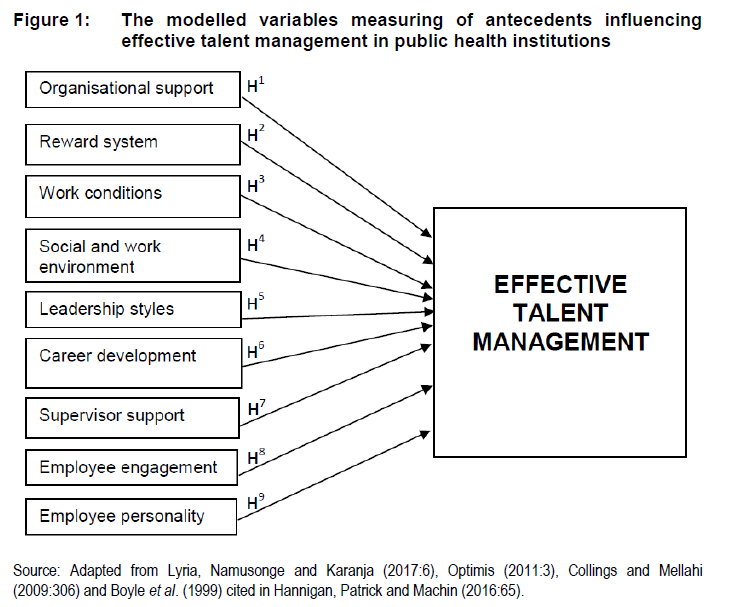
Dong (2019:906) has indicated that organisations need to adopt flexible talent management systems, to operate in different environments, while Antony (2018:34) and Vnouckova, Urbancova and Smolova (2018:3327) found that the process of managing talent relationships is associated with building the organisation's image and meeting employee expectations. Thus, there is both a perception and evidence that talent management is predicted by organisational support, reward system, work conditions, social and work environment, leadership styles, career development, supervisor support, employee engagement and employee personality.
4.2
Organisational supportOrganisational support refers to the perceived extent to which an organisation cares about and values its employees (Liu, Zhao, Shi, Zhang, Liu, Li, Duan, Li, Lou, Jia, Fan, Sun & Ni 2018:2). Therefore, for the purpose of this study, organisational support is described as the mental process of evaluating the degree to which an organisation offers assistance, encouragement, appreciation, respect, care and empowerment for the well-being of its employees, as compared to similar positions in other organisations. A number of scholars maintain that employees who are talented appreciate working in supportive organisations. This encourages them to commit to the organisation, as supported by the work of Mensah (2019:527). In the health sector, Shi, Wang, Jia, Li, Mu, Liu, Peng, Li and Fan (2017:10) found that, when working for organisations that have supportive mechanisms in place to counter violence and anxiety, nurses remain committed to providing quality treatment to patients. Similarly, Liu et al. (2018:10) and Tomo and De Simone (2017:49) concur that organisations in the health sector should focus their attention on creating working conditions that enhance fairness, employee well-being and the involvement of employees, and which foster relationships as a show of support. In summary, public health institutions need to be supportive to encourage reciprocal behaviour amongst health workers, which is important in managing employee talent.
4.3
Reward systemA reward system is described as the combination of the policies and practices that govern the provision of all monetary and non-monetary compensation and incentives provided by an organisation to its employees, in exchange for their contributions to the overall organisational goals (Aremu 2019:8; Vincent, Alala & Kiongera 2017:1395). Peluso, Innocenti and Pilati (2017:311) found that organisations that plan, adopt and implement practices and policies related to rewards, are able to benefit from motivated employees and innovative employee behaviour. Non-financial rewards include task variety, benefits, job security, mentoring, leave, recognition and promotion, while financial rewards, encompassing salary and wage, are the core rewards (Prouska, Psychogios & Rexhepi 2016:1262; Stumpf, Tymon Jr, Ehr & van Dam 2016:468).
According to Adom (2018:2) and Beck-Krala, Tarczon and Mastyk (2017:17), rewards reflect the values and beliefs of an organisation, and are important in the attraction of talent. This is supported by the work of Tsai, Chou and Chen (2008) cited in Hamukwaya and Yazdanifard (2014:192) that suggest that an organisation that pay high wages attract not only qualified but competent and productive candidates that recognise the organisation's ability to achieve its objectives, and thus contribute to the overall performance of the organisation. Antony (2018:42) also found that fair salary, together with good safety and health insurance were crucial to keeping talent rooted to organisations. In addition, employees who are talented increase their work efforts and positive behaviour when they feel that rewards are fairly earned (Allisey Rodwell & Noblet 2016:665).
In light of this, it is evident that public health institutions need to implement fair and equitable systems of financial and non-financial rewards, such as remuneration, allowances, pension and other benefits to manage, attract and retain talented health workers.
4.4 Work conditions
Work conditions are described as the conditions in and under which work is performed (Hsiao & Lin 2018:248; Robertson, Di, Brown & Dehejia 2016:1). Flexibility in work schedules, balancing family and work, workplace hazards, social benefits, housing conditions, access to public facilities and the type of employment contract are aspects of work conditions (Antony 2018:44; Binczycki & Łukasiński 2016:187). Fleischmann, Carr, Stansfeld, Xue and Head (2018:183) suggest that talented employees need favourable conditions to be efficient and productive in their jobs. Mwanzi, Wamitu and Kiama (2017:1) suggest that enhancing the work conditions of health workers is associated with talent utilisation. Therefore, for public health institutions to manage, attract and retain talented health workers, they should provide quality work conditions for the different types of employee contracts, such as the outsourced, transferred, temporary, contract or permanent employees.
4.5
Social and work environmentThe social and work environment refers to the employee's surroundings at work, which are characterised by low levels of stress, employees feeling appreciated by management and not feeling threatened at work (Plantiveau, Dounavi & Virués-Ortega 2018:195). It is important to note that organisations differ from one another in terms of the interplay of factors within the social and work environment, such as social interaction, norms, values and attitudes (Berthelsen, Muhonen & Toivanen 2018:6). Turner, Glaister and Al Amri (2016:53), suggest that the environment in which employees work shapes talent management practices. Fletcher (2016:2) and Masharyono, Pratama and Purnama (2016:574) further maintain that it is important to create flexible environments in which employees are comfortable enough to make contributions to their organisations.
Numerous studies indicate that talented employees can be managed in a reputable organisation with a conducive social and work environment, which has abundant resources and is free from distractions (Antony 2018:35; Chavengvorakul & Wongsurawat 2017:17). Furthermore, Edem, Akpan and Pepple (2017:4) found that talented health workers were impressed by, and successfully fulfil their tasks in organisations that had suitable office space, work areas, new furniture, access to electricity, transport, housing, improved work tools, bright wall colours, lighting, proper ventilation, plants, feedback mechanisms and open communication with management. Thus, it is imperative that employees in public health institutions feel protected and empowered to perform their duties within the social and work environment, which is related to the attraction, commitment and retention of talented employees.
4.6
Leadership styleLeadership styles are defined as the different types of behaviour and characteristics of leaders which, if used effectively, contribute to the creation of a well-positioned organisation (Ekiyor & Dapper 2019:89; Fahlevi, Zuhri, Parashakti & Ekhsan 2019:2440; Malik, Saleem & Naeem 2016:387). i Solà, i Badia, Hito, Osaba and García (2016:2) describe leadership styles as the means of communicating a shared vision and performance expectations; and providing an appropriate role model for employees. This is in addition to fostering collaboration and support amongst employees to achieve collective goals (Moorosi & Bantwini 2016:1). It should be noted that leadership styles include authoritarian, democratic and laissez-faire styles, among others. These highlight the behaviours of individuals in leadership positions and how they differ in terms of interdependency and shared goals between leaders and followers (Gerard, McMillan & D'Annunzio-Green 2017:116).
Rao (2017:1) and Siddique and Nawaz (2019:1042) support the understanding that, through their leadership styles, leaders make use of negotiation, appreciation, motivation and collaboration as methods to build and nurture sustainable relationships with talented employees. Asrar-ul-Haq and Kuchinke (2016:56), supported by Mi, Gan, Xu, Long, Qiao and Zhu (2019:3) and Ramdas and Patrick (2018:19), found that there is increased social justice, collaboration, employee engagement and creation of new perspectives and ideas when talented employees are working in an organisation in which they see their leader as a role model. Moreover, numerous studies indicate that the attitudes and behaviours that leaders exhibit in the execution of their duties, guide and manage the emotions and feelings of talented employees towards realising their full potential, participating in decision making, and accomplishing tasks - which will result in the attraction, motivation and retention of employee talent (Khalid, Pahi & Ahmed 2016:609; Othman, Hamzah, Abas & Zakuan 2017:115; Solaja & Ogunola 2016:55). Leadership styles are important to the management, attraction and retention of talented employees since they can inspire confidence, respect, communication and other positive attitudes and behaviours amongst employees. This is supported by the findings of Kaok, Yusuf and Dewi (2019:46), Ebrahimi, Moosavi and Chirani (2016:351), i Solà et al. (2016:1) as well as Siam, Bakar and Ramli (2019:77) and Supraptiningsih, Brasit and Mardiana (2018:20).
4.7 Career development
Jusuf, Mahfudnurnajamuddin and Latief (2016:8) define career development as the technical, theoretical, conceptual and moral education regarding the requirements of the position held by an employee. For the purpose of this study, career development is defined as the process through which an organisation provides employees guidance on their career paths; it also includes selecting, assessing, assigning and developing employees so that they become more qualified, secure, employable, change resilient, ready for promotion and meeting future needs. According to a study conducted by Bocciardi, Caputo, Fregonese, Langher and Sartori (2017:68), the knowledge and skills gained from education are related to enhanced job security and career adaptability, as well as advancement and performance, since employees are able to make better decisions and cope with the demands of their work. Further, Mani (2020:1210) and Björkman, Ehrnrooth, Mäkelä, Smale and Sumelius (2017:4) emphasise that, through job rotation and career progression, an organisation can develop talent. Ali, Bashir and Mehreen (2019:75) found out that career development was another factor that affected talent management. For public health public institutions, a number of studies support that continuous learning and development are associated with employee satisfaction as well as the attraction and retention of talented health workers, such as midwives, nurses and doctors (Adeniji, Osibanjo, Salau, Falola, Igbinoba, Ohunakin & Ogueyungbo 2019:256; Jigssa, Desta, Tilahun, McCutcheon & Berman 2018:9; Momanyi, Adoyo, Mwangi & Mokua 2016:6).
4.8
Supervisor supportSomers, Birnbaum and Casal (2018:7), Chauhan, Ghosh, Rai and Kapoor (2017:269) and Pohl and Galletta (2017:62) describe supervisor support as employee beliefs regarding the manner in which supervisors treat their subordinates, value their contributions, care about their interests and well-being, and show patience and tolerance towards employees who experience difficulties in completing their tasks. Supervisor support includes giving credit for jobs well done, listening to employees' complaints about workplace stress, and providing incentives for employees to perform better.
Hämmig (2017:394) found that there is a significant relationship between supervisor support, talent management and employee retention. Furthermore, the research findings of Ludwick, Turyakira, Kyomuhangi, Manalili, Robinson and Brenner (2018:1) revealed that supportive supervision is related to the management of talented health workers in Uganda. Thus, it is evident that talented employees in public health institutions appreciate the support of their direct supervisors in relation to the problems or outcomes of their work.
4.9
Employee engagementEmployee engagement is defined as the practice of ensuring that employees with a positive, fulfilling work related state of mind feel connected and loyal, so that they grow attached to organisations and exceed organisational expectations (Pandita & Ray 2018:4). For the purpose of this study, employee engagement is described as the employee's physical, cognitive, emotional and psychological show of vigour, pride, dedication, enthusiasm and passion in performing their duties, roles and responsibilities. The empirical findings of a study by Pandita and Ray (2018:12) suggest that employee engagement initiatives influence the management and maintenance of innovative and talented employees within organisations. Alrowwad, Obeidat, Al-Khateeb and Masa'deh (2018:35) also suggest that employee engagement has a positive influence on the management of talented employees. Moreover, it encourages employees to enjoy their work and establish healthy work relationships, which affords them opportunities for professional growth, to realise their full potential and to accomplish their tasks.
Jindal, Shaikh and Shashank (2017:15); and Jindal and Shaikh (2016:1216) found that employee engagement has a positive impact on the management, attraction and retention of talented employees, who then reflect the values of an organisation as brand representatives.
This is supported by the work of Ali et al. (2019:75) and Ramli, Isa, Baharin and Ibrahim (2018:1), which proved that there is a relationship between talent management practices, employee engagement and staff retention. This is in line with the findings of O'Connor and Crowley-Henry (2019:903), Pandita and Ray (2018:1) and Hassan (2016:62) who established that there is a relationship between talent management practices and employee engagement. Therefore, public health institutions need to emphasise employee engagement initiatives and programs that boost their ability to attract, retain, commit and enhance the performance of talented employees.
4.10 Employee personality
According to Singh (2019:3) and Emecheta, Hart and Ojiabo (2016:69), employee personality is explained as a reflection of the way in which individuals think, feel and behave, that has an impact on their emotions, anxiety, needs, desires, satisfaction, confidence levels, preferences, propensity for risk and performance. Howell (2017:145) also revealed that enhanced employee engagement is predicted by an individual's personality traits. This is supported by the findings of Puryear, Kettler and Rinn (2019:10), Herath and Shamila (2018:2) and Kawiana, Dewi, Martini and Suardana (2018:35), which reveal that engagement in desirable behaviours, as a result of personality, predicts performance, creativity and innovativeness. In addition, De la Fuente-Solana, Cañadas, Ramirez-Baena, Gómez-Urquiza, Ariza and Cañadas-De La Fuente (2019:1), Duan-Porter, Hatch, Pendergast, Freude, Rose, Burr, Müller, Martus, Pohrt and Potter (2018:2-3), Takase, Yamamoto and Sato (2018:167) and McCarthy, Cronly and Perry (2017:394) reveal that, across hospitals, personality traits such as being collaborative and cooperative predict a health worker's ability to control and deal with job demands such as workload, depression and anxiety; this means that these employees can withstand the pressures of their work, which results in employee commitment, performance and retention. However, little research has been made to link employee personality directly to effective talent management. It is therefore assumed that the presence of employee personality will lead to effective talent management. In light of this, public health institutions need to identify suitable and desirable personalities and qualities that dictate how doctors, nurses, midwives, consultants and other employees think, feel and act while interacting with patients and colleagues.
The hypothetical model (Figure 1) indicates the antecedents impacting effective talent management to comprise: organisational support, reward system, work conditions, social and work environment, leadership styles, career development, supervisor support, employee engagement and employee personality.
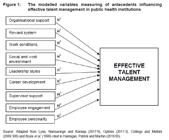
Source: Adapted from Lyria, Namusonge and Karanja (2017:6), Optimis (2011:3), Collings and Mellahi (2009:306) and Boyle et al. (1999) cited in Hannigan, Patrick and Machin (2016:65).
The following research hypotheses were formulated for this study, based on the modified theoretical model depicted in Figure 1:
H1: There is a relationship between organisational support and effective talent management.
H2: There is a relationship between the reward system and effective talent management.
H3: There is a relationship between work conditions and effective talent management.
H4: There is a relationship between the social and work environment and effective talent management.
H5: There is a relationship between leadership styles and effective talent management.
H6: There is a relationship between career development and effective talent management.
H7: There is a relationship between supervisor support and effective talent management.
H8: There is a relationship between employee engagement and effective talent management.
H9: There is a relationship between employee personality and effective talent management.
5. RESEARCH METHODOLOGY
The quantitative method has been employed in this study because it allows the original set of research goals to be followed, allows the researcher to arrive at more objective conclusions and supports the testing of hypotheses. In addition, since the independent and dependent variables under investigation in this study have been clearly specified prior to data collection, the quantitative design for the study requires hypotheses testing to measure the relationship between the variables.
5.1
Population and samplingIn this study, the population comprised of all employees in public health institutions in Uganda. The employees in the healthcare sector included doctors, consultants, dentists, dispensers, nurses, pharmacists, clinical officers, laboratory staff, occupational therapists, allied health staff, environmental health officers, general administrative cadres, cold chain technicians and support staff. A sample of 910 employees was drawn from the population using stratified random sampling. Stratified random probability sampling was used in this study to select a sample of respondents from each stratum. These strata were divided into categories of public health institutions, in the Central region of Uganda, namely, national referral hospitals, regional hospitals, general hospitals, district health offices, urban authorities' health units and three health centres. A total number of 910 questionnaires were distributed to respondents in Uganda's Central region. The collected usable questionnaires were 655 (70% response rate) and a total of 255 (30%) were wasted and incomplete.
Fifty-one percent of the respondents were female and forty-nine percent male, while seventy-four percent were within the age group of 30 to 49 years. Eighty-two percent of the respondents had diplomas and bachelor's degrees. Seventy-five percent of the respondents, that is, had a tenure of less than ten years in the public health institutions. This implies that the management and government should implement employee retention strategies to manage talent effectively in the public health institutions.
5.2
Research instrumentA self-administered structured questionnaire comprising of 78 items was used, with six items relating to the biographical profile of the respondents. The questionnaire had the following number of items per variable: organisational support (6 items), reward system (6 items), work conditions (8 items) social and work environment (9 items), leadership style (9 items), career development (6 items), supervisor support (6 items), employee engagement (6 items), employee personality (6 items) and effective talent management (10 items). All questionnaire items were linked to a seven-point Likert scale (1 = strongly disagree, 2 = disagree, 3 = somewhat disagree, 4 = undecided, 5 = somewhat agree, 6 = agree, 7 = strongly agree).
6. DATA ANALYSIS
STATISTICA (version 12) software package was used to analyse data for reliability, validity, descriptive statistics and multiple regression. Finally, the hypothesised relationships were tested.
6.1 Validity and reliability
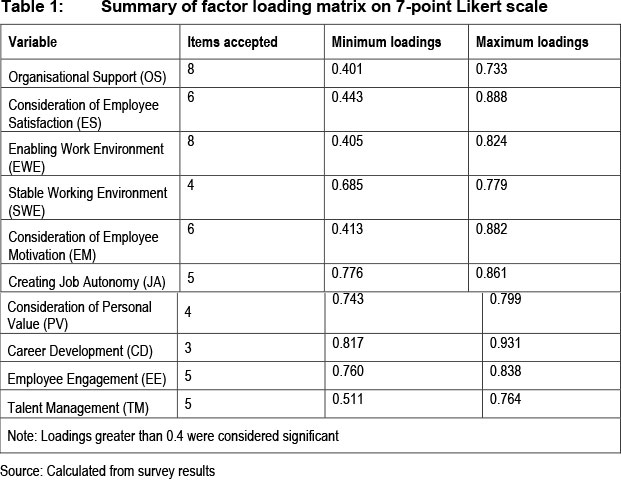
The validity of the various items used to measure the constructs, was verified by means of factor analysis, which is used to establish complex interrelationships amongst items and to group items that are part of unified concepts (de Smith 2018:30). For the purpose of this study, a factor should have at least three items and each of these items loading onto it should have factorial loads of not less than 0.4 (>0.4). Table 1 illustrates the findings of exploratory factor analysis.
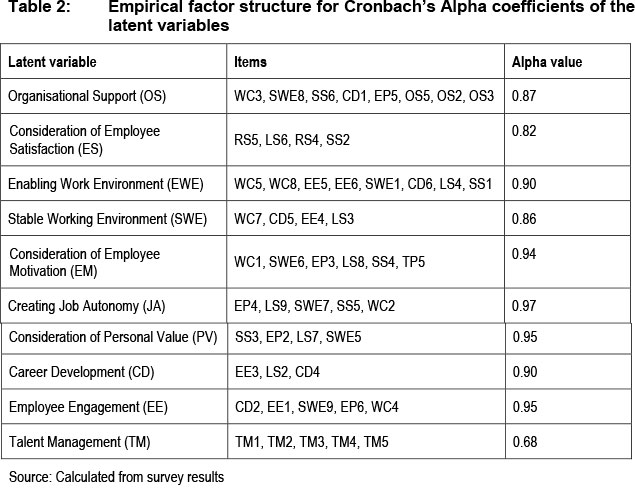
The constructs of the re-specified model and the items which were used to define each construct are depicted in Table 2. The constructs were identified as follows: Organisational Support (OS), Consideration of Employee Satisfaction (ES), Enabling Work Environment (EWE), Stable Working Environment (SWE), Consideration of Employee Motivation (EM), Creating Job Autonomy (JA), Consideration of Personal Value (PV), Career Development (CD), Employee Engagement (EE) and Talent Management (TM).
A Cronbach's Apha of 0.60 is considered acceptable and was used as the cut-off point in assessing internal consistency reliability (Riva, Xuereb, Makris, Ageno & Gatt 2019:971). The removal of items LS5 and WC6 improved the alpha value of 'personal value' from 0.52 to 0.95. Table 2 shows that all the Cronbach's Alpha values of the measuring instrument are 0.60 and above.
6.2 Regression analysis results
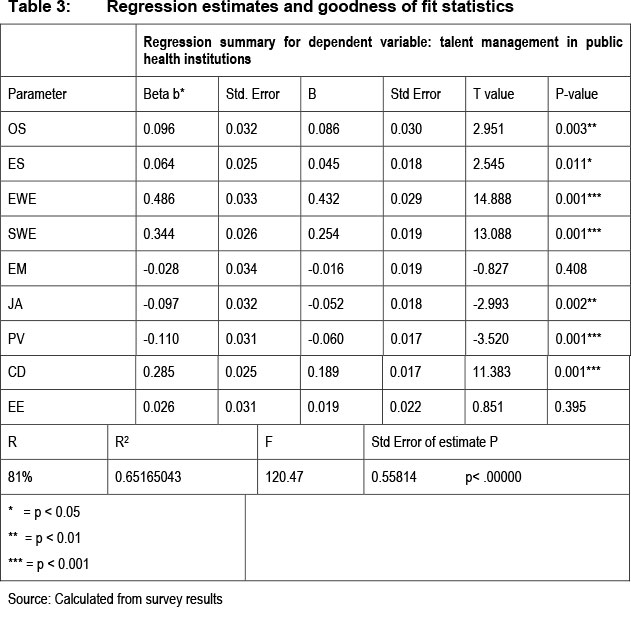
The influence of the independent variables on the dependent variables was evaluated through multiple regression analysis (Morrissey & Ruxton 2018:2). Table 3 indicates that an enabling work environment (b=0.432, p<0.001), a stable working environment (b=0.0254, p<0.001) and career development (b=-0.189, p<0.001) are positively related to talent management. The R2 of 0.651 indicates that 65% of variability in the model is explained by the moderating variable (TM). Creating job autonomy (b=-0.052, p<0.01) and consideration of personal value (b=-0.060, p<0.001) are negatively related to talent management. Although organisational support (b=0.086, p<0.01) and consideration of employee satisfaction (b=0.045, p<0.01) are related to talent management, these variables are moderately related.
The t-values reported in Table 3 indicate that the higher the t-values, the stronger the impact of the independent variables on 'talent management'. The independent variables with high t-values, namely, enabling work environment (t=14.888), stable working environment (t=13.088) and career development (t=11.383) have a strong impact on talent management. In contrast, a moderate t-value for consideration of personal value (t=-3.520), and low values for creating job autonomy (t=-2.993) and organisational support (t=2.951) as well as consideration of employee satisfaction (t=2.545) are evident.
7. FINDINGS OF THE REFORMULATED HYPOTHESES
H1: There is a relationship between organisational support and effective talent management.
Table 3 indicates a weak but existent relationship between organisational support and effective talent management (p<0.01). H1 is accepted.
H2.1: There is a relationship between consideration of employee satisfaction and effective talent management.
Table 3 reveals a weak but existent relationship between consideration of employee satisfaction and effective talent management (p<0.01). H2.1 is accepted.
H3.1: There is a relationship between enabling work environment and effective talent management
Table 3 reveals a statistically significant relationship between enabling work environment and effective talent management (p<0.001). H3.1 is accepted.
H3.2: There is a relationship between stable working environment and effective talent management
Table 3 reveals a statistically significant relationship between stable working environment and effective talent management (p<0.001). H3.2 is accepted.
H4.1: There is a relationship between consideration of employee motivation and effective talent management
Table 3 indicates that consideration of employee motivation is not significantly related to effective talent management (r=-0.028, NS). H4.1 is rejected and the alternative is accepted.
H4.2: There is a relationship between creating job autonomy and effective talent management
Table 3 reveals a statistically significant relationship between creating job autonomy and effective talent management (p<0.01). H4.2 is accepted.
H4.3: There is a relationship between consideration of personal value and effective talent management
Table 3 a statistically significant relationship between consideration of personal value and effective talent management (p<0.001). H4.3 is accepted.
H6: There is a relationship between career development and effective talent management
Table 3 reveals a statistically significant relationship between career development and effective talent management (p<0.001). H6 is accepted.
H8: There is a relationship between employee engagement and effective talent management
Table 3 indicates that employee engagement is not significantly related to effective talent management (r=0.026, NS). H8 is rejected and the alternative is accepted.
8. CONCLUSIONS AND RECOMMENDATIONS
The findings revealed in this study indicate that an enabling work environment, a stable working environment and career development effectively influence talent management. However, management in public health institutions need to realise the importance of creating opportunities to increase consideration of employee satisfaction, improve organisational support, facilitate and monitor creation of job autonomy and consideration of personal values, to effectively enhance talent management.
8.1
Organisational supportEmployees tend to feel that they are appreciated and valued when an organisation offers the necessary support through colleagues and management. It is thus indicated in this study that acknowledging employee contributions to the achievement of organisational objectives by rendering of satisfactory healthcare services is important in enhancing effective talent management in public health institutions. Thus, it is recommended that the management of these institutions:
• provide the necessary assistance, encouragement, appreciation, respect, care and empowerment for the well-being of employees.
• consider the different financial, emotional, moral and psychological needs of employees.
• consider and support the goals, values and opinions of employees by providing them with opportunities for career development and promotion.
• acknowledge, encourage and recognise the hard work and contribution of each employee, for employees to feel appreciated and valued.
• provide mentorship and guidance programmes such as job shadowing, monthly meetings, or mentorship sessions that can assist employees in reaching their full potential.
• identify and allow individuals to solve problems creatively, in innovative and imaginative ways.
8.2
Consideration of employee satisfactionThe subjective value judgement pertaining to the level of fulfilment of the needs, wants and desires of an individual in an organization describes employee satisfaction. The organisations need to manage talented employees by ascertaining and fulfilling their employment requests as well as those related to their position and work environment, so that they are gratified with their job performance. Thus, it is recommended that for employee satisfaction, to promote the effective talent management of employees in public health institutions, management should:
• promote fair and consistently applied financial policies, on salaries, benefits and allowances, to satisfy employees.
• provide clear, transparent and efficient policies on remuneration, performance, evaluation and retention.
• provide talented employees with greater responsibility and authority, as this is an opportunity for career advancement.
8.3
Enabling work environmentBased on this study an enabling work environment is a setting in which the systems and circumstances meet the needs of employees and make the work itself a rewarding experience. Organisations thus need to create an enabling work environment to enhance a more rewarding work experience for employees, which would allow for effective talent management. Accordingly, it is recommended that management in public health institutions:
• provide a work space that is safe, free from noise and has sufficient lighting.
• cultivate a culture of participation in decision making pertaining to issues such as career and organisational growth, which can drive creativity and innovation.
• focus on potential, and not only on performance, by matching individuals with the suitable positions to expose their capabilities and potential. This can be done by providing employees with the requisite skills, tools and technology to carry out tasks and fulfil the responsibilities inherent in these positions.
• help employees plan their career transitions and growth, which includes providing career opportunities that are in line with employee passions and interests.
• trust and respect the decisions made by employees.
8.4
Stable working environmentA combination of conditions such as social ties, participatory decision making, resources, which have the ability to enhance positive outcomes such as performance, quality of work, loyalty and employee wellbeing describes a stable work setting. Organisations need to expose employees to a stable working environment that can enhance employee well-being and become a source of competitive advantage for organisations. In this respect, it is recommended that management in public health institutions:
• recognise and reward performance, respect work/life balance and mitigate instances of workplace bullying, harassment and discrimination.
• make employees comfortable by encouraging open communication.
• prepare a stable and pleasant workplace for employees as they carry out their duties, such as providing job security at work and designing clear work rules and policies that can guide employees on employment issues including, work hours, leave, vacation time, holidays and overtime.
• offer training related to the accomplishment of tasks and focussing on matters such as health and data protection.
• be proactive and adapt to both short and long-term changes in methods, technologies and organisational structure, to succeed in managing talented employees.
Therefore, when employees believe their workplace to be a stable working environment, talent management will be achieved.
8.5
Creating job autonomyIt is important for organisations to offer employees considerable liberty and choice to make decisions that are associated with successful work scheduling and accomplishing their tasks. Based on the findings of the study, employees in public health institutions are not offered liberty to decide how they are going to perform their duties and solve problems on their own. Therefore, public health institutions need to offer employees the freedom to carry out tasks that will optimise their talents. In light of this, it is recommended that management:
• provide employees with access to information and resources that are relevant to the accomplishment of their duties.
• grant the employees authority and responsibility to execute tasks.
• encourage units or teams to schedule their own work and determine themselves how to do it.
• provide for flexible work arrangements and appreciate employees who are flexible at work, in terms of working hours, task expectations, responsibilities and responses to change.
More so, for talent management to be improved, it is important that employees see that their organisations consider them to be competent, with the right skills and knowledge to carry out their assignments.
8.6
Consideration of personal valuesEmployees need to have desirable personal values such as honesty, intelligence, creativity, kindness, confidence, courage, fairness, courtesy and passion that are perceived as useful and constructive to their respective organisations. Therefore, the public health institutions should understand the personal value of each employee, to identify employees who have the desirable attitudes and intentions, for the enhancement and effective management of their talent. Accordingly, it is recommended that management:
• appreciate personal values in terms of understanding the principles, goals and standards that individuals consider worthy to promote their talent.
• appreciate employees who are innovative, adaptive to change, open and honest while communicating.
• understand the values of individual employees and match each employee to a job that suits his/her personal values.
• invest in training and development to inculcate appropriate and sound values in employees.
• build and nurture personal values by rewarding positive behaviours, and create a conducive environment that is characterised by open communication and feedback as well as furnished, well-lit, comfortable and equipped work spaces.
8.7 Career development
Public health institutions need to manage talented employees by identifying career development needs that can be modified through the enhancement of skills, knowledge and experience relevant to the field of health. Thus, it is recommended that management:
• coach, mentor and counsel new employees so that they are aware of, and participate in, career development efforts within their institutions.
• take an active interest in individual employees' career plans and possibilities for development.
• have one-on-one career sessions or workshops in which employees are assisted in career planning.
• prioritise investment in the training and education of all employees.
It can also be concluded that it is important for management to be the chief judge of the achievements of members of their group, which ensures effective leadership in terms of career development.
8.8 Effective talent management
Based on the findings of this study, organisations are expected to establish and provide a stable and an enabling work environment that can meet the needs and desires of their employees. Employees consider staying rooted to organisations that offer career development opportunities, can help employees fulfil their potential. Organisations that provide employees with enough freedom to carry out their tasks at work are making significant strides in the management of employee talent. Organisations need to ascertain and utilise information about the values and principles that employees hold, since this will help explain employee behaviours and attitudes at work, which is important to the management of employee talent. The support that an organisation provides, in terms of assistance and guidance, is guaranteed to contribute to positive behaviour within the workplace, which is important in the management of talented employees. The contentment that employees feel when their needs have been fulfilled is also important to employee talent management. Therefore, it can be concluded that the unique antecedents of effective talent management of workforce in the health environment are: stable working environment, an enabling work environment, career development, creating job autonomy, consideration of employee values, organisational support and consideration of employee satisfaction. It is thus recommended that management:
• make an effort to align the positions of talented employees with organisational needs.
• put in place systematic succession plans that can enable employees to effectively perform roles that have traditionally been reserved for members of management and to deal with the changing realities of the workplace that result from the transfer, death or retirement of employees.
• facilitate and support employees to learn work-related competencies such as teamwork, responsibility, work commitment, decision making, communication and leadership.
• foster professional growth and development in order to enhance talent management in organisations.
• offer specialised training, formal education, or advanced professional learning intended to help employees to increase their levels of knowledge, competence, skill and effectiveness at work.
• recognise the role of the talent pool to uncover the hidden potential of employees, which is the essence of talent management.
• create and make use of a profile of employees who have the potential and ability to contribute to performance.
• make an effort to understand the values of individual employees and to match employees to jobs which enhance their talent effectively.
REFERENCES
4. LITERATURE REVIEW
-
ADENIJI A, OSIBANJO O, SALAU OP, FALOLA HO, IGBINOBA E, OHUNAKIN F & OGUEYUNGBO O. 2019. Competence model for measuring career development and organisational growth in the health sector. Verslas: Teorija Ir Praktika / Business: Theory And Practice 20:246-258. [Internet:http://eprints.covenantuniversity.edu.ng/12755/1/BTP_article_30957_en_2.pdf; downloaded on 07 May 2020.
» http://eprints.covenantuniversity.edu.ng/12755/1/BTP_article_30957_en_2.pdf -
]
» https://apsdpr.org/index.php/apsdpr/article/download/228/323 -
]
» https://www.researchgate.net/profile/Zulqurnain_Ali2/publication/332560759_Managing_Organizational _Effectiveness_through_Talent_Management_and_Career_Development_The_Mediating_Role_of_Employee_En gagement/links/5cc15238299bf120977d832d/Managing-Organizational-Effectiveness-through-Talent-Management-and-Career-Development-The-Mediating-Role-of-Employee-Engagement.pdf -
ALEFARI M, BARAHONA AMF & SALONITIS K. 2018. Modelling manufacturing employees' performance based on a system dynamics approach. Procedia CIRP 72:438-443. [Internet:https://www.sciencedirect.com/science/article/pii/S2212827118303196/ pdf?md5=deb440a7af0e6eb8ba4baa18d65d530c&pid=1-s2.0-S2212827118303196-main.pdf; downloaded on 07 May 2020.
» https://www.sciencedirect.com/science/article/pii/S2212827118303196/ pdf?md5=deb440a7af0e6eb8ba4baa18d65d530c&pid=1-s2.0-S2212827118303196-main.pdf -
]
» https://pdfs.semanticscholar.org/9b77/cfa72ca285a368aca30b3ced8cbb9ac02cde.pdf -
]
» https://esource.dbs.ie/bitstream/handle/10788/3665/mba_aremu_a_2019.pdf?sequence=1&isAllowed=y -
ALLISEY A, RODWELL J & NOBLET A. 2016. An application of an extended effort-reward imbalance model to police absenteeism behaviour. Personnel Review 45(4):663-680. [Internet:https://www.emerald.com/insight/content/doi/10.1108/PR-06-2014-0125/full/pdf?title=an-application-of-an-extended-effort-reward-imbalance-model-to-police-absenteeism-behaviour; downloaded on 07 May 2020.
» https://www.emerald.com/insight/content/doi/10.1108/PR-06-2014-0125/full/pdf?title=an-application-of-an-extended-effort-reward-imbalance-model-to-police-absenteeism-behaviour -
]
» http://yadda.icm.edu.pl/baztech/element/bwmeta1.element.baztech-bdcf73bc-c98b-428d-93de-6ad821ad2ffc/c/Beck-Krala_PJMS_2017_16_2_17.pdf -
]
» http://cqm.rs/2016/cd1/pdf/papers/focus_1/26.pdf -
ANTONY MR. 2018. Paradigm shift in employee engagement-A critical analysis on the drivers of employee engagement. International Journal of Information, Business and Management 10(2):32-46. [Internet:http://ijibm.site666.com/IJIBM_Vol10No2_May2018.pdf#page=37; downloaded on 07 May 2020.
» http://ijibm.site666.com/IJIBM_Vol10No2_May2018.pdf#page=37 -
]
» https://www.emerald.com/insight/content/doi/10.1108/EJTD-07-2016-0049/full/pdf?title=career-adaptability-as-a-strategic-competence-for-career-development-an-exploratory-study-of-its-key-predictors -
]
» https://www.emerald.com/insight/content/doi/10.1108/JWL-08-2016-0079/full/pdf?title=improving-transfer-of-training-with-transfer-design-does-supervisor-support-moderate-the-relationship -
ASRAR-UL-HAQ M & KUCHINKE KP. 2016. Impact of leadership styles on employees' attitude towards their leader and performance: Empirical evidence from Pakistani banks. Future Business Journal 2(1):54-64. [Internet:https://www.sciencedirect.com/science/article/pii/S2314721016300032; downloaded on 07 May 2020.
» https://www.sciencedirect.com/science/article/pii/S2314721016300032 -
]
» http://www.academia.edu/download/32086459/1-s2.0-S1053482209000461-main.pdf -
]
» http://www.davidpublisher.com/Public/uploads/Contribute/5dd509f70487a.pdf -
BERTHELSEN H, MUHONEN T & TOIVANEN S. 2018. What happens to the physical and psychosocial work environment when activity-based offices are introduced into academia? Journal of Corporate Real Estate 20(4):1-13. [Internet:https://muep.mau.se/bitstream/handle/2043/26905/Main%20document%20relocation%20%28rev2%201 9%20okt2017%29%20MUEP.pdf?sequence=2&isAllowed=y; downloaded on 07 May 2020.
» https://muep.mau.se/bitstream/handle/2043/26905/Main%20document%20relocation%20%28rev2%201 9%20okt2017%29%20MUEP.pdf?sequence=2& isAllowed=y -
]
» https://pdfs.semanticscholar.org/9857/acb682451b41cf8bc9fa15302f07a3d6c662.pdf -
]
» https://www.ncbi.nlm.nih.gov/pmc/articles/PMC6087547/pdf/nihms-983097.pdf -
BJÖRKMAN I, EHRNROOTH M, MÄKELÄ K, SMALE A & SUMELIUS J. 2017. Talent management in multinational corporations. The Oxford handbook of talent management 1-25. [Internet:https://osuva.uwasa.fi/bitstream/handle/10024/10282/Osuva_Bj%C3%B6rkman _Ehrnrooth_M%C3%A4kel%C3%A4_Smale_Sumelius_2017.pdf?sequence=2&isAllowed=y; downloaded on 07 May 2020.
» https://osuva.uwasa.fi/bitstream/handle/10024/10282/Osuva_Bj%C3%B6rkman _Ehrnrooth_M%C3%A4kel%C3%A4_Smale_Sumelius_2017.pdf?sequence=2& isAllowed=y -
]
» https://www.omicsonline.org/open-access/impact-of-workplace-environment-on-health-workers-2329-6879-1000261.pdf -
]
» http://www.eajournals.org/wp-content/uploads/Personality-Characteristics-and-Employee-Affective-Commitment.pdf -
CAO M & LI X. 2017. Research on training mode of tourism talents in universities against the background of reform of the supply front. (2nd International Conference on Education, E-learning and Management Technology) 365-369. [Internet:http://www.dpi-proceedings.com/index.php/dtssehs/article/viewFile/14489/14006; downloaded on 07 May 2020.
» http://www.dpi-proceedings.com/index.php/dtssehs/article/viewFile/14489/14006 -
]
» https://oem.bmj.com/content/oemed/75/3/183.full.pdf -
]
» https://www.ncbi.nlm.nih.gov/pmc/articles/PMC6089369/pdf/nihms975686.pdf -
CHAVENGVORAKUL K & WONGSURAWAT W. 2017. Scandal prevention through a moral work environment: Case Study from Thailand. Development and Learning in Organizations 31(3):15-18. [Internet:https://www.emerald.com/insight/content/doi/10.1108/DLO-03-2016-0027/full/pdf?title=scandal-prevention-through-a-moral-work-environment-case-study-from-thailand; downloaded on 07 May 2020.
» https://www.emerald.com/insight/content/doi/10.1108/DLO-03-2016-0027/full/pdf?title=scandal-prevention-through-a-moral-work-environment-case-study-from-thailand -
]
» https://www.sciencedirect.com/science/article/pii/S2352827316301793 -
]
» https://www.researchgate.net/profile/M_Machin/publication/310235908 _Maximising_retention_of_nurses_Australian_evidence/links/582a85c108ae102f071f398e/Maximising-retention-of-nurses-Australian-evidence.pdf?origin=publication_detail -
DAHSHAN MEAE, KESHK LI & DORGHAM LS. 2018. Talent Management and Its Effect on Organization Performance among Nurses at Shebin El-Kom Hospitals. International Journal of Nursing 5(2):108-123. [Internet:https://www.researchgate.net/profile/Laila_Dorgham3/publication/330507104 _Talent_Management_and_Its_Effect_on_Organization_Performance_among_Nurses_at_Shebin_El_-Kom_Hospitals/links/5e0cb8a84585159aa4aa3f7d/Talent-Management-and-Its-Effect-on-Organization-Performance-among-Nurses-at-Shebin-El-Kom-Hospitals.pdf; downloaded on 07 May 2020.
» https://www.researchgate.net/profile/Laila_Dorgham3/publication/330507104 _Talent_Management_and_Its_Effect_on_Organization_Performance_among_Nurses_at_Shebin_El_-Kom_Hospitals/links/5e0cb8a84585159aa4aa3f7d/Talent-Management-and-Its-Effect-on-Organization-Performance-among-Nurses-at-Shebin-El-Kom-Hospitals.pdf -
]
» http://www.journalsajsse.com/index.php/SAJSSE/article/download/25766/48208 -
]
» http://www.lifescienceglobal.com/pms/index.php/jrge/article/download/5448/3068 -
DE LA FUENTE-SOLANA EI, CAÑADAS GR, RAMIREZ-BAENA L, GÓMEZ-URQUIZA JL, ARIZA T & CAÑADAS-DE LA FUENTE GA. 2019. An explanatory model of potential changes in burnout diagnosis according to personality factors in oncology nurses. International journal of environmental research and public health 16(312):1-9. [Internet:https://www.mdpi.com/1660-4601/16/3/312/pdf; downloaded on 07 May 2020.
» https://www.mdpi.com/1660-4601/16/3/312/pdf -
]
» https://helda.helsinki.fi/dhanken/bitstream/handle/10227/10325/10_1108_ER_02_2018_ 0064.pdf?sequence=1& isAllowed=y -
]
» https://pdfs.semanticscholar.org/8ff7/d9e00c44a4a82286a5d3c7dcd3bdb2e88875.pdf?_ga=2.26151790 1.1792266301.1568689535-1000002052.1537848666 -
DONG Y. 2019. Optimization of Talent Flow Model under Flexible Human Resource Management. (5th International Conference on Economics, Management and Humanities Science) 904-909. [Internet:https://webofproceedings.org/proceedings_series/ECOM/ECOMHS%202019/ECOMHS19196.pdf; downloaded on 07 May 2020.
» https://webofproceedings.org/proceedings_series/ECOM/ECOMHS%202019/ECOMHS19196.pdf -
]
» https://www.researchgate.net/profile/Mohsin_Shaikh3/publication/322002581_Employee_Engagement_ Tool_of_Talent_Retention_Study_of_a_Pharmaceutical_Company/links/5ab9f35aa6fdcc46d3ba36e9/Employee-Engagement-Tool-of-Talent-Retention-Study-of-a-Pharmaceutical-Company.pdf -
]
» https://sloap.org/journals/index.php/irjmis/article/download/166/1045 -
EBRAHIMI P, MOOSAVI SM & CHIRANI E. 2016. Relationship between Leadership Styles and Organizational Performance by Considering Innovation in Manufacturing Companies of Guilan Province. Procedia-Social and Behavioral Sciences 230:351-358. [Internet:https://www.sciencedirect.com/science/article/pii/S1877042816311454/pdf?md5=24c2fc3081f9d6d3fbf4e0472a8f6f62&isDTMRedir=Y&pid=1-s2.0-S1877042816311454-main.pdf; downloaded on 07 May 2020.
» https://www.sciencedirect.com/science/article/pii/S1877042816311454/pdf?md5=24c2fc3081f9d6d3fbf4e0472a8f6f62&isDTMRedir=Y&pid=1-s2.0-S1877042816311454-main.pdf -
]
» https://cris.maastrichtuniversity.nl/ws/portalfiles/portal/17766777/c5839.pdf -
]
» https://human-resources-health.biomedcentral.com/track/pdf/10.1186/s12960-018-0272-1 -
EKIYOR R & DAPPER E. 2019. Leadership Styles and Entrepreneurial Orientation. European Journal of Business and Management 11(8):88-94. [Internet:https://www.researchgate.net/profile/Regina_Ekiyor2/publication/33223283 4_Leadership_Styles_and_Entrepreneurial_Orientation/links/5ca7922992851c64bd53056f/Leadership-Styles-and-Entrepreneurial-Orientation.pdf; downloaded on 07 May 2020.
» https://www.researchgate.net/profile/Regina_Ekiyor2/publication/33223283 4_Leadership_Styles_and_Entrepreneurial_Orientation/links/5ca7922992851c64bd53056f/Leadership-Styles-and-Entrepreneurial-Orientation.pdf -
]
» https://www.equinetafrica.org/sites/default/files/uploads/ documents/EQ%20Diss%20115%20HR%20ret°/o20litrev°/o20Sep°/o202018.pdf -
]
» https://archives.tpnsindia.org/index.php/sipn/article/download/273/253 -
FAHLEVI M, ZUHRI S, PARASHAKTI RD & EKHSAN M. 2019. Leadership Styles of Food Truck Businesses. Journal of Research in Business, Economics and Management 13(2):2437-2442. [Internet:https://www.researchgate.net/profile/Mochammad_Fahlevi2/publication/ 334441144_LEADERSHIP_STYLES_OF_FOOD_TRUCK_BUSINESSES/links/5d2947a8a6fdcc2462da2b3d/LEADERSHIP-STYLES-OF-FOOD-TRUCK-BUSINESSES.pdf; downloaded on 07 May 2020.
» https://www.researchgate.net/profile/Mochammad_Fahlevi2/publication/ 334441144_LEADERSHIP_STYLES_OF_FOOD_TRUCK_BUSINESSES/links/5d2947a8a6fdcc2462da2b3d/LEADERSHIP-STYLES-OF-FOOD-TRUCK-BUSINESSES.pdf -
]
» https://academic.oup.com/occmed/article-pdf/67/5/394/18688413/kqx066.pdf -
]
» https://fardapaper.ir/mohavaha/uploads/2020/03/Fardapaper-A-new-perspective-to-promote-organizational-citizenship-behaviour-for-the-environment-The-role-of-transformational-leadership.pdf -
FLETCHER L. 2016. Can perceptions of flexible work arrangements boost engagement and desirable employee behaviour? University of Brighton. [Internet:https://cris.brighton.ac.uk/ws/portalfiles/portal/397696/LFletcher_CIPD_paper.pdf; downloaded on 07 May 2020.
» https://cris.brighton.ac.uk/ws/portalfiles/portal/397696/LFletcher_CIPD_paper.pdf -
]
» https://www.ajol.info/index.php/saje/article/download/149299/138798 -
]
» https://gh.bmj.com/content/bmjgh/5/8/e002445.full.pdf -
GERARD L, MCMILLAN J & D'ANNUNZIO-GREEN N. 2017. Conceptualising sustainable Leadership. Industrial and Commercial Training 49(3):116-126. [Internet:https://www.emerald.com/insight/content/doi/10.1108/ICT-12-2016-0079/full/pdf?title=conceptualising-sustainable-leadership; downloaded on 07 May 2020.
» https://www.emerald.com/insight/content/doi/10.1108/ICT-12-2016-0079/full/pdf?title=conceptualising-sustainable-leadership -
]
» http://mural.maynoothuniversity.ie/8933/1/MCH_%20Exploring.pdf -
]
» http://eprints.covenantuniversity.edu.ng/11367/1/Osibanjo%20et%20al%20_Web12_1_%20%281%29.pdf -
HAMUKWAYA SI & YAZDANIFARD R. 2014. How a Proper Performance Related Reward System Can Contribute to Work Performance Excellence. Open Journal of Business and Management 2:189-194. (DOI:http://dx.doi.org/10.4236/ojbm.2014.23023; downloaded on 22 November 2020.
» http://dx.doi.org/10.4236/ojbm.2014.23023 -
)
» https://pdfs.semanticscholar.org/39f0/37d3dfe7f7d2bec2965872a3d9acfc8fea64.pdf -
]
» http://student.bms.lk/GDM/Assignment/MPAssignment/10.pdf -
HASSAN R. 2016. The role of human capital management in enhancing engagement and retention among top talent in organization: A critical literature review. Journal of Emerging Economies & Islamic Research 4:54-67. [Internet:http://ir.uitm.edu.my/id/eprint/32809/1/32809.pdf; downloaded on 26 November 2020.
» http://ir.uitm.edu.my/id/eprint/32809/1/32809.pdf -
]
» https://www.tandfonline.com/doi/pdf/10.1080/15021149.2018.1438339 -
]
» https://www.emerald.com/insight/content/doi/10.1108/PR-02-2015-0024/full/pdf?title=rewarding-employees-in-turbulent-economies-for-improved-organisational-performance-exploring-smes-in-the-south-eastern-european-region -
HOWELL A. 2017. Engagement starts at the top: the role of a leader's personality on employee engagement. Strategic HR Review 16(3):144-146. [Internet:https://www.emerald.com/insight/content/doi/10.1108/SHR-03-2017-0017/full/pdf?title=engagement-starts-at-the-top-the-role-of-a-leaders-personality-on-employee-engagement; downloaded on 07 May 2020.
» https://www.emerald.com/insight/content/doi/10.1108/SHR-03-2017-0017/full/pdf?title=engagement-starts-at-the-top-the-role-of-a-leaders-personality-on-employee-engagement -
]
» https://apcz.umk.pl/czasopisma/index.php/JPM/article/viewFile/27920/23764 -
]
» https://www.researchgate.net/profile/Nagarajapillai_Ramu/publication/325336420_Primax _International_Journal_of_Commerce_and_Management_Research_EMERGING_TALENT_MANAGEMENT_PRACTICES_I N_THE_NEW_MILLIENNIUM/links/5b06aa1c4585157f8709e281/Primax-International-Journal-of-Commerce-and-Management-Research-EMERGING-TALENT-MANAGEMENT-PRACTICES-IN-THE-NEW-MILLIENNIUM.pdf -
I SOLÀ GJ, I BADIA JG, HITO PD, OSABA MAC & GARCÍA JLDV. 2016. Self-perception of leadership styles and behaviour in primary health care. BMC health services research 16(572):1-9. [Internet:https://bmchealthservres.biomedcentral.com/articles/10.1186/s12913-016-1819-2; downloaded on 07 May 2020.
» https://bmchealthservres.biomedcentral.com/articles/10.1186/s12913-016-1819-2 -
]
» https://acta.mendelu.cz/media/pdf/actaun_2016064020653.pdf -
]
» https://www.econstor.eu/bitstream/10419/169328/1/ewp-497.pdf -
JIGSSA HA, DESTA BF, TILAHUN HA, MCCUTCHEON J & BERMAN P. 2018. Factors contributing to motivation of volunteer community health workers in Ethiopia: the case of four woredas (districts) in Oromia and Tigray regions. Human resources for health 16(57):1-11. [Internet:https://link.springer.com/article/10.1186/s12960-018-0319-3; downloaded on 07 May 2020.
» https://link.springer.com/article/10.1186/s12960-018-0319-3 -
]
» https://bmjopen.bmj.com/content/7/7/e016810?itm_content=consumer& itm _medium=cpc& itm_source=trendmd& itm_term=0-A& itm_campaign=bmjo -
]
» https://www.researchgate.net/profile/Allah_Nawaz/publication/334786252_THE_MEDIATION _OF_TRANSFORMATIONAL_LEADERSHIP_BETWEEN_TRANSACTIONAL_LEADERSHIP_ AND_GROUP_MANAGEMENT_SKILLS_OF_ACADEMICIANS_IN_HEIs_OF_KPK_PAKISTAN/links/5d41840b299bf1995b59b0c2/THE-MEDIATION-OF-TRANSFORMATIONAL-LEADERSHIP-BETWEEN-TRANSACTIONAL-LEADERSHIP-AND-GROUP-MANAGEMENT-SKILLS-OF-ACADEMICIANS-IN-HEIs-OF-KPK-PAKISTAN.pdf -
JINDAL P & SHAIKH M. 2016. Talent Management through Employee Engagement in Hospitality Companies. International Journal of Multidisciplinar/ and Current research 4:1216-1222. pnternet:http://ijmcr.com/wp-content/uploads/2016/12/Paper211216-1222.pdf; downloaded on 07 May 2020.
» http://ijmcr.com/wp-content/uploads/2016/12/Paper211216-1222.pdf -
]
» https://d1wqtxts1xzle7.cloudfront.net/61103074/solaja_and_Ogunola_leadpaper20191102-15301-1vml18o.pdf?1572707621=& response-content-disposition=inline%3B+filename%3DLeadershipStyle_and_Multigenerational_W.pdf& Expires=1606390975& Sig nature=brBHxjti6swL2OEMmoF97nmyQG2yzqVyF-t-kxe0kmym7oPbMBt9fuDujHRaLQm007bJIISZy2M7bC90~PIXTr0WmUCaFiEhdjVyqmBYw4I8GPLY09qTIn5f6z OBj3g3Z48kVs9QyAjcr85ZdQuC43t-wTOO82yCKDJk259s~9jJNzrpL9Vfxz~0x0Ov6oDY9NS9nAJI96uiCEKLXq-ikQ8I5nKuphib0CkDM4j9iYgNnKJXKmzTHg5smcP1Ynydj~JuR1MpUIvX~Y7fbgyZ5JBbJqEvBvTai ke4efOnRNtVghNc4zXRU9JMEJNd6Gg4OcsTt5mI32JxcwAgEwyFQ__& Key-Pair-Id=APKAJLOHF5GGSLRBV4ZA -
]
» https://www.emerald.com/insight/content/doi/10.1108/LODJ-08-2014-0147/full/html -
KAOK M, YUSUF RM & DEWI ARS. 2019. PENGARUH GAYA KEPEMIMPINAN DAN TALENT MANAGEMENT TERHADAP PENGEMBANGAN KARYAWAN PADA PT. MARSYAVIN JAYA KABUPATEN MERAUKE. Hasanuddin Journal of Applied Business and Entrepreneurship 2(1):46-59. [Internet:https://feb.unhas.ac.id/jurnal/index.php/hjabe/article/download/140/79; downloaded on 07 May 2020.
» https://feb.unhas.ac.id/jurnal/index.php/hjabe/article/download/140/79 -
]
» https://onlinelibrary.wiley.com/doi/pdf/10.1111/jjns.12180 -
]
» https://www.researchgate.net/profile/Marian_Thunnissen/publication/286455838_Talent_management _for_what_how_and_how_well_An_empirical_exploration_of_Talent_Management_in_practice/links/56adde3808a e28588c619834/Talent-management-for-what-how-and-how-well-An-empirical-exploration-of-Talent-Management-in-practice.pdf -
KHALID N, PAHI MH & AHMED U. 2016. Loosing your best talent: Can leadership retain employees? The dilemma of the banking sector of Hyderabad Sindh, Pakistan: A mediation investigation. International Review of Management and Marketing 6(3):608-616. [Internet:http://repo.uum.edu.my/20211/1/IRMM%2063%202016%20%20608-616.pdf; downloaded on 07 May 2020.
» http://repo.uum.edu.my/20211/1/IRMM%2063%202016%20%20608-616.pdf -
]
» http://eprints.leedsbeckett.ac.uk/4367/1/DevelopingTalentStrategiesPV_TURNER.pdf -
]
» https://www.researchgate.net/profile/Lucie_Vnouckova/publication/326054975_Building_Employer_Ima ge_Thanks_to_Talent_Programmes_in_Czech_Organisations/links/5e41494b458515072d8e2fce/Building-Employer-Image-Thanks-to-Talent-Programmes-in-Czech-Organisations.pdf -
LIU W, ZHAO S, SHI L, ZHANG Z, LIU X, LI L, DUAN X, LI G, LOU F, JIA X, FAN L, SUN T & NI X. 2018. Workplace violence, job satisfaction, burnout, perceived organisational support and their effects on turnover intention among Chinese nurses in tertiary hospitals: a cross-sectional study. BMJ open 8(6):1-11. [Internet:https://bmjopen.bmj.com/content/bmjopen/8/6/e019525.full.pdf; downloaded on 07 May 2020.
» https://bmjopen.bmj.com/content/bmjopen/8/6/e019525.full.pdf -
]
» http://irep.ntu.ac.uk/id/eprint/35879/1/13456_Whysall.pdf - ]
-
LYRIA RK, NAMUSONGE GS & KARANJA K. 2017. Role of talent management on organisation performance in companies listed in Nairobi securities exchange in Kenya. Journal of Human Resource and Leadership 1(3):1-17. [Internet:https://iprjb.org/journals/index.php/JHRL/article/download/216/283; downloaded on 07 May 2020.
» https://iprjb.org/journals/index.php/JHRL/article/download/216/283 - ]
- ]
-
MALIK SZ, SALEEM M & NAEEM R. 2016. Effect of leadership styles on organizational citizenship behaviour in employees of telecom sector in Pakistan. Pakistan Economic and Social Review 54(2):385-406. [Internet:http://pu.edu.pk/images/journal/pesr/PDF-FILES/10-v54_2_16.pdf; downloaded on 07 May 2020.
» http://pu.edu.pk/images/journal/pesr/PDF-FILES/10-v54_2_16.pdf - ]
- ]
-
MASHARYONO S, PRATAMA KF & PURNAMA R. 2016. The Effect of Social Work Environment on Employee Productivity in Manufacturing Company in Indonesia. (1st Global Conference on Business, Management and Entrepreneurship (GCBME-16)). Advances in Economics, Business and Management Research 15. [Internet:https://download.atlantis-press.com/article/25865978.pdf; downloaded on 07 May 2020.
» https://download.atlantis-press.com/article/25865978.pdf - ]
- ]
-
MENSAH JK. 2019. Talent management and talented employees' attitudes: mediating role of perceived organisational support. International Review of Administrative Sciences 85(3):527-543. [Internet:http://197.255.68.205/bitstream/handle/123456789/32319/Talent-management-and-talented-employees-attitudes-mediating-role-of-perceived-organisational-supportInternational-Review-of-Administrative-Sciences.pdf?sequence=1&isAllowed=y; downloaded on 07 May 2020.
» http://197.255.68.205/bitstream/handle/123456789/32319/Talent-management-and-talented-employees-attitudes-mediating-role-of-perceived-organisational-supportInternational-Review-of-Administrative-Sciences.pdf?sequence=1& isAllowed=y - ]
- ]
-
MOMANYI GO, ADOYO MA, MWANGI EM & MOKUA DO. 2016. Value of training on motivation among health workers in Narok County, Kenya. Pan African Medical Journal 23(1):1-12. [Internet:https://www.ajol.info/index.php/pamj/article/download/139648/129341; downloaded on 07 May 2020.
» https://www.ajol.info/index.php/pamj/article/download/139648/129341 - ]
- ]
-
MORRISSEY MB & RUXTON GD. 2018. Multiple regression is not multiple regressions: the meaning of multiple regression and the non-problem of collinearity. Philos Theor Pract Biol 10(3):1-24. [Internet:https://philarchive.org/archive/MORMRI-4; downloaded on 07 May 2020.
» https://philarchive.org/archive/MORMRI-4 - ]
- ]
-
MWANZI J, WAMITU S & KIAMA M. 2017. Influence of talent management on organizational growth. IOSR Journal of Business and Management (IOSR-JBM) 19(8):01-36. [Internet:http://41.89.55.71:8080/xmlui/bitstream/handle/123456789/3810/ Wamitu_Influence%20of%20talent%20management%20on%20organizational%20growth.pdf?sequence=1&isAllowed=y; downloaded on 07 May 2020.
» http://41.89.55.71:8080/xmlui/bitstream/handle/123456789/3810/ Wamitu_Influence%20of%20talent%20management%20on%20organizational%20growth.pdf?sequence=1& isAllowed=y - ]
- ]
-
OPTIMIS HCM. 2011. Building your future - People, Strategy, Processes, Structures Systems. [Internet:https://www.optimis-hcm.com/data/file/Optimis-ConsultingServices-ENG.pdf; downloaded on 07 May 2020.
» https://www.optimis-hcm.com/data/file/Optimis-ConsultingServices-ENG.pdf - ]
- ]
-
OTHMAN AK, HAMZAH MI, ABAS MK & ZAKUAN NM. 2017. The influence of leadership styles on employee engagement: The moderating effect of communication styles. International Journal of Advanced and Applied Sciences 4(3):107-116. [Internet:https://www.academia.edu/download/57896388/IASE_IJAAS2017_Comm_styles_Engagement.pdf; downloaded on 26 November 2020.
» https://www.academia.edu/download/57896388/IASE_IJAAS2017_Comm_styles_Engagement.pdf - ]
- ]
-
PAGANO A. 2017. New international dynamics in the geography of human capital. Demografija 14:83-92. [Internet:https://scindeks-clanci.ceon.rs/data/pdf/1820-4244/2017/1820-42441714083P.pdf; downloaded on 07 May 2020.
» https://scindeks-clanci.ceon.rs/data/pdf/1820-4244/2017/1820-42441714083P.pdf - ]
- ]
-
PELUSO AM, INNOCENTI L & PILATI M. 2017. Pay is not everything: Differential effects of monetary and nonmonetary rewards on employees' attitudes and behaviours. Evidence-based HRM: A Global Forum for Empirical Scholarship 5(3):311-327. [Internet:https://www.researchgate.net/profile/Alessandro_M_Peluso/publication/320594499 _Pay_is_not_everything_Differential_effects_of_monetary_and_non-monetary_rewards_on_employees%27_attitudes_and_behaviours/links/5a2e8e65a6fdcc196d131af9/Pay-is-not-everything-Differential-effects-of-monetary-and-non-monetary-rewards-on-employees-attitudes-and-behaviours.pdf; downloaded on 07 May 2020.
» https://www.researchgate.net/profile/Alessandro_M_Peluso/publication/320594499 _Pay_is_not_everything_Differential_effects_of_monetary_and_non-monetary_rewards_on_employees%27_attitudes_and_behaviours/links/5a2e8e65a6fdcc196d131af9/Pay-is-not-everything-Differential-effects-of-monetary-and-non-monetary-rewards-on-employees-attitudes-and-behaviours.pdf - ]
- ]
-
POHL S & GALLETTA M. 2017. The role of supervisor emotional support on individual job satisfaction: A multilevel analysis. Applied Nursing Research 33:61-66. [Internet:https://www.researchgate.net/profile/Maura_Galletta/publication/308902900_The_role_of_ supervisor_emotional_support_on_individual_job_satisfaction_A_multilevel_analysis/links/5a9909dc0f7e9ba42977639d/The-role-of-supervisor-emotional-support-on-individual-job-satisfaction-A-multilevel-analysis.pdf; downloaded on 07 May 2020.
» https://www.researchgate.net/profile/Maura_Galletta/publication/308902900_The_role_of_ supervisor_emotional_support_on_individual_job_satisfaction_A_multilevel_analysis/links/5a9909dc0f7e9ba42977639d/The-role-of-supervisor-emotional-support-on-individual-job-satisfaction-A-multilevel-analysis.pdf - ]
- ]
-
PURYEAR JS, KETTLER T & RINN AN. 2019. Relating personality and creativity: Considering what and how we measure. The Journal of Creative Behavior 53(2):1-14. [Internet:https://www.researchgate.net/profile/Todd_Kettler/publication/315466809_Relating _Personality_and_Creativity_Considering_What_and_How_We_Measure/links/59cbb1d8a6fdcc451d5cdec5/Relating-Personality-and-Creativity-Considering-What-and-How-We-Measure.pdf; downloaded on 07 May 2020.
» https://www.researchgate.net/profile/Todd_Kettler/publication/315466809_Relating _Personality_and_Creativity_Considering_What_and_How_We_Measure/links/59cbb1d8a6fdcc451d5cdec5/Relating-Personality-and-Creativity-Considering-What-and-How-We-Measure.pdf - ]
- ]
-
RAMLI AA, ISA A, BAHARIN NL & IBRAHIM HI. 2018. The role of talent management in the relationships between employee engagement: A study of GLCs. In MATEC Web of Conferences. (MATEC Web of Conferences) 150:1-6. [Internet:https://www.matec-conferences.org/articles/matecconf/pdf/2018/09/matecconf_mucet2018_05060.pdf; downloaded on 07 May 2020.
» https://www.matec-conferences.org/articles/matecconf/pdf/2018/09/matecconf_mucet2018_05060.pdf - ]
- ]
-
RAO MS. 2017. Soft Leadership: An innovative leadership perspective. The Journal of Values-Based Leadership 10(1):1-11. [Internet:https://scholar.valpo.edu/cgi/viewcontent.cgi?referer=https://scholar.google.com/&httpsr edir=1&article=1179&context=jvbl; downloaded on 07 May 2020.
» https://scholar.valpo.edu/cgi/viewcontent.cgi?referer=https://scholar.google.com/& httpsr edir=1& article=1179& context=jvbl - ]
- ]
-
RIVA N, XUEREB CB, MAKRIS M, AGENO W & GATT A. 2019. Reliability and validity of the Maltese version of the Perception of Anticoagulant Treatment Questionnaire (PACT-Q). Patient preference adherence 13:969-979. [Internet:https://www.ncbi.nlm.nih.gov/pmc/articles/PMC6593733/; downloaded on 07 May 2020.
» https://www.ncbi.nlm.nih.gov/pmc/articles/PMC6593733/ - ]
- ]
-
SCHEFFLER RM, CAMPBELL J, COMETTO G, MAEDA A, LIU J, BRUCKNER TA, ARNOLD DR & EVANS T. 2018. Forecasting imbalances in the global health labor market and devising policy responses. Human Resources for Health 16(5):1-10. [Internet:https://human-resources-health.biomedcentral.com/track/pdf/10.1186/s12960-017-0264-6; downloaded on 07 May 2020.
» https://human-resources-health.biomedcentral.com/track/pdf/10.1186/s12960-017-0264-6 - ]
- ]
-
SIAM IMI, BAKAR MSB & RAMLI AB. 2019. Knowledge Sharing Behaviour and Leadership Style and Academic Job Performance: The Role of Entrepreneurial Orientation. Journal of Emerging Technologies and Innovative Research (JETIR) 6(11):74-87. [Internet:https://www.researchgate.net/profile/Ibrahim_Siam2/publication/340004339 _KNOWLEDGE_SHARING_BEHAVIOUR_AND_LEADERSHIP_STYLE_AND_ACADEMIC _JOB_PERFORMANCE_THE_ROLE_OF_ENTREPRENEURIAL_ORIENTATION/links/5e723ddc299bf15718476cea/KNOWLEDGE-SHARING-BEHAVIOUR-AND-LEADERSHIP-STYLE-AND-ACADEMIC-JOB-PERFORMANCE-THE-ROLE-OF-ENTREPRENEURIAL-ORIENTATION.pdf; downloaded on 07 May 2020.
» https://www.researchgate.net/profile/Ibrahim_Siam2/publication/340004339 _KNOWLEDGE_SHARING_BEHAVIOUR_AND_LEADERSHIP_STYLE_AND_ACADEMIC _JOB_PERFORMANCE_THE_ROLE_OF_ENTREPRENEURIAL_ORIENTATION/links/5e723ddc299bf15718476cea/KNOWLEDGE-SHARING-BEHAVIOUR-AND-LEADERSHIP-STYLE-AND-ACADEMIC-JOB-PERFORMANCE-THE-ROLE-OF-ENTREPRENEURIAL-ORIENTATION.pdf - ]
- ]
-
SINGH R. 2019. Developing organisational embeddedness: employee personality and social networking. The International Journal of Human Resource Management 30(16):3-20. [Internet:https://www.researchgate.net/profile/Riann_Singh/publication/317053469_Developing_organisational_ embeddedness_employee_personality_and_social_networking/links/5d8bca64458515202b68f35a/Developing- organisational-embeddedness-employee-personality-and-social-networking.pdf; downloaded on 07 May 2020.
» https://www.researchgate.net/profile/Riann_Singh/publication/317053469_Developing_organisational_ embeddedness_employee_personality_and_social_networking/links/5d8bca64458515202b68f35a/Developing- organisational-embeddedness-employee-personality-and-social-networking.pdf - ]
- ]
-
SOMERS MJ, BIRNBAUM D & CASAL J. 2018. Supervisor support, control over work methods and employee well-being: New insights into nonlinearity from artificial neural networks. The International Journal of Human Resource Management 1-23. [Internet:https://www.researchgate.net/profile/Mark_Somers/publication/328346685_ Supervisor_Support_Control_Over_Work_Methods_and_Employee_Well-Being_New_Insights_Into_Nonlinearity_From_Artificial_Neural_Networks/links/5bf3950c92851c6b27cbfe67/Sup ervisor-Support-Control-Over-Work-Methods-and-Employee-Well-Being-New-Insights-Into-Nonlinearity-From-Artificial-Neural-Networks.pdf; downloaded on 07 May 2020.
» https://www.researchgate.net/profile/Mark_Somers/publication/328346685_ Supervisor_Support_Control_Over_Work_Methods_and_Employee_Well-Being_New_Insights_Into_Nonlinearity_From_Artificial_Neural_Networks/links/5bf3950c92851c6b27cbfe67/Sup ervisor-Support-Control-Over-Work-Methods-and-Employee-Well-Being-New-Insights-Into-Nonlinearity-From-Artificial-Neural-Networks.pdf - ]
- ]
-
SUPRAPTININGSIH OP, BRASIT N & MARDIANA R. 2018. Effects of Talent Management, Leadership Style and Motivation On Employee Performance in Information Technology Industries in West Jakarta and West Java, Indonesia. Scientific Research Journal (SCIRJ) VI(XI):20-26. [Internet:http://www.scirj.org/papers-1118/scirj-P1118578.pdf; downloaded on 07 May 2020.
» http://www.scirj.org/papers-1118/scirj-P1118578.pdf - ]
- ]
-
TAYE A, MORANKAR S, ABDULAHI M, ADMASU B & TADELE A. 2019. Health Care Workers Motivation and Retention Approaches of Health Workers in Ethiopia: A Scoping Review. Health Research Policy and Systems 6(3):1-7. [Internet:https://www.researchgate.net/profile/Afework_Mekonnen/publication/338358240_Health_Care_Workers _Motivation_and_Retention_Approaches_of_Health_Workers_in_Ethiopia_A_Scoping_Review/links/5e0f25cb29 9bf10bc38d12c7/Health-Care-Workers-Motivation-and-Retention-Approaches-of-Health-Workers-in-Ethiopia-A-Scoping-Review.pdf; downloaded on 07 May 2020.
» https://www.researchgate.net/profile/Afework_Mekonnen/publication/338358240_Health_Care_Workers _Motivation_and_Retention_Approaches_of_Health_Workers_in_Ethiopia_A_Scoping_Review/links/5e0f25cb29 9bf10bc38d12c7/Health-Care-Workers-Motivation-and-Retention-Approaches-of-Health-Workers-in-Ethiopia-A-Scoping-Review.pdf - ]
- ]
-
TOMO A & DE SIMONE S. 2017. Exploring Factors that Affect the Well-Being of Healthcare Workers. International Journal of Business and Management 12(6):49-61. [Internet:https://pdfs.semanticscholar.org/b530/407b0f9ec4a19817c867e974bea229010f64.pdf; downloaded on 07 May 2020.
» https://pdfs.semanticscholar.org/b530/407b0f9ec4a19817c867e974bea229010f64.pdf - ]
- ]
-
VINCENT MM, ALALA OB & KIONGERA F. 2017. Effect of Employee Reward System on Job Satisfaction among Non-Core Staff in Catholic Sponsored Secondary Schools in Bungoma Diocese, Kenya. International Journal of Multidisciplinar/ and Current Research 5:1394-1397. [Internet:http://ijmcr.com/wp-content/uploads/2017/12/Paper241394-1397.pdf; downloaded on 07 May 2020.
» http://ijmcr.com/wp-content/uploads/2017/12/Paper241394-1397.pdf - ]
- ]
-
WANDURU P, TETUI M, TUHEBWE D, EDIAU M, OKUGA M, NALWADDA C, EKIRAPA-KIRACHO E, WAISWA P & RUTEBEMBERWA E. 2016. The performance of community health workers in the management of multiple childhood infectious diseases in Lira, northern Uganda-a mixed methods cross-sectional study. Global health action 9(1):1-9. [Internet:https://www.tandfonline.com/doi/pdf/10.3402/gha.v9.33194; downloaded on 07 May 2020.
» https://www.tandfonline.com/doi/pdf/10.3402/gha.v9.33194 - ]
- ]
-
WITTER S, MASHANGE W, NAMAKULA J, WURIE HR, SSENGOOBA F & ALONSO-GARBAYO A. 2017. Incentives for health workers to stay in post and in rural areas: Findings from four conflict-and crisis-affected countries. Liverpool. (ReBUILD RPC Working Paper No. 26). [Internet:https://www.researchgate.net/profile/Sophie_ Witter/publication/323772207_Incentives_for_health_workers_to_stay_in_post_and_in_rural _areas_findings_from_four_conflict-_and_crisis-affected_countries/links/5aaa311c458515178819e957/Incentives-for-health-workers-to-stay-in-post-and-in-rural-areas-findings-from-four-conflict-and-crisis-affected-countries.pdf; downloaded on 07 May 2020.
» https://www.researchgate.net/profile/Sophie_ Witter/publication/323772207_Incentives_for_health_workers_to_stay_in_post_and_in_rural _areas_findings_from_four_conflict-_and_crisis-affected_countries/links/5aaa311c458515178819e957/Incentives-for-health-workers-to-stay-in-post-and-in-rural-areas-findings-from-four-conflict-and-crisis-affected-countries.pdf