Determinants influencing the retention of women in technical positions in the South African mining industry
Abstract
PURPOSE OF THE STUDY: In this study, the determinants influencing the retention of women in technical positions in the South African mining industry were investigated. While the industry has managed to increase the overall female representation to 21%, a structural misalignment persists: most of these women are concentrated in support roles that do not reflect the industry's primary growth areas. Conversely, the high-demand technical streams - where the most significant employment opportunities exist to mitigate South Africa's high unemployment rate - remain overwhelmingly male-dominated. This research shows that the industry's primary challenge is not a lack of initial recruitment, but a critical failure to stabilise the workforce; the few women who successfully infiltrate these core technical positions leave the industry. By determining the factors driving this attrition, the study aimed to provide evidence-based insights to address the loss of essential human capital. DESIGN/METHODOLOGY/APPROACH: A mixed-methods convergent research design was used. Data were collected from women in technical positions and employer representatives within South Africa's mining industry using structured questionnaires and semi-structured interviews. The quantitative data were analysed using univariate, bivariate and multivariate analysis techniques, and the qualitative data were analysed by means of thematic analysis. FINDINGS: The findings revealed that organisational commitment, compensation and benefits, career development opportunities, job characteristics, and work-life balance are important factors to consider in retaining women in technical mining positions. Furthermore, sociodemographic variables, such as age, qualification, tenure in one's position and tenure in the organisation and industry, may influence employees' intention to stay with their organisation. RECOMMENDATIONS/VALUE: This research significantly contributes to the existing body of knowledge regarding the retention of women in the mining industry by revealing critical challenges and identifying determinants that influence their long-term participation. MANAGERIAL IMPLICATIONS: The research findings may inform employers on key factors influencing the retention of women in technical positions within South Africa's mining industry. The sustained retention of women in technical positions is critical for advancing gender equity and ensuring women's meaningful participation in the industry. JEL CLASSIFICATION: M12; M54.
Mining industry; retention; South Africa; technical positions; women
1. INTRODUCTION
The mining industry is fundamental to the South African economy, serving as one of the primary contributors to both national revenue and employment (Department of Mineral & Petroleum Resources [DMPR], 2025). As of 2025, the industry employed 475 023 individuals (Mining Qualifications Authority [MQA], 2025). However, this substantial contribution to national employment is undermined by systemic gender imbalance within the workforce. Female employees constitute only 21% (99 938) of the total workforce (MQA, 2025). This underrepresentation is rooted in historical exclusion; specifically, legislative prohibitions on women working underground during the apartheid era cemented patriarchal attitudes and institutionalised the marginalisation of women in mining (Commission for Gender Equality [CGE], 2024).
While the existing Constitution has promoted gender equality through legislative interventions, successfully increasing female representation from 4% in 2002 to the current 21%, this progress masks a deeper crisis of sustainability (Mashaba, 2022; MQA, 2021a). The industry's current landscape is characterised by a leaky pipeline where the growth in recruitment is neutralised by high attrition rates among women in technical roles (Intergovernmental Forum on Mining, Minerals, Metals and Sustainable Development [IGF], 2024; McKinsey & Company, 2024). This phenomenon is particularly acute in South Africa, where numerical gains in workforce entry are frequently offset by the exit of skilled female talent (Minerals Council of South Africa, 2024a; Moraka, 2024). This turnover is not only a loss of demographic diversity but also a significant drain on the high-level technical expertise required to sustain national mineral production.
Technical positions are defined as those frontline roles that necessitate a tertiary qualification in the core tasks of exploration, quantification, development, extraction, and processing of mineral resources (Terrill, 2016). These roles encompass highly skilled professionals, such as geoscientists, engineers, metallurgists, surveyors, chemists, and specialists in environmental science and occupational health and safety. Women in mining remain disproportionately concentrated in clerical and support roles, functions that offer fewer growth opportunities and reflect historical precedents of exclusion (MQA, 2021a). Contemporary data confirm this segregation: only 5% of women occupied technical positions in 2025 (MQA, 2021b, 2025). The low representation of women in technical roles is problematic, as most current and future employment opportunities, driven by modernisation and the "Mine of the Future" model, are situated within these core technical streams (CGE, 2024; DMPR, 2025). By failing to integrate women into these high-demand technical roles, the industry not only loses essential Science, Technology, Engineering, and Mathematics (STEM) talent to gender-balanced industries such as financial services and renewable energy (International Institute for Sustainable Development [IISD] & IGF, 2022) but also misses a critical opportunity to broaden its impact on national employment. Effectively transitioning women into these technical vacancies is therefore essential, as increasing female participation in these core areas would provide a vital mechanism for reducing the country's significant unemployment levels.
The challenges surrounding retention also underscore structural failure. For instance, research suggests that women who graduate with crucial STEM degrees in South Africa often choose to enter other, more inclusive industries where they have higher overall representation, indicating that the mining industry is losing essential technical talent to more gender-balanced environments (IISD & IGF, 2022). This structural failure is further evidenced by reports that mining companies tend to focus resources on the initial hiring of women but subsequently lack clear plans for their development and retention (Cooper et al., 2022). McKinsey & Company's (2021) research, based on interviews with over 1,000 women globally, identified that tenured women in mining (with five or more years of experience) often lose interest and leave the industry as they progress. This assertion is corroborated by the Minerals Council of South Africa (2024a), which noted that retention remains problematic despite an upward trajectory in female enrolment in mining-related degree programmes. The key factors influencing this exodus are multifaceted, including difficulties such as achieving work-life balance (especially in geographically isolated mining areas), limited opportunities for career advancement, and a pervasive culture of gender bias and discrimination in the workplace (Mashaba, 2022; Minerals Council of South Africa, 2024a).
While the extent and causes of gender imbalance are well-documented, a more granular understanding is required to effectively address the crisis. By investigating the factors influencing the retention of women in technical positions, this research sought to provide evidence-based recommendations to build a sustainable pipeline of female talent necessary for the industry's long-term transformation and strategic needs.
2.1 Retention conceptualised
The ability of organisations to sustain themselves and achieve long-term success relies on the retention of key personnel (Deshwal, 2015; Ibidunni et al., 2016). Although the term "employee retention" is defined in several ways, it is viewed as the voluntary determination by organisations to develop a work environment that engages employees for the long term (Onah & Anikwe, 2016). From an employee viewpoint, retention suggests a state in which employees willingly decide to work and remain in a particular organisation on a prolonged basis (Osaro, 2016).
Taylor (2002) introduced two perspectives on retention. The first perspective contends that employee turnover is a crucial issue that organisations must address and, therefore, initiatives focusing on employee retention should aim to address turnover rates. Turnover is the movement of individuals between jobs, organisations and occupations, and between statuses of employment and unemployment in different organisations (Abbasi & Hollman, 2000). Two types of turnover can occur in organisations, namely voluntary turnover, which takes the form of resignations or retirement, and involuntary turnover, which is a result of layoff or discharge (Bhattacharya, 2015). The second perspective suggests that human resource management policies are crucial for improving retention or turnover rates in general (Taylor, 2002). In particular, employee retention policies aim to enhance job satisfaction and reduce the costs of recruiting and hiring new employees (Onah & Anikwe, 2016). Employee retention policies and practices should be implemented to prevent capable, talented, and highly skilled employees from leaving the organisation (Knox, 2013; Samuel & Chipunza, 2013). Taylor (2002) suggested that high rates of voluntary turnover are a sign of failure in human resource functions.
2.2 Theoretical framework
Herzberg's two-factor theory (Herzberg et al., 1959) was used as a lens of inquiry to understand the retention of women in technical mining occupations in South Africa. Herzberg's two-factor theory is still considered a pivotal framework that is extensively studied among several theorists who elucidate the role of motivation in employee turnover intention and retention (Almaaitah et al., 2017; Chiat & Panatik, 2019; Holston-Okae & Mushi, 2018; Salsabil & Cahyo, 2023).
Herzberg's two-factor theory (Herzberg et al., 1959) posits that two factors affect employee satisfaction and motivation in the workplace, namely hygiene factors and motivators. Hygiene factors are non-work-related factors that do not necessarily satisfy employees, but their absence can lead to dissatisfaction (Almaaitah et al., 2017). Examples of hygiene factors include company policies, salaries or wages, co-worker relations and management (Almaaitah et al., 2017). Motivators are work-related factors that can enhance employee performance and provide satisfaction. Herzberg contends that providing opportunities for achievement of work-related tasks, recognition, stimulation, responsibility, and opportunities for advancement are key motivators for employees to remain in their workplaces (Almaaitah et al., 2017).
Motivational and hygiene factors can be considered as intrinsic and extrinsic drivers of employee retention (Chiboiwa et al., 2010). Herzberg's two-factor theory highlights the importance of addressing these elements as critical measures for facilitating job satisfaction and causing employees to stay in their jobs (Ahmad & Azumah, 2012). Herzberg's two-factor theory provides a nuanced understanding of the significance of work as a motivating factor for employees, taking into account the limited influence of hygiene factors (more money, fringe benefits, and better working conditions) and the strong influence of motivators (achievement, recognition, responsibility, and opportunities for advancement and growth) (Ndeipanda, 2018). Therefore, it is important that management consider a combination of both intrinsic and extrinsic variables as an effective retention strategy (Chiboiwa et al., 2010). Employees are reported to remain with their organisations if they are provided with motivational incentives (Govindaraju, 2018).
2.3 Key determinants influencing the retention of women in the mining industry
The determinants influencing the retention of women employed in the mining industry, as documented nationally and globally, are related to the following: compensation and benefits; career development opportunities; work-life balance; and gender stereotypes and workplace culture.
2.3.1 Remuneration
Competitive remuneration and comprehensive benefit packages remain foundational determinants for the retention of women within the mining industry (IGF, 2024). Empirical data from Statistics South Africa (Stats SA, 2024) highlight the industry's financial dominance, revealing that the average monthly earnings in the mining industry (R34 451) are significantly higher than the national formal sector average (R26 894). This disparity positions mining as a high-paying outlier, acting as a significant extrinsic motivator for continued employment (Minerals Council of South Africa, 2024b; Stats SA, 2024). Research into the workplace experiences of women in the South African mining industry suggests that a substantial portion of the female workforce remains in the industry primarily because of these financial incentives rather than personal vocation or free choice (IGF, 2023; Mangaroo-Pillay & Botha, 2020). An empirical survey conducted by Mangaroo-Pillay and Botha (2020) found that 50% of surveyed women admitted to working in mining solely for the income benefits. This economic dependence creates a precarious retention model: evidence indicates that, if women were presented with comparable income opportunities in more gender-balanced environments, a significant number would opt to exit the industry (IISD & IGF, 2022). Furthermore, contemporary studies confirm that, while women are initially attracted to the industry by the nature of the work, the high pay scales, often supplemented by housing and medical allowances, serve as the primary factor preventing their departure despite challenging workplace cultures and limited career growth (McKinsey & Company, 2021; Mussacaleca, 2022).
Despite the high average wages offered by the mining industry, remuneration is not equitably distributed, as women continue to face a significant gender pay gap that adversely affects long-term retention (IGF, 2023). Empirical evidence from a 2023 IGF global assessment highlights severe disparities across major mining jurisdictions: in Australia, female mining employees earn 83% of their male counterparts' salaries; in South Africa, the disparity is often characterised by a stark 2:1 ratio (IGF, 2023). This systematic inequality suggests that the financial incentive for entering the industry is diminished for women by the reality of lower relative earnings.
The relationship between pay and retention is complex; while low remuneration acts as a push factor, high remuneration alone is often insufficient for long-term commitment (Chew, 2004). This is supported by Hadebe et al. (2023), whose qualitative study in the South African mining context reveals that employee perceptions of supervisory support and career development pathways are just as critical as financial rewards. Their findings suggest that even when wages are high, a lack of non-monetary recognition and inadequate management support can drive employees to exit the industry (Hadebe et al., 2023). Therefore, while achieving pay parity is a necessary condition for equity, it must be accompanied by supportive leadership and clear growth opportunities to effectively stabilise women's technical talent pipeline (IGF, 2024; McKinsey & Company, 2021).
2.3.2 Career development opportunities
Women's retention in mining is not only affected by remuneration but also by an environment that fosters growth and development (Ernst & Young, 2022). Historically, the unavailability of advancement opportunities has been identified as a primary driver of attrition (Coetzee & Stoltz, 2015). Research consistently indicates a positive correlation between the quality of career development received and an employee's intention to remain with an organisation (Ampoty, 2014; Hadebe et al., 2023). The International Finance Corporation (IFC, 2020) identified broader talent pools, improved employee retention, greater innovation and increased productivity as potential benefits of gender inclusive recruitment in mining.
Despite these benefits, structural barriers remain entrenched. Mekgwe et al. (2025) and Moraka (2024) argued that, while women enter the industry with high-level qualifications, they frequently encounter a glass ceiling in technical and operational streams. This is corroborated by Mussacaleca (2022), whose research showed that, while women are often initially drawn to mining by the technical nature of the work itself, their long-term retention is undermined when they perceive their career paths to be stagnant compared to their male counterparts. Mussacaleca (2022) emphasised that the interest in mining as a career quickly dissipates without clear, merit-based advancement. This is further detailed by the CGE (2024) and Cooper et al. (2022), who observed that, while recruitment has improved, companies lack robust succession planning for women, leading to a stagnation of talent at junior levels. The Minerals Council of South Africa (2024b) reinforced this, stating that the industry will continue to lose expertise required for the "Mine of the Future" (IGF, 2024) unless these cultural and procedural hurdles are dismantled.
2.3.3 Work-life balance
The retention of women in the mining industry is profoundly impacted by the industry's characteristic reliance on remote operational locations and rigid work schedules, including rotating shifts and mandatory overtime. These factors create a systemic conflict with traditional gender roles and domestic responsibilities, often cited as a primary deterrent to career longevity (Botha, 2017; Mining Industry Human Resources Council [MiHR], 2011). Empirical research by McKinsey & Company (2021, 2024) reveals that lack of flexibility and unsustainable work-life balance are the top reasons women in technical roles cite for leaving the industry, surpassing even remuneration in some jurisdictions.
In the South African context, this conflict is exacerbated by the double burden or second-shift phenomenon. Botha (2017) and Mussacaleca (2022) observed that women in technical mining roles often work longer hours than men because their professional shifts are followed by primary caregiving and household management responsibilities. This assertion is supported by recent data from the CGE (2024), which found that 62% of women in the South African mining workforce struggle to reconcile their professional demands with family commitments because of a lack of childcare facilities at remote mine sites and the inflexibility of underground shift rotations.
Furthermore, the geographical isolation of mine sites acts as a structural barrier. Unless mining houses implement flexible work arrangements, such as job-sharing, compressed work weeks, or hybrid models for technical roles like planning and design, women are likely to seek employment in more family-friendly industries (Ernst & Young, 2022). Mekgwe et al. (2025) argued that the industry is losing talent to the financial and technology industries, where arrangements allow for a professional identity that is compatible with family life. As Cooper et al. (2022) concluded, the perception that a high-level technical career in mining is fundamentally incompatible with motherhood remains a leading cause of mid-career attrition among female engineers and geoscientists.
2.3.4 Gender stereotypes and workplace culture
As stated earlier, the mining industry remains one of the most male-dominated industries in the global economy. According to the IGF (2024) and World Bank (2024), as of 2024, women comprised approximately 15% to 17% of the large-scale mining workforce globally, with representation in technical and operational roles often dipping below 10%. This demographic imbalance fosters a culture of hyper-masculinity, where entrenched perceptions often suggest that men are inherently better suited for mining tasks and that women lack the physical capacity or psychological resilience for core operational roles (Kilu et al., 2017). Such stereotypical attitudes manifest in the daily workplace experience. Matiashe (2022) and Moraka (2024) observed that women in technical roles were frequently subjected to verbal abuse, derogatory labels, and mansplaining, which served to undermine their professional authority and technical competence.
The exclusionary culture in mining is a primary driver of attrition. The industry's public image, characterised by a boys' club mentality, creates a hostile environment where women often experience the isolation of being the sole female member in their technical teams, a phenomenon known as tokenism (Lord & Eastham, 2011; MiHR, 2016). Research indicates that this lack of diversity is not merely a social issue but a direct push factor. McKinsey & Company (2021, 2024) discovered that employees who perceive their corporate culture as unsupportive of diversity are twice as likely to express an intention to leave compared to those in gender-balanced environments.
Furthermore, recent findings by the CGE (2024) highlight that this culture often prevents women from reporting harassment or bias, as they fear professional retaliation or being labelled as difficult. In technical streams, where peer respect is essential for operational safety and efficiency, these cultural barriers significantly erode a woman's sense of belonging and professional identity. If these stereotypical attitudes and systemic hostilities persist, the industry's ability to stabilise its female talent pipeline will remain fundamentally compromised (Cooper et al., 2022).
3. METHODOLOGY
3.1 Research approach
The research methodology comprised a mixed-methods convergent research design using quantitative and qualitative research approaches and methods. In a convergent design, both qualitative and quantitative data are prioritised equally, are independently analysed, and are then compared and merged to form an integrated analysis (Clark et al., 2022). The method added value to the study, as the researchers could triangulate and enhance the findings and produce a more comprehensive understanding of the factors affecting the retention of women employed in technical positions.
3.2 Research method
3.2.1 Research participants
For the quantitative phase of the study, the target population comprised women employed in technical mining positions in all South African provinces. Convenience sampling was used to select the respondents. In convenience sampling, the participants are chosen based on their availability or accessibility (Bryman, 2012). The inclusion criteria were as follows: women who held a tertiary qualification in the frontline activities within the mining value chain, including the exploration, quantification, development, extraction and processing of mineral resources. This encompassed women employed in technically oriented roles such as geology, mining engineering, metallurgical engineering, chemical engineering, electrical engineering, analytical chemistry, mine surveying, as well as jewellery design and manufacturing. The exclusion criteria applied to women occupying administrative support roles, including clerical and secretarial positions, catering services, and nursing and other health-related functions.
For the qualitative phase of the study, the population comprised human resource personnel responsible for tasks related to employee retention at mining organisations. Purposive sampling was used to select the participants. In purposive sampling, the researcher targets individuals with specific traits that are of interest or relevance to the study (Turner, 2019). A total of 282 women in technical mining positions completed the structured questionnaire, and 11 human resource personnel participated in the semi-structured interviews.
3.2.2 Measuring instruments
For the quantitative phase of the study, an online structured questionnaire was used. The questionnaire comprised three sections. The first section focused on eliciting respondents' socio-demographic information and included the following variables: province employed; mining industry employed; age; highest qualification; marital status; working underground and/or on surface; the requirement to work night shift; and involvement in work committees. For the second section, the Retention Factor Scale (RFS), developed by Döckel (2003), was adapted to measure the determinants influencing the retention of women employed in technical mining positions. The questionnaire included questions that measured respondents' commitment to their organisation; compensation and benefits; job characteristics; training and development opportunities; career development and supervisor support; work-life balance; and likelihood of staying or leaving the organisation. Various five-point Likert scales were employed to capture respondents' responses. The particular scales used for each section of the RFS are indicated in subsection 4.1.2.
For the qualitative phase of the study, a semi-structured interview schedule was used, and the questions focused on obtaining information on the determinants influencing the retention of women in technical mining positions from an employer perspective.
3.2.3 Data collection
The online questionnaire link was distributed through different channels, including Women in Mining South Africa (WiMSA), the Mining Qualifications Authority (MQA), the Minerals Council of South Africa, and the National Union of Mineworkers. The participants for the qualitative phase were identified through the assistance of different mines, the MQA, and the National Union of Mineworkers. E-mail invitations were sent to the identified participants, requesting them to participate in the study. The invitation included the background to and purpose of the study, ethical considerations, and the researcher's contact details. The semi-structured interviews were conducted either in person or virtually using video-meeting platforms, such as Zoom, Microsoft Teams, or Skype. Participants also had the option to respond to the interview questions in written format by means of email if preferred.
3.2.4 Statistical analysis
The quantitative data were analysed using univariate, bivariate and multivariate analysis techniques. Descriptive statistics, exploratory factor analysis, independent samples t-tests, analysis of variance (ANOVA), effect sizes (Cohen's d), and Pearson's product-moment correlation coefficient were used to analyse the data. The qualitative data were analysed using thematic analysis; the six-stage process suggested by Braun and Clarke (as cited in Clark et al., 2022) was followed. The steps entailed familiarising oneself with the data; initial coding; identifying themes; reviewing the themes; defining the themes; and evidencing the themes (Clark et al., 2022).
3.2.5 Ethical considerations
Ethical clearance was obtained prior to data collection (see the ethics statement at the end of the article). The researchers adhered to the following ethical standards: voluntary participation; informed consent; anonymity; confidentiality; privacy; respect; no harm and protection from undue risks (see Wilson & MacLean, 2011).
4. FINDINGS
This section first presents the results that emerged from the quantitative phase of the study, followed by the findings that emerged from the qualitative phase.
4.1 Quantitative phase
4.1.1 Socio-demographic information
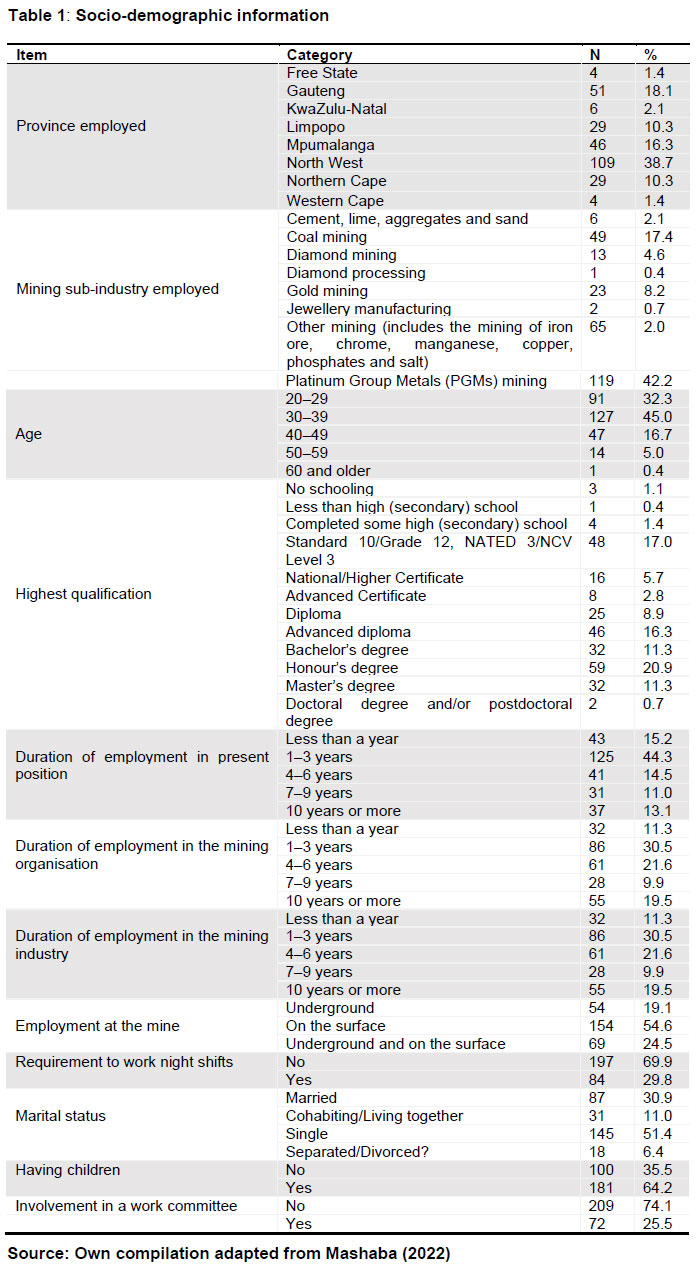
A total of 282 respondents completed the questionnaire. Although 282 responses were obtained, some sections were not entirely completed. These questionnaires were not entirely disregarded. Only satisfactory sections that contained valuable and useful information were retained. Consequently, the number of responses varied across questions. The socio-demographic information of the respondents is displayed in Table 1.
The survey respondents were from eight provinces of South Africa, with the majority employed in the North West province (38.7%; N = 109). Moreover, respondents were from the following manufacturing industries: coal; gold; PGM; cement, lime, aggregates and sand; diamond processing; and jewellery. They were also from other mining industries (including the mining of iron ore, chrome, manganese, copper, phosphates, and salt). PGM mining had the highest representation (42.2%; N = 119); diamond processing had only one respondent (0.4%). This reflects South Africa's mining industry, as most mining employees are employed in the North West province where platinum is abundant (MQA, 2021a).
Most of the respondents were middle-aged (30-39) (45%; N = 127), followed by those in the 20-29 age group (32.3%; N = 91). Most of the respondents had an honours degree (20.9%; N = 59), followed by an advanced diploma (16.3%; N = 46). Only a few respondents (1.1%; N = 3) stated that they had not attended school.
Just over half (51.4%; N = 145) of the respondents indicated that they were single. Most of the respondents (54.6%; N = 154) worked on the surface and were not required to work night shifts (69.9%; N = 197). In addition, most respondents (44.4%; N = 125) had been in their positions for one to three years, and an equal proportion (30.5%; N = 86) had been employed in their organisation and the mining industry for the past one to three years.
4.1.2 Validity and reliability of retention
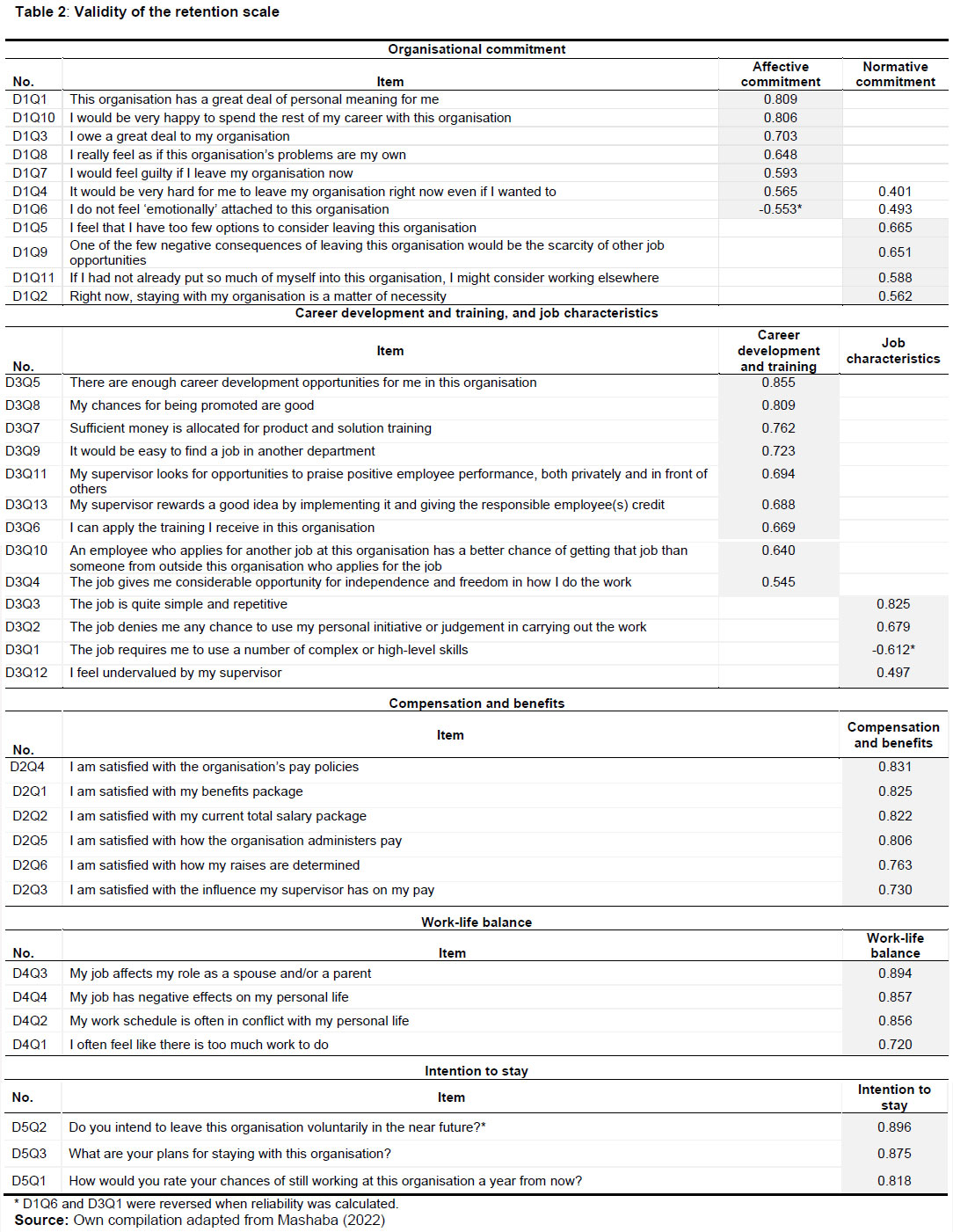
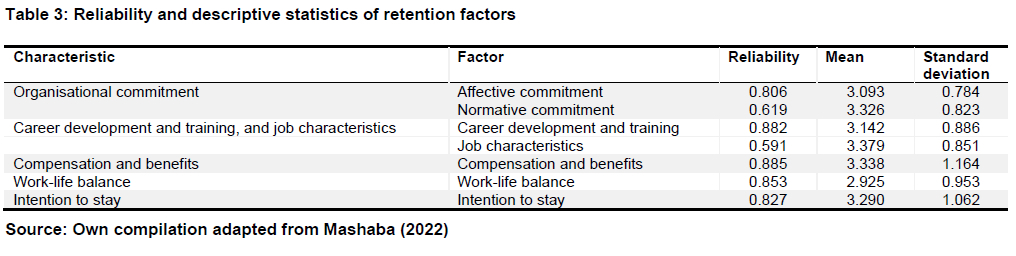
An adapted version of the RFS developed by Döckel (2003) was used to determine the factors associated with employee retention. Therefore, an exploratory factor analysis (EFA) was conducted on each of the subscales measuring organisational commitment; compensation and benefits; career development, training and job characteristics; work-life balance; and intention to stay (see Table 2). The reliability and descriptive statistics of the retention factors are depicted in Table 3.
The values for the Kaiser-Meyer-Olkin (KMO) tests were either within the recommended threshold of 0.7 or higher, confirming sampling adequacy (Kaiser, 1974). The p-values for Bartlett's test of sphericity were < 0.001, indicating statistical significance and that the correlations between statements were sufficient for exploratory factor analysis, as recommended by Field (2009).
The EFA conducted on organisational commitment revealed two factors - affective commitment (seven items) and normative commitment (four items) - which explained 50.773% of the total variance using Kaiser's criteria (see Field, 2009). Affective commitment occurs when an individual is emotionally attached to their organisation to the point where they are strongly committed to it, involved, and enjoy being a part of it (Allen & Meyer, 1990). Normative commitment refers to an individual's belief in their responsibility to the organisation - in other words, the perceived obligation to remain in the organisation (Allen & Meyer, 1990; Meyer et al., 2002). The factor loadings for affective commitment ranged between 0.553 and 0.809, and for normative commitment, between 0.562 and 0.665 (see Table 2). Field (2009) suggested that factor loadings of more than 0.3 are regarded as important. Affective commitment and normative commitment obtained Cronbach's alpha coefficient values of 0.806 and 0.619, respectively, showing acceptable reliability (see Table 3). Field (2009) recommended that the value of Cronbach's alpha coefficient should preferably be above 0.7. However, Field (2009) mentioned that Cronbach's alpha could realistically be below 0.7, as the number of items included in a scale can influence the value (Cortina as cited in Field, 2009). A large number of statements may result in higher Cronbach alpha coefficient values, while a small number of statements may result in lower values (Field, 2009). However, the factor obtained a mean inter-item correlation of 0.289, which is sufficient, according to Clark and Watson (1995). The inter-item correlations should be in the range of 0.15 to 0.55 to be considered as an indicator of an acceptable level of consistency (Clark & Watson, 1995). The mean score for affective commitment was 3.093 and for normative commitment 3.326 (on a five-point Likert scale, where 1 represents strongly disagree, and 5 represents strongly agree). This suggests that, on average, women had a neutral to slightly positive stance regarding their commitment to their organisations (see Table 3).
The EFA conducted on career development, training, and job characteristics revealed two factors - career development and training (nine items) and job characteristics (four items) - which explained 50.835% of the total variance using Kaiser's criteria (see Field, 2009). The factor loadings for career development and training ranged between 0.545 and 0.855 and for job characteristics between 0.497 and 0.825 (see Table 2). The Cronbach alpha coefficient value for career development and training was 0.882, showing good reliability and internal consistency (see Table 3). Job characteristics obtained a Cronbach alpha coefficient value of 0.591, indicating low reliability and internal consistency. The number of statements in the factor could have affected the result. However, the factor obtained a mean inter-item correlation of 0.269, which is sufficient, according to Clark and Watson (1995). Career development and training obtained a mean of 3.142, indicating a neutral stance (3) to positive sentiment towards mining companies' efforts to provide training and development opportunities for women in technical mining positions. The mean of job characteristics was 3.379, indicating a positive sentiment towards the characteristics/nature of the respondents' jobs (see Table 3). The Likert scale ranged from 1 (strongly disagree) to 5 (strongly agree).
The EFA conducted on compensation and benefits revealed one factor, explaining 63.519% of the total variance using Kaiser's criteria (see Field, 2009). The factor comprised six items, and the factor loadings ranged from 0.730 to 0.831 (see Table 2). The factor obtained a Cronbach alpha value of 0.885, indicating good reliability and internal consistency (see Table 3). The mean score was computed at 3.338, indicating that, on average, the respondents' sentiments regarding their compensation and benefits leaned towards positive (see Table 3). The Likert scale ranged from 1 (very dissatisfied) to 5 (very satisfied).
One factor was extracted for work-life balance using Kaiser's criteria, explaining 69.621% of the total variance. The factor consists of four items, and the factor loadings ranged from 0.720 to 0.894 (see Table 2). The factor showed high reliability and internal consistency, as Cronbach's alpha yielded a value of 0.853 (see Table 3). The factor mean was calculated to be 2.925 (see Table 3). This indicates that there was a neutral sentiment towards the respondents' experience of work-life balance in their organisations. The Likert scale ranged from 1 (strongly disagree) to 5 (strongly agree).
The EFA revealed one factor for intention to stay, which explained 74.557% of the total variance using Kaiser's criteria. Three items were included in the factor, and the loadings ranged from 0.818 to 0.896 (see Table 2). The Cronbach's alpha reliability coefficient for the factor was 0.827, indicating good reliability and internal consistency (see Table 3). The factor mean was 3.290 (see Table 3). This indicates that the respondents' position regarding their intention to stay leaned towards positive, and they would only consider leaving their organisations if something considerably better turned up. The Likert scale ranged from 1 (not likely at all/will definitely leave/I intend to leave as soon as possible) to 5 (very likely/definitely will not leave/I intend to stay until I retire).
4.1.3 Association between retention factors and intention to stay
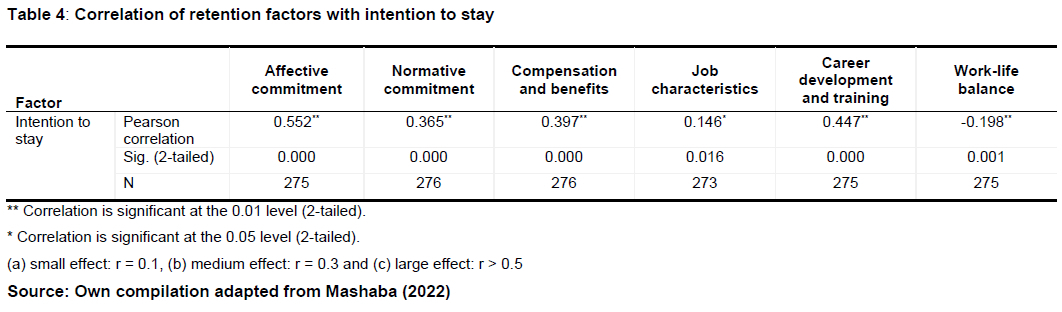
Pearson's product-moment correlation coefficient showed small to large positive correlations between affective and normative commitment, compensation and benefits, job characteristics and career development and training, and intention to stay. However, there was a small negative correlation between work-life balance and intention to stay. The results are shown in Table 4.
4.1.4 The relationship between socio-demographic variables and the retention of women in technical mining positions
Although hypotheses were not stated for the study, the relationships between selected socio-demographic variables and the retention of women employed in technical mining positions were explored to provide more insight into the determinants affecting the retention of these women.
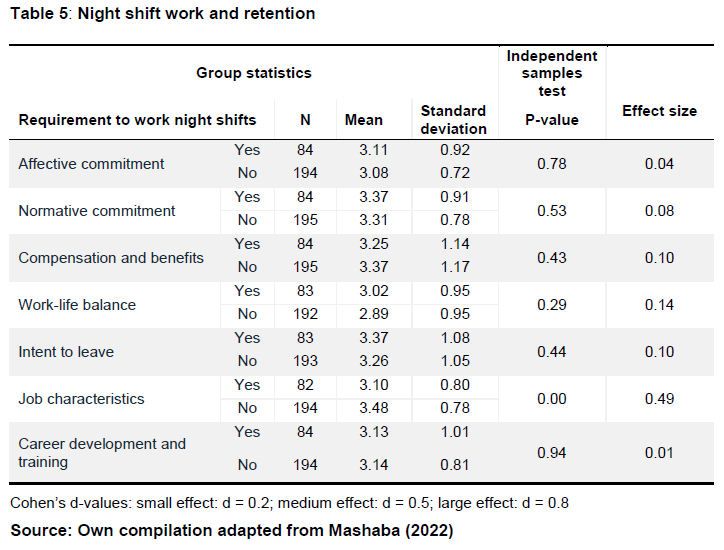
Night shift work. The independent samples t-test (see Table 5) showed a statistically significant difference (p < 0.05) for the requirement to work night shifts as it pertains to job characteristics. On average, respondents who did not work night shifts (M = 3.48) scored higher on job characteristics than respondents who worked night shifts (M = 3.10). The effect size (d = 0.49) showed a medium effect. This indicates that, to some extent, respondents who were not required to work night shifts were more positive about their job characteristics than those respondents who worked night shifts.
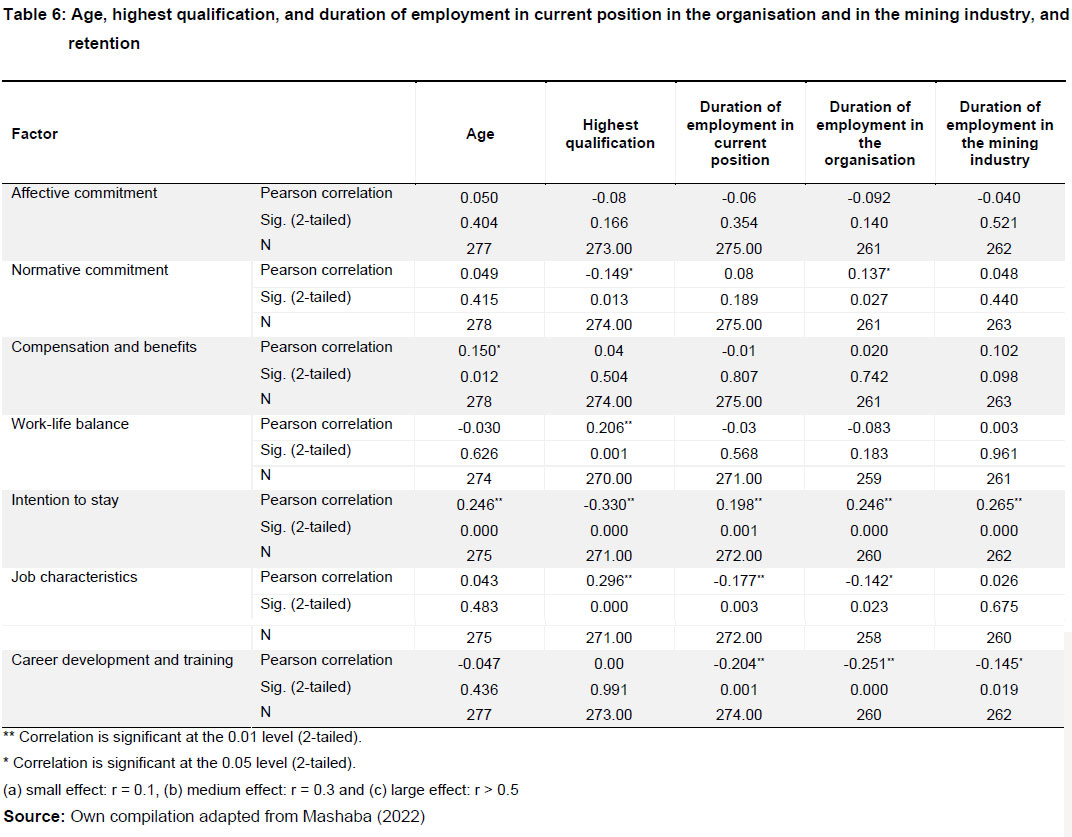
Pearson's product-moment correlation coefficient was used to explore the relationship between age, highest qualification, duration of employment in current position in the organisation and in the mining industry, and the retention factors (see Table 6). The results are discussed below.
Age. Small positive correlations existed between age and compensation and benefits (p = 0.012; r = 0.150) and intention to stay (p < 0.001; r = 0.246). Thus, the older the respondents, the more positive they were about their compensation and benefits and the more they were inclined to stay with their organisations.
Highest qualification. Small to medium negative correlations were found between highest qualification and normative commitment (p = 0.013; r = -0.149) and highest qualification and intention to stay (p < 0.001; r = -0.330). This shows that the higher the qualification of the respondents, the less they felt obligated to remain in their organisations and the less likely they were to stay. Small to medium positive correlations were found between highest qualification and work-life balance (p = 0.001; r = 0.206) and highest qualification and job characteristics (p < 0.001; r = 0.296). This shows that those with higher qualifications were more positive about their work-life balance and their jobs' characteristics.
Duration of employment in current position. A small positive correlation was found between the duration of the respondents' employment in their current position and intention to stay (p = 0.001; r = 0.198). The results show that respondents who had worked in a specific role for a longer period were more likely to stay with their organisations.
Small negative correlations were found between the duration of the respondents' employment in their current position and job characteristics (p = 0.003; r = -0.177) as well as career development and training (p = 0.001; r = -0.204). This suggests that respondents with more years of service in a particular position were less positive about the support they received from their organisation as regards career development and training, as well as with their job characteristics.
Duration of employment in the organisation. Small positive correlations were found between the duration of employment in an employee's organisation and normative commitment (p = 0.027; r = 0.137) and intention to stay (p < 0.001; r = 0.246). This indicates that respondents who had worked for a particular organisation for a longer period were more likely to feel obligated to remain in it and were more inclined to stay with their organisation.
Small negative correlations were found between the duration of employment in an employee's organisation and job characteristics (p = 0.023; r = -0.142) and career development and training (p < 0.001; r = -0.251). This indicates that the longer the respondents worked at their organisation, the less positive they were about their job characteristics and the career development and training offered by their organisations.
Duration of employment in the mining industry. A small positive correlation was found between the duration of employment in the mining industry and intention to stay (p < 0.001; r = 0.265). The results show that those respondents who had worked in the mining industry for a long time were more likely to remain employed in the industry and not leave. A small negative correlation was found between the duration of employment in the mining industry and career development and training (p = 0.019; r = -0.145). This suggests that the longer the respondents worked in the mining industry, the less positive they were about their career development and training.
4.2 Qualitative phase
Employer representatives were interviewed to investigate the determinants influencing the retention of women employed in technical mining positions. The analyses revealed three broad themes: average tenure of women in technical mining positions; factors influencing their retention; and measures implemented to retain them.
4.2.1 Average tenure of women in technical mining positions
The purpose of learning about women's tenure was to provide the researchers with a picture of retention issues in the mining industry. The findings revealed that, although the literature review suggests that women in technical mining positions face challenges related to retention, most participants claimed that this was not the case in their organisations. Participants stated that women rarely resigned from their positions. In the rare case when they would, it would be those in management or highly skilled employees. This is because there is a paucity of such skills and competition among mining organisations for women with these talents. The following comment illustrates participants' opinion on the average tenure of women in technical mining positions:
There is no high turnover on females. If they are here, they stay here. In the last year or so, between these three shafts, I lost about three or four females. The risk is only when it is top management or highly skilled employees. … but big companies are all fighting for the same thing. So, if there is a skilled woman, they are fighting for that woman. (Participant 1, PGM, HR manager)
As most of the participants stated that they did not face challenges related to retaining women in technical mining positions, they were asked to provide factors that they believed should be implemented to retain women rather than asking them about their experiences with retention factors. These aspects are discussed in the following subsection.
4.2.2 Factors influencing the retention of women in technical mining positions
The main factor that would retain women is the provision of career growth opportunities, such as promotion, training, and development opportunities. According to the participants, women who do not receive these opportunities tend to leave. Opportunities like these can be aided by providing financial assistance for further education. Below are some of the views expressed by participants:
Offer them an opportunity for growth. Women leave for growth opportunities. (Participant 1, PGM, HR manager)
An aggressive development programme (fast-tracking). (Participant 4, PGM, HR manager)
Women should be encouraged to study to empower themselves. (Participant 6, Gold, HR assistant)
Encouraging active participation in Women in Mining (WiM) forums could also help retain women. These forums are important for promoting gender equality and providing a platform for women to share their work experiences and challenges. However, for these forums to be successful, they must remain active and be held on a regular basis, as noted in the comment below:
Keep Women in Mining forums very active on a monthly scale. (Participant 2, PGM, HR assistant)
This is accompanied by the promotion of a work-life balanced work environment. Women leave the industry because of the demanding nature of mine work, which interferes with the time they spend with their families. In addition, as mines are in remote areas far from their families, some women leave to be closer to their families. The following quote proves this view:
They leave because they want to be closer to home, to be with their kids, family. (Participant 1, PGM, HR manager)
4.2.3 Measures implemented to retain women in technical mining positions
Most participants stated that employees were often offered training and given opportunities to register for courses. Below are some examples provided by participants:
There are courses that the company offers to equip them. (Participant 7, PGM, HR assistant)
So, there are career development opportunities in terms of training and school. School is in the form of bursaries. (Participant 11, Other mining, HR officer)
Also, two participants said that they did not have any retention initiatives in place. The following statements highlight their assertions:
No retention initiatives aimed at retaining women. (Participant 2, PGM, HR assistant)
Currently, we don't have a retention programme to retain women. (Participant 5, Other mining, HR officer)
The findings above show that, despite the low turnover experienced by the participants' organisations, there is a notion that promoting career development in the workplace is critical to retaining women in technical mining positions. In addition, WiM forums are viewed as important entities to drive retention; however, they need to be more active.
To determine the organisation's stance on having women in mining, the participants were asked if they would encourage women to pursue careers in technical mining positions. The participants were unanimous in their encouragement of women to pursue technical mining positions. They asserted that this would benefit the industry by increasing diversity, changing the workplace culture, and empowering women. The industry was also commended for being one of the highest-paying industries. The following comments illustrate these points:
Yes, this will add more value in changing the mining culture and how people are being treated. (Participant 4, PGM)
It is to have a balanced and diverse environment. It is very important. (Participant 2, PGM)
To boost their self-worth and gain power in man's world. (Participant 8, PGM)
A salary of the lowest-paid entry-level position in the mine is around R22 000 cost to company, including all the benefits. So, the lowest paid person here takes home around R12 500. An employee in another industry is not getting the same salary. (Participant 1, PGM)
5. DISCUSSION
This study aimed to investigate the determinants influencing the retention of women employed in technical positions in the South African mining industry using a mixed-methods research approach. The exploratory factor analysis revealed seven factors: affective commitment; normative commitment; compensation and benefits; career development and training; job characteristics; work-life balance; and intention to stay.
From the mean scores, it was evident that, on average, the respondents held a neutral stance regarding their affective commitment (i.e., strongly committed to their organisation, involved and enjoy being a part of it) and a slightly positive stance regarding their normative commitment (i.e., the perceived obligation to remain with their organisation). These insights underscore the need for targeted interventions and strategies to enhance the overall commitment and, consequently, retention of women in technical roles within the South African mining industry.
Sentiments about respondents' compensation and benefits, the characteristics of their jobs, and their organisations' provision of career development and training leaned towards the positive side of the scale; however, there was considerable room for improvement in these areas. Furthermore, the respondents showed a neutral inclination towards the experience of work-life balance in their organisations. The results of Pearson's product-moment correlation coefficient showed that the more the respondents demonstrated affective and normative commitment to their organisation and the more satisfied they were with their compensation and benefits, job characteristics and the career development and training offered by their organisations, the more they were inclined to stay with their organisations. Furthermore, the more they were affected by work-life balance issues, the more they were inclined to leave their organisations. The qualitative findings confirmed that the provision of career growth opportunities - such as promotion, training and development opportunities and a work environment that promotes work-life balance - is of utmost importance to retain women in the industry.
The results and findings of the study are confirmed by the literature, which suggests that attractive wages/salaries and benefits (Ernst & Young, 2022; IGF, 2023, 2024; Mangaroo-Pillay & Botha, 2020; McKinsey & Company, 2021; Mussacaleca, 2022; Nyabeze et al., 2010), career development opportunities (Botha, 2017; Coetzee & Stoltz, 2015; Ernst & Young, 2022; Hadebe et al., 2023; Ibidunni et al., 2016; McKinsey & Company, 2021; Women in Mining Canada [WIMC], 2010) and work-life balance (Botha, 2014; Ernst & Young, 2022; Hughes, 2012; McKinsey & Company, 2021, 2024; MiHR, 2011; Nyabeze et al., 2010) are important factors to consider in retaining women in the industry. According to Herzberg (1987), compensation and benefits are related to hygiene factors in organisations. Hygiene factors are extrinsic factors that emanate from non-job-related factors such as salaries, working conditions, security, et cetera (Herzberg, 1987). Improving hygiene factors would not necessarily satisfy employees but would prevent them from being dissatisfied (Armstrong, 2014). Furthermore, Herzberg (1987) believed that employees become truly motivated and find their work enriching when they are offered opportunities for achievement and recognition, stimulation, responsibility, and advancement. Employees frequently have a desire to achieve and experience growth within their organisation (Herzberg, 1987); therefore, they would remain loyal to an organisation that prioritises the provision of motivators, such as career development, and are willing to leave if these factors are jeopardised (Henha, 2019).
Furthermore, the results of the comparison tests revealed that additional factors influenced respondents' views about their affective and normative commitment, compensation and benefits, job characteristics, career development and training, work-life balance, and intention to stay with their organisations.
The respondents tended to show more normative commitment the lower their qualifications and the longer their tenure in their organisations. Furthermore, the results revealed that age positively correlated with compensation and benefits. The requirement to work night shift and longer tenure in respondents' current positions and organisations influenced their views about their job characteristics negatively. However, the higher the respondents' qualifications, the more positive they were about their job characteristics and their work-life balance. The results also revealed that the longer the tenure in respondents' current position, organisation and in the mining industry, the less positive they were about the career development and training offered by their organisations.
Regarding retention, the results revealed that the older the respondents and the longer the tenure in their current positions, in their organisations and in the mining industry, the more likely they were to stay with their organisations. Interestingly, the higher the qualifications of the respondents, the tendency to stay with their organisations decreased.
6. MANAGERIAL IMPLICATIONS
The research findings are important for employers and managers seeking to cultivate a more supportive and fulfilling work environment for women employed in technical positions within the mining industry. Creating such an environment is essential for enhancing the retention of women in the traditionally male-dominated sector. Considering the study's findings, the following recommendations are made:
• Mining organisations need to devise and implement interventions and strategies that prioritise both hygiene and motivation factors. Hygiene factors include competitive compensation and benefits, and improved working conditions, whereas motivators include an engaging work environment, recognising employees' contributions, enabling women to utilise and develop their competencies, involving them in tasks that involve increased responsibility and new challenges, and providing clear opportunities for career advancement and growth.
• Organisations should cultivate and facilitate the advancement of women in technical mining positions. There should be a succession plan in place that is monitored regularly, guided by measurable targets to facilitate women's career progression in the industry.
• Employee retention programmes should be tailored to accommodate employees' age, qualifications, and length of service in the industry, as research shows that they are not all retained by the same factors.
• Mining organisations should explore the implementation of flexible working arrangements for women employed in technical positions where operationally feasible. In cases where women are required to work night shifts, alternative scheduling options should be considered to improve work-life balance and allow employees to spend more time with their families.
7. LIMITATIONS
Limitations were imposed by using a non-probability sampling technique, limiting the generalisability of the study's findings to the broader population of women in technical mining roles in South Africa. Consequently, the study's results and conclusions are confined to the participants involved in the research.
8. CONCLUSION
The results of the study showed that both hygiene and motivational factors shape women's intention to remain in their organisations. Specifically, organisational commitment, satisfaction with compensation and benefits, positive job characteristics, and access to career development and training opportunities are associated with a stronger intention to stay in an organisation, while challenges related to work-life balance increase the likelihood of leaving. Fostering a supportive and sustainable work environment for women is critical for promoting gender equity and ensuring their meaningful participation in the mining industry, thereby enhancing their long-term retention in technical roles within the industry.
Acknowledgements: The authors extend their gratitude to the mining companies, Women in Mining South Africa, the Minerals Council of South Africa, and the National Union of Mineworkers for their assistance in disseminating the questionnaire across multiple platforms. Additionally, sincere appreciation is expressed to Prof. Suria Ellis for her contributions to the processing of the empirical data, as well as to Dr Jackie de Vos for her professional editorial assistance.
Conflict of interest: The authors declare no conflict of interest with respect to the research, authorship, and publication of the article.
Data availability: The data used for this article can be found in Mashaba, N. (2022). An investigation into the attraction, engagement and retention of women employed in technical mining positions, South Africa [Master's dissertation, North-West University].
Ethical clearance and informed consent statement: The researchers obtained ethical clearance from the Arts Research Ethics Committee of the Faculty of Humanities at North-West University under ethics clearance number NWU-01007-20-A7 prior to data collection. Informed consent from all participants in this study was obtained.
Funding: The authors did not receive any financial support for research, authorship, and publication of the article.
REFERENCES
2. LITERATURE REVIEW
-
Abbasi, S. M., & Hollman, K. W. (2000). Turnover: The real bottom line. Public Personnel Management, 29(3), 333-342. https://doi.org/10.1177/009102600002900303
» https://doi.org/10.1177/009102600002900303 -
Ahmad, K., & Azumah, K. K. (2012). Employee retention strategies: The case of a patent firm in Australia. https://www.diva-portal.org/smash/get/diva2%3A833433/FULLTEXT01.pdf. Blekinge Institute of Technology.
» https://www.diva-portal.org/smash/get/diva2%3A833433/FULLTEXT01.pdf -
Allen, N. J., & Meyer, J. P. (1990). The measurement and antecedents of affective, continuance and normative commitment to the organisation. Journal of Occupational Psychology, 63(1), 1-18. https://doi.org/10.1111/j.2044-8325.1990.tb00506.x
» https://doi.org/10.1111/j.2044-8325.1990.tb00506.x -
Almaaitah, M. F., Harada, Y., Sakdan, M. F., & Almaaitah, A. M. (2017). Integrating Herzberg and social exchange theories to underpinned human resource practices, leadership style and employee retention in health industry. World Journal of Business and Management, 3(1), 16-34. https://doi.org/10.5296/wjbm.v3i1.10880
» https://doi.org/10.5296/wjbm.v3i1.10880 - Ampoty, J. (2014). An investigation into the effects of career development on employee retention at Anglo Gold Ashanti Limited, Obuasi Mine [Unpublished MBA dissertation]. Kwame Nkrumah University of Science and Technology.
- Armstrong, M. (2014). Armstrong's handbook of human resource management practice (13th ed.). Kogan Page.
-
Bhattacharya, Y. (2015). Employee engagement as a predictor of seafarer retention: A study among Indian officers. The Asian Journal of Shipping and Logistics, 31(2), 295-318. https://doi.org/10.1016/j.ajsl.2015.06.007
» https://doi.org/10.1016/j.ajsl.2015.06.007 -
Botha, D. (2014). Women in mining: A conceptual framework for gender issues in the South African mining industry [Doctoral thesis, North-West University]. NWU Institutional Repository. https://hdl.handle.net/10394/12234
» https://hdl.handle.net/10394/12234 -
Botha, D. (2017). Barriers to career advancement of women in mining: A qualitative analysis. South African Journal of Labour Relations, 41, 15-32. https://doi.org/10.25159/2520-3223/3766
» https://doi.org/10.25159/2520-3223/3766 - Bryman, A. (2012). Social research methods (4th ed.). Oxford University Press.
-
Chew, J. C. L. (2004). The influence of human resource management practices on the retention of core employees of Australian organisations: An empirical study [Doctoral dissertation, Murdoch University]. Murdoch University Research Portal. https://researchportal.murdoch.edu.au/esploro/outputs/doctoral/The-influence-of-human-resource-management/991005543047007891
» https://researchportal.murdoch.edu.au/esploro/outputs/doctoral/The-influence-of-human-resource-management/991005543047007891 -
Chiat, L. C., & Panatik, S. A. (2019). Perceptions of employee turnover intention by Herzberg's motivation-hygiene theory: A systematic literature review. Journal of Research in Psychology, 1(2), 10-15. https://doi.org/10.31580/jrp.v1i2.949
» https://doi.org/10.31580/jrp.v1i2.949 - Chiboiwa, M. W., Samuel, M. O., & Chipunza, C. (2010). An examination of employee retention strategy in a private organisation in Zimbabwe. African Journal of Business Management, 4(10), 2103-2109.
-
Clark, L. A., & Watson, D. (1995). Constructing validity: Basic issues in objective scale development. Psychological Assessment, 7(3), 309-319. https://doi.org/10.1037/1040-3590.7.3.309
» https://doi.org/10.1037/1040-3590.7.3.309 - Clark, T., Foster, L., Sloan, L., & Bryman, A. (2022). Bryman's social research methods (5th ed.). Oxford University Press.
-
Coetzee, M., & Stoltz, E. (2015). Employees' satisfaction with retention factors: Exploring the role of career adaptability. Journal of Vocational Behavior, 89, 83-91. https://doi.org/10.1016/j.jvb.2015.04.012
» https://doi.org/10.1016/j.jvb.2015.04.012 -
Commission for Gender Equality. (2024). Gender transformation in the South African mining industry 2023/2024. https://cge.org.za/wp-content/uploads/2024/11/Gender-Transformation-in-the-South-African-Mining.pdf
» https://cge.org.za/wp-content/uploads/2024/11/Gender-Transformation-in-the-South-African-Mining.pdf -
Cooper, T., Goliath, M., & Perkins, D. (2022). Women and the mine of the future: A gendered analysis of employment and skills in the large-scale mining sector: South Africa. Intergovernmental Forum on Mining, Minerals, Metals and Sustainable Development. https://www.iisd.org/system/files/2023-04/women-mine-of-the-future-south-africa.pdf
» https://www.iisd.org/system/files/2023-04/women-mine-of-the-future-south-africa.pdf -
Department of Mineral and Petroleum Resources. (2025). Critical minerals and metals strategy South Africa 2025. https://www.gov.za/sites/default/files/gcis_document/202505/critical-minerals-and-metals-strategy-south-africa-2025.pdf
» https://www.gov.za/sites/default/files/gcis_document/202505/critical-minerals-and-metals-strategy-south-africa-2025.pdf - Deshwal, P. (2015). Green HRM: An organizational strategy of greening people. International Journal of Applied Research, 1(13), 176-181.
-
Döckel, A. (2003). The effect of retention factors on organisational commitment: An investigation of high technology employees [Master's dissertation, University of Pretoria]. UPSpace Repository. https://hdl.handle.net/2263/27597
» https://hdl.handle.net/2263/27597 -
Ernst & Young. (2022). Women in mining 2022: You can't be what you can't see. https://assets.ey.com/content/dam/ey-sites/ey-com/en_au/topics/corporate-social-responsibility/ey-you-cant-be-what-you-cant-see-20220923.pdf
» https://assets.ey.com/content/dam/ey-sites/ey-com/en_au/topics/corporate-social-responsibility/ey-you-cant-be-what-you-cant-see-20220923.pdf - Field, A. P. (2009). Discovering statistics using SPSS: And sex, drugs and rock 'n' roll (3rd ed.). Sage.
- Govindaraju, N. (2018). The role of traditional motivation theories on employee retention. International Journal of Arts, Humanities and Management Studies, 4, 95-110.
-
Hadebe, L., Tebele, C., & Nel, E. (2023). Employee perceptions of key retention factors in the mining industry: A qualitative study. Journal of Psychology in Africa, 33(1), 92-96. https://doi.org/10.1080/14330237.2023.2175975
» https://doi.org/10.1080/14330237.2023.2175975 -
Henha, E. P. N. (2019). An exploratory study on the predictors of turnover intentions among expatriate academics and talent retention strategies at selected universities in KwaZulu-Natal, South Africa [Doctoral thesis, Durban University of Technology]. DUT Open Scholar. https://hdl.handle.net/10321/3268
» https://hdl.handle.net/10321/3268 - Herzberg, F. (1987). One more time: How do you motivate employees? Harvard Business Review, 65(5), 109-120.
- Herzberg, F., Mausner, B., & Snyderman, B. (1959). The motivation to work. Wiley.
-
Holston-Okae, B. L., & Mushi, R. J. (2018). Employee turnover in the hospitality industry using Herzberg's two-factor motivation-hygiene theory. International Journal of Academic Research in Business and Social Sciences, 8(1), 218-248. https://doi.org/10.6007/IJARBSS/v8-i1/3805
» https://doi.org/10.6007/IJARBSS/v8-i1/3805 - Hughes, C. M. (2012). A study on the career advancement and retention of highly qualified women in the Canadian mining industry [Master's thesis, University of British Columbia]. UBC cIRcle. file:///C:/Users/User/Downloads/ubc_2012_fall_hughes_courtnay.pdf.pdf
-
Ibidunni, S., Osibanjo, O., Adeniji, A., Salau, O. P., & Falola, H. (2016). Talent retention and organizational performance: A competitive positioning in Nigerian banking industry. Periodica Polytechnica Social and Management Sciences, 24(1), 1-13. https://doi.org/10.3311/PPso.7958
» https://doi.org/10.3311/PPso.7958 -
Intergovernmental Forum on Mining, Minerals, Metals and Sustainable Development. (2023). Women and the mine of the future: Global report. https://www.iisd.org/system/files/2023-04/women-mine-of-the-future-global-report.pdf
» https://www.iisd.org/system/files/2023-04/women-mine-of-the-future-global-report.pdf -
Intergovernmental Forum on Mining, Minerals, Metals and Sustainable Development. (2024). Gender and the mine of the future: Global trends in workforce diversity. https://www.igfmining.org/resource/gender-and-the-mine-of-the-future/
» https://www.igfmining.org/resource/gender-and-the-mine-of-the-future/ -
International Institute for Sustainable Development, & Intergovernmental Forum on Mining, Minerals, Metals and Sustainable Development. (2022). How will women fit into the mining workforce of the future? https://www.igfmining.org/women-mining-workforce-future/
» https://www.igfmining.org/women-mining-workforce-future/ - Jenns, C. (2024). Efficiency and innovation: The economic case for gender diversity in heavy industry. International Journal of Mining Science, 12(2), 88-104. International Finance Corporation (IFC). (2020). Integrating gender in mining operations. https://www.ifc.org/content/dam/ifc/doc/mgrt/gender-equity-in-mining-fin-for-web.pdf
-
Kaiser, H. F. (1974). An index of factorial simplicity. Psychometrika, 39(1), 31-36. https://doi.org/10.1007/BF02291575
» https://doi.org/10.1007/BF02291575 - Kilu, R. H., Andersson, E., Sanda, M. A., & Udén, M. (2017). Reflections on organizational barriers vis-à-vis women participation in large scale Ghanaian mines. International Journal of Business and Social Science, 1-18.
-
Knox, H. J. (2013). Attracting and retaining talent: Identifying employee value proposition (EVP) drivers of attraction and retention in the South African labour market [Master's dissertation, Nelson Mandela Metropolitan University]. SEALS Digital Commons. https://hdl.handle.net/10948/d1020065
» https://hdl.handle.net/10948/d1020065 -
Lord, L., & Eastham, J. (2011). Attraction and retention of women in the minerals industry: Stage one report for the Minerals Council of Australia. https://espace.curtin.edu.au/bitstream/handle/20.500.11937/21578/159028_37259_Stage%20One%20Report%20MCA%20Attraction%20and%20Retention%20of%20Women%20in%20the%20Resources%20Industry%20May%202011.pdf?sequence=2
» https://espace.curtin.edu.au/bitstream/handle/20.500.11937/21578/159028_37259_Stage%20One%20Report%20MCA%20Attraction%20and%20Retention%20of%20Women%20in%20the%20Resources%20Industry%20May%202011.pdf?sequence=2 -
Mangaroo-Pillay, S., & Botha, D. (2020). An exploration of women's workplace experiences in the South African mining industry. Journal of the Southern African Institute of Mining and Metallurgy, 120, 475-483. https://doi.org/10.17159/2411-9717/1099/2020
» https://doi.org/10.17159/2411-9717/1099/2020 -
Mashaba, N. (2022). An investigation into the attraction, engagement and retention of women employed in technical mining positions, South Africa [MA dissertation, North-West University]. NWU Institutional Repository. https://repository.nwu.ac.za/items/fe867916-9937-4073-856b-36e50d3224ed
» https://repository.nwu.ac.za/items/fe867916-9937-4073-856b-36e50d3224ed -
Matiashe, F. S. (2022). In Zimbabwe, a women-only gem mine gives abuse survivors new hope. https://news.trust.org/item/20220330151242-vl8om
» https://news.trust.org/item/20220330151242-vl8om -
McKinsey & Company. (2021). Why women are leaving the mining industry and what mining companies can do about it. https://www.mckinsey.com/industries/metals-and-mining/our-insights/why-women-are-leaving-the-mining-industry-and-what-mining-companies-can-do-about-it#/
» https://www.mckinsey.com/industries/metals-and-mining/our-insights/why-women-are-leaving-the-mining-industry-and-what-mining-companies-can-do-about-it#/ -
McKinsey & Company. (2024). Women in the workplace 2024: The 10th anniversary report. https://www.mckinsey.com/featured-insights/diversity-and-inclusion/women-in-the-workplace-2024
» https://www.mckinsey.com/featured-insights/diversity-and-inclusion/women-in-the-workplace-2024 -
Mekgwe, M., Mpanza, M., & Mgiba, C. (2025, June 19). The retention of female mining graduates in hard rock mining operations - challenges and opportunities [PowerPoint slides]. Minerals Council South Africa. https://www.mineralscouncil.org.za/component/jdownloads/?task=download.send&id=2502&catid=22&m=0
» https://www.mineralscouncil.org.za/component/jdownloads/?task=download.send&id=2502&catid=22&m=0 -
Meyer, J. P., Stanley, D. J., Herscovitch, L., & Topolnytsky, L. (2002). Affective, continuance, and normative commitment to the organization: A meta-analysis of antecedents, correlates, and consequences. Journal of Vocational Behavior, 61(1), 20-52. https://doi.org/10.1006/jvbe.2001.1842
» https://doi.org/10.1006/jvbe.2001.1842 -
Minerals Council of South Africa. (2024a). Women in Mining (WiM) newsletter - June 2024. https://www.mineralscouncil.org.za/womeninmining/wp-content/uploads/2024/06/WIM-June-Newsletter_V2.pdf
» https://www.mineralscouncil.org.za/womeninmining/wp-content/uploads/2024/06/WIM-June-Newsletter_V2.pdf -
Minerals Council of South Africa. (2024b). Facts and figures 2023/2024: Economic and employment trends. https://www.mineralscouncil.org.za/
» https://www.mineralscouncil.org.za/ -
Mining Industry Human Resources Council. (2011). Unearthing possibilities: Human resources challenges and opportunities in the Canadian mineral exploration industry. https://www.pdac.ca/docs/default-source/members---membership/programs---students/labour-market-research/mihr-unearthing-possibilities-(full-version-eng).pdf?sfvrsn=9ce3a52e_6
» https://www.pdac.ca/docs/default-source/members---membership/programs---students/labour-market-research/mihr-unearthing-possibilities-(full-version-eng).pdf?sfvrsn=9ce3a52e_6 -
Mining Industry Human Resources Council. (2016). Strengthening mining's talent alloy: Exploring gender inclusion. https://mihr.ca/wp-content/uploads/2020/03/MiHR_Gender_Report_EN_WEB.pdf
» https://mihr.ca/wp-content/uploads/2020/03/MiHR_Gender_Report_EN_WEB.pdf -
Mining Qualifications Authority. (2021a). Sector skills plan update 2015-2020. https://mqa.org.za/wp-content/uploads/2021/08/MQA-SSP-Final.pdf
» https://mqa.org.za/wp-content/uploads/2021/08/MQA-SSP-Final.pdf - Mining Qualifications Authority. (2021b). Workplace skills plan - annual training report. [Unpublished data; accessed on 15 December 2025].
- Mining Qualifications Authority. (2025). Sector skills plan update 2026-2027. [Unpublished report; accessed on 15 December 2025].
-
Moraka, N. V. (2024). Mining corporate boardrooms still a male club? Experiences and challenges faced by South African women. Journal of the Southern African Institute of Mining and Metallurgy, 124(1), 25-32. https://doi.org/10.17159/2411-9717/2789/2024
» https://doi.org/10.17159/2411-9717/2789/2024 -
Mussacaleca, M. (2022). Op-ed: Why women are leaving the mining industry: The mining industry is struggling to retain women leaders, so what can be done? https://www.miningmagazine.com/research/news/1427918/op-ed-why-women-are-leaving-the-mining-industry
» https://www.miningmagazine.com/research/news/1427918/op-ed-why-women-are-leaving-the-mining-industry -
Ndeipanda, E. (2018). Towards developing retention strategies: A study of the professional and administrative staff of the Namibian Ministry of Education, arts and culture [MPA thesis, Stellenbosch University]. SUNScholar Research Repository. https://scholar.sun.ac.za/handle/10019.1/103608
» https://scholar.sun.ac.za/handle/10019.1/103608 -
Nyabeze, T., Espley, S., & Beneteau, D. (2010). Gaining insights on career satisfaction for women in mining. https://internationalwim.org/wp-content/uploads/2020/06/Tech-Paper_MEMO_2010_Beneteau_Espley_Nyabeze_Gaining-Insights-on-Career-Sati.pdf
» https://internationalwim.org/wp-content/uploads/2020/06/Tech-Paper_MEMO_2010_Beneteau_Espley_Nyabeze_Gaining-Insights-on-Career-Sati.pdf -
Onah, F. O., & Anikwe, O. S. (2016). The task of attraction and retention of academic staff in Nigerian universities. Journal of Management and Strategy, 7(2), 9-20. https://doi.org/10.5430/jms.v7n2p9
» https://doi.org/10.5430/jms.v7n2p9 -
Osaro, C. (2016). Talent attraction and employee retention in oil firms in Rivers State. International Journal of Novel Research in Humanity and Social Sciences, 3(2), 75-84. https://www.scribd.com/document/887991109/Talent-Attraction-and-Employee-retention
» https://www.scribd.com/document/887991109/Talent-Attraction-and-Employee-retention -
Salsabil, N. G., & Cahyo, W. N. (2023). Design strategy for improving employee retention based on two-factors theory. Jurnal Ilmiah Teknik Industri, 22(1), 137-142. https://doi.org/10.23917/jiti.v22i1.21750
» https://doi.org/10.23917/jiti.v22i1.21750 -
Samuel, M. O., & Chipunza, C. (2013). Attrition and retention of senior academics at institutions of higher learning in South Africa: The strategies, complexities and realities. Journal of Social Sciences, 35(2), 97-109. https://doi.org/10.1080/09718923.2013.11893151
» https://doi.org/10.1080/09718923.2013.11893151 - Statistics South Africa. (2024). Quarterly employment statistics (QES), June 2024 (Statistical release P0277).
- Taylor, S. (2002). The employee retention handbook. CIPD.
-
Terrill, J. L. (2016). Women in the Australian mining industry: Careers and families [Doctoral thesis, University of Queensland]. UQ eSpace. https://doi.org/10.14264/UQL.2016.830
» https://doi.org/10.14264/UQL.2016.830 -
Turner, D. (2019). Sampling methods in research design. Headache: The Journal of Head and Face Pain, 60(1), 8-12. https://doi.org/10.1111/head.13707
» https://doi.org/10.1111/head.13707 - Wilson, S., & MacLean, R. (2011). Research methods and data analysis for psychology. McGraw-Hill.
-
Women in Mining Canada. (2010). Ramp up: A study on the status of women in Canada's mining and exploration industry. https://internationalwim.org/wp-content/uploads/2020/06/Ramp-UPFinal2010.pdf
» https://internationalwim.org/wp-content/uploads/2020/06/Ramp-UPFinal2010.pdf -
World Bank. (2024, June 14). Breaking barriers for women in mining. World Bank Blogs. https://blogs.worldbank.org/en/energy/breaking-barriers-for-women-in-mining-
» https://blogs.worldbank.org/en/energy/breaking-barriers-for-women-in-mining-