Entrepreneurial Skills, Characteristics and Intentions amongst Unemployed Individuals in the Vaal-Triangle Region of South Africa
Abstract
South Africa has been faced with a long history of socio-economic challenges of which unemployment can probably be considered as one of the most daunting. Resulting from this problem, the South African government has placed much emphasis on small business and entrepreneurial development. When looking at entrepreneurship on a global scale, females have been lagging in the business domain and most of the entrepreneurship data available merely report on business development as a whole and do not distinguish between genders. In light of this, the purpose of this study was to determine the self-reported entrepreneurial skills, characteristics and intentions of a group of unemployed South African individuals and if any differences between males and females exist regarding the mentioned variables. The study made use of primary data obtained through self-administered questionnaires. A convenience sampling technique was used resulting in a final sample of 206 unemployed individuals from the Vaal-Triangle region in South Africa. Various statistical techniques were employed to analyse the data, these included: outlier statistics, internal-consistency reliability analysis, descriptive statistics, correlation analysis and an independent sample t-test. The unemployed individuals recorded statistically significant means indicating that they have entrepreneurial skills, display positive entrepreneurial characteristics and possess positive intentions towards becoming entrepreneurs. In addition, males were associated with a statistically larger mean for all constructs compared to females. The study showed that unemployed individuals have high intentions to start businesses, especially the male cohort. JEL CLASSIFICATION: L26
Characteristics; entrepreneurial skills; intentions; South Africa and unemployment
1. INTRODUCTION
In recent years, a profound emphasis has been placed on entrepreneurship and the positive effect it may have on a country's economy and social well-being of its citizens (Audretsch, Keilbach, & Lehmann 2006:3; Meyer & Meyer 2016:153; Wennekers & Thurik 1999:27). For developing countries such as South Africa, entrepreneurship may unlock further potential as it can be considered the centre of economic advancement both in economic growth and development (Gürol & Atsan 2006:26; Meyer & Meyer 2017:429). The advancement of economic growth and development not only leads to improved economic growth and the creation of more jobs, but also to social adjustment within local communities (Greblikaite, Sroka & Grants 2015; Meyer & de Jongh 2018:288). In addition, Sata (2013:34) and Davidsson (2016:4) opine that entrepreneurship leads not only to the introduction of new economic activity, but more importantly financial independence.
In order for individuals to act entrepreneurially, a certain set of skills and characteristics are required (Ferreira, Ratten & Dana 2017:162; Greblikaite, Sroka & Gerulaitiene 2016; Solesvik 2019). Herrington and Kew (2013:22) and Herrington, Kew and Kew (2015:20) state that after a potential entrepreneur obtains the necessary skills and possesses the required entrepreneurial characteristics, the intention to actually start a business needs to be demonstrated. Taking this statement into consideration, individuals should have a certain degree of entrepreneurial skills, characteristics and the intention to start new businesses. In light of this, the purpose of this study was to determine the self-reported entrepreneurial skills, characteristics and intentions of a group of unemployed South African individuals in the Vaal-Triangle region.
2. REVIEW OF THE LITERATURE
Developing nations all across the world are faced with socio-economic challenges of which unemployment may be considered as one of the most challenging, especially in the case of South Africa. Internationally, it has been recognised that increased entrepreneurial activity could have a positive effect on a country's economy (Pinelli 2015). Over the years, many different definitions for entrepreneurship have been developed. For example, Gries and Naudé (2011:217) define it as "the resource, process and state of being through and in which individuals utilize positive opportunities in the market by creating and growing new business firms". Another definition of entrepreneurship describes it as an activity that includes, the innovation, evaluation, discovery and exploitation of opportunities to introduce the development of markets, goods, services, processes and raw materials through procedures and methods that have not existed previously (Shane & Venkataraman 2000:14; Venkataraman 1997). In essence, an entrepreneur is seen as a business or social innovator who identifies and takes hold of opportunities and then continues to develop these opportunities into practical ideas together with adding value in the form of time, money and skills. They then proceed to implement these ideas into the marketplace while accepting the associated risks in an effort to realise the resulting rewards such as job satisfaction and profit (Dvorsky, Popp, Virglerova, Kovács & Oláh 2018; Frederick, O'Connor & Kuratk 2019:8; Oláh, Kovács, Virglerova, Lakner & Popp 2019).
According to Rwigema and Venter (2005:113), Eckhardt, Ciuchta and Carpenter (2018:371) and Nagy, Oláh, Erdei, Máté & Popp (2018), innovation involves the discovery of new and improved methods of engaging in activities which directly links to the creation of new opportunities and development of markets. Entrepreneurship is known to be a facilitator for structural change and institutional growth (Naudé 2013:4). That being said, it is important for entrepreneurs to have intent, the necessary skills and characteristics to act upon. Ghatak, Morelli and Sjöström (2007:2) and Dimova and Pela (2018:305) state that entrepreneurs with low skills levels and a general lack of entrepreneurial characteristics, more often than not, employ workers that are less productive, and hence earn lower wages.
As a result, this reduces opportunity costs of self-employment, which in turn, leads to the entry of more entrepreneurs and business managers with low skill sets. On the contrary, when entrepreneurship does incorporate the skills and positive intent mentioned earlier, it may lead to a multitude of benefits in the economy. Research conducted by Fortunato and Alter (2015) suggest that entrepreneurship could improve the standard of living of a community in local regions. Through entrepreneurship Alvord, Brown and Letts (2004), in conjunction with Balmaceda (2018:873), found that local problem solving could be enhanced. This is emphasised by Hausmann and Rodrik (2003) and Balmaceda (2018:872) that entrepreneurship facilitates new goods into markets and therefore provides technological externalities, they also make new information on the probability of these new goods available, hence providing financial externalities as well. Leading to the conclusion that entrepreneurship could lead to the diversification of local industries (Clark 2009; Mukhtar, Gwazawa & Jega 2018:2) and as a result this may lead to the creation of sustained employment opportunities over a period of time (Henrekson & Johansson 2010; Sauka, Schneider & Williams 2016:9; Wennekers & Thurik 1999).
Globally, the development of entrepreneurship has been found to have a positive impact on economies and the standard of living in communities (Asogwa & Dim 2016:30). Various international studies such as Emery, Wall and Macke (2004), Lichtenstein, Lyons and Kutzhanova, (2004); Markley, Lyons and Macke (2015) reiterate the importance of developing entrepreneurial activities and how imperative it is for local economic development. Naudé (2011) points out that entrepreneurship is seen as a significant factor that contributes to economic growth, particularly with regards to obtaining new sources of production growth and innovation in developed countries. As a result, researchers are of the opinion that Africa presents a unique and encouraging scenario for future research on marketing, strategy and entrepreneurship as the core focus (George, Corbishley, Khayesi, Haas & Tihanyi 2016:380).
Entrepreneurship is also considered as a planned behaviour that is dependent on individual persons' entrepreneurial intentions (Krueger 1993:7; Urban & Kujinga 2017:638). This suggests that entrepreneurial intentions are determined by the attitude towards the perceived behavioural control, behaviour itself and subjective norms (Ajzen 2005:118). According to Thompson (2009:676) and Urban and Kujinga (2017:639) entrepreneurial intention is a person's self-acknowledged belief to knowingly plan and undertake a new business venture in the foreseeable future. Entrepreneurial intentions are one of the factors known to distinguish entrepreneurs, along with the acknowledgement of an opportunity, new processes, and the employment of strategic management practices in a business (Carland, Boulton & Carland 1984; Simmons, Carr, Hsu & Shu 2016:606; Watson 2001). A vast body of research has been done on the Theory of Planned Behaviour (TPB) and how the model links to entrepreneurial behaviour and intention (Ferreira, Raposo, Rodrigues, Dinis, do Paco 2012:424-426).
Authors such as Van Gelderen, Brand, van Praag, Bodewes, Poutsma and van Gils (2008), Van Gelderen, Kautonen and Fink (2013) and Tsordia and Papadimitriou (2015) have emphasised the link between these two concepts, and it has consequently resulted in one of the most often applied theories explaining and forecasting individual behaviour. After a prospective entrepreneur has identified a good opportunity and perceives that they have the required skills and capabilities needed to start the business, the intention to actually start the entrepreneurial journey needs to be established. This is an important stage during the entrepreneurial process since a strong correlation exists between entrepreneurial intention and actually starting a business. The intention to start a business could be influenced by external factors such as perceptions about entrepreneurship by the general public and the media (Herrington & Kew 2013:22; Herrington et al. 2015:20).
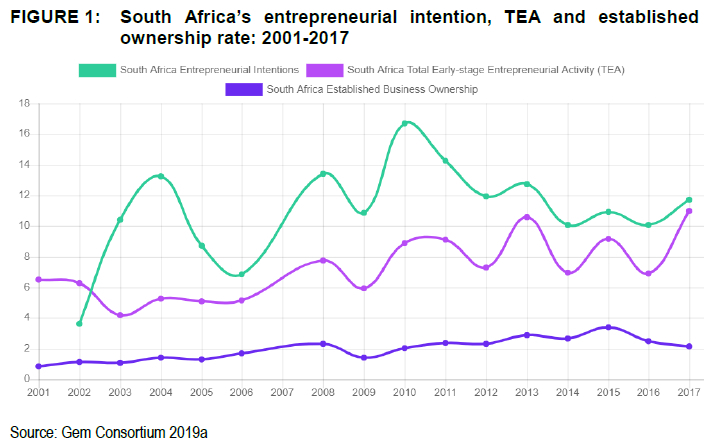
In developing countries such as South Africa, entrepreneurship has been used as a tool to combat unemployment, low economic growth and poverty (Bruton, Ahlstrom & Obloj 2008; West, Bamford & Marsden 2008; Malebana 2016). In an effort to determine the efficiency of the South African governments' interventions and policies aimed at encouraging entrepreneurship, information regarding the role of entrepreneurial support and how it influences entrepreneurial intention in the country is vital (Malebana 2017:75). Entrepreneurial intention1 in South Africa is known to be rather low as seen in Figure 1 (Botha & Bignotti 2017:1071). With this being said, various researchers such as Lüthje and Franke (2003) and Malebana (2014) have come to the conclusion that entrepreneurial activity could play a key role in developing local entrepreneurship, as it has the potential to stimulate entrepreneurial intention and therefore the resulting entrepreneurial experiences. Even though the South African government has placed emphasis on small business and entrepreneurial development, the country's total early-stage (TEA2) entrepreneurial activity rates also remains very low as seen in Figure 1 (Malebana 2017:75).
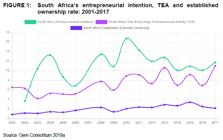
The aforementioned would have to be resolved if the South African government wishes to address the country's unemployment rate of over 27 percent. This is because entrepreneurs, and especially those with established businesses3 who actually makes a meaningful contribution towards the economic growth, play a significant role in creating jobs and providing opportunities, which could all contribute to decreasing the unemployment rate (Pinelli 2015). South Africa's unemployment rate is amongst the highest in the world, especially when compared to countries such as Spain (13.9%), Mexico (3.3%), Poland (3.5%), Italy (10.7%), Australia (4.9%) and Brazil (12.4%) (Countryeconomy 2019). Figure 1 depicts South Africa's entrepreneurial intention, TEA and established ownership rate.
Figure 1 depicts South Africa's fluctuating rates of intention, TEA and established business ownership rates. Over the said period (2001-2017), intention has exhibited an upward trend until 2010 where it gradually declines. On a positive note, TEA has shown a slightly upward trend and during 2017 it was almost equal to entrepreneurial intention. When comparing South Africa's TEA (10.96% in 2017) to other efficiency-driven economies such as Malaysia (21.6% in 2017), Peru (22.39% in 2018), Slovakia (12.12% in 2018) and Thailand (19.68% in 2018), more emphasis could be placed on improving South Africa's current circumstances (Gem Consortium 2019b).
In addition to entrepreneurs having the intention to pursue entrepreneurial activities, they should also possess a certain combination of skills and characteristics. This is necessary as Marais and Botes (2006:393) point out local communities are often faced with negative consequences resulting from lack of business and entrepreneurial skills. Entrepreneurial skills can be described as those particular expertise and experiences that are required to successfully create and maintain a business venture (Balmaceda 2018:874; Pyysiainen, Anderson, McElwee & Vesala 2006:23). Entrepreneurs are categorised by various sets of characteristics such as leadership, being able to manage risk and uncertainty, creative thinking, being innovative, effective communication, teamwork, the recognition of opportunities, technical skill sets, human relations understanding as well as understanding market forces (Entika, Mohammad, Jabor & Osman 2017:96; Rosique-Blasco, Madrid-Guijarro & García-Pérez-de-Lema 2016:818). In addition, Patel (2019) argues that characteristics are those aspects that an individual is born with which typically includes having motivation, need for independence and success, communication abilities, internal drive and motivation and being optimistic. Skills can be taught or learned either directly by means of education or indirectly through experience. Formal education and skills training constitute a substantial part of the development of a country. The awareness and level of one's capability to actually act on intentions is crucial for entrepreneurial development.
If a lack of perceived skills and abilities due to low education levels exist, the intention to act entrepreneurially decreases leading to the establishment of fewer new businesses (Herrington et al. 2015:34). Previous studies have demonstrated that higher education levels in individuals are positively associated with an increase of business start-ups and in some cases greater sustainability of these new ventures. For example, a study conducted in India by the Danish Agency for Science, Technology and Innovation (2016:5) found that, an increase in entrepreneurial training in higher education institutions resulted in students showing increased confidence levels especially regarding business idea generation. As such, the role of educational establishments is significant in creating entrepreneurial aptitudes (O'Malley 2016). It may then be assumed that an increase in entrepreneurial skills transfer, for example including entrepreneurial modules and short courses, creates options for students to act entrepreneurial and may also improve the quality of technological and innovative start-ups. Regrettably, the South African education system has let down many prospective entrepreneurs, especially necessity-driven ones, as they may have a greater disadvantage regarding basic business-operating and life-skills. Low levels of education continue to negatively affect South Africa, due to a rising skills gap (Herrington et al. 2015:34). Good education builds confidence and provides individuals with much needed skills which could contribute to successful start-up of new businesses (Máté 2015).
As Herrington, Kew and Kew (2010) point out, efforts should be directed towards building entrepreneurial capacity in local regional areas as these areas are known to have lower entrepreneurial activity than their urban counter parts. The lack of understanding on the characteristics, skills and entrepreneurial intentions of individuals, specifically on regional and local level, makes it difficult for policy makers to accurately develop frameworks to effectively develop entrepreneurial activities (Meyer & Meyer 2017:439; Pyysianinnen et al. 2006:25). As Fayolle and Liñán (2014:665) suggest, research should be directed towards developing a better understanding of people's entrepreneurial intentions as this may lead to better policy formulation and possible increased entrepreneurial activity.
In addition to this several authors have in the past have identified that significant differences between male and female motivations, characteristics and business growth and development aspects do exist. There are clear variances in some of the methods and ways female entrepreneurs start and manage their businesses and develop strategies for example (Bird & Brush 2002:43; Brush, Carter, Gatewood, Greene & Hart 2006:586; Carter, Henry, Cinnéide & Johnston 2006:1; Greene, Hart, Gatewood, Brush & Carter 2003:2; Meyer 2018:4). Despite this, females do become very successful entrepreneurs although many of their businesses remain small and do not have much growth potential. It is not clear what the exact reasons for this are; most of the entrepreneurship data available merely report on business development as a whole and do not distinguish between the genders and therefore additional research on gender differences may be valuable (Brush et a/.2006:4). The research objective of this study is to determine the self-reported entrepreneurial skills, characteristics and intentions of a group of unemployed South African individuals and if any differences between males and females exist regarding the mentioned variables of a group of unemployed South African individuals in the Vaal-Triangle region.
3. RESEARCH METHODOLOGY
3.1 Sampling area
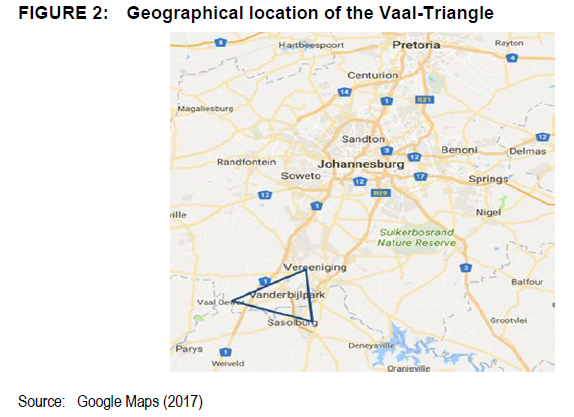
As mentioned, the availability of data regarding entrepreneurial aspects on regional and local level is very scarce. Due to this reason the decision was made to use the Vaal-Triangle region as the selected study area. The Vaal-Triangle area consists of three towns namely: Vereeniging, Vanderbijlpark and Sasolburg, the triangular shape of these three areas pathed the way for the name given Vaal-Triangle. (De Bruyn 2018:61). The Vaal-Triangle area was well-known for being one of South Africa's industrial hubs in the latter stages of the 20thcentury with industrial giants such as SASOL, ArcelorMittal, Samancor and Cape Gate (Local Government Handbook 2016). Due to recent changes in the steel and other industrial industries leading to large scale retrenchments and downscaling productions, gave rise to high unemployment rates in recent years. Unemployment figures for this area are more than 7 percentage points higher than the national unemployment rate and as much as 54 percent for some of the townships in this area (Blom 2018). The area of the Vaal-Triangle is depicted in Figure 2.
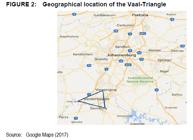
Considering Figure 2, the Vaal-Triangle is located closely to main economic cities such as Johannesburg and Pretoria (Local Government Handbook 2016). The town of Sasolburg is governed by the Metsimaholo Local Municipality and Vanderbijlpark and Vereeniging forms part of the Emfuleni Local Municipal area situated in the Fezile Dabi District in the Free State and Sedibeng District in Gauteng respectively, both Category B municipalities (Local Government Handbook 2016). Although the area falls within two provinces, they are merely divided by the Vaal River and the economic composition of this area is similar due to its industrial nature.
3.2 Sampling method
The target population of this study comprised unemployed individuals residing in the Vaal-Triangle region situated in the Gauteng and Free State provinces of South Africa. This study employed a non-probability convenience sampling technique to collect the primary data. The data was collected utilising self-administered structured questionnaires wherein 210 unemployed individuals were sampled. The questionnaires were distributed to these individuals during an unemployment workshop held at a higher education institution in the Vaal-Triangle region. The questionnaire was completely voluntary in nature and participation was of free will. The questionnaire also included a cover letter explaining the nature and purpose of the study as well providing anonymity of participants.
3.3 Research instrument
The research instrument included demographic information for example age, gender, language and total number of individuals in the household. In addition, previously validated scales measuring entrepreneurial intention and skills were adapted to fit the scope of this study more appropriately. Entrepreneurial characteristics of the unemployed individuals were measured using 13 items drawn from the literature and included aspects such as taking advantage of opportunities, commitment, being optimistic, motivation, determination, communication and leadership abilities (Balmaceda 2018; Krueger 1993; Pyysiainen et al. 2006; Urban & Kujinga 2017). To measure entrepreneurial skills and entrepreneurial intentions, scales from Liñán (2008:269-270) were adapted with 14 items and 12 items respectively. The entrepreneurial skill scale was measured using a four-point Likert scale ranging from no knowledge whatsoever (1) to sufficient knowledge (4). Both the entrepreneurial characteristics and intention scales were measured utilising a six-point Likert scale ranging from strongly disagree (1) to strongly agree (6).
4. RESULTS AND DISCUSSION
The questionnaire returned a 98 percent response rate, i.e. 206 of the 210 questionnaires were returned completed. Of the 206 responses none were discarded as all responses met the requirements of the study leaving 206 viable questionnaires for statistical analysis. The sample size included individuals in the age range of between 17 and 57 years. In terms of gender, the sample included more females (60 percent) than males (40 percent). The number of individuals living in each household ranged from one to ten individuals with majority of households (47 percent) having five individuals living within the home. Of the 206 participants' households 57 percent indicated that at least one individual was currently employed, whilst 33 percent indicated two people were employed. The bulk of the respondents (53 percent) completed matric, while, 39.5 percent had at least some form of further educated training.
4.1 Data Normality
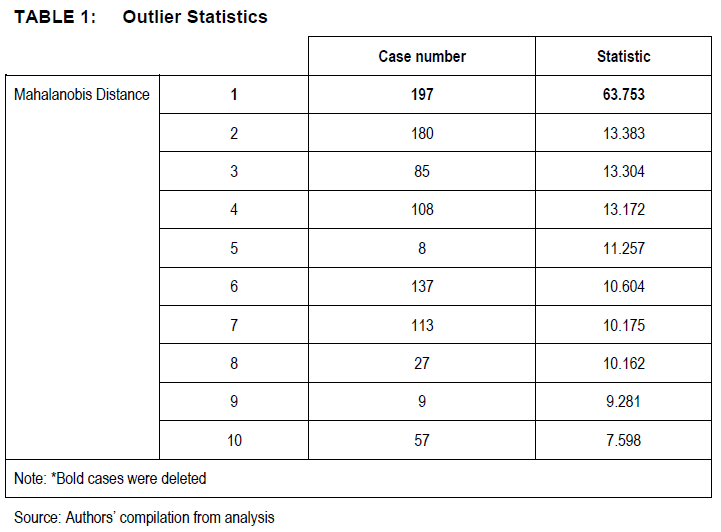
Normality of the data set was certified by screening for outliers and any missing values. A frequency analysis was run and identified one missing response in one subject case. To address the missing response, the items mode was computed and subsequently replaced the missing response. Next the data set was analysed to determine if any outliers were present. Outliers are deviations within a population and detecting them is important as outliers can have significant negative effects on statistical results (Field 2009:791; Hair, Black, Babin & Anderson 2010:65; Pallant 2013:127-128). As the sample size of this study was relatively small when compared to other studies in the social sciences realm (Pallant 2013:295), the Mahalanobis distance statistic was calculated to identify any outliers. This study consisted of three variable constructs, as such any Mahalanobis distance statistic larger than 16.266 (chi-square value for a=0.001 at 3 df) was considered an outlier. The subject numbers in the data set were marked as dummy dependent variables and SPSS generated the highest 10 Mahalanobis distance indicators as depicted in Table 1.
As can be seen in Table 1 above, there was one subject case which exceeded the 16.266 cut off level (case number 197). Subsequently, case number 197 was deleted from the data set, leaving 205 viable responses for data analysis.
4.2 Data Reliability
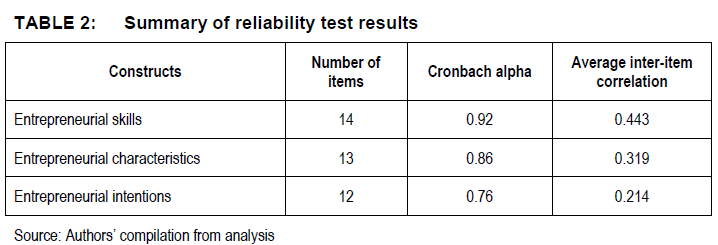
The Cronbach alpha statistic was the chosen statistic to measure the scales internal-consistency reliability. Cronbach alpha values between 0.70 and 0.95 are indicative of good to excellent reliability according to Zikmund and Babin (2013:257). The results of the standardised Cronbach alpha value analysis are depicted in Table 2.
Each construct exceeded the acceptable Cronbach alpha cut off level of 0.70. Entrepreneurial skills achieved the highest value of 0.92, closely followed by entrepreneurial characteristics (0.86). Entrepreneurial intentions recorded the lowest value of 0.76, however, it is still regarded as having good reliability. Based on the results it can be said that measurement instruments scales possess acceptable internal-consistency reliability. In addition, average inter-item correlation values were determined and provided an indication of the convergent and discriminant validity estimates of construct validity. According to Clark and Watson (1995:316), average inter-item correlation values below 0.15 (indicates that items are not related to each) are indicative of a lack of convergent validity, whilst those that greatly exceed 0.50 (suggest that items are closely related to each other) may point towards a lack of discriminant validity. Considering the average inter-item correlation values for the three scales used in this study were all between the recommended values it was reasonable to assume convergent and discriminant validity of the items within the construct.
4.3 Descriptive analysis
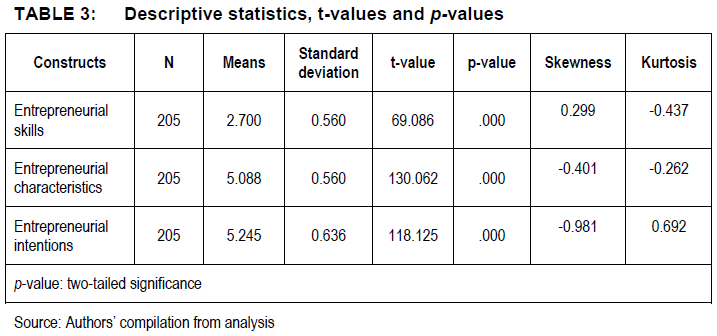
Once the internal-consistency reliability of the scales had been asserted, the data's descriptive statistics were computed along with a one-sample t-test which assessed the significance of the means. Owing to the use of a four-point Likert for entrepreneurial skills, the expected mean threshold was set at a value of 2.5. The expected threshold for the remaining two scales was set at a value 3.50 as a six-point Likert scale was used. The significance level was set at a = 0.05. Table 3 outlines the results of the means, standard deviations and p-values.
As Table 3 shows, entrepreneurial skills achieved a mean of 2.700, whilst entrepreneurial characteristics and intentions achieved means higher than 3.50. In addition, each scale's mean was statistically significant at the p < 0.05 level. These results indicate that unemployed individuals from the Vaal-Triangle region regard themselves to have entrepreneurial skills and characterise themselves as having entrepreneurial characteristics. These individuals display positive intent to become entrepreneurs and ultimately starting a business. Laguna (2013:254) states that the stronger the intention to perform a specific action the bigger the probability of it actually happening. In addition, a sufficient level of self-efficacy or the belief that people have about their own capabilities (skills and characteristic) also play a significant role in coping with specific actions. The normality of the data warranted no cause for concern as the skewness values fell between -2 and +2 and kurtosis values showed no irregularities (Berndt & Petzer 2011).
4.3 Correlation analysis
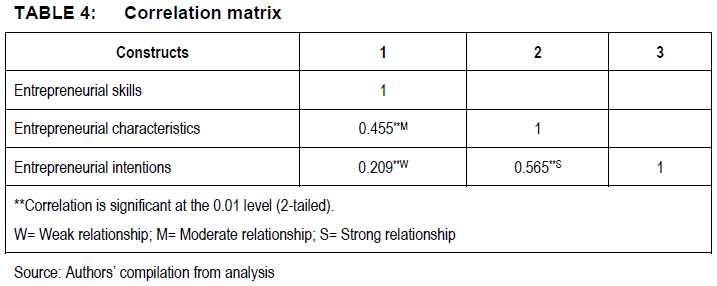
The Pearson's Product-Movement was used to determine if any underlying relationships existed between the constructs. The strength of the relationships are of significant importance and are denoted as r > .10 (weak relationship), r > .30 (moderate relationship) and r > .50 (strong relationship) (Cohen 1992:158; Pallant 2013:139). Table 4 illustrates the correlation matrix.
As is evident from Table 4, there is a statistically positive relationship between entrepreneurial skills and entrepreneurial characteristics (r = 0.455, p<0.01) as well as entrepreneurial intentions (r = 0.209, p<0.01). In addition, entrepreneurial characteristics displayed a positive significant relationship towards entrepreneurial intentions (r = 0.565, p<0.01). The results above indicate that unemployed individuals in the Vaal-Triangle region entrepreneurial intentions are highly associated with their sense of entrepreneurial characteristics. Whilst their entrepreneurial skills are weakly associated with entrepreneurial intentions it is still significant at the 0.01 level.
This weak association might be due to them still lacking confidence in their own entrepreneurial skills and experience. Fini, Grimaldi, Marzocchi and Sobrero (2009:17-18) state that two domains are needed in order for the formation of strong entrepreneurial motivation that being individual (for example motivation, personality, skills and experience) and contextual (for example the economy, social context and market environment) domains. As for the individual domain, psychological characteristics such as risk-taking tendency and spotting opportunities combined with the improvement of skills and experience, can have a strong positive influence on entrepreneurial intention (Fini et al. 2009:18; Meyer 2018:35; Zhao, Seibert & Hills 2005;). As the participant in this study showcased strong entrepreneurial characteristics (M = 5.088) it can be deduced that this variable has a strong relationship to entrepreneurial intention. As none of the correlation coefficients exceeded 0.90, it may be assumed that there is no obvious multicollinearity present between the constructs.
4.4 Independent sample t-test
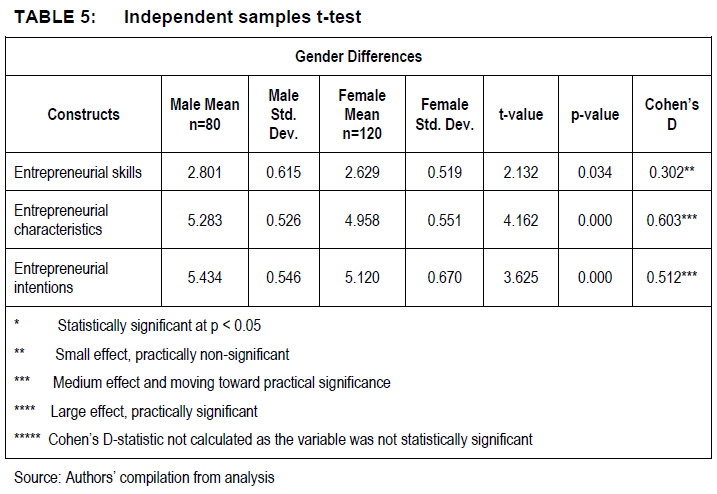
In the entrepreneurial spectrum gender has always been a prevalent factor when starting a new business (Ahl 2006; Ambrish 2014; Bird & Brush 2002; Brush et al. 2006; Hamilton 2015; Meyer 2018). To determine if any differences was present in unemployed individuals within the Vaal-Triangle region an independent sample t-test was conducted. These results are presented in Table 5.
As Table 5 shows males (N=80) were associated with entrepreneurial skills (M = 2.801; SD = 0.615), entrepreneurial characteristics (M = 5.283; SD 0.526) and entrepreneurial intentions (M = 5.434; SD = 0.546). By comparison, females (N = 120) were associated with a numerically smaller sense of entrepreneurial skills (M = 2.629; SD = 0.519), entrepreneurial characteristics (M = 4.958; SD 0.551) and entrepreneurial intentions (M = 5.120; SD = 0.670). The assumption of homogeneity of variances was tested and satisfied via Levene's F test, F (198) = 2.68, p = 0.103 for entrepreneurial intention; F (198) = 0.06, p = 0.804 for entrepreneurial characteristics and F (198) = 5.81, p = 0.017 for entrepreneurial intentions. The independent sample t-test was associated with a statistically significant effect t(198) = 2.132, p = 0.034 for entrepreneurial skills; t(198) = 4.162, p = 0.000 for entrepreneurial characteristics and t(198) = 3.625, p = 0.000 for entrepreneurial intentions.
Males were associated with a statistically larger mean for all constructs compared to females. Owing to the statistically significant differences amongst males and females, the Cohens d statistic was calculated for each of the constructs to determine if the differences had any practical significant effect. The Cohens d for entrepreneurial skills amounted to 0.302, a small effect which is practically non-significant.
Entrepreneurial characteristics achieved a value of 0.603, which is a medium effect moving towards practical significance. Entrepreneurial intentions yielded a Cohens d value of 0.512 which also signifies a medium effect moving towards practical significance. Chowdhury and Endres (2005), Wilson, Kickul and Marlino (2007) as well as Brixiová and Kangoye (2018) found in their studies that females consider themselves to be less skilled and to possess lower capabilities and performance compared to males. This study once again proved this and despite the array of programmes developed to assist female entrepreneurial development their own belief in their abilities, skills and capabilities needs to be improved in order to increase self-confidence and decrease gender stereotyping (Meyer 2018:117). Although female entrepreneurship has increased in recent years, it is still widely perceived that males are more likely to be positively inclined towards a career as an entrepreneur (Lo, Sun & Law 2012:35; Meyer 2018:4-5).
5. CONCLUSION
This study set out to determine the self-reported entrepreneurial skills, characteristics and intentions of a group of unemployed South African individuals as well as determining if any differences between males and females exist regarding the mentioned variables. Findings pointed out, that in the case of this sample; the unemployed individuals recorded statistically significant means. This indicates that they perceive having entrepreneurial skills, display positive entrepreneurial characteristics and possess positive intentions towards becoming entrepreneurs. Results from this study showed that females deem themselves as having less entrepreneurial skills and associated characteristics and in addition having lower entrepreneurial intention than males. This might also be a reason why female entrepreneurial activity is lower than male entrepreneurial activity in many countries. As in the case of several former studies (Gupta, Goktan & Gunay 2014; Justo, DeTienne & Sieger 2015; Kelley, Brush, Greene & Litovsky 2011; Kot, Meyer & Broniszewska 2016; Máté, Sarihasan, Popp, & Oláh, 2018; Saridakis, Marlow & Storey 2014) it was found that female entrepreneurial activity in many economies is noticeably less than males. The study showed that unemployed individuals have high intentions to start businesses, especially the male cohort. This specific group were all unemployed at the time of forming part of the study, for some reason, they seem to seldom act on this intention although having the required self-reported skills and characteristics. This might suggest that other factors, such as lack of opportunity, finance and a large enough market, and the absence of an enabling environment to start new businesses might have a direct impact on these individuals not actively pursuing their entrepreneurial intention (Máté, Sarihasan & Dajnoki 2017).
6. LIMITATIONS AND FUTURE STUDIES
Although this study filled a gap in providing findings based on a local region, this also may be deemed as a limitation as the sample size and data collection method restricts the findings from being generalized to the greater community. Future studies may include adding additional variables such as entrepreneurial attitude and the availability of an enabling environment for businesses to be established in. In addition, further studies may include a more qualitative approach to identify reasons why unemployed individuals do not act on their intention although having the required self-reported skills and characteristics.
REFERENCES
- AHL H. 2006. Why research on women entrepreneurship needs new direction. Entrepreneurship Theory and Practice 2006:595-621.
- AJZEN I. 2005. Attitudes, personality and behavior. 2nd ed. Maidenhead, UK: Open University Press.
- ALVORD SH, BROWN LD & LETTS CW. 2004. Social entrepreneurship and societal transformation: An exploratory study. The Journal of Applied Behavioral Science 40:260-282.
- AMBRISH DR. 2014. Entrepreneurship development: An approach to economic empowerment of female. International Journal of Multidisciplinary Approach and Studies 1(6):224-232.
- ASOGWA OS & DIM EM. 2016. Entrepreneurship development and unemployment reduction in Nigeria. International Journal of Business and Management Review 4(8):27-43.
- AUDRETSCH DB, KEILBACH MC & LEHMANN EE. 2006. Entrepreneurship and economic growth. Oxford, UK: Oxford University Press.
- BALMACEDA F. 2018. Entrepreneurship: skills and financing. Small Business Economics 50(4):871-886.
- BERNDT A & PETZER D. 2011. Marketing research. Pinelands, Cape Town: Heinemann.
- BIRD B & BRUSH CG. 2002. A gender perspective on organizational creation. Entrepreneurship Theory and Practice 2002:41-65.
-
BLOM N. 2018. Vaal River district hit by sewage discharge. Business Day 31 July 2018. [Internet:https://www.pressreader.com/; downloaded on 14 March 2019.
» https://www.pressreader.com/ - ]
- BOTHA M & BIGNOTTI A. 2017. Exploring moderators in the relationship between cognitive adaptability and entrepreneurial intention: Findings from South Africa. International Entrepreneurship Management Journal 13:1069-1095.
- BRIXIOVÁ R & KANGOYE T. 2018. Skills as a barrier to women's start-ups: A model with evidence from Eswatini. ERSA Working Paper 768.
- BRUSH CG, CARTER NM, GATEWOOD EJ, GREENE PG & HART MM. 2006. Growth-orientated women entrepreneurs and their businesses: A global research perspective. Cheltenham, UK: Edward Elgar.
- BRUTON GD, AHLSTROM D & OBLOJ K. 2008. Entrepreneurship in emerging economies: where are we today and where should the research go in the future. Entrepreneurship Theory and Practice 32(1):1-14.
- CARLAND JW, HOY F, BOULTON WR & CARLAND JAC. 1984. Differentiating entrepreneurs for small business owners: A conceptualization. Academy of Management Review 9(2):354-359.
- CARTER NM, HENRY CÓ, CINNÉIDE B & JOHNSTON K. 2006. Female entrepreneurship: Implications for education, training and policy. London: Routledge.
- CHOWDHURY S & ENDRES M. 2005. Gender differences and the formation of entrepreneurial self-efficiency. Indian Wells, CA. (Paper presented at the United States Association of Small Business (USASBE) Annual Conference.
- )
- CLARK J. 2009. Entrepreneurship and diversification on English farms: Identifying business enterprise characteristics and change processes. Entrepreneurship and Regional Development 21:213-236.
- CLARK LA & WATSON D. 1995. Constructing validity: Basic issues in objective scale development. Psychological Assessment 7(3):309-319.
-
COUNTRYECONOMY. 2019. Unemployment. [Internet:https://countryeconomy.com/unemployment; downloaded on 13 April 2019.
» https://countryeconomy.com/unemployment -
]
» https://www.google.co.za/maps/@-26.2336094,28.0094989,12.75z -
DANISH AGENCY FOR SCIENCE, TECHNOLOGY & INNOVATION. 2016. European institute for gender equality. [Internet:http://eige.europa.eu/gender-mainstreaming/structures/denmark/danish-agency-science-technology-and-innovation; downloaded on 17 May 2016.
» http://eige.europa.eu/gender-mainstreaming/structures/denmark/danish-agency-science-technology-and-innovation - ]
- DAVIDSSON P. 2016. Researching entrepreneurship: Conceptualization and design. Switzerland: Springer International Publishing.
- DE BRUYN C. 2018. The impact of tourism on Local Economic Development (LED): an analysis of the Vaal Triangle region. North-West University, Vaal Triangle Campus. (Doctoral dissertation.
- )
- DIMOVA R & PELA K. 2018. Entrepreneurship: structural transformation, skills and constraints. Small Business Economics 51(1):203-220.
- DVORSKY J, POPP J, VIRGLEROVA Z, KOVÁCS S & OLÁH J. 2018. Assessing the importance of market risk and its sources in the SME of the Visegrad Group and Serbia. Advances in Decision Sciences 22(A):1-25.
- ECKHARDT JT, CIUCHTA MP & CARPENTER M. 2018. Open innovation, information, and entrepreneurship within platform ecosystems. Strategic Entrepreneurship Journal 12:369-391.
- EMERY M, WALL M & MACKE D. 2004. From theory to action: Energizing entrepreneurship strategies to aid distressed communities grow their own. Community Development 35(1):82-96.
- ENTIKA CLE, MOHAMMAD S, JABOR MK & OSMAN S. 2017. Preliminary study on the prominent entrepreneurial skills set in the context of civil engineering practice. Journal of Technical Education and Training (JTET) 9(2):94-104.
- FAYOLLE A. & LINÁN F. 2014. The future of research on entrepreneurial intentions. Journal of Business Research 67(5):663-666.
- FERREIRA JJ, RAPOSO LM, RODRIGUES RG, DINIS A & DO PACO A. 2012. A model of entrepreneurial intention: An application of the psychological and behavioural approaches. Journal of Small Business and Enterprise Development 19(3):424-440.
- FERREIRA JJ, RATTEN V & DANA LP. 2017. Knowledge spill over-based strategic entrepreneurship. International Entrepreneurship and Management Journal 13(1):161-167.
- FIELD A. 2009. Discovering statistics using SPSS, 3rd ed. London, UK: Sage Publications Ltd.
- )
- FORTUNATO MW & ALTER T. 2015. Community entrepreneurship development: An introduction. Community Development 46(5):444-455.
- FREDERICK H, O'CONNOR A. & KURATK DF. 2019. Entrepreneurship. 5th ed. Victoria, Australia: Cengage Learning Australia Pty Ltd.
-
GEM CONSORTIUM. 2019a. Entrepreneurial behavior and attitudes. London: Global Entrepreneurship Research Association. [Internet:https://www.gemconsortium.org; downloaded on 22 March 2019.
» https://www.gemconsortium.org - ]
-
GEM CONSORTIUM. 2019b. Total early-stage entrepreneurial activity (TEA): Most recent data. London: Global Entrepreneurship Research Association. [Internet:https://www.gemconsortium.org/data; downloaded on 22 March 2019.
» https://www.gemconsortium.org/data - ]
-
GEM CONSORTIUM. 2019c. GEM Wiki: Definitions. London: Global Entrepreneurship Research Association. [Internet:https://www.gemconsortium.org/wiki/1375 downloaded on 22 March 2019.
» https://www.gemconsortium.org/wiki/1375 - ]
- GEORGE G, CORBISHLEY C, KHAYESI JN, HAAS MR & TIHANYI L. 2016. Bringing Africa in: Promising directions for management research. Academy of Management Journal 59(2):377-393.
- GHATAK M, MORELLI M & SJÖSTRÖM T. 2007. Entrepreneurial talent, occupational choice and trickle up policies. Journal of Economic Theory 137(1):27-48.
-
]
» https://www.inc.com/sujan-patel/10-essential-characteristics-of-highly-successful-.html - GREBLIKAITE J, SROKA W & GERULAITIENE N. 2016. Involving young people in Polish and Lithuanian social enterprises by fostering entrepreneurial skills and abilities as entrepreneurial opportunity at university. Entrepreneurial Business and Economics Review 4(3):131-152.
- GREENE PG, HART MM, GATEWOOD EJ, BRUSH CG & CARTER NM. 2003. Women entrepreneurs: Moving front and center. An overview of research and theory. Coleman White Paper Series 3:1 -47.
- GRIES T & NAUDÉ WA. 2011. Entrepreneurship and human development: A capability approach. Journal of Development Economics 3(1):216-224.
- GUPTA VK, GOKTAN AB & GUNAY G. 2014. Gender differences in evaluation of new business opportunity: A stereotype threat perspective. Journal of Business Venturing 29(2):273-288.
- HAIR JF, BLACK WC, BABIN BJ & ANDERSON RE. 2010. Multivariate data analysis: A global perspective. New Jersey: Pearson Education Limited.
- HAMILTON L. 2015. Generation Y female students' inclination towards entrepreneurship: a comparative study between South Africa and the Netherlands. Vanderbijlpark, North-West University. (Doctoral thesis.
- )
- HAUSMANN R & RODRIK D. 2003. Economic development as self-discovery. Journal of Development Economics 72(2):603-33.
- HENREKSON M & JOHANSSON D. 2010. Gazelles as job creators: A survey and interpretation of the evidence. Small Business Economics 35:227-244.
- HERRINGTON M & KEW J. 2013. GEM 2013 South African report: Twenty years of democracy. University of Cape Town Centre for Innovation and Entrepreneurship. Cape Town: South Africa.
-
HERRINGTON M, KEW J & KEW P. 2010. Tracking entrepreneurship in South Africa: A GEM perspective. [Internet:http://www.gemconsortium.org; downloaded on 11 April 2019.
» http://www.gemconsortium.org - ]
- HERRINGTON M, KEW J & KEW P. 2015. 2014 GEM South Africa report: South Africa: The crossroads - a goldmine or a time bomb? University of Cape Town Centre for Innovation and Entrepreneurship. Cape Town: South Africa.
- JUSTO R, DETIENNE DR & SIEGER P. 2015. Failure or voluntary exit? Reassessing the female underperformance hypothesis. Journal of Business Venturing 30(6):775-792.
- KELLEY DJ, BRUSH CG, GREENE PG & LITOVSKY Y. 2011. Global Entrepreneurship Monitor. 2010 women's report. Babson College. United States: Babson Park, MA.
- KOT S, MEYER N & BRONISZEWSKA A. 2016. A cross-country comparison of the characteristics of Polish and South African women entrepreneurs. Economics and Sociology (4):207-221.
- KRUEGER N. 1993. The impact of prior entrepreneurial exposure on perceptions of new venture feasibility and desirability. Entrepreneurship Theory and Practice 18(1):5-21.
- LAGUNA M. 2013. Self-efficacy, self-esteem, and entrepreneurship among the unemployed. Journal of Applied Social Psychology 43(2):253-262.
- LICHTENSTEIN GA, LYONS TS & KUTZHANOVA N. 2004. Building entrepreneurial communities: The appropriate role of enterprise development activities. Community Development 35(1):5-24.
- LO C, SUN H & LAW K. 2012. Comparing the entrepreneurial intention between female and male engineering students. Journal of Women's Entrepreneurship and Education 1-2:28-51.
-
LOCAL GOVERNMENT HANDBOOK. 2016. Sedibeng district municipality. [Internet:http://localgovernment.co.za/districts/view/14/Sedibeng-District-Municipality; downloaded on 29 May 2017.
» http://localgovernment.co.za/districts/view/14/Sedibeng-District-Municipality - ]
-
LÜTHJE C & FRANKE N. 2003. The 'making' of an entrepreneur: Testing a model of entrepreneurial intent among engineering students at MIT. Research and Development Management 33(2):135-147. (DOI:10.1111/1467-9310.00288.
» https://doi.org/10.1111/1467-9310.00288 - )
- MALEBANA MJ. 2014. The effect of knowledge of entrepreneurial support on entrepreneurial intention. Mediterranean Journal of Social Sciences 5(20):1020-1028.
- MALEBANA MJ. 2016. The effect of entrepreneurial role models on entrepreneurial intention in South Africa. Journal of Contemporary Management 13(1):90-116.
- MALEBANA MJ. 2017. Knowledge of entrepreneurial support and entrepreneurial intention in the rural provinces of South Africa. Development Southern Africa 34(1):74-89.
- MARKLEY DM, LYONS TS & MACKE DW. 2015. Creating entrepreneurial communities: Building community capacity for ecosystem development. Community Development 46(5):580-598.
-
MÁTÉ D. 2015. Impact of human capital on productivity growth in different labour-skilled branches. Acta Oeconomica 65(1):51-67. [Internet:https://doi.org/10.1556/AOecon.65.2015.1.3; downloaded on 14 April 2019.
» https://doi.org/10.1556/AOecon.65.2015.1.3 - ]
- MÁTÉ D, SARIHASAN I & DAJNOKI K. 2017. The relations between labour market institutions and employment of migrants. Amfiteatru Economic 19(46):806-820.
-
MÁTÉ D, SARIHASAN I, POPP J & OLÁH J. 2018. The Role of Regional Differences in Immigration: The Case of OECD Countries. Economics & Sociology 11(3):190-206. [Internet:https://doi.org/10.14254/2071-789X.2018/11-3/12; downloaded on 14 April 2019.
» https://doi.org/10.14254/2071-789X.2018/11-3/12 - ]
- MEYER N & DE JONGH J. 2018. The importance of entrepreneurship as a contributing factor to economic growth and development: The case of selected European countries. Journal of Economics and Behavioural Studies 10:287-299.
- MEYER N & MEYER DF. 2017. An econometric analysis of entrepreneurial activity, economic growth and employment: The case of the BRICS countries. International Journal of Economic Perspectives 11(2): 429-441.
- )
- MUKHTAR S, GWAZAWA UG & JEGA AM. 2018. Entrepreneurship development for diversification of Nigerian economy. Journal of Economics, Management and Trade 21(6):1-11.
- NAUDÉ W. 2013. Entrepreneurship and Economic Development: Theory, Evidence and Policy. Discussion Paper No. 7507.
- NAUDÉ WA. 2011. Entrepreneurs and economic development. United Nations University World Institute for Development Economics Research. Helsinki: Palgrave Macmillan.
-
O'MALLEY B. 2016. Universities playing 'key role' in growth of start-ups. [Internet:http://www.universityworldnews.com/article.php?story=20160127162334861; downloaded on 02 March 2017.
» http://www.universityworldnews.com/article.php?story=20160127162334861 - ]
- OLÁH J, KOVÁCS S, VIRGLEROVA Z, LAKNER Z & POPP J. 2019. Analysis and Comparison of Economic and Financial Risk Sources in SMEs of the Visegrad Group and Serbia, Sustainability 11(7):1853:1-19.
- PALLANT J. 2013. SPSS survival manual. 5th ed. London: Open University Press.
- ]
-
PINELLI M. 2015. Can entrepreneurship solve the youth unemployment crisis? [Internet:https://www.weforum.org/agenda/2015/09/can-entrepreneurship-solve-the-youth-unemployment-crisis; downloaded on 11 April 2019.
» https://www.weforum.org/agenda/2015/09/can-entrepreneurship-solve-the-youth-unemployment-crisis - ]
- PYYSIAINEN J, ANDERSON A, MCELWEE G & VESALA K. 2006. Developing the entrepreneurial skills of farmers: Some myths explored. International Journal of Entrepreneurial Behavior and Research 12(1):21-39.
- ROSIQUE-BLASCO M, MADRID-GUIJARRO A & GARCÍA-PÉREZ-DE-LEMA D. 2016. Entrepreneurial skills and socio-cultural factors: An empirical analysis in secondary education students. Education and Training 58(7/8):815-831.
- RWIGEMA H & VENTER R. 2005. Advanced entrepreneurship. Cape Town: Oxford.
- SARIDAKIS G, MARLOW S & STOREY DJ. 2014. Do different factors explain male and female self-employment rates? Journal of Business Venturing 29(3):345-362.
- SATA M. 2013. Entrepreneurial intention among undergraduate business students. International Journal of Research in Management, Economics and Commerce 3(9):33-48.
- SAUKA A, SCHNEIDER F & WILLIAMS CC. 2016. Entrepreneurship and the Shadow Economy. Cheltenham, UK: Edward Elgar Publishing.
- SHANE S & VENKATARAMAN S. 2000. Entrepreneurship as a field of research: The promise of entrepreneurship as a field of research. Academy of Management Review 26(1):13-17.
- SIMMONS SA, CARR JC, HSU DK & SHU C. 2016. The Regulatory Fit of Serial Entrepreneurship Intentions. Applied Phycology 65(3):605-627.
- SOLESVIK MZ. 2019. Entrepreneurial competencies and intentions: The role of higher education. Forum Scientiae Oeconomia 7(1):9-23.
- THOMPSON ER. 2009. Individual entrepreneurial intent: Construct clarification and development of an internationally reliable metric. Entrepreneurship Theory and Practice 33(3):669-694.
- TSORDIA C & PAPADIMITRIOU D. 2015. The role of theory of planned behavior on entrepreneurial intention of Greek business students. International Journal of Synergy and Research 4(1):23-37.
- URBAN B & KUJINGA L. 2017. The institutional environment and social entrepreneurship intentions. International Journal of Entrepreneurial Behavior & Research 23(4):638-655.
- VAN GELDEREN M, BRAND M, VAN PRAAG M, BODEWES W, POUTSMA E & VAN GILS A. 2008. Explaining entrepreneurial intentions by means of the theory of planned behaviour. Career Development International 13(6):538-559.
- VAN GELDEREN M, KAUTONEN T & FINK M. 2013. The moderating role of volitional conditions and trait self-control on the entrepreneurial intention-action relationship. Frontiers of Entrepreneurship Research 33(4):5-15.
- WATSON CH. 2001. Small business versus entrepreneurship revisited. In Brockhans RH. Ed. Entrepreneurship education: A global view. Burlington: Ashgate.
- WENNEKERS S & THURIK R. 1999. Linking entrepreneurship and economic growth. Small Business Economics 13(1):27-56.
- WEST GP, BAMFORD CE & MARSDEN JW. 2008. Constraining entrepreneurial economic development in emerging Latin American economies: Application and extensions of resource based theory. Entrepreneurship Theory and Practice 32:15-36.
- WILSON F, KICKUL J & MARLINO D. 2007. Gender, entrepreneurial self-efficacy, and entrepreneurial career intentions: implications for entrepreneurship education. Entrepreneurship Theory and Practice 31(3):387-406.
- ZHAO H, SEIBERT S & HILLS G. 2005. The mediating role of self-efficacy in the development of entrepreneurial intentions. Journal of Applied Psychology 90(6):1265-1272.
- ZIKMUND GW & BABIN JB. 2013. Essentials of marketing research. 5th ed. Boston: South-Western, Cengage Learning.
1 Percentage of 18-64 population (individuals involved in any stage of entrepreneurial activity excluded) who are latent entrepreneurs and who intend to start a business within three years" (Gem Consortium 2019c).
2 Percentage of 18-64 population who are either a nascent entrepreneur or owner-manager of a new business" (Gem Consortium 2019c).
3 Percentage of 18-64 population who are currently an owner-manager of an established business, i.e., owning and managing a running business that has paid salaries, wages, or any other payments to the owners for more than 42 months" (Gem Consortium 2019c).