Job stress and turnover intention of employees in the South African steel manufacturing industry - a management challenge
Abstract
Steel export from China has increased significant globally. China subsidises its local steel industry and therefore enables manufacturers to export excess steel at reduced costs. Consequently, the local South African steel industry is under pressure, as significant role-players have ceased operations due to financial constraints resulting in the unemployment of large numbers of employees. The purpose of the study was to investigate job stress and turnover intention of employees in the South African steel manufacturing industry. A research questionnaire was developed and circulated to a sample of 1 000 employees in the local steel manufacturing industry, of which 190 responses were received. The statistical analysis confirmed the validity and reliability of the questionnaire. Results indicated that business performance and remuneration had the most significant effect on employee stress levels and aspects related to work output rewards had the largest impact on employee turnover intention. Consequently, this situation poses a challenge to managers.
Import tariffs; management; turnover intention; steel and job stress
1. INTRODUCTION
According to the Suny Levin Institute (2017:Internet), globalisation is the result of the increased international trade over several decades. Steel is paramount to the functioning of our modern world. In 2017 the usage of steel globally amounted to 214,5 million tonnes of finished steel products (World Steel Association 2018:17). It is for this reason that it forms part of everyday life; used where people live, work and travel. Humankind has used steel over several thousands of years due to its unique mechanical and chemical characteristics compared to its relatively low production costs. These characteristics allow steel to be applied for a variety of uses where tensile strength and ductility are required (Pauliuk, Wang & Muller 2012:151).
China is one of the major role-players and has been for many years growing at an impressive rate and had one of the highest growth rates in the world (Holland 2017:40). According to Sun, Dong and Zhao (2017:13), China was able to sustain the exceptional economic growth of more than 10% over the last three decades. As a result, China has experienced a massive demand for infrastructure development and investment, which resulted in an excess production capacity of steel (Zhou & Zhang 2017:1). China is a major player in the global commodity price determinant, due to its insatiable demand for resources to fuel its aggressive growth strategy (Wang, Zheng & Liu 2016:76).
China's recent slowdown in growth has seen the commodity demand decline (Oster 2016:Internet). According to Novy (2013:101), this could be the result of the global slowdown in economic activities. As growth in China slowed, it experienced an internal oversupply of steel, which led to increased exports that doubled during 2014. In addition to this China is exporting steel at prices below the cost of production of other countries (Sky News Business Team 2015:Internet). The Chinese Government implemented macro-control policies which were widely considered to be anti-market (Sun et al. 2017:13).
South Africa is an emerging market environment characterised by a well-developed corporate sector (Tshivase & Kleyn 2016:272). The local South African steel manufacturing industry has been under severe financial pressure over the last couple of years. There was a decrease of one-third in steel production in the space of nine years, which has raised the alarming prospect of the extinction of South Africa's steel industry. At the same time, imports of steel products are on the rise (Dondofema, Matope & Akdogan 2017:9). It is evident that this scenario has put tremendous stress on the global steel market, and this is putting pressure on the South African market. In addition, the poor performance of the manufacturing sector attributes to increased competition from South-East Asia and the skills shortage in South Africa (Bhorat & Rooney 2017:Internet).
According to the World Trade Organisation (WTO) Tariffs (2017:Internet), import tariffs provide a price advantage to locally manufactured products or services by making the imported product or service more expensive. Felbermayr, Jung and Larch (2015:296) state that revenue generated from tariffs has an impact on the welfare of the country when used as a demand shifter. Shifting demand from the international to the local producer ensures that welfare is distributed to locals instead of leaving the country's boundaries (Felbermayr et al. 2015:297).
2.1 Job stress
From the literature, it is clear that a person's stress levels are influenced by their direct environment, which causes the person to deviate from their normal psychological and physiological behaviour (Berto 2014:394). Of concern is that the negative side of stress comes into play when the amount of stress experienced exceeds an individual's ability to cope with it (Hwang, Lee, Park, Chang & Kim 2014:63).
Various factors in the work environment have an impact on the wellbeing of an employee that can lead to a variety of reactions such as physical illness, mental illness and negative behaviour (Sonnentag & Fritz 2015:S72). Lotfizadeh, Maimaiti and Ismail (2014:79) found that occupational stress is a health hazard in the workplace. Stress can be viewed in the manner in which someone reacts to threatening and challenging factors in their environment (Sur & Ng 2014:81). People are stressed when they feel that they are not in control and there is a possibility that they will be unable to achieve their life goals (Sahraian, Omdivar, Ghanizadeh & Bazrafshan 2014:1). The stress experienced can be attributed to difficulties faced in their personal or professional life or a combination of both (Agarwal 2015:728).
Stress is a status which happens when individuals recognise that the conditions or strains facing them may be more than their endurance. The term job stress can be defined as a group of harmful external factors in the work environment (Gharib, Jamil, Ahmad & Ghouse 2016:21). A person's stress levels are influenced by their direct environment, which causes the person to deviate from their normal psychological and physiological behaviour (Berto 2014:394).
It is of great importance that the manager can address the abovementioned. Managers have to promote effective and efficient individual performance, which has to result in organisational performance (Thomas 2015:12). There is a critical need for managers to create a favourable work environment where employees are satisfied, motivated and remain focused on the objectives of the organisation. The challenge for managers is that they cannot eliminate turnover of employees, but they have to minimise the turnover of employees (Robbins & Coulter 2016:475).
2.2 Turnover intention
Turnover intention is the intention to leave one's job or organisation. In addition, it is the thinking and planning of employees to leave their job and organisation due to different reasons. It is difficult to determine the factors that lead to the decision to leave one's current job and business (Belete 2018:253).
It is further noted by Bothma and Roodt (2013:2) that the construct of turnover intention is seldom pertinently defined. The cost of employing new employees is very high; from not only a recruitment perspective but also the time and training it will require getting the new employee to perform to the extent they have been employed to do sufficiently (Yin-Fah, Foon, Chee-Leong & Osman 2010). The struggling steel manufacturing industry cannot afford this cost.
Another vital aspect of turnover intention is an employee's willingness to leave their current job voluntarily (Wong & Laschinger 2015:1827). The turnover intention is impacted by external factors outside the organisation, such as the availability of alternative jobs and employment levels. According to Demirtas and Akdogan (2015:62), the turnover intention is influenced by external factors (alternative jobs), internal or organisational factors (leadership, rewards and environment) and personal factors (performance and satisfaction).
Common factors include poor communication, the perception of a negative work environment, job description, job expectations from the organisation, salary and the provision of fringe benefits (Qureshi, Iftikhar, Abbas, Hassan, Khan & Zaman 2013:765). Another contributing factor is employee dedication. As employee dedication to an organisation decreases, turnover intention increases (Dane & Brummel 2013:120). The intention to leave does not constitute literally leaving the job. Cohen, Blake and Goodman (2015:255) found a positive relation between intention to leave and pertinently leaving.
Turnover intention is the final step of withdrawal as the employee contemplates quitting and actively starts looking for alternative employment (Lu & Gursoy 2016:212). According to Ahmed (2016:16), company performance is negatively related to employee turnover intention, as intent declines, company performance increases and this has a cost reduction effect on new employee training and hiring.
3. PROBLEM INVESTIGATED
The steel manufacturing industry acknowledge the augmented implementation of tariffs and duties imposed on steel imports from China (Ginindza 2015:Internet). Although this is likely to provide relief to the South African steel industry, there is little information about the possible influence it has on stress and turnover intention of employees in this industry. Yin-Fah et al. (2010:57) argue that there is a direct link between job stress and turnover intention. Kim and Kao (2014:220) underline this fact by stating that job stress is one of the most significant drivers of increased turnover intention.
Stress relates to the manner in which someone reacts to threatening and challenging factors in their environment (Sur & Ng 2014:81). People are stressed when they feel that they are not in control and there is a possibility that they will be unable to achieve their life goals (Sahraian et al. 2014:1). The stress experienced can be attributed to difficulties faced in their personal or professional life, or a combination of both (Agarwal 2015:728). Lotfizadeh et al. (2014:79) emphasise that occupational stress is a health hazard in the workplace, and can lead, according to Sonnentag and Fritz (2015:S72), to a variety of reactions such as physical illness, mental illness and negative behaviour.
Turnover intention, as the result of stress, is the final step of withdrawal as the employee contemplates quitting and actively starts looking for alternative employment. Management strives to prevent this from happening as the potential cost implications can be high for the individual and the business (Lu & Gursoy 2016:212). Ahmed (2016:16) also agrees that business performance is negatively related to turnover intention.
The article aims to determine whether employees in the South African steel manufacturing industry perceive to understand what steel import tariffs and duties are. The article also investigates whether the implementation of tariffs and duties together with other aspects have an influence on the job stress levels and turnover intentions of these employees.
Consequently, the research question for this article is: What aspects influence job stress and turnover intention of employees in the South African steel manufacturing industry?
4. RESEARCH OBJECTIVES
The research aims to achieve primary and secondary objectives.
The primary objective of this article is:
• to determine the factors which influences stress levels and turnover intention of employees.
The secondary objectives of this article are to:
• determine whether employees are aware of import tariffs and duties that has been implemented;
• determine the aspects that increase the level of employees' stress levels;
• determine employees' turnover intention;
• determine whether there is a difference in perception between highest qualification groupings regarding understanding what import tariffs and duties entail; and to
• determine whether there is a difference in perception between highest qualification and the aspects that influence employee stress levels and turnover intentions.
5. RESEARCH METHODOLOGY
This study used a quantitative research design. The study followed a cross-sectional approach, as the implementation of the import tariffs and duties were a once-off event. The understanding and impact it had on employees, if any, should have taken place when the implementation was announced and should not differ over a period.
5.1
Measuring instrumentData were collected through structured, self-administered questionnaires. The questionnaire included a preamble explaining the objectives of the study as well as the complete instructions for the questionnaire. The first section of the questionnaire aimed to gather demographic information about respondents, as well as information on their employing department and current organisational level. The final sections measured the main constructs of the study (i.e. job stress and turnover intentions) on an unlabelled four-point Likert-type scale, where 1 indicates 'strongly disagree' and 4 'strongly agree'.
5.2
The target population and sample selectionJager, Putnick and Bornstein (2017:13) define convenience sampling as a sampling method where a sample is chosen purely based on availability. These authors also contend that the convenience sample is simple, quick and inexpensive. From the reasons mentioned by the aforementioned authors the researcher is of the opinion that convenience sampling is best suited for this study.
Considering the complexity of the population and constraints involved, non-probability sampling was considered the best option for this research. Non-probability sampling is less complicated and more cost-effective compared to probability sampling (Malhotra 2010:376). There are numerous types of non-probability sampling methods including quota sampling, judgement sampling, snowball sampling and convenience sampling (Struwig & Stead 2013:116-118). In this study, a convenience sampling method was used. Data were collected via an electronic questionnaire, and statistical analysis and inferences were used to formulate the findings and conclusions.
The sample comprised the unit of analysis that was based on business units located in Vanderbijlpark, Vereeniging, Newcastle, Saldanha and Pretoria. Data were easy to obtain as employees in the units of analysis all have access to the internet and have individually allocated email addresses. These email addresses were obtained with the relevant permission from management. Management further permitted that the questionnaires could be distributed to the employees. A sample of 1 000 employees was selected, and 190 responses were received.
5.3
Data collectionQuestionnaires were distributed to participants electronically via the internet and the internal email system of the identified companies. The respondents were asked to complete the questionnaire regarding their awareness of tariffs and duties, their stress levels and turnover intentions. The respondents, who had not returned their completed questionnaires in time, were reminded telephonically about the due date for the questionnaires.
5.4
Data analysisThe researchers used the Statistical Package for the Social Sciences (SPSS 24) to capture, clean, edit and analyse the data obtained from the questionnaires. An exploratory factor analysis was used as a data reduction technique to determine the dimensions or factors underlying the construct, followed by confirmatory factor analysis. Reliability analysis was subsequently undertaken to determine the reliability of the nine factors extracted through the exploratory factor analysis. The descriptive results for the individual statements measuring the different factors were reported after that.
5.5
Psychometric properties of the measuring instrumentTo investigate the psychometric properties of the instrument, validity was examined by addressing construct and content validity, while reliability was investigated by computing alpha coefficients (Delport & Roestenburg 2011:173-177).
5.5.1 Construct validity
Van Zyl and Pellissier (2017:150) state that constructs validity explain how well items within a measuring instrument measure the construct that the measuring instrument was intended to measure. An exploratory factor analysis (EFA) was conducted first to group the items in the questionnaire into factors. The EFA was conducted on all the items in the questionnaire.
The EFA yielded nine factors containing two to six items each (a total of 33 items). The factors or constructs were understanding and information as part of import tariffs and duties. Personal matters, company performance, company environment, company communication and work environment were constructs of stress levels. Work environment, work output reward, personal aspects were constructs of turnover intention.
According to Yong and Pearce (2013:79), the broad purpose of EFA is to uncover complex patterns by exploring data sets and CFA to confirm it. In this article, the data set is new, and therefore both EFA and CFA were used. The EFA was followed by confirmatory factor analysis (CFA).
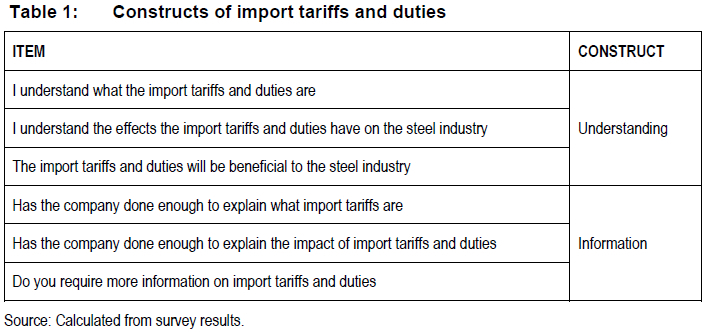
According to Table 1 the section on import tariffs and duties yielded two factors from six items. The calculated Kaiser's overall MSA was 0.67, indicating a result larger than 0.5 and therefore that factor analysis was deemed appropriate. The Eigenvalues of the correlation matrix was calculated and served as an indication of the amount a variance could be explained by the number of factors.
According to the results, two factors were retained and could explain 70% of the variance. The final commonality estimates indicated that communalities varied from a high of 82% to a low 39%. Communality is the estimate of variance that is present for each variable as a component of the retained factors (Field 2009:637). A variable with a high communality has a high contribution to a retained component whereas a variable with a low communality does not contribute much to a retained component.
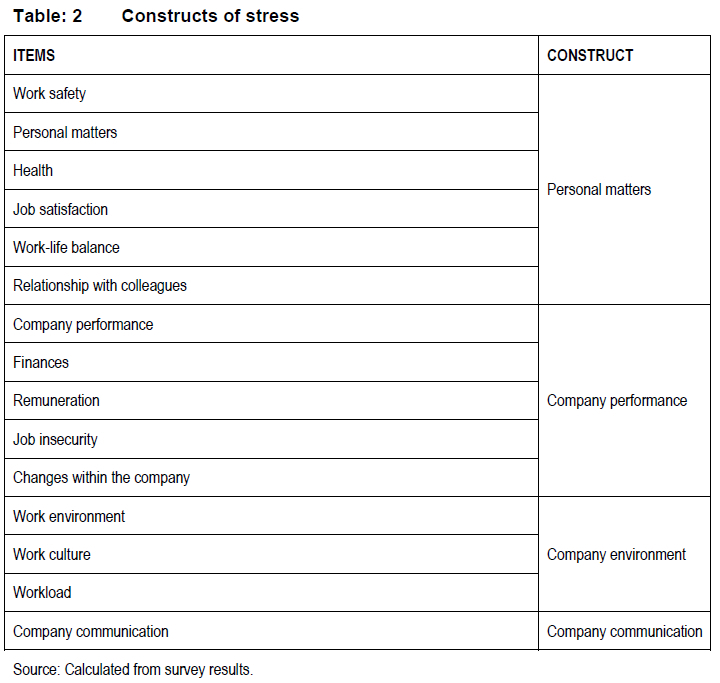
According to Table 2 the section on stress yielded 4 factors from 16 items. The calculated Kaiser's overall MSA was 0.85, indicating a result larger than 0.50 and therefore that factor analysis was deemed appropriate. The Eigenvalues of the correlation matrix were calculated and served as an indication of the amount a variance that could be explained by the number of factors. According to the results, four factors were retained and could explain 59% of the variance. The final communality estimates indicated that communalities varied from a high of 71% to a low 37%.
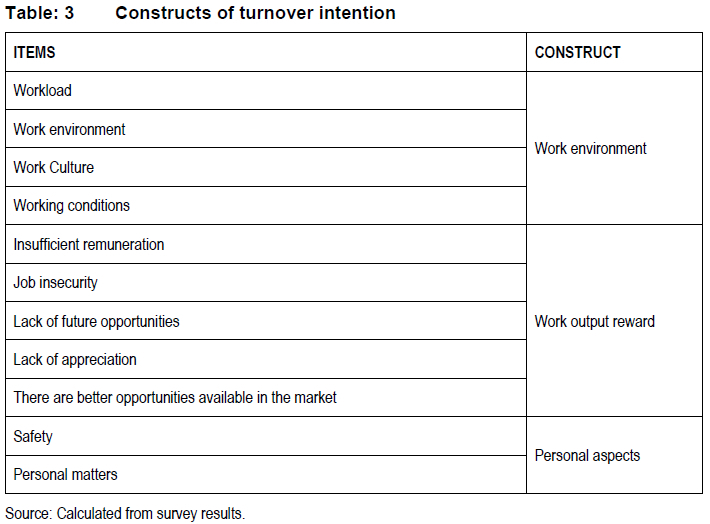
According to Table 3 the section on turnover intention yielded 3 factors from 11 items. The calculated Kaiser's overall MSA was 0.83, indicating a result larger than 0.50 and therefore that factor analysis was deemed appropriate. The Eigenvalues of the correlation matrix were calculated and served as an indication of the amount a variance that could be explained by the number of factors. According to the results, three factors were retained and could explain 59% of the variance. The final communality estimates indicated that communalities varied from a high of 75% to a low 37%. Consequently, the measuring instrument shows construct validity.
5.5.2 Content validity
According to Van Zyl and Pellissier (2017:150), content validity is obtained when the content of the items adequately represents the comprehensive field of a given construct. The selected unit of analysis was deemed adequately informed about the impact import tariffs and duties could have on the company. Based on the selected units' background and company profiles, these units were deemed adequately informed about the existence and meaning of import tariffs and duties. Subsequently, these units of analysis were regarded as ideal for obtaining feedback regarding the impact of import tariffs and duties on their employees. Consequently, the measuring instrument can be deemed construct valid.
5.5.3 Reliability
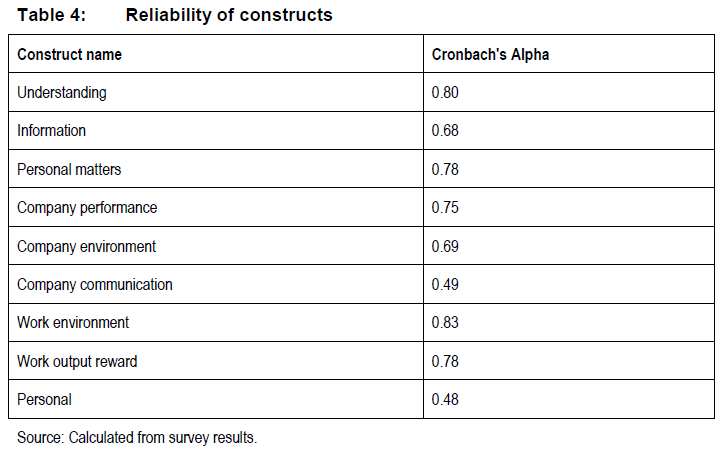
Cronbach's alpha coefficient was calculated as a measure of reliability and internal consistency. It is an indication of whether items and subsets of items within the measuring instrument are correlated (Field 2009:675).
The Cronbach's alpha reliability coefficient may range between 0 and 1, with the value closer to 1 indicating a greater internal consistency of the items in the construct. According to Field (2009:675), a Cronbach's alpha value greater than 0.8 can be considered acceptable for cognitive testing. When testing ability, a Cronbach's alpha value greater than 0.7 can be considered acceptable, whereas when testing psychological constructs Cronbach's alpha values lower than 0.7 can still be considered realistically acceptable because the constructs that are measured can be considered diverse. The fewer items included in a construct it would be expected that the value of the Cronbach's Alpha would be lower (Tavakol & Dennick 2011:53). This measuring instrument was therefore deemed reliable
6. RESULTS AND DISCUSSION
In this section the empirical results of the research are presented according to the objectives.
6.1 Tariff and duty understanding
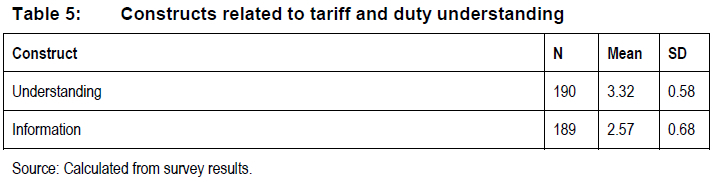
The first objective was to determine employees' comprehension of tariffs and duties; their understanding and awareness thereof were examined. Subsequently, as indicated in Table 5 the mean scores indicate respondents' comprehension of tariffs and duties.
The results (Mean = 3.32, SD = 0.58) suggest that, based on a 4-point Likert scale, respondents had a good understanding (Understanding) of what tariffs and duties are and the effect it could have on the local steel manufacturing industry. The above results (Mean = 2.57, SD = 0.68) information about tariffs and duties (Information) indicated that enough had been done to provide sufficient information regarding tariffs and duties and that respondents do not require further information.
6.2 Stress level
To address the second secondary objective, aspects that could influence respondents' levels of stress were investigated.
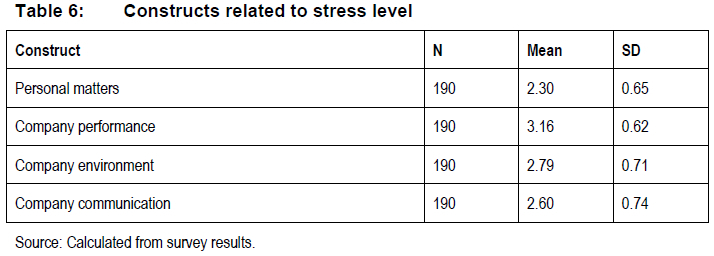
Subsequently, Table 6 summarises the mean scores for the stress-related constructs. The results (Mean = 2.30, SD = 0.65) show that respondents indicated that they agree 2.30 on a four-point scale that personal matters had a moderate effect increase their stress levels. The results (Mean = 2.79, SD = 0.71) further indicate that the company environment increases the respondents' stress levels. The results (Mean = 2.60, SD = 0.74) also show that company communication also increases the stress levels of the respondents.
The results (Mean = 3.16, SD = 0.62) indicate that company performance affected respondent stress levels the most. The findings are understandable as the questions are related to company performance centre around how the company performance, financial performance and employee remuneration, job insecurity and changes within the company.
To conclude, most respondents agree that company performance increases their stress levels and the fewest respondents agree that personal matters increase their stress levels.
6.3 Turnover intentions
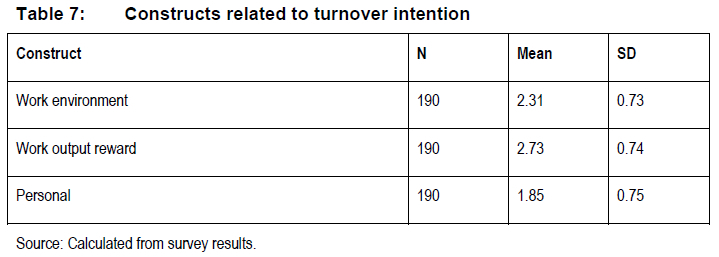
The respondents' turnover intentions were investigated to address the third secondary objective. Subsequently, Table 7 summarises the mean scores of the turnover intention-related factors.
The results (Mean = 2.31, SD = 0.73) show that the respondents indicated that they agree 2.31 on a four-point scale that work environment increases their turnover intention. The results (Mean = 1.85, SD = 0.75) further show that personnel had the smallest effect on the employee's intention to leave their current employer.
The results (Mean = 2.73, SD = 0.74) also show that work output reward had the largest effect on respondent turnover intention. The construct consisted of factors such as insufficient remuneration, job insecurity, the absence of appreciation, lack of future opportunities with their current employer and the perception of better employment opportunities in the market. To conclude, most respondents agree that the company work environment increases their turnover intention and the fewest respondents agree that personal matters escalate their turnover intention.
6.4 Level of education
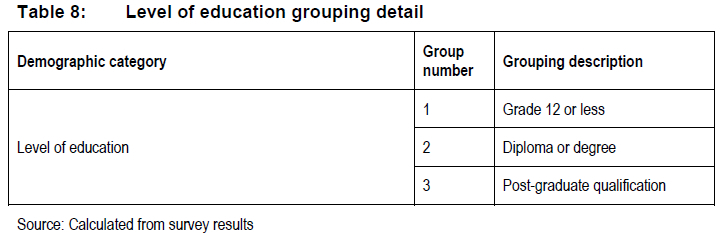
The fourth secondary objective is to determine whether there is a significant difference in perception between the level of education groupings regarding understanding what tariffs and duties are and what influence employee stress levels and turnover intentions.
The level of education groupings was tested against the constructs to determine whether there was a significant difference in perception.
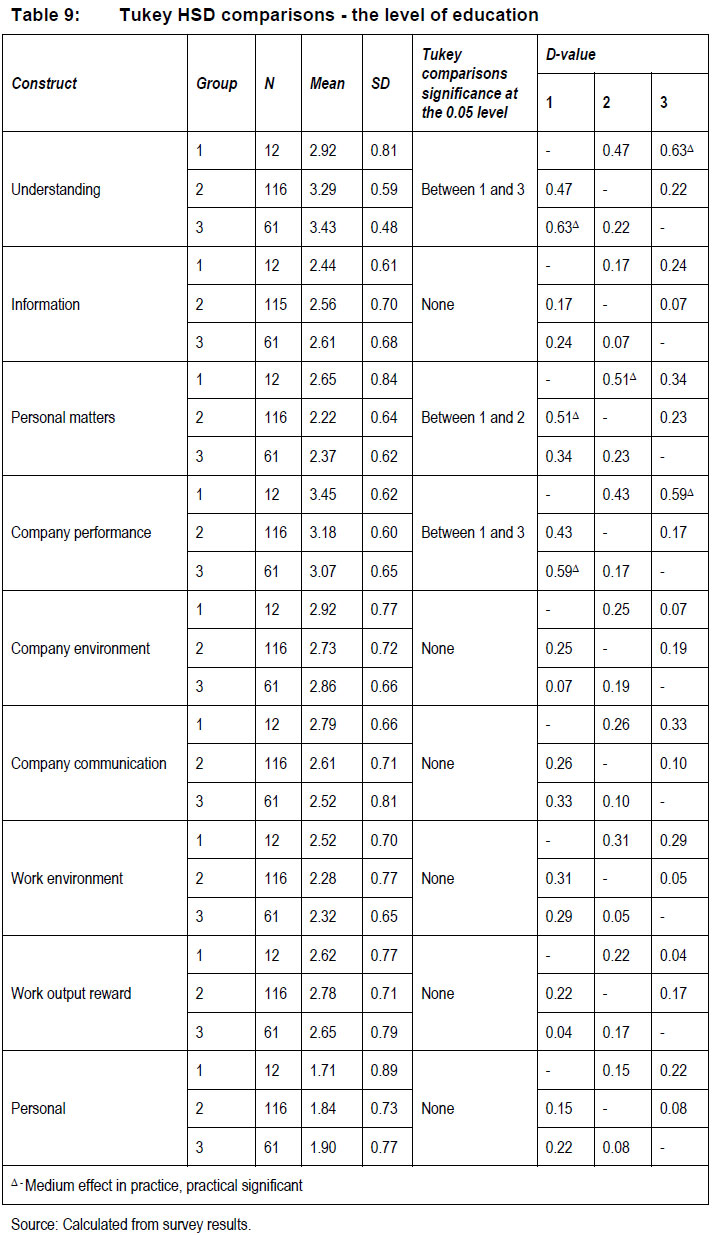
The analysis of variance test (ANOVA) is used when multiple independent groups are used, therefore in this article, ANOVA was used. Tukey's honesty significance difference (HSD) test was used to determine whether there were any comparisons between groups when compared to constructs. A significant difference between groups indicates that the groups differ from each other. The means of the different groups are compared to determine whether significant differences are present (Abdi & Williams 2010:1).
Table 9 provides a summary of the Tukey comparisons performed for highest qualification groupings.
The Tukey comparison identified practically significant differences between groups one and three for understanding. It appears that employees with a post-graduate qualification had a better understanding of tariffs and duties compared to employees with grade 12 or less. In addition, the Tukey comparison identified practically significant differences between groups one and two for personal matters. It appears that personal matters have a bigger influence on employees with a diploma or degree than employees with grade 12 or less. Lastly, the Tukey comparison identified practically significant differences between groups one and three for company performance. It appears that company performance had a bigger influence on stress on employees with post-graduate qualification compared to employees with grade 12 or less.
7. CONCLUSIONS
The primary objective of this article is to determine what influence stress levels and turnover intention of employees. The results show that company performance increases stress level the most and work output reward have the biggest influence on turnover intention.
The first secondary objective was to determine whether employees are aware of tariffs and duties and that it has been implemented. The results confirmed that the majority of respondents are aware of tariffs and duties and that it has been implemented. The results further indicate that individuals understand what tariffs and duties are.
The second secondary objective focuses on which aspects influence employee stress levels. The results show that most respondents indicated that company performance increases their stress levels the most.
The third secondary objective focuses on which aspects influence employee turnover intentions. The results show that most respondents indicated that work output reward has the biggest influence on their turnover intention the most.
The fourth secondary objective is to determine whether there is a significant difference in perception between highest qualification groupings regarding understanding what tariffs and duties are and what influences employee stress levels and turnover intentions. It was noted that there is a difference in the proper understanding of tariffs and duties by individuals with only a grade 12 or less appeared to be less informed compared to individuals with a postgraduate qualification.
The fifth secondary objective to determine whether there is a difference in perception between highest qualification and what influences employee stress levels and turnover intentions. It was noted that there is a difference in stress levels on personal matters and that personal matters have a bigger influence on employees with a diploma or degree than employees with grade 12 or less. It was also noted that there is a difference in stress levels on company performance and that company performance had a bigger influence on stress on employees with post-graduate qualification compared to employees with grade 12 or less.
8. PRACTICAL MANAGERIAL IMPLICATIONS AND RECOMMENDATIONS
The results of this study indicate that company performance influence employee's stress levels the most. These results can assist management to identify possible solutions of stress (Thomas 2015:12). Therefore, it is crucial for businesses to develop effective stress management strategies in order to address aspects such as company performance that cause work stress (Islam, Jantan, Bashir, Masud & Roy 2017:21).
The results also show that work output reward had the largest influence on employee turnover intention. This is a challenge for any manager, but for the business to be successful, this issue needs much attention. Management must ensure that applicable rewards for output are in place to ensure a low turnover intention.
This study also shows that employee's qualifications influence the individual understanding of tariffs and duties. Individuals with only grade 12 or less appeared to be less informed compared to individuals with a postgraduate qualification. In addition, personal matters have a bigger influence on employees with a diploma or degree than employees with grade 12 or less. Lastly, company performance had a bigger influence on stress on employees with postgraduate qualification compared to employees with grade 12 or less.
Therefore management should encourage and support employees to improve their qualifications (Schenk 2014:396). Managers have to encourage their employees to work to a prosperous future - a fulfilling career. In addition, employees have to be encouraged to improve themselves by attending courses to improve their skills and qualifications. The above remains one of the acute challenges of South Africa (Bhorat & Rooney 2017:Internet).
REFERENCES
2. LITERATURE REVIEW
- ABDI H & WILLIAMS LJ. 2010. Tukey's honesty significant difference (HSD) test. Encyclopedia of Research Design. Thousand Oaks, CA: Sage.
- AGARWAL RN. 2015. Stress, job satisfaction and job commitment's relation with attrition with special reference to the Indian IT sector. Bucharest: International Management Conference. (9th conference of the International Management Conference; 5-6 Nov.
-
)
» https://doi.org/10.4172/2169-026X.1000253 -
AHMED NOA. 2016. Impact of emotional exhaustion on turnover intentions: a mediating role of organisational commitment in higher education institutes of Saudi Arabia. [Internet:http://www.ersj.eu/repec/ers/pijeba/15_3_p2.pdf ; downloaded on 02 April 2017.
» http://www.ersj.eu/repec/ers/pijeba/15_3_p2.pdf -
]
» http://www.dpru.uct.ac.za/sites/default/files/image_tool/images/36/Publications/Working_Papers/DPRU%20WP201702.pdf -
)
» https://doi.org/10.1177%2F0734371X15581850 -
BERTO R. 2014. The role of nature in coping with psycho-physiological stress: a literature review on restorativeness. Behavioural Sciences 4:394-409. (DOI:https://doi.org/10.3390/bs4040394.
» https://doi.org/10.3390/bs4040394 - )
-
]
» https://doi.org/10.7166/28-4-1683 -
BOTHMA CF & ROODT G. 2013. The validation of the turnover intention scale. South African Journal of Human Resource Management 11(1):1-12. (DOI:https://doi.org/10.4102/sajhrm.v11i1.507.
» https://doi.org/10.4102/sajhrm.v11i1.507 - )
-
)
» http://www.itac.org.za/news-headlines/itac-in-the-media/itac-on-track-to-deliver-decisions-on-steel-tariffs -
DANE E & BRUMMEL BJ. 2013. Examining workplace mindfulness and its relations to job performance and turnover intention. Human Relations 67(1):105-128. (DOI:https://doi.org/10.1177%2F0018726713487753.
» https://doi.org/10.1177%2F0018726713487753 -
)
» https://doi.org/10.1080/15256480.2014.872898 -
DEMIRTAS O & AKDOGAN AA. 2015. The effect of ethical leadership behavior on ethical climate, turnover intention, and affective commitment. Journal of Business Ethics 130(1):59-69. (DOI:https://doi.org/10.1007/s10551-014-2196-6.
» https://doi.org/10.1007/s10551-014-2196-6 - )
- )
-
FELBERMAYR G, JUNG B & LARCH M. 2015. The welfare consequences of import tariffs: a quantitative perspective. Journal of International Economics 97(2):295-309. (DOI:https://doi.org/10.1016/j.jinteco.2015.05.002.
» https://doi.org/10.1016/j.jinteco.2015.05.002 -
)
» http://internationalbanker.com/banking/commodity-price-declines-and-their-economic-impact/ - GHARIB MN, JAMIL S, AHMAD M, & GHOUSE S. 2016. The impact of job stress on job Performance: A case study on Academic staff at Dhofar university. JER © Serials Publications, 13(1): 21-33.
-
]
» http://news.sky.com/story/1570552/china-s-impact-on-the-global-steel-market - HOLLAND J. 2017. Intellectual property rights in China: patents and economic development. Journal of International Law and Jurisprudence 8(1):40-45.
-
)
» http://www.globalization101.org/trade-introduction/ - ISLAM A, JANTAN AHB, BASHIR A, MASUD S & ROY B. 2017. Work stress among managers of business organisation in Bangladesh. International Journal of Business & Management 10(3):18-21.
-
JAGER J, PUTNICK DL & BORNSTEIN MH. (2017). II. More than just convenient: the scientific merits of homogeneous convenience samples. Monographs of the Society for Research in Child Development, 82(2):13-30. (DOI:https://doi.org/10.1111/mono.12296.
» https://doi.org/10.1111/mono.12296 -
)
» https://doi.org/10.1080/00208825.2016.1140523 -
KIM H & KAO D. 2014. A meta-analysis of turnover intention predictors among US child welfare workers. Children and Youth Services Review47:214-223. (DOI:https://doi.org/10.1016/j.childyouth.2014.09.015.
» https://doi.org/10.1016/j.childyouth.2014.09.015 -
)
» http://dx.doi.org/10.4236/jss.2016.45011 -
LU ACC & GURSOY D. 2016. Impact of job burnout on satisfaction and turnover intention: do generational differences matter? Journal of Hospitality & Tourism Research 40(2):210-235. (DOI:10.1177/1096348013495696.
» https://doi.org/10.1177/1096348013495696 -
)
» https://doi.org/10.5539/ijbm.v5n8p57 -
NOVY D. 2013. Gravity redux: Measuring international trade costs with panel data. Economic Inquiry 51(1):101-121. (DOI:https://doi.org/10.1111/j.1465-7295.2011.00439.x.
» https://doi.org/10.1111/j.1465-7295.2011.00439.x - )
- ]
-
PAULIUK S, WANG T & MULLER DB. 2012. Moving toward the circular economy: the role of stocks in the Chinese steel cycle. Environmental Science and Technology 46(1):148-154. (DOI:https://doi.org/10.1021/es201904c.
» https://doi.org/10.1021/es201904c - )
-
QURESHI MI, IFTIKHAR M, ABBAS SG, HASSAN U, KHAN K & ZAMAN K. 2013. Relationship between job stress, workload, environment and employees' turnover intentions: what we know, what should we know. World Applied Sciences Journal 23 (6):764-770. (DOI:10.5829/idosi.wasj.2013.23.06.313.
» https://doi.org/10.5829/idosi.wasj.2013.23.06.313 - )
- ROBBINS SP & COULTER M. 2016. Management. 12th ed. Essex: Pearson
-
SAHRAIAN A, OMDIVAR B, GHANIZADEH A & BAZRAFSHAN A. 2014. Association of job stress with locus of control in nurses. Shiraz E-Medical Journal 15(2):1-3. (DOI:10.17795/semj20588.
» https://doi.org/10.17795/semj20588 - )
- SCHENK H. 2014. Human Resource Management. In NEL J & DE BEER A (eds). Business Management: A contemporary Approach. 2nd ed. Cape Town: Juta.
- ]
-
SONNENTAG S & FRITZ C. 2015. Recovery from job stress: the stressor-detachment model as an integrative framework. Journal of Organizational Behavior 36 (S1):S72-S103. (DOI:https://doi.org/10.1002/job.1924.
» https://doi.org/10.1002/job.1924 - )
- STRUWIG FW & STEAD GB. 2013. Research: planning, designing and reporting. 2nd ed. Cape Town: Pearson.
-
SUN W, DONG K & ZHAO T. 2017. Market demand dynamic induced mechanism in China's steel industry. Resources Policy 51:13-21. (DOI:https://doi.org/10.1016/j.resourpol.2016.10.011.
» https://doi.org/10.1016/j.resourpol.2016.10.011 - )
- ]
-
SUR S & NG ES. 2014. Extending theory on job stress: the interaction between the "Other 3" and "Big 5" personality traits on job stress. Human Resource Development Review 13(1):79-101. (DOI:https://doi.org/10.1177%2F1534484313492332.
» https://doi.org/10.1177%2F1534484313492332 - )
-
TAVAKOL M & DENNICK R. 2011. Making sense of Cronbach's alpha. International Journal of Medical Education 2:53-55. (DOI:https://dx.doi.org/10.5116/ijme.4dfb.8dfd.
» https://dx.doi.org/10.5116/ijme.4dfb.8dfd - )
- THOMAS R. 2015. Employee performance: The challenge for managers in the Free State public service: Bloemfontein: University of the Free State. (Dad-thesis.
- )
- )
- VAN ZYL D & PELLISSIER R. 2017. Surveys as research strategy. In: VAN ZYL D, VENTER P, STACK E, VAN RENSBURG W, JOUBERT P & PELLISSIER R (eds.). Economic & Management research. Cape Town: Oxford. (pp 131-155.
- )
- )
-
WONG CA & LASCHINGER HKS. 2015. The influence of frontline manager job strain on burnout, commitment and turnover intention: A cross-sectional study. International Journal of Nursing Studies 52(12):1824-1833. (DOI:https://doi.org/10.1016/j.ijnurstu.2015.09.006.
» https://doi.org/10.1016/j.ijnurstu.2015.09.006 - )
-
WORLD TRADE ORGANISATION (WTO). 2017. Tariffs. [Internet:https://www.wto.org/english/tratop_e/tariffs_e/tariffs_e.htm; downloaded on 14 June 2017.
» https://www.wto.org/english/tratop_e/tariffs_e/tariffs_e.htm - ]
-
WORLD STEEL ASSOCIATION. 2018. World steel in figures 2018. [Internet:https://www.worldsteel.org/en/dam/jcr:f9359dff-9546-4d6b-bed0-996201185b12/World+Steel+in+Figures+2018.pdf; downloaded on 21 September 2018.
» https://www.worldsteel.org/en/dam/jcr:f9359dff-9546-4d6b-bed0-996201185b12/World+Steel+in+Figures+2018.pdf; downloaded - ]
- )
-
YONG AG & PEARCE S. 2013. A beginner's guide to factor analysis: Focusing on exploratory analysis. Tutorials in Quantitative Methods for Psychology 9(2):79-94. (DOI:https://doi.org/10.20982/tqmp.09.2.p079.
» https://doi.org/10.20982/tqmp.09.2.p079 - )
-
ZHOU W & ZHANG S. 2017. Anti-dumping practices and China's implementation of WTO rulings. The China Quarterly 3:1-16. (DOI:https://doi.org/10.1017/S0305741017000510.
» https://doi.org/10.1017/S0305741017000510