The use of strategy tools by chartered accountants in the South African mining industry
Abstract
As a third of all directors in South Africa are chartered accountants (CAs), this research examined the strategising practices of CA strategists in the mining industry. Drawing on the strategy-as-practice perspective, the research aimed to answer questions pertaining to which strategy tools CA strategists use, and how their accounting background informs their decisions on which tools to use and how to use them. Empirical data were produced through semi-structured individual interviews with CA strategists selected through purposive and snowball sampling. Data were analysed through conversation analysis using thematic coding. Findings portray CA strategists as craftspeople who adapt and interpret strategy tools from an accounting perspective to serve the requirements of the situation they face. The research confirmed wide use of accounting tools in strategising. The research found that the model of strategising, albeit deliberate or emergent, as well as the educational background of the strategist, affects deciding which strategy tools are used and how they are used. Specifically, findings indicated that mostly analytical tools are used during planning and deliberate strategising whereas people and project-oriented tools are used during implementation. Understanding how strategy is done in the South African mining industry, offers insight into the social practice of strategy.
chartered accountant; mining industry; strategising; strategist; strategy tools; strategy as practice
1. INTRODUCTION
Approximately a third of chief executive officers of the Johannesburg Stock Exchange's (JSE's) top 194 companies are chartered accountants (CAs), while as many as three quarters of the chief financial officers of those companies are CAs. In addition, a third of all directors in South African companies are CAs (SAICA 2011 internet). By implication, a significant number of top management teams of South African organisations comprise members with a specific financial and accounting background grounded in a dedicated academic programme.
The relationship between accounting and strategy has been researched for many years, ranging from accounting initially serving a supporting role to strategic management to accountants becoming strategic managers actively involved in strategising (Arnaud, Mills, Legrand & Matón 2016:52-53; Skaerbaek & Tryggestad 2010:120). According to the South African Institute for Chartered Accountants (SAICA 2011 internet), only 11% of these directors hold master's degrees in business administration (MBAs). As business strategy does generally not form part of CAs' training, one can argue that a large portion of management teams of South African organisations is not necessarily trained as strategists, which warrants further investigation. In the context of our research, we commenced the investigation with a broad question in mind: how do these members of management teams, referred to as CA strategists, actually strategise?
The strategy-as-practice perspective offers a useful lens with which to investigate the practices of CA strategists. The practice approach to strategy is seen as a necessary corrective to researching the nitty-gritty details of strategising, directing attention to the organisational micro-processes. The strategy-as-practice perspective purports that strategy is not seen as something that an organisation has, but rather as something that organisations and its members do. Strategising is the ongoing interplay between strategy practitioners and strategy practices in shaping strategy over time (Arnaud et al. 2016:38; Jarzabkowski & Kaplan 2015:537). Strategy tools are an inherent part of the strategising process and are often placed at the centre of Strategising - enabling Strategising (Jarzabkowski & Kaplan 2015:538; Rigby & Bilodeau 2015:3,10).
At the start, in order to understand how CA strategists do strategy, it is necessary to identify which tools they use. Moreover, do the model of Strategising and the educational background of the strategist have an influence on deciding which strategy tools are used and how they are used? Do strategists base their decisions on known strategic frameworks and tools, or do they work according to their accounting perspectives? Ultimately, does their accounting background inform their decision on which tools to use, and how to use it? This article reports on research that aimed to answer these questions.
We argue in support of the views of Jarzabkowski and Kaplan (2015:549) that it is important for strategists to clarify the definitions and functions of strategy tools in order to facilitate the use thereof and to ensure that these are well matched with organisational needs. It is therefore important to know how CA strategists use strategy tools, because this will signify their motivations and reasoning behind using certain tools. This knowledge may shed light on the processes followed in the application of tools, which will assist in understanding the use of strategy tools. The South African mining industry, as the largest industry sector in South Africa, offers a rich context in which to explore these Strategising practices and the use of tools.
Following this introduction, the article describes the theoretical context in which the research was conducted in order to locate CA strategists within the context of the South African mining industry. This is followed by a description of the qualitative research design employed to explore the use of strategy tools by CA strategists. The findings offer insight into the social practice of strategy - a strategy-as-practice perspective - by describing how strategy is done in the South African mining sector by CA strategists.
2. SOUTH AFRICAN MINING CONTEXT
South Africa is renowned for its mineral resources, accounting for a significant proportion of both world production. Mining contributed 4.9% to national gross domestic product (GDP) in 2013 (Media Club South Africa 2016:lnternet). Although it is on a downward trend from its peak some decades ago (from 21% contribution to GDP in 1970 to 6% in 2011), the mining sector nevertheless continues to significantly contribute to the South African economy, most notably in terms of foreign exchange earnings, employment and economic activity (KPMG 2016:lnternet). The mining sector is a key component of the JSE and is recognised to play a major role in the national economy (Chamber of Mines of South Africa 2014:1).
The landscape within which mines in South Africa operate has changed since democracy in 1994 (Van der Zwan 2013:641) and it is facing some of its toughest challenges in history, such as the global economic recession, domestic constraints linked to regulatory uncertainty, infrastructure constraints, a volatile labour market and tough and disruptive government safety interventions (De Hoop 2016). Rapidly increasing input costs have affected the profitability of the industry as a whole. Nationalisation is also high on the policy agenda in South Africa (Gcaza& Urban 2015:21; Hope 2014a:16; Van der Zwan 2013:642).
It stands to reason that management teams operating in the mining sector are challenged with Strategising for survival. It is vital to ensure the competitiveness of the mining industry as an enabler of growth and transformation in South Africa (cf. Chamber of Mines of South Africa 2014:4; Hope 2014b:76). Strategy at business level of a mine relates to the competitiveness of each component of business, and a competitive strategy adds value to stakeholders, such as shareholders.
Since the competitiveness of the mining industry cannot be ignored, this research set out to explore the Strategising practices of CA strategists at business level across different mines in South Africa (De Jager & Steyn 2013:21; Urban & Oosthuizen 2009:170; also cf. Groenewald & Van Vuuren 2011:6). As researchers, we could not ignore the need for knowledge on how these teams strategise, given the strategic importance of the mining industry to the country and wider.
Also, with reference to a strategy-as-practice perspective, CA strategy practitioners had to be studied as part of a web of social practices - as organisational actors in the South African mining industry. Strategic management in the mining industry could arguably also be representative of business in general for South African conditions.
3. STRATEGISING
Strategising is presented in the literature through two models, namely models of deliberate and emergent strategies. Deliberate strategies are formal, process-based, structured and rational, whilst emergent strategies are informal patterns realised without the clear intent associated with deliberate strategies (cf. Mintzberg & Walters 1985:258).
A synthesis of deliberate and emergent strategies rather than perfect forms of either would be found in real-world Strategising, as dictated by different environments in organisations (Ansoff 1991:459; cf. Leonardi 2015:S20; Mintzberg & Walters 1985:258). The model of Strategising, and this article argues also the educational background of the strategist, may affect deciding which strategy tools are used and how they are used.
3.1 CA strategists
The strategy-as-practice perspective created a platform where researchers can explore the everyday practices of strategists within a specific context. As indicated earlier, the unique context within which this research was conducted was the South African mining industry and their CA strategists.
For this research, CA strategists were defined as members of the management team engaged in strategising practices in mining companies who are eligible to use the CA(SA) designation by virtue of being registered with SAICA. We also considered these CA strategists not as independent individuals, but rather as organisational role players practicing strategising. CA strategists reinforce their strategic competence by making their accounting backgrounds suitable and valuable in their strategising. By combining their financial knowledge and their daily strategising activities, these CA strategists transform their professional roles from accountants to strategy practitioners.
3.2
Strategy toolsFrom a strategy-as-practice perspective, strategising practices are enabled by the application of strategy tools. Strategy tools could include "any techniques, tools, methods, models, frameworks, approaches and methodologies, which are available to support decision making in strategic management" (cf. Arnaud et al. 2016:39 Clark 1997:417;). On average, strategists use a core of between one and nine strategy tools. Literature suggests (see Jarzabkowski & Kaplan 2015:550 and Roper & Hodari 2015:3) that strategists prefer tools that are transparent and simple to use rather than sophisticated tools that require specialist knowledge and skills. The reasons for tool usage also determine which tools are selected. Simultaneously, the strategy tools that are used to shape an organisation's strategy, influence and help legitimise strategies that are planned and implemented (Roper & Hodari 2015:1; cf. Whittington 2015:S14).
The use of strategy tools have been studied outside of the context within which they are used (Arnaud et aí. 2016:38-39; cf. Vaara & Whittington 2012:4). The traditional view of considering strategy as property of organisations has created a gap between the view of researchers: their doxa, tacitly set up as the standard and the practical view of what actually happens in practice.
Knowledge must come to the foreground, directing the research emphasis away from the strategy process, form and content, towards the practical competence of the strategist. The strategy tools used during strategising must be studied from a practice perspective: a social practice perspective on how strategists really act and interact every day (Whittington 2015:S15).
Rigby's series of surveys conducted since 1993 (Rigby & Bilodeau 2015:1-16) are some of the most prominent works on strategy tool usage. Rigby's latest research is from a corporate (practice) perspective, and forms part of Bain & Company's Management Tools & Trends (Rigby & Bilodeau 2015:1-3). Rigby's studies focused on trends in strategy practitioners' choices to identify 25 of the most popular strategy tools. These tools were defined, their use documented (how and to which extent they are used) and their rate of success determined in an effort to understand the vast plethora of continually evolving strategy tools (Rigby & Bilodeau 2015:1-4).
The five most popular strategy tools identified through the literature are SWOT analysis (cf. Gunn & Williams 2007:207), core competence analysis (cf. Rigby & Bilodeau 2015:4), Porter's five forces model (cf. Louw & Venter 2013:21), scenario planning (cf. Illbury & Sunter 2001:15) and strategy meetings, workshops and brainstorming sessions (cf. Jarzabkowski & Seidl 2008:1393; Smets, Jarzabkowski, Burke & Spee 2015:936-937). Examples of other tools include meetings in the practice of strategy (Jarzabkowski & Seidl 2008:1416), strategy workshops (Johnson, Prashantam, Floyd & Bourque 2010:1591), visual strategising such as the use of PowerPoint (Kaplan 2011:342), strategy as storytelling (Brown & Thompson 2013:1143), and material artefacts ('stuff') such as pictures, maps, data packs and graphs (Jarzabkowski, Spee & Smets 2013:45).
Strategy tools can also be qualitative or quantitative, manual or computerised (Arnaud eí a/. 2016:39-40) and can be drawn from various academic disciplines such as accounting, economics and information technology (cf. Gunn & Williams 2007:203, 212) - bringing the use of strategy tools by CA strategists in the mining industry to the foreground. Quite possibly, the strategy tools mostly used by CA strategists in the South African mining industry might differ from the above, but no similar studies could be found in a South African mining industry context.
4. METHODOLOGY
Within the rich context of the South African mining sector coupled with the strategy-as-practice perspective requisite for nitty-gritty detail of Strategising, the current research followed a qualitative approach. According to Creswell (2015:18), qualitative research helps researchers understand people and what they do, as well as the social and cultural contexts within which people live.
For this research, we were interested not only in any one decision, its carrying out, the participants who share it or the circumstances, but in all of these and more as they combine in day-to-day practices from a strategy-as-practice perspective (Vaara & Whittington 2012:2). In other words, not only the CAs as strategy practitioners mattered, but also their strategising practices and praxis in the context of the South African mining industry.
To locate the data, we identified settings across South Africa where most mining activity takes place. Some of the participants were also located at corporate head offices. Empirical, primary data were produced by means of semi-structured individual interviews. Participants were identified through purposive and snowball sampling.
The selection criteria of participants for this research were that participants had to be CAs registered with SAICA, they could have held various positions in the mining organisation as long as they were responsible for strategy at business level, they had to have the authority as strategic managers to develop and implement strategy, and had to have at least two years' strategising experience.
The participants selected represented variants of a particular social setting (the real object of the research in question) and of the experiences arising from it (Crouch & McKenzie 2006:493). The guiding principle that determined the number of participants selected was the concept of saturation (Creswell 2013:178, 190, 217; Crouch & McKenzie 2006:487; Fuchs & Ness 2015:1413; Lê & Jarzabkowski 2014:444).
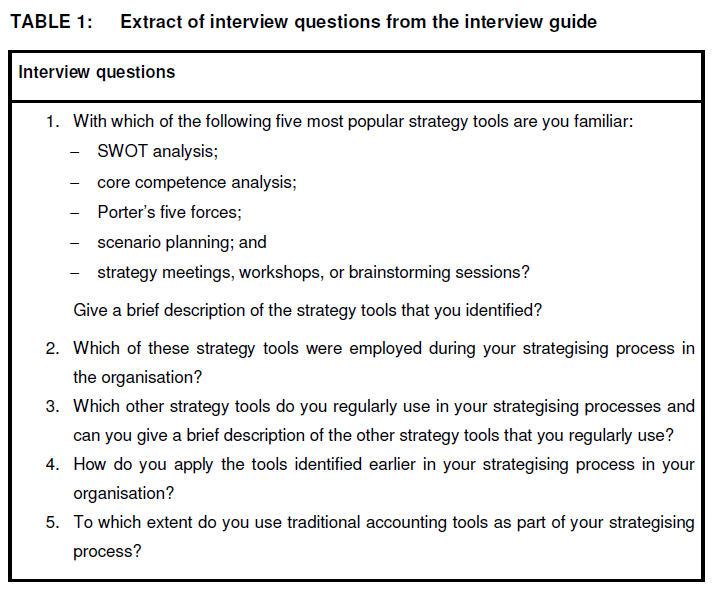
A semi-structured interview guide was developed, based on the literature and research questions. One of the interview questions covered the educational background of each participant to link the possibility of such background to familiarity with the strategy tools as well as his/her position in the organisation. The next section of the interview guide dealt with strategy tools and Strategising.
Each of the five most popular strategy tools were named to the participants without providing clues on what the tools might entail. To this end, structural questions were asked to discover participants' experience with and basic knowledge of strategy tools, whilst descriptive, open-ended questions were asked to allow participants to express themselves freely and to share ideas comfortably (Creswell 2015:217). To answer the open-ended questions, participants were asked to recall recent and previous Strategising experiences, with specific reference to how they engaged with the strategy tools. These rich descriptions generated in-depth reflective data that offered insight as to why specific aspects of their experiences were important.
The empirical voice-recorded interviews were analysed through conversation analysis to offer qualitative descriptions of interactional structures and practices. The data produced from the nine transcribed conversations consisted of 126 pages with 43 728 words (324 voice-recorded minutes) in total. Data saturation was reached when there was enough information to replicate the study and when no new, rich information was obtained. Whilst no single method, theory, or observer can capture all the data that is relevant or important, by employing the most suitable data collection methods such as individual interviews in the current study, data saturation was reached (Fusch & Ness 2015:1413).
First- and second-cycle coding was performed to analyse the complex phenomena hidden in the unstructured qualitative data systematically. First-cycle coding divided the data into seven subcategories of which 'theming the data' was applied. This was done in order to categorise basic themes identified during pre-coding according to commonality. Second-cycle coding entailed focused coding by further arranging first-cycle codes into a concise list of similar themes. These themes related to how CA strategists engaged with strategy tools during Strategising.
Table 1 offers an extract of some of the questions from the interview guide.
The ATLAS.ti software program was used during the coding process to store, organise, manage, reconfigure and systematically analyse the transcribed interviews. Codes were created based on the codes identified during first-cycle coding and were further to order the themes to reflect different groupings and relationships. Data analysis followed an inductive process of reasoning to draw conclusions about the use of strategy tools by CAs. To increase the credibility of the coding, transcribed interviews were co-coded, with the co-coder acting as an independent consultant who had no knowledge of the field of strategy-as-practice or CAs.
5. FINDINGS
The central storyline of the research revolved around how CA strategists use strategy tools during strategising in the South African mining industry (Brown & Thompson 2013:1155). It was found that CA strategists are bricoleurs of strategy tools - craftspeople who prefer the less formal and less traditional strategy tools, using these in close conjunction with accounting tools like budgets, reconciliations and a financial risk assessment framework. This confirms the earlier work of Arnaud et al. (2016:52), Jarzabkowski (2004:544), and Rigby and Bilodeau (2015:4-16), who identified adaptive use of tools, or the "artisan-like inventiveness' (bricolage) on how strategists produce their own purposeful activities and meanings for the tools which they use.
The findings confirmed that strategy tools are inherently part of the strategising process and they enable strategic planning and implementation. The participants described their strategising practices as deliberate during the planning phase and as emergent during the implementation phase, which influenced the way in which the strategy tools were used.
5.1 Background and position of participants
To understand which strategy tools CA strategists chose to use, it was necessary to consider their background. None of the nine CAs participating in this research held MBA qualifications, although two participants were studying towards MBAs.
Five of the nine participants had attended informal, in-house strategic management courses.
Five of the nine participants practiced their strategising at head offices - ranging from a senior executive in charge of the company's strategy to a senior manager responsible for capital expansion projects and a general manager of information and business planning, whilst four of the participants practiced their strategising at mining operations offices -ranging from a mine's financial manager to heads of stay-in-business projects and long term production productivity strategies.
The findings suggest that participants replaced formal strategic management training with in-house programmes such as mini-MBAs. This finding could have affected participants' knowledge and use of traditional strategy tools.
5.2 Strategy tools used by CA strategists
In order to explore how participating CA strategists use strategy tools, it was firstly necessary to determine which of the five most popular strategy tools as identified in the literature, as well as any other strategy and accounting tools, were being used during Strategising. The five most popular strategy tools were determined through an evaluation of studies of various-sized companies over different industries in different countries for the period 2000 to 2014.
5.2.1 The five most popular strategy tools
In general, participants were familiar with the five most popular strategy tools, but their accounts of their use of these tools lacked rich, theoretical descriptions of the first three tools in particular (strengths, weaknesses, opportunities and threats [SWOT] analysis, core competence analysis and Porter's five forces), as illustrated by the following statements:
"SWOT is strength, weaknesses, opportunities and authority" (Participant 4).
"Yes, what do you call it, look, yes, I am aware of it [SWOT analysis]" (Participant 5).
"I am not a hundred per cent familiar [with core competence analysis]. Very similar to SWOT but it just looks at the competencies and everything more than the business as it is" (Participant 1).
"The Porter one focuses on the competition within the industry, which in mining of course is different from other industries" (Participant 4).
Participants showed better insight in the less formal and less structured strategy tools of meetings, workshops and brainstorming sessions, and scenario planning.
"There is a standard framework that we use that has been developed by [corporate head office], so that guides us in terms of how to facilitate workshops" (Participant 8).
5.2.1.1 Scenario planning
Scenario planning, together with meetings, workshops and brainstorming sessions, was the tool with which participants were most familiar and which they used most. Scenario planning was commonly used in conjunction with other strategy and accounting tools, namely with budgets, risk management and as a valuable bargaining tool with corporate head office. It was used mainly from a financial perspective and with financial performance drivers, such as obtaining maximum finance from corporate head office, economical value of projects and the financial effect of worst-case scenarios.
"Especially from a risk point of view it [scenario planning] is actually a real analysis, because it is embedded in what I do. I do not even think of it as a tool, because it is what I do. Risk management looks at various possibilities in terms of what could happen" (Participant 8).
5.2.1.2 Meetings, workshops and brainstorming sessions
As could be expected, all participants were familiar with meetings, workshops and brainstorming sessions and described them as valuable, productive and effective. Participants provided detailed descriptions of these sessions that were being used extensively during the planning phase of Strategising, but also later during the implementation phase as part of status updates and project evaluations.
"You first have your, we call it PTV [pathway to value] where you have your strategies and then they say we think you need to adapt this, or adapt that, you need to speed up this, and then from there you develop your business plan. Once a year, as a company, we call PTV sessions, where everybody from across the world get together and different mines present their strategies for the year ahead" (Participant 1)-
Sessions were mostly formally structured during the planning phase and informally structured during the implementation phase.
5.2.1.3 SWOT analysis
Although all nine participants indicated that they were familiar with SWOT analysis and seven participants stated that they did use it, only three participants provided detailed information on how they used SWOT analysis in their day-to-day Strategising practices. The findings indicated that SWOT analysis was combined with other strategy and accounting tools, such as action plans and scenario planning.
The three participants who actively used SWOT analysis and who were able to describe how they used the tool, all used it as an analytical tool as part of a formalised (deliberate) planning phase of their strategising. Participants did not have a strong knowledge of SWOT analysis, however, one participant illustrated how he overcame his lack of knowledge of SWOT analysis by the use of a facilitator, ''at the time that we did it we had a facilitator and we had two or three days that we did it over" (Participant 1).
5.2.1.4 Core competence analysis
Five participants indicated that they were familiar with core competence analysis, with only two participants stating that they used core competence analysis in their strategising practices. However, as a result of the descriptions by three participants (Participants 2, 3 and 6) of their day-to-day strategising practices, it was found that they were also using core competence analysis regularly without realising it. For example, Participant 3 described some of his day-to-day strategising as:
"So for each of these core functional areas within this little mini-business, you need to know what other competencies are required. When a project manager sits and he says okay, here's my piece of paper so let me start "specking" who I want to be on my project team, he needs to decide what the outputs are. So these are the outputs that my project needs to deliver and for that I need expert A, Β and C and they need to have certain competencies. Ultimately, this is the output of my project and those are the specific [resources]."
Similar to SWOT analysis, core competence analysis was found to be used during the planning phase of strategising as a formal (deliberate) tool predominantly to determine the availability of internal resources for projects. Resources mentioned by participants included mainly human resources, but also production plant capacity, transportation capacity of mined products and financial resources (for example operational capital and external finance, such as long-term loans). Core competence analysis was again adapted in its use based on participants' financial backgrounds and their limited knowledge of the tool.
5.2.1.5 Porter's five forces
Porter's five forces was the strategy tool that the participants used least with only two participants using Porter's five forces during their strategising. One of the participants who used Porter's five forces commented, "it's at times difficult to convince people who are in industry ... to really follow Porter's five forces" (Participant 7).
Porter's five forces model was once again used as a formal strategy tool during deliberate strategic planning. The power of customers was highlighted as one of Porter's five forces that play an important role in the South African mining industry.
Thus, participants in the study were less familiar with the more formal and traditional strategy tools of a SWOT analysis, core competence analysis and Porter's five forces, and did not use them often during strategising.
5.2.2 Other tools
In addition to the five most popular strategy tools listed in the interview guide, participants were asked to describe other strategy tools used during strategising. Participants were then required to describe how they applied the identified tools during their strategising.
5.2.2.1 Change management
Two participants provided detailed information on the change management tools they employed to communicate strategies to create awareness and buy-in at various levels within their organisations during strategy implementation.
5.2.2.2 Project implementation plan
Another strategy tool used by participants was a project implementation plan, referred to as a "Gantt chart" (Participant 3) [from Microsoft Projects] and "action plans" (Participant 1). The Gantt chart contains the number and type of resources utilised, outcomes, completion dates, interdependencies and financial information (cf. Wilson 2003:432). Participants reported that the Gantt chart was drafted from planning documentation during the planning phase of the project. The Gantt chart was mainly used during the handover to the project team as the journey map during implementation of the project.
5.2.2.3 Balanced scorecard
Another participant mentioned his balanced scorecard that listed specific outcomes during the implementation phase of his division's projects. The balanced scorecard was used as framework from which "personal scorecards" (Participant 7) were developed to assign responsibilities to individual team members. As a result, the balanced scorecard was also used as a performance management tool during strategy implementation.
5.2.3 Accounting tools
During the interviews, we also enquired from participants to which extent they used accounting tools as part of their strategising practices.
5.2.3.1 Budgets
Budgets were the accounting tool mostly used during strategising. Participants commented that focus was placed on budgets as part of defensive strategies during a global financial recession. Budgets were used mainly during the planning phase of strategising and since budgets should mainly serve as a controlling mechanism during strategising, CAs' use of budgets predominantly during the planning phase could illustrate their lack of strategic management knowledge.
Based on the interviews, some of the factors included in the budgets were ratios, such as net present value of capital employed in projects, internal rates of return, dividend cover, debt types and other financing instruments, flexibility around capital finance drawings and around interest repayments, production targets, sales targets, cost of production and financial impacts of waste. Budgets were also used during the implementation phase to measure progress and performance against set targets.
5.2.3.2 Reconciliations and risk assessment
Other accounting tools used by participants were 'reconciliations" and a "risk assessment framework" (Participant 8) that was developed in-house by the corporate head office. Reconciliations were performed during both the planning and implementation phases of strategising, and on a variety of strategy decision-making information. Once again, reconciliations as an accounting tool have been adapted in their use to reconcile non-financial information also.
One such example was a reconciliation between service-level agreements, outputs, due dates, service payments and late delivery penalties on service-level agreements. The risk assessment framework was also an adaptation of the Committee of Sponsoring Organizations of the Treadway Commission (COSO) framework commonly used by CAs to assess internal control and specifically financial risk (COSO 2013). The financial risk assessment framework was used by Participant 8 throughout the planning and implementation phases of his strategising.
5.3 Strategising by CA strategists
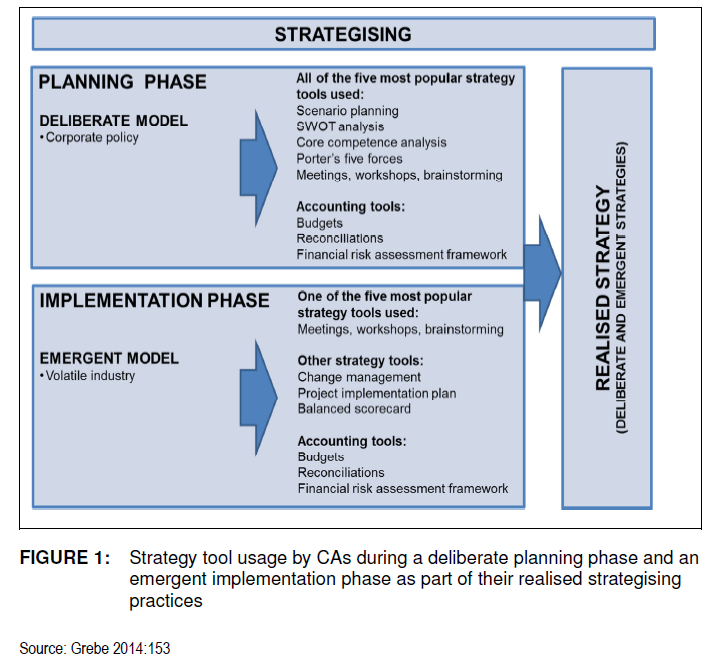
Findings suggested that realised strategies comprised a combination of deliberate and emergent strategies, in line with findings by Mintzberg and Walters (1985:271). Strategising during the planning phase followed a deliberate strategy model whilst strategising during the implementation phase followed an emergent strategy model.
5.3.1 Use of the five most popular strategy tools
The five most popular strategy tools were mainly used during the formal planning phase, with the fifth tool, namely meetings, workshops and brainstorming sessions, as the exception. Meetings, workshops and brainstorming sessions were held throughout the strategising process.
5.3.2 Use of other strategy tools and accounting tools
Other strategy tools such as change management, a risk assessment framework and a balanced scorecard were used during an emergent implementation phase. Accounting tools, such as budgets, were extensively used throughout the strategising process, but mainly in conjunction with the five most popular strategy tools. As such, the use of accounting tools depended on the use of strategy tools.
These accounting tools were found to be used often in conjunction with other strategy tools, such as scenario planning. As a result, the strategy tools with which accounting tools were used, determined the strategy phase (i.e. planning or implementation) and strategy model (i.e. deliberate or emergent) of their use. For example, budgets were used in a formal, deliberate manner in conjunction with scenario planning during the planning phase of strategy. In contrast, budgets were used in an informal, emergent manner as a performance measurement tool during the implementation phase of strategy. As such, an analysis of findings indicated a pattern that showed that accounting tools used during the planning phase followed a deliberate model whilst accounting tools used during the implementation phase followed an emergent model.
Figure 1 depicts the findings on deliberate and emergent strategising and which tools are used when.
Our findings indicated that mostly analytical tools were used during planning and deliberate strategising whereas people and project-oriented tools were used during implementation. In order to realise the strategy, changes in strategy models from deliberate to emergent during the planning and implementation phases, influenced which and how strategy tools were used by participating CA strategy practitioners.
From figure 1 it seems through CAs' strategising practices during planning and implementation, that they possibly view strategic management as an 'add-on' only and not as an integral part of their business plan.
6. DISCUSSION AND MANAGERIAL IMPLICATIONS
Participating CA strategists are bricoleurs of strategy tools who adapt and interpret strategy tools to serve the requirements of the situation they face. These findings confirmed findings in the literature (cf. Dameron, Lê & LeBaron 2015:S2; Jarzabkowski & Kaplan 2015:554; Rigby & Bilodeau 2015:4-9) that the particularities of the use of strategy tools as dictation of which strategy tools to use and the way in which they are used, optimise these strategy tools.
The participating CA strategists preferred less formal and less traditional strategy tools, such as meetings, workshops and brainstorming sessions and scenario planning, which they used in conjunction with accounting and other strategy tools. The reasons for this intuitive approach could relate to CAs' lacking knowledge of formal, traditional strategy tools.
The five most popular strategy tools that were identified in the literature were mainly used in conjunction with accounting and other strategy tools, such as budgets and change management, in particular from a financial perspective.
Findings suggested that financial performance strategic drivers, such as commodity prices and operational costs, informed strategic decisions. This finding was confirmed with the extensive use of budgets in conjunction with the five most popular strategy tools. It became clear from participants' descriptions that they often adapted strategy tools to serve as financial decision-making tools during strategising. In turn, accounting tools were adapted to serve as strategy tools. Scenario planning is therefore put forward as a useful tool to be utilised more extensively in the South African mining environment, which is facing challenges such as a global economic recession.
The development of strategy skills and competencies of CA strategists contributes to the transformation of their roles as strategy leaders in the South African mining industry.
Participants did not illustrate a strong knowledge and use of strategy tools, yet they held leadership positions in international mining organisations. Participants seemed to regard their CA qualifications as sufficient for their transformation into strategists and they replaced formal strategic management training with in-house programmes, such as mini-MBAs.
These findings were at odds with literature, which places strategy tools at the core of Strategising as an inherent part of the Strategising process (Belmondo & Sargis-Roussel 2015:S91; Rigby & Bilodeau 2015:10-12).
The question could be asked whether participating CAs were merely promoted to strategic roles for their success in dealing with operations in the mining industry and because of their professional skills in accounting, or whether in fact they have successfully transformed as competent strategy leaders? This knowledge could contribute to professional accounting bodies and educators alike by extending the basis of knowledge on the transformation of CAs as strategy leaders for the future education, recruitment and development of CAs.
Participants described how they adapted accounting tools to suit their Strategising practices, in line with Rigby and Bilodeau's (2015:16) argument that tools should be adjusted to suit business systems. For example, budgets included also non-quantitative indicators and were used as a performance-measuring tool during strategy implementation. Participants' adaptation of accounting tools may therefore be interpreted as part of their transformation into strategy leaders.
CA strategists are part of the social constructs within which they perform their strategy practices and, as such, their environment also had an effect on their transformation as strategy practitioners. Defensive strategies in a mining industry facing a global financial recession could have contributed to participants' financial perspective with financial performance as key strategic organisational driver during their Strategising. These findings could add to the base of knowledge of Strategising in a mining industry that is facing some of its toughest challenges in recent times, to aid decision makers such as CEOs, executive directors and human resource recruiters of strategists to the industry.
7. FUTURE RESEARCH
The adaptation of accounting tools to be useful strategy tools, in addition to authentic, traditional strategy tools is identified as an area for further research. The ways these tools were adapted by participating CA strategists and similarities and duplications of these tools with existing strategy tools could be useful knowledge for future use of these tools.
Stronger alignment and synergy between strategy tools and accounting tools could be explored. Based on the findings on the subconscious use of core competence analysis, the possibility exists that participants also used other strategy tools without realising it, an area for further research. The question arises of how is the strategic decision informed by CAs' biased thinking?
This research only explored strategising of nine participants and we cannot claim that it represents the experiences of all CA strategists in the South African mining as well as other industries. Further research could be conducted to obtain descriptions of how other CA strategists as well as other business strategists in other business sectors, engage with strategy tools during strategising.
8. CONCLUSION
CAs will continue to be part of management teams. Understanding how strategy is done by these CAs, offers insight into the social practice of strategy and informs scholars and practitioners. CA strategists base their decisions on known strategic frameworks and tools influenced by their accounting perspectives. This article argues that the model of strategising and educational background of the strategist, affect selection and use of strategy tools.
REFERENCES
- ANSOFF HI. 1991. Critique of Henry Mintzberg's The design school: reconsidering the basic premises of strategic management'. Strategic Management Journal 12:449-461.
- ARNAUD N , MILLS CE, LEGRAND C & MATÓN E. 2016. Materializing strategy in mundane tools: the key to coupling global strategy and local strategy practice? British Journal ofManagement 27(1):38-57'.
- BELMONDO C & SARGIS-ROUSSEL C. 2015. Negotiating language, meaning and intention: strategy infrastructure as the outcome of using a strategy tool through transforming strategy objects. British Journal of Management 26(S 1): S90-S104.
- BROWN AD & THOMPSON ER. 2013. A narrative approach to strategy-as-practice. Business History 55(7):1143-1167.
- CHAMBER OF MINES OF SOUTH AFRICA. 2014. Facts and figures 2013/2014. Johannesburg.
- CLARK DN. 1997. Strategic management tool usage: a comparative study. Strategic Change 6(7):417-427.
-
COMMITTEE OF SPONSORING ORGANIZATIONS OF THE TREADWAY COMMISSION. 2013. Internal control: integrated framework. Executive summary. [Internet: http://coso.org/IC.htm; downloaded on 2016-05-16.
» http://coso.org/IC.htm - ]
- COSO see COMMITTEE OF SPONSORING ORGANIZATIONS OF THE TREADWAY COMMISSION
- CRESWELL JW. 2013. Research design: qualitative, quantitative, and mixed methods approaches. Thousand Oaks, CA: Sage.
- CRESWELL JW. 2015. Educational research: planning, conducting, and evaluating quantitative and qualitative research. Upper Saddle River, NJ: Pearson Education.
- CROUCH M & MCKENZIE H.2006. The logic of small samples in interview-based qualitative research. Social Science Information 45(4):483-499.
- DAMERON S, LÊ JK & LEBARON C. 2015. Materializing strategy and strategizing material: why matter matters. British Journal of Management 26(S1 ):S1-S12.
-
DE HOOP H. 2016. South African mining sector faces a tough year. [Internet: http://mg.co.za/article/2016-02-19-OO-south-african-mining-sector-faces-a-tough-year/; downloaded on 2016-04-29.
» http://mg.co.za/article/2016-02-19-OO-south-african-mining-sector-faces-a-tough-year/ - ]
- DE JAGER FC & STEYN Η. 2013. Organisational strategic drivers and core competencies applied in the South African mining sector. Journal of Contemporary Management 10:20-38.
- GREBE L. 2014. The use of strategy tools by chartered accountants in the South African mining industry. Pretoria: University of South Africa. (Master's dissertation).
- GROENEWALD D & VAN VUUREN J. 2011. Conducting a corporate entrepreneurial health audit in the South African short term insurance business. Journal of Contemporary Management 8:1-33.
- GUNN R & WILLIAMS W. 2007. Strategic tools: an empirical investigation into strategy in practice in the UK. Strategic Change 16:201-216.
- HOPE G. 2014a, Business as usual for the mining industry, Inside Mining 1:16-17.
- HOPE G. 2014b. Is mining the panacea for SA? inside Mining 1:76-77.
- ILLBURY C & SUNTER C. 2001. The mind of a fox, Cape Town: Human & Rousseau & Tafelberg.
- JARZABKOWSKI P. 2004. Strategy-as-practice: recursiveness, adaptation and practices-in-use. Organization Studies 25(4):529-560.
- JARZABKOWSKI P & KAPLAN S. 2015. Strategy tools-in-use: a framework for understanding "technologies of rationality" in practice. Strategic Management Journal 36(4):537-558.
- JARZABKOWSKI P & SEI DL D. 2008, The role of meetings in the social practice of strategy, Organization Studies 29:1391-1426.
- JOHNSON G, PRASHANTAM S, FLOYD SW & BOURQUE N. 2010. The ritualization of strategy workshops. Organization Studies 31 (12): 1589-1618.
- KAPLAN S. 2011. Strategy and PowerPoint: an inquiry into the epistemic culture and machinery of strategy making. Organization Science 22(2):320-346.
-
KPMG. 2016. The role of mining in the South African economy. [Internet: http://www,sablog.kpmg.co,za/2013/12/role-mining-south-african-economy/; downloaded on 2016-04-29,
» http://www,sablog.kpmg.co,za/2013/12/role-mining-south-african-economy/ - ]
- LÊ JK & JARZABKOWSKI P. 2014. The role of task and process conflict in strategizing. British Journal of Management 26(3):439-462.
- LEONARDI PM. 2015, Materializing strategy: the blurry line between strategy formulation and strategy implementation. British Journal of Management 26(S1):S17-S21.
- LOUW L & VENTER P. 2013. Strategic management: developing sustainability in Southern Africa. Cape Town: Oxford University Press Southern Africa,
-
MEDIA CLUB SOUTH AFRICA. 2016. South Africa's economy: key sectors. [Internet: http://www.mediaclubsouthafrica.com/africa/37-economy/economy-bg/111-sa-economy-key-sectors; downloaded on 2016-04-29.
» http://www.mediaclubsouthafrica.com/africa/37-economy/economy-bg/111-sa-economy-key-sectors - ]
- MINTZBERG H & WALTERS JA. 1985. Of strategies: deliberate and emergent. Strategic Management Journal 6:257-272. Jul-Sep
- RIGBY D & BILODEAU B. 2015. Management: tools & trends. London, UK: Bain.
- ROPER A & HODARI D. 2015. Strategy tools: contextual factors impacting use and usefulness. Tourism Management 51:1-12.
- SKAERBAEK P & TRYGGESTAD K. 2010. The role of accounting devices in performing corporate strategy, Accounting Organizations and Society 35:108-124,
- SAICA see SOUTH AFRICAN INSTITUTE OF CHARTERED ACCOUNTANTS
- SMETS M, JARZABKOWSKI Ρ, BURKE GT & SPEE P. 2015. Reinsurance trading in Lloyd's of London: Balancing conflicting-yet-complementary logics in practice. Academy of Management Journal 58(3):932-970.
-
SOUTH AFRICAN INSTITUTE OF CHARTERED ACCOUNTANTS, 2011. Fully one-third of top business leaders of top listed company CEOs are chartered accountants. [Internet: https://www.saica.co.za/News/NewsArticlesandPressmediareleases/tabid/695/itemid/2916/pageid/5/language/en-ZA/language/en-ZA/Default.aspx; downloaded on 2014-10-28.
» https://www.saica.co.za/News/NewsArticlesandPressmediareleases/tabid/695/itemid/2916/pageid/5/language/en-ZA/language/en-ZA/Default.aspx - ]
- URBAN B & OOSTHUIZEN C. 2009, Empirical analysis of corporate entrepreneurship in the South African mining industry, Journal of Contemporary Management 6:170-092.
- VAARA E & WHITTINGTON R. 2012. Strategy-as-practice: taking social practices seriously. The Academy of Management Annals 6(1):285-336.
- VAN DER ZWAN P. 2013. A post-implementation analysis of the South African mining royalty regime. The Journal of Applied Business Research 29(3):641-652.
- WHITTINGTON R. 2015. The massification of strategy. British Journal of Management 26(S1):S13-S16.
- WILSON JM. 2003. Gantt charts: a centenary appreciation. European Journal of Operational Research 149(2):430-437.