The role of sense of belonging on the success of community-based agricultural enterprises in KwaZulu-Natal, South Africa
Abstract
Community-based entrepreneurship (CBE) is considered a viable approach for bridging the gap between people living in the mainstream economy and the Bottom of the Pyramid (BoP), especially in rural communities of developing nations such as South Africa. Previous research studies focused on the impact of CBE on employment creation and poverty reduction. This study investigated the role of sense of belonging on the success of community-based agricultural enterprises in KwaZulu-Natal, South Africa. The study adopted a positivism research paradigm using a quantitative research approach for data collection. A census sampling strategy was employed to gather data from all 209 members of three (3) agricultural cooperatives in Nkandla rural communities using structured questionnaires. Statistical Package for Social Sciences (SPSS) version 25 was used to analyse data using descriptive and inferential statistics. The Pearson Correlation Coefficient was used to establish the relationship between the psychological factors and the success and sustainability of community-based enterprises. Findings revealed that sense of community is an enabling factor for the success and sustainability of community-based enterprises. This study concluded that to ensure the success and sustainability of CBE, policy makers should consider the assessment of psychological factors during the design and implementation of community-based initiatives.
CBE; sense of belonging; sense of community and social capital
1. INTRODUCTION
Community-based entrepreneurship has been adopted as the strategy for local economic development in both developed and developing countries such as Norway, India and Kenya (Dana, Han, Ratten & Welpe 2008:750; Purusottama, Trilaksono & Soehadi 2018:435). The need for CBE has become more urgent for addressing socio-economic issues in South Africa (Peredo & Chrisman 2006:315). Scholars revealed that CBE is an integral part of the entrepreneurial ecosystem in a country (Parwez 2017:1; Ratten 2014:301). The debate on CBE is a shift from the traditional approach of attracting entrepreneurs to the urban area. This stems from the realisation that, it is the small enterprises that innovate and create new employment in both rural and urban areas (Ivan 2009:1). An empirical study conducted by Mtapuri and Giampiccoli (2016:165) established a relationship between CBE and rural economic development in South Africa.
Rural areas are mostly affected by poverty and unemployment which necessitate the need for CBE to address these socioeconomic conditions. Consistent with this argument, Tchamyou, Erreygers and Cassimon (2019:170) posit that South Africa is currently experiencing socio-economic challenges such as poverty, economic exclusion and inequalities especially in the rural areas. Community-based entrepreneurship seeks to offer a bottom-up approach for community engagement since it focuses on the lifeblood and foundational issues of the community (Giampiccoli, Saayman & Jugmohan 2016:549). The sense of community is an important aspect in the development of CBE (Ahmad & Talib 2015:830; Wise 2015:921). Community-based entrepreneurship is necessary for the local economic development of rural communities and there is a need to understand the variables that drive this phenomenon. Previous studies on CBE in South Africa mostly focus on access to finances, managerial challenges and access to markets which are the micro aspects of CBE (Indaba Report 2010:1; Surender & Van Niekerk 2008:326). There is a need to offer a bottom-up approach that will highlight psychological community aspects that are relevant for the development of CBE. This study will add to the existing knowledge in South Africa by providing empirical evidence on community based agricultural enterprises with reference to rural communities in Nkandla Municipality.
Rural population constitutes 70% to 80% of the entire population of most third world countries (Jones & O'Neill 2016:2). Governments in Africa have come to the realisation that no development will be meaningful except when the rural communities are also carried along. This realisation is borne out of the reality that rural dwellers constitute a significant component of the population in Africa (Alem & Adesina 2017: 260).
South African rural areas are not different from other African countries in terms of underdevelopment. The underdevelopment of the rural areas of South Africa has been attributed to the apartheid mode of government, which was aimed at building a first-class capitalist economy for the few at the expense of the majority, thereby creating a legacy of underdevelopment and poverty in rural areas (Gwanya 2010:2). In view of the lack of development of the rural areas, many rural communities developed coping strategies for surviving the harsh economic realities by developing alternative means of income (Gwanya 2010:4). This section focuses on extensive review of related literature on CBE.
2.1
Community-based entrepreneurshipEntrepreneurship plays a crucial role in accelerating the pace of economic development of a region by discovering new users of available resources and maximizing their utilisation (Littlewood & Holt 2018:526; Sengupta, Sahay & Croce 2018:526). This function also necessitates the creation of CBE as a part of local economic development initiatives. According to Peredo and Chrisman (2006:310), "Community-Based Entrepreneurship refers to a process whereby the group of community members acts corporately as both an entrepreneur and enterprise in pursuit of the common good". Community-based entrepreneurship contributes towards advancing the governance, productivity, and implementation of cooperatives as the vehicle to create jobs, generate income and alleviate poverty (Purusottama et al. 2018:433). The nature of CBE as a concept needs to be clarified to understand the context of the discussion.
2.2
Nature of community-based entrepreneurshipThere are various debates in literature concerning the nature and character of CBE (Anderson & Gaddefors 2017:4; Kwon, Heflin & Ruef 2013:988). The scope of this debate creates room for confusion among scholars and government departments (Haugh & Pardy 1999:163; Ratten 2014:301). For example, some scholars never drew the line of separation between CBE and small businesses in their definitions of CBE (Anderson & Gaddefors 2017:6; Haugh & Pardy 1999:163). Parwez (2017:3) suggests that, the basic principles of CBE involve group approach, mutual trust, and motivation towards economic activities encouraged by institutional support. Sankaran and Demangeot (2017:78) argue that CBE may be a crucial catalyst to overcome many of the adverse circumstances confronted by communities globally such as climate change, terrorism and the lack of funds for social action. Small businesses on the other hand, refers to a business unit, comprising of cooperative enterprises and non-governmental organisations, managed by one (1) owner or more which, includes its branches, if any (Storey 2016:7). This definition also creates room for confusion because there are some Small Medium Micro-Sized Enterprises such as tuck-shops, which do not fall into the categories suggested by the definition (Peredo & Chrisman 2006:310). This confusion also affects the contextual application of this concept by different scholars. Ivan (2009:2) defines CBE as a strategy which is more outcome-based rather than extracting the features which compose these concepts. In addition, different lenses or perspectives are adopted by scholars when defining CBE. For example, a definition by Sarreal (2013:174) adopted a social perspective because it emphasised the social character of CBE. The definition by Ivan (2009:2) took an economic approach because it classified this concept as a response to the economic needs of both rural and urban areas. Chiutsi and Mudzengi (2012:128) emphasised the political character of CBE because it is more citizenry-based. This study adopted the definition of CBE offered by Peredo and Chrisman (2006:310). This definition is relevant to this study because (1), it provides a holistic approach to this concept by eliminating prejudices; (2) this definition clearly captures the essence of CBE as compared to social entrepreneurship.
Value creation and innovation are considered key to poverty reduction and local economic development (Peredo & Chrisman 2006:309). Community-based entrepreneurship is aimed at reducing poverty through the creation of business enterprises geared towards the social and economic upliftment of a community. Community-based entrepreneurship is a shift from the traditional economic development initiatives of attracting multinational companies for local economic development purposes. The CBE development serves as a viable tool for bridging the development gap between rural communities and urban centres, thereby stemming the tide of rural-urban migration (Purusottama et al. 2018:430). Consistent with this argument, Parwez (2017:1) posits that "Community-based entrepreneurship is considered to be an important instrument for the realisation of potential among marginal and deprived communities isolated from the mainstream economy and is important in bringing social upliftment".
Community-based entrepreneurship is a concept that emerged from the need to provide sustainable local economic development among the poor populace mostly located in rural areas (Peredo & Chrisman 2006:309; Purusottama et al. 2018:430). This involves creating cooperative relationships in which resources are exchanged to create value among all parties. Many governments globally have seen the benefits of CBE because of its potential to transform society and improve the standard of living of the people (Ratten & Welpe 2011:285).
3. SENSE OF COMMUNITY THEORY
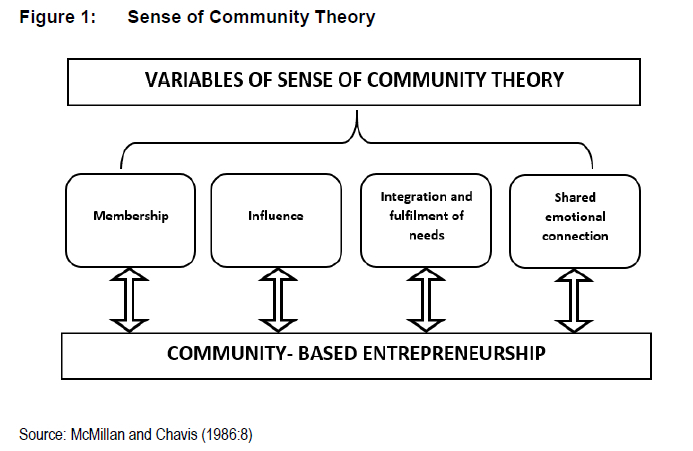
This study hinges on the sense of community theory as proposed by McMillan and Chavis (1986:7). The theory proposes that membership, influence, shared emotional connection and integration as well as the fulfilment of needs helps to explain the sense of belonging among community members (McMillan & Chavis 1986:7). These basic elements are presented and explained in Figure 1.
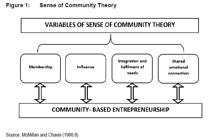
This theory is composed of four (4) factors, namely, membership, influence, integration and fulfilment of needs and shared emotional connection (McMillan & Chavis 1986:9). This theory is now considered as the central theory for community psychology in the 21st century (Chavis & Pretty 1999:639). Kim and Kaplan (2004:313) introduced four (4) other elements which claim to address the physical attributes that were ignored by McMillan and Chavis's theory. According to Kim and Kaplan (2004:314) community attachment, community identity, social interaction, and pedestrianism play an important role in embedding the feeling of a sense of community in the inhabitants of the community. Based on the foregoing, the sense of community theory is found appropriate to achieve the main aim of this study, which is to investigate the role of sense of belonging on the success of community-based agricultural enterprises. It is important to note that this research only focused on the membership aspect of the sense of community which is further discussed below.
3.1 Membership
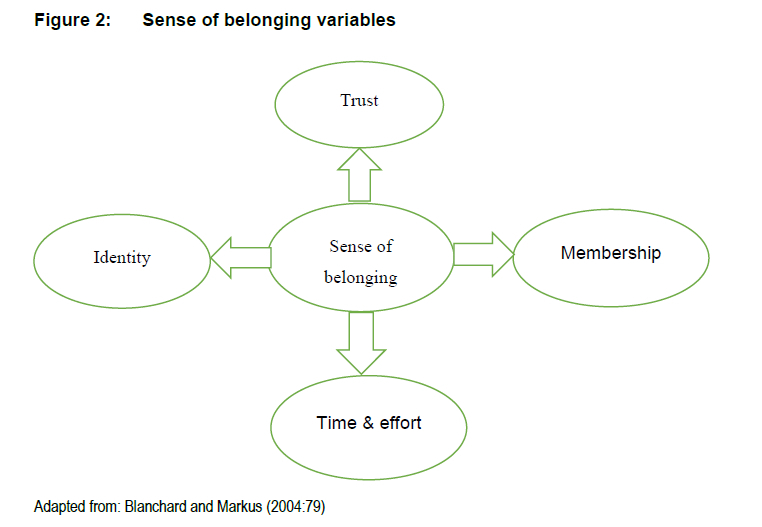
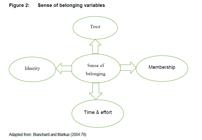
The concept of membership proposes that trust, symbols of expressions, identity, effort and time help to explain the sense of community (Blanchard & Markus 2004:67). Consistent with Blanchard and Markus (2004:67), this study identified four (4) factors to explain the sense of belonging, trust, membership, time and effort, and Identity. Figure 2 depicts the factors.
3.2 Trust
Trust refers to an expectation based on individual experiences and is contingent on the trustworthiness of others (Robbins 2016:973). According to Lazányi (2017:329), organisational survival hinges on trust, which engenders collaboration, creativity and innovation. Sohaib and Kang (2014:3) also argued that it is very difficult for people to trust each other unless they share a sense of acceptance. This implies that, when people trust one another, the group can achieve truly meaningful goals (Spector & Jones 2004:315).
Consistent with the preceding argument, King, Samii and Snilstveit (2010:345) posit that trust is important among group members because it enhances transmission of information between group members. Llewellyn (2005:334) argues that the presence of finances within a group might compromise the level of trust among group members.
3.3
Membership and symbolsAccording to Elgenius (2005:335), symbols are expressions of membership towards a particular group or community. They serve a purpose of raising and reinforcing awareness about a status of membership. Elgenius (2005:337) further argued that people tend to take pride in the symbols of expression when they feel accepted within their group or community (Elgenius 2005:320). Symbols act as vehicles to express and affirm the community they represent. Furrer, Skinner and Pitzer (2014:110) further argue that sense of relatedness promotes the need to be connected to others and to belong to a larger social group. Pretty, Bramston, Patrick and Pannach (2006) further argued that symbols are very important in the grouping of people and also give them a sense of identity and pride. Erel-Koselleck (2004:29) also argues that symbols and expressions of membership represent a material culture.
3.4
Time and effortEffort is the measure of commitment to a particular activity or organisation (Peppers & Rogers 2016). The level of commitment is displayed by the amount of time and effort people are willing to invest (Lazányi 2017:329). This implies that there is a connection between effort and time and a sense of belonging. Stillman and Lambert (2013) argued that people invest their time and effort to reward their feeling of acceptance in a group. Walton and Cohen (2011) also argued that people are not willing to sacrifice their time and effort if they do not feel any sense of acceptance within a group.
3.5
IdentityAccording to Jenkins (2000:4), identity "refers to the ways in which individuals are distinguished in their social relations with other individuals and collectives". Leary (2012) argued that identities are traits and characteristics, social relations, roles, and social group memberships that define who one is. Grace and Cramer (2003:662) further argued that community members use social group membership as the basis for self-definition.
Based on the foregoing, the following hypotheses were formulated:
H
1: A significant relationship exists between sense of belonging and level of trust among agricultural cooperative members.H2: A significant relationship exists between sense of belonging and expression of membership.
H3: There is a significant relationship between sense of belonging and the time and effort that members invest in their agricultural cooperatives.
H4: There is a relationship between sense of belonging and identity.
4. METHODOLOGY
This study adopted an exploratory research design to investigate the role of sense of belonging on the success and sustainability of community-based agricultural enterprises in KwaZulu-Natal, South Africa. The reason for conducting a descriptive research was to get a deeper insight into the influence of psychological aspects of sense of community on the success of community-based enterprises. Since the study was quantitative in nature, positivism paradigm was used to address the research problem.
4.1. Sampling Strategy
The site for this study was Nkandla Local Municipality in the province of KwaZulu-Natal, South Africa. The target population was members of Nkandla agricultural cooperatives. Nkandla has fourteen municipal wards (Nkandla Report 2014). In these fourteen wards, there were more than one hundred registered agricultural cooperatives, with an average membership of fifty-five members per cooperative (Nkandla Report 2014). Due to resource constraints, it was not feasible to use this research population. The researcher narrowed down the research population to agricultural cooperatives from only Ward 8, 10 and 12. According to the Nkandla Report (2014), there were ten operating agricultural cooperatives in these three (3) wards. Again, due to resource constraints, it was not feasible to conduct a study of such magnitude.
As a result, the researcher decided to select the best performing agricultural cooperative in each of the three (3) wards using the judgment sampling technique. The best performing agricultural cooperatives were selected based on their productivity, sustainability and the economic impact they have in their respective communities. In order to meet the criteria mentioned above, the researcher approached Nkandla Municipality to gather information about the three (3) best performing cooperatives in Ward 8, 10 and 12. According to the Nkandla Local Municipality (2014) database, the best performing cooperatives were Isikhwane Livestock, Mpangazitha Poultry, and Sgodini Farming from Ward 8, 10 and 12 respectively. The research population of this study was made up of all the active members of these three (3) agricultural cooperatives. According to the Nkandla Municipality database for 2014, there were a total of two hundred and nine members in these three (3) cooperatives. The study adopted a census research approach where the target population is also the sample size. A census survey strategy was employed to administer questionnaires to all 209 members of the cooperatives. A census survey was found appropriate to collect data for this study due to the diverse and small size of the target population (Martínez-Mesa, González-Chica, Duquia, Bonamigo & Bastos 2016:327; Tyrer & Heyman 2016:58).
A structured questionnaire was employed for data collection. A questionnaire is deemed to be a good method for collecting data in a study of this nature because it allows the researcher to gather complete and accurate information with respect to the sense of community variables (Ganiyu, Fields & Atiku 2017:449; Sekaran & Bougie 2016:143). The questionnaire was written in isiZulu using closed-ended questions on a 5-point Likert type rating scale, ranging from Strongly Disagree (1) to Strongly Agree (5). The questionnaire measured the variables of sense of community developed by McMillan and Chavis (1986:10). The researcher firstly discussed the variables of a sense of community theory with research respondents to ensure clarity and understanding before the commencement of the data collection. The discussion was done in groups based on the three cooperatives surveyed. A research assistant with good knowledge of the local language and culture was employed for the purpose of interpreting the questionnaire items in local dialect to respondents who did not have good understanding of the English language. The data collection took approximately five (5) months to complete.
The SPSS version 25 was used to analyse the data collected using structured questionnaires. Descriptive statistics such as frequency distribution, mean and standard deviation were employed to analyse respondents' perceptions on the role of sense of belonging in promoting CBE in rural KwaZulu-Natal, South Africa. Pearson's correlation was used to test the formulated hypotheses.
To ensure data quality control, a questionnaire was pre-tested to enhance validity and the internal consistency reliability was calculated using Cronbach's Alpha. For sense of membership variables, the Cronbach's Alpha was 0.728.
The anonymity of the survey respondents was ensured through the signing of an informed consent letter before completing the questionnaires. The informed consent also served as evidence that the survey respondents understood and were willing to take part in this research.
5. PRESENTATION AND DISCUSSION OF RESULTS
This section presents the data analysis and discussion of the research findings.
5.1 Membership distribution
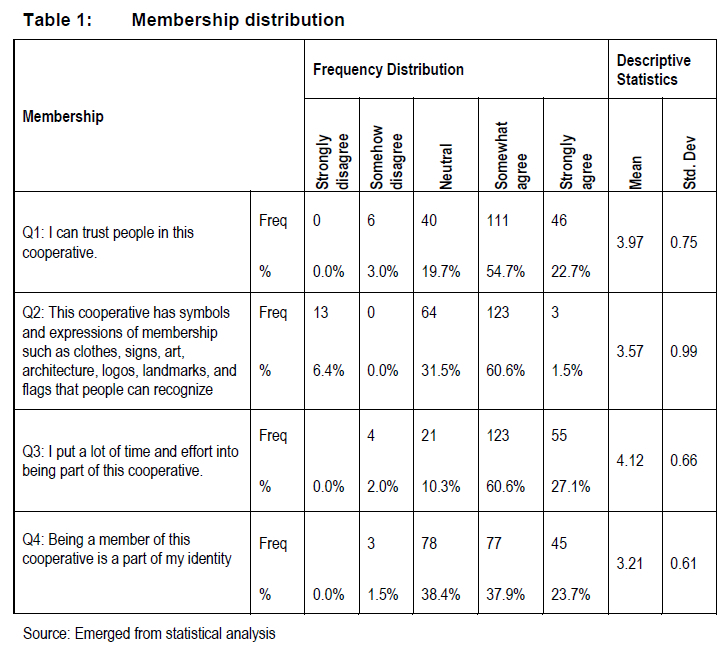
Table 1 depicts questions that were asked to gather perceptions of agricultural cooperatives members on the membership variables of a Sense of Community Theory.
Majority of the study respondents with 77.4% of total respondents agreed (as indicated by the members who somewhat agreed and strongly agreed) that they trust other members of their agricultural cooperative. The respondents that somewhat disagreed that they trust members of their cooperative were 19.7%, while 3.3% of the respondents strongly disagreed. These findings imply that the majority (74.6%) of agricultural cooperative members trust each other. This is evident with the mean score of 3.95 which is closer to somewhat agree. A Pearson correlation coefficient was computed to assess whether there is a relationship between sense of belonging and trust among agricultural cooperative members. The respondents were asked to indicate whether they have any form of symbols and expression of membership in their cooperative.
The results in Table 1 further indicate that the majority of the respondents (i.e. 62.1% of total respondents) somewhat agreed and strongly agreed that they have any form of symbols and expression of membership in their cooperatives, while 31.5% were neutral. On the other hand, 6.4% strongly disagreed that they have any form of symbols and expression of membership in their cooperatives. These findings clearly show that agricultural cooperatives members have symbols and expression of membership. This is evident with the mean score of 3.57 which is closer to somewhat agree.
In addition, the majority (i.e., 87.7%) of the respondents agreed as indicated by the members who somewhat agreed and strongly agree that they put a lot of time and effort into being part of their cooperative. On the other hand, 10.3% were neutral whereas 2.0% strongly disagreed. These findings show that agricultural cooperative members invest a lot of time and effort in being part of their cooperative. The mean score of 4.12 also amplifies the above statement. A Pearson correlation coefficient was computed to test the association between sense of belonging and the effort and time invested into the cooperative by the members of the three agricultural cooperatives.
The respondents were asked to indicate whether being part of their cooperative is part of their identity or not. As indicated in Table 1, the results reveal that the majority (i.e. 59.6%) of the total respondents agreed that being part of their cooperative is part of their identity. On the other hand, 38.4% were neutral, while 1.5% strongly disagreed. These findings reveal that the majority (59.6%) of the respondents agreed that being part of their cooperative is part of their identity. This is evident with the mean score of 3.21 which is situated between neutral and somewhat agree.
5.2 Test of hypotheses
5.2.1 Trust
To establish the relationship between trust and sense of belonging, the following hypothesis is tested.
• H1: A significant relationship exists between sense of belonging and level of trust among agricultural cooperative members.
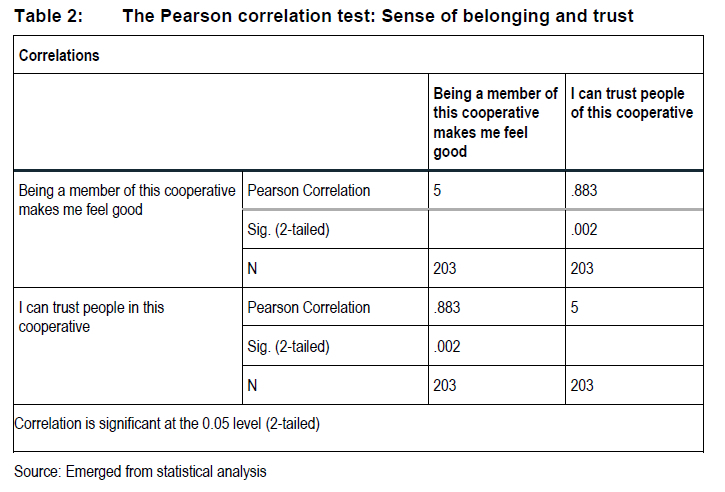
The results of this test are presented in Table 2.
Table 2 shows the outcome of the Pearson's correlation that was performed to assess the relationship between sense of belonging and level of trust among agricultural cooperatives. The result indicates that a statistically significant positive relationship exists between sense of belonging and level of trust among agricultural cooperatives in Nkandla Local Municipality at (r=0.883, n=203, p<0.005). This implies that an increase in sense of belonging brings about a corresponding increase in trust among the members of agricultural cooperatives. Based on this outcome, the alternative hypothesis which states that a relationship exists between sense of belonging and level of trust among agricultural cooperative members is supported. This finding is consistent with the outcome of the study conducted by Pichon (2016:51), which revealed that a sense of belonging enhances the level of trust among community members. Sohaib and Kang (2014:8) argued that it is very difficult for people to trust each other unless they share a sense of acceptance. Spector and Jones (2004) also argued that when people trust one another, the group can achieve truly meaningful goals. Trust among cooperative members also enhances the transmission of information within a cooperative (King et al. 2010:360). This is necessary for improving social cohesion and social capital. According to DiPasquale and Glaeser (1999) "social cohesion is defined as the willingness of members of a society to cooperate with each other in order to survive and prosper". For members to cooperate there must be a presence of trust among them. This emphasised the fact that a healthy sense of community is important to the success of CBE. The leaders of agricultural cooperatives need to come up with strategies that will enhance and ensure the level of trust is built and maintained among its members.
5.2.2 Symbols and expression of membership
A Pearson correlation coefficient was performed to test the association between sense of belonging and symbols and expressions of membership among agricultural cooperative members. The hypothesis is stated below:
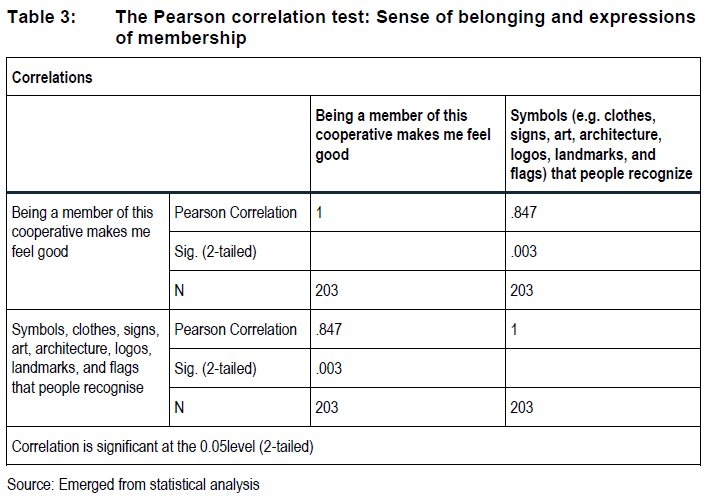
H2: A significant relationship exists between sense of belonging and expression of membership. The results of this test are presented in Table 3 below.
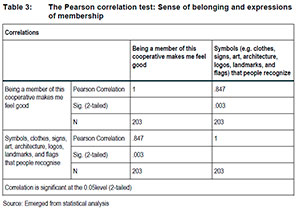
Table 3 shows a Pearson correlation coefficient that was performed to examine the relationship between sense of belonging and symbols and expressions of membership among agricultural cooperatives. The results indicate a positive correlation between the two variables, r=0.847, n=203, p<0.005. The null hypothesis was therefore rejected since the P value was less than 0.05. This test implies that, an increase in the sense of belonging results in an increase in the expression of membership through the use of symbols such as clothes, signs, art, architecture, logos, landmarks, and flags among members of the agricultural cooperative. This assumes that the feeling of acceptance or belonging is positively correlated to how members use expressions of membership to represent their group. This is consistent with the findings of the empirical studies conducted by Pretty et al. (2006), Elgenius (2005) and Erel-Koselleck (2004:58) which showcase that people tend to take pride in the symbols of expression when they feel accepted within their group or community. Pretty et al. (2006) further argue that symbols are very important in the grouping of people and they also give them a sense of identity and pride (Elgenius 2005:231).
Erel-Koselleck (2004:20) further argues that symbols and expressions of membership represent a material culture. Material culture refers to the physical objects, resources, and spaces that people use to define their culture (Erel-Koselleck 2004:19). All these physical aspects of a culture help to define members' behaviours and perceptions and further enhance their connections and sense of relatedness. Furrer et al. (2014:115) further argued that sense of relatedness promotes the need to be connected to others and to belong to a larger social group. This connection promotes competence which refers to a need to feel effective in interactions with social and physical environments (Furrer et al. 2014:115). This is necessary for members of the agricultural cooperative and for the success of a cooperative at large.
5.2.3 Time and effort
To establish the relationship between time and effort, and sense of belonging, the hypothesis below is formulated:
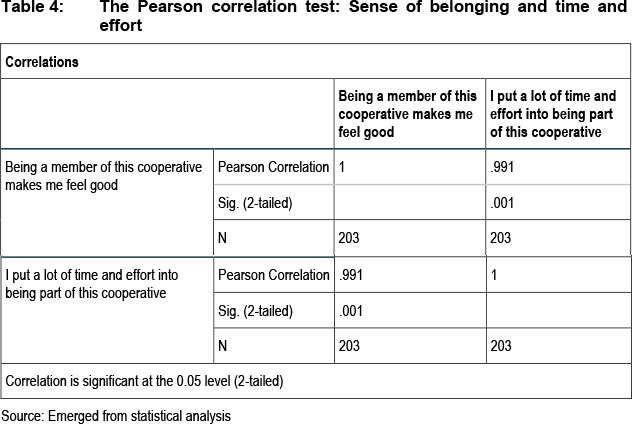
H
3: There is a significant relationship between sense of belonging and the time and effort that members invest in their agricultural cooperatives.Table 4 shows the Pearson correlation coefficient that was performed to assess the relationship between sense of belonging and the time and effort that members invest in their agricultural cooperatives at (r=0.991, n=203, p<0.005). The null hypothesis is therefore rejected since the P-value is less than 0.005. This implies that an increase in sense of belonging results in an increase in the time and effort that is invested by the members of the cooperatives. These findings concur with extant literature such as Stillman and Lambert (2013:6) and Rogerson (2006:50). Stillman and Lambert (2013:6) argue that people invest their time and effort to reward their feeling of acceptance in a group. Rogerson (2006:51) further argued that time and effort is a valid proof of one's commitment to an activity. Respondents in this study acknowledged that they put a lot of time and effort in being part of their cooperative. This serves as a proof that members value their connections amongst one another.
5.2.4 Identity
A Pearson correlation coefficient was employed to test the association between sense of belonging and essence of identity derived from being a member of an agricultural cooperative. The below formulated hypothesis is tested:
H
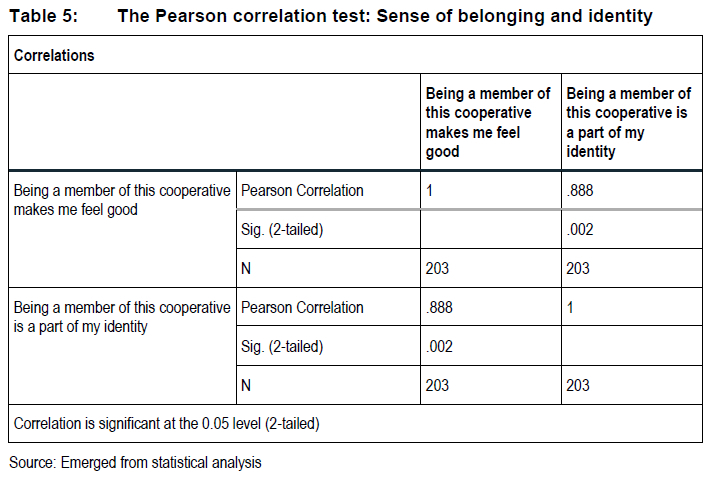
4: There is a relationship between sense of belonging and identity.The results of this test are presented in Table 5 below.
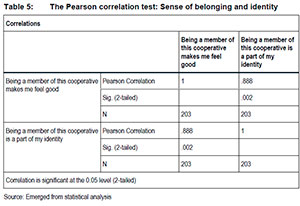
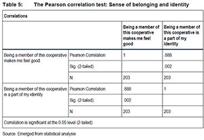
Table 5 shows the Pearson correlation coefficient that was performed to assess the association between sense of belonging and essence of identity derived from being a member of an agricultural cooperative. There is a positive correlation between the two variables, r=0.888, n=203, p<0.005. The null hypothesis is therefore rejected since the P value is less than 0.005. This test implies that an increase in sense of belonging also results in an increase in the essence of identity derived from being a member of an agricultural cooperative. This result of the statistical analysis consistent with the outcomes of the studies conducted by Littlewood and Holt (2018: 525) and Stillman and Lambert (2013:330) which revealed that sense of belonging positively affects one's identity. Kwon et al. (2013:989) posit that identities are traits and characteristics, social relations, roles and social group memberships that define individual identity. Kwon et al. (2013:1001) further argue that community members use social group membership as the basis for self-definition.
6. CONCLUSION AND IMPLICATION FOR POLICY
The researcher explored the variables of membership in relation to the sense of belonging within agricultural cooperatives members. In this case, the status of membership refers to a sense of meaningful connection and a sharing of a sense of personal relatedness with others. There were four variables that were used to address this research objective namely, trust, symbols, and expression of membership, identity and effort and time. Findings revealed that there is a positive correlation between sense of belonging and all these variables. For example, if there is a sense of belonging the level of trust among cooperative members will increase and vice versa. These findings could help in understanding social mobilization in relation to agricultural cooperatives. The relevance of the results of this study will help substantiate the local government strategy for rural development through CBE.
7. LIMITATIONS AND SUGGESTIONS FOR FURTHER STUDIES
Due to resource constraints, primary data for the study was gathered from only three (3) agricultural cooperatives in Nkandla, as the model of CBE out of more than one hundred cooperatives that exist in the area. The findings of this study cannot be generalised to the entire population of agricultural cooperatives in Nkandla, KwaZulu-Natal, but only to the selected agricultural cooperatives. There is a need for a study that will extend the survey to other agricultural cooperatives in KwaZulu-Natal. Findings of the study only reflect the views of the three selected cooperatives. In addition, the findings of this study lay the foundation for future research on the study area, and the study fills a research gap on how the role of sense of community promotes CBE in rural KwaZulu-Natal.
REFERENCES
2. LITERATURE REVIEW
-
AHMAD MS & TALIB NBA. 2015. Empowering local communities: decentralization, empowerment and community driven development. Quality & Quantity 49(2):827-838. (DOI:https://doi.org/10.1007/s11135-0140025-8.
» https://doi.org/10.1007/s11135-0140025-8 -
)
» https://doi.org/10.1111/1467-8268.12255 -
)
» https://doi.org/10.1145/968464.968470 -
ANDERSON AR & GADDEFORS J. 2017. Entrepreneurship and Context: Is entrepreneurship research out of context? Dilemmas with (non) contextualised views of entrepreneurship. Journal of Asia Entrepreneurship and Sustainability 13(4):3-9. [Internet:https://search.proquest.com/docview/2007939429?pq-origsite=gscholar&fromopenview=true; downloaded on 05 June 2019.
» https://search.proquest.com/docview/2007939429?pq-origsite=gscholar& fromopenview=true -
])
» https://scholar.google.co.za/scholar?hl=en& as_sdt=0%2C5& q=CHIUTSI+S+%26+MUDZENGI+BK.+2012& btnG= -
)
» https://doi.org/10.1006/juec.1998.2098 -
CHAVIS DM & PRETTY GM. 1999. Sense of community: Advances in measurement and application. Journal of Community Psychology 27(6):635-642. (DOI:https://doi.org/10.1002/(SICI)1520-6629(199911)27:6<635::AID-JCOP1>3.0.CO;2-F.
» https://doi.org/10.1002/(SICI)1520-6629(199911)27:6<635::AID-JCOP1>3.0.CO;2-F -
)
» https://scholar.google.co.za/scholar?hl=en& as_sdt=0%2C5& q=ERELKOSELLECK+ES.+2004.+The+Role+a nd+Power^f+Symbols+in+the+Identity+Formation+of+Community+Mem bers.+Ankara%3A+Middle+East+Technical+University.+%28MCom+Dissertation.%29& btnG= -
]
» https://hdl.handle.net/10520/EJC-8c772cc8f -
DANA LP, HAN M, RATTEN V & WELPE IM. 2008. Toward a theory of internationalization for European entrepreneurship. In Dana, Leo-Paul, Welpe, Isabell M., Han, Mary and Ratten, Vanessa (ed), Handbook of research on European business and entrepreneurship: towards a theory of internationalization, Edward Elgar, Cheltenham, United Kingdom. (pp 743-759). [Internet:http://hdl.handle.net/10536/DRO/DU:30034700; downloaded on 10 August 2017.
» http://hdl.handle.net/10536/DRO/DU:30034700 -
]
» https://doi.org/10.1080/00224540309598469 -
)
» https://doi.org/10.1108/13552559910293119 -
ELGENIUS G. 2005. Expressions of nationhood: national symbols and ceremonies in contemporary Europe. (Doctoral Thesis). The London School of Economics (LSE) and Political Science. [Internet:http://etheses.lse.ac.uk/id/eprint/638; downloaded on 15 August 2018.
» http://etheses.lse.ac.uk/id/eprint/638 - ]
-
]
» https://doi.org/10.1088/1748-9326/11 /8/084003 -
FURRER CJ, SKINNER EA & PITZER JR. 2014. The influence of teacher and peer relationships on students' classroom engagement and everyday motivational resilience. National Society for the Study of Education 113(1):101-123. [Internet:https://www.researchgate.net/profile/Ellen_Skinner/publication/248702173_The_Influence_of_Teacher_a nd_Peer_Relationships_on_Students'_Classroom_Engagement_and_Everyday_Resilience/links/54ac9d150cf2 479c2ee8144e.pdf; downloaded on 16 August 2018.
» https://www.researchgate.net/profile/Ellen_Skinner/publication/248702173_The_Influence_of_Teacher_a nd_Peer_Relationships_on_Students'_Classroom_Engagement_and_Everyday_Resilience/links/54ac9d150cf2 479c2ee8144e.pdf -
]
» https://doi.org/10.1080/17449057.2010.504552 -
]
» https://doi.org/10.5937/sjm12-12143 -
GIAMPICCOLI A, SAAYMAN M & JUGMOHAN S. 2016. Are 'Albergo Diffuso'and community-based tourism the answers to community development in South Africa? Development Southern Africa 33(4):548-561. DOI:https://doi.org/10.1080/0376835X.2016.1180968.
» https://doi.org/10.1080/0376835X.2016.1180968 -
)
» https://doi.org/10.1108/EUM0000000007304 -
)
» https://doi.org/10.1002/1520-6629(198601)14:1<6::AID-JCOP2290140103>3.0.CO;2-I -
GWANYA TT. 2010. A model for the comprehensive rural development programme. [Internet::http://www.rimisp.org/wp-content/uploads/2010/05/Paper_T.T_Gwanya.pdf; downloaded on 27 September 2019.
» http://www.rimisp.org/wp-content/uploads/2010/05/Paper_T.T_Gwanya.pdf -
]
» https://doi.org/10.1080/03736245.2014.977813 -
)
» https://doi.org/10.1186/s13731-017-0074-z -
INDABA REPORT. 2010. Indaba-IMVABA Eastern Cape Provincial Co-operative Development Fund. [Internet:www.imvaba.co.za/files/.../1322735669_CO-OPS%20INDABA%20REPORT.docx; downloaded on 06 August 2016.
» www.imvaba.co.za/files/.../1322735669_CO-OPS%20INDABA%20REPORT.docx -
]
» https://doi.org/10.5465/amr.2006.20208683 -
]
» https://doi.org/10.1177/0002764206290636 -
JENKINS R. 2000. Categorization: Identity, social process and epistemology. Current sociology 48(3):7-25. (DOI:https://doi.org/10.1177/0011392100048003003.
» https://doi.org/10.1177/0011392100048003003 -
)
» https://doi.org/10.1108/JEEE-05-2014-0015 -
)
» https://doi.org/10.1111/soc4.12391 -
KIM J & KAPLAN R. 2004. Physical and psychological factors in sense of community: New urbanist Kentlands and nearby Orchard Village. Environment and behaviour 36(3):313-340. DOI: https://doi.org/10.1177/0013916503260236.
» https://doi.org/10.1177/0013916503260236 -
)
» https://doi.org/10.1108/J EC-02-2015-0017 - )
-
KWON SW, HEFLIN C & RUEF M. 2013. Community social capital and entrepreneurship. American Sociological Review 78(6):980-1008. (DOI:https://doi.org/10.1177/0003122413506440.
» https://doi.org/10.1177/0003122413506440 -
)
» http://hdl.handle.net/10453/33657 -
)
» https://doi.org/10.1007/978-94-007-6527-6_23 -
LEARY MR. 2012. Sociometer theory. In PAM Van Lange, AW Kruglanski & ET Higgins (Eds.). Handbook of theories of social psychology (pp. 151-159). Thousand Oaks, CA: Sage Publications Ltd. (DOI:http://dx.doi.org/10.4135/9781446249222.n33.
» http://dx.doi.org/10.4135/9781446249222.n33 -
)
» https://doi.org/10.1332/030557308X307658 -
)
» https://doi.org/10.1192/pb.bp.114.050203 -
LITTLEWOOD D & HOLT D. 2018. Social entrepreneurship in South Africa: Exploring the influence of environment. Business & Society 57(3):525-561. (DOI:https://doi.org/10.1177/0007650315613293.
» https://doi.org/10.1177/0007650315613293 -
)
» https://doi.org/10.1002/jcop.21722 - )
-
MARTÍNEZ-MESA J, GONZÁLEZ-CHICA DA, DUQUIA RP, BONAMIGO RR & BASTOS JL. 2016. Sampling: how to select participants in my research study? Anais brasileiros de dermatologia 91(3):326-330. (DOI:https://doi.org/10.1590/abd1806-4841.20165254.
» https://doi.org/10.1590/abd1806-4841.20165254 - )
- )
-
NKANDLA LOCAL MUNICIPALITY. 2014. Draft Annual Report 2014/2015. Nkandla Local Municipality, Nkandla. [Internet:https://municipalities.co.za/resources/1108/nkandla-local-municipality; downloaded on 06 November 2015.
» https://municipalities.co.za/resources/1108/nkandla-local-municipality - ]
- )
-
PEPPERS D & ROGERS M. 2016. Managing customer experience and relationships: A strategic framework. New Jersey, USA: John Wiley & Sons. [Internet:https://scholar.google.co.za/scholar?hl=en&as_sdt=0%2C5&q=PEPPERS+D+%26+ROGERS+M.+2016.+Managing+custome r+experience+and+relationships%3A+A+strategic+framework.+New+Jersey%2C+USA%3A+John+Wiley+%26+Sons.&btnG=; downloaded on 15 August 2019.
» https://scholar.google.co.za/scholar?hl=en& as_sdt=0%2C5& q=PEPPERS+D+%26+ROGERS+M.+2016.+Managing+custome r+experience+and+relationships%3A+A+strategic+framework.+New+Jersey%2C+USA%3A+John+Wiley+%26+Sons.& btnG= - ]
- )
-
PICHON HW. 2016. Developing a sense of belonging in the classroom: community college students taking courses on a four-year college campus. Community College Journal of Research and Practice 40(1):47-59. (DOI:https://doi.org/10.1080/10668926.2014.964429.
» https://doi.org/10.1080/10668926.2014.964429 - )
- )
-
PURUSOTTAMA A, TRILAKSONO T & SOEHADI AW. 2018. Community-based entrepreneurship: A community development model to boost entrepreneurial commitment in rural micro enterprises. MIX: Jurnal Ilmiah Manajemen 8(2):429-448. [Internet:https://mix.mercubuana.ac.id/; downloaded on 17 October 2019.
» https://mix.mercubuana.ac.id/ - ]
- )
-
RATTEN V & WELPE IM. 2011. Community-based, social and societal entrepreneurship. Journal of Entrepreneurship and Regional Development 283-286. (DOI:https://doi.org/10.1080/08985626.2011.580159.
» https://doi.org/10.1080/08985626.2011.580159 - )
- )
-
ROGERSON CM. 2006. Pro-poor local economic development in South Africa: The role of pro-poor tourism. Local environment 11(1):37-60. (DOI:https://doi.org/10.1080/13549830500396149.
» https://doi.org/10.1080/13549830500396149 - )
- )
-
SARREAL ER. 2013. Community-Based entrepreneurship: An alternative social enterprise model for small communities in poor municipalities. Edited by Paulynne J Castillo. (pp 173-189). [Inernet:https://www.dlsuaki.com/uploads/1/0/2/2/102266760/complete_final_entrepreneurship_101816 _with_corrections_pp150-152.pdf#page=187; downloaded on 05 May 2019.
» https://www.dlsuaki.com/uploads/1/0/2/2/102266760/complete_final_entrepreneurship_101816 _with_corrections_pp150-152.pdf#page=187 - ]
-
SENGUPTA S, SAHAY A & CROCE F. 2018. Conceptualizing social entrepreneurship in the context of emerging economies: An integrative review of past research from BRIICS. International Entrepreneurship and Management Journal 14(4):771-803. (DOI :https://doi.org/10.1007/s11365-017-0483-2.
» https://doi.org/10.1007/s11365-017-0483-2 - )
- ]
-
SPECTOR MD & JONES GE. 2004. Trust in the workplace: Factors affecting trust formation between team members. The Journal of Social Psychology 144(3):311-321. (DOI:https://doi.org/10.3200/SOCP.144.3.311-321.
» https://doi.org/10.3200/SOCP.144.3.311-321 - )
- )
-
STOREY DJ. 2016. Understanding the small business sector. London, UK: Routledge. [Internet:https://books.google.co.za/books?hl=en&lr=&id=B263DAAAQBAJ&oi=fnd &pg=PP1&dq=STOREY+DJ.+2016.+Understandin g+the+small+business+sector.+London,+UK:+Routledge.&ots=Qb7JWITjbw&sig=8ZrKfiIGn VScVOYrpEzmF9YzxAQ#v=onepage&q=STOREY%20DJ.%202016.%20Understanding%20the%20small%20bu siness%20sector.%20London%2C%20UK%3A%20Routledge.&f=false; downloaded on 25 May 2018.
» https://books.google.co.za/books?hl=en& lr=&id=B263DAAAQBAJ& oi=fnd & pg=PP1& dq=STOREY+DJ.+2016.+Understandin g+the+small+business+sector.+London,+UK:+Routledge.& ots=Qb7JWITjbw& sig=8ZrKfiIGn VScVOYrpEzmF9YzxAQ#v=onepage& q=STOREY%20DJ.%202016.%20Understanding%20the%20small%20bu siness%20sector.%20London%2C%20UK%3A%20Routledge.& f=false - ]
- )
-
TCHAMYOU VS, ERREYGERS G & CASSIMON D. 2019. Inequality, ICT and financial access in Africa. Technological Forecasting and Social Change 139:169-184. (DOI:https://doi.org/10.1016/j.techfore.2018.11.004.
» https://doi.org/10.1016/j.techfore.2018.11.004 - )
- )
-
WALTON GM & COHEN GL. 2011. A brief social-belonging intervention improves academic and health outcomes of minority students. Science 331(6023):1447-1451. (DOI:10.1126/science. 1198364.
» https://doi.org/10.1126/science. 1198364 - )