Cross-disciplinary approach and entrepreneurial orientation in Nigerian universities: a conceptual framework
Abstract
Research was conducted on the general elective nature of entrepreneurship courses offered as compulsory to all students irrespective of their career paths and interests. Although, empirical studies have established the module as teachable and learnable, the impact remains significantly weak in Nigeria because of the teaching and learning pedagogy operating in most universities is substantially theoretical and centralised exposure. This article was aimed at establishing the variation between individual disciplines, modes of learning and intentions for business start-up. Five hundred and ten questionnaires were administered through stratified and systematic sampling techniques on undergraduates and postgraduate students of three universities in Southwest Nigeria. Inferential statistics including Pearson's correlation, t-tests, and chi-square at 0.05 p-value level of significance were employed for the statistical analysis. Significant differences in entrepreneurial orientation were found among school faculties and disciplines. It is concluded that education groups have potential influence on students' intentions and mind-sets for future entrepreneurial ventures. A cross-disciplinary learning model that is decentralised is recommended to bridge the dichotomy in the schools' curriculum, enhance distribution of hands-on activities, and cater for individual variations, preference and learning abilities. The new framework would comprise interdisciplinary mentoring, coaching, networking, attachment and students' exchange programmes.
education; orientation; pedagogy; school; training
1. INTRODUCTION
In the past decade, discussions around designing entrepreneurship education programmes along diverse academic fields of study are on the increase in global entrepreneurial research. The contributions, insights and perspectives of academic scholars from engineering, sciences, arts/music, design, medicine/healthcare, and agriculture are found to be unique and vary from the regular traditional business model (Daniela, Rainer, Norbert & Birgit 2016:173; Nambisan 2015:1).
These differences perhaps justify the quest for a cross-disciplinary learning framework, which has remained largely unexploited in Nigerian universities. Several years after the inclusion of entrepreneurship into the university academic curriculum, the rate of graduate unemployment still remains high in Nigeria (Ekundayo & Babatunde 2014:16; Maduka 2015:91; Oduwole 2015:30). Contrary to government expectations, the impact remains significantly low evidently as a result of the kind of education system inherited from the earlier colonial administration. The school structure under the British government substantially instilled mind-sets for remunerative employment (Musa & Adewale 2015:20). Such orientation is believed to have contributed to the production of graduates with little or no employability skills.
This state of affairs is against the entrepreneurial spirit in Nigerian youths that existed before the advent of administration by the white people. In the imperialist era, there was a high demand for the services of graduates because there were substantial job opportunities around. Then, the available school leavers from higher education institutions (HEIs) were few in number; the challenge was rather how to make the best choice between different lucrative job offers (Aladekomo 2004:75-76; Nkang 2013:90).
Today, the reverse is the case to such an extent that a large number of graduates are produced annually to the already saturated labour market in Nigeria (Akpan & Etor 2013:1181). Many of them roam the streets in search of non-available government jobs. For example over 700,000 youths applied for only 10,000 job vacancies declared by the Nigerian police force (Thisday Newspaper April 20th, 2016:1). This instance is similar to a "recruitment hurricane" that resulted in the loss of lives of many graduates when over 500,000 job applicants jostled to fill fewer than 3, 500 vacant positions in the Nigerian immigration service (Ehinomen & Afolabi 2015:4; Obamuyi & Fapetu 2016:37).
Given the non-availability of paid employment, many of the educated school leavers resorted to odd jobs while others do take recourse to crime and illicit activities in order to make ends meet. This behaviour is largely attributed to the disappointment arising from long period between the year of graduation and the date of employment (Uduak & Aniefiok 2011:173). The literature reveal that in recent time more crimes are perpetrated by youths in Nigeria due to the problem of unemployment (Asamu, Ojo & Benson 2015:23; Oduwole 2015:31; Salami 2013:18).
The rationale behind introducing entrepreneurship education (EE) into the university curriculum is to provide undergraduates with orientation and skills for employment generation. This approach is in recognition of EE potentials as a driver of leadership development, youth empowerment and national economic growth (Afolabi 2015:50; Garba 2010:141; Imafidon 2014:101). . The multiplier effects include the springing up of small and medium scale enterprises, creation of jobs and the eradication of poverty and crimes. As laudable as this initiative may be, the impact on the youth employment is low and the efficacy of the guiding framework in the HEIs remains questionable.
1.1 Background to EE practices in Nigerian universities
Empirical studies have revealed that the method adopted for teaching and learning (T&L) in Nigerian generally focuses more on lectures than practice (Akpomi cited in Ali & Muhammad 2012:22; Olorundare & Kayode 2014:156). It appears as if many of the lecturers handling entrepreneurship classes are not experts and that the materials used in teaching are not up to date despite constant changes in world of knowledge (Alabi, Alanana & Bahal 2014:40). This article underscores the issues of overcrowded lecture theatres observed during EE lectures.
The problem of overcrowding is due to the university-wide trend of bringing all learners to the entrepreneurship development centre (EDC). Entrepreneurship is a compulsory general study course for all students across all faculties in the universities. At the moment, a centralised training technique is adopted. Entrepreneurship courses are offered to all students irrespective of their career choices, interests and academic disciplines. This practice is contrary to the submission that the propensity to act in an entrepreneurial manner is not limited to certain individual learners (Ali & Muhammad 2012:22). It is believed that different individual learners would demonstrate a mix of abilities, skills and attributes. Such qualities can be learned, practised and deepened through flexible learning methods at different levels of education so that all learners could have an equal chance to become entrepreneurs, if appropriate training mechanisms are adopted.
This article reveals the need to match instructions with learners' peculiarities, choice, interest or area of academic discipline. In the same way that a career is chosen based on choice and interest, so also should graduate orientation towards learning entrepreneurship be done. However, there are attempts to engage students in some practical vocations such as tailoring, soap-making, catering, shoe-making and bead-making, amongst other things at entrepreneurship development centres (EDCs).
The fact that the focus is still restricted to those skills in which the centres have the capacity, skilled personnel and equipment aligned with the submission that the method of pursuing capacity building programmes in Nigeria is too mechanistic and fall below acceptable standard (Alabi et al. 2014:40; Ali & Muhammad 2012:22) . It must be emphasised that disciplines differ in curriculum content and processes of learning.
Furthermore, some disciplines such as Humanities, Social Sciences, Arts and Management seem to engage students more on knowledge of theory through classroom interactions and there is clearly little or no interaction with the industry. Students who study courses such as engineering, agriculture, medicine and applied sciences seem to be rather engaged more in practical/ field training in addition to knowledge they acquire in the classroom. Industrial experiences through exposure to internship and the Students' Work Experience Scheme (SIWES) afford students in these education groups more interface with the industry.
1.2 The related perspectives
According to the Economist report cited in Kleeman (2011:17), a positive significant relationship exists between innovative teaching practices and students' learning outcomes. According to the report, students with a background in practical-based activities might be motivated for better performance. This view is justified by the submission that students who are from technical-related faculties have a higher chance to venture into technology-oriented self-businesses (Daniela et al. 2016:173).
These arguments bring to questioning the appropriateness of the entrepreneurial model obtainable at the moment at the university which does not put into consideration the learners' academic backgrounds, career choices and preferred areas of interest. The growing trend of entrepreneurial research in academic disciplines necessitated the investigation in Nigeria; consequently, an appeal is made in this article for a paradigm shift in perspective from a highly centralised content-based dimension to a decentralised outcome-based dimension to EE in Nigerian universities.
This aim might be achievable through a cross-disciplinary learning exchange entrepreneurial programme which would provide a problem-based alternative to teaching, learning and assessment (TLA) in entrepreneurial studies (Ali & Muhammad 2012:19). The new model could be more inspirational, flexible and adaptive to both immediate and future needs of the graduates.
This article is of the view that EE programme could rather be tied to the outlined factors rather than offering same thing to all learners centrally at EDCs. Consequently, the motive behind generalising EE across all academic disciplines needs to be re-focused. The multidisciplinary model under the university-wide coordination has the potential to be stronger than mere operating traditional and central norms.
The article is aimed at determining the variation between individual education group mode of learning and the influence on students' entrepreneurial education in the selected universities in southwest Nigeria.
"... any attempt to unify the entire body of diverse entrepreneurship work within a single common framework would inevitably omit certain disciplinary contributions and questions of interest" (Ireland & Webb 2007:914).
This contribution above by Ireland and Webb (2007:914) provides an insight to how effective teaching and learning framework for EE can be better approached. Discussion on such guiding framework has witnessed a regular reoccurrence in the global context (Pihie & Sani 2009:340). Cotrugi (1990) cited in Daniela et al. (2016:172) proposed how EE can be delivered to students.
Cotrugi (XXX ref XXX) argued that the EE is approachable in the context of diverse academic disciplines and thus suggested that students from backgrounds such as engineering and the applied sciences have higher entrepreneurial tendencies. Hence, the proposition that entrepreneurship should not just be taken out of the box, but that a new box should be created. Gibbs (2002:243) supports the view that EE should be taken out of the "locker room of economics", and be based "within a wider cross-disciplinary context with pluralistic and diffused views of society".
To develop an entrepreneurial framework also requires innovative teaching capable of imparting both knowledge and application of skills. This is justified by Kolb's experiential learning theory as discussed in Frederick (2007:6-7). The theory provides different learning approaches for the optimum development of the students' entrepreneurial skills achievable through a combination of knowing and doing learning techniques. Based on his findings from grounded theory perspectives, Frederick (2007:6-7) concluded that learning entrepreneurship requires experiential pedagogical interventions.
These perspectives align with the submission that the success of EE is largely dependent on what is taught, who teaches, and how and where entrepreneurship is taught (European Commission Report 2009:11).
2.1 Review of key entrepreneurship conceptual issues
Kauffman cited in Bilic, Prka and Vidovic (2011:116) described entrepreneurship as a fundamental transformation process involving innovative generation of ideas for value creation to enterprise development. Similar researches confirmed that such process of value transformation including the proliferation of small and medium business enterprises could lead to national economic growth, innovation and job creation (Afolabi 2015:50; Garba 2010:141; Imafidon 2014:101) . Perhaps, these key deliverables aroused the quest for integrated strategies, policies and more scientific framework towards fostering entrepreneurial orientation using university education and training as a tool.
Entrepreneurial orientation connotes key entrepreneurial potentials required of individuals supposedly being positioned for value creation and future enterprises. Such potentials according to Callaghan and Venter (2011:29) include: innovativeness, competitive aggressiveness, risk taking propensity, autonomy and pro-activeness.
These potentials can be realised through a unique multifaceted and flexible system for nurturing high impact entrepreneurship education obtainable in the developed nations around the world (Wilson 2008:3). Hence, entrepreneurship is more of a mindset to create and develop economic activity by blending risk-taking with creativity and innovation.
This study aligned with Vankataraman's position contained Mwatsika (2015:426), which explained entrepreneurship as a concept through which opportunities to create future goods and services are discovered, evaluated and explored. Wilson (2008:5) averred that such practice of positioning learners for future entrepreneurial opportunities was treated as an integral part of multidisciplinary education process in the context of higher education in Europe.
2.2 Review of empirical studies on perspectives on EE
In the USA, entrepreneurship curriculum contents have embedded activities such as small business management, new venture creation and entrepreneurship sustenance (Aondoaseer 2013:86) with the aim of instilling entrepreneurial mindsets in American university graduates.
The methodologies involve the use of mentoring, internship, role play, case studies, seminars, creating business plans, business simulations and discussions, as well as lectures to reinforce learning. Musa and Adewale (2015:24) reported that such curriculum contents are structured in such a way that 41% training is done at the departmental level in line with students' chosen careers. Thirty one per cent of the contents are domiciled in the business schools/faculties while the remaining 23% is administered by the university entrepreneurship development centres. This is a contrast to what is presently practised in most Nigerian universities where the teaching and learning of entrepreneurship is concentrated at EDCs.
This is similar to the opinion of Tulgan cited in Akpan and Etor (2013:1181), who described entrepreneurship as training that offers capacity and mindset building for human capital development.
The strategy is to empower the students/graduates to become self-employed and self-reliant thereby reducing poverty. Thus, the learning approaches are directed towards providing appropriate attitude, knowledge and skills reinforced by practical-related work activities. Akhuemonkhan, Raimi and Sofoluwe (2013:9) also concurred that developed nation of the world like America and Japan operate what is termed "facultative" training for entrepreneurship education. This is more of practical-based interface than the usual teach-listen traditional approach obtainable in most developing countries of the world.
2.3 Review of related studies in Nigeria
In a study conducted by the National Universities Commission in 2004 on the labour market expectations of Nigerian graduates, it was observed that the structure in Nigerian universities had not adequately prepared graduates for self-employment. Graduates are rather prepared as job seekers instead of job creators. Underlying this situation is the fact that the contents of curriculum for entrepreneurship learning are not broad enough to equip graduates with desirable skills required for self-employment; therefore, stakeholders in recent times have called for designing appropriate curriculum as equipment for graduates' self-employment and relevance in society (Adebisi 2015:93; Arogundade 2011:28)..
In addressing the shortfall, Anene and Imam (2011:5-10) identified 66 potentially viable entrepreneurship skills for which university students could be trained. Some of these skills include painting, cultivation of flowers, landscaping, ceramic production, metalwork, woodwork, electric wiring, fabrication, radio/television repairs, and veterinary services, operating saloon, computer services, care technology and the rest.
It is worthy of note that many of these skills are already embedded at different levels in the school curricula. While some are available at EDCs, others are provided by stakeholders outside the university campuses. The authors are of the opinion that focusing attention on these vocations could deepen entrepreneurship employability mind-sets. This view is supported by the claim that learning entrepreneurship requires different methods because entrepreneurial students learn differently and they have different learning moments (Frederick 2007:5-6; Mkala & Wanjau 2013:19).
The students show a high preference for active, visual, practical and concrete teaching methods. Anene and Imam's (2011:5-10) report confirmed that respondents' opinions differ according to academic disciplines and faculties at the University of Abuja. The students, irrespective of their courses of study, were given freedom to rank 66 entrepreneurial viable skills according to the level of preference from the checklist. The results confirm difference in opinion, interest and preference, which shows that it is difficult to ascertain the students' interests; thus it is rather difficult to determine projects that students regard as providing viable choices (Anene & Imam 2011:10). This is similar to the 66 entrepreneurial competency items by cluster category identified in Jamaica by training academy managers for the improvement of entrepreneurial education curriculum in the commercial training institutes (Dixon, Meier, Brown & Custer 2005:30-42). Each of these institutes provide commercial school-based sectoral skills along clusters considered to be relative in nature (Dixon et al. 2005:26)
The idea of concentrating EE in a particular context within the universities calls for a review. This empirical study observed that there is always an entrepreneurship component in every academic discipline. These components are better identified and made available at the levels of different departments or faculties. This could facilitate cross-disciplinary knowledge transfer within the university system irrespective of students' career paths.
The position sketched above is affirmed by the fact that learning is situated in a diverse environment and involves apprentices starting with little assignments, using the relevant tools to deliver. The apprentices practise and build confidence slowly over time; they advance from observing to participating in more difficult assignments until they become fully skilled (Neergaard, Tangaard, Krueger & Robinson 2012:4).
3. PROBLEM INVESTIGATED
Even though a number of studies have been conducted in Nigeria on entrepreneurship orientation and graduates' intentions, literature on the cross-disciplinary learning approach is scanty. At present, there is evidence of little or no interface between faculties or departments at different educational groups and EDCs in the area of student exchange training programmes. EDCs operate according to a standalone and highly centralised outlook.
The concern at the level of students department or faculty is more of how to secure the release of results from EDCs central collation centre. In the course of the investigation, it was observed that many academic staff members seem to be unaware of the operation of the EDCs and the interplay with core students' disciplines. Furthermore, the expertise and materials to give the required training to students at the EDCs is inadequate.
The universities are challenged in the area of funding; at the same time seemed not taking the advantage of multi-disciplinary structures at their disposal. Many students rather view the general nature of EE in the universities as an imposed academic exercise necessary to complete the graduation requirements. These scenarios are described as inadequate towards achieving entrepreneurial education for sustainable development (Dambuazo 2015:11).
These above-mentioned practices affect students who are preparing to face future challenges posed by unemployment in the country. Since the education training system places a high premium on the traditional and centralised mode of learning as against experientialism and decentralisation in its operation, graduates have consistently been produced without the necessary skills for employment.
Musa and Adewale (2015:29) contend that relying mostly on lectures in the classroom could result in theoretical knowledge only, because the method lacks the basic initiative for application. The mere teaching of entrepreneurship in the classroom would do no more than create entrepreneurial awareness among university graduates, and mere entrepreneurial awareness might not provide the much needed skills and experience for entrepreneurial practice.
These concerns confirm that limited studies on interaction between learning methods remains a big gap in entrepreneurial research (Brink & Madsen 2015:651). It was therefore deemed necessary to conduct an exploratory study on stimulating graduates' entrepreneurship through cross-disciplinary learning synergies and thus to attempt to fill the existing knowledge gap.
4. RESEARCH OBJECTIVES
The study on which this article is based was aimed at determining the variation between the individual education group mode of learning and the influence on students' entrepreneurial education in the selected universities in southwest Nigeria.
The study also aimed to do the following:
■ Determine the extent to which educational target groups are different in their perception of mindsets for entrepreneurial business start-up.
■ Determine the extent to which educational target groups view the need for a modified framework to entrepreneurial orientation in Nigerian universities.
■ Propose a cross-disciplinary model for the teaching and learning of entrepreneurship in Nigerian universities.
5. RESEARCH METHODOLOGY
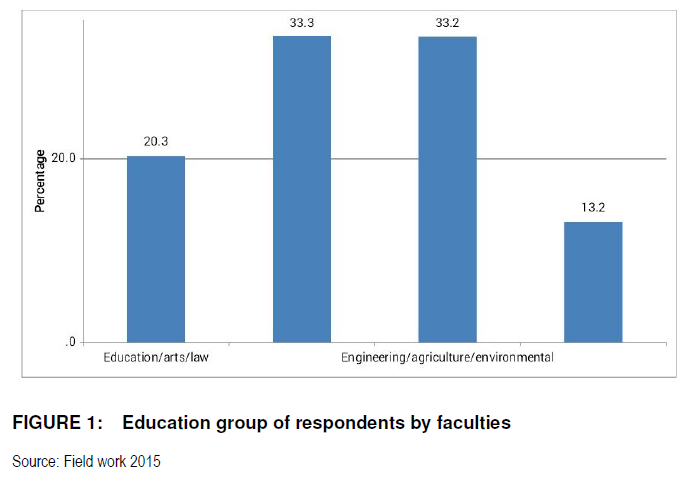
The research design was descriptive premised on the fact that the study was interested in the description of the identified variables in terms of frequencies and averages. A self-administered questionnaire adapted from related studies was used to elicit responses from the respondents. This was based on a 6-point Likert scale fundamental to the level of agreement to the statements contained in the questionnaire administered on different education groups operating in different departments/faculties in the selected universities as contained in figure 1
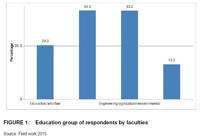
Descriptive statistics including means and standard deviations were used in the study, where applicable. In this article frequencies are represented in tables or graphs. The chi-square goodness-of-fit-test is a univariate test, used on a categorical variable to test whether any of the response options are selected significantly more/less often that the others.
A one-sample t-test was used to test whether the average value was significantly different from a value of 3.5 (the central score). This was applied to a 6-point Likert scale according to (strongly disagree - 1, disagree - 2, strongly disagree - 3, slightly agree - 4, agree - 5 and strongly agree - 6). A chi-square test of independence was used on cross-tabulations to see whether a significant relationship existed between the two variables represented in the cross-tabulation.
The study also made use of independent sample t-test (tests for significant differences in average responses between two independent groups). In essence, this was done to provide Fisher's exact test in case the conditions were not met. Five hundred and ten copies of the questionnaire were administered to final-year students and postgraduate students at different faculties in the three universities in southwest Nigeria, namely the Ekiti State University, Ado-Ekiti, the Federal University of Technology, and the Akure and Babcock University, Ilisan-Remon.
Four hundred and forty six questionnaires were returned. The study employed a combination of stratified, systematic and simplified proportional sampling technique by Yamane cited in Israel (2009) to select sample size. According to Sekaran and Bougie (2009:294-295), this sample size is representative and thus it justified the required level of confidence and precision.
A total number of 316 full-time students at the final-year level and 130 postgraduate students participated in the study. The field work yielded an 86.67% response rate using inferential statistics including Pearson's correlation, t-tests, and chi-square with a p-value of 0.05 level of significance. The research is a product of data collected through primary and secondary sources.
6. RESULTS AND DISCUSSIONS
The findings of the study revealed that the respondents differed in their perceptions along the career paths, faculties and modes of learning.
The following terms are abbreviated in the presentation of the analyses:
Ed = Education/Arts
SS = Social Sciences/Management
Eng =Engineering/ Technological/ Agricultural/ Environmental studies
SM = Sciences/ Medical studies EDP=Entrepreneurial Development Programme
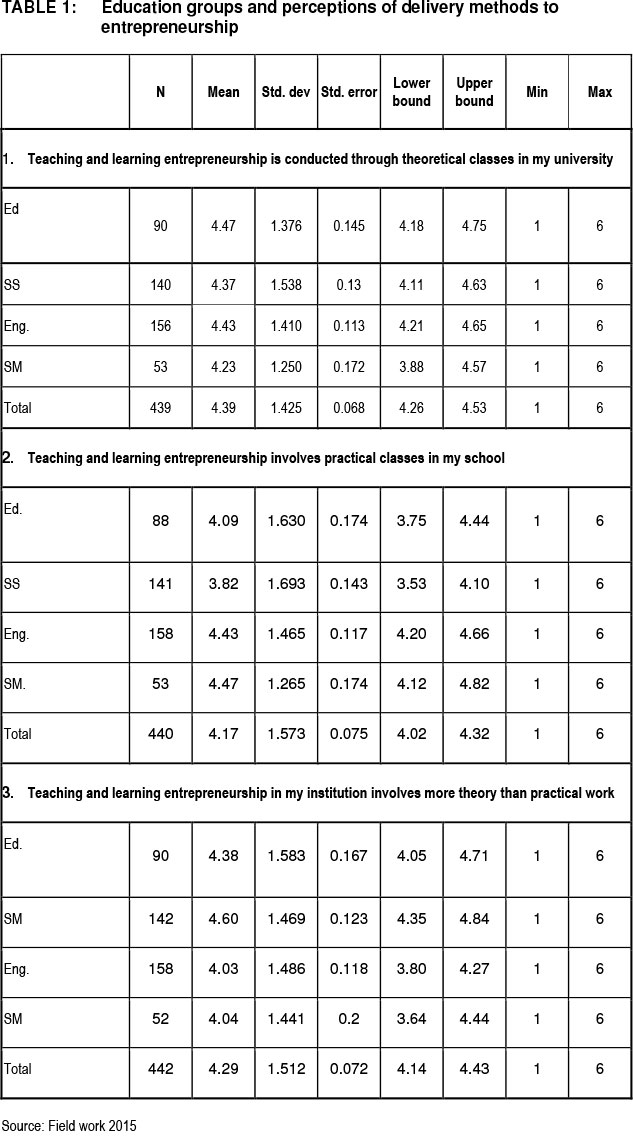
In an attempt to determine the extent by which individual groups differ along career paths in the mindsets for entrepreneurial ventures, the study considered a number delivery approaches to entrepreneurial education. Hence, the viewpoints of individual learning group according to chosen disciplines were sought. The idea was to determine the influence of the career paths on modes of instruction to entrepreneurship modules as contained in table 1.
Table 1 shows that there was significant agreement among students across all the faculties that theoretical lectures are still the mode of instruction in entrepreneurship courses (t(443) = 17.71 . p<0.0005 ; the classes are conducted mostly through theoretical classes (t(438) = 13.15, p<0.0005).
However, significant differences across faculties are found in the agreement that teaching and learning involves practical classes (Welch (3, 183.901) = 4.619, p=0.004 ). Specifically, there is less average agreement from Social sciences/ Management students (3.82) than Engineering/ Technology/ Agricultural/ Environmental students (4.43) and Sciences/ medical students (4.47) . There are also significant differences across faculties as to the fact that there is more theory than practical work (F (3, 438) = 4.177, p=0.006 ). Specifically, Social Sciences/ Management faculties (4.6) shows more average agreement than Engineering/ Technology/Agricultural/ Environmental faculties (4.03) and SM (4.04).
These findings demonstrate that students who attend Science, Engineering, and Medical -related courses seem to be more exposed to practical-related work activities than their counterparts in Arts, Education, and Social Sciences. These hands-on activities have a considerable influence on students to become practising entrepreneurs. These findings are in agreement with the submission that the traditional lecturing style remains the most frequently used mode of instruction for students in Nigeria (Akhuemonkhan eí a!. 2013:67; Olorundare & Kayode 2014:156).
The findings also show that the theoretical instructions account for the largest percentage of class time used by Education/ Arts and Social Sciences/ Management. A decentralised EE offer along clusters within the hierarchy of schools has potential impacts on the learning outcomes. Jennings cited in Onu (2013:43) affirms that entrepreneurial orientation could be stimulated through a flexible, loosely controlled, decentralised, consensual and adaptable education structure. The implication is that the autonomy embedded at the level of students' disciplines along their departments/faculties in the universities could foster graduates' entrepreneurial development.
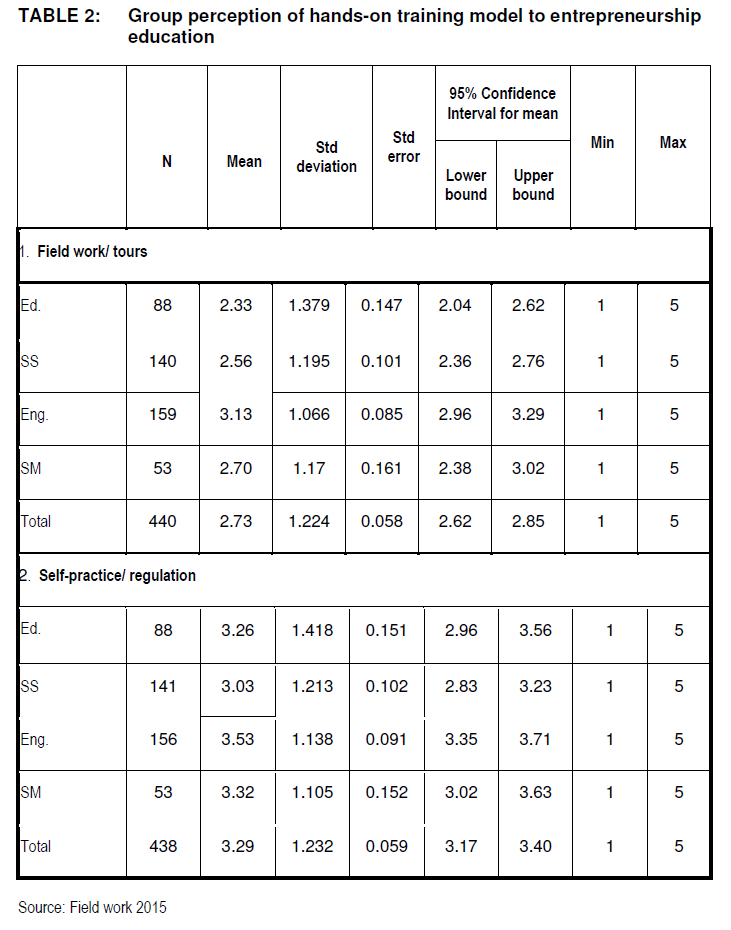
The perceptions of learning groups were sought to established individual preference for self-efficacy and practical-based activities as reinforcement to EE as contain in the table 2.
The findings presented in Table 2 show significant differences across faculties in the agreement that field work/ tours and self-efficacy for the bases of learning framework. Students in technical-related disciplines Engineering^Technology/ Agriculture/Environment and Sciences/Medical studies differ in their opinion with those in Arts, Social Science and Education/ Arts. The former engage in more field activities than the latter. The findings reveal that Engineering, Sciences/Medical studies > Education, Social Sciences: (3.13, 2.7) > (2.33, 2.56) respectively, (Welch (3, 177.103) = 4.396, p=0.005 ).
Similarly, the concept of self-efficacy is higher in faculties such as Engineering, Sciences and Medicine than Social Sciences, Art and Education: Engineering/Science/ Medicine > Education, Arts, Social Sciences/ Management: (3.53, 3.32) > (3.26,3) respectively, (Welch (3,183.901) = 4.619, p=0.004).
The implication is that Engineering, Sciences/Medical students might likely have higher preference for entrepreneurship environments where hands-on activities and self-practices.
This perhaps could be related to the nature of the curriculum operating at the different levels of education groups within the university education system.
The finding supports the position that such learning that is done within workplace is likely to increase students' skills and performance (Togara 2013:784). It is evident that practical and experiential activities are directly related to acquiring hands-on skills development which might be difficult to acquire only through learning in the classroom.
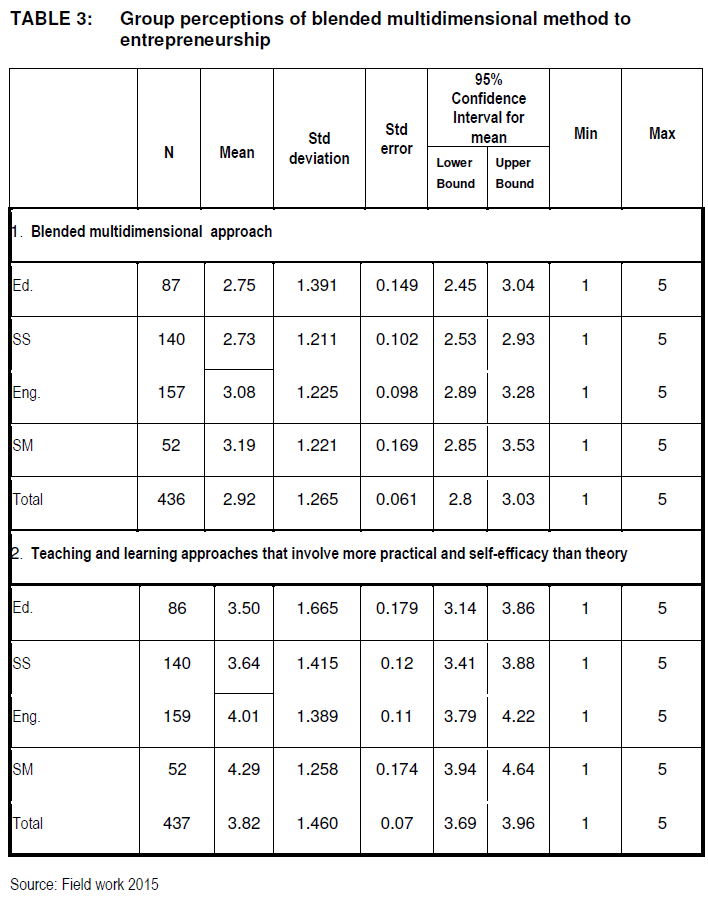
The perception of respondents by educational groups was sought in respect of applying multidimensional blended methods to conduct EE as contained in table 3. Significant differences across faculties were found in the agreement that the multi-disciplinary blended learning approach is effective in EE.
Specifically, there is less agreement from Education/ Arts and Social Sciences/ Management students (2.75, 2.73) than Eng and SM (3.08, 3.19) respectively (Welch (3, 175.765) = 5.002, p=0.002). In the same vein, Engineering, Sciences and Medicine differ in their agreement that self-efficacy methods are effective in EE. The results show greater agreement between Engineering/Technological / Agricultural/ Environmental and Sciences/ Medical students (4.01, 4.29) than Education/ Arts and Social Sciences/ Management students (3.5, 3.64) respectively.
It is evident that effective EE requires active learning that provides a practical platform to the learner. The current practices in Nigerian universities are described as not meeting the expected standard. This affirms the reason why Garba (2010:145) advocated for a shift from general education to specific entrepreneurial education in Nigeria.
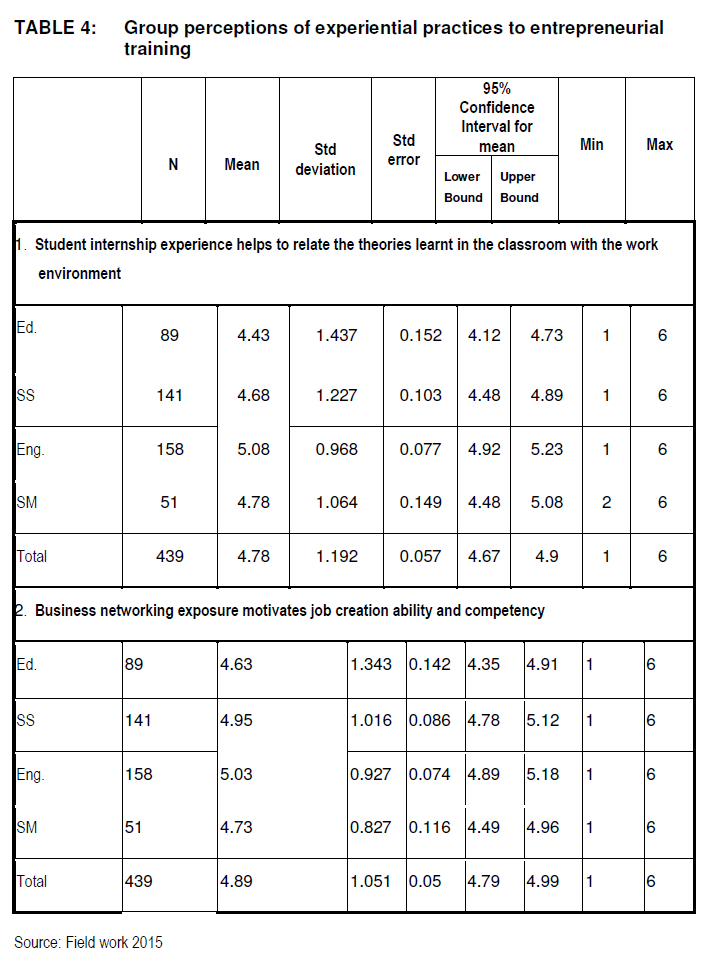
The relevance of exposure to experiential learning and self-practice was established based on the operating curriculum in all educational groups as contained in table 4. Significant differences across academic disciplines/ faculties were found in the agreement that experience from internship experience helps to relate the theories learnt in the classroom with the work environment.
The results show differences in agreement between students in Social Sciences, Education, Arts and those in Engineering, Science and Medicine. Specifically there is less agreement between Education/ Arts and Social Sciences/Management students (4.43, 4.68) than Engineering/ Technology/Agriculture/ Environment and Sciences/ Medical studies (5.08, 4.78) respectively (Welch (3, 175.789) = 3.102, p=0.028).
In the same vein, students from faculties of Engineering, Sciences and Medicine differ from those in Education, Social Sciences and Arts that business networking exposure motivates entrepreneurial mind-sets. This result shows significance agreement of Engineering/ Technological/ Agricultural/Environmental and Sciences/ Medical students (5.03, 4.89) and those in Education/ Arts and Social Sciences /Management (4.63, 4.95) respectively.
The result is supported by the submission that EE requires learning that places students at the centre of the education system which affords them the freedom to learn about themselves in their chosen areas of interests and relevance (Alabi et al. 2014:40).
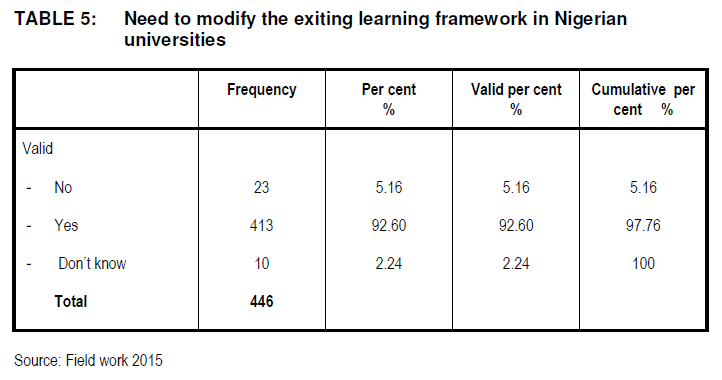
The study sought the opinion of the respondents to establish the need to modify current model to entrepreneurship education in Nigerian universities as analysed in table 5:
Table 5 shows a high percentage of respondents: about 93% agreed that there is a need to change the way EE instruction is delivered at the moment in Nigerian universities. About 5% of the respondents believed that the status quo could be maintained while around 3% chose to be indifferent. The result of this findings is in tandem with the similar empirical studies which have suggested a review of existing entrepreneurship curricula with a view of strengthening them for better performance (Aja-Okorie & Adali 2013:12; Ali & Muhammad 2012:12; Garba 2010:148). These goals could be achieved through decentralised T&L in terms of chosen career paths and interests.
Based on the findings, this empirical study offers a framework that places more emphasis on students' career choice, area of interest and processes of learning in various departments/faculties. Finding shows that learners' conception of entrepreneurship differs from what the educators offer through the routine textbook and lectures (Neergaard eí al. 2012:2).
Whereas, empirical studies revealed that the implication of stringent reliance on such pedagogy has the tendency to prepare mindsets for employment in the formal sectors. This situation according to Ejere and Tende, cited in Olorundare and Kayode 2014:156 could lead to perpetual unemployment.
The article is specifically motivated when discovered that teaching and learning entrepreneurship requires different approaches because entrepreneurial students tend to learn differently and they have different learning moments (Mkala & Wanjau 2013:19).
Accordingly, the students could exhibit higher preference for experiential interventions through active, practical, concrete, visual and reflective teaching to entrepreneurship. These innovative strategies corroborate the assurances that hands-on activities within academic curriculum have the potential influence on individual variations and learning outcomes (Isaac 2007:619).
This also considers the interests of different groups within the learning range which including the gifted, disable and student with learning difficulties (Judi & Corno 2005:47). The essence is to match instructions with learners' peculiarities.
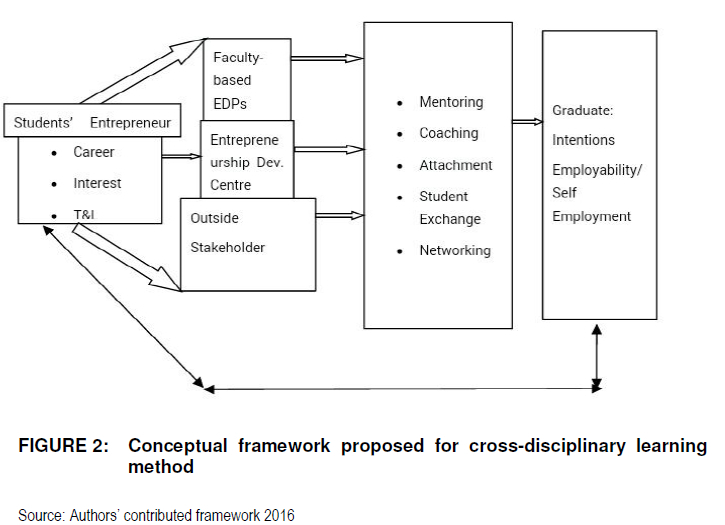
Figure 2 suggests a decentralised T&L model that provides entrepreneurial knowledge and training through the interplay of students' careers, university departments, faculties, EDCs, alumni including experienced stakeholders outside the university environment.
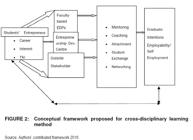
Such practices is what Gibbs (2002:3-5) described as the concern in the UK to create related entrepreneurship programmes within the level of academic courses of study. The desired results could be achieved through mentoring, coaching, industrial attachment and student exchange design. Through such approaches, graduate entrepreneurial intentions could be motivated for employment along career paths and interests.
The alumni involvement in the area of mentoring and coaching could act as a resource base to complement undergraduates' empowerment development in Nigerian universities, since an integral and practice-led delivery method is relevant to the development of mindsets for entrepreneurial sustainable development (Dambudzo 2015:11-12). It is therefore believed that a work-related pedagogy could be more sustainable with regard to learning due to its symbolic link to the immediate environment. These practices could lead to competition among participating academic groups and the faculties that offer better programmes might experience a higher rate of student enrolment.
7. RECOMMENDATIONS
Based on the findings of the study, the authors emphasise the need to decentralise EE in Nigerian universities, since this approach could help to bridge the current dichotomy in the academic curriculum and serve as a model for entrepreneurial knowledge transfer for all other HEIs in Nigeria.
Therefore, the following recommendations are made:
■ The EE curriculum could be redirected to strike a balance between theoretical and practical learning activities in Nigerian universities.
■ Rather than a centralised model operating in most universities in Nigeria, EE should be decentralised and offered as optional along career paths at faculty or departmental levels.
■ The components of entrepreneurship in all academic careers should be identified and made available to interested students irrespective of their faculties.
A cross-disciplinary approach in the area of entrepreneurial research should be encouraged to create additional knowledge.
■ The new framework could help universities resolve the dearth of competent skilled workers at the EDCs.
■ At the departmental level, successful entrepreneurs could be engaged to give further hands-on training to both trainers and trainees.
■ Government - through the university authorities - should make funding available to develop EE in Nigeria.
■ EDCs should play greater incubatory and monitoring roles that are not limited to undergraduates. A database of alumni should also be created while feedback and post-study technical support is provided.
8. CONCLUSION
The imports of this empirical article established a consensus among the respondents that the lecture format is still the substantial T&L approach to entrepreneurship in Nigerian universities. However, they differ across discipline, university departments, faculties and careers with regard to the extent to which theoretical activities are involved. The students from Engineering, Science and Medicine agree more than those from Humanities, Education, and Social Sciences. This perhaps is due to academic curriculum of the former group which covers more practical/field activities, self-practice and industrial skills than the latter.
At the moment, since entrepreneurship is taught as general study course to all students irrespective of their course majors, a dichotomy is created along faculties. In this study, 98% of the respondents agreed that the current learning framework should be modified for better performance.
It is therefore suggested that rather than adopting a centralised format, the universities could take a decentralised and cross-disciplinary T&L model. Such an approach could bridge the difference and promote knowledge sharing.
Furthermore, since there is always an entrepreneurship component in every academic career, these components need to be identified and implemented along academic preferences. Students, irrespective of their courses of study, could be given freedom to participate in any EE of their choice.
An approach such as the one mentioned above might include allowing interested students in Psychology, Sociology, Political Sciences, History, Business Administration, Marketing, and Language Education to acquire skills in fields such as fisheries, plant production, animal rearing, chemistry, computer repairs, sales of pharmaceuticals, and automobile repair.
In the same vein, graduates studying courses with orientation in technology-science-related disciplines could also borrow from the humanities, social sciences and law in such areas as Book-Keeping, Industrial Psychology, Human Resources Management, Organisational Behaviour, Industrial Relations, Sales and Marketing.
The experiential momentum can be garnered through cross-disciplinary blending of learning methodologies capable of providing the much-needed entrepreneurship for employment skills and self-sustenance before graduation. This article therefore challenges the existing literature that promotes a centralised method to teaching and learning entrepreneurship in HEIs.
REFERENCES
2. LITERATURE REVIEW
- ADEBISI TA. 2015. Acquisition of entrepreneurial skills by polytechnic students in Osun State, Nigeria. Journal of Educational and Social Research 5(1):83-94, Jan.
- AFOLABI A. 2015. The effect of entrepreneurship on economy growth and development in Nigeria. International Journal of Development and Economic Sustalnability 3(2):49-65, May.
- AJA-OKORIE U & ADALI O. 2013. Achieving youth empowerment through repositioning entrepreneurship education in Nigerian universities: problems and prospects, European Scientific Journal 9(28):113-132, Oct,
- AKHUEMONKHAN I A, RAI ΜI L & SOFOLUWE AO. 2013, Entrepreneurship education and employment stimulation in Nigeria. Journal of Studies in Social Sciences 3(1):55-79,
- AKPAN C & ETOR C. 2013, University lecturers' perception of entrepreneurship education as an empowerment strategy for graduate self-employment in south- south Nigeria. International Journal of Asian Social Science 3 (5):1180-1195,
- ALABI TO, ALANANAN KP & BAHAL MO. 2014. Pedagogy of entrepreneurship in a contemporary society. The Enterprise International Research Journal for Development 8 (1): 18-32.
- ALADEKOMO FO. 2004. Nigeria educational policy and entrepreneurship. Journal of Social Science 9(2): 75-83.
- ALI I & MUHAMMAD RR. 2012. The influence of teaching approaches among technical and vocational education teachers towards acquisition of entrepreneurship skills in Kano State-Nigeria. Journal of Humanities and Social Sciences 5(3): 19-22, Nov.
- ANENE J & IMAM H. 2011, Entrepreneurship education curriculum content for undergraduate students in Nigerian universities, Journal of Education and Practices 2(3):1-12,
- ANIELA M, RAINER Η, NORBERT Κ & BIRGIT W. 2016, The impact of entrepreneurship education on the entrepreneurial intention of students in science and engineering versus business studies university programs. Technological Forecasting and Social Change 104:172-179.
- AONDOASEER AF. 2013. Driving entrepreneurship education in Nigeria: issues and challenges. International Journal of Business and Management Review 4:83-90, Dec,
- AROGUNDADE BB. 2011. Entrepreneurship education: an imperative for sustainable development in Nigeria. Journal of Emerging Trends in Educational Research and Policy Studies 1:26-29.
- ASAMU FF, OJO MOD & BENSON PA. 2015. Unemployment and youth criminality: the perceptions of landmark university students, Omu-Aran, Nigeria. American Journal of Economics, Finance and Management 1(2):19-24,
- BILIC I, PRKA A & VIDOVIC G. 2011, How does education influence entrepreneurship orientation? Case study of Croatia. Management 16(1):115-128,
- BRINK Τ & MADSEN S. 2015. Entrepreneurial learning requires action on the meaning generated, International Journal of Entrepreneurial Behaviour and Research 21 (5):650-672.
- CALLAGHAN C & VENTER R. 2011. An investigation of the entrepreneurial orientation, context and entrepreneurial performance of inner-city Johannesburg street traders. Southern African Business Review 15: 28-48.
- DAMBUDZO II. 2015. Curriculum issues: teaching and learning for sustainable development in developing countries: Zimbabwe case study. Journal of Education and Learning 4(1):11-24, Feb.
- DIXON R, MEIER RL, BROWN DC & CUSTER RL. 2005. The critical entrepreneurial competencies required by instructors from institution-based enterprises: a Jamaican study, Journal of Industrial Teacher Education 42(4).
-
EHINOMEN C & AFOLABI B. 2015. Rising youth unemployment and its social economic implications for the growth and development of the Nigerian economy. [Internet: http://www.ssrn.com/abstract=2549284.pdf; downloaded on 2016-05-29.
» http://www.ssrn.com/abstract=2549284.pdf -
]
» www.iiste.org - EJERE ESI & TENDE SBA. 201). Entrepreneurship and new venture creation: small enterprises and entrepreneurship development. Dakar, SEN: Amalion.
- EKUNDAYO BB & BABATUNDE ED. 2014, The impact of entrepreneurship education on entrepreneurial intentions among Nigerian undergraduates. International Journal of Research in Humanities, Arts and Literature 2(11):15-26, Nov,
- EUROPEAN COMMISSION. 2009. Report of the global education initiative: educating the next wave of entrepreneurs: unlocking entrepreneurial capabilities to meet the global challenges of the 21st Century. World Economic Forum.
-
FREDERICK HH. 2007. Blended learning in entrepreneurship education in the Asia-Pacific: a grounded approach to entrepreneurship pedagogy. In Small Enterprise Conference, 23-26 Sep 2007, Unitec Business School, Auckland.91. [Internet: http://www.deakin.edu.aU/dro/view/DU:30022216.pdf: downloaded on 2016-04-23.
» http://www.deakin.edu.aU/dro/view/DU:30022216.pdf -
]
» http://www.thisdaylive.com/index.php/2016/04/20/705352-apply-for-10000-police-jobs/ - GARBA AS. 2010. Refocusing education system towards entrepreneurship development in Nigeria: a tool for poverty eradication. European Journal of Social Sciences 15:140-150.
- GIBBS A. 2002. In pursuit of a new 'enterprise' and 'entrepreneurship' paradigm for learning: creative destruction, new values, new ways of doing things and new combinations of knowledge. International Journal of Management Review 4(3):233-269.
- IMAFIDON K. 2014. Entrepreneurship development for sustaining economic growth in third world nations. Journal of Emerging Trends in Economics and Management Sciences 5(7):101-108.
- IRELAND R & WEBB JW. 2007, A cross-disciplinary exploration of entrepreneurship research, Journal of Management 33(6):891-927
- ISAACS E; VISSER K; FRIEDRICH C& BRIJLAL P. 2007, Entrepreneurship education and training at the further education and training level in South Africa. South African Journal of Education 27:613-629.
-
ISRAEL GD. 2009. Determining sample size. Gainesville, FL: University of Florida (Institute of Food and Agricultural Sciences (IFAD); Document PEOD6). [Internet: http://edis.ifas.ufl.edu; downloaded on 2016-06-04,
» http://edis.ifas.ufl.edu - ]
- JUDI R & CORNO L. 2005, Teaching and learner variation: pedagogy: learning for teaching, The British Psychological Society MJEP ll,(3): 47-69.
- KLEEMAN M. 2011. Insights into entrepreneurship education: Integrating innovating teaching practices. Jönköping, Smâland, SWE: Jönköping University (Jönköping International Business School) [Master thesis in business administration,
- ]
- MADUKA CE. 2015. Vocational and technical education: a solution to unemployment among graduates in Nigeria. Journal of Policy and Development Studies 9 (2): 90-94, Feb.
- MKALA Μ & WANJUA K. 2013. Transforming implementation of entrepreneurship education programme in technical training institutes in Kenya, European Journal of Business and Innovation Research 3:18-27, Sept,
- MUSA MY & ADEWALE RS. 2015, Effects of entrepreneurship education on willingness to own personal business among Nigerian university graduates. European Journal of Academic Research 3(1):19-30
- MWATSIKA C. 2015. Entrepreneurship development and entrepreneurial orientation in rural areas in Malawi. African Journal of Business Management 9(9):425-436.
- NAMBISAN S. 2015. Embracing entrepreneurship across disciplines: idea and insights from engineering, sciences, medicine & arts, Cheltenham, UK: Edward Elger,
-
NEERGAARD H, TANGAARD L, KRUEGER Ν & ROBINSON S. 2012, Pedagogical interventions in entrepreneurship from behaviourism to existential learning, ISBE conference - Institute for small business and entrepreneurship, [Internet: http://www,forskningsdatabasen,dk/en/catalog/2282365145; downloaded on 2016-05-13.
» http://www,forskningsdatabasen,dk/en/catalog/2282365145 - ]
- OBAMUYI TM & FAPETU O. 2016, The Nigerian economy in the face of socio political challenges: a retrospective view and ways forward. Journal of Finance and Banking Studies 5(3):32-41.
- ODUWOLE TA. 2015. Youth unemployment and poverty in Nigeria. International Journal of Sociology and Anthropology Research 1(2): 3-39, May.
- OLORUNDARE AS & KAYODE DJ. 2014. Entrepreneurship education in Nigerian universities: a tool for national transformation. Asia Pacific Journal of Educator and Education 29:155-175.
- ONU AJC. 2013. Stimulating entrepreneurship in educational institutions in Nigeria. European Scientific Journal 9(25):38-49, Sept.
- PIHIE ZA & SANI AS. 2009. Exploring the entrepreneurial mindset of students: implication for improvement of entrepreneurial learning at university. The Journal of International Social Research 2(8):340-345.
- SALAMI CGE. 2013. Youth unemployment in Nigeria: a time for creative intervention. International Journal of Business and Marketing Management 1 (2):18-26.
- SEKARAN U & BOUGIE R. 2009. Research methods for business: a skill building approach. New York, NY: Wiley.
- ]
- TOGARA W. 2013. Accounting students' evaluation of internship experiences from a skills perspective. international Journal of Asian Social Science 3 (3):783-799.
- UDUAK ME & ANIEFIOK OE. 2011. Entrepreneurship education and career Intentions of tertiary education. International Education Studies 4( 1): 172-178.
-
WILSON K. 2008. Entrepreneurship education in Europe: entrepreneurship and higher education. OECDA-tf. [Electronic copy: http://ssrn.com/abstract.
» http://ssrn.com/abstract