The chairperson's statement: understanding prioritisation of discretionary disclosures by Johannesburg Security Exchange listed companies
Abstract
Research question/Issue: This article set out to determine and describe themes contained in chairperson's statements of 100 high- and poor-performing companies listed on the Johannesburg Stock Exchange (JSE) in South Africa. This was done to shed light on information the chairpersons prioritised in their address to stakeholders. Research findings/Insights: Findings suggest that the main differences between the chairperson's statements of high-performing companies and those of poor performing companies were the emphasis placed on aspects such as adherence to corporate governance, where high-performing companies were better able to address many of the content elements of an integrated report in their chairperson's statement, and the reactive or proactive responses to the companies' performance. Theoretical/Academic implications: In the evaluation of the content of the chairperson's statements of selected companies, theory provided a useful conceptual framework for determining the themes contained in these statements. However, theory does not inform beyond adherence which themes to prioritise above others as annual reports become more integrated. Practitioner/Policy implications: South Africa's annual reporting is integrated to provide a holistic representation of company performance and activities. This study will be useful in helping chairpersons and board advisors to enhance their communication efforts with stakeholders in their integrated annual reports.
chairperson's statement; corporate governance; discretionary disclosures; thematic analysis
1. INTRODUCTION
As stakeholders become better informed and reporting requirements become more stringent, it is not enough for companies to provide feedback merely in the form of an income statement and balance sheet. Publicly listed companies in South Africa are, as a regulatory requirement, required to publish integrated annual reports (Eccles & Saltzman 2011:57). These integrated annual reports contain more narrative text. The integrated annual report customarily includes the chairperson's statement. Often written by the highest order of the board, the chairperson's statement provides insight into the organisational communication with stakeholders, the organisation's reality through an explanation of its performance, and insight into its strategic plan. Wisniewski and Yekini (2015:282) state companies retain much flexibility in the drafting of narrative statements in annual reports. Insofar, that the CEO and chairman's statements are written by the undersigned with consultation of lawyers and the chief financial officer.
Previous research indicates that even though researchers in the field of narrative reporting may disagree about the themes covered by various listed companies as a result of differing environments. A common thread is the view that companies could be classified as either high or low performers based on the themes covered in the chairperson's statement (Kohut & Segars 1992:17; Lord 2002:374; Merkl-Davies & Koller 2012:183; Smith & Taffler 2000:637).
Understanding how the document is written, the chairman's statement may provide insight into what information the chairpersons of high-performing and poor-performing companies prioritise in their address to stakeholders. This assumption is, however, speculative, as the level of disclosure by companies is often not known. This is a consequence of South African auditing standards not mandating the reporting contained in the chairperson's statement (Bhana 2009:32).
The chairperson's statement is merely a customary component of the corporate annual report used as a communication and compliance document by companies. This article will describe how a selection of high-performing and poor performing companies respond to similar themes identified in this discretionary disclosure document. An understanding of the differences and similarities in reactions to the themes may contribute to an understanding of the communication priorities of the chairpersons of these listed companies in their interaction with stakeholders. The various theories discussed in the literature review which guide thematic analysis provide a starting point for an understanding of the formulation of discretionary disclosures such as the chairperson's statement.
2. AIM OF THE RESEARCH
This article is the second research paper based on research that investigated discretionary disclosures in the chairperson's statements of 100 JSE listed companies. The first article focused on the inclusion of content elements of the Integrated Reporting Council (IRC) of South Africa in the chairpersons' statements of these JSE-listed companies (Mmako & Jansen van Rensburg tbc).
The chairman's statement plays an important role in communicating a company's ability to demonstrate effective planning capabilities (Kohut & Segars 1992:8). Such unaudited narrative disclosures provide important information that is, not only associated with a company's past, but is also associated with future-oriented reporting (Smith & Taffler 2000:625). The article aims to determine and describe themes that chairpersons of the sampled JSE listed companies prioritised in their address to stakeholders. This article strives to make a contribution to the assessment of communication priorities in chairperson's statements and to the existing body of knowledge with regard to qualitative aspects of integrated reporting.
3.1 Corporate annual reports as constructed information dispensing tools
Corporate annual reports (CARs) are often a valuable communication tool, and contribute significantly to the first impression of a company formed by investors and other stakeholders (Brennan & Merkl-Davies 2013:6; Clarke & Murray 2000:150). CARs are generally viewed as a tool used by management to construct a particular image of the company in the eyes of institutional investors as well as other relevant stakeholders. The CAR is an information dispensing tool to communicate the personality and philosophy of the company, as well as a marketing tool that can impart a particular organisational message (Stanton & Stanton 2002:478). If a CAR is drafted on this basis, this would mean that the document is compiled as more than just a statutory requirement for publicly listed companies.
CARs remain a popular medium to communicate company strategies and may be a means for the company to earn credibility by convincing others that it is pursuing a sound strategy and also has an effective planning capability (Merkl-Davies & Koller 2012:179; Moumena, Othman & Hussainey 2015:179).
3.2 The JSE and corporate governance in South Africa
Established in 1887, the JSE is licensed as an exchange under the Security Services Act No 36 of 2004. Industrial sectors that list on the JSE range from mining, textiles, media and entertainment, banking, real estate, software and computer services to investment entities. It is estimated that over 400 companies are listed on the JSE Main Board and AltX (an alternative listing option for small to medium-sized companies (African Business Review 2013:Internet). Like the Companies Act of 2008, the JSE requires that financial statements presented in the annual reports of companies listed be a fair representation of a company's operating results and financial position. These statements in themselves may not be misleading. Global corporate scandals in developed and developing nations have heightened the importance of corporate governance and the need for holistic and reliable reporting, as such financial scandals demolish investor confidence and diminish the reliability of financial disclosures. Corporate governance has been studied as a mechanism which affects corporate disclosure (Alhazaimeh, Palaniappan & Almsafir 2013:342).
Corporate governance in South Africa was institutionalised through the King Report on Corporate Governance (King I) published in 1994 by the King Committee on Corporate Governance (Young 2010:140) for South African companies having realised the importance of adopting good governance structures following the demise of apartheid in 1994 (Andreasson 2009:649).
Continued efforts towards the improvement of corporate governance have led South Africa to move away from the single bottom line towards the triple bottom line as recommended in the second King Report on Corporate Governance (King II), published in 2002. For companies, this entails not only reporting on the economic, social, environmental and financial bottom-line activities of the company, but also an effort to make reporting more integrated to facilitate stakeholder assessment of a company's corporate governance (Andreasson 2009:659; West 2009:12).
Moreover, the King III Report, published in 2009, recommends that companies report on how they have eradicated negative effects within the communities in which they operate, and provide details of how they will exert a positive influence on the economy of the environment within which they operate (PricewaterhouseCoopers 2009:2). In 2010 the JSE altered listing requirements, making it mandatory for JSE-listed companies to provide integrated reports.
In South Africa, the King Reports on Corporate Governance are a demonstration of how developing markets and countries can devise their own solutions corporate governance, while also aligning themselves with international best practices (Andreasson 2009:655). Business reporting models today have expanded beyond the traditional financial reporting models towards more forward-looking information that is not always financial in nature. Narrative disclosures can be useful vehicles for achieving this increased quality in annual reports.
3.3 Narrative disclosures
Narrative reporting may be defined as all annual report content published by companies other than financial statements, notes and the auditor's report (Rowbottom & Lymer 2010:90). The inclusion of more narrative sections in annual reports is seen as a response to criticisms raised by readers of annual reports regarding the use of specialist technical terms and the provision of insufficient information to understand a company's holistic position and strategic plans. However, the integration of annual reports has not been achieved as minimal linkage exists between the narrative of integrated reports and governance reporting (PriceWaterHouse Cooper 2013:18)
Two types of disclosures can be found in CARs, namely mandatory disclosures and voluntary disclosures. Mandatory disclosures are those that are required by law, stock exchanges and prescribers of accounting standards, whereas voluntary disclosures are made available at the discretion of the company (Myburgh 2001:201). Voluntary disclosures on the other hand are the free choices on the part of company managements to provide accounting and other information deemed relevant to the decision needs of users of their annual reports. This may also include disclosure recommended by an authoritative code or body (Shehata 2014:18) and other information deemed relevant to the decision needs of users of their annual reports.
When one considers the complexity of annual reports, voluntary disclosures may be an important way to improve the effectiveness of communication in this type of document. However, various factors such as extent, frequency, the culture and complexity of the company, the number and type of the company's shareholders, the cost of disclosure, the favourableness of the news, the intensity of competition and the method of disclosure influence a company's decision to disclose (Myburgh 2001:201).
The chairperson's statement is a voluntary disclosure document that traditionally forms part of the annual report. However, the formalisation of reporting requirements, such as corporate governance, environmental disclosures and sector specific issues, has made it necessary to include the discussion of certain pertinent issues in the chairperson's statement.
3.4 The chairperson's statement
Communicators have long been in favour of repeated conversations between parties, with regular communication channels contributing to building a relationship. Rowbottom and Lymer (2010:90) opine that narrative reporting may be considered a public relations tool allowing management to provide a biased picture of their own performance. With the introduction of integrated reporting, the chairperson's statement nevertheless does not accommodate two-way communication and may still be viewed as one-way communication from the company.
As legislation does not stipulate what should be contained in the chairperson's statement, the content of chairperson's statements is not standardised, and executives must consider and decide on what to include. Even though the chairperson's statement is unregulated, it is important to remember the stewardship function of management. This means that stakeholders will still hold managers responsible for the performance of the company (Brühl & Kury 2016:9). Although reporting models may change, Holmes and Sugden (1986:131) advanced that it is from the chairperson's statement that one can gauge how the company has fared over the past year and the context in which the company performed, and form a basic idea of how the company will perform beyond the current year. Yet, in South Africa -as in many of its global counterparts -the auditor's report does not validate the correctness of information contained in the chairperson's statement (Bhana 2009:32).
Takeda, Truex and Long (2007:257) observe that the statement addressed to shareholders can do one of two things. It can either reiterate accomplishments or expand on promises made in the previous year's statement, or it can depart from the previous year's statement completely. Readers of these statements will often look for signals that will affect them.
3.5 Conceptual framework
A conceptual framework, based on the use of theory to explain the rationale behind the formulation of the chairman's statement, assisted in understanding what to extract in the course of evaluating the chairperson's statements selected for the study. This conceptual framework, developed to aid in the identification of themes, drew on agency theory, signalling theory, stakeholder management and impression management.
3.5.1 Signalling theory
Signalling theory provides a means whereby the sellers of high-quality products can circumvent problems of information asymmetry by signalling their superiority in the market. In an accounting environment this might be through the adoption of accounting policies deemed to constitute the best available practice, through voluntary adoptions or disclosures, or through clarity of exposition. The signalling theory suggests that companies are motivated to disclose excellent financial performance in an unambiguous manner. Connelly, Certo, Ireland and Reutzel (2011:40) consider the signalling theory useful in describing behaviour when two parties have different information to present.
In cases where the sender (the company) chooses what to communicate, for example as in the chairperson's statement, the sender may select what to communicate and what not to communicate, whereas in the financial statements of the CAR the sender is compelled to present statements that are truly reflective of a company's standing. A company's tangible resources are identifiable and measurable, and their value is reported in the financial statements of the organisational CAR. Financial statements do not reflect intangible resources, and firms often have to devise ways to communicate this value to stakeholders (Abeysekera 2010:538). The chairperson's statement could constitute an avenue for this.
The decision to disclose and the degree of clarity in the message are driven by operational performance and the associated compensation consequences (Smith & Taffler 1992:75). Based on this theory, managers will often disclose information to users of financial reports in order to convey specific signals to users and potential users (Elzahar & Hussainey 2012:137). The signalling theory provides a means whereby the sellers of high quality products can circumvent problems of information asymmetry by signalling their superiority in the market.
Stilgitz (in Connelly et al. 2011:42) highlights two important forms of information asymmetry, namely information quality asymmetry and information intent asymmetry. In the case of asymmetry of information quality, one party is not fully aware of the characteristics of another party. This could apply in the case of an investor who makes use of publicly available information such as CARs to obtain information about a company. Where annual reports become harder to understand, the potential investor may make use of the narratives of the CAR, such as the chairperson's statement. In the case of asymmetry of information intent, where a party is concerned about the behavioural intentions of another party, that party may seek more qualitative information (Connelly et al. 2011:43-45).
The literature suggests that the basic signalling model can be used to distinguish between high-performing and poor-performing companies (Cen 2014:47, Connelly et al. 2011:43, Shehata 2014:20). Given circumstances such as good performance, high-performing companies are more motivated to signal high quality in absolute and clear terms. Poor-performing companies (inferior signallers), even if they have no incentive to mislead readers, may produce false signals, as a result of which the receivers of their messages will adopt them as the organisations of choice.
Signalling theory focuses primarily on the deliberate communication of positive information in an effort to convey positive organisational attributes (Connelly et al. 2011:44). Corporate reporting is often evaluated in terms of signalling and agency theories, because these theories provide a useful foundation for understanding and predicting how a company portrays itself publicly and what information it makes known to the public.
3.5.2 Agency theory
Agency theory describes how managers will disclose information only if it increases their welfare and when the benefits of disclosure outweigh the associated costs (Abrahamson & Park 1994:1304; Morris 1987:48; Ness & Mirza 1991:212). The cornerstone of the agency theory is the assumption that at some point the interests of the principal and agent are divergent (Hill & Jones 1992:132).
Brennan and Merkl-Davies (2013:3) state that managers are assumed to exercise judgement in order to "alter financial reports to mislead some stakeholders about the underlying economic performance of the company". This, however, they deem to be the narrow view of the agency theory, as they further add that if discretionary accounting narratives are used to mislead, then financial reporting quality will be undermined and capital misallocations may occur. However, Gisbert and Navallas (2013:289) propose that when strong regulatory mechanisms are in place, the interest of companies leans more towards being highly transparent in order to gain a more favourable reputation and avoid losing investors.
The agency theory is concerned with resolving two problems that can occur in agency relationships. The first problem that may arise is when the goals of the principal and agent conflict, and the second is when it becomes difficult for the principal to verify what the agent is actually doing (Eisenhardt 1989:58). The cornerstone of the agency theory is the assumption that at some point the interests of the principal and agent are divergent (Hill & Jones 1992:132).
Information may be concealed as to not alarm shareholders who are unable to directly observe management. This may lead to manipulative management behaviour. Managers must disclose information to shareholders but this information is often distilled, incomplete and subject to manipulation (Ndofor Wesley & Prien 2015:1779). Management may use this discretion to withhold information to maintain its power, avoid embarrassment, questions that may be difficult to answer, negative publicity, litigation and selling off of shares in the company (Leung Parker & Courtis 2015:278).
Yekini, Adelopo, Andrikopoulos and Yekini (2015:254) suggest that items disclosed in the chairperson's statement are more likely to be read than any other narrative section of the annual report. The chairperson often has to make the chairperson's statement consistent with organisational performance reflected in the financial statements.
In South Africa, integrated reporting is regarded as a solution to the complicated technical financial reporting by companies. In principle, integrated reports should provide communication that is relevant, about the long-term strategy of the company and should benefit stakeholder stakeholders in granting them access to key investment information (Rensburg & Botha 2014:146).
3.5.3 Stakeholder management
Stakeholders may be defined as "any group or individual who can affect or is affected by the achievement of the organisation's objectives" (Freeman in Hutt 2010:182). From an economic point of view, investors may be considered the most important users of annual reports. However, there are a variety of other stakeholder groups to whom the company managers are also accountable (Yuthas, Rogers & Dillard 2002:142). Understood broadly, the stakeholder theory deals with the relationship between the firm and all groups (stakeholders) that have a vested interest in the firm's activities or product. These various stakeholder groups tend to have diverse and conflicting objectives, and so it is often a company's management that decides on the various trade-offs between alternative demands under the normative principle of value maximization (Yekini et al. 2015:252).
Stakeholder engagement practices by companies have risen to a new level of importance and are seen as a critical way to inform and gain feedback on a company's employed strategy (Hutt 2010:182). As indicated by Yuthas et al. (2002:142), researchers have not fully explored whether annual reports fulfil the communicative purpose they were intended to serve as well as their strategic use to manipulate the perceptions of stakeholders. Silverman (2009:134) states that the annual report is written for stakeholders and must meet certain legal criteria, as well as standards of readability and understandability; however, more often than not, these documents contain complex technical language and themes which may obscure meaning. These differences may be unique to the various stakeholder groups. The chairperson's statement may be useful in understanding the implicit decisions between the company and stakeholders. Impression management relates to stakeholders and how they legitimise the company, and management may use this as a tool to market the company mainly to their stakeholders (Brennan & Merkl-Davies 2013:6; Cen 2014:46).
3.5.4 Impression management
It is assumed that managers act rationally to maximise their utilities in the exploitation of information asymmetries to mislead investors about the real financial performance of an organisation (Merkl-Davies, Brennan & McLeay 2011:316; Rahman 2012:2). Cen and Cai (2014:5) explain that impression management is initiated by the reporting organisation, and that the reporting organisation will tend to present the company in the most favourable light so as to influence the decision to invest. Older literature views impression management as a social bias involving "controlling or manipulating the attributions or impressions" (Tedeshi & Riess in Merkl-Davies et al. 2011:317).
Baird and Zelin (2000:71) consider the issue of impression management in annual reports to be multi-faceted. On the one hand, an organisation spending a great deal of money producing its annual report should strive to make the report a useful and effective tool for communicating with stakeholders, and it can be argued that information should be presented in a way that best promotes the company. On the other hand, investors should be aware of the potential impact of alternative and creative ways of presenting the company; studies have shown that companies will vary information presented in the chairperson's statement according to their performance (Baird & Zelin 2000:71; Kohut & Segars 1992:13).
4. METHODOLOGY
A purposive sample of 50 of the best-performing as well as 50 of the worst-performing companies listed on the JSE was chosen using earnings before interest, tax, depreciation, and amortisation (EBITDA) as an inclusion criterion. EBITDA is useful when comparing companies with different capital structures. It is a measure that is helpful in measuring company performance without the influence of factors such as capital structures, depreciation policies, financing and accounting decisions, and the tax rate environment affecting ranking (Chanprasopchai & Atthirawong 2012:37).
In all, therefore, 100 chairperson's statements were analysed; this represented 40% of JSE-listed companies. A sample of this size was considered practical, as it was wide enough to produce a dichotomous sample comprising both poor-performing companies and high-performing companies (Bhana 2009:37). The list of companies was obtained from the McGregor BFANet database. The annual reports of these companies for the 2012 financial year were used as they were easily accessible and available on their corporate websites.
To achieve the aim of the study, documents (annual reports) were analysed so as to synthesise themes and provide rich descriptions of the phenomena. An inductive approach to content analysis was used. Computer analysis software, Atlas.ti, was used to modify codes and coding segments, retrieve data based on various criteria, integrate material, attach notes and offer overviews during analysis. Therefore, an overall qualitative approach was undertaken in the study.
5. FINDINGS AND RESULTS
Determining and understanding the prevailing themes in the selected chairperson's statements of JSE-listed companies provided insight into not only the performance of the company, but also what the company's chairperson deemed important for its sustained existence.
The perspective of the chairperson of the company was important because it not only expresses the alignment of the company to external standards, but also highlights progress regarding the projects the company is involved in and its plans for the future, and details the commitment of the company's management and employees to achieving the company's strategic goals.
Anonymity was maintained in the study, and where direct quotes are provided companies are referred to as either high-performing companies (HPC) or poor-performing companies (PPC).
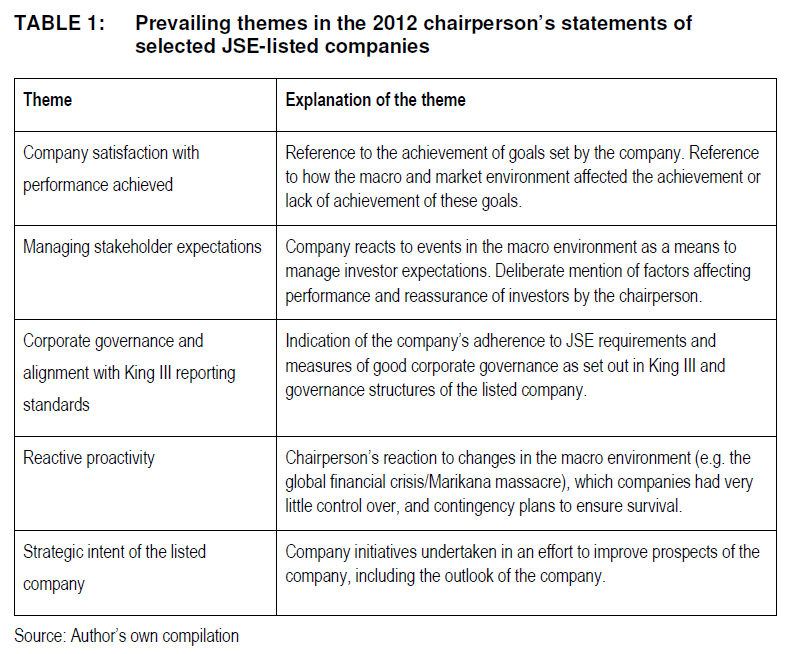
Table 1 sets out prevailing themes identified in the chairperson's statements of the 100 JSE-listed companies selected for the study.
Theme 1: Company satisfaction with performance achieved
The company's achievement or non-achievement of goals was stated. Poorly performing companies did not always state explicitly that they had not met their set targets. By contrast, as a result of a good track record and the ability to better communicate profitability, high-performing companies more clearly stated how they had met or exceeded targets set. The chairperson of a high-performing company explained:
"[Company name omitted] is a company that was listed on the JSE in 1986 with a market capitalisation of R170m which has currently grown to around R24bn. During the year under review growth continued: in Dubai it was remarkable, in Southern Africa it was solid and in the Eastern Region of Switzerland it was satisfactory" (HPC 23:3:4:4).
Theme 2: Managing stakeholder expectations
Irrespective of whether they were classified as high-performing or poor- performing, companies reported on external factors that had a bearing on their operations. Factors affecting companies severely were concentrated in the macro and market environments of the company's operations. Often companies have minimal or no control of these factors.
The theme "Company satisfaction with performance achieved" was connected to managing stakeholder expectations. Stakeholder expectations were managed through deliberate mention of negative factors that should be considered in judging and measuring the performance of the company. The global financial crisis had an impact on both high-performing and poor- performing companies - an impact significant enough for 84 chairpersons to consider it necessary to mention the effects in their statements.
Unlike high-performing companies, which were more inclined to take credit for their better responsiveness to the effects of the global financial crisis, poor-performing companies reflected a reactive approach to external events and were direct in lowering shareholder expectations, as highlighted in the quote below:
"While these forward-looking statements represent our judgments and future expectations, a number of risks, uncertainties and other important factors could cause actual developments and results to differ materially from our expectations. These include factors that could adversely affect our businesses and financial performance", (PPC 35:4:64:64).
Nonetheless, the chairperson of a company should be in a position to communicate honestly the real state of company affairs without creating fear among stakeholders. Chairpersons of high-performing companies displayed what Bournois and Point (2006:46) term "optimistic bias". Irrespective of whether the company did well or not, readers were assured that the company was in good hands and that success was imminent in the future. It may be considered important for chairpersons to do this so as to avoid unnecessary panic among stakeholders, both internal and external. Compared with poor-performing companies, the chairperson's statements of high-performing companies ended with critical performance aspects and expressed reassurance, as highlighted in the quote below:
"We live in uncertain and challenging times. However, I am confident that [Company name omitted] will continue to grow and create value for all its stakeholders" (HPC 2:33:97).
Theme 3: Corporate governance and alignment with King III reporting standards
In light of South Africa's corporate failures such as Fidentia, JCI-Randgold, Masterbond, Leisurenet, MacMed and Regal Treasury Bank (Mangena & Chamisa 2008:29), corporate governance is an issue that continues to generate interest in reporting documents.
Commitment by listed companies to alignment with best corporate governance practices and adherence to key performance standards was noticeable. Both high-performing and poor-performing companies mentioned maintenance efforts without depleting social resources or environmental systems.
The discussion of corporate governance by high-performing companies gives rise to two observations:
Observation 1: The corporate governance and sustainability efforts of the company were set out in a separate report within the overall annual report. It therefore did not make sense for the chairperson to over-elaborate on corporate governance in the chairperson's statement. In the chairperson's statement, the discussion of corporate governance was limited to a mention of adherence to King III requirements as prescribed by the JSE.
Only 14 high-performing companies did not explicitly mention the company's corporate governance efforts, which might have included a discussion of the board structure and how corporate governance supports the strategic objectives of the company.
Observation 2: This was either the first or second integrated annual report that many JSE-listed companies were required to draft, since the JSE made this a listing requirement for all public companies, and even though reporting standards were clear, companies did not want to over-elaborate on new standards which were not yet fully integrated into company practices.
Despite the public pronouncement of corporate governance by all listed companies that formed part of the study, their discussion of corporate governance practices in the chairperson's statement dogmatic under the adequate grounds of King III.
Theme 4: Reactive proactivity
While the impact of the global financial crisis cannot be denied, of significance in the present section is the way in which high-performing companies reacted to and capitalised on this weakness. All the chairperson's statements started by commenting on this situation in macro-economic terms so as to provide a context for a discussion of the impact of the global financial crisis on the overall performance of the company.
However, the strategic responses of high-performing and poor-performing companies were different. High-performing companies responded with less panic in their tone about any changes to their strategies as a result of the global financial crisis.
Reactive proactivity in poor-performing companies was experienced differently, however. New plans were put into effect during this period to respond to the current recession. For many of these poor-performing companies it seemed as though previous strategies and plans took a knock as a result of the recession and required major re-evaluation, as illustrated in the following quote:
"I alluded previously to the state of the global economy and the financial markets. We are obviously concerned about the state of the coking coal and thermal coal markets and we will no doubt be placed under more pressure for as long as these conditions persist.
Nonetheless, we are fortunate that our significant coking coal assets at [locations omitted] will be producing premium products and should therefore be able to maintain their market position through this cycle" (PPC 13:9: 12:12).
Theme 5: Strategic intent of the listed company
Strategic intent relates to planning that is not explicit, and as a result leaves room for interpretation of how the intention of an organisation will be realised.
Voluntary disclosures by the reporting company of the strategic intent of the organisation can be used to gain the favour of investors. Observed were deliberate, yet sometimes subtle, efforts by the chairpersons of the companies to attribute the success of the company to board expertise, managerial effort or grand strategies in place in the company.
Managing stakeholder expectations involved creating realistic expectations of the company's future. Strategically, the chairpersons of high-performing companies were better able to signal that the company was in good hands, based on the credentials of the board, responsiveness of the company's strategy to the prevailing economic climate, and the way in which the company still achieved satisfactory results.
The recognition of corporate governance as an important contributor to stakeholder trust in the company was well documented in the statements of high-performing companies. Corporate governance efforts were clearly discussed in the chairperson's statement of 36 high-performing companies. By contrast, corporate governance was discussed in the chairperson's statement of only 21 poorly performing companies.
Aspects such as the chairperson's outlook and forecast for the future, current and future projects the company was engaged in or had plans to engage in, as well as the strategic review by the company were instrumental in conveying "strategic intent" as a theme that surfaced in the analysis of the chairperson's statements.
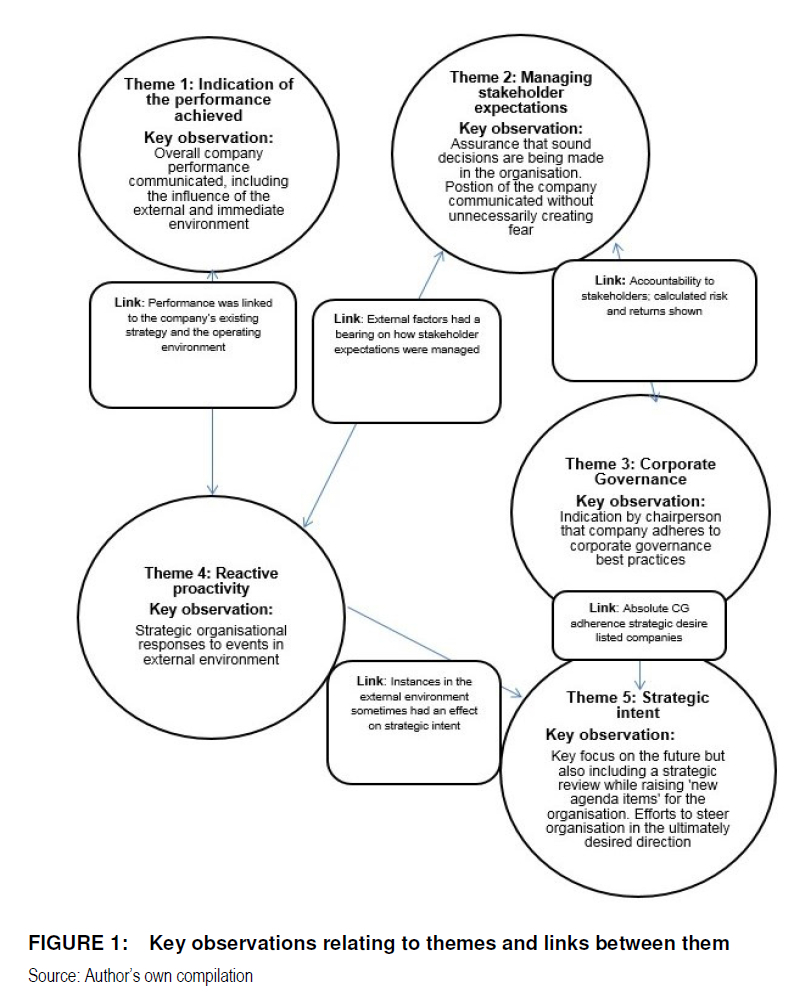
Figure 1 reflects key observations relating to the themes identified in the chairperson's statements analysed, as well as links between some of these themes.
6. CONCLUSION
The study reported on in this article set out to determine the themes and responses to them contained in chairperson's statements of high-performing as well as poorly performing companies listed on the Johannesburg Stock Exchange in South Africa. The chairperson's statement was found to be a strategic document drafted with the aim of informing the investing stakeholders about the company's performance and managing other stakeholders' expectations.
Theories such as agency theory, signalling theory and impression management were applied in analysing a number of chairperson's statements. Narratives such as the chairperson's statement provide insight into not only the current performance of the company, but the future prospects of the company as well. Chairpersons of high-performing companies were aware that for signals to be effective, they had to be difficult to copy by other companies. This unique selling point often came from years of experience, accolades achieved, increased high-performance despite difficult environments, and an experienced and qualified management team. If high-performing companies do not communicate superiority, they experience opportunity loss. Attributes of signalling were prevalent in the chairperson's statements of high-performing companies, where they were more inclined to take credit for good performance. While poor-performing companies experience challenges such as competing with already established entities and increased capital requirements, their communication efforts in statements such as the chairperson's statement must nevertheless convey to a potential investing stakeholder that they are a worthwhile investment.
Findings of the study suggest that the chairperson of the board, along with the board of directors, is important in steering the company towards its intended strategic destination, but this cannot be done to benefit the organisation at the expense of its stakeholders. Therefore it is necessary to be honest, but by the same token the chairperson need not create unwarranted fear among stakeholders. This is in line with agency theory: understanding the conditions and risks of disclosure contained in the chairperson's statement is important in determining the level of disclosure. It was therefore possible to view the chairperson's statements in light of a combination of agency theory and signalling theory.
While the chairperson's statement is not a mandatory audited disclosure, this document is strategic in communicating both the current performance of the company and its future prospects. Particular themes covered in the chairperson's statements conveyed information which, when read by investors, may foster trust and contribute significantly to good impressions about the company. This is in line with impression management theory.
As a customary component of an annual report, the chairperson's statement is important in understanding the strategic position of the company. It is important for chairpersons to evaluate topics beyond the expected, and to lean more towards the unique performance attributes of the company. This will help stakeholders to evaluate the stance of the company beyond merely whether the company ticks certain "expected" boxes.
REFERENCES
3. LITERATURE REVIEW
- ABEYSEKERA I. 2010. The influence of board size on intellectual capital disclosure by Kenyan listed firms. Journal of Intellectual Capital 11 (4):504-518.
- ABRAHAMSON E & PARK C. 1994. Concealment of negative organisational outcomes: an agency theory perspective. Academy of Management Journal, 37(5): 1302: 1334.
-
AFRICAN BUSINESS REVIEW. 2013. The JSE - a premium listing destination. [Internet: http://www.africanbusinessreview.co.za/money_matters/the-jse---a-premium-listing-destination, accessed on 2013-09-10.
» http://www.africanbusinessreview.co.za/money_matters/the-jse---a-premium-listing-destination - ]
- ALHAZAIMEH A, PALANIAPPAN R & ALMSAFIR M. 2013. The impact of corporate governance and ownership structure on voluntary disclosure in annual reports among listed Jordanian companies. Malaysia: ICIMTR (2nd International Conference on Innovation, Management and Technology Research, 22 - 23 Sep.
- )
- ANDREASSON S. 2009. Understanding corporate governance reform in South Africa: Anglo-American divergence, the King Reports and hybridization. Business & Society 50(4):647-673.
- BHANA N. 2009. The chairman's statements and annual reports: are they reporting the same company performance to investors? Investment Analyst Journal 70:32-46.
-
BRENNAN NM & MERKL-DAVIES DM. 2013. Accounting narratives and impression management. [Internet: http://papers.ssrn.com/sol3/papers.cfm?abstract_id=1873188; downloaded on 2014-10-15.
» http://papers.ssrn.com/sol3/papers.cfm?abstract_id=1873188 - ]
- BRÜHL R & KURY K. 2016. Rhetorical tactics to influence responsibility judgments: account giving in banks presidents' letters during the financial market crisis. International Journal of Business Communication January: 1-27.
- CEN Z. 2014. Textual differences in chairman's statements of Australian companies. Accountancy Business and the Public Interest 13:43-69.
- CEN Z & CAI R. 2014. Preference in presentation or impression management: a comparison study between chairmen's statements of the most and least profitable Australian companies. Australasian Accounting, Business and Finance Journal 8(3):3-22.
- CHANPRASOPCHAI P & ATTHIRAWONG W. 2012. EBIDTA based on commercial margin prediction by hybrid model for ready mixed concrete business. Lecture Notes in Management Science 4:37-45.
- CLARKE G & MURRAY LW. 2000. Investor relations: perceptions of the annual statement. Corporate Communications: An International Journal 5(3): 144-151.
- CONNELLY BL CERTO ST IRELAND RD & REUTZEL CR. 2011. Signalling theory: a review and assessment. Journal of Management 37(1):39-67.
- ECCLES RG & SALTZMAN D. 2011. Achieving sustainability through integrated reporting. Stanford Social Innovation Review Summer: 56-61.
- EISENHARDT KM. 1989. Agency theory: an assessment and review. The Academy of Management Review 14(1):57-74.
- GISBERT A & NAVALLAS B. 2013. The association between voluntary disclosure and corporate governance in the presence of severe agency conflicts. Advances in Accounting, incorporating Advances in International Accounting 29:286-298.
- HILL CWL & JONES TM. 1992. Stakeholder-agency theory. Journal of Management Studies 29(2):131-154.
- HOLMES G & SUGDEN A. 1986. Interpreting company reports and accounts. City, NH: Woodhead-Faulkner.
- HUTT RW. 2010. Identifying and mapping stakeholders: an industry case. Corporate Communications: An International Journal 15(2):181-191.
- KOHUT GF & SEGARS AH. 1992. The president's letter to stockholders: an examination of the corporate communication strategy. The Journal of Business Communication 29(1):7-21.
- LEUNG S, PARKER L & COURTIS J. 2015. Impression management through minimal narrative disclosure in annual reports. The British Accounting Review 47(3):275-289.
- LORD HL. 2002. Annual reports: a literature review (1989-2001). Journal of Technical Writing and Communication 32(4):367-389.
- MANGENA M & CHAMISA E. 2008. Corporate governance and incidences of listing suspension by the JSE securities exchange of South Africa: an empirical analysis. The International Journal of Accounting 43(1):28-44.
- MERKL-DAVIES DM, BRENNAN NM & MCLEAY SJ. 2011. Impression management and retrospective sense-making in corporate narratives: a social psychology perspective. Accounting, Auditing & Accountability Journal 24(3):315-344.
- MERKL-DAVIES DM & KOLLER V. 2012. Metaphoring people out of this world: a critical discourse analysis of a chairman's statement of a UK defence firm. Accounting Forum 36(3):178-193.
- MMAKO NM & JANSEN VAN RENSBURG M. (tbc). Towards integrated reporting: the inclusion of content elements of an integrated annual report in the chairpersons' statements of JSE-listed companies. South African Journal for Business Management.
- MORRIS RD. 1987. Signalling, agency theory and accounting policy choice. Accounting and Business Research 18(69):47-56.
- MOUMENA N. OTHMAN HB & HUSSAINEY K. 2015. The value relevance of risk disclosure in annual reports: evidence from MENA emerging markets Research in International Business and Finance 34:177-204.
- MYBURGH JE. 2001. The informativeness of voluntary disclosure in the annual reports of listed industrial companies in South Africa. Meditan Accountancy Research 9:199-216.
- NDOFOR HA, WESLEY C & PRIEN RL. 2015. Providing CEOs with opportunities to cheat: the effects of complexity-based information asymmetries on financial reporting fraud. Journal of Management 41 (6):1774-1797.
- NESS KE & MIRZA AM. 1991. Corporate social disclosure: a note on the test of agency theory. British Accounting Review 23:211-217.
-
PRICEWATERHOUSECOOPERS. 2009. Corporate governance: executive guide to King III. [Internet: frhttps://ww2.pwc.co.za/general/popup_KingIII, accessed on 2013-10-15.
» https://ww2.pwc.co.za/general/popup_KingIII - ]
-
PRICEWATERHOUSE COOPER. 2013. The value creation journey: a survey of JSE Top-40 companies' integrated reports. [Internet: https://www.pwc.co.za/en/assets/pdf/integrated-reporting-august-2013.pdf, accessed on 2014-10-15.
» https://www.pwc.co.za/en/assets/pdf/integrated-reporting-august-2013.pdf - ]
- RAHMAN S. 2012. Impression management motivations, strategies and disclosure credibility of corporate narratives. Journal of Management Research 4(3):1-14.
- RENSBURG R & BOTHA E. 2014. Is integrated reporting the silver bullet of financial communication? A stakeholder perspective from South Africa. Public Relations Review 40(2):144-152.
- ROWBOTTOM N & LYMER A. 2010. Exploring the use and users of narrative reporting in the online annual report. Journal of Applied Accounting Research 11(2):90-108.
- SHEHATA NF. 2014. Theories and determinants of voluntary disclosure. Accounting and Finance Research 3(1):18-26.
- SILVERMAN HI. 2009. Qualitative analysis in financial studies: employing ethnographic content analysis. Journal of Business & Economics Research 7(5):133-136.
- SMITH M & TAFFLER RJ. 1992. The chairman's statement and corporate financial performance. Journal of Accounting and Finance November:75-90.
- SMITH M & TAFFLER RJ. 2000. The chairman's statement: a content analysis of discretionary narrative disclosures. Journal of Auditing and Accountability Journal 13(5):624-646.
- STANTON P & STANTON J. 2002. Corporate annual reports: research perspectives used. Accounting, Auditing & Accountability Journal 15(4):478-500.
- TAKEDA, H TRUEX III, D & LONG, CL. 2007. The discourse of large scale organisational policy: a content analysis of annual reports. Paper presented at proceedings of the 2007 Southern Association for Information Systems Conference, 9-10 March:257-262.
- WEST A. 2009. The ethics of corporate governance: a (South) African perspective. International Journal of Law and Management 51(1):10-16.
- WISNIEWSKI TP & YEKINI LS. 2015. Stock market returns and the content of annual report narratives. Accounting Forum 39(4):281-294.
- YEKINI KC, ADELOPO I, ANDRIKOPOULOS P & YEKINI S. 2015. Impact of board independence on the quality of community disclosures in annual reports. Accounting Forum 39(4):249-267.
- YOUNG J. 2010. Corporate governance and risk management: a South African perspective. Corporate Ownership & Control 7(3):136-145.
- YUTHAS K, ROGERS R & DILLARD JF. 2002. Communicative action and corporate annual reports. Journal of Business Ethics 41:141-157.