Millennial engineers: talent management expectations and needs in an African mining corporation
Abstract
The continuous recession in Africa, and the influence it has on the mining industry, has many challenges due to the inimitable conditions in Africa. The purpose of the study was to identify the unique talent management expectations of millennial engineers in an African mining company. The population for this included all engineers employed in the company. Different commodities are mined and consist of copper, cobalt, coal, platinum, fluorspar, bauxite and other non-ferrous divisions. The countries under study were Malawi, the Democratic Republic of the Congo, Zimbabwe, Zambia, Mozambique and South Africa. A total of 487 questionnaires were distributed to the different mines via the SurveyMonkeyTM website with a response rate of 51%. 56% were employees under the age of 36 years old which are considered as the millennial generation. A principal axis factor analysis was conducted to determine the most important factors regarding the needs and expectations of the millennial generation. An analysis of variance (ANOVA) was used to assess whether there were differences between subgroups on the different factors. The results specified the importance of work values, motivation and retention in the company under study. Suggestions are drawn to address the needs and expectations as identified by the millennial generation.
Engineers; millennial generation; retention; work values
1. INTRODUCTION
Unremitting skills shortages, the shifting demographics of the labour force, its ever-increasing multiplicity, work-life balance schemas and the continuous recession have steered an extremely inflexible labour market. This resulted in increased competition from organisations for individuals who are capable of making the greatest of differences to organisational performance. Various research projects and reports (Lim 2012a:25; Osae, Faunconnier & Webber-Youngman 2011:864; Price Waterhouse Coopers 2011:12) indicate that although the mining industry is a technologically demanding industry, investment in employees is the actual key to sustainable organisational growth.
This contemporary relationships in the African mining industry necessitates urgent attention, as its focus is predominantly on production of natural resources rather than on relationships with employees (Chartered Institute of Personnel & Development 2013:6).
The research objectives for this study are to determine the talent management (TM) expectations and needs of millennial engineers in an African mining corporation.
The focal objective of the literature review is to ascertain talent management factors, which are professed as expectations and needs of millennial engineers. To address this issue the definition of millennials, work values, work motivation, attraction and retention will be outline.
2.1 Definition of millennials
Retaining the best employees is a dynamic component to organisational success (Luscombe, Lewis & Biggs 2013:272). The millennial generation, also referred to as Generation Y, dot.com generation, nexter's and echo boomers (Broadbridge, Maxwell & Ogden 2007:528; Martin 2005:41) has been denoted as totally different from previous generations (i.e. generation X, baby-boomers).
For the purpose of clarification on the various generations Lim (2012a:282) identified five generation groups according to the years they were born in: Traditionalists (1925-1945), Baby boomers (1946-1964), Generation X (1965-1979), Millennials (1980-1999).
The millennial generation's wants, needs and expectations are very different from the previous generations. According to Luscombe, Lewis and Biggs (2013:275) as well as Raymond and Yeng (2016:84), the millennial generation's goal expectations in the workplace relate to job flexibility. They do not see themselves as keeping a job for a lifetime, for many of them a long term position at one organisation is maximum a year.
This typically stems from their risk-taking characteristics and the tendency of continued parental support. Bolton, Parasuraraman, Hoefnagels, Migchels, Kabadayi, Gruber, Loureiro and Solnet (2013:252) agree, and add that the millennial generation are also referred to as the "Peter Pan Generation", as they tend to postpone entering adulthood.
Broadbridge et al. as cited by Luscombe et al. (2013:275) are of the opinion that this generation needs significant responsibility and challenges in a workplace, with openness to creativity, clear directions and an open management style - where they are not micromanaged - and with praise on a continuous basis (Bolton et al. 2013:253). Millennials value and expect mentoring and career development, partly because of flexibility and they want to remain marketable in their respective industries (Guillot-Soulez & Soulez 2014:324).
2.1 Work values
Lindquist, as cited by Luscombe et al. (2013:274), emphasises that the policies and procedures used to employ the best candidates from previous generations are likely to be relatively ineffective with millennials. The most important work values as indicated by Lim (2012b:26) are that the millennials prefer a work environment where they have opportunities for training and development, maintenance of a work-life balance and high responsibility.
Chen and Choi (2008:601) agrees and also adds that millennials thrive on challenging work, goals are driven, expecting rapid promotion, have high expectations of employers and they challenges the status quo. According to Lim (2012b:284), general life experiences of millennials are a contributing factor to their work values.
Fernandes, Hyde, Ives, Fleischer, Evoy and Van Marrum (2011:5-6) give insight into the changed work values of millennials from previous generations are because of their family's influence in work values. The millennials understanding of work values are influenced by their parents' employment and economic situation. Kaufmen (2004:105) adds that the generation under study's perceptions of parental work attitudes and experiences greatly influence the development of their own work beliefs and attitudes.
2.2 Work motivation
Theories of work motivation provides a framework for organisations to ensure their employee's "drive to work" and to increase their enthusiasm to perform their jobs thoroughly and well. Cran (2010:6-7) identified factors which relate to work motivation factors for millennials, these include: personable and friendly relationships within the working environment; team activities; being part of activities in which the company supports the society; green projects are motivating and inspiring for these employees.
According to Kultalahti and Viitala's (2014:572) research it clearly emphasised that millennials prosper on both intrinsic (performing a job because the employee finds it stimulating, interesting and satisfying) and extrinsic motivators (performing an activity for instrumental reasons e.g. remuneration).
Empirical research specifies that millennials rated engagement, job satisfaction and organisational commitment to be ominously lower than groups of other generations (Solnet, Kralj & Kandampully 2012:38). College as cited by Acar (2014:14) defines extrinsic motivation as something that employees do that leads to a distinct outcome, for example outside inspiration of rewards are earned form performing well on a job, rather than the actual gratification of the job.
Catania and Randall (2013:34) and Kultalahti and Viitala's (2014:572) found that younger employees are more concerned with extrinsic rewards, especially financial factors. Supported by Acar (2014:16), the top criteria for the millennial age group, to apply and accept a position, are salary, benefits and potential for advancement. Similar studies that support the notion of extrinsic motivational factors being important to the millennium generation are Anantuatmula and Shrivastav (2012:14); Kian and Yusoff (2012:13); Luscombe and Biggs (2013:274); Masibigri and Nienaber (2011:6);
2.3
AttractionAccording to Bolton et al. (2013:247-248) and Huybers (2011:26) a large number of the baby boom and traditionalist generations are in the position to retire at an early age over the next few years. The millennials are still more a less a decade away of filling these gaps in management. Which leaves organisations in a predicament of less workers available to replace the retired employees. Companies will continue to fail financially, if they are not proactive in their recruitment policies and systems to attract this dynamic generation (Dupre 2013:Internet).
Millennials were exposed to technology from birth, living in both a human and technological world. Huybers (2011:27); Lim (2012b:26) indicate that advertisements for this generation should have a foot in both of these worlds. Recruitment must be driven by a marketing strategy; only advertising positions on an organisational website only will not be sufficient.
A recruitment strategy should involve social media such as a "blogosphere" and even "internet-games". Millennials are a "digital native" group who wants to apply and receive immediate feedback. Online-application processes (e-recruitment), should be streamlined and to the point. Tulgan (2009:23) postulates that millennials are looking at several things when applying for a job which includes the following: "performance based compensation; flexible work schedules; flexible work locations; marketable skills; access to decision makers; personal credit for results achieved; a clear area of responsibility and the chance for creative expression". By incorporating these eight factors, organisations should have a better chance of recruiting talented millennials.
2.4
RetentionRetention of talented staff is a key feature in an organisation and is often overlooked. Losing talented individuals is a significant cost for every organisation, as companies invest in developing skills, competencies and knowledge. As mentioned before there is an agreement that the millennial generation's needs are different from those of previous generations in terms of their work-related characteristics, therefore to secure this generation in the organisation, policies and procedures that are previously used to recruit and retain employees, will not be successful (Luscombe & Biggs 2012: 273).
According to the 2013 survey in the mining and industrial sector (Hay Group 2013), a key challenge regarding extremely talented employees is to keep their interest and motivation levels high, to encourage them to perform and to generate new ways of working that will have a powerful impact on the bottom line of the business. Mining organisations must identify and retain internal talent by providing training and development and launching succession and professional development programmes (Dickie & Dwyer 2011:337).
Armstrong (2012:245); Bairi, Manchar and Kundu (2011:154); Berger and Berger (2011:536); Gberevbie (2010:63-64), indicate various factors that have an influence on retention but focus on the most important as the role of the employee's immediate manager, engagement, remuneration, succession planning as well as developmental opportunities and the need for challenging and meaningful work. Bairi et al. (2011:49) believe that making employees happier and healthier (e.g. healthcare benefits and free employee assistance programmes) increases their effort, contributions and productivity.
Berger and Berger (2011:299) emphasise that organisations should not underestimate the value of health care, paid vacation and retirement plans as retention factors. Huybers (2011:30) agrees and adds that millennials can be retained with mentors that is provided to them, at least for the first six months after employment. They expect from the mentor to take responsibility during the induction programme and initials training.
A mistake that employers make, is that they spend a lot of time and effort into hiring a new employee, and then immediately thereafter let them jump into a new depressing, non-supportive environment. A further contribution by Deery, Jabo and Fredline (2012:65) is the important role that a psychological contract between the employee and employer, plays in retention of millennials.
According to a researched study done by Marais (2013:43) on generation Y engineers in South Africa, it was found this generation "value gaining practical engineering experience on actual engineering sites, involvement in engineering design, learning, training and development, mentoring, work-life balance and the ability to manage their own career development.
Travelling, making a contribution and making a difference in the organisation were also seen as important". Gruber's (2008:58-59) study among engineers working in a South African consulting company found that respondents were more likely to stay at the company when they were motivated at work, they were satisfied, aligned with the corporate culture and value system, adequately remunerated, able to enjoy sound relationships with superiors, learning in a learning organisation, challenged at work, autonomous and able to satisfy higher order needs outside their work life.
3. RESEARCH METHODOLOGY
The research questions were:
■ What are the main need and expectations of millennial engineers in an African mining corporation?
■ What are the main factors contributing to the retention of millennial engineers in an African mining corporation?
3.1
Type of researchIn the underlying research, a quantitative research approach was used. Berger and Berger (2011:288) define quantitative research as "... research within the primary aim of establishing casual relationships between variables".
The research was conducted in the social world. The advantages of quantitative research are as follows: "Researchers can gather data from a large quantity of people concurrently and from various places or sites; comparisons can easily be made, since standardised wording and order of questions mean responses can be compared and respondents can answer from their point of view by selecting what is applicable to their situation" (Lawler 2008:104).
3.2
Measuring instrumentTo obtain relevant information regarding the needs and expectations of millennial engineers in a mining company in Africa, it was decided to make use of a questionnaire to gather data. An integration of the literature review, the international organisational strategy and the business plan of the mining group under study led to the design of the questionnaire.
It was decided to make use of a 4-point forced Likert scale, to "force" definite choices from the respondents; consequently, the researcher was able to make scientific meaning out of the data as there are no neutral responses (Filipowich 2011 :Internet).
The initial questionnaire consisted of 29 questions to determine factors that influence recruitment and retention. The Cronbach's alpha was utilised to measure the reliability of the questionnaire. Input was given by ten human resources experts in the management field to ensure face validity.
3.3
Population and samplingThe African mining is of great interest to the researcher due to its diverse and interesting nature. Contact was made with the director of HR: Africa, where the potential study was discussed and approved.
The population for this study included electrical, civil, mechanical, geotechnical, architectural and chemical engineers at 14 sites in the natural resources mining company in Africa. Different commodities are mined, such as copper, cobalt, coal, platinum, fluorspar, bauxite and other non-ferrous metals. The countries under study were Malawi, the Democratic Republic of Congo, Zimbabwe, Zambia, Mozambique and South Africa.
A census (non-probability) sample of 487, which included only engineers at all the mining sites in Africa was selected. The sample included engineers of diverse age groups. With the company being in operation less than 6 years and the various bursary schemes and internships offered to students, the assumption was made that most engineering employees would fall into the millennial age group. This was verified in the results were 56% of respondents were under the age of 36 years old. Questionnaires and letters of consent were distributed via the SurveyMonkey™ website. After two weeks, 396 completed questionnaires were received back from the participants, indicating a response rate of 51%.
3.4
Data analysisA principal axis factor analysis was utilised to reduce the large number of variables to a smaller number of factors for the purpose of identifying the needs and expectations of millennial engineers. Although engineers of various age groups were included in the research, the focus was mainly on the millennial engineers. The factor loadings are the correlation coefficients between the variables (rows) and factors (columns).
An oblique rotation was performed, and pattern and structure matrixes were provided. The pattern matrix was used to investigate the factors for the study; thus, only unique contributions of coefficients were identified. The analysis of variance (ANOVA) was used to determine whether differences exist between two or more population means (Keller 2012:93).
This method analyses the variance of the data to determine whether it can be conditional that the population means differ. A post hoc procedure was used to explore the data to determine whether there are any differences between means. Post hoc tests consist of pairwise comparisons that are designed to compare all different combinations of groups (Field 2012:Internet). A t-test was done in the cases where only one independent variable was available. A correspondence analysis was completed to determine systematic relations between different independent variables.
4. RESULTS
The descriptive and inferential statistics will now be discussed.
4.1 Biographical information
In terms of the age distribution 56% were employees under the age of 36 years old. The majority of respondents were males (77.3%), while 22.7% females. The majority (50.5%) of the respondents were black, 35.9% were white followed by 9.1% Indian and 4,0% coloured. Various engineering qualification were obtained as follows: 39.8% acquired a National Diploma; 32.9% obtained a degree and 27.3% has post-graduate qualification. The majority of workers were employed on a permanent basis (60.9%), 30.3% were full-time expatriate employees and 8.1% were employed on fixed-terms contracts.
A total of 36.4% are citizens from the Democratic Republic of the Congo (DRC), 17.3% from Zimbabwe, 13.0% from Zambia, 15.3% from Mozambique and 10.5% from Malawi. Of the respondents, 7.5% was citizens from other countries such as Britain, Russia and France.
At the time of the study the mining company was less than 6 years in operation - this was substantiated by the fact that 75.1% of respondents had two years or less service within this mining company.
4.2 Factorial structure of the questionnaire
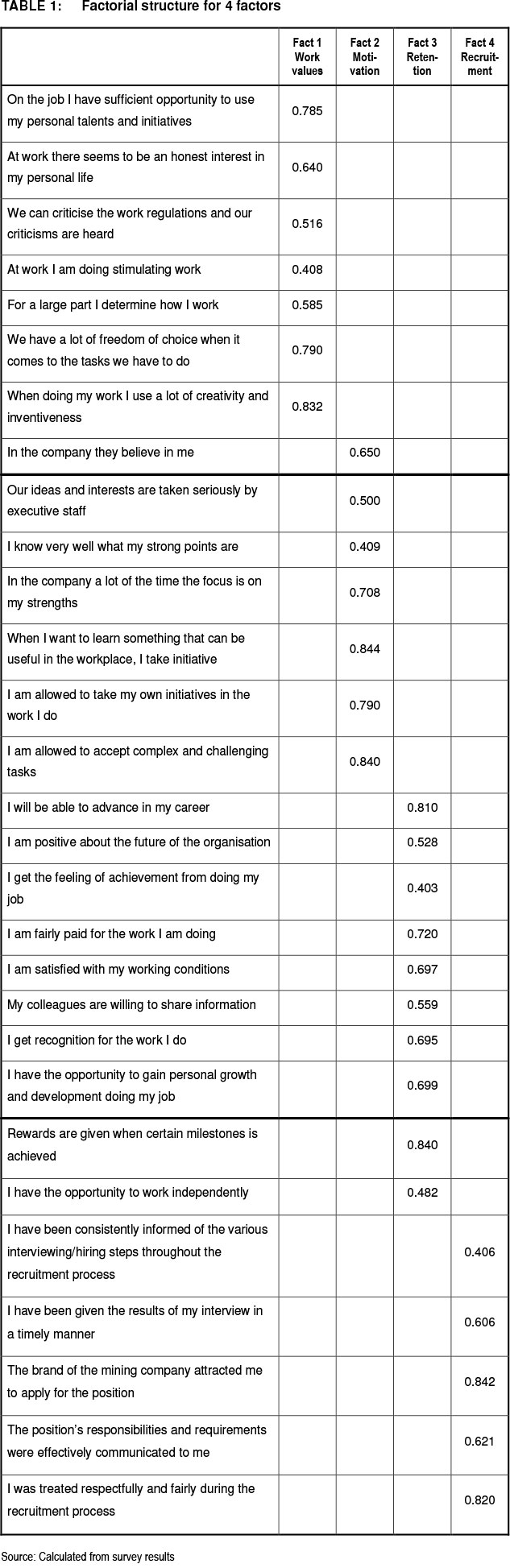
The four factors are identified by the principal factor analysis as: factor 1: work values; factor 2: motivation; factor 3: retention and factor 4: recruitment (Table 1).
A principal axis factor analysis with a direct oblimin rotation was performed on the 29 closed-question items to investigate the grouping of items and their correspondence to the original theoretical scales.
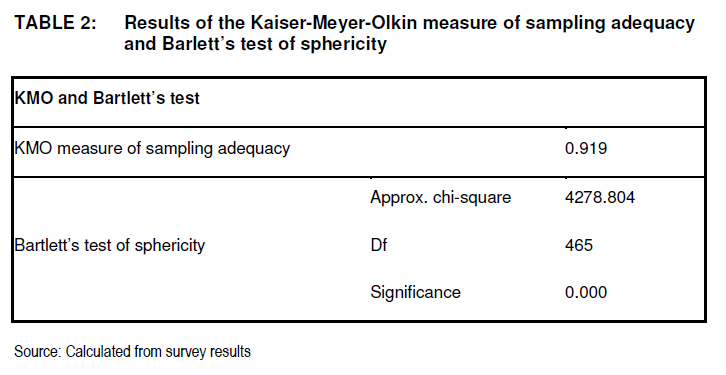
As per Table 2, the Kaiser-Meyer-Olkin (KMO) measure of sampling adequacy was 0.919. The KMO should be 0.60 or higher in order to proceed with factor analysis. Bartlett's test of sphericity with 0.000 is significant (p<0.05) and indicates sampling adequacy (Salkind 2014:195-196).
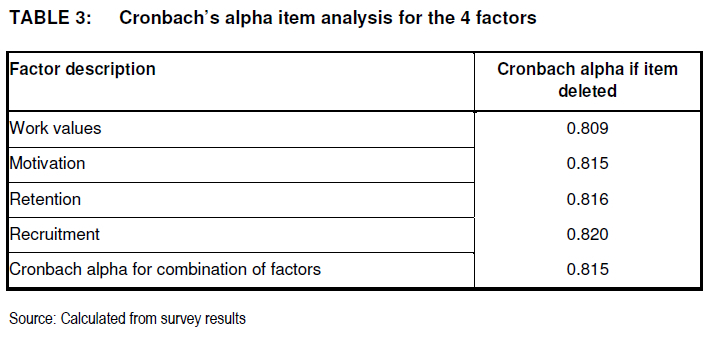
All individual items contributed well to the overall reliability of the instrument. In Table 3, the Cronbach's alpha for each of the identified factors (alpha = 0.815) indicates high reliability.
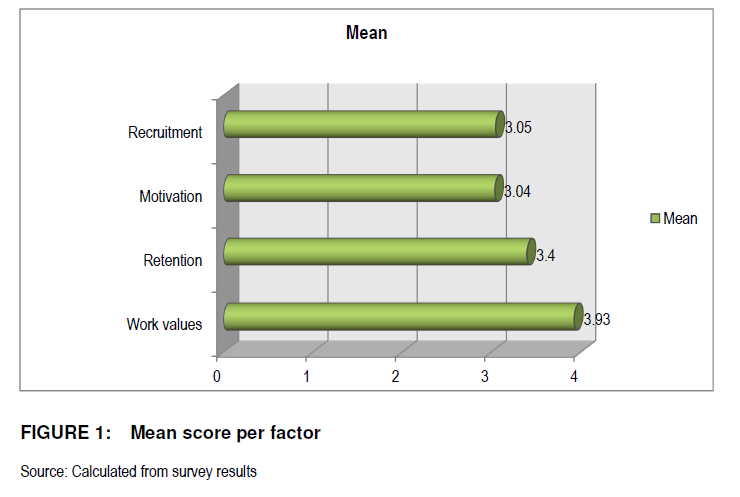
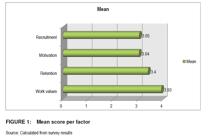
Figure 1 indicates the importance of the four recognised factors. According to the respondents the most important factor is work values (3.93), followed by retention (3.40). Motivation (3.04) is important but recruitment (2.05) is less important.
4.3 Analysis of variance (ANOVA)
The subgroups were formed by the different demographic variables. Interesting results are discussed with reference to the four identified factors and the importance thereof.
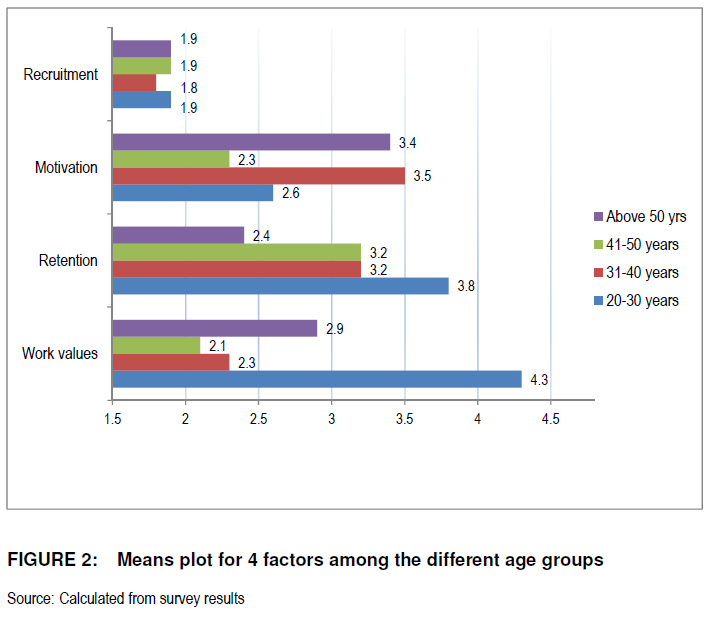
According to Figure 2, the most important factor for the millennials is work values (4.3), this age group are of the opinion that retention (3.8) is also imperative to them. Motivation (2.6) tends toward being central, but it is interesting to note that recruitment (1.9) shows a far lesser part of importance.
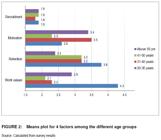
For the age group of 31-40 years the most important factor is motivation (3.5) and the least important factor is again recruitment (1.8). The group with ages between 41 and 50 years values the importance of retention (3.2). Motivation (3.4) and work values (.9) were identified as important to the age group above 50.
There is a high correlation between the literature review and the results regarding age groups. Millennial employees find work values (such as a work environment where they have opportunities for training and development, maintenance of a work-life balance and high responsibility, challenging work, goals driven, expecting rapid promotion, high expectations of employers) highly valuable (Chen & Choi 2008:601; Lim 2012b:26 & 284).
As the age of the employees increase, work values become less important but motivation more important. Older employees (especially above 50 years old) are near the end of their careers and therefor value other factors such as motivation as much more important.
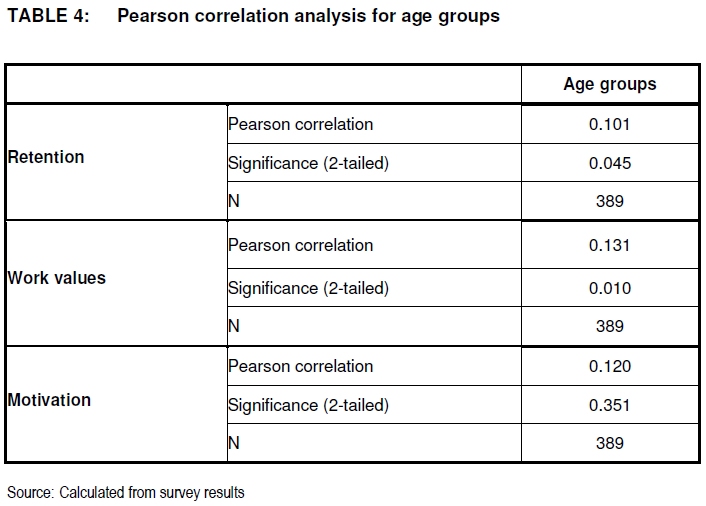
In Table 4, Pearson's correlations are depicted for retention, motivation and work value factors. Correlations were found between age groups for retention (r = 0.101), work values (r = 0.131) and motivation (r = 0.120).
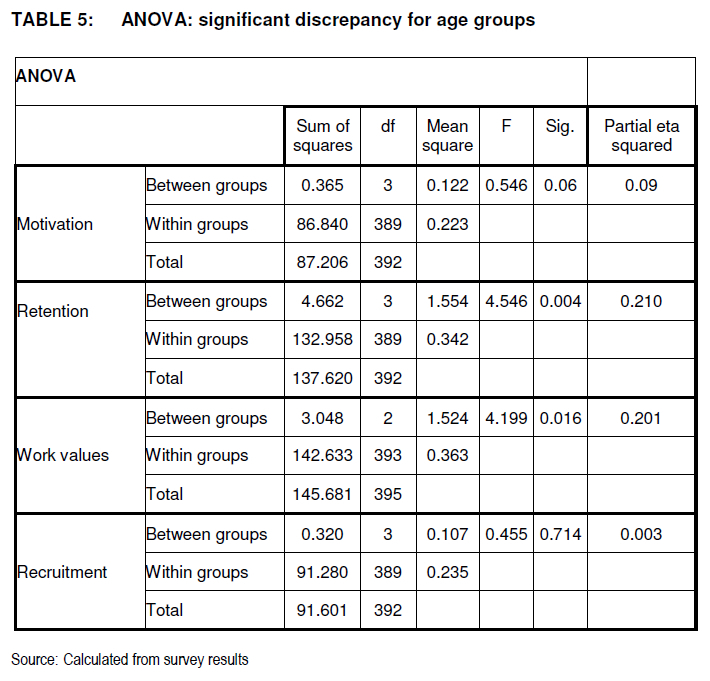
Table 5 indicates the significance of the difference between age groups. For a significant difference the value should be < 0.05. Significant differences were detected between groups was work values (p > 0.016), retention (p > 0.04) and motivation (p>0.06).
The eta square and partial eta squares are estimates of the degree of association for the sample. According to Cohen (1988:36), the eta square can be interpreted as follows: 0.01 is a small effect, 0.09 a medium effect and 0.25 a large effect. The partial eta square in table 5 for the four factors shows a large effect for both retention (0.210) work values (0.201), and motivation (0.09).
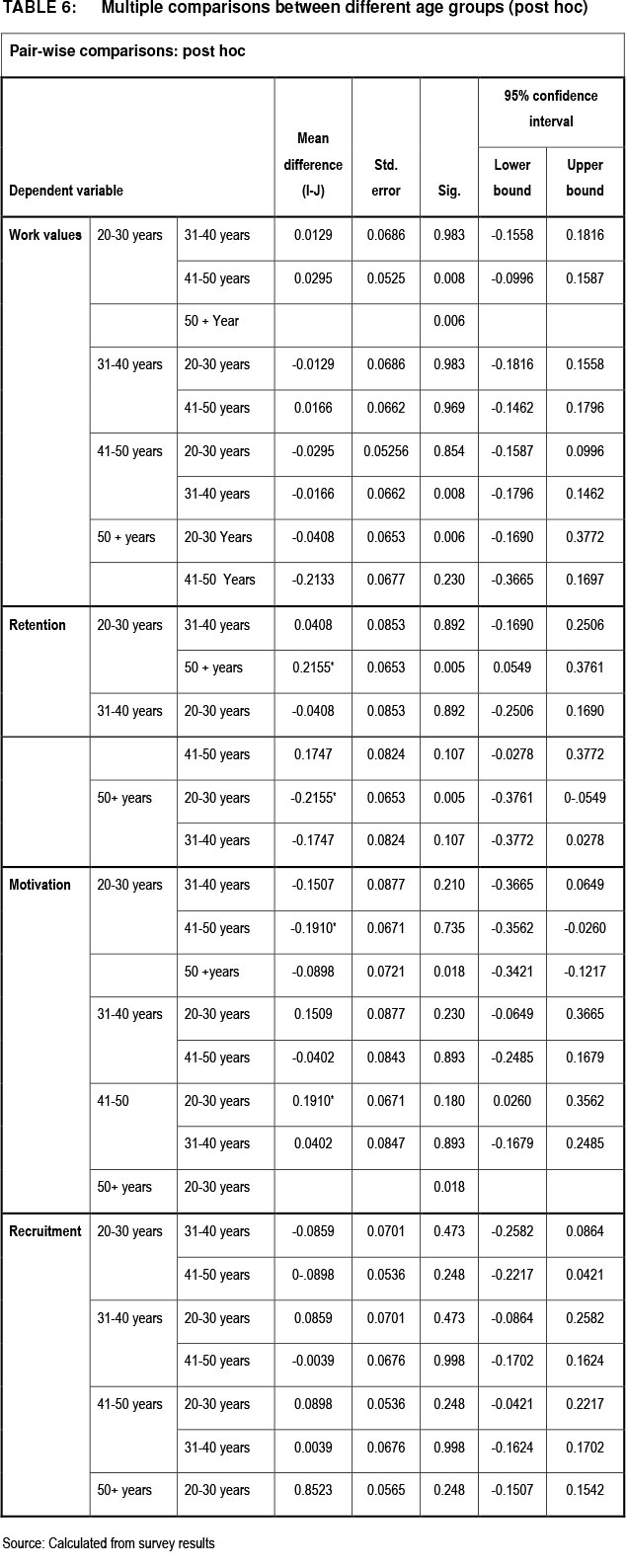
A post hoc test comprising pair-wise comparisons (Table 6) was performed to compare all different combinations of the age groups.
There were important differences detected between the following groups regarding work values: 20-30 and 41-50 year age group (0.008); 20-30 and 50+ year age group (0.006). Regarding the factor on retention, significant differences were detected between the age group of 20-30 and 50+ years of age 0(.005). Noteworthy variances were identified on the motivation factor, were the difference was between the age groups of 20-30 and 50+ years of age (0.018). There were no statistical differences between indicated by the post hoc test regarding retention
From table 6, one can conclude that substantial variance between the millenniums and older employees exist.
With regard to recruitment all the age groups are in agreement that it does not play an important role in their day to day dealings within the organisation.
5. RECOMMENDATIONS
The nature and different values that the various age groups grew up with, plays an imperative role in the organisations overall success. From the results obtained the millennial age group has a unique perspective on what organisations can offer them and vice versa, which will be discussed below.
The most important factor that should be explored, in the mining company under study, is how imperative work values are to the millennial age group. This age group prefer a work environment where they have opportunities for the maintenance of work-life balance and high responsibility. The management cadre should address these in an inimitable way. A good starting point would be an environment where unique training and development programmes, for specific individuals in this age group, are available. To address their unique background, it would be of great value if training is web-based, with immediate feedback.
Although workers over 40 years of age are not grouped as millennials, it is of importance to note how their work values differ. Employees 40 years and older, grew up in a time when computers and cell phones were not yet commonplace in the business environment. It is important to develop training protocols that help older workers keep up with the latest advances in technology (Kooij, De Lange, Jansen & Dikkers 2008:368). This group will thrive on self-paced training opportunities and will further be motivated for the training of younger employees. The older workforce thrives on recognition of their previous achievement, and will still be motivated by opportunities to excel in the work environment (Oster 2015:Internet).
The millennial engineering generation embrace entrepreneurship, innovation, flexible schedules and career development which builds on retention. This is even more important due to the fact that millennials do not see themselves as keeping a job for a lifetime, for many of them a long term position at one organisation is maximum a year. To retain the millennial employees, management have to embrace areas in the workplace were the young employees have the freedom to be innovative with work systems and the technical aspects thereof. Flexible work schedules and opportunities for societal involvement through projects in their communities are of utmost importance.
Although the millennial group did not value recruitment as an imperative factor, processes and procedures regarding recruitment should be aligned with the groups technologically advanced nature. They want fast feedback with detailed reasons why they have not being selected for a vacant position.
This research only focused on African countries in a natural resources mining company, although it forms part of an international company.
Future research could focus on the international talent management strategy to be compared with that of Africa and possible changes could be suggested to combine the strategies to accommodate the international and the African systems.
Research in other mining organisations (e.g. gold, copper, platinum) in Africa could be undertaken and compared with the natural resources mining industry, to identify whether the same or unique contributing dimension talent management applies.
6. CONCLUSION
In the light of the findings of this research, the mining industry needs to take note of the importance of work values to the millennial generation, with specific emphasis on of work-life balance and high responsibility levels. This age group thrives on unique training and development programmes, preferable web-based training. Younger employees prosper on entrepreneurship opportunities, innovation, flexible schedules and career development which builds on retention.
REFERENCES
2. LITERATURE REVIEW
- ACAR AB. 2014. Do intrinsic and extrinsic motivation factors differ from generation X and generation Y? International Journal of Business and Social Science 5(5): 12-20.
- ANANTATMULA VS & SHRIVASTAV B. 2012. Evolution of project teams for Generation Y workforce. International Journal of Managing Projects in Business 5(1):9-26.
- ARMSTRONG M. 2012. Armstrong's handbook of human resource management practice. London, UK: Kogan Page.
- BERGER LA & BERGER DR. (eds). 2011. The talent management handbook. New York, NY: McGraw-Hill.
- BAIRI J, MANOHAR BM & KUNDU GK. 2011. Knowledge retention in the IT service industry. Journal of Systems and Information Technology 13(1):43-65.
- BOLTON RN, PARASURARAMAN A, HOEFNAGELS A, MIGCHELS N, KABADAYI S, GRUBER T, LOUREIRO YK & SOLNET D. 2013. Understanding generation Y and their use of social media: a review and research agenda. Journal of Service Management 24(3):245-267.
- BROADBRIDGE AM, MAXWELL GA & OGDEN SM. 2007. Experiences, perceptions and expectations of retail employment for generation Y. Career Development International 12(6):523-44.
- CATANIA G & RANDAL R. 2013. The relationship between age and intrinsic and extrinsic motivation in workers in a Maltese cultural context. International Journal of Art and Sciences 6(2):31-45.
-
CHARTERED INSTITUTE OF PERSONNEL & DEVELOPMENT (CIPD). 2013. Employee relations: an overview. [Internet: www.cipd.co.uk/hr-resources/factsheets/employee-relations-overview.aspx; downloaded on 2013-10-02.
» www.cipd.co.uk/hr-resources/factsheets/employee-relations-overview.aspx - ]
- CHEN P & CHOI Y. 2008. Generational differences in work values: a study of hospitality management. International Journal of Contemporary Hospitality Management 20(6):595-615.
- COHEN J. 1988. Statistical power analysis for the behavioural sciences. 2nd ed. Hillsdale, NJ: Erlbaum.
- CRAN C. 2010. 101 Ways to make Generations X, Y and Zoomers happy at work. Vancouver, Canada: Synthesis at Work Incorporated.
- DEERY M JAGO L & FREDLINE L. 2012. Rethinking social impacts of tourism research: a new research agenda. Tourism Management 33(1):64-73.
- DICKIE C & DWYER J. 2011. A 2009 perspective of HR practices in Australian mining. Journal of Management Development 30(4):329-343.
-
DUPRE R. 2013. Recruitment and retention horizon: navigating generation Y. [Internet:www.rigzone.com/news/oil_gas/a/126031; downloaded on 2014-12-08.
» www.rigzone.com/news/oil_gas/a/126031 - ]
-
FIELD A. 2012. Discovering statistics. [Internet: www.statisticshell.com/docs/contrasts.pdf; downloaded on 2013-02-16.
» www.statisticshell.com/docs/contrasts.pdf - ]
- GBEREVBIE DE. 2010. Organizational retention strategies and employee performance of Zenith Bank in Nigeria. African Journal of Economic and Management Studies 1 (1):61-74.
-
FERNANDES K, HYDE I, FLEISCHER E, TAYLOR Y & VAN MARRUM K. 2011. A comparative study of work values between Generation X and Generation Y [Internet: www.seanlyons.ca/wp-content/uploads/2012/01/Fernandes-et-al-2012.pdf; downloaded 2015-03-20.
» www.seanlyons.ca/wp-content/uploads/2012/01/Fernandes-et-al-2012.pdf - ]
-
FILIPOWICH M. 2011. What are forced choice surveys? [Internet: www.ehow.com/info_8183067_forced-choice-surveys.html; downloaded on 2013-02-22.
» www.ehow.com/info_8183067_forced-choice-surveys.html - ]
- GRUBER A. 2008. Factors that affect the retention of engineers in the contracting sector in South Africa. Johannesburg: University of Johannesburg. (DCom-thesis.
- )
-
HAY GROUP. 2013. Hay group global salary forecasts. [Internet: www.atrium.haygroup.com/ww/our-products/misc.aspx?id=3334; downloaded on 2015-10-22.
» www.atrium.haygroup.com/ww/our-products/misc.aspx?id=3334 - ]
- HUYBERS CM. 2011. The recruitment and retention of Generation Y. Madison, WI: The graduate School of the University of Wisconsin-Stout. (MA Social Science.
- )
- KAUFMEN BE. (ed.) 2004. Theoretical perspectives on work and employment relationship. Champaigne IL: University of Illinois.
- KIAN TS & YUSOFF FW. 2012. Generation X and Y and their work motivation. International Conference of Technology, Management, Business and Entrepreneurship; 18-19 December 2012; Melaka, Malaysia. (ICTMBE2012).
- KELLER G. 2012, Statistics for management economics. Ontario, CA: Cengage Learning.
- KOOIJ D, DE LANGE A, JANSEN P & DIKKERS J. 2008. Older workers' motivation to continue to work: five meanings of age. Journal of Managerial Psychology 23(4):364-394.
- KULTALAHTI S & VIITALA RL. 2014. Sufficient challenges and a weekend ahead - Generation Y describing motivation at work. Journal of Organizational Change Management 27(4):569-582.
- LIM HL. 2012a. Generation Y workforce expectations: implications for the UAE, Education. Business and Society: Contemporary Middle Eastern Issues 5(4):281-293.
- LUSCOMBE J, LEWIS I & BIGGS HC. 2013. Essential elements for recruitment and retention: Generation Y. Education and Training 55(3)272-2190.
- )
- MARTIN CA. 2005. From high maintenance to high productivity. Industry and Commercial Training 37(1):39-44.
- MASIBIGIRI V & NIENABER H. 2011. Factors affecting the retention of Generation X public servants: an exploratory study. South African Journal of Human Resources Management 9(1):1-11.
- OSAE WK, FAUNCONNIER CJ & WEBBER-YOUNGMAN G. 2011. A value assessment of mergers and acquisitions in the South African mining industry: the Harmony ARM gold example. Journal of the South African Institute of Mining and Metallurgy 111 (December):857-869.
-
OSTER KV. 2015. How to motivate & develop older employees. [Internet: www.smallbusiness.chron.com/motivate-develop-older-employees-47955.html; downloaded on 2015-08-12.
» www.smallbusiness.chron.com/motivate-develop-older-employees-47955.html - ]
- PRICE WATERHOUSE COOPERS. 2011. The game has changed: review of global trends in the mining industry. Melbourne, Australia: Price Waterhouse Coopers.
- SALKIND NJ. 2014. Statistics foe people who think they hate statistics. London, UK: Sage Publications.
- TULGAN B. 2009. Not everyone gets a trophy: how to manage generation Y. San Francisco, LA: Jossey-Bass.