Exploring succession planning in a multinational corporation in South Africa
Abstract
PURPOSE OF THE STUDY: This study explored succession planning in a multinational corporation in South Africa. The objectives were focused on determining the understanding and importance of succession planning within a multinational corporation in South Africa. DESIGN/METHODOLOGY/APPROACH: A qualitative research approach was employed, using purposeful sampling to select the participants from the four relevant business units in the organisation. Semi-structured interviews were conducted with 14 key laboratory staff members. Thematic analysis and NVivo 20 were employed, and tools, such as word clouds, tree maps, cluster analysis, hierarchy charts, and word trees, were used for data analysis. FINDINGS: The study emphasised the importance of succession planning and, in conclusion, highlighted the need to select suitable successors, share knowledge, and ensure continuity. Moreover, succession planning was perceived as supporting staff growth and development and complementing career development. The findings indicated that the organisation lacked formal succession planning, despite discussions and assessments. However, some participants felt that some progress was being made, that they experienced personal growth, and that succession planning was slowly emerging but was not formalised. RECOMMENDATIONS/VALUE: Recommendations included training and upskilling employees and keeping up to date with global trends. Succession planning should be proactive, with effective governance measures, a clear vision, and a succession policy in place. MANAGERIAL IMPLICATIONS: The study's findings show the importance of succession planning in organisations and offer leadership and insight regarding the importance of succession in a competitive environment. JEL CLASSIFICATION: M10.
Candidate selection; knowledge; opportunity; succession planning; talent; training
1. INTRODUCTION
Succession planning aids in the development and retention of employees at all levels; thus, companies without a succession strategy risk losing key employees (Perrenoud, 2020). According to Bano et al. (2021), there will be no need to start from scratch if a succession plan is in place. In short, with effective recruitment and selection, succession planning can be achieved and then monitored by means of talent management, leadership development, and employee retention (Ahsan, 2018). Succession planning is a business strategy that has attracted significant attention in all companies due to the high demand for knowledge retention and the lack of trained labour (Bano et al., 2022). Essentially, the purpose of succession planning, regardless of the situation, is to combine an organisation's business strategy with its human resources to maximise the value of potential candidates for a position's succession (Philip, 2020). As Thakur (2022) posited, an effective workforce development to fulfil necessary roles is ensured by the active implementation of succession planning. Thus, proactive planning enables a company to be ready to implement employee advancement (Wajidi et al., 2023), hire qualified candidates (Desarno et al., 2023; Fadeyi et al., 2019), and undertake organisational redesign to take full advantage of new opportunities.
When an employee leaves an organisation, there is a strong sense of impact, especially for those who are competent and talented and hold important leadership positions. This could also result in a backlog of work, thereby impacting both the organisation and its customers, as well as organisational continuity (Awadhi & Muslim, 2023). In a study by Serenko (2023), an increase in resignations negatively affected organisations, leading to a loss of knowledge. Valuable knowledge had left the organisation, shrinking the pool of available knowledge. Moreover, once employees depart, it is impossible to use their specialised (and mostly tacit) knowledge to develop, integrate, and reconfigure internal business processes. Accordingly, intra-organisational knowledge flows are affected, prompting a negative psychological effect on the remaining employees who are dealing with disappointment and anxiety, precipitating their reluctance to share knowledge. That said, one way to overcome the challenges of resignations is to review a universal succession plan for all employees at all levels who possess valuable organisational knowledge.
This study is a qualitative exploration of succession planning across the technical laboratories (Research and Development and Quality Control) of a multinational company in South Africa to determine the overall understanding and importance of succession within the organisation's four business units. However, there were insufficient guidelines and implementation of succession planning for the technical laboratory at one of the business units. This posed a challenge to the organisation, as a key position could not be filled immediately with a suitable candidate. Another detrimental aspect is that laboratory workers approaching retirement age have invaluable expertise. Therefore, every laboratory needs a strategy to record and transmit crucial information. Notably, through systematic mentoring, the abilities and knowledge of departing workers will be passed on to the following generation, underscoring the importance of succession planning. Another problematic situation relevant to today's workforce is enhanced employee turnover. They transition from job to job in search of opportunities, sharing expertise and answering how-and-why questions in the workplace; hence, the laboratory environment will become more complex than ever. To ensure quality continuity, Warning (2023) encourages succession planning and knowledge transfer.
The study aimed to explore succession planning in the technical laboratories at a multinational organisation in South Africa. The objectives of the research were:
• To determine the understanding of succession planning in the technical laboratories of a multinational company in South Africa
• To examine the importance of succession planning in the technical laboratories at a multinational company in South Africa
Most organisations are beginning to place great importance on employee development for organisational sustainability and business continuity. That said, with the proper personnel, every business, regardless of size, can overcome the obstacles it encounters (Bano et al., 2022). Therefore, by fostering an environment that encourages development and offers defined career trajectories, multinational companies can attract, nurture, and retain top leadership talent globally, thereby securing a sustainable competitive edge over time (Judijanto et al., 2025). Succession planning provides guidance to employees, keeps the business on track to meet long-standing goals, and ultimately supports the company's achievement (Ahsan, 2018). More specifically, career development represents a mediating factor in succession planning and staff retention. The importance of succession planning for maintaining productive personnel and advancing their careers cannot be overstated (Malokani et al., 2023). It is crucial for organisations seeking success to develop strategic succession plans for the entire organisation (Makumbe et al., 2025), as these will support the corporate structure in the competitive business environment. The fact remains that organisations do lose their highly skilled human resources much more quickly than they can afford to replace them. In short, no organisation, institution, enterprise, or company can survive without succession planning (Okon et al., 2023). The human resource manager should prioritise succession planning to reduce reliance on external human resources, boost employee morale, and promote resilience and longevity in multinational oil and gas companies (Okeah, 2024).
2.1 Human capital management (HCM)
Human resources management (HRM) has evolved from a functional to a strategic field, becoming crucial to any organisation's success (Baporikar, 2021). As a result of the shift in the human resource management role from being a purely administrative expert to a strategic partner, employee champion, and change agent. HRM strategies are now being adapted to the business's strategies. Thus, human resource (HR) managers must be able to provide quality human resources for the business to achieve its goals (Malik, 2019).
Generally, organisations consider the strategic value of their human resources to be their human capital. Accordingly, human capital refers to an individual's value arising from their capacities, knowledge, skills, experience, and motivation (Mirzaie et al., 2019). A human resource investment made to boost productivity is known as human capital (Darius, 2022). Thus, the value that employees add to businesses is referred to as human capital. It highlights the importance of strategic investments in human capital through initiatives in engagement, retention, talent management, and learning and development (Wujarso et al., 2021).
2.2 Defining succession planning
An organisation's deliberate and methodical attempt to retain and build intellectual capital for the future, support individual advancement, and assure leadership continuity in key roles is known as succession planning. Despite the current global economic challenges companies face, forward-thinking executives are focused on identifying, cultivating, and retaining the next generation of leaders (Gabriel et al., 2020). Organisational performance and strategic leadership are related, with succession planning serving as a small but vital mediator. Therefore, the strength of the link between strategic leadership and organisational performance depends on the extent to which succession planning is influenced by the resources strategic leadership deploys (Mutungi et al., 2023).
To ensure leadership continuity for an organisation's survival and development, succession planning constitutes a deliberate process of creating a leadership pipeline and a qualified talent pool (Desarno et al., 2023). Succession planning must be in accordance with strategic planning and organisational objectives, as the aim of some firms is to develop leaders who can guide the organisation to accomplish its goals. The organisation's mission, vision, and values serve as the cornerstone around which the aims of the organisation are created (Chia et al., 2023).
2.3 The importance of succession planning
"Changes of personnel are inevitable; age, illness, retirement, death disturb the human make-up of the firm; certain employees are no longer capable of carrying out their duties, while others become fit to assume greater responsibilities" (Fayol, 1949, p. 39). Therefore, succession planning is important in the event of an unexpected event, such as a sudden termination of employment, resignation, promotion, unexpected death, or illness, which makes a position vacant, and organisations must be prepared to fill the vacancy. With the retirement of the baby boomers, there will be a loss of experience, skills, and knowledge. In the case of expected retirement, organisations must keep track of all their employees who are about to retire (Bano et al., 2022).
Overall, the benefits of succession planning in a laboratory are: a) Uninterrupted lab operations (not having staff available to operate an instrument may cause a work overload for the laboratory; there might be a delay in sending out results to the customer; and a loss of research advantage); b) Co-worker engagement creates a productive working atmosphere and higher employee retention rates; and c) Collaborative culture means that laboratories would benefit from having a proactive succession development programme in place that is focused on leadership development and skill building in both group and individual settings (Shynkaruk, 2020).
Technical succession planning scans the organisational structure horizontally. The objective is to gradually spread institutional memory from one person to another. It could be crucial for the competitive advantage of some businesses (Rothwell, 2011). Hence, planning for efficient knowledge transfer (Bano et al., 2024; Pane & Christanti, 2023) and succession ensures that personnel are hired, trained, and ready to take on leadership roles within the organisation, preventing the loss of vital institutional knowledge. Losing the institutional expertise of long-term workers harms respondents' capacities to deliver consistent and appropriate service. Thus, organisations must work harder to ensure that tacit information is transmitted (Siewert & Louderback, 2019). By implementing strategies, such as succession planning, laboratories can retain essential knowledge and ensure smooth transitions during leadership changes (Jones et al., 2025)
2.4 Knowledge management
Individuals possessing diverse abilities are essential for knowledge creation, as they can generate varied information sources, integrate theoretical and practical insights, and understand how their awareness relates to actual organisational problems (Kaldeen & Nawaz, 2020). Competence, which comprises knowledge, skills, and expertise, is the difficult part of human capital. The acquisition of knowledge often involves training, has a theoretical component, and is connected to scientific and technical challenges. The worker's attitude, including job satisfaction and motivation, is the soft component of human capital. Over the next few years, knowledge management will be crucial to the strategic management of human resources. Overall, embracing these notions now will enable businesses to be more adept at addressing future difficulties associated with human capital (Mirzaie et al., 2019).
Knowledge is a continually evolving combination of facts, insights, wisdom, and values. Moreover, circumstances and timing affect knowledge. For example, knowledge develops through social interactions, supports experience acquisition, and affects one's capacity for effectiveness. However, the effectiveness of an organisation also depends more on the potential for utilising its human capital than on quantity. The essential elements are needed to develop a company's human capital, as well as the possible interactions between them. Three elements determine the human capital's capacity for application: a) Employees possess the management, entrepreneurial, and creative talents, as well as knowledge, mental and creative faculties, and problem-solving abilities; b) Employees are open to imparting their expertise; and c) This knowledge can be utilised and accepted by the organisation (Trenev, 2018). Therefore, business owners need appropriate entrepreneurial competencies from formal or informal education to ensure innovative successions, proper skill and knowledge transfer, and business continuity and success (Sobrevega & Lopena, 2024).
3. METHODOLOGY
This study is a qualitative case study exploring succession planning in the technical laboratories at a multinational company in South Africa. Qualitative research aims to comprehend the significance of what individuals or groups attribute to a problem, which involves asking questions and collecting data in participants' environments. This qualitative study employed a constructivist worldview. In the constructivist worldview, the researcher relies on participants' views related to the topic and interprets the meaning that the participants furnish on a topic. There are several assumptions in constructivism: connotations are created when engaging with the world; there is an understanding of the scenery of the participants by gathering data individually; and the method is mostly inductive (Creswell & Creswell, 2018).
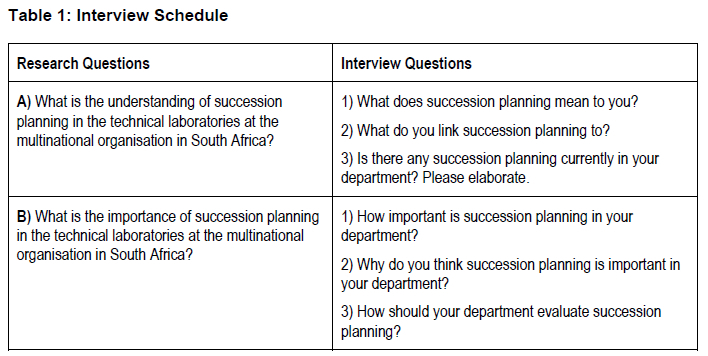
The technical laboratories of a multinational company in South Africa included: i) the Research and Development (R&D) laboratory; and ii) the Quality Control (QC) laboratory. The target population was 14 employees from the technical laboratories situated in Durban, Johannesburg, and Cape Town. The participants were identified as P1 to P14 to protect their identities. Purposeful sampling was employed, and the participants ranged from the Head of Technical to laboratory technicians. The semi-structured interviews were conducted in June and July 2023 via Microsoft Teams, and a thematic analysis was performed on the collected data. The interview schedule, developed by the researcher, included the research questions and interview questions as tabulated in Table 1. The qualitative analysis entailed a thematic approach using NVivo 20. Techniques, including word clouds, tree maps, cluster analyses, hierarchy charts, and word trees, were used to eloquently illustrate respective themes and sub-themes. Thematic analysis evaluates data, involving classifying, tabulating, or otherwise recombining the data to address the study's main objectives. It concentrated on locating, examining, and documenting forms or themes within the gathered data (Coffie et al., 2022).
That said, detail and transparency, as well as replicability, are some tools that bring rigour to qualitative research. The reader of the research could assess the study's credibility through transparency and comprehensive explanations of how the research design and its execution were justified. Throughout this research, there has been consistent transparency and explanations of the research study. Whenever an interview is used to acquire data, there is a significant chance to prove procedural trustworthiness through audio recordings and full transcriptions.
4. FINDINGS AND DISCUSSION
4.1 Themes and sub-themes for objective 1
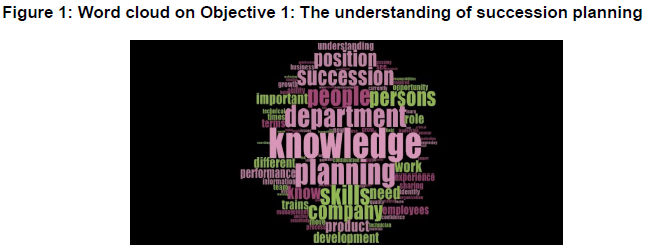
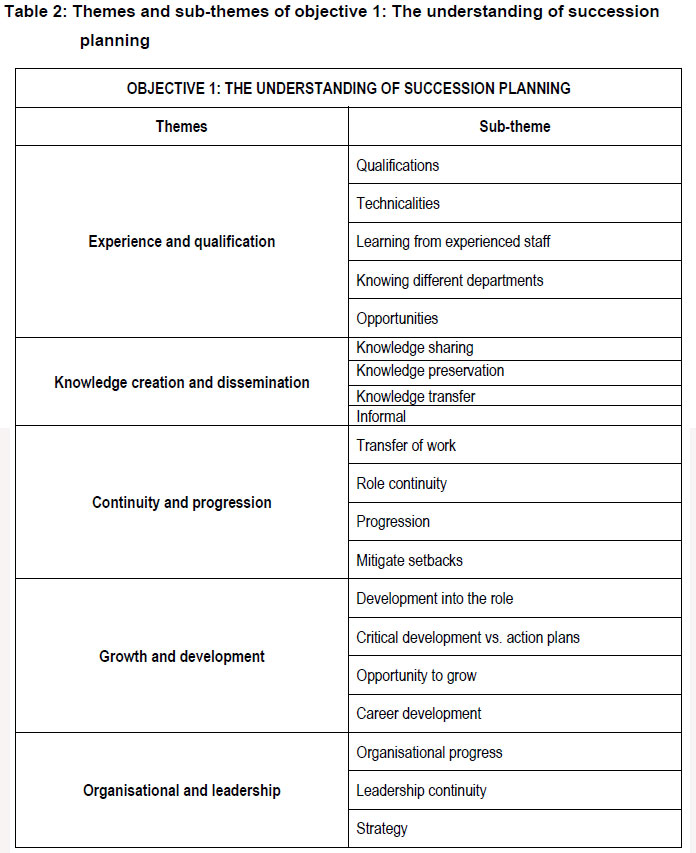
The objective was to determine the understanding of succession planning in the technical laboratories at a multinational company in South Africa. Figure 1 and Table 2 below highlight the analysis of Objective 1.
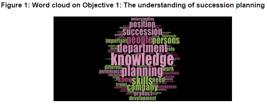
Figure 1 shows that the most used word under Objective 1 was knowledge, followed by department. Other keywords were skills, importance, and performance. The participants were of the view that for succession planning, knowledge and skills were vital for the overall performance of employees in the department.
Table 2 lists the five themes that emerged in the understanding of succession planning: 1) experience and qualification; 2) knowledge creation and dissemination; 3) continuity and progression; 4) growth and development; and 5) organisational and leadership. The highest-ranked themes from the participants were experience and qualifications. The analyses of the themes of experience and qualifications, and continuity and progression, are discussed below.
4.1.1 Theme: Experience and qualifications
This was the highest-ranked sub-theme in terms of the understanding of succession planning. Most participants felt that succession planning involved ensuring that the successor had the right qualifications and experience.
Sub-theme: Qualifications
Some participants believed that having the proper qualifications is necessary. One could not be placed in a position where they lacked adequate qualifications for the job/department. For example, one's qualification is important: An accountant cannot be placed in a laboratory where specialised knowledge and skills in Chemistry are required.
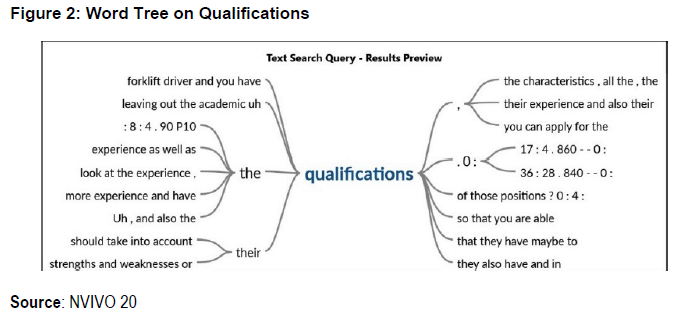
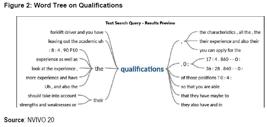
Figure 2 displays how the work qualifications were linked to positions, experience, strengths, and weaknesses. For example, Participant P10 expressed that "The qualifications they also have and in terms of knowledge in that field. For example, you can't take someone who did accounting and bring them into a laboratory where we need people who have chemistry and so forth."
Sub-theme: Technicalities
An important point was raised whereby a key aspect of succession planning was to have a person with technical knowledge, as some departments were highly technical and specialised. Most participants argued that a technical background is very important for understanding the materials with which the laboratory is working. It was highlighted that the industry necessitates highly specialised knowledge. For example, Participant P8 expounded on this as follows:
Especially in our technical field, where there's a lot of knowledge and understanding required to manage a technical department. Whoever takes overall [sic] as successor needs to be able to carry on [sic] firstly have some knowledge on the current projects that are happening...He's basically with the technical fields and in the business. For instance, understanding your product knowledge, your technical background regarding the materials that you use…It's overall knowledge of a specialised knowledge of the raw materials and the materials used in the process and the product, and things like that.
The results highlighted that, in terms of understanding succession planning, experience and qualifications were paramount. Hence, ensuring the successor has the necessary training, and experience is the goal of succession planning. Before taking on a succession job, a person needs to garner knowledge from more experienced employees. It is, therefore, imperative for employees to understand the roles of other departments if they desire to advance within the business. People must also be allowed to develop their skills and acquire experience in many fields.
These views are supported by Coffie et al.'s (2022) study, whereby employees were selected based on their demonstrated leadership skills, talent for the top position, evaluation systems, and a strong formal educational foundation. Then, as part of the preparation process, prospects were guided through several exercises. The best applicants were then chosen based on demonstrations of remarkable capabilities and leadership skills. As Henri Fayol (1949) clearly stated, management is responsible for ensuring the "stability of tenure of personnel" (Fayol, 1949, p. 38). If that need is ignored, according to Fayol, crucial posts will be filled by under-qualified individuals. Moreover, Fadeyi et al. (2019) had similar views, whereby in most banks, qualifications and experience are considered the main criteria for succession.
4.1.2 Theme: Continuity and progression
Succession planning is based on continuity and progression, with minimal to no setbacks.
Sub-theme: Transfer of work
Participants argued that succession involved the effective transfer of work to the most appropriate person who could assume such work responsibilities. Crucially, there will be a time when a new employee with inadequate skills needs to come up to speed with understanding the technicalities to be able to perform the job. In the absence of an employee, there must be someone in the department who can perform the duties. These concerns were voiced by the following participant:
That's quite specialised in that field that you have to be able to fully do that function and give the correct guidance where somebody comes out from a different background…For instance, they would appoint somebody in my position from externally who hasn't worked in a [sic] field for any time; there's a lot of technical knowledge that they won't have. So, there will be a time that it will take that person to catch up and understand the technicalities regarding the raw materials, the processes, the product performance requirements, and things like that. (P8)
Moreover, Participant P14 stated that "I think it means having, as a business or in my department, having somebody who can perform the duties if I'm not around."
Sub-theme: Role continuity
Participants were of the view that role continuity was vital in the sense that a successor needed to be able to execute their new role effectively to foster continuity. Hence, ample strategies, including training plans, are required. Since succession planning pertains to the continuity of roles in the organisation, when someone leaves the organisation, there must be someone available to fill the vacant role.
Participant P4 explained that "Succession planning, to me, means a development plan or training plan that's put together by management or by the business to ensure that there is a passing on or pass on of leadership roles." Participant P8 echoed this statement: "To me, it's making sure that…that there's a person or persons ready to take over or carry on with a certain role." Moreover, Participant P1 responded that "It's not one that I thought of in terms of how what, but I mean succession planning is making sure that…that we have continuity here going forward when the time comes for me to step aside."
The results highlighted that succession planning focused on maintaining continuity and progression, while minimising or eliminating setbacks. Also, an effective transfer of work to the proper successor is required. However, to maintain continuity, a successor must be able to perform their new function successfully. As such, staff advancement was a focus of succession planning, which can encourage growth rather than impede it. Employees can grow within the organisation through succession planning and established standards and plans. This was supported by Ahmad et al. (2020), who posited that succession is crucial to maintaining leadership in University A and helping the incumbent operate more effectively. Mans-Kemp and Flanegan (2022) had similar views in that the need to build the talent pipeline to maintain business continuity was emphasised by all interviewees.
4.2 Themes and sub-themes for Objective 2
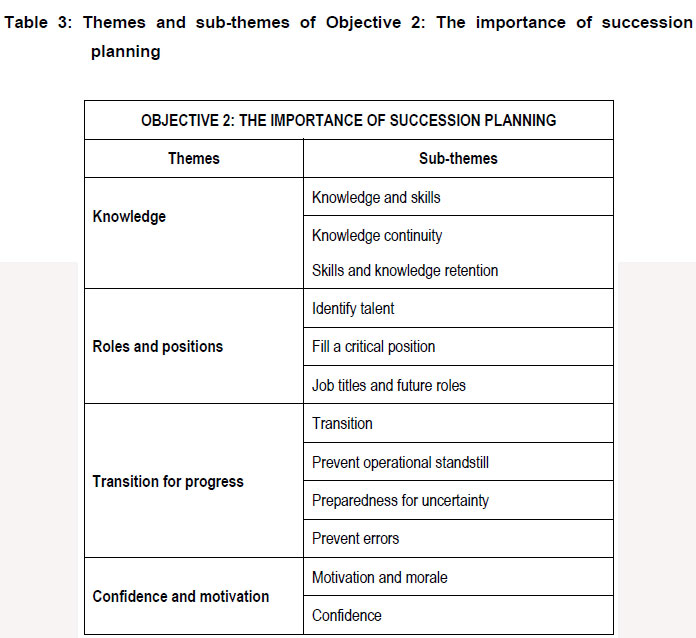
The objective was to examine the importance of succession planning in technical laboratories at a multinational company in South Africa. Since all participants viewed succession planning as important, this was classified into themes, as tabulated in Table 3
Table 3 depicts the themes identified for the importance of succession planning. The themes were knowledge, roles and positions, transition for progress, confidence, and motivation. The analyses of the theme knowledge and transition for progress are discussed below.
4.2.1 Theme: Knowledge
Succession planning complemented the knowledge base of the organisation through its staff.
Sub-theme: Knowledge and skills
Succession planning is important as it primarily involves knowledge and skills development and sharing. Thus, knowledge and skills must be effectively passed on so that the department can perform at its optimum level. This, in turn, has a positive effect on the organisation. Moreover, participants contended that staff members should disseminate their expertise, thereby ensuring that all personnel possess the same level of knowledge in order to successfully complete laboratory tasks. They also shared that staff must acquire new methods to accomplish a task.
For example, P7 stated the following: "I think within any business, in every organisation they understand it's… they understand their objectives, they understand what they need. And, it's always… and every organisation is always evolving, and they always need different skills." Moreover, P5 explained it in more detail:
One person would analyse it differently, the other one would analyse it differently, and they can come up with two different solutions to the same problem. So, having people share their knowledge would help us widen our vision, and, of course, we would most likely be a [sic] person's intellect. The work, through the work they do and how they do their work, that would be a skill, cause [sic] people don't do or analyse things in the same way. I believe that to be a skill.
Sub-theme: Knowledge continuity
Relating to the above, succession planning was important to ensure knowledge continuity. For example, if there were only one person with specialised knowledge and that person was unavailable, off sick, or had left the organisation, the organisation should not come to a standstill. Participants were strongly of the view that succession planning was predicated on extending this knowledge to other employees, and as one participant mentioned, "equip your team as best possible" (P9).
Other participants also expounded on this:
For example, the way things are is there's only one person who works in the lab, which is me, the quality lab technician. When I'm not around, not just get done if anything goes wrong in the plant, or the raw material, nobody will verify if the issue is the raw material. If we produce, for example, glass in the line and they think there's an issue with the batch, nobody's there to test if the chemical is in order. When it comes to training, we need to have more than just one person knowing how to do all these tests that we need to support the process. (P14)
Defining what knowledge is-before we can even talk about knowledge transfer-knowledge is, in my own opinion…it is either the facts or the information or the school, skills acquired through experience. When you are passing [sic] the knowledge, the knowledge transfer then means people who are in a better position in terms of experience or leadership roles. I want to think that they have better knowledge, they have better experience, or they have better, better knowledge in terms of academics and terms of experience. When you are transferring that knowledge, it means that you equip your team as best [sic] possible. (P9)
These findings indicated that succession planning complemented the organisation's expertise developed by its employees. For the department to operate at its peak capacity, knowledge and skills must be successfully transferred. Planning for the next generation is essential to maintaining the flow of information. Therefore, the retention of important skills and expertise can be guaranteed via succession planning. However, the technical division would encounter significant challenges in replacing special skills, as knowledge and talent management are crucial. According to Schultz (1961), human capital theory holds that, when combined with other human investments, the acquisition of knowledge and skills largely explains the productive dominance of technologically advanced nations.
This assertion was supported by Olatunji et al. (2020), who found that organisations that place greater emphasis on identifying talent for important positions within the organisation are able to navigate volatility with ease. If the impact of these jobs is to be felt inside the organisation, these critical positions should be filled by competent individuals. Bano et al. (2024) further illustrated that effective knowledge management is crucial for employee retention, with mentoring and coaching being the most effective training methods for transferring tacit knowledge.
4.2.2 Theme: Transitioning for progress
Succession planning was deemed important for transition purposes, especially in terms of transitioning for progress.
Sub-theme: Transition
Participants were of the view that succession planning is crucial for a smooth transition. This entailed the unhindered passing of knowledge from one person to another for a successive role and ensuring that the organisation continues smoothly in terms of its operations and its respective performance, as well as progressing due to the technical department being a vital department for the organisation: "It's the engine of the car" (P9).
Participant P9 answered the related question during the interview as follows:
This is a very important department; I want to think that it's the engine of the car. We are making things happen. We are making this company grow, so it is very important to ensure that a smooth transition becomes a part of the plan…Smooth transition: passing the knowledge, passing their proper, or having their proper teachings. Propriety information is transferred from one person to the next. Not putting the companies in for the department's information and the risk of understanding.
Participant P12 summarised it in this manner: "You just want to have the smooth transition in terms of succession that one person drops off."
Subtheme: Prevent operational standstill
Relating to the above, the transitioning process would prevent an operational standstill. Participants agreed that such a standstill can occur when staff who possess key knowledge of a product or process are no longer available. This would severely impact operations and direction. Therefore, if knowledge is not transferred, the new employees in the department would be trained by staff with limited knowledge, which may slow down the performance of the department; hence, impacting other departments that require the services of the technical division.
For example, Participant P2 posited that "I think it's very important regarding the running of the department and making sure that there aren't any setbacks and we [sic] left without the staff we need and the support that we need."
Other participants expounded more on this issue:
Let's say now we have a new person coming, and that person would not have any knowledge, or the basic stuff. And, then we would have to slow down production because now we must start training that person with the limited knowledge we have. So, now that not only affects our department, [sic] start impacting other departments, because now we might take longer to analyse stuff. (P5)
Because when you look at the product and development, then, if we don't have the product, there is nothing to sell. But, then to have these products, to develop them, then you need the skills; you need the knowledge. Then, if you don't have the skills, you don't know, you might not have the product. And, if you don't have the product, then you have nothing to sell. (P13)
The study revealed that succession planning is crucial for transitional reasons, particularly for a seamless transition and transitioning for progress. This requires the free transfer of knowledge from one individual to another for a succeeding function. Since the technical department is a vital department within the organisation-"It's the engine of the car" (P9), it ensures that the organisation continues to operate, perform, and advance smoothly. Suwaidi et al. (2020) had similar views, positing that the difficulty of succession planning resides in its capacity to strike an effective balance between granting the new executive ample freedom to lead and maintaining the outgoing executive's collaboration, when necessary, both before and after the leadership transition. Additionally, Nosike and Egbunike (2024) demonstrated that, in order to ensure a smooth transition, small to medium enterprises should have succession plans in place, and the role of the successor should be structured.
4.3 The need for succession planning
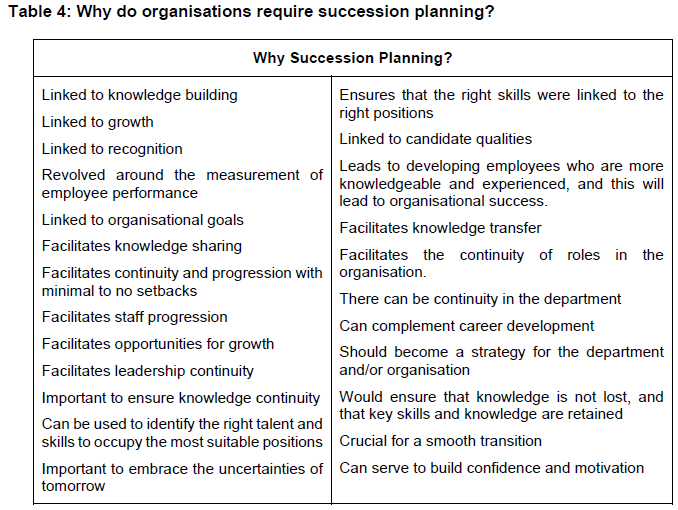
From the analysis and discussion of the research, the researcher explained why organisations need succession planning. The observations are tabulated in Table 4 below.
Table 4 summarises succession planning as derived from this research and explains why organisations need succession planning. All organisations will benefit from succession planning, as stipulated in the aforementioned table, due to its critical role.
5. MANAGERIAL IMPLICATIONS
The organisation should take into consideration that candidates must have the right qualifications and experience to fill a position due to very specialised technical knowledge and skills requirements in the laboratory. Knowledge management as well as talent management should be practiced to ensure that knowledge and talented people are retained in the organisation. The organisation should consider ensuring a smooth transition in the succession process by creating awareness of the succession planning strategy and improving the communication of succession planning.
6. CONCLUSION AND RECOMMENDATIONS
The following discusses the significance of succession planning and the conclusions derived from its comprehension.
6.1 Objective 1: To determine the understanding of succession planning in the technical laboratories at a multinational company in South Africa
Participants' understanding of succession planning was that it involved ensuring successors had the proper qualifications and experience, thereby promoting knowledge sharing and ensuring continuity. Succession planning also supported staff growth and development, thereby complementing career development. Moreover, succession planning is crucial for both the organisation and its leadership, as it encourages a well-planned strategy.
It can be concluded that succession planning can be linked to the following:
• Employee development, where training is crucial and can be done internally, through on-the-job training, or externally. Thakur (2022) highlighted that the active implementation of the succession planning method ensures effective workforce development to fulfil the necessary roles.
• Skills and qualities where a candidate may possess the necessary character or qualities to perform in a specific role. Every firm requires a highly skilled workforce to remain competitive (Malik, 2019; Okeah, 2024) because skilled labour is becoming increasingly important to organisations.
• Performance must be monitored and reviewed in terms of succession planning when selecting a successor for the position. As organisations actively work to create high-performance and high-engagement work environments (Baporikar, 2021; Wajidi et al., 2023)-where decision-making is decentralised-leadership is diffused throughout an empowered workforce.
• Succession planning will lead to developing employees who are more knowledgeable and experienced, which will lead to organisational success. For businesses to compete with other organisations in a competitive market, they need to ensure that their employees are consistently learning and developing their skills and knowledge base. Knowledge is being utilised more frequently to gauge competitive performance as it constitutes a crucial productivity component (Pangaribuan et al., 2020). Organisations are consistently looking for ways to increase the effectiveness of their internal resources. To increase effectiveness, productivity, and profitability, staff members should be able to prioritise learning and development, share knowledge, actively participate in problem-solving, and have a desire to learn and grow sustainably (Eisenberg et al., 2018).
• The graduate programme allowed the graduates to grow in their respective departments. Thakur (2022) stated that establishing a clear path for the employees' career growth through the implementation of leadership programmes that effectively utilise the perspectives of mentors or managers and identify potential employees is crucial for organisations.
6.2 Objective 2: To examine the importance of succession planning in technical laboratories at a multinational company in South Africa
Participants' view of the importance of succession planning was that it is crucial for maintaining knowledge continuity and ensuring the retention of essential skills within an organisation. Succession planning allowed for smooth transitions and progression, enhancing motivation and self-assurance, and preparing employees for new responsibilities, thereby ultimately contributing to the overall success of the organisation.
It can be concluded that the participants felt that the evaluation of succession planning must include the following:
• The review and measurement of succession planning must be tied to performance reviews to assess employees' performance, strengths, and weaknesses. To be eligible for progression, people must be performing well in their current positions. As such, managing an employee's performance is a critical function of any organisation (Dodd et al., 2021).
• The succession planning programme must follow organisational policies and regulations to ensure it is executed ethically and has merit. Jahwari and Nur (2023) demonstrated that a new generation is moving from a dependency on people to a dependency on systems and policies. Marrelli (2022) explained that the common succession planning practice of senior leaders personally identifying promising employees, giving them special development opportunities, and then promoting them into critical positions is prohibited by the merit system principle: "Recruit, select and advance on merit after fair and open competition" (Marrelli, 2022, p. 630).
• Knowledge became a recurring factor in this research and is derived from experience. Furthermore, training remains a key component of knowledge generation.
• Thus, knowledge management of an organisation's human capital through knowledge exchange and transfer is essential to its success (Desarno et al., 2023).
• Other skills must inform succession planning evaluations, such as people and communication skills. Essentially, entrepreneurial competencies equip businessmen with knowledge, technical expertise, and people skills to implement succession efforts, ensuring business continuity and success through a collaborative approach (Sobrevega & Lopena, 2024).
• Succession planning must also involve the transfer of leadership skills, as these are important for guiding others and generating new ideas. Planning for efficient knowledge transfer (Bano et al., 2024; Pane & Christanti, 2023) and succession ensures that personnel are hired, trained, and ready to assume leadership roles within the organisation, preventing the loss of vital institutional knowledge.
• Succession planning must be evaluated alongside role development.
o A candidate must possess the abilities, performance, and knowledge. These views are supported by Coffie et al.'s (2022) study, whereby employees were chosen based on their demonstrated leadership skills, talent for the top position, evaluation systems, and a strong formal educational foundation.
o Internal consideration should be given when seeking successive roles rather than looking outside. These views are supported by Ahmad et al. (2020), who found that decision-making jobs require experience.
o Roles should be created, whereby employees can grow into them. Ali and Babu (2015) had similar views, highlighting that some roles within organisations offer employees the chance to grow professionally through training and rotational job shadowing.
• There should be adequate planning and consideration of involvement.
o A collective involvement of all stakeholders ensures that everyone's input is considered towards a succession plan. Susanto and Parmenas (2021) also posited that the company's retention strategy is primarily focused on strengthening relationships with employees and keeping talented workers on board. The company's retention initiatives include employee appreciation, numerous employee welfare programmes, leadership programmes, clear and guided career development plans, and open and comfortable communication patterns with employees.
o There must be ample awareness of the plan created so that everyone can be involved.
Jahwari and Nur (2023) expressed similar views that for succession planning to be effective, communication must have a positive and significant impact. Matagi's (2023) study in Africa expressed that in the past, succession plans were frequently kept confidential because it was believed that individuals would put in more effort to advance in their careers if they were unaware of their current position. Modern firms must, however, find a balance between allowing individuals to take charge of their own development and being overly visible. In other words, employees should be involved in their own succession planning.
6.3 Recommendations
The following recommendations are made to improve succession planning in the technical laboratories at a multinational company in South Africa. The recommendations listed below are based on participants' feedback regarding the study's objectives.
> The organisation should take into consideration that candidates must have the proper qualifications and experience to fill a position due to the very specialised technical knowledge and skills requirements in the laboratory. Nosike and Egbunike (2024) determined that the successor of the organisation must be experienced to oversee the organisation. Fadeyi et al. (2019) demonstrated that in most banks, qualifications and experience are the main criteria considered for succession.
> The transfer of knowledge from experienced staff must take place, as they have skills and knowledge about executing tasks that are not in any manual or textbook. The organisation should practice knowledge management as well as talent management to ensure that knowledge and talented people are retained within the organisation. This will ensure the continuity of knowledge and skills. To effectively manage top talent performance, a talent management strategy should be developed (Waldick & Schultz, 2023). Knowledge is increasingly being used to gauge competitive performance as it is a crucial productivity component (Pangaribuan et al., 2020). To increase effectiveness, productivity, and profitability, staff members should be able to share knowledge (Eisenberg et al., 2018), thereby ensuring that organisational knowledge management and transfer are sustained (Rothwell, 2010).
> The organisation must create opportunities for staff to gain experience across diverse areas/departments and to grow within the organisation. Furthermore, the organisation must give employees the freedom to apply their minds to the succession planning process, be part of it, and make them aware of positions they can grow into. Mans-Kemp and Flanegan (2022) recommended providing scholarships, internships, and graduate programmes to deserving, diverse candidates. Job training typically includes both a written and a practical component to help translate knowledge into experience (Kerin, 2022). Implementing an organisation's learning culture can significantly enhance talent attraction, retention, and development (Srimannarayana, 2019). Moreover, in order to thrive in a competitive market, businesses must ensure their staff are continuously learning and developing (Pangaribuan et al., 2020).
> Thus, there must be ample strategies-inclusive of training plans-as part of succession planning to ensure the continuity of roles in the organisation. Also, there needs to be a developmental plan in place that would cater to all the developmental and career needs of employees, including their growth needs. The organisation must not procrastinate when it comes to the succession planning of employees. In Susanto and Parmenas's (2021) study, the company's retention initiatives included employee appreciation, numerous employee welfare programmes, leadership programmes, clear and guided career development plans, and open and comfortable communication patterns with employees. Investing in the training of research and development (R&D) personnel who have the curiosity to study new ideas is crucial for promoting unique and complex technological knowledge (Sarpong et al., 2023). Research shows that quality planning and training significantly enhance the development and quality assurance of manufacturing companies (Chigozie & Chijioke, 2015).
> The organisation should consider creating roles or positions into which employees can grow. Essentially, employees need to overcome their personal challenges of underperforming in their roles. A succession planning programme (FOCUSED) was researched by Jones and Rivers (2021); this programme was a purposeful and methodical effort to support professional growth and advancement, thereby retaining knowledge, developing future leaders, and assuring nursing leadership continuity in important roles. Umetiti and Onyezere (2025) reviewed conditions in Nigeria, a developing country, and ascertained that succession planning significantly influences how employees develop the crucial abilities they need to grow. Jones et al. (2025) found that strategic preparation customised to meet the unique requirements of a laboratory ensures that employees are not assigned tasks for which they have little experience. Additionally, this approach can assist in reducing unnecessary stress from added responsibilities, which could diminish staff morale and potentially lead to higher turnover rates.
The study's findings show the importance of succession planning in organisations and offer leadership and insight into its critical role in a competitive environment. The limitations of the research were that it relied on interviews with only a few participants in a division in South Africa. Therefore, the study's findings cannot be generalised. Future research could investigate the challenges of implementing succession planning within an organisation, as well as a global perspective on succession planning across all global laboratories within the organisation. Future research could investigate knowledge management, talent management, and a learning organisation's impact on succession planning in technical laboratories. Future research could consist of a quantitative study on succession planning in technical laboratories.
Conflict of interest: The authors declare no conflict of interest with respect to the research, authorship and publication of the article.
Data availability: Data is available on request.
Ethical clearance and informed consent statement: The researchers obtained ethical clearance prior to the data collection and received informed consent from all the participants in this study, reference number HSSREC/00005306/2023.
Funding: The authors did not receive any financial support for the research, authorship, and publication of the article.
REFERENCES
2. LITERATURE REVIEW
-
Ahmad, A. R., Ming, T. Z., & Sapry, H. R. M. (2020). Effective strategy for succession planning in higher education institutions. Journal of Education and e-Learning Research, 7(2), 203-208. https://doi.org/10.20448/journal.509.2020.72.203.208
» https://doi.org/10.20448/journal.509.2020.72.203.208 -
Ahsan, M. (2018). Effective recruitment and selection along with succession planning towards leadership development. In Employee retention and talent management in Pakistan, Journal of Entrepreneurship & Organisation Management, 7(1) 2-8. https://doi.org/10.4172/2169-026X.1000233
» https://doi.org/10.4172/2169-026X.1000233 -
Ali, A. H. M., & Babu, P. P. (2015). Succession planning and leadership development in software organizations (with reference to select leading information technology companies in Bangalore). European Journal of Business and Management, 7(1), 311-321. https://iiste.org/Journals/index.php/EJBM/article/view/18909/19376
» https://iiste.org/Journals/index.php/EJBM/article/view/18909/19376 -
Awadhi, T. H. A., & Muslim, S. B. (2023). Reviewing the relation between human resources practices, talent management, and succession planning in UAE public sector. Information Sciences Letters, 12(4), 1271-1283. http://dx.doi.org/10.18576/isl/120442
» http://dx.doi.org/10.18576/isl/120442 -
Baporikar, N. (2021). Talent retention for succession planning in the defence forces. International Journal of Applied Management Sciences and Engineering, 8(2), 52-71. https://doi.org/10.4018/IJAMSE.2021070104
» https://doi.org/10.4018/IJAMSE.2021070104 -
Bano, Y., Omar, S. S., & Ismail, F. (2021). Revitalising organisations' emergency succession planning in the face of the COVID-19 outbreak. The European Journal of Social and Behavioural Sciences, 30(1), 5-20. https://doi.org/10.15405/ejsbs.285
» https://doi.org/10.15405/ejsbs.285 -
Bano, Y., Omar, S. S., & Ismail, F. (2022). Succession planning best practices for large and small organisations. Mediterranean Journal of Social Sciences, 13(2), 11-21. https://doi.org/10.36941/mjss-2022-0013
» https://doi.org/10.36941/mjss-2022-0013 -
Bano, Y., Omar, S. S., & Ismail, F. (2024). The theoretical foundation for the development of a conceptual model on the relationship between succession planning practices, employee retention, and knowledge management in HEIs. Mediterranean Journal of Social Sciences, 15(1), 42-57. https://doi.org/10.36941/mjss-2024-0003
» https://doi.org/10.36941/mjss-2024-0003 -
Chia, C., Razak, A. Z., & Ghavifekr, S. (2023). University succession planning: A conceptual review of models in the Malaysian context. Educational Leader, 11, 1-20. https://ejournal.um.edu.my/index.php/PEMIMPIN/login
» https://ejournal.um.edu.my/index.php/PEMIMPIN/login -
Chigozie, M. P., & Chijioke, E. (2015). Effects of research and development on organisational product quality. Asia Pacific Journal of Research in Business Management, 6(3), 29-50. https://www.researchgate.net/publication/337731862_EFFECTS_OF_RESEARCH_AND_DEVELOPMENT_ON_ORGANISATIONAL_PRODUCT_QUALITY
» https://www.researchgate.net/publication/337731862_EFFECTS_OF_RESEARCH_AND_DEVELOPMENT_ON_ORGANISATIONAL_PRODUCT_QUALITY -
Coffie, R. B., Odikro, D., & Turkson, J. K. (2022). A thematic approach to succession planning, leadership continuity, and organisational growth: Spotlight on chief executive officers in Ghanaian industry. African Journal of Applied Research, 8(2), 83-100. https://doi.org/10.26437/ajar.31.10.2022.06
» https://doi.org/10.26437/ajar.31.10.2022.06 - Creswell, J. W., & Creswell, J. D. (2018). Research design: Qualitative, quantitative, and mixed method approaches (5th ed.). Sage Publications.
-
Darius, B. (2022). Intellectual capital development and competitive advantage. International Journal of Academic Management Science Research, 6(7), 1-8. https://www.researchgate.net/publication/362368812_Intellectual_Capital_Development_and_Competitive_Advantage
» https://www.researchgate.net/publication/362368812_Intellectual_Capital_Development_and_Competitive_Advantage -
Desarno, J., Perez, M., Rivas, R., Sandate, I., Reed, C., & Fonseca, I. (2023). Succession planning within the health care organisation: Human resources management and human capital management considerations. Nurse Leader, 19(4), 411-415. https://www.nurseleader.com/article/S1541-4612(20)30220-2/abstract
» https://www.nurseleader.com/article/S1541-4612(20)30220-2/abstract - Dodd, N., Brewster, C., & Holland, P. (2021). Contemporary issues in human resource management (5th ed.). Oxford University Press.
-
Eisenberg, A., Ignatjeva, S., Ilisko, D., & Rauckiene-Michaelsson, A. (2018). Adaptation of the organisational learning culture (OLC) dimension methodology in the Israeli local authorities context. Discourse and Communication for Sustainable Education, 9(1), 50-63. https://doi.org/10.2478/dcse-2018-0004
» https://doi.org/10.2478/dcse-2018-0004 -
Fadeyi, O., Oladele, K., Imhonopi, D., & Nwachukwu, C. (2019). Analysing succession planning management practice in the context of organisational survival: A qualitative approach. International Journal for Quality Research, 13(2), 52-71. https://doi.org/10.24874/IJQR13.02-11
» https://doi.org/10.24874/IJQR13.02-11 -
Fayol, H. (1949). General and industrial management. Pitman and Sons Ltd. https://archive.org/details/in.ernet.dli.2015.13518/page/n71/mode/2up
» https://archive.org/details/in.ernet.dli.2015.13518/page/n71/mode/2up -
Gabriel, I. P., Biriowu, C. S., & Dagogo, E. L. (2020). Examining succession and replacement planning in work organisations. European Journal of Business and Management Research, 5(2), 1-7. https://doi.org/10.24018/ejbmr.2020.5.2.192
» https://doi.org/10.24018/ejbmr.2020.5.2.192 -
Jahwari, A. A., & Nur, M. (2023). The role of top management support and effective communication on succession planning effectiveness: An empirical study of Omani civil service organisations. Problems and Perspectives in Management, 21(3), 244-254. http://dx.doi.org/10.21511/ppm.21(3).2023.19
» http://dx.doi.org/10.21511/ppm.21(3).2023.19 -
Jones C, Peterson S; and Porter R, (2025)."Benefits of Succession Planning in Medical Laboratories". Medical Laboratory Science Independent Study Projects. 3. https://commons.und.edu/mls-projects/3
» https://commons.und.edu/mls-projects/3 -
Jones, P., & Rivers, R. (2021). Development of a staff nurse to chief nursing officer succession planning program. Nurse Leader, 19(6), 646-654. https://doi.org/10.1016/j.mnl.2021.05.002
» https://doi.org/10.1016/j.mnl.2021.05.002 -
Judijanto, L., Al-Amin, & Hasanah, A. (2025). Leadership development to face global economic challenges. International Journal of Financial Economics (IJEFE), 2(4), 182-193. https://wikep.net/index.php/IJEFE/article/view/73
» https://wikep.net/index.php/IJEFE/article/view/73 -
Kaldeen, M., & Nawaz, S. S. (2020). Impact of human capital capabilities on knowledge management process. International Journal of Psychosocial Rehabilitation, 24(7), 463-478. https://doi.org/10.37200/IJPR/V24I7/PR270045
» https://doi.org/10.37200/IJPR/V24I7/PR270045 -
Kerin, T. (2022). Creating a learning organisation. Chemical Engineering Transactions, 90, 781-786. https://doi.org/10.3303/CET2290131
» https://doi.org/10.3303/CET2290131 -
Mans-Kemp, N., & Flanegan, J. N. (2022). Prudent and proactive board succession planning: A case study of selected companies in South Africa. Acta Commercii, 22(1), 1-11. https://doi.org/10.4102/ac.v22i1.970
» https://doi.org/10.4102/ac.v22i1.970 -
Makumbe, W., Kamupini, A., & Jackson, L. (2025). The mediating role of organisational commitment on the relationship between succession planning practices and business performance. Acta Commercii, 25(1), a1334. https://doi.org/10.4102/ac.v25i1.1334
» https://doi.org/10.4102/ac.v25i1.1334 -
Malik, A. (2019). Creating competitive advantage through source basic capital strategic humanity in the industrial age 4.0. International Research Journal of Advanced Engineering and Science, 4(1), 209-215. http://irjaes.com/volume-4-issue-1/
» http://irjaes.com/volume-4-issue-1/ -
Malokani, D. K. A. K., Ali, S., Nazim, F., Amjad, F., Hassan, S. S., Rani, S., & Ahmad, S. (2023). Impact of succession planning on employee retention: Mediating role of career development. Journal of Positive School Psychology, 7(4), 284-292. https://www.researchgate.net/publication/380105538_Impact_Of_Succession_Planning_On_Employee_Retention_Mediating_Role_Of_Career_Development
» https://www.researchgate.net/publication/380105538_Impact_Of_Succession_Planning_On_Employee_Retention_Mediating_Role_Of_Career_Development -
Marrelli, A. F. (2022). Innovation in government succession planning: A case study. Industrial and Organisational Psychology, 15(4), 630-638. https://doi.org/10.1017/iop.2022.63
» https://doi.org/10.1017/iop.2022.63 -
Matagi, S. O. (2023). Effective succession planning practices pose challenges within African establishments. International Journal of Scientific Research and Management (IJSRM), 11(8), 2848-2855. https://www.researchgate.net/publication/373402220_Effective_Succession_Planning_Practices_Pose_Challenges_within_African_Establishments
» https://www.researchgate.net/publication/373402220_Effective_Succession_Planning_Practices_Pose_Challenges_within_African_Establishments -
Mirzaie, M., Javanmard, H. A., & Hasankhani, M. R. (2019). Impact of knowledge management process on human capital improvement in Islamic Consultative Assembly. Knowledge Management Research and Practice, 17(11), 1-12. https://doi.org/10.1080/14778238.2019.1599579
» https://doi.org/10.1080/14778238.2019.1599579 -
Mutungi, V., Oduor, B. A., & Oduol, T. (2023). The mediating role of succession planning on the relationship between strategic leadership and organisational performance: A study of Kenya Airways. International Journal of Innovative Science and Research Technology, 8(6), 1525-1534. https://www.researchgate.net/publication/373679145_The_Mediating_Role_of_Succession_Planning_on_the_Relationship_between_Strategic_Leadership_and_Organizational_Performance_A_Study_of_Kenya_Airways
» https://www.researchgate.net/publication/373679145_The_Mediating_Role_of_Succession_Planning_on_the_Relationship_between_Strategic_Leadership_and_Organizational_Performance_A_Study_of_Kenya_Airways -
Nosike, C. J., & Egbunike, C. F. (2024). Succession planning and sustainability of small and medium enterprises (SMEs) in Anambra State. African Banking and Finance Review Journal (ABFRJ), 8(8), 1-13. https://www.researchgate.net/publication/378107285_Succession_Planning_And_Sustainability_of_Small_and_Medium_Enterprises_SMEs_In_Anambra_State
» https://www.researchgate.net/publication/378107285_Succession_Planning_And_Sustainability_of_Small_and_Medium_Enterprises_SMEs_In_Anambra_State -
Okeah, M. I. N. (2024). Human resource succession planning and resilience of multinational oil and gas producing companies in Nigeria. Journal of Human Resource & Leadership, 8(2), 39-51. https://doi.org/10.53819/81018102t2339
» https://doi.org/10.53819/81018102t2339 -
Okon, O. A., Brownson, C., & Uwa, K. (2023). Succession planning and organisational sustainability among banks in Eket local government, Akwa Ibom State. International Journal of Advanced Academic Research, 9(6), 209-234. https://www.ijaar.org/succession-planning-and-organizational-sustainability-among-banks-in-eket-local-govt-akwa-ibom-state/
» https://www.ijaar.org/succession-planning-and-organizational-sustainability-among-banks-in-eket-local-govt-akwa-ibom-state/ -
Olatunji, F., Abimbola, A., Richard, O. M., & Samuel, T. A. (2020). Empirical assessment of the link between succession planning and business agility. International Journal of Research Publications, 52(1), 1-17. https://www.researchgate.net/publication/342493351_EMPIRICAL_ASSESSMENT_OF_THE_LINK_BETWEEN_SUCCESSION_PLANNING_AND_BUSINESS_AGILITY
» https://www.researchgate.net/publication/342493351_EMPIRICAL_ASSESSMENT_OF_THE_LINK_BETWEEN_SUCCESSION_PLANNING_AND_BUSINESS_AGILITY -
Pane, Y. Y., & Christanti, R. (2023). Exploring family businesses succession in Indonesia: The knowledge management lenses. Kontigensi: Jurnal Ilmiah Manajemen, 11(1), 52-67. https://doi.org/10.56457/jimk.v11i1.315
» https://doi.org/10.56457/jimk.v11i1.315 -
Pangaribuan, C. H., Wijaya, F. H., Djamil, A. B., Hidayat, D., & Putra, O. P. B. (2020). An analysis on the importance of motivation to transfer learning in VUCA environments. Management Science Letters, 10(2), 271-278. https://doi.org/10.5267/j.msl.2019.9.005
» https://doi.org/10.5267/j.msl.2019.9.005 -
Perrenoud, A. J. (2020). Delphi approach to identifying best practices for succession planning within construction firms. International Journal of Construction Education and Research, 16(3), 197-210. https://doi.org/10.1080/15578771.2018.1544950
» https://doi.org/10.1080/15578771.2018.1544950 -
Philip, K. L. (2020). Concept analysis: Succession planning. Wiley Periodicals-Nursing Forum, 55(4), 730-736. https://doi.org/10.1111/nuf.12490
» https://doi.org/10.1111/nuf.12490 -
Rothwell, W. J. (2011). Replacement planning: A starting point for succession planning and talent management. International Journal of Training and Development, 15(1), 87-99. https://doi.org/10.1111/j.1468-2419.2010.00370.x
» https://doi.org/10.1111/j.1468-2419.2010.00370.x -
Rothwell W.J., 2010, Effective Succession Planning, Ensuring Leadership Continuity and Developing Talent from Within, 4th edition, New York: Amacom. https://hcmindonesia.files.wordpress.com/2012/12/9b-successionplanhandbook.pdf
» https://hcmindonesia.files.wordpress.com/2012/12/9b-successionplanhandbook.pdf -
Sarpong, D., Boakye, D., Ofosu, G., & Botchie, D. (2023). The three pointers of research and development (R&D) for growth-boosting sustainable innovation system. Technovation, 122, 1-9. https://doi.org/10.1016/j.technovation.2022.102581
» https://doi.org/10.1016/j.technovation.2022.102581 -
Serenko, A. (2023). The great resignation: The great knowledge exodus or the onset of the great knowledge revolution? Journal of Knowledge Management, 27(4), 1042-1055. https://www.researchgate.net/publication/360978837_The_Great_Resignation_The_Great_Knowledge_Exodus_or_the_Onset_of_the_Great_Knowledge_Revolution
» https://www.researchgate.net/publication/360978837_The_Great_Resignation_The_Great_Knowledge_Exodus_or_the_Onset_of_the_Great_Knowledge_Revolution -
Schultz, T. W. (1961). Investment in human capital. The American Economic Review, 51(1), 1-17, https://www.jstor.org/stable/1813848
» https://www.jstor.org/stable/1813848 -
Shynkaruk, O. (2020). Succession planning in a lab: What, why, who, and how a solid strategy can save you time and resources. Lab Manager. https://www.labmanager.com/leadership-and-staffing/succession-planning-in-a-lab-what-why-who-and-how-21842
» https://www.labmanager.com/leadership-and-staffing/succession-planning-in-a-lab-what-why-who-and-how-21842 -
Siewert, K. G., & Louderback, P. (2019). The "BUS PROOF" library: Technical succession planning, knowledge transfer, and institutional memory. Journal of Library Administration, 59(4), 455-474. https://doi.org/10.1080/01930826.2019.1593716
» https://doi.org/10.1080/01930826.2019.1593716 -
Sobrevega, E. B., & Lopena, G. L. (2024). Entrepreneurial competencies and succession planning of family business owners in a second-class municipality in Iloilo Province: An explanatory sequential mixed methods study. Philippine Social Science Journal, 7(3), 85-100. https://doi.org/10.52006/main.v7i3.1040
» https://doi.org/10.52006/main.v7i3.1040 -
Srimannarayana, M. (2019). Creating a culture of learning in the workplace: An exploratory study. The Indian Journal of Industrial Relations, 54(4), 657-676. https://www.jstor.org/stable/27124684
» https://www.jstor.org/stable/27124684 -
Susanto, P. C., & Parmenas, N. H. (2021). Model development of succession planning in subsidiary companies engaged in the insurance industry. Journal of Economics, Management, Entrepreneur, and Business, 1(1), 43-57. https://doi.org/10.52909/jemeb.v1i1.16
» https://doi.org/10.52909/jemeb.v1i1.16 -
Suwaidi, M. A., Jabeen, F., Stachowicz-Stanusch, A., & Webb, M. (2020). Determinants linked to executive succession planning in public sector organisations. Vision-The Journal of Business Perspective, 24(3)284-299. https://www.researchgate.net/publication/341709000_Determinants_Linked_to_Executive_Succession_Planning_in_Public_Sector_Organisations
» https://www.researchgate.net/publication/341709000_Determinants_Linked_to_Executive_Succession_Planning_in_Public_Sector_Organisations -
Thakur, A. (2022). An inclusive study of the need for succession planning processes and trends in organisations. OPUS, 13(1), 54-75. https://www.researchgate.net/publication/362303677_An_Inclusive_Study_of_the_Need_for_Succession_Planning_Processes_and_Trends_in_Organizations
» https://www.researchgate.net/publication/362303677_An_Inclusive_Study_of_the_Need_for_Succession_Planning_Processes_and_Trends_in_Organizations -
Trenev, V. N. (2018). Knowledge management in human capital development in the context of the digital economy. International Journal of Engineering & Technology, 7(3), 108-112. https://doi.org/10.14419/ijet.v7i3.19.16997
» https://doi.org/10.14419/ijet.v7i3.19.16997 -
Umetiti, C. B., & Onyezere, C. V. (2025). Succession management and employee development: A study of Anambra State civil service, Awka. International Journal of Public Administration and Development Studies (IJPADS), 2(1), 144-165. https://ijpads.com/index.php/ijpads/article/view/33
» https://ijpads.com/index.php/ijpads/article/view/33 -
Waldick, S., & Schultz, C.M. (2023). Talent management factors in the new world of work within the engineering, procurement, construction, and maintenance industry. Journal for New Generation Sciences, 21(2), 61-77. https://www.researchgate.net/publication/378201276_TALENT_MANAGEMENT_FACTORS_IN_THE_NEW_WORLD_OF_WORK_WITHIN_THE_ENGINEERING_PROCUREMENT_CONSTRUCTION_AND_MAINTENANCE_INDUSTRY
» https://www.researchgate.net/publication/378201276_TALENT_MANAGEMENT_FACTORS_IN_THE_NEW_WORLD_OF_WORK_WITHIN_THE_ENGINEERING_PROCUREMENT_CONSTRUCTION_AND_MAINTENANCE_INDUSTRY -
Wajidi, F. A., Saeed, M., Baig, M. D., Rehan, E. W., & Hussain, D. (2023). Impact of leadership on effective succession planning: Comparison of public and private organisations. International Journal of Social Sciences and Entrepreneurship, 3(1), 161-170. https://doi.org/10.58661/ijsse.v3i1.86
» https://doi.org/10.58661/ijsse.v3i1.86 -
Warning, B. (2023). Knowledge sharing and succession planning in the lab. The American Society for Clinical Laboratory Science. https://ascls.org/knowledge-sharing-and-succession-planning-in-the-lab/
» https://ascls.org/knowledge-sharing-and-succession-planning-in-the-lab/ -
Wujarso, R., Saprudin, & Dameria, R. (2021). Human capital management as a resource in achieving competitive advantage. Budapest International Research and Critics Institute-Journal, 4(2), 3052-3058. https://www.researchgate.net/publication/352158663_Human_Capital_Management_as_a_Resource_in_Achieving_Competitive_Advantage
» https://www.researchgate.net/publication/352158663_Human_Capital_Management_as_a_Resource_in_Achieving_Competitive_Advantage