Applying institutional theory to assess the readiness of public health institutions to use smart technologies: A perspective from South Africa's Public Healthcare Sector
Abstract
PURPOSE OF THE STUDY: This study investigated the application of Institutional Theory to enhance patient care at public healthcare institutions in South Africa by leveraging smart technologies. DESIGN/METHODOLOGY/APPROACH: This study used the Design Science Research (DSR) paradigm and research methodology to develop a framework for the effective use of smart technologies to enhance patient care in public healthcare institutions. Following a pragmatic research approach, the study employed a single DSR cycle in developing the framework. FINDINGS: The study identified 12 readiness concepts: core readiness, structural readiness, technology readiness, learning readiness, societal readiness, policy readiness, technology infrastructure readiness, engagement readiness, public-patient readiness, organisational readiness, individual readiness, and non-readiness. These concepts were aligned with the elements of organisational structures in Institutional Theory, specifically regulative, normative, and cultural-cognitive elements. The alignment was presented in the framework as a contribution to the existing body of knowledge. The framework's key contribution highlighted how the readiness of public healthcare institutions can be institutionalised to drive institutional change, with the support of environmental, relational, and cognitive mechanisms to facilitate desired institutional changes at public healthcare institutions RECOMMENDATIONS/VALUE: This study provides valuable insights for academics, healthcare practitioners, and stakeholders on addressing limitations in implementing institutional changes to improve patient care using smart technologies in public healthcare institutions. The framework developed in this study integrates organisational structures and readiness concepts, as well as environmental, relational, and cognitive factors to facilitate institutional change and enhance patient care. Further research is needed to evaluate the effectiveness of this framework in different public healthcare settings. Additionally, this study highlights the importance of understanding the role of regulative, normative, and cultural-cognitive elements in the organisational structures of public healthcare institutions to align with readiness concepts for driving desired institutional changes through the adoption of smart technologies. MANAGERIAL IMPLICATIONS: The developed framework can guide healthcare practitioners in using smart technologies to enhance patient care in public healthcare institutions. For managers and policymakers, it is important to consider the alignment of external demands with desired outcomes, the competence of healthcare practitioners in meeting these demands, and managerial stability across different levels of the public healthcare sector. These factors are critical in driving the goals for enhancing patient care JEL CLASSIFICATION: I18; M15; O32
Healthcare; institutional theory; public healthcare institution; readiness; smart technologies
1. INTRODUCTION
The advancements in smart technologies present opportunities for public healthcare institutions to enhance patient care. Various sectors are exploring alternative solutions where smart technologies can have a positive impact. The public healthcare sector recognises the potential of smart technologies to address the challenges it faces in delivering patient care (Srivastava & Shainesh, 2015; Alexei et al., 2024). Savjani et al. (2018) emphasise the importance of quality healthcare in patients' lives. This study examined the application of Institutional Theory to improve patient care at public healthcare institutions in South Africa through the utilisation of smart technologies.
Rooted in the early years of social sciences, Institutional Theory focuses on the resilient aspects of social structures such as rules, schemas, routines, and norms that become established as authoritative guidelines for social behaviours (King et al., 1994; Scott, 1995; Steinhauser, 2019). The theory outlines how these elements are created, diffused, adopted, and adapted over time, as well as how they decline and fall into disuse. Previous studies by Savjani et al. (2018) and Srivastava and Shainesh (2015) have not provided evidence of the theory's contributions to public healthcare institutions in establishing these aspects of organisational structures as authoritative guidelines for social behaviour when using smart technologies to enhance patient care. Therefore, this study aimed to address these gaps by aligning the concept of readiness with the organisational structures of Institutional Theory and proposes a framework for effectively utilising smart technologies to enhance patient care.
1.1 Background of the study
With the increasing adoption of smart technologies in healthcare, healthcare professionals are recognising the significance of assessing and integrating these technologies with the objectives of public healthcare institutions to enhance patient care. Gharaibeh et al. (2017) and Thangam et al. (2022) highlight that smart technologies have introduced a new paradigm in public health, as patients now seek continuous monitoring, diagnosis, and treatment for their health concerns regardless of time and location.
Gharaibeh et al. (2017) suggest that factors such as primary care, chronic disease management, and the risk of life-threatening conditions have heightened the demand for efficient healthcare services on a global scale. It is essential to apply Institutional Theory to evaluate the preparedness of public healthcare institutions in adopting smart technologies to enhance patient care. Their effective use can mitigate risks to patients' lives, ultimately enhancing patient care (Al-Fuqaha et al., 2015; Thangam et al., 2022). Srivastava and Shainesh (2015) further elaborate that smart technologies have the potential to revolutionise patients' lives by enabling rapid diagnosis and improving symptom analysis for further evaluation and treatment.
In their studies, Srivastava and Shainesh (2015) and Lytras et al. (2020) argued that public healthcare institutions face diverse challenges in providing patient care, including limited resources and capacity to fully adopt smart technologies. Industries that experienced technology adoption have shown resilience in using technology (Al-Fuqaha et al., 2015; Gharaibeh et al., 2017; Thangam et al., 2022). What has not been extensively discussed in the literature is the institutionalisation of rules, routines, norms, and schemas as established authoritative guidelines for using smart technologies to enhance patient care in South African public healthcare institutions.
1.2
Purpose of the studyThis study aimed to investigate the application of Institutional Theory in improving patient care at public healthcare institutions in South Africa through the utilisation of smart technologies. By addressing gaps in the existing literature, this study extended the application of Institutional Theory to public healthcare institutions to enhance patient care by using smart technologies. Furthermore, the study highlighted the importance of institutionalising organisational structures, such as rules, schemas, routines, and norms, to establish authoritative guidelines for social behaviour. By aligning the concept of readiness with the organisational structures of Institutional Theory, a framework has been proposed for the effective utilisation of smart technologies to enhance patient care.
1.3
Research problemInstitutional Theory, which highlights the resilient aspects of social structures like rules, schemas, routines, and norms that can be institutionalised as authoritative guidelines for social behaviours, has not been extensively explored for its application in promoting the effective adoption of smart technologies in public healthcare institutions. The literature revealed gaps in applying Institutional Theory to enhance the use of smart technologies for patient care in public healthcare institutions. This study aimed to address these gaps by making new contributions to existing knowledge and expanding the application of Institutional Theory to public healthcare institutions.
1.4
Research questionsThis study aimed to investigate the alignment of the concept of readiness with the organisational structures of Institutional Theory to effectively utilise smart technologies for enhancing patient care in public healthcare institutions in South Africa.
1.5
Research objectivesThe study aimed to address the main research question by focusing on the following objectives:
RO1: To investigate the readiness of public healthcare institutions to use smart technologies.
RO2: To identify organisational structures that can benefit from the use of smart technologies in public healthcare institutions.
RO3: To align the concept of readiness with organisational structures of Institutional Theory applicable to the public healthcare institutions.
This section provides an overview and defines what smart technologies are, as well as the potential benefits of adopting these technologies in healthcare. The section also examines the advantages of smart technologies in healthcare services and systems from the perspectives of both developed and developing countries. The section concludes with the underlying theoretical framework underpinning this study.
2.1 Overview and definitions of smart technologies
Understanding the concept of smart technologies in healthcare is essential, as it has evolved over the years. According to Lee and Trimi (2018), the term "smart" is now associated with smartphones, smart cars, smart homes, smart infrastructure, smart countries, and smart systems. Lee and Trimi (2018) further point out that the term "smart" represents hope and aspiration, which can depend on a given condition, environment, culture, and the person's value system. The concept of smart technologies refers to an innovative living environment that provides intelligent solutions to complex problems, addressing human, social, cultural, and environmental issues (Canton, 2015; Malungana & Motsi, 2024).
Negra et al. (2016) define smart technologies as technologies that can automatically adapt and modify behaviours to suit the environment, equipment that can employ sensors to sense things, provide data for analysis and inference, and draw conclusions based on rules. These technologies can learn from experience and knowledge to enhance performance (Negra et al., 2016). Additionally, these technologies can anticipate, think, and reason about future actions, and are capable of self-generation and self-sustainment (Negra et al., 2016). Lee and Trimi (2018) define smart technologies as technologies that adapt their behaviour based on learning experiences without relying on instructions from people and are capable of producing anticipated results. This study adopted the definitions by Lee and Trimi (2018) and Negra et al. (2016) and defined smart technologies as technologies capable of automatically adapting and modifying behaviours to fit the environment based on learning experiences, while sensing, providing data for analysis, inferring, and concluding rules to produce anticipated results. Canton (2015) suggests that terms such as smart technologies, smart systems, and smart applications can be used interchangeably. Thus, for this study, the term "smart technologies" was used and referred to throughout.
It is essential to note that there has been a recent increase in the variety and use of smart technologies in healthcare, with the potential for further growth (Negra et al., 2016; Lee & Trimi, 2018; Plageras et al., 2017; Tania & Mauro, 2023). Given the wide range of smart technologies available in the healthcare market (Negra et al., 2016; Lee & Trimi, 2018; Plageras et al., 2017; Tania & Mauro, 2023), some examples used in healthcare include clinical decision support (CDS) systems, which can proactively respond to indications for specific diagnostics and provide best practice recommendations; wearable and personalised robotic devices connected to sensors and capable of addressing essential healthcare issues; as well as virtual and augmented reality devices connected to the Internet of Things (IoT) with the ability to alert severe and critical medical conditions before they occur.
From a technical standpoint, smart technologies require various components to function effectively (Lee & Trimi, 2018; Plageras et al., 2017; Tania & Mauro, 2023). These components include sensors, databases, and wireless access, which collaborate to sense, adapt, and provide valuable data to end-users. Moreover, Lytras et al. (2020) elaborate that smart technologies also integrate virtualisation and control functions to describe, analyse, and make informed decisions based on available data in a predictive or adaptive manner. Canton (2015) contends that smart technologies have been described as intelligent, proactive, purposeful, aspirational, and goal-oriented, employing innovative concepts to achieve desired objectives. The recent advancements in Information Technology (IT) have expanded the capabilities of smart technologies to address the current challenges encountered by public healthcare institutions.
Negra et al. (2016) state that the concept of smart technologies is based on autonomous operations, closed-loop control, energy efficiency, and networking capabilities, which are essential for their operation across various disciplines. Govindarajan (2016) further explains that the core components of smart technologies include sensors for signal acquisition, elements for information transmission, command and control units for decision-making, components for transmitting decisions and instructions, and actuators for executing required actions. Many smart technologies integrate components from microsystem technologies, such as miniaturised electric, mechanical, optical, and fluidic devices, with other disciplines (Govindarajan, 2016; Holzinger et al., 2015; Lytras et al., 2020). According to Holzinger et al. (2015), the new generation of smart technologies combines technical intelligence and cognitive functions to bridge the virtual and physical spectrum. Smart technologies are seamlessly integrated with other technologies to provide healthcare services (Govindarajan, 2016; Holzinger et al., 2015; Plageras et al., 2017; Lytras et al., 2020).
Holzinger et al. (2015) and Alexei et al. (2024) explain that recent advancements in healthcare, through the integration of smart technologies, have made important contributions, such as:
• Easy access to medical records (EMS), medication, and laboratory data.
• Access to more advanced analytical data and algorithms that alert healthcare practitioners to conflicting or misaligned prescriptions.
• Enabling healthcare practitioners to measure performance against set benchmarks and quality standards using advanced analytics.
• Addressing data storage and data analysis issues experienced in the healthcare sector.
• Enhancing the privacy and security of patient data.
According to Holzinger et al. (2015) and Plageras et al. (2017), the alignment of organisational structures with the concept of readiness to enhance patient care has not been clearly defined and explained. This study aimed to address this gap to enhance patient care.
2.2 Smart technologies and their potential benefits in healthcare
Lee and Trimi (2018) argue that the integration of smart technologies in healthcare has been significant in recent years. Yachir et al. (2016) explain that smart technologies have been utilised in different healthcare domains such as decision-making tools, environmental interaction, quicker response times, efficient analysis of complex data, and as a platform for information-based care and treatment. Smart technologies are used in healthcare to tackle intricate data analysis and overcome obstacles in developing health information systems (Bazel et al., 2021). Bazel et al. (2021) elaborate that smart technologies are employed for real-time monitoring, disease diagnosis, and facilitating communication between patients and healthcare practitioners. Holzinger et al. (2015) also emphasise that smart technologies are leveraged to streamline the collection of patient data and enhance the capabilities of healthcare information systems. Furthermore, Holzinger et al. (2015) argue that the integration of smart technologies in healthcare has significantly expanded the capabilities and opportunities for medical data delivery.
Lee and Trimi (2018) explain that the use of smart technologies in healthcare is highly valued for its contribution to creating greater customer (patient) value, better competitive advantage, and improved quality of life. It also plays an essential role in improving patients' lives. According to Holzinger et al. (2015) and Thangam et al. (2022), smart technologies are used to remotely deliver healthcare services, allowing physicians to effectively analyse data, process data accurately, make estimations, and provide real-time opinions for medical diagnosis and procedures. Smart technologies have been proven to play an essential role in rehabilitation and therapy after special surgery procedures (Negra et al., 2016; Thangam et al., 2022). When connected to a medical facility, smart technologies' sensors can be used to correct and address any undesired motion behaviours to reach an ideal position or expectation (Negra et al., 2016; Thangam et al., 2022), additionally, physicians can use smart technologies' advanced data algorithms to detect and track human movements and provide real-time feedback to patients, thereby improving patient healthcare experience (Negra et al., 2016; Thangam et al., 2022).
Smart technologies' sensors connected to a medical facility or central medical hub have been shown to help patients independently monitor and manage their health status outside healthcare facilities (Holzinger et al., 2015; Bazel et al., 2021). This advancement is particularly beneficial for patients who do not require constant medical supervision but still want to track their heart rate, blood pressure, and deviations from normal health parameters as recommended by healthcare providers, thereby reducing response times to address any potential issues promptly (Holzinger et al., 2015; Bazel et al., 2021). From the patient's perspective, smart technologies offer various advantages such as cost savings, access to more detailed health data, self-diagnosis capabilities, remote monitoring, enhanced patient experience, increased user satisfaction, time efficiency, and real-time tracking of health status (Holzinger et al., 2015; Bazel et al., 2021). Healthcare professionals believe that smart technologies offer several potential benefits, including easy access to patient data, improved monitoring and tracking of patients, early detection and prevention of diseases, satisfaction for healthcare personnel, decision support, and a better understanding of diseases and viruses (Holzinger et al., 2015; Bazel et al., 2021; Yachir et al., 2016; Gandomi & Haider, 2015).
Holzinger et al. (2015) explain that smart technologies integrate technical intelligence and cognitive functions to create a bridge between the virtual and physical realms. A network infrastructure with numerous smart sensors is necessary to perform various functions, such as generating diagnoses, which often involve complex data algorithms (Lee & Trimi, 2018; Thangam et al., 2022). Yachir et al. (2016) explain that smart technologies can be used to diagnose and sense even the most complex and challenging medical conditions. Yachir et al. (2016) further argue that smart technologies are more predictive and can be used to interact with the environment. The data to be processed and interpreted may come from various sources and in large volumes. The smartness of these technologies lies in their ability to process inputs from various sources, interpret them, and provide meaningful insights (Holzinger et al., 2015; Yachir et al., 2016; Govindarajan, 2016). Yachir et al. (2016) suggest that integrating the decision-making process is crucial in accelerating the delivery of healthcare services. As smart technologies become more complex, enhancing the decision-making process is vital for patient care. Stakeholders need to work together towards common goals (Holzinger et al., 2015; Yachir et al., 2016; Govindarajan, 2016).
Public healthcare institutions can benefit from smart technologies in various ways, including cost savings, increased productivity, secure platforms and applications, return on investment (ROI), improved data collection and analysis, interoperability, and interconnected systems capabilities (Gandomi & Haider, 2015; Thangam et al., 2022). These technologies also offer accessibility and password support, enhanced data security, improved security of patients' data, easy storage, and retrieval of patient credentials (Holzinger et al., 2015; Lobaccaro et al., 2016). These technologies further assist in streamlining the monitoring processes, regulatory compliance for integrated systems, enhanced automation, efficient data management, reduced errors during medical procedures, integrated infrastructure, shorter test cycles reducing costs, timely medical reports, and patient feedback (Holzinger et al., 2015; Lobaccaro et al., 2016). Additionally, smart technologies play an essential role in the optimisation of IT resources, transparency, early fraud detection, and improved performance against benchmarks and quality standards (Holzinger et al., 2015; Lobaccaro et al., 2016; Gandomi & Haider, 2015; Thangam et al., 2022).
2.3 Complexities of smart technologies in healthcare
Several complexities have been identified in the use of smart technologies to enhance patient care in healthcare (Lobaccaro et al., 2016; Thangam et al., 2022; Lytras et al., 2020). The challenges in implementing smart initiatives include the high risk involved due to limited support from public healthcare institutions, the need for sufficient skills to operate smart technologies, and the lack of coordination for the effective utilisation of these technologies. Furthermore, concerns exist regarding the security and privacy of patients' data, as well as the integration and interoperability of smart technologies with other healthcare technologies.
Furthermore, challenges such as the adoption of smart technologies by healthcare professionals, lack of oversight in monitoring the use of smart technologies for patient well-being, and the complexities in processing and interpreting the large volume of data generated by smart technologies have been identified (Lobaccaro et al., 2016; Lytras et al., 2020). Bazel et al. (2021) suggest that these challenges, including remote access to patient information and the risk of errors in dosages, treatments, and procedures, can impede initiatives aimed at enhancing patient care.
2.4 Healthcare services and systems
In the healthcare sector, institutions are investing in smart technologies to support healthcare services (Mhlanga & Hassan, 2022; Malungana & Motsi, 2024). This section focuses on the readiness of public healthcare institutions in using smart technologies to enhance patient care. It also examines previous research on healthcare services and systems from the perspectives of both developed and developing countries. Understanding healthcare systems and services is essential in establishing the context for this study. According to the World Health Organisation (WHO) 2016 report, the healthcare system comprises activities aimed at promoting, restoring, and maintaining health. The primary objective of the healthcare system is to be responsive to the needs and demands of patients (Tania & Mauro, 2023; Malungana & Motsi, 2024). Furthermore, Marsan et al. (2017) explain that healthcare institutions provide a range of services that differ based on the region, environment, and specific health requirements of the population. Marsan et al. (2017) contend that the framework of healthcare services and systems is influenced by diverse perspectives, and the following section examines the viewpoints of both developed and developing countries.
Recent advancements in smart technologies have had an impact on the future of healthcare services and systems worldwide. Public healthcare institutions are increasingly focused on increasing life expectancy and improving the quality of healthcare for patients (Tarafdar & Tanriverdi, 2018). Despite efforts in developed countries to improve healthcare services, there is still a need to improve patient outcomes (Holzinger et al., 2015; Mhlanga & Hassan, 2022). Tarafdar and Tanriverdi (2018) note that healthcare expenditures are rising faster than overall economic growth, with significant investments being directed towards other programs at the expense of healthcare. Mhlanga and Hassan (2022) argue that delivering quality healthcare in developed countries is complicated by factors such as globalisation, consumerisation, changing demographics, and lifestyles, highlighting the need for governments to prioritise healthcare services.
Holzinger et al. (2015) argue that developed countries are facing challenges in delivering services at their public institutions and are seeking solutions to address them. Governments in developed countries are considering aligning their visions with improved quality of patient care at public institutions and are leaning towards integrating smart technologies to meet their strategic goals (Holzinger et al., 2015; Tan et al., 2013; Malungana & Motsi, 2024). Mhlanga and Hassan (2022) explain that developed countries have realised the challenges facing public healthcare institutions and are advocating for increased funding as a strategic move to enhance patient care. Additionally, Tarafdar and Tanriverdi (2018) point out that public healthcare institutions in developed countries should collaborate to address the complexities posed by the use of smart technologies to drive patient care.
The 2016 report from the World Health Organisation (WHO) indicates that, despite efforts to improve patient care in developing countries, the state of healthcare delivery remains a major concern. Malungana and Motsi (2024) suggest that the cost of primary healthcare is increasing without significant improvements to life expectancy, mortality rates, disease prevalence, training of qualified healthcare personnel, and availability of medical products, vaccines, and infrastructure equipment. Malungana and Motsi (2024) further explain that, despite the rising cost of primary healthcare, public healthcare institutions in developing countries are struggling to meet the needs of growing populations.
Malungana and Motsi (2024) explain that in many developing countries, the primary focus on improving patient care is often limited to delivering essential healthcare services rather than more comprehensive ones. Some of the key areas frequently highlighted in the literature as problematic in developing countries include infant mortality, maternal mortality, low birth weight, perinatal/neonatal mortality, and the incidence of infectious diseases (Tania & Mauro, 2023; Malungana & Motsi, 2024). Tarafdar and Tanriverdi (2018) further elaborate that the challenges in developing countries are exacerbated by the lack of functioning transportation and communication systems, which require specific attention.
Overcoming the challenges associated with improving healthcare systems is a daunting task (Tania & Mauro, 2023; Malungana & Motsi, 2024). An evaluation of the state of healthcare systems and services in developed and developing countries reveals that the challenges facing public healthcare institutions are not unique to either (Mhlanga & Hassan, 2022; Malungana & Motsi, 2024; World Health Organisation (WHO), 2016). While the types of interventions in place may vary between developed and developing countries (Mhlanga & Hassan, 2022; Malungana & Motsi, 2024; World Health Organisation (WHO) 2016 report), there is a need to develop a framework that aligns social structures using smart technologies to potentially enhance patient care at public healthcare institutions.
2.5 Institutional theory as the underlying theoretical framework
Institutional Theory is employed in various disciplines to analyse the enduring aspects of societal structures, which consist of a group of individuals or institutions. Within these structures, collectives act and orient themselves in an environment that is constantly evolving (Meyer & Rowan, 1977; DiMaggio & Powell, 1983; Scott, 1995; Kimaro & Nhampossa, 2005). The theory delves into the processes by which schemas, rules, norms, routines, practices, and structures are established as authoritative guidelines for organisational behaviour. It also explores how these processes are created, diffused, adopted, and adapted over space and time (King et al., 1994; Nielsen et al., 2014). Furthermore, the theory aims to comprehend how these elements decline and become obsolete (King et al., 1994; Nielsen et al., 2014).
The contributions of Institutional Theory demonstrate its role in understanding the impact of both internal and external influences on institutions engaged in activities involving IT-induced changes, transformation, and technology diffusion (Scott, 1995, 2000, 2004; Steinhauser, 2019). Steinhauser (2019) also suggests that the theory is used to comprehend value creation and appropriation that involves all stakeholders within an organisational structure. According to Scott (1995), the key theme of the theory revolves around the concept of institutions, and there is no single definition of an institution in this school of thought. Institutions are social structures such as organisations, markets, sectors, and governments, which evolve, reach stability, and provide meaning to actors through the influences of organisational structures (Scott, 1995, 2004; Parker & Scheepers, 2012). These structures are composed of regulative, normative, and cultural-cognitive elements, which, when combined with associated activities and resources, provide stability and meaning to social life (Parker & Scheepers, 2012). It is essential to note that certain norms, practices, schemas, behaviours, rules, and structures become institutionalised as organisational structures after achieving a high degree of resilience (Scott, 1995, 2004; Parker & Scheepers, 2012).
Regulative elements consist of rule-setting, monitoring, and sanctioning activities by state-sponsored agencies and departments in institutions (Scott, 1995; Kimaro & Nhampossa, 2005; Hiatt et al., 2009). Normative elements consist of prescribed and proscribed structures, arrangements, and practices instituted by associations, professional bodies, and organisational structures (King et al., 1994; Scott, 1995; Hiatt et al., 2009). Cultural-cognitive elements emphasise underlying, taken-for-granted, shared beliefs and practices (e.g., best practices, traditional practices, market forces), which develop and can be mimicked by other members through imitation (Scott, 1995; Hiatt et al., 2009).
Saadia and Razar (2019) argue that for the elements of organisational structures to take effect, various actors such as individuals, social and organisational groups, and structures must come together. Another aspect of interest in the theory is the development of institutional and organisational mechanisms that can serve as tools for explaining and influencing institutional or organisational change (Nielsen et al., 2014). Scott (1995) and Nielsen et al. (2014) define a mechanism as a system through which institutional changes can be achieved. Scott (1995, 2004) further suggests that mechanisms provide a solid foundation for explaining internal and external influences on changes in organisational structures, artefacts, practices, routines, norms, services, and activities. Hiatt et al. (2009) argue that when mechanisms are applied to elements or pillars of organisational structures, they can drive a response to institutional change.
Saadia and Razar (2019) explain that while theory can be manipulated or falsified, a mechanism cannot. Institutional Theory consists of three categories of mechanisms: environmental, relational, and cognitive. Environmental mechanisms involve externally generated influences that impact social conditions (Scott 1995, 2004; Hiatt et al., 2009, Nielsen et al., 2014). Relational mechanisms change connections among individuals, groups, and interpersonal networks. Cognitive mechanisms operate by influencing individuals and collectives (Scott 1995, 2004; Hiatt et al., 2009, Nielsen et al., 2014).
3. RESEARCH METHOD
This section provides an overview of the research design and methodology employed in this study. The study adhered to a Design Science Research (DSR) paradigm, which covers the research philosophy, research strategy, data collection methods, and the overall methodology.
3.1 Research paradigm and philosophical assumptions
The literature discusses various research paradigms that outline values, assumptions, and different viewpoints within an intellectual discipline (De Langhe & Schliesser, 2017). Design Science Research (DSR) has been proposed as a research paradigm that introduces a new framework while supporting a pragmatic approach (Vaishnavi et al., 2015; Hevner & Wickramasinghe, 2018). DSR emphasises the creation of innovative artefacts to address real-world problems within pragmatic research (Cater-Steel et al., 2019; Osembe & Khomo, 2022).
Knowledge is acquired through the process of designing artefacts within this research paradigm (Vaishnavi et al., 2015; Hevner & Wickramasinghe, 2018; Osembe & Khomo, 2022). Unlike other research philosophies, pragmatism involves using ideas, approaches, strategies, and research methodologies that are most suitable for the problem being studied (Kaushik & Walsh, 2019).
3.2 Research strategies
Various research strategies can be employed to address research questions (Saunders et al., 2019). The main rationale for choosing DSR as a research strategy for this study is its role in problem-solving and the development of innovative artefacts. According to Livari (2015), DSR can take various forms, such as models, constructs, methods, instantiations, improved theories, and frameworks. Models consist of propositions that describe the relationships between constructs, while constructs are terms used to describe a solution (Coskun-Setirek & Tanrikulu, 2021). Methods are step-by-step guidelines for performing a task with a detailed plan to achieve a goal (Coskun-Setirek & Tanrikulu, 2021). Instantiation involves the actualisation of a construct, model, or method to demonstrate its effectiveness and feasibility in DSR (Coskun-Setirek & Tanrikulu, 2021). DSR has the potential to contribute to the development of new theories for understanding new artefacts and evaluating relationships between constructs in research (Coskun-Setirek & Tanrikulu, 2021). Frameworks in DSR research refer to categories and sets of relevant constructs that are key components of a study (Coskun-Setirek & Tanrikulu, 2021).
From the perspective of the Design Science Research methodology, this study adhered to the methodology outlined by Kuechler and Vaishnavi (2012). The methodology consists of five phases: awareness of the problem, suggestion, development, evaluation, and conclusion (Kuechler & Vaishanavi, 2012; Coskun-Setirek & Tanrikulu, 2021). In the awareness of the problem phase, the research problem is defined. The suggestion phase involves proposing new ideas for potential functionalities or designs of the artefact. The development phase focuses on creating a preliminary design of the artefact. The evaluation phase assesses the suitability of the new artefact based on specific criteria. Finally, the conclusion phase wraps up the research cycle and allows the researcher to extract lessons learned that can contribute to the existing body of knowledge. Each phase of the DSR methodology may involve one or more data collection methods (Coskun-Setirek & Tanrikulu, 2021). These methods can be qualitative, quantitative, or a combination of both. In this study, a systematic literature review and analysis were used as data collection techniques, following an inductive approach.
The outcomes of the DSR methodology can be achieved through single or multiple DSR cycles (Kuechler & Vaishanavi, 2012; Coskun-Setirek & Tanrikulu, 2021). In a single DSR cycle, outcomes are derived from the main DSR cycles and guiding phases, which include the awareness of the problem, suggestion phase, development phase, evaluation phase, and conclusion phase (Kuechler & Vaishanavi, 2012; Coskun-Setirek & Tanrikulu, 2021). In multiple DSR cycles, various phases can be conducted from each main DSR guiding cycle and phase to achieve the desired outcomes (Kuechler & Vaishanavi, 2012; Coskun-Setirek & Tanrikulu, 2021). The awareness of the problem, when used as a guiding DSR main cycle, can involve an awareness DSR sub-cycle, a suggestion DSR sub-cycle, and a development DSR sub-cycle (Kuechler & Vaishanavi, 2012). The balance of the DSR phases can follow the same process by including DSR sub-cycles in each DSR guiding phase to achieve the outcomes of the problem under investigation. For this study, a single DSR cycle was followed, and outcomes were presented in each guiding DSR cycle.
The discussion on each DSR guiding phase is presented in the following sections.
3.3 Awareness of the problem
During this phase, the researcher examined the level of preparedness of public healthcare institutions to use smart technologies for enhancing patient care. Gaps in the readiness of public healthcare institutions in using smart technologies were identified in the literature and are discussed in this section. A comprehensive discussion was conducted to raise awareness of the concept of readiness.
In the context of this study, it is essential to assess readiness, as smart technologies are one of the innovative tools used by patients, healthcare professionals, and healthcare institutions. It is essential to emphasise that this study considers smart technologies as an integral part of the healthcare information system, rather than in isolation. This approach helps assess the readiness of healthcare institutions to utilise technology for improving patient care. Both public and private healthcare institutions have embraced technology to achieve their objectives. Parasuraman and Colby (2015) suggest that technology has transformed service delivery across various sectors, with substantial growth and adoption rates of essential technologies. To achieve the goal of this phase, a review of previous studies on the readiness of public healthcare institutions to use smart technologies was conducted.
The following section defines readiness from both user and organisational perspectives. The section also examines readiness in the context of technology adoption and its implementation at public healthcare institutions to identify gaps in the literature. According to Gholamhosseini and Ayatollahi (2017), readiness in healthcare refers to the willingness of communities and healthcare institutions to adapt to expected changes brought about by technology. Yusif et al. (2017) define readiness in healthcare as the state of preparedness of healthcare institutions and communities for anticipated changes brought about by technology programs. Narayanamurphy et al. (2018) refer to organisational readiness as the ability of an organisation to smoothly transform in response to the changing needs and expectations of its internal and external environment.
Considering the various definitions of readiness, this study adopted the definitions by Yusif et al. (2017) and Narayanamurthy et al. (2018) and defined readiness as the state of preparedness of an organisation and its community to anticipate changes brought about by technology and to respond to the needs and expectations for a smooth transformation within the organisation. Smart technologies are essential in public healthcare institutions when fully exploited to achieve institutional objectives (Davis, 1989; Tornatzky & Fleischer, 1990; Chiu et al. (2017). Private and public institutions constantly consider the concepts of technology use, adoption, diffusion, innovation, and transformation when new advancements in technology become available and accessible (Chiu et al., 2017). According to Chiu et al. (2017), evaluating these concepts requires a readiness assessment.
According to Parasuraman and Colby (2015), the rapid advancement of smart technologies is expected to accelerate the transformation of services in the future. This transformation is evident in various sectors, including healthcare (Tarafdar & Tanriverdi, 2018). According to Yusif et al. (2017), organisations that implement new technology but fail to realise its benefits often experience frustration, particularly when the intended objectives of the adoption are not achieved. This study indicates that the high failure rates of technology adoption in public healthcare institutions are not solely attributed to technical issues. Other potential factors include the level of user interactions, task and process sequencing, the technology environment, user proficiency, and resistance to change. Yusif et al. (2017) propose that smart technologies have the potential to enhance healthcare efficiency, extend healthcare services to a larger number of patients, and improve patient outcomes, particularly in public healthcare institutions. For instance, smart self-service technologies allow patients to undergo health assessments without the direct involvement of healthcare professionals (Parasuraman & Colby, 2015). The effective implementation of smart technologies in public healthcare institutions relies heavily on factors such as technology readiness (Gholamhosseini & Ayatollahi, 2017; Parasuraman, 2000).
3.4 Suggestion phase
During the suggestion phase, a thorough analysis of the readiness concept was necessary to understand how it would be integrated into the proposed framework. To achieve this, a systematic literature review was conducted. According to Mackenzie et al. (2012), a systematic literature review is a review that uses a systematic method to summarise evidence with detailed and comprehensive steps. The systematic review was carried out between June 2022 and October 2023. The inclusion criteria for this systematic literature review were peer-reviewed studies addressing technology readiness published between 2000 and 2020. Exclusion criteria included non-peer-reviewed studies, studies not focusing on technology readiness outcomes and duplicate studies.
A total of 1165 publications were retrieved from ACM, Taylor & Francis, SpringerLink, and ScienceDirect. An additional 343 publications were obtained from other sources, including Google Scholar, Wiley Online Library, IEEE Xplore, and ProQuest Central. After eliminating 674 duplicate publications, a total of 796 publications were excluded based on the predefined exclusion criteria. Subsequently, 38 publications were screened, out of which 18 were excluded based on abstracts, and six were excluded due to misleading titles that did not meet the inclusion criteria. Finally, 14 publications were selected for inclusion in this study.
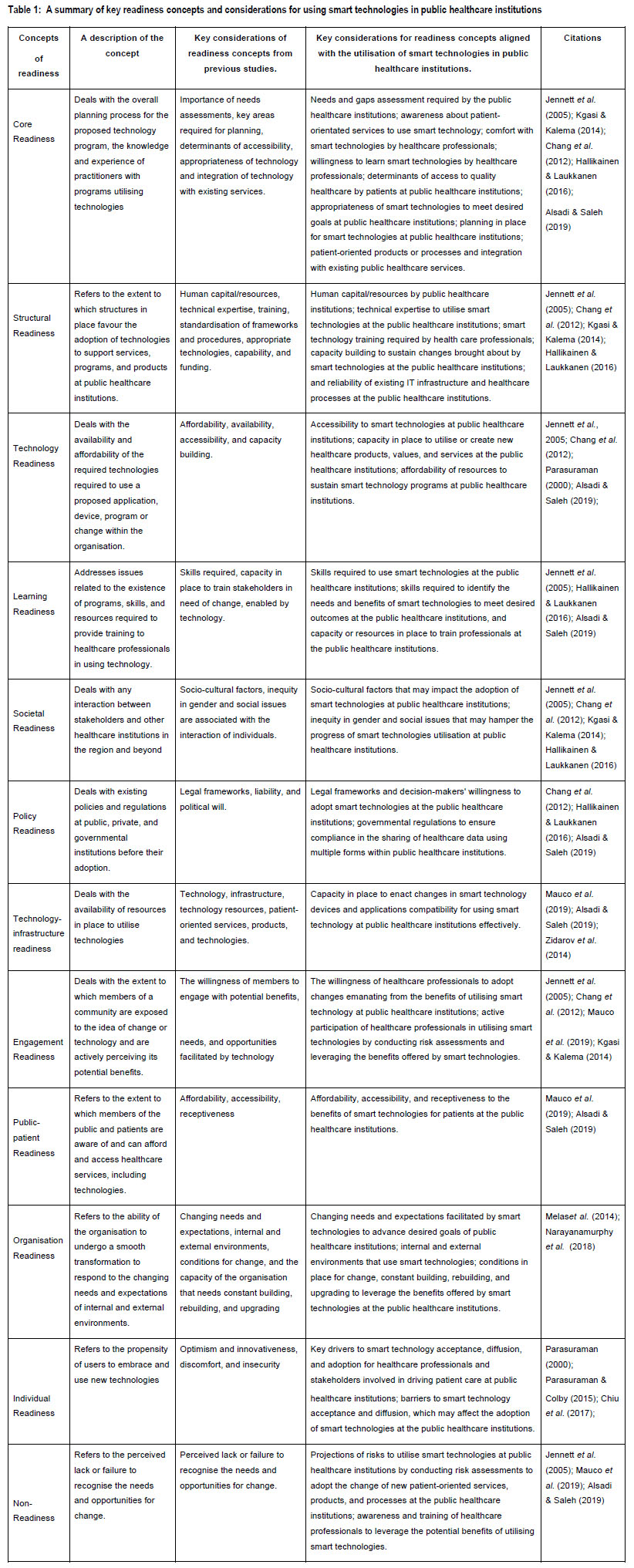
An analysis of the 14 publications identified various concepts related to readiness for the adoption of smart technologies in public healthcare institutions. These concepts include core readiness, structural readiness, technology readiness, learning readiness, societal readiness, policy readiness, technology infrastructure readiness, engagement readiness, public-patient readiness, organisational readiness, individual readiness, and non-readiness. The key considerations associated with each concept are outlined in Table 1.
3.5 Development phase
In this phase, a single development cycle was employed to create the framework. The researcher analysed the literature and identified gaps in a single cycle. The literature analysis involved steps such as problem awareness, suggestion, and development. In the development phase, the researcher began mapping the components of Institutional Theory with readiness concepts to create the framework.
Studies that employed Institutional Theory to investigate phenomena have laid the groundwork for understanding complex issues related to the environment and institutions (Parker & Scheepers, 2012). This study highlighted the influence of internal and external, formal, and informal, social, and institutional forces on public healthcare institutions, which are essential for achieving institutional change in organisational structures and processes. As discussed by Hiatt et al. (2009) and Steinhauser (2019), institutions establish authoritative guidelines for organisational behaviours. This study proposes the alignment of the concepts of readiness with organisational structures by considering routines, practices, rules, structures, processes, and norms that may or may not be established. It also considers how these concepts can be created, diffused, adopted, or adapted to enhance patient care in public healthcare institutions.
This study further reveals that established rules, norms, activities, schemas, practices, and structures, including processes, may become institutionalised or deinstitutionalised, influencing the current state of readiness of public healthcare institutions to use smart technologies to enhance patient care. According to Hiatt et al. (2009) and Steinhauser (2019), the depth of institutionalisation depends on the amount of leeway there is for personal and group interaction among social or organisational actors, both internally and externally. This study also shows that Institutional Theory can provide a better understanding of the interaction among health care professionals and actors and establish relationships as to how practices and structures may fall into decline or disuse at various levels of public healthcare institutions. This theory also provides a better basis for investigating how current interaction patterns may positively or negatively influence the adoption of smart technologies to enhance patient care.
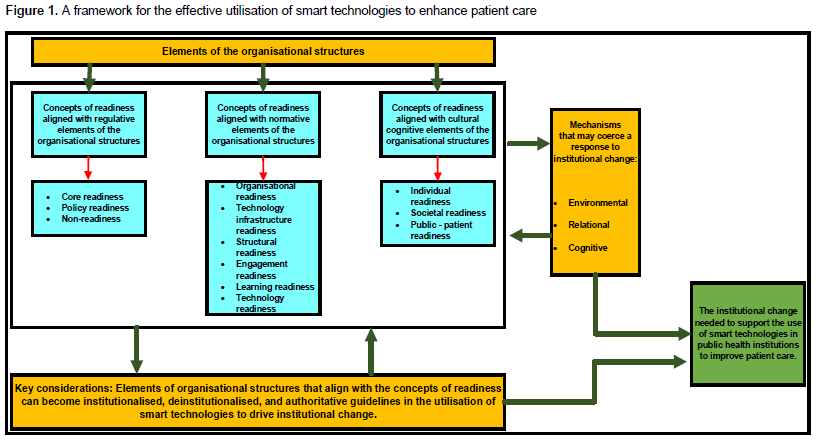
To map the concepts of readiness to the elements of organisational structures, it was necessary to group the concepts of readiness based on their descriptions as presented in this study. According to Scott (1995), Parker and Scheepers (2012), and Steinhauser (2019), the regulative elements of organisational structures play an essential role in setting rules, monitoring, and sanctioning activities to influence the state of the organisation's readiness. Therefore, this study aligns core readiness, policy readiness, and non-readiness concepts with regulative elements of organisational structures, as these may play an essential role in supporting public healthcare institutions in setting rules, monitoring, and sanctioning readiness activities, including processes leading to the successful adoption of smart technologies to enhance patient care.
According to King et al. (1994), Scott (1995), and Hiatt et al. (2009), normative elements of organisational structures consist of prescribed and proscribed structures, arrangements, and organisational practices instituted by associations, professional bodies, and organisational structures. This study aligns organisational readiness, technology-infrastructure readiness, structural readiness, engagement readiness, learning readiness, and technology readiness with the normative elements of organisational structures. These elements may become prescribed and proscribed readiness structures and practices instituted by public healthcare institutions, leading to the successful adoption of smart technologies to enhance patient care. According to Scott (1995) and Steinhauser (2019), the cultural-cognitive aspects of organisational structures emphasise shared beliefs and practices that are often taken for granted and can be adopted by other members of the organisation. This study aligns individual readiness, societal readiness, and public-patient readiness with the cultural-cognitive elements of organisational structures as best practices in leveraging smart technologies to enhance patient care in public healthcare institutions.
It is essential to note that the development of a framework to guide the effective utilisation of smart technologies for enhancing patient care in this study involved aligning readiness concepts with appropriate organisational structures based on Institutional Theory. This study suggests that readiness in public healthcare institutions can be institutionalised to drive institutional change. Public healthcare institutions should consider readiness concepts aligned with organisational structures to implement authoritative guidelines that promote the adoption of smart technologies for patient care. The mapping process should be supported by environmental, relational, and cognitive mechanisms that facilitate institutional change. The analysis of the proposed framework enables the alignment of organisational structure elements with readiness concepts, supported by environmental, relational, and cognitive mechanisms, to drive institutional change and improve patient care through the use of smart technologies in public healthcare institutions. The proposed framework is illustrated in Figure 1.
3.6
Evaluation phaseDuring the evaluation phase, the proposed framework was assessed against existing principles in the literature to determine its effectiveness in guiding healthcare practitioners in utilising smart technologies to enhance patient care in public healthcare institutions. The researcher employed three criteria to evaluate the effectiveness of the framework, as outlined by Sherer et al. (2016): coherence of external demands, managerial competence in aligning external demands with the overall quality improvement strategy, and managerial stability.
The healthcare sector is considered an important area of Information Systems (IS) research, with a focus on advancing research streams (Venkatesh et al., 2016). Srivastava & Shainesh (2015) propose that smart technologies play an essential role in meeting healthcare needs. The alignment of external institutional demands, as discussed by Sherer et al. (2016), supports the framework by guiding health care practitioners to prioritise readiness in adopting smart technologies for patient care improvement. The study emphasises the importance of acknowledging the value and contributions of external entities in achieving the goal of meeting the needs of public healthcare institutions through smart technology. Managerial competence, as highlighted by Sherer et al. (2016), is essential for health care practitioners at different levels to acquire the necessary skills and knowledge for quality improvement strategies. The study also evaluated the framework using the third factor discussed by Sherer et al. (2016), by emphasising the importance of policymaker awareness in driving goals for enhancing patient care. This research contributes to the IS field by developing a framework that aligns readiness concepts with Institutional Theory structures to effectively leverage smart technologies for patient care.
3.7
Conclusion phaseThis phase concluded the DSR cycle. By applying Institutional Theory to the healthcare sector, the study successfully extended the application of this theory. The research followed a single DSR cycle, starting with an investigation into the preparedness of public institutions to adopt smart technologies for enhancing patient care. Identified gaps in preparedness prompted an analysis of readiness concepts in the literature.
During the suggestion phase, a detailed analysis of the concept of readiness was conducted. A systematic literature review identified 12 readiness concepts: core readiness, structural readiness, technology readiness, learning readiness, societal readiness, policy readiness, technology infrastructure readiness, engagement readiness, public-patient readiness, organisational readiness, individual readiness, and non-readiness. In the development phase, the researcher aligned these readiness concepts with organisational structures, considering routines, practices, rules, structures, processes, and norms to facilitate the adoption or rejection of smart technologies that could improve patient care. This study successfully integrated organisational readiness, technology infrastructure readiness, structural readiness, engagement readiness, learning readiness, and technology readiness with normative structures and practices to guide public healthcare institutions in leveraging smart technologies for enhanced patient care. Furthermore, the study aligned individual readiness, societal readiness, and public-patient readiness with the cultural-cognitive aspects of organisational structures to support the adoption of smart technologies for improved patient care in public healthcare institutions. The framework's key contribution demonstrated how the readiness of public healthcare institutions can be institutionalised to drive institutional change, with support from environmental, relational, and cognitive mechanisms to facilitate desired institutional changes.
In the evaluation phase, this study assessed the effectiveness of the framework using three factors identified by Sherer et al. (2016): coherence of demands from external institutions, managerial competence in aligning external demands with overall quality improvement strategy, and managerial stability. By applying these factors to the framework, the study addressed a key consideration of the DSR methodology, emphasising the rigour required to use DSR as a strategy and methodology. The researcher outlined the contributions of each phase of the DSR process in answering the research questions. Following a single DSR cycle for the guiding phases, the researcher chose to evaluate the framework's effectiveness in guiding health care policymakers on the use of smart technologies to enhance patient care. This effective use of smart technologies was aligned with the study's objectives to extend Institutional Theory to public healthcare institutions to enhance patient care.
4. MANAGERIAL IMPLICATIONS
The developed framework serves as a strategic blueprint for healthcare practitioners, enabling them to systematically integrate smart technologies such as AI-driven diagnostics, IoT-based patient monitoring, and telemedicine platforms into daily clinical workflows. By following the framework, practitioners can move beyond adopter-centric trial-and-error approaches toward a structured method that prioritises patient care, data accuracy, and timely interventions. For instance, the framework might guide practitioners in using wearable sensors to track vital signs remotely or help physicians interpret real-time analytics for chronic disease management. At a managerial level, this implies that policymakers and regulators in healthcare must invest in continuous training programmes to ensure practitioners are not only technically proficient but also capable of critically evaluating technology-generated outputs. Furthermore, healthcare leaders should establish clear backup procedures to prevent over-reliance on smart technologies. Without such managerial oversight, even the most advanced technologies risk becoming underutilised or misaligned with patient needs.
For managers and policymakers within pubic healthcare institutions, three interconnected factors demand focused attention. First, external demand, such as regulatory changes, patient expectations, and budget constraints, must be systematically aligned with desired patient care outcomes. This requires managers to regularly audit technology investments against performance metrics like reduced wait times, lower readmission rates, or improved patient satisfaction. Second, the competence of healthcare practitioners in meeting these demands cannot be assumed; managers must implement competency frameworks, simulation-based assessments, and review mechanisms to ensure skills keep pace with evolving technologies. Third, managerial stability across hierarchical levels, from hospital administration to regional health authorities, is critical for sustaining long-term goals. Frequent leadership turnover can disrupt technology adoption cycles, erode staff trust, and fragment data integration efforts. Therefore, policymakers should incentivise continuity through multi-year funding commitments and leadership development pipelines. Ultimately, the framework highlights that successful smart technology adoption in public healthcare is not merely a technical challenge but a managerial one, requiring coherent strategy, workforce empowerment, and institutional resilience.
5. CONCLUSIONS, LIMITATIONS, AND FUTURE RESEARCH
This study investigated the application of Institutional Theory to enhance patient care in public healthcare institutions in South Africa by leveraging smart technologies. A literature review was conducted to identify readiness concepts that aligned with the organisational structures of Institutional Theory. The review of 14 publications revealed 12 readiness concepts: core readiness, structural readiness, technology readiness, learning readiness, societal readiness, policy readiness, technology infrastructure readiness, engagement readiness, public-patient readiness, organisational readiness, individual readiness, and non-readiness.
The discussion on each aspect of readiness emphasised the importance of health care practitioners being aware and well-prepared to utilise smart technologies effectively in improving patient care at public healthcare facilities. This study proposes that understanding key readiness definitions can help align with the organisational structures of Institutional Theory to promote the institutionalisation of best practices, norms, routines, and methods, ultimately leading to established guidelines for public healthcare institutions. Furthermore, healthcare professionals should actively promote the adoption of best practices to achieve the desired outcomes of enhancing patient care.
The concepts of readiness were later aligned with the elements of organisational structures in Institutional Theory, which consist of regulative, normative, and cultural-cognitive elements. Through a detailed analysis of each readiness concept and the role that organisational structures play in institutionalising or deinstitutionalising change within an organisation, the framework proposed the following mappings: The concepts of core readiness, policy readiness, and non-readiness were equally suitable for aligning with the regulative elements of organisational structures. These concepts play an essential role in supporting public healthcare institutions in establishing rules, monitoring, and sanctioning readiness activities, including processes that lead to the successful use of smart technologies for patient care. Similarly, the concepts of organisational readiness, technology-infrastructure readiness, structural readiness, engagement readiness, learning readiness, and technology readiness are equally suitable for aligning with the normative elements of organisational structures. These concepts represent prescribed and proscribed readiness structures and practices instituted by healthcare public institutions, leading to the successful use of smart technologies for patient care. Finally, the concepts of individual readiness, societal readiness, and public-patient readiness are equally suitable for aligning with the cultural-cognitive elements of organisational structures. Best practices in using smart technologies may become equally valuable shared readiness practices to drive institutional change and enhance patient care at public healthcare institutions.
Mapping the concept of readiness to the organisational structures of Institutional Theory allows healthcare practitioners to be guided in leveraging smart technologies to enhance patient care. By considering the environmental, relational, and cognitive factors of Institutional Theory, stakeholders can better understand how these factors influence responses to institutional change. This study contributes to existing knowledge by successfully mapping organisational structures and readiness concepts, along with the relevant environmental, relational, and cognitive factors, to drive institutional change and enhance patient care through the adoption of smart technologies in public healthcare institutions.
Evaluating the effectiveness of the framework provided insight into applying Institutional Theory in different public healthcare institution settings to guide the conversation on the use of smart technologies for enhancing patient care. Building on factors that support the Institutional Theory proposed by Sherer et al. (2016), this study effectively assessed the framework's efficacy in public healthcare institutions. Contributions to the body of knowledge in addressing gaps in the application of Institutional Theory to public healthcare institutions to achieve desired outcomes are essential. This study acknowledges limitations in expanding the search for readiness concepts to early publications to align with the organisational structures of Institutional Theory. By acknowledging this limitation, the study recommends further research by academics, healthcare practitioners, and stakeholders in the healthcare sector to make new contributions to the body of knowledge. The study developed a framework for effectively using smart technologies to enhance patient care and aligned the concept of readiness with the organisational structures of Institutional Theory. This alignment could lead to the establishment of authoritative guidelines for social behaviour to enhance patient care. One observed limitation was the evaluation of the framework's effectiveness in addressing the needs of various structures of public healthcare institutions and the level of stakeholder awareness to institutionalise the use of smart technologies for enhancing patient care. This study offers an opportunity for practitioners to further test the framework's effectiveness within the context of Institutional Theory to institutionalise or deinstitutionalise elements of organisational structures into authoritative guidelines for enhancing patient care through the use of smart technologies.
This study examined the mechanisms that influence responses to institutional changes in public healthcare institutions, including environmental, relational, and cognitive factors. The framework outlines how these mechanisms interact with readiness concepts within the Institutional Theory, highlighting the role of regulative, normative, and cultural-cognitive elements in organisational structures. One limitation of the study was the lack of detailed exploration of these elements and their potential impact on enhancing patient care in public healthcare institutions. This missed opportunity could serve as a basis for further research to address this gap and provide guidance for practitioners seeking to enhance patient care in public healthcare settings.
This study employed Design Science Research as its pragmatic strategy and research method. It followed a single DSR cycle encompassing the problem awareness, suggestion, development, evaluation, and conclusion phases. The study did not use multiple DSR sub-cycles, which could be seen as a limitation. The researcher suggests that employing multiple DSR sub-cycles could offer more comprehensive insights and enrich the framework development. The study made use of a systematic literature review and document analysis as data collection methods, which may have provided limited insights into aligning readiness concepts with organisational structures of Institutional Theory to enhance patient care.
Conflict of interest: The authors declare no conflict of interest with respect to the research, authorship and publication of the article.
Data availability: This study employed data from a single round of systematic literature review, in which secondary data were examined.
Ethical clearance and informed consent statement: This study did not involve human interactions, so the researchers did not need to obtain ethical clearance. Secondary data was used for this study, eliminating the need for informed consent to be shared with participants.
Funding: The authors did not receive any financial support for research, authorship and publication of the article.
REFERENCES
2. LITERATURE REVIEW
-
Al-Fuqaha, A., Guizani, M., Mohammadi, M., Aledhari, M., & Ayyash, M. (2015). Internet of things: A survey on enabling technologies, protocols, and applications. IEEE Communications Surveys & Tutorials, 17(4), 2347-2376. https://doi.org/10.1109/COMST.2015.2444095
» https://doi.org/10.1109/COMST.2015.2444095 -
Alexei, A., Platon, N., Bolun, I., & Alexei, A. (2024). Smart and digital healthcare. Advanced technologies and security issues. In Proceedings of the Central and Eastern European eDem and eGov Days 2024 (pp. 288-294). https://doi.org/10.1145/3670243.3673857
» https://doi.org/10.1145/3670243.3673857 -
Alsadi, M. & Saleh, A. (2019). Electronic health records implementation readiness: An integrative review. Open Journal of Nursing, 9(2),152-162. https://doi.org/10.4236/ojn.2019.92014
» https://doi.org/10.4236/ojn.2019.92014 -
Bazel, M. A., Mohammed, F., & Ahmed, M. (2021, August). Blockchain technology in healthcare big data management: Benefits, applications and challenges. In 2021 1st International Conference on Emerging Smart Technologies and Applications (eSmarTA) (pp. 1-8). IEEE. https://doi.org/10.1109/eSmarTA52612.2021.9515747
» https://doi.org/10.1109/eSmarTA52612.2021.9515747 - Canton, J. (2015). Future smart: Managing the game-changing trends that will transform your world. Grand Central Publishing.
-
Cater-Steel, A., Toleman, M., & Rajaeian, M. M. (2019). Design science research in doctoral projects: An analysis of Australian theses. Journal of the Association for Information Systems, 20(12), 3. https://doi.org/DOI:10.17705/1jais.00587
» https://doi.org/DOI:10.17705/1jais.00587 -
Chang, I. C., Li, Y. C., Wu, T. Y., & Yen, D. C. (2012). Electronic medical record quality and its impact on user satisfaction-Healthcare providers' point of view. Government Information Quarterly, 29(2), 235-242. https://doi.org/10.1016/j.gig.2011.07.006
» https://doi.org/10.1016/j.gig.2011.07.006 -
Chiu, C.Y., Chen, S. & Chen, C.L. (2017). An integrated perspective of TOE framework and innovation diffusion in broadband mobile applications adoption by enterprises. International Journal of Management, Economics and Social Sciences (IJMESS), 6(1), 14-39. https://hdl.handle.net/10419/157921
» https://hdl.handle.net/10419/157921 -
Coskun-Setirek, A., & Tanrikulu, Z. (2021). Digital innovations-driven business model regeneration: A process model. Technology in Society, 64, 101461. https://doi.org/10.1016/j.techsoc.2020.101461
» https://doi.org/10.1016/j.techsoc.2020.101461 -
Davis, F. D. (1989). Perceived Usefulness, Perceived Ease of Use, and User Acceptance of Information Technology. MIS Quarterly 1 September 1989; 13 (3), 319-340. https://doi.org/10.2307/249008
» https://doi.org/10.2307/249008 -
De Langhe, R., & Schliesser, E. (2017). Evaluating philosophy as exploratory research. Metaphilosophy, 48(3), 227-244. https://doi.org/10.1111/meta.12244
» https://doi.org/10.1111/meta.12244 -
DiMaggio, P.J. & Powell, W.W. (1983). The iron cage revisited: Institutional isomorphism and collective rationality in organisational fields. American Sociological Review, 48(2), 147-160. https://doi.org/10.2307/2095101
» https://doi.org/10.2307/2095101 -
Gandomi, A. & Haider, M. (2015). Beyond the hype: Big data concepts, methods, and analytics. International Journal of Information Management, 35(2), 137-144. https://doi.org/10.1016/j.ijinfomgt.2014.10.007
» https://doi.org/10.1016/j.ijinfomgt.2014.10.007 -
Gharaibeh, A., Salahuddin, M.A., Hussini, S.J., Khreishah, A., Khalil, I., Guizani, M., & AI-Fugaha, A. (2017). Smart cities: A survey on data management, security, and enabling technologies, IEEE communications survey & tutorials, 19(4), 2456-2501. https://doi.org/10.1109/COMST.2017.2736886
» https://doi.org/10.1109/COMST.2017.2736886 -
Gholamhosseini, L. & Ayatollahi, H. (2017). The design and application for an e-health readiness assessment tool. Health Information Management Journal, 46(1), 32-41. https://doi.org/10.1177/1833358316661065
» https://doi.org/10.1177/1833358316661065 - Govindarajan, V. (2016). The three-box solution: A strategy for leading innovation. Harvard Business Review Press.
-
Hallikainen, H., & Laukkanen, T. (2016). How technology readiness explains acceptance and satisfaction of digital services in B2B healthcare sector? PACIS 2016 Proceedings, Paper 294. https://aisel.aisnet.org/pacis2016/294
» https://aisel.aisnet.org/pacis2016/294 -
Hiatt, S. R., Sine, W. D., & Tolbert, P. S. (2009). From Pabst to Pepsi: The deinstitutionalization of social practices and the creation of entrepreneurial opportunities. Administrative Science Quarterly, 54(4), 635-667. https://doi.org/10.2189/asqu.2009.54.4.635
» https://doi.org/10.2189/asqu.2009.54.4.635 -
Hevner, A. R., & Wickramasinghe, N. (2018). Design science research opportunities in health care. In: Wickramasinghe, N., Schaffer, J.(eds) Theories to inform superior health informatics research and practice. healthcare delivery in the information age. Springer. (pp. 3-18). https://doi.org/10.1007/978-3-319-72287-0_1
» https://doi.org/10.1007/978-3-319-72287-0_1 -
Holzinger, A., Röcker, C. & Ziefle, M. (2015). From smart health to smart hospitals. Smart Health: Open Problems and Future Challenges, 1-20. https://doi.org/10.1007/978-3-319-16226-3_1
» https://doi.org/10.1007/978-3-319-16226-3_1 -
Jennett, P., Jackson, A., Ho, K., Healy, T., Kazanjian, A., Woollard, R., Haydt, S. & Bates, J. (2005). The essence of telehealth readiness in rural communities: an organisational perspective. Telemedicine Journal & e-Health, 11(2), 137-145. https://doi.org/10.1089/tmj.2005.11.137
» https://doi.org/10.1089/tmj.2005.11.137 -
Kaushik, V., & Walsh, C. A. (2019). Pragmatism as a research paradigm and its implications for social work research. Social Sciences, 8(9), 255. https://doi.org/10.3390/socsci8090255
» https://doi.org/10.3390/socsci8090255 -
Kgasi, M., & Kalema, B. (2014). Assessment E-health readiness for rural South African areas. Journal of Industrial and Intelligent Information, 2(2), 131-135. https://doi.org/10.12720/jiii.2.2.131-135
» https://doi.org/10.12720/jiii.2.2.131-135 -
King, J.L., Gurbaxani, V., Kraemer, K.L., McFarlan, F.W., Raman, K.S. & Yap, C.S. (1994). Institutional factors in information technology innovation. Information Systems Research, 5(2), 139-169. https://doi.org/10.1287/isre.5.2.139
» https://doi.org/10.1287/isre.5.2.139 -
Kimaro, H.C. & Nhampossa, J.L. (2005). Analysing the problem of unsustainable health information systems in less-developed economies: case studies from Tanzania and Mozambique. Information Technology for Development, 11(3), 273-298. https://doi.org/10.1002/itdj.20016
» https://doi.org/10.1002/itdj.20016 -
Kuechler, W., & Vaishnavi, V. (2012). A framework for theory development in design science research: multiple perspectives. Journal of the Association for Information systems, 13(6), 3. https://doi/org/10.17705/j.jais.00300
» https://doi/org/10.17705/j.jais.00300 -
Lee, S.M. & Trimi, S. (2018). Innovation for creating a smart future. Journal of Innovation & Knowledge, 3(1):1-8. https://doi.org/10.1016/j.jik.2016.11.001
» https://doi.org/10.1016/j.jik.2016.11.001 -
Livari, J. (2015). Distinguishing and contrasting two strategies for design science research. European Journal of Information Systems, 24(1), 107-115. https://doi.org/10.1057/ejis.2013.35
» https://doi.org/10.1057/ejis.2013.35 -
Lobaccaro, G., Carlucci, S., & Löfström, E. (2016). A review of systems and technologies for smart homes and smart grids. Energies, 9(5), 348. https://doi.org/10.3390/en9050348
» https://doi.org/10.3390/en9050348 -
Lytras, M. D., Papadopoulou, P., & Sarirete, A. (2020). Chapter 1 - Smart Healthcare: emerging technologies, best practices, and sustainable policies. In Next Generation Technology Driven Personalised Med&Smart Healthcare, Innovation in Health Informatics, Academic Press, 3-38. https://doi.org/10.1016/B978-0-12-819043-2.00001-0
» https://doi.org/10.1016/B978-0-12-819043-2.00001-0 -
MacKenzie, H., Dewey, A., Drahota, A., Kilburn, S., Kalra, P., Fogg, C., & Zachariah, D. (2012). Systematic reviews: what they are, why they are important, and how to get involved. Journal of Clinical and Preventive Cardiology, 1(4), 193-202. https://pure.port.ac.uk/ws/portalfiles/portal/4704726/Systematic_reviews_what_they_are.pdf
» https://pure.port.ac.uk/ws/portalfiles/portal/4704726/Systematic_reviews_what_they_are.pdf -
Malungana, L., & Motsi, L. (2024). An investigation of healthcare professionals' intention to use Smart Card Technology. South African Journal of Information Management, 26(1), 1663. https://doi.org/10.4102/sajim.v26i1.1663
» https://doi.org/10.4102/sajim.v26i1.1663 -
Marsan, J., Audebrand, L.K., Croteau, A.M. & Magnin, G. (2017). Healthcare service innovation based on information technology: The role of social values alignment. Systèmes d'information et management, 22(1), 97-127. https://doi.org/10.3917/sim.171.0097
» https://doi.org/10.3917/sim.171.0097 -
Mauco, K.L., Scott, R. & Mars, M. (2019). Development of an E-Health readiness assessment framework for botswana and other developing countries: Interview Study. JMIR Medical Informatics, 7(3), 1-10. https://doi.org/10.2196/12949
» https://doi.org/10.2196/12949 -
Melas, C. D., Zampetakis, L. A., Dimopoulou, A., & Moustakis, V. S. (2014). An empirical investigation of technology readiness among medical staff based in Greek hospitals. European Journal of Information Systems, 23(6), 672-690. https://doi.org/10.1057/ejis.2013.23
» https://doi.org/10.1057/ejis.2013.23 -
Meyer, J.W. & Rowan, B. (1977). Institutionalised Organisations: Formal structure as myth and ceremony. The American Journal of Sociology, 83(2), 340-363. https://doi.org/10.1086/226550
» https://doi.org/10.1086/226550 -
Mhlanga, D. & Hassan, A. (2022). An investigation of the factors influencing the choice of healthcare facility in South Africa. International Journal of Research in Business and Social Science (2147-4478), 11(4), 50-58. https://doi.org/10.20525/iirbs.v11i4.1765
» https://doi.org/10.20525/iirbs.v11i4.1765 -
Narayanamurphy, G., Gurumurthy, A., Subramanian, N., & Moser, R. (2018). Assessing the readiness to implement lean in healthcare institutions-A case study. International journal of production economics, 197, 123-142. https://doi.org/10.1016/j.iipe.2017.12.028
» https://doi.org/10.1016/j.iipe.2017.12.028 -
Negra, R., Jemili, I., & Belghith, A. (2016). Wireless body area networks: Applications and technologies. Procedia Computer Science, 83, 1274-1281. https://doi.org/10.1016/i.procs.2016.04.266
» https://doi.org/10.1016/i.procs.2016.04.266 -
Nielsen, J.A., Mathiassen, L. & Newell, S. (2014). Theorisation and translation in information technology institutionalisation: Evidence from Danish home care. Mis Quarterly, 38(1), 165-186. https://doi.org/10.25300/MISQ/2014/38.1.08
» https://doi.org/10.25300/MISQ/2014/38.1.08 - Osembe, L. & Khomo, F.L. (2022). Measuring the effectiveness of e-learning contents for active learning when deployed on mobile and web-based design interfaces using the Multi-Motive Information Systems Continuance (MISC) Model. The Independent Journal of Teaching and Learning, 17(2), 7-27.
-
Parasuraman, A. (2000). Technology Readiness Index (TRI) a multiple-item scale to measure readiness to embrace new technologies. Journal of service research, 2(4), 307-320. https://doi.org/10.1177/109467050024001
» https://doi.org/10.1177/109467050024001 -
Parasuraman, A., & Colby, C. L. (2015). An updated and streamlined technology readiness index: TRI 2.0. Journal of Service Research, 18(1), 59-74. https://doi.org/10.1177/1094670514539730
» https://doi.org/10.1177/1094670514539730 -
Parker, C.M. & Scheepers, R. 2012. Applying King et al.'s taxonomy to frame the IS discipline's engagement in green IS discourse. 23rd Australian Conference on Information Systems, 1-11. https://aisel.aisnet.org/acis2012/113/
» https://aisel.aisnet.org/acis2012/113/ -
Plageras, A. P., Stergiou, C., Kokkonis, G., Psannis, K. E., Ishibashi, Y., Kim, B. G., & Gupta, B. B. (2017, July). Efficient large-scale medical data (ehealth big data) analytics in internet of things. In 2017 IEEE 19th Conference on Business informatics (CBI) (Vol. 2, pp. 21-27). IEEE. https://doi.org/10.1109/CBI.2017.3
» https://doi.org/10.1109/CBI.2017.3 -
Saadi, I. A., & Che Razak, R. (2019). Technological capability, innovative human capital and organizational sustainability: A proposed framework. International Journal of Innovation, Management and Technology, 10(6), 219-228. https://doi.org/10.18178/ijimt.2019.10.6.864
» https://doi.org/10.18178/ijimt.2019.10.6.864 -
Savjani, K., Haseeb, F. & Reay, M. (2018). Measuring quality and outcomes in intensive care. Surgery (Oxford), 36(4):196-200. https://doi.org/10.1016/j.mpsur.2018.01.008
» https://doi.org/10.1016/j.mpsur.2018.01.008 - Saunders, M.N.K., Lewis, P. & Thornhill, A. (2019) Research Methods for Business Students. 8th Edition, Pearson, New York.
- Scott, W.R. (2004). Institutional theory: Contributing to a theoretical research program. In K.G. Smith and M.A. Hitt (Eds.), Great minds in management: The process of theory development (460-484). Oxford: Oxford University Press.
- Scott, W. R. (1995). Symbols and organizations: from Barnard to the institutionalists. Organization theory: from Chester Barnard to the present and beyond, 38-55.
-
Sherer, S. A., Meyerhoefer, C. D., & Peng, L. (2016). Applying institutional theory to the adoption of electronic health records in the US. Information & Management, 53(5), 570-580. https://doi.org/10.1016/j.im.2016.01.002
» https://doi.org/10.1016/j.im.2016.01.002 -
Srivastava, S. C., & Shainesh, G. (2015). Bridging the Service Divide Through Digitally Enabled Service Innovations: Evidence from Indian Healthcare Service Providers! Mis Quarterly, 39(1), 245-267. https://doi.org/10.25300/MISQ/2015/39.1.11
» https://doi.org/10.25300/MISQ/2015/39.1.11 -
Steinhauser, S. (2019). Network-based business models, the institutional environment, and the diffusion of digital innovations: Case studies of telemedicine networks in Germany. Schmalenbach Business Review, 71(3), 343-383. https://doi.org/10.1007/s41464-019-00076-9
» https://doi.org/10.1007/s41464-019-00076-9 -
Tan, J., Shao, Y., & Li, W. (2013). To be different, or to be the same? An exploratory study of isomorphism in the cluster. Journal of Business Venturing, 28(1), 83-97. https://doi.org/10.1016/j.jbusvent.2012.02.003
» https://doi.org/10.1016/j.jbusvent.2012.02.003 -
Tania, B. & Mauro, D. (2023). A Review of Trustworthiness of Digital Assistants for Personal Healthcare. ACM Computing Surveys (CSUR), 57(7), 1-34. https://doi.org/10.1145/3714999
» https://doi.org/10.1145/3714999 - Thangam, D., Malali, A.B., Subramanian, G., Mohan, S., & Park, J.Y. (2022). Internet of Things: a smart technology for healthcare industries. In Healthcare Systems and Health Informatics (pp. 3-15). CRC Press.
-
Tarafdar, M., & Tanriverdi, H. (2018). Impact of the information technology unit on information technology-embedded product innovation. Journal of the Association for Information Systems, 19(8), 2. https://doi.org/10.17705/1jais.00507
» https://doi.org/10.17705/1jais.00507 - Tornatzky, L. & Fleischer, M. (1990). The process of technology innovation, Lexington, MA.
-
Vaishnavi, V.K., Vaishnavi, V.K., & Kuechler, W. (2015). Design Science Research Methods and Patterns: Innovating Information and Communication Technology, 2nd Edition (2nd ed.). CRC Press. https://doi.org/10.1201/b18448
» https://doi.org/10.1201/b18448 -
Venkatesh, V., Rai, A., Sykes, T. A., & Aljafari, R. (2016). Combating Infant Mortality in Rural India: Evidence from a Field Study of eHealth Kiosk Implementations. MIS Quarterly, 40(2), 353-380. https://doi.org/10.25300/MISQ/2016/40.2.04
» https://doi.org/10.25300/MISQ/2016/40.2.04 -
World Health Organisation (WHO) (2016). Atlas of African Health Statistics: Health Situation Analysis of the African Region.http://www.aho.afro.who.int/.pdf.
» http://www.aho.afro.who.int/.pdf -
Yachir, A., Djamaa, B., Mecheti, A., Amirat, Y., & Aissani, M. (2016). A comprehensive semantic model for smart object description and request resolution in the internet of things. Procedia Computer Science, 83, 147-154. https://doi.org/10.1016/j.procs.2016.04.110
» https://doi.org/10.1016/j.procs.2016.04.110 -
Yusif, S., Hafeez-Baig, A., & Soar, J. (2017). e-Health readiness assessment factors and measuring tools: A systematic review. International Journal of Medical Informatics, 107, 56-64. https://doi.org/10.1016/j.ijmedinf.2017.08.006
» https://doi.org/10.1016/j.ijmedinf.2017.08.006 -
Zidarov, D., & Poissant, L. (2014). Exploring factors in the systematic use of outcome measures: a multi-disciplinary rehabilitation team perspective. Open Journal of Theraphy and Rehabilitation, 2, 86-96. http://dx.doi.org/10.4236/ojtr.2014.22013
» http://dx.doi.org/10.4236/ojtr.2014.22013