Organisational Politics and Job Stress among SMES Employees
Abstract
Organisational politics has developed into an essential construct in organisational research. It has attracted the attention of management researchers and organisational psychologists worldwide. Politics is an integral part of any organisation; however, there are key variances in the level and strength of such politics. Organisational politics is a significant element of organisational being, which represents a conduct in which individual benefits are secured over the organisational benefits. There is however, till to date insufficient research in the Small and Medium Enterprises (SMEs) sector. This study examines the influence of organisational politics on job stress among SMEs employees in Matlosana Local District. A quantitative method (questionnaire survey) was used to gather data from 431 SMEs employees in Matlosana Local District of South Africa. Smart PLS 3 was used to test the relationships among the six hypotheses. The study validates that there is a significant positive relationship between political behaviour, get ahead, pay and promotion policies on time stress and anxiety. The findings also emphasised that organisational politics is considered as a hindrance-related stressor that hampers the proper functioning of individual employees.
Get ahead; job stress; organisational politics; pay and promotion policies; political behaviour; small and medium enterprises; social exchange theory and Matlosana Local District
1. INTRODUCTION
Organisational politics is a significant element of organisational being, which represents a conduct in which individual benefits are secured over the organisational benefits (Labrague, McEnroe-Petitte, Gloe, Tsaras, Arteche & Maldia 2017). Organisational politics are defined as actions that allow individuals in organisations to achieve objectives without following appropriate channels (Olorunleke 2015). Swartz and Potgieter (2017) describe organisational politics as actions involved inside organisations to gain, expand and utilise authority and other resources to acquire an individual's ideal results in a state in which there is doubt or inconsistency about preferences.
From the literature, different kind of actions, which are focused on attending to the self-centredness of workers and supervisors at all levels, are regarded as a fragment of organisational politics, which mostly rest on people's perceptions (Liang & Wang 2016). Perception of politics incorporates numerous acts of impact and exercise of authority inside an organisational environment which for the most part results in negative results (Faiz 2018). Perceived organisational politics has been considered as a strategic action made by a person inside an organisation that will prompt long term or short term individual outcome to the detriment of others (Hassan, Vina & Ithnin 2017). As per the model presented by Ferris, Russ and Fandt (1989), workplace and employee influences turn to be precursors of perceived organisational politics, which thusly offer increase to various work outcomes such as, job involvement, job satisfaction, job anxiety, turnover and absenteeism (Hassan et al. 2017). Employees who feel exploited by organisational politics commonly generate negative practices towards work and the whole organisation, influencing their performances (Jain & Ansari 2018).
The nature of organisational politics includes negative consequences on employees' personalities, behaviours and performance including job satisfaction, organisational commitment, turnover intentions; negligent behavior, job burnout and job stress (Hassan et al. 2017). Sadeghi, Khedmati and Yousefi (2018) explained job stress as an employee's responses to features of the job setting that appear mentally and physically upsetting. It highlights a deprived fitting among the employee's abilities and his or her job setting, in which excessive demands are made from the employee or the employee is not completely equipped to manage specific circumstances. Taking this into consideration organisational politics will prompt job stress and will hamper performance in the work environment. In other words, people who perceive high levels of organisational politics will also encounter high levels of job stress (Jam, Donia, Raja & Ling 2017).
The principal aim of this research is to examine the influence of organisational politics on job stress among SMEs in Matlosana Local District in South Africa. An effort is made to apply the social exchange relationship in this research context. This undertaking is considered to give a solid theoretical grounding to the current study. All in all, the findings of this article are considered to contribute to new knowledge of the current collection of Human Resources (HR) literature on organisational politics influence on job stress, as well as providing practical implications to practitioners in the SMEs sector, especially with regards to developing nations.
2. PROBLEM STATEMENT
The detrimental effect of organisational politics on desirable job outcomes has been of interest to organisational behaviour scholars, particularly in North America and Europe. This leaves a gap in developing countries (Jam et al. 2017).Despite the fact that there are studies conducted on organisational politics and job satisfaction (Akanbi & Ofoegbu 2013; Hassan et al. 2017), turnover intention (Delle 2013; Kaya, Aydin & Ayhan 2016), performance (Abbas & Awan 2017; Kartono, Hilmiana & Muizu 2017), organisational citizenship behaviour (Chang, Rosen, Siemieniec & Johnson 2012; Hsiung, Lin & Lin 2012) and commitment (Shrestha & Mishra 2015; Singh 2012), empirical evidence of organisational politics and job stress has not attained due consideration of researchers.
Organisational politics has been researched in different settings by focusing on perceived organisational politics influences on organisational commitment among supporting staff members at a selected higher education institution (Donald, Bertha & Lucia 2016:29); work stress, burnout and organisational politics: perceptions and experience of senior managers in the South African government sector (Swartz & Potgieter 2017:1); perceptions of organisational commitment, job satisfaction and turnover intentions in a post-merger South African tertiary institution (Martin & Roodt 2008:23); and perceptions of organisational politics, frustration with work and occupational commitment in a sport and recreation department in Gauteng (Radebe & Dhurup 2016:152). There is practically no evidence found in South Africa particularly within the SMEs sector. The present study attempts to address this lacuna in organisational politics literature. The purpose of this research is to determine the influence of organisational politics on job stress among SMEs employees in Matlosana Local District of South Africa.
The literature outlines two major aspects of this article which include organisational politics and job stress.
3.1 Social Exchange Theory
The social exchange theory (SET) was established for observing human behaviour (Sun & Xia 2018) in an effort to understand organisational behaviour (Oh 2015). According to Jinyang (2015), the philosophy of social exchange has the belief that there are specific standards that direct behaviour and approach. The theory stipulates that the exchange practice be fair and shared principles would establish the connection, resulting in trust (Lee, Capella, Taylor, Luo & Gabler 2014). This makes the way for quality, steadiness and the tenure of the exchange relationship (Jinyang 2015). Exchange parties trust each other to fulfil their obligations over a long period (Jinyang 2015) and the exchange is ruled to be a fair one, with fairness defined principally by common adherence to the norm of reciprocity (Colquitt, Scott, Rodell, Long, Zapata, Conlon & Wesson 2013).
In the exchange process, both parties cultivate a psychological commitment to the relationship, as directed by increased affective attachment, a sense of loyalty, mutual support and an authentic concern for the other's well-being (Oh 2015). Bodla, Afza and Danish (2015) assert that social exchange theory offers a conceptually coherent description for an employee's work-related outcomes. Khan, Zhiqiang, Sarpong and Naz (2017) assert that organisational politics is well known within the workplace situation and propose that politics are a norm that directs behaviour within most organisations. Since organisational politics frequently impacts negatively on workers, they are observed as being biased, which according to the social exchange theory, places the exchange relationship in danger, conflicting with the advantage gained from justice (Saleem 2015).
Once employees establish social exchange relationships within the organisation, they have improved job performance, enhanced organisational citizenship behaviours and display lower propensity towards turnover intentions, lower perceptions of organisational politics as well as job stress (Ahmad, Nisar, Othman & Kamil 2017). The model proposes that workers establish social exchange relationships to the degree that they get valuable benefits that are allocated in a fair fashion. Employment conditions that create job stress are expected to disrupt the state of affairs within the work setting. Job stress is generally detrimental to the employees and the organisation and often perceived as unfair. This construct also hampers the improvement of work and social exchange relationships, as it could manifest through organisational politics (O'Boyle, Forsyth, Banks & McDaniel 2012). In the context of the social exchange theory, it is proposed that the lack of social exchange relationships among employees can create perceptions of organisational politics and have AN impact on job outcomes within the working environment (Bodla et al. 2015).
The SET model proposes that workers establish social exchange relationships to the degree that they get valuable benefits that are allocated fairly. Employments that create job stress are expected to disrupt the state of affairs. Job stress is generally detrimental to the employees and the organisation and often perceived as unfair. This construct also hampers the improvement of work and social exchange relationships, as it could manifest through organisational politics (Cropanzano, Rupp & Byrne 2003). In the context of social exchange theory, it is proposed that the lack of a social exchange relationship among employees could produce perceptions of organisational politics and job stress within the work environment (Cropanzano et al. 2003). For this study, SET is integrated as a basis of the relationship between the employees and the organisation in order to explore the interaction of the features within the workplace, namely, organisational politics and its influence on job stress.
3.2
Small and Medium Enterprises (SMES)According to Turner and Ledwith (2018:276) there is no a distinct, universally appropriate meaning of the concept small and medium enterprises (SME). The World Bank defines SMEs as firms that hire 5 to 199 workers, whereas the European Commission (EC) defines SMEs as businesses that hire less than 500 workers. In the United States of America (USA) a business is regarded as an SME once it obligates certain quantitative and qualitative criteria (Hashim & Abdullah 2000:67). Ayyagari, Demirguc-Kunt and Maksimovic (2011:6) comprehend that the term SME includes a variety of descriptions and measures that differ across countries as reported by sources on SME statistics worldwide. The countries' economies are different and it is challenging to suggest a generally recognised definition of SMEs. Nevertheless, in the South African context SMEs are described in a variety of means, usually with the orientation on the number of workers, turnover bands and variances according to industry sector or subsector (Chingwaru 2014:44).
According to the National Small Business Amendment Act (2004), Act No 29, a "small business" means a separate and distinct business entity (including co-operative enterprises and non-government enterprises) managed by one owner or more, including its branches or subsidiaries (if any), is predominantly carried on in any sector or subsector of the economy and which can be classified as a micro-enterprise, a very small enterprise, a small enterprise or a medium enterprise.
3.3
Organisational PoliticsOrganisational politics is described as the manner of utilising influence actions that are not required by a formal role in the organisation to augment self-interest to the detriment of the organisational objectives (Yilmaz 2014). According to Guo, Kang, Shao and Halvorsen (2019:787) organisational politics refers to non-authorised practices and activities purposefully intended to secure and upgrade personal gains normally in discord with organisational objectives. Organisational politics is explained as actions involved inside organisations to gain, expand and utilise authority and other resources to acquire an individual's ideal results in a state in which there is doubt or inconsistency about preferences (Swartz & Potgieter 2017:1). When organisational politics is seen from the side of employees, it regularly takes a negative structure and has been observed to be a negative construct within the working environment and is labelled as perceived organisational politics (POP) (Atta & Khan 2016:22). Perceived organisational politics has been considered as a strategic action taken by a person inside an organisation that will lead to short term or long term personal gains at the expense of other people (Hassan et al. 2017:479).
Ferris et al. (1989) constructed a model of POP which becomes the base of several studies later and remains the prevalent model. Several researches validated it by discovering its negative relationship with job related desirable outcomes like satisfaction, commitment, performance and so forth and positive relationships with job related undesirable outcomes like stress, burnout, turnover and so on (Ahmad, Akhtar, Ur Rahman, Imran & Ul Ain 2017). Varela-Neira, del Río Araujo and Sanmartín (2018) present that the concept of organisational politics is conceptualised as a three-dimensional construct. First, general political behaviour evolves when individuals pursue self-interested behaviours to achieve desired results. Secondly, go along to get ahead construct whereby individuals demonstrate silence and behave passively for the purpose of gaining specific benefits. Thirdly, pay and promotion policies, involves individuals who are responsible for the implementation of policies and react politically in the process of making decisions. The validation of perceptions of organisational politics scale by Kacmar and Carlson (1997) focused on the first three dimensions.
3.3.1 General Political Behaviours
Lau, Scully and Lee (2018:249) state that this dimension concentrates on how individuals act politically and the means by which they acquire individual gains. Ahmad et al. (2017:376) explain that political behaviours have a tendency to escalate in a situation where guidelines are not adhered to and in such circumstances; individuals progressively develop their personal guidelines for achieving a superior place in the organisation. Additionally, political behaviours could also exist in environments where there is a lack of valued resources, such as increment, budget and work space causes competition between employees and groups, which in turn result in politics (Kaya, Aydin & Ayhan 2016).
3.3.2 Go Along To Get Ahead
This construct describes the actions displayed by workers in which they remain quiet in the organisation by not involving themselves in personal interactions (Lau et al. 2018:249). Certain workers attempt to protect their personal interests without attracting attention to themselves. Workers might stay quiet or demonstrate an inactive approach in order to avert personal interests in certain situations (Gull & Zaidi 2012:157). Individuals in an organisation might avoid conflict and for that reason, they do not clash with others' interests. Normally, conflict evasion behaviour seems to be a non-political action; however, it is a practice of political behaviour. Go along to get ahead, might be a rational and beneficial attitude to embrace in order to lead an individual's own self-interests when operating in a political environment (Ahmad et al. 2017).
3.3.3 Pay and Promotion
Ahmed (2018:3) purports that this dimension clarifies why supervisors have a tendency to give preferential treatment to workers who are most convenient to them and to whom they offer higher percentages in performance appraisal processes, so that these preferred workers enjoy superior chances of promotion and pay increment. In addition, this dimension of organisational politics includes how workers and organisations act politically over policy application and rewards system (Ahmad et al. 2017:376). Additionally, workers might embrace some political conducts in order to inspire their supervisors to act in a biased way (Lau et al. 2018:250).
3.4 Job Stress
In an organisational environment, job stress is also referred to as work stress and/or occupational stress. These constructs are frequently utilised interchangeably within the organisation and denotes a similar description (Shukla & Srivastava 2016:4). Prasad and Vaidya (2018:2458) explain job stress as an employee's responses to features of the job setting that appear mentally and physically upsetting. It highlights a deprived fitting among the employee's abilities and his or her job setting, in which excessive demands are made from the employee or the employee is not completely equipped to manage a specific circumstance. In common terms, the greater the inequality among workloads and the employee's competences, the higher the level of job stresses that will be experienced. Job stress, according to Setar, Buitendach and Kanengoni (2015:4), refers to some characteristics causing workers to feel nervous within a work situation. Job stress is personal in nature, since its evaluation is founded on the views of employees and whether they have confidence in that they could cope with the different psychological, physical and environmental stressors dominant in the workplace.
3.4.1 Consequence of Job Stress
Job stress is inevitable in order to cope with job demands and may be tolerable in the short term to human resources, but in the long-term will cause degeneration of psychological and physical strength of an employee and eventually leads to job burnout (Heidari, Mahdinia & Rahimifard 2016). Job stress has intended and unintended outcomes that interrupt the job performance and customer orientation (Tshabalala 2011). Failure of workers to manage psychological and physiological stresses could harmfully distract their work conduct and approaches within the organisation (Shukla & Srivastava 2016). Nouri and Soltani (2017:102) denote that job stress generates a range of adverse, costly and irreversible consequences that impact on the employees and the organisation. Job stress is the major source of challenges in the health and performance of employees within the organisational setting, resulting in consequences for the workplace. Job stress consequences could be examined with reference to individual and organisational characteristics (Nouri & Soltani 2017:103).
3.5 Conceptualised Framework and Research Hypotheses Formulation
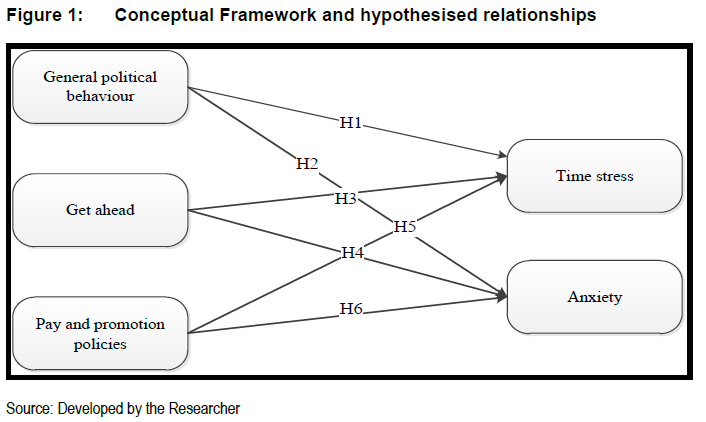
The conceptual framework was theorised specifically to investigate the influence of organisations politics dimensions on job stressors. Figure 1 illustrates a framework of the constructs and hypothesised relationships investigated in the study.
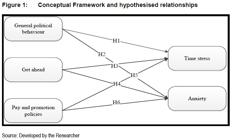
H1: There is a significant relationship between employees' perceptions of general political behaviour and time stress.
H
2: There is a significant relationship between employees' perceptions of general political behaviour and anxiety.H
3: There is a significant relationship between employees' perceptions of get ahead in the organisation and time stress.H4: There is a significant relationship between employees' perceptions of get ahead in the organisation and anxiety.
H5: There is a significant relationship between employees' perceptions of pay and promotion in the organisation and time stress.
H6: There is a significant relationship between employees' perceptions of pay and promotion in the organisation and anxiety.
4. RESEARCH METHODOLOGY
The quantitative method was selected to test the relationships and the influence of one variable on the other. The researcher run the data and all the statistics required using SPSS 25.0 and SMART PLS 3.
4.1 Target Population
The target population can be described as a definite group of individuals or substances of which queries can be examined or opinions acknowledged to produce required information and evidence (Bless, Higson-Smith & Sithole 2013). The target population consisted of people, groups, organisations, officials and enterprises (Quinlan 2011). For this study, the target population was made up of SME employees within Matlosana Local District in North West province. Matlosana Local District consists of the towns of Klerksdorp, Orkney, Stilfontein and Hartebeesfontein with the surrounding townships as well as the rural areas surrounding the towns; the district has a total population of 417 282 people (Statistics South Africa 2016).
The study is located with a quantitative paradigm. Five-point-Likert scales were used to collect data from the respondents. The questions in this study were adapted from Kacmar and Ferris (1991) and Parker and Decotiis (1983). SMES located on Motlasana district are facing a lot of challenges related to organisational politics. A cross-sectional survey design was utilised as it is generally quick, easy and inexpensive to perform. A total of 550 questionnaires were distributed to SME employees in retail, transport and food service sectors and 431 questionnaires were returned. This constitutes a response rate of 78 percent. A non-probability convenience sampling method was chosen because there was no sampling frame to select the respondents, ease of the researcher's access to the SMEs employees and their willingness to participate in the study. Five trained fieldworkers were used to collect the data. Sample size recommendations for quantitative research were based on having sufficient sample size to reduce the likelihood of convergence problems and to obtain unbiased estimates or standard errors.
4.2
Measurement InstrumentsThe questions in this study were adapted from past literature. Organisational politics was measured using fourteen items adopted from Kacmar and Ferris (1991) and job stress was assessed with thirteen items adopted from Parker and Decotiis (1983). Response options were arranged in the five-point Likert scale configuration standardised as follows: Scale: 1 = strongly disagree, 2 = disagree, 3 = moderately agree, 4 = agree, and 5 = strongly agree. In this study, a Five-point Likert-type scale was used because it is less confusing, comprehensive and allows respondents to evaluate the strength of agreement or disagreement about a statement (Hair, Wolfinbarger, Money, Samouel & Page 2015). A Five-point Likert scale was used in this study because it was easy for respondents to understand the questions while completing the questionnaires.
4.3
Descriptive StatisticsThe results show that the majority of the respondents were male (55%; n=238) compared to females (45%; n=193). The respondents' ages ranged from under 30 years to 60 years and above. The majority of respondents were under 30 years (40%; n=174) followed those employees who were between 30 and 39 years (36%; n=154). Around (17%; n=73) of the respondents were aged between 40 and 49 years. The respondents aged between 50 and 59 years represent (5%; n=21) followed by (2%; n=8) of the age group of 60 years and above. The literature on the SMEs employees indicates that this sector is dominated by employees aged between 16 years and 39 years and it is attributed to factors such as unemployment and willingness to assist their families financially (Maloka 2013:71). In terms of race the findings present that the majority of respondents (81%; n=349) are Black, followed by 7.9 percent (n=34) Coloureds, 5.6 percent (n=24) Indians, 5.3 percent (n=23) White and 0.2 percent (n=1) of the respondent indicated other as their race.
5. TESTS OF MEASURES AND ACCURACY ANALYSIS STATISTICS
5.1 Reliability Results
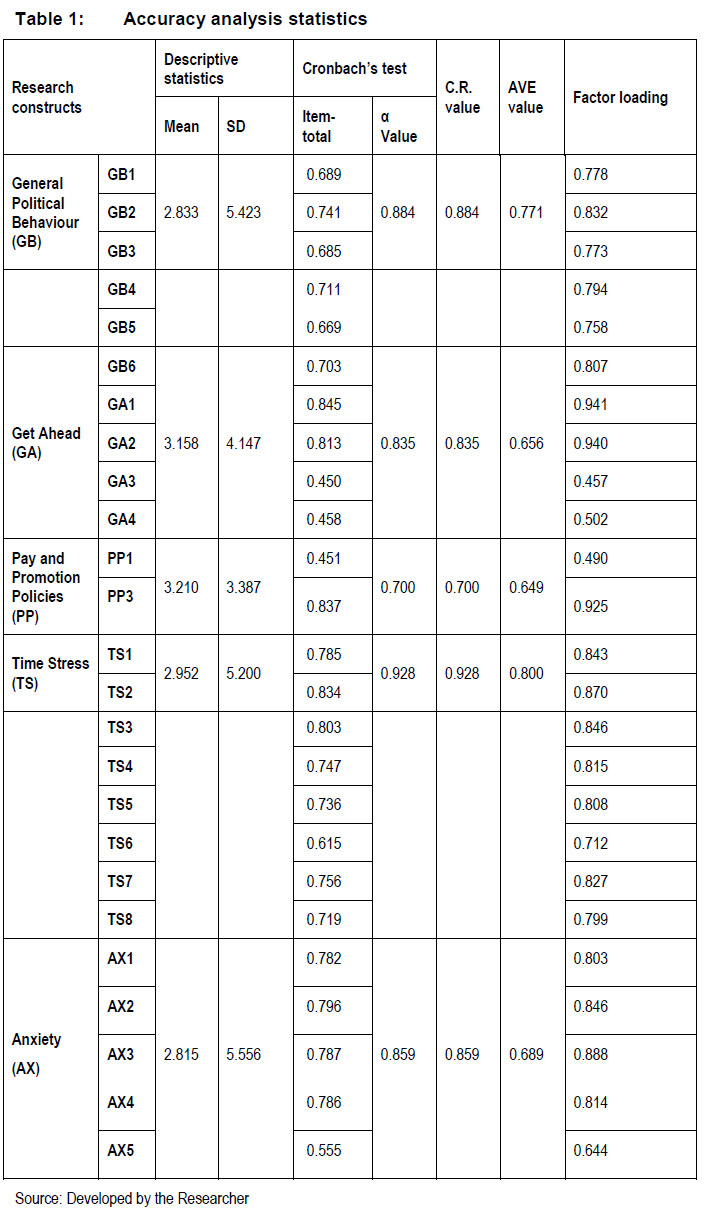
Table 1, demonstrates the research constructs, descriptive statistics, Cronbach's test, composite reliability (CR), Item-to-total values, average variance extracted (AVE) and factor loading values.
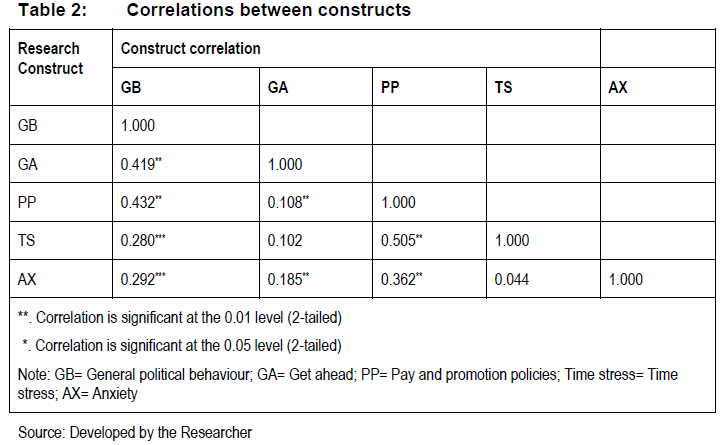
Items with factor loadings below 0.5 were deleted because they failed to meet the threshold. Those items were PP 2 and PP 3. The bottommost item to total loading observed was GA 3 with 0.450 and the highest was GA 1 with 0.845. The lowest factor loading observed was GA 3 with 0.457 and the highest is GA 1 with 0.941. These results conclude that the measurement instruments are valid. The lowest Cronbach alpha was 0.700 and the highest was 0.928 which shows that the constructs were internally consistent or reliable and explained more that 60% of the variance. All composite reliability values were above the recommended minimum of 0.7 (Bagozzi & Yi 1988), which further attests to the reliability of the measurement instrument used in the study. One of the methods used to ascertain the discriminant validity of the research constructs was the evaluation of whether the correlations among latent constructs were less than 0.60. These results are reported in Table 2.
Table 2, illustrates correlation analysis between the different constructs. The correlation between GA and GB shows a significant relationship (r=0.419; p<0.01), followed by a correlation between PP and GB (r=0.432; p<0.01). A significant correlation exists between TS and GB (r=0.280; p<0.01) and AX and GB (r=0.292; p<0.01). Moreover, the correlation between PP and GA demonstrates a significant relationship (r=0.108; p<0.01), followed by a correlation between TS and GA (r=0.102; p<0.01), which is significant. A significant relationship is evident between TS and PP (r=0.505; p<0.01), furthermore, another significant association between AX and GB can be seen (r=0.292; p<0.01). Other correlations with a significant relationship are AX and GA (r=0.185; p<0.01), AX and PP (r=0.363; p<0.01) followed by a correlation between AX and TS (r=0.044; p<0.01).
5.2 Smart PLS Path Modelling Results
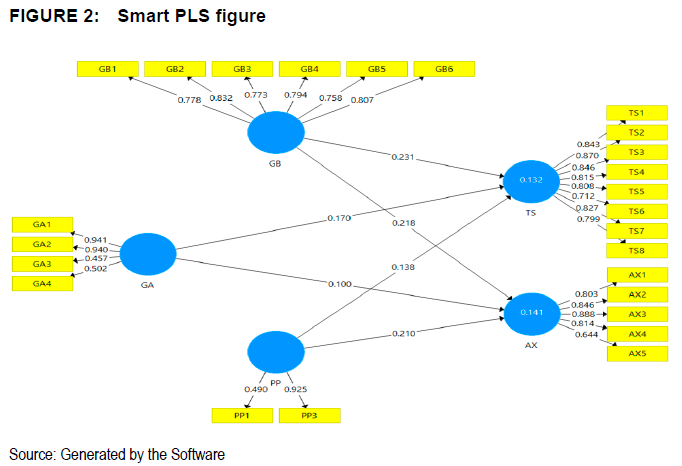
After approving the reliability and validity of the measurement instruments (reported in Table 2), the study proceeded to test the proposed hypotheses. In total there are six hypotheses that are tested. Figure 2 provides the proposed hypotheses and the respective path coefficients. The same results of the path coefficients are tabulated in Table 2 depicting the Item to Total correlations, Average variance extracted (AVE), Composite Reliability (CR) and Factor Loadings.
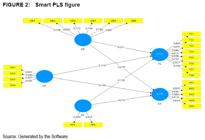
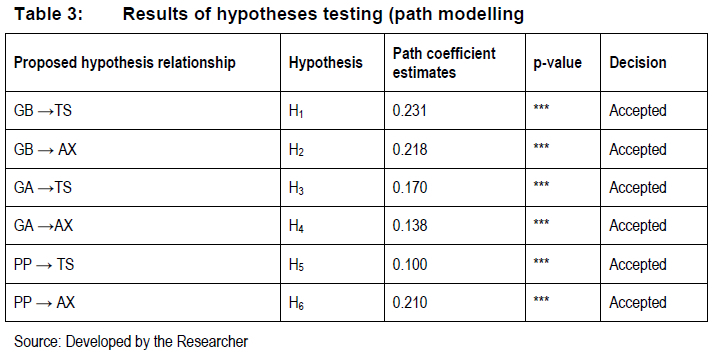
As illustrated in Table 3, and Figure 2 the levels of the coefficients of all six hypotheses are significant at a level of p<0.01. The significance levels of p<0.05, p<0.01 and p<0.001 are pointers of positive, strong and significant relationships between the constructs. It can be confirmed that all six hypotheses proposed in this study were supported and accepted as shown in Figure 4.8.
6. DISCUSSION OF THE RESULTS
The results of the hypotheses H1, H2, H3, H4, H5 and H6 were significant and supported (p<0.01).
6.1
Results for hypothesis 1Hypothesis 1 stated that employees' perceptions of general political behaviour are positively related with time stress. The value of path coefficient for H1 is at 0.231, the result of the hypothesis indicates that there is a positive relationship between employees' perceptions of general political behaviour and time stress in the SMEs. Therefore, the p-value is significant at 99% (r=0.01), which means that this hypothesis is supported. The results resonate with the results obtained by studies undertaken by Evans and Qureshi (2013) who found that political behaviours in organisations could result in stress and have undesirable effects on the employee and organisational environment. This study confirmed that general political behaviour exists in the SMEs and influences job stress experienced by the employees.
6.2
Results for hypothesis 2Hypothesis 2 stated that employees' perceptions of general political behaviour are positively related to anxiety. Table 3 revealed that H2 was found to be supported and acceptable (r=0.218; p<0.01). The findings indicate that the employees' perceptions of general political behaviour are positively related with anxiety. In support of the findings, a previous study suggested that organisational politics might function as a possible job stressor for employees that can lead to anxiety (Goodman, Evans & Carson 2011). These results are in line with a study conducted by Rashid, Karim, Rashid and Usman (2013), who found that the relationship between political behaviour and job stress shows a significant positive relationship. The authors further confirmed that the results clearly show that if the workplace were politically infused, the employees would face anxiety at their job, leading to adverse effects on both employees and organisation.
6.3
Results for hypothesis 3Hypothesis 3 stated that employees' perceptions of get ahead in the organisation are positively related to time stress. As stated in Table 3, there is a positive correlation between perceptions of get ahead and time stress (r=0.170; p<0.01). The results further confirm that perceptions of getting ahead have a significant influence on time stress in the SME sector. These results are confirmed by Abbas and Raja (2014) that employees who observe get ahead practices in their organisational environment to be politically motivated, they experience job stress. In support of the findings for this study, research conducted by Swartz and Potgieter (2017) indicates that employees' perceptions of getting ahead can function as a potential stressor that can result in job stress. The results confirmed that employee perceptions of get ahead in the SME sector can result in time stress.
6.4
Results for hypothesis 4Hypothesis 4 stated that employees' perceptions of get ahead in the organisation are positively related to anxiety. The results of H4 present that there is positive significant correlation between perceptions of get ahead and anxiety (/= 0.138; p< 0.01). The results reveal that perceptions of get ahead are positively related to anxiety. In support of the results, Rashid et al. (2013) reveal that employees who face high pressure on the job emanating from perceptions of get ahead in the workplace could experience high levels of anxiety and show nervous behaviour. Moreover, get ahead actions arising from perceptions of organisational politics have been found to have harmful effects on employee work-related outcomes like, turnover intentions, absenteeism and anxiety (Goodman et al. 2011).
6.5
Results for hypothesis 5Hypothesis 5 stated that employees' perceptions of pay and promotion in the organisation are positively related with time stress. Table 3, shows a path coefficient value of (r=0.100; p<0.01) for H5 and it means the results are significant and confident at 99%. The outcome confirms that perceptions of pay and promotion are positively related to time stress. The positive relationship established between employees' perceptions of pay and promotion and time stress is consistent with the results provided by Cacciattolo (2015) who found that employees are expected to participate in organisational politics when there is uncertainty involved in pay and promotion procedures and as a result, they might experience job stress.
6.6
Results for hypothesis 6Hypothesis 6 stated that employees' perceptions of pay and promotion in the organisation are positively related with anxiety. The findings of H6 present that there was a positive and significant relationship (r=0.210; p<0.01) between perceptions of pay and promotion and anxiety. The results are consistent with the study of Ugwu, Ndugbu, Okoroji and Kalu (2014), which found that pay and promotion policies have negative impact on employees who are not politically involved in organisations. Employees who observe unfairness concerning rewards might experience job anxiety (Haq 2011). Akanbi and Ofoegbu (2013) discovered that in the work environment where employees are politically involved in pay and promotional policies, it could result in anxiety. The results of this study indicated that SMEs employee's perception of pay and promotion policies have impact on anxiety.
This study is one of the limited efforts to investigate the influence of organisational politics and job stress. This research has contributed to new literature and empirical findings of organisational politics and job stress in the SMEs context and it is a valuable source for future research. An effort has been taken in this study to formulate a conceptual framework illustrating the dimensions of the constructs. This conceptual framework would be useful for further empirical studies in various research backgrounds. Additionally, the framework makes a huge contribution in current academic literature on human resources management particularly in the SME sector. The management of the SMEs should concede that organisational politics are part of the organisational environment; therefore, policies and procedures must be in place to control such political behaviour. Since there are positive and negative implications of organisational politics, management should make use of the positive impact to attain organisational objectives and encourage change management. The negative implications of the politics should be curbed and eradicated since they affect job outcomes of employees within the organisation.
8. LIMITATIONS OF THE STUDY
Although this study contributes to the organisational politics and job stress literature in a number of ways, it has some limitations. This study was restricted to the SME employees in Matlosana Local District. For this reason, the results of the study should be interpreted with caution because they may only be generalised to the sample that was chosen for the research and may not be generalised to other SME employees in other local districts within South Africa. Additionally, this study is limited in scope since there may be other factors such as employee motivation, engagement and retention that could affect the influence of organisational politics on job stress. The researcher distributed questionnaires physically to the respondents and had no control over how respondents completed the questionnaires and had to rely on data provided by the respondents. This study sampled a total of 431 SME employees from a target of 550. A larger sample size of 550 may have produced better results and only a quantitative approach was followed, which limits the depth of information collected.
Nothing has been done on the staff count and turnover of the organisations surveyed. This may have given important clues to the complexity of the organisations within which the respondents work. Future researchers might attempt to solve this lacuna in future.
9. IMPLICATIONS FOR FUTURE RESEARCH
Future research should also expand the conceptual framework and explore mediating variables, for example, personality, emotional intelligence, and leader-member exchange to strengthen and describe the relationship between constructs. For the purpose of comparison reasons, further studies should be conducted in other cultures, areas, countries and with a large sample size of respondents to better understand the relationship between organisational politics and job stress. Since the study use the quantitative approach, the researcher believes that better accuracy and understanding may be attained if future studies utilise longitudinal study or the mixed method, which combines both qualitative and quantitative approaches.
10. CONCLUSION
This study investigated the influence of organisational politics on job stress among SMEs employees. The primary purpose was to ascertain the relationship between organisational politics variables such as, general political behaviour, get ahead and, pay and promotion policies against job stress variables, time stress and anxiety. There are several studies that have been conducted in developed nation's context, yet, there is insufficient evidence of how organisational politics influence job stress among SMEs employees particularly in the context of small enterprises in developing nations. The results suggest a positive significant relationship between organisational politics and job stress in SMEs employees in Matlosana Local District in South Africa. Moreover, results support the findings of prior studies which examined the effect of organisational politics on job related outcomes particularly job stress. In this view, if the organisational politics dominate SMEs there could be job outcomes resulting from the organisational politics experienced by employees, other than job stress. As a result, it is the duty and responsibility of the SME owners/managers to engender good working relationships between their employees in order to achieve the objectives of the organisation.
REFERENCES
3. LITERATURE REVIEW
-
ABBAS M & RAJA U. 2014. Impact of perceived organizational politics on supervisory-rated innovative performance and job stress: evidence from Pakistan. Journal of Advanced Management Science 2(2):158-162. (DOI:10.12720/joams.2.2.158-162.
» https://doi.org/10.12720/joams.2.2.158-162 -
)
» https://nbn-resolving.org/urn:nbn:de:0168-ssoar-51861-8 -
)
» https://doi.org/10.17576/pengurusan-2018-51-23 -
AHMAD J, AKHTAR HMW, UR RAHMAN H, IMRAN RM & UL AIN N. 2017. Effect of diversified model of organizational politics on diversified emotional intelligence. Journal of Basic and Applied Sciences 13:375-385. (DOI:10.6000/1927-5129.2017.13.62.
» https://doi.org/10.6000/1927-5129.2017.13.62 -
)
» https://www.iiste.org/Journals/index.php/EJBM/article/view/3939 - )
-
AHMED I. 2018. Organizational politics and turnover intention: A study from private colleges of Pakistan. European Journal of Economic and Business 3(2):3-12. (DOI:10.13140/RG.2.2.28303.02729.
» https://doi.org/10.13140/RG.2.2.28303.02729 - )
-
)
» https://eujournal.org/index.php/esj/article/view/4941 -
ATTA M & KHAN MJ. 2016. Perceived organizational politics, organizational citizenship behavior and job attitudes among university teachers. Journal of Behavioural Sciences 26(2):21-38. (DOI:http://pu.edu.pk/images/journal/doap/PDF-FILES/Article%20No.%2002_v26_2_16.pdf.
» http://pu.edu.pk/images/journal/doap/PDF-FILES/Article%20No.%2002_v26_2_16.pdf - )
-
BAGOZZI RP & YI Y. 1988. On the evaluation of structural equation models. Journal of the Academy of Marketing Science 16(1):74-94. (DOI:https://doi.org/10.1007/BF02723327.
» https://doi.org/10.1007/BF02723327 - )
-
BODLA MA, AFZA T & DANISH RQ. 2015. Perceived organizational politics and employee morale: Mediating role of social exchange perceptions in Pakistani organizations. European Online Journal of Natural and Social Sciences 4(1):66-75. (DOI:http://european-science.com/eojnss/article/view/2505/pdf.
» http://european-science.com/eojnss/article/view/2505/pdf -
)
» https://pdfs.semanticscholar.org/3f8f/ac838b28624ab04e2d3f1d75573e1b8158b6.pdf -
)
» https://doi.org/10.1108/PR-07-2017-0205 -
CHANG CH, ROSEN CC, SIEMIENIEC GM & JOHNSON RE. 2012. Perceptions of organizational politics and employee citizenship behaviors: Conscientiousness and self-monitoring as moderators. Journal of Business and Psychology 27(4): 395-406. (DOI:https://doi.org/10.1007/s10869-012-9257-6.
» https://doi.org/10.1007/s10869-012-9257-6 -
)
» https://doi.org/10.1016/j.sbspro.2011.10.549 -
COLQUITT JA, SCOTT BA, RODELL JB, LONG DM, ZAPATA CP, CONLON DE & WESSON MJ. 2013. Justice at the millennium, a decade later: A meta-analytic test of social exchange and affect-based perspectives. Journal of Applied Psychology 98(2):199-236. (DOI: 10.1037/a0031757.
» https://doi.org/10.1037/a0031757 -
)
» https://doi.org/10.22053/jsehr.2016.33381 -
CROPANZANO R, RUPP DE & BYRNE ZS. 2003. The Relationship of Emotional Exhaustion to Job Performance Ratings and Organizational Citizenship Behavior. Journal of Applied Psychology 88(1):160-169. (DOI:10.1037/0021-9010.88.1.160.
» https://doi.org/10.1037/0021-9010.88.1.160 -
)
» https://doi.org/10.21002/seam.v12i1.9396 -
DELLE E. 2013. The influence of perception of organizational politics on employee job involvement and turnover intentions: Empirical evidence from Ghanaian organizations. European Journal of Business and Management 5(9):151-160. (DOI:https://www.iiste.org/Journals/index.php/EJBM/article/view/5135.
» https://www.iiste.org/Journals/index.php/EJBM/article/view/5135 -
)
» http://dx.doi.org/10.3926/jiem.1389 -
)
» https://doi.org/10.1177%2F0013164491511019 - EVANS N & QURESHI AMA. 2013. Organisational politics: The impact on trust, information and knowledge management and organisational performance. (International Conference on Information Management and Evaluation. Academic Conferences International Limited.) (pp 34-40.
-
)
» https://doi.org/10.4236/ajibm.2016.63022 -
FAIZ S. 2018. Perception of Politics and its Dual Outcomes: The Moderating Role of Psychological Hardiness. Abasyn University Journal of Social Sciences 11(1):117-130. (DOI:http://ajss.abasyn.edu.pk/admineditor/papers/V11I1-8.pdf.
» http://ajss.abasyn.edu.pk/admineditor/papers/V11I1-8.pdf -
)
» https://doi.org/10.1111/inr.12347 - FERRIS GR, RUSS GS & FANDT PM. 1989. Politics in organizations. In RA Giacalone & P Rosenfeld Eds. Impression Management in the Organization. Hilsdale, NJ: Lawrence Erlbaum Associates, Publishers. (pp 143170).
- )
-
GULL S & ZAIDI AA. 2012. Impact of organizational politics on employees' job satisfaction in the health sector of Lahore Pakistan. Interdisciplinary Journal of Contemporary Research in Business 4(2):156-170. (DOI:https://journal-archieves19.webs.com/156-170.pdf.
» https://journal-archieves19.webs.com/156-170.pdf -
)
» https://www.gov.za/sites/default/files/gcis_document/201409/a29-04.pdf -
)
» https://doi.org/10.1037/a0025679 - HAIR JF, WOLFINBARGER CM, MONEY AH, SAMOUEL P & PAGE MJ. 2015. Essential of Business Research Methods. 2nd ed. London: Routledge.
-
)
» https://doi.org/10.4236/psych.2018.910141 -
HASHIM MK & ABDULLAH MS. 2000. A proposed framework for redefining SMEs in Malaysia: One industry, one definition. Asian Academy of Management Journal 5(1): 65-79. (DOI:http://web.usm.my/aamj/5.1.2000/5-1-6.pdf.
» http://web.usm.my/aamj/5.1.2000/5-1-6.pdf -
)
» https://dergipark.org.tr/en/download/article-file/257156 -
HASSAN H, VINA TMH & ITHNIN NS. 2017. Perceived organizational politics and job satisfaction: the role of personality as moderator. Scientific Journal of Logistics 3(4):479-493. (DOI:10.17270/J.LOG.2017.4.8.
» https://doi.org/10.17270/J.LOG.2017.4.8 -
)
» https://doi.org/10.4236/sm.2018.82006 -
)
» https://doi.org/10.4102/sajip.v41i1.1183 -
HSIUNG HH, LIN CW & LIN CS. 2012. Nourishing or suppressing? The contradictory influences of perception of organizational politics on organizational citizenship behaviour. Journal of Occupational and Organizational Psychology, 85(2): 258-276. (DOI: https://doi.org/10.1111/j.2044-8325.2011.02030.x.
» https://doi.org/10.1111/j.2044-8325.2011.02030.x -
)
» https://doi.org/10.1080/23311975.2016.1201905 - )
-
JAM FA, DONIA MB, RAJA U & LING CH. 2017. A time-lagged study on the moderating role of overall satisfaction in perceived politics: Job outcomes relationships. Journal of Management & Organization 23(3):321-336. (DOI:https://doi.org/10.1017/jmo.2016.13.
» https://doi.org/10.1017/jmo.2016.13 -
)
» https://doi.org/10.4172/2315-7844.1000200 -
)
» https://doi.org/10.1111/jsbm.12265 -
KACMAR KM & CARLSON DS. 1997. Further validation of the perceptions of politics scale (POPS): A multiple sample investigation. Journal of management 23(5):627-658. (DOI:https://doi.org/10.1177%2F014920639702300502.
» https://doi.org/10.1177%2F014920639702300502 -
)
» https://doi.org/10.1016/j.emj.2018.08.001 - )
-
KARTONO K, HILMIANA H & MUIZU WOZ, 2017. Personality and organisational politics on employees performance: studies at local government enterprises of people credit bank in West Java Region III. International Journal of Business and Globalisation 18(4): 524-538. (DOI:http://www.feb.unpad.ac.id/dokumen/files/IJBG180406-Wa-Ode-Zusnita-Muizu-Jurnal-Int.pdf.
» http://www.feb.unpad.ac.id/dokumen/files/IJBG180406-Wa-Ode-Zusnita-Muizu-Jurnal-Int.pdf - )
- )
-
KHAN HS, ZHIQIANG M, SARPONG PB & NAZ S. 2017. Perceived organisational politics and job attitudes: A structural equation analysis of higher education faculty of Pakistani Universities. Canadian Journal of Applied Science and Technology (5)2:254-263. (DOI:https://pdfs.semanticscholar.org/e1a2/4fd119060ddb41d37b141aad2ecda94edea9.pdf.
» https://pdfs.semanticscholar.org/e1a2/4fd119060ddb41d37b141aad2ecda94edea9.pdf - )
- )
-
LAU CM, SCULLY G & LEE A. 2018. The effects of organizational politics on employee motivations to participate in target setting and employee budgetary participation. Journal of Business Research 90:247-259. (DOI:https://doi.org/10.1016/j.jbusres.2018.05.002.
» https://doi.org/10.1016/j.jbusres.2018.05.002 - )
-
LEE JJ, CAPELLA ML, TAYLOR CR, LUO M & GABLER CB. 2014. The financial impact of loyalty programs in the hotel industry: a social exchange theory perspective. Journal of Business Research 67:2139-2146. (DOI:https://doi.org/10.1016/j.jbusres.2014.04.023.
» https://doi.org/10.1016/j.jbusres.2014.04.023 - )
-
LIANG T & WANG Y. 2016. Organizational silence in state-owned enterprises: intermediary role of the perceptions of organizational politics. American Journal of Industrial and Business Management 6(5):640-648. (DOI:http://dx.doi.org/10.4236/ajibm.2016.65059.
» http://dx.doi.org/10.4236/ajibm.2016.65059 - )
- )
-
MARTIN A & ROODT G. 2008. Perceptions of organisational commitment, job satisfaction and turnover intentions in a post-merger South African tertiary institution. SA Journal of Industrial Psychology, 34(1): 23-31. (DOI:https://doi.org/10.4102/sajip.v34i1.415.
» https://doi.org/10.4102/sajip.v34i1.415 - )
- ]
-
NOURI BA & SOLTANI M. 2017. Effective factors on job stress and its relationship with organizational commitment of nurses in hospitals of Nicosia. International Journal of Management, Accounting and Economics 4(2):100-117. (DOI:https://pdfs.semanticscholar.org/f5c3/b2cae29be6666a8c36d6b4e8eddc95ef15e5.pdf.
» https://pdfs.semanticscholar.org/f5c3/b2cae29be6666a8c36d6b4e8eddc95ef15e5.pdf - )
- )
-
OH YS. 2015. Effects of voucher system on the respite care service in South Korea: In the view of Social Exchange Theory. Human Service Organizations: Management, Leadership & Governance 39:208-218. (DOI:https://doi.org/10.1080/23303131.2015.1015700.
» https://doi.org/10.1080/23303131.2015.1015700 - )
-
OLORUNLEKE GK. 2015. Effect of organisational politics on organisational goals and objectives. International Journal of Academic Research in Economics and Management Sciences 4(3):59-70. (DOI:http://dx.doi.org/10.6007/IJAREMS/v4-i3/1877.
» http://dx.doi.org/10.6007/IJAREMS/v4-i3/1877 - )
-
PARKER DF & DECOTIIS TA. 1983. Organisational determinants of job stress. Organisational Behaviour and Human Performance 32:160-177. (DOI:https://doi.org/10.1016/0030-5073(83)90145-9.
» https://doi.org/10.1016/0030-5073(83)90145-9 - )
- )
- QUINLAN C. 2011. Business Research Methods. London: Cengage Learning.
- )
- RASHID U, KARIM N, RASHID S & USMAN A. 2013. Employee's perception of organisational politics and its relationship with stress. Asian Journal of Business Management 5(4):348-352.
- )
-
SALEEM H. 2015. The impact of leadership styles on job satisfaction and mediating role of perceived organizational politics. Procedia - Social and Behavioral Sciences 172:563-569. (DOI:https://doi.org/10.1016/j.sbspro.2015.01.403.
» https://doi.org/10.1016/j.sbspro.2015.01.403 - )
- )
-
SHRESTHA AK & MISHRA AK. 2015. Interactive effects of public service motivation and organizational politics on Nepali civil service employees' organizational commitment. Business Perspectives and Research, 3(1): 21-35. (DOI:https://doi.org/10.1177%2F2278533714551862.
» https://doi.org/10.1177%2F2278533714551862 - )
- )
-
SINGH K. 2012. Relationship bewteen organizational politics, job satisfaction and organizational commitment in UiTM Sarawak. In 2012 IEEE Business, Engineering & Industrial Applications Colloquium (BEIAC), 377-382. (DOI:https://doi.org/10.1109/BEIAC.2012.6226087.
» https://doi.org/10.1109/BEIAC.2012.6226087 - )
-
SUN YW & XIA HS. 2018 Research on perceptions of organizational politics and its influence on employee silence. Open Journal of Business and Management 6:250-264. (DOI:10.4236/ojbm.2018.62018.
» https://doi.org/10.4236/ojbm.2018.62018 - )
- )
- TSHABALALA MP. 2011. Occupational stress and coping resources in air traffic control. Pretoria: University of South Africa. (Master's Thesis.
- )
- )
-
UGWU KE, NDUGBU M, OKOROJI L & KALU AU. 2014. Organizational politics and employees' performance in private sector investment: A comparative study of Zenith Bank Plc and Alcon Plc. Nigeria. European Journal of Business and Management 6(2):103-113. (DOI:https://www.iiste.org/Journals/index.php/EJBM/article/view/14987.
» https://www.iiste.org/Journals/index.php/EJBM/article/view/14987 - )
- )
-
YILMAZ LD. 2014. Perception of organisational politics and impression management behaviours: a tourism industry perspective. International Journal of Business and Social Science 5(8):98-109. (DOI:https://pdfs.semanticscholar.org/d77c/05104f729cddadb95caab8bcb4926a8b4417.pdf)
» https://pdfs.semanticscholar.org/d77c/05104f729cddadb95caab8bcb4926a8b4417.pdf