Criteria for recognising frameworks as scholarly contributions in doctoral research
Abstract
PURPOSE OF THE STUDY: The purpose of this study is to clarify what constitutes a legitimate and original framework as a doctoral thesis contribution. Despite the widespread use of frameworks in doctoral work, substantial ambiguity remains regarding their definition, differentiation from models, and criteria for scholarly acceptance. Addressing this gap is significant because doctoral candidates, supervisors, and examiners often operate without shared standards, resulting in inconsistencies in supervision and evaluation DESIGN/METHODOLOGY/APPROACH: The study followed a two-phase research design. Phase 1 comprised a semi-systematic literature review examining how frameworks are defined, conceptualised, and assessed within doctoral research. A structured keyword strategy and inclusion criteria guided the selection of peer-reviewed sources, and thematic analysis was used to identify recurring characteristics. Phase 2 involved a qualitative expert roundtable with seven experienced doctoral supervisors and scholars. The discussion was recorded, transcribed, and analysed using ATLAS.ti through open, axial, and selective coding to identify dominant themes and areas of conceptual convergence. Findings from both phases were synthesised to generate evidence-based criteria for evaluating frameworks as doctoral contributions FINDINGS: The study found persistent conceptual ambiguity between models and frameworks, inconsistent expectations of rigour, and a general lack of shared criteria across supervisory and examination practices. Key characteristics of high-quality doctoral frameworks include theoretical grounding, conceptual coherence, methodological transparency, practical applicability, and alignment with the research problem. These insights informed the development of a structured rubric RECOMMENDATIONS/VALUE: The study recommends integrating explicit guidance on framework development into doctoral supervision, training programmes, and thesis examination criteria. The proposed rubric offers a practical tool for candidates and examiners, contributing to greater clarity and consistency in doctoral research assessment MANAGERIAL IMPLICATIONS: For management and leadership in higher education, the findings provide actionable criteria that can strengthen doctoral programme quality, enhance supervisor capability, support consistent examination standards, and promote more rigorous conceptual contributions within applied doctoral degrees JEL CLASSIFICATION: I23
Conceptual clarity; doctoral research; frameworks; original contribution; thesis evaluation; scholarly rigour
1. INTRODUCTION
Pursuing original contributions is fundamental to doctoral research and often manifests as either a framework or a model. Clarifying the subtle difference between these two constructs is essential for doctoral candidates and their supervisors, especially during thesis evaluation (Leshem & Trafford, 2007). To submit a successful thesis, a doctoral candidate's study must demonstrate originality, rigour, and scholarly coherence. It must also introduce novel findings, theories, or methodologies that advance the field of study (University of Toronto, 2025).
This novel contribution may involve applying existing theories to new contexts or problems, developing new tools or frameworks, or synthesising disparate ideas into a cohesive argument. Therefore, it should address gaps in the literature or solve practical issues, demonstrating mastery of research methods and the ability to persuade with well-structured arguments (Thomson, 2016).
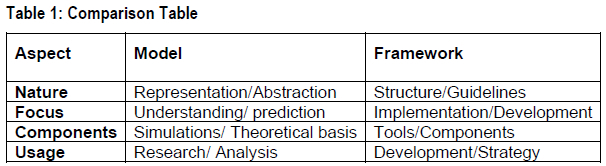
Candidates mainly present their theoretical contributions as frameworks or models. Students often use the terms model and framework interchangeably, but these concepts have distinct meanings and applications across different fields. A model is an abstraction or representation of a real-world system, process, or phenomenon. It aims to explain, simulate, or forecast behaviours and outcomes. Models focus on understanding and analysing specific aspects of a system (Dusin et al., 2023; Pamplona, 2024). A framework is a structured approach or set of guidelines that provides a foundation for developing systems, applications, or processes. It functions as a scaffold for organising concepts and facilitating implementation (Awati, 2025; Bingham et al., 2024).
A model is used for analysis, prediction, and understanding of complex systems. It aids decision-making by simulating potential outcomes based on data (Dusin et al., 2023; Pamplona, 2024). Conversely, a framework provides a standardised structure for developing solutions and guides the implementation of best practices or methodologies (Olawanle, 2022). A model represents theoretical concepts or processes, often being static and focused on specific scenarios and behaviours. In contrast, a framework offers components and tools to streamline development, allowing customised within predefined rules or boundaries, and it is dynamic in nature (Awati, 2025; Bingham et al., 2024). See Table 1 for a summary of the differences between a model and a framework.
The difference between models and frameworks also stems from broader philosophical traditions that influence how knowledge is produced in doctoral research. Models usually align with positivist or post-positivist paradigms, aiming to represent, simulate, or forecast aspects of reality through measurable variables and structured causal links. Their strength lies in accuracy, explanatory capacity, and the ability to test predictions empirically. Frameworks, however, are generally rooted in interpretivist and constructivist traditions that see knowledge as socially constructed and dependent on context. In these paradigms, a framework acts as a conceptual structure that organises ideas, guides enquiry, and supports meaning-making rather than prediction. This philosophical difference explains why frameworks tend to be more adaptable, flexible, and sensitive to context, while models are more closely tied to empirical testing and replication.
In essence, a model is primarily analytical; it helps explain or predict phenomena. A framework, on the other hand, is action-oriented, providing the structure needed to systematically develop or execute solutions. Both are complementary tools: models inform frameworks by offering insights into systems, while frameworks enable the practical application of those insights. This article aims to examine the criteria for a framework to be recognised as a novel contribution in a doctoral thesis. It is part of a broader study on doctoral education and pedagogical supervision, with a follow-up study planned to identify the criteria for a model when assessed as a thesis contribution.
Doctoral students often struggle with developing a clear theoretical framework for their research, which involves understanding the epistemological, ontological, teleological, and sociological aspects relevant to their scholarly inquiry (Wald & Daniel, 2020). A major challenge for doctoral candidates is effectively communicating their understanding and engagement with the theoretical foundations of their work, showing how their research builds on existing literature and adds to ongoing scholarly conversations (Wisker, 2015). Many doctoral theses feature frameworks as a key contribution, but the exact nature and criteria of what makes a framework legitimate within doctoral research require careful consideration (Schmidt & Hansson, 2018).
This semi-systematic literature review aims to clarify the concept of "framework" within the context of doctoral research, specifically focusing on the characteristics and criteria that define a framework as a valid contribution to a doctoral thesis. In doctoral research, a framework functions as a conceptual structure that offers a lens for examining a phenomenon or problem (Yang & MacCallum, 2021). It integrates various factors affecting the doctoral student's experience to enable coherent and effective responses (McAlpine & Norton, 2006). A framework is primarily conceptual, providing a structure for understanding or analysing a phenomenon (Yang & MacCallum, 2021). It is essential to examine the specific attributes a framework must have to be regarded as a substantial contribution warranting doctoral recognition (Yang & MacCallum, 2021).
The conceptualisation of "frameworks" in this study is informed by a broadly interpretivist and constructivist philosophical stance, which sees knowledge creation in doctoral work as a process of meaning-making shaped by the researcher's engagement with theory, context, and scholarly discourse. This position aligns with the work of Kivunja (2018), Leshem and Trafford (2007), and Wald and Daniel (2020), who argue that frameworks emerge through the synthesis, organisation, and integration of concepts rather than through prediction or simulation. Drawing on theory-building literature and the scholarship of doctoral education, the study understands a framework as a conceptual structure rooted in existing theoretical traditions but open to refinement through empirical insights and supervisory engagement. These assumptions underpin the criteria used in this paper to distinguish frameworks from models and to evaluate their legitimacy as doctoral contributions.
2. PROBLEM STATEMENT
Doctoral candidates and their supervisors often lack clarity about the specific criteria that define a legitimate, original doctoral thesis contribution, leading to confusion and inconsistency in thesis assessment.
2.1 Research objectives
• To clarify the conceptual difference between a model and a framework within the context of doctoral research.
• To identify and synthesise the essential characteristics and criteria that define a framework as a legitimate and original contribution in a doctoral thesis.
• To guide doctoral candidates and supervisors on effectively articulating and evaluating frameworks as scholarly contributions.
• To contribute to the broader discourse on doctoral education and supervision by providing a structured understanding of frameworks in thesis work.
3. METHODOLOGY
The study employs a two-phase research design comprising a semi-systematic literature review and qualitative expert engagement. Its aim is to clarify the characteristics that define a framework as a valid contribution within the context of doctoral research. This methodological approach arises from the need to define conceptual boundaries and guide scholarly practice in doctoral supervision and examination.
3.1 Phase 1: Semi-systematic literature review
The first phase involves a semi-systematic literature review guided by the principles outlined by Snyder (2019, 2023). This approach is suitable when the aim is not to aggregate findings quantitatively but to map the field, identify conceptual ambiguities, and establish a structured foundation or agenda for further scholarly dialogue. In this case, the literature review examined how "framework" is defined, distinguished, and applied in doctoral research, focusing on the criteria that deem a framework a significant original contribution.
A keyword search strategy was applied using academic databases such as EBSCOhost, Scopus, and Google Scholar. Search terms included: "doctoral research frameworks", "models vs frameworks in dissertations", "theoretical frameworks in PhD studies", "conceptual frameworks in doctoral theses" and "original contribution in doctoral education."
A structured screening process was employed to select inclusion based on relevance to doctoral education, clarity of concepts regarding frameworks and models, and publication in peer-reviewed academic journals.
Inclusion Criteria:
• Peer-reviewed journal articles and book chapters.
• Studies focused on doctoral research, theoretical and conceptual frameworks, and models.
• Theoretical, empirical, or review-based contributions with conceptual depth.
• Literature written in English.
Exclusion Criteria:
• Literature unrelated to doctoral research or frameworks/models.
• Opinion pieces and editorials.
• Studies focusing on frameworks in non-educational contexts (e.g., business, engineering) without relevance to doctoral education.
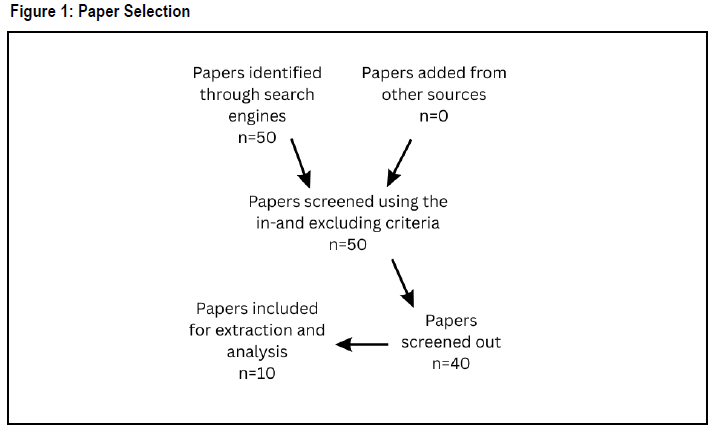
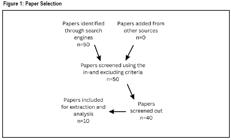
Ten articles met all the criteria and were chosen for in-depth analysis. A qualitative content analysis was employed to identify recurring themes and differences in the construction, use, and assessment of frameworks in doctoral work. This stage ended with an initial synthesis of the key characteristics that define a scholarly contribution as a framework.
3.2 Phase 2: Qualitative expert engagement
The second phase involved a qualitative enquiry to validate and refine the conceptual insights developed in the first phase. A purposive sample of doctoral education scholars and supervisors participated in a virtual expert roundtable discussion. Participants included experienced doctoral supervisors from both public and private higher education institutions, academics with published work on doctoral education, supervision, and examination, and educational theorists specialising in epistemology and research design.
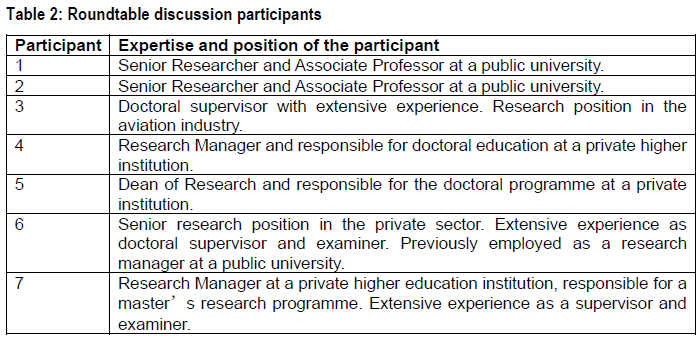
Participants were asked to reflect on the initial findings from the literature review, particularly regarding the practical distinction between a model and a framework in doctoral research, the purpose of defining a framework as a contribution to a doctoral thesis, the epistemological and conceptual rigour expected of a doctoral framework, and the criteria for assessing a framework as an original contribution to a thesis. Seven participants volunteered and contributed to this discussion, as shown in Table 2.
The discussion was transcribed and thematically analysed to identify commonalities and divergences in expert views. These insights informed a refined understanding of what constitutes a legitimate framework in doctoral research and helped propose guidelines for candidates and supervisors seeking to conceptualise their own frameworks. The results from phase two were synthesised with the findings from phase one to create a rubric that serves as a guideline for doctoral candidates developing a framework as their novel contribution in their thesis, and it functions as criteria for examiners assessing doctoral theses where candidates present frameworks as their doctoral contributions.
Saturation in the expert discussion was determined through ongoing analysis during and after transcription of the roundtable conversation. As coding progressed in ATLAS.ti, no new codes, categories, or conceptual insights emerged after the contributions of the fifth and sixth participants, indicating that thematic saturation had been reached. Although seven experts participated, the final participant reinforced existing themes rather than introducing new conceptual material. Given the homogeneity of expertise among participants-all experienced doctoral supervisors or research managers-this convergence of views is consistent with qualitative principles of information power. The point of saturation, therefore, signalled that the data were sufficiently rich and comprehensive to support the development of the thematic structure presented in Table 5.
4. FINDINGS
4.1 Phase one: Paper search
Using the research question "What defines a framework, and what are the criteria for a framework to be presented as a contribution made by a candidate in a doctoral thesis?", over 126 million academic papers from the Semantic Scholar corpus were searched. The 50 most relevant papers to the query were retrieved through a Boolean search.
4.1.1 Screening
The following questions were used as inclusion and exclusion criteria when screening the 50 papers:
•Framework Definition: Does the study explicitly define or discuss theoretical frameworks in an academic research context?
•Doctoral Context: Does the study examine theoretical frameworks specifically within doctoral-level research?
•Evaluation Criteria: Does the study include specific criteria or standards for evaluating theoretical frameworks?
•Framework Development: Does the paper discuss methodological approaches to framework development?
•Framework Analysis Depth: Does the study go beyond merely applying an existing framework to include substantive discussion of the framework's nature or development?
•Evidence Base: Does the study include theoretical or empirical support for its claims (not just opinion)?
•Academic Context: Is the framework discussion within a clear academic research context?
•Theoretical Contribution: Does the study contribute to understanding the theoretical framework of doctoral research?
All questions were considered and critically judged to determine whether to include them for screening in each paper.
4.1.2 Data extraction
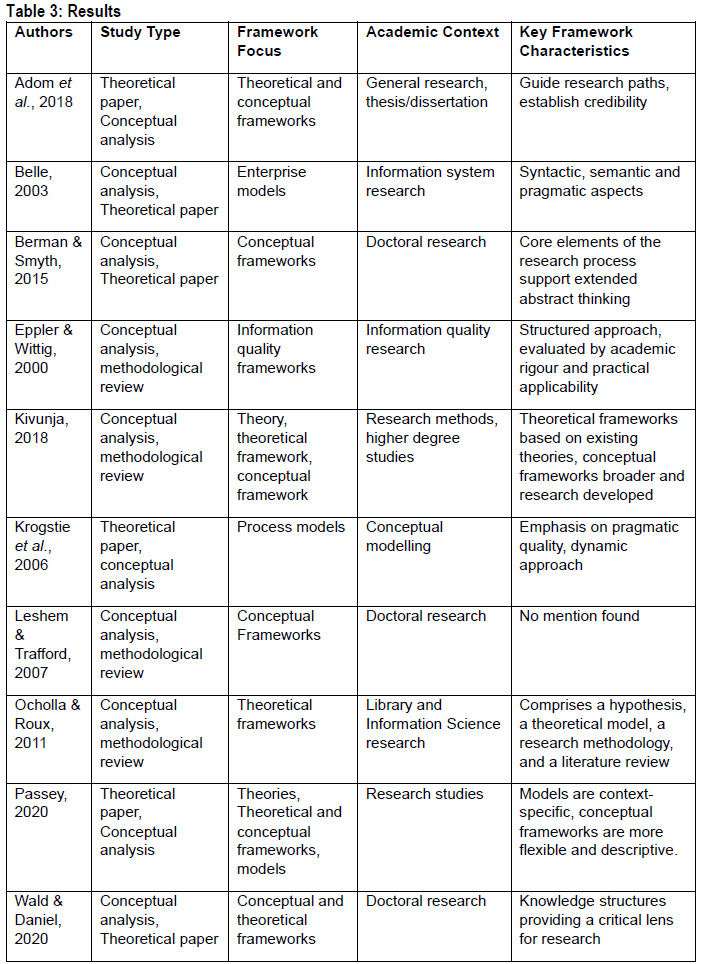
As stated in Table 3, the data extracted from the articles were the author, the study type, the framework focus, and the key framework characteristics.
• Type of study.
This question aimed to identify the type of study represented by the article. Thus, was it a theoretical paper, a conceptual analysis, a methodological review or an empirical study?
• Framework/Model Definition:
This question focused on the definition of the framework or model provided by the authors. The purpose was to note any distinguishing characteristics between the frameworks and models described.
• Characteristics of Frameworks:
Are there any characteristics of frameworks mentioned in the study, such as structural elements, purpose, development process, or validation criteria? Were explicit framework attributes listed, or was there a discussion on framework development? Was the framework tested? What methods were used for validation?
• Doctoral Thesis Contribution Assessment:
This question explored the criteria for considering a framework or model a valid doctoral contribution.
Based on the analysis of the included studies, conceptual analysis was the most common type, mentioned in all 10 studies examined. Theoretical papers and methodological reviews were each cited in five studies. Only one study was found to mention an empirical study.
Doctoral research was the most frequent context. The majority of studies (8 out of 10) combined different research methods, often pairing conceptual analysis with either a theoretical paper or a methodological review.
4.1.3 Framework quality and assessment criteria
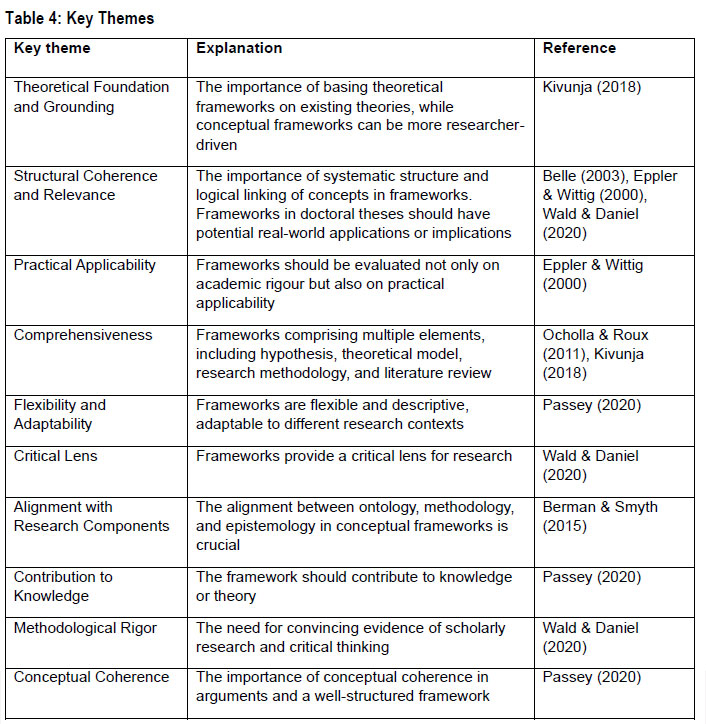
Based on our analysis of the included studies, we identified several key themes related to framework quality criteria, as summarised in Table 4.
It is important to note that these quality criteria and explicit criteria for assessing frameworks in doctoral theses are inconsistently provided, not universally applied, or explicitly stated across all studies. The lack of consensus on quality criteria and guidelines for assessing frameworks as contributions highlights a gap in the literature, particularly in evaluating them as doctoral contributions. This gap in the literature suggests a potential need for more specific, standardised criteria for evaluating doctoral contributions in the form of frameworks. Therefore, this semi-systematic literature review has created an agenda (Snyder, 2023) for qualitative research to address the identified gap and develop criteria for assessing frameworks as doctoral thesis contributions. The key themes listed in Table 4 could serve as a potential draft rubric or guideline that can be expanded and refined through the qualitative research phase of this study, by supervisors and examiners, to guide and assess doctoral theses, providing a framework as a novel contribution.
4.2 Phase two: Qualitative focus group
An online round table discussion with seven experts, as mentioned in Table 2 above, was conducted. Along with the invitation to participate, they received Table 4 and a summary of the analysed literature to prepare for and guide the discussion. This was a second iteration in the research process to develop an artefact: a rubric for examiners assessing a framework as a contribution to a doctoral thesis, or guidelines for doctoral students to consider when creating a framework as part of their doctoral thesis's novel contribution. The questions posed to them were: What is the difference between a model and a framework? Furthermore, what are the criteria for a framework to be recognised as a new scholarly contribution within a doctoral thesis? The aim was for them to share their in-depth understanding, experiences, and opinions regarding the research question at hand. The online session was recorded with their permission on Microsoft Teams, and the software also transcribed the conversation. The data from Phase Two of the qualitative focus group were analysed with ATLAS.ti.
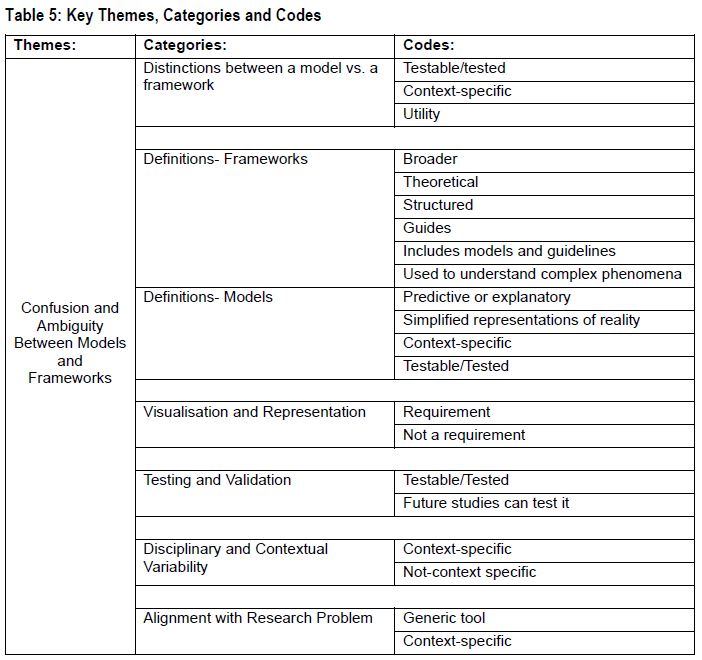
The qualitative data were analysed using an inductive thematic coding approach in ATLAS.ti. The coding process involved three steps. First, open coding was performed to identify meaningful units of text related to participants' conceptualisations of models and frameworks. Second, similar codes were grouped into categories through axial coding, allowing the identification of relationships and patterns among participants' statements. Finally, selective coding was used to synthesise these categories into overarching themes that reflected shared understandings, points of confusion, and areas of divergence. This systematic process ensured that the themes presented in Table 5 emerged directly from the participants' contributions rather than being imposed beforehand.
4.3 Emerging themes
4.3.1 Confusion and ambiguity between models and frameworks
Multiple speakers expressed uncertainty about what constitutes a model versus a framework.
"I have to be quite honest, I am not clear in my mind what we should expect from a student, even after all these years. I never thought about any criteria for a framework. I judge what they present to see if it makes sense." - Participant 6
4.3.2 Definitions and characteristics
Various definitions and key characteristics emerged from the focus group on what a model and framework could be defined as. Nobody gave precise definitions. They were all very vague.
"A model is like a representation of reality" - Participant 2
"A framework provides a structured foundation --an outline of key concepts, theories, and variables. " - Participant 7
"So, frameworks can have models in them, and they often do, and they can have guidelines in them" - Participant 2
"A model is a simulation or a prediction " - Participant 2
"A framework is broader" Participant 3
"A model means that we are modelling something. " - Participant 3 "A framework is much, much broader" - Participant 3
"A model is a built little structure that will represent reality, and I find that very handy because if you look at that, it is a simplified version or a representative version of what reality will be like." - Participant 2
"A model is explanatory or predictive, or simplifies reality. " - Participant 2
"A framework is very limited to a very specific context. " - Participant 2
4.3.3 Visualisation and representation
■There is confusion about whether a framework must be visually depicted or not.
"It seems to me that in certain universities, the framework is not necessarily a visual depiction. However, something visual will help to understand better. " - Participant 6
4.3.4 Testing and validation
It was discussed whether a framework must be tested to count as a contribution. Some indicate it does not need to be tested immediately; future studies may do that. The quality of data and how the framework contributes to knowledge are crucial.
"My first encounter with a model and framework was with one of the external examiners in 2001, who reviewed my doctoral thesis. I was presenting a model, and then he said to me: It's a framework because it still has to be tested," - Participant 6
4.3.5 Disciplinary and contextual variability
There were mentions about the importance of disciplinary context (e.g., architecture vs. social sciences).
"Beauty is in the eye of the beholder, when you assess a framework. If, what you read makes sense, and it follows as a logical conclusion to the study, it can be considered a contribution. " - Participant 2
"A framework provides a structured foundation --an outline of key concepts, theories, and variables -- guided by the research that is answering the problem statement. " - Participant 7
4.3.6 Alignment with research problem
There was an emphasis on conceptual alignment, meaning the framework must not be a generic tool but should be tailored to the research's core issue.
"...you can only be guided by the research. Is the framework answering [the] problem statement..." - Participant 7
Table 5 lists the categories, codes and themes identified using the Atlas.ti analysis.
The coding process revealed several key insights into how experienced supervisors and scholars understand doctoral frameworks. The first central insight is the widespread ambiguity between the terms "model" and "framework," with participants frequently using the concepts interchangeably, confirming a lack of shared definitions in supervisory practice. The second insight relates to conceptual breadth: participants consistently described frameworks as broader, more flexible, and more responsive to context than models, which they viewed as explanatory or predictive representations of reality. A third insight concerns expectations of rigour: some participants believed frameworks must be tested, while others saw testing as optional or suitable only for subsequent studies. Finally, the codes highlight the importance of alignment with the research problem, as participants emphasised that a framework must naturally emerge from the study's purpose rather than being generic. Collectively, these insights demonstrate the lack of consensus in the field and underscore the need for clearer criteria for evaluating doctoral thesis frameworks.
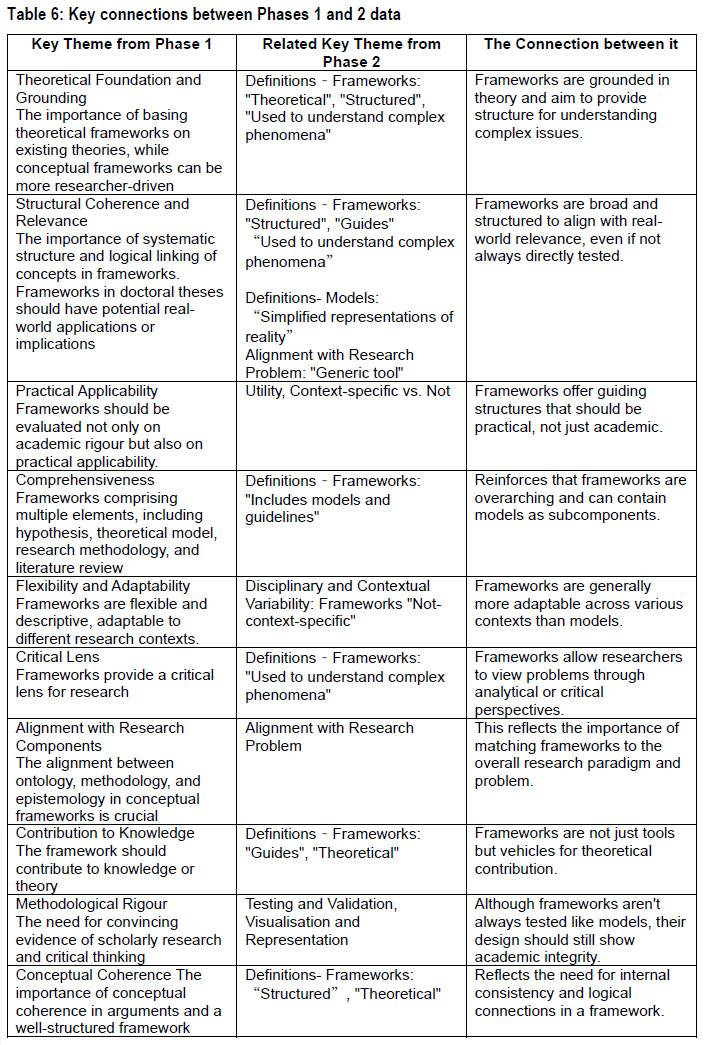
Next, we linked the key findings from the literature review with the data from the roundtable discussion to identify how they complement each other. The result is presented in Table 6.
5. DISCUSSION
5.1 Positioning frameworks as scholarly contributions
Frameworks are essential to doctoral research, often serving as the primary means of demonstrating originality and academic impact. Unlike models, which generally aim to represent or simulate specific phenomena, frameworks provide structured, adaptable scaffolds that guide the development, analysis, or implementation of research within a particular domain. The literature consistently emphasises that, when developed thoroughly, frameworks can connect theoretical ideas with practical application, thereby making a meaningful contribution to scholarship and practice (Awati, 2025; Bingham et al., 2024).
Reflecting on the themes emerging from the expert roundtable, three findings stand out as particularly important for doctoral practice. First, the ongoing ambiguity between models and frameworks-highlighted by participants' interchangeable use of both terms-underscores the need for clearer doctoral guidance and supervisory dialogue. This aligns with the literature, which emphasises conceptual confusion in doctoral supervision (Schmidt & Hansson, 2018). Second, the widespread expectation that frameworks should be flexible and responsive to context, rather than rigid predictive structures, indicates a shift towards interpretivist epistemologies in doctoral research. Participants stressed that a meaningful framework evolves from the problem context and supervisory engagement, rather than a pre-made template. Third, the recurring theme of alignment with the research problem and purpose emerged consistently: respondents emphasised that frameworks must be closely integrated with the doctoral enquiry, not merely added as decorative scaffolding. Collectively, these themes reinforce the proposed criteria by demonstrating how authenticity, coherence, and purposeful development of frameworks are both empirically grounded and theoretically meaningful.
5.2
Criteria for recognising frameworks as doctoral contributionsThe findings from both the literature review and expert engagement converge on several key criteria that define when a framework constitutes a legitimate doctoral contribution:
• Originality and Novelty: The framework must fill a specific gap in the literature or answer an unresolved issue. This might involve synthesising existing theories in new ways, adapting frameworks to new contexts, or creating entirely new conceptual structures (Leshem & Trafford, 2007).
• Conceptual Clarity and Coherence: A doctoral-level framework should be grounded in a well-articulated theoretical foundation, with clearly defined constructs and relationships. This clarity ensures that the framework is not merely a collection of concepts but a coherent structure that advances understanding (Kivunja, 2018).
• Methodological rigour: The process of developing the framework should be transparent and systematic, often involving iterative refinement through literature review, empirical validation, or expert consultation. This rigour sets doctoral frameworks apart from less robust conceptual tools (Eppler & Wittig, 2000).
• Practical Utility and Applicability: Beyond theoretical soundness, a framework should provide practical value by guiding research design, data analysis, or intervention strategies. Its usefulness in real-world or scholarly settings highlights its contribution (Eppler & Wittig, 2000).
• Validation and Scholarly Engagement: The framework's credibility is bolstered through critical engagement, whether via empirical testing, peer review, or expert feedback. This process guarantees that the framework can withstand academic scrutiny and be adopted or adapted by others (Wald & Daniel, 2020).
5.3
Frameworks vs. models: Implications for doctoral researchThe data show that there is still confusion among students and supervisors about the exact difference between a framework and a model when they are presented as a novel contribution in a doctoral thesis. However, understanding the difference between frameworks and models is important for doctoral candidates. While models are often static, analytical, and aimed at prediction or explanation, frameworks are dynamic, action-oriented, and designed to organise research or practice. This difference affects both the development process and the criteria used for assessment in doctoral work. Due to their flexibility and broad applicability, frameworks are especially suitable for interdisciplinary research and situations where existing models may not fully reflect the complexity of the research problem (Dusin et al., 2023; Pamplona, 2024; Awati, 2025; Bingham et al., 2024).
5.4
Challenges and considerations in framework developmentDoctoral candidates frequently struggle to articulate and justify their frameworks. These challenges include:
• Navigating epistemological and ontological assumptions underlying the framework.
• Demonstrating how the framework advances or departs from existing literature.
• Ensuring the framework is not overly generic but tailored to the research context and questions (Wald & Daniel, 2020; Wisker, 2015).
Expert feedback from the roundtable discussion emphasised the importance of reflexivity in the development of frameworks. Candidates must critically assess their own assumptions and the implications of their framework for knowledge production and application.
5.5
Guidelines for doctoral candidates and supervisorsBased on the synthesis of literature and expert perspectives, the following guidelines are proposed for candidates and supervisors:
• Clearly articulate the gap or problem the framework addresses.
• Ground the framework in a thorough review of relevant literature.
• Employ a transparent and systematic development process.
• Engage with experts or stakeholders to validate and refine the framework.
• Demonstrate both the theoretical and practical implications of the framework.
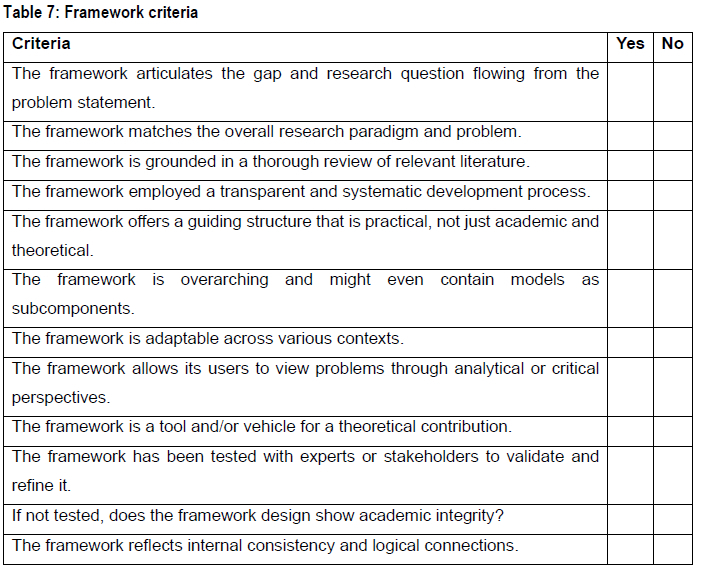
The criteria in Table 7 were created through a structured synthesis of insights from both study phases. The semi-systematic literature review highlighted key attributes of high-quality frameworks-including theoretical grounding, structural coherence, methodological rigour, and practical relevance. These themes were then compared with qualitative findings from the expert roundtable, where participants stressed issues such as conceptual ambiguity, the importance of aligning with the research problem, expectations of validation, and the broader flexibility of frameworks. Using analytical triangulation, common themes from both datasets were combined, while unique insights from each phase were retained to ensure the criteria reflect academic standards as well as supervisory and examination practices. The final criteria thus serve as an evidence-based guide to support doctoral candidates in developing frameworks and examiners in their assessment.
Table 7 summarises the criteria that could assist students and examiners when creating or assessing a framework. It can serve as a marking rubric for thesis examiners and as a guideline for students, providing a framework for their doctoral thesis contribution.
5. MANAGERIAL IMPLICATIONS
The findings of this study have significant implications for the effective management and supervision of doctoral research, especially regarding scholarly contributions that involve developing frameworks. These implications are relevant to doctoral candidates, supervisors, institutional research committees, and academic quality assurance panels.
5.1
For doctoral candidates: Candidates must treat framework development as a core part of their doctoral contribution, not just an ancillary output. A crucial implication is the necessity to demonstrate conceptual maturity by clearly explaining how their proposed framework aligns with their epistemological stance, addresses a specific research gap, and provides both theoretical and practical value. Candidates should be encouraged to systematically document the development process-from initial conceptualisation to refinement-emphasising the framework's rigour, originality, and intended purpose. Furthermore, they should explicitly distinguish between a framework and a model, as confusing the two can weaken the scholarly robustness of their work.5.2
For supervisors: Supervisors play a vital role in guiding candidates through the often-ambiguous process of developing frameworks. They need to be equipped to assist students in identifying the correct scope, structure, and academic basis of their frameworks. An essential managerial task is to foster a mindset of reflexivity and critical engagement, encouraging students to challenge their assumptions and evaluate their frameworks through peer review, expert input, or limited empirical validation. Supervisors should also support ensuring that the framework remains internally consistent and logically aligned with the research questions and methodology.5.3
For research committees and programme managers: At an institutional level, clearer policies and criteria should be established to determine when a framework qualifies as a legitimate doctoral contribution. This includes integrating framework development into doctoral training programmes, proposal evaluation rubrics, and examination guidelines. Committees can further support candidates by ensuring access to exemplars, development workshops, and expert panels to assist in framework testing or critique.5.4
For examiners and quality assurance panels: Examiners should be encouraged to evaluate frameworks based on academic novelty, coherence, transferability, and practical application. The assessment rubric (such as the one suggested in Table 7) can serve as a formal tool to structure feedback and ensure consistency when assessing the scholarly merit of a framework contribution. Moreover, examiners should expect candidates to explain why a framework-rather than a model or taxonomy-was selected and how it enhances the field and knowledge production practice.5.5
Cross-institutional implications: In the era of interdisciplinary and practice-oriented doctoral education, frameworks are uniquely positioned to connect theory and application. Institutions should recognise the strategic importance of supporting framework contributions, especially in applied doctoral degrees (such as DBAs, DEds, or DBLs programmes), where integrating research with real-world contexts is vital. When managed effectively, framework development can significantly boost the relevance and impact of doctoral research beyond academia.6. CONCLUSION
This study aimed to clarify what defines a legitimate framework as a contribution to a doctoral thesis and to address the widespread conceptual uncertainty surrounding frameworks in doctoral research. By combining a semi-systematic literature review with insights from experienced doctoral supervisors and scholars, the study offers one of the first explicit, evidence-based descriptions of the criteria that determine a high-quality doctoral framework. The findings show that a framework's scholarly value depends on its theoretical basis, conceptual coherence, methodological rigour, and practical utility, all of which must align with the overarching research problem and paradigm.
The paper's original contribution lies in synthesising these insights into a structured set of criteria, presented in Table 7, which functions as both a guideline for doctoral candidates developing frameworks and a rubric for examiners assessing them. This contribution fills a notable gap in the doctoral education literature, where frameworks are often treated implicitly or inconsistently despite being central to many doctoral theses. The study also highlights areas of ongoing confusion among supervisors-particularly the unclear distinction between models and frameworks-and reinterprets this confusion through philosophical traditions that clarify why frameworks tend to be more interpretivist and responsive to context.
In doctoral education, the implications are considerable. Establishing clearer criteria for framework development can improve supervision, ensure greater consistency in examinations, and enhance doctoral candidates' ability to communicate original contributions. Institutions might also use these criteria to improve doctoral training, proposal assessments, and supervisory development programmes.
As with all qualitative work, the study has limitations. The expert sample, although rich in experience, was limited to seven participants, and further research could expand these consultations across disciplines and international contexts. Future studies may also examine how doctoral candidates test, validate, or present their frameworks, as well as how the proposed criteria operate when examiners apply them to doctoral theses.
Overall, the study advances understanding of frameworks as scholarly contributions and provides practical tools to support more rigorous, transparent, and conceptually grounded doctoral research.
Conflict of interest: The authors declare no conflict of interest with respect to the research, authorship and publication of the article.
Data availability: The data used are stored on our private laptops and are available on request.
Ethical clearance and informed consent statement: The researchers obtained ethical clearance prior to data collection and obtained informed consent from all participants in this study, as well as from the institution where we work (STADIO-PFS-2025-DOCX1).
Funding: The authors did not receive any financial support for the research, authorship, or publication of this article.
REFERENCES
- Adom, D., Hussein, E.K. & Adu-Agyem, J. 2018. Theoretical and conceptual framework: Mandatory ingredients of a quality research. International Journal of Scientific Research, 7(1):438-441.
-
Awati, R. 2025. What is a framework? [Internet: www.TechTarget.com; downloaded on 09/04/2025].
» www.TechTarget.com - Belle, J.V. 2003. A framework for the analysis and evaluation of enterprise models. University of Cape Town.
-
Berman, J. & Smyth, R. 2015. Conceptual frameworks in the doctoral research process: a pedagogical model. Innovations In Education and Teaching International, 52(2):125-136. [https://doi.org/10.1080/14703297.2013.809011].
» https://doi.org/10.1080/14703297.2013.809011 -
Bingham, A.J., Mitchell, R. & Carter, D.S. 2024. A Practical Guide to Theoretical Frameworks for Social Science Research. Routledge. [https://doi.org/10.4324/9781003261759].
» https://doi.org/10.4324/9781003261759 -
Dusin J, Melanson A. & Mische- Lawson L. Evidence-based practice models and frameworks in the healthcare setting: a scoping review. BMJ Open 2023;13:e071188. [https://doi.org/10.1136/bmjopen-2022-071188].
» https://doi.org/10.1136/bmjopen-2022-071188 - Eppler, M.J. & Wittig, D. 2000. Conceptualizing Information Quality: A Review of Information Quality Frameworks from the Last Ten Years. Fifth Conference on Information Quality (IQ 2000) At: MIT - Massachusetts Institute of Technology, Cambridge, US.
-
Kivunja, C. 2018. Distinguishing between Theory, Theoretical Framework, and Conceptual Framework: A Systematic Review of Lessons from the Field. International Journal of Higher Education, 7(6).44-53. [https://doi.org/10.5430/ijhe.v7n6p44].
» https://doi.org/10.5430/ijhe.v7n6p44 -
Krogstie, J., Sindre, G. & Jorgensen, H. 2006. Process models representing knowledge for action: a revised quality framework. European Journal of Information Systems, 15(1):91-102. [https://doi.org/10.1057/palgrave.eJis.3000598].
» https://doi.org/10.1057/palgrave.eJis.3000598 -
Leshem, S. & Trafford, V. 2007. Overlooking the conceptual framework. Innovations in Education and Teaching International, 44(1):93-105. [https://doi.org/10.1080/14703290601081407].
» https://doi.org/10.1080/14703290601081407 -
McAlpine, L. & Norton, J. 2006. Reframing our approach to doctoral programs: an integrative framework for action and research. Higher Education Research & Development, 25(1):3-17. [https://doi.org/10.1080/07294360500453012].
» https://doi.org/10.1080/07294360500453012 - Ocholla, D. & Roux, J.L. 2011. Conceptions and misconceptions of theoretical frameworks in Library and Information Science research: a case study of selected theses and dissertations from eastern and southern African universities. University of KZN.
-
Olawanle, J. 2022. What is a Framework? Software framework definition. [Internet: www.freecodecamp.org; downloaded on 9/04/2025].
» www.freecodecamp.org -
Pamplona, F. 2024. Models vs Frameworks: Understand how each of them works. [Internet: www.Mindthegraph; downloaded on 09/04/2025].
» www.Mindthegraph -
Passey, D. 2020. Theories, theoretical and conceptual frameworks, models and constructs: Limiting research outcomes through misconceptions and misunderstandings. Studies in Technology Enhanced Learning, 1(1):1-20. [https://doi.org/10.21428/8c225f6e.56810a1a].
» https://doi.org/10.21428/8c225f6e.56810a1a -
Schmidt, M. & Hansson, E. 2018. Doctoral students' well-being: a literature review [Review of Doctoral students' well-being: a literature review]. International Journal of Qualitative Studies on Health and Well-Being, 13(1):1-14. [https://doi.org/10.1080/17482631.2018.1508171].
» https://doi.org/10.1080/17482631.2018.1508171 -
Snyder, H. 2019. Literature review as a research methodology: An overview and guidelines. Journal of Business Research, 104:333-339. [https://doi.org/10.1016/j.jbusres.2019.07.039].
» https://doi.org/10.1016/j.jbusres.2019.07.039 -
Snyder, H. 2023. Designing the literature review for a strong contribution. Journal of Decision Systems, 33(4):551-558. [https://doi.org/10.1080/12460125.2023.2197704].
» https://doi.org/10.1080/12460125.2023.2197704 -
Thomson, P. 2016. What's a #phd 'contribution'? [Internet: www.patthomson.net; downloaded on 9/04/2025].
» www.patthomson.net -
University of Toronto 2025. Supervisor Guidelines for the Doctoral Thesis. [Internet: www.sgs.utoronto.ca; downloaded on 9/04/2025).
» www.sgs.utoronto.ca -
Wald, N. & Daniel, B. 2020. Enhancing students' engagement with abstract ideas through conceptual and Theoretical Frameworks. Innovations in Education & Teaching International, 57:496-505. [https://doi.org/10.1080/14703297.2019.1692055].
» https://doi.org/10.1080/14703297.2019.1692055 -
Wisker, G. 2015. Developing doctoral authors: engaging with theoretical perspectives through the literature review. Innovations in Education and Teaching International, 52(1):64-74. [https://doi.org/10.1080/14703297.2014.981841].
» https://doi.org/10.1080/14703297.2014.981841 -
Yang, Y. & MacCallum, J. 2021. A three-dimensional multi-world framework for examining cross-cultural experiences of international doctoral students. Studies in Continuing Education, 44(3):493.509. [https://doi.org/10.1080/0158037x.2021.1890569].
» https://doi.org/10.1080/0158037x.2021.1890569