Relationship between personality and the intention on repeat purchases for environmentally friendly products
Abstract
Finding new customers for environmentally friendly products is costly and difficult as firms have to compete for consumer attention in small and evolving markets. For that reason, businesses are challenged to stimulate consumption levels and repeat purchases by current customers. Little research considers the influence of psychographic characteristics of customers on repeat purchases in markets for green products, particularly in the sub-Sahara Africa context. This study empirically tests the influence of green personality on the intention to repurchase green products by college-level customers, as well as how green satisfaction and environmental attitudes mediate this relationship. The results should assist marketers of the products to ascertain the most effective way of encouraging more usage or consumption by the targeted market. A survey of 284 students at a particular polytechnic college in Zimbabwe revealed a predictive relationship between green personality and the intention to repurchase environmentally friendly products. Both green satisfaction and environmental attitude partially mediated this relationship. Hence, marketers need to consider green personality, green satisfaction and environmental attitudes when designing marketing strategies intended to encourage brand loyalty and repeat purchases of green products.
Environmental attitude; green personality; green satisfaction; repeat purchases; students and Zimbabwe
1. INTRODUCTION
One of the most contentious topics in contemporary marketing is sustainable consumption. This comes against a background of increased industrialisation driven by unrestrained domestic consumption patterns which have over the years placed unprecedented pressures on the natural environment throughout the world (Bao, Chen & Song 2011:71-2; Nazeer, Tabassum & Alam 2016:590). These pressures have, in turn, compromised the quality of life enjoyed by humankind and other living organisms. According to the Health Effects Institute (HEI)'s (2018:Internet) and the annual Global State of the Air Report, approximately 95% of the worlds' population breathes harmful air contaminated by industrial emissions, exposing them to the risk of air pollution-related illnesses such as strokes, lung disease, lung cancer and heart attacks. In addition, the United Nations (2018:Internet) claims that drinking water from sources that are contaminated by industries and human waste currently accounts for about 1.8 million deaths annually and 24.8 million disability-adjusted life years in the Asian and Pacific region only. The preceding challenges also extend to other global locations including sub-Sahara Africa, albeit at a different scale (Nel & Froneman 2015:274-5; Teta, Ncube & Naik 2017:351-2). Individual conduct produces enormous environmental challenges and welfare threats to societies which, in turn, creates further economic burdens for respective governments which (Emenike, Tenebe, Omole, Ngene, Oniemayin, Maxwell & Onoka 2017:264; Khare 2015:310; Pereira & Drimie 2016:27), more often than not, are forced to take initiative to correct the situation. Unsustainable consumption is no longer recognised only as a serious public health and environmental concern, but as creating an avoidable economic challenge. For a low-income and economically struggling country like Zimbabwe and others in sub-Sahara Africa in a similar situation, spending on environmental reclamation is a luxury which they can ill afford. Against such a background, it is proposed in this article that such countries are in a better position if the bulk of their citizenry practice sustainable and environmentally-friendly consumption.
A considerable amount of previous research studies have focused on understanding the decision making processes of consumers who purchase environmentally friendly products (also called green purchasing behaviour) (Gonçalves, Lourenço & Silva 2016:1484; Moser 2015:167; Uddin & Khan 2016: 85-6; Yadav & Pathak 2016:733). Some of these have specifically sought to test the various factors which influence individual buyers' intention to purchase environmentally friendly products (Barbarossa & De Pelsmcker 2016:229; Joshi & Rahman 2015:128; Moser 2016:389; Prakash & Pathak 2017:385). The bulk of the extant research concentrates more on North America, Western Europe, the Indian subcontinent, and Middle Eastern regions compared to sub-Sahara Africa. Results from such studies fundamentally propose that to predict the purchases of ecologically-friendly products, one has to comprehend how the intention to purchase such products evolves. This is so because behaviour is an outcome of a long cognitive process whose culmination is a deliberate decision to make a purchase (Gil & Jacob 2018:302; Hasnah Hassan 2014:380; Huang, Yang & Wang 2014:251; Joshi & Rahman 2015:129).
There is also a notable growth of literature which centres around green purchasing intentions of young consumers (students in particular) (Chen 2014:952; Chen & Tung 2014:222; Lai & Cheng 2016:68; Wang & Hazen 2016:461; Yadav & Pathak 2016:733) even though this market segment does not have substantial self-generated disposable incomes and purchasing power. That said, the often-cited justification for targeting the stated market is that young consumers, particularly those at tertiary education level are usually expected to earn relatively high incomes in the near future (van Deventer, de Klerk & Bevan-Dye 2017:79), and thus are a potential market for environmentally friendly products.
Despite the obvious visibility of young peoples' purchasing intentions in the green consumer behaviour literature in economically advanced countries, studies focusing on environments with limited economic resources such as the case of Zimbabwes' college students are yet to materialise. As a matter of fact, scholars generally caution against the transplanting of studies designed in high income environments into emerging economy contexts without sufficient adaptation and assessment of their propriety and pertinence to such circumstances. Hence, there remains some scope to explore how various individual peculiarities influence the formation of young consumers' intention to buy green products.
The fascination with young consumers hints at a dearth of understanding of how the said customer group shuns, or seeks and buys environmentally friendly products, both as firsttime or repeat purchasers. Accordingly, this article narrows this research gap by addressing how an environmentally friendly (green) personality may influence the development of intentions to repurchase green products.
Personality characteristics are integral to individual life choices (Schiffman & Kanuk 2009:120), including whether or not to consume environmentally friendly products. This observation is supported by Markowitz, Goldberg, Ashton and Lee (2012:83) and Pavalache-Ilie and Cazan (2018:76) who underscore the importance of the personality characteristics-behaviour link in pro-environment decision-making. In addition, the view is complemented by findings from Wei, Chen and Longs' (2016:349) study of the connection between ecological personality and low-carbon behavioural intentions of sample urban residents in China.
The study unveiled a positive, albeit inconsistent, correlation between the two variables. Despite being few and limited in scope, the foregoing studies provide an idea of some of the psychographic attributes and behaviour of the pro-environment individual. To build on these, the current study grounds on the assumptions of intention-based explanations of human behaviour to explore how personality characteristics may affect the intention to repurchase green products among college-level students in Zimbabwe. It also considers the mediational influence of satisfaction with the previous consumption of environmentally friendly products (green satisfaction) and environmental attitude on the aforementioned relationship.
It responds to a call in literature for the further exploration of psychological processes through which different personalities affect consumers' inclination towards environmentally -friendly products and other purchasing behaviour outcomes (Brick & Lewis 2014:3; Stern 2000:422). Such mechanisms are discerned to give insight into the intricacy of introducing environmental-friendly products to new and previously unexplored markets. This study, therefore, aims to develop and test a model that links personality to the intention to repurchase environmentally friendly products in general through the mediating roles of environmental attitudes and green satisfaction. Though an insufficiently theorised research area, there is an emerging body of literature which insinuates the potential of the customer satisfaction and attitude to mediate the interaction between personality and repeat purchasing behaviour (Anaza 2014:254: Kaiser, Wölfing & Fuhrer 1999:2; Lam, Lau & Cheung 2016:54; Oliver 2014:15).
The article makes the following contributions: it firstly provides empirical evidence to those who are keen to build theories and frameworks based on pro-environment consumer behaviour. Secondly, it provides marketers of environmentally friendly products with indicators of focal points where they should target their marketing communication messages. According to Parumasur and Roberts-Lombard (2014:221), understanding personalities assist marketers to get a comprehensive representation of their customers i.e. their needs, motivation, learning, attitude and perceptions.
The rest of the article is organised as follows: it first presents the theoretical underpinnings of this study. This is followed by the research design and methods used to address the research goal of the study. The succeeding section presents the findings of the study. This is followed by a discussion and implications for practice. The last section looks critically at the study limitations and areas for future research.
2. THEORETICAL FRAMEWORK AND HYPOTHESES DEVELOPMENT
2.1 Theoretical framework
In the literature, some consumer product purchasing contexts are portrayed as relatively complex and therefore involving more sophisticated decision-making processes than others (East, Singh, Wright, Vanhuele 2016:6; Harris, Roby & Dibb 2016:310; Mihaela 2015:1448). For instance, the process of buying sophisticated products that are perceived as expensive and which reflect the buyers' personality and image is more elaborate and pre-planned. At the same time, the routine and less risky purchases of staple merchandise on a regular basis is less involving, generally requires no prior planning, and decisions can be made on the go. Arguably, the buying scenarios portrayed above are also applicable to purchasing decisions relating to environmentally friendly (green) products. In view of this, the study is guided by the following consumer behaviour theories, each applicable to one of the aforementioned contexts: Ajzens' (1985) theory of planned behaviour (applicable to high involvement buying) and Ehrenbergs' (1988:53) repeat purchases model (applicable to low involvement buying).
The theory of planned behaviour proposes a linear relationship between the intention to engage in certain behaviour and actual behaviour. Notwithstanding its shortcomings, it has been used to explain the intention-behaviour relationships in a range of research contexts including entrepreneurship behaviour, consumer behaviour, voting behaviour and internet adoption with some convincing results. Central to this theory is the prediction of intentions which are strongly correlated to actual behaviour. It suggests that behavioural intentions are an outcome of certain behavioural, attitudinal and control beliefs whose influence is mediated by the following factors: attitudes, subjective norms and perceived behavioural control. The eventual execution of actual intended behaviour is also subject to other factors that may be beyond the individuals' control. In this study, the authors' recognise the direct effect of environmental attitudes on consumer intentions to repurchase green products. The aforementioned constructs are explained in subsequent subsections. The authors' also acknowledge its mediational effect on the indirect relationship between green personality (a background factor not originally part of the theory of planned behaviour) and consumer intentions to repurchase green products.
Shifting focus to Ehrenbergs' (1988:53) repeat purchases model, it proposes that current buying experiences, to a large extent, depend on previous experiences with a particular product. Also known as the ATR (awareness, trial and repeat purchases) model, this theory is usually applied to low involvement buying situations. The buyer goes through linear phases of product awareness via promotional messages, product trial, and then if satisfied with the previous experience, product repurchase. A key issue in this model is the role of customer satisfaction in generating repeat purchases.
Customer satisfaction relates to a buyers' post-purchase evaluation of a product or service (East et al. 2016:168). If the performance of the purchased product exceeds customer expectations, then satisfaction occurs. Dissatisfaction occurs when product performance is below the expected threshold. Kuo, Hu and Yang (2012:172) distinguish between two forms of satisfaction, which is the transaction-specific and cumulative standpoints. The former considers a customers' level of fulfilment or contentment just after consuming a product while the latter is all-encompassing and incorporates past and present experiences. Some scholars argue that the cumulative approach is more effective at predicting post-purchasing behaviour. In fact, some research findings demonstrate that customer satisfaction predicts both repeat purchases intentions and actual repeat purchases (Chiu, Wang, Fang & Huang 2014:86; Minarti & Segoro 2014:1016; Moriuchi & Takahashi 2016:147-8). Hence, in the context of this study, the green satisfaction construct is integrated as a direct predictor of consumer intentions to repurchase green products. This is a novel construct which was first proposed by Chen (2009:306). It is presented as a mediating variable for the predictive relationship between green personality and consumer intentions to repurchase green products.
2.1 Green personality
The term green personality has come to be used to refer to the "ability to handle the relationship between humans and nature and to consider human beings, nature, and society as an integrated system" (Wei et al. 2016:344). In other words, it is a transposition of general individual personality to buying situations relating to environmentally friendly products. Peng (2011:166-7) associated a green personality with positive predispositions, attitudes, and moral orientation towards life and the natural environment. Significantly, this attribute is not innate but evolves over time as an individual interacts with the environment and develops a definite moral compass (Wei et al. 2016:344. In studying green personality, the following dimensions of Goldbergs' (1993:27-8) "Big Five" personality model are often used as a frame of reference: extraversion, openness, agreeableness, conscientiousness, and neuroticism. These dimensions are described below. Firstly, extraversion measures an individual's level of sociability, openness to novelties, cheerfulness and self-assuredness. Secondly, agreeableness reflects assesses one's benevolence, compassion, amenability, temperateness, and civility. Thirdly, conscientiousness relates to a person's sense of orderliness, tenacity and motivation in purposeful conduct. Fourthly, neuroticism articulates the degree to which a person is susceptible to emotionally stability or instability in different contexts. Lastly, openness describes a thinking style which is characterised by a flexibility of mind, tolerance of novel situations and appreciation of abstract issues.
To marketers of environmentally friendly products, the understanding of customer personality is critical given the concepts convoluted interconnection with customer behaviour (Schiffman & Kanuk 2009:120). While previous studies have showed a mixed relationship between personality traits (Kvasova 2015:115; Markowitz et al. 2012:85; Swati & Darshana 2018:89), Brick and Lewis (2016:635) argue that only the "openness" trait has the strongest and most consistent association with environmentally friendly behaviour. Against this background, and acknowledging the attendant weakness to such an approach, this study emphasises the aforementioned trait as representative of green personality. This study incorporates green personality as one of the key antecedents of environmentally friendly behaviour. The inclusion comes against a background where scholars recognise the indispensable contribution of environmentally conscious decision making towards forestalling and restraining environmental crisis. Some studies conducted in the past sought to determine the factors which influenced individuals' decisions to act in an environmentally friendly way. However, it appears these studies were limited by their preoccupation with erratic attributes like context, knowledge, attitude, specific norms, and self-efficacy.
Markowitz et al. (2012:82) argues that this fixation is at the expense of studying the influence of more enduring determinants of human decision making such as values and personality. A weakness of the aforementioned approach is its failure to unravel issues which explain why certain individuals consistently act in an environmentally friendly way at different times and contexts leading to partial understanding. As a result, this study sought to contribute to ameliorating this shortcoming by scientifically testing how a stable factor like green personality affects the intentions to repurchase an environmentally friendly product.
2.2 Green satisfaction
Green satisfaction is a fairly new research construct and was first mentioned in a study by Chen (2009). In that study, Chen (2009:306) defined it as "a pleasurable level of consumption-related fulfilment to satisfy a customers' environmental desires, sustainable expectations, and green needs.'' Martinez (2015:902) portrays the construct as relating to the pleasure derived from the consumption of environmentally friendly products. The construct is unidimensional and emphasises pleasure arises from a consumers' needs, expectations and desires having been met or exceeded.
The need to maintain a satisfied and therefore loyal customer base need not be overemphasised, particularly for profit-orientated businesses given the high cost of getting new customers (Parasumar & Roberts-Lombards 2014:8). Like for any other customer category, the needs and expectations of consumers of environmentally friendly products must be met and, if possible, exceeded to enhance customer satisfaction. According to Martinez (2015:903), a satisfied customers' perception of the green image of a product cements green trust and satisfaction which in turn promotes green loyalty. Chen, Lin and Weng (2015:1047) and Chen (2013:295-6) claim that the environmental friendliness of a product enhances green trust and perceived quality which ultimately influences green satisfaction. On the contrary, a study by Bruns-Smith, Choy, Chong and Verma (2015:4) revealed a weak connection between eco-friendly service and improved customer satisfaction when compared to other non-environment elements such as food quality, room and facilities in the hotel industry. Bruns-Smith et al. (2015:4) noted that in as much as the sampled hotel guests participated in environmental sustainability programmes, they still considered price and location when choosing a hotel.
2.3 Environmental attitudes
Literature on consumer behaviour underscores the importance of attitudes in influencing individuals in buying situations. Attitudes are essentially "a lasting general evaluation of people (including oneself), objects or issues" evaluation (Solomon 2010:157)). Essentially, an individual can have either a favourable, indifferent or unfavourable predisposition towards a subject.
Attitudes extend to other situations of daily life and communicate peoples' values, hence the concept of environmental or pro-environment attitude. For Bamberg (2003:21), environmental attitude refers to "cognitive and affective evaluation of the object of environmental protection". Previous studies reveal that environmental attitudes are measured mostly using self-reporting methods such as scales and inventories (Milfont & Duckitt 2010:86). Although several previous studies present environmental attitudes as a one-dimension construct, others are increasingly acknowledging it as multi-dimensional. The two aspects of resource utilisation and preservation feature prominently in the multidimensional measures.
There is general consensus among scholars that consumers who demonstrate proenvironment attitudes are more inclined to purchase environmentally friendly products than those who do not (Chen & Tung 2014:223; Joshi & Rahman 2015:129; Yadav & Pathak 2016:733-4). In addition, intention-based theories of behaviour suggest that attitudes are precursors of intention to do something and, ultimately, actual behaviour (Sheppard, Hartwick & Warshaw 1988:327). Against this background, attitudes research affords marketers of green products the opportunity to answers many marketing questions, including whether targeted customers will accept the products or not. The following hypothesis is proposed:
H1: Environmental attitude predict green product repurchasing intention 2.4 Green repurchasing intention
The concept of repurchasing or repeat purchases intentions is integral to the marketing of different kinds of goods and services including environmentally friendly products. According to Mpinganjira (2014:119), repeat purchases intentions denotes "the degree to which customers are willing to purchase from the same retailer in future." Similarly, Kuo et al. (2012:170) define the concept as "the degree to which customers are willing to purchase the same product or service..." While the former definition gives emphasis to customer allegiance to a product seller, the latter underscores affinity to a product or service. Ehrenberg (1988:6) proclaims that "In as far as the same person buys any particular item more than once within a relatively short time- period, such as a week, a month, or a year, the notion of repeat-buying becomes particularly relevant". Grounded on the preceding definitions, this study proposed a novel construct, ''green repurchasing intention" and defined it as ''the degree to which customers are willing to purchase the same environmentally friendly product in the future.'' It can be argued that green repurchasing intentions have a problem-solving significance to marketers of environmentally friendly products as they can use it to establish whether customers will stay with them or move on to competitors' brands. A loyal customer base is an important source of revenue and, therefore, enhances the chances of a business making profits (Pitta, Franzak & Fowler 2006:422). It helps retailers to circumvent costs which are concomitant to securing new customers (Gee, Coates & Nicholson 2008:365). Notwithstanding the practical significance, little, if anything, is known about the nature and scope of the green repurchasing intentions of consumers in sub-Sahara Africa.
Results from some past studies reveal that environmentally friendly consumers' have a tendency to repeat a purchase at the same supplier, a tendency which is attributable to diverse factors (Dubihlela & Ngxukumeshe 2016:170: Wu & Chen 2014:81). Ariffin, Yusof, Putit and Shah (2016:393) argue that green repeat purchases can be influenced by the consumers' previous experience with the green product. This argument concurs with the findings by Zixuans' (2013:582) study which revealed that past experiences with organic food in Bangkok influenced repurchase intentions. From the preceding study, it was concluded that good previous experiences with organic food increased the chances of repeat purchases, unlike bad ones. Based on the findings of the aforementioned studies, it can be noted that consumers decide on future purchases considering the utility of the product and value obtained in previous purchases since they anticipate the same useful product performance with future purchases. Other scholars have argued that a perception of strong product quality also influences repeat purchases through green value, which in turn enhanced product recognition (Jeong, Jang, Day & Ha 2014:18; Wu & Chen 2014:81).
2.5 Relationship between green personality and repurchasing intention
The links between personality attributes and environmentally friendly conduct are widely debated in the literature, even though cause and effect relationships are not concluded (Busic-Sontic, Czap & Fuerst 2017:322; Gordon-Wilson & Modi 2015:4; Markowitz et al. 2012:3; Nalchy, Rasoulian & Boojari 2012:49; Pavalache-Ilie & Cazan 2018:72; Wei et al. 2016:345). Taken together, these studies advance the notion that there are certain personality attributes which positively correlate with pro-environment behaviour and any intention to engage in such behaviour. This is certainly true in the case of the Big Five personality attributes to the extent that Wei et al. (2016:345) have coined the following environment-related components of individual personality: eco-neuroticism (EN), eco-agreeableness (EA), eco-extraversion (EE), eco-openness (EO), and eco-conscientiousness(EC).
Researchers have not treated the influence of ecological personality on repeat purchases of green products in much detail. There is a need to focus on repeat purchases because of the concepts' indicative value. According to Mpinganjira (2014:119), the afore-mentioned concept reveals to product marketers "...whether customers will switch to competitors or not". Such knowledge is vital, particularly in fairly new markets like those for environmentally products. Against this background, the following hypothesis was proposed:
H2: Green personality is associated with green repurchasing intention
2.6
Relationship between green satisfaction and repurchasing intentionConsumers who are satisfied with their previous experience of consuming a green product tend to look for more information about that specific product, opt for and consume it repeatedly (Farida & Ardyan 2015:193). According to Lam et al. (2016:58), a positive relationship exists between green satisfaction and green repurchase intention, a proclamation which has also been made by Ariffin et al. (2016:393) and Zixuan (2013:581). Dubihlela and Ngxukumeshes' (2016:171) study of a sample of South African retail consumers found that satisfaction with the previous consumption of green products enhanced intentions to increase the consumption of the said products in the future. In contrast, a study by Farida and Ardyan (2015:199) revealed that there was an insignificant relationship between green satisfaction and the repurchase intentions of a sample of customers at Starbucks in Indonesia. Hence, they argued that green satisfaction could not be a major motivating factor for a repeat purchase. Instead, other external factors had a much larger influence. Against a background of inconclusive debate, it was hypothesised that:
H3: Green satisfaction is associated with repurchasing intentions
2.7
Mediation effect of green satisfaction on the relationship between green personality and repurchasing intentionsTo the authors' knowledge, no studies conducted in sub-Sahara Africa have demonstrated the mediation effect of satisfaction with ecologically friendly products on the relationship between green personality and green products repurchasing intentions. However, some studies have linked personality and satisfaction in different life contexts (Baudin, Aluja, Rolland & Blanch 2011:335; Kim, Suh & Eves 2015:227-8; Liu 2014:1117). Others have also connected satisfaction and repeat purchases (Abdul-Muhmin 2010:7; Kuo et al. 2013:169).
Some theoretical frameworks suggest that the personality factor precedes attitude related factors (including satisfaction) in the sequence of key determinants of environmentally- friendly behaviour (Kaiser et al. 1999:4; Stern 2000:421). In fact, Brick and Lewis (2014:3) suggest that component variables of the "Big Five" model fractionally determine attitude and other comparables. Given this background, it is hypothesised that:
H4: Green satisfaction mediates the relationship between green personality and repurchasing intentions
2.8 Mediation effect of environmental attitude on the relationship between green personality and repurchasing intentions
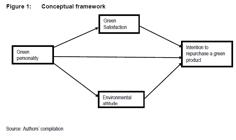
In the current study, green personality is the independent variable, while green repurchasing intentions are the dependent variable. Literature supports the view that personality influences ones' intention to consume ecologically friendly products (Brick & Lewis 2016:635; Kvasova 2015:115; Swati & Darshana 2018:89). In the same vein, some studies prove that environmental attitude also influences ones' intentions to engage in particular behaviour (Chen & Tung 2014:223; Joshi & Rahman 2015:129; Yadav & Pathak 2016:7334). Yet, the processes underlying the aforementioned relationships are under-explored. To the authors' knowledge, no previous study ought to prove the mediation effect of environmental attitude on the green personality-green repurchase intentions relationships in a low income economy context. An appreciation of the strength and level of the proposed mediating factor between green personality and repurchasing intentions leverage the knowledge of marketers of environmentally-friendly products concerning why personality is integral to promoting repeat purchases, hence the need for this study. Thus, the authors hypothesise that:
H5: Environmental attitude mediates the relationship between green personality and repurchasing of green products.
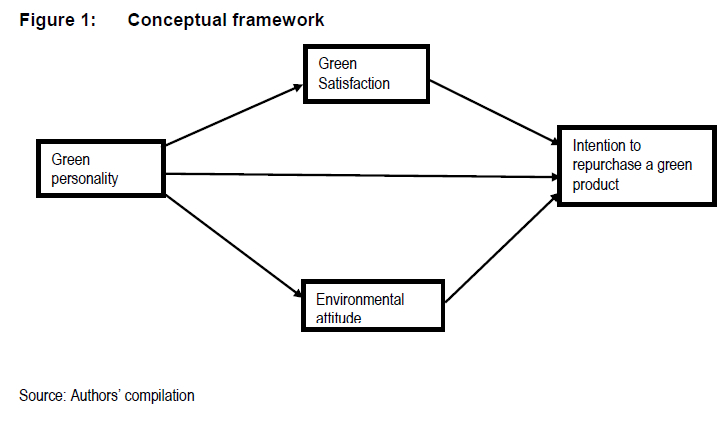
The conceptual framework for this study is presented in Figure 1.
3. RESEARCH METHODOLOGY
3.1
Research designThis study was conducted using a positivist epistemology and quantitative approach. This was done so as to confirm or disconfirm some hypothesised relationships between the study variables. A cross-sectional survey design was used to gather data from a sample of respondents, with the sole purpose of generalising the findings to the target population.
3.2
Target population and sampling issuesThe target population consisted of undergraduate students who were enrolled at the Engineering, Applied Sciences and Business Studies divisions of a particular polytechnic college in Zimbabwe during 2018. A sample of 300 students was drawn from the population using simple random methods. Class lists sourced from the tutors-in-charge of the different classes were used to compile a sampling frame from which respondents were chosen using an online number generator. The demographic profile of the respondents is presented in next subsection.
3.3
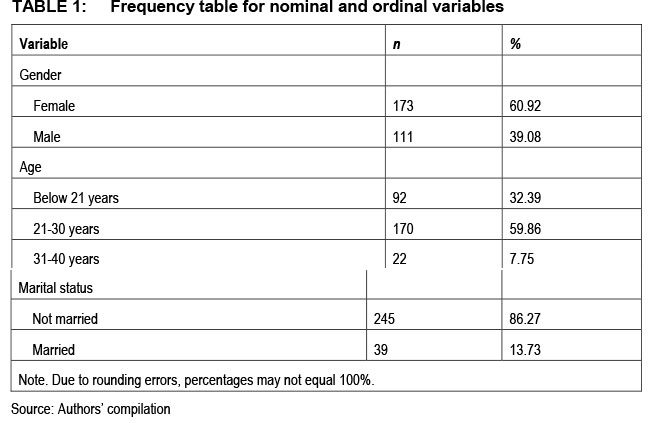
Demographic profile of respondentsFrequencies and percentages were calculated for the following variables: Gender, Age, and Marital status. The most frequently observed category of Gender was Female (n = 173, 61%). Next, the most frequently observed category of Age was 21-30 years (n = 170, 60%). Lastly, the most frequently observed category of Marital status was Not married (n = 245, 86%). The frequencies and percentages are presented in Table 1.
3.4
Data collectionData was collected using a self-completion questionnaire. A total of 300 questionnaires were distributed to respondents over a period of two weeks in July 2018. One of the co-authors, who is employed as a lecturer at the participating college was responsible for distributing the questionnaires. Of the total distributed, 284 were returned and usable, representing a 94.6% response rate.
Permission to conduct the study was sought from and granted by the concerned college authorities. Informed consent for participation was obtained from the respondents. The respondents were assured of the privacy and confidentiality of their contributions. No rewards were offered to the respondents for participating in the study.
3.5
Measuring instrumentThe research questionnaire comprised of two sections. The items in the first section solicited data on the respondents' demographic details while those included in section B covered the following variables: green personality, environmental attitude, green satisfaction, and green repurchasing intention. The four variables were measured using Likert scale items which had scale points that ranged from 1 ("Strongly disagree") to 5 ("Strongly agree"). Some of the items were adopted from previous studies which had used similar variables while others were formulated by the authors from cognate literature. The four items used to measure "green satisfaction" were adapted from Chen (2009:312). In addition, two of the five items used to measure environmental attitude were adopted from Banerjee and McKeage (1994:149-50), and the other three were developed by the authors from extant literature. The additional items were incorporated so as to enhance the completeness of the measuring scale. The green personality variable was measured using three items, all of which focused specifically on the "openness" dimension. These were adapted from Kvasova (2015:114). The items covered the following dimensions of the aforementioned trait: imagination; unconventionality and amenability to abstract ideas. The repurchasing intentions variable was measured using a four items, three of which were adapted by the authors from Tsai and Huang (2007:235). The remainder was developed by the authors for the study context. Two academics evaluated the items and provided input to help reduce redundancy and ambivalence. The details of the credibility of the scale items are presented in the next subsection.
3.6 Credibility issues
3.6.1 Reliability
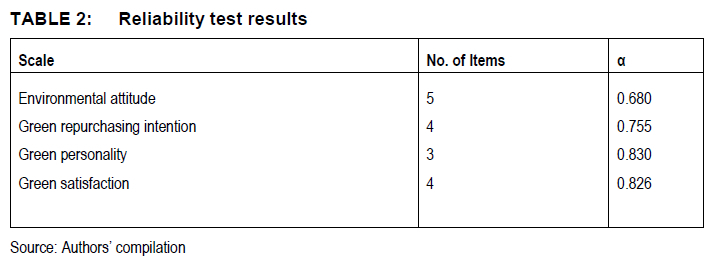
The Cronbach alpha test was used to assess the internal consistency of the study variables. Thus, reliability coefficients were calculated for the following variables: environmental attitude, green personality, green satisfaction and green repurchasing intention. The reliability coefficients were evaluated using the guidelines suggested by George and Mallery (2016:245-56) where > 0.9 excellent, > 0.8 good, > 0.7 acceptable, > 0.6 questionable, > 0.5 poor, and < 0.5 unacceptable. Table 2 shows the outcome of the reliability test.
Except for the environmental attitude variable which is questionable, the reliability coefficients for the other variables extended from acceptable to good.
3.7.2 Validity
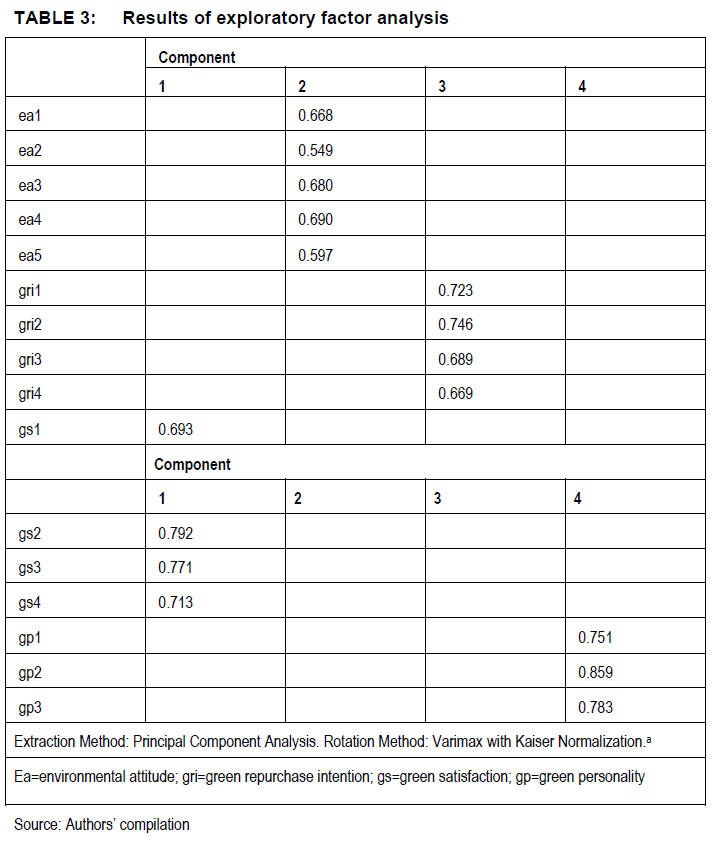
The researchers used exploratory factor analysis to assess the construct validity of the questionnaire items which represented the four variables of the study. The Kaiser-Meyer-Olkin (KMO) measure of sampling and Bartletts' test of sphericity were carried out in order to determine the appropriateness of the data for factor analysis. The KMO measure of sampling adequacy score of 0.863 which derived was bigger than the minimum threshold of 0.5, and the Bartlett's test of sphericity result of x2 (120) = 1608.206, p < 0.000, signifies that the configuration of correlation of the items used to measure the study variables was compact and possibly yielded consistent factors. A Varimax rotation was done on the 16 items of the measuring scale. Principal component analysis was used as the extraction method. Four factors (environmental attitude, green repurchasing intention, green satisfaction, and green personality) appeared, and these accounted for 60.32% of the variance. Hence, the acceptable loading of all 16 items on four factors confirms convergent validity. Table 3 presents the factor loadings after rotation.
4. FINDINGS
4.1 Test for normality of data distribution
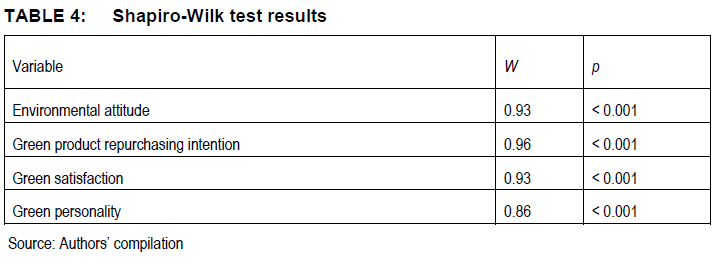
Shapiro-Wilk tests were conducted in order to determine whether the distributions of environmental attitude, green product repurchasing intention, green satisfaction, and green personality were significantly different from a normal distribution. The results are presented in Table 4. All of the aforementioned variables had distributions which significantly differed from normality as is indicated by the p-values which are less than 0.05.
4.2 Correlation analysis
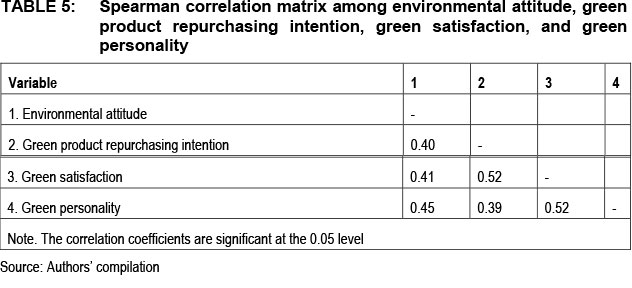
Since all the study variables measured were significantly different from a normal distribution, a non-parametric test was used to test whether they correlated with each other. Hence, Spearman's correlation analysis was carried out on the following variables: environmental attitude, green product repurchasing intention, green satisfaction, and green personality. Cohens' standard was used to evaluate the strength of the relationships, where coefficients between 0.10 and 0.29 represented a small effect size, coefficients between 0.30 and 0.49 denoted a moderate effect size, and coefficients above 0.50 indicated a large effect size (Cohen 1992:156). The results are presented in Table 5.
Positive and significant correlations were observed between all pairs of variables. The strength of the correlations between the various pairs ranged from moderate to strong, as shown by the correlation coefficients. The results provided a strong foundation for carrying out regression analysis tests on the variables.
4.3 Mediation tests
Two sets of Baron and Kenny mediation analyses were conducted. The first one sought to assess if green satisfaction mediated the relationship between green personality and Green product repurchasing intention. The second one evaluated whether environmental attitude mediated the relationship between green personality and green product repurchasing intention. To determine whether a mediating relationship was supported by the data, three regressions were conducted. For mediation to be supported, four conditions must be met: 1) the independent variable must be related to the dependent variable, 2) the independent variable must be related to the mediator variable, 3) the mediator must be related to the dependent variable while in the presence of the independent variable, and 4) the independent variable should no longer be a significant predictor of the dependent variable in the presence of the mediator variable (Baron & Kenny 1986:1177).
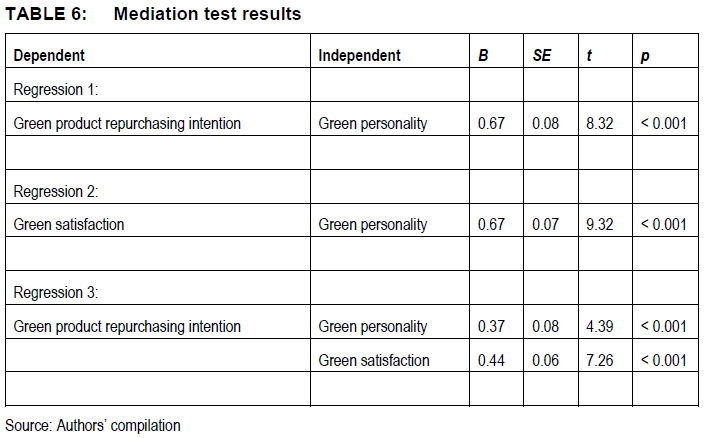
In the first analysis, the independent variable was green personality, the mediator variable was green satisfaction and the dependent variable was green product repurchasing intention. Firstly, the regression with green personality predicting green product repurchasing intention was conducted. The results of this test were significant, F(2, 282) = 69.24, p < 0.001. This indicated that the first criterion for mediation was satisfied. Secondly, the regression with green personality predicting green satisfaction was conducted. The regression of green satisfaction on green personality was significant too, F(2, 282) = 86.87, p < 0.001. This outcome demonstrated that the second criterion for mediation was fulfilled. Next, the regression test with green personality and green satisfaction predicting green product repurchasing intention was conducted. The outcome was significant, F(3, 281) = 67.35, p < 0.001, suggesting that green personality and green satisfaction accounted for a significant amount of variance in green product repurchasing intention. A further examination of the individual predictors results revealed that green satisfaction was a significant predictor of green product repurchasing intention even when green personality was included in the regression model, B = 0.44. This confirms that the third criterion for mediation was satisfied.
In the same vein, green personality significantly predicted green product repurchasing intention when green satisfaction was included in the regression model, B = 0.37, indicating that the fourth criterion for mediation was not satisfied. Since conditions 1, 2, and 3 were met, while condition 4 was not, partial mediation is supported. The results of the regression models are summarised in Table 6.
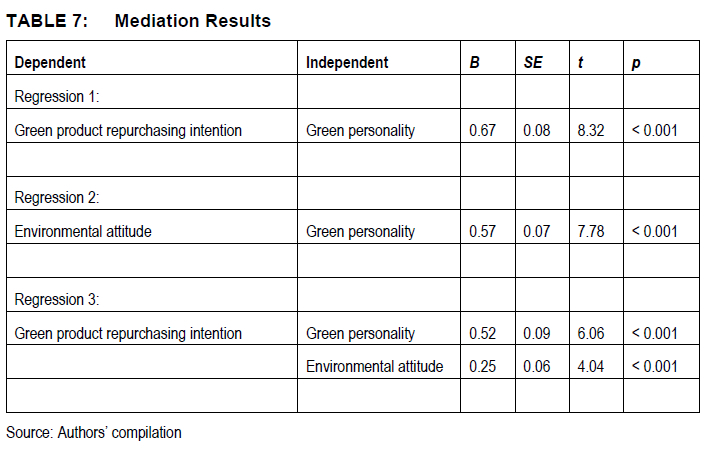
In the second mediation analysis, the first regression with green personality predicting green product repurchasing intention was carried out. The outcome exhibited a statistically significant effect, F(2, 282) = 69.24, p < 0.001. This means that the first yardstick for mediation was satisfied. Secondly, the regression with green personality predicting environmental attitude was conducted. Again, this relationship was significant, F(2, 282) = 60.48, p < 0.001. The result confirmed that green personality was a significant predictor of environmental attitude, B = 0.57, signifying that the second condition for mediation was satisfied. After that, the regression with green personality and environmental attitude predicting green product repurchasing intention was tested. The afore-mentioned relationship was significant also, F(3, 281) = 44.64, p < 0.001, suggesting that green personality and environmental attitude accounted for a significant amount of variance in green product repurchasing intention. The effects of the different predictors were scrutinized further. It emerged that environmental attitude significantly predicted green product repurchasing intention when green personality was incorporated in the regression model, B = 0.25. This demonstrated that the third condition for mediation was satisfied. Finally, the results also showed that the green personality variable was a significant predictor of green product repurchasing intention when the environmental attitude variable was included in the regression equation, B = 0.52. This meant that the fourth criterion for mediation was not met. Since conditions 1, 2, and 3 were met, while 4 was not, partial mediation is supported. The results of the mediation test are summarised in Table 7.
5. DISCUSSION
Past studies on consumer behaviour research highlight an important connection between personality and buying behaviour in general. However, not much research attention has been extended to environmentally friendly products and habitual (repeat) purchase situations in particular. Despite calls for more studies which seek to unravel the mechanism through which the aforementioned relationship is perpetuated, little is known about them, particularly their integration. Hence, this study sought to contribute to the narrowing of this research gap by testing a number of relationships.
It was hypothesised that a green personality is positively associated with an intention to repeat the purchases of environmentally friendly products. Both the correlation and regression tests confirmed this link, with the green personality variable explaining 67 % of the variance in the intent to repurchase green products. This result corroborates the findings of previous research which highlighted the link between personality and green purchasing behaviour (Busic-Sontic et al. 2017:322; Gordon-Wilson & Modi 2015:4; Markowitz et al. 2012:3; Nalchy et al. 2012:49; Pavalache-Ilie & Cazan 2018:72; Wei et al. 2016:345). A plausible explanation for this relationship, particularly for a study based on a sample of college students, a customer group reasonably assumed to have access to different information sources about the society they live in, is that the respondents could have been previously exposed to and persuaded by information on the positive effects of sustainable consumption, and thus developed pro-environment outlooks. As earlier noted a green personality is malleable and can be acquired through experience. Hence, most of the respondents in this study could have developed eco-friendly personalities over time through experiences, which explains the outcome of the hypothesis tests. This explanation needs to be taken with caution given that it relates to a result emanating from a study based on a small sample and a cross-sectional survey.
The second hypothesis proposed that environmental attitude is associated with the intention to repurchase environmentally friendly products. The hypothesis was confirmed by the outcome from both the correlation and regression analysis tests. While few studies explicitly suggest a positive relationship between environmental attitude and repurchase intentions (Ariffin et al. 2016:395), several others support a similar connection between environmental attitude and the intention to purchase for the first time (Hsu, Chang & Yansritakul 2017:1478; Joshi & Rahman 2015:129; Moser 2015:167; Paul, Modi & Patel 2016:124-5; Yadav & Pathak 2016:733). This outcome is not surprising given that intention based theories of behaviour stress that attitudes precede an intention to act. It, therefore, follows that positive environmental attitudes precede an individuals' willingness to purchase environmentally friendly products.
The third hypothesis proposed a mediation effect of green satisfaction variables on the relationship between green personality and intentions to repurchase green products. The outcome of the analysis revealed that green satisfaction partially explained the predictive link between the aforementioned variables. This means that the predictive effect of green personality on an individuals' intention to repurchase environmental friendly products is not explained completely by green satisfaction only. Therefore, other factors also explain the said relationship. Although the authors could not locate in literature a study which explored a similar relationship to one hypothesised here, the findings in the current study cement those of other scholars who argue that enhanced levels of satisfaction with a product are likely to lead to higher levels of loyalty behaviours, commonly assessed through willingness to return and willingness to endorse (Harrison & Shaw 2004:26).
The fourth and last hypothesis proposed a mediation effect of environmental attitude on the relationship between green personality and the intention to repurchase environmentally friendly products. The results support a partial mediation only on the mentioned relationship. This result means that the environmental attitudes variable did not fully explain the relationship between green personality and the intention to repurchase an environmentally friendly product.
Instead, there might be some other factor/s. This finding however strengthens the credibility of the claims of the Theory of Trying, Theory of Reasoned Action and Theory of Planned Behaviour which proposes a mediation role for attitudes on the relationship between other independent variables and intention to engage in actual behaviour. Some previous studies on environment-related behaviour take cognisance of this and have conceptualised studies with attitude towards behaviour as a mediating factor (Cottrell 2003:7; de Leeuw, Valois, Ajzen & Schmidt 2015:129). The preceding findings have significant implications for practice and research. These are dealt with in the following sections.
6. MANAGERIAL IMPLICATIONS
The study indicates that variables such as green personality, green satisfaction and environmental attitude are integral to green marketers' understanding of the intention of consumers of green products to repeat purchases. An implication of the findings presented earlier on is that the said variables should be taken into account when designing marketing strategies intended to promote green products. As competition in consumer product markets continues to stiffen, and it increasingly becomes costly and difficult to get new customers, it is advantageous for retailers of green products to find ways of encouraging repeat purchases, and therefore brand loyalty, from already existing customers. Hence, understanding the forces that underlie the intention to repurchase is a vital first step.
To a large extent, marketers of green products have overly relied on demographic variables as means for segmenting and targeting markets. In as much as such criterion provides a convenient way of categorising customers, it is hampered by numerous issues among which is the failure to give comprehensive explanations for certain buyer motivations and behaviours. Hence, marketers can mitigate such limitations by the use of psychographic attributes like green personality and environmental attitude as a means of getting an in-depth understanding of their customers.
Lastly, the identification of individual idiosyncrasies which are linked to certain product consumption or usage creates opportunities for marketers of environmentally friendly products to design tailored products that appeal to particular personalities. Marketers can make use of this information to differentiate their product offerings in line with different customer personality based segments. Similarly, promotional messages in line with the unique attributes of the target market.
7. LIMITATIONS AND AREAS FOR FUTURE RESEARCH
Some limitations might be related to collecting the data and interpreting the results. A first limitation might be the use of a relatively small sample of respondents from a single institution of higher learning in Zimbabwe. Although the sample size was deemed acceptable, a more generalisable and valid result could have been derived if respondents had been drawn from diverse institutions.
Secondly, a potential design weakness in the study is common method bias. A single questionnaire was used to collect data on all the variables constituting this study. Therefore, the strength of the relationships between these variables could probably have been exaggerated.
A third potential limitation is related to the use of a cross-sectional survey to evaluate predictive relationships. A more accurate test of such a link would assess variables at different time intervals. Another weakness is that reverse causal effects were not tested. These might have affected the mediation effects between the variables. These noted limitations could guide researchers to conceptualise their future research agendas.
REFERENCES
- ABDUL-MUHMIN AG. 2010. Repeat purchase intentions in online shopping: the role of satisfaction, attitude, and online retailers' performance. Journal of International Consumer Marketing 23(1):5-20.
- AJZEN I. 1985. From Intentions to Actions: A Theory of Planned Behavior. In Kuhl J & Beckmann J. Eds. Action Control. Springer Series in Social Psychology. Berlin, Heidelberg: Springer. (pp 11-39.
- )
- ANAZA NA. 2014. Personality antecedents of customer citizenship behaviors in online shopping situations. Psychology & Marketing 31 (4):251-263.
- BAMBERG S. 2003. How does environmental concern influence specific environmentally related behaviors? A new answer to an old question. Journal of Environmental Psychology 23(1):21-32.
- BANERJEE B & MCKEAGE K. 1994. How green is my value: exploring the relationship between environmentalism and materialism. In Allen CT & Roedder D. Eds. Provo, UT: Association for Consumer Research. (pp 147-152.
- )
- BAO Q, CHEN Y & SONG L. 2011. Foreign direct investment and environmental pollution in China: a simultaneous equations estimation. Environment and Development Economics 16(1):71-92.
- BARBAROSSA C & DE PELSMACKER P. 2016. Positive and negative antecedents of purchasing eco-friendly products: a comparison between green and non-green consumers. Journal of Business Ethics 134(2):229-247.
- BARON RM & KENNY DA. 1986. The moderator-mediator variable distinction in social psychological research: conceptual, strategic, and statistical considerations. Journal of Personality and Social Psychology 51(6):1173-1182.
- BAUDIN N, ALUJA A, ROLLAND JP & BLANCH A. 2011. The role of personality in satisfaction with life and sport. Psicologia Conductual 19(2):333-345.
- BRICK C & LEWIS GJ. 2014. Unearthing the "green" personality: core traits predict environmentally friendly behavior. Environment and Behavior 48(5):635-658.
- BUSIC-SONTIC A, CZAP NV & FUERST F. 2017. The role of personality traits in green decisionmaking. Journal of Economic Psychology 62:313-328.
- CHEN KK. 2014. Assessing the effects of customer innovativeness, environmental value and ecological lifestyles on residential solar power systems install intention. Energy Policy 67:951-961.
- CHEN YS. 2009. The drivers of green brand equity: green brand image, green satisfaction, and green trust. Journal of Business Ethics 93(2):307-19.
- CHEN YS. 2013. Towards green loyalty: driving from green perceived value, green satisfaction, and green trust. Sustainable Development 21(5):294-308.
- CHEN MF & TUNG PJ. 2014. Developing an extended theory of planned behavior model to predict consumers' intention to visit green hotels. International Journal of Hospitality Management 36:221-230.
- CHEN YS, LIN YL & WENG SW. 2015. The influence of environmental friendliness on green trust: The mediating effects of green satisfaction and green perceived quality. Sustainability 7:1035-1052.
- CHIU CM, WANG ET, FANG YH & HUANG HY. 2014. Understanding customers' repeat purchase intentions in B2C e-commerce: the roles of utilitarian value, hedonic value and perceived risk. Information Systems Journal 24(1):85-114.
- COHEN J. 1992. A power primer. Psychological bulletin 112(1):155-159.
- COTTRELL SP. 2003. Influence of socio-demographics and environmental attitudes on general responsible environmental behavior among recreational boaters. Environment and Behavior 35(3):347-375.
- DE LEEUW A, VALOIS P, AJZEN I & SCHMIDT P. 2015. Using the theory of planned behavior to identify key beliefs underlying pro-environmental behavior in high school students: implications for educational interventions. Journal of Environmental Psychology 42:128-138.
- DUBIHLELA J & NGXUKUMESHE T. 2016. Eco-friendly retail product attributes, customer attributes and the repurchase intentions of South African consumers. International Business & Economics Research Journal 15(4).
- EAST R, SINGH J, WRIGHT M & VANHUELE M. 2016. Consumer behaviour: Applications in marketing. London: Sage.
- EHRENBERG ASC. 1988. Repeat-Buying: Facts, Theory and Applications. London: Charles Griffin & Company Limited.
- EMENIKE CP, TENEBE IT, OMOLE DO, NGENE BU, ONIEMAYIN BI, MAXWELL O & ONOKA BI. 2017. Accessing safe drinking water in sub-Saharan Africa: Issues and challenges in South-West Nigeria. Sustainable cities and society 30:263-272.
- FARIDA N & ARDYAN E. 2015. Repeat purchase intention of Starbucks consumers in Indonesia: a green brand approach. TRZISTE 27(2):189-202.
- GEE R, COATES G & NICHOLSON M. 2008. Understanding and profitably managing customer loyalty. Marketing Intelligence & Planning 26(4):359-374.
- GEORGE D & MALLERY P. 2016. IBM SPSS Statistics 23 Step by Step. London: Routledge.
- GIL MT & JACOB J. 2018. The relationship between green perceived quality and green purchase intention: a three-path mediation approach using green satisfaction and green trust. International Journal of Business Innovation and Research 15(3):301-319.
- GOLDBERG LR. 1993. The structure of phenotypic personality traits. American Psychologist 48:26-34.
- GONÇALVES HM, LOURENÇO TF & SILVA GM. 2016. Green buying behavior and the theory of consumption values: a fuzzy-set approach. Journal of Business Research 69(4):1484-1491.
- GORDON-WILSON S & MODI P. 2015. Personality and older consumers' green behaviour in the UK. Futures 71:1-10.
- HARRIS F, ROBY H & DIBB S. 2016. Sustainable clothing: challenges, barriers and interventions for encouraging more sustainable consumer behaviour. International Journal of Consumer Studies 40(3):309-318.
- HARRISON P & SHAW R. 2004. Consumer satisfaction and post-purchase intentions: an exploratory study of museum visitors. International Journal of Arts Management 23-32.
- HASNAH HASSAN S. 2014. The role of Islamic values on green purchase intention. Journal of Islamic Marketing 5(3):379-395.
-
HEALTH EFFECTS INSTITUTE (HEI). 2018. State of Global Air: How clean is the air you breathe? [Internet://www.stateofglobalair.org/air; downloaded on 09 October 2018.
» www.stateofglobalair.org/air - ]
- HSU CL, CHANG CY & YANSRITAKUL C. 2017. Exploring purchase intention of green skincare products using the theory of planned behavior: testing the moderating effects of country of origin and price sensitivity. Journal of Retailing and Consumer Services 34:145-152.
- HUANG YC, YANG M & WANG YC. 2014. Effects of green brand on green purchase intention. Marketing Intelligence & Planning 32(3):250-268.
- JEONG E, JANG SS, DAY J & HA S. 2014. The impact of eco-friendly practices on green image and customer attitudes: an investigation in a café setting. International Journal of Hospitality Management 41(2014):10-20.
- JOSHI Y & RAHMAN Z. 2015. Factors affecting green purchase behaviour and future research directions. International Strategic Management Review 3(1 -2):128-143.
- KAISER FG, WÖLFING S & FUHRER U. 1999. Environmental attitude and ecological behaviour. Journal of Environmental Psychology 19:1-19.
- KHARE A. 2015. Antecedents to green buying behaviour: a study on consumers in an emerging economy. Marketing Intelligence & Planning 33(3):309-329.
- KIM YG, SUH BW & EVES A. 2010. The relationships between food-related personality traits, satisfaction, and loyalty among visitors attending food events and festivals. International Journal of Hospitality Management 29(2):216-226.
- KUO YF, HU TL & YANG SC. 2013. Effects of inertia and satisfaction in female online shoppers on repeat-purchase intention: the moderating roles of word-of-mouth and alternative attraction. Managing Service Quality: An International Journal 23(3):168-187.
- KVASOVA O. 2015. The Big Five personality traits as antecedents of eco-friendly tourist behavior. Personality and Individual Differences 83:111-116.
- LAI CK & CHENG EW. 2016. Green purchase behavior of undergraduate students in Hong Kong. The Social Science Journal 53(1):67-76.
- LAM AYC, LAU MM & CHEUNG R. 2016. Modelling the relationships among green perceived value, green trust, satisfaction, and repurchase intention of green products. Contemporary Management Research 12(1):47-60.
- LIU H. 2014. Personality, leisure satisfaction, and subjective well-being of serious leisure participants. Social Behavior and Personality: An International Journal 42(7):1117-1125.
- MARKOWITZ EM, GOLDBERG LR, ASHTON MC & LEE K. 2012. Profiling the "pro-environmental individual": a personality perspective. Journal of Personality 80(1):81-111.
- MARTINEZ P. 2015. Customer loyalty: exploring its antecedents from a green marketing perspective. International Journal of Contemporary Hospitality Management 27(5):896-917.
- MIHAELA OOE. 2015. The influence of the integrated marketing communication on the consumer buying behaviour. Procedia Economics and Finance 23:1446-1450.
- MILFONT TL & DUCKITT J. 2010. The environmental attitudes inventory: a valid and reliable measure to assess the structure of environmental attitudes. Journal of Environmental Psychology 30(1):80-94.
- MINARTI SN & SEGORO W. 2014. The influence of customer satisfaction, switching cost and trusts in a brand on customer loyalty-The survey on student as IM3 users in Depok, Indonesia. Procedia-Social and Behavioral Sciences 143:1015-1019.
- MORIUCHI E & TAKAHASHI I. 2016. Satisfaction trust and loyalty of repeat online consumer within the Japanese online supermarket trade. Australasian Marketing Journal (AMJ) 24(2):146-156.
- MOSER AK. 2015. Thinking green, buying green? Drivers of pro-environmental purchasing behavior. Journal of Consumer Marketing 32(3):167-175.
- MOSER AK. 2016. Consumers' purchasing decisions regarding environmentally friendly products: an empirical analysis of German consumers. Journal of Retailing and Consumer Services 31:389-397.
- MPINGANJIRA M. 2014. Understanding online repeat purchase intentions: a relationship marketing perspective. Management: Journal of Contemporary Management Issues 19(2):117-135.
- NALCHY A R, RASOULIAN M & BOOJARI H. 2012. Consumer purchasing behavior towards foreign brands in the domestic brands. Development of Management Journal (8):47-56.
- NAZEER M, TABASSUM U & ALAM S. 2016. Environmental pollution and sustainable development in developing countries. The Pakistan Development Review 55(4): 589-604.
- NEL HA & FRONEMAN PW. 2015. A quantitative analysis of microplastic pollution along the south-eastern coastline of South Africa. Marine Pollution Bulletin 101(1):274-279.
- OLIVER RL. 2014. Satisfaction: a behavioral perspective on the consumer: A behavioral perspective on the consumer. London: Routledge.
- PARUMASUR SB & ROBERTS-LOMBARD M. 2014. Consumer behaviour. Cape Town: Juta.
- PAUL J, MODI A & PATEL J. 2016. Predicting green product consumption using theory of planned behavior and reasoned action. Journal of Retailing and Consumer Services 29:123-134.
- PAVALACHE-ILIE M & CAZAN AM. 2018. Personality correlates of pro-environmental attitudes. International Journal of Environmental Health Research 28(1):71-78.
- PENG L. 2011. Ways to mould ecological personality. Journal of Jishou University (Social Science Edition) 32 (3):166-169.
- PEREIRA L & DRIMIE S. 2016. Governance arrangements for the future food system: addressing complexity in South Africa. Environment: Science and Policy for Sustainable Development 58(4):18-31.
- PITTA D, FRANZAK F & FOWLER D. 2006. A strategic approach to building online customer loyalty: integrating customer profitability tiers. Journal of Consumer Marketing 23(7):421-429.
- PRAKASH G & PATHAK P. 2017. Intention to buy eco-friendly packaged products among young consumers of India: a study on developing nation. Journal of Cleaner Production 141:385-393.
- SCHIFFMAN L & KANUK L. 2009. Consumer behaviour. 10th edition. New York: Prentice Hall.
- SHEPPARD BH, HARTWICK J & WARSHAW PR. 1988. The theory of reasoned action: a meta-analysis of past research with recommendations for modifications and future research. Journal of Consumer Research 15(3) 325-343.
- SOLOMON MR. 2010. Consumer behaviour: A European perspective. London: Pearson education.
- STERN PC. 2000. New environmental theories: Toward a coherent theory of environmentally significant behavior. Journal of Social Issues 56: 407-424.
- TETA C, NCUBE M & NAIK YS. 2017. Heavy metal contamination of water and fish in peri-urban dams around Bulawayo, Zimbabwe. African Journal of Aquatic Science 42(4):351-358.
- TSAI HT & HUANG HC. 2007. Determinants of e-repurchase intentions: An integrative model of quadruple retention drivers. Information & Management 44(3):231-239.
- UDDIN SF & KHAN MN. 2016. Exploring green purchasing behaviour of young urban consumers: empirical evidences from India. South Asian Journal of Global Business Research 5(1):85-103.
-
UNITED NATIONS. 2018. Rate of environmental damage increasing across the planet but there is still time to reverse worst impacts if governments act now, UNEP Assessment Says. United Nations Sustainable Development. [Internet:www.un.org/sustainabledevelopment/blog/2016/05/rate-of-environmental-damageincreasing-across-planet-but-still-time-to-reverse-worst-impacts/; downloaded on 09 October 2018.
» www.un.org/sustainabledevelopment/blog/2016/05/rate-of-environmental-damageincreasing-across-planet-but-still-time-to-reverse-worst-impacts/ - ]
- VAN DEVENTER M, DE KLERK N & BEVAN-DYE A. 2017. Influence of perceived integrity and perceived system quality on Generation Y students perceived trust in mobile banking in South Africa. Banks and Bank Systems 12(1):128-134.
- WANG Y & HAZEN BT. 2016. Consumer product knowledge and intention to purchase remanufactured products. International Journal of Production Economics 181:460-469.
- WEI J, CHEN H & LONG R. 2016. Is ecological personality always consistent with low-carbon behavioral intention of urban residents? Energy Policy 98:343-352.
- WU SI & CHEN YJ. 2014. The impact of green marketing and perceived innovation on purchase intention for green products. International Journal of Marketing Studies 6(5):81.
- YADAV R & PATHAK GS. 2016. Young consumers' intention towards buying green products in a developing nation: extending the theory of planned behavior. Journal of Cleaner Production 135:732-739.
- ZIXUAN Z. 2013. Factors influencing consumer repurchase intention towards organic food in Bangok, Thailand. Business Sciences International Research Journal 1(2):579-582.