Increasing the organisational effectiveness of professional associations in South Africa
Abstract
Professionals, such as accountants and lawyers, and their professional associations (PAs), serve organisations such as business firms, educational institutions courts of law. Without professional associations, these organisations and the economy would not operate effectively. PAs are regularly confronted by rapid and unpredictable changes (for example, in labour and company legislation), which require them to adapt quickly in order to provide relevant services to their members. Globalisation compels professionals in companies to be more innovative in delivering goods and services to local and international markets. If PAs do not grow and are not effectively and efficiently run, businesses, society and the economy will suffer. On a sample of 32 senior officials of 25 South African PAs, this study investigates how membership growth in PAs can be achieved and how their organisational effectiveness can be improved. The empirical results show that being an effective learning organisation (ELO) and membership growth are important measures of a PA's organisational effectiveness. The results revealed that access to funding correlated positively with a PA being an ELO, while membership growth is driven by a PA's competitive characteristics and it being an ELO and a first-mover in its industry.
competitiveness; learning organisation; organisational effectiveness; professional associations
1. INTRODUCTION
Professions and professional associations (or bodies) are a feature of the social structure of all advanced societies (Ackroyd 1996:601). According to Cruess, Johnson and Cruess (2004:74), a profession is "an occupation whose core element is work, based upon the mastery of a complex body of knowledge and skills."
It is a vocation in which "knowledge of some department of science or learning, or the practice of a vocation upon which it is based, is used in the service of others. Its members are governed by a code of ethics, and profess a commitment to altruism, competence, integrity and morality, and the promotion of the public good within their sector. This forms the basis of a social contract between a profession and society, which in return allows the profession a monopoly over the use of its knowledge base, the privilege of self-regulation and autonomy in practice" (Cruess et al. 2004:75).
According to the Collins English Dictionary, a professional association (PA) is, therefore, "a body of persons engaged in the same profession, usually formed to control entry into the profession, [to] maintain standards, and [to] represent the profession in discussions with other bodies" (HarperCollins Publishers 2006:650).
Professional associations play an important role in the society and the economy of a country. Professionals, such as accountants, lawyers and engineers, serve organisations in all sectors of society, including business firms, educational institutions, hospitals and the courts of law. Without professions, supported by professional associations, these organisations in the legal fraternity, communities and the economy would not be able to operate effectively. PAs, therefore, have a huge societal and economic value. Against this background, the present study investigates the challenges that PAs face, and how these organisations could be made more effective and efficient.
Professional associations have traditionally served the needs of professionals, who are also their members. Their primary focus areas have been the provision of professional development to members through education or training, facilitating and disseminating research into the profession or industry, or to provide industry and/or the government with professional representation (Kloss 1999:71). Associations generally are owned and funded by the membership dues; they are usually structured democratically, with any member also able to nominate and be elected to leadership positions (Prideaux 2005:52). Professional associations exist to advance the standing of members in their occupation or profession; and they do this by setting educational and other standards governing the profession, advocating favourable public and private policies, aiding members in their professional development, and advancing professional practice through research and information dissemination (Kloss 1999:71).
The value of professional associations, however, is not only restricted to the professionals or the sector in which they operate; but it extends much further. Every professional association serves the sector in which it operates, and indirectly many persons associated with that sector. Its effectiveness determines how the professionals served by the professional association operate, which in turn influences the effectiveness of professional associations again. The cascading benefits (political, economic, social and environmental) to the sector are immense. These benefits cascade to the lives of many who are dependent on the sector, including the public at large. Hence, effective associations have a huge role to play in society.
There are 48 professional associations registered with the South African Qualifications Authority (SAQA 2013:lnternet). Some of the most popular of these PAs, in alphabetical order, are: the Chartered Institute of Management Accountants, the Chartered Secretaries of Southern Africa, the Engineering Council of South Africa, the Health Professions Council of South Africa, the Institute of Directors in Southern Africa, the Institution of Occupational Safety and Health (South Africa), and lastly, the South African Institute of Chartered Accountants.
In membership alone, three of the bigger PAs reported that they have received annual membership fees from their members to the tune of R42.5 mil, R37.9 mil and R15.9 mil respectively, as at June 2015 (SAQA 2015: personal communication on 8 August 2015). In June 2015, the last available statistics, indicated that there were 91 426 members affiliated to professional associations in South Africa (SAQA 2015: personal communication). These statistics on PAs indicate that these organisations play an important role in the South African economy - through advocacy and the regulatory decision-making frameworks that they provide to their members.
2. PROBLEM INVESTIGATED
Professions and their associations are often confronted with changes which require them to adapt quickly in order to preserve their unique strengths, minimise their weaknesses, exploit their opportunities and counter any threats. For example, changes in legislation often require PAs to change their constitutional rules and procedures, in order for them to self-regulate their members. If PAs do not implement these constitutional changes timeously, this important function of self-regulation is hindered. Changes in the labour and company laws of a country also require PAs to provide guidance and training to their members on how they should align their firms with these changes. If these PAs are not effectively and efficiently run, businesses, society and the economy will suffer.
South African PAs are also dealing with challenges of improving the quality and quantity of professional development services for their members, broadening their impact in the professions they serve, and increasing their influence within society (Arendale, Barrow Carpenter, Hodges, McGrath, Newell & Norton 2009:30). South African PAs must, therefore, find ways to improve their membership retention through the provision of better services to their members. This requires from PAs to firstly investigate what improved services their members want, secondly which environmental factors drive the need for these services, and thirdly then plan and execute strategies to meet these needs (Arendale eí ai. 2009:30).
Globalisation, and consequently, the need for international competitiveness expect firms to be more innovative in delivering goods and services to local and international markets. This requires firms to invest huge amounts of money in research and development (R&D) activities in their firms. R&D is often driven by highly specialised professionals in all firms. If PAs do not engage in cutting-edge R&D training and education themselves, they cannot effectively service these members, while the latter would then not be able to serve their firms in the most effective ways. The result is less competitive firms and national economies. The effectiveness of PAs is, therefore, of national importance.
Against the background of the above-mentioned problem statement, the following research questions have been identified:
■ How can membership growth in PAs be achieved and maintained?
■ How can the organisational effectiveness of PAs be improved, in order for them to deliver better services to their members?
■ Which environmental factors (political, economic, social, technological and educational) influence the organisational effectiveness of PAs?
■What role do internal factors, such as competitive position, re-investment in skills and resources, the quality of operations, and finances, play in the organisational effectiveness of PAs?
3. A CONCEPTUAL FRAMEWORK TO INCREASE THE ORGANISATIONAL EFFECTIVENESS OF PAs
In this section, the measurement of organisational effectiveness and its proposed determinants in the context of PAs will be discussed.
3.1 Conceptualising organisational effectiveness
The present study consulted Kotler's (2001:10) notion of high-performing businesses, Kaplan and Norton's (1996:25) Balanced Scorecard and Bharadwaj, Varadarajan and Fahy's (1993:84) model for sustainable competitive advantage in order to identify the factors influencing the organisational effectiveness of PAs.
Kotier (2001:10) describes a high-performing business, in other words a highly effective organisation, as one that creates both customer value and customer satisfaction by maintaining effective management of four key success factors, namely: the stakeholders, processes, resources and the organisation. High-performance businesses do not only focus on their shareholders as stakeholders, but increasingly on their customers, employees, suppliers and distributors. Following Kotier (2001:10), in the present study, elements such as stakeholders (members, employees and customers), processes (operations), resources (people and physical resources) and organisation (structure and culture) are included in the conceptual model, in order to improve the organisational effectiveness of PAs.
Many business firms use the Balanced Scorecard (BSC) as a management tool to measure organisational performance (Atkinson & Epstein 2000:23; Frigo & Krumwiede 2000:51; Rigby 2015:16-17). Many firms have reported improved operational efficiency and profitability as a result of using the BSC {Atkinson & Epstein 2000:23; Gumbus, Lyons & Bellhouse 2002:50).
In addition to reporting on the financial aspects of the organisational effectiveness of firms, the BSC also focuses on competence and knowledge, customer focus, operational efficiency and innovation - as indicators of effectiveness. According to Kaplan and Norton (1996:25), the BSC should also focus on internal processes, learning, and the growth of an organisation, when its organisational effectiveness is assessed. Internal processes include items like organisational structure, transformation and corporate governance. Following the BSC Model, skills, operational efficiency, transformation and issues of governance are included in the conceptual model - to improve the organisational effectiveness of PAs.
Bharadwaj et al. (1993:84) proposed a model for sustainable competitive advantage, whereby firms focus on the external environment and client service to remain competitive. According to Bharadwaj et al. (1993:86), high-performing organisations have an advantage that allows them to outperform their competitors. They single out unique skills and assets, as important sources of competitive advantage. The model of Bharadwaj et al. (1993:88) also highlights scale (size of the organisation leading to more services), corporate culture, organisational expertise and skills, barriers and imitation of skills, as well as the reinvestment in skills and resources as important issues to consider in the organisational effectiveness of firms. Following the model of Bharadwaj et al. (1993:88), these issues are included in the conceptual model, in order to improve the organisational effectiveness of PAs.
In the present study, it is proposed that a PA is effective when its membership grows, when it is an effective learning organisation, and when it has an impact on its industry and society in terms of customer service, financial growth and social development. Membership growth refers to how many full members a PA has; effective learning organisation refers to the extent to which the PA continuously tries to learn and improve and does research for its own benefit, as well as for its members, sector, and country. As a learning organisation, the PA should also do research on relevant international trends, and on future developments and needs.
In the present study, it is further proposed that the important determinants of organisational effectiveness in PAs would be environmental factors, operational quality, competitive position, finances and re-investing in skills and resources {the independent variables). These variables and their concomitant hypothesised relationships with organisational effectiveness are now briefly discussed.
3.2
Environmental characteristicsThe characteristics of a country and industry, whether political, economic or social, influence the structures and practices of institutions or organisations (DiMaggio & Powell 1983:150; Grewal & Dharwadkar 2002:84). These external factors often exert pressures and constraints on the decision-making processes in institutions, making them difficult to change or prompting them to implement change that has undesirable consequences {Peters 1999:13-17; Matten & Moon 2008:405). Transformation in South Africa has, for example, political, economic or social factors that influence all the current and future decisions in firms. It is, therefore, hypothesised that:
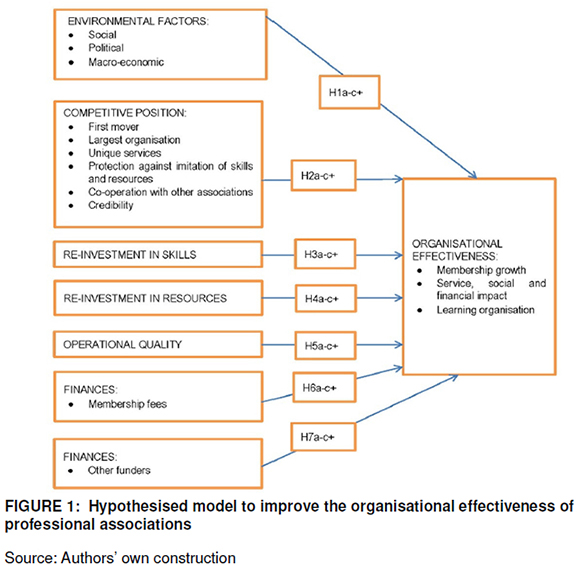
H1: Favourable environmental factors are positively related to the organisational effectiveness of PAs, as measured by: {a) membership growth; (b) rendering effective client services and having a financial and social impact; and (c) being a learning organisation.
3.3
Competitive positionMost organisations continuously try to improve their competitive positions in their industries, in order to attract more customers. Most companies strive to be effective in doing "... a significantly better job than rivals [in] providing what buyers [clients or members] are looking for ..." (Thompson, Strickland & Gamble 2010:108). Attracting and competitively servicing customers are, therefore, indicators of organisational effectiveness.
Porter's (1980:6) five generic competitive strategies generally form the basis of companies' strategies to enhance their competitive positions. Some competitive strategies are linked to the life-cycle stages of industries (Dess, Lumpkin & Eisner 2006:170; Sabol, Sander & Fuckan 2013:637-639), in which first-mover advantages, for example, are pursued in the introduction phase of products and services; while the market growth rate, through intensive focus on product design, sales and marketing, is pursued in the growth phase.
Being a first-mover as a professional association could, amongst others, have the advantage of brand loyalty and accumulated valuable knowledge that is difficult and costly to acquire or imitate (Hill, Jones & Schilling 2015:229). The actions that PAs implement to exploit their first-mover status and protect themselves against the imitation of skills would, therefore, increase their competitive positions, and therefore, their organisational effectiveness.
It is, therefore, hypothesised that:
H2: A favourably perceived competitive position is positively related to the organisational effectiveness of PAs, as measured by: (a) membership growth; (b) rendering effective client services and having a financial and social impact; and (c) being a learning organisation.
3.4 Re-investing in skills and resources
Knowledge and the capability to create it are seen by many scholars and practitioners to be important sources of competitive advantage for organisations and their associations. This, in turn, influences the effectiveness of an association (Crossan & Guatto 1996:109; Nonaka, Toyama & Konno 2000:5). Through skills investment, organisations can expand their knowledge and skill bases, and improve their ability to assimilate and utilise new information (Cohen & Levinthal 1990:136; Schilling 2002:388). Developing employees' skills improves their productivity and performance (CBI 2015:5). In PAs, skills development for their members is usually linked to licensure, which is required to maintain the members' professional certification (Fenwick 2009:229). The continuous investment in skills is, therefore, an important determinant for the organisational effectiveness of PAs.
When reinvesting in physical resources, such as information technology (IT), and new equipment, firms replace the existing infrastructure and applications, with alternatives or supplements. Such investments improve the working practices by streamlining operations and activities, and eliminating the duplication of data and effort (Cornford & Pollock 2003:5; Oregan Business Plan 2015:2-3). Integrating technology effectively also removes organisational silos, facilitates better quality information, and leads to more improved decision-making (Bannister 2001:81; Wagner & Newell 2004:325). All these aspects should contribute to increased organisational effectiveness.
Against the background of the preceding literature review, it is hypothesised that:
H3: Re-investing in skills is positively related to the organisational effectiveness of PAs, as measured by: (a) membership growth; (b) rendering effective client services and having a financial and social impact; and (c) being a learning organisation.
H4: Re-investing in resources is positively related to the organisational effectiveness of PAs, as measured by: (a) membership growth; (b) rendering effective client services and having a financial and social impact; and (c) being a learning organisation.
3.5
Operational qualityA firm's operations are derived from its strategic and business goals. The latter are cascaded down into operational decisions, policies, practices and action plans, in order to achieve the strategic and business goals (Espino-Rodríguez & Gil-Padilla 2014:4). Operations management sees to it that the firm's resources and productive factors are used effectively and efficiently, in order to strategise the business goals. Firms, including PAs, must therefore continuously pursue the improvement of the quality of their operations, in order to achieve organisational effectiveness and sound business performance (Diaz-Garrido, Martín-Pena & García-Muina 2007:2125; Gharakhani, Rahmati, Farrokhi & Farahmandian 2013:48).
It is, therefore, hypothesised that:
H5: Operational quality is positively related to the organisational effectiveness of PAs, as measured by: (a) membership growth; (b) rendering effective client services and having a financial and social impact; and (c) being a learning organisation.
3.6
FinancesPAs are highly dependent on the membership fees that they collect from their members. Attracting and recruiting of new members are important fund-raising activities for PAs. As membership fees are not sufficient to sustain the existence of PAs, they vigorously pursue additional income sources through private donations, advertising, sponsorships, governmental contributions and international funders.
Against this background, it is hypothesised that:
H6: Favourable finances (membership fees) are positively related to the organisational effectiveness of PAs, as measured by: (a) membership growth; (b) rendering effective client services and having a financial and social impact; and (c) being a learning organisation.
H7: Favourable finances (sources of additional funding) are positively related to the organisational effectiveness of PAs, as measured by: (a) membership growth; (b) rendering effective client services and having a financial and social impact; and (c) being a learning organisation.
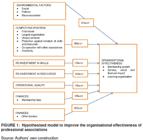
The above-mentioned hypothesised relationships are graphically depicted in Figure 1
4. OBJECTIVE OF THE STUDY
The primary research objective of the study is to make a contribution to the organisational effectiveness of professional associations by investigating the role that selected external and internal factors play in achieving this objective. More specifically, the study investigates the influence of environmental characteristics, competitive position, re-investment in skills and resources, operational quality, and finances - on the organisational effectiveness of PAs (as measured by membership growth; rendering effective client services and having a financial and social impact; and being a learning organisation).
5. RESEARCH METHODOLOGY
In this section, the sample and measuring instruments are discussed.
5.1 The sample
Purposive sampling was used to target three senior staff members, or office bearers in each of the 48 SAQA registered professional associations in South Africa. This translated into a potential sample size of 144 participants. Questionnaires were e-mailed to these 144 office bearers; but after numerous follow-up requests, only 32 participated in the study. The sample however covered 25 of the 48 professional associations. The response rate in terms of questionnaires returned was, therefore 22.2%; but in terms of the professional associations represented, this amounted to 52.1%.
The 32 participants included seven (7) chief executive officers; five (5) board members (including one chairperson and one deputy chairperson); ten (10) executive directors; one (1) registrar; one (1) national secretary; one (1) head of human resources research; one (1) head of professional development and education; and six (6) managers (for example general, project and operations managers). Although the final sample was small, the knowledge and expertise of these respondents were considered sufficient to provide the requisite information on professional associations. Most of the PAs (58.0%) from which the respondents were drawn had been in existence for more than 30 years, while about 22.6% of them existed for between 16 to 30 years. On the basis of the senior managerial positions that they occupied and the maturity of their professional associations, these respondents were judged to have sufficient knowledge to complete the questionnaires.
5.2 The measuring instruments
Self-constructed instruments were used to measure the variables included in the hypothesised model. As explained in section 3.1 above, the present study consulted Kotler's (2001:10) views on high-performing businesses, Kaplan and Norton's (1996:25) Balanced Scorecard and Bharadwaj et al.'s (1993:84) model for sustainable competitive advantage in order to identify the antecedents to and measurements of organisational effectiveness in PAs. On this basis, questionnaire statements were formulated to measure the following variables: membership growth; service, financial and social impact; learning organisation principles; environmental factors; competitive position; re-investment in skills; re-investment in resources; and finances.
Membership growth was measured with a single question asking how many full members the association had at that moment.
Rendering effective client services and having a financial and social impact (in short, service, financiai and social impact) were measured with three questions, requesting respondents to rate their PAs in terms of: (1) how effective they are in rendering services to their clients; (2) how effective they are in terms of the perceived financial impact they have in the industry; and (3) how effective they are in terms of the perceived social impact they have in the society. Rating was done on a 7-point scale, ranging from (1) very ineffective to (7) very effective.
Being a learning organisation was measured with 7-item instrument, capturing the extent to which the PA tries to continuously learn and improve, as well as the extent to which it conducts research that benefits the association, members, sector and country. The instrument also captures to what extent the PA conducts research to stay abreast of international trends and future developments. The responses were assessed, according to a 5-point scale ranging from (1) never to (5) frequently.
A 9-item instrument was used to measure environmental factors, capturing the respondents' assessment of how strongly their PAs were affected by social issues (crime, education, cultural differences), political influences (political uncertainty, strikes, corruption), and macro-economic factors (unemployment, interest rates, inflation). Responses were anchored to a 5-point scale ranging from (1) not at all, to (5) extremely.
The competitive position of a PA was measured with a 10-item instrument, capturing whether the PA was the first one established in its industry, was the largest in its field in South Africa, and had a positive competitive position, compared to PAs in the same field. The instrument also captured aspects, such as how protected a PA is against the imitation of competitive skills and resources, how credible the PA is in its field, and how intensively it cooperates with other PAs. The responses were anchored to a 5-point scale, ranging from (1) strongly disagree to (5) strongly agree.
Re-investment in skills was measured with a 2-item instrument asking the respondents to indicate the percentage of annual turnover their PAs re-invest in general membership skills development, staff training, and development. Re-investment in resources was measured with a 5-item instrument asking the respondents to indicate the percentage of annual turnover their PAs re-invest in office equipment, capital expenditure, buildings, information technology and electronic communications (social media and website).
The instrument to measure operational quality comprised four (4) items requesting the respondents to evaluate their PAs' operational quality, as well as whether there is sufficient independence between strategy and operations, and between the Board of Directors and operations management in their PAs. The responses were anchored to a 5-point scale, ranging from (1) strongly disagree to (5) strongly agree.
Two measures of finances were used in this study. Firstly, the 2-item measure required the respondent to indicate what percentage of the association's revenue came from: (1) membership fees, and (2) from additional services offered to clients (or members). Secondly, the 5-item instrument required the respondent to indicate what percentage of the association's revenue came from private donations, business advertisements, sponsorships, government contributions, and international organisations.
Five-point anchoring scales were used for all the above-mentioned latent variables, except for service, financial and social impact, for which a 7-point anchoring scale was used. This is in line with Preston and Colman's (2000:13) suggestion that different anchoring scales for different variables should be used. While they found that 7-point scales produced superior results in terms the reliability, validity and discriminating power of data, they regarded 5-point scales as acceptable and scales smaller than 5-point scales as weaker with regard to these psychometric properties (Preston & Colman 2000:12-13)
6. THE EMPIRICAL RESULTS
Using the STATISTICA Version 10 (Statsoft 2011), the data analyses included exploratory factor analyses, the calculation of Cronbach alphas and Pearson correlations. The empirical results emanating from these analyses are reported next.
6.1 The validity and reliability of the data
Exploratory factor analyses (EFAs) were conducted; and Cronbach alpha coefficients were calculated to assess the validity and the reliability of the data, respectively. Complete EFAs could not be conducted because the sample was too small. The EFAs therefore included the following:
■ test for the discriminant validity of the two dependent variables, being an effective learning organisation and service, financial and social impact;
■ test for the discriminant validity of the two independent variables, re-investment in skills, and re-investment in resources;
■ test for the reliability of the data;
■ test for the unidimensionality of the environmental characteristic's variable;
■ test for the unidimensionality of the competitive position variable; and
■ test for the unidimensionality of the operational quality variable.
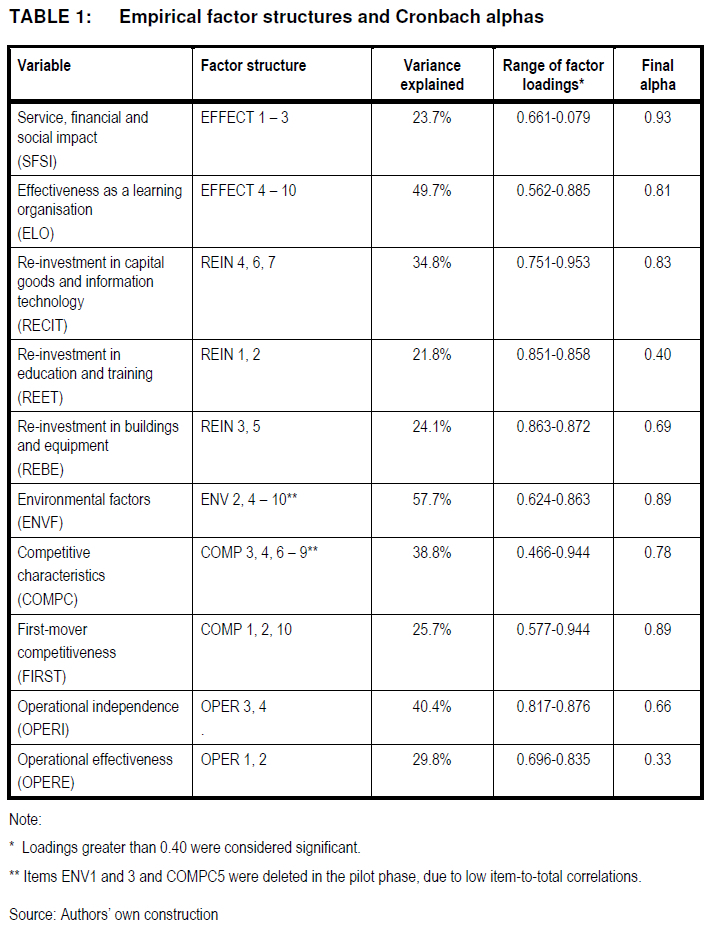
Principal Component Analysis and Varimax Raw were specified as the methods of factor extraction and rotation, respectively, in all cases. The results are reported in Table 1. Table 1 shows that the items measuring being an effective learning organisation (ELO) and rendering effective client services and having a financial and social impact (SFSI) - loaded as expected. EFFC 1 to 3 loaded on ELO; while EFFC 4 to 10 loaded on SFSI.
Table 1 also reveals that the re-investment in skills and the re-investment in resources' variables can be split into three separate variables: Re-investment in capital goods and information technology (RECIT); re-investment in education and training (REET); and reinvestment in buildings and equipment (REBE). The environment characteristics (ENV) items, however, loaded as expected. Two environmental characteristics, items ENV1 and 3, were however, deleted in the pilot phase of the study - due to low item-to-total correlations in the Cronbach alpha analysis.
Table 1 also indicates that the competitive position and operational quality variables were not unidimensional constructs. The competitive position items, COMP3, 4 and 6 to 9, loaded on the original competitive characteristics (COMPC) construct and were, therefore, labelled as such. Three competitive characteristics items, COMP 1, 2 and 10 loaded on a second factor. These items were associated with being the first mover in the sector, in which the PA operates; and they were, therefore, labelled as first-mover competitiveness (FIRST).
Two of the operational quality items (OPER3 and 4) loaded on one factor, which related to the independence of the operations management from the Board. This factor was, therefore, labelled operational independence (OPERI). The other two operational quality items {OPER1 and 2) loaded on another factor, which related to the original operations quality construct. This variable was, therefore, labelled operational effectiveness (OPERE).
Table 1 shows that all the variables that emerged from the EFAs produced fair Cronbach alpha coefficients, in other words in excess of 0.60 (Zikmund, Babin, Carr & Griffin 2014:302), except the re-investment in education and training (REET), and the operational effectiveness (OPERE) variables. These variables were thus omitted from subsequent statistical analyses.
6.2 The Pearson correlation results
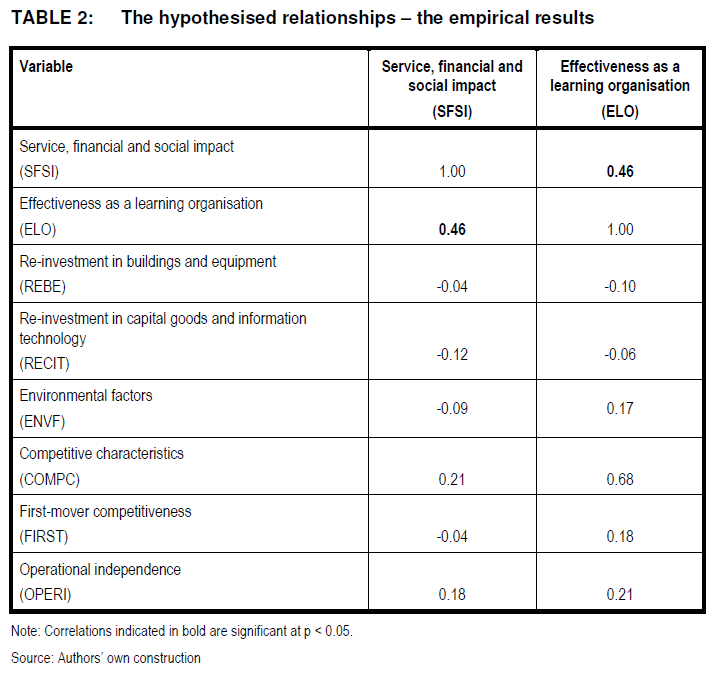
Pearson correlations were calculated to investigate the hypothesised relationships between independent and dependent variables in this study. Table 2 reports on the relationships between the independent variables and the two dependent variables: service, financial and social impact (SFSI) and being effective as a learning organisation (ELO).
6.2.1 The determinants of the effective rendering dient service and having a financiai and social impact (SFSI)
The empirical results (Table 2) show that none of the above-mentioned variables were significantly related to the effectiveness of professional organisations in terms of their service, financial and social impact (SFSI), except being effective as a learning organisation (ELO) (r = 0.46. ρ < 0.05). These empirical results, therefore, did not support the hypotheses: H1b, H2b, H3b, H4b and H5b.
The significantly positive relationship (r = 0.46, ρ < 0.05) between SFSI and ELO means, that for a professional association to be effective in having a service, in terms of its financial and social impact on its industry, it must be a learning organisation. In other words, if a professional association continuously strives to learn and improve its performance by conducting research that benefits the association itself, its members, its sector and its country, it would then be an effective PA. Such a learning organisation also studies international trends and future needs.
6.2.2 The determinants of effectiveness as a learning organisation (ELO)
The empirical results (Table 2) indicate that none of the independent variables significantly influence the effectiveness of professional associations as learning organisations (ELO), except their competitive characteristics and their effectiveness in service and financial and social impact (SFSI). This means, that the empirical results, therefore, did not support the hypotheses H1c, H3c, H4c and H5c. The empirical results, however, did support H2c - that competitive characteristics are positively related to the effectiveness of professional associations as learning organisations (ELO).
The empirical results also revealed that SFSI and ELO are positively related (r = 0.46, ρ < 0.05). This means that when a professional body is effective in rendering client service and having a financial and social impact in its industry, such a body would be seen as a strong learning organisation. It also means that success in service, financial and social impact in the industry would drive learning organisational principles and practices in these professional associations.
6.2.3 The determinants of membership growth
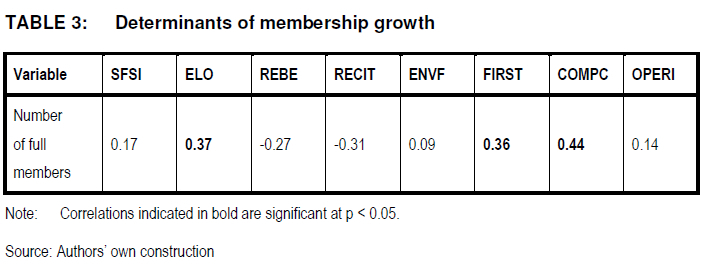
Pearson correlations were calculated to investigate the relationships between the latent variables in Table 3 and selected one-item measures of interest. The empirical results are reported in Table 3.
Table 3 indicates that having more full members is positively related to the effectiveness in being a learning organisation (r = 0.37, ρ < 0.05), being the first and largest professional association (r = 0.36, ρ < 0.05), and the association's competitive characteristics (r = 0.44, ρ < 0.05). This means that an association's full membership numbers could be increased if these members view such an association as a learning organisation, if such an association maintains its first and largest status, and if such an association maintains its competitive characteristics.
These competitive characteristics should include the relative position that a professional association holds in terms of membership growth, service levels, influence on government, etcetera; unique services that it develops for its members; the extent to which the association is protected against imitation of its resources and skills; what competitive advantages the association has over its competitors; and how highly the association's credibility is considered compared to other professional associations.
6.2.4 Finance as a determinant of organisational effectiveness of a PA
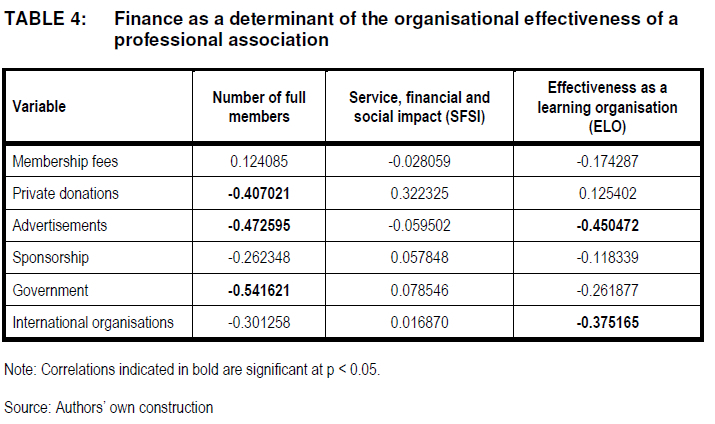
The empirical results (Table 4) also show that none of the independent variables were related to the effectiveness of professional associations as learning organisations, except for access to advertisement income or resources (r = -0.45, ρ < 0.05) and access to income/resources from international organisations (r = -0.37, ρ < 0.05).
The empirical results (Table 4) reveal that the listed funding sources do not have a significant influence on the service, financial and social impact a PA has in its industry.
Hypothesis H7b was, therefore, not supported by these results. This means that pouring more money into PAs does not make them effective in having an impact in their industries. It is only when these PAs use this money to learn and disseminate the learning to their members and industry, that they are seen as effective organisations.
Table 4 further shows that private donations (r = -0.41, ρ < 0.05), advertisement {r = -0.47, ρ < 0.05) and government funding (r = -0.54, ρ < 0.05) are negatively related to the number of full members that a PA has. For the same reason explained above, this correlation is actually positive. The hypothesis H7a, that additional sources of funding would be positively related to membership growth, is therefore supported. In other words, the more members a PA has, the more funding they attract from these sources.
Table 4 also indicate that the income received from membership fees is not significantly related to the number of members a PA has, or to the service, financial and social influence it has; and neither is it related to the PA being a learning organisation. The hypotheses H6a, H6b and H6c are not therefore supported by the empirical results. These results indicate that finance through membership fees is not a determinant of the effectiveness of PAs. The empirical results suggest that if PAs want to attract income from advertisements and international organisations, they should strive to be strong learning organisations.
7. FINDINGS AND THEIR MANAGERIAL IMPLICATIONS
The most important finding of this study is that being an effective learning organisation (ELO) is an important indicator of a PA's organisational effectiveness. To be an ELO means that the PA should continuously strive to learn and improve by conducting research that benefits the association itself, its members, its sector and its country. It is, therefore, important that PAs focus their efforts on becoming effective learning organisations - by planning and directing their resources in achieving this objective. It means that PAs must employee, or contract in, intellectual resources that would enable them to stay at the cutting-edge of those services that their members and clients want. This would require PAs to ensure that they have the continuous services of high-calibre researchers.
A PA, as an ELO, positively influences, and is being influenced, by the service, financial and social impact (SFSI) the PA has in its industry, as well as the number of full members the PA has. PAs must, therefore, always endeavour to increase their full membership and SFSI.
This would require PAs to regularly conduct satisfaction surveys of how their services are received, and on the financial and social impact these services have in communities, industries and the country.
For a PA to be an ELO, it must also increase its competitive characteristics. This means that the PA should continuously try to improve its relative position in its industry - via membership growth, service levels, influence on government, and the unique services it develops for its members, protecting itself against imitation of its resources and skills, outperforming its competitors, and strengthening its credibility, as compared to other professional associations.
The empirical results also revealed that funding from advertisements and international organisations correlated positively with a PA being an ELO. This means that PAs managed, according to learning organisation principles, have a better chance of attracting these types of funding. Additional funding, on the other hand, would enable a PA to improve itself as an ELO. This finding reinforces the importance of PAs developing themselves into ELOs.
The second important finding of this study is the indication that membership growth is another measure of a PA's organisational effectiveness. The empirical results showed that membership growth in PAs is driven by it being an ELO, it being the first-mover in its industry, and by its competitive characteristics.
It has already been reported above that being an ELO drives membership growth. The fact that being the first-mover in the industry increases membership growth is an indication that PAs should capitalise on this strength - by always striving to be the first in everything its members and clients require or will require. This calls for PAs to conduct continuous environmental scanning, as well as the required research and development to deliver products and services first to their members and clients.
The fact that competitive characteristics drive membership growth indicates to PAs that they could attract more members if they maintain and improve service levels continuously and effectively; lobby government for better services for their members and clients; develop and deliver unique services to their members and clients; protect themselves against any imitation of their resources and skills, outperform their competitors; and continuously enhance their credibility compared to other professional associations. The empirical results revealed that membership growth is also associated with increased funding from advertisements, government and private donors.
8. CONCLUSION
Despite the important findings produced by this study, caution needs to be exercised with regard to the generalisability of the empirical results. The sample of 32 participants from 25 out of the 48 registered PAs in South Africa does not allow generalisation to all the potential participants in all of the 48 PAs. The seniority in terms of leadership level of the participants, however, provides high-level insights into the issues of organisational effectiveness in PAs. In order to increase the generalisability of the findings to other PAs and participants; it is, therefore, recommended that the study be replicated on a bigger sample of PAs and participants.
Furthermore, on the basis of the use of valid and reliable measuring instruments and credible participants, it is argued that this study has made an important contribution to the effective management of professional associations as institutions that could drive socioeconomic development in South Africa. For institutions that should oversee and develop the conduct and integrity of professionals, such as accountants, lawyers, engineers, medical practitioners, and others, this study has produced important findings that could assist them in playing this important role.
REFERENCES
- ACKROYD S. 1996. Organization contra organizations: professions and organizational change in the United Kingdom. Organization Studies 17(4):599-621.
- ARENDALE D, BARROW H, CARPENTER K, HODGES R, MCGRATH J, NEWELL Ρ & NORTON J. 2009. Position paper: creating a new professional association. Journal of Developmental Education 33(1):30-37.
- ATKINSON A & EPSTEIN M. 2000. Measure for measure. CMA Management 74(7):22-29.
- BANNISTER F. 2001. Dismantling the silos: extracting new value from IT in public administration. Information Systems Journal 11 (1 ):65-84.
- BHARADWAJ S, VARADARAJAN R & FAHY J. 1993. Sustainable competitive advantage in service industries: a conceptual model and research propositions. The Journal of Marketing 57(4):83-99.
- CBI. 2015, Business investment in skills: the road back to growth. London: The Confederation of British Industry.
- CEDERHOLM T. 2014. Must-know: external factors that influence the airline industry. Market Realist 30 September: 1-9,
- COHEN WM & LEVINTHAL DA. 1990. Absorptive capacity: a new perspective on learning and innovation. Administrative Science Quarterly 35(1):128-152.
- CORNFORD J & POLLOCK N. 2003. Putting the university online: information, technology and organizational change, Buckingham, UK: Society for Research into Higher Education and Open University Press,
- CROSSAN MM & GUATTO T. 1996. Organizational learning research profile. Journal of Organizational Change Management 9(1):107-112.
- CRUESS SR, JOHNSON S & CRUESS RL. 2004. "Profession": a working definition for medical educators. Teaching and Learning Journal (16)1:74-76.
- DESS GG, LUMPKIN GT & EISNER AB. 2006. Strategic management: text and cases. 2nd ed. Boston, OH: McGraw-Hill Irwin.
- DIMAGGIO PJ & POWELL WW. 1983. The iron cage revisited: institutional isomorphism and collective rationality in organizational fields. American Sociological Review 48(2):147-160.
- DÍAZ GARRIDO Ε, MARTIN-PEÑA ML & GARCIA-MUIÑA F. 2007. Structural and infrastructural practices as elements of content operations' strategy: the effect on a firm's competitiveness. International Journal of Production Research 45(9):2119-2140.
- ESPINO-RODRÍGUEZ Τ & GIL-PADILLA Α. 2014. The structural and infrastructural decisions of operations' management in the hotel sector and their impact on organizational performance. Tourism and Hospitality Research 15(1):3-18.
- FENWICK T. 2009. Making to measure? Reconsidering assessment in professional continuing education. Studies in Continuing Education 31(3):229-244.
- FRIGO ML & KRUMWIEDE KR. 2000. The Balanced Scorecard. Strategic Finance 81:50-54.
- GHARAKHANI D, RAHMATI H, FARROKHI MR & FARAHMANDIAN A. 2013. Total quality management and organizational performance. American Journal of Industrial Engineering 1(3):46-50.
- GREWAL R & DHARWADKAR R. 2002. The role of the institutional environment in marketing channels, Journal of Marketing 66(3):83-97.
- GUMBUS A, LYONS Β & BELLHOUSE D. 2002. Journey to destination 2005. Strategic Finance 84(2):46-50.
- HARPERCOLLINS PUBLISHERS. 2006. The Collins English Dictionary. 2nded. London, UK: HarperCollins.
- HILL CWL, JONES GR & SCHILLING MA. 2015. Strategic management: an integrated approach. 11,h ed. Stamford, CT: Cengage Learning.
- KAPLAN RS & NORTON DP. 1996. The Balanced Scorecard: translating strategy into action. Boston, MA 02163: Harvard Business School Press.
- KLOSS L. 1999. The suitability and application of scenario planning for national professional associations. Nonprofit Management and Leadership 10(1 ):71 -83.
- KOTLER P. 2003. Marketing management. 11th ed. Upper Saddle River, NJ: Prentice-Hall.
- MATTEN D & MOON J. 2008. "Implicit" and "Explicit" CSR: a conceptual framework for a comparative understanding of corporate social responsibility. Academy of Management Review 33(2):404-424.
- NONAKA I, TOYAMA R & KONNO N. 2000. SECI, Ba and Leadership: a unified model of dynamic knowledge creation. Long-Range Planning 33:5-34.
- OREGON BUSINESS PLAN. 2015, Simplify and streamline regulation and permitting, Portland, Oregon: Oregon Business Plan.Org.
- PETERS BG. 1999. Institutional theory in political science: the new institutionalism. London: Pinter.
- PORTER ME. 1980. Competitive strategy: techniques for analyzing industries and competitors. New York: Free Press.
- PRESTON CC & COLMAN AM. 2000. Optimal number of response categories in rating scales: reliability, validity, discriminating power, and respondent preferences. Acta Psychologica, 104: 1-5.
- PRIDEAUX MC. 2005. Towards a strategy framework for voluntary membership professional associations in Australia: a case study of the Chartered Institute of Logistics and transport in Australia, Townsville City, Queensland: James Cook University. (PhD thesis.
- )
- RIGBY DK. 2015, Management tools 2015: an executive's guide, Boston, MA: Bain & Company Inc.
- SABOL A, SANDER Μ & FUCKAN D. 2013. The concept of industry life cycle and development of business strategy. In V Dermol, NT Sirca & G Dakovic (Eds,), Proceedings of the Management, Knowledge and Learning International Conference 2013 (pp, 635-642), Bangkok, Thailand: ToKnowPress,
- SAQA see SOUTH AFRICAN QUALIFICATIONS AUTHORITY.
- SCHILLING MA. 2002. Technology success and failure in winner take-all markets: the impact of learning orientation, timing and network externalities. Academy ofManagement Journal 45(2):387'-398.
-
SOUTH AFRICAN QUALIFICATIONS AUTHORITY. 2013. Annual integrated report. [Internet: http://www.saqa.org.za/docs/rep_annual/2014/annual1213.pdf; downloaded on 2015-02-05.
» http://www.saqa.org.za/docs/rep_annual/2014/annual1213.pdf - ]
- SOUTH AFRICAN QUALIFICATIONS AUTHORITY. 2015. Profession designations and number of people as at 31 December 2013 and 8 August 2015, as well as professional bodies' finances list as at 12 June 2015 (information provided by SAQA). Pretoria: South African Qualifications Authority.
- STATSOFT. 2011. STATISTICA (data analysis software system): version 10. Tulsa, Oklahoma: StatSoft Incorporated.
- THOMPSON AA, STRICKLAND AJ & GAMBLE JE. 2010. Crafting and executing strategy: the quest for competitive advantage. 17th ed. Boston: McGraw-Hill Irwin.
- WAGNERR E & NEWELL S. 2004. Best for whom? The tension between "best practice" ERP packages and the diverse epistemic cultures in a university context. Journal of Strategic Information Systems 13(4):305-328.
- ZIKMUND WG, BABIN BJ, CARR JC & GRIFFIN M. 2014. Business research methods. 10th ed. Mason, OH: South-Western.