Examining Organisational Citizenship Behaviour as an Outcome of an Ethical Work Culture in a Developing Country
Abstract
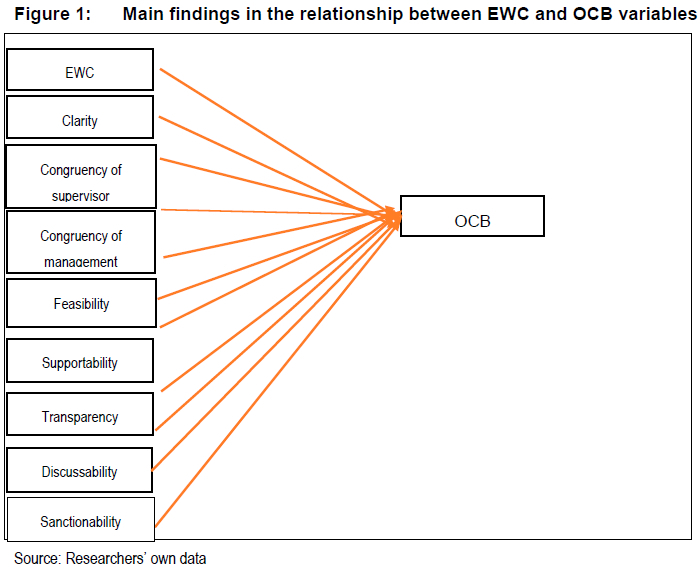
Drawing on both theory and research on organisational citizenship behaviour (OCB) and ethical work culture (EWC), this study examined the relationship between employees' perceptions of the work ethical culture (WEC) and their self-reported OCB. Convenience sampling (n=839) was used, which comprised of respondents who are permanently employed in a railway organisation in the Democratic Republic of Congo. The participants completed the Corporate Ethical Virtue Questionnaire (CEVQ), which measured the WEC and the OCB, which measured the OCB. The data was analysed by using multiple regressions to predict the relationship between EWC and employees' OCB. The results indicated that the participants perceived EWC significantly and positively in relation to OCB, and that participants perceived that WEC predicted their OCB. The results are beneficial for future researchers to understand the relationship between WEC and OCB, particularly in DRC organisations, which may be applicable to other developing countries. The study adds value to discretionary behaviour theory by suggesting that a work environment with a positive EWC will encourage workers to engage in discretionary behaviour that benefits both them and the organisation. It is suggested that this study could help human resource practitioners and managers to develop performance strategies that will create an ethical work environment, which encourages workers to display OCB, whilst enhancing job performance.
Ethical work culture; Democratic Republic of Congo and organisational citizenship behaviour
 Thumbnail