Managing organisational reputation using social media at South African universities
Abstract
The purpose of this article is to consider social media policies at South African universities to provide a deeper understanding of higher education reputation management. A two-phased qualitative research approach was used to conduct an analyses of approved social media documents and interviews at South African universities to explore social media practices within public higher education institutions. The research found that 61% of the respondent universities had no formal documents or policies to manage their social media practices. The respondents who indicated that their universities were in the process of developing social media policies but had not yet done so, felt that their organisations had not yet experienced a need for a formal management system. The few threats experienced in the past were dealt with by their communication teams. The majority of the social media documents were located in their marketing and public relations departments. However, the responses also indicated an awareness of the need for social media policy development to address risk-related issues. The argument for higher education institutions is no longer how to avoid or protect an organisation from the risks associated with social media use, but how to harness their institutional potential by including social media into most aspects of their organisation's operations, while still recognising the areas of possible threat to organisational reputations.
organisational reputation; reputation management; social media; social media management; social media policies
1. INTRODUCTION
With the development of technology and the increase of people who have access to it, the traditional channels of information are changing (Bajrami 2011:27). Furthermore, organisations are developing an appreciation for social media tools as they provide abundant opportunities for relationship-building, open communication channels and exchange and generation of information. This development poses a number of opportunities for the development of free speech and democracy in general, but also poses immense challenges on how to prevent abuse (Bajirami 2011:27). Thus, social media, for many organisations, is blurring the lines between work and private life in ways that are legally-complex and difficult to control (Field & Chelliah 2012:36). As a result, organisations increasingly need to put procedures and practices in place to manage their reputations and the risks involved as they and their stakeholders set out to engage with the wider community on the social web.
For universities, the risk is extended to staff and students associated with and formally-linked to the organisation. McNeill (2012:154) emphasises the need to manage the organisation's reputational risk associated with uncontrolled and decentralised uses of social media services and this informs, to a degree, the development of social media policies in higher education.
While other policy documents such as marketing, computing, intellectual property, ethics as well as staff and student disciplinary policies may exist, higher education institutions need to respond to both the new challenges and the new risks posed by social media practices. As a result, developing explicit social media policies for staff and students that are unique to a particular industry with the aim of protecting and developing the organisation's reputation has become essential.
Against the background of organisational reputation, this article reports on an investigation the management of the organisational reputation of South African higher education institutions by developing and implementing social media policy documents. The article was also informed by interviews conducted to determine the role social media played and management of reputation amongst South African higher education institutions. Further, it outlines the methodological approach selected to analyse existing South African higher education institutions' social media practices and policy documents.
2. AN OVERVIEW OF REPUTATION MANAGEMENT
The concept of organisational reputation is framed by overviewing numerous key organisational attributes, including the organisation's capacity for innovation, the quality of its management and staff, as well as the perceived quality of its products and services and how these elements relate to the organisation's stakeholders (O'Rourke 2014:2). Urde and Greyser (2016:89-99) consider the conceptualisation of a "triangle-shaped framework" reflecting on what the organisations says it is, what the organisation actually is and what the customers or consumers think it is, thus providing the link between identity, reputation and vision.
Reputations are also built on an organisation's long-term investment value, financial soundness, social responsibility and the use of corporate assets. These are all factors which affect how both the internal and external stakeholders view the organisation's value (O'Rourke 2014:2). Organisational reputation can also be viewed by both the organisation and academics as having a progressively larger impact on the organisation's viability as was previously the case (Vidaver-Cohen & Bronn 2015:49). De Castro, Lopez and Saez (2006:363) emphasise the multidimensionality of the concept of organisational reputation and introduce seven key elements to the definition of reputation. These elements include managerial quality, financial strength, product and service quality, innovation, use of corporate assets/efficiencies, capability to develop and retain talented people, social responsibility among (towards) the community and the value of long-term investment.
For the purposes of this article, organisational reputation is seen as an intangible asset (Aula & Mantere 2012:340; Friedman 2009:229) that combines the perceptions of all its stakeholders, both internal and external (Chun 2005:93; Dolphin 2004:79; Hong & Yang 2011:194) with regard to the performance areas of social responsibility (Carter 2006:1145; Puncheva 2008:275), work environment (Puncheva 2008:275), products and services (Carter 2006:1145; Puncheva 2008:275), financial performance (Puncheva 2008:275; Weber, Erickson & Stone 2011:36; Weiss Anderson & Maclnnis 1999:75), as well as governance and management (Puncheva 2008:275). These perceptions are generated from stakeholder expectations of the organisation versus the actual behaviour of the organisation (Aula & Mantere 2012:341; Friedman 2009:230; Hong & Yang 2011:194; Louisot & Rayner 2013:2; Murray 2003:143; Winn, MacDonald & Zietsma 2008:36). Such expectations are developed through the communicated organisational image, identity (Roberts 2009:3; Schultz & Werner 2013:2) and brand. A positive organisational reputation can increase financial performance, attract top staff and create a competitive advantage.
2.1 The concept of reputation management
Watson and Kitchen (2013:6) view relationship management to be at the heart of creating, enhancing and retaining positive stakeholder relationships. Strong communication practices by organisational leaders and effective feedback instruments from stakeholders are vital elements for expressing relevant messages and making informed decisions for the purpose of retaining the support of stakeholders (Watson & Kitchen 2013:7).
These communication practices are stressed by Mahon (2002:419-420) who highlights that various stakeholders have the ability to communicate with one another in search of actions that reflect the organisation's past and the assessment of its behaviour in a given context. As a result, strong organisational relationships are the cornerstone to developing strong organisational reputations.
When organisational reputation is well-planned, managed and monitored in each management facet, reputation leads to an improved general market positioning of the organisation, creating a barrier that competing organisations will find difficult to overcome and enabling organisations to attain the distinction of being "sought-after" within that profession (Zabala, Panadero, Gallardo, Amate, Sanchez-Galindo, Tena & Villalba 2005:60).
Louisot and Rayner (2013:3) assert that the greatest benefit of a good reputation is its capacity to provide a reserve of goodwill, often referred to as reputational capital or equity that can help the organisation withstand future shocks and crises. Such reputational capital, which reinforces stakeholder trust and confidence, can act as a buffer in times of crises and encourage stakeholders to give the organisation the benefit of a second chance. Maintenance of a good reputation necessitates ongoing identification and management of emerging gaps between experience and expectations and between claims and reality using a risk-orientated approach (Louisot & Rayner 2013:3-4).
2.2
Managing risk in organisationsReputation management is essential to organisations, particularly in crisis situations. Organisational crisis is described by Weber Erickson and Stone (2011:36) as an unexpected, non-routine event that creates uncertainty and threatens an organisation's legitimacy. However, Yu and Lester (2008:4) define reputational crisis as a situation in which stakeholders negatively re-evaluate their opinions and beliefs about an organisation. Crisis situations usually result in negative publicity, which threatens the organisation's image or reputation and could cause harm to stakeholders (community members, staff, customers and stockholders) both psychologically and financially (Weber et al. 2011:36).
Raj and Sindhu (2013:63) describe risk management as the identification and management of deficiencies in activities that may result in its failure. With good risk management practices, managers will be able to accelerate decision-making from policy formulation to the execution of such policies in a timely manner. Cooper (2000:19) emphasises the value of risk management and argues the need for a paradigm shift within organisations. Management not only need to assign accountability and align objectives clearly throughout the organisation; they need to build risk management as a core competency and develop holistic controls to mitigate possible risks.
2.3
Reputation management and higher education institutionsAs higher education institutions try to preserve their competitiveness, quality and organisational reputation become crucial elements in distinguishing their competitive edge and superior quality (Wong, Woo & Tong 2016:113). As a result, there has been a noticeable change in the perception of higher education institutions towards reputation management, which is in line with a change in the identity of the higher education sector, both internationally and nationally (Higher Ed Impact Monthly Diagnostic 2011:Internet). In addition, according to Ressler and Abratt (2009:35), universities are facing increased competition along with decreased government and private support. Sontaite and Kristense (2009:131) also note that higher education institutions are increasingly faced with a need to compete for financial resources and consider alternative sources.
Furthermore, globalisation has led institutions to compete not only in domestic but also in global markets. Thus, higher education institutions need to rethink their orientation and undertake a long-term strategic view towards developing a strong organisational reputation. However, there are limitations and problems associated with corporate reputation management at higher education institutions (Sontaite & Kristense 2009:130).
Roberts (2009:11) points out that there already exists a preconceived reputation or expectation assigned to all institutions of higher learning, as well as the sector's anticipated behaviours and ethics. Reputations in general are evaluative and stakeholders compare what they know about an organisation to some standard to determine whether or not the organisation meets their expectation for how an organisation should behave (Coombs 2007:164).
For most part, universities are considered good, fit for purpose and socially-engaged, which sets the reputation baseline, threshold or norms by which all are then evaluated (Roberts 2009:11). Thus, reputations are, to a degree, shaped and limited by collective associations.
3. AN OVERVIEW OF SOCIAL MEDIA
The term "social media" includes a range of tools and services that all enable direct user interaction on computer mediated environments (Lampe, LaRose Steinfield & De Maagd 2011:2). Rauniyar, Rawski, Yang and Johnson (2014:7) define social media as the form of electronic communication, such as web sites for social networking and micro-blogging, through which users create online communities to share information, ideas, personal messages and other forms of communication, for example, videos. This form of communication has a social impact that reaches beyond documents or data to networks of associations and their structures (Linke & Zerfass 2013:271).
Schultz and Peltier (2013:88) believe that the course of human history has been changed significantly by social media, and argue that interactivity and interconnections between customers and organisations will provide the central paradigm for a new interactive communication model going forward. From an organisational perspective, social media presents great opportunities for engagement with staff, customers and other stakeholders. Social media can also help build brand awareness, visibility, reputation, knowledge sharing, customer acquisition and retention, low cost promotions, new product development and customer relationship marketing (Chikandiwa, Contogiannis & Jembere 2013:366). Jones, Temperley and Lima (2009:930) argue that well-managed and orchestrated on-line conversations can help organisations build and maintain their presence, reputation and brand image. Engagement of this nature can be used to benefit organisations greatly, and not only their brand awareness. As such, social media can be employed to assist with crisis communication or risk management, customer education and building stronger relationships with customers, staff and other stakeholders.
However, many organisations enter the social media "environment" with little or no strategic thought or plan (Schultz & Peltier 2013:87). According to Bagdasarian (2010:2-3), it is important to know how to strategically-manage social media investments.
3.1
Social media and risk managementThe occurrence of risk and subsequent crisis raises an important issue for the consumption of social media within organisations (Lachlan, Spence, Lin, Najarían & Del Greco 2015:1). The new transformative power of social media over organisations continues to reflect aspects of marketing, operations and management and online communications with and amongst stakeholders. The challenges related to organisational risk management is thus on the increase (Rauiar et al. 2014:7). According to Linke and Zerfass (2013:272), although technologies offer organisations great opportunities, the organisations tend to lose control over the dissemination of information.
Stakeholder liaisons via social media mean less control over stakeholder relationships and conversations and the ease of communication between these groups (Aula 2010:44). Thus, according to Linke and Zerfass (2013:272), attention should be paid to the specific dangers and methods of social engineering, common activities and threats to privacy that social media presents. Jennex (2010:20) points out that an organisation can use social media to prepare for crisis situations, as organisations will use the available knowledge and technologies through a process of communications, data gathering and analysis as well as decision-making.
3.2
Social media and higher education institutionsAn increasing number of universities use social media platforms such as Twitter, Facebook and YouTube, among others, to engage with past, present and prospective students (McNeill 2012:152). Social media has the potential to connect with students, staff and communities personally and directly, thus building stronger relationships, which is key to building a good organisational reputation. In addition, the main distinguishing characteristic of all social media practices is that of mass socialisation, namely, harnessing the influence of the collective actions of online user communities rather than individual users (Selwyn 2012:1).
However, many organisations have not yet adapted to the on-going shift toward public social communication and the accompanying legal and ethical issues (Cain 2011:1036), and the higher education institutions are no different. It is important, therefore, that both staff and students receive education and training on the use of social media for higher education institutions to accrue the full benefit of social media use and to reduce the possible risks (Perez-Carballo & Blaszynski 2014:33).
Furthermore, it has become important for universities to understand the added multidimensional approach to the relationship between students and the social media tool when managing social media within higher education institutions, in particular. According to Sontaite-Petkeviciene (2015:140), higher education institutions should place major attention on their organisational reputation, including aspects such as the impact of social media on student protection, recruitment and retention.
3.2.1 Student protection and social media
Universities have to protect and educate their students on social media use. Vander Broek, Puiszis and Brown (2009:11) point out that universities have a responsibility to protect students from inappropriate content or predatory practices while still respecting the right to freedom of expression and the privacy of their students. Cain (2011:1038) emphasises that many students do not fully-appreciate the professional boundaries when using social media and many are under the impression that information published on social media is irrelevant to the workplace or university and should not be used for judgements of professional ability or reputation.
Williams and James (2011:1) make the observation that students may be unaware of how information from postings on social media networks can be used by university admission committees, potential employers and supervisors. For example, issues such as plagiarism by students who electronically cut and paste from web-based materials have raised concerns with universities. This is exacerbated by the ability of social media to broadcast copied material to a large audience and in so doing violate the copyright of the author or owner of the original work (Cain & Fink 2010:6).
Cain and Fink (2010:6) further point out that other potential legal issues arising from the use of social media include civil liabilities for defamation, fraud, employment law issues, identity theft and unethical research. According to Cain and Fink (2010:2), attempts to regulate student social media activities raises liability concerns related to freedom of speech and privacy that can result in negative publicity and legal consequences. The challenge arises when trying to balance these concerns against institutional obligations to ensure student safety and security.
3.2.2 Student recruitment and social media
The use of social media tools has provided numerous benefits to the recruitment of students in that knowledge-sharing tools such as Facebook, LinkedIn and Twitter provide flexible, agile and intuitive solutions for connecting people to people and thus facilitate coordination, communication and collaboration (Kwon, Min, Geringer & Lim 2013:111). According to the research done by Constantinides and Stagno (2011:7), engaging with social media as a marketing tool is an appealing option because of positive past experience in the business sector and the high adoption rate of social media by the younger generations.
3.2.3 Student retention and social media
The "relationship marketing" approach is considered the best-fit for higher education institutions, particularly when regarded from an ethical point of view (Constantinides & Stagno 2011:10). Relationship marketing by higher education institutions encompasses building and maintaining a relationship of value interactions between the institutions and the three main student stakeholder groups, namely, alumni, current students and future students.
Constantinides and Stagno (2011:10) observe that the quality of these relationships positively relates to the long-term loyalty of the stakeholder groups. In addition, social media provides higher education institutions with the opportunity to humanise stories of students, staff and alumni, which not only will create loyalty and generate future revenue (students and funding), but will ultimately earn their respect (Reuben 2008:11).
3.3 Social media policies at universities
Some universities have published policies or guidance documents on the use of social media for a range of university-related purposes including learning, teaching and assessment (McNeill 2012:152). However, marketisation has been the foremost policy driver, with many social media policies being established to primarily promote university "brands". But, not unlike other organisations that exist in this era, the potential risks to their reputation and future success may be threatened if social media is not used responsibly.
Thus, policies need to include aspects that assist institutions to manage their institutional reputations and potential threats to themselves, their staff, students and possibly their communities. Educational institutions also have a direct moral and legal responsibility to protect both staff and students by considering their privacy and safety (Osborne 2011:3).
4. RESEARCH PARADIGM AND DESIGN
Within the social constructivist paradigm, a qualitative descriptive research approach was used to investigate the phenomenon in this article. This research employed a two-phase qualitative research design process of gathering and analysing data. The first phase used document analysis to obtain an understanding of the manner in which South African higher education institutions manage their social media activities through formally-approved documents. Formally-approved documents included social media policies, social media guidelines, social media strategy documents and other policy documents such as Internet and online communications policies that are used to govern social media. The second phase incorporated in-depth telephonic interviews.
4.1 Research sample
The results of the research were obtained by including twenty-three of the twenty-five registered, public universities within South Africa. During 2014, two additional universities were registered, namely, the University of Mpumalanga and the Sol Plaatje University. Given their short time in existence, the two newly-registered universities, who are yet to develop their organisational reputations, were excluded.
The research considers the three major categories of public universities within South Africa, namely:
■ eleven traditional universities;
■ six comprehensive universities;
■ six universities of technology
The first phase considered all the available policy documents and alternative documents obtained from the Internet search and as provided by the respective institutions. Nine documents, including formal social media policies, social media guidelines and other documents governing aspects of social media, were obtained.
The second phase included conducting telephonic interviews at eleven universities who were willing to participate in the research and who did not have formally-approved social media policies at the time of research. The aim of the interviews was to provide a better understanding of the status of social media management and practices as well as its link to reputation management, among the SA universities that did not have formal social media policies.
4.2 Research data collection
The data was generated by investigating what social media policies documents might exist within the public South African higher education institutions. The process of collecting the data took place in two phases.
Phase 1 of the data collection process consisted of two steps:
■ Step 1 - Searching for documents available through a number of string searches, for example, "social media policy HEI", "Web 2.0 policy HEI", "Social networking Policy HEI". Only documents obtained using these search strings were included. All these documents were collected within the same calendar week.
■ Step 2 - Telephonically contacting all 23 public universities to request their social media policies, guidelines, strategies or alike. It was noted whether or not documentation existed and, in such cases, a request for a telephonic interview was arranged to establish social media management within the institution.
In phase 2 of the data collection process, in-depth telephonic interviews were conducted with division heads of universities that presumably had no active social media management policies in place and were willing to participate in the interviews. This included universities where social media policies were currently under consideration and ones who managed social media by means of alternative policies or arrangements, such as Internet protocols.
4.3
Research data analysisThe data obtained was mainly from document analysis of documents used to manage social media. In the document analysis, the way the specific documents structures were deployed in the social construct of institutional management were reflected upon. The in-depth, semi-structured interviews with key personnel were conducted to clarify and provide further insight into the social media policy situation.
4.4
Research coding procedureThe coding structure used during document analysis to code and analyse the data obtained from the formally-approved documents included two theme categorisation types:
■ Categorise formally-approved documents into three distinct theme levels according to where documents were located/housed within the host organisation, namely, Marketing/Public Relations, Human Resources and Other (IT, teaching)
■ Check formally-approved documents to observe the main focus themes (what did the policy address?)
The coding structure used to code the data obtained from the semi-structured in-depth interviews includes various categories:
■ Plans for social media policy document development / refinement
■ University's perception of social media's influence on their reputation
■ University's stance on reputation management within the institution
■ Value of using social media as a tool to manage risk
■ Extent to which the university uses social media, other than for marketing purposes
For the purposes of this article, the research employed and adapted the Consensual Qualitative Research (CQR) method to ensure research trustworthiness and reliability. According to Barden and Cashwell (2014:47-48), CQR is based on the underlying assumption that multiple perspectives with regard to collecting and analysing data are more effective than a singular perspective and, therefore, minimises research bias.
For Hill, Thompson and Williams (1997:523), the CQR process involved three general steps:
■ Open-ended question responses to questionnaires or interviews for each individual case, which were divided into domains (namely, topic areas)
■ Core ideas constructed (namely, abstracts or brief summaries) for all the material within each domain for each case
■ Cross-analysis conducted to develop categories to "describe consistencies in the core ideas within domains across cases.
Thus, through cross-analysis and repeated comparisons, the research was able to identify "discrepant or disconfirming evidence" and revise categories of ideas that evolved to reflect a closer representation of the data (Yeh & Inman 2007:388).
5. RESULTS OF THE RESEARCH
The research results were taken from the sample of 23 public South African universities and are discussed according to documents analysed and interviews conducted.
5.1 Results of social media policy documents used
The research considered all documents offered by South African universities to manage their social media activities internally and externally. The research revealed that universities used a combination of documents other than formal social media policy documents, namely, social media guidelines, social media strategies and other policies.
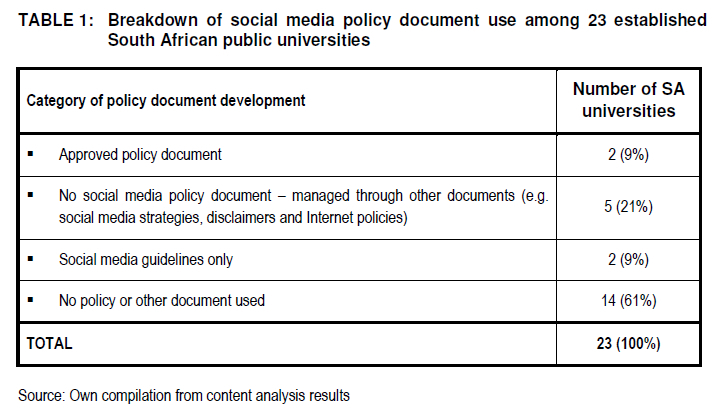
Table 1 provides the breakdown of the status of social media policies and other document use taking place within the 23 South African universities consulted for the research.
Table 1 shows that nine of the 23 registered public universities under discussion managed their social media use through some type of formally-approved document. The remaining 14 universities did not manage social media use through any formally-approved policy, strategy or guideline document. However, four universities indicated that their institutions were in the process of approving draft policy documents, but these drafts were not available for distribution at the time of the research.
5.2 Results of document analysis and interviews
Of the nine formally-approved documents (social media policies, guidelines or strategies) obtained, the analysis indicated a split between documents located in the marketing and public relations departments, and the category listed as "other", indicating two documents originating from the IT departments and one located in the registrar's office. One policy was located in the human resources department.
According to McNeill (2012: 156), the location of the policy is a clear indicator of which department has the strongest strategic interest in developing a social media policy within the university. Moreover, McNeill (2012) emphasises that these departments have a larger stake in actively engaging and enhancing organisational reputation. With reference to McNeill's (2012) statement, the findings of this investigation indicated that the majority of the policies aimed to address both the staff and students.
The analysis of the nine documents identified the following themes:
■ The majority (44%) focused on the risk of the institution only while 33% focused on both risk and relationship-building and 22% focused on relationship-building only
■ Reference to brand and image was made by the majority (44%), while 22% focused on brand, image and reputation
■ The majority of the documents (56%) directly referred to disciplinary action
■ The majority of the documents (67%) offered both professional and personal guidelines on the use of social media.
In order to provide a deeper insight into how universities that did not have formally-adopted policies, guidelines or strategies, managed their social media activities and reputations, 11 interviews were conducted. The questions considered the universities' plans for social media management, their perception on social media use for managing their reputations and possible organisational risks. The questions also generated information on how these universities made use of social media platforms other than for marketing functions.
As a whole, the respondents indicated that their universities were in the process of developing social media policies, but had not yet done so as they felt that their organisation had not yet experienced a need for a formal management system and that the few threats experienced in the past were dealt with by their communication teams. The responses also pointed to an awareness of the need for social media policy development to address risk-related issues, but did not highlight a need for the institutions to develop policies to harness the potential advantages offered by social media. Further, the responses from the interviews were equally split with half the respondents maintaining that their institutions used social media as a tool to manage risk, and the other half maintaining that their institutions saw the tool as a risk and not as a potential means of managing risk. Only one university viewed it purely as a relationship-building tool.
Five of the 11 respondents interviewed considered reputation to be a concern related to communication and marketing, while 44% of the approved documents reviewed focused on branding and image of the organisation. The analysis suggested a growing awareness of the alternative applications of social media other than marketing. Although the value of social media in organisational functions such as recruitment, education, engagement, crisis management, research and communication should be considered, but at this stage, social media was mainly a communication or marketing tool.
6. MANAGERIAL IMPLICATIONS AND RECOMMENDATIONS
An appreciation of the integrated and profound impact social media has on society is firstly important and needs to be the foundation of managerial actions. The argument is no longer how to avoid or (only) protect an organisation from the risks associated with social media use, but how to harness the potential and move with the times by including social media into most aspects of the operation of the organisation, while still recognising the areas of possible threat to organisational reputation. The South African higher education institutions need to align themselves to this position if they hope to operate in a competitive environment. The research suggests that many South African higher education institutions have not yet maximised the full potential or recognised the innate risks attached to this social media tool.
The following recommendations are presented with the aim of enhancing social media policy development and social media management, by considering the management application more generally, and thus refining organisational reputation management for South African universities.
6.1 Policy document content
Social media policies need to establish the principles of behaviour for both staff and students using social media for official and private purposes, when the staff or students' affiliation to the university is identified or known or presumed (Du Toit 2013:24). Social media policy documents need to be clearly-described as "social media policies" including specific guidelines on how to use these public and institutional platforms (Du Toit 2013:25).
6.1.1 Review date
The frequency with which the policy is reviewed and updated needs to be reflected concisely and clearly in the policy document. Internal changes and new platforms could be introduced and restructured and that also needs to be reflected in the policy. It is recommended that policies should be reviewed annually, but also updated when the need requires.
6.1.2 Ownership of the policy
Social media activities should not only be seen as a marketing activity or an IT activity if an organisation wishes to develop and protect its organisational reputation. Organisations need to develop a strategy to improve their reputations, and social networks and Internet-based social media platforms are key instruments of which advantage could be taken. However, risk management needs to be a key concern when social media policies are being developed. Social media management is proposed as part of the strategic management processes of any organisation that hopes to harness the benefits and avoid the potential risks related to this integrated activity.
6.1.3 Target audience of the policy
The majority of the documents sampled, seven (78%) of the documents obtained from the South African higher education institutions addressed students and staff within its governance.
Policies need to ensure that staff working at all levels within the organisation are included. Within higher education, students should be considered as significant stakeholders of the organisation because of their unique position as both "external" client and "internal" contributor to building and maintaining the organisational brand and image. For universities, students need to be included in the target audience of the policy that seeks to regulate their social media activities.
6.1.4 Policy tone and scope
The main aim of any policy is to be understood and to be put into practice by its target audience. Further, the policy needs to captivate the main thrust and scope of its message. Social media policies for SA universities need to account for all the potential risks that the institutions face on Internet-based platforms and the importance of compliance must be stressed concerning issues of security, confidentiality, integrity, privacy and compliance with the law.
In addition, policies should also encourage their target audience to use social media responsibly and as a valuable instrument for two-way engagement and reputation-building. Within universities, such policies should be appreciated and encouraged within multiple levels of operation, for example:
■
Education and research - to generate and disseminate information and knowledge and assist staff in providing an improved service to their students (clients)■
Creating a personal brand - to encourage internal stakeholders to promote and manage their individual and professional profiles■
Human resources - to recruit appropriate staff within a timely manner, and understanding the value in appraising applicants as future staff■
Marketing and public relations - to communicate organisational activities and generate the desired reputation for both internal and external stakeholders6.1.5Focus on image, brand and responsibility
With the aim of achieving an awareness of corporate responsibility, the policy document needs to communicate clearly the desired image and brand of the institution. The target audience needs to develop an appreciation of the institution's aim to build a sustained reputation that must be protected at all costs. Direct reference should be made in the policy document to the institutional vision and mission with an aim of fostering a united concept of the organisational goals. The vision and mission should be integrated into both formal and informal communication strategies.
6.1.6 Internal and external organisational stakeholders
Organisations have a responsibility to both their internal and external stakeholders. Social media policy documents frequently provide reference to specific/various stakeholders and "communities" as a separate category of stakeholder reference. However, it is fundamental to ensure that staff and students alike are aware of this responsibility as representatives of the institution. Communicating and engaging with the external environment with the aim of developing the appropriate relationship or linkage is essential for reputation management.
Organisations also need to ensure that their internal stakeholders are well-protected and included in their social media policies. Issues related to sexual harassment, defamation, discrimination and violence are often overlooked as actions related to social media activity. Higher education institutions need to educate staff in the appropriate use of social media to avoid disputes will assist organisations to not only protect their organisational reputation through avoiding negative publicity, but also assist staff to protect their personal reputations. Internal stakeholders should be encouraged to use social media to create their own reputational identities and platforms and be educated on how to develop and maintain their online profiles.
Universities have a unique responsibility to their students who are considered internal stakeholders and are required to comply with policy regulations, the same as other internal stakeholders, for example, staff. However, students are also considered external stakeholders as beneficiaries of the institutions' services. Further, they also contribute to the institutions' reputations by being considered "outputs" of the institutions where they have completed their studies.
On professional levels, staff and students who represent the institution on social media platforms, and who have been approved to use organisational social media tools, should be well-versed on the institution's vision and understand their role within the broader institutional communication philosophies. The marketing and communication departments should aim at ensuring a collective front on all communication programmes and provide training to the approved users. In addition, policies should contain detailed processes and procedures.
6.1.7 Disciplinary action and compliance
All policies should aim at achieving compliance with their content. Regulating behaviour on social media platforms is crucial to protect the organisation's reputation. But staff or others associated with an organisation also need to adhere to the laws of the country as well as the rules regulating the use of particular social media platforms. As social media activity grows so do the laws that govern those activities. However, organisations often rely on a code of conduct, unlawful-harassment policy, email / Internet IT policy, confidentiality-of-information policy to discipline or terminate employment or registration of those who use social networking and other social media utilities for inappropriate use that negatively effects the organisation (Lieber 2010:87).
Staff and students alike need to be made aware of the responsibilities placed on them when communicating and networking both professionally and personally. Direct reference to disciplinary procedure through the actual policy document or other performance management policies needs to be provided. In addition, organisations need to communicate clear reporting lines or avenues regarding compliance issues and other enquiries. However, care should be taken to appreciate freedom of speech and freedom to share information.
6.2 Implementing social media policy for compliance as a strategic management issue
The importance given to organisational responsibility is a key part of any organisational strategy, and reputation has become a new measurement for the success of an organisation and its perceived competitive advantage (Pihlstedt 2012:14-15). As organisations operate in different fields, their reputations can be damaged in different ways, which means that there is more than one strategy to manage and protect an organisation's reputation (Pihlstedt 2012:15). Similarly, different social media strategies need to be employed to best manage the desired outcome within specific industries and organisations.
Although several foundational policy proposals are similar, there are many interrelated factors at different levels. For example, staff, managers, organisational situations and environmental settings are liable to structure managerial approaches towards policy implementation and monitoring (Den Dulk & De Ruijter 2008:1224). Linke and Zerfass (2013:272) propose the concept of "social media governance" and support the stance of this research by suggesting that the strategic use of social media in organisations requires resources such as trained and educated staff, modern information technology and appropriate budgets, as well as favourable organisational cultures and structures. Cain (2011:1037) also emphasises that policies should not be an organisation's sole means of addressing social media use.
7. CONCLUSION
Understanding corporate reputation as a multifaceted and interrelated phenomenon within an organisation is the key to providing directives towards the most appropriate approach to management. Furthermore, understanding the significant role to be played by social media in these corporate strategies becomes an important management perspective towards obtaining optimal results for sustained growth and development. Organisations need to appreciate the enormous opportunities that are created, but also to take cognisance of the associated risks when engaging on this platform.
However, organisations cannot ignore social media as an integral part of current social behaviour, with society expecting organisations to engage at this level. What becomes important is the ability of organisations to manage its use, not only as an isolated function or activity of the organisation, but as an integral element of all parts or subsystems of the organisation.
Social media policy development is only the starting point of ensuring a positive return for the organisation. The organisation needs to be seen as actively engaging in the benefits and the risks posed by social media within various aspects of operation. Thus, a more strategic corporate strategy is proposed to realise the full potential of social media use in the organisation as well as to manage any potential risk to the organisation and its reputation.
The Higher Education Sector cannot be divorced from this debate. The literature would suggest a growing awareness of the alternative applications of social media other than as a marketing tool. Although the value of social media in organisational functions such as recruitment, education, engagement, crisis management, research and communication should be considered, at this stage, social media is seen by the majority of SA universities as a communication or marketing tool. However, it is important for universities to be proactive and put systems in place to manage greater reputational risks by formulating social media policies for their institutions.
REFERENCES
- AULA P. 2010. Social media, reputation risk and ambient publicity management. Strategy and Leadership 38(6):43-49.
- AULA P & MANTERE S. 2012. Making and breaking sense: an inquiry into the reputation change. Journal of Organisational Change Management 26(2):340-352.
- BAGDASARIAN A. 2010. Using social media to grow your business. Graziadio Business Review 13(4):1-6.
- BAJRAMI D. 2011. The role of social media as an uncontrolled and accessible channel of information. International Journal of Literature, Linguistics and Interdisciplinary Studies (1):27-35.
- BARDEN SM & CASHWELL CS. 2014. International immersion in counsellor education: a consensual qualitative research investigation. Journal of Multicultural Counseling and Development 42:42-60.
- CAIN J. 2011. Social media in health care: the case for organisational policy and employee education. American Journal of Health-System Pharmacy 68(11):1036-1040.
- CAIN J & FINK JL. 2010. Legal and ethical issues regarding social media and pharmacy education American Journal of Health-System Pharmacy 74(10):184-191.
- CARTER SM. 2006. The interaction of top management group, stakeholder and situational factors on certain corporate reputation management activities. Journal of Management Studies 43(5):1145-1175.
- CHIKANDIWA ST, CONTOGIANNIS E & JEMBERE E. 2013. The adoption of social media marketing in South African banks. European Business Review 25(4):365-381.
- CHUN R. 2005. Corporate reputation: meaning and measurement. International Journal of Management 7(2): 91-109.
- CONSTANTINIDES E & STAGNO MCZ. 2011. Potential of the social media as instruments of higher education marketing: a segmentation study. Journal of Marketing for Higher Education 21(1):7-24.
- COOMBS WT. 2007. Protecting organisation reputations during crisis: the development and application of situational crisis communication theory. Corporate Reputation Review 10(3):163-176.
- COOPER C. 2000. How good are banks at managing business risk? Balance Sheet 8(1):15-19.
- DE CASTRO M, LOPEZ JEN & SAEZ PL. 2006. Business and social reputation: exploring the concept and main dimensions of corporate reputation. Journal of Business Ethics 63:361-370.
- DEN DULK L & DE RUIJTER J. 2008. Managing work-life policies - disruption versus dependency arguments: explaining managerial attitudes towards employee utilization of work-life policies. The International Journal of Human Resource Management 19(7):1222-1236.
- DOLPHIN RR. 2004. Corporate reputation - a value-creating strategy. Corporate Governance 4(3):77-92.
-
DU TOIT J. 2013. Social medial guidelines on the policies for employees using social media for non-business purposes. The South African Labour Guide. [Internet: http://www.labourguide.co.za/most-recent/1358-social-media-guidelines-on-the-policy-for-employees-using-social-media-for-non-business-purposes; downloaded on 2015-09-10.
» http://www.labourguide.co.za/most-recent/1358-social-media-guidelines-on-the-policy-for-employees-using-social-media-for-non-business-purposes -
]
» http://www.academia.edu/7243890/Putting_Reputation_at_Risk_The_Seven_Factors_of_Reputational_Management - FIELD J & CHELLIAH J. 2012. Social-media misuse a ticking time-bomb for employers. Human Resource Management International Digest 20(7): 36-38.
- FRIEDMAN BA. 2009. Human resource management role implications for corporate reputation. Corporate Reputation Review 12(3):229-244.
-
HIGHER ED IMPACT MONTHLY DIAGNOSTIC. 2011. [Internet: http://www.academicimpressions.com/hei_resources/0211-diagnostic.pdf; downloaded on 2013-10-05.
» http://www.academicimpressions.com/hei_resources/0211-diagnostic.pdf - ]
- HILL CE, THOMPSON BJ & WILLIAMS EN. 1997. A guide to conducting consensual qualitative research. The Counseling Psychologist 25(4):517-572.
- HONG SY & YANG S. 2011. Public engagement in supportive communication behaviours towards an organisation: effects of relational satisfaction and organisational reputation in public relations management. Journal of Public Relations Research 23(2):191-217.
- JENNEX ME. 2010. Implementing social media in crisis response using knowledge management. International Journal of Information Systems for Crisis Response and Management 2(4):20-32.
- JONES B, TEMPERLEY J & LIMA A. 2009. Corporate reputation in the era of Web 2.0: the case of Primark. Journal of Marketing and Management 25 (9-10):927-939.
- KWON O, MIN D, GERINGER S & LIM S. 2013. Student's perception of qualifications for successful social media coordinators. Academy of Marketing Studies Journal 17(1):109-128.
- LACHLAN KA, SPENCE PR, LIN X, NAJARIAN K & DEL GRECO M. 2015. Social media and crisis management: CERC, search strategies, and Twitter content. Computers in Human Behavior 54:1-6.
- LAMPE C, LAROSE R, STEINFIELD C & DE MAAGD K. 2011. Inherent barriers to the use of social media for public policy informatics. The Innovation Journal: The Public Sector Innovation Journal 16(1):1-17.
- LIEBER LD. 2010. Harassment goes viral - what can HR do to prevent it? Employment Relations Today 37(2):81-89.
- LINKE A & ZERFASS A. 2013. Social media governance: regulatory framework for successful online communications. Journal of Communication Management 17(3):270-286.
-
LOUISOT J & RAYNER J. 2013. Managing risks to reputation - from theory to practice. [Internet: http://risk2reputation.com/files/managing_risks_to_reputation_from_theory_to_practice.pdf; downloaded on 2013-11-05.
» http://risk2reputation.com/files/managing_risks_to_reputation_from_theory_to_practice.pdf - ]
- MAHON JF. 2002. Corporate reputation: research agenda using strategy and stakeholder literature. Business Society 41:415-445.
- MCNEILL T. 2012. "Don't affect the share price": social media policy in higher education as reputation management. Research in Learning Technology. ALT-C 2012 Conference Proceedings.
- MURRAY K. 2003. Reputation - managing the single greatest risk facing business today. Journal of Communication Management 8(2):142-149.
- ]
-
OSBORNE N. 2011. Using social media in education, Part 1: opportunity, risk, and policy. Developerworks. [Internet: www.ibm.com/developerworks/library/wa-ind-educ-socialmedia; downloaded on 2013-11-10.
» www.ibm.com/developerworks/library/wa-ind-educ-socialmedia - ]
- PEREZ-CARBALLO J & BLASZCZYNSKI C. 2014. A study of the use of social media by business college students. Journal of Organisational Culture, Communication and Conflict 18(1):29-40.
- PIHLSTEDT T. 2012. Reputation management - a study of leading Finnish companies. Turfu, Finland: Turku University of Applied Science. (Bachelor's thesis.
- )
- PUNCHEVA P. 2008. The role of corporate reputation in the stakeholder decision-making process. Business and Society 47(3):272-290.
- RAJ B & SINDHU R. 2013. Managing non-financial risk: business and growth. SCMS Journal of Indian Management 10(4):63-74
- RESSLER J & ABRATT R. 2009. Assessing the impact of university reputation on stakeholder intentions. Journal of General Management 35:35-45.
-
REUBEN R. 2008. The use of social media in higher education for marketing and communications: a guide for professionals in higher education. [Internet: http://www.fullerton.edu/technologyservices/_resources/pdfs/social-media-in-higher-education.pdf; downloaded on 2015-11-10.
» http://www.fullerton.edu/technologyservices/_resources/pdfs/social-media-in-higher-education.pdf - ]
-
ROBERTS D. 2009. Reputational management for education: a review of the academic and professional literature. The Knowledge Partnership. [Internet: http://theworld100.com/wp-content/uploads/2013/09/Dave-Roberts-Reputation-Management-for-Education-2009.pdf; downloaded on 2013-10-15.
» http://theworld100.com/wp-content/uploads/2013/09/Dave-Roberts-Reputation-Management-for-Education-2009.pdf - ]
- SCHULTZ DE & PELTIER J. 2013. Social media's slippery slope: challenges and future research directions. Journal of Research in Interactive Marketing 7(2):86-99.
-
SCHULTZ HB & WERNER A. 2013. Reputation management. [Internet: https://www.oxford.co.za/download_files/cws/Reputation.pdf; downloaded on 2013-10-16.
» https://www.oxford.co.za/download_files/cws/Reputation.pdf - ]
-
SELWYN N. 2012. Social media in higher education. [Internet: http://www.educationarena.com/pdf/sample/sample-essay-selwyn.pdf; downloaded on 2014-11-14.
» http://www.educationarena.com/pdf/sample/sample-essay-selwyn.pdf - ]
- SONTAITE M & KRISTENSE T. 2009. Aesthetics-based corporate reputation management in the context of higher education. Management of Organisations 51:129-146.
- SONTAITE-PETKEVICIENE M. 2015. Corporate reputation management of higher education institutions: disparities of stakeholders' approaches. Management of Organisations 74:140-151.
- URDE M & GREYSER SA. 2016. The corporate brand identity and reputation matrix - the case of the nobel prize. Journal of Brand Management 23(1):89-117.
- VANDER BROEK KS, PUISZIS SM & BROWN ED. 2009. Schools and social media: first amendment issues arising from student use of the Internet. Intellectual Property & Technology Law Journal 21 (4): 11-27.
- VIDAVER-COHEN D & BRONN PS. 2015. Reputation, responsibility, and stakeholder support in Scandinavian firms: a comparative analysis. Journal of Business Ethics 127:49-64.
-
WATSON T & KITCHEN PJ. 2013. Reputation management: corporate image and communication. [Internet: http://eprints.bournemouth.ac.uk/12633/2/Chapter_13_def.pdf; downloaded on 2013-11-03.
» http://eprints.bournemouth.ac.uk/12633/2/Chapter_13_def.pdf - ]
- WEBER M, ERICKSON SL & STONE M. 2011. Corporate reputation management: Citibank's use of image restoration strategies during the US banking crisis. Journal of Organisational Culture, Communication, and Conflict 15 (2):35-55.
- WEISS AM ANDERSON E & MACLNNIS D. 1999. Reputation management as a motivation for sales structure decisions. Journal of Marketing 63:74-89.
- WILLIAMS J & JAMES K. 2011. The effects of a social media policy on pharmacy students' Facebook security setting. American Journal of Pharmaceutical Education 75(9):1-6.
- WINN MI, MACDONALD P & ZIETSMA C. 2008. Managing industrial reputation: the dynamic tension between collective and comparative reputation management strategies. Corporate Reputation Review 11:35-55.
- WONG A, WOO A & TONG C. 2016. Student satisfaction and school reputation: the moderating role of student loyalty and school image. Journal of Marketing and HR 2(1):113-125.
- YEH CJ & INMAN AG. 2007. Qualitative data analysis and interpretation in counseling psychology: strategies for best practice. The Counseling Psychologist 35(3):369-403.
- YU T & LESTER RH. 2008. Moving beyond firm boundaries: a social network perspective on reputation spillover. Corporate Reputation Review 11:94-108.