Contact lenses as a vehicle to grow the Optometrie industry in South Africa
Abstract
In the South African Optometrie industry, medical aid administrators govern output prices while optical suppliers govern input prices. This poses difficulty for optometrists in adjusting their pricing structure to meet annual inflation rates. The objective of this study was to determine if the contact lens market in South Africa is a potential source for growing revenues at a practice level. This was a cross-sectional study conducted among 100 optometrists using anonymous questionnaire via QuestionPro online survey methods. It was found that optometrists were of the view that profit margins were likely to decrease over time. At the time of completing the survey more optometrists did not actively prescribe contact lenses as a means to increasing revenues. However, optometrists were of the view that actively prescribing contact lenses as a means to increasing revenues would be successful. The study concluded that contact lenses have the potential to grow the optometric industry in South Africa.
contact lenses; medical aid; optometry industry; potential; revenue; South Africa
1. INTRODUCTION
Contact lenses are able to correct myopia (short-sightedness), hypermetropia (farsightedness), astigmatism (an irregular shaped cornea, where the corneal curvature is steeper along one meridian and flatter along the other) and presbyopia (refers to the ageing eye, usually over the age of forty people require the aid of reading spectacles). Contact lenses are made from a host of materials including: conventional hydrogel, silicone hydrogel and rigid gas permeable materials. People are now able to wear contact lenses with more comfort and have less contact lens related complications than in the past.
It is also possible to wear contact lenses for extended periods and sleep with contact lenses on the eyes without any side effects. In the 21st century contact lenses are available in the following wearing modalities: conventional (yearly), monthly, bi-weekly and daily disposable. This can be further divided into daily wear or extended wear in the case of monthly and biweekly contact lenses.
Globally, optometrists provide people with vision correction in the form of spectacles and contact lenses. The optometric industry has, due to the introduction of new technologies, progressed significantly over the past ten years making it possible to correct more vision disorders with new aids to vision such as silicone hydrogel.
Spectacles are essential in all cases that require vision correction while contact lenses have always been a popular choice for many ever since its introduction 1887 when contact lenses were first made from glass (Contactlenses 2015:Internet).
2.1 The global visual statistics
At some stage of life, the average human being would require visual correction. There are an estimated 7 billion people in the planet. The Vision Impact Institute estimated that 4.2 billion people globally require visual correction of which around 1.7 billion people are able to receive vision correction through spectacle lenses and contact lenses (Essilor 2012:Internet). There remains an estimated 2.5 billion people worldwide who require visual correction but remain uncorrected. It was also reported that 30% of children worldwide have vision difficulties that could impact their lives negatively, 33% of the working population has visual difficulties that have the potential to reduce their professional performance by up to 20%, and 23% of drivers worldwide require some form of visual correction and 59% of road accidents have been related to visual difficulties (Essilor 2012:Internet). Researchers stated that the highest rate of soft toric contact lens prescribing is 50% in India and Sweden with a low of 4% (Morgan, Efron & Woods 2012:Internet).
A more recent trend in the contact lens industry stems from the correction of presbyopic patients (those over the age of 40 years requiring reading correction). Contact lens companies have invested a fair amount of resources into multifocal contact lens research and development so much so that daily disposable multifocal contact lenses are available at present.
The number of presbyopic people in the United States of America is projected to increase to 116 million in 2016, from 108 million in 2011 (Murphy 2013:Internet). Those people that are currently wearing contact lenses and about to become presbyopic, would rather remain on contact lenses than having to wear spectacles. Similarly those people that have never worn contact lenses or spectacle lenses may have benefit from wearing multifocal contact lenses as opposed to having to start wearing spectacles at the age of 40. It was concluded that: a potential exists to satisfy an underserved population (Murphy 2013:Internet).
The Euromcontact (2015:Internet) statistics for 2014 indicate an increase in market value of soft contact lenses by 32.4% to € 1'482 million in 33 countries surveyed. The same study reported that a total of 14.09% of the 15-64 years old population is wearing CLs (Euromcontact 2015:Internet). Online businesses have begun to capitalize on the eye care industry.
Setar and MacFarland (2012:Internet) stated that online sales of contact lenses and spectacles are one of the top 10 fastest growing industries. It was reported that online contact lens and spectacle sales grew 28.2% between 2002 and 2012. These figures are based on existing contact lens wearers who are changing their purchase habits due to benefits of online shopping. However, in developing countries the contact lens market remains relatively untapped both with regard to over the counter and online purchasing. According to the British Contact Lens Association (2014:Internet), there exists a gap in the number of people wearing spectacles and contact lenses (British Contact Lens Association 2014:Internet). Hence it could be shown that almost all spectacle wearers are candidates for contact lenses. However, contact lenses wearers still require a pair of spectacles.
2.2 The contact lens industry
In 1508 Leonardo da Vinci illustrated the concept of contact lenses by discovering that he had better vision under water without spectacles than in air. In 1887 Adolf Fick, a Swiss physician, successfully fitted the first glass contact lens. The contact lens industry is less than 150 years old and technological advancements make it possible to currently correct a vast amount of visual impairments using contact lenses. They serve as a complementary aid to vision; in most instances contact lenses do not replace the need for spectacles.
Fonn (2009:43) stated "If the contact lens industry is serious about protecting or increasing the growth and combating the economic plunge about to affect eye care, much more effort has to be devoted to solving the problems of end-of-day contact lens-induced discomfort and designing more optically effective bi- or multifocal contact lenses". Since then many of these issues have been addressed through the application of technological advancements in contact lens manufacturing. Morgan et al. (2012:Internet) stated that the highest rate of soft toric contact lens prescribing is 50% in India and Sweden with a low of 4% observed in China.
The major global contact lens companies are showing a move toward the one-day modality (daily disposables) of contact lens wear. This is seen by the higher percentage of daily disposable contact lens wearers in first world countries such as the United Kingdom and United States of America. This amounts to as much as 80% of the soft lens market in those countries. The one-day modality of contact lens wear has proven to be most hygienic and easiest with regard to patient compliance, however the significant drawback in developing markets is the price factor as it cost significantly more for daily disposables as compared to monthly lenses over the same period of time (Efron, Morgan, Woods & International Contact Lens Prescribing Survey Consortium 2013:58).
A more recent trend in the contact lens industry stems from the correction of presbyopic patients (those over the age of 40 years requiring reading correction). Over the past 5 years contact lens companies have invested a fair amount of resources into multifocal contact lens research and development so much so that daily disposable multifocal contact lenses are available at present.
The number of presbyopic people in the United States of America is projected to increase to 116 million in 2016, from 108 million in 2011 (Murphy 2013:Internet). Those people currently wearing contact lenses and about to become presbyopic, would rather remain on contact lenses than having to wear spectacles. Similarly, those people that have never worn contact lenses or spectacle lenses may have benefit from wearing multifocal contact lenses as opposed to having to start wearing spectacles at the age of 40. It was concluded that: a potential exists to "satisfy and underserved population" (Murphy 2013:Internet).
2.3 The impact of contact lenses on lifestyle
Current technology allows vision correction to take on many forms such as: spectacle correction, contact lens correction and surgical correction. Atkins (2009:103) reported that the opportunity to try contact lenses prior to spectacle dispensing was well received by subjects who generally reported a very positive experience. In particular, contact lenses assisted in seeing frame detail and suitability for wear.
One third of subjects proceeded to purchase contact lenses. The success of this study highlights two important aspects: firstly the contact lenses enhanced peoples lifestyle as those people from the test group who opted to try contact lenses reported having a "very positive experience" and secondly, a third of those people continued to wear and purchase contact lenses which has a direct impact on revenue generated from contact lenses for the optometrist concerned.
Contact lenses have been proven to have different impacts at different stages of life. In two separate studies by Pesudovs (2006:19) and Queiros (2012:116) where adults were surveyed, participants responses proved to be highly positive toward the lifestyle benefits of contact lenses as they experienced cosmetic benefits and contact lenses where less restrictive during physically active tasks. In three separate studies by Anstice (2011:152); Rah (2010:560) and Walline (2007:317), it was reported that, in younger patients significantly greater lifestyle benefits have been noted as the self-perception of children are improved by contact lens wear and fitting children with contact lenses do not require more time from the optometrist as compared to fitting adults with contact lenses while minimal risk of adverse effects were reported. Children have been fitted with contact lenses from as young as eight years old.
2.4 Optometry - a declining industry in South Africa
Optometry in South Africa saw value growth which was driven by upward unit price adjustments during 2014 (Euromonitor International 2014:Internet). But, volume growth was flat in most categories. There was high demand of contact lenses and spectacles that were influenced by increased eye-related problems, whilst other categories such as sunglasses and spectacle frames were driven by fashion trends and product promotions by retailers and manufacturers. Competition is on the increase as with the advent of franchises, buyer power increases and many independent optometrists find themselves losing "customers" to larger groups on the basis of price and sometimes service.
A segment of optometry that is increasing in developing countries is the contact lens segment (Euromonitor International 2014:Internet). Some optometrists are putting together a package or bundle that includes spectacles and contact lenses to make the concept more attractive to the first time wearer of contact lenses. The contact lens market appears to be a viable option to grow the optometric industry in South Africa.
3. PROBLEM STATEMENT
In the South African Optometric Industry, Medical Aid Administrators govern output prices while optical suppliers govern input prices. This poses difficulty for optometrists in adjusting their pricing structure to meet annual inflation rates. Each year the rental of business premises (where applicable), staff salaries, cost of supplies and stock increase, while annual turnover does not increase in proportion to the increase of such overhead costs. Many optometrists may find that turnover is fairly constant to previous years yet the profit margin has decreased in comparison to previous years.
The number of optometrists in practice is increasing hence more optometrists are competing for the same pool of patients. This poses a further hindrance to the growth of the business at a practice level hence optometrists must explore new ways of growing revenues.
4. AIM OF THE STUDY
This study aims to investigate optometrists' attitudes towards recommending contact lenses to customers to grow revenues at a practice level.
5. SIGNIFICANCE OF THE STUDY
In an ever changing economy, where competition has increased significantly in the market place and technology is at the forefront as a business driver, the medical profession has also been impacted upon as consumers expect practitioners to be technologically up to date as well as provide exceptional healthcare.
Technology in optometry has improved vastly over the past ten years more so in the field of contact lenses, making it possible for many more consumers that require vision correction to be presented with the option of contact lenses.
The study serves to benefit optometrists, contact lens companies in South Africa and the general population of South Africa that require vision correction as the results of this study may encourage optometrists to offer patients more in terms of vision correction.
7. RESEARCH METHODOLOGY
This was a cross-sectional quantitative study conducted among all optometrists in South Africa. In South Africa, all practicing optometrists are legally required to be registered with the Health Professions Council of South Africa (HPCSA). According to HPCSA (2014), there were 648 registered optometrists in KwaZulu-Natal, South Africa (HPCSA 2014:Internet). All the registered optometrists were part of the study.
The researcher designed the research questionnaires based on the research objectives. The questionnaire was pretested among five optometrists from Durban who were not part of the main study. The objective of this pretesting was to ensure that the questionnaires were in line with the research objectives.
This questionnaire contained 15 questions in three sections. First section had four questions relating to demographic data entailed questions about gender of the optometrist; age of the optometrist; number of years that the optometrist is in practice for and the province in which the optometrist is based.
The second section had eight questions. These questions included aspects of optometrist's awareness of American contact lens market; questions pertaining to the profit margin in optometry and questions related to the viability of contact lenses as a means to increase revenue. Optometrists were also asked if in their opinion, if profit margins would increase by actively prescribing contact lenses.
The last section had three open ended questions dealt with optometrists that were not contact lens practitioners; the percentage of patients that individual optometrist currently have that are using contact lenses and what optometrists believed could be done to sustain the optometric industry.
An electronic survey was created using Question Pro (an online survey tool). Questionnaires together with informed consent and covering letters were electronically mailed to the population of optometrists. The emails were sent via UKZN Department of Optometry. Data collection commenced from 1st September 2014 to 15th October 2014. To ensure a better response rate, reminder emails were sent out in the third week following the initial email.
Data were imported to SPSS software program for analysis. Descriptive statistics such as mean (SD) was calculated for continuous variables and frequency distribution for categorical variables. Chi-squared test of association was carried out to find significance association between prescribing contact lenses with other variables. A p-value of <0.05 was considered statistically significance.
Prior to data collection, ethical clearance certificate was obtained from the ethics committee of the University of KwaZulu-Natal and the questionnaires were tested. Participation in the study was voluntary. Anonymity and confidentiality was maintained at all times.
8. RESULTS AND DISCUSSION
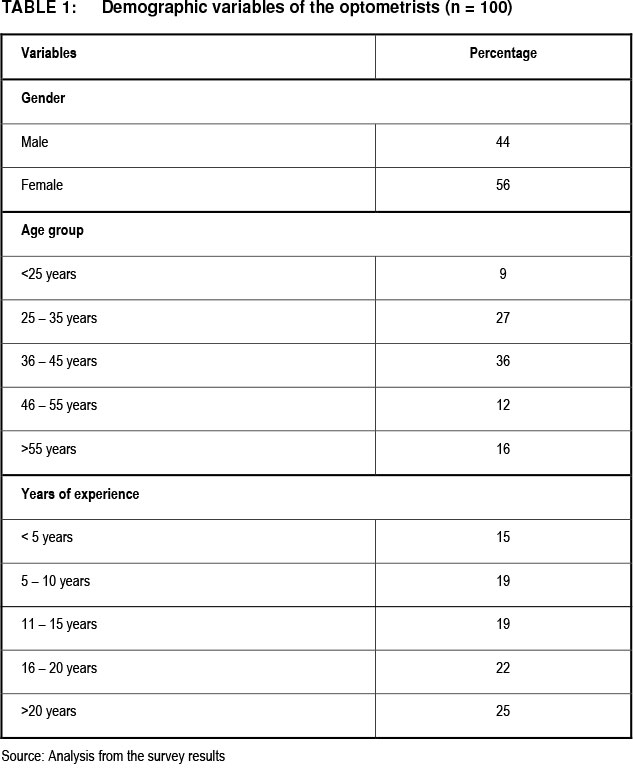
Regarding the optometrists survey, 190 optometrists viewed the questionnaire, 134 started the questionnaire, and 100 completed the questionnaire. Participants' demographic information is summarized in Table 1. Of the optometrists that responded, more than half (56%) of the respondents were female.
This gender distribution is representative of the South African gender profile of optometrists and similar to another study which found 57.8% of optometrists registered with the HPCSA up to 2008 were female while 42.2% were male (Nirghin 2011:123). It is also be noted that University intake for optometry programme is greater in ratio of female to male.
The age group of the respondents varied with the majority being between 36-45 years old and the least were under the age of 25 years old (Table 1). A fairly even distribution was noted in terms of the optometrists experience with regard to the number of years in practice (Table 1).
About two-thirds of respondents (66%) were in practice for over 10 years. The responses regarding the years in practice provided insight regarding the experience of the optometrists and hence their confidence in prescribing contact lenses, as with more experience, optometrists are more confident in prescribing contact lenses.
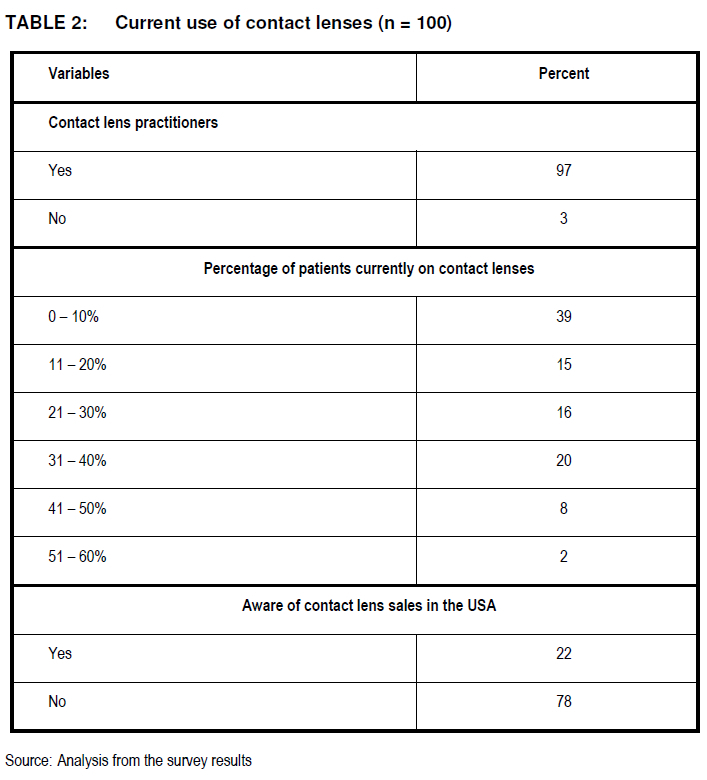
Almost all (97%) the respondents were contact lens practitioners (Table 2). A study conducted in the United Kingdom, about contact lens prescribing trends between 1995 and 2005 reported that technological advancements in the contact lens industry have had significant impact on the contact lens market over a short period of time (Morgan & Efron 2006:59). This is a possible reason as to why almost all the respondents prescribed contact lenses.
More than a third (39%) of optometrists reported that fewer than 10% of their patients were currently on contact lenses while 2% of optometrists reported that between 51 to 60% of their patients are currently on contact lenses (Table 2).
The reasons for the results being such are multi-factorial and may be attributed to clinical factors such as new contact lens fits being time consuming for the practitioner and the patient as well as factors such as demographics and patient compliance.
An average of the results indicates that at a practice level South African optometrists have 24.25% percent of patients on contact lenses while the average over the past five years in the Unites States of America was 35.2% (Nichols 2014:22). Of the respondents, 78.13% were not aware of revenues earned from contact lens sales in the USA, thus highlighting the applicability of the study (Nichols 2014:22).
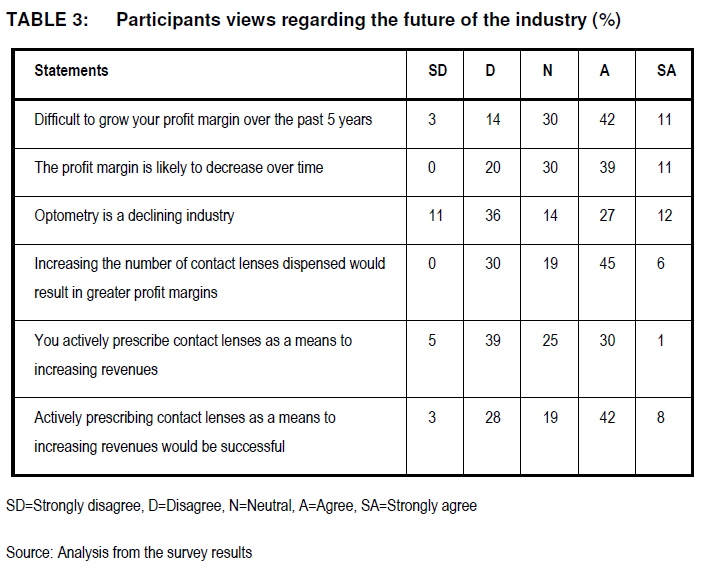
More than half of the respondents (53%) found it difficult to grow profit margins over the past five years while 30% of the respondents were neutral with regard to this statement (Table 3). Reasons for the results being such are possibly due to physical location of individual practices, the Living Standards Measure of the communities surrounding the individual practices and number of years that a practice has existed.
According to Review of Optometry's annual income survey 2011, in 22% of optometrists in the United States of America stated that profit margins decreased in 2011 compared to 2010 and 57% stated that profit margins remained constant (Review of Optometry 2009:Internet). According to the surveys conducted in the United States of America, profit margins have remained the same since 2008. Thus in terms of difficulty to grow profit margins, Optometry in South Africa is reflective of the United States of America (Review of Optometry 2009: Internet).
Half of the respondents (50%) were of the opinion that profit margins in optometry were likely to decrease over time (Table 3). According to the Review of Optometry's annual income survey in 2011, 9% of optometrists expected a decrease in income for 2012 while 37% expected income to remain the same for 2012 in the United States of America. In comparison to the Unites States of America, more South African Optometrists are of the opinion that profit margins are likely to decrease over time (Review of Optometry 2012: Internet).
More respondents felt that optometry is not a declining industry at the time of answering the questionnaire (Table 3). Of the respondents 52% believed that dispensing more contact lenses would increase the profit margins while no respondent strongly disagreed with this statement (Table 3). In a study it was reported that patients who wear both spectacles and contact lenses are of more value to a practice in terms of generating revenues than patients who are only on spectacles as the study showed that contact lens patients generate 91% greater revenue over a period of six years (Akerman 2010:Internet).
Of the optometrists that completed the survey, more than a third (39%) disagreed that they actively prescribe contact lenses as a means to increase revenues while 30% actively prescribed contact lenses as a means to increasing revenues (Table 3). Researchers showed that by actively prescribing contact lenses and offering a payment plan to consumers in the United Kingdom, greater profits and customer loyalty were achieved by optometrists (Patel, Naroo, Eperjesi, & Rumney 2015:15). A possible reason as to why optometrists may not actively prescribe contact lenses as a means to increase revenues could be due to the fact that it is time consuming to fit people with contact lenses as many aftercare visits are required and rather than prescribing contact lenses optometrists may believe that spectacle sales may be more worthwhile in that time.
A total of 50% of respondents believed that actively prescribing contact lenses as a means to increase revenues would be successful (Table 3). According to a study it was reported that most contact lens wear was initiated by patients requesting contact lenses and not by optometrists actively prescribing contact lenses as from the survey 71% of contact lens wear began after patients requested contact lenses while 21% of contact lens wear was initiated by optometrists (Wu, 2010:183). This indicates that actively prescribing contact lenses as a means to increasing revenues would be successful.
When asked about what could be done to sustain the industry, a multitude of responses were received for this question. There were many optometrists with similar responses.
The responses were grouped as follows:
■ better patient education
■ stamp out franchising in optometry
■ better governance from the Health Professions Council of South Africa
■ medical aid administrators should increase contact lens benefits in accordance with inflation
■ cost of spectacles should be dropped at a wholesale level
■ better marketing by contact lens manufacturers
■ lowering of the cost of contact lenses by manufacturers
■ better professionalism on the part of optometrists in terms of patient education about contact lenses.
According to Alberts (2002), franchising in optometry has made economies of scale and brand awareness very relevant in optometry in South Africa. This has allowed franchises to provide considerable discounts and advertise them widely. The study showed that it was necessary for optometrists in South Africa to gain a sustainable competitive advantage in the market place.
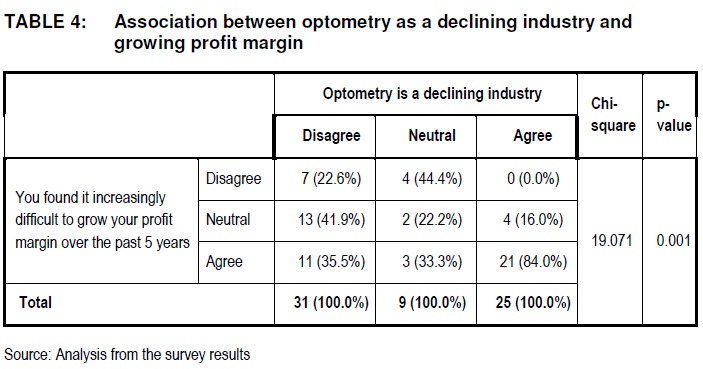
The research results highlighted that there was significant association between optometry declining industry and difficulty to grow the profit margins over the past 5 years (p=0.001). This meant that majority of the respondents, who agreed that optometry is a declining industry also agreed that it was difficult to grow the profit margins over the past 5 years (84%) (Table 4).
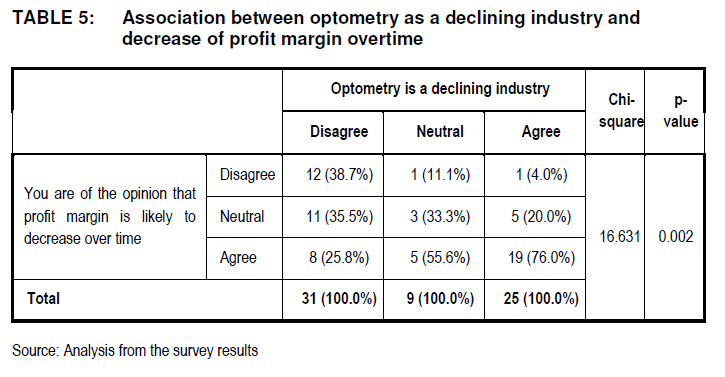
There was a significant relationship between optometry declining industry and the possibility of profit margin decrease over time (p=0.002). Respondents who agreed that optometry is a declining industry, also agreed that profit margins are likely to decrease over time (76%) (Table 5).
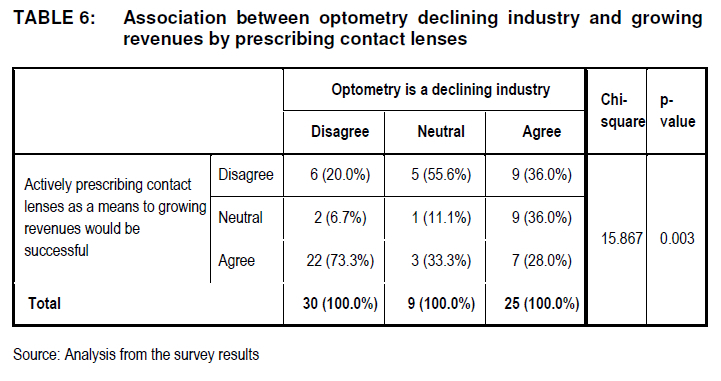
Results highlighted that there was significant association between optometry declining industry and actively prescribing contact lenses as a means to growing revenues would be successful (p=0.003). This meant that majority of the respondents, who disagreed that Optometry is a declining industry also agreed that actively prescribing contact lenses as a means to grow revenues would be successful (73.3%) (Table 6).
9. RECOMMENDATIONS
It is recommended that optometrists should take time to discuss the option of contact lenses with each and every patient. Another recommendation would be that contact lens companies engage marketing strategies that create awareness about the benefits of contact lenses in the minds of consumers. This could be done via television, radio and suitable print media.
10. LIMITATIONS
A limitation from researcher's perspective while conducting this study was the response rate to the questionnaires. The researcher anticipated a greater number of responses from certain provinces in South Africa that would give a better reflection of the optometrists and consumers of South Africa. There is minimal impact of the findings as three major cities has been adequately represented. Further study is needed with large sample size for validating the present findings. This could be done by using different data collection methods such as posting or hand delivered the questionnaire which might have better response rate than online survey.
11. CONCLUSION
The majority of optometrists found it difficult to grow profit margins over the past five years. Most optometrists are of the opinion that profit margins are likely to decrease over time thus it can be deduced that the scenario of a decrease in profit margins is more likely to occur than an increase in profit margins for optometrists. Optometrists need to prescribe contact lenses for revenue to grow in future. Therefore, it was essential to discover the views of practitioners regarding contact lenses as a business driver in South Africa.
REFERENCES
2 LITERATURE REVIEW
-
AKERMAN D. 2010. The economics of independent & corporate Optometrie practice. [Internet: http://www.visionmondaysummit.com/2010/presentation/vms2010_s3_akermandwight_cibavision.pdf; downloaded on 2016-08-18.
» http://www.visionmondaysummit.com/2010/presentation/vms2010_s3_akermandwight_cibavision.pdf - ]
- )
- ANSTICE NS. 2011. Effect of dual-focus soft contact lens wear on axial myopia progression in children. Ophthalmology 118:152-161.
-
BRITISH CONTACT LENS ASSOCIATION. 2014. Benefits of contact lenses. [Internet: http://bcla.org.uk/Public/Consumer/Benefits_of_contact_lenses.aspx; downloaded on 2014-09-30.
» http://bcla.org.uk/Public/Consumer/Benefits_of_contact_lenses.aspx -
]
» http://www.reportlinker.com/p01118670-summary/Eyewear-in-South-Africa.html -
CONTACTLENSES. 2015. A brief history of contact lenses. [Internet: www.contactlenses.org/timeline.htm; downloaded on 2016-16-06.
» www.contactlenses.org/timeline.htm -
]
» www.hpcsa.co.za/Publications/Statistics - EFRON N, MORGAN PB, WOODS CA, INTERNATIONAL CONTACT LENS PRESCRIBING SURVEY CONSORTIUM. 2013. An international survey of daily disposable contact lens prescribing. Clinical and Experimental Optometry 96(1 ):58-64.
-
ESSILOR. 2012. 2012 annual report. [Internet: http://www.essilor.com/en/Investors/DocReports/2012_Annual_Report_Essilor.pdf; downloaded on 2014-25-06.
» http://www.essilor.com/en/Investors/DocReports/2012_Annual_Report_Essilor.pdf -
]
» www.reviewofoptometry.com/content/c/40356/dnnprintmode/true/?skinsrc=%5BI% 5Dskins/ro2009/pageprint&containersrc=5BI%5Dcontainers/ro2009/simple -
EUROMCONTACT. 2015. Activity report 2015. [Internet: http://www.euromcontact.org/; downloaded on 2015-09-17.
» http://www.euromcontact.org/ - ]
- ]
- FONN D. 2009. Can the contact lens industry be protected from the economic diminution? Eye & Contact Lens 35:43.
-
]
» www.reviewofoptometry.com/content/d/income_survey/c/37293 -
HPCSA see HEALTH PROFESSIONAL COUNCIL OF SOUTH AFRICA
» http://www.slideshare.net/on3dprinting/ibisworld-2012-fastest-growing-industries -
MORGAN P, EFRON N & WOODS C. 2012. Contact lens prescribing: USA vs. the World: a look at how contact lens prescribing in the United States compares with other world markets. [Internet:www.Reviewof contactlenses.com/content/c/34844/; downloaded on 2015-07-25.
» www.Reviewof contactlenses.com/content/c/34844/ - ]
- MORGAN PB & EFRON N. 2006. A decade of contact lens prescribing trends in the United Kingdom 1995-2005. Contact Lens & Anterior Eye 29:59-68.
-
MURPHY J. 2012. Income survey: group practices bring home the bacon. [Internet: www.reviewofoptometry.com/content/d/income_survey/c/37293; downloaded on 2014-07-17.
» www.reviewofoptometry.com/content/d/income_survey/c/37293 - ]
- ]
- NICHOLS J. 2014. Contact Lenses 2013. Contact Lens Spectrum 29:22-28.
- PATEL NI, NAROO SA, EPERJESI F & RUMNEY NJ. 2015. Customer loyalty among daily disposable contact lens wearers. Contact Lens & Anterior Eye 38(1): 15-20.
- QUEIROS A. 2012. Quality of life of myopic subjects with different methods of visual correction using the NEI RQL - 42 questionnaire. Eye & Contact Lens 38:116-121.
- RAH MJ. 2010. Vision specific quality of life of paediatric contact lens wearers. Optometry and Vision Science 87:560-566.
-
REVIEW OF OPTOMETRY. 2009. The multifocal contact lens market: it's yours to lose. [Internet: www.reviewofoptometry.com/content/c/40356/dnnprintmode/true/?skinsrc=%5BI%5Dskins/ ro2009/pageprint&containersrc=5BI%5Dcontainers/ro2009/simple; downloaded on 2014-06-14.
» www.reviewofoptometry.com/content/c/40356/dnnprintmode/true/?skinsrc=%5BI%5Dskins/ ro2009/pageprint& containersrc=5BI%5Dcontainers/ro2009/simple - ]
- ]
- ]
- WALLINE JJ. 2007. Benefits of contact lens wear for children and teens. Eye Contact Lens 33:317-321.