Graphic history and style: Dada Khanyisa's drawings for The Widow of Marabastad
Abstract
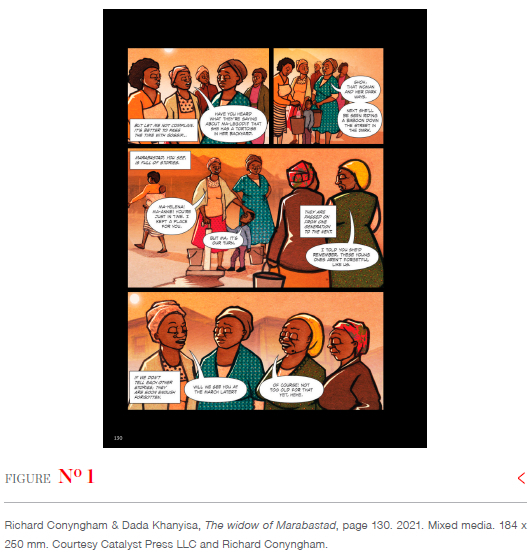
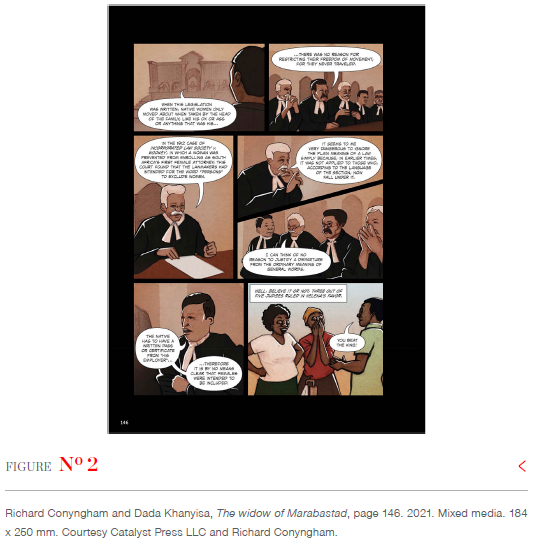
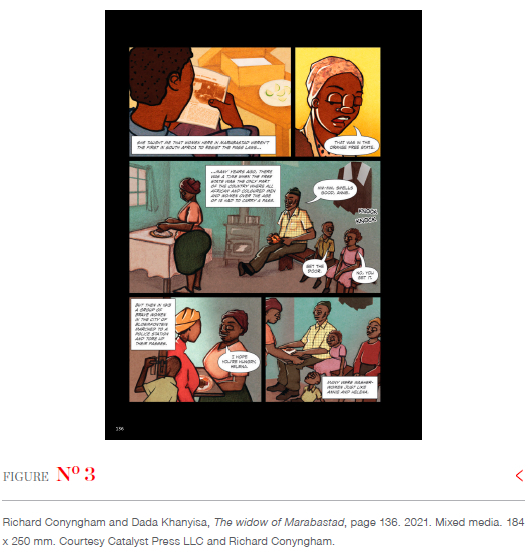
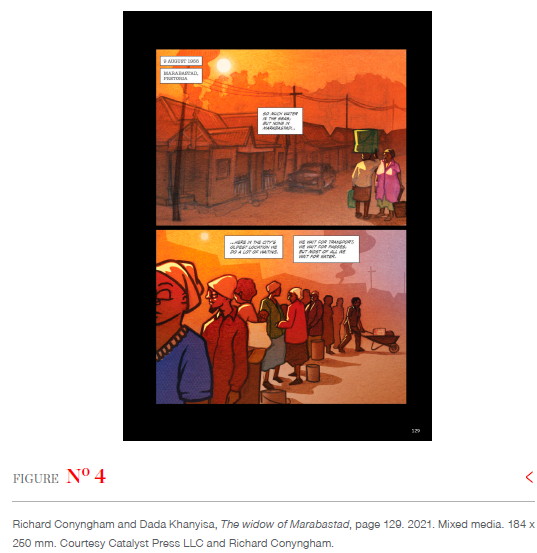
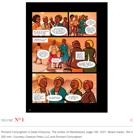
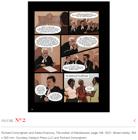
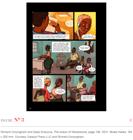
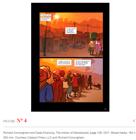
Since the 1980s, South African comics have explored resistance history, with organisations like the South African Committee for Higher Education (SACHED) producing works to counter apartheid education. Muziwakhe Nhlabatsi's Down Second Avenue (1981), a comic adaptation of Es'kia Mphahlele's autobiography for SACHED's Upbeat magazine, is a key example. More recently, Richard Conyngham's All rise: Resistance and rebellion in South Africa 1910-1948 (2021) has continued this tradition, highlighting working-class resistance. One chapter, The widow of Marabastad, illustrated by Dada Khanyisa, recounts Helena Detody's defiance of the 1925 night passes law, leading to a legal victory for black women's freedom of movement. Both The widow of Marabastad and Down Second Avenue depict Marabastad, emphasise women's roles in resisting injustice, and reflect the distinct styles of their illustrators. The analysis of drawing styles in graphic histories is often overlooked despite their importance in historical narratives (Ahmed 2012). In this article, we focus on Khanyisa's portrayal of the characters and Marabastad, using Mikkonen's (2017) writing on narratology in comics. We specifically examine graphic style and subjectivity, and following an interview with Khanyisa, we argue that their approach challenges the notion of "objective history", explicitly acknowledging their own subjectivity, and encouraging readers to critically engage with how history is presented.
Apartheid; Dada Khanyisa; graphic history; graphic style; South African comics; Women's resistance
 Thumbnail
 Thumbnail
 Thumbnail
 Thumbnail