Reading Tee Yod through Buddhist psychology of trauma
Abstract
This article examines Tee Yod (Death Whisperer, 2023), a Thai horror film directed by Taweewat Watanawat, through the lens of Buddhist psychology of trauma. Departing from the conventions of the Nang Phi genre, Tee Yod reinterprets the ghost as a metaphor for intergenerational suffering and psychological distress within a Buddhist cosmological and moral framework. Drawing on Theravāda Buddhist principles of suffering, ignorance, impermanence, purification, mindfulness, and insight, this study argues that Tee Yod challenges western paradigms of trauma and post-traumatic stress disorder (PTSD) by proposing an alternative framework for recovery and transformation grounded in Buddhist ethics and contemplative practice. A comparative analysis of western trauma treatments - such as trauma-focused cognitive behavioural therapy, exposure therapy, and pharmacotherapy - and Buddhist-inspired approaches demonstrates the latter's potential for moral repair, emotional regulation, and integrative healing. The article situates the film within broader discourses on Buddhist psychology, highlighting how mindfulness, ethical cultivation, and insight function as means of transcending suffering. Ultimately, it suggests that Tee Yod offers a cinematic articulation of Buddhist trauma theory, foregrounding healing as a process of awareness and compassion.
Post-traumatic stress disorder; trauma; Buddhist; Theravāda; suffering; ignorance; impermanence; purification; mindfulness; insight; western psychology
Introduction
The Thai horror film Tee Yod {Death Whisperer, 2023), directed by Taweewat Watanawat, defies the genre conventions of Nang Phi (Thai supernatural horror film). While traditional Nang Phi narratives place ghosts in Thai religious and cosmological contexts, Tee Yod interprets the spirit as a metaphor for Buddhist cosmology, intergenerational trauma, and psychological distress. Using familiar horror tropes - apparitions, possession, and physical decay - the film embeds its terror in a moral and spiritual investigation. Its narrative structure reflects the Buddhist psychological principles of suffering, attachment, ignorance, purification, mindfulness, and insight, framing the trauma as both personal and communal. Set in the early 1970s, in a period of rural poverty, family fragmentation, and emigration (Siamwalla, Pinthong, Poapongsakorn, Satsanguan, Nettayarak, Mingmaneenakin & Tubpun 1990:271-295), Tee Yod is a meditation on the transmission of grief, between generations and across society.
Although Tee Yod is part of the Nang Phi genre and does not explicitly address Theravāda Buddhist psychology, this article interprets it through a contemplative perspective. It views it as a symbolic exploration of Buddhist concepts of mind, suffering, and healing. It argues that the film challenges western paradigms of trauma and post-traumatic stress disorder (PTSD) treatment and proposes a Buddhist framework for recovery and transformation.
To support the central claim of this article - that Tee Yod challenges western therapeutic models of trauma and PTSD and introduces Buddhist-based healing paradigms - a comparative overview is provided. Western trauma treatment models, including trauma-focused cognitive behavioural therapy (TF-CBT), exposure therapy and pharmacotherapy, are still empirically sound (Hoskins, Pearce, Bethell, Dankova, Barbui, Tol, Ommeren, de Jong, Seedat, Chen & Bisson 2006:92-100). However, Buddhist-based paradigms -especially those of meditation, contemplation, loving kindness, ethical cultivation, and spiritual care - offer complementary and sometimes superior ways of healing beyond symptom-control (Kearney, Malte & Storms 2021:e216604). A randomised clinical trial of mindful stress reduction in PTSD veterans reported a significant reduction in symptoms compared to present-centred therapy (PCGT), as well as measurable neurophysiological improvement in the interoceptive brain responses associated with attention and awareness (Kang, Sponheim & Lim 2022:793-804). These findings suggest that Buddhist methods nurture regulatory and integrative processes rather than just behavioural modifications.
Second, Buddhist paradigms offer a framework for existential and moral repair, which is often neglected by western models that focus on desensitisation, cognitive restructuring, and coping mechanisms. Western approaches tend to ignore the moral dimensions of trauma - guilt, shame, alienation, and loss of identity (Wilson, Drozdek, & Turkovic 2006:1122-1421). By contrast, Buddhist teachings of impermanence, compassion (karunā), and non-attachment enable survivors to recover from their trauma and to reclaim dignity and a sense of purpose (Boehnlein 2007:259-274).
Thirdly, empirical evidence increasingly supports the effectiveness of Buddhist-derived practices of the mind and body. A recent meta-analysis of interventions in adolescents with PTSD found that TF-CBT, meditation and mindfulness all significantly reduced symptoms compared with controlled trials, with mindfulness ranking closely behind TF-CBT in effectiveness (Zhang, Jianchun, Xiaoyu & Yang 2025). These findings confirm the clinical value of meditation, especially in those who are resistant to or unable to access formal psychotherapy.
Fourthly, Buddhist approaches mitigate some of the risks inherent in western models based on exposure. Exposure therapy, although effective, may cause recurrence of trauma in individuals if it is administered before emotional regulation has been achieved. Buddhist practice, on the other hand, places a premium on grounding, acceptance and mindful awareness prior to revisiting painful memories (Wisco, Sloane & Marx 2013:435-442). In addition, integrating cultural and spiritual contexts improves treatment adherence and reduces stigma among survivors of trauma (Harris, Usset, Voecks, Thuras, Currier & Erbes 2018:420-428). Studies in Sri Lanka have shown that Buddhist rituals, meditation and community-based practices such as Bodhi-Pujujah1 and participation in sangha (Buddhist community) can effectively mitigate trauma related to war and disasters (Hoeberichts 2012:390-401; Wickrama & de Zoysa 2011).
Even though western psychology practitioners are investing more in Buddhist trauma treatment paradigms, not all western scholars accept Buddhist paradigms universally as superior treatment for trauma. There is still evidence to support TF-CBT, eye movement desensitisation and reprocessing (EMDR) and similar approaches as frontline interventions (Austin & Cowles 2025). Optimal outcomes often arise from integrative frameworks that consider practitioner expertise, cultural congruence, and client belief systems (Zang et al 2025). While the Buddhist practices may lose their essential ethical and spiritual dimension, their synthesis with western methods offers a holistic path to healing trauma and psychological transformation (Zang et al 2025).
It is necessary to have a clear understanding of Buddhist and western concepts of trauma. In Buddhism, trauma is not defined by diagnostic categories such as those outlined in the Diagnostic and Statistical Manual of Mental Disorders, 5th Edition (DSM-5) and the International Classification of Diseases, 11th Revision (ICD-11). However, it is understood as the expression of suffering (dukkha) caused by ignorance, craving and attachment (Naik 2000:27-45). While western psychiatry defines trauma as symptomatic of intrusive memories, avoidance, negative thinking, and PTSD (Friedman 2013:548-566), Buddhist psychology places these conditions within a broader ontological and ethical framework that emphasises causation, interdependence, and transformation rather than suppression of symptoms. Chandra Deep Naik (2020:27-45) compares the DSM-5 and ICD-11 psychiatric classifications with the Buddhist concepts of impermanence (ananta), non-self (anattā) and dependent origination and highlights the familiar but different ontological assumptions. Laka Mitra Bhikkhu (2018:89-103) also shows that Theravāda Buddhist practices, such as moral conduct, meditation, chanting, and withdrawal from unhealthy thoughts, can mitigate the psychological effects of trauma. In this sense, PTSD and trauma are disorders of mental structures formed by ignorance, longing and aversion (Dhammapāragu 2025:1-15). Buddhist healing, therefore, encourages insight (vipassana), meditation {samadhi), mindfulness {sati), ethical behaviour (sita), and wisdom (pañnana) as a means of transforming the root of suffering (trauma). Observing the impermanence of thoughts and emotions reduces attachment to anxiety, allowing for mental clarity and liberation (nibbāna) (Anālayo 2015:1-24; Brazier 2007).
To understand how Tee Yod represents Theravāda Buddhism, it is essential to grasp the fundamental principles of Theravāda Buddhist psychology. Briefly, Theravāda Buddhist psychology is a rich and coherent system for understanding the mind, suffering, and transformation, rooted in the early Pāli Canon. Rather than conceptualising mental health solely in terms of westernised psychological symptoms or pathology, Vimala Dhammapāragu (2025:1-15) frames mental experiences in terms of processes: how mental events (citta, viññāṇa, namma), ethical behaviour (sajna), concentration (samudra), and insight interact to create and cease to interact with suffering. In parallel, the development of the concept of the mind is dynamic and functional.
Grzegorz Polak (2022) and Alexander von Rospatt (2024:1-3) analyse how various Pāli terms (citta, viññāna, nana) are used for multiple functions in the mental processes, rejecting any notion of a fixed self in favour of a continuous series of conditioned events. The study "Bridging the gap between Sīla and Samādhi: The role of mindfulness in pre-meditative practice" (2024:2386-2401) by Aviran Ben-David demonstrates that practices of good action, living, and restraint are crucial for developing focus and wisdom. Meditation, particularly insight meditation (vipassana), is then a method by which practitioners observe impermanence, suffering and non-self in their own experience. The practice of observing the body, feelings, mind, and phenomena (satipathana) is a systematic path to psychological transformation (Tanupabrungsun & Lertsakornsiri 2016).
The first section of the article introduces a short plot summary of the film to place the theory in context. The following is a theoretical framework as a foundation for analysing Tee Yod, which examines a comprehensive definition of Buddhist trauma, the differences between Buddhist trauma and western psychological concepts of PTSD and trauma, and the broader meaning of Theravāda psychology. The theoretical framework presents Buddhist-inspired insights and practices, illustrating how trauma can be addressed through holistic care that integrates mindfulness, ethical reflection, and culturally grounded rituals.
Buddhist psychological themes in the film are discussed, offering a complementary framework for understanding and transforming suffering within a Buddhist context. The discussion is framed by Theravāda Buddhist psychology and focuses on the concepts of suffering, interdependence, attachment, ignorance, purification, mindfulness and awareness, insight, and liberation. The article then applies the theoretical framework to analyse the film, with a specific focus on the individual traumas of Yak and Yaem, the collective trauma of the family as a sangha, and how, through Buddhist interventions, they seek healing and insight.
Tee Yod: Plot
Set in 1972 in a remote farming village in the western province of Kanchanaburi, Tee Yod follows the lives of a family of eight in the countryside: a mother and a father, three sons (Yak, Yos, Yod) and three daughters (Yaed, Yaem, Yee). Their peace is shattered when the young girl, Nart, dies in the community in mysterious and painful circumstances after a long illness. This event suggests the presence of darker forces at work. Soon after, the three daughters witness a woman in black (a Phi Pop, a Thai female ghost) under a tree.
Shortly thereafter, Yaem, one of the daughters, becomes ill and changes her behaviour: she lapses into a trance, shows signs of external possession, and becomes more estranged from her family. Yak, the eldest brother, returns from the Vietnam War and finds Yaem suffering. Immediately, he exhibits several narratively depicted symptoms consistent with PTSD. Whenever Yaem's condition deteriorates, Yak regularly hears intrusive whispers and momentarily loses focus (Sanghavi 2024:1). According to Theravāda psychology, these experiences are not merely western psychological PTSD reflections, but reveal deeper psychological processes, particularly the workings of defilements known as kilesa. These include māna (conceit or egoistic pride), uddhacca (restlessness), and tanhā (craving or clinging) (Bhikkhu 1994:1).
At first, the family believes Yaem is medically ill and takes her to the hospital, but gradually believes that a demonic spirit is possessing her. The presence of this ghost is associated with a character known as Chauy, an old woman reputed to have been in contact with dark spirits. Chauy performs a ritual that appears to prepare Yaem as a host to the evil force. Eventually, when the family realise that rational or western medical explanations are not enough, they turn to spiritual help: the Buddhist priest Puth performs the rituals.
They find organs hidden in the father's beloved bamboo tree near their house (including a human heart, which is still beating), and they attempt to destroy it. Then, Yak, along with two of his siblings, his mother, and his assistants, tries to transport Yaem to the hospital for further medical help, but supernatural forces attack them on the way. In the showdown, Yak uses a special weapon to kill the ghost, and Yaem is temporarily released from the possession. However, later, in the hospital, Yaem's condition deteriorates; she suddenly swells violently, bleeding from several places, and dies in horrible circumstances. Her funeral is held. Yak returns to the tree where the Phi Pop first appeared and burns it, vowing that the threat is not over - a sign that it is still present.
-
Definition of Buddhist trauma
To substantiate the argument, it is first necessary to clarify how trauma and PTSD are understood in Buddhist terms. From the Buddhist point of view, trauma is an experience of profound suffering caused by an uncontrollable event such as violence, loss or betrayal. However, the suffering extends beyond the event itself, manifesting in habitual mind responses - attachment to the past, aversion to reminders, guilt, and self-recrimination (Nicolardi, Simione, Scaringi, Malinowski, Yordanova, Kolev, Mauro, Giommi, Barendregt, Aglioti & Raffone 2022:753-774). In Buddhist psychology, this suffering is compounded by ignorance, desire and delusion that sustain mental anguish (Thera 1978:6-122).
Across Theravāda, Mahāyāna, and Vajrayāna Buddhist traditions, healing trauma involves cultivating mindfulness, ethical conduct, concentration (samādhi), and wisdom (paññā) (Shulman 2024:2415-2427). Mindfulness promotes non-reactive awareness of painful memories and feelings and reveals their permanence (Guendelmann, Medeiros & Rampes 2017). Ethical conduct and generosity (dāna) restore moral integrity and social connection, while compassion and loving-kindness (mettā) counteract shame and aversion (Woods & Proeve 2014:20-33). Meditation stabilises attention and reduces physiological excitement (Amihai & Kozhevnikov 2014). Buddhist rituals and teachings reframe suffering not as a moral failing but as part of a conditioned existence (Suchart & Pornpitchanarong 2017:354-365), and the doctrine of non-self reduces the identification of pain and allows for psychological recovery (Gallagher et al 2024:795-803).
Empirical evidence is increasingly supporting the therapeutic value of Buddhist practices. Meta-analyses show that meditation and yoga significantly reduce the symptoms of PTSD and trauma, reducing intrusive thoughts and hyperarousal, and improving quality of life (Hilton, Maher, Colaiaco, Apaydin, Sorbero, Booth, Shanman & Hempel 2017:453-460). Western studies applying mindful stress reduction in war veterans have shown both reduction in symptoms and neural changes related to emotional regulation (Kang et al 2021:793-804). Bhikkhu (2018:89-103) identifies chanting, listening to suttas (sermons) and cultivating healthy thoughts as the keys to the cure of trauma.
Buddhist scholarship also examines how trauma interacts with mental illness and how the cultural context shapes recovery (Feinberg 2024:1241). David Brazier (2007) stresses the therapeutic importance of non-self and repetition compulsion, and Bhikkhu (2018:89-103) documents Buddhist approaches to trauma in Thailand, linking the concepts of non-self and permanence with perseverance.
In contrast, western psychology defines PTSD by diagnostic categories and often places priority on reducing symptoms by pharmacological or behavioural means (Livingston, Farmer, Mahoney, Marx & Keane 2021:386-395). Buddhism, on the other hand, seeks to transform one's relationship with suffering through insight, meditation, and ethical development (Kelly 2025:9-26). While western therapy focuses on the individual self, Buddhism views the self as impermanent and allows for non-attachment to heal (Gallagher et al 2024:795-803). However, Buddhist methods may lack structured clinical protocols and risk reactivating trauma when misused (Canby, Cosby, Palitsky, Kaplan, Lee, Mahdavi, Lopez, Goldman, Eichel, Lindahl & Britton 2025:0318499).
Although Buddhist understandings of PTSD and trauma differs from that of western psychiatry, both recognise the intrinsic suffering, avoidance, and dysregulation of the disorders (Patel & Hall 2021:197-203). Nevertheless, Buddhism enriches this model by situating trauma in an ethical and existential context and showing how insight, meditation, and compassion transform suffering at its root (Feinberg 2024:1241).
Theravāda Buddhist psychology
Tee Yod is a Thai film, and since Theravāda Buddhism is the predominant religion in Thailand (Thailand Foundation 2025:1), interpreting its symbolic, cultural, and psychological aspects requires awareness of Theravāda Buddhism's psychological tenets and associated Thai cultural practices. A unique yet complementary framework to western clinical psychology, Theravāda Buddhist psychology is based on early Buddhist teachings. It frames mental experience, suffering, healing, and liberation through ethical cultivation and insight into the mind rather than symptom management (De Silva 2018:108-111). Its primary goals are to determine the nature of mental phenomena, pinpoint the reasons behind suffering, and promote morality (sīla), concentration, and wisdom as the cornerstones of mental health (Ahn et al 2024:85-98).
The three marks of existence (tilakkhaṇa) are impermanence, suffering, and non-self (Anālayo 2021:1136-1143). These are experiential understandings of reality's impermanence rather than abstract doctrines. To understand that clinging to permanence and selfhood prolongs suffering and delusion, individuals are urged to observe how all phenomena arise and pass away (Gallagher et al 2024:795-803). Gaining wisdom and achieving liberation depend on understanding these traits.
As part of the chain of dependent origination (paṭicca-samuppāda) that perpetuates the cycle of suffering, saṅkhāra (mental formation) is a key concept in Theravāda psychology (Dhammapāragu 2025:1-15). Attachment, aversion, and ignorance are produced by mental formations that condition consciousness and behaviour (Bodhi 1995:1). Practitioners can gradually lessen the impact of these states and develop mental equilibrium by learning to observe their emergence and cessation through awareness and meditation.
The citta (mind), also known as viññānṇa or nāma, is seen as a dynamic continuum of mental processes rather than a fixed entity (Bhikkhunī 2023:1-3). Concomitant mental factors (cetasika), which can be either wholesome or unwholesome, give rise to consciousness. According to Sudaporn Khiewngamdee and Chamnong Kanthik (2022:5-10), psychological well-being results from eschewing unwholesome states such as hatred and delusion and fostering wholesome states such as loving-kindness, compassion, and non-attachment.
According to Theravāda Buddhist psychology, ignorance, desire, and aversion are the internal causes of suffering (Davis 2023:1). Because it involves understanding the transient nature of experience, letting go of attachment, and leading an ethical life, healing is transformative rather than symptomatic (Dhammapāragu 2025:1-15). To avoid regret and maintain psychological equilibrium, morality, compassion, and mindfulness are essential components of mental clarity (Thukhavati 2023:60-71). The aim of Theravāda Buddhist psychology is liberation from suffering, attained through wisdom, ethical discipline, and meditation. Through direct observation of the mind, insight meditation teaches practitioners to perceive the emergence and dissolution of thoughts, emotions, and sensations (Thirach & Tongkratok 2022:178-184). In addition to lowering anxiety and distress, this slow realisation causes a significant shift in how one views oneself, disrupting old habits and promoting a clear grasp of reality.
Buddhist-inspired insights and practices towards the healing of trauma
The article places trauma in a Buddhist framework, in which insight, understanding of change, and personal development lead to healing, while attachment, mental corruption, and ignorance perpetuate suffering. Therapeutic approaches closely aligned with Theravāda psychology emphasise cultural rituals, symbolic acts, compassion, and community support (Champawan 2020:20-28).
In Thai Buddhist trauma care, research shows that recovery often requires a holistic and community-based approach. These practices include Theravāda-based chanting, meditation, ethical behaviour, philanthropy and collective ritual (Songwathana et al 2013:203-207). The accounts of Buddhist healing traditions in Tee Yod relate to the Theravāda practices that help individuals and communities achieve mental peace and harmony, such as focused attention, chanting, meditation, and ceremonial offering (Bodhi 2005a:110-111; Nikapitiye & Ranjan 2024:171-183). Singing and mental focus are two techniques that can reduce stress and promote psychological balance (Gao, Skouras, Leung, Wu, Chang & Sik 2020). A study of trauma survivors in an unstable region of Thailand has shown that conventional religious practices, combined with a mindful attitude, positive thinking and lifestyle changes, increase psychological resilience (Songwathana et al 2013:203-207).
Examples of Theravāda-based interventions effective in reducing PTSD symptoms in contemporary western psychological settings include counselling from a Buddhist healing point of view, including mindful practice and insight practice. These methods help individuals develop self-compassion, redefine their sense of self, and diminish the emotional dominance of the ego (Srichannil & Prior 2014:243-261). Often, negative thinking is associated with western psychological ideas regarding PTSD (Cieslak, Benight & Lehman 2008:788-799). Theravāda Buddhist psychology promotes compassion and provides a path to ritualistic meaning-making by viewing suffering as part of a broader process (Harris 2005:1). Trauma cannot be eliminated according to Buddhist practice, but it can be reduced in its impact on life. This aligns with the Buddhist emphasis on non-interference and impermanence (Kyōkan 2025:1). It parallels Buddhist practices that emphasise moral commitment and the potential for change through enlightened understanding (Ubeysekara 2020).
Supportive self-compassion, grounding and awareness of the present moment, as well as stress-reduction and compassion-based therapies, are components of Buddhist ethical teachings and are integrated with a spiritual focus on trauma care in many contemporary western psychological PTSD therapies (Davis, Whetsell, Hamner, Bremner & Knecht 2018:7-25). These approaches promote health through a culturally appropriate perspective and facilitate healing (Sutthirat 2024:1-14).
Theravāda Buddhist psychological themes interwoven through Tee Yod
Tee Yod, which, I argue, builds on Theravāda Buddhist psychology, can be seen as a film that explores Buddhist psychological ideas through the experiences of a single family. Using key Theravāda themes - suffering, interdependence, attachment, ignorance, purification, mindfulness, insight, and liberation - the movie weaves spiritual insight with elements of cultural horror to create a story of trauma and moral awakening.
Regarding suffering, Yaem's family experiences severe distress because of her enigmatic illness and spiritual possession, which leads to widespread fear and hallucinations. Her eventual passing highlights the psychological and physical costs of loss and causes deep sorrow and bewilderment. According to Theravāda psychology, this kind of suffering is a natural part of saṃsāric existence (beginningless cycle of repeated birth, suffering, and death) and is brought about by ignorance and craving in human experience (Ahn et al 2024:85-98). Thus, the family's suffering reflects the universal Buddhist view that attachment and delusion are the root causes of suffering.
The interdependence theme is equally prominent. The family's emotional lives are intertwined: Yaem's suffering affects her siblings, empathy and intuition drive Yak's return from military service, and the family works together to face the supernatural threat. The Buddhist concept of dependent origination, according to which no being exists in isolation, and all persons' thoughts and deeds affect others, is embodied in this shared experience. As a result, the family's entwined fates illustrate the reciprocal nature of karma, a system in which compassion and suffering condition one another.
Yak's compulsive protectiveness of Yaem and the Phi Pop's frantic attempt to survive by clinging to life via the bamboo tree that contains living organs are two examples of attachment. The Buddha's first noble truth - that attachment is the source of suffering - is dramatised in both relationships (Bhikkhu 1956:47-56). From the perspective of Buddhist psychology, the Phi Pop's reliance on physical remnants represents unresolved attachment. In contrast, Yak's obsession reveals his incapacity to let go of emotional bonds, which is a type of trauma. The most potent emotional conflict in the film arises from the tension between love and detachment.
The family's early misinterpretation of Yaem's condition serves as a metaphor for ignorance. Their ambiguity - whether her ailment is spiritual or medical - is a prime example of ignorance's obscuring influence. Their irrational beliefs and fear-based reactions exacerbate their suffering. According to Theravāda psychology, ignorance causes mental fragmentation and distorts perception (Dhammapāragu 2025:1-15). The family's susceptibility to delusion is maintained by their incapacity to perceive events clearly.
The family seeks moral and spiritual healing through purification. They destroy the tainted bamboo tree, recruit Priest Puth, and face hardships in their quest for assistance. Yak's bravery, selflessness, and perseverance represent moral cleansing. Purification, according to Theravāda philosophy, involves moral self-control and focused effort, fostering mental clarity and dispelling illusion (Dhammapāragu 2025:1-15). Therefore, rituals have both psychological and symbolic functions, offering a framework for transforming fear into targeted moral intent.
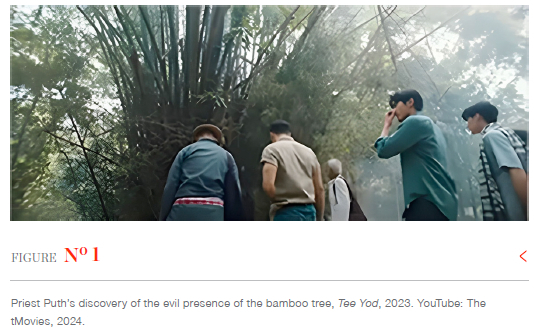
There are moments of mindfulness as the family struggles to stay conscious in the face of fear. Yaed's self-inflicted suffering to maintain consciousness and Yak's alertness represent conscious attention and defiance of unconscious fear. They demonstrate a collective mindfulness that keeps them rooted in the present through their observation of Chauy's rituals and Yaem's trances, as well as their awareness of the evil presence associated with the bamboo tree (Figure 1). Such conscious awareness serves as a safeguard against the disorder of maladaptive mental patterns in Theravāda psychology (Gilpin 2008:227-251).
Yak's developing comprehension of the nature of the spirit marks a significant shift in insight. He understands that, rather than just combating evil's outward manifestations, real resolution requires confronting the tree itself. Buddhist understanding of impermanence, suffering, and non-self is reflected in the family's realisation that western medicine cannot cure Yaem on its own without addressing the spiritual cause (Gallagher et al 2024:795-803). Even though their awareness is still developing, it represents a growing realisation of the fleeting nature of life and the importance of inner clarity.
Ultimately, the issue of liberation is still open. The Phi Pop's persistence and Yaem's passing imply that nibbāna, or ultimate release, has not yet been accomplished. Yak's (1.55.02) statement that 'this is not over' and the destruction of the trees, however, are symbolic actions that suggest continued vigilance and moral resolve. Liberation, according to Theravāda psychology, is the end of suffering through insight and detachment (Dhammapāragu 2025:1-15); the family's bravery, purification, and partial insight mark the start of that path, even though complete awakening is not present.
Yak: Traumatised protector developing into a mindful agent
Yak's compulsiveness to save Yaem is a clear indication of his deep attachment to his protective role, even at the expense of his traumatic mental disorder, which indicates symptoms consistent with the western diagnosis of PTSD. He displays symptoms such as acute agitation, persistent anxiety, and auditory disturbances such as whispering and moving shadows (Wearne, Curtis, Choy, Martengaard, Samuel & Melvill-Smith 2018:385-388). However, Bhikkhu (2018:89-103) and Dhammapāragu (2025:1-15) claim that in Buddhist psychology, traumatic mental disorders, such as those experienced by Yak, are caused by distorted mental formations that can only be resolved by moral restraint, focus, and mindfulness. Yak's visual and auditory hallucinations, along with his fatigue and sleeplessness, highlight the intrusive symptoms of western diagnostic PTSD. On the other hand, according to Laura Strachan, Georgie Paulik, and Peter McEvoy (2022:1791-1811), unresolved trauma and ingrained cognitive patterns are the causes of these recurrent sensory disturbances in Theravāda psychology.
Yak's growing alienation and loneliness are additional indicators of war trauma. His increasing detachment and emotional retreat from society reflect the Buddhist concept of ignorance, which renders individuals oblivious to connections. He feels both empowered and constrained by his self-perception as a protector, which breeds guilt and prevents him from practising self-compassion. Within a Buddhist framework, recovery from traumatic mental disorders necessitates moral action, chanting, focused meditation, and the release of unwholesome thoughts, according to Bhikkhu (2018:89-103). These practices are beneficial for war veterans.
It has been demonstrated that mindfulness-based therapies can successfully lessen the symptoms of PTSD (Li, Nannastad, Leow & Heward 2024:1). Meditation techniques like loving-kindness and mindfulness-based stress reduction (MBSR) have been shown in meta-analyses to dramatically lower intrusive memories, hyperarousal, and dissociation (Petrovic, Metzler, Cho & Heath 2024:1). According to recent research, trauma survivors - especially war veterans like Yak - can better control their emotions and lessen their distress by practicing self-compassion, non-reactive awareness, and mindful presence (Kang et al 2022:793-804).
Buddhist psychological concepts promote compassion and emotional control (Shonin, Van Gordon, Compare, Zanganeh & Griffiths 2014:1). Like meditative insight, Yak's decisive actions - burning the haunted tree and destroying the bamboo that is filled with organs - mark a symbolic turning point that reveals purification and release (Kalupahana 1995:151 -158). Yak's internal metamorphosis - his realisation of impermanence and the pointlessness of attachment - is externalised by the trees' destruction.
Yak transitions from hopelessness to acceptance in his last moments, expressing the Buddhist understanding that although suffering is unavoidable, freedom comes from letting go of one's identity (Bodhi 1998:1-5). Buddhist academics ultimately propose that trauma is spiritual, moral, and psychological (Jayatunge 2016:1). Through ritual destruction, moral resolve, and familial solidarity, Yak's journey creates a therapeutic narrative that integrates trauma rather than just surviving it. His journey is a prime example of the Buddhist process of transformation, which involves admitting suffering, ritualising its manifestation, and transforming it into moral clarity and wisdom (Ambos 2012:249-269).
Yaem and the Phi Pop spirit: Trauma externalised
A pivotal moment in Tee Yod occurs when Yaem changes from an innocent child into a conduit of supernatural disturbance. The black-robed ghoul that haunts her family home serves as both a plot device and a symbolic representation of psychological collapse, while her possession reveals what many cultures consider to be a spiritual occupation. The Phi Pop, sometimes referred to as Puang's ghoul, is characterised as a wicked ghost that preys on children, dead animals, and human remains as it moves from victim to victim (Baird 2024:109-138). Yaem's identity is constantly displaced by this invasive presence, which is reminiscent of the Buddhist idea of impermanence and constant change (Inthachak 2019:265-280).
Tee Yod's eerie whispering serves as an auditory representation of trauma - an obtrusive echo that mimics post-traumatic flashbacks. Such experiences are interpreted in Buddhist psychology as the reappearance of unresolved mental formations (Dhammapāragu 2025:1-15; Sayadaw 1994:1). Therefore, the repeated chant serves as more than just a horror cliché; it also awakens Yaem's dormant suffering, causing her to experience abrupt, disorienting episodes that neither she nor her family can explain.
Buddhism holds that mental factors, not outside influences, are the primary source of suffering (Thera 1972:14). Thus, it is possible to interpret the Phi Pop as an externalised representation of Yaem's inner turmoil. Within a Buddhist framework, the spirit inhabiting her body represents how psychological distress increases when attachment to trauma and ignorance of mental processes cloud consciousness (Feinberg 2024:1241). Thus, the possession represents the Buddhist realisation that clinging and ignorance prolong suffering. The Phi Pop becomes a metaphorical conduit for suffering - the embodiment of unresolved pain.
Chanting, meditation, ritual, and moral discipline are all considered to be spiritually and therapeutically restorative methods of mind purification in Buddhist practice (Perry, Polito, Shankar & Thompson 2022). Tee Yod illustrates this through group rites where Yaem's relatives try to exorcise the ghost and mend her broken self. Her brief hospital stay serves as a metaphor for the temporary union of body and mind attained by ritual purification and group effort (Lindhal 2017).
However, despite her family's devotion and Yak's frantic efforts to save her, Yaem's eventual death highlights the limitations of outward religious acts that are not accompanied by inward transformation. True liberation in Theravāda Buddhism results from direct understanding of suffering, impermanence, and non-self (Bodhi 1998:1). Rituals by themselves cannot bring about enlightenment; instead, attachment and ignorance are broken down by internal awareness (Sayadaw 2005:1). Thus, Yaem's passing serves as an example of the severe results of spiritual and psychological disintegration brought on by unresolved trauma and a loss of self-awareness (Lindahl 2017:1). The failure of western medical intervention serves as more evidence that insight, mindfulness, and the development of inner clarity are more important for recovery in the Buddhist sense than external cures.
The family as a sangha in crisis: Collective trauma and communal ritual
Tee Yod portrays the family as a collective body facing shared trauma, going beyond the depiction of individual suffering. In a journey of ritual confrontation and spiritual awakening, Sergeant, another returning soldier, Priest Puth, Yak, his parents, and siblings reflect the communal aspect of healing in the Theravāda Buddhist tradition.
Despite Yaem's eventual death, the family's experience shows how Buddhist practices can offer spiritual and psychological support for dealing with traumatic stress. The family experiences existential and emotional upheaval because of Yaem's possession, which is characterised by hallucinations, fear, and confusion. Her suffering serves as a metaphor for how everyday reality dissolves and family life becomes fragmented. The line separating spiritual crisis from psychological trauma is blurred by the overlapping layers of moral distress and grief.
Parittas, or protective verses from the Pāli Canon, are chanted to ward off evil forces and bring about peace during Priest Puth's intervention. Buddhist communities have long employed these recitations to bring people together and ward off bad spirits (Ganaratna & Thera 1999:1). These ceremonies show how Buddhist practice can deal with trauma as a disturbance of moral and social harmony in addition to a psychological injury (Csordas & Lewton 1998:435-512).
To transform suffering, Buddhist psychology emphasises the interdependence of moral intention, relational harmony, and mental discipline (Coss-Chioino 2006:652-670). The family's bravery and acceptance of impermanence at the film's climax symbolise a growing understanding of how unstable life and the self are. As instructed by Priest Puth, they felled the bamboo tree, signifying the severing of guilt, ancestry, and unresolved suffering and an act of karmic purification. While its destruction embodies the Buddhist discipline of letting go, the preserved human organs inside the tree symbolise the persistence of moral residue (Siritharo, Yuttitharo & Palapanno 2019:86-94).
The family's dangerous journey through the dark and fog to the hospital serves as an example of how interdependent they are as a psychological sangha. Their common goal combats the isolating effects of trauma by offering bravery and emotional control. Research demonstrates that group support, as opposed to coping alone, greatly facilitates recovery (Wang, Chang, Wang Yu & Kenardy 2021). The subsequent vehicle accident represents the loss of control and confusion that frequently follows trauma, acting as a metaphorical crucible (Corkalo, Ajdukovic & Stanic 2014:1).
In the end, Tee Yod portrays trauma as a spiritual ordeal that necessitates group fortitude. Like Buddhist healing traditions in Sri Lanka and Cambodia, victims are reoriented and their equilibrium restored through group rituals (Agger, Igreja, Kielhe & Polatin 2012:568-589). The family becomes a temporary sangha - a community that embodies wisdom, altruism, and moral steadfastness - through their chanting, sacrifice, and shared suffering. Despite tragedy, their unity reflects the Theravāda belief that healing comes from facing pain together with compassion and mindfulness rather than from eliminating it (Nguyen 2014:33-48).
Conclusion
The article argues that Tee Yod reimagines ethereal beings as a symbolic vehicle for exploring Buddhist cosmology and the psychological burden of suffering. The film uses familiar horror conventions, but beneath the supernatural veneer lies a sustained meditation on Buddhist psychological principles, such as suffering, detachment, awareness, purification, and insight.
Although not explicitly didactic in its engagement with Buddhist thought, the film is read in the article through the lens of Theravāda psychology, as the family's encounter with the Phi Pop spirit symbolises both psychological fragmentation and the transmission of pain across generations. This interpretation suggests that the supernatural is not a literal haunting, but a metaphor for the unhealthy mental structures - fear, longing, and delusion - that sustain suffering. Yaem's obsession and Yak's haunted memories of the war reflect the attachment to the trauma of ignorance and attachment, while the rituals of the family gesture towards the practice of mindfulness, ethical action, and community healing, as opposed to western models of PTSD.
The article emphasises that Tee Yod is more than a horror film; it serves as a cinematic lesson in spiritual potential and Buddhist psychology. It presents a perspective on trauma grounded in Theravāda thought. This view seeks to understand impermanence, the notion of non-self, and ethical responsibility, rather than attempting to eliminate suffering through avoidance or suppression. In this framework, trauma becomes a stepping stone to awakening - a painful yet profound challenge that cultivates liberating insight and the transformative power of mindful practice. In the case of Tee Yod, cinema serves as both a ritual and a revelation, offering a narrative of suffering and healing rather than just terror.
Notes1 In English, the Bodhi-Pujujah translates as the blessing of the Bodhi tree. It is a popular Buddhist ritual, particularly in Sri Lanka, where practitioners worship the sacred Bodhi Tree, which symbolises the Buddha's enlightenment. The ritual involves making offerings such as flowers, water, and incense, and often includes singing.
References
-
Agger, I, Igreja, V, Kielhe, R & Polatin, P. 2012. Testimony ceremonies in Asia: Integrating spirituality in testimonial therapy for torture survivors in India, Sri Lanka, Cambodia, and the Philippines. Transcultural Psychology 49(3-4):568-589. https://doi.org/10.1177/1363461512447138
» https://doi.org/10.1177/1363461512447138 -
Ambos, E. 2012. The changing image of Sinhalese healing rituals: Performing identity in the context of transculturality, in Transcultural turbulences. Transcultural research - Heidelberg Studies on Asia and Europe in a global context, edited by C Brosius & R Wenzlhuemer. Heidelberg: Springer, Berlin:249-269. https://doi.org/10.1007/978-3-642-18393-5_11
» https://doi.org/10.1007/978-3-642-18393-5_11 -
Amihai, I & Kozhevnikov, M. 2014. Arousal vs. relaxation: A comparison of the neurophysiological and cognitive correlates of Vajrayana and Theravada meditative practices. PLoS One 9(7):e102990. https://doi.org/10.1371/journal.pone.0102990
» https://doi.org/10.1371/journal.pone.0102990 -
Anālayo, B. 2015. Healing in early Buddhism. Buddhist Studies Review 32(1):1 24. https://doi.org/10.1558/bsrv.v32i1.28962
» https://doi.org/10.1558/bsrv.v32i1.28962 -
Austin, A & Cowles, M. 2025. Trauma-focused cognitive behavioural therapy (TF-CBT) for domestic abuse with an individual at risk of ongoing threat of further harm; a single case experimental design. The Cognitive Behaviour Therapist 18:e47. https://doi.org/10.1017/S1754470X25100172
» https://doi.org/10.1017/S1754470X25100172 -
Ben-David, A. 2024. Bridging the gap between STia and Samādhi: The role of mindfulness in pre-meditative practice. Mindfulness 15:2386-2401. https://doi.org/10.1007/s12671-024-02411-9
» https://doi.org/10.1007/s12671-024-02411-9 - Bhikkhunī, D. 2023. Bhavanga in Theravāda Buddhism, in Encyclopedia of mindfulness, Buddhism, and other contemplative practices, edited by NN Singh. New York: Springer:1-3.
- Bhikkhu, B. 1956. Handbook for mankind. Bangkok: Thammasapa.
-
Bhikkhu, T. 1994. Upakkilesa Samyutta: Defilements. Tipitaka. [O]. Available: http://dhammatalks.net/accesstoinsight/html/tipitaka/sn/index.html#:~:text=Bhikkhu%2Dsamyutta%20%E2%80%94%20Monks,273%3B%20CDB%20i%20713%7D%20%5BThanissaro%5D. & text=Kilesa%2Dsamyutta%20%E2%80%94%20Defilements,232%3B%20CDB%20i%201012%7D%20%5BThanissaro%5D Accessed 23 July 2025.
» http://dhammatalks.net/accesstoinsight/html/tipitaka/sn/index.html#:~:text=Bhikkhu%2Dsamyutta%20%E2%80%94%20Monks,273%3B%20CDB%20i%20713%7D%20%5BThanissaro%5D. & text=Kilesa%2Dsamyutta%20%E2%80%94%20Defilements,232%3B%20CDB%20i%201012%7D%20%5BThanissaro%5D - Bhikkhu, LM. 2018. An application of Buddha's teachings for healing traumatic mental disorder. The Journal of International Association of Buddhist Universities (JIABU) 11(2):89-103.
- Baird, IG. 2024. Where do the ravenous spirits (Phi Pop) go? Nakasang Village in Southern Laos as a place of cultural healing. Southeast Asian Studies 13(1):109-138.
-
Bohdi, B. 1995. The foundations of mindfulness. The middle length discourses of the Buddha. [O]. Available: https://buddhadust.net/dhamma-vinaya/wp/mn/mn.010.ntbb.wp.htm Accessed 20 September 2025.
» https://buddhadust.net/dhamma-vinaya/wp/mn/mn.010.ntbb.wp.htm - Bodhi, B. 1998. The noble eightfold path: The way to the end of suffering. Kandy, Sri Lanka: Buddhist Publication Society.
- Bodhi, B. 2005a. In the Buddha's words. Boston: Wisdom Publications.
- Bodhi, B. 2005b. Dīghajāṇu Sutta, in In the Buddha's words. Boston: Wisdom Publications:110-111.
-
Boxer, A, Shawyer, F, Coghlan, I, Ling, D & Meadows, G. 2025. Mindfulness-based interventions: What more can the west learn from Buddhism? A fieldwork study. Frontier Psychology 23(16):1579575. https://doi.org/10.3389/fpsyg.2025.1579575
» https://doi.org/10.3389/fpsyg.2025.1579575 - Boehnlein, JK. 2007. Religion and spirituality after trauma, in Understanding trauma: Integrating biological, clinical, and cultural perspectives, edited by LM Kirmayer, R Lemelson & M Barad. Cambridge: Cambridge University Press:259-274.
-
Brazier, D. 2007. Buddhist psychology and trauma work. Illness, Crisis and Loss 15(2). https://doi.org/10.1177/105413730701500207
» https://doi.org/10.1177/105413730701500207 -
Champawan, S. 2020. Spiritual health bolstering rituals in Lanna traditions. Journal of Thai Studies 20(2):1-28. https://doi.org/10.58837/CHULA.JTS.20.2.7
» https://doi.org/10.58837/CHULA.JTS.20.2.7 -
Cieslak, R, Benight, CC & Lehman, VC. 2008. Coping self-efficacy mediates the effects of negative cognitions on posttraumatic distress. Behaviour Research and Therapy 46(7):788-98. https://doi.org/10.1016/j.brat.2008.03.007
» https://doi.org/10.1016/j.brat.2008.03.007 -
Corkalo, DC, Ajdukovic, D & Stanic, AL. 2014. When the world collapses: Changed worldview and social reconstruction in a traumatized community. European Journal of Psychotraumatology 5(1). https://doi.org/10.3402/ejpt.v5.24098
» https://doi.org/10.3402/ejpt.v5.24098 -
Coss-Chioino, J. 2006. Spiritual transformation, relation and radical empathy: Core components of the ritual healing process. Transcultural Psychiatry 43(4). https://doi.org/10.1177/1363461506070789
» https://doi.org/10.1177/1363461506070789 -
Csordas, TJ & Lewton, E. 1998. Practice, performance, and experience in ritual healing. Transcultural Psychiatry 35(4):435-512. https://doi.org/10.1177/136346159803500401
» https://doi.org/10.1177/136346159803500401 -
Davis, LL, Whetsell, C, Hamner, MB, Carmody, JO, Rothbaum, B, Allen, RS, Bartolucci, A, Southwick, SM & Bremner RD. 2018. A multisite randomized controlled trial of Mindfulness-Based Stress Reduction in the Treatment of Posttraumatic Stress Disorder. Psychiatric Research and Clinical Practice 1(2):39-48. https://doi.org/10.1176/appi.prcp.20180002
» https://doi.org/10.1176/appi.prcp.20180002 -
Davis, TH. 2023. Theravāda Buddhist philosophy. Routledge Encyclopedia of Philosophy. [O]. Available: https://www.rep.routledge.com/articles/thematic/theravada-buddhist-philosophy/v-1 Accessed 20 September 2025.
» https://www.rep.routledge.com/articles/thematic/theravada-buddhist-philosophy/v-1 -
Dhammapāragu, VV. 2025. The application of the concept of Sankhāra (Mental Formation) in Theravāda Buddhist psychology for reducing human mental suffering in modern life. Journal of International Buddhist Studies 16(1):1-15. https://doi.org/10.5281/zenodo.15763591
» https://doi.org/10.5281/zenodo.15763591 - De Silva, P. 2018. Buddhist psychology and implications for treatment, in Psychiatry and religion context, consensus and controversies, edited by D Buhgra. London: Routledge:108-111.
-
Feinberg, N. 2024. The Buddhist logic of distress (Samvega): An exploration of early Abhidharma sources. Religions 15(10):1241. https://doi.org/10.3390/rel15101241
» https://doi.org/10.3390/rel15101241 -
Gallagher, S, Raffone, A, Berkovich-Ohana, A, Barendregt, HP, Bauer, PR, Brown, KW, Giommi, F, van Nyklícek, I, Ostafin, BD, Slagter, H, Trautwein, F-M & Vago, DR. 2024. The self-pattern and Buddhist psychology. Mindfulness 15:795-803. https://doi.org/10.1007/s12671-023-02118-3
» https://doi.org/10.1007/s12671-023-02118-3 -
Ganaratna, V & Thera, P. 1999. Book of protection. Paritta. [O]. Available: https://www.accesstoinsight.org/ati/lib/authors/piyadassi/protection.html?utm_source=chatgpt.com Accessed 5 August 2025.
» https://www.accesstoinsight.org/ati/lib/authors/piyadassi/protection.html?utm_source=chatgpt.com -
Gao, J, Skouras, S, Leung, HK, Wu, BWY, Wu, H, Chang, C & Sik, HH. 2020. Repetitive religious chanting invokes positive emotional schema to counterbalance fear: A multi-modal functional and structural MRI study. Frontiers in Behavioral Neuroscience 24. https://doi.org/10.3389/fnbeh.2020.548856
» https://doi.org/10.3389/fnbeh.2020.548856 -
Gallagher, S, Raffone, A, Berkovich-Ohana, A, Barendregt, H.P, Bauer, P.R, Brown, K.W. Brown, Giommi, F, Nyklícek, I, Brian, Ostafin, D, Slagter, H, Trautwein, F-M. & Vago, D.R. 2024. The self-pattern and Buddhist psychology. Mindfulness 15:795-803. https://doi.org/10.1007/s12671-023-02118-3
» https://doi.org/10.1007/s12671-023-02118-3 -
Gilpin, R. 2008. The use of Theravāda Buddhist practices and perspectives in mindfulness-based cognitive therapy. Contemporary Buddhism 9(2):227-251. https://doi.org/10.1080/14639940802556560
» https://doi.org/10.1080/14639940802556560 -
Guendelmann, S, Medeiros, S & Rampes, H. 2017. Mindfulness and emotion regulation: Insights from neurobiological, psychological, and clinical studies. Frontiers in Psychology 8. https://doi.org/10.3389/fpsyg.2017.00220
» https://doi.org/10.3389/fpsyg.2017.00220 -
Harris, E. 2005. Detachment and compassion in early Buddhism. [O]. Available: https://theravada.vn/ati/lib/authors/harris/ Accessed 21 July 2025.
» https://theravada.vn/ati/lib/authors/harris/ -
Harris, JI, Usset, T, Voecks, C, Thuras, P, Currier, J & Erbes, C. 2025. Spiritually integrated care for PTSD: A randomized controlled trial of "Building Spiritual Strength". Psychiatry Research 267:420-428. https://doi.org/10.1016/j.psychres.2018.06.045
» https://doi.org/10.1016/j.psychres.2018.06.045 -
Hoeberichts, JH. 2012. Teaching council in Sri Lanka: A post disaster, culturally sensitive and spiritual model of group process. Journal of Religious Health 51(2):390-401. https://doi.org/10.1007/s10943-010-9358-3
» https://doi.org/10.1007/s10943-010-9358-3 -
Hopwood, TL & Schutte, NS. 2017. A meta-analytic investigation of the impact of mindfulness-based interventions on post-traumatic stress. Clinical Psychology Review 57:12-20. https://doi.org/10.1016/j.cpr.2017.08.002
» https://doi.org/10.1016/j.cpr.2017.08.002 -
Hoskins, M, Pearce, J, Bethell, A, Dankova, C, Barbui, D, Tol, WA, Ommeren, M, de Jong, J, Seedat, S, Chen, H & Bisson, I. 2006. Pharmacotherapy for post-traumatic stress disorder: Systematic review and meta-analysis. The British Journal of Psychiatry 2:93-100. https://doi.org/10.1192/bjp.bp.114.148551
» https://doi.org/10.1192/bjp.bp.114.148551 -
Inthachak, S. 2019. Strengthening social ethics through Animism and Buddhism in Lanna. The Journal of International Association of Buddhist Universities 6(1):265-280. https://so04.tci-thaijo.org/index.php/JMA/article/view/165071
» https://so04.tci-thaijo.org/index.php/JMA/article/view/165071 -
Jayatunge, RM. 2016. Moral injury and post-traumatic growth described in the Buddhist Jathaka stories. Lankaweb. [O]. Available: https://www.lankaweb.com/news/items/2016/07/28/moral-injury-and-post-traumatic-growth-described-in-the-buddhist-jathaka-stories-2/ Accessed 29 July 2025.
» https://www.lankaweb.com/news/items/2016/07/28/moral-injury-and-post-traumatic-growth-described-in-the-buddhist-jathaka-stories-2/ - Kalupahana, DJ (ed). 1995. Buddhist thought and ritual. Delhi: Motilal Banarsidass.
-
Kang, SS, Sponheim, SR, Lim, KO. 2022. Interoception underlies therapeutic effects of mindfulness meditation for posttraumatic stress disorder: A randomized clinical trial. Biological Psychiatry Cognitive Neuroscience Neuroimaging 7(8):793-804. https://doi.org/10.1016/j.bpsc.2021.10.005
» https://doi.org/10.1016/j.bpsc.2021.10.005 -
Kearney, DJ, Malte, CA & Storms, M. 2021. Loving-kindness meditation vs cognitive processing therapy for posttraumatic stress disorder among veterans. A randomised clinical trial. Jama Open Network 4(4):e216604. https://doi.org/10.1001/jamanetworkopen.2021.6604
» https://doi.org/10.1001/jamanetworkopen.2021.6604 -
Khiewngamdee, S & Kanthik, C. 2022. The difference between cetasika in Abhidhamma Pitaka and Abhidhammattha Sangaha. BOHR International Journal of Social Science and Humanities Research 1(1):5-10. https://doi.org/10.54646/bijsshr.2022.02
» https://doi.org/10.54646/bijsshr.2022.02 -
Kyōkan. 2025. Buddhist psychology and trauma healing. [O]. Available: https://kyokan.org/buddhist-psychology-and-trauma-healing/ Accessed 21 July 2025.
» https://kyokan.org/buddhist-psychology-and-trauma-healing/ - Leeka, J. 2024. The role of karma in Thai society: A philosophical and socio-political analysis. Modern Academic Social Science 1(3):64-76.
-
Li, WW, Nannastad, J, Leow, T & Heward, C. 2024. The effectiveness of mindfulness-based stress reduction (MBSR) on depression, PTSD, and mindfulness among military veterans: A systematic review and meta-analysis. Health Psychology 11. https://doi.org/10.1177/20551029241302969
» https://doi.org/10.1177/20551029241302969 -
Lindhal, JR. 2017. Somatic energies and emotional traumas: A qualitative study of practice-related challenges reported by Vajrayāna Buddhists. Religions 8(8). https://doi.org/10.3390/rel8080153
» https://doi.org/10.3390/rel8080153 - Naik, CD. 2020. Buddhism and psychology. Delhi: Kalpaz Publications.
-
Nguyen, H. 2014. Buddhism-based exorcism and spirit-calling as a form of healing for mental problems: Stories from Vietnam. Journal of Religion & Spirituality in Social Work: Social Thought 33(1):33-48. https://doi.org/10.1080/15426432.2014.873648
» https://doi.org/10.1080/15426432.2014.873648 -
Nikapitiye, N & Ranjan, JK. 2024. The application of Theravāda Buddhist meditation practices and techniques in mindfulness-based interventions. Vidyodaya Journal of Humanities and Social Sciences 9(1):171-183. http://doi.org/10.31357/fhss/vjhss.v09i01.11
» http://doi.org/10.31357/fhss/vjhss.v09i01.11 -
Nicolardi, V, Simione, L, Scaringi, S, Malinowski, M, Yordanova, JY, Kolev, V, Mauro, Giommi, F, Barendregt, HP, Aglioti, SM & Raffone, A. 2022. The two arrows of pain: Mechanisms of pain related to meditation and mental states of aversion and identification. Mindfulness 15:753-774. https://doi.org/10.1007/s12671-021-01797-0
» https://doi.org/10.1007/s12671-021-01797-0 -
Patel, AR & Hall, BJ. Beyond the DSM-5 diagnoses: A cross-cultural approach to assessing trauma reactions. Focus 19(2):197-203. https://doi.org/10.1176/appi.focus.20200049
» https://doi.org/10.1176/appi.focus.20200049 -
Perry, G, Polito, V, Sankaran, M & Thompson, NS. 2022. How chanting relates to cognitive function, altered states and quality of life. Brain Sciences 12(11). https://doi.org/10.3390/brainsci12111456
» https://doi.org/10.3390/brainsci12111456 -
Petrovic, J, Mettler, J, Cho, S & Heath, NL. 2024. The effects of loving-kindness interventions on positive and negative mental health outcomes: A systematic review and meta-analysis. Clinical Psychology Review 110:1-13. https://doi.org/10.1016/j.cpr.2024.102433.
» https://doi.org/10.1016/j.cpr.2024.102433 -
Plum Village. 2012. Through the Insight of Interbeing | Dharma Talk by Thich Nhat Hanh, 2012.10.11. [O]. Available: https://www.youtube.com/watch?v=kuDSxr5qBT8&t=37s Accessed 7 August 2025.
» https://www.youtube.com/watch?v=kuDSxr5qBT8&t=37s - Polak, G. 2022. Does the not-Self (anattā) teaching in the Nikāyas presuppose the existence of a special type of consciousness? Argument 12(1).
-
Robins, CJ, Keng, SL, Ekblad, AG & Brantley, JG. 2012. Effects of mindfulness-based stress reduction on emotional experience and expression: A randomized controlled trial. Journal of Clinical Psychology 68(1):117-131. https://doi.org/10.1002/jclp.20857
» https://doi.org/10.1002/jclp.20857 -
Siamwalla, A, Pinthong, C, Poapongsakorn, N, Satsanguan, P, Nettayarak, P, Mingmaneenakin, P & Tubpun Y. 1990. The Thai rural credit system: Public subsidies, private information, and segmented markets. The World Bank Economic Review 4(3):271-229. https://doi.org/10.1093/wber/4.3.271
» https://doi.org/10.1093/wber/4.3.271 -
Sanghavi, PS. 2024. Death Whisperer (2023) movie ending explained: Can Yak save Yam from dying? High on Film. [O]. Available: https://www.highonfilms.eom/death-whisperer-2023-movie-ending-explained/#google_vignette Accessed 23 July 2025.
» https://www.highonfilms.eom/death-whisperer-2023-movie-ending-explained/#google_vignette -
Sayadaw, M. 1994. Mahasi Sayadaw. [O]. Available: https://www.accesstoinsight.org/ati/lib/authors/mahasi/ Accessed 28 July 2025.
» https://www.accesstoinsight.org/ati/lib/authors/mahasi/ -
Shonin, E, Van Gordon W, Compare, A, Zangeneh, M & Griffiths, MD. 2014. Buddhist-derived loving-kindness and compassion meditation for the treatment of psychopathology: A systematic review. Mindfulness 6:1161-1180. https://doi.org/10.1007/s12671-014-0368-1
» https://doi.org/10.1007/s12671-014-0368-1 -
Shulman, E. 2024. Ethics, mindfulness, and consciousness: A study of their relation in early Buddhism. Mindfulness 15:2415-2427. https://doi.org/10.1007/s12671-024-02434-2
» https://doi.org/10.1007/s12671-024-02434-2 -
Siritharo, PS, Yuttitharo, PK & Palapanno, PA. 2019. The study of approach of elimination of impurity in Theravada Buddhism. Academic MCU Buriram Journal 4(1):86-94. https://so06.tci-thaijo.org/index.php/ambj/article/view/241485
» https://so06.tci-thaijo.org/index.php/ambj/article/view/241485 -
Songwathana, P, Watanasiriwanich, W & Kitrungrote, L. 2013. Holistic self care for rehabilitation experienced by Thai Buddhist trauma patients in areas of political and social unrest. Journal of Trauma Nursing 20(4):203-207. https://doi.org/10.1097/jtn.0000000000000013
» https://doi.org/10.1097/jtn.0000000000000013 -
Srichannil, C & Prior, S. 2014. Practise what you preach: Counsellors' experience of practising Buddhist counselling in Thailand. International Journal for the Advancement of Counselling 36(3):243-261. https://doi.org/10.1007/s10447-013-9204-x
» https://doi.org/10.1007/s10447-013-9204-x - Suchart, P & Pornpitchanarong, S. 2017. Buddhism and trauma healing. Journal of MCU Peace Studies (3):354-365.
-
Sutthirat, N. 2024. Holistic wellbeing for improving mental health Buddhist practices in Thailand. BUDDHO 3(1):1-14. https://so13.tci-thaijo.org/index.php/Buddho/article/view/1461/1051
» https://so13.tci-thaijo.org/index.php/Buddho/article/view/1461/1051 -
Strachan, LP, Paulik, G & McEvoy, PM. 2022. A narrative review of psychological theories of post-traumatic stress disorder, voice hearing, and other psychotic symptoms. Clinical Psychology & Psychotherapy 9(6). https://doi.org/10.1002/cpp.2754
» https://doi.org/10.1002/cpp.2754 -
Tanupabrungsun, S & Lertsakornsiri, M. 2016. The effects of meditation practice approaches by integrating Satipatthana 4 and SKT1 on mental ability, self-awareness and academic achievement of nursing students. Journal of Research in Nursing-Midwifery and Health Sciences 36(4):13-28. https://he02.tci-thaijo.org/index.php/nur-psu/article/view/73461
» https://he02.tci-thaijo.org/index.php/nur-psu/article/view/73461 -
Thailand Foundation. 2025. Buddhism in Thailand. [O]. Available: https://thailandfoundation.or.th/th/buddhism-in-thailand/ Accessed 18 September 2025.
» https://thailandfoundation.or.th/th/buddhism-in-thailand/ - Thera, P. 1972. The psychological aspect of Buddhism. Kandy, Sri Lanka: Buddhist Publication Society.
- Thera, N. 1978. The Roots of Good and Evil. Buddhist Texts translated from the Pali. Kandy, Sri Lankra: Buddhist Publication Society.
-
Thirach, PP & Tongkratok, PC. 2022. A study of Vipassana practice based on a noble eightfold path appearing in Asivisopamasutta. Journal of Multidisciplinary in Humanities and Social Sciences 5(1):178-184. https://so04.tci-thaijo.org/index.php/jmhs1_s/article/view/256320
» https://so04.tci-thaijo.org/index.php/jmhs1_s/article/view/256320 -
Thukhavati, T. 2023. The practical way of generosity (Dana) to achieve real happiness in Theravada Buddhism. Journal of International Buddhist Studies 14(1):60-71. https://so09.tci-thaijo.org/index.php/jibs/article/view/2104
» https://so09.tci-thaijo.org/index.php/jibs/article/view/2104 - Trainor, K. 2004. Buddhism: The illustrated guide. Oxford: Oxford University Press.
-
Ubeysekara, A. 2020. Sympathetic joy (mudita) in Theravada Buddhism. Drarisworld. [O]. Available: https://drarisworld.wordpress.com/2020/02/08/sympathetic-joy-mudita-in-theravada-buddhism/ Accessed 21 July 2025.
» https://drarisworld.wordpress.com/2020/02/08/sympathetic-joy-mudita-in-theravada-buddhism/ - Von Rospatt, A. 2024. Momentariness, in Encyclopedia of mindfulness, Buddhism, and other contemplative practices, edited by NN Singh. New York: Springer:1-3.
-
Wang,Y, Chang, MC, Wang, M, Yu, X & Kenardy, J. 2021. Social support and posttraumatic stress disorder: A meta-analysis of longitudinal studies. Clinical Psychology Review 85. https://doi.org/10.1016/j.cpr.2021.101998
» https://doi.org/10.1016/j.cpr.2021.101998 -
Wickrama, T & de Zoysa, P. 2011. Mental health and the role of cultural and religious support in the assistance of disabled veterans in Sri Lanka. Journal of the Hellenic Veterinary Medical Society 19(3). https://doi-ds.org/doilink/03.2023-34685987/JMVH_Vol_19_No_3
» https://doi-ds.org/doilink/03.2023-34685987/JMVH_Vol_19_No_3 -
Wilson, JP, Drozdek, B & Turkovic, S. 2006. Posttraumatic shame and guilt. Trauma, Violence & Abuse: A Review Journal 7(2):122-141. https://doi.org/10.1177/2167702613486630
» https://doi.org/10.1177/2167702613486630 -
Wisco, BE, Sloan, DM & Marx, BP. 2013. Cognitive emotion regulation and written exposure therapy for posttraumatic stress disorder. Clinical Psychological Science 1(4):435-442. https://doi.org/10.1177/2167702613486630
» https://doi.org/10.1177/2167702613486630 -
Woods, H & Proeve, M. Relationships of mindfulness, self-compassion, and meditation experience with shame-proneness. Journal of Cognitive Psychotherapy 28(1):20-33. https://doi.org/10.1891/0889-8391.28.1.20
» https://doi.org/10.1891/0889-8391.28.1.20 -
Zhang, B, Jianchun, Z, Xiaoyu, X & Yang, J. 2025. Mind-body intervention for post-traumatic stress disorder in adolescents: A systematic review and network meta-analysis. BMC Psychiatry 25(178). https://doi.org/10.1186/s12888-025-06620-x
» https://doi.org/10.1186/s12888-025-06620-x
Accepted: 2025-10-21
Published: 2026-03-30