"You are not alone": how Gentle Tango affects older adults' close social relationships: A phenomenological exploration of two case studies
Abstract
The purpose of this study was to explore the effect of a Gentle Tango dance programme (located in Victoria, Australia) on older adults' close social relationships. Primary data was collected by conducting semi-structured interviews with two older adults who participated in the programme. A total of five Gentle Tango staff member/ volunteers were also recruited for interviews meant to obtain a contextual understanding of the programme. While analysis of the staff/volunteer interview transcripts remained at the level of description, analysis of the two primary case studies necessitated a phenomenologically oriented thematic approach. Themes that emerged in the study concerned participants' relationships and connection with their life partner and other dance participants. An important issue that was recognised in the analysis was that both participants' life partners have illnesses that made it difficult for them to take part in a mainstream dance class. Overall findings suggest that Gentle Tango provides an environment for participants and their partners to embody "learner", "dancer" and even "partner" roles. Through the incorporation of these forementioned roles, Gentle Tango offered an expanse of connective opportunities for participants, including a sense of belonging, being part of a culture of acceptance, kinaesthetic learning experiences and embodied brief but intense moments of connection in the dance. Furthermore, the findings of this study suggest that dance, specifically Gentle Tango, may be a way to overcome structural barriers experienced by older adults in fulfilling social needs by providing an environment formulated to cater to the differing needs of its participants.
interpretative phenomenological analysis; role theory; reflective lifeworld; social programmes for older adults
Introduction
Australia's ageing population is growing at a rapid rate. In fact, the number of people aged 65 years and over is expected to double between 2016 and 2056 (Australian Institute of Health and Welfare, 2018). With a significantly large aging population, future consideration needs to be taken in how to support older adults in promoting social relationships (Walker & Luszcz, 2009; Perissonotto et al., 2012). Traditionally, however, the physical needs of older adults have been foregrounded over their social needs in Western society (Cacioppo & Cacioppo, 2014). The promotion of older adults' social relationships is an important initiative for several reasons. Social isolation, loneliness and perceiving one's own relationships negatively have all been linked to reduced health and decreased longevity (Holt-Lunstad et al., 2010; Perissonotto et al., 2012; Hajek et al., 2020). This is especially concerning due to the high prevalence of social isolation and loneliness among older adults who experience illness and/or disability, or who are caregivers of others (Savikko et al., 2005; Schafer, 2012; Maccora et al., 2020). In addition, perceiving one's own social relationships and social networks positively are associated with better health and are protective factors against ill health (Holt-Lunstad et al., 2010). The implication of this research is that if a society promotes the social relationships of older adults, this could then improve the morbidity and mortality rates in that society.
This article explores a method for supporting older adults in their relationships: social dancing. A phenomenological study was conducted as part of a Bachelor of Social Work Honours thesis that focused on the effect of a Gentle Tango programme on the social relationships of its participants in regional Victoria, Australia. The Gentle Tango programme is targeted towards any person who may find a mainstream tango class not suitable to their needs, such as persons with illness and/or disability and older adults (younger people can participate, though the attendees usually are of an older age). The study focused on the experiences of two female participants of Gentle Tango, of which the findings are presented as two case studies. Both participants described their own experiences of growing older and having partners with illnesses, while attending the Gentle Tango programme.
Research on dance for older adults
There have been many studies to suggest that therapeutic dance, in various forms, has many benefits for older adults (Eyigor et al., 2009; Hui et al., 2009; Granacher et al., 2012; Nadolny et al., 2020). Some of these benefits include improvements in physical health such as balance and strength as well as improvements in quality of life, self-esteem and psychological health (Eyigor et al., 2009; Hui et al., 2009; Granacher et al., 2012; Nadolny et al., 2020).
The social benefits of dance for older adults is a growing area of enquiry (Lakes et al., 2016; Poulos et al., 2019; Douse et al., 2020; Nadolny et al., 2020). Many of these studies focus on the social benefits of dance for older adults who reside in aged care homes (Duignan et al., 2009; Guzmán-García et al., 2012; Melhuish et al., 2017). Some of the findings of these studies show older adults having an increase in the amount and enjoyment of social interactions (Duignan et al., 2009; Guzmán-García et al., 2012; Melhuish et al., 2017). Another study concluded that participatory art programmes, including dance, can offer residents living in aged care the opportunity to engage in a shared experience, a diverse range of interactions and an increase in communication and fostered social connectedness between older people through feelings of belonging and support (Dadswell et al., 2020).
Phenomenology has been a well-utilised technique in researching and theorising dance (Warburton, 2011; Sheets-Johnstone, 2015; Giese & Keightley, 2022). Several recent phenomenological studies have explored the experience of older adults in dance broadly and with a focus on social relationships (Kontos et al., 2021; Han & Sa, 2023; Toohey et al., 2025). Phenomenologically based dance studies seek to understand the lived experience of older adults participating in dance. For example, Toohey et al. (2025) explored older adults' sense of lifeworld - one's subjective experience of the world - upon relocating to residential care homes. One of the findings was that dance enabled a reconnection to older adults' lifeworld and experiences formerly associated with their youth such as bodily agency. Similarly, other studies found that dance promoted a connection to "self-identity" and promoted a positive view of ageing in middle-aged and older adults (Kim et al., 2022; Han & Sa, 2023). Another study, conducted by Kontos et al. (2021), illustrated that older adults with dementia taking part in a dance programme embodied playfulness and creativity - a theme, Kontos et al. (2021) acknowledged, not widely accredited to older adults with dementia. Numerous quantitative and qualitative methodologies, including phenomenology, have been utilised in previous research to explore the benefits of dance as they relate to the physical and social domains. However, further research into the subjective experience of older adults in dance may provide further understanding of the mechanisms by which the social benefits occur.
Theoretical underpinning
This study employed a broadly phenomenological framework to highlight the concerns and themes that ground both cases. One of the two phenomenological approaches utilised in this study is interpretative phenomenological analysis (IPA). IPA came into existence through two traditions: phenomenology and hermeneutics (Smith et al., 2009). IPA does not just focus on the lived experiences of individuals as in phenomenology, but on how participants "make sense of major life experiences" (Smith et al., 2009, p. 1). IPA also focuses on participants' lived experience of "being-in-the-world" in contrast to earlier Husserlian approaches that focus on "transcendental phenomenology" (Smith et al., 2021, p. 10, 13). One of IPA's strongest tenets is that it is interpretive (Smith et al., 2009). Smith et al. (2009) stress the importance of this concept in that one cannot truly know what it is to experience exactly what another is experiencing, but that IPA tries to get as close as possible. Furthermore, IPA utilises an idiographic approach, which means it gathers detailed and "particular" information from a small number of participants (Smith et al., 2009, p. 29). Smith et al. (2021) advocates for a richer and more in-depth exploration of participants' experiences in relation to phenomena, arguing that the use of large sample sizes would take away from individual perspectives. Various studies on dance have utilised IPA with great success (Braun & Kotera, 2021; Toohey et al., 2025), due to their ability to thoroughly explore the participants' embodied and personal experience of dance.
In conjunction with IPA is Dahlberg et al.'s (2008) reflective lifeworld approach (also referred to as lifeworld phenomenology in this article) which was also employed. As used in research, the reflective lifeworld approach can be utilised to try understanding the lifeworld of an individual. The lifeworld being the world that individuals subjectively experience through their corporeality (Dahlberg et al., 2008). Van Manen (1997) aptly describes the lifeworld as being an embodied experience with four key tenets: the lived body, lived time, lived space and lived human relation; that is, it is the world being perceived through our corporeal experience, temporality, spatiality and social relations (Van Manen, 1997). Though each of these tenets can be explored separately, they cannot be reduced to each other, because ultimately, if one changes, it will affect another and the combined experience of the lifeworld (Van Manen, 1997).
The three core components of Dahlberg et al.'s (2008) lifeworld approach consist of providing context, ensuring openness and bridling pre-understandings. To elaborate, "context" refers to the ontological perspective of the lifeworld approach, that everything happens in a context and that information cannot "be reduced to each-other" (Bengtsson, 2013, p. 5), while openness focuses on the researcher accepting the existence of multiple realities as it pertains to both the researcher and the participant (Dahlberg et al., 2008). Openness surrounds all aspects of lifeworld research such as the design, methodologies and frame of mind (Dahlberg et al., 2008; Vagle, 2016). Lastly, bridling could be described as containing two aspects: the process of trying to be aware of our pre-understandings and restraining them, and looking at the research holistically (Vagle, 2016). Both perspectives are applicable to the current study as they provide ways of approximating an understanding of what the participants may be experiencing, in this case, what people are experiencing in interpersonal relationships during a Gentle Tango class.
Research design
Research questions and focus
This research posed the question: In what ways does the Gentle Tango programme affect programme participants' perceptions of their close social relationships? In turn the objectives were to 1) identify and describe how the Gentle Tango programme affects programme participants' perceptions of their roles in their close social relationships, and 2) explore how the Gentle Tango programme affects programme participants' experiences of connection in their close social relationships. The focus on "roles" for this research was born through the perspective that understanding the role of a person would help to see how that person fits into their social network (Antonucci et al., 2014; Fuller et al., 2020). For clarification, role can be described as the "expected behaviour of a person in a certain position" (Hopcroft, 2018, p. 53), while role performance, coined by Goffman (cited in Hopcroft, 2018, p. 54) is the "actual conduct of a person in their role". Connection is a more elusive concept. Connection (also termed social connection or connectedness) can be described as the experience of bonding with another person, or the reciprocal sense of meaningful interaction between two people (O'Rourke et al., 2018). Investigation of connection from a phenomenological perspective enables the researcher to explore individuals' own lived experience of connection and therefore what aspects of connection are most important to the participants.
Sampling and recruitment
Purposive sampling was utilised in this research because it involved recruiting participants whose circumstances made them most apt in answering the research question (Alston & Bowles, 2018), namely that they were participants who attended a Gentle Tango class. In terms of recruitment, the original target of five participants was not reached. A probable reason for this was that the study was conducted during the first six months of the COVID-19 pandemic, where government restrictions resulted in "lockdowns" in Australia and which removed in-person access to many programmes such as Gentle Tango. Therefore, a broadening of recruitment strategies ensued (moving from email advertisements to the researcher presenting an online talk on the study to potential participants who attended the Gentle Tango class). The criteria to be a participant in the research was expanded several times, from "partners of people with dementia who had participated in Gentle Tango in the last 12 months" to "a person who had participated in the Gentle Tango programme in the last 12 months". The change of criteria resulted in the recruitment of two primary participants, which is suitable for the use of IPA due to its focus on gathering detailed information on a select few participants rather than the generalisability of results (Smith et al., 2009).
A secondary participant group was also recruited to provide context for the case studies, which included staff, volunteers and affiliated patrons of Southern Cross Tango who had either worked for or referred participants to the Gentle Tango programme. Five secondary participants were recruited through an email advertisement, which was sent to them from the co-ordinator of the dance programme (the advertisement was created by the researcher). The secondary participant group was included for descriptive reasons to understand the context and layout (stages of the dance programme, goals of the programme, length of the programme, etc.) of the Gentle Tango programme that the two primary participants attended.
Data collection
Data for both primary and secondary participants were collected through semi-structured interviews. The interview questions for the primary participants focused on why they joined the programme, if and how it affected their relationships and what meaning they got from the programme (see Appendix 1a). The interview questions for secondary participants consisted of process- and format-based questions, i.e. with a focus on frequency, goals and layout (see Appendix 1b).
All participants were separately interviewed once by the researcher. The interview length for each participant was approximately one hour. One interview was conducted via telephone, while the remaining six were conducted via Zoom (an online communication platform). All interviews were digitally recorded and then transcribed verbatim. All identifying information that was in each transcription was then de-identified and the data stored in a secured university database.
Data analysis
In the secondary research participant accounts, relevant topics were identified by the researchers, which built up a vivid contextual picture of the programme, its aims and objectives as perceived by staff and volunteers, what these individuals felt were principal features of the programme, and what the central benefits for the programme participants were likely to be. For the primary sample, or as we will refer to them in the rest of the article, the two case studies, the data was analysed in the style of IPA as outlined by Smith et al. (2009). The process consisted of listening to audio recordings of the interviews and reading through the data to gain familiarity of the data source (Smith et al., 2009). The data were then comprehensively coded, focusing on content, linguistics and conceptual elements. Based on these codes, emergent themes were constructed. Patterns between emergent themes were searched for to create a finalised set of themes. This analytical process was conducted separately for each data set. Due to the limited number of participants, a deeper and in-depth focus was placed on the individual case studies, and a further superordinate set of themes was not explicitly outlined between the two case studies. Various tenets from lifeworld phenomenology were utilised throughout the process of analysis, such as the researchers ensuring an openness to the possibilities of the data and findings while bridling pre-understandings and offering contextual descriptions in the themed findings (Dahlberg et al., 2008).
Rigour of the findings
To ensure rigour in the findings, Guba and Lincoln's (cited in Korstjens & Moser, 2018) four methods of substantiating trustworthiness in qualitative research were employed. These methods consist of credibility, transferability, dependability and confirmability. Credibility (truth-value) was exercised by the researchers in cross-checking the "emergent themes" to "finalised" themes, and the data itself. Transferability is the provision of contextual information so that the reader of the presented study can make a judgement on the relevance of the study. In the current study, a description of the analytical process was provided to enable opportunities for transferability. Both dependability and confirmability are concerned with replicability and neutrality respectively. They have been demonstrated in this research by providing an "audit trail" and outlining the examination of the existing literature, the theoretical lens used, sampling and recruitment processes and data collection/analysis processes.
Ethics approval
Ethics approval was granted by Deakin University on 11 June 2020. The ethical aspects of this study were approved after several non-substantive changes were made to the initial application by the request of the ethics committee.
Findings
The programme set-up
The Gentle Tango programme is a dance class that predominantly takes place in Geelong, albeit a smaller class is also offered in Sebastopol, Victoria, Australia. The basic premise of the programme is to provide a gentler approach to learning tango that may suit the needs of older adults and their families or carers. Two dance teachers conduct the class with the assistance of various volunteers who have dance experience. The programme operates on a weekly basis as a mid-morning class consisting of three main components: exercises for mobility and warming up, the dance class itself and a "morning tea" (the duration of each component is approximately 30, 60 and 45 minutes respectively).
The goal illustrated by staff and volunteers that may come across as most obvious is for programme participants to learn tango. However, this concept is not as simple as it seems on the surface. For example, some of the Gentle Tango participants may have experienced barriers to learning the tango such as reduced mobility or a previous injury. Therefore, teaching the tango to these participants was not only about teaching them the movements, but instilling a sense of confidence and capability despite these additional barriers.
Staff and volunteers identified a variety of overarching goals in Gentle Tango; these included providing programme participants a safe space for focusing on general well-being, physical health and social involvement with others. Specifically relating to relationships, goals centred around fostering participants "having respect for others and self-esteem for ourselves" and "enjoying time with other people". Staff and volunteers encouraged older adults in the tango classes in several ways, such as focusing on enjoying the movement, promoting acceptance of themselves and others and adapting the dance to physical ability. As mentioned, these findings were meant to build the context and were not rigorously analysed in the way the two case study narrative accounts were. However, it is important to note that the goals that volunteers and staff identified in the Gentle Tango programme generally encompassed themes of acceptance of others, ourselves and being able to participate regardless of ability. It appears the goals of the staff and volunteers provided a social and intercorporeal context meant to affect class members' lived experience of the dance class, which can be seen generally in the following case studies.
Margaret's experience
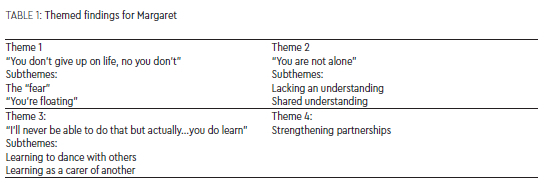
Analysis of data from the first participant, Margaret, resulted in the emergence of four overarching themes and six subthemes (Table 1). Those themes are as follows: "You don't give up on life, no you don't", which consists of two subthemes: "the fear" and "You're floating". The second theme, "You are not alone", also consists of two subthemes" "Lacking an understanding" and "Shared understanding". The third theme, "I'll never be able to do that but actually...you do learn", comprises of two subthemes, "Learning the tango with others" and "Learning as a carer of another". While the last theme, "Strengthening partnerships", does not include subthemes.
You don't give up on life, no you don't
This first theme initially centred on Margaret's experience of "fear" as it relates to her partner's diagnosis of dementia and what this may mean for their future together. For Margaret, this feeling of fear of the future compounded negative feelings in the present, such as "helplessness". Importantly, Gentle Tango was perceived by Margaret to be an environment she could "let go" of these feelings of fear and instead foster positivity.
The "fear"
Margaret described how her initial reaction to her partner's diagnosis of dementia was "fear". Ultimately, the "fear" was of the future and the possibility of not sharing it with her husband. Through analysis of Margaret's interview, it was shown that there was a power held by the "fear" which could dictate Margaret's present, in a way, paralysing it. Importantly, it was Margaret's strong belief that you cannot let the "fear" overtake you. And Gentle Tango was seen by her as a tool to remove herself from its grip:
I think that the worst thing you can do is just dissolve and sit at home and feel sorry for ourselves [Margaret and her husband] - we don't do that, so...to get out and go to [Gentle Tango classes] - if ever one of us is a bit down and sometimes you do, it's not an easy thing to cope with and we go to our Gentle Tango classes, and within half an hour I'm on top of the world again.
"You're floating"
The most profound mechanism which enabled "letting go" of the " fear" was in the dance itself. Margaret described an embodied experience of "floating". It is a moment in time where you are dancing with another and all the components such as your movements, the music and the atmosphere are working together and culminate in a moment when you are no longer focusing on outside concerns, you are simply "floating":
you feel so relaxed which you often don't when you're dealing with what life is dishing out to you and you get uptight and the pressure goes up, but when you do that and you get it and the music is so lovely, you're floating.
Importantly, this removal of the "fear" for Margaret and her husband's future together then allowed an anticipation of the future to take its place. As Margaret said herself, "when you have something to look to forward to, you're less likely to worry".
"You are not alone"
Overall, the theme of "You are not alone" illustrates Margaret's ability to make friendships built out of "shared understanding" with others from the Gentle Tango class. This is in contrast to the often negative or judgemental views of other people outside Gentle Tango. Ultimately, Gentle Tango offered Margaret a place to feel as if "you are not alone".
Lacking an understanding
Margaret stated that although it is important not to diminish the challenges that come with a diagnosis of dementia, a large part of the difficulty was other people's reaction to it. For example, Margaret had regularly experienced negative comments from others regarding her husband's diagnosis. Many of these comments seemed to appear from a lack of "understanding" of the experience of people who have dementia and feelings of "worry":
...because all of us initially don't know anything about dementia and we all have ideas about, "oh that's terribly sad", and you know, "that's awful"...
Although these comments are usually not meant to be hurtful, they are often experienced by Margaret as another stressor in dealing with daily life, and result in her not feeling understood. Alongside this, comments such as these also frame dementia as a "tragedy", which partners of people with dementia may not feel comfortable aligning with. For Margaret, this is especially relevant, as having a positive outlook is what enables her to cope with the difficulties that come with a diagnosis of dementia for her husband.
Shared understanding
In contrast to the previous subtheme, Margaret spoke about being able to form friendships that were built on shared understanding at Gentle Tango. For example, other programme participants are familiar with the feelings of shock and coping with not only diagnoses of dementia, but other health issues for themselves and/or their partners. For Margaret, being around other people who understood what she was going through was a relief. This meant that she could freely express if she was feeling emotionally "low" due to caregiving without fear of judgement from others. Overall, this sense of shared understanding was what helped Margaret form supportive friendships with others as demonstrated by the following quote:
...when we get a bit down or a bit low, we ring each other and say, "oh god, it's that sort of day" and you just get it off your chest, you know, and it's amazing... how much, you know, for all the psychology in the world - a good friend who understands because people don't understand what it's like.
The key tenet in this theme is the joining of like-minded participants where there is a shared understanding of ageing. This context of shared understanding of ageing allows participants to not be boxed into an imposed embodied experience of "tragedy".
"I'll never be able to do that but actually...you do learn" This theme explores Margaret's experience of learning the tango. Especially as it pertains to Margaret feeling a sense of achievement over something that she initially thought was impossible to achieve. Through the process of analysis, two overarching factors emerged in relation to the "learning" process and its effect on relationships. Firstly, learning in this context enabled connection with other dance participants via learning from each other and being co-learners. And secondly, the confidence gained from Margaret's ability to learn something as complicated as the tango also strengthened her sense of confidence to learn tasks associated with being a carer of her husband.
Learning the tango with others
Margaret described how she initially perceived barriers that made it seem impossible to learn the tango. These included her body feeling uncoordinated, comparing oneself to other dancers (especially professionals) and being older. Margaret detailed how then overcoming these barriers to learn the tango was a "morale boosting" experience:
...I think a lot of people maybe think it is too hard, or they've never done it before, but it doesn't matter, it's amazing how much we learn and that's part of the joy of it, and as I said that when you get it, it's such a boost to your morale and your feelings of relaxing and enjoying...
An important factor that helped Margaret learn was the help of other programme participants. This may be in the form of learning the types of movements used from others with more experience and dancing with a diverse array of people to gain self-confidence. She also learned from other programme participants that it was "fine to mess up", as they said, because they had all done this themselves before. Beyond the learning, Gentle Tango also offered Margaret a connective experience with other programme participants:
...it's very relaxing. It's just lovely and sometimes you're not dancing with one of the dancers [volunteers] but you're dancing with other males or females even [programme participants] and you just feel so good when you master the steps and you relax and you just float and it's really lovely actually.
Learning as a carer of another
Margaret expressed how as a partner of a person with dementia, over time she had to learn some of the tasks that were previously her husband's responsibility. These tasks can be separated into aspects such as fixing items, maintenance of the garden and maintenance of the home, etc.:
when things go wrong, the carer and the partner has to end up learning - like our air-conditioner almost died and I had to get onto them [make a phone call to maintenance company] and I had to go step by step until I got it all right.
Margaret described that having to learn some of these tasks was daunting, especially considering that a number of them she had never done before. Importantly, the experience of Margaret learning something as complex as the tango fostered her confidence in being able to learn these new tasks associated with her caring role:
I think it's very important to...be able to understand that you can cope with these things and you can cope with learning new dancing steps and all the rest of it 'cause when I first saw the tango I thought, "oh I'd never be able to do that, it's very complex".
The core connection between the two sub-themes is that Margaret's kinaesthetic learning experience with other dance participants had a transference effect to other areas of her life, namely to her lived body experience as a carer. The building of confidence and learning through movement served as a realisation for Margaret that an expansion of her lifeworld and role as a carer was achievable.
Strengthening partnerships
Part of the importance of Gentle Tango for Margaret was how it fostered the strength in her relationship with her partner in various ways. For example, for Margaret a strong point of positivity in her relationship with her husband, Michael, was seeing him enjoying himself in the company of others at Gentle Tango:
...Michael dances with other people, other ladies and I say, "oh, he's doing really well" and he seems quite chuffed, you know, and he says "oh, I think I am", which is also very important.
Gentle Tango also offered forms of co-dependence between the couple. For example, on the odd occasion when Margaret is feeling emotionally "low", Michael will encourage her to go to the Gentle Tango class, while Margaret knows the enjoyment Michael gets out of it is an incentive for her to attend. Margaret then explained how she is always relieved that she ended up attending:
...and I said, "I don't feel like going dancing today. I'm too tired" and Michael said, "oh, come on, if you come, you'll spark up and you'll enjoy it", and I do, and he's right...
Lastly, the opportunity of going to Gentle Tango is a way of continuing something they have always enjoyed doing as a couple:
...it's fun and you enjoy it and we've always loved dancing and socialising and partying and all the rest of it. You've still got that, and that, that also keeps your relationship very strong and very happy, even when sometimes you think, "oh god, can I really cope with this?" And you know, you can, and you do and those moments are quickly dissipated, and that's huge.
The relevance of examples provided in this last theme is that despite the difficulties associated with caring for a person with dementia, Gentle Tango enabled Margaret and her partner Michael to continue their embodiment of the role of romantic partner to each other, building positive lived body experience, which served as a protective factor against challenges associated with being a carer, or having a diagnosis of dementia.
Natalie's experience
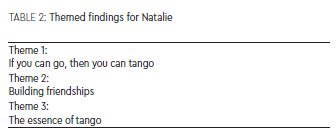
The analysis of data from Natalie's interview resulted in the construction of three overarching themes with the absence of subthemes (Table 2). These themes are "If you can go then you can tango", " Building friendships" and "The essence of tango".
If you can go, then you can tango
Natalie consistently described the flexibility of Gentle Tango and how this enabled people of varying physical ability to be able to participate in the class:
It's not only a matter of having those issues, but if for any reason you don't feel either able to attend, or not inclined to participate in the more advanced class which is held on Monday night, then this suits the needs of people who might be a little bit older, a bit less mobile or for whatever reason, you know, they feel it is more appropriate to their needs.
Part of this enabling of people of varying ability to participate in Gentle Tango was the flexibility of the dance itself and the "gentle coaching" of it. In a way, the dance can be seen as " simple yet complex". To elaborate, on one level all one needs to do is step. On the other hand, there is a deeper sensation that makes it " far more than just steps":
So, it really is very satisfying when it works. It might only work for a very short time, you know, that you can get that wonderful sense.it's quite a complex thing. But it's the flexibility I think, it can be the simplicity of it, yes, I think at its very essence it can work very well.
The language used by Natalie alluded to an accepting atmosphere in the Gentle Tango programme:
...my observation and my experience is it socially works very well and meets needs and the dance, the exercises are all, you know, you just work at your appropriate level.
The accepting nature of the group was largely due to a "shared understanding" of some of the experiences one can have as they age. The group's "shared understanding" of ageing is precisely what fosters their acceptance of difference (of ability). For example, when the researcher enquired about what Natalie meant by "shared understanding", she replied:
you know, we're all around the same age for a start and all dealing with different issues, I suppose, in different ways. Then there can be some commonality and other people can understand situations...I think that's where that common understanding can be very supportive.
It is important to note here, that for Natalie, Gentle Tango was not strictly about relationships. However, the flexibility of tango to cater for varying abilities and the accepting nature of the programme are partly what allow a space for Natalie and her partner to have a positive experience as a couple:
...it's positive for, for both, and if a partner has, you know - more specific needs or more limitations, then it's right for them, but it's also - and I think the support, that partners might get - that partners do get, I think that's a really good thing too and that's where the morning tea and all the talk and friendships...they are part of the support that's sort of given to each other. So, it's a positive thing for each of us, you know, to sort of take and get out of the Wednesday morning and in different ways.
Not only did the factors of flexibility of the dance to cater for physical ability and the acceptance/support among the group enable an environment that both Natalie and her partner could enjoy, it also enabled an experience that Natalie could look forward to. The importance of this stems from Natalie's illustration that there is a need to be socially involved with others, especially when a person experiences a reduction in the activeness of their social life:
...first of all, it's on the calendar Wednesday morning, right. You get up, you wash your hair and you work out what you're going to wear, what you're going to cook. So, just getting there, I think is a good thing because sometimes...unless, some people have very busy lives, you know, and social lives and things and if things tend to be quieter, it's good to actually have an occasion like that to, sort of, put some nicer clothes on for and go to, so...there's that side of it. It's always a positive experience, there's no pressure. [We] both enjoy the whole thing and we both probably take different things from the morning.
Overall, Gentle Tango provides an environment that appears to foster acceptance among the group, enabling people of differing abilities to embody the role of dancer. This is largely due to having a "shared understanding" of some of the factors that can affect people as they age and the flexibility of the dance towards people of varying levels of manoeuvrability. As a further understanding of these findings, Gentle Tango is a place that fosters an anti-ageist mentality, because the programme "works around" people's often diminishing abilities, enabling them to be involved in the programme (Greene et al., 2016).
Building friendships
Natalie spoke about the building of friendships, not only for herself, but also for her partner. A part of the creation of friendships was simply the opportunity to exist in the space together:
You know, when people come in and so.and the tables and the chairs around the table actually encourage people to talk. So, there's a lot of friendships, a lot of support among participants in the programme.
Beyond this, Natalie shared how she thought the openness of the other participants and having "shared experiences" also helped build friendships:
I think people who go to the programme are quite open and keen to talk about their situations.but, you know, you do build a familiarity and [you have] some degree, some shared experiences, I suppose, you know. I think that's what is a basis of understanding and friendships.
For Natalie, a lot of the way friendships were deepened was through meaningful interactions of providing/receiving support:
Well, this is sort of the caring aspect...I think. And it's almost - the table is almost a metaphor, you know, that sort of stands for the friendship and the support of each other and that sort of thing.
Natalie expressed how many of these supportive interactions were practised during the morning tea. For example, support in the sense of each person contributing and sharing at the morning tea as a signal of care for others in the programme:
And you go home, you don't need lunch. People usually take leftover food home. So, there's a lot of good will around the table and about the table.
The core of the building of friendships could be likened to the earlier described concept of "common understanding", where other participants are able to offer a sense of care that is free from judgement due to being familiar with some of the issues that may occur related to ageing or illness. Another element that was found to be important in the creation of friendship was the feeling of being able to meaningfully contribute, whether it be in the form of listening to another person's situation, or bringing food to share with others.
The essence of tango
Lastly, the dance itself was captivating for Natalie. Natalie's initial description of the tango was that it "is a wonderful, exciting, interesting, addictive thing". It all starts with building the tango foundations - where one has to work on the elements of strength, confidence and technique. Natalie emphasised the time that building a strong foundation takes:
So, it takes a long time to learn because you need to build technique and, you know, some sort of confidence and strength and all the rest. And I was only getting a tiny way along the track.
Part of the "learning aspect" is of course that it takes two to tango. Therefore, you are spatially connected and learning to move kinaesthetically. The complexity of this process in and of itself can take a long time. This is not only in the sense of physically learning, but also a sense of "feeling the connection". For example, Natalie spoke about "connection" in relation to the dance unprompted. The researcher then enquired further about what Natalie meant by this term:
Well...in terms of the dance and as far as I'm concerned - the connection's everything the dance is about. You have to establish and maintain a connection, with the partner and, you know, that in itself can be something that takes a long time to actually come to feel and establish.
Natalie had not specified one particular person in relation to these processes of learning the tango, but meant it in a general sense. This is important to note because the programme participants do dance with their partners, but they also dance with a collection of other people. This suggests that the process of learning to "connect" is part of dancing with any person.
Now, finally, we approach what could labelled as the "addictive" component of the dance. Although the dance cannot be reduced to this one component, it is of vital importance to Natalie's experience. It is described as a feeling of "complete presence":
that's a very complex thing and the essence of tango. It's a feeling, you know. It's far more than just the steps. It's a fascination, it's a connection, it's an energy and it's the present, just being completely present. You're not trying to remember, you know, step sequences.
Part of the importance of this addictive moment is a sense of achievement that can be felt, especially due to all the hard work that is put into the dance:
Hopefully, you know, people who might be struggling on whatever level - and we all struggle, don't get me wrong, you know, there's something in there that can be quite satisfying. That sense of achievement.
While this theme of the essence of tango and Natalie's focus on momentary connection do not necessarily suggest there is any lasting effect on relationships, there is an implication that there is a momentary bliss in just existing in the moment with another person. Another important aspect to this sense is that a level of practice and learning kinaesthetically is needed with another person to learn "how to connect" to achieve this blissful moment. Lastly, there are elements of Natalie's description that suggest that there is the potential to "relieve a sense of struggle" for her, not only by a "sense of achievement", but by focusing on the present. However, Natalie, herself did not specify what this struggle consisted of, instead focusing on the "sense of achievement" felt from learning something new.
Discussion
Key findings in relation to the study's objectives include that the Gentle Tango programme enabled a space for its dance participants to embody a variety of roles, including "dancer", "learner" and even "partner". It must be noted that wider society does not typically assign the forementioned roles to either older, ill or disabled persons. Secondly, through the embodiment of these roles, Gentle Tango offered an expanse of connection and connective opportunities, including feeling a sense of belonging, being part of a culture of acceptance, intercorporeal learning and kinaesthetic experiences and brief, addictive but intense moments of connection in the dance.
Embodiment of role and why it matters
Throughout the analysis, reference was made to both participants being able to embody the roles of "dancer", "learner" and "partner". This in and of itself may seem insignificant; however, we need to consider this in a wider context, including that both partners of the participants in the study had illnesses and may not have the opportunity to embody these roles in a mainstream dance class. To extend this beyond "dance classes", research has found that the lack of flexibility of social programmes to meet the needs of people with illness or disability has been a prohibiting factor to meeting social needs (Savikko et al., 2005; Bruggencate et al., 2018; Gardiner et al., 2018) This inflexibility of social programmes may extend to being a barrier to couples of which one has an illness or disability. Viewing this concept through a phenomenological lens, the lifeworld, the individual's subjective experience of the world is largely affected by intersubjective experiences with others (Husserl, 1960; 1970; Schutz, 1967) where one's perception and reactions alter another's embodied experience and lived experience in the world. Potentially, those perceptions and reactions, especially those of stereotypes and negative views of older adults in Western society, can narrow the opportunity to embody roles that offer opportunities to connect with others, such as in arts and dance (Antonucci et al., 2014; Greene et al., 2016). Therefore, the present article advocates that programmes such as dance be made available to older adults as a way for them to challenge and even reject stereotyped views and open up different opportunities for embodied roles and intersubjective connection. For example, in a study exploring participatory art programmes in aged care homes, including dance, found that these programmes broadened perceived roles among aged care residents, which led to a more dynamic connection between residents and carers, i.e. being storyteller and listener as compared to resident and carer (Dadswell et al., 2020).
Another key finding of the study was that values of acceptance and flexibility as opposed to judgement (of ability) in the group were major facilitators of what made participants able to embody the role of dancer or learner. To elaborate, having an environment where all are welcome, and each participant "could work at their own level" with the complete understanding of other participants is a pillar of what makes this programme possible, and in fact a special part of the bond created between participants. Similarly, a study by Dadswell et al. (2020) exploring participatory art programmes (including dance) found that such programmes enabled a deepened sense of connection between aged care residents through feelings of belonging and support. Beyond this, wider research suggests that a sense of reciprocity or having a meaningful connection where one feels the other has offered "something" to another is a vital aspect of meeting older adults' social needs (Bruggencate et al., 2018; Gardiner et al., 2018). A different study by Canning et al. (2020) found that ballet also helped foster acceptance among dance participants. However, this acceptance was between children and older adults with dementia. Initially the children saw only the differences between themselves and the older adults. The transition to developing feelings of acceptance and seeing similarities was a gradual process. Comparing these studies opens up questions that are worthy of further exploration in future studies, such as whether the act of the dance itself is a connective factor that enables acceptance to develop, or whether some form of acceptance needs to be established to enable dance participants to embody the dancer/learner role.
Considering the participants' embodiment of the "partner" role further, Gentle Tango enabled an environment where two people in a couple could both belong, learn, enjoy and have a positive experience. Therefore, Gentle Tango is unique in that it enabled both participants of differing physical ability to be part of a single programme in a flexible, "pressure-free" and supportive environment.
Furthermore, wider research suggests that the changing role experienced by family members who care for a loved one can be challenging (Miskovski, 2017; McGilton et al., 2018). This may be due to the perceived extreme change of one's lifeworld, transitioning one lifeworld's intersubjective experience as family member/partner to carer (Husserl, 1960; Miskovski, 2017; McGilton et al., 2018). This is especially important when discussing Margaret's narrative account, as she found Gentle Tango strengthened her sense of partnership with her husband while also increasing her confidence as a carer, enabling simultaneous roles rather than a rigid partner or carer lifeworld perspective. Potentially, dance programmes could be a way to mitigate the extensive change in lifeworld and jarring intersubjective relation once a partner becomes ill or disabled.
The last key finding was an experience discussed by both participants that is intimately linked to a sense of connection. It is described as being in a moment when you are "floating", " not thinking about step sequences" and completely and joyfully engrossed in the movement, aptly named by one participant, as the "essence" of Gentle Tango. This phenomenon has been illustrated in other dance-related exploration, being described as "when movement, momentum, and ideas move seamlessly, without reflection or critical awareness, between the two dancers, causing them to form one entity moving fluidly among others" (Bosse, 2015, p. 133). In the present study, the moment where participants felt that they had nurtured the connection with another person to a point where they were "floating" could be likened to the concept of "flow", a deeply satisfying experience where one is completely focused and engrossed in the task at hand, the pleasant feelings of which have been found to be intensified in couple or group environments (Csikszentmihalyi, 1975; Nakamura & Csikszentmihalyi, 2002; Walker, 2010). However, it has been found that there is no guarantee to achieve flow, even among world level competitors in dance (Lloyd, 2021). In Gentle Tango, for two or more individuals to nurture a connection by which they develop an intuitive understanding of the other dancer's next movement in space was noted to take time, practice and mutual comfort. It is only when this embodied understanding of the other's next movement becomes completely accessible to one's intuition can the experience of "floating" then manifest for the dancer. Sheets-Johnstone (2024) noted how dance is different to exercise, as you are not restricted to a defined practice, rather you are kinaesthetically learning, thinking, feeling and "being-in-the-movement". It is no surprise that another study that explored intercorporeal connections in dance found that dancers get to know each other "intimately", with one participant even noting it may be a connection perhaps even beyond that of sexual intimacy (Purser, 2019).
Overall, the findings of this study suggest that through the promotion of acceptance of disability and ageing, the Gentle Tango programme enables participants to embody the roles of "learner", "dancer" and "partner". This, in turn, allows participants to feel a sense of belonging with others and to connect through kinaesthetic learning and experiences of "flow". Implications from this research are that dance would be a worthy intervention applied over a range of settings, including in community and aged care, to mitigate feelings of loneliness and perceptual changes in lifeworld for older adults, such as the ageing self, or when a partner becomes ill or disabled. However, considerations would need to be made regarding the volunteers and staff facilitating an environment of acceptance of disability and ageing, and physical amendments or flexibility in the programme itself for either ill or disabled persons.
Limitations, strengths and future research
A possible limitation of the research is the fact that the study consists of only two case studies, albeit with five interviews among secondary participants. However, as discussed, an interpretative phenomenological analysis (IPA) approach is not necessarily concerned with the number of interviews, but in applying a phenomenological lens to investigate the experiential process of a select few participants on a particular issue. However, a larger participant pool would have enabled further exploration of potentially under-represented or differing experiences in the Gentle Tango programme. Nonetheless, due to the small sample size, this study could be utilised as a pilot study for future research.
A strength was that secondary participants fleshed out the orientation of the programme, which assisted in contextualising the primary participants' accounts of their experience in detail.
The mirroring of some of this contextual information with primary participants' accounts, such as staff stating they had "promoted acceptance", shows that developing programmes in line with certain positive dispositions can create spaces where individuals can flourish and meaningfully connect in their social and indeed intercorporeal activities with others.
Future research may benefit in comparative analyses between programme staff/volunteers' and programme participants' perceptions to further understand staff/volunteer members' roles in fostering social relationships in order to utilise these factors in real world programmes. Future research would also benefit exploring a variety of concepts including the relationship between flow and kinaesthetic learning experiences in dance, and how they may impact older adults' perception of their own role and subjective lifeworld, as well as intersubjective connection and relationships with others.
Conclusion
Overall, the findings of this study indicate that the Gentle Tango programme could potentially be used as a method of promoting older adults' social relationships in both intimate partnerships and friendships. The way in which this could occur is through the embodiment of learner, dancer and partner roles in a public setting, enabling connection through feelings of belonging and acceptance as well as experiences of flow and kinaesthetic learning experiences. Furthermore, the findings of this study suggest that dance, specifically Gentle Tango, may be a way to overcome structural barriers experienced by older adults in fulfilling social needs. One overarching barrier is that social programmes are often not set up to be flexible enough to meet a range of social and physical needs (Schafer, 2012; Gardiner et al., 2018). Overall, more research needs to be undertaken on dance programmes in Australia to further explore the applicability of dance in promoting older adult social relationships.
References
- Alston, M., & Bowles, W. (2018). Research for social workers: An introduction to methods (4th ed.). allen & Unwin.
-
Antonucci, T. C., Brauch, K. J., & Birditt, K. S. (2014). The convoy model: explaining social relations from a multidisciplinary perspective. Gerontologist, 54(1), 82-92. https://doi.org/10.1093/geront/gnt118.
» https://www.aihw.gov.au/reports-data/population-groups/olderpeople/overview -
Bengtsson, J. (2013). With the lifeworld as ground. A research approach for empirical research in education - the Gothenburg tradition. Indo-Pacific Journal of Phenomenology, 13, 1-18. https://doi.org/10.2989/IPJP.2013.13.2.4.1178.
» https://doi.org/10.2989/IPJP.2013.13.2.4.1178 -
Bosse, J. (2015). Becoming Beautiful: Ballroom Dance in the American Heartland. University of Chicago Press. https://doi.org/10.5406/illinois/9780252039010.001.0001.
» https://doi.org/10.5406/illinois/9780252039010.001.0001 -
Braun, N., & Kotera, Y. (2021). Influence of dance on embodied self-awareness and well-being: an interpretative phenomenological exploration. Journal of Creativity in Mental Health, 17(4), 469-484. https://doi.org/10.1080/15401383.2021.1924910.
» https://doi.org/10.1080/15401383.2021.1924910 -
Bruggencate, T. T., Luijkx, K. G., & Sturm, J. (2018). Social needs of older people: a systematic literature review. Ageing & Society, 38, 1745-1770. https://doi.org/10.1017/S0144686X17000150.
» https://doi.org/10.1017/S0144686X17000150 -
Cacioppo, J. T., & Cacioppo, S. (2014). Social relationships and health: The toxic effects of perceived social isolation. Social and Personality Psychology Compass, 8(2), 58-72. https://doi.org/10.1111/spc3.12087.
» https://doi.org/10.1111/spc3.12087 -
Canning, S. E., Gaetz, M., & Blakeborough, D. (2020). It takes time: building relationships and understanding through an intergenerational ballet programme. Dementia, 19(2), 270-284. https://doi.org/10.1177/1471301218772895.
» https://doi.org/10.1177/1471301218772895 - Csikszentmihalyi, M. (1975). Beyond Boredom and Anxiety. Jossey-Bass Publishers.
-
Dadswell, A., Bungay, H., Wilson, C., & Munn-Giddings, C. (2020). The impact of participatory arts in promoting social relationships for older people within care homes. Perspectives in Public Health, 140(5), 286-293. https://doi.org/10.1177/1757913920921204.
» https://doi.org/10.1177/1757913920921204 - Dahlberg, K., Dahlberg, H., & Nystrom, M. (2008). Reflective Lifeworld Research (2nd ed.). Studentlitteratur.
-
Douse, L, Farrer. R., & Aujla, I. (2020). The Impact of an Intergenerational Dance Project on Older Adults' Social and Emotional Well-Being. Frontiers in Psychology, 11, 561126. https://doi.org/10.3389/fpsyg.2020.561126.
» https://doi.org/10.3389/fpsyg.2020.561126 - Duignan, D., Hedley, L, & Milverton, R. (2009). Exploring dance as a therapy for symptoms and social interaction in a dementia care unit. Nursing Times, 105(30), 19-22.
-
Eyigor, S., Karapolat, H., Durmaz, B., Ibisoglu, U., & Cakir, S. (2009). A randomized controlled trial of Turkish folklore dance on the physical performance, balance, depression and quality of life in older women. Archives of Gerontology and Geriatrics, 48(1), 84-88. https://doi.org/10.1016/j.archger.2007.10.008.
» https://doi.org/10.1016/j.archger.2007.10.008 -
Fuller, H. R., Ajrouch, K. J., & Antonucci, T. C. (2020). The convoy model and later-life family relationships. Journal of Family Theory and Review, 2, 126-146. https://doi.org/10.1111/jftr.12376.
» https://doi.org/10.1111/jftr.12376 -
Gardiner, C., Geldenhuys, G., & Gott, M. (2018). Interventions to reduce social isolation and loneliness among older people: An integrative review. Health & Social Care in the Community, 26(2), 147-157. https://doi.org/10.1111/hsc.12367.
» https://doi.org/10.1111/hsc.12367 -
Giese, J., & Keightley, E. (2022). Dancing through time: A methodological exploration of embodied memories. Memory Studies, 17(2), 444-457. https://doi.org/10.1177/17506980221126611.
» https://doi.org/10.1177/17506980221126611 -
Granacher, U., Muehlbauer, T., Bridenbaugh, S. A., Wolf, M., Roth, R., Gschwind, Y., Wolf, I., Mata, R., & Kressig, R. W. (2012). Effects of a salsa dance training on balance and strength performance in older adults. Gerontology, 58(4), 305-312. https://doi.org/10.1159/000334814.
» https://doi.org/10.1159/000334814 - Greene, R. R., Galambos. C., Cohen, H. L, & Green. N. (2016). Social work with the aged and their families (4th ed.). Routledge.
-
Guzmán-García, A., Hughes, J. C., James, I. A., & Rochester, L. (2012). Dancing as a psychosocial intervention in care homes: a systematic review of the literature. International Journal of Geriatric Psychiatry, 28(9), 914-924. https://doi.org/10.1002/gps.3913.
» https://doi.org/10.1002/gps.3913 -
Hajek, A., Riedel-Heller, S. G., & König, H. (2020). Perceived social isolation and cognitive functioning longitudinal findings based on the German Ageing Survey. International Journal of Geriatric Psychiatry, 35(3), 276-281. https://doi.org/10.1002/gps.5243.
» https://doi.org/10.1002/gps.5243 -
Han, J. H., & Sa, H. J. (2023). Health and happiness of older Korean women participating in dance activities. Heliyon, 9(3), e13761. https://doi.org/10.1016/j.heliyon.2023.e13761.
» https://doi.org/10.1016/j.heliyon.2023.e13761 -
Holt-Lunstad, J., Smith, T. B., & Layton, J. B. (2010). Social relationships and mortality risk: A meta-analytic review. PLoS Medicine, 7(7), e1000316. https://doi.org/10.1371/journal.pmed.1000316.
» https://doi.org/10.1371/journal.pmed.1000316 -
Hopcroft, R. L. (2018). Sociology: A Biosocial Introduction. Routledge. https://doi.org/10.4324/9781315169446.
» https://doi.org/10.4324/9781315169446 -
Hui, E., Chui, B. T., & Woo, J. (2009). Effects of dance on physical and psychological wellbeing in older persons. Archives of Gerontology and Geriatrics, 49(1), e45-e50. https://doi.org/10.1016/j.archger.2008.08.006.
» https://doi.org/10.1016/j.archger.2008.08.006 - Husserl, E. (1960). Cartesian meditations: An introduction to phenomenology (D. Cairns, Trans.). Martinus Nijhoff.
- Husserl, E. (1970). The crisis of European sciences and transcendental phenomenology (D. Carr, Trans.). Northwestern University Press.
-
Kim, J., Im, S., Lee, S., & Heo, J. (2022). "At this age, I can do anything": a phenomenological study exploring self-efficacy in pole dancing among middle-aged women. Leisure Studies, 42(5), 736-750. https://doi.org/10.1080/02614367.2022.2138511.
» https://doi.org/10.1080/02614367.2022.2138511 -
Kontos, P., Grigorovich, A., Kosurko, A., Bar, J. R., Herron, V. R., Menec, H. V., & Skinner, W. M. (2021). Dancing with dementia: Exploring the embodied dimensions of creativity and social engagement. The Gerontologist, 61(5), 2021, 714-723. https://doi.org/10.1093/geront/gnaa129.
» https://doi.org/10.1093/geront/gnaa129 -
Korstjens, I., & Moser, A. (2018). Series: Practical guidance to qualitative research. Part 4: Trustworthiness and publishing. The European Journal of General Practice, 24(1), 120-124. https://doi.org/10.1080/13814788.2017.1375092.
» https://doi.org/10.1080/13814788.2017.1375092 -
Lakes, K. D., Marvin, S., Rowley, J., Nicolas, M. S., Arastoo, S., Viray, L., Orozco, A., & Jurnak, F. (2016). Dancer perceptions of the cognitive, social, emotional, and physical benefits of modern styles of partnered dancing. Complementary Therapies in Medicine, 26, 117-122. https://doi.org/10.1016/j.ctim.2016.03.007.
» https://doi.org/10.1016/j.ctim.2016.03.007 -
Lloyd, R. J. (2021). The power of interactive flow in salsa dance: a motion-sensing phenomenological inquiry featuring two-time world champion, Anya Katsevman. Qualitative Research in Sport, Exercise and Health, 13(6), 955-971. https://doi.org/10.1080/2159676X.2020.1820559.
» https://doi.org/10.1080/2159676X.2020.1820559 -
Maccora, J., Ee, N., Hosking, D., & McCallum, J. (2020, 18 May). Who cares? Older Australians do. National Seniors Australia. https://nationalseniors.com.au/uploads/NSAResearchReport-Whocares.pdf.
» https://nationalseniors.com.au/uploads/NSAResearchReport-Whocares.pdf -
McGilton, K. S., Vellani, S., Yeung, L., Chishtie, J., Commisso, E., Ploeg, J., Andrew, M. K., Ayala, A. P., Gray, M., Morgan, D., Chow, A. F., Parrott, E., Stephens, D., Hale, L., Keatings, M., Walker, J., Wodchis, W. P., Dubé, V., McElhaney, J., & Puts, M. (2018). Identifying and understanding the health and social care needs of older adults with multiple chronic conditions and their caregivers: a scoping review. BMC Geriatrics, 18, 231. https://doi.org/10.1186/s12877-018-0925-x.
» https://doi.org/10.1186/s12877-018-0925-x -
Melhuish, R., Beuzeboc, C., & Guzman, A. (2017). Developing relationships between care staff and people with dementia through music therapy and dance movement therapy: A preliminary phenomenological study. Dementia, 16(3), 282-296. https://doi.org/10.1177/1471301215588030.
» https://doi.org/10.1177/1471301215588030 -
Miskovski, K. (2017, June). Relationships and Dementia. Alzheimers Australia. https://www.dementia.org.au/sites/default/files/NSW/documents/Discussion%20Paper%20Relationships%20and%20Dementia.pdf.
» https://www.dementia.org.au/sites/default/files/NSW/documents/Discussion%20Paper%20Relationships%20and%20Dementia.pdf -
Nadolny, A. M., Trilo, M., Fernandes, J. R., Pinheiro, C. S. P., Kusma, S. Z., & Raymundo, T. M. (2020). Senior dance as a resource of the occupational therapist with older adults: Contributions in the quality of life. Brazilian Journal of Occupational Therapy, 28(2), 554-574. https://doi.org/10.4322/2526-8910.ctoAO1792.
» https://doi.org/10.4322/2526-8910.ctoAO1792 - Nakamura, J., & Csikszentmihalyi, M. (2002). The concept of flow. In C. R. Snyder & S. J. Lopez (eds), Handbook of Positive Psychology. (pp. 89-105). Oxford University Press.
-
O'Rourke, H. M., Collins, L., & Sidani, S. (2018). Interventions to address social connectedness and loneliness for older adults: a scoping review. BMC geriatrics, 18, 214. https://doi.org/10.1186/s12877-018-0897-x.
» https://doi.org/10.1186/s12877-018-0897-x -
Perissonotto, C. M., Cenzer, I. S., & Covinsky, K. E. (2012). Loneliness in older persons: A predictor of functional decline and death. Archives of Internal Medicine, 172(14), 1078-1083. https://doi.org/10.1001/archinternmed.2012.1993.
» https://doi.org/10.1001/archinternmed.2012.1993 -
Poulos, R. G., Marwood, S., Harkin, D., Opher, S., Clift, S., Cole, D. M. A., Rhee, J., Beilharz, K., & Poulos, J. C. (2019). Arts on prescription for community-dwelling older people with a range of health and wellness needs. Health and Social Care in the Community, 27, 483-492. https://doi.org/10.1111/hsc.12669.
» https://doi.org/10.1111/hsc.12669 -
Purser, A. (2019). Dancing Intercorporeality: A health humanities perspective on dance as a healing art. Journal of Medical Humanities, 40(2), 253-263. https://doi.org/10.1007/s10912-017-9502-0.
» https://doi.org/10.1007/s10912-017-9502-0 -
Savikko, N., Routasalo, P., Tilvis, R. S., Strandberg, T. E., & Pitkälä, K. H. (2005). Predictors and subjective causes of loneliness in an aged population. Archives of Gerontology and Geriatrics, 41(3), 223-233. https://doi.org/10.1016/j.archger.2005.03.002.
» https://doi.org/10.1016/j.archger.2005.03.002 -
Schafer, M. H. (2012). Structural advantages of good health in old age: Investigating the health-begets-position hypothesis with a full social network. Research on Aging, 35(3), 348-370. https://doi.org/10.1177/0164027512441612.
» https://doi.org/10.1177/0164027512441612 - Schutz, A. (1967). The Phenomenology of the Social World. Northwestern University Press.
- Sheets-Johnstone, M. (2015). The Phenomenology of Dance. Temple University Press.
-
Sheets-Johnstone, M. (2024). The existential realities of dancing. Frontiers in Cognition, 3, 1372945. https://doi.org/10.3389/fcogn.2024.1372945.
» https://doi.org/10.3389/fcogn.2024.1372945 - Smith, J. A., Flowers, P., & Larkin, M. (2009). Interpretative phenomenological analysis: Theory method and research. Sage.
-
Smith, J. A., Flowers, P., & Larkin, M. (2021). Interpretative Phenomenological Analysis: Theory Method and Research (2nd ed.). Sage. https://doi.org/10.1037/0000252-008.
» https://doi.org/10.1037/0000252-008 -
Toohey, B., Moloney, G., & Hutchinson, M. (2025). 'I'm still using my body' - dancing with the lived musical body: an interpretative phenomenological analysis of embodied knowledge. Ageing and Society, 1-24. https://doi.org/10.1017/S0144686X25100299.
» https://doi.org/10.1017/S0144686X25100299 -
Vagle, M. D. (2016). Crafting Phenomenological Research. Routledge. https://doi.org/10.4324/9781315431451.
» https://doi.org/10.4324/9781315431451 - van Manen, M. (1997). Researching Lived Experience: Human Science for an Action Sensitive Pedagogy (2nd ed.). Routledge
-
Walker, C. J. (2010). Experiencing Flow: Is Doing It Together Better than Doing It Alone?. The Journal of Positive Psychology. 5(1), 3-11. https://doi.org/10.1080/17439760903271116.
» https://doi.org/10.1080/17439760903271116 -
Walker, R. B., & Luszcz, M. A. (2009). The health and relationship dynamics of late-life couples: A systematic review of the literature. Ageing and Society, 29(3), 455-480. https://doi:10.1017/S0144686X08007903.
» https://doi:10.1017/S0144686X08007903 -
Warburton, E. C. (2011). Of meanings and movements: Re-languaging embodiment in dance phenomenology and cognition. Dance Research Journal, 43, 65-84. https://doi.org/10.1017/S0149767711000064.
» https://doi.org/10.1017/S0149767711000064

Appendices
1a.
Amended interview question list for primary participants
1. Can you describe why you wanted to take part in the Gentle Tango programme?
2. Can you explain in your words what happens at a Gentle Tango programme?
3. What do you feel you get out of participating in the Gentle Tango programme?
4. Did you feel that participating in the Gentle Tango programme had an effect on your relationships with any of your friends or family?
5. If so, in what ways did the Gentle Tango programme affect your relationship with your friends or family?
6. Can you tell me about a specific memorable incident that had meaning for you while participating in the Gentle Tango programme?
7. Why was this incident meaningful for you?
1b.
Interview questions for staff/volunteers/patrons of Southern Cross Tango who have been involved in the Gentle Tango programme
1. What is the structure of the dance programme?
a. How long does the individual dance programme go for?
b. How often do these programmes run and for how long?
c. What are the phases or stages of the programme?
d. What do those stages include?
2. What are the goals of the Gentle Tango sessions?
a. What are the general goals?
b. What are the goals relating to relationships?
3. How do you try to meet these goals?